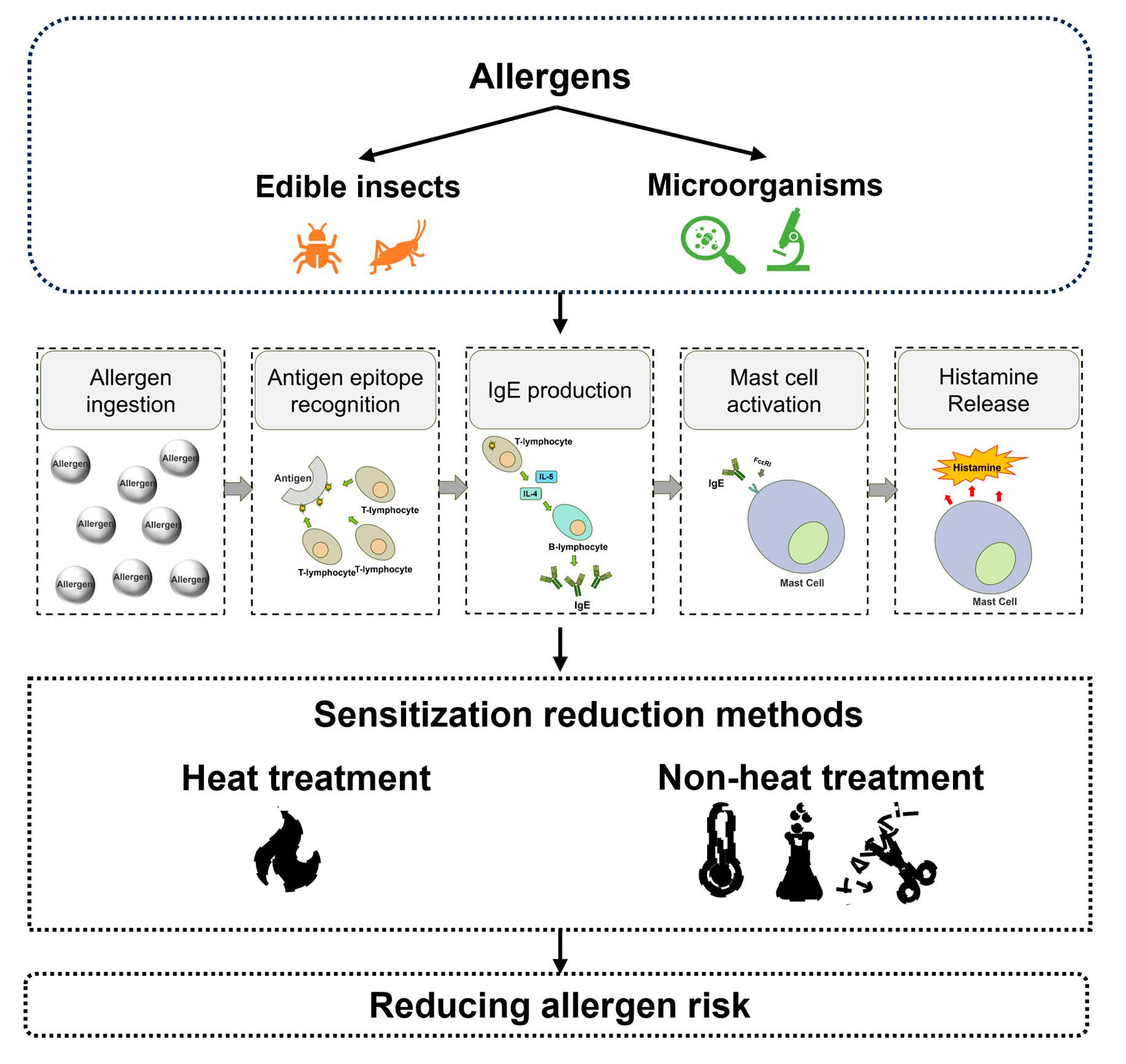
Sustainable Emerging Proteins: Allergenic Proteins in Edible Insects, Microalgae, and Microorganisms, and Desensitization Processing Technologies
 ,
,
Abstract
1. Introduction
1.1. Edible Insect Proteins

1.2. Single-Cell Proteins
1.2.1. Microalgae Proteins
1.2.2. Fungal, Bacterial and Yeast Proteins
1.3. Applications of Insect Protein and Microbial Protein in Foods
2. Allergens
2.1. Edible Insect Allergens
2.1.1. Bombyx mori
2.1.2. Tenebrio molitor
2.1.3. Hermetia illucens
2.1.4. Periplaneta americana & Blattella germanica
2.1.5. Other Edible Insects
2.1.6. Prevention and Control of Allergy Risks from Edible Insects
2.2. Microbial Allergens
2.2.1. Microalgae Allergens
2.2.2. Fungal Allergens
2.2.3. Prevention and Control of Microbial Allergy Risks

| Type | Source | Protein Type | Allergen | MW (kDa) | Reference |
|---|---|---|---|---|---|
| Edible insects | Bombyx mori | Arginine kinase | Bomb m 1 * | 42 | Yue et al. [86] |
| Bombyx mori | Tropomyosin | Bomb m 3 * | 40 | Yue et al. [86] | |
| Bombyx mori | Hemolymph lipoprotein | Bomb m 4 * | 30 | Yue et al. [86] | |
| Bombyx mori | lipoprotein | Bomb m 5 * | 30 | Yue et al. [86] | |
| Bombyx mori | Apolipophorin-III | Bomb m 6 * | 25–33 | Yue et al. [86] | |
| Bombyx mori | 30K Protein | Bomb m 9 ** | 30 | Zuo et al. [88] | |
| Acheta domesticus | Tropomyosin | Unknown ** | 32–4 | Lamberti et al. [108] | |
| Acheta domesticus | Myosin heavy chain isoforms | Unknown ** | 224.7 | Kamemura et al. [133] | |
| Acheta domesticus | Myosin heavy chain | Unknown ** | 135 | Lamberti et al. [108] | |
| Acheta domesticus | Myosin Light Chain | Unknown ** | 2 | Lamberti et al. [108] | |
| Acheta domesticus | Troponin T | Unknown ** | 46.7 | Lamberti et al. [108] | |
| Acheta domesticus | Hexamerin-like protein 2 | Unknown ** | 75 | de las Marinas et al. [134] | |
| Pygmy grasshoppers | Cuticle proteins | Unknown ** | 18.9 | Lamberti et al. [108] | |
| Pygmy grasshoppers | Myosin heavy chain | Unknown ** | 222.8 | Lamberti et al. [108] | |
| Pygmy grasshoppers | Myosin Light Chain | Unknown ** | 22.5 | Lamberti et al. [108] | |
| Pygmy grasshoppers | β-Actin | Unknown ** | 41.7 | Lamberti et al. [108] | |
| Pygmy grasshoppers | Troponin T | Unknown ** | 46.7 | Lamberti et al. [108] | |
| Pygmy grasshoppers | Lysozyme | Unknown ** | 80.0 | Lamberti et al. [108] | |
| Pygmy grasshoppers | Tropomyosin | Mec e 7 ** | 38 | Leung et al. [135] | |
| Locusta migratoria | Hexamerins | Unknown ** | 78 | Pharima et al. [136] | |
| Locusta migratoria | Arginine kinase | Unknown ** | ≈40 | Egonyu et al. [112] | |
| Locusta migratoria | Hemocyanin | Unknown ** | ≈75 | Egonyu et al. [112] | |
| Locusta migratoria | Cuticle proteins | Unknown ** | 12–17 | Lamberti et al. [108] | |
| Locusta migratoria | Myosin Light Chain | Unknown ** | 23 | Lamberti et al. [108] | |
| Tenebrio molitor | Tropomyosin | Ten m 7 ** | 35 | Barre et al. [78] | |
| Tenebrio molitor | α-Amylases | Unknown ** | ≈50 | Barre et al. [78] | |
| Tenebrio molitor | Arginine kinase | Unknown ** | ≈40 | Barre et al. [78] | |
| Tenebrio molitor | Hexamerins | Unknown ** | 70 | Barre et al. [78] | |
| Tenebrio molitor | α-tubulin | Unknown ** | Unknown | Ribeiro et al. [91] | |
| Tenebrio molitor | β-tubulin | Unknown ** | Unknown | Ribeiro et al. [91] | |
| Tenebrio molitor | Actin | Unknown ** | 41.9 | van Broekhoven et al. [137] | |
| Tenebrio molitor | Fructose biphosphate aldolase | Unknown ** | Unknown | Ribeiro et al. [91] | |
| Tenebrio molitor | Myosin Light Chain | Unknown ** | 21.7 | Lamberti et al. [108] | |
| Tenebrio molitor | Troponin T | Unknown ** | 45.8 | Lamberti et al. [108] | |
| Hermetia illucens | Hemocyanin | Unknown ** | ≈75 | Karnaneedi et al. [109] | |
| Hermetia illucens | Tropomyosin | Unknown ** | ≈33 | Karnaneedi et al. [109] | |
| Hermetia illucens | Cuticle proteins | Unknown ** | ≈24 | Karnaneedi et al. [109] | |
| Hermetia illucens | Odorant-binding proteins | Unknown ** | ≈14 | Karnaneedi et al. [109] | |
| Hermetia illucens | Arginine kinase | Unknown ** | Unknown | Broekman et al. [138] | |
| Hermetia illucens | Troponin | Unknown ** | Unknown | Broekman et al. [138] | |
| Hermetia illucens | Triosephosphate Isomerase | Unknown ** | Unknown | Broekman et al. [138] | |
| Blattella germanica | Bd 90 K | Bla g 1 * | 45.8 | WHO/IUIS (https://www.allergen.org) Allergome (https://www.allergome.org/index.php, accessed on 15 November 2025) Uniport (https://www.uniprot.org/) | |
| Blattella germanica | Inactive Aspartic Proteases | Bla g 2 * | 38.5 | WHO/IUIS (https://www.allergen.org) Allergome (https://www.allergome.org/index.php, accessed on 15 November 2025) Uniport (https://www.uniprot.org/) | |
| Blattella germanica | Hemocyanin | Bla g 3 * | 78.7 | WHO/IUIS (https://www.allergen.org) Allergome (https://www.allergome.org/index.php, accessed on 15 November 2025) Uniport (https://www.uniprot.org/) | |
| Blattella germanica | Calycin, lipocalin | Bla g 4 * | 20.0 | Chuang et al. [139] | |
| Blattella germanica | Glutathione S-transferase | Bla g 5 * | 22.9 | Chuang et al. [139] | |
| Blattella germanica | Troponin | Bla g 6 * | 17.2 | Hindley et al. [140] | |
| Blattella germanica | Tropomyosin | Bla g 7 * | 32.8 | Chuang et al. [139] | |
| Blattella germanica | Myosins | Bla g 8 * | 22. | WHO/IUIS (https://www.allergen.org) Allergome (https://www.allergome.org/index.php, accessed on 15 November 2025) Uniport (https://www.uniprot.org/) | |
| Blattella germanica | Arginine Kinase | Bla g 9 * | 39.7 | WHO/IUIS (https://www.allergen.org) Allergome (https://www.allergome.org/index.php, accessed on 15 November 2025) Uniport (https://www.uniprot.org/) | |
| Blattella germanica | Serine protease | Bla g 10 * | 26.3 | WHO/IUIS (https://www.allergen.org) Allergome (https://www.allergome.org/index.php, accessed on 15 November 2025) Uniport (https://www.uniprot.org/) | |
| Blattella germanica | α-Amylase | Bla g 11 * | 54.0 | WHO/IUIS (https://www.allergen.org) Allergome (https://www.allergome.org/index.php, accessed on 15 November 2025) Uniport (https://www.uniprot.org/) | |
| Blattella germ anica | Chitinase | Bla g 12 * | 58.0 | Pomés et al. [141] | |
| Blattella germanica | Enolase | Bla g Enolase ** | 47.1 | Chuang et al. [139] | |
| Blattella germanica | Vitellogenin | Bla g Vitellogenin ** | 213.5 | Chuang et al. [139] | |
| Blattella germanica | Triosephosphate Isomerase | Bla g TPI ** | 26.8 | Chuang et al. [139] | |
| Blattella germanica | Receptors for Activated Protein Kinase, RACK1 | Bla g RACK1 ** | 35.7 | Chuang et al. [139] | |
| Periplaneta americana | Cr-PII | Per a 1 | 44.5 | WHO/IUIS (https://www.allergen.org) Allergome (https://www.allergome.org/index.php, accessed on 15 November 2025) Uniport (https://www.uniprot.org/) | |
| Periplaneta americana | Aspartic Protease | Per a 2 * | 36.0 | Gustchina et al. [142] | |
| Periplaneta americana | Hemocyanin | Per a 3 * | 78.6 | Wu et al. [143] | |
| Periplaneta americana | Lipocalin | Per a 4 * | 17.0 | Wangorsch et al. [144] | |
| Periplaneta americana | Glutathione-S-transferases | Per a 5 * | 23.0 | WHO/IUIS (https://www.allergen.org) Allergome (https://www.allergome.org/index.php, accessed on 15 November 2025) Uniport (https://www.uniprot.org/) | |
| Periplaneta americana | Troponin | Per a 6 * | 17.1 | Hindley et al. [140] | |
| Periplaneta americana | Tropomyosin | Per a 7 * | 33.0 | Asturias et al. [145] | |
| Periplaneta americana | Myosin | Per a 8 * | 28. | Wangorsch et al. [144] | |
| Periplaneta americana | Arginine Kinase | Per a 9 * | 43.0 | Sookrung et al. [95] | |
| Periplaneta americana | Serine protease | Per a 10 * | 28.0 | Sudha et al. [146] | |
| Periplaneta americana | alpha-Amylase | Per a 11 * | 55. | Fang et al. [147] | |
| Periplaneta americana | Chitinase | Per a 12 * | 45.0 | Fang et al. [147] | |
| Periplaneta americana | GAPDH | Per a 13 * | 36.0 | Xu et al. [148] | |
| Periplaneta americana | Glyceraldehyde-3-phosphate dehydrogenase | Per a 13 * | 36.0 | Xu et al. [148] | |
| Periplaneta americana | Enolase | Per a 14 * | 50.0 | Wang et al. [149] | |
| Periplaneta americana | Cytochrome C | Per a 15 * | 15.0 | Wang et al. [149] | |
| Periplaneta americana | Cofilin | Per a 16 * | 20.0 | Wang et al. [149] | |
| Periplaneta americana | Alpha-tubulin | Per a 17 * | 53.0 | Wang et al. [149] | |
| Periplaneta americana | Peptidyl-prolyl-cis-trans isomerase; Cyclophilin | Per a 18 * | 24.0 | Wang et al. [149] | |
| Periplaneta americana | Porin 3 | Per a 19 * | 7.4 | Wang et al. [149] | |
| Periplaneta americana | Peroxiredoxin-6 (Prx6) | Per a 20 * | 24.0 | Wang et al. [149] | |
| Periplaneta americana | Fructose bisphosphate aldolase | Per a 21 * | 39 kDa, 160 kDa | www.allergen.org | |
| Periplaneta americana | Pyruvate kinase | Per a 22 * | 58 kDa, ~220 kDa | www.allergen.org | |
| Mic roalgae | Spirulina | Superoxide dismutase (C3V3P3) | Unknown ** | Unknown | Gromek et al. [34] |
| Spirulina | GAPDH | Unknown ** | Unknown | Gromek et al. [34] | |
| Spirulina | Triosephosphate Isomerase (D5A635) | Unknown ** | Unknown | Gromek et al. [34] | |
| Spirulina | Thioredoxin reductase (D4ZSU6) | Unknown ** | Unknown | Bianco et al. [120] | |
| Spirulina | Thioredoxin reductase (K1VP15) | Unknown ** | Unknown | Bianco et al. [120] | |
| Spirulina | C-Phycocyanin-β-Subunit | Art pl beta_Phycocyanin ** | 18.0 | Bianco et al. [120] | |
| Chlorella | Calmodulin proteins | Unknown ** | Unknown | Bianco et al. [120] | |
| Chlorella | Troponin C | Unknown ** | Unknown | Bianco et al. [120] | |
| Chlorella | Triosephosphate Isomerase | Unknown ** | Unknown | Hamzelou et al. [150] | |
| Chlorella | Heat Shock Proteins | Unknown ** | Unknown | Hamzelou et al. [150] | |
| Chlorella | Cyclic protein | Unknown ** | Unknown | Hamzelou et al. [150] | |
| Chlorella | Fructose biphosphate aldolase | Unknown ** | Unknown | Mariachiara et al. [120] | |
| Bacteria bacillota | Nattokinase (subtilisin-like serine protease) | Bac s 1 * | 30.0 | Suzuki et al. [151] | |
| Bacte ria and fungi | Saccharomyces cerevisiae | Transaldolase | Sac c 14 ** | 37.0 | Chou et al. [152] |
| Saccharomyces cerevisiae | Carboxypeptidase | Sac c Carboxypeptidase Y ** | 59.8 | WHO/IUIS (https://www.allergen.org) | |
| Saccharomyces cerevisiae | Cyclophilin | Sac c CyP ** | ≈18 | Flückiger et al. [153] | |
| Saccharomyces cerevisiae | Enolase | Sac c Enolase ** | 46.8 | WHO/IUIS (https://www.allergen.org) Allergome (https://www.allergome.org/index.php, accessed on 15 November 2025) Uniport (https://www.uniprot.org/) | |
| Saccharomyces cerevisiae | α-Glucosidase | Sac c Glucosidase ** | 68.1 | WHO/IUIS (https://www.allergen.org) Allergome (https://www.allergome.org/index.php, accessed on 15 November 2025) Uniport (https://www.uniprot.org/) | |
| Saccharomyces cerevisiae | β-fructofuranosidase | Sac c Invertase ** | 60.0 | WHO/IUIS (https://www.allergen.org) Allergome (https://www.allergome.org/index.php, accessed on 15 November 2025) Uniport (https://www.uniprot.org/) | |
| Saccharomyces cerevisiae | Manganese SO dismutase | Sac c MnSOD ** | 25.7 | WHO/IUIS (https://www.allergen.org) Allergome (https://www.allergome.org/index.php, accessed on 15 November 2025) Uniport (https://www.uniprot.org/) | |
| Saccharomyces cerevisiae | Profiling | Sac c Profilin ** | 13.6 | WHO/IUIS (https://www.allergen.org) Allergome (https://www.allergome.org/index.php, accessed on 15 November 2025) Uniport (https://www.uniprot.org/) | |
| Saccharomyces cerevisiae | Ribosomal Proteins | Sac c P2 ** | 10.7 | WHO/IUIS (https://www.allergen.org) Allergome (https://www.allergome.org/index.php, accessed on 15 November 2025) Uniport (https://www.uniprot.org/) | |
| Fusarium spp. | Ribosomal Proteins P2 | Fus c 1 * | 11.0 | Weber et al. [154] | |
| Fusarium spp. | Thioredoxin reductase | Fus c 2 * | 13.0. | Weber et al. [154] | |
| Fusarium spp. | Transaldolase | Fus p 4 * | 37.5 | Weber et al. [154] | |
| Fusarium spp. | Vacuolar serine protease | Fus p 9 * | 36.5 | Yeh et al. [155] | |
| Alternaria alternata | Unknown | Alt a 1 * | 16.4, 15.3 | Abel-Fernández et al. [126] | |
| Alternaria alternata | Heat shock protein 70 | Alt a 3 * | 85.0 | Abel-Fernández et al. [126] | |
| Alternaria alternata | Disulfide isomerase | Alt a 4 * | 57.0 | Abel-Fernández et al. [126] | |
| Alternaria alternata | Ribosomal protein P2 | Alt a 5 * | 11.0 | Abel-Fernández et al. [126] | |
| Alternaria alternata | Enolase | Alt a 6 * | 45.0 | Abel-Fernández et al. [126] | |
| Alternaria alternata | Flavodoxin, YCP4 protein | Alt a 7 * | 22.0 | Abel-Fernández et al. [126] | |
| Alternaria alternata | Mannitol dehydrogenase | Alt a 8 * | 29.0 | Abel-Fernández et al. [126] | |
| Alternaria alternata | Aldehyde dehydrogenase | Alt a 10 * | 53.0 | Abel-Fernández et al. [126] | |
| Alternaria alternata | Aid ribosomal protein P1 | Alt a 12 * | 11.0 | Abel-Fernández et al. [126] | |
| Alternaria alternata | Glutathione-transferase | Alt a 13 * | 26.0 | Abel-Fernández et al. [126] | |
| Alternaria alternata | Manganese SO dismutase | Alt a 14 * | 24.0 | Abel-Fernández et al. [126] | |
| Alternaria alternata | Vacuolar serine protease | Alt a 15 * | 58.0 | Abel-Fernández et al. [126] |
3. Influence of Food Processing Techniques on Protein Sensitization

3.1. Heat Treatment
3.1.1. Boiling and Frying
| Allergen Source | Heat Treatment | Effect on Allergenicity | Key Determining Factor |
|---|---|---|---|
| Silkworm pupa | Heating > 80 °C | Decreased | Protein degradation/aggregation; structural unfolding leading to epitope masking. |
| Silkworm pupa | Heating > 80 °C | Unchanged/Partial decrease | Thermostability of specific protein components. |
| Tenebr io molitor | Boiling (100 °C, 1–10 min), Frying (180 °C, 30 s) | Largely unchanged | High intrinsic thermal stability of coiled-coil structure. |
| Tenebrio molitor | Frying (180 °C, 3 min) | Decreased (Partial) | Longer duration/intensity of heating leading to irreversible denaturation. |
| Locust | Frying (180 °C, 3 min) | Decreased | Heat-labile structure; denaturation destroys epitopes. |
| Locust | Frying (180 °C, 3 min) | Increased | Exposure of previously hidden (cryptic) epitopes due to unfolding. |
| Locust | Frying (180 °C, 3 min) | Decreased | Irreversible denaturation eliminating IgE-binding |
| Locust | Boiling (100 °C, 5 min) | Increased | Partial denaturation exposing hidden epitopes. |
| Peanut | Boiling | Decreased | Leaching of allergens into water; structural changes. |
| Peanut | Roasting | Increased | Maillard reaction creating new or stabilizing existing epitopes. |
| Soybean | Heating (1 h) | Increased | Aggregation or stabilization of conformational epitopes. |
3.1.2. Microwave
3.2. Non-Heat Treatment
3.2.1. High Pressure
3.2.2. Enzymatic Treatment
3.2.3. Chemical Modification
3.2.4. Pulsed Electric Field
3.2.5. Ultrasonic
3.2.6. Irradiation
3.2.7. Emerging Technologies
3.3. Challenges and Future Directions of Processing Technology Applications
4. Conclusions and Prospects
Author Contributions
Funding
Institutional Review Board Statement
Informed Consent Statement
Data Availability Statement
Conflicts of Interest
References
- Alexandros, N.; Bruinsma, J.; Bodeker, G.; Schmidhuber, J.; Broca, S.; Shetty, P.; Ottaviani, M.G. World Agriculture Towards 2030/2050; Food and Agriculture Organization of the United Nations: Rome, Italy, 2012. [Google Scholar]
- Henchion, M.; Hayes, M.; Mullen, A.M.; Fenelon, M.; Tiwari, B. Future protein supply and demand: Strategies and factors influencing a sustainable equilibrium. Foods 2017, 6, 53. [Google Scholar] [CrossRef] [PubMed]
- Dolganyuk, V.; Sukhikh, S.; Kalashnikova, O.; Ivanova, S.; Kashirskikh, E.; Prosekov, A.; Michaud, P.; Babich, O. Food proteins: Potential resources. Sustainability 2023, 15, 5863. [Google Scholar] [CrossRef]
- Volden, J. ‘A wing in the throat’: Negotiating edibility in everyday insect consumption. Geoforum 2024, 157, 104132. [Google Scholar] [CrossRef]
- Yang, J.; Zhou, S.; Kuang, H.; Tang, C.; Song, J. Edible insects as ingredients in food products: Nutrition, functional properties, allergenicity of insect proteins, and processing modifications. Crit. Rev. Food Sci. Nutr. 2024, 64, 10361–10383. [Google Scholar] [CrossRef]
- Meng, T.; Zhu, X.; He, S.; Liu, X.; Mitra, P.; Liu, H. Advances in extraction, structural design, functional activity and application of yeast protein peptides. Food Biosci. 2024, 62, 105026. [Google Scholar] [CrossRef]
- Zhao, Y.; Han, Z.; Zhu, X.; Chen, B.; Zhou, L.; Liu, X.; Liu, H. Yeast proteins: Proteomics, extraction, modification, functional characterization, and structure: A Review. J. Agric. Food Chem. 2024, 72, 18774–18793. [Google Scholar] [CrossRef]
- Patel, B.Y.; Volcheck, G.W. Food allergy: Common causes, diagnosis, and treatment. Mayo Clin. Proc. 2015, 90, 1411–1419. [Google Scholar] [CrossRef]
- Sicherer, S.H.; Sampson, H.A. Food allergy: Epidemiology, pathogenesis, diagnosis, and treatment. J. Allergy Clin. Immunol. 2014, 133, 291–307.e5. [Google Scholar] [CrossRef]
- Zhou, F.; He, S.; Sun, H.; Wang, Y.; Zhang, Y. Advances in epitope mapping technologies for food protein allergens: A review. Trends Food Sci. Technol. 2021, 107, 226–239. [Google Scholar] [CrossRef]
- van Wijk, F.; Knippels, L. Initiating mechanisms of food allergy: Oral tolerance versus allergic sensitization. Biomed. Pharmacother. 2007, 61, 8–20. [Google Scholar] [CrossRef]
- Yang, A.; Zuo, L.; Cheng, Y.; Wu, Z.; Li, X.; Tong, P.; Chen, H. Degradation of major allergens and allergenicity reduction of soybean meal through solid-state fermentation with microorganisms. Food Funct. 2018, 9, 1899–1909. [Google Scholar] [CrossRef]
- Huang, H.-W.; Yang, B.B.; Wang, C.-Y. Effects of high pressure processing on immunoreactivity and microbiological safety of crushed peanuts. Food Control 2014, 42, 290–295. [Google Scholar] [CrossRef]
- Cabanillas, B.; Cuadrado, C.; Rodriguez, J.; Hart, J.; Burbano, C.; Crespo, J.F.; Novak, N. Potential changes in the allergenicity of three forms of peanut after thermal processing. Food Chem. 2015, 183, 18–25. [Google Scholar] [CrossRef] [PubMed]
- House, J. Insects as food in the Netherlands: Production networks and the geographies of edibility. Geoforum 2018, 94, 82–93. [Google Scholar] [CrossRef]
- de Castro, R.J.S.; Ohara, A.; Aguilar, J.G.d.S.; Domingues, M.A.F. Nutritional, functional and biological properties of insect proteins: Processes for obtaining, consumption and future challenges. Trends Food Sci. Technol. 2018, 76, 82–89. [Google Scholar] [CrossRef]
- van der Spiegel, M.; Noordam, M.Y.; van der Fels-Klerx, H.J. Safety of novel protein sources (insects, microalgae, seaweed, duckweed, and rapeseed) and legislative aspects for their application in food and feed production. Compr. Rev. Food Sci. Food Saf. 2013, 12, 662–678. [Google Scholar] [CrossRef]
- Arp, C.G.; Pasini, G. Exploring edible insects: From sustainable nutrition to pasta and noodle applications—A Critical Review. Foods 2024, 13, 3587. [Google Scholar] [CrossRef]
- Smetana, S.; Mathys, A.; Knoch, A.; Heinz, V. Meat Alternatives: Life cycle assessment of most known meat substitutes. Int. J. Life Cycle Assess. 2015, 20, 1254–1267. [Google Scholar] [CrossRef]
- Vanqa, N.; Mshayisa, V.V.; Basitere, M. Proximate, Physicochemical, techno-functional and antioxidant properties of three edible insect (Gonimbrasia belina, Hermetia illucens and Macrotermes subhylanus) Flours. Foods 2022, 11, 976. [Google Scholar] [CrossRef]
- Aguilera, Y.; Pastrana, I.; Rebollo-Hernanz, M.; Benitez, V.; Álvarez-Rivera, G.; Viejo, J.L.; Martín-Cabrejas, M.A. Investigating edible insects as a sustainable food source: Nutritional value and techno-functional and physiological properties. Food Funct. 2021, 12, 6309–6322. [Google Scholar] [CrossRef]
- Oliveira, L.A.; Dias, K.A.; Pereira, S.M.S.; Vicente, L.C.O.S.; Barnabé, M.L.F.; Lucia, C.M.D. Digestibility and quality of edible insect proteins: A systematic review ofin vivo studies. J. Insects Food Feed. 2023, 9, 1333–1344. [Google Scholar] [CrossRef]
- Handley, M.A.; Hall, C.; Sanford, E.; Diaz, E.; Gonzalez-Mendez, E.; Drace, K.; Wilson, R.; Villalobos, M.; Croughan, M. Globalization, binational communities, and imported food risks: Results of an outbreak investigation of lead poisoning in monterey county, California. Am. J. Public Health 2007, 97, 900–906. [Google Scholar] [CrossRef] [PubMed]
- Blum, M.S. The limits of entomophagy: A discretionary gourmand in a world of toxic insects. Food Insects Newsl. 1994, 7, 1–6. [Google Scholar]
- Yang, A.; Zhang, G.; Meng, F.; Lu, P.; Wang, X.; Peng, M. Enhancing protein to extremely high content in photosynthetic bacteria during biogas slurry treatment. Bioresour. Technol. 2017, 245, 1277–1281. [Google Scholar] [CrossRef]
- Vieira, E.; Cunha, S.C.; Ferreira, I.M.P.L.V.O. Characterization of a potential bioactive food ingredient from inner cellular content of brewer’s spent yeast. Waste Biomass Valorization 2019, 10, 3235–3242. [Google Scholar] [CrossRef]
- Reihani, S.F.S.; Khosravi-Darani, K. Influencing factors on single-cell protein production by submerged fermentation: A review. Electron. J. Biotechnol. 2019, 37, 34–40. [Google Scholar] [CrossRef]
- Otero, M.A.; Guerrero, I.; Wagner, J.R.; Cabello, A.J.; Sceni, P.; García, R.; Soriano, J.; Tomasini, A.; Saura, G.; Almazán, O.J.B.A. Yeast and its derivatives as ingredients in the food industry. Biotecnol. Apl. 2011, 28, 273–275. [Google Scholar]
- Goldberg, I. Single Cell Protein; Springer Science & Business Media: Berlin, Germany, 2013; Volume 1. [Google Scholar]
- Soto-Sierra, L.; Stoykova, P.; Nikolov, Z.L. Extraction and fractionation of microalgae-based protein products. Algal Res. 2018, 36, 175–192. [Google Scholar] [CrossRef]
- Manzoor, M.F.; Afraz, M.T.; Yılmaz, B.B.; Adil, M.; Arshad, N.; Goksen, G.; Ali, M.; Zeng, X.-A. Recent progress in natural seaweed pigments: Green extraction, health-promoting activities, techno-functional properties and role in intelligent food packaging. J. Agric. Food Res. 2024, 15, 100991. [Google Scholar] [CrossRef]
- Yang, S.; Wang, Y.; Wang, J.; Cheng, K.; Liu, J.; He, Y.; Zhang, Y.; Mou, H.; Sun, H. Microalgal protein for sustainable and nutritious foods: A joint analysis of environmental impacts, health benefits and consumer’s acceptance. Trends Food Sci. Technol. 2024, 143, 104278. [Google Scholar] [CrossRef]
- Yu, Z.; Zhao, W.; Sun, H.; Mou, H.; Liu, J.; Yu, H.; Dai, L.; Kong, Q.; Yang, S. Phycocyanin from microalgae: A comprehensive review covering microalgal culture, phycocyanin sources and stability. Food Res. Int. 2024, 186, 114362. [Google Scholar] [CrossRef] [PubMed]
- Gromek, W.; Kołdej, N.; Kurowski, M.; Majsiak, E. Spirulina (Arthrospira platensis): Antiallergic agent or hidden allergen? A literature review. Foods 2024, 13, 1052. [Google Scholar] [CrossRef] [PubMed]
- Dillon, J.; Phan Phuc, A.; Dubacq, J.P. Nutritional value of the alga Spirulina. World Rev. Nutr. Diet. 1995, 77, 32–46. [Google Scholar] [PubMed]
- Soni, R.A.; Sudhakar, K.; Rana, R.S. Spirulina—From growth to nutritional product: A review. Trends Food Sci. Technol. 2017, 69, 157–171. [Google Scholar] [CrossRef]
- Debnath, C.; Bandyopadhyay, T.K.; Bhunia, B.; Mishra, U.; Narayanasamy, S.; Muthuraj, M. Microalgae: Sustainable resource of carbohydrates in third-generation biofuel production. Renew. Sustain. Energy Rev. 2021, 150, 111464. [Google Scholar] [CrossRef]
- Wicker, R.J.; Kumar, G.; Khan, E.; Bhatnagar, A. Emergent green technologies for cost-effective valorization of microalgal biomass to renewable fuel products under a biorefinery scheme. Chem. Eng. J. 2021, 415, 128932. [Google Scholar] [CrossRef]
- Novoveská, L.; Nielsen, S.L.; Eroldoğan, O.T.; Haznedaroglu, B.Z.; Rinkevich, B.; Fazi, S.; Robbens, J.; Vasquez, M.; Einarsson, H. Overview and challenges of large-scale cultivation of photosynthetic microalgae and cyanobacteria. Mar. Drugs 2023, 21, 445. [Google Scholar] [CrossRef]
- Coelho, M.O.C.; Monteyne, A.J.; Dunlop, M.V.; Harris, H.C.; Morrison, D.J.; Stephens, F.B.; Wall, B.T. Mycoprotein as a possible alternative source of dietary protein to support muscle and metabolic health. Nutr. Rev. 2020, 78, 486–497. [Google Scholar] [CrossRef]
- Mirzaei, M.; Mirdamadi, S.; Ehsani, M.R.; Aminlari, M. Production of antioxidant and ACE-inhibitory peptides from Kluyveromyces marxianus protein hydrolysates: Purification and molecular docking. J. Food Drug Anal. 2018, 26, 696–705. [Google Scholar] [CrossRef]
- Wang, B.; Shi, Y.; Lu, H.; Chen, Q. A critical review of fungal proteins: Emerging preparation technology, active efficacy and food application. Trends Food Sci. Technol. 2023, 141, 104178. [Google Scholar] [CrossRef]
- Bratosin, B.C.; Darjan, S.; Vodnar, D.C. Single cell protein: A potential substitute in human and animal nutrition. Sustainability 2021, 13, 9284. [Google Scholar] [CrossRef]
- Li, D.; Tong, S.; Zeng, Y.; Yang, J.; Qi, X.; Wang, Q.; Sun, Y. [Low carbon biomanufacturing for future food]. Sheng Wu Gong Cheng Xue Bao 2022, 38, 4311–4328. [Google Scholar] [CrossRef]
- Cardoso Alves, S.; Díaz-Ruiz, E.; Lisboa, B.; Sharma, M.; Mussatto, S.I.; Thakur, V.K.; Kalaskar, D.M.; Gupta, V.K.; Chandel, A.K. Microbial meat: A sustainable vegan protein source produced from agri-waste to feed the world. Food Res. Int. 2023, 166, 112596. [Google Scholar] [CrossRef] [PubMed]
- Derbyshire, E.J.; Delange, J. Fungal Protein—What Is It and What Is the Health Evidence? A Systematic Review Focusing on Mycoprotein. Front. Sustain. Food Syst. 2021, 5, 581682. [Google Scholar] [CrossRef]
- Mussatto, S.I.; Yamakawa, C.K.; van der Maas, L.; Dragone, G. New trends in bioprocesses for lignocellulosic biomass and CO2 utilization. Renew. Sustain. Energy Rev. 2021, 152, 111620. [Google Scholar] [CrossRef]
- Prasertsan, P.; Choorit, W.; Suwanno, S. Isolation, identification and growth conditions of photosynthetic bacteria found in seafood processing wastewater. World J. Microbiol. Biotechnol. 1993, 9, 590–592. [Google Scholar] [CrossRef]
- Kobayashi, M. Mass culture and cell utilization of photosynthetic bacteria. Process Biochem. 1978, 13, 27–30. [Google Scholar]
- Hülsen, T.; Hsieh, K.; Lu, Y.; Tait, S.; Batstone, D.J. Simultaneous treatment and single cell protein production from agri-industrial wastewaters using purple phototrophic bacteria or microalgae—A comparison. Bioresour. Technol. 2018, 254, 214–223. [Google Scholar] [CrossRef]
- Fradinho, J.C.; Domingos, J.M.; Carvalho, G.; Oehmen, A.; Reis, M.A. Polyhydroxyalkanoates production by a mixed photosynthetic consortium of bacteria and algae. Bioresour. Technol. 2013, 132, 146–153. [Google Scholar] [CrossRef]
- Sasaki, K.; Watanabe, M.; Suda, Y.; Ishizuka, A.; Noparatnaraporn, N. Applications of photosynthetic bacteria for medical fields. J. Biosci. Bioeng. 2005, 100, 481–488. [Google Scholar] [CrossRef]
- Hülsen, T.; Barry, E.M.; Lu, Y.; Puyol, D.; Keller, J.; Batstone, D.J. Domestic wastewater treatment with purple phototrophic bacteria using a novel continuous photo anaerobic membrane bioreactor. Water Res. 2016, 100, 486–495. [Google Scholar] [CrossRef]
- Cao, K.; Zhi, R.; Li, Q.; Zhang, G.; Wang, H. Photosynthetic bacterial protein production from wastewater: Effects of C/N and light-oxygen condition. J. Water Process Eng. 2021, 44, 102361. [Google Scholar] [CrossRef]
- Kim, H.-W.; Setyabrata, D.; Lee, Y.J.; Jones, O.G.; Kim, Y.H.B. Pre-treated mealworm larvae and silkworm pupae as a novel protein ingredient in emulsion sausages. Innov. Food Sci. Emerg. Technol. 2016, 38, 116–123. [Google Scholar] [CrossRef]
- Choi, Y.-S.; Kim, T.-K.; Choi, H.-D.; Park, J.-D.; Sung, J.-M.; Jeon, K.-H.; Paik, H.-D.; Kim, Y.-B. Optimization of replacing pork meat with yellow worm (Tenebrio molitor L.) for Frankfurters. Food Sci. Anim. Resour. 2017, 37, 617–625. [Google Scholar] [CrossRef] [PubMed]
- Park, Y.-S.; Choi, Y.-S.; Hwang, K.-E.; Kim, T.-K.; Lee, C.-W.; Shin, D.-M.; Han, S.G. Physicochemical properties of meat batter added with edible silkworm pupae (Bombyx mori) and transglutaminase. Food Sci. Anim. Resour. 2017, 37, 351–359. [Google Scholar] [CrossRef]
- Yong, H.I.; Kim, T.-K.; Cha, J.Y.; Lee, J.H.; Kang, M.-C.; Jung, S.; Choi, Y.-S. Effects of edible insect extracts on the antioxidant, physiochemical, and microbial properties of Tteokgalbi during refrigerated storage. Food Biosci. 2023, 52, 102377. [Google Scholar] [CrossRef]
- Stephan, A.; Ahlborn, J.; Zajul, M.; Zorn, H. Edible mushroom mycelia of Pleurotus sapidus as novel protein sources in a vegan boiled sausage analog system: Functionality and sensory tests in comparison to commercial proteins and meat sausages. Eur. Food Res. Technol. 2018, 244, 913–924. [Google Scholar] [CrossRef]
- Pancrazio, G.; Cunha, S.C.; de Pinho, P.G.; Loureiro, M.; Meireles, S.; Ferreira, I.M.; Pinho, O. Spent brewer’s yeast extract as an ingredient in cooked hams. Meat Sci. 2016, 121, 382–389. [Google Scholar] [CrossRef]
- Bertolo, A.P.; Kempka, A.P.; Rigo, E.; Sehn, G.A.R.; Cavalheiro, D. Incorporation of natural and mechanically ruptured brewing yeast cells in beef burger to replace textured soy protein. J. Food Sci. Technol. 2022, 59, 935–943. [Google Scholar] [CrossRef]
- Grasso, S.; Smith, G.; Bowers, S.; Ajayi, O.M.; Swainson, M. Effect of texturised soy protein and yeast on the instrumental and sensory quality of hybrid beef meatballs. J. Food Sci. Technol. 2019, 56, 3126–3135. [Google Scholar] [CrossRef]
- Sriprablom, J.; Kitthawee, S.; Suphantharika, M. Functional and physicochemical properties of cookies enriched with edible insect (Tenebrio molitor and Zophobas atratus) powders. J. Food Meas. Charact. 2022, 16, 2181–2190. [Google Scholar] [CrossRef]
- dos Santos Richards, N.S.P.; Freiberg, J.A.; Schardong, I.S.; Pedroso, M.A.P.; Jiménez, M.S.E. Chrysodeixis includens as a potential source of protein and acceptance of cookies containing Tenebrio molitor. J. Food Meas. Charact. 2025, 19, 3278–3287. [Google Scholar] [CrossRef]
- Ochieng, B.O.; Anyango, J.O.; Nduko, J.M.; Mudalungu, C.M.; Cheseto, X.; Tanga, C.M. Aroma characterization and consumer acceptance of four cookie products enriched with insect (Ruspolia differens) meal. Sci. Rep. 2023, 13, 11145. [Google Scholar] [CrossRef] [PubMed]
- Aleman, R.S.; Marcia, J.; Pournaki, S.K.; Borrás-Linares, I.; Lozano-Sanchez, J.; Fernandez, I.M. Formulation of protein-rich chocolate chip cookies using cricket (Acheta domesticus) powder. Foods 2022, 11, 3275. [Google Scholar] [CrossRef] [PubMed]
- Mashau, M.E.; Ramalisa, T.; Ramashia, S.E.; Mshayisa, V.V. Development of high-protein biscuits by the enrichment with mopane worm (Gonimbrasia belina) flour. Food Sci. Technol. Int. 2024. [Google Scholar] [CrossRef]
- Gomes, N.G.; Schirmann, G.d.S.; de los Santos, M.L.P.; Zago, A.C.; Bortolini, V.M.d.S.; Rockenbach, R.; Bragança, G.C.M. Development and sensory evaluation of a hyperprotein bakery product using brewer’s yeast as the main innovative ingredient. Braz. J. Dev. 2021, 7, 9396–9413. [Google Scholar] [CrossRef]
- Çabuk, B. Influence of grasshopper (Locusta migratoria) and mealworm (Tenebrio molitor) powders on the quality characteristics of protein rich muffins: Nutritional, physicochemical, textural and sensory aspects. J. Food Meas. Charact. 2021, 15, 3862–3872. [Google Scholar] [CrossRef]
- Gumul, D.; Oracz, J.; Kowalski, S.; Mikulec, A.; Skotnicka, M.; Karwowska, K.; Areczuk, A. Bioactive Compounds and antioxidant composition of nut bars with addition of various edible insect flours. Molecules 2023, 28, 3556. [Google Scholar] [CrossRef]
- Ribeiro, J.C.; Lima, R.C.; Maia, M.R.G.; Almeida, A.A.; Fonseca, A.J.M.; Cabrita, A.R.J.; Cunha, L.M. Impact of defatting freeze-dried edible crickets (Acheta domesticus and Gryllodes sigillatus) on the nutritive value, overall liking and sensory profile of cereal bars. LWT 2019, 113, 108335. [Google Scholar] [CrossRef]
- Çabuk, B.; Yılmaz, B. Fortification of traditional egg pasta (erişte) with edible insects: Nutritional quality, cooking properties and sensory characteristics evaluation. J. Food Sci. Technol. 2020, 57, 2750–2757. [Google Scholar] [CrossRef]
- Duda, A.; Adamczak, J.; Chełmińska, P.; Juszkiewicz, J.; Kowalczewski, P. Quality and nutritional/textural properties of durum wheat pasta enriched with cricket powder. Foods 2019, 8, 46. [Google Scholar] [CrossRef] [PubMed]
- Piazza, L.; Ratti, S.; Girotto, F.; Cappellozza, S. Silkworm pupae derivatives as source of high value protein intended for pasta fortification. J. Food Sci. 2023, 88, 341–355. [Google Scholar] [CrossRef]
- Hidalgo, A.; Cullere, M.; Dalle Zotte, A.; Pasini, G. Salt-soluble protein extracts from Hermetia illucens and Bombyx mori for high protein pasta production. LWT 2023, 190, 115507. [Google Scholar] [CrossRef]
- Althwab, S.A.; Alhomaid, R.M.; Ali, R.F.M.; Mohammed El-Anany, A.; Mousa, H.M. Effect of migratory locust (Locusta migratoria) powder incorporation on nutritional and sensorial properties of wheat flour bread. Br. Food J. 2021, 123, 3576–3591. [Google Scholar] [CrossRef]
- Tian, Y.; Li, C.; Xue, W.; Huang, L.; Wang, Z. Natural immunomodulating substances used for alleviating food allergy. Crit. Rev. Food Sci. Nutr. 2023, 63, 2407–2425. [Google Scholar] [CrossRef]
- Barre, A.; Pichereaux, C.; Velazquez, E.; Maudouit, A.; Simplicien, M.; Garnier, L.; Bienvenu, F.; Bienvenu, J.; Burlet-Schiltz, O.; Auriol, C.; et al. Insights into the allergenic potential of the edible yellow mealworm (Tenebrio molitor). Foods 2019, 8, 515. [Google Scholar] [CrossRef]
- Kewuyemi, Y.O.; Kesa, H.; Chinma, C.E.; Adebo, O.A. Fermented edible insects for promoting food security in Africa. Insects 2020, 11, 283. [Google Scholar] [CrossRef]
- Imathiu, S. Benefits and food safety concerns associated with consumption of edible insects. NFS J. 2020, 18, 1–11. [Google Scholar] [CrossRef]
- Van Huis, A.; Van Itterbeeck, J.; Klunder, H.; Mertens, E.; Halloran, A.; Muir, G.; Vantomme, P. Edible Insects; FAO: Rome, Italy, 2013. [Google Scholar]
- Suh, S.-M.; Kim, K.; Yang, S.-M.; Lee, H.; Jun, M.; Byun, J.; Lee, H.; Kim, D.; Lee, D.; Cha, J.-E.; et al. Comparative analysis of LC-MS/MS and real-time PCR assays for efficient detection of potential allergenic silkworm. Food Chem. 2024, 445, 138761. [Google Scholar] [CrossRef]
- Dai, Y.; Huang, M.; Xu, Y.; Mu, L.; Gao, J.; Chen, H.; Wu, Z.; Yang, A.; Wu, Y.; Li, X. Enzymatic hydrolysis of silkworm pupa and its allergenicity evaluation by animal model with different immunization routes. Food Sci. Hum. Wellness 2023, 12, 774–782. [Google Scholar] [CrossRef]
- Liu, Z.; Xia, L.; Wu, Y.; Xia, Q.; Chen, J.; Roux, K.H. Identification and characterization of an arginine kinase as a major allergen from silkworm (Bombyx mori) larvae. Int. Arch. Allergy Immunol. 2009, 150, 8–14. [Google Scholar] [CrossRef] [PubMed]
- Jeong, K.Y.; Han, I.S.; Lee, J.Y.; Park, K.H.; Lee, J.H.; Park, J.W. Role of tropomyosin in silkworm allergy. Mol. Med. Rep. 2017, 15, 3264–3270. [Google Scholar] [CrossRef]
- Yue, W.; Huang, S.; Lin, S.; He, K.; He, W.; Chen, J.; Li, L.; Chai, W.; Wu, X. Purification, immunological identification, and characterization of the novel silkworm pupae allergen Bombyx mori Lipoprotein 3 (Bomb m 6). J. Agric. Food Chem. 2023, 71, 13527–13534. [Google Scholar] [CrossRef] [PubMed]
- Jeong, K.Y.; Lee, J.S.; Yuk, J.E.; Song, H.; Lee, H.J.; Kim, K.J.; Kim, B.J.; Lim, K.-J.; Park, K.H.; Lee, J.-H.; et al. Allergenic characterization of Bomb m 4, a 30-kDa Bombyx mori lipoprotein 6 from silkworm pupa. Clin. Exp. Allergy 2022, 52, 888–897. [Google Scholar] [CrossRef] [PubMed]
- Zuo, J.; Lei, M.; Yang, R.; Liu, Z. Bom m 9 from Bombyx mori is a novel protein related to asthma. Microbiol. Immunol. 2015, 59, 410–418. [Google Scholar] [CrossRef]
- Zhao, X.; Vázquez-Gutiérrez, J.L.; Johansson, D.P.; Landberg, R.; Langton, M. Yellow mealworm protein for food purposes—Extraction and functional properties. PLoS ONE 2016, 11, e0147791. [Google Scholar] [CrossRef]
- Efsa Panel on Nutrition, N.F.; Food, A.; Turck, D.; Castenmiller, J.; De Henauw, S.; Hirsch-Ernst, K.I.; Kearney, J.; Maciuk, A.; Mangelsdorf, I.; McArdle, H.J.; et al. Safety of dried yellow mealworm (Tenebrio molitor larva) as a novel food pursuant to Regulation (EU) 2015/2283. EFSA J. 2021, 19, e06343. [Google Scholar] [CrossRef]
- Ribeiro, J.C.; Cunha, L.M.; Sousa-Pinto, B.; Fonseca, J. Allergic risks of consuming edible insects: A systematic review. Mol. Nutr. Food Res. 2018, 62, 1700030. [Google Scholar] [CrossRef]
- Emilia, M.; Magdalena, C.; Weronika, G.; Julia, W.; Danuta, K.; Jakub, S.; Bożena, C.; Krzysztof, K. IgE-based analysis of sensitization and cross-reactivity to yellow mealworm and edible insect allergens before their widespread dietary introduction. Sci. Rep. 2025, 15, 1466. [Google Scholar] [CrossRef]
- Salahuddin, M.; Abdel-Wareth, A.A.A.; Hiramatsu, K.; Tomberlin, J.K.; Luza, D.; Lohakare, J. Flight toward sustainability in poultry nutrition with black soldier fly larvae. Animals 2024, 14, 510. [Google Scholar] [CrossRef]
- Leni, G.; Tedeschi, T.; Faccini, A.; Pratesi, F.; Folli, C.; Puxeddu, I.; Migliorini, P.; Gianotten, N.; Jacobs, J.; Depraetere, S.; et al. Shotgun proteomics, in-silico evaluation and immunoblotting assays for allergenicity assessment of lesser mealworm, black soldier fly and their protein hydrolysates. Sci. Rep. 2020, 10, 1228. [Google Scholar] [CrossRef] [PubMed]
- Sookrung, N.; Chaicumpa, W.; Tungtrongchitr, A.; Vichyanond, P.; Bunnag, C.; Ramasoota, P.; Tongtawe, P.; Sakolvaree, Y.; Tapchaisri, P. Periplaneta americana arginine kinase as a major cockroach allergen among Thai patients with major cockroach allergies. Environ. Health Perspect. 2006, 114, 875–880. [Google Scholar] [CrossRef] [PubMed]
- Pomés, A.; Arruda, L.K. Investigating cockroach allergens: Aiming to improve diagnosis and treatment of cockroach allergic patients. Methods 2014, 66, 75–85. [Google Scholar] [CrossRef] [PubMed]
- Pomés, A.; Mueller, G.A.; Randall, T.A.; Chapman, M.D.; Arruda, L.K. New Insights into cockroach allergens. Curr. Allergy Asthma Rep. 2017, 17, 25. [Google Scholar] [CrossRef]
- Helm, R.; Cockrell, G.; Stanley, J.S.; Brenner, R.J.; Burks, W.; Bannon, G.A. Isolation and characterization of a clone encoding a major allergen (Bla g Bd90K) involved in IgE-mediated cockroach hypersensitivity. J. Allergy Clin. Immunol. 1996, 98, 172–180. [Google Scholar] [CrossRef]
- Arruda, L.K.; Vailes, L.D.; Mann, B.J.; Shannon, J.; Fox, J.W.; Vedvick, T.S.; Hayden, M.L.; Chapman, M.D. Molecular cloning of a major cockroach (Blattella germanica) allergen, Bla g 2: Sequence homology to the aspartic proteases*. J. Biol. Chem. 1995, 270, 19563–19568. [Google Scholar] [CrossRef]
- Arruda, L.K.; Vailes, L.D.; Platts-Mills, T.A.E.; Hayden, M.L.; Chapman, M.D. Induction of IgE antibody responses by glutathione S-Transferase from the german cockroach (Blattella germanica)*. J. Biol. Chem. 1997, 272, 20907–20912. [Google Scholar] [CrossRef]
- Ayuso, R.; Reese, G.; Leong-Kee, S.; Plante, M.; Lehrer, S.B. Molecular basis of arthropod cross-reactivity: IgE-binding cross-reactive epitopes of shrimp, house dust mite and cockroach tropomyosins. Int. Arch. Allergy Immunol. 2002, 129, 38–48. [Google Scholar] [CrossRef]
- Pascal, M.; Grishina, G.; Yang, A.C.; Sánchez-García, S.; Lin, J.; Towle, D.; Ibañez, M.D.; Sastre, J.; Sampson, H.A.; Ayuso, R. Molecular diagnosis of shrimp allergy: Efficiency of several allergens to predict Clinical Reactivity. J. Allergy Clin. Immunol. Pract. 2015, 3, 521–529.e510. [Google Scholar] [CrossRef]
- Togias, A.; Fenton, M.J.; Gergen, P.J.; Rotrosen, D.; Fauci, A.S. Asthma in the inner city: The perspective of the National Institute of Allergy and Infectious Diseases. J. Allergy Clin. Immunol. 2010, 125, 540–544. [Google Scholar] [CrossRef]
- Lee, M.-F.; Song, P.-P.; Hwang, G.-Y.; Lin, S.-J.; Chen, Y.-H. Sensitization to per a 2 of the American cockroach correlates with more clinical severity among airway allergic patients in Taiwan. Ann. Allergy Asthma Immunol. 2012, 108, 243–248. [Google Scholar] [CrossRef]
- Stelmach, I.; Jerzynska, J.; Stelmach, W.; Majak, P.; Chew, G.; Gorski, P.; Kuna, P. Cockroach allergy and exposure to cockroach allergen in Polish children with asthma. Allergy 2002, 57, 701–705. [Google Scholar] [CrossRef]
- Pomés, A.; Arruda, L.K. Cockroach allergy: Understanding complex immune responses to develop novel therapies. Mol. Immunol. 2023, 156, 157–169. [Google Scholar] [CrossRef] [PubMed]
- Ayieko, M.A.; Ogola, H.J.; Ayieko, I.A. Introducing rearing crickets (gryllids) at household levels: Adoption, processing and nutritional values. J. Insects Food Feed. 2016, 2, 203–212. [Google Scholar] [CrossRef]
- Lamberti, C.; Nebbia, S.; Cirrincione, S.; Brussino, L.; Giorgis, V.; Romito, A.; Marchese, C.; Manfredi, M.; Marengo, E.; Giuffrida, M.G.; et al. Thermal processing of insect allergens and IgE cross-recognition in Italian patients allergic to shrimp, house dust mite and mealworm. Food Res. Int. 2021, 148, 110567. [Google Scholar] [CrossRef] [PubMed]
- Karnaneedi, S.; Johnston, E.B.; Bose, U.; Juhász, A.; Broadbent, J.A.; Ruethers, T.; Jerry, E.M.; Kamath, S.D.; Limviphuvadh, V.; Stockwell, S.; et al. The allergen profile of two edible insect species—Acheta domesticus and Hermetia illucens. Mol. Nutr. Food Res. 2024, 68, 2300811. [Google Scholar] [CrossRef]
- Scala, E.; Abeni, D.; Villella, V.; ViIlalta, D.; Cecchi, L.; Caprini, E.; Asero, R. Investigating novel food sensitization: A real-life prevalence study of cricket, Locust, and mealworm ige-reactivity in naïve allergic individuals. J. Investig. Allergol. Clin. Immunol. 2024, 35, 197–202. [Google Scholar]
- Cullen, D.A.; Cease, A.J.; Latchininsky, A.V.; Ayali, A.; Berry, K.; Buhl, C.; De Keyser, R.; Foquet, B.; Hadrich, J.C.; Matheson, T.; et al. Chapter Seven—From molecules to management: Mechanisms and consequences of Locust phase polyphenism. In Advances in Insect Physiology; Verlinden, H., Ed.; Academic Press: Cambridge, MA, USA, 2017; Volume 53, pp. 167–285. [Google Scholar]
- Egonyu, J.P.; Subramanian, S.; Tanga, C.M.; Dubois, T.; Ekesi, S.; Kelemu, S. Global overview of locusts as food, feed and other uses. Glob. Food Secur. 2021, 31, 100574. [Google Scholar] [CrossRef]
- Mitsuhashi, J. Edible Insects of the World; CRC Press: Boca Raton, FL, USA, 2016. [Google Scholar]
- Van Huis, A. Insects as food and feed, a new emerging agricultural sector: A review. J. Insects Food Feed. 2020, 6, 27–44. [Google Scholar] [CrossRef]
- Meir Paul, P. Allergy to locusts and Acridid Grasshoppers: A Review. J. Orthoptera Res. 2014, 23, 59–67. [Google Scholar] [CrossRef]
- Ji, K.; Chen, J.; Li, M.; Liu, Z.; Wang, C.; Zhan, Z.; Wu, X.; Xia, Q. Anaphylactic shock and lethal anaphylaxis caused by food consumption in China. Trends Food Sci. Technol. 2009, 20, 227–231. [Google Scholar] [CrossRef] [PubMed]
- Brogan, E.N. Protein and Lipid Characterization of Acheta domesticus, Bombyx mori, and Locusta migratoria Dry Flours; West Virginia University: Morgantown, WV, USA, 2018. [Google Scholar]
- Wang, Y.; Zhang, Y.; Lou, H.; Wang, C.; Ni, M.; Yu, D.; Zhang, L.; Kang, L. Hexamerin-2 Protein of locust as a novel allergen in occupational allergy. J. Asthma Allergy 2022, 15, 145–155. [Google Scholar] [CrossRef] [PubMed]
- Petrus, M.; Culerrier, R.; Campistron, M.; Barre, A.; Rougé, P. First case report of anaphylaxis to spirulin: Identification of phycocyanin as responsible allergen. Allergy 2010, 65, 924–925. [Google Scholar] [CrossRef] [PubMed]
- Bianco, M.; Ventura, G.; Calvano, C.D.; Losito, I.; Cataldi, T.R.I. A new paradigm to search for allergenic proteins in novel foods by integrating proteomics analysis and in silico sequence homology prediction: Focus on spirulina and chlorella microalgae. Talanta 2022, 240, 123188. [Google Scholar] [CrossRef]
- Bianco, M.; Ventura, G.; Calvano, C.D.; Losito, I.; Cataldi, T.R.I. Discovery of marker peptides of spirulina microalga proteins for allergen detection in processed foodstuffs. Food Chem. 2022, 393, 133319. [Google Scholar] [CrossRef]
- Tiberg, E.; Einarsson, R. Variability of allergenicity in eight strains of the green algal genus Chlorella. Int. Arch. Allergy Appl. Immunol. 2009, 90, 301–306. [Google Scholar] [CrossRef]
- Tiberg, E.; Rolfsen, W.; Einarsson, R.; Dreborg, S. Detection of Chlorella-specific IgE in mould-sensitized children. Allergy 1990, 45, 481–486. [Google Scholar] [CrossRef]
- Simon-Nobbe, B.; Denk, U.; Pöll, V.; Rid, R.; Breitenbach, M. The spectrum of fungal allergy. Int. Arch. Allergy Immunol. 2008, 145, 58–86. [Google Scholar] [CrossRef]
- Bush, R.K.; Prochnau, J.J. Alternaria-induced asthma. J. Allergy Clin. Immunol. 2004, 113, 227–234. [Google Scholar] [CrossRef]
- Abel-Fernández, E.; Martínez, M.J.; Galán, T.; Pineda, F. Going over Fungal Allergy: Alternaria alternata and Its Allergens. J. Fungi 2023, 9, 582. [Google Scholar] [CrossRef]
- Asturias, J.A.; Ibarrola, I.; Ferrer, A.; Andreu, C.; López-Pascual, E.; Quiralte, J.; Florido, F.; Martínez, A. Diagnosis of Alternaria alternata sensitization with natural and recombinant Alt a 1 allergens. J. Allergy Clin. Immunol. 2005, 115, 1210–1217. [Google Scholar] [CrossRef]
- Paris, S.; Debeaupuis, J.P.; Prévost, M.C.; Casotto, M.; Latgé, J.-P. The 31 kd major allergen, ALT a I1563, of Alternaria alternata. J. Allergy Clin. Immunol. 1991, 88, 902–908. [Google Scholar] [CrossRef]
- De Vouge, M.W.; Thaker, A.J.; Zhang, L.; Muradia, G.; Rode, H.; Vijay, H.M. Molecular cloning of IgE–Binding fragments of Alternaria alternata allergens. Int. Arch. Allergy Immunol. 1998, 116, 261–268. [Google Scholar] [CrossRef] [PubMed]
- Twaroch, T.E.; Curin, M.; Valenta, R.; Swoboda, I. Mold allergens in respiratory allergy: From structure to therapy. Allergy Asthma Immunol. Res. 2015, 7, 205–220. [Google Scholar] [CrossRef] [PubMed]
- Jia, C.; Wei, Y.; Shi, J.; Zhang, H.; Xiao, Y.; Gan, Z.; Jia, G.; Qian, X.; Gao, W.; Zhang, Y.; et al. Allergenic risk assessment of enolase leaked from Saccharomyces cerevisiae under pressurization. Food Biosci. 2023, 56, 103399. [Google Scholar] [CrossRef]
- Ibáñez, M.D.; Martínez, M.; Sánchez, J.J.; Fernández-Caldas, E. [Legume cross-reactivity]. Allergol. Immunopathol. 2003, 31, 151–161. [Google Scholar]
- Kamemura, N.; Sugimoto, M.; Tamehiro, N.; Adachi, R.; Tomonari, S.; Watanabe, T.; Mito, T. Cross-allergenicity of crustacean and the edible insect Gryllus bimaculatus in patients with shrimp allergy. Mol. Immunol. 2019, 106, 127–134. [Google Scholar] [CrossRef]
- de las Marinas, M.D.; Cerdá, J.C.; López-Matas, M.A.; González-Ruiz, A.; Martorell, C.; Felix, R.; Alvariño, M.; Carnés, J. Hexamerin-like protein 2, a cricket allergen involved in occupational and food allergy. Clin. Exp. Allergy 2021, 51, 858–860. [Google Scholar] [CrossRef]
- Leung, P.S.; Chow, W.K.; Duffey, S.; Kwan, H.S.; Gershwin, M.E.; Chu, K.H. IgE reactivity against a cross-reactive allergen in crustacea and mollusca: Evidence for tropomyosin as the common allergen. J. Allergy Clin. Immunol. 1996, 98, 954–961. [Google Scholar] [CrossRef]
- Phiriyangkul, P.; Srinroch, C.; Srisomsap, C.; Chokchaichamnankit, D.; Punyarit, P. Effect of food thermal processing on allergenicity proteins in Bombay Locust (Patanga succincta). Int. J. Food Eng. 2015, 1, 23–28. [Google Scholar] [CrossRef][Green Version]
- van Broekhoven, S.; Bastiaan-Net, S.; de Jong, N.W.; Wichers, H.J. Influence of processing and in vitro digestion on the allergic cross-reactivity of three mealworm species. Food Chem. 2016, 196, 1075–1083. [Google Scholar] [CrossRef] [PubMed]
- Broekman, H.; Knulst, A.; den Hartog Jager, S.; Monteleone, F.; Gaspari, M.; de Jong, G.; Houben, G.; Verhoeckx, K. Effect of thermal processing on mealworm allergenicity. Mol. Nutr. Food Res. 2015, 59, 1855–1864. [Google Scholar] [CrossRef] [PubMed]
- Chuang, J.-G.; Su, S.-N.; Chiang, B.-L.; Lee, H.-J.; Chow, L.-P. Proteome mining for novel IgE-binding proteins from the German cockroach (Blattella germanica) and allergen profiling of patients. Proteomics 2010, 10, 3854–3867. [Google Scholar] [CrossRef] [PubMed]
- Hindley, J.; Wünschmann, S.; Satinover, S.M.; Woodfolk, J.A.; Chew, F.T.; Chapman, M.D.; Pomés, A. Bla g 6: A troponin C allergen from Blattella germanica with IgE binding calcium dependence. J. Allergy Clin. Immunol. 2006, 117, 1389–1395. [Google Scholar] [CrossRef]
- Pomés, A.; Schulten, V.; Glesner, J.; da Silva Antunes, R.; Sutherland, A.; Bacharier, L.B.; Beigelman, A.; Busse, P.; Frazier, A.; Sette, A. IgE and T Cell reactivity to a comprehensive panel of cockroach allergens in relation to disease. Front. Immunol. 2020, 11, 621700. [Google Scholar] [CrossRef]
- Gustchina, A.; Li, M.; Wünschmann, S.; Chapman, M.D.; Pomés, A.; Wlodawer, A. Crystal structure of cockroach allergen Bla g 2, an unusual zinc binding aspartic protease with a novel mode of self-inhibition. J. Mol. Biol. 2005, 348, 433–444. [Google Scholar] [CrossRef]
- Wu, C.H.; Lee, M.F.; Liao, S.C.; Luo, S.F. Sequencing analysis of cDNA clones encoding the American cockroach Cr-PI Allergens: Homology with insect hemolymph proteins*. J. Biol. Chem. 1996, 271, 17937–17943. [Google Scholar] [CrossRef]
- Wangorsch, A.; Jamin, A.; Eichhorn, S.; Pablos, I.; Sharma, S.; Schweidler, B.; Kastner, B.; Wildner, S.; Saloga, J.; Führer, F.; et al. Component-resolved diagnosis of American cockroach (Periplaneta americana) allergy in patients from different geographical areas. Front. Allergy 2021, 2, 691627. [Google Scholar] [CrossRef]
- Asturias, J.A.; Gómez-Bayón, N.; Arilla, M.C.; Martínez, A.; Palacios, R.; Sánchez-Gascón, F.; Martínez, J. Molecular characterization of american cockroach tropomyosin (Periplaneta americana allergen 7), a cross-reactive allergen. J. Immunol. 1999, 162, 4342–4348. [Google Scholar] [CrossRef]
- Sudha, V.T.; Arora, N.; Gaur, S.N.; Pasha, S.; Singh, B.P. Identification of a serine protease as a major allergen (Per a 10) of Periplaneta americana. Allergy 2008, 63, 768–776. [Google Scholar] [CrossRef]
- Fang, Y.; Long, C.; Bai, X.; Liu, W.; Rong, M.; Lai, R.; An, S. Two new types of allergens from the cockroach, Periplaneta americana. Allergy 2015, 70, 1674–1678. [Google Scholar] [CrossRef]
- Xu, Z.-Q.; Zhu, L.-X.; Lu, C.; Jiao, Y.-X.; Zhu, D.-X.; Guo, M.; Yang, Y.-S.; Cao, M.-D.; Zhang, L.-S.; Tian, M.; et al. Identification of Per a 13 as a novel allergen in American cockroach. Mol. Immunol. 2022, 143, 41–49. [Google Scholar] [CrossRef]
- Wang, L.; Xiong, Q.; Saelim, N.; Wang, L.; Nong, W.; Wan, A.T.; Shi, M.; Liu, X.; Cao, Q.; Hui, J.H.L.; et al. Genome assembly and annotation of Periplaneta americana reveal a comprehensive cockroach allergen profile. Allergy 2023, 78, 1088–1103. [Google Scholar] [CrossRef]
- Hamzelou, S.; Belobrajdic, D.; Juhász, A.; Brook, H.; Bose, U.; Colgrave, M.L.; Broadbent, J.A. Nutrition, allergenicity and physicochemical qualities of food-grade protein extracts from Nannochloropsis oculata. Food Chem. 2023, 424, 136459. [Google Scholar] [CrossRef]
- Suzuki, K.; Nakamura, M.; Sato, N.; Futamura, K.; Matsunaga, K.; Yagami, A. Nattokinase (Bac s 1), a subtilisin family serine protease, is a novel allergen contained in the traditional Japanese fermented food natto. Allergol. Int. Off. J. Jpn. Soc. Allergol. 2023, 72, 279–285. [Google Scholar] [CrossRef] [PubMed]
- Chou, H.; Wu, K.G.; Yeh, C.C.; Tai, H.Y.; Tam, M.F.; Chen, Y.S.; Shen, H.D. The transaldolase, a novel allergen of Fusarium proliferatum, demonstrates IgE cross-reactivity with its human analogue. PLoS ONE 2014, 9, e103488. [Google Scholar] [CrossRef] [PubMed]
- Flückiger, S.; Fijten, H.; Whitley, P.; Blaser, K.; Crameri, R. Cyclophilins, a new family of cross-reactive allergens. Eur. J. Immunol. 2002, 32, 10–17. [Google Scholar] [CrossRef] [PubMed]
- Weber, R.W.; Levetin, E. Allergen of the Month 2014 Fusarium. Ann. Allergy Asthma Immunol. 2014, 112, A11. [Google Scholar] [CrossRef]
- Yeh, C.C.; Tai, H.Y.; Chou, H.; Wu, K.G.; Shen, H.D. Vacuolar serine protease is a major allergen of Fusarium proliferatum and an IgE-Cross reactive pan-fungal allergen. Allergy Asthma Immunol. Res. 2016, 8, 438–444. [Google Scholar] [CrossRef]
- Bi, Y.; Liu, C.; Pan, F.; Peng, W.; Fang, X.; Che, H.; Tian, W. Allergenicity risk in animal-based food proteins: Source, dietary factors effect, allergen detection and processing modification methods. Trends Food Sci. Technol. 2024, 153, 104726. [Google Scholar] [CrossRef]
- Pi, X.; Sun, Y.; Fu, G.; Wu, Z.; Cheng, J. Effect of processing on soybean allergens and their allergenicity. Trends Food Sci. Technol. 2021, 118, 316–327. [Google Scholar] [CrossRef]
- Pan, T.G.; Wu, Y.N.; He, S.; Wu, Z.; Jin, R. Food allergenic protein conjugation with plant polyphenols for allergenicity reduction. Curr. Opin. Food Sci. 2022, 43, 36–42. [Google Scholar] [CrossRef]
- Jiménez-Saiz, R.; Benedé, S.; Molina, E.; López-Expósito, I. Effect of processing technologies on the allergenicity of food products. Crit. Rev. Food Sci. Nutr. 2015, 55, 1902–1917. [Google Scholar] [CrossRef] [PubMed]
- Chizoba Ekezie, F.-G.; Cheng, J.-H.; Sun, D.-W. Effects of nonthermal food processing technologies on food allergens: A review of recent research advances. Trends Food Sci. Technol. 2018, 74, 12–25. [Google Scholar] [CrossRef]
- Pi, X.; Wan, Y.; Yang, Y.; Li, R.; Wu, X.; Xie, M.; Li, X.; Fu, G. Research progress in peanut allergens and their allergenicity reduction. Trends Food Sci. Technol. 2019, 93, 212–220. [Google Scholar] [CrossRef]
- He, W.; He, K.; Sun, F.; Mu, L.; Liao, S.; Li, Q.; Yi, J.; Liu, Z.; Wu, X. Effect of heat, enzymatic hydrolysis and acid-alkali treatment on the allergenicity of silkworm pupa protein extract. Food Chem. 2021, 343, 128461. [Google Scholar] [CrossRef]
- Sodek, J.; Hodges, R.S.; Smillie, L.B.; Jurasek, L. Amino-acid sequence of rabbit skeletal tropomyosin and its coiled-coil structure. Proc. Natl. Acad. Sci. USA 1972, 69, 3800–3804. [Google Scholar] [CrossRef]
- Zhang, T.; Shi, Y.; Zhao, Y.; Tang, G.; Niu, B.; Chen, Q. Boiling and roasting treatment affecting the peanut allergenicity. Ann. Transl. Med. 2018, 6, 357. [Google Scholar] [CrossRef]
- Li, T.; Bu, G.; Xi, G. Effects of heat treatment on the antigenicity, antigen epitopes, and structural properties of β-conglycinin. Food Chem. 2021, 346, 128962. [Google Scholar] [CrossRef] [PubMed]
- Liu, W.L.; Wang, H.; Hu, Y.M.; Wang, X.M.; Chen, H.Q.; Tu, Z.C. Mechanism of the allergenicity reduction of ovalbumin by microwave pretreatment-assisted enzymolysis through biological mass spectrometry. J. Agric. Food Chem. 2023, 71, 15363–15374. [Google Scholar] [CrossRef] [PubMed]
- Plagemann, R.; von Langermann, J.; Kragl, U. Microwave-assisted covalent immobilization of enzymes on inorganic surfaces. Eng. Life Sci. 2014, 14, 493–499. [Google Scholar] [CrossRef]
- Dong, X.; Wang, J.; Raghavan, V. Impact of microwave processing on the secondary structure, in-vitro protein digestibility and allergenicity of shrimp (Litopenaeus vannamei) proteins. Food Chem. 2021, 337, 127811. [Google Scholar] [CrossRef]
- Liu, K.; Lin, S.; Liu, Y.; Wang, S.; Liu, Q.; Sun, K.; Sun, N. Mechanism of the reduced allergenicity of shrimp (Macrobrachium nipponense) by combined thermal/pressure processing: Insight into variations in protein structure, gastrointestinal digestion and immunodominant linear epitopes. Food Chem. 2023, 405, 134829. [Google Scholar] [CrossRef]
- Kang, W.; Zhang, J.; Yu, N.; He, L.; Chen, Y. Effect of ultrahigh-pressure treatment on the structure and allergenicity of peach allergenic proteins. Food Chem. 2023, 423, 136227. [Google Scholar] [CrossRef]
- Li, D.; Peng, Y.; Tao, Y.; Liu, D.; Zhang, H. Quality changes in high pressure processed tan mutton during storage. Food Sci. Technol. Int. 2021, 27, 517–527. [Google Scholar] [CrossRef]
- Chen, Y.; Yao, X.; Sun, J.; Ma, A. Effects of different high temperature-pressure processing times on the sensory quality, nutrition and allergenicity of ready-to-eat clam meat. Food Res. Int. 2024, 185, 114263. [Google Scholar] [CrossRef]
- Xiong, Z.; Cheng, J.; Hu, Y.; Chen, S.; Qiu, Y.; Yang, A.; Wu, Z.; Li, X.; Chen, H. A composite enzyme derived from papain and chymotrypsin reduces the Allergenicity of Cow’s Milk allergen casein by targeting T and B cell epitopes. Food Chem. 2024, 459, 140315. [Google Scholar] [CrossRef]
- Chen, B.; He, H.; Wang, X.; Wu, S.; Wang, Q.; Zhang, J.; Qiao, Y.; Liu, H. Research rrogress on shrimp allergens and allergenicity reduction methods. Foods 2025, 14, 895. [Google Scholar] [CrossRef]
- Hall, F.; Johnson, P.E.; Liceaga, A. Effect of enzymatic hydrolysis on bioactive properties and allergenicity of cricket (Gryllodes sigillatus) protein. Food Chem. 2018, 262, 39–47. [Google Scholar] [CrossRef] [PubMed]
- Shen, H.-W.; Liu, Y.-Y.; Chen, F.; Hu, J.-W.; Cao, M.-J.; Su, W.-J.; Liu, G.-M. Purification, characterization and immunoreactivity of tropomyosin, the allergen in Octopus fangsiao. Process Biochem. 2014, 49, 1747–1756. [Google Scholar] [CrossRef]
- Villas-Boas, M.B.; Benedé, S.; de Lima Zollner, R.; Netto, F.M.; Molina, E. Epitopes resistance to the simulated gastrointestinal digestion of β-lactoglobulin submitted to two-step enzymatic modification. Food Res. Int. 2015, 72, 191–197. [Google Scholar] [CrossRef]
- Golkar, A.; Milani, J.M.; Vasiljevic, T. Altering allergenicity of cow’s milk by food processing for applications in infant formula. Crit. Rev. Food Sci. Nutr. 2019, 59, 159–172. [Google Scholar] [CrossRef]
- Hall, F.; Liceaga, A. Effect of microwave-assisted enzymatic hydrolysis of cricket (Gryllodes sigillatus) protein on ACE and DPP-IV inhibition and tropomyosin-IgG binding. J. Funct. Foods 2020, 64, 103634. [Google Scholar] [CrossRef]
- Boukil, A.; Perreault, V.; Chamberland, J.; Mezdour, S.; Pouliot, Y.; Doyen, A. High hydrostatic pressure-assisted enzymatic hydrolysis affect mealworm allergenic proteins. Molecules 2020, 25, 2685. [Google Scholar] [CrossRef]
- Clemente, A.; Vioque, J.; Sanchez-Vioque, R.; Pedroche, J.; Millán, F. Production of Extensive Chickpea (Cicer arietinum L.) Protein Hydrolysates with Reduced Antigenic Activity. J. Agric. Food Chem. 1999, 47, 3776–3781. [Google Scholar] [CrossRef]
- Cabanillas, B.; Pedrosa, M.M.; Rodríguez, J.; Muzquiz, M.; Maleki, S.J.; Cuadrado, C.; Burbano, C.; Crespo, J.F. Influence of enzymatic hydrolysis on the allergenicity of roasted peanut protein extract. Int. Arch. Allergy Immunol. 2011, 157, 41–50. [Google Scholar] [CrossRef]
- Sung, D.-E.; Lee, J.; Han, Y.; Shon, D.-H.; Ahn, K.; Oh, S.; Do, J.-R. Effects of enzymatic hydrolysis of buckwheat protein on antigenicity and allergenicity. Nutr. Res. Pract. 2014, 8, 278–283. [Google Scholar] [CrossRef]
- Grossmann, K.K.; Merz, M.; Appel, D.; De Araujo, M.M.; Fischer, L. New insights into the flavoring potential of cricket (Acheta domesticus) and mealworm (Tenebrio molitor) protein hydrolysates and their Maillard products. Food Chem. 2021, 364, 130336. [Google Scholar] [CrossRef]
- Zhang, Z.; Xiao, H.; Zhou, P. Allergenicity suppression of tropomyosin from exopalaemon modestus by glycation with saccharides of different molecular sizes. Food Chem. 2019, 288, 268–275. [Google Scholar] [CrossRef] [PubMed]
- Han, X.-Y.; Yang, H.; Rao, S.-T.; Liu, G.-Y.; Hu, M.-J.; Zeng, B.-C.; Cao, M.-J.; Liu, G.-M. The Maillard reaction reduced the sensitization of tropomyosin and arginine kinase from Scylla paramamosain, simultaneously. J. Agric. Food Chem. 2018, 66, 2934–2943. [Google Scholar] [CrossRef] [PubMed]
- Polikovsky, M.; Fernand, F.; Sack, M.; Frey, W.; Müller, G.; Golberg, A. In silico food allergenic risk evaluation of proteins extracted from macroalgae Ulva sp. with pulsed electric fields. Food Chem. 2019, 276, 735–744. [Google Scholar] [CrossRef] [PubMed]
- Graham, D.E.; Phillips, M.C. Proteins at liquid interfaces: I. Kinetics of adsorption and surface denaturation. J. Colloid Interface Sci. 1979, 70, 403–414. [Google Scholar] [CrossRef]
- Villamiel, M.; de Jong, P. Influence of High-Intensity Ultrasound and Heat Treatment in Continuous Flow on Fat, Proteins, and Native Enzymes of Milk. J. Agric. Food Chem. 2000, 48, 472–478. [Google Scholar] [CrossRef]
- Zhenxing, L.; Caolimin, L.; Jamil, K. Reduction of allergenic properties of shrimp (Penaeus vannamei) allergens by high intensity ultrasound. Eur. Food Res. Technol. 2006, 223, 639–644. [Google Scholar] [CrossRef]
- Zehi, Z.B.; Afshari, A.; Noori, S.M.A.; Jannat, B.; Hashemi, M. The Effects of X-ray irradiation on safety and nutritional value of food: A Systematic Review Article. Curr. Pharm. Biotechnol. 2020, 21, 919–926. [Google Scholar] [CrossRef]
- Seo, J.-H.; Lee, J.-W.; Kim, J.-H.; Byun, E.-B.; Lee, S.-Y.; Kang, I.-J.; Byun, M.-W. Reduction of allergenicity of irradiated ovalbumin in ovalbumin-allergic mice. Radiat. Phys. Chem. 2007, 76, 1855–1857. [Google Scholar] [CrossRef]
- Meng, X.; Li, X.; Wang, X.; Gao, J.; Yang, H.; Chen, H. Potential allergenicity response to structural modification of irradiated bovine α-lactalbumin. Food Funct. 2016, 7, 3102–3110. [Google Scholar] [CrossRef]
- Zhu, X.; Wang, W.; Shen, J.; Xu, X.; Zhou, G. Influence of gamma irradiation on porcine serum albumin structural properties and allergenicity. J. AOAC Int. 2018, 101, 529–535. [Google Scholar] [CrossRef]
- Liu, Y.; Li, Z.; Pavase, T.; Li, Z.; Liu, Y.; Wang, N. Evaluation of electron beam irradiation to reduce the IgE binding capacity of frozen shrimp tropomyosin. Food Agric. Immunol. 2017, 28, 189–201. [Google Scholar] [CrossRef]
- Li, Z.; Zhou, T.; Zhang, Q.; Liu, T.; Lai, J.; Wang, C.; Cao, L.; Liu, Y.; Ruan, R.; Xue, M. Influence of cold atmospheric pressure plasma treatment of Spirulina platensis slurry over biomass characteristics. Bioresour. Technol. 2023, 386, 129480. [Google Scholar] [CrossRef]
- Shriver, S.K. Effect of Selected Nonthermal Processing Methods on the Allergen Reactivity of Atlantic White Shrimp (Litopenaeus setiferus). Ph.D. Thesis, University of Florida, Gainesville, FL, USA, 2011. [Google Scholar]
- Davis, C.M.; Gupta, R.S.; Aktas, O.N.; Diaz, V.; Kamath, S.D.; Lopata, A.L. Clinical management of Seafood allergy. J. Allergy Clin. Immunol. Pract. 2020, 8, 37–44. [Google Scholar] [CrossRef]
- Bußler, S.; Rumpold, B.A.; Fröhling, A.; Jander, E.; Rawel, H.M.; Schlüter, O.K. Cold atmospheric pressure plasma processing of insect flour from Tenebrio molitor: Impact on microbial load and quality attributes in comparison to dry heat treatment. Innov. Food Sci. Emerg. Technol. 2016, 36, 277–286. [Google Scholar] [CrossRef]
- Li, F.; Zhou, E.; Wang, M.; Pan, F.; Zhou, J.; Yang, M.; Wang, T.; Li, L.; Wu, L.; Li, Q. A novel sustainable photo/chemical magnetic nanomaterial effectively mitigates the allergenicity of phospholipase A2. Food Chem. 2024, 461, 140851. [Google Scholar] [CrossRef]
- Dimopoulos, G.; Limnaios, A.; Aerakis, E.; Andreou, V.; Taoukis, P. Effect of high pressure on the proteolytic activity and autolysis of yeast Saccharomyces cerevisiae. Innov. Food Sci. Emerg. Technol. 2021, 74, 102865. [Google Scholar] [CrossRef]
- Sánchez, A.G. Allergy to beer and wine caused by Saccharomyces cerevisiae in a patient sensitized to fungi. J. Investig. Allergol. Clin. Immunol. 2022, 32, 311–313. [Google Scholar] [CrossRef]


| Food | Added | Advantages | Disadvantages | Ref |
|---|---|---|---|---|
| Emulsified Sausage | T. molitor B. mori | Increased protein content; Improved cooking yield; Enhanced hardness (chewiness); Reduced moisture content; | Increased fat content; Darker color; Reduced antioxidant activity | [55] |
| Frankfurters | T. molitor L. | Increased protein content; Increased mineral content; Reduced fat content | Reduced moisture content; Decreased meat batter solubility; Reduced hardness (chewiness); Decreased emulsion stability; Lower acceptability | [56] |
| Meat Batter | B. mori | Increased protein content; Increased mineral content; Enhanced hardness (chewiness); Reduced cooking loss | Lower sensory acceptability | [57] |
| Tteokgalbi | A. dichotoma P. brevitarsis | Improved antioxidant activity Increased cooking yield Softer texture | Softer texture leading to poorer mouthfeel | [58] |
| Sausages | P. sapidus | Improved nutritional value; Higher sensory acceptability; Lower production cost; Environmentally friendly | Reduced hardness and crispiness; Less vibrant color; Flavor requires further improvement | [59] |
| Cooked ham | S. cerevisiae | Increased protein content’ Increased mineral content; Enhanced nutritional properties; Improved texture | Extended cooking time may increase production costs | [60] |
| Beef burger | S. cerevisiae | Increased protein content; Improved cooking yield; Lower production cost | Deteriorated sensory characteristics Lower acceptability | [61] |
| Beef meatball | Yeast | Improved nutritional value; Enhanced flavor and texture; Increased cooking yield | Affected beef meatball color | [62] |
| Cookie | T. monitor Z. atratus | Increased protein content; Increased mineral content; Reduced carbohydrate content; Darker cookie color; Increased moisture content | Increased cookie hardness; Reduced sensory attributes; Lower acceptability | [63] |
| Cookie | T. molitor | Increased protein content; Increased fat content; Higher polyunsaturated fatty acid content | Lower acceptability | [64] |
| Cookie | R. differens | Improved protein digestibility; Richer volatile compounds | Harder texture; Lower acceptability | [65] |
| Cookie | A. domesticus | Increased protein content; Increased moisture content | Lower acceptability | [66] |
| Cookie | G. belina | Increased protein content; Increased fat content; Increased mineral content | Lower acceptability | [67] |
| Cookie | S. cerevisiae | Increased protein content; Increased fiber content; Improved antioxidant capacity; Reduced processing cost | Reduced sensory attributes; Lower acceptability | [68] |
| Muffins | L. migratoria T. molitor | Increased protein content; Increased fat content; Reduced hardness | Lower sensory attributes | [69] |
| Nut Bar | A. domesticus L. A. diaperinus P. T. molitor L. | Improved antioxidant activity; Higher phenolic compound content; Increased phytosterol content | Lower sensory attributes; Lower consumer acceptability | [70] |
| Cereal bar | A. domesticus G. sigillatus | Increased protein content; Increased mineral content; Improved sensory; characteristics | Lower market acceptability; Affected flavor, aroma, appearance, and texture | [71] |
| Erişte | T. molitor L. migratoria | Increased protein content; Increased mineral content; Increased crude fiber content | Reduced noodle expansion volume; Reduced brightness and yellowness; Increased cooking loss; Reduced moisture absorption; Deteriorated texture and sensory characteristics | [72] |
| Pasta | A. domesticus | Increased protein content; Increased fat content; Increased mineral content; Increased energy value; Reduced cooking loss; Improved hardness (chewiness) | Reduced noodle brightness; Undesirable off-flavors developed | [73] |
| Pasta | B. mori | Increased protein content | Darker noodle color; More brittle texture; Increased cooking loss; Compromised structural integrity | [74] |
| Pasta | H. illucens B. mori | Increased protein content; Increased mineral content; Improved hardness (chewiness) | Reduced noodle brightness; Increased cooking loss | [75] |
| Bread | L. migratoria | Increased protein content; Increased fat content; Increased crude fiber content; Improved functional properties (water absorption, oil absorption, foaming, emulsification) | Reduced bread volume; Darker bread color; Lower acceptability | [76] |
| Processing Technology | Advantages | Limitations |
|---|---|---|
| Boiling/Frying | Reduces allergenicity of most proteins; Frying is particularly effective for thermostable proteins | May expose new IgE-binding epitopes; Ineffective for certain proteins; High temperatures may degrade nutritional quality |
| High-Pressure | Destroys IgE-binding sites; Improves food texture | Requires high-pressure equipment; Potential alterations in sensory attributes (e.g., taste, texture) |
| Microwave | Fast and efficient; Exhibits synergistic effects when combined with other technologies | Risk of protein over-denaturation; High operational costs for industrial applications |
| Ultrasound | Significantly disrupts protein structures; Compatible with other processing methods | Potential generation of free radicals; Expensive large-scale implementation |
| Enzymatic Hydrolysis | Degrades allergens; Enhances protein solubility | Short peptides may retain allergenicity; Altered food flavor profiles |
| Chemical Modification | Masks allergenic epitopes; Improves protein stability | Ineffective for specific conditions; Possible impacts on nutritional value |
| Pulsed Electric Field | Non-thermal treatment; Selectively inhibits allergen release | High equipment costs; limited research on broad applicability |
| Irradiation | Environmentally friendly; Efficient and low-carbon | Low-dose irradiation may enhance sensitization; High-doses may affect the flavor and quality of food |
| Cold Atmospheric Pressure Plasma | Thoroughly destroys IgE-binding epitopes; Preserves nutritional value | Laboratory-scale validation only; Mechanisms require further elucidation |
| Magnetic Nanocomposite Adsorption | Efficiently separates allergenic proteins | Complex technology; Challenges in scaling up for industrial production |
Disclaimer/Publisher’s Note: The statements, opinions and data contained in all publications are solely those of the individual author(s) and contributor(s) and not of MDPI and/or the editor(s). MDPI and/or the editor(s) disclaim responsibility for any injury to people or property resulting from any ideas, methods, instructions or products referred to in the content. |
© 2025 by the authors. Licensee MDPI, Basel, Switzerland. This article is an open access article distributed under the terms and conditions of the Creative Commons Attribution (CC BY) license.
Share and Cite
Xu, F.; Zhao, Y.; Han, Z.; Zhang, X.; Chen, B.; Zhu, X.; Liu, H. Sustainable Emerging Proteins: Allergenic Proteins in Edible Insects, Microalgae, and Microorganisms, and Desensitization Processing Technologies. Foods 2026, 15, 69. https://doi.org/10.3390/foods15010069
Xu F, Zhao Y, Han Z, Zhang X, Chen B, Zhu X, Liu H. Sustainable Emerging Proteins: Allergenic Proteins in Edible Insects, Microalgae, and Microorganisms, and Desensitization Processing Technologies. Foods. 2026; 15(1):69. https://doi.org/10.3390/foods15010069
Chicago/Turabian StyleXu, Fei, Yan Zhao, Zhaowei Han, Xiaoyue Zhang, Bingyu Chen, Xuchun Zhu, and Hongzhi Liu. 2026. "Sustainable Emerging Proteins: Allergenic Proteins in Edible Insects, Microalgae, and Microorganisms, and Desensitization Processing Technologies" Foods 15, no. 1: 69. https://doi.org/10.3390/foods15010069
APA StyleXu, F., Zhao, Y., Han, Z., Zhang, X., Chen, B., Zhu, X., & Liu, H. (2026). Sustainable Emerging Proteins: Allergenic Proteins in Edible Insects, Microalgae, and Microorganisms, and Desensitization Processing Technologies. Foods, 15(1), 69. https://doi.org/10.3390/foods15010069