The Combined Hypoglycemic Effect of Quercetagetin and Lutein from Marigold and Related Molecular Mechanisms in Mice

Abstract
1. Introduction
2. Materials and Methods
2.1. Chemicals, Standards and Assay Kits
2.2. Animals, Experimental Flow and Grouping
2.3. Sample Collection and Preparation
2.4. Determination of Fasting Blood Glucose, Oral Glucose and Insulin Tolerance
2.5. Physiological Index Determination
2.6. Histopathological Analysis of Ileum and Pancreas Tissues
2.7. Western Blot Analysis of Ileal Tight Junction Proteins
2.8. Gut Microbiota Analysis by 16S rRNA Sequencing and Bioinformatics
2.9. Data Processing and Statistics
3. Results and Discussion
3.1. Dynamic Changes in Body Weight and Feed and Water Intake of Mice
3.2. Dynamic Changes in Blood Glucose and Insulin Levels of Mice
3.3. Variations in Serum Biochemical Indicators of Different Groups of Mice
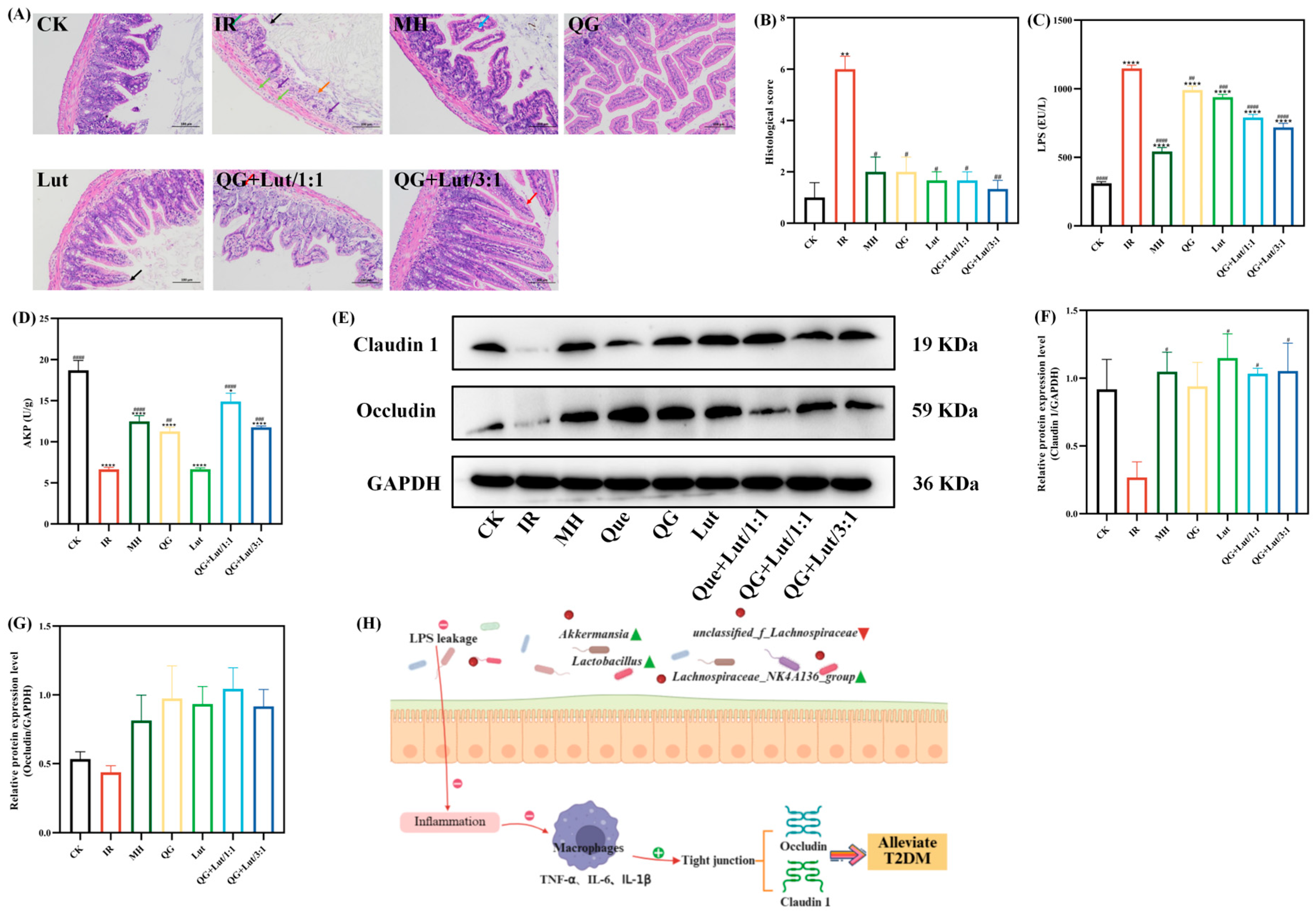
3.4. Changes in Intestinal Barrier Function of Different Groups of Mice
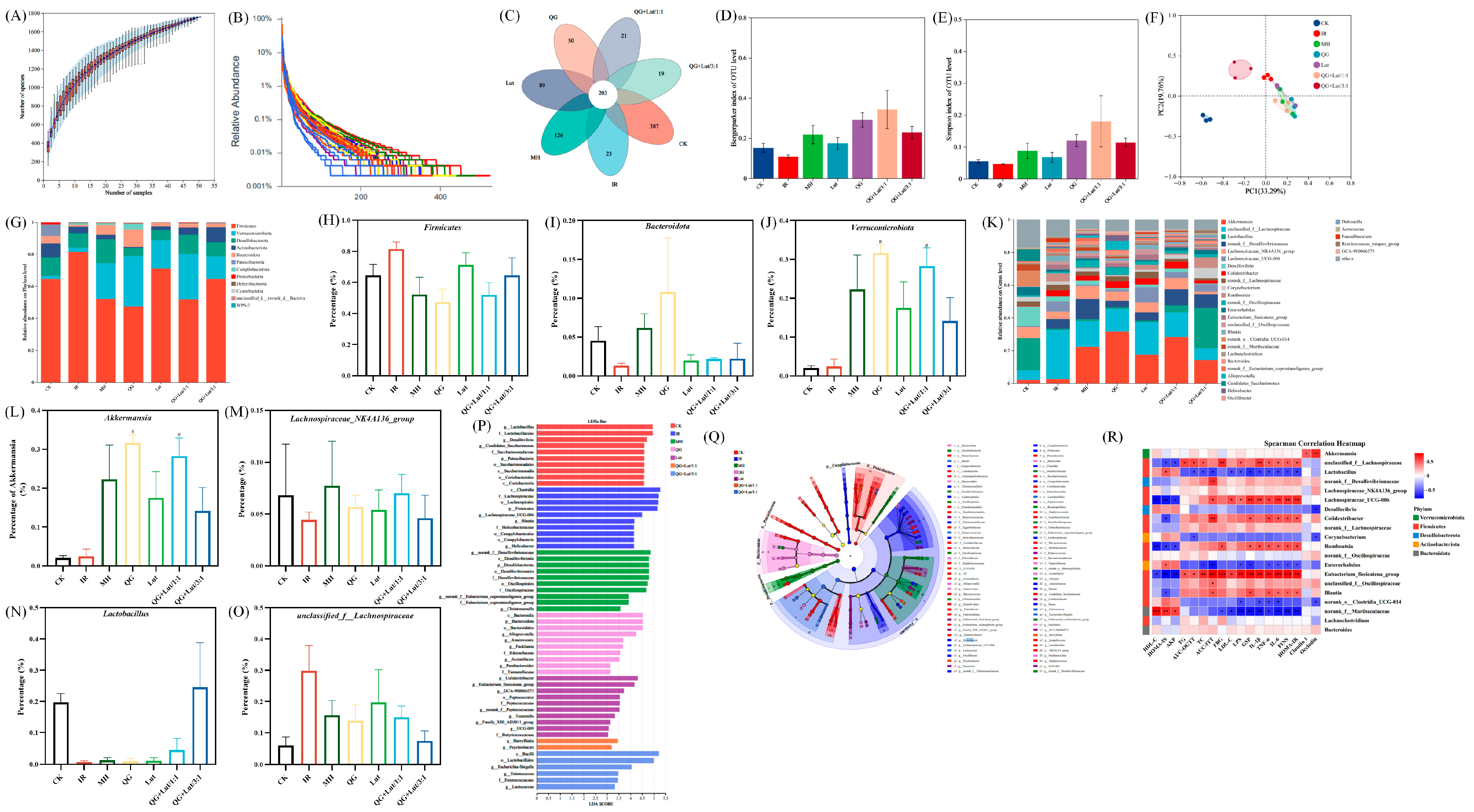
3.5. Gut Microbiota Variations in Mice Exposed to Different Treatments
4. Conclusions
Author Contributions
Funding
Institutional Review Board Statement
Informed Consent Statement
Data Availability Statement
Conflicts of Interest
References
- He, X.; Wang, C.e.; Zhu, Y.; Jiang, X.; Qiu, Y.; Yin, F.; Xiong, W.; Liu, B.; Huang, Y. Spirulina compounds show hypoglycemic activity and intestinal flora regulation in type 2 diabetes mellitus mice. Algal Res. 2022, 66, 102791. [Google Scholar] [CrossRef]
- Tönnies, T.; Rathmann, W.; Hoyer, A.; Brinks, R.; Kuss, O. Quantifying the underestimation of projected global diabetes prevalence by the International Diabetes Federation (IDF) Diabetes Atlas. BMJ Open 2021, 9, e002122. [Google Scholar] [CrossRef] [PubMed]
- Wu, J.; Shi, S.; Wang, H.; Wang, S. Mechanisms underlying the effect of polysaccharides in the treatment of type 2 diabetes: A review. Carbohydr. Polym. 2016, 144, 474–494. [Google Scholar] [CrossRef]
- Xia, T.; Liu, C.-S.; Hu, Y.-N.; Luo, Z.-Y.; Chen, F.-L.; Yuan, L.-X.; Tan, X.-M. Coix seed polysaccharides alleviate type 2 diabetes mellitus via gut microbiota-derived short-chain fatty acids activation of IGF1/PI3K/AKT signaling. Food Res. Int. 2021, 150, 110717. [Google Scholar] [CrossRef]
- Chen, Y.; Qi, L.; Zhong, F.; Li, Y.; Ke, W.; Ma, Y. Integrated metabolomics and ligand fishing approaches to screen the hypoglycemic ingredients from four Coptis medicines. J. Pharm. Biomed. Anal. 2021, 192, 113655. [Google Scholar] [CrossRef]
- Mi, S.; Zhu, W.X.; Zhang, X.N.; Wang, Y.H.; Li, T.; Wang, X.H. Enhanced Hypoglycemic Bioactivity via RAS/Raf-1/MEK/ERK Signaling Pathway by Combining Capsaicin and QUERCETIN from Chili Peppers. Mol. Nutr. Food Res. 2023, 67, e2200577. [Google Scholar] [CrossRef] [PubMed]
- Zhou, Z.; Sun, B.; Yu, D.S.; Zhu, C.S. Gut Microbiota: An Important Player in Type 2 Diabetes Mellitus. Front. Cell. Infect. Microbiol. 2022, 12, 834485. [Google Scholar] [CrossRef] [PubMed]
- Xiao, S.W.; Liu, C.; Chen, M.J.; Zou, J.F.; Zhang, Z.M.; Cui, X.; Jiang, S.; Shang, E.X.; Qian, D.W.; Duan, J.A. Scutellariae radix and coptidis rhizoma ameliorate glycolipid metabolism of type 2 diabetic rats by modulating gut microbiota and its metabolites. Appl. Microbiol. Biotechnol. 2020, 104, 303–317. [Google Scholar] [CrossRef]
- Chen, Y.W.; Zhou, J.H.; Wang, L. Role and Mechanism of Gut Microbiota in Human Disease. Front. Cell. Infect. Microbiol. 2021, 11, 625913. [Google Scholar] [CrossRef]
- Wu, S.Y.; Zuo, J.H.; Cheng, Y.; Zhang, Y.; Zhang, Z.S.; Wu, M.J.; Yang, Y.; Tong, H.B. Ethanol extract of Sargarsum fusiforme alleviates HFD/STZ-induced hyperglycemia in association with modulation of gut microbiota and intestinal metabolites in type 2 diabetic mice. Food Res. Int. 2021, 147, 110550. [Google Scholar] [CrossRef]
- Toragall, V.; Baskaran, V. Chitosan-sodium alginate-fatty acid nanocarrier system: Lutein bioavailability, absorption pharmacokinetics in diabetic rat and protection of retinal cells against H2O2 induced oxidative stress in vitro. Carbohydr. Polym. 2021, 254, 117409. [Google Scholar] [CrossRef] [PubMed]
- Wang, W.Y.; Xu, H.G.; Chen, H.; Tai, K.D.; Liu, F.G.; Gao, Y.X. In vitro antioxidant, anti-diabetic and antilipemic potentials of quercetagetin extracted from marigold (Tagetes erecta L.) inflorescence residues. J. Food Sci. Tech. Mys. 2016, 53, 2614–2624. [Google Scholar] [CrossRef]
- Liu, Y.C.; Miao, Q.Y.; Liu, Y.; Jiang, M.M. Effects of chitosan guanidine on blood glucose regulation and gut microbiota in T2DM. Int. J. Biol. Macromol. 2024, 279, 135422. [Google Scholar] [CrossRef]
- Fan, X.P.; Wei, X.J.; Hu, H.L.; Zhang, B.Y.; Yang, D.Q.; Du, H.N.; Zhu, R.J.; Sun, X.T.; Oh, Y.R.; Gu, N. Effects of oral administration of polystyrene nanoplastics on plasma glucose metabolism in mice. Chemosphere 2022, 288, 132607. [Google Scholar] [CrossRef] [PubMed]
- Xu, T.; Ge, Y.M.; Du, H.; Li, Q.; Xu, X.M.; Yi, H.; Wu, X.Y.; Kuang, T.T.; Fan, G.; Zhang, Y. Berberis kansuensis extract alleviates type 2 diabetes in rats by regulating gut microbiota composition. J. Ethnopharmacol. 2021, 273, 113995. [Google Scholar] [CrossRef]
- Qi, X.F.; Guan, K.F.; Liu, C.H.; Chen, H.R.; Ma, Y.; Wang, R.C. Whey protein peptides PEW and LLW synergistically ameliorate hyperuricemia and modulate gut microbiota in potassium oxonate and hypoxanthine-induced hyperuricemic rats. J. Dairy Sci. 2023, 106, 7367–7381. [Google Scholar] [CrossRef]
- Nie, Q.X.; Hu, J.L.; Gao, H.; Fan, L.L.; Chen, H.H.; Nie, S.P. Polysaccharide from Plantago asiatica L. attenuates hyperglycemia, hyperlipidemia and affects colon microbiota in type 2 diabetic rats. Food Hydrocoll. 2019, 86, 34–42. [Google Scholar] [CrossRef]
- Wang, Y.J.; Jia, Y.A.; Li, S.Q.; Li, N.N.; Zhou, J.N.; Liu, J.Y.; Yang, S.Y.; Zhang, M.; Panichayupakaranant, P.; Chen, H.X. Gut microbiome-mediated glucose and lipid metabolism mechanism of star apple leaf polyphenol-enriched fraction on metabolic syndrome in diabetic mice. Phytomedicine 2023, 115, 154820. [Google Scholar] [CrossRef]
- Zhao, Y.F.; Song, P.L.; Yin, S.; Fan, T.Y.; Li, F.W.; Ge, X.D.; Liu, T.T.; Xu, W.; Xu, S.; Chen, L.G. Onchidium struma polysaccharides exhibit hypoglycemic activity and modulate the gut microbiota in mice with type 2 diabetes mellitus. Food Funct. 2023, 14, 1937–1951. [Google Scholar] [CrossRef] [PubMed]
- Li, Z.R.; Jia, R.B.; Luo, D.H.; Lin, L.Z.; Zheng, Q.W.; Zhao, M.M. The positive effects and underlying mechanisms of Undaria pinnatifida polysaccharides on type 2 diabetes mellitus in rats. Food Funct. 2021, 12, 11898–11912. [Google Scholar] [CrossRef] [PubMed]
- Zhang, Y.; Wang, R.Q.; Yang, Y.N.; Ma, N.; Zhou, Z.; Tan, Y.F.; Dong, L.; Li, Y.Y.; Lu, W.Y.; Wu, C.M.; et al. Laurolitsine ameliorates type 2 diabetes by regulating the hepatic LKB1-AMPK pathway and gut microbiota. Phytomedicine 2022, 106, 154423. [Google Scholar] [CrossRef]
- Manaer, T.; Yu, L.; Nabi, X.H.; Dilidaxi, D.; Liu, L.; Sailike, J. The beneficial effects of the composite probiotics from camel milk on glucose and lipid metabolism, liver and renal function and gut microbiota in db/db mice. BMC Complement. Med. Ther. 2021, 21, 127. [Google Scholar] [CrossRef]
- Song, M.X.; Tan, D.H.; Li, B.; Wang, Y.Q.; Shi, L. Gypenoside ameliorates insulin resistance and hyperglycemia via the AMPK-mediated signaling pathways in the liver of type 2 diabetes mellitus mice. Food Sci. Hum. Wellness 2022, 11, 1347–1354. [Google Scholar] [CrossRef]
- Kong, F.H.; Zhang, J.; Kang, S.M.; Shen, X.Y.; Liu, A.C.; Zheng, Y.; Shao, J.H.; Yue, X.Q. Effects of axylitol-casein complex on insulin resistance and gut microbiota composition in high-fat-diet plus streptozotocin-induced type 2 diabetes mellitus mice. Food Sci. Hum. Wellness 2024, 13, 2741–2753. [Google Scholar] [CrossRef]
- Wang, H.Y.; Li, Q.M.; Yu, N.J.; Chen, W.D.; Zha, X.Q.; Wu, D.L.; Pan, L.H.; Duan, J.; Luo, J.P. Dendrobium huoshanense polysaccharide regulates hepatic glucose homeostasis and pancreatic ß-cell function in type 2 diabetic mice. Carbohydr. Polym. 2019, 211, 39–48. [Google Scholar] [CrossRef]
- Nogal, A.; Valdes, A.M.; Menni, C. The role of short-chain fatty acids in the interplay between gut microbiota and diet in cardio-metabolic health. Gut Microbes 2021, 13, 1897212. [Google Scholar] [CrossRef]
- Ma, C.X.; Ma, X.N.; Guan, C.H.; Li, Y.D.; Mauricio, D.; Fu, S.B. Cardiovascular disease in type 2 diabetes mellitus: Progress toward personalized management. Cardiovasc. Diabetol. 2022, 21, 74. [Google Scholar] [CrossRef]
- Dong, J.; Liang, Q.X.; Niu, Y.; Jiang, S.J.; Zhou, L.; Wang, J.M.; Ma, C.Y.; Kang, W.Y. Effects of Nigella sativa seed polysaccharides on type 2 diabetic mice and gut microbiota. Int. J. Biol. Macromol. 2020, 159, 725–738. [Google Scholar] [CrossRef]
- Peng, X.; Wei, Y.S.; Gong, D.M.; Zhang, G.W. Hesperetin-copper (II) complex improves liver glucose metabolism by regulating the IRS-1/PI3K/AKT signaling pathway in T2DM mice. Food Biosci. 2024, 62, 105408. [Google Scholar] [CrossRef]
- Rahmani, S.; Naraki, K.; Roohbakhsh, A.; Hayes, A.W.; Karimi, G. The protective effects of rutin on the liver, kidneys, and heart by counteracting organ toxicity caused by synthetic and natural compounds. Food Sci. Nutr. 2023, 11, 39–56. [Google Scholar] [CrossRef] [PubMed]
- Huang, J.Z.; Guan, B.B.; Lin, L.J.; Wang, Y.P. Improvement of intestinal barrier function, gut microbiota, and metabolic endotoxemia in type 2 diabetes rats by curcumin. Bioengineered 2021, 12, 11947–11958. [Google Scholar] [CrossRef]
- He, Y.H.; Chen, J.Q.; Zhang, Q.Y.; Zhang, J.L.; Wang, L.L.; Chen, X.X.; Molenaar, A.J.; Sun, X.Z. α-Chaconine Affects the Apoptosis, Mechanical Barrier Function, and Antioxidant Ability of Mouse Small Intestinal Epithelial Cells. Front. Plant. Sci. 2021, 12, 673774. [Google Scholar] [CrossRef] [PubMed]
- Zhang, X.X.; Wang, L.; Khan, A.I.; Rehman, A.U.; Khinsar, K.H.; Xin, Y. Lentinan’s effect on gut microbiota and inflammatory cytokines in 5-FU-induced mucositis mice. AMB Express 2025, 15, 11. [Google Scholar] [CrossRef] [PubMed]
- Huang, W.; Huang, G.P.; Zhang, L.X.; da Yu, E.; Yang, W.K.; Ye, M.; Zou, S.Q.; Ni, L.; He, H.Q. Lignan-rich extract from Cinnamomum camphora leaf attenuates metabolic syndrome by modulating glycolipid metabolism and gut microbiota in T2DM mice. Phytomedicine 2024, 135, 156118. [Google Scholar] [CrossRef]
- Mahowald, M.A.; Rey, F.E.; Seedorf, H.; Turnbaugh, P.J.; Fulton, R.S.; Wollam, A.; Shah, N.; Wang, C.Y.; Magrini, V.; Wilson, R.K.; et al. Characterizing a model human gut microbiota composed of members of its two dominant bacterial phyla. Proc. Nati. Acad. Sci. USA 2009, 106, 5859–5864. [Google Scholar] [CrossRef]
- Wang, X.L.; Yang, Z.M.; Xu, X.; Jiang, H.; Cai, C.; Yu, G.L. Odd-numbered agaro-oligosaccharides alleviate type 2 diabetes mellitus and related colonic microbiota dysbiosis in mice. Carbohydr. Polym. 2020, 240, 116261. [Google Scholar] [CrossRef]
- Al-Jameel, S.S. Association of diabetes and microbiota: An update. Saudi. J. Biol. Sci. 2021, 28, 4446–4454. [Google Scholar] [CrossRef]
- Peng, F.; Yu, Z.Q.; Du, B.; Niu, K.; Yu, X.; Wang, S.J.; Yang, Y.D. Non-starch polysaccharides from Castanea mollissima Bl. ameliorate metabolic syndrome by remodeling barrier function, microbial community, and metabolites in high-fat-diet/streptozotocin-induced diabetic mice. Food Res. Int. 2025, 202, 115638. [Google Scholar] [CrossRef]
- Li, A.L.; Ni, W.W.; Zhang, Q.M.; Li, Y.; Zhang, X.; Wu, H.Y.; Du, P.; Hou, J.C.; Zhang, Y. Effect of cinnamon essential oil on gut microbiota in the mouse model of dextran sodium sulfate-induced colitis. Microbiol. Immunol. 2020, 64, 23–32. [Google Scholar] [CrossRef]
- Li, M.J.; Kang, S.G.; Huang, K.L.; Tong, T. Dietary Supplementation of Methyl Cedryl Ether Ameliorates Adiposity in High-Fat Diet-Fed Mice. Nutrients 2023, 15, 788. [Google Scholar] [CrossRef]


| Lesion Type | Score | Standard |
|---|---|---|
| Inflammatory cell infiltration | 0 | None |
| 1 | Mild | |
| 2 | Moderate | |
| 3 | Severe | |
| Intestinal gland cell edema | 0 | None |
| 1 | Mild | |
| 2 | Moderate | |
| 3 | Severe | |
| Mucosal injury | 0 | None |
| 1 | Mild | |
| 2 | Moderate | |
| 3 | Severe | |
| Vascular congestion | 0 | None |
| 1 | Mild | |
| 2 | Moderate | |
| 3 | Severe |
| (A) | |||||
|---|---|---|---|---|---|
| Groups (n = 10) | Body Weigh (g) | ||||
| Week 0 | Week 1 | Week 2 | Week 3 | Week 4 | |
| CK | 51.85 ± 0.84 a | 52.20 ± 2.40 b | 52.78 ± 2.25 a | 52.89 ± 3.71 a | 53.51 ± 5.31 a |
| IR | 48.05 ± 1.03 a | 46.57 ± 3.86 c | 46.71 ± 4.10 b | 46.21 ± 3.06 b | 45.12 ± 2.72 b |
| MH | 40.08 ± 5.79 b | 43.04 ± 4.07 c | 44.23 ± 4.43 b | 44.72 ± 4.78 b | 45.40 ± 3.71 b |
| QG | 49.64 ± 5.62 a | 47.88 ± 5.69 bc | 47.71 ± 6.76 ab | 48.77 ± 6.20 ab | 46.92 ± 6.80 b |
| Lut | 48.92 ± 3.25 a | 47.36 ± 3.12 bc | 47.23 ± 3.96 ab | 49.48 ± 1.15 ab | 49.53 ± 0.78 ab |
| QG + Lut/1:1 | 49.26 ± 2.93 a | 46.65 ± 3.65 c | 47.44 ± 3.25 ab | 48.30 ± 3.51 ab | 49.18 ± 3.90 ab |
| QG + Lut/3:1 | 47.08 ± 4.91 a | 47.53 ± 4.65 bc | 48.63 ± 4.38 ab | 49.64 ± 4.92 ab | 50.21 ± 4.57 ab |
| (B) | |||||
| Groups (n = 10) | Feed intake (g) | ||||
| Week 0 | Week 1 | Week 2 | Week 3 | Week 4 | |
| CK | 4.72 ± 0.08 b | 4.76 ± 0.56 b | 5.25 ± 0.29 b | 5.40 ± 0.35 a | 5.64 ± 0.37 bc |
| IR | 6.35 ± 0.06 a | 6.50 ± 0.49 a | 6.86 ± 1.08 a | 7.06 ± 0.10 a | 7.34 ± 0.16 a |
| MH | 6.19 ± 0.13 a | 5.95 ± 0.19 a | 5.85 ± 0.70 ab | 5.47 ± 0.49 c | 5.28 ± 0.18 bcd |
| QG | 6.31 ± 0.08 a | 6.22 ± 0.03 a | 6.00 ± 0.11 ab | 5.46 ± 0.31 c | 4.65 ± 0.30 d |
| Lut | 6.29 ± 0.07 a | 6.20 ± 0.20 a | 6.11 ± 0.98 ab | 6.02 ± 0.58 bc | 5.42 ± 0.33 bcd |
| QG + Lut/1:1 | 6.38 ± 0.42 a | 6.30 ± 0.06 a | 6.35 ± 0.73 ab | 5.44 ± 0.57 c | 5.02 ± 0.60 cd |
| QG + Lut/3:1 | 6.23 ± 0.38 a | 6.21 ± 0.38 a | 6.14 ± 0.49 ab | 5.97 ± 0.68 bc | 5.57 ± 1.05 bc |
| (C) | |||||
| Groups (n = 10) | Water intake (mL) | ||||
| 0 | 1 | 2 | 3 | 4 | |
| CK | 7.24 ± 0.20 e | 7.37 ± 1.14 c | 7.63 ± 2.39 b | 7.70 ± 1.40 c | 8.07 ± 1.11 d |
| IR | 13.30 ± 0.42 abc | 14.13 ± 1.43 a | 14.43 ± 0.92 a | 15.59 ± 0.68 a | 15.60 ± 1.31 b |
| MH | 13.54 ± 0.36 a | 13.17 ± 0.30 ab | 12.65 ± 0.43 a | 12.32 ± 0.41 b | 12.17 ± 0.74 c |
| QG | 13.04 ± 0.08 cd | 12.64 ± 0.50 ab | 11.61 ± 2.30 a | 11.26 ± 0.53 b | 11.13 ± 0.35 c |
| Lut | 12.86 ± 0.15 d | 12.77 ± 0.73 ab | 12.17 ± 0.39 a | 11.44 ± 1.86 b | 10.38 ± 0.54 c |
| QG + Lut/1:1 | 12.98 ± 0.19 cd | 12.38 ± 0.59 b | 11.53 ± 3.15 a | 11.34 ± 0.59 b | 11.14 ± 0.68 c |
| QG + Lut/3:1 | 13.11 ± 0.12 bcd | 12.80 ± 0.34 ab | 11.49 ± 1.14 a | 11.41 ± 0.44 b | 11.40 ± 0.36 c |
Disclaimer/Publisher’s Note: The statements, opinions and data contained in all publications are solely those of the individual author(s) and contributor(s) and not of MDPI and/or the editor(s). MDPI and/or the editor(s) disclaim responsibility for any injury to people or property resulting from any ideas, methods, instructions or products referred to in the content. |
© 2025 by the authors. Licensee MDPI, Basel, Switzerland. This article is an open access article distributed under the terms and conditions of the Creative Commons Attribution (CC BY) license (https://creativecommons.org/licenses/by/4.0/).
Share and Cite
Wang, R.; Dang, C.; Gao, Z.; Wu, D.; Lian, Y.; Wang, X.; Mi, S. The Combined Hypoglycemic Effect of Quercetagetin and Lutein from Marigold and Related Molecular Mechanisms in Mice. Foods 2025, 14, 4279. https://doi.org/10.3390/foods14244279
Wang R, Dang C, Gao Z, Wu D, Lian Y, Wang X, Mi S. The Combined Hypoglycemic Effect of Quercetagetin and Lutein from Marigold and Related Molecular Mechanisms in Mice. Foods. 2025; 14(24):4279. https://doi.org/10.3390/foods14244279
Chicago/Turabian StyleWang, Rongrong, Chao Dang, Zhe Gao, Di Wu, Yunhe Lian, Xianghong Wang, and Si Mi. 2025. "The Combined Hypoglycemic Effect of Quercetagetin and Lutein from Marigold and Related Molecular Mechanisms in Mice" Foods 14, no. 24: 4279. https://doi.org/10.3390/foods14244279
APA StyleWang, R., Dang, C., Gao, Z., Wu, D., Lian, Y., Wang, X., & Mi, S. (2025). The Combined Hypoglycemic Effect of Quercetagetin and Lutein from Marigold and Related Molecular Mechanisms in Mice. Foods, 14(24), 4279. https://doi.org/10.3390/foods14244279