Review

Advances in GABA-Enriched Yogurt and Frozen Yogurt: Microbial Biosynthesis, Functional Properties, and Health Perspectives—A Comprehensive Review


by
Muhammad Ameer Ushidee-Radzi
1,
Chong Shin Yee
1,2,
Raja Balqis Raja-Razali
1,
Nur Asyiqin Zahia-Azizan
1,
Tiziana Di Renzo
3,*,
Anna Reale
3,
Stefania Nazzaro
3,
Pasquale Marena
3,
Zul Ilham
4,5,
Nur ‘Aliaa Abd Rahman
6 and
Wan Abd Al Qadr Imad Wan-Mohtar
1,*
1
Functional Omics and Bioprocess Development Laboratory, Institute of Biological Sciences, Faculty of Science, University Malaya, Kuala Lumpur 50603, Malaysia
2
Biomass Energy Laboratory, Faculty of Science, University Malaya, Kuala Lumpur 50603, Malaysia
3
Institute of Food Sciences, National Research Council (CNR-ISA), Via Roma, 64, 83100 Avellino, Italy
4
Environmental Science and Management Program, Institute of Biological Sciences, Faculty of Science, University Malaya, Kuala Lumpur 50603, Malaysia
5
Centre for Science and Environment Studies, Institute of Islamic Understanding Malaysia, 2 Langgak Tunku Off Jalan Tuanku Abdul Halim, Kuala Lumpur 50480, Malaysia
6
Department of Process and Food Engineering, Faculty of Engineering, University Putra Malaysia, Serdang 43400, Malaysia
*
Authors to whom correspondence should be addressed.
Foods 2025, 14(24), 4254; https://doi.org/10.3390/foods14244254
Submission received: 23 October 2025 / Revised: 28 November 2025 / Accepted: 8 December 2025 / Published: 10 December 2025
(This article belongs to the Special Issue Feature Reviews on Food Microbiology)

Abstract

Gamma-aminobutyric acid (GABA) is a bioactive, non-protein amino acid recognized for its role as an inhibitory neurotransmitter in the human central nervous system. Increasing interest in functional foods has increased attention on GABA due to its potential health benefits, including antihypertensive, anxiolytic, antidepressant, and neuroprotective effects. This review summarizes the natural dietary sources of GABA and explores advanced strategies for enriching dairy products, particularly yogurt and frozen yogurt (froyo), with GABA. Key microbial species capable of GABA biosynthesis via the glutamate decarboxylase (GAD) pathway are discussed, alongside enzymatic production techniques that support controlled GABA synthesis. A major focus of this review is the evaluation of various methods for incorporating GABA into dairy matrices, including direct GABA fortification and in situ fermentation using GABA-producing strains, with comparisons of yield, sensory attributes, and product stability. Physicochemical analyses and sensory evaluations are presented as essential tools for assessing product performance. Furthermore, the review outlines the therapeutic effects of GABA-fortified foods and their potential roles in managing hypertension, stress, and neurodegenerative disorders. Key challenges, including strain-dependent variability in GABA-production, storage stability, and regulatory compliance are addressed, along with market and legislative considerations for GABA-fortified foods. Future perspectives include the development of novel high GABA-producing strains, process optimization to improve product stability and sensory acceptance, and expanded applications within the functional food sector. Overall, this review provides an integrated, up-to-date overview of technological, functional and regulatory aspects, offering a clear scientific foundation for the development and commercialization of GABA-fortified dairy products.

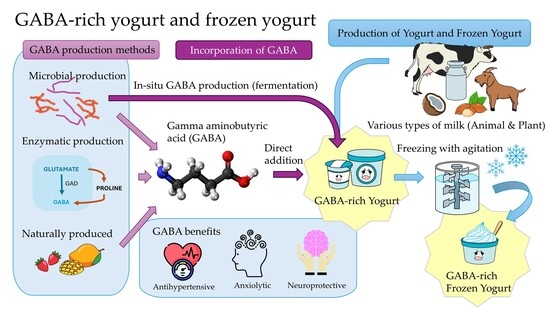
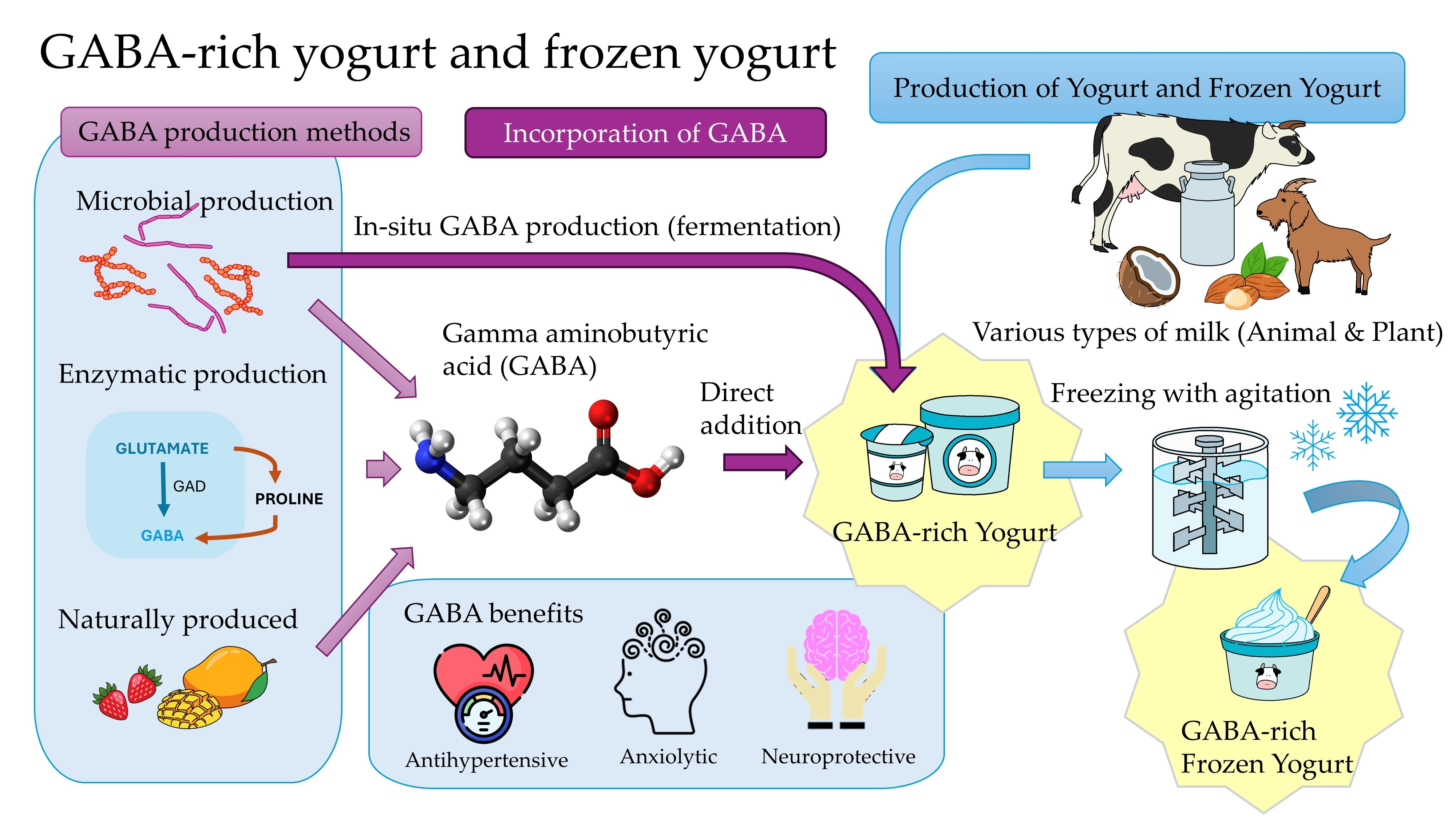
Graphical Abstract

1. Introduction

Gamma-aminobutyric acid (GABA) is a non-protein amino acid that functions predominantly as an inhibitory neurotransmitter in the mammalian central nervous system [1,2,3]. By binding primarily GABA-A and GABA-B receptors, it reduces neuronal excitability, maintaining a critical balance between excitation and inhibition [2,4]. More recently, GABA-C receptors, now often referred to as GABA-Aρ receptors, have been identified. These receptors possess ligand-gated ion channels similar to those of GABA-A receptors, although their precise physiological role in humans remains unclear [1,5]. The regulatory role of GABA is crucial in controlling processes such as anxiety, sleep regulation, and seizures modulation [5]. Endogenously, GABA is synthesized through the decarboxylation of glutamate by the glutamate decarboxylase enzyme (GAD), and its concentration is tightly regulated within neuronal tissues [1,2,4,5].
Beyond its neurological roles, GABA has gained attention for its potential health-promoting properties when consumed in the diet. Numerous studies have highlighted its antihypertensive, anxiolytic, antidepressant, antidiabetic, and immune-modulating effects [6,7,8,9,10,11]. The significance of GABA extends to the context of non-communicable diseases (NCDs) [12]. According to the World Health Organization, 3.7 million deaths were reported from NCDs in 2021, including cardiovascular diseases, diabetes, cancers, neurological disorders, chronic respiratory diseases, and digestive disorders [12]. Many of these diseases are increasingly prevalent across both developed and developing countries. For instance, hypertension and stress-related disorders are becoming increasingly prevalent in our modern society, and GABA-rich dietary interventions could offer a complementary approach to conventional treatments [13]. Additionally, GABA’s capacity to mitigate oxidative stress and neurodegeneration highlights its potential in managing age-related neurological conditions such as Alzheimer’s and Parkinson’s diseases [14,15,16]. The health benefits of consuming GABA-rich foods have been substantiated through numerous in vitro and in vivo studies. A study on GABA-enriched fermented milk demonstrated notable ACE inhibitory activity, contributing to its blood pressure-lowering effects [17]. Other studies have linked GABA intake to reduced stress and anxiety levels, improved sleep quality, and enhanced cognitive function [13,16,18].
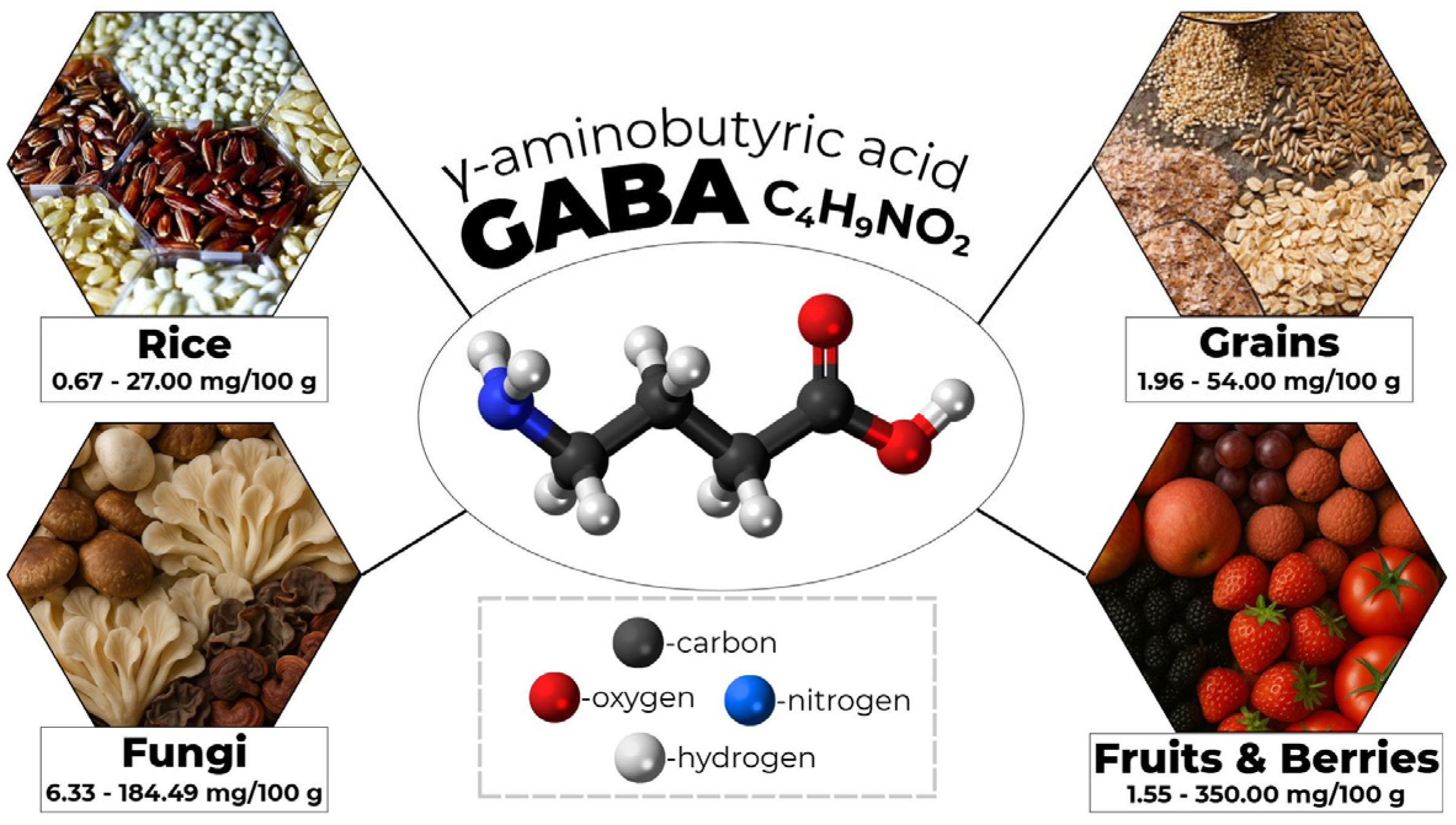
GABA is naturally present in a wide range of food sources [11] (Table 1). Numerous studies have shown that plant-based foods generally contain higher GABA levels than animal-derived foods, with concentrations reaching several mg g−1 depending on the plant species, developmental stage, and postharvest processing conditions (Table 1). Rice, grains, fungi, fruits and berries are among the most widely consumed GABA-rich foods globally (Figure 1).
As shown in Table 1, the GABA content of cereals and pseudocereals varies widely, from 0.67 mg/100 g in black rice to 54 mg/100 g in barley, depending on cultivar and processing conditions [11,19]. Among legumes, lupins are particularly noteworthy, reaching GABA concentrations of up to 46 mg/100 g. Fruits, berries, and vegetables also constitute important plant sources of GABA, with some varieties, such as lychees, containing up to 350 mg/100 g. Certain mushrooms, including the sun mushroom (Agaricus brasiliensis), have been reported to contain as much as 184.49 mg/100 g [11,57]. These variations reflect both intrinsic plant metabolic pathways and external factors such as cultivar selection, environmental conditions, and post-harvest handling. Although medicinal plants may also provide relevant GABA levels, their contribution to dietary intake is negligible due to the small quantities typically consumed. Other plant-derived products with exceptionally high GABA concentrations include pumpkin seeds (Cucurbita pepo and Cucurbita maxima), which may contain up to 1553 mg/100 g.
Animal-derived foods such as eggs and honey contain moderate amounts of GABA, whereas milk, regardless of the animal species, contains only a few micrograms per 100 mL. Moreover, GABA levels in these products are often substantially reduced during technological processing [31].
In contrast, both germination and fermentation significantly increase GABA content by activating glutamate decarboxylase (GAD), which enhances the conversion of glutamate into GABA [21]. Milk, in particular, represents an excellent substrate for producing a wide range of fermented dairy products. In recent years, substantial research has focused on microorganisms capable of synthesizing GABA, especially lactic acid bacteria (LAB) and yeasts, which provide safe and sustainable alternatives to chemical production methods. Among these microorganisms, lactobacilli are the predominant GABA producers in fermented foods with their efficiency largely determined by GAD activity and the availability of glutamic acid within the food matrix.
Because lactic acid fermentation can markedly elevate the natural GABA content, LAB strains with high GABA-producing capacity have been successfully employed to develop GABA-enriched fermented dairy products. Among these, yogurt and frozen yogurt stand out as ideal carriers due to their physicochemical stability, creamy texture, and sensory appeal, making them convenient vehicles for consistent intake of this health-promoting bioactive compound.
Based on these considerations, this comprehensive review provides an in-depth overview of the current literature on the production of yogurt and frozen yogurt enriched with bioactive GABA, as well as the key factors that influence GABA synthesis [66]. Relevant scientific articles were identified through systematic searches conducted in the ISI Web of Science, Scopus, and PubMed databases, covering publications from 2000 to 2025. Only articles published in English and focused on the nutritional, microbiological, and health-functional aspects of GABA-rich yogurt and frozen yogurt were included. After applying the inclusion criteria, the articles were screened by title and abstract, and duplicates were excluded. In total, 157 articles were deemed relevant to this review, highlighting the key challenges and opportunities related to the development and consumption of GABA-enriched yogurt and frozen yogurt, and contributing to a deeper understanding of their potential in promoting health-conscious and functional dietary patterns. This review also highlights methods used to characterize GABA-enriched yogurt and frozen yogurt, such as those reported by Li et al. [67], which include assessments of sensory attributes, functional properties, and therapeutic efficacy [67]. Moreover, the review aims to support the advancement of enhanced probiotic products—often described as “superfoods”—that deliver amplified health benefits through the synergistic action of probiotics and functional compounds like GABA. Emerging innovations, including the discovery of novel GABA-producing microbial strains and the use of artificial intelligence (AI) to optimize GABA biosynthesis, are discussed as promising future directions. A deeper understanding of GABA’s physiological roles, along with its broader integration into the food system, could play a significant role in advancing public health initiatives and improving dietary habits on a global scale.

2. Production Process for Yogurt and Frozen Yogurt

Yogurt (or Yoghurt) is a semi-solid dairy product produced through the fermentation of milk by thermophilic lactic acid bacteria (LAB) starter cultures. The primary bacteria used are Streptococcus thermophilus and Lactobacillus delbrueckii subsp. bulgaricus, though other species such as Lactobacillus acidophilus, Bifidobacterium lactis, Lactococcus lactis, and Leuconostoc spp. may also be involved [68,69,70]. S. thermophilus plays a crucial role as the initial producer of lactic acid, which lowers milk pH and creates a favorable environment for L. delbrueckii subsp. bulgaricus to grow [71]. Once active, Lb. bulgaricus breaks down milk casein into smaller peptides and amino acids, forming a gel-like network that traps water and gives yogurt its characteristic semi-solid texture. S. thermophilus and Lb. delbrueckii subsp. bulgaricus share a symbiotic relationship, in which each produces compounds that stimulate the growth and metabolic activity of the other. Together, they break down milk sugars and produce lactic acid creating a texture essential to yogurt [71]. Notably, this process reduces the lactose content, making yogurt more suitable for individuals with lactose intolerance who may otherwise struggle to consume dairy products in large amounts [70].
Aside from lactic acid, secondary metabolites are also produced within the process of fermentation of milk, which not only boost the nutritional profile of yogurt but also improve its digestibility. To mention a few, formates, acetaldehydes, or diacetyls that contribute to the fermented products’ aromatic, functional, nutritional, and textural qualities, as well as pyruvic acid, formic acid, acetone, and acetoin [70]. In addition to microbes, another important key in the production of yogurt is the milk itself. Yogurt is commonly made using cow’s milk; however, it may also be made using other types of milk such as goat’s milk, buffalo milk [72], and recently, with plant-based milk such as coconut milk [73], chickpea [74] as well as almond milk [75] and pistachio [76,77]. The trend towards creating plant-based yogurt is most likely to suit the dietary demands of people practicing a vegetarian and vegan diet as well as to enable those with intolerances such as lactose intolerance to enjoy the yogurt-like products [78].
Yogurts is a high-nutritious food, rich in essential vitamins and minerals such as vitamins B2 and B12 calcium, magnesium, potassium, and zinc, all of which are important for maintaining good health [68].
On the other hand, frozen yogurt, otherwise known as froyo or frogurt, is the frozen counterparts of yogurt, produced in a manner similar to ice cream [79,80]. It retains much of the original yogurt’s nutritional content and sensory attributes. A fermented frozen dairy product, frozen yogurt blends the nutritional value and flavor of fermented milk products with the texture of ice cream [79,81]. It’s a creative method to combine the benefits of ice cream with the therapeutic qualities of yogurt, making it a healthy substitute for ice cream for those with lactose intolerance, obesity and cardiovascular disorders, because it has less fat and lactose content than ice cream [82,83].
The primary difference lies in its texture and consistency. According to Hudson et. al. [79], frozen yogurt possesses a lighter, more aerated texture compared to traditional yogurt. In contrast to regular ice cream, frozen yogurt is typically slightly more acidic in flavor, reflecting its yogurt base [79]. Commercially, frozen yogurt is available in both soft-serve and hard-type forms [79]. Soft-serve frozen yogurt is usually freshly dispensed in stores for immediate consumption, whereas the hard-type version is prepackaged, offering longer shelf stability. They are commonly found in the freezer sections of grocery stores and other retail outlets.
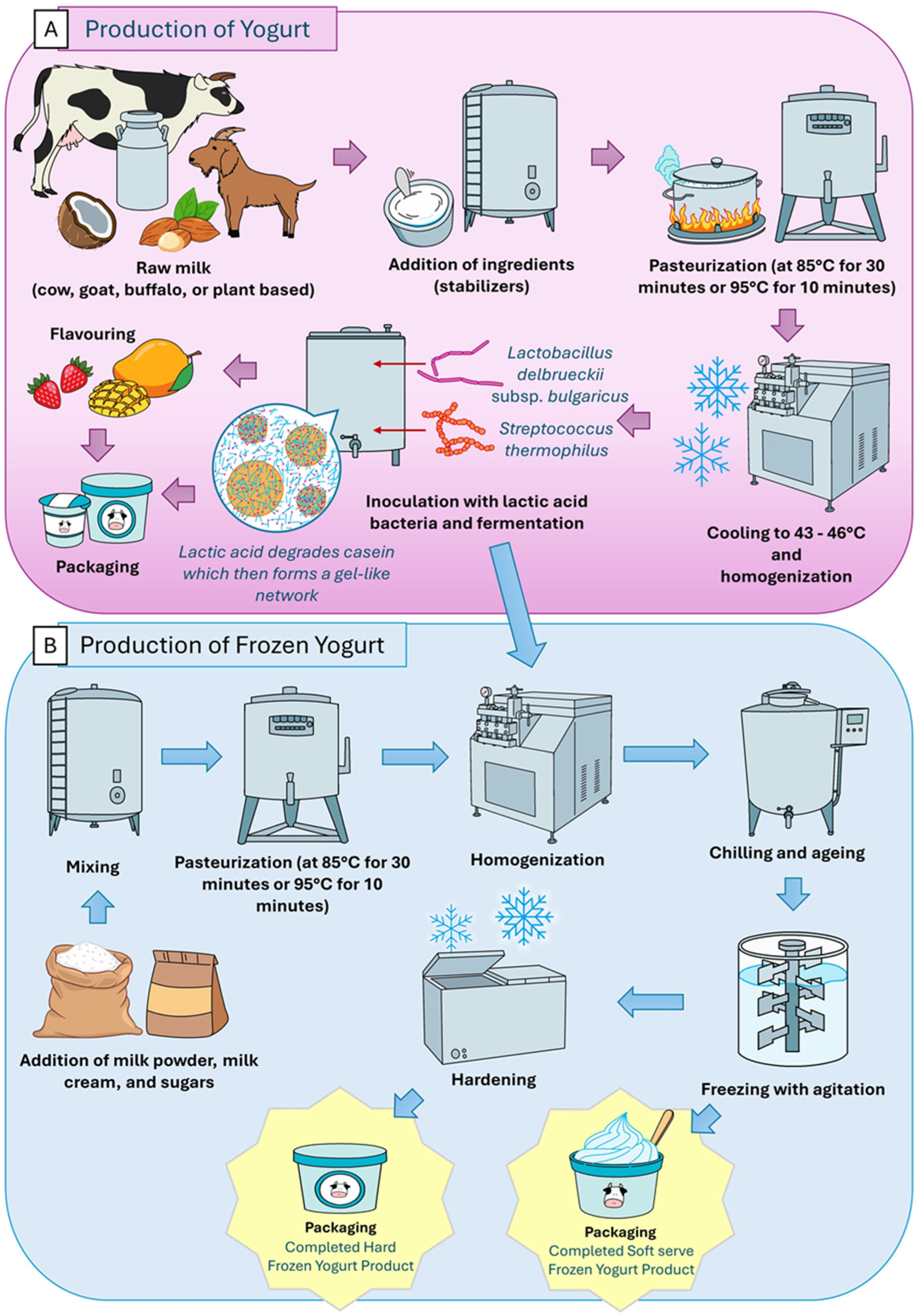
The production processes of yogurt and frozen yogurt are closely interrelated, as shown in Figure 2. As previously stated, the process begins with the selection of milk. Different types of milk result in different types of yogurts, each with unique nutritional properties and health benefits.
One of the key characteristics that influence the final yogurt product is milk fat content. For instance, buffalo and goat milk contain significantly higher fat content (7.1% and 7.3%, respectively) compared to cow milk, which contains about 3.6% of fats [84]. Due to these variations, the type of milk used directly impacts the category of yogurt produced, typically classified as non-fat (NF), low-fat (LF) and high-fat (HF). These yogurt categories were defined by the United States Department of Agriculture (USDA) in 2001 [85]. According to these standards, HF must contain no less than 3.25% milk fat and at least 8.25% milk-solids-not-fat. Low-fat (LF) yogurt must contain between 0.5% and 2% milk fat, also with a minimum of 8.25% milk solids-not-fat. Finally, NF yogurt must contain no more than 0.5% milk fat while still maintaining at least 8.25% milk solids-not-fat [85]. Milk-solids-not-fat refer to all milk components excluding milk fat, like carbohydrates, starches, sugars, sweeteners, proteins, hydrocolloids, stabilizing agents and other dairy constituents [86,87]. The fat content within the yogurt is crucial in determining its quality and sensory characteristics. According to Erturk et al. [86], milk fat significantly contributes to flavor profile, mouthfeel, texture, whey syneresis (separation/expulsion of liquid), overall appearance, and physical properties of yogurt. Products with reduced fat content tend to perform poorly in many of these sensory attributes [86]. After milk selection, the next step in yogurt production is the addition of other ingredients. In most homemade or small-scale yogurt production, the process is straight-forward, typically involving milk and a yogurt starter culture or mother yogurt. However, in large-scale and commercial yogurt production, additional ingredients are often included to achieve specific product qualities and extend shelf life. These may include added fats, stabilizers [88] and occasionally, preservatives [89].
Proteins, too, are often added to yogurt to enhance its nutritional and textural qualities, with skimmed milk powder (SMP), as well as other whey and casein-based ingredients, being commonly used [88].
According to Arab et al. [88], increasing protein content not only improves the textural quality by enhancing gel elasticity but also helps reduce syneresis. However, each type of added protein comes with its own drawbacks. For instance, the use of SMP can result in a powdery mouthfeel, a strong fermented flavor, and a more intense acidic taste [88,90,91]. On the other hand, whey protein concentrates, isolates, hydrolysates, and other whey powders may lead to undesirable sensory attributes, such as a grainy texture and an unappealing whey flavor.
Adjustments of fat content in yogurt are typically performed by adding separated creams [91], such as cooking cream, heavy cream, double cream, and clotted cream. A combination of high fat content and proper homogenization results in the uniform distribution of small fat globules, which enhances yogurt water holding capacity. This, in turn, reduces syneresis and contributes to an improved texture and creamier mouthfeel.
Finally, the addition of stabilizers and preservatives is also somewhat common in commercial yogurt production. Stabilizers, particularly hydrocolloids such as carrageenans, carboxymethyl cellulose (CMC), sodium alginate and pectin, are added to achieve specific textural and physical properties in the final product. Each stabilizers serves a distinct purpose, for example, CMC is primarily used for its gel forming ability and its role in preventing syneresis. K-carrageenans also helps reduce syneresis, while sodium alginate functions mainly as thickening and emulsifying agent [87,92]. Due to the diverse functionalities of these compounds, the best practice to achieve a desired physical property of yogurt is via a mixture of different stabilizers with optimum proportions to each other. Preservatives such as potassium sorbate are added to extend shelf life [89]. This is particularly important in commercial production, allowing yogurt to remain stable during distribution and storage, both in retail environments and at home.
They primarily act as antimicrobial agents, inhibiting the growth of unwanted fungi, aerobic bacteria and yeasts [89]. However, because compounds such as potassium sorbate are usually synthesized through chemical processes, there has been growing interest in natural alternatives. Research has explored the use of plant-, algae-, and fungi-derived antioxidants as potential natural preservatives [89]. These are increasingly advocated as safer options, given the potential adverse health effects associated with synthetic preservatives [93].
Following the addition of ingredients, the yogurt premix undergoes pasteurization, a heat treatment process aimed to reduce microbial contamination. The specific temperature and duration depend on the method used. The most common approach is high-temperature pasteurization, where the premix is heated at 85 °C for 20–30 min or, alternatively, at 90–95 °C for 5 min for a shorter treatment. Other pasteurization techniques include low-temperature pasteurization carried out at 63–65 °C for 20 min, High temperature Short Time pasteurization at 72–75 °C for 15–20 s and Ultra High Temperature carried out at 145 °C for 1–2 s [71]. The process continues with the cooling and homogenization of yogurt mix. This is a relatively simple step, in which milk is cooled at 43–46 °C, for the next crucial stage: inoculation and fermentation. The inoculation process involves the addition of the main yogurt-making lactic acid bacteria Lb. delbrueckii subsp. bulgaricus (Lb. bulgaricus) and S. thermophilus, as well as any other desired functional or probiotic bacteria. This can be done by adding either a yogurt starter culture or “mother yogurt” from a previous batch [93]. Yogurt starter cultures are commonly available commercially in dried or powdered form, produced through the lyophilization (freeze-drying) of bacterial cultures grown in specific media. These commercial yogurt starters are generally food-grade, with some being made according to specific standards, including Kosher and Halal certifications [93]. As stated by Vedamuthu [93], several quality attributes are assessed in commercial yogurt starters before they reach the market. These include viable cell count, absence of contaminants and pathogens, functional activities (such as acid production), packaging integrity, accuracy of labeling, and compliance with declared shelf life. The use of commercial yogurt starters allows for greater precision and consistency, as they come with standardized data regarding bacterial composition and fermentation parameters, enabling producers to achieve specific yogurt characteristics within a controlled timeframe. On the other hand, mother yogurt is a more accessible option, as it refers to previously made yogurt that is used to inoculate a new batch with yogurt-making bacteria. In dairy plants, mother yogurt is often used to first inoculate an intermediate culture before being utilized to the final yogurt mixture. After inoculation, the yogurt mix undergoes fermentation, during which lactic acid bacteria (LAB) convert lactose into lactic acid—the key step in yogurt formation. Fermentation is typically carried out at 40–44 °C, which is the optimal growth temperature for Lb. delbrueckii subsp. bulgaricus. The duration of fermentation varies depending on the desired physical and sensory attributes, such as acidity, flavor, and texture. Once the desired level of fermentation is achieved, the process is halted by rapidly cooling the yogurt to approximately 4 °C. This drop in temperature significantly slows microbial activity without destroying the beneficial bacteria, thereby preserving yogurt flavor, texture, and, where applicable, probiotic content during storage, transport, and distribution [94].
The final step in yogurt production is packaging. The packaging material must be appropriate and chemically inert to prevent any reaction with yogurt, ensuring that product quality, safety, and shelf life are maintained. As brought forth by Saint-Eve et al. 2008 [94], concerns regarding yogurt packaging have been under investigation since 1992, beginning with research by Linssen et al. [95]. Their study revealed that aroma compounds in flavored drinking yogurts were being absorbed by polyethylene packaging, which compromised product sensory quality. Subsequent studies have since explored the broader effects of packaging materials on both the sensory and physicochemical properties of yogurt [94,95]. One significant finding relates to olfactory properties: among various packaging materials, glass exhibited the least aroma loss, followed by polystyrene and polypropylene [94]. Despite these insights, a need for more contemporary research focused on emerging packaging technologies remains, including active and environmentally friendly (green) packaging. These newer materials require further evaluation, particularly in the context of dairy products, which are typically stored for short durations and at low temperatures. Due to these specific conditions, the effects of packaging are often understudied or based on outdated model systems [96]. In addition to packaging, yogurt flavoring is a crucial step in the production process. Although flavoring may be introduced during the early stages of processing, it is generally preferred toward the end of fermentation. This timing helps ensure optimal development of the base yogurt, as early addition of flavoring agents or additives can interfere with microbial fermentation by altering parameters such as pH, which is critical for the activity of yogurt cultures [97]. Flavoring can involve the incorporation of whole fruits or the use of natural and artificial flavor compounds. Common fruits added to yogurt include strawberries, blueberries, raspberries, cane berries, peaches, cherries, and bananas. To enhance or replicate these fruity profiles, manufacturers may also use a variety of flavoring types—ranging from natural, to natural with other natural flavors, to natural and artificial, and fully artificial flavorings [98]. To improve visual appeal and suggest stronger flavor cues, colorants are frequently added to yogurt products. These may be incorporated directly or through fruit preparation steps. Any addition of color must be clearly declared on the product label with terms such as “Color added” or “Colored with _____,” specifying whether the colorant is natural or artificial.
In the case of frozen yogurt production, as shown in Figure 2, yogurt may immediately enter the frozen yogurt making process after the completion of the fermentation step, bypassing the need for packaging. If outsourcing is necessary, any externally produced yogurt may be utilized as a base for frozen yogurt production. The process typically begins with the incorporation of various additional ingredients such as milk (in pasteurized, raw, or powdered form), milk cream or creamer, sugars, stabilizers, emulsifiers, water, colorants, flavorings, and other optional ingredients such as toppings [79,83,99]. The specific formulation, including the ratio of ingredients, is determined by the manufacturer, based on the desired characteristics of the final product, such as texture, flavor, fat content, and the proportion of non-fat solids. All ingredients are commonly blended and homogenized together while being subjected to thermal treatment or pasteurization. This step is performed before adding the yogurt itself, in order to preserve the viability of the live bacterial cultures present in the yogurt. Once the mixture has sufficiently cooled, the yogurt is added and the mixture is homogenized again to ensure a smooth and uniform consistency.
Following the homogenization process, the mixture undergoes aging, a critical step in the production of both frozen yogurt and ice cream. As stated by Hudson et al. [79], aging is carried out at temperatures below 4 °C for at least 12 h. This step serves multiple purposes: it promotes fat crystallization, hydrates proteins and stabilizers (increasing viscosity of the mix), and facilitates the replacement of proteins on the membranes of fat globules with emulsifiers, an essential preparation for fat destabilization during freezing [79]. The final phase, prior to packaging, involves freezing and hardening, which is commonly carried out using a scraped surface heat exchanger or one of several types of freezers (continuous freezers, soft-serve freezers and batch freezers) operating at temperatures ranging from −2 °C to −6 °C [79,100]. The mixture must be agitated during freezing to introduce air, a process known as achieving overrun, which imparts the desired light and airy texture.
During this stage, the gel structure within the mixture is disrupted by agitation, thereafter partially reconstituting alongside the development of ice crystals during the hardening process, which imparts ice cream and frozen yogurt with a firm yet light and airy texture [79,100]. Once the frozen yogurt is churned, it is immediately discharged from the machine and collected either in its final packaging or in a temporary container. From there, it is swiftly transferred to cold storage to prevent melting and preserve quality. The finished product may be distributed and served as a soft-serve dessert, or stored at freezing temperatures in retail packaging as hard-frozen yogurt, similar to traditional ice cream. Yogurt and frozen yogurt (froyo) are widely consumed fermented dairy products recognized as excellent carriers for probiotics and bioactive compounds, including GABA. Their nutrient-rich composition, characterized by protein, fat, and lactose provides an ideal matrix for the survival and metabolic activity of beneficial probiotic microbes such as Lactobacillus and Bifidobacterium species [101,102,103]. The ability of these products to maintain a viable probiotic count during storage and gastrointestinal transit makes them suitable platforms for functional food development [104].
Probiotics play a dual role in yogurt and froyo production: they enhance gut health and act as natural biosynthesizers of bioactive compounds. Several strains, such as Lactiplantibacillus plantarum, Levilactobacillus brevis, and Lactobacillus delbrueckii ssp. bulgaricus, have demonstrated the ability to synthesize GABA during fermentation [105,106,107]. These microbes convert available glutamate into GABA via the glutamate decarboxylase (GAD) enzyme pathway, enabling in situ enrichment of the product.
Although froyo is traditionally consumed as a dessert, it has increasingly evolved into a functional food with potential health benefits. Unlike traditional yogurt, froyo is consumed in a frozen state, which poses unique challenges regarding probiotic viability and metabolic activity. However, studies have shown that, through optimized formulation, such as the use of cryoprotectants and cold-adapted strains, both probiotic survival and GABA retention can be preserved or even enhanced during frozen storage [106,108].
Yogurt and froyo, with their high sensory acceptability, convenience, and familiarity among consumers, represent ideal delivery systems for such bio-functional compounds. Moreover, the feasibility of GABA incorporation through either direct addition or microbial fermentation enhances the versatility and potential market of these dairy-based functional foods in addressing both nutritional and therapeutic goals [109].

3. GABA Production in Yogurt and Froyo

The increasing global interest in functional foods has brought gamma-aminobutyric acid (GABA) to the forefront of nutraceutical research. With its well-documented physiological benefits, including neuroprotective, antihypertensive, mood-regulating, and metabolic effects, GABA has become a promising candidate for incorporation into everyday consumables [11,109]. In response to this demand, different studies have explored the incorporation of GABA into widely consumed foods such as yogurt and frozen yogurt (froyo) with the aim to develop functional products that offer greater health benefits due to the synergistic effects of microorganisms, sometimes probiotics, and functional compounds such as GABA.
The microbial production of GABA as emerged as key biotechnological strategy for enhancing the functional properties of fermented foods, including yogurt and froyo. As highlighted by Di Renzo & Reale [110], advancements in microbial fermentation not only focus on better preserving foods but also on improving their sensory and nutritional qualities. Several microorganisms, particularly lactic acid bacteria (LAB) and certain fungi, possess the necessary enzymatic system to convert glutamate into GABA via the glutamate decarboxylase (GAD) pathway [106,111].
The primary biosynthetic route for GABA production, known as the GABA shunt pathway, takes place within the cytoplasm and cytosol of microbial cells. This pathway involves the decarboxylation of L-glutamate to GABA by the enzyme glutamate decarboxylase (GAD), which is typically expressed under acidic stress conditions [112,113].
In eukaryotic cells (e.g., fungi or yeast), GABA can be transported into mitochondria via GABA permease (GABP) for catabolism by the enzymes GABA transaminase (GABA-T) and succinic semialdehyde dehydrogenase (SSADH) to form succinate supplied to Krebs cycle or TCA cycle. Additionally, extracellular GABA may bind to GABA receptors under stress conditions [113], increasing intracellular Ca2+ levels, which in turn activate GAD and enhance cytosolic GABA production.
In bacterial strains, the GABA shunt operates entirely in the cytoplasm or associated with the cell membrane. Here, GABA contributes to cellular stress resistance and may be further catabolized within the cytoplasm without involvement of organelles [114].
A comprehensive overview of GABA-producing microorganisms is presented in Table 2, which highlights the variability in GABA yield among different microbial strains and fermentation substrates used.
Lactobacillus species are recognized as the most prominent microbial producers of GABA. L. plantarum, L. brevis, and L. delbrueckii ssp. bulgaricus have all shown to synthesize substantial quantities of GABA, especially under optimized fermentation conditions. For instance, L. plantarum L10–11, isolated from fermented fish (Plaa-som), was reported to produce a remarkable 15,740 mg/L of GABA in optimized media [115]. Similarly, L. fermentum strains from palm wine achieved GABA production levels up to 5340 mg/L [116], while L. brevis produces up to 150 mg/100 mL of GABA [107]. These findings highlight the potential of LAB strains as bio-fortifying agents in the development of GABA-enriched dairy matrices. In addition to bacterial sources, certain fungi strains, such as Aspergillus oryzae have also exhibited significant GABA biosynthetic capacity. Optimized A. oryzae strains, commonly used in soy sauce koji fermentation, have been show to produce over 3000 mg/L of GABA [117]. These fungi are particularly relevant in non-dairy fermentation systems and offer broader industrial potential due to their robust metabolic capabilities and adaptability to diverse substrates.
Key optimization strategies, including pH regulation, co-substrate supplementation, and targeted strain selection play critical roles in maximizing GABA production [10]. Importantly, the use of GRAS (Generally Recognized as Safe) organisms such as LAB ensures compliance with food safety regulations and enhances the commercial viability of GABA-enriched functional products. As the demand for natural health-enhancing foods grows, the identification and application of high-yield GABA-producing microorganisms will remain a cornerstone in the development of next-generation functional dairy products.
Table 2. GABA-producing microorganisms.
MicroorganismGABA Content SourceReferences
Aspergillus oryzae NSK451.70 mg/kgKoji[118]
Aspergillus oryzae NSK194.00 mg/LSoy sauce koji[119]
Aspergillus oryzae NSK (production capacity optimisation)236.74–354.08 mg/LSoy sauce koji[120]
Aspergillus oryzae NSK (production capacity optimisation)3278.31 mg/LSoy sauce koji[117]
Tetragenococcus halophilus KBC217.13–293.43 mg/LSoy sauce moromi[10]
Tetragenococcus halophilus KBC (production capacity optimisation)653.1 mg/LSoy sauce moromi[10]
Aspergillus oryzae NSK and Bacillus cereus NSK (production capacity optimisation)161.00 mg/LSoy sauce koji and soy
sauce moromi
[121]
Aspergillus oryzae NSK and Tetragenococcus halophilus KBC (production capacity optimisation)159.00 mg/LSoy sauce koji and soy
sauce moromi
[121]
Bacillus cereus KBC523.74 mg/LSoy sauce moromi[122]
Bacillus cereus KBC (production capacity optimisation)3393.02 mg/LSoy sauce moromi [122]
Lactobacillus delbrueckii ssp. bulgaricus (production capacity optimisation) + other LAB species36.1 mg/LYogurt[10,105]
Lactobacillus fermentum (production capacity optimisation)5340.0 mg/LPalm wine [116]
Lactobacillus plantarum L10-11 (production capacity optimisation)15740.0 mg/LFermented fish (Plaa-som) [10,115]
Lactiplantibacillus plantarum ssp. plantarum T-3132.68 mg/LFermented cassava (Growol)[123]
Lactiplantibacillus plantarum subsp. plantarum T-3 (production capacity optimisation)164.95 mg/LFermented cassava (Growol)[123]
Lactobacillus plantarum NDC75017 (production capacity optimisation)314.56 mg/100 gTraditional fermented chinese dairy products[124]
Lactobacillus plantarum BC1141450.0 mg/LChinese traditional paocai (Sichuan paocai)[125]
Saccharomyces cerevisiae SC1251030.0 mg/LChinese traditional paocai (Sichuan paocai)[125]
Saccharomyces cerevisiae SC125 and Lactobacillus plantarum BC1142420.0 mg/LChinese traditional paocai (Sichuan paocai)[125]
Lactiplantibacillus pentosus SS655 mg/gFermented mulberry fruits[126]
Lactobacillus pentosus 9D3143.1 mg/LThai pickled weed[127]
Streptococcus salivarius ssp. thermophiles fmb5 7300.0 mg/LDirect Vat Set yogurt starter[128]
Streptococcus thermophilus APC1512000.0 mg/LDigestive tract of fish
(L. mixtus)
[129]
Levilactobacillus brevis F064A3310.0 mg/LThai fermented sausage[130]
Levilactobacillus brevis CGMCC 1.5954 (L. brevis 54)1473.6 mg/LRaw cow’s milk[107]
Lactobacillus brevis Y861.3 mg/kgKimchi[131]
Pichia kudriavzevii 1–21614.0 mg/kgKazakh cheese[132]
Kluyveromyces marxianus B13–5956.0 mg/kgKazakh cheese[132]
Saccharomyces cerevisiae DL6–20450.0 mg/kgKazakh cheese[132]
Kluyveromyces lactis DY1–10793.0 mg/kgKazakh cheese[132]
Kluyveromyces marxianus B13–5 and Saccharomyces cerevisiae DL6–20 (1:1)189 mg/100 gKazakh cheese[133]
Pediococcus pentosaceus HN8 and Lactobacillus namurensis NH24051 mg/kgFermented meats[134]
Lactococcus lactis L-57186.0 mg/LArtisanal Mexican cheeses[135]
Lactococcus lactis L-57286.2 mg/LArtisanal Mexican cheeses[135]
Lactococcus lactis L-571 (production capacity optimisation)1153.0 mg/LArtisanal Mexican cheeses[135]
Lactococcus lactis L-572 (production capacity optimisation)140–200 mg/LArtisanal Mexican cheeses[135]
Lactococcus lactis L-571 and Lactococcus lactis L-572 (production capacity optimisation)1147.0 mg/LArtisanal Mexican cheeses[135]
In the context of fermented dairy systems, such as yogurt and frozen yogurt (froyo), careful optimization of these parameters is essential for maximizing GABA yield. By fine-tuning fermentation conditions to align with the metabolic needs of selected microbial strains, producers can significantly enhance the functional properties of the final product. Glutamate, the precursor for GABA biosynthesis, is the principal substrate influencing GABA production. Microbial synthesis of GABA primarily depends on the activity of glutamate decarboxylase (GAD), which catalyzes the decarboxylation of glutamate into GABA [1,2,4,5].
GAD enzymes are predominantly derived from microorganisms, particularly lactic acid bacteria (LAB), fungi, and, to a lesser extent, plant systems. Microbial GADs, especially from L. brevis, L. plantarum, and S. thermophilus, have demonstrated high activity under food-compatible conditions [107,129,136,137]. Fungal species, including Monascus spp. and Rhizopus spp. have also been explored for their robust GAD activity in acidic environments, making them particularly suitable for GABA production in dairy matrices like yogurt and froyo [138,139].
Moreover, advancements in recombinant DNA technology have enabled the heterologous expression of GAD enzymes in hosts such as Escherichia coli. This allows for enzyme purification and industrial-scale production with enhanced stability and catalytic efficiency [140]. The availability of purified enzymes facilitates precise control over reaction conditions and minimizes the risk of microbial contamination, making it highly advantageous in food systems [140].
Both the presence and concentration of glutamate in the fermentation medium play a critical role in determining GABA yields. Several studies have shown that supplementation with monosodium glutamate (MSG) or glutamic acid can significantly enhance GABA production [141,142,143]. For instance, L. brevis demonstrated a marked increase in GABA yield upon MSG supplementation, often reaching levels over 1000 mg/L [144].
In natural dairy matrices, however, glutamate availability may be limited. Cow milk proteins, particularly β-casein, possess a high concentration of several metabolites such as valine, lysine, phenylalanine, lactate, 3-hydroxybutyrate and most importantly, glutamate [145]. Yet, the efficiency of GABA synthesis depends on the form of glutamate, whether it is present as a free amino acid or bound within peptide. Peptide-bound glutamate is less readily utilized by microbes for GABA production. To overcome this limitation, supplementation or pre-treatment methods (e.g., proteolysis) are often employed to release glutamate from milk proteins and enhance its bioavailability for microbial conversion into GABA [146].
Environmental conditions such as pH, temperature, oxygen levels, and incubation time substantially affect GABA biosynthesis. The optimal pH for GAD activity typically lies in the acidic range (around pH 4.0–5.5), aligning well with yogurt fermentation conditions [147]. Temperature is another key factor, with most LAB showing maximum GABA production between 30–37 °C [114,148]. Under suboptimal pH or temperature conditions, GAD activity is compromised, leading to reduced GABA accumulation.
Furthermore, anaerobic or microaerophilic environments generally favor both LAB growth and GABA synthesis. Studies on L. delbrueckii ssp. bulgaricus and L. plantarum have demonstrated that maintaining appropriate oxygen tension and incubation duration (24–48 h) is critical for maximizing GABA yields during dairy fermentations [105,109].
GABA production is closely linked to the microbial growth cycle, typically peaking during the late exponential to stationary phase. During this period, cells begin to accumulate stress-response metabolites, most likely due to the role of the GAD system in maintaining intracellular pH homeostasis and cellular integrity under acidic condition [149]. By monitoring and targeting this specific growth phase during fermentation, it is possible to enhance in situ GABA biosynthesis in products such as yogurt and froyo.
Maximizing GABA production in microbial systems requires a holistic understanding of microbial physiology and fermentation dynamics. A strategic optimization of all factors mentioned above is essential for developing efficient fermentation systems capable of producing GABA-enriched functional dairy products.
Enzymatic production of GABA provides an alternative to microbial fermentation and offers greater control over yield, purity, and reaction conditions [150]. This method involves the direct conversion of glutamate into γ-aminobutyric acid via the enzyme glutamate decarboxylase (GAD). GAD, a pyridoxal 5′-phosphate (PLP)-dependent enzyme, is responsible for catalyzing the decarboxylation of L-glutamic acid to GABA in a highly specific and efficient manner [111,149]. This was proven by Yogeswara et al. [150], who successfully synthesized GABA enzymatically from monosodium glutamate (MSG) using purified GAD, which was produced via recombinant DNA technology from L. plantarum FNCC 260, alongside PLP as cofactor [150].
PLP is essential as a coenzyme for the decarboxylation reaction, and its supplementation is often necessary for maximizing enzyme activity [114,147,148].
The substrate concentration also plays a pivotal role in determining GABA yield. Excess glutamate can increase GABA production [144], although substrate inhibition may occur at very high concentrations [122]. Therefore, a balance must be maintained to achieve maximum conversion efficiency. To improve process efficiency, enzyme immobilization techniques have been developed enhancing enzyme stability and reusability, allowing for continuous or repeated-batch production systems [151].
Compared to microbial fermentation, enzymatic production offers a faster and more predictable method for GABA synthesis, particularly in formulations requiring precise GABA enrichment. It is especially advantageous in contexts where microbial growth is limited by environmental conditions, such as in frozen yogurt or heat-processed dairy products. Nonetheless, the enzymatic synthesis of GABA may incur higher costs due to the need for additional processing steps, including enzyme production, isolation, and purification. Furthermore, despite improvements in enzyme immobilization, there remain challenges concerning enzyme stability and reusability, which can limit the overall economic feasibility when compared to microbial fermentation [13].
The incorporation of GABA into yogurt and froyo represents a promising strategy for developing functional dairy products aimed to support mental well-being and cardiovascular health [152]. GABA enrichment can be achieved through either direct addition of compound or through in-situ production during microbial fermentation. Each method offers distinct advantages and limitations, and the choice depends on the desired product characteristics, regulatory constraints, and consumer preferences.
Direct addition involves fortifying dairy products with purified GABA either during or after processing. A common approach is the supplementation with powdered GABA, typically produced by spray drying the fermentation broth of GABA producing microbes [13]. This approach offers precise control over the final GABA concentration and avoids variability associated with microbial fermentation. It also simplifies quality assurance and regulatory compliance, as the GABA content can be standardized and consistently monitored [109]. However, the stability of GABA under different processing and storage conditions is critical, especially in froyo where freezing may affect its bioavailability. In addition, flavor compatibility is essential, as excessive GABA addition might introduce off-tastes or negatively affect the sensory profile of the final product. Despite these limitations, direct addition remains a practical and scalable strategy, especially for commercial formulations targeting specific GABA dosages or application in non-fermented or heat-treated dairy matrices, where microbial viability and fermentation-based production may be limited.
In-situ production, instead, involves microorganisms synthesizing GABA during fermentation, aligning with clean-label trends and consumer demand for minimally processed, naturally functional foods. This method leverages GABA-producing bacteria such as L. brevis, L. plantarum, and S. thermophilus, which convert available glutamate, either naturally present or supplemented in milk, into GABA during yogurt or froyo fermentation [105,107,111,129].
Using starter cultures that naturally produce GABA allows for perfect integration of the compound during dairy production. For instance, L. delbrueckii ssp. bulgaricus and S. thermophilus, common yogurt starters, but also L. plantarum [124] can be selected or engineered to enhance GABA synthesis without compromising product quality and fermentation performances [129,153]. This method is really promising when probiotic microorganisms are incorporated simultaneously, providing a dual benefit: the generation of bioactive compounds like GABA, and the promotion of probiotic viability, both of which enhance the functional and commercial value of the final product [106,149].
Alternatively, hybrid approaches that combine both direct fortification and in-situ biosynthesis have recently gained attention. In these systems, yogurt or frozen yogurt is first fermented with GABA-producing starter cultures, followed by supplementation with additional purified GABA to achieve target concentrations [115,116]. Co-cultivation strategies allow the combination of desirable sensory traits from traditional starters with the functional GABA-enrichment capabilities of specialized strains. For instance, co-fermentation of species such as Lactobacillus fermentum SMN10-3(A) and Lactococcus lactis SMN15-6(B) has been shown to significantly increase GABA content in dairy matrices [154].
In a study conducted by Ramos et al. [155], 38 indigenous Lactobacillus strains, isolated from different food ecosystems, were assessed for GABA production capacity in sheep milk. They belonged to the species Lactobacillus acidophilus, Levilactobacillus brevis, Lactobacillus delbrueckii, Lacticaseibacillus paracasei and Lactiplantibacillus plantarum. Only two strains showed the highest GABA concentrations, approximately 200 mg/L, and milk derived from them showed higher viscosity and taste rating than the control [155].
This approach offers formulation flexibility and can be tailored to meet specific demographics target or health claims.
Incorporating GABA into yogurt and froyo, whether through direct fortification or fermentation-driven biosynthesis, expands the functional food landscape. These methods provide food technologists and manufacturers with versatile tools to develop innovative, health-oriented products that align with modern nutritional goals.

4. Qualitative Properties of GABA-Rich Yogurt and Frozen Yogurt

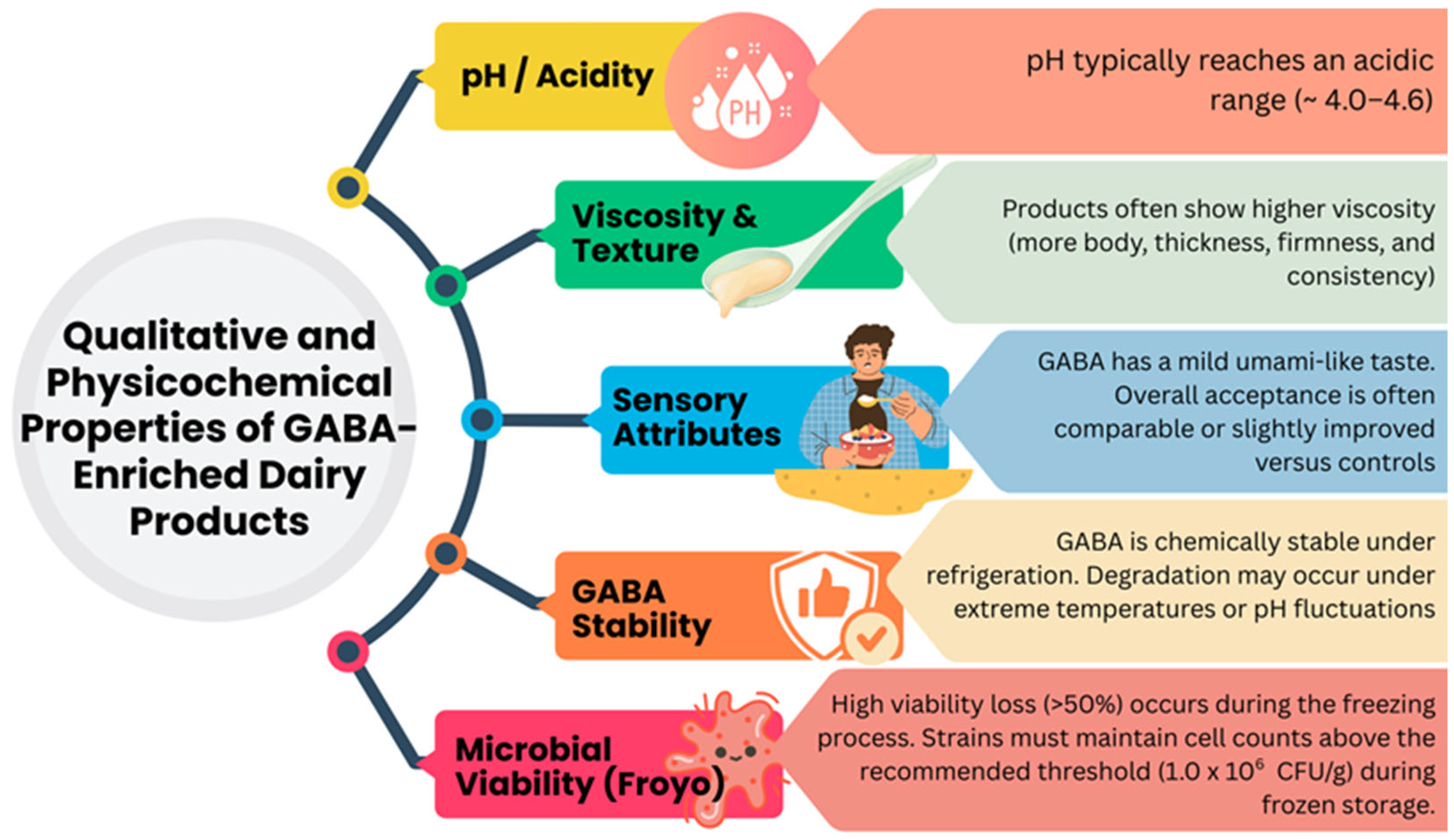
To ensure product quality, consumer acceptability, and therapeutic efficacy, GABA-rich yogurt and froyo must be thoroughly characterized in terms of their physicochemical, sensory, and stability attributes [141,153,156]. The incorporation of GABA, whether through fermentation or direct fortification, can influence parameters such as pH, viscosity, texture, flavor, and shelf life. Detailed characterization is essential for formulation optimization and for ensuring that functional claims meet both regulatory standards and consumer expectations.
GABA production through microbial fermentation is often associated with acidification due to lactic acid accumulation, with a pH of yogurt and froyo to around 4.0–4.6 [66,107,136,148,149,157]. Interestingly, the GAD pathway may help microbes buffer intracellular pH under acidic conditions by consuming protons during glutamate decarboxylation [148,149]. Studies have shown that in yogurts fermented with L. brevis or L. plantarum, when the fermentation time increased, the pH gradually decreased and the amount of viable LAB increased, but GABA reached a maximum value [107,114,124,150]. In addition to pH, viscosity can be influenced by GABA-producing strains due to variations in exopolysaccharide (EPS) production and proteolytic activity (Figure 3).
Yogurt made with GABA-producing strains presented a higher viscosity and, as a result, more body, thickness, firmness, and consistency [66,129].
While some LAB strains enhance texture and mouthfeel through EPS synthesis, excessive proteolysis can weaken the protein matrix and reduce viscosity, underscoring the importance of optimized fermentation conditions [141,158,159]. Similarly, texture attributes, such as firmness, cohesiveness, and creaminess, are critical for consumer perception and must be preserved in GABA-enriched products [71,141]. This is particularly important for frozen yogurt, where freezing impacts ice crystal formation and protein network structure.
It has been claimed that more than 50% of viable bacterial counts are lost during the freezing methods used to make frozen sweets. Therefore, in order to ensure bacteria viability throughout freezing procedures of frozen dessert manufacture and storage, bacteria cell protection strategies such as immobilization, microencapsulation or prebiotics addition like inulin, or stabilizers like κ-carrageenan, iso-malt and corn starch could be required [81,87,92,97,106,108,151,160,161,162,163]. Studies have shown that co-fermentation with L. plantarum or supplementation with GABA does not negatively impact textural properties when properly formulated [141,164,165].
Sensory acceptance is key to the market success of GABA-rich dairy products. GABA itself has a mild umami-like taste and generally does not impart off-flavors when used at moderate concentrations [114,123].
However, fermentation byproducts, acidity, and texture changes can affect flavor and mouthfeel [124]. Sensory panel evaluations have reported comparable or slightly improved ratings in flavor balance, creaminess, and overall acceptability for GABA-enriched yogurts versus controls, particularly when optimized GABA-producing strains are used [105,111]. In general, look, odor, thickness, acidity, and fluidity of the mixed-starter culture GABA-rich dairy products and the control did not differ significantly. Therefore, the addition of GABA-producing strains for milk fermentation did not significantly affect sensory evaluation overall [124].
GABA does not degrade during fermentation, making it ideal for fortifying yoghurt. At moderate concentrations, it improves texture, rheology and sensory properties without negatively affecting overall perception. Higher concentrations worsen texture due to gel instability and high pH [166].
Regarding stability and shelf-life, GABA is chemically stable under refrigeration, although extreme temperatures or pH fluctuations can lead to degradation [141]. In frozen products, GABA levels have been shown to remain stable over several weeks if bacterial activity is sufficiently halted during storage. Furthermore, the viability of starter cultures is a concern in frozen system, but the use of cryoprotectants such as skim milk powder, inulin, or glycerol can help maintain microbial viability above the recommended threshold (106 CFU/g) during frozen storage [78,80,167].
Specifically, during storage, the count remained below the initial value, indicating limited growth compared to inoculation, remaining within the recommended range of 106–107 CFU/mL, confirming that yogurt meets the requirements to be considered a probiotic food with potential health benefits [168]. Furthermore, no coliforms, molds, or yeasts were detected. Since the absence of these harmful microorganisms is essential to guarantee the product safety and general quality, this absence shows that the yogurt-frozen yogurt samples had excellent microbiological quality [51,168].
Overall, with appropriate strains selection, fermentation control, and ingredient synergy, GABA-enriched dairy products can achieve favorable physicochemical and sensory profiles while delivering scientifically supported health benefits.

5. Health Benefits and Applications

GABA-enriched functional foods have garnered heightened interest owing to their wide-ranging health benefits. Dairy-based products, such as yogurt and froyo, serve as effective delivery vehicles, providing a palatable and bioavailable means to consume GABA in amounts that exert physiological effects. As summarized in Table 3, various studies using in vitro assays, animal models, and clinical investigations have demonstrated the therapeutic potential of GABA in modulating blood pressure, alleviating anxiety and depression, and providing neuroprotective effects.
Based on Table 3, one of the most studied benefits of GABA is its antihypertensive effect. GABA lower blood pressure primarily by inhibiting angiotensin-converting enzyme (ACE), reducing vasoconstriction and promoting improved blood flow [170,171]. Several studies have validated this mechanism in functional food matrices. For instance, a GABA-enriched fermented milk exhibited significant ACE inhibitory activity (93 mU/mL) and effectively reduced blood pressure in animal models [17]. Further support comes from clinical trials, which confirm the blood pressure-lowering potential of GABA-fortified foods, specifically attributed to GABA (not to other components of milk such as calcium, magnesium or peptides), which acts peripherally by inhibiting the release of noradrenaline [176].
In a study of Nishimura et al. [25], the consumption of GABA-enriched white rice leds to significant reductions in both systolic and diastolic blood pressure in hypertensive adults. GABA plays a central role also in lowering hyperglycaemia, in improving gut microbiota in GABA soy fermented milk [177] and neuroinhibition, contributing to the regulation of stress and mood. This suggests synergistic effects between raw materials, GABA production, and bacteria. Its supplementation has been associated with reduced anxiety and alleviation of depressive symptoms, primarily by enhancing inhibitory signaling within the central nervous system [18,178]. Fermentation with Lactobacillus strains transforms products, making them healthy when enriched with high concentrations of GABA, which protects neuronal cells from toxins [175].
Several studies involving oral intake of GABA-enriched foods have reported beneficial outcomes, including reductions in cortisol levels, improvements in sleep quality, and increased alpha brainwave activity, which are indicators of relaxation [176,179]. GABA does not only act directly on the brain (as it may not easily cross the blood–brain barrier), but indirectly by regulating the gut microbiota, which influences the nervous system via the vagus nerve, neurotransmitters and short-chain fatty acids (SCFAs). This could open up avenues for natural treatments for insomnia, using probiotics and lactic ferments as a safe alternative to medication [173].
Actually, the incorporation of GABA in everyday foods like yogurt may serve as a dietary strategy to manage mild anxiety and stress-related conditions without pharmacological interventions. While the precise dosage-response relationship remains established in human populations, preclinical studies and pilot clinical trials on the anxiolytic and anti-depressant properties of GABA shows promising results [172].
Beyond its calming effects, GABA also exhibits neuroprotective properties. GABA-rich extracts have been shown to mitigate oxidative stress, reduce apoptosis, and enhance neuronal survival in cellular models exposed to toxic stimuli [180,181,182,183]. For instance, ethanolic extracts from germinated brown rice (GBR) containing GABA reduced mitochondrial membrane depolarization and phosphatidylserine translocation in SH-SY5Y cells, indicating protection against early apoptosis [180]. Similarly, a study using GABA-enriched chickpea milk demonstrated improved cell viability and reduced lactate dehydrogenase release in manganese-stressed PC12 cells [175]. These findings suggest that regular consumption of GABA-enriched foods could support brain health, particularly in aging populations or individuals at increased risk of neurodegenerative diseases.
Actually, the rising interest in natural nootropics (smart drugs), such as oxiracetam, and mood-supporting foods [184,185] has significantly expanded the market potential for GABA-enriched dairy products. Consumer surveys indicate an increasing demand for food products that support mental well-being and cardiovascular health [186].
In this evolving landscape, functional yogurts and frozen yogurts are well-positioned due to their familiarity, convenience, and broad demographic appeal. Analysis of market data reveals that the overall yogurt segment is expanding rapidly, providing a robust base for the integration of high-value nutraceuticals.
The yogurt category in particular is demonstrating vigorous expansion, with the market expected to increase from USD 2.9 billion in 2024 to USD 5.5 billion by 2034, registering a compound annual growth rate (CAGR) of 6.6% from 2025 to 2034 [187]. The frozen yoghurt market, on the other hand, although currently larger, is expanding at a slower pace, with growth from USD 3.6 billion in 2024 to USD 5.6 billion by 2034 and a projected CAGR of 4.6% [188]. Current consumption trends increasingly emphasize functionality, digestive wellness, and microbiome support. The yogurt category has evolved beyond simple probiotic claims to embrace prebiotics and postbiotics, creating a receptive environment for advanced functional ingredients. Within this context, GABA stands out as an ideal candidate. When incorporated through fermentation, GABA offers compounded benefits: viable lactic acid bacteria for gut health, additional physiological functions attributed to GABA, and the intrinsic nutrient density of dairy [141]. Integrating GABA into traditional yogurt aligns well with the category’s strong growth trajectory. With the GABA market projected to grow between 5.0% and 10.5% [189], adding it to a rapidly expanding yogurt base positions the product to shift from a simple daily staple to a targeted wellness solution.
Furthermore, as consumer preferences increasingly shift toward clean-label, minimally processed foods, the ability to generate GABA through natural fermentation confers an important competitive advantage. In-situ GABA biosynthesis allows manufacturers to meet both nutritional expectations and labeling preferences without relying on chemically synthesized additives, thereby reinforcing product transparency and consumer trust [190]. However, translating these opportunities into globally marketable products requires navigating complex and uneven regulatory landscapes. Regions differ widely in how they classify and authorize the use of novel or non-traditional functional ingredients. In the United States, GABA benefits from GRAS status, enabling its addition to a broad range of food products under established safety parameters. By contrast, the European Union adopts a more conservative stance, classifying GABA as a novel ingredient and imposing strict daily intake limits and stringent restrictions on health claims, which narrows the scope for marketing. Malaysia poses the most significant regulatory challenges. Here, GABA is not included within standard fortification schedules, and its use in food requires a formal petition process supported by extensive safety data, clear technological justification, and strict adherence to labeling rules, particularly those governing Quantitative Ingredient Declarations and additive classifications. Thus, in markets such as Malaysia, the major barrier to commercialization is not technical feasibility or consumer demand but regulatory approval procedures.
Taken together, while GABA-enriched yogurts and frozen yogurts hold strong commercial potential, supported by consumer trends, manufacturing feasibility, and growing international safety recognition, their long-term success will hinge on achieving an optimal balance between functional efficacy, sensory appeal, cost competitiveness, and regulatory compliance across diverse global markets.

6. Challenges and Future Perspectives

Despite the significant progress in developing GABA-enriched yogurt and froyo, several challenges remain in terms of optimizing production processes, ensuring consistency, and scaling for commercial success. Additionally, future research will need to address technological gaps, regulatory challenges, and evolving consumer expectations.
One of the primary challenges is ensuring consistent and high GABA yields during fermentation. Natural variability among microbial strains, fluctuations in raw material composition (e.g., milk or glutamate source), and environmental factors such as pH and temperature can affect GABA synthesis [106,111]. Furthermore, the selection of suitable starter cultures that simultaneously offer robust fermentation performance and high GABA productivity, without compromising sensory quality, remains a critical issue.
From a formulation standpoint, the stability of GABA during storage, particularly in frozen systems like froyo, must be controlled. Although GABA is chemically stable under cold conditions, microbial and enzymatic activity during storage could alter product composition. However, if the product is fortified and optimized, its antioxidant activity, sensory attributes, physicochemical characteristics, and microbiological stability of can be improved [191]. This modification may not influence the degradation of GABA; rather, it could potentially enhance GABA levels. Microbial activity during cold storage is generally reduced depending on the temperature, but residual activity may contribute to GABA production. Nonetheless, these ongoing processes raiser concerns regarding potential changes in product taste and texture. In fermented products, flavor, texture, and aroma are influenced by fermentation duration, potentially resulting in an unintended or excessively pronounced taste. Additionally, regulatory considerations for labeling and health claims differ between countries, affecting how GABA-enriched products can be marketed. For instance, while GABA is generally recognized as safe (GRAS) in many regions [192], claims regarding specific health benefits, such as blood pressure reduction or anxiety relief, typically require clinical substantiation.
The discovery and development of novel high-yield GABA-producing strains—including genetically enhanced or adaptively evolved variants—are keys to overcome yield bottlenecks. Advances in gene editing and strain engineering have enabled the identification of strains with significantly enhanced GABA-producing capabilities [193]. Genomic editing tools, notably the well-known CRISPR-Cas9, offer a powerful approach to genetically modify lactic acid bacteria including Lactobacillus spp., Bifidobacterium spp. and S. thermophilus [194,195,196,197]. Using CRISPR, even other bacterial species such as E. coli [198] can be engineered to exhibit enhanced GABA-producing. The potential applications are extensive: LAB strains with existing GABA-producing capacity can be optimized, and their functional genes can be transferred to other beneficial microorganisms via plasmids. This approach would enhance their trait and functionality, making them valuable in food industry. CRISPR can also improve fermentation properties of LABs, enabling precision engineering of metabolic pathways in generally recognized as safe (GRAS) microorganisms to efficiently utilize low-cost substrates for food production [199]. Beyond production efficiency, genome editing can enhance the sensory properties of fermented foods, including flavor, color, and texture [200,201,202]. While gene editing may be a futuristic solution for obtaining superior GABA-producing strains, exploring the biodiversity remains critical. Traditional fermented foods, unique microbiomes, and underutilized fermented products may harbor strains with exceptional GABA-producing potential [105,115]. The search for GABA-producing microorganisms dates back to the 1950s, when yeast extracts were first identified as GABA sources [106]. Since then, notable species, such as L. fermentum 4-17, isolated from kashkineh, an Iranian cereal based fermented food [168], have been identified, capable of producing up to 14.846 mg/100 mL of GABA [129].
Fermented foods may also harbor multiple GABA-producing bacterial species. For example, soy sauce has been used to isolate two distinct GABA-producing microbes: Bacillus cereus strain KBC, capable of producing 3393 mg/L of GABA, and Tetragenococcus halophilus strain KBC, which can produce 653.1 mg/L of GABA [10,121,122].
The isolation of GABA-producing microbes from food sources is particularly beneficial, as these microorganisms are already commonly consumed, which implies they are safe for human consumption. However, to establish their GRAS status, additional testing for pathogenicity and toxicity may be required to provide concrete evidence of their safety.
In addition to optimize microbial strain, enhancing fermentation techniques through bioprocess engineering, co-culturing methods, and precision fermentation can significantly boost GABA synthesis while maintaining desirable sensory and nutritional qualities [10]. One effective approach to optimize fermentation conditions is Response Surface Methodology (RSM), a statistical tool widely used to identify the ideal conditions, such as substrate volume, pH, temperature, inoculum percentage, aeration, and agitation speed, that maximize GABA yield [158]. Innovative techniques like two-stage fermentation (e.g., acidification followed by GABA conversion) or the use of immobilized cells can help decouple acid production from GABA biosynthesis, improving both yield and product quality [157]. Moreover, smart fermentation systems could also be researched and applied in order to maximize the production of GABA as well as other beneficial compounds in fermented foods. The integration of cutting-edge technologies such as biosensors, internet of things (IoT), artificial intelligence (AI) as well as machine learning may revolutionize the production of fermented foods, especially those rich in GABA. As highlighted by Yee et. al. [203], the incorporation of adaptive control systems into fermentative vessels can enable real-time monitoring of GABA production. These systems, using machine learning and AI, would adjust fermentation conditions dynamically based on the rate of GABA synthesis. For example, if its production begins to plateau due to substrate depletion, the system could automatically supply additional substrates to sustain optimal production levels. These smart fermentation systems could be applied in various feeding strategies, including continuous, batch, or fed-batch systems, enabling either batch-wise or continuous production of fermented foods.
The integration of these advanced technologies into fermentation processes could not only revolutionize the production of GABA-rich fermented foods but also transform the broader food industry. As a result, more nutraceuticals and superfoods—foods with health benefits beyond basic nutrition—could be developed, offering new opportunities for functional food production.
There is significant potential to expand GABA incorporation into a wider range of functional foods, extending beyond just yogurt and frozen yogurt (froyo). The development of GABA-enriched raw ingredients in food product formulations can help promote its diverse health benefits. Various raw food ingredients, such as rice, fruits, berries, and mushrooms, have been shown to naturally contain GABA [11], and these could be integrated into everyday foods. However, the use of natural ingredients may not be enough to create a truly GABA-rich product, as its content may diminish when mixed with other ingredients. To create a genuinely GABA-rich functional food, a product or dish could be developed using only GABA-rich raw materials. These could include smoothies, dairy-alternative beverages, and frozen desserts tailored to specific consumer groups, such as older adults or athletes who may benefit from increased GABA intake. For example, a smoothie traditionally made with ice cream could be reimagined with frozen yogurt as a GABA-rich alternative, incorporating GABA-rich fruits and berries like apples, mulberries, and grapes for natural flavoring. Recipes like these, using only GABA-enriched ingredients, would certainly meet the criteria of being classified as GABA-rich. However, if only foods do not appeal to general public, future formulations could combine its use with other bioactive compounds, such as prebiotics, polyphenols, or magnesium, to create synergistic health effects. These combinations could be supported by well-designed clinical trials to validate their benefits.
Furthermore, research into encapsulation technologies could enhance GABA stability and targeted delivery, improving its bioavailability and potentially masking any sensory drawbacks. For commercial success, interdisciplinary collaboration between food technologists, microbiologists, and marketing professionals will be crucial in moving GABA-based innovations from lab to market—turning concepts from the “bench to the shelf” or “bench to fork.” As mentioned above, the trend of creating plant-based yogurt is one of the emerging trends in food industry. As mentioned above, the trend towards creating plant-based yoghurts is one of the emerging trends in the food industry. This trend stems from the lifestyle choices of many people who practice vegetarianism and veganism. To meet the needs of these consumer groups, industries and researchers have turned to plant-based alternatives to dairy milk. These alternatives can be derived from a variety of plants, including coconut, soy, rice, oats, hemp, flax, peas and quinoa, as well as nuts such as almonds, pistachio and cashews [50,204].
The exploration of plant-based milks has paved the way for the development of plant-based yogurt alternatives, such as those made from soy milk [205], almond milk [75,206,207], quinoa [208], peanut milk [159], cashew milk and coconut cream or milk [73,207], pistachio [76,77,209,210], oat milk [211], chickpea [74], potato milk [174], and brown rice milk [127]. This research trend highlights the boom in phytoyogurt development, as industry continues to explore new plant-based yogurt varieties. These innovations pave the way for more inclusive options that cater to a wider range of dietary preferences, allowing individuals to enjoy the health benefits of probiotics and GABA, just like traditional dairy yogurt. As the market for plant-based foods continues to grow, these dairy-free alternatives could become a mainstream option for people seeking both nutritional benefits and inclusivity.

7. Conclusions

Incorporating GABA into yogurt and frozen yogurt represents a compelling intersection of food science and preventive health. Through microbial or enzymatic strategies, GABA can be efficiently produced and retained in dairy matrices, enabling the development of functional foods with tangible physiological benefits. The well-documented health advantages of GABA, including cardiovascular regulation, improved mental well-being, and neuroprotection, highlight its potential as a dietary intervention for modern lifestyle-associated disorders. Although challenges remain in optimizing microbial strains, maintaining sensory quality, and securing regulatory approval, advancements in fermentation technology and bioprocessing are offering promising solutions. Continued exploration of high-GABA-producing strains, smart fermentation systems, and synergistic bioactive formulations holds the key to future innovation in this field. Ultimately, GABA-enriched dairy products stand as practical and appealing vehicles for delivering scientifically supported health benefits to a broad consumer base. With ongoing research and innovation in phyto-yogurts enriched with GABA, these products have the potential to make a meaningful contribution to public health, addressing issues such as stress, cardiovascular risk, and neurodegeneration, while remaining both accessible and enjoyable for all.

Author Contributions

Conceptualization, M.A.U.-R., T.D.R., W.A.A.Q.I.W.-M. and N.A.Z.-A.; writing—original draft preparation, M.A.U.-R., N.A.Z.-A., R.B.R.-R., T.D.R. and C.S.Y.; writing—review and editing, M.A.U.-R., C.S.Y., R.B.R.-R., N.A.Z.-A., T.D.R., Z.I., A.R., S.N., P.M. and N.‘A.A.R.; visualisation, W.A.A.Q.I.W.-M., C.S.Y., R.B.R.-R., N.‘A.A.R., T.D.R. and Z.I.; supervision, W.A.A.Q.I.W.-M., Z.I., T.D.R. and N.‘A.A.R. All authors have read and agreed to the published version of the manuscript.

Funding

This work is supported by Universiti Malaya Partnership Grant (MG002-2025: Formulation of Lampam Sungai Sustainable Fish Feed Using Petronas Waste, and MG004-2025: Transforming Soy Sauce Processing Liquid Waste into Essential Polyunsaturated Fatty Acids Utilizing Thraustochytrids from Malaysian Mangroves). This work was also supported by the European Commission—NextGenerationEU, Project SUS- MIRRI.IT “Strengthening the MIRRI Italian Research Infrastructure for Sustainable Bioscience and Bioeconomy”, code n. IR0000005.

Institutional Review Board Statement

Not applicable.

Informed Consent Statement

Not applicable.

Data Availability Statement

No new data were created or analyzed in this study. Data sharing is not applicable to this article.

Acknowledgments

The author thanks the Faculty of Engineering UPM and Institute of Biological Sciences, UM for providing facilities and resources to support the present study.

Conflicts of Interest

The authors declare no conflicts of interest.

Abbreviations

The following abbreviations are used in this manuscript:
ACEAngiotensin-converting enzyme
AIArtificial Intelligence
CFUsColony forming units
CMCcarboxymethyl cellulose
CRISPRClustered Regularly Interspaced Short Palindromic Repeats
DNADeoxyribonucleic acid
EFSAEuropean Food Safety Authority
GABAGamma-aminobutyric acid
GABA-TGABA transaminase
GABPGABA permease
GADGlutamate decarboxylase
GRASGenerally recognized as safe
HFHigh fat
IoTInternet of Things
LABLactic acid Bacteria
LFLow fat
MSGMonosodium glutamate
NCDNon-communicable diseases
NFNon-fat
PBMAPlant-based milk Alternatives
PLPPyridoxal 5′-phosphate
RSMResponse Surface Methodology
SHRSpontaneously hypertensive rats
SMPSkimmed milk powder
SSADHSuccinic semialdehyde dehydrogenase
TCATricarboxylic Acid
USDAUnited States Department of Agriculture

References

  1. Sarasa, S.B.; Mahendran, R.; Muthusamy, G.; Thankappan, B.; Selta, D.R.F.; Angayarkanni, J. A brief review on the non-protein amino acid, gamma-amino butyric acid (GABA): Its production and role in microbes. Curr. Microbiol. 2020, 77, 534–544. [Google Scholar] [CrossRef]
  2. de Leon, A.S.; Tadi, P. Biochemistry, Gamma Aminobutyric Acid. In StatPearls; StatPearls Publishing: Treasure Island, FL, USA, 2019. [Google Scholar]
  3. Kalu, A.U.; Wan-Mohtar, W.A.A.Q.I.; Noor, W.S.A.W.M.; Mohd Zaini, N.A. Assessment of GABA enrichment and probiotic potential in fermented okpeye by Bacillus amyloliquefaciens AUK. J. Food Sci. Technol. 2025, 62, 2291–2302. [Google Scholar] [CrossRef] [PubMed]
  4. Jewett, B.E.; Sharma, S. Physiology, GABA. In StatPearls; StatPearls Publishing: Treasure Island, FL, USA, 2025. [Google Scholar]
  5. Chen, R.J.; Sharma, S. GABA Receptor. In StatPearls; StatPearls Publishing: Treasure Island, FL, USA, 2025. [Google Scholar]
  6. Liwinski, T.; Lang, U.E.; Bruhl, A.B.; Schneider, E. Exploring the therapeutic potential of gamma-aminobutyric acid in stress and depressive disorders through the gut-brain axis. Biomedicines 2023, 11, 3128. [Google Scholar] [CrossRef] [PubMed]
  7. Choat, H.M.; Martin, A.; Mick, G.J.; Heath, K.E.; Tse, H.M.; McGwin, G.; McCormick, K.L. Effect of gamma aminobutyric acid (GABA) or GABA with glutamic acid decarboxylase (GAD) on the progression of type 1 diabetes mellitus in children: Trial design and methodology. Contemp. Clin. Trials 2019, 82, 93–100. [Google Scholar] [CrossRef]
  8. Xu, J.; Ge, Z.; Wang, H.; Zhang, C.; Xu, J.; Li, Y.; Yang, X.; Zhang, L.; Li, Z.; Liu, Z. Long-term GABA supplementation mitigates anxiety by modulating complement and neuroinflammatory pathways. Npj Sci. Food 2025, 9, 60. [Google Scholar] [CrossRef]
  9. Barakat, H.; Aljutaily, T. Role of γ-aminobutyric acid (GABA) as an inhibitory neurotransmitter in diabetes management: Mechanisms and therapeutic implications. Biomolecules 2025, 15, 399. [Google Scholar] [CrossRef]
  10. Sassi, S.; Ilham, Z.; Jamaludin, N.S.; Halim-Lim, S.A.; Shin Yee, C.; Weng Loen, A.W.; Poh Suan, O.; Ibrahim, M.F.; Wan-Mohtar, W.A.A.Q.I. Critical optimized conditions for gamma-aminobutyric acid (GABA)-producing Tetragenococcus halophilus strain KBC from a commercial soy sauce Moromi in batch fermentation. Fermentation 2022, 8, 409. [Google Scholar] [CrossRef]
  11. Hou, D.; Tang, J.; Feng, Q.; Niu, Z.; Shen, Q.; Wang, L.; Zhou, S. Gamma-aminobutyric acid (GABA): A comprehensive review of dietary sources, enrichment technologies, processing effects, health benefits, and its applications. Crit. Rev. Food Sci. Nutr. 2024, 64, 8852–8874. [Google Scholar] [CrossRef]
  12. Weerawatanakorn, M.; He, S.; Chang, C.H.; Koh, Y.C.; Yang, M.J.; Pan, M.H. High gamma-aminobutyric acid (GABA) oolong tea alleviates high-fat diet-induced metabolic disorders in mice. Acs Omega 2023, 8, 33997–34007. [Google Scholar] [CrossRef]
  13. Oketch-Rabah, H.A.; Madden, E.F.; Roe, A.L.; Betz, J.M. United States Pharmacopeia (USP) safety review of gamma-aminobutyric acid (GABA). Nutrients 2021, 13, 2742. [Google Scholar] [CrossRef]
  14. Solas, M.; Puerta, E.; Ramirez, M.J. Treatment options in Alzheimer s disease: The GABA story. Curr. Pharm. Des. 2015, 21, 4960–4971. [Google Scholar] [CrossRef]
  15. Kuruvilla, K.P.; Nandhu, M.; Paul, J.; Paulose, C. Oxidative stress mediated neuronal damage in the corpus striatum of 6-hydroxydopamine lesioned Parkinson’s rats: Neuroprotection by serotonin, GABA and bone marrow cells supplementation. J. Neurol. Sci. 2013, 331, 31–37. [Google Scholar] [CrossRef]
  16. Almutairi, S.; Sivadas, A.; Kwakowsky, A. The effect of oral GABA on the nervous system: Potential for therapeutic intervention. Nutraceuticals 2024, 4, 241–259. [Google Scholar] [CrossRef]
  17. Liu, C.F.; Tung, Y.T.; Wu, C.L.; Lee, B.-H.; Hsu, W.-H.; Pan, T.M. Antihypertensive effects of Lactobacillus-fermented milk orally administered to spontaneously hypertensive rats. J. Agric. Food Chem. 2011, 59, 4537–4543. [Google Scholar] [CrossRef]
  18. Yoto, A.; Murao, S.; Motoki, M.; Yokoyama, Y.; Horie, N.; Takeshima, K.; Masuda, K.; Kim, M.; Yokogoshi, H. Oral intake of γ-aminobutyric acid affects mood and activities of central nervous system during stressed condition induced by mental tasks. Amino Acids 2012, 43, 1331–1337. [Google Scholar] [CrossRef]
  19. Islam, M.Z.; Shim, M.-J.; Jeong, S.-Y.; Lee, Y.-T. Effects of soaking and sprouting on bioactive compounds of black and red pigmented rice cultivars. Int. J. Food Sci. Technol. 2022, 57, 201–209. [Google Scholar] [CrossRef]
  20. An, M.-K.; Ahn, J.-B.; Lee, S.-H.; Lee, K.-G. Anaylsis of γ-aminobutyric acid (GABA) content in germinated pigmented rice. Korean J. Food Sci. Technol. 2010, 42, 632–636. [Google Scholar]
  21. Sitanggang, A.B.; Joshua, M.; Munarko, H.; Kusnandar, F.; Budijanto, S. Increased γ-aminobutyric acid content of germinated brown rice produced in membrane reactor. Food Technol. Biotechnol. 2021, 59, 295–305. [Google Scholar] [CrossRef] [PubMed]
  22. Zhang, B.; Wang, R.-M.; Chen, P.; He, T.-S.; Bai, B. Study on zinc accumulation, bioavailability, physicochemical and structural characteristics of brown rice combined with germination and zinc fortification. Food Res. Int. 2022, 158, 111450. [Google Scholar] [CrossRef] [PubMed]
  23. Müller, C.P.; Hoffmann, J.F.; Ferreira, C.D.; Diehl, G.W.; Rossi, R.C.; Ziegler, V. Effect of germination on nutritional and bioactive properties of red rice grains and its application in cupcake production. Int. J. Gastron. Food Sci. 2021, 25, 100379. [Google Scholar] [CrossRef]
  24. Ding, J.; Ulanov, A.V.; Dong, M.; Yang, T.; Nemzer, B.V.; Xiong, S.; Zhao, S.; Feng, H. Enhancement of gamma-aminobutyric acid (GABA) and other health-related metabolites in germinated red rice (Oryza sativa L.) by ultrasonication. Ultrason. Sonochem. 2018, 40, 791–797. [Google Scholar] [CrossRef]
  25. Nishimura, M.; Yoshida, S.-I.; Haramoto, M.; Mizuno, H.; Fukuda, T.; Kagami-Katsuyama, H.; Tanaka, A.; Ohkawara, T.; Sato, Y.; Nishihira, J. Effects of white rice containing enriched gamma-aminobutyric acid on blood pressure. J. Tradit. Complement. Med. 2016, 6, 66–71. [Google Scholar] [CrossRef]
  26. Rico, D.; Peñas, E.; García, M.d.C.; Martínez-Villaluenga, C.; Rai, D.K.; Birsan, R.I.; Frias, J.; Martín-Diana, A.B. Sprouted barley flour as a nutritious and functional ingredient. Foods 2020, 9, 296. [Google Scholar] [CrossRef]
  27. Paucar-Menacho, L.M.; Martinez-Villaluenga, C.; Dueñas, M.; Frias, J.; Peñas, E. Optimization of germination time and temperature to maximize the content of bioactive compounds and the antioxidant activity of purple corn (Zea mays L.) by response surface methodology. LWT-Food Sci. Technol. 2017, 76, 236–244. [Google Scholar] [CrossRef]
  28. Sharma, S.; Saxena, D.C.; Riar, C.S. Using combined optimization, GC–MS and analytical technique to analyze the germination effect on phenolics, dietary fibers, minerals and GABA contents of Kodo millet (Paspalum scrobiculatum). Food Chem. 2017, 233, 20–28. [Google Scholar] [CrossRef]
  29. Kim, M.J.; Kwak, H.S.; Kim, S.S. Effects of germination on protein, γ-aminobutyric acid, phenolic acids, and antioxidant capacity in wheat. Molecules 2018, 23, 2244. [Google Scholar] [CrossRef]
  30. Pencheva, D.; Teneva, D.; Denev, P. Validation of HPLC method for analysis of gamma-aminobutyric and glutamic acids in plant foods and medicinal plants. Molecules 2023, 28, 84. [Google Scholar] [CrossRef]
  31. Ramos-Ruiz, R.; Poirot, E.; Flores-Mosquera, M. GABA, a non-protein amino acid ubiquitous in food matrices. Cogent Food Agric. 2018, 4, 1534323. [Google Scholar] [CrossRef]
  32. Gómez-Favela, M.A.; Gutiérrez-Dorado, R.; Cuevas-Rodríguez, E.O.; Canizalez-Román, V.A.; del Rosario León-Sicairos, C.; Milán-Carrillo, J.; Reyes-Moreno, C. Improvement of chia seeds with antioxidant activity, gaba, essential amino acids, and dietary fiber by controlled germination bioprocess. Plant Foods Hum. Nutr. 2017, 72, 345–352. [Google Scholar] [CrossRef] [PubMed]
  33. Morita, N.; Miyake, K.; Maeda, T.; Van Hung, P. Germinated Buckwheat for Functional Foods. In Advances in Cereal and Pseudocereal Research for Functional Foods; Morita, N., Van Hung, P., Maeda, T., Eds.; US: Nova Science Publishers, Inc.: Hauppauge, NY, USA, 2013; pp. 75–90. [Google Scholar]
  34. Martínez-Villaluenga, C.; Kuo, Y.-H.; Lambein, F.; Frías, J.; Vidal-Valverde, C. Kinetics of free protein amino acids, free non-protein amino acids and trigonelline in soybean (Glycine max L.) and lupin (Lupinus angustifolius L.) sprouts. Eur. Food Res. Technol. 2006, 224, 177–186. [Google Scholar] [CrossRef]
  35. Li, L.; Liu, B.; Zheng, X. Bioactive ingredients in adzuki bean sprouts. J. Med. Plants Res. 2011, 5, 5894–5898. [Google Scholar]
  36. Pradeep, S.R.; Malleshi, N.G.; Guha, M. Germinated millets and legumes as a source of gamma-aminobutyric acid. World Appl. Sci. J. 2011, 14, 108–113. [Google Scholar]
  37. Trobacher, C.P.; Clark, S.M.; Bozzo, G.G.; Mullen, R.T.; DeEll, J.R.; Shelp, B.J. Catabolism of GABA in apple fruit: Subcellular localization and biochemical characterization of two γ-aminobutyrate transaminases. Postharvest Biol. Technol. 2013, 75, 106–113. [Google Scholar] [CrossRef]
  38. Jia, H.; Okamoto, G.; Hirano, K. Effect of amino acid composition on the taste of ‘Hakuho’ peaches (Prunus persica Batsch) grown under different fertilizer levels. Hort. J. 2000, 69, 135–140. [Google Scholar] [CrossRef]
  39. Gutiérrez-Gamboa, G.; Carrasco-Quiroz, M.; Martínez-Gil, A.; Pérez-Álvarez, E.P.; Garde-Cerdán, T.; Moreno-Simunovic, Y. Grape and wine amino acid composition from Carignan noir grapevines growing under rainfed conditions in the Maule Valley, Chile: Effects of location and rootstock. Food Res. Int. 2018, 105, 344–352. [Google Scholar] [CrossRef]
  40. Wu, Z.-C.; Yang, Z.-Y.; Li, J.-G.; Chen, H.-B.; Huang, X.-M.; Wang, H.-C. Methyl-inositol, γ-aminobutyric acid and other health benefit compounds in the aril of litchi. Int. J. Food Sci. Nutr. 2016, 67, 762–772. [Google Scholar] [CrossRef]
  41. Lee, Y.; Hwang, K.T. Changes in physicochemical properties of mulberry fruits (Morus alba L.) during ripening. Sci. Hortic. 2017, 217, 189–196. [Google Scholar] [CrossRef]
  42. Lee, Y.; Lee, J.H.; Kim, S.D.; Chang, M.S.; Jo, I.S.; Kim, S.J.; Hwang, K.T.; Jo, H.B.; Kim, J.H. Chemical composition, functional constituents, and antioxidant activities of berry fruits produced in Korea. J. Korean Soc. Food Sci. Nutr. 2015, 44, 12. [Google Scholar] [CrossRef]
  43. Deewatthanawong, R.; Nock, J.F.; Watkins, C.B. γ-Aminobutyric acid (GABA) accumulation in four strawberry cultivars in response to elevated CO2 storage. Postharvest Biol. Technol. 2010, 57, 92–96. [Google Scholar] [CrossRef]
  44. Macrae, E.A.; Redgwell, R.J. Amino-acids in kiwifruit. Distribution within the fruit during fruit maturation. N. Z. J. Crop Hortic. Sci. 1992, 20, 329–336. [Google Scholar] [CrossRef]
  45. Collado, J.; Pérez, Z.C.; Medina, S.; Mellisho, C.D.; Hernández, P.R.; Galindo, A.; Egea, I.; Romojaro, F.; Ferreres, F.; Torrecillas, A.; et al. Effects of water deficit during maturation on amino acids and jujube fruit eating quality. Maced. J. Chem. Chem. Eng. 2014, 33, 105–119. [Google Scholar] [CrossRef]
  46. Zhou, M.; Ndeurumio, K.H.; Zhao, L.; Zhuoyan, H. Impact of precooling and controlled-atmosphere storage on gamma-aminobutyric acid (GABA) accumulation in longan (Dimocarpus longan lour.) fruit. J. Agric. Food Chem. 2016, 64, 6443–6450. [Google Scholar] [CrossRef]
  47. Saito, T.; Matsukura, C.; Sugiyama, M.; Watahiki, A.; Ohshima, I.; Iijima, Y.; Konishi, C.; Fujii, T.; Inai, S.; Fukuda, N. Screening for γ-aminobutyric acid (GABA)-rich tomato varieties. J. Jpn. Soc. Hortic. Sci. 2008, 77, 242–250. [Google Scholar] [CrossRef]
  48. Fan, T.W.M.; Higashi, R.M.; Lane, A.N.; Jardetzky, O. Combined use of 1H-NMR and GC-MS for metabolite monitoring and in vivo 1H-NMR assignments. Biochim. Biophys. Acta 1986, 882, 154–167. [Google Scholar] [CrossRef]
  49. Oh, S.-H.; Moon, Y.-J.; Oh, C.-H. γ-aminobutyric acid (GABA) content of selected uncooked foods. J. Food Sci. Nutr. 2003, 8, 75–78. [Google Scholar] [CrossRef]
  50. Gamboa-Santos, J.; Soria, A.C.; Corzo-Martínez, M.; Villamiel, M.; Montilla, A. Effect of storage on quality of industrially dehydrated onion, garlic, potato and carrot. J. Food Nutr. Res. 2012, 51, 132–144. [Google Scholar]
  51. Lee, Y.R. Nutritional components and antioxidant activity of dry bitter melon (Momordica charantia L.). J. Korean Soc. Food Sci. Nutr. 2016, 45, 518–523. [Google Scholar] [CrossRef]
  52. Eum, H.L.; Yi, T.G.; Hong, S.J.; Park, N.-I. Variations of bioactive compound contents and antioxidant capacity of asparagus seedlings in 23 varieties. Hortic. Sci. Technol. 2020, 38, 291–302. [Google Scholar] [CrossRef]
  53. Kim, Y.B.; Lee, M.-K.; Kim, S.-J.; Kim, H.H.; Chung, E.; Lee, J.-H.; Park, S.U. Accumulation of gamma aminobutyric acid and transcription of glutamate decarboxylase in Brassica juncea (L.). Czern. Plant Omics 2013, 6, 263–267. [Google Scholar]
  54. Palma, F.; Carvajal, F.; Jamilena, M.; Garrido, D. Contribution of polyamines and other related metabolites to the maintenance of zucchini fruit quality during cold storage. Plant Physiol. Biochem. 2014, 82, 161–171. [Google Scholar] [CrossRef]
  55. Al-Taher, F.; Nemzer, B. Determination of gamma-aminobutyric acid (GABA) content in grains and cruciferous vegetable seeds. J. Food Res. 2019, 8, 6. [Google Scholar] [CrossRef]
  56. Chen, Q.; Li, M.S.; Ding, W.; Tao, M.M.; Li, M.R.; Qi, Q.; Li, Y.H.; Li, J.; Zhang, L. Effects of high N2/CO2 in package treatment on polyamine-derived 4-Aminobutyrate (GABA) biosynthesis in cold-stored white mushrooms (Agaricus bisporus). Postharvest Biol. Technol. 2020, 162, 111093. [Google Scholar] [CrossRef]
  57. Lo, Y.-C.; Lin, S.-Y.; Ulziijargal, E.; Chen, S.-Y.; Chien, R.-C.; Tzou, Y.-J.; Mau, J.-L. Comparative study of contents of several bioactive components in fruiting bodies and mycelia of culinary-medicinal mushrooms. Int. J. Med. Mushrooms 2012, 14, 357–363. [Google Scholar] [CrossRef]
  58. Chen, W.; Li, W.; Yang, Y.; Yu, H.; Zhou, S.; Feng, J.; Li, X.; Liu, Y. Analysis and evaluation of tasty components in the pileus and stipe of Lentinula edodes at different growth stages. J. Agric. Food Chem. 2015, 63, 795–801. [Google Scholar] [CrossRef] [PubMed]
  59. Wang, Q.; Meng, L.; Wang, X.; Zhao, W.; Shi, X.; Wang, W.; Li, Z.; Wang, L. The yield, nutritional value, umami components and mineral contents of the first-flush and second-flush Pleurotus pulmonarius mushrooms grown on three forestry wastes. Food Chem. 2022, 397, 133714. [Google Scholar] [CrossRef] [PubMed]
  60. Marseglia, A.; Palla, G.; Caligiani, A. Presence and variation of γ-aminobutyric acid and other free amino acids in cocoa beans from different geographical origins. Food Res. Intern. 2014, 63, 360–366. [Google Scholar] [CrossRef]
  61. Qi, H.J.; Yang, Y.; Wang, L.B.; Xu, Y.Q.; Qu, S.P. Determination of bioactive ingredients in five pumpkin seeds cultivars. Adv. Mater. Res. 2012, 554, 985–989. [Google Scholar] [CrossRef]
  62. Limon, A.; Gallegos-Perez, J.-L.; Reyes-Ruiz, J.M.; Aljohi, M.A.; Alshanqeeti, A.S. The endogenous GABA bioactivity of camel, bovine, goat and human milks. Food Chem. 2014, 145, 481–487. [Google Scholar] [CrossRef]
  63. Kelly, M.T.; Blaise, A.; Larroque, M. Rapid automated high performance liquid chromatography method for simultaneous determination of amino acids and biogenic amines in wine, fruit and honey. J. Chromatogr. A 2010, 1217, 7385–7392. [Google Scholar] [CrossRef]
  64. Paramás, A.M.G.; Gómez Bárez, J.A.; Marcos, C.C.; García-Villanova, R.J.; Sánchez, J.S. HPLC-fluorimetric method for analysis of amino acids in products of the hive (honey and bee-pollen). Food Chem. 2006, 95, 148–156. [Google Scholar] [CrossRef]
  65. Park, N.; Lee, T.-K.; Nguyen, T.T.H.; An, E.-B.; Kim, N.-M.; You, Y.-H.; Park, T.-S.; Kim, D. The effect of fermented buckwheat on producing l-carnitine- and γ-aminobutyric acid (GABA)-enriched designer eggs. J. Sci. Food Agric. 2017, 97, 2891–2897. [Google Scholar] [CrossRef]
  66. Icer, M.A.; Sarikaya, B.; Kocyigit, E.; Atabilen, B.; Çelik, M.N.; Capasso, R.; Ağagündüz, D.; Budán, F. Contributions of gamma-aminobutyric acid (GABA) produced by lactic acid bacteria on food quality and human health: Current applications and future prospects. Foods 2024, 13, 2437. [Google Scholar] [CrossRef]
  67. Li, B.; Ye, L.; Zhao, Y.; Liu, Y.; Chen, Y.; Zhang, H. A comprehensive review of probiotic yogurt: Nutritional modulation, flavor improvement, health benefits, and advances in processing techniques. Agric. Prod. Process. Storage 2025, 1, 17. [Google Scholar] [CrossRef]
  68. Zahia-Azizan, N.A.; Lim, T.C.; Siva, R.; Wan-Mohtar, W.A.A.Q.I. Development of γ-aminobutyric acid (GABA)-rich yoghurt using Tetragenococcus halophilus strain KBC isolated from a commercial soy sauce moromi. Food Res. 2022, 6, 39–47. [Google Scholar] [CrossRef]
  69. Savaiano, D.A.; Hutkins, R.W. Yogurt, cultured fermented milk, and health: A systematic review. Nutr. Rev. 2021, 79, 599–614. [Google Scholar] [CrossRef]
  70. Gengan, G.; Mohd Zaini, N.; Saari, N.; Meor Hussin, A.; Jaafar, A.H.; Hasan, H.; Lim, E.; Wan-Mohtar, W.; Abd Rahim, M.H. Nutritional and therapeutic benefits of coconut milk and its potential as a plant-based functional yogurt alternative: A review. Food Sci. Hum. Wellness 2025, 14, 9250004. [Google Scholar] [CrossRef]
  71. Sfakianakis, P.; Tzia, C. Conventional and innovative processing of milk for yogurt manufacture; development of texture and flavor: A review. Foods 2014, 3, 176–193. [Google Scholar] [CrossRef] [PubMed]
  72. Setyawardani, T.; Sumarmono, J.; Rahardjo, A.; Fadhlurrohman, I. Quality of yogurt produced from various types of milk as raw materials. IOP Conf. Ser. Earth Environ. Sci. 2024, 1292, 012020. [Google Scholar] [CrossRef]
  73. Gengan, G.; Sha’ari, A.A.M.; Khalid, N.I.; Mohsin, A.Z.; Azman, E.M.; Mahmud, N.K.; Rashid, A.; Abd Rahim, M.H. Properties of malaysian coconut-breed (matag, mawa, and pandan) yogurts: A preliminary analysis of chemical, microbiological, and sensorial characteristics. J. Biochem. Microbiol. Biotechnol. 2024, 12, 93–95. [Google Scholar] [CrossRef]
  74. Fazla, S.N.M.; Marzlan, A.A.; Hussin, A.S.M.; Rahim, M.H.A.; Madzuki, I.N.; Mohsin, A.Z. Physicochemical, microbiological, and sensorial properties of chickpea yogurt analogue produced with different types of stabilizers. Discov. Food 2023, 3, 19. [Google Scholar] [CrossRef]
  75. Zainuddin, N.; Khalid, N.I.; Mohsin, A.Z.; Azman, E.M.; Mahmud, N.K.; Rashid, A.; Abd Rahim, M.H. Physicochemical, microbiological, and sensory properties of almond milk yogurt-like products with varied concentrations of tapioca starch as stabilizer. J. Biochem. Microbiol. Biotechnol. 2024, 12, 90–92. [Google Scholar] [CrossRef]
  76. Reale, A.; Puppo, M.C.; Boscaino, F.; Garzon, A.G.; Drago, S.R.; Marulo, S.; Di Renzo, T. Development and evaluation of a fermented pistachio-based beverage obtained by colloidal mill. Foods 2024, 13, 2342. [Google Scholar] [CrossRef]
  77. Garzòn, A.G.; Puppo, M.C.; Di Renzo, T.; Drago, S.R.; Reale, A. Mineral bioaccessibility of pistachio-based beverages: The effect of lactic acid bacteria fermentation. Plant Foods Hum. Nutr. 2025, 80, 4. [Google Scholar] [CrossRef]
  78. Di Renzo, T.; Garzón, A.G.; Nazzaro, S.; Marena, P.; Carboni, A.D.; Puppo, M.C.; Drago, S.R.; Reale, A. An overview of the microbiological, nutritional, sensory and potential health aspects of tree nut-based beverages. Beverages 2025, 11, 144. [Google Scholar] [CrossRef]
  79. Hudson, E.A.; de Souza, L.B.; de Paula Rezende, J.; dos Santos Pires, A.C. Ice Cream and Frozen Yogurt. In Dairy Foods Processing; Springer: Berlin/Heidelberg, Germany, 2024; pp. 277–291. [Google Scholar] [CrossRef]
  80. Atallah, A.A.; Ismail, E.A.; Yehia, H.M.; Elkhadragy, M.F.; Aloufi, A.S.; Gemiel, D.G. Physicochemical, microbiological and microstructural characteristics of sucrose-free probiotic-frozen yogurt during storage. Foods 2022, 11, 1099. [Google Scholar] [CrossRef]
  81. Terpou, A.; Papadaki, A.; Bosnea, L.; Kanellaki, M.; Kopsahelis, N. Novel frozen yogurt production fortified with sea buckthorn berries and probiotics. LWT 2019, 105, 242–249. [Google Scholar] [CrossRef]
  82. Abdelazez, A.; Muhammad, Z.; Zhang, Q.-X.; Zhu, Z.-T.; Abdelmotaal, H.; Sami, R.; Meng, X.C. Production of a functional frozen yogurt fortified with Bifidobacterium spp. Biomed. Res. Int. 2017, 2017, 6438528. [Google Scholar] [CrossRef]
  83. de Abreu, E.; Zeni, J.; Steffens, C.; Steffens, G. Frozen yogurt from sheep milk. Food Sci. Technol. 2016, 63, 605–613. [Google Scholar] [CrossRef]
  84. Nayak, C.; Ramachandra, C.; Kumar, G. A comprehensive review on composition of donkey milk in comparison to human, cow, buffalo, sheep, goat, camel and horse milk. Mysore J. Agric. Sci. 2020, 54, 42–50. [Google Scholar]
  85. USDA Specifications for Yogurt, Nonfat Yogurt and Lowfat Yogurt; U.A.M. Service, Ed.; USDA Agricultural Marketing Service: Washington, DC, USA, 2001.
  86. Erturk, M.Y.; Bonilla, J.C.; Kokini, J. Relationship of non-linear rheological properties and quantitative network analysis parameters as a function of increasingly large amplitude deformations in non-fat, low-fat and high-fat yogurt products. Food Hydrocoll. 2021, 111, 106194. [Google Scholar] [CrossRef]
  87. Abdelmoneim, A.; Sherif, A.; Sameh, K. Rheological properties of yoghurt manufactured by using different types of hydrocolloids. J. Nutr. Food Sci. 2016, 4, 1082. [Google Scholar]
  88. Arab, M.; Yousefi, M.; Khanniri, E.; Azari, M.; Ghasemzadeh-Mohammadi, V.; Mollakhalili-Meybodi, N. A comprehensive review on yogurt syneresis: Effect of processing conditions and added additives. J. Food Sci. Technol. 2023, 60, 1656–1665. [Google Scholar] [CrossRef] [PubMed]
  89. Caleja, C.; Barros, L.; Antonio, A.L.; Carocho, M.; Oliveira, M.B.P.; Ferreira, I.C. Fortification of yogurts with different antioxidant preservatives: A comparative study between natural and synthetic additives. Food Chem. 2016, 210, 262–268. [Google Scholar] [CrossRef] [PubMed]
  90. Karam, M.C.; Gaiani, C.; Hosri, C.; Burgain, J.; Scher, J. Effect of dairy powders fortification on yogurt textural and sensorial properties: A review. J. Dairy Res. 2013, 80, 400–409. [Google Scholar] [CrossRef] [PubMed]
  91. Shaker, R.; Jumah, R.; Abu-Jdayil, B. Rheological properties of plain yogurt during coagulation process: Impact of fat content and preheat treatment of milk. J. Food Eng. 2000, 44, 175–180. [Google Scholar] [CrossRef]
  92. Zang, J.; Xiao, P.; Chen, Y.; Liu, Z.; Tang, D.; Liu, Y.; Chen, J.; Tu, Y.; Yin, Z. Hydrocolloid application in yogurt: Progress, challenges and future trends. Food Hydrocoll. 2024, 153, 110069. [Google Scholar] [CrossRef]
  93. Vedamuthu, E.R. Starter Cultures for Yogurt and Fermented Milks. In Manufacturing Yogurt and Fermented Milks, 2nd ed.; Chandan, R.C., Kilara, A., Eds.; Wiley Black Well: Hoboken, NJ, USA, 2013; pp. 115–148. [Google Scholar] [CrossRef]
  94. Saint-Eve, A.; Lévy, C.; Le Moigne, M.; Ducruet, V.; Souchon, I. Quality changes in yogurt during storage in different packaging materials. Food Chem. 2008, 110, 285–293. [Google Scholar] [CrossRef]
  95. Linssen, J.; Verheul, A.; Roozen, J.; Posthumus, M. Absorption of flavour compounds by packaging material: Drink yoghurts in polyethylene bottles. Int. Dairy J. 1992, 2, 33–40. [Google Scholar] [CrossRef]
  96. van Willige, R.W.G.; Linssen, J.P.H.; Voragen, A.G.J. Influence of food matrix on absorption of flavour compounds by linear low-density polyethylene: Oil and real food products. J. Sci. Food Agric. 2000, 80, 1790–1797. [Google Scholar] [CrossRef]
  97. Farag, M.A.; Saleh, H.A.; Ahmady, S.E.; Elmassry, M.M. Dissecting yogurt: The impact of milk types, probiotics, and selected additives on yogurt quality. Food Rev. Int. 2022, 38, 634–650. [Google Scholar] [CrossRef]
  98. O’Rell, K.; Chandan, R.C. Yogurt: Fruit Preparations and Flavoring Materials. In Manufacturing Yogurt and Fermented Milks; Blackwell Publishing: Ames, IA, USA, 2013; pp. 193–215. [Google Scholar]
  99. Abdul Razak, S.; Abd Rahman, N.; Baharuddin, A.; Mohd Amin, N.; Mat Johari, A.; Mohammad Parid, D. Optimisation of stabiliser combinations in instant ice cream mix powder formulation via mixture design methodology. Int. Food Res. J. 2019, 26, 1689–1698. [Google Scholar]
  100. Arbuckle, W.S. Ice Cream; Avi Publishing Company: Roslyn, NY, USA, 1966. [Google Scholar]
  101. Ranadheera, C.S.; Vidanarachchi, J.K.; Rocha, R.S.; Cruz, A.G.; Ajlouni, S. Probiotic delivery through fermentation: Dairy vs. non-dairy beverages. Fermentation 2017, 3, 67. [Google Scholar] [CrossRef]
  102. de Souza, M.; Drunkler, D.A.; Colla, E. Probiotic functional yogurt: Challenges and opportunities. Fermentation 2024, 10, 6. [Google Scholar] [CrossRef]
  103. Reale, A.; Di Renzo, T.; Coppola, R. Factors affecting viability of selected probiotics during cheese-making of pasta filata dairy products obtained by direct-to-vat inoculation system. LWT—Food Sci. Technol. 2019, 110, 108476. [Google Scholar] [CrossRef]
  104. Succi, M.; Sorrentino, E.; Di Renzo, T.; Tremonte, P.; Reale, A.; Tipaldi, L.; Pannella, G.; Russo, A.; Coppola, R. Lactic acid bacteria in pharmaceutical formulations: Presence and viability of “healthy microorganisms”. J. Pharm. Nutr. Sci. 2014, 4, 66–75. [Google Scholar] [CrossRef]
  105. Sharafi, S.; Nateghi, L. Optimization of gamma-aminobutyric acid production by probiotic bacteria through response surface methodology. Iran. J. Microbiol. 2020, 12, 584. [Google Scholar] [CrossRef]
  106. Dhakal, R.; Bajpai, V.K.; Baek, K.-H. Production of GABA (γ-aminobutyric acid) by microorganisms: A review. Braz. J. Microbiol. 2012, 43, 1230–1241. [Google Scholar] [CrossRef]
  107. Fan, X.; Yu, L.; Shi, Z.; Li, C.; Zeng, X.; Wu, Z.; Pan, D. Characterization of a novel flavored yogurt enriched in γ-aminobutyric acid fermented by Levilactobacillus brevis CGMCC1.5954. J. Dairy Sci. 2023, 106, 852–867. [Google Scholar] [CrossRef] [PubMed]
  108. Oberoi, K.; Tolun, A.; Sharma, K.; Sharma, S. Microencapsulation: An overview for the survival of probiotic bacteria. J. Microbiol. Biotechnol. Food Sci. 2019, 9, 280. [Google Scholar] [CrossRef]
  109. Diana, M.; Quílez, J.; Rafecas, M. Gamma-aminobutyric acid as a bioactive compound in foods: A review. J. Funct. Foods 2014, 10, 407–420. [Google Scholar] [CrossRef]
  110. Di Renzo, T.; Reale, A. Process optimization and quality improvement of fermented foods and beverages. Foods 2025, 14, 1238. [Google Scholar] [CrossRef]
  111. Wu, Q.; Shah, N.P. Restoration of GABA production machinery in Lactobacillus brevis by accessible carbohydrates, anaerobiosis and early acidification. Food Microbiol. 2018, 69, 151–158. [Google Scholar] [CrossRef]
  112. Cavalcanti-de-Albuquerque, J.P.; de-Souza-Ferreira, E.; de Carvalho, D.P.; Galina, A. Coupling of GABA metabolism to mitochondrial glucose phosphorylation. Neurochem. Res. 2022, 47, 470–480. [Google Scholar] [CrossRef]
  113. Ansari, M.I.; Jalil, S.U.; Ansari, S.A.; Hasanuzzaman, M. GABA shunt: A key-player in mitigation of ROS during stress. Plant Growth Regul. 2021, 94, 131–149. [Google Scholar] [CrossRef]
  114. Pannerchelvan, S.; Rios-Solis, L.; Wong, F.W.F.; Zaidan, U.H.; Wasoh, H.; Mohamed, M.S.; Tan, J.S.; Mohamad, R.; Halim, M. Strategies for improvement of gamma-aminobutyric acid (GABA) biosynthesis via lactic acid bacteria (LAB) fermentation. Food Funct. 2023, 14, 3929–3948. [Google Scholar] [CrossRef]
  115. Tanamool, V.; Hongsachart, P.; Soemphol, W. Screening and characterisation of gamma-aminobutyric acid (GABA) producing lactic acid bacteria isolated from Thai fermented fish (Plaa-som) in Nong Khai and its application in Thai fermented vegetables (Som-pak). Food Sci. Technol. 2019, 40, 483–490. [Google Scholar] [CrossRef]
  116. Rayavarapu, B.; Tallapragada, P.; Usha, M. Statistical optimization of γ-aminobutyric acid production by response surface methodology and artificial neural network models using Lactobacillus fermentum isolated from palm wine. Biocatal. Agric. Biotechnol. 2019, 22, 101362. [Google Scholar] [CrossRef]
  117. Wan-Mohtar, W.A.A.Q.I.; Ab Kadir, S.; Halim-Lim, S.A.; Ilham, Z.; Hajar-Azhari, S.; Saari, N. Vital parameters for high gamma-aminobutyric acid (GABA) production by an industrial soy sauce koji Aspergillus oryzae NSK in submerged-liquid fermentation. Food Sci. Biotechnol. 2019, 28, 1747–1757. [Google Scholar] [CrossRef]
  118. Zareian, M.; Oskoueian, E.; Majdinasab, M.; Forghani, B. Production of GABA-enriched idli with ACE inhibitory and antioxidant properties using Aspergillus oryzae: The antihypertensive effects in spontaneously hypertensive rats. Food Funct. 2020, 11, 4304–4313. [Google Scholar] [CrossRef]
  119. Ab Kadir, S.; Wan-Mohtar, W.A.A.Q.I.; Mohammad, R.; Abdul Halim Lim, S.; Sabo Mohammed, A.; Saari, N. Evaluation of commercial soy sauce koji strains of Aspergillus oryzae for γ-aminobutyric acid (GABA) production. J. Ind. Microbiol. Biotechnol. 2016, 43, 1387–1395. [Google Scholar] [CrossRef]
  120. Hajar-Azhari, S.; Wan-Mohtar, W.A.A.Q.I.; Ab Kadir, S.; Rahim, M.H.A.; Saari, N. Evaluation of a Malaysian soy sauce koji strain Aspergillus oryzae NSK for γ-aminobutyric acid (GABA) production using different native sugars. Food Sci. Biotechnol. 2018, 27, 479–488. [Google Scholar] [CrossRef]
  121. Yee, C.S.; Sohedein, M.N.A.; Suan, O.P.; Loen, A.W.W.; Abd Rahim, M.H.; Soumaya, S.; Ilham, Z.; Wan, W.A.A.Q.I. The production of functional γ-aminobutyric acid Malaysian soy sauce koji and moromi using the trio of Aspergillus oryzae NSK, Bacillus cereus KBC, and the newly identified Tetragenococcus halophilus KBC in liquid-state fermentation. Future Foods 2021, 4, 100055. [Google Scholar] [CrossRef]
  122. Wan-Mohtar, W.A.A.Q.I.; Sohedein, M.N.A.; Ibrahim, M.F.; Ab Kadir, S.; Suan, O.P.; Weng Loen, A.W.; Sassi, S.; Ilham, Z. Isolation, identification, and optimization of γ-aminobutyric acid (GABA)-producing Bacillus cereus strain KBC from a commercial soy sauce moromi in submerged-liquid fermentation. Processes 2020, 8, 652. [Google Scholar] [CrossRef]
  123. Purwaningsih, P.; Ashidiqie, M.W.; Arkan, A.; Djafar, T.F.; Rahayu, E.S.; Suroto, D.A. Development of fermented etawa goat milk containing gamma-aminobutyric acid (GABA) by indigenous Lactiplantibacillus plantarum subsp. plantarum T-3. Trends Sci. 2025, 22, 9067. [Google Scholar] [CrossRef]
  124. Shan, Y.; Man, C.X.; Han, X.; Li, L.; Guo, Y.; Deng, Y.; Li, T.; Zhang, L.W.; Jiang, Y.J. Evaluation of improved γ-aminobutyric acid production in yogurt using Lactobacillus plantarum NDC75017. J. Dairy Sci. 2015, 98, 2138–2149. [Google Scholar] [CrossRef]
  125. Zhang, Q.; Sun, Q.; Tan, X.; Zhang, S.; Zeng, L.; Tang, J.; Xiang, W. Characterization of γ -aminobutyric acid (GABA)-producing Saccharomyces cerevisiae and coculture with Lactobacillus plantarum for mulberry beverage brewing. J. Biosci. Bioeng. 2020, 129, 447–453. [Google Scholar] [CrossRef] [PubMed]
  126. Zhong, Y.; Wu, S.; Chen, F.; He, M.; Lin, J. Isolation of high γ-aminobutyric acid-producing lactic acid bacteria and fermentation in mulberry leaf powders. Exp. Ther. Med. 2019, 18, 147–153. [Google Scholar] [CrossRef]
  127. Kittibunchakul, S.; Yuthaworawit, N.; Whanmek, K.; Suttisansanee, U.; Santivarangkna, C. Health beneficial properties of a novel plant-based probiotic drink produced by fermentation of brown rice milk with GABA-producing Lactobacillus pentosus isolated from Thai pickled weed. J. Funct. Foods 2021, 86, 104710. [Google Scholar] [CrossRef]
  128. Chen, L.; Zhao, H.; Zhang, C.; Lu, Y.; Zhu, X.; Lu, Z. γ-Aminobutyric acid-rich yogurt fermented by Streptococcus salivarius subsp. thermophiles fmb5 apprars to have anti-diabetic effect on streptozotocin-induced diabetic mice. J. Funct. Foods 2016, 20, 267–275. [Google Scholar] [CrossRef]
  129. Linares, D.M.; O’Callaghan, T.F.; O’Connor, P.M.; Ross, R.P.; Stanton, C. Streptococcus thermophilus APC151 strain is suitable for the manufacture of naturally GABA-enriched bioactive yogurt. Front. Microbiol. 2016, 7, 2016. [Google Scholar] [CrossRef] [PubMed]
  130. Kanklai, J.; Somwong, T.C.; Rungsirivanich, P.; Thongwai, N. Screening of GABA-producing lactic acid bacteria from Thai fermented foods and probiotic potential of Levilactobacillus brevis F064A for GABA-fermented mulberry juice production. Microorganisms 2021, 9, 33. [Google Scholar] [CrossRef]
  131. Yu, H.-H.; Choi, J.H.; Kang, K.M.; Hwang, H.-J. Potential of a lactic acid bacterial starter culture with gamma-aminobutyric acid (GABA) activity for production of fermented sausage. Food Sci. Biotechnol. 2017, 26, 1333–1341. [Google Scholar] [CrossRef]
  132. Li, S.; Zhang, Y.; Yin, P.; Zhang, K.; Liu, Y.; Gao, Y.; Li, Y.; Wang, T.; Lu, S.; Li, B. Probiotic potential of γ-aminobutyric acid (GABA)–producing yeast and its influence on the quality of cheese. J. Dairy Sci. 2021, 104, 6559–6576. [Google Scholar] [CrossRef] [PubMed]
  133. Li, S.; Zhang, Y.; Li, X.; Yin, P.; Wang, T.; Li, Y.; Zhang, K.; Sheng, H.; Lu, S.; Ji, H.; et al. The effect of the ratio of gamma aminobutyric acid-producing Saccharomyces cerevisiae dl6-20 and Kluyveromyces marxianus b13-5 addition on cheese quality. Front. Microbiol. 2022, 23, 900394. [Google Scholar] [CrossRef]
  134. Ratanaburee, A.; Kantachote, D.; Charernjiratrakul, W.; Sukhoom, A. Enhancement of γ-aminobutyric acid (GABA) in Nham (Thai fermented pork sausage) using starter cultures of Lactobacillus namurensis NH2 and Pediococcus pentosaceus HN8. Int. J. Food Microbiol. 2013, 167, 170–176. [Google Scholar] [CrossRef] [PubMed]
  135. Santos-Espinosa, A.; Beltrán-Barrientos, L.M.; Reyes-Díaz, R.; Mazorra-Manzano, M.A.; Hernández-Mendoza, A.; González-Aguilar, G.A.; Sáyago-Ayerdi, S.G.; Vallejo-Cordoba, B.; González-Córdova, A.F. Gamma-aminobutyric acid (GABA) production in milk fermented by specific wild lactic acid bacteria strains isolated from artisanal Mexican cheeses. Ann. Microbiol. 2020, 70, 12. [Google Scholar] [CrossRef]
  136. Lu, X.; Chen, Z.; Gu, Z.; Han, Y. Isolation of γ-aminobutyric acid-producing bacteria and optimization of fermentative medium. Biochem. Eng. J. 2008, 41, 48–52. [Google Scholar] [CrossRef]
  137. Dung Pham, V.; Somasundaram, S.; Lee, S.H.; Park, S.J.; Hong, S.H. Efficient production of gamma-aminobutyric acid using Escherichia coli by co-localization of glutamate synthase, glutamate decarboxylase, and GABA transporter. J. Ind. Microbiol. Biotechnol. 2016, 43, 79–86. [Google Scholar] [CrossRef]
  138. Dikshit, R.; Tallapragada, P. Screening and optimization of γ-aminobutyric acid production from Monascus sanguineus under solid-state fermentation. Front. Life Sci. 2015, 8, 172–181. [Google Scholar] [CrossRef]
  139. Dahiya, D.; Manuel, J.V.; Nigam, P.S. An overview of bioprocesses employing specifically selected microbial catalysts for γ-aminobutyric acid production. Microorganisms 2021, 9, 2457. [Google Scholar] [CrossRef]
  140. Wang, Q.; Xin, Y.; Zhang, F.; Feng, Z.; Fu, J.; Luo, L.; Yin, Z. Enhanced γ-aminobutyric acid-forming activity of recombinant glutamate decarboxylase (GadA) from Escherichia coli. World J. Microbiol. Biotechnol. 2011, 27, 693–700. [Google Scholar] [CrossRef]
  141. Zhu, F.; Hu, S.; Mei, L. Production and quality evaluation of a novel γ-aminobutyric acid-enriched yogurt. Front. Nutr. 2024, 11, 1404743. [Google Scholar] [CrossRef]
  142. Song, H.Y.; Yu, R.C. Optimization of culture conditions for gamma-aminobutyric acid production in fermented adzuki bean milk. J. Food Drug Anal. 2018, 26, 74–81. [Google Scholar] [CrossRef]
  143. Herawati, H.; Afifah, D.N.; Kusumanigtyas, E.; Usmiati, S.; Soemantri, A.S.; Kamsiati, E.; Bachtiar, M. Characterization of GABA (gamma-aminobutyric acid) levels some fermented food in Indonesia. IOP Conf. Ser. Earth Environ. Sci. 2021, 819, 012068. [Google Scholar] [CrossRef]
  144. Mohammadkhani, S.; Rezaei Mokarram, R.; Sowti Khiabani, M.; Bodbodak, S. Gamma-aminobutyric acid production by Lactobacillus brevis NCL912 in whey enriched with glutamic acid. Food Process. Preserv. J. 2024, 16, 21–42. [Google Scholar] [CrossRef]
  145. Lv, Z.; Liu, H.; Yang, Y.; Bu, D.; Zang, C.; Yang, K.; Yu, X.; Wang, J. Changes in metabolites from bovine milk with β-casein variants revealed by metabolomics. Animals 2020, 10, 954. [Google Scholar] [CrossRef] [PubMed]
  146. Halpern, B.P. Glutamate and the flavor of foods. J. Nutr. 2000, 130, 910S–914S. [Google Scholar] [CrossRef] [PubMed]
  147. Yang, L.; Zhang, X.; Chen, J.; Zhang, Y.; Feng, Z. Expanding the pH range of glutamate decarboxylase from L. plantarum LC84 by site-directed mutagenesis. Front. Bioeng. Biotechnol. 2023, 11, 1160818. [Google Scholar] [CrossRef]
  148. Li, H.; Cao, Y. Lactic acid bacterial cell factories for gamma-aminobutyric acid. Amino Acids 2010, 39, 1107–1116. [Google Scholar] [CrossRef]
  149. Komatsuzaki, N.; Shima, J.; Kawamoto, S.; Momose, H.; Kimura, T. Production of γ-aminobutyric acid (GABA) by Lactobacillus paracasei isolated from traditional fermented foods. Food Microbiol. 2005, 22, 497–504. [Google Scholar] [CrossRef]
  150. Yogeswara, I.B.A.; Kittibunchakul, S.; Rahayu, E.S.; Domig, K.J.; Haltrich, D.; Nguyen, T.H. Microbial production and enzymatic biosynthesis of γ-aminobutyric acid (GABA) using Lactobacillus plantarum FNCC 260 isolated from Indonesian fermented foods. Processes 2020, 9, 22. [Google Scholar] [CrossRef]
  151. Teepakorn, C.; Zajkoska, P.; Cwicklinski, G.; De Berardinis, V.; Zaparucha, A.; Nonglaton, G.; Anxionnaz-Minvielle, Z. Nitrilase immobilization and transposition from a micro-scale batch to a continuous process increase the nicotinic acid productivity. Biotechnol. J. 2021, 16, 2100010. [Google Scholar] [CrossRef]
  152. El-Fattah, A.A.; Sakr, S.; El-Dieb, S.; Elkashef, H. Developing functional yogurt rich in bioactive peptides and gamma-aminobutyric acid related to cardiovascular health. Food Res. Int. 2022, 162, 111801. [Google Scholar] [CrossRef]
  153. Mohsin, A.Z.; Marzlan, A.A.; Muhialdin, B.J.; Wai, L.K.; Mohammed, N.K.; Hussin, A.S.M. Physicochemical characteristics, GABA content, antimicrobial and antioxidant capacities of yogurt from Murrah buffalo milk with different fat contents. Food Biosci. 2022, 49, 101949. [Google Scholar] [CrossRef]
  154. Xia, Y.; Zha, M.; Feng, C.; Li, Y.; Chen, Y.; Shuang, Q. Effect of a co-fermentation system with high-GABA-yielding strains on soymilk properties: Microbiological, physicochemical, and aromatic characterisations. Food Chem. 2023, 423, 136245. [Google Scholar] [CrossRef] [PubMed]
  155. Ramos, I.; Poveda, J.M. Fermented sheep’s milk enriched in gamma-amino butyric acid (GABA) by the addition of lactobacilli strains isolated from different food environments. LWT 2022, 163, 113581. [Google Scholar] [CrossRef]
  156. Liu, S.Q. Flavors and Food Fermentation. In Handbook of Plant-Based Fermented Food and Beverage Technology, 2nd ed.; CRC Press: Boca Raton, FL, USA, 2012; pp. 23–34. [Google Scholar]
  157. Gu, X.; Zhang, R.; Zhao, J.; Li, C.; Guo, T.; Yang, S.; Han, T.; Kong, J. Fast-acidification promotes GABA synthesis in response to acid stress in Streptococcus thermophilus. LWT 2022, 164, 113671. [Google Scholar] [CrossRef]
  158. Yee, C.S.; Ilham, Z.; Cheng, A.; Rahim, M.H.A.; Hajar-Azhari, S.; Yuswan, M.H.; Zaini, N.A.M.; Reale, A.; Di Renzo, T.; Wan-Mohtar, W.A.A.Q.I. Optimisation of fermentation conditions for the production of Gamma-Aminobutyric Acid (GABA)-rich soy sauce. Heliyon 2024, 10, E33147. [Google Scholar] [CrossRef]
  159. Bansal, S.; Mangal, M.; Sharma, S.K. Optimization of process conditions for developing yoghurt like probiotic product from peanut. LWT 2016, 73, 6–12. [Google Scholar] [CrossRef]
  160. Shahein, M.R.; Elkot, W.F.; Albezrah, N.K.A.; Abdel-Hafez, L.J.M.; Alharbi, M.A.; Massoud, D.; Elmahallawy, E.K. Insights into the microbiological and physicochemical properties of bio-frozen yoghurt made with probiotic strains in combination with Jerusalem artichoke tubers powder. Fermentation 2022, 8, 390. [Google Scholar] [CrossRef]
  161. Rezaei, R.; Khomeiri, M.; Aalami, M.; Kashaninejad, M. Effect of inulin on the physicochemical properties, flow behavior and probiotic survival of frozen yogurt. J. Food Sci. Technol. 2012, 51, 2809–2814. [Google Scholar] [CrossRef]
  162. Isik, U.; Boyacioglu, D.; Capanoglu, E.; Nilufer Erdil, D. Frozen yogurt with added inulin and isomalt. J. Dairy Sci. 2011, 94, 1647–1656. [Google Scholar] [CrossRef] [PubMed]
  163. Skryplonek, K.; Henriques, M.; Gomes, D.; Viegas, J.; Fonseca, C.; Pereira, C.; Dmytrów, I.; Mituniewicz-Małek, A. Characteristics of lactose-free frozen yogurt with κ-carrageenan and corn starch as stabilizers. J. Dairy Sci. 2019, 102, 7838–7848. [Google Scholar] [CrossRef]
  164. Li, C.; Song, J.; Kwok, L.-y.; Wang, J.; Dong, Y.; Yu, H.; Hou, Q.; Zhang, H.; Chen, Y. Influence of Lactobacillus plantarum on yogurt fermentation properties and subsequent changes during postfermentation storage. J. Dairy Sci. 2017, 100, 2512–2525. [Google Scholar] [CrossRef]
  165. Szkolnicka, K.; Mituniewicz-Małek, A.; Dmytro’w, I.; Bogusławska-Wąs, E. The use of mare’s milk for yogurt ice cream and synbiotic ice cream production. PLoS ONE 2024, 19, e0304692. [Google Scholar] [CrossRef] [PubMed]
  166. Liu, M.; Wang, Y.; Jiang, L.; Xia, Q.; Qiu, Y.; Fan, L.; Zhou, J.; Zhao, L. Effect of γ-aminobutyric acid on the physicochemical, rheological and sensory properties of yoghurt. Int. J. Dairy Technol. 2015, 68, 503–510. [Google Scholar] [CrossRef]
  167. Davidson, R.H.; Duncan, S.E.; Hackney, C.R.; Eigel, W.N.; Boling, J.W. Probiotic culture survival and implications in fermented frozen yoghurt characteristics. J. Dairy Sci. 2000, 83, 666–673. [Google Scholar] [CrossRef]
  168. Falah, F.; Vasiee, A.; Behbahani, B.A.; Yazdi, F.T.; Moradi, S.; Mortazavi, S.A.; Roshanak, S. Evaluation of adherence and anti-infective properties of probiotic Lactobacillus fermentum strain 4-17 against Escherichia coli causing urinary tract infection in humans. Microb. Pathog. 2019, 131, 246–253. [Google Scholar] [CrossRef] [PubMed]
  169. Hussin, F.S.; Chay, S.Y.; Zarei, M.; Hussin, A.S.M.; Ibadullah, W.Z.W.; Zaharuddin, N.D.; Wazir, H.; Saari, N. Potentiality of self-cloned Lactobacillus plantarum Taj-Apis362 for enhancing GABA production in yogurt under glucose induction: Optimization and its cardiovascular effect on spontaneous hypertensive rats. Foods 2020, 9, 1826. [Google Scholar] [CrossRef]
  170. Inoue, K.; Shirai, T.; Ochiai, H.; Kasao, M.; Hayakawa, K.; Kimura, M.; Sansawa, H. Blood-pressure-lowering effect of a novel fermented milk containing γ-aminobutyric acid (GABA) in mild hypertensives. Eur. J. Clin. Nutr. 2003, 57, 490–495. [Google Scholar] [CrossRef]
  171. Hayakawa, K.; Kimura, M.; Kasaha, K.; Matsumoto, K.; Sansawa, H.; Yamori, Y. Effect of a g-aminobutyric acid-enriched dairy product on the blood pressure of spontaneously hypertensive and normotensive Wistar–Kyoto rats. Br. J. Nutr. 2004, 92, 411–417. [Google Scholar] [CrossRef]
  172. Fan, X.; Zhou, H.; Shen, Q.; Quan, W.; Shi, Z.; Wu, Z.; Chen, B.; Pan, D.; Luo, J. Gamma-aminobutyric acid-enriched yogurt alleviates anxiety and memory decline in mice with circadian rhythm disorders via the gut-brain axis. Food Biosci. 2025, 63, 105676. [Google Scholar] [CrossRef]
  173. Yua, L.; Hana, X.; Cen, S.; Duan, H.; Feng, S.; Xue, Y.; Tian, F.; Zhao, J.; Zhang, H.; Zhai, Q.; et al. Beneficial effect of GABA-rich fermented milk on insomnia involving regulation of gut microbiota. Microbiol. Res. 2020, 233, 126409. [Google Scholar] [CrossRef] [PubMed]
  174. Anitha, S.; Manivannan, A. Nutritional profile of probiotic-enriched potato yogurt as a plant-based alternative to dairy yogurt. Next Res. 2025, 2, 100497. [Google Scholar] [CrossRef]
  175. Li, W.; Wei, M.; Wu, J.; Rui, X.; Dong, M. Novel fermented chickpea milk with enhanced level of γ-aminobutyric acid and neuroprotective effect on PC12 cells. PeerJ 2016, 4, e2292. [Google Scholar] [CrossRef] [PubMed]
  176. Abdou, A.M.; Higashiguchi, S.; Horie, K.; Kim, M.; Hatta, H.; Yokogoshi, H. Relaxation and immunity enhancement effects of γ-aminobutyric acid (GABA) administration in humans. Biofactors 2006, 26, 201–208. [Google Scholar] [CrossRef]
  177. Weng, B.B.-C.; De Yuan, H.; Chen, L.-G.; Chu, C.; Hsieh, C.W. Soy yoghurts produced with efficient GABA (γ-aminobutyric acid)-producing Lactiplantibacillus plantarum ameliorate hyperglycaemia and re-establish gut microbiota in streptozotocin (STZ)-induced diabetic mice. Food Funct. 2023, 14, 1699–1709. [Google Scholar] [CrossRef]
  178. Boonstra, E.; De Kleijn, R.; Colzato, L.S.; Alkemade, A.; Forstmann, B.U.; Nieuwenhuis, S. Neurotransmitters as food supplements: The effects of GABA on brain and behavior. Front. Psychol. 2015, 6, 167121. [Google Scholar] [CrossRef] [PubMed]
  179. Hepsomali, P.; Groeger, J.A.; Nishihira, J.; Scholey, A. Effects of oral gamma-aminobutyric acid (GABA) administration on stress and sleep in humans: A systematic review. Front. Neurosci. 2020, 14, 559962. [Google Scholar] [CrossRef]
  180. Ismail, N.; Ismail, M.; Fathy, S.F.; Musa, S.N.A.; Imam, M.U.; Foo, J.B.; Iqbal, S. Neuroprotective effects of germinated brown rice against hydrogen peroxide induced cell death in human SH-SY5Y cells. Int. J. Mol. Sci. 2012, 13, 9692–9708. [Google Scholar] [CrossRef]
  181. Xie, Z.; Xia, S.; Qiao, Y.; Shi, Y.; Le, G. Effect of GABA on oxidative stress in the skeletal muscles and plasma free amino acids in mice fed high-fat diet. J. Anim. Physiol. Anim. Nutr. 2015, 99, 492–500. [Google Scholar] [CrossRef]
  182. Soi-ampornkul, R.; Junnu, S.; Kanyok, S.; Liammongkolkul, S.; Katanyoo, W.; Umpornsirirat, S. Antioxidative and neuroprotective activities of the pre-germinated brown rice extract. Food Nutr. Sci. 2012, 3, 135–140. [Google Scholar] [CrossRef]
  183. Ikonomovic, S.; Kharlamov, E.; Manev, H.; Ikonomovic, M.D.; Grayson, D.R. GABA and NMDA in the prevention of apoptotic-like cell death in vitro. Neurochem. Int. 1997, 31, 283–290. [Google Scholar] [CrossRef]
  184. Tyurenkov, I.N.; Borodkina, L.E.; Bagmetova, V.V.; Berestovitskaya, V.M.; Vasil’eva, O.S. Comparison of nootropic and neuroprotective features of aryl-substituted analogs of Gamma-Aminobutyric Acid. Bull. Exp. Biol. Med. 2016, 160, 465–469. [Google Scholar] [CrossRef]
  185. Schifano, F.; Catalani, V.; Sharif, S.; Napoletano, F.; Corkery, J.M.; Arillotta, D.; Fergus, S.; Vento, A.; Guirguis, A. Benefits and harms of ‘smart drugs’ (nootropics) in healthy individuals. Drugs 2022, 82, 633–647. [Google Scholar] [CrossRef] [PubMed]
  186. Baker, M.T.; Lu, P.; Parrella, J.A.; Leggette, H.R. Consumer acceptance toward functional foods: A scoping review. Int. J. Environ. Res. Public Health 2022, 19, 1217. [Google Scholar] [CrossRef] [PubMed]
  187. Yoghurt Market Size, Share and Growth Analysis Report—Forecast Trends and Outlook (2025–2034). Global Market Insights Inc. (n.d.). Available online: https://www.gminsights.com/industry-analysis/yogurt-market (accessed on 20 November 2025).
  188. Frozen Yoghurt Market. Available online: https://market.us/report/global-frozen-yogurt-market/ (accessed on 20 November 2025).
  189. Global GABA (gamma-Aminobutyric Acid) Market by Type (Chemical Synthesis, Biological Fermentation), By Application (Pharmaceuticals, Food & Beverage, Animal Feeds, Others), By Distribution Channel (Direct Sales, Indirect Sales), By Region and Key Companies—Industry Segment Outlook, Market Assessment, Competition Scenario, Trends and Forecast 2024–2033. Available online: https://market.us/report/gaba-gamma-aminobutyric-acid-market/ (accessed on 20 November 2025).
  190. Salta, D.; Du, X. Role of Flavor in Health and Wellness Food Products. In Flavor-Associated Applications in Health and Wellness Food Products; Du, X., Jun, Y., Eds.; Springer Nature: London, UK, 2024; pp. 21–46. [Google Scholar] [CrossRef]
  191. Awad, D.A.; El-Hadary, A.; Osman, A.; Alsuhaibani, A.M.; Al-Shawi, A.H.; Elkelish, A.; Hamad, A. Yogurt fortified with enzyme-modified egg white lysozyme impact on sensory, physicochemical, and microbiological properties and potential for functional product development. J. Agric. Food Res. 2023, 14, 100670. [Google Scholar] [CrossRef]
  192. FDA. GRAS Exemption Claim for Gamma-Aminobutyric Acid (GABA) for Use as a Food Ingredient in the United States (U.S.); (FDA), Food and Drug Administration Co.: Silver Spring, MA, USA; Pharma Food International: Kyoto, Japan, 2015.
  193. Luo, H.; Liu, Z.; Xie, F.; Bilal, M.; Liu, L.; Yang, R.; Wang, Z. Microbial production of gamma-aminobutyric acid: Applications, state-of-the-art achievements, and future perspectives. Crit. Rev. Biotechnol. 2021, 41, 491–512. [Google Scholar] [CrossRef]
  194. Xie, Z.; Jin, Y.-S.; Miller, M.J. Exploiting endogenous Cas9-based genome editing of Lacticaseibacillus rhamnosus GG (LGG) for precision food fermentation and live biotherapeutics. bioRxiv 2025. [Google Scholar] [CrossRef]
  195. Wu, P.; Zhang, Y.; Shan, Q.; Wang, Z.; Cheng, S.; Wang, L.; Liu, B.; Li, W.; Chen, Z.; Luo, J. The investigation of the mechanism underlying variations in oxidative stress tolerance of Lacticaseibacillus paracasei resulting from fermentation methods through endogenous CRISPR-Cas9 editing methodology. Food Microbiol. 2025, 127, 104697. [Google Scholar] [CrossRef]
  196. Ma, S.; Wang, F.; Xuejing, Z.; Liping, Q.; Xueping, G.; Lu, X.; Qi, Q. Repurposing endogenous type II CRISPR-Cas9 system for genome editing in Streptococcus thermophilus. Biotechnol. Bioeng. 2024, 121, 749–756. [Google Scholar] [CrossRef]
  197. Han, X.; Chang, L.; Chen, H.; Zhao, J.; Tian, F.; Ross, R.P.; Stanton, C.; van Sinderen, D.; Chen, W.; Yang, B. Harnessing the endogenous Type IC CRISPR-Cas system for genome editing in Bifidobacterium breve. Appl. Environ. Microbiol. 2024, 90, e02074-23. [Google Scholar] [CrossRef] [PubMed]
  198. Lan, Y.-J.; Tan, S.-I.; Cheng, S.-Y.; Ting, W.-W.; Xue, C.; Lin, T.-H.; Cai, M.-Z.; Chen, P.-T.; Ng, I.-S. Development of Escherichia coli Nissle 1917 derivative by CRISPR/Cas9 and application for gamma-aminobutyric acid (GABA) production in antibiotic-free system. Biochem. Eng. J. 2021, 168, 107952. [Google Scholar] [CrossRef]
  199. Xin, Y.; Guo, T.; Qiao, M. Current application and future prospects of CRISPR-Cas in lactic acid bacteria: A review. Food Res. Int. 2025, 209, 116315. [Google Scholar] [CrossRef]
  200. Thierry, A.; Pogačić, T.; Weber, M.; Lortal, S. Production of Flavor Compounds by Lactic Acid Bacteria in Fermented Foods. In Biotechnology of Lactic Acid Bacteria: Novel Applications, 2nd ed.; Mozzi, F., Raya, R.R., Vignolo, G.M., Eds.; John Wiley & Sons, Ltd.: Hoboken, NJ, USA, 2015; pp. 314–340. [Google Scholar] [CrossRef]
  201. Solopova, A.; van Tilburg, A.Y.; Foito, A.; Allwood, J.W.; Stewart, D.; Kulakauskas, S.; Kuipers, O.P. Engineering Lactococcus lactis for the production of unusual anthocyanins using tea as substrate. Metab. Eng. 2019, 54, 160–169. [Google Scholar] [CrossRef]
  202. Bøe, C.A.; Holo, H. Engineering Lactococcus lactis for increased vitamin K2 production. Front. Bioeng. Biotechnol. 2020, 8, 191. [Google Scholar] [CrossRef]
  203. Yee, C.S.; Zahia-Azizan, N.A.; Abd Rahim, M.H.; Mohd Zaini, N.A.; Raja-Razali, R.B.; Ushidee-Radzi, M.A.; Ilham, Z.; Wan-Mohtar, W.A.A.Q.I. Smart fermentation technologies: Microbial process control in traditional fermented foods. Fermentation 2025, 11, 323. [Google Scholar] [CrossRef]
  204. Reyes-Jurado, F.; Soto-Reyes, N.; Dávila-Rodríguez, M.; Lorenzo-Leal, A.C.; Jiménez-Munguía, M.; Mani-López, E.; López-Malo, A. Plant-based milk alternatives: Types, processes, benefits, and characteristics. Food Rev. Int. 2023, 39, 2320–2351. [Google Scholar] [CrossRef]
  205. Al-Nabulsi, A.; Shaker, R.; Osaili, T.; Al-Taani, M.; Olaimat, A.; Awaisheh, S.; Abushelaibi, A.; Holley, R. Sensory evaluation of flavored soy milk-based yogurt: A comparison between jordanian and malaysian consumers. J. Food Sci. Eng. 2014, 4, 27–35. [Google Scholar]
  206. Bernat, N.; Chafera, M.; Chiralt, A.; Gonzalez-Martınez, C. Probiotic fermented almond “milk” as an alternative to cow-milk yoghurt. Int. J. Food Stud. 2015, 4, 201–211. [Google Scholar] [CrossRef]
  207. Grasso, N.; Alonso-Miravalles, L.; O’Mahony, J.A. Composition, physicochemical and sensorial properties of commercial plant-based yogurts. Foods 2020, 9, 252. [Google Scholar] [CrossRef] [PubMed]
  208. Lorusso, A.; Coda, R.; Montemurro, M.; Rizzello, C.G. Use of selected lactic acid bacteria and quinoa flour for manufacturing novel yogurt-like beverages. Foods 2018, 7, 51. [Google Scholar] [CrossRef] [PubMed]
  209. Di Renzo, T.; Osimani, A.; Marulo, S.; Cardinali, F.; Mamone, G.; Puppo, M.C.; Garzon, A.G.; Drago, S.R.; Laurino, C.; Reale, A. Insight into the role of lactic acid bacteria in the development of a novel fermented pistachio (Pistacia vera L.) beverage. Food Biosci. 2023, 53, 102802. [Google Scholar] [CrossRef]
  210. Di Renzo, T.; Garzón, A.G.; Sciammaro, L.P.; Puppo, M.C.; Drago, S.R.; Reale, A. Influence of fermentation and milling processes on the nutritional and bioactive properties of pistachio-based beverages. Fermentation 2025, 11, 429. [Google Scholar] [CrossRef]
  211. Lim, E.-S. Preparation and functional properties of probiotic and oat-based synbiotic yogurts fermented with lactic acid bacteria. Appl. Biol. Chem. 2018, 61, 25–37. [Google Scholar] [CrossRef]
Figure 1. The most consumed plant-based foods containing GABA.
Foods 14 04254 g001
Figure 2. Production Process of Yogurt (A) and Frozen Yogurt (B).
Foods 14 04254 g002
Figure 3. Qualitative aspects of GABA-enriched yogurt and frozen yogurt.
Foods 14 04254 g003
Table 1. GABA content in different raw materials.
Raw MaterialsVarietiesContentReferences
LowestHighest
RiceBlack rice (Oryza sativa L.)0.67 mg/100 g7.46 mg/100 g[11,19,20]
Brown rice (Oryza sativa L.)5.28 mg/100 g27.00 mg/100 g[11,21,22]
Red rice (Oryza sativa L.)1.18 mg/100 g2.91 mg/100 g[11,23,24]
White rice (Oryza sativa ‘Yumepirika’) 2.70 mg/100 g11.20 mg/100 g[25]
GrainsBarley (Hordeum vulgare L.)1.96 mg/100 g54.00 mg/100 g[11,26]
Corn (Zea mays L.)-15.27 mg/100 g[11,27]
Kodo millet (Paspalum scrobiculatum)-7.15 mg/100 g[11,28]
Wheat (Triticum aestivum L.)4.55 mg/100 g14.68 mg/100 g[11,29]
Quinoa (Chenopodium Quinoa)-10.45 mg/100 g DW[30,31]
Chia (Salvia hispanica L.)-9.51 mg/100 g[31,32]
Buckwheat (Fagopyrum esculentum)-12.4 mg/100 g DW[31,33]
Amaranth (Amaranthus caudatus L.)-2.6 mg/100 g DW[27,31]
LegumesLentil (Lens culinaris)-10.37 mg/100 g DW[30,31]
Chickpea (Cicer arietinum)-8.7 mg/100 g DW[30,31]
Soybean (Glycine max)-25 mg/100 g[31,34]
Adzuki bean seeds (Vigna radiata L.)-21.31 mg/100 g[31,35]
Lupin (Lupinus angustifolius L. var. zapaton)-46 mg/100 g[31,34]
Peas (Pisum sativum)-1.5 mg/100 g[31,36]
Fruits & BerriesApple (Malus pumila Mill.)-9.71 mg/100 g[11,37]
Peach (Prunus persica L. Batsch)-0.008 mg/mL[31,38]
Grape (Vitis vinifera L.)5.89 mg/100 g10.98 mg/100 g[11,39]
Lychee (Litchi chinensis Sonn.)170.00 mg/100 g350.00 mg/100 g[11,40]
Mulberry fruit (Morus alba L.)17.10 mg/100 g33.60 mg/100 g[11,41]
Raspberry (Rubus idaeus)-10.1 mg/100 g FW[31,42]
Black Raspberry (Rubus occidentalis)-19.4 mg/100 g FW[31,42]
Strawberry (Fragaria × ananassa Duch.)1.55 mg/100 g3.61 mg/100 g[11,43]
Blueberry (Vaccinium corymbosum)7.9 mg/100 g FW8.9 mg/100 g FW[31,42]
Kiwi (Actinidia deliciosa)8 mg/100 g14 mg/100 g[31,44]
Jujube (Zizyphusju-juba Mill.)-140 mg/100 g DW[31,45]
Longan (Dimocarpus longan Lour.)134 mg/100 g144 mg/100 g[31,46]
Tomato (Solanum lycopersicum L.)21.50 mg/100 g189.7 mg/100 g[47]
VegetablesCarrot Daucus carota subsp. sativus)0.014–0.3 mg/100 g DW230–280 mg/100 g DW[31,48,49,50]
Bitter melon (Momordica charantia L.)-283.8 mg/100 g DW[31,51]
Broccoli (Brassica oleracea var. italica)-12.88 mg/100 g FW[30,31]
Potato (Solanum tuberosum)-44.86 mg/100 g FW[30,31]
Parsley (Petroselinum crispum)-28.18 mg/100 g FW[30,31]
Red beet (Beta vulgaris)-18,84 mg/100 g FW[30,31]
Asparagus (Asparagus officinalis L.)-16–111.6 mg/100 g DW[31,52]
Red mustard flower buds (Brassica juncea (L.) Czern)-179.8 mg/100 g FW[31,53]
Spinach (Spinacia oleracea)-4.3 mg/100 g[31,49]
Zucchini (Cucurbita pepo L)1.5 mg/100 g4 mg/100 g[31,54]
Brussel Sprouts seeds (Brassica oleracea)62.75 mg/100 g70.61 mg/100 g[31,55]
FungiWhite mushroom (Agaricus bisporus)18.00 mg/100 g20.00 mg/100 g[11,56]
Sun mushroom (Agaricus brasiliensis) -184.49 mg/100 g[57]
Shiitake mushroom (Lentinula edodes)17.00 mg/100 g35.00 mg/100 g[11,58]
Oyster mushroom (Pleurotus pulmonarius)32.15 mg/100 g57.73 mg/100 g[11,59]
Wood ear mushroom (Auricularia polytricha) -28.16 mg/100 g[57]
Baby lingzhi (Ganoderma lucidum)-6.33 mg/100 g[57]
Medical plantsBistort root (Bistorta officinalis)-57.3 mg/100 g DW[30,31]
Chamomile flower (Matricaria chamomilla)-51.4 mg/100 g DW[30,31]
Lophanthus, aerial parts
(Lophanthus chinensis)
-49.3 mg/100 g DW[30,31]
Basil, leaf (Ocimum basilicum)-26.9 mg/100 g DW[30,31]
White oregano leaf (Origanum heracleoticum)-23.8 mg/100 g DW[30,31]
Lemon balm leaf (Melissa officinalis)-21.6 mg/100 g DW[30,31]
Mint leaf (Mentha piperita)-19.4 mg/100 g DW[30,31]
Salvia leaf (Salvia officinalis)-17.2 mg/100 g DW[30,31]
Thyme aerial parts (Thymus vulgaris)-15.9 mg/100 g DW[30,31]
Rosemary aerial parts (Rosmarinus officinalis)-13.7 mg/100 g DW[30,31]
Lavender flower (Lavandula angustifolia)-12.5 mg/100 g DW[30,31]
OthersCocoa beans (Theobroma cacao L)31.7 mg/100 g101.2 mg/100 g[31,60]
Pumpkin seeds (Cucurbita pepo and Cucurbita maxima)371 mg/100 g1553 mg/100 g[31,61]
Broccoli seeds (Brassica oleracea var. italica)104.1 mg/100 g108.9 mg/100 g[31,55]
Animal productsHuman milk-1 µg/100 mL[31,62]
Cow milk-1.4 µg/100 mL[31,62]
Goat milk-6.2 µg/100 mL[31,62]
Camel milk -~7 µg/100 mL[31,62]
Honey0.6 mg/100 g61.5 mg/100 g[31,63,64]
Egg yolk 5.77 mg/100 g14.37 mg/100 g[31,65]
Table 3. In vivo studies on health benefits of GABA-enriched foods.
Health BenefitsIngredientsModelDosesGABA
Content
Key FindingsReferences
Anti-hypertensive effectGABA-enriched yogurt containing L. plantarum Taj-Apis362 + starter culture (S. thermophilus + L. delbrueckii ssp. bulgaricus)Spontaneously
hypertensive rats (SHR)
Three doses of yogurt (30, 150, 300 mg/kg)59 mg/100 gNo significant difference between GABA doses (p > 0.05), indicating that 30 mg/kg yogurt (0.1 mg/kg GABA) is effective.[169]
GABA-enriched milk fermented with Lacticaseibacillus casei strain Shirota and Lc. lactis YIT 2027 (FMG)39 mildly hypertensive patients aged 28–81 years100 mL of
FMG daily at breakfast for 12 weeks + 2 weeks of no intake
10–12 mg/100 mLFMG reduces BP in patients with mild hypertension (grade 1–2 WHO/ISH) without altering heart rate or causing side effects, with a dose-dependent effect from GABA (10–12 mg/day). The effect is rapid (within 2–4 weeks), persistent during intake and partially reversible after discontinuation.[170]
GABA-enriched milk fermented with Lb. casei strain Shirota and Lc. lactis YIT 2027 (FMG)SHR and normotensive Wistar–Kyoto (WKY/Izm) ratsSingle oral dose of FMG (experiment 1) + chronic oral dose (3 weeks) (experiment 2)0.5 mg/kg (experiment 1)
0.1 mg/kg (experiment 2)
Experiment 1 = In hypertensive rats (SHR), systolic blood pressure was significantly reduced after 4–8 h. The effect disappeared after 24 h. No change was observed in normotensive rats (WKY) → the effect is selective for those with hypertension. Experiment 2 = delayed increase in SBP in hypertensive rats.[171]
GABA-enriched
fermented milk with Lacticaseibacillus paracasei spp. paracasei NTU 101 (101FM) and Lactobacillus plantarum NTU 102 (102FM), separately
SHRSingle oral dose of FMG + 101FM and FMG + 102FM (experiment 1) + chronic oral dose FMG + 101FM and FMG + 102FM (8 weeks) (experiment 2)970 mg/L101FM significantly reduced systolic (SBP) and diastolic (DBP) blood pressure as early as 4 h, maintaining the effect for up to 24 h. 102FM and GABA showed significant reductions, especially at 8 h (experiment 1)
Both (101FM and 102FM) slowed the increase in blood pressure in SHR rats compared to the control group (experiment 2).
[17]
GABA enriched-white rice39 adults (aged 40–64 years) with mild hypertension150 g rice for 8 weeks11.2 mg GABA per 100 g of riceMorning systolic blood pressure decreased significantly, starting in week 1 and markedly in weeks 6 and 8 (and also 1 week after the end of the study). Morning diastolic blood pressure improved in week 1 post-study.[25]
Anxiolytic effectGABA-enriched yogurt with Levilactobacillus brevis CGMCC1.5954 + starter culture (S. thermophilus ABT-T and L. bulgaricus BNCC 336436)56 male mice with circadian rhythm disorders0.4 mL of GABA aqueous solution per day (0.33 g/L (low-dose), 0.65 g/L (medium-dose), and 1.30 g/L (high-dose))147.36 mg/100 mLIntake of high-dose GABA-enriched yogurt group was effective in reducing levels of oxidative stress, 5-HT and Glu in mince brain tissue and increased serum GABA levels, resulting in the alleviation of symptoms related to anxiety and memory loss in mice.[172]
Anti-insomnia
effect
GABA-enriched
fermented milk with Levilactobacillus brevis DL1-11
Sixty mice divided into groups: control, fermented milk without GABA, low/medium/high doses of milk with GABA, and a group with diazepam (an anti-anxiety drug as a comparison).Oral daily dose (30 days)LGFM group (low-dose GABA fermented milk): 8.83 mg/kg
MGFM group (medium-dose GABA fermented milk): 16.67 mg/kg
HGFM group (high-dose GABA fermented milk): 33.33 mg/kg
Milk with high doses of GABA reduces anxiety and improves sleep (longer sleep and reduced latency).
No significant effect with low doses or without GABA.
[173]
Improvement of hyperglycaemia and balance of the gut microbiotaGABA-soy milk fermented with high GABA-producing L. plantarum GA30 (LPGA30) and low GABA-producing L. plantarum PV30 (LPPV30)STZ-induced hyperglycaemic miceDaily oral dose30 mg/gHigh GABA-producing L. plantarum GA30 yogurt improves glucose regulation, restores β-cell insulin production and rebalances gut microbiota with beneficial microbes.[174]
Neuroprotective effectGABA-enriched
chickpea milk
fermented with L. plantarum M-6
PC12 cells MnCl2-injured500, 1000,
1500,
2000 μg/mL
17.78 mg/gImprovement of cell viability, markedly attenuation of
lactate dehydrogenase release and recovery of cell morphology
[175]
Disclaimer/Publisher’s Note: The statements, opinions and data contained in all publications are solely those of the individual author(s) and contributor(s) and not of MDPI and/or the editor(s). MDPI and/or the editor(s) disclaim responsibility for any injury to people or property resulting from any ideas, methods, instructions or products referred to in the content.