Article

A Robust and Tunable Splitter–Filter Based on a Hybrid Photonic Crystal–Quasicrystal Waveguide


School of Physical Science and Technology, Beijing University of Posts and Telecommunications, Beijing 100876, China
*
Author to whom correspondence should be addressed.
Photonics 2026, 13(2), 138; https://doi.org/10.3390/photonics13020138
Submission received: 18 December 2025 / Revised: 8 January 2026 / Accepted: 29 January 2026 / Published: 31 January 2026

Abstract

We propose a design of a composite splitter–filter by replacing the traditional periodic arrays with Fibonacci rod chains along both sides of the output channel of a T-junction photonic crystal waveguide. This integrated structure concurrently realizes the dual functions of a power splitter and an optical filter. The coexistence and effectiveness of these two functions are verified through numerical simulations. Furthermore, the proposed device exhibits excellent robustness against three types of defects and enables strong tunability of its operating wavelength window. Owing to these superior characteristics, this hybrid photonic crystal–quasicrystal structure holds significant application potential in photonic integrated circuits and high-performance optical communication systems.

1. Introduction

The relentless demand for higher data capacity and greater on-chip functionality has propelled photonic integrated circuits (PICs) to the forefront of modern technology [1,2,3,4,5]. However, realizing complex optical systems on a single chip faces two fundamental, interconnected challenges: functional integration and fabrication robustness [6,7,8,9]. Traditional PhC-based designs typically excel at a single task, such as beam splitting [10,11,12,13] or wavelength filtering [14,15,16]. In recent years, PhC-based devices, including power splitters, logic gates, sensors, and encoders, have been extensively investigated [17,18], and various filter configurations have also been reported, such as plasmonic–photonic hybrid structures for ultra-narrowband filtering [19], ring resonator-based channel drop filters with high quality factors [20], tunable narrowband filters with a controllable frequency response [21], all-optical tunable photonic crystals via refractive index modification [22], and dual-cavity DWDM filters for next-generation communication systems [23]. While these designs demonstrate excellent performance in their respective single functions, extending them to perform multiple tasks within a single compact structure remains challenging, often requiring the cascading of several large-footprint components—thereby undermining the core goal of miniaturization [2,24,25]. More critically, the performance of these periodic, resonance-based structures is often exquisitely sensitive to the unavoidable imperfections of fabrication, posing a major obstacle to the scalable and reliable manufacturing of advanced PICs [26,27,28,29,30].
To overcome these twin challenges of functional integration and fabrication robustness, it is imperative to venture beyond the design paradigm of periodic lattices. Photonic quasicrystals (PQCs), which possess deterministic long-range order but lack translational symmetry, offer a compelling alternative [31,32,33]. The unique structure of PQCs gives rise to a dense and highly structured reciprocal space, providing a richer set of degrees of freedom for manipulating light propagation than their periodic counterparts [34,35,36,37,38,39]. Their complex, often fractal-like spectral properties are naturally suited for creating the sharp spectral features required for filtering [40,41,42,43]. In particular, one-dimensional Fibonacci fractal photonic crystals have been shown to exhibit pseudo bandgaps and high-Q resonant microcavity behavior [44], while coupled ring resonators with Fibonacci-spaced frequencies have been proposed for quantum information processing [45]. Furthermore, light transport in quasicrystalline landscapes can exhibit remarkable resilience to local defects, a property sometimes connected to non-trivial topological characteristics [46,47], promising a new avenue for designing disorder-resilient photonic devices [35,48,49,50,51,52].
While PQCs have shown promise for high-performance, single-function components [53,54], important research gaps remain. The design of a single, compact PQC-based device that concurrently performs distinct optical tasks, such as splitting and filtering, remains a largely unexplored frontier [35,55,56]. Moreover, existing implementations mainly fall into three categories: fully two-dimensional quasicrystal patterns [54,57], one-dimensional quasiperiodic multilayers [35,58], and 1D–1D hybrid stacks composed of periodic and quasiperiodic (e.g., Fibonacci, Thue–Morse, and Rudin–Shapiro sequences) elements [59,60]. Crucially, all reported hybrid configurations maintain dimensional consistency, combining 1D periodic elements with 1D quasiperiodic elements, or utilizing fully 2D quasiperiodic structures.
In this work, we bridge these gaps by proposing and numerically demonstrating a novel hybrid photonic architecture that strategically merges periodic and quasiperiodic order. Instead of constructing a device entirely from a PQC, we introduce one-dimensional Fibonacci quasicrystal rod chains as engineered boundaries within an otherwise conventional two-dimensional PhC waveguide. Physically, the unique optical properties of the Fibonacci chain arise from its deterministic long-range order, which differs fundamentally from both periodic crystals and disordered systems. Unlike periodic lattices, the Fibonacci structure possesses a reciprocal space indexed by two independent integers, which are larger than its spatial dimension [41]. This reciprocal space leads to a singular continuous energy spectrum exhibiting a self-similar, Cantor-set structure [41]. Through finite element simulations, we demonstrate that this simple yet powerful design transforms a standard T-junction waveguide into a dual-function device. Our structure exhibits efficient power splitting across a 34.3 nm bandwidth within the optical communication S- and C-bands [61] and concurrently provides two distinct filtering channels with high channel isolation at longer wavelengths. Crucially, we show that these functionalities are exceptionally robust against multiple classes of common fabrication defects, including missing rods, size variations, and positional displacements. Finally, we establish that the device’s operating wavelengths can be precisely tuned by a simple scaling of the lattice constant. To the best of our knowledge, the integration of 1D quasiperiodic chains as functional boundaries within a 2D periodic PhC waveguide to realize a composite splitter–filter has not been explored before. In summary, this work presents a novel and robust design strategy for developing highly integrated, multifunctional devices: power splitting enables signal distribution for on-chip optical interconnects, while wavelength-selective filtering supports channel separation in wavelength-division multiplexing (WDM) systems.
This paper is organized as follows. Section 2 presents the structural design. Section 3 demonstrates the detailed characteristics of the device, acting as both a splitter and a filter, based on simulations. Section 4 and Section 5 study the robustness and tunability of the device, respectively. Finally, the last section concludes the paper.

2. Structural Design and Simulation

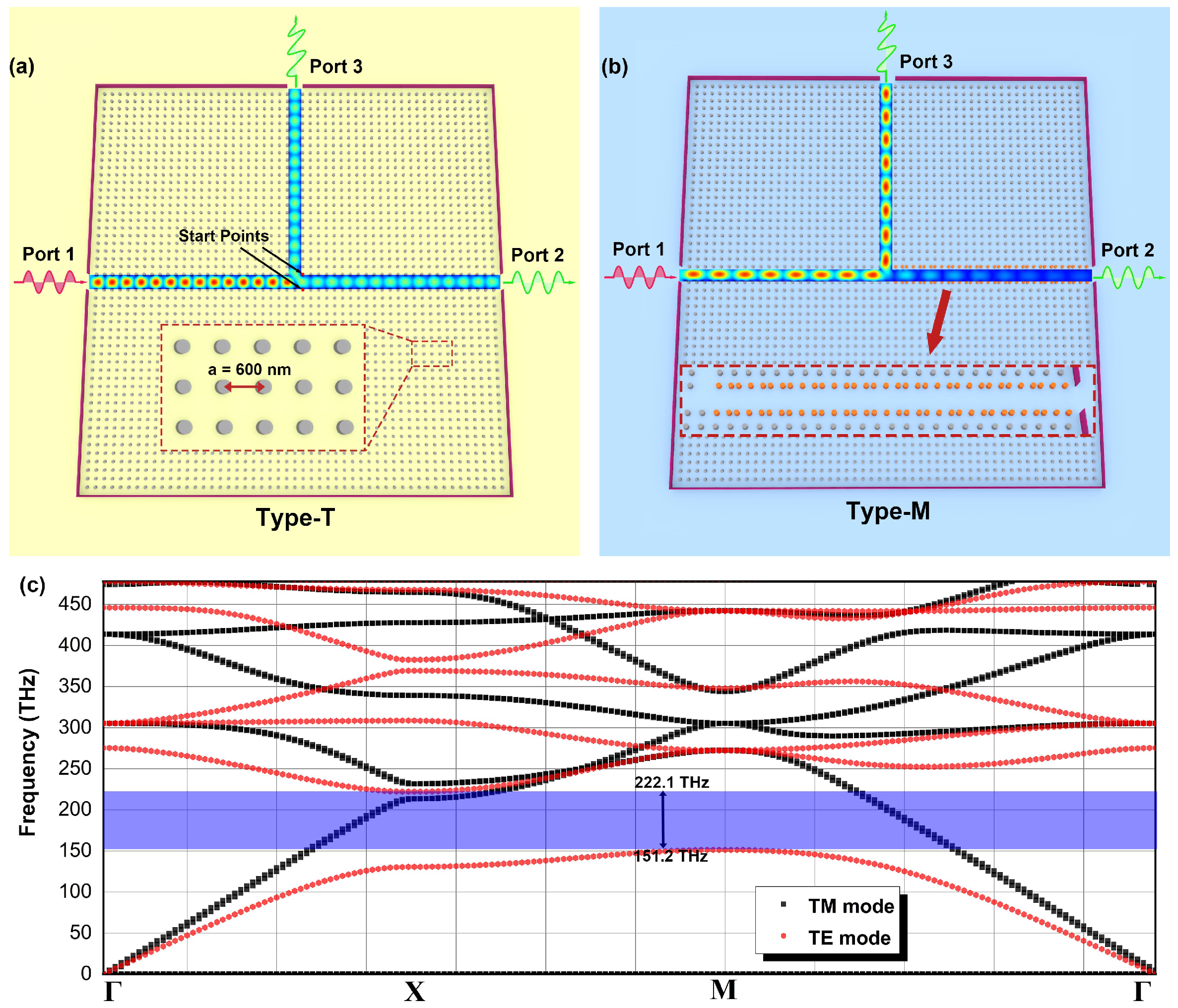
The splitter–filter device is derived from a conventional PhC waveguide structure. The traditional inverted T-junction branching waveguide, as shown in Figure 1a, is carved out from a bulk 2D square-lattice PhC. The lattice constant a of this PhC is set to 600 nm. The overall device measures 52 a × 52 a . At every lattice point, a cylindrical gallium arsenide (GaAs) rod of radius 0.18 a with the refractive index n GaAs = 3.4 is embedded in an air background n Air = 1 , as illustrated in Figure 1a. The incident light from port 1 goes through the waveguide and can export from both port 2 and port 3, fulfilling the function of a splitter. To control the splitting and filtering functions, we engineered the PhC by replacing the periodic rod arrays on both sides of the right semi-side waveguide (from the separation point to Port 2) with Fibonacci rod chains of the same size and the same refractive index, as depicted in Figure 1b.
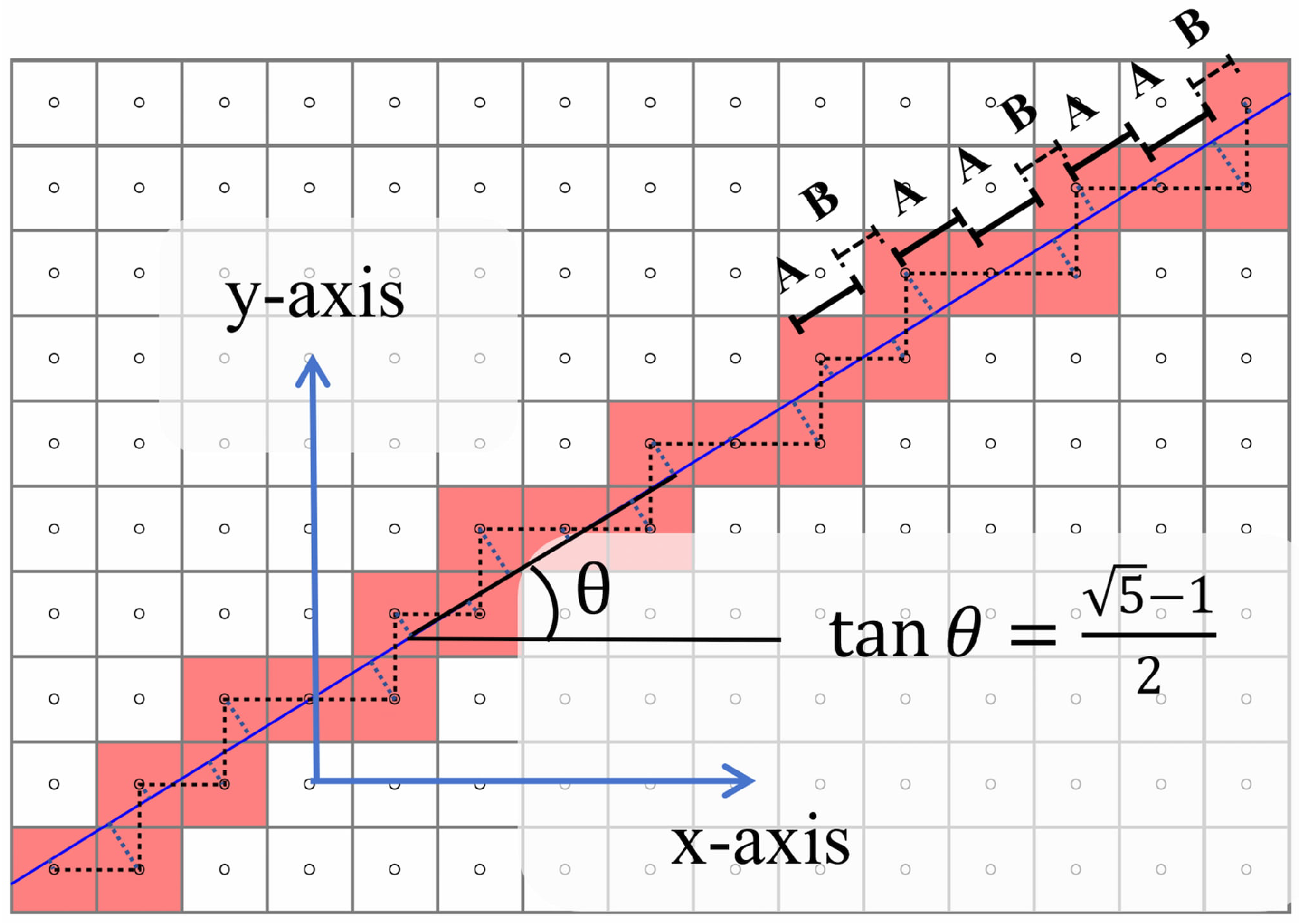
The Fibonacci rod chains are generated from the original square lattice using the cut-and-project method [41,62], yielding two characteristic spacings A = a cos θ = 510.39 nm and B = a sin θ = 315.44 nm (see Figure A1). In practice, a finite segment of the otherwise infinite Fibonacci chain is selected. While lower-order sequences (e.g., S 7 with 21 rods) offer a reduced footprint, our preliminary investigations showed that they cannot achieve the same level of high-performance power splitting and filtering as the current S 8 structure. Therefore, the S 8 Fibonacci sequence (containing 34 rods with spacings either A or B, as listed in Table A1) is chosen as the optimal configuration to balance device compactness with performance robustness. The sequence consists of 34 rods with spacings either A or B. Two identical S 8 Fibonacci rod chains are both symmetrically and horizontally positioned on both sides of the right semi-side waveguide, with their leftmost rods coinciding with the “Start Points” in the original structure, as shown in Figure 1a. With the non-trivial geometric replacement, a new structure emerges, depicted in Figure 1b. Consequently, the transmittance profiles of Port 2 and Port 3 undergo significant functional changes, which will be analyzed below. Hereinafter, the modified design is referred to as “Type-M”, while the traditional structure shown in Figure 1a is termed “Type-T”.
To investigate the power-splitting and filtering performances of both the Type-T and Type-M structures, finite element numerical simulations were carried out using COMSOL 6.2 Multiphysics. Light was launched from Port 1 and collected at Ports 2 and 3. All three ports were assigned a width of 2 a , while the scattering boundary conditions were applied to all exterior boundaries. To reduce computational costs, we simulated the two-dimensional cross-section (i.e., the x y plane) of both the “Type-T” and “Type-M” structures, reducing the simulation time from several weeks to a few days.
The photonic band structure of the traditional PhC in Figure 1a was calculated and is presented in Figure 1c. It is seen that the TM mode does not exhibit any bandgap, but the TE mode has some bandgaps, of which the lowest one is located from 151.2 THz to 222.1 THz, corresponding to wavelengths of 1350 nm to 1982 nm.

3. Optical Splitting and Selective Filtering

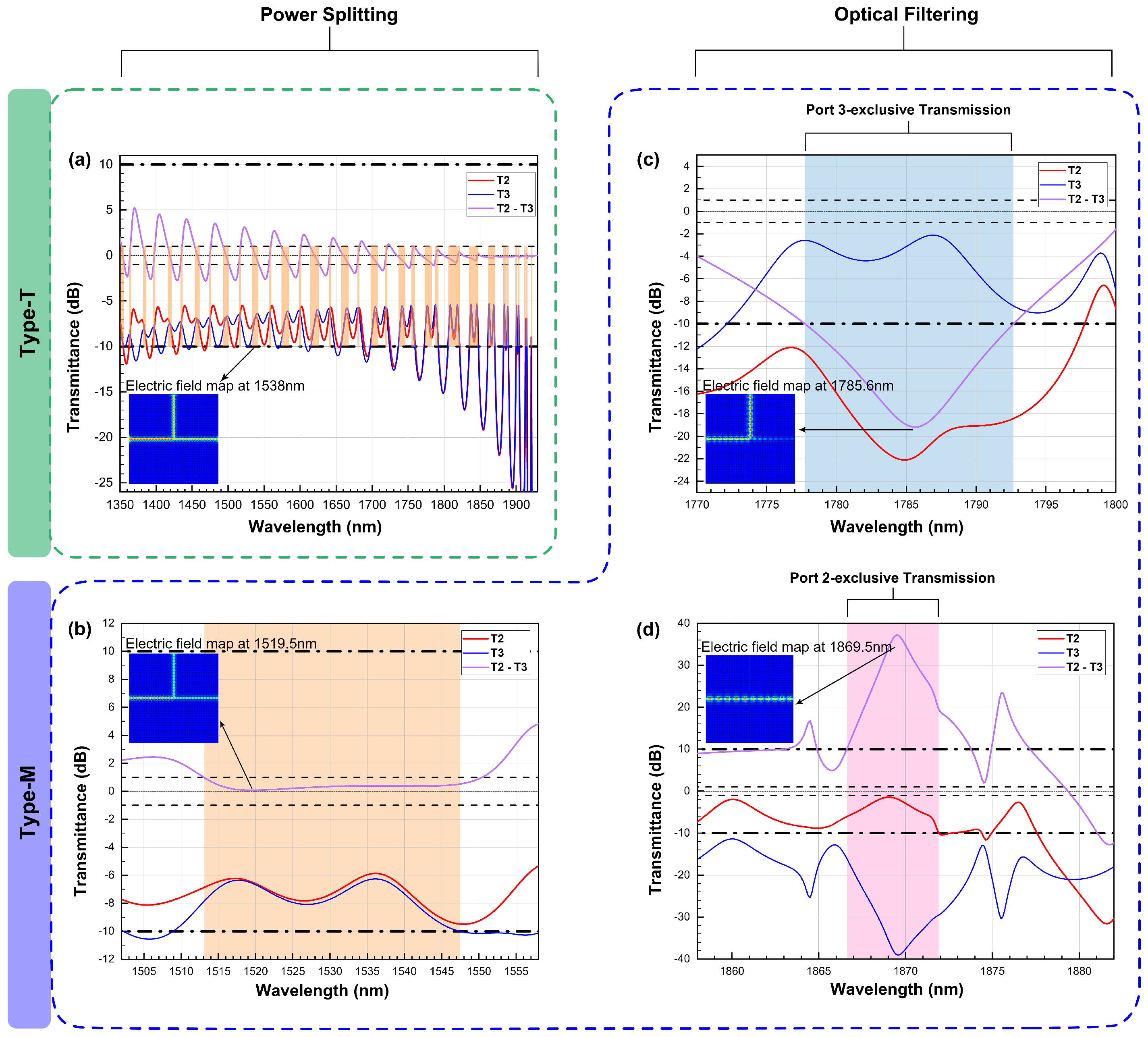
We begin with the splitting function of the conventional “Type-T” structure. A TE mode light with an input power of 100 mW/m was simulated through Port 1, with the wavelength ranging from 1350 to 1982 nm. For clarity, two simplified notations, T 2 and T 3 , are used to denote the transmittance of Port 2 and Port 3, respectively. We define the effective power splitting band as the wavelength range where T 2 T 3 locates within ±1 dB, and, at the same time, both T 2 and T 3 remain above −10 dB. The transmission spectrum of the Type-T structure was calculated with the help of COMSOL Multiphysics, as shown in Figure 2a. It is seen that the transmission spectrum of the Type-T structure exhibits power-splitter characteristics over a broad wavelength range, where multiple effective power-splitting band segments are highlighted in orange, indicating fragmented yet cumulative coverage. Despite the Type-T structure’s commendable power-splitting performance, it lacks the dual functionality of splitting and filtering. Moreover, within the optical communication band, its operating bandwidth remains insufficiently continuous and broad. The longest segment in the optical communication band spans merely 11.7 nm (1614.8–1626.5 nm).
In contrast, the Type-M structure’s transmission spectrum, as illustrated in Figure 2b–d, demonstrates both power-splitting and port-selective filtering behaviors. For power splitting, the transmission characteristics shown in Figure 2b are analyzed for the 1513.1–1547.4 nm band (marked by an orange rectangle): the red and blue curves represent the transmittance of Port 2 and Port 3, respectively, while the purple curve T 2 T 3 denotes their difference. Within this band, the transmittance ranges from −10.00 dB (Port 3 at 1547.4 nm) to −5.87 dB (Port 2 at 1536.1 nm), with T 2 T 3 varying between 0.07 dB (1519.5 nm) and 0.98 dB (1513.1 nm). The Type-M structure thus satisfies the criteria for power splitting ( T 2 > 10 dB, T 3 > 10 dB and T 2 T 3 within ±1 dB) across the 1513.1–1547.4 nm band, encompassing portions of the S-band and C-band in optical communications [61].
Furthermore, the Type-M structure exhibits excellent filtering performance. As shown in Figure 2c,d, within the 1770–1880 nm band, the transmittance spectra of Port 2 and Port 3 exhibit alternating dominance, characterized by one port’s transmittance exceeding the other by more than 10 dB. For effective filtering, two criteria must be met: within the target wavelength range, the transmittance difference | T 2 T 3 | exceeds 10 dB, and at the same time, the transmittance for either port must be above −10 dB to exclude filtering that is not practically meaningful. It can be observed that within the 1777.8–1792.6 nm band, T 2 T 3 remains below −10 dB, reaching a minimum of −19.18 dB at 1785.6 nm. Simultaneously, the transmittance of Port 3 varies between −8.36 dB (at 1792.6 nm) and −2.12 dB (at 1786.9 nm), while Port 2 transmittance ranges from −22.10 dB (at 1784.9 nm) to −12.66 dB (at 1777.8 nm). These results indicate that light within the 1777.8–1792.6 nm band selectively passes through Port 3, with minimal leakage to Port 2, demonstrating Port 3-exclusive transmission.
Similarly, in the 1866.7–1871.9 nm band, T 2 T 3 exceeds 10 dB, varying from 10.84 dB (at 1866.7 nm) to 37.17 dB (at 1869.5 nm). The T 2 ranges from −9.94 dB (at 1871.9 nm) to −1.44 dB (at 1869 nm), while T 3 drops from −39.07 dB (at 1869.6 nm) to −16.75 dB (at 1866.7 nm). This confirms that light in this wavelength range is predominantly guided to Port 2, with negligible transmission through Port 3, indicating Port 2-exclusive transmission.
These findings confirm that the Type-M device effectively performs port-selective filtering within 1777.8–1792.6 nm and 1866.7–1871.9 nm bands. Furthermore, this filtering characteristic enables a compelling wavelength-division multiplexing (WDM) application. For instance, when two optical signals with distinct wavelengths (1786.9 nm and 1869 nm) are simultaneously injected into Port 1, the 1869 nm component is extracted from Port 2 with −1.44 dB efficiency, while the 1786.9 nm component emerges from Port 3 with −2.12 dB efficiency, demonstrating the device’s strong potential for WDM-based signal routing.

4. Robustness Check

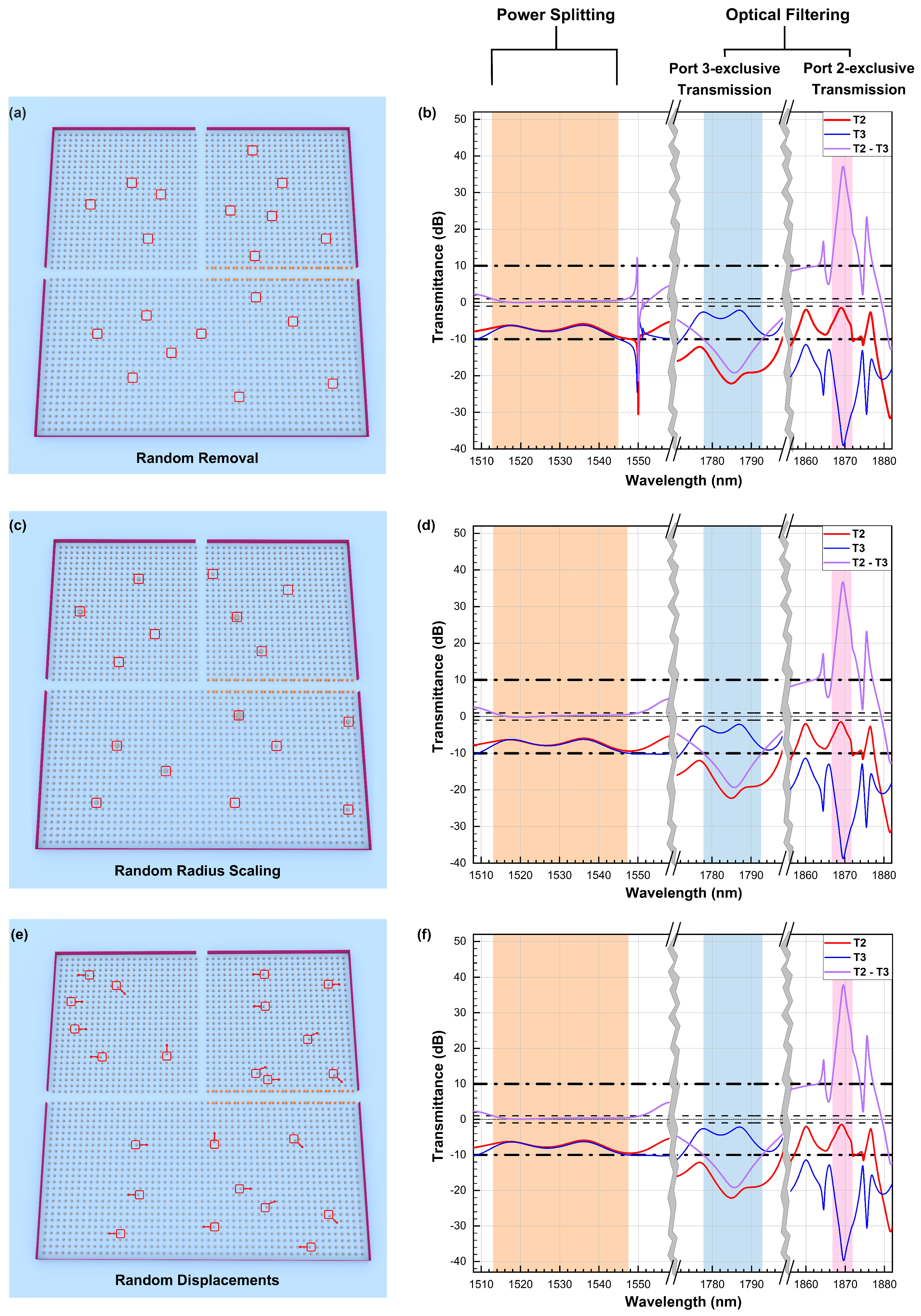
To check the robustness of the optical device, we investigated its performance against structural perturbations induced by fabrication. We considered three types of structural defects. The first type is the random removal of rods, as shown in Figure 3a. The red rectangles denote the locations where the GaAs rods are removed. The positions are random, but the number of defects is controlled to simulate a certain degree of imperfection. Second, some rods are randomly chosen to be rescaled (by multiplying the rod’s radius by a random coefficient ranging from 0.2 to 3), as shown in Figure 3c, also denoted by red rectangles. Third, random positional displacements are introduced, as shown in Figure 3e, where the red rectangles indicate the defective locations, and the red arrows show their displacement directions.
The transmission spectra were calculated using finite element simulations and are shown in Figure 3b,d,f for the three different types of structural perturbations. To quantitatively substantiate the robustness of the proposed device, three random iterations were performed for each defect type (rod removal, radius scaling, and positional displacement). The statistical results, summarized in Table A3 in Appendix C, show that standard deviations are less than 1.00 nm for all key performance metrics. It is seen that both the power-splitting and filtering bands remain stable under these perturbations. Compared with the defect-free structure, the operational wavelength bands exhibit minimal variation, and the dual-function efficiencies are effectively maintained. These results demonstrate that the Type-M structure exhibits excellent robustness against these three defect types, thereby offering a promising solution for designing photonic crystal devices with high tolerance to fabrication imperfections.

5. Wavelength Tunability

The proposed Type-M structure exhibits prominent design-stage wavelength tunability, and this functional characteristic is verified through systematic numerical simulations. Specifically, when the lattice constant a is adjusted to 500 nm (with all other structural parameters and their proportional relationships kept unchanged), the transmission spectrum of the Type-M structure shows two distinct functional behaviors: (1) power splitting performance within the wavelength interval of 1260.9–1289.5 nm. In this range, the power difference between Port 2 and Port 3 satisfies the condition of | T 2 T 3 | < 1 dB, while the transmittance of both ports maintains a relatively high level ( T 2 , T 3 > 10 dB), ensuring the effectiveness of the power splitting function; (2) port-selective filtering characteristics in two newly generated wavelength bands. One band is 1481.4–1493.9 nm, where exclusive transmission is achieved at Port 3; the other band is 1555.6–1559.8 nm, corresponding to exclusive transmission at Port 2.
It is noteworthy that all the numerically observed power-splitting intervals and port-selective filtering bands are in good agreement with the theoretical prediction. To further confirm the reliability of this consistency, quantitative verification is conducted as follows. For the power-splitting function, the original power-splitting wavelength range of the Type-M structure at a = 600 nm is 1513.1–1547.4 nm. According to the theoretical scaling relationship, when the lattice constant is adjusted from 600 nm to 500 nm, the scaling factor of the wavelength is 500 / 600 = 5 / 6 . After scaling by this factor, the theoretical power-splitting range is calculated as 1260.9–1289.5 nm, which is completely consistent with the numerically simulated power-splitting range at a = 500 nm. For the port-selective filtering function: the original filtering bands of the structure at a = 600 nm are 1777.8–1792.6 nm and 1866.7–1871.9 nm. Applying the same scaling factor of 5 / 6 to these two bands, the theoretical filtering ranges are obtained as 1481.5–1493.8 nm and 1555.6–1559.9 nm, respectively. These theoretical values are in precise agreement with the filtering bands observed in the numerical simulation at a = 500 nm. From a fabrication perspective, the rod diameter ( D = 0.36 a ) for a = 500 nm is 180 nm. This is well within the resolution limits of modern lithographic fabrication, particularly Electron Beam Lithography (EBL), which can achieve resolutions below 10 nm [63].
These results demonstrate that both the power-splitting and port-selective filtering functionalities of the proposed Type-M structure can be flexibly tuned by simply adjusting the lattice constant. Moreover, this study further validates the high consistency between the theoretical predictions and the results of numerical simulations, which provides a solid theoretical and numerical basis for the practical application of the Type-M structure in wavelength-tunable photonic devices.

6. Conclusions

In conclusion, this study proposes a 1 × 2 inverted T-junction branching waveguide integrated with Fibonacci rod chains and realizes a novel optical splitter–filter based on such photonic quasicrystals. The power-splitting and port-selective filtering functionalities of the designed device are systematically investigated via numerical simulations, and the results clearly demonstrate its inherent advantages over traditional counterparts, including more flexible functional integration and better adaptability to complex photonic application scenarios. Moreover, the proposed device exhibits excellent structural defect robustness: it maintains stable operational performance against common fabrication-induced defects, such as rod removal, rod radius variations, and rod displacement. This characteristic significantly improves the device’s fabrication tolerance, addressing a key challenge in the practical manufacturing of nanophotonic components and laying a solid foundation for its industrial application. Furthermore, the device’s operational wavelength can be flexibly tuned by adjusting the lattice constant, which further underscores its versatility in accommodating diverse wavelength requirements of different photonic systems. For further study, three-dimensional simulations are necessary to evaluate out-of-plane losses, mode influence, and practical imperfections such as vertical rod diameter variations and sidewall roughness, which are not captured in this 2D proof-of-concept study.
Combining multifunctional integration (splitting and filtering), high structural defect robustness, and design-stage wavelength tunability, our proposed photonic quasicrystal-based architecture represents a highly promising and adaptable platform for multifunctional nanophotonic devices. It holds significant application potential in photonic integrated circuits (PICs) and optical communication systems. This positions the proposed device as a compelling candidate for next-generation integrated photonic systems, with the ability to drive performance improvements in high-density photonic integration and high-speed optical communication networks.

Author Contributions

Conceptualization, Y.-J.J. and X.-J.W.; methodology, Y.-J.J. and Y.-P.L.; formal analysis, Y.-J.J.; investigation, Y.-J.J.; writing—original draft preparation, Y.-J.J.; writing—review and editing, J.-Y.Y.; visualization, Y.-J.J.; supervision, J.-Y.Y. All authors have read and agreed to the published version of the manuscript.

Funding

This research received no external funding.

Data Availability Statement

Data underlying the results presented in this paper are not publicly available at this time but may be obtained from the authors upon reasonable request.

Conflicts of Interest

The authors declare no conflicts of interest.

Appendix A. Cut-and-Project Method

Figure A1. Schematic of the cut-and-project method used to generate the Fibonacci rod chains.
Photonics 13 00138 g0a1
Table A1. Illustration of the Fibonacci sequence. The sequence satisfies the recurrence relation S n + 2 = S n + S n + 1 .
Fibonacci Sequence
S 0 B
S 1 A
S 2 AB
S 3 ABA
S 4 ABAAB
S 5 ABAABABA
S 6 ABAABABAABAAB
S 7 ABAABABAABAABABAABABA
S 8 ABAABABAABAABABAABABAABAABABAABAAB
The Fibonacci rod chains are generated via the cut-and-project method [41,62]. Assuming the lattice vectors are chosen to align with the x and y axes in the waveguide, a line with a specific slope k = tan θ = 5 1 2 intersects the Wigner–Seitz (W-S) unit cells, red-highlighted regions in Figure A1. The lattice points at the centers of these intersected W-S unit cells are then orthogonally projected onto the line, resulting in two distinct spacing intervals: A = a cos θ = 510.39 nm, and B = a sin θ = 315.44 nm. The resulting sequence of intervals on the line dictates the positions of the Fibonacci rods in the engineered waveguide. The Fibonacci sequence can also be generated by the recurrence relation, as shown in Table A1. In practice, a finite segment of the otherwise infinite Fibonacci chain—specifically, the S 8 Fibonacci sequence (see Table A1 for definitions of S 0 S 8 )—is selected. The sequence consists of 34 rods with spacings either A or B.

Appendix B. Quantitative Comparison with Other Devices

Here we present a numerical performance summary of other reported splitters or filters, against which our device is benchmarked.
Table A2. Performance comparison with other reported devices.
LC-Filled Photonic Crystal Fibre [64]1 × 32 Splitter with Dielectric Filters [65]Octagonal Photonic Quasicrystal [53]Our Device
Validation MethodExperimentExperimentNumerical simulationNumerical simulation
Splitting Band608 nm and 760 nm1.31 μm, 1.55 μm 1513.1–1547.4 nm
Insertion Loss ≤17.5 dB 3.05–6.72 dB
ImbalanceOnly relative strength is provided 0.07–0.98 dB
Filtering Band608 nm and 760 nm1.65 μmaround Ω = 0.406 a / λ 1777.8–1792.6 nm & 1866.7–1871.9 nm
IsolationOnly relative strength is provided 10.08–19.18 dB (1777.8–1792.6 nm) & 10.84–37.17 dB (1866.7–1871.9 nm)
Insertion Loss or Efficiency <2.17 dB95% dropping efficiency2.06–7.96 dB (1777.8–1792.6 nm) & 1.44–9.89 dB (1866.7–1871.9 nm)
FootprintLength: ∼20 cm10 mm × 28 mm 973.44 μm2

Appendix C. Statistical Summary of Robustness Tests

To quantitatively substantiate the robustness of the proposed device, three random iterations were performed for each defect type. Table A3 summarizes the statistical results.
Table A3. Statistical summary of device performance under structural perturbations.
MetricBaselineMean (n  = 9)Std. Dev.
Power Splitting Bandwidth34.3 nm33.23 nm1.00 nm
Port-2 Filtering Bandwidth5.2 nm5.08 nm0.17 nm
Port-3 Filtering Bandwidth14.8 nm14.81 nm0.11 nm
Note: Among all nine perturbation cases, only one unexpected minor spectral gap (0.2 nm) was observed within the power-splitting band (between 1513.1–1530.6 nm and 1530.8–1546.8 nm), and the total bandwidth was calculated as the sum of both segments (33.5 nm).

References

  1. Kish, F.; Lal, V.; Evans, P.; Corzine, S.; Ziari, M.; Butrie, T.; Reffle, M.; Tsai, H.; Dentai, A.; Pleumeekers, J.; et al. System-on-Chip Photonic Integrated Circuits. IEEE J. Sel. Top. Quantum Electron. 2018, 24, 6100120. [Google Scholar] [CrossRef]
  2. Su, Y.; He, Y.; Guo, X.; Xie, W.; Ji, X.; Wang, H.; Cai, X.; Tong, L.; Yu, S. Scalability of Large-Scale Photonic Integrated Circuits. ACS Photonics 2023, 10, 2020–2030. [Google Scholar] [CrossRef]
  3. Shekhar, S.; Bogaerts, W.; Chrostowski, L.; Bowers, J.E.; Hochberg, M.; Soref, R.; Shastri, B.J. Roadmapping the next generation of silicon photonics. Nat. Commun. 2024, 15, 751. [Google Scholar] [CrossRef] [PubMed]
  4. Shi, Y.; Zhang, Y.; Wan, Y.; Yu, Y.; Zhang, Y.; Hu, X.; Xiao, X.; Xu, H.; Zhang, L.; Pan, B. Silicon photonics for high-capacity data communications. Photonics Res. 2022, 10, A106–A134. [Google Scholar] [CrossRef]
  5. Daudlin, S.; Rizzo, A.; Lee, S.; Khilwani, D.; Ou, C.; Wang, S.; Novick, A.; Gopal, V.; Cullen, M.; Parsons, R.; et al. Three-dimensional photonic integration for ultra-low-energy, high-bandwidth interchip data links. Nat. Photonics 2025, 19, 502–509. [Google Scholar] [CrossRef]
  6. Dai, T.; Ma, A.; Mao, J.; Ao, Y.; Jia, X.; Zheng, Y.; Zhai, C.; Yang, Y.; Li, Z.; Tang, B.; et al. A programmable topological photonic chip. Nat. Mater. 2024, 23, 928–936. [Google Scholar] [CrossRef]
  7. Xing, Y.; Dong, J.; Khan, U.; Bogaerts, W. Capturing the Effects of Spatial Process Variations in Silicon Photonic Circuits. ACS Photonics 2023, 10, 928–944. [Google Scholar] [CrossRef]
  8. Rizzo, A.; Dave, U.; Novick, A.; Freitas, A.; Roberts, S.P.; James, A.; Lipson, M.; Bergman, K. Fabrication-robust silicon photonic devices in standard sub-micron silicon-on-insulator processes. Opt. Lett. 2023, 48, 215–218. [Google Scholar] [CrossRef]
  9. Gostimirovic, D.; Grinberg, Y.; Xu, D.X.; Liboiron-Ladouceur, O. Improving Fabrication Fidelity of Integrated Nanophotonic Devices Using Deep Learning. ACS Photonics 2023, 10, 1953–1961. [Google Scholar] [CrossRef]
  10. Bayindir, M.; Temelkuran, B.; Ozbay, E. Photonic-crystal-based beam splitters. Appl. Phys. Lett. 2000, 77, 3902–3904. [Google Scholar] [CrossRef]
  11. Ke, H.; Li, P.L.; Shi, W.H. Two-dimensional photonic crystal waveguide 1×5 beam splitter reversely designed by downhill-simplex algorithm. Acta Phys. Sin. 2022, 71, 144204. [Google Scholar] [CrossRef]
  12. Zhang, L.; Yang, C. Polarization splitter based on photonic crystal fibers. Opt. Express 2003, 11, 1015–1020. [Google Scholar] [CrossRef]
  13. Liu, D.; Citrin, D.; Hu, S. Compact high-performance polarization beam splitter based on a silicon photonic crystal heterojunction. Opt. Mater. 2020, 109, 110256. [Google Scholar] [CrossRef]
  14. Madhumitha, M.; Selvendran, S.; Raja, A.; Muthu, K. Photonic crystal based narrowband optical filter: A brief analysis. Optik 2021, 228, 166162. [Google Scholar] [CrossRef]
  15. Zhang, T.; Sun, J.; Yang, Y.; Li, Z. Photonic crystal filter based on defect mode and waveguide mode symmetry matching. Opt. Commun. 2018, 428, 53–56. [Google Scholar] [CrossRef]
  16. Shi, Q.; Feng, S.; Zhao, J. Engineering Design of an Expandable 1-D Photonic Crystal Slab Biosensor Array for Joint Detection of Multiple Tumor Markers. IEEE Sens. J. 2025, 25, 5986–5994. [Google Scholar] [CrossRef]
  17. Gangwar, R.K.; Pathak, A.K.; Kumar, S. Recent Progress in Photonic Crystal Devices and Their Applications: A Review. Photonics 2023, 10, 1199. [Google Scholar] [CrossRef]
  18. Soroosh, M.; AL-Shammri, F.K.; Maleki, M.J.; Balaji, V.R.; Adibnia, E. A Compact and Fast Resonant Cavity-Based Encoder in Photonic Crystal Platform. Crystals 2025, 15, 24. [Google Scholar] [CrossRef]
  19. Shafagh, S.G.; Kaatuzian, H.; Danaie, M. Design and analysis of optical devices with ultra-high quality factor based on a plasmonic photonic hybrid structure. Eng. Res. Express 2025, 7, 015356. [Google Scholar] [CrossRef]
  20. Saghaei, H.; Soroosh, M.; Maleki, M.J.; Mondal, H.; Nurmohammadi, T.; Jafari, B.; Shahi, M.; Sepahvandi, V.; Adibnia, E. High-performance and compact photonic crystal channel drop filter using P-shaped ring resonator. Results Opt. 2025, 21, 100817. [Google Scholar] [CrossRef]
  21. Ryabov, E.A.; Andreev, A.A.; Sergeev, S.A.; Mikhailov, A.I. Control of the frequency response of a narrow-band filter for the X-band frequency based on a photonic crystal with a movable cylindrical defect. Russ. Technol. J. 2025, 13, 84–91. [Google Scholar] [CrossRef]
  22. Anghel, I.; Petris, A. Design of an all-optical tunable 2D photonic crystal in As2S3 film. Opt. Commun. 2025, 574, 131247. [Google Scholar] [CrossRef]
  23. Manasvi, R.; Deepa, V.; Balaji, V.R.; Soroosh, M.; Hegde, G. Numerical Investigation of Dual-Cavity DWDM Optical Filters for Ultra-Narrowband C-Band 6G Applications. Silicon 2025. [Google Scholar] [CrossRef]
  24. Menssen, A.J.; Hermans, A.; Christen, I.; Propson, T.; Li, C.; Leenheer, A.J.; Zimmermann, M.; Dong, M.; Larocque, H.; Raniwala, H.; et al. Scalable photonic integrated circuits for high-fidelity light control. Optica 2023, 10, 1366–1372. [Google Scholar] [CrossRef]
  25. Du, Z.; Liao, K.; Dai, T.; Wang, Y.; Gao, J.; Huang, H.; Qi, H.; Li, Y.; Wang, X.; Su, X.; et al. Ultracompact and multifunctional integrated photonic platform. Sci. Adv. 2024, 10, eadm7569. [Google Scholar] [CrossRef]
  26. Ramunno, L.; Hughes, S. Disorder-induced resonance shifts in high-index-contrast photonic crystal nanocavities. Phys. Rev. B 2009, 79, 161303. [Google Scholar] [CrossRef]
  27. Minkov, M.; Dharanipathy, U.P.; Houdré, R.; Savona, V. Statistics of the disorder-induced losses of high-Q photonic crystal cavities. Opt. Express 2013, 21, 28233–28245. [Google Scholar] [CrossRef]
  28. Portalupi, S.L.; Galli, M.; Belotti, M.; Andreani, L.C.; Krauss, T.F.; O’Faolain, L. Deliberate versus intrinsic disorder in photonic crystal nanocavities investigated by resonant light scattering. Phys. Rev. B 2011, 84, 045423. [Google Scholar] [CrossRef]
  29. Maeno, K.; Takahashi, Y.; Nakamura, T.; Asano, T.; Noda, S. Analysis of high-Q photonic crystal L3 nanocavities designed by visualization of the leaky components. Opt. Express 2017, 25, 367–376. [Google Scholar] [CrossRef]
  30. Bommer, S.P.; Panuski, C.; Guilhabert, B.; Xia, Z.; Smith, J.A.; Dawson, M.D.; Englund, D.; Strain, M.J. Transfer printing micro-assembly of silicon photonic crystal cavity arrays: Beating the fabrication tolerance limit. Nat. Commun. 2025, 16, 5994. [Google Scholar] [CrossRef]
  31. Shechtman, D.; Blech, I.; Gratias, D.; Cahn, J.W. Metallic Phase with Long-Range Orientational Order and No Translational Symmetry. Phys. Rev. Lett. 1984, 53, 1951–1953. [Google Scholar] [CrossRef]
  32. Senechal, M. Quasicrystals and Geometry; Cambridge University Press: Cambridge, UK, 1995. [Google Scholar]
  33. Biswal, A. Periodic and quasi-periodic one-dimensional extrinsically magnetized photonic crystals with robust photonic bandgaps. Appl. Opt. 2023, 62, 8197–8203. [Google Scholar] [CrossRef] [PubMed]
  34. Janot, C. Quasicrystals: A Primer; Oxford University Press: Oxford, UK, 2012. [Google Scholar]
  35. Vardeny, Z.V.; Nahata, A.; Agrawal, A. Optics of photonic quasicrystals. Nat. Photonics 2013, 7, 177–187. [Google Scholar] [CrossRef]
  36. Tsvetkov, D.; Gao, J.; Frantz, J.; Litchinitser, N.M. Design approach for photonic quasicrystals to enable multiple nonlinear interactions. Opt. Express 2021, 29, 38280–38290. [Google Scholar] [CrossRef] [PubMed]
  37. Johnson, S.G.; McCauley, A.P.; Rodriguez-Wong, A. Computation and visualization of photonic quasicrystal spectra. In Optics of Aperiodic Structures: Fundamentals and Device Applications; Dal Negro, L., Ed.; CRC Press: Boca Raton, FL, USA, 2013; pp. 471–511. [Google Scholar]
  38. Rostami, A.; Matloub, S.; Moravvej-Farshi, M.K. Mode analysis of 2D photonic quasicrystals based on an approximate analytic model. Photonics Nanostruct.-Fundam. Appl. 2011, 9, 22–30. [Google Scholar] [CrossRef]
  39. Alyatkin, S.; Sitnik, K.; Daníelsson, V.K.; Kartashov, Y.V.; Töpfer, J.D.; Sigurðsson, H.; Lagoudakis, P.G. Quantum fluids of light in 2D artificial reconfigurable aperiodic crystals with tailored coupling. Sci. Adv. 2025, 11, eadz2484. [Google Scholar] [CrossRef]
  40. Ricciardi, A.; Pisco, M.; Cutolo, A.; Cusano, A.; O’Faolain, L.; Krauss, T.F.; Castaldi, G.; Galdi, V. Evidence of guided resonances in photonic quasicrystal slabs. Phys. Rev. B 2011, 84, 085135. [Google Scholar] [CrossRef][Green Version]
  41. Jagannathan, A. The Fibonacci quasicrystal: Case study of hidden dimensions and multifractality. Rev. Mod. Phys. 2021, 93, 045001. [Google Scholar] [CrossRef]
  42. Kuriakose, A.; Acharyya, J.N.; Srivastava, P.; Vijaya Prakash, G. Photonic Band Gap and Fractal Resonances in Aperiodic Cantor-like Self-Similar a:SiNx Photonic Structures. ACS Appl. Opt. Mater. 2024, 2, 670–678. [Google Scholar] [CrossRef]
  43. Naweed, A.; Akhtar, M.S. Unconventional optical response of time-domain Fibonacci quasicrystals. Opt. Lett. 2025, 50, 4746–4749. [Google Scholar] [CrossRef]
  44. Tavakoli, M.; Jalili, Y.S. One-dimensional Fibonacci fractal photonic crystals and their optical characteristics. J. Theor. Appl. Phys. 2014, 8, 113. [Google Scholar] [CrossRef]
  45. Ciminelli, C.; Brunetti, G.; D’Amico, A.; Armenise, M.N. Coupled ring resonators at fibonacci frequencies. In Proceedings of the 2020 22nd International Conference on Transparent Optical Networks (ICTON), Bari, Italy, 19–23 July 2020; pp. 1–5. [Google Scholar]
  46. Bandres, M.A.; Rechtsman, M.C.; Segev, M. Topological Photonic Quasicrystals: Fractal Topological Spectrum and Protected Transport. Phys. Rev. X 2016, 6, 011016. [Google Scholar] [CrossRef]
  47. Fan, J.; Huang, H. Topological states in quasicrystals. Front. Phys. 2021, 17, 13203. [Google Scholar] [CrossRef]
  48. Zhang, Y.; Lan, Z.; Hu, L.; Shu, Y.; Yuan, X.; Guo, P.; Peng, X.; Chen, W.; Li, J. Chiral photonic topological states in Penrose quasicrystals. Opt. Lett. 2023, 48, 2229–2232. [Google Scholar] [CrossRef]
  49. Levi, L.; Rechtsman, M.; Freedman, B.; Schwartz, T.; Manela, O.; Segev, M. Disorder-Enhanced Transport in Photonic Quasicrystals. Science 2011, 332, 1541–1544. [Google Scholar] [CrossRef]
  50. Yang, X.; Wang, Z.; Gao, H.; Yang, L.; Meng, Y.; Xi, X.; Shum, P.P.; Gao, Z. Observation of photonic chiral edge states in penrose quasicrystals. Opt. Mater. Express 2024, 14, 1590–1595. [Google Scholar] [CrossRef]
  51. Yan, B.; Xie, J.; Liu, E.; Peng, Y.; Ge, R.; Liu, J.; Wen, S. Topological Edge State in the Two-Dimensional Stampfli-Triangle Photonic Crystals. Phys. Rev. Appl. 2019, 12, 044004. [Google Scholar] [CrossRef]
  52. Verbin, M.; Zilberberg, O.; Lahini, Y.; Kraus, Y.E.; Silberberg, Y. Topological pumping over a photonic Fibonacci quasicrystal. Phys. Rev. B 2015, 91, 064201. [Google Scholar] [CrossRef]
  53. Romero-Vivas, J.; Chigrin, D.N.; Lavrinenko, A.V.; Torres, C.M.S. Resonant add-drop filter based on a photonic quasicrystal. Opt. Express 2005, 13, 826–835. [Google Scholar] [CrossRef]
  54. Yulevich, I.; Maguid, E.; Shitrit, N.; Veksler, D.; Kleiner, V.; Hasman, E. Optical Mode Control by Geometric Phase in Quasicrystal Metasurface. Phys. Rev. Lett. 2015, 115, 205501. [Google Scholar] [CrossRef]
  55. Trabelsi, Y. Output multichannel optical filter based on hybrid photonic quasicrystals containing a high-Tc superconductor. Photonics Nanostruct.-Fundam. Appl. 2019, 36, 100724. [Google Scholar] [CrossRef]
  56. Mercier, T.M.; Rahman, T.; Krishnan, C.; Khorani, E.; Shaw, P.J.; Pollard, M.E.; Boden, S.A.; Lagoudakis, P.G.; Charlton, M.D. High symmetry nano-photonic quasi-crystals providing novel light management in silicon solar cells. Nano Energy 2021, 84, 105874. [Google Scholar] [CrossRef]
  57. Florescu, M.; Torquato, S.; Steinhardt, P.J. Complete band gaps in two-dimensional photonic quasicrystals. Phys. Rev. B 2009, 80, 155112. [Google Scholar] [CrossRef]
  58. Tun-Carrillo, M.A.; Mora-Ramos, M.E.; Gómez-Urrea, H.A.; Pérez-Quintana, I.V. Photonic properties of 1D multilayered structures based on quasiperiodic Rudin–Shapiro sequence. Ann. Phys. 2025, 472, 169860. [Google Scholar] [CrossRef]
  59. Trabelsi, Y.; Benali, N.; Bouazzi, Y.; Kanzari, M. Microwave transmission through one-dimensional hybrid quasi-regular (fibonacci and Thue-Morse)/periodic structures. Photonic Sens. 2013, 3, 246–255. [Google Scholar] [CrossRef]
  60. Xu, S.; Zhu, Y.; Wang, L.; Yang, P.; Chu, P.K. Photonic quantum well composed of photonic crystal and quasicrystal. Opt. Commun. 2014, 313, 369–374. [Google Scholar] [CrossRef]
  61. Winzer, P.J. Making spatial multiplexing a reality. Nat. Photonics 2014, 8, 345–348. [Google Scholar] [CrossRef]
  62. Kramer, P.; Schlottmann, M. Dualisation of Voronoi domains and Klotz construction: A general method for the generation of proper space fillings. J. Phys. A Math. Gen. 1989, 22, L1097. [Google Scholar] [CrossRef]
  63. Manfrinato, V.R.; Zhang, L.; Su, D.; Duan, H.; Hobbs, R.G.; Stach, E.A.; Berggren, K.K. Resolution Limits of Electron-Beam Lithography toward the Atomic Scale. Nano Lett. 2013, 13, 1555–1558. [Google Scholar] [CrossRef]
  64. Wang, J.; Liu, Y.; Zhang, L.; Jiang, Y.; Ma, J.; Sun, W. Temperature-controllable beam splitter and optical filter based on filling liquid crystal into both ends of photonic crystal fibres. Liq. Cryst. 2016, 43, 61–65. [Google Scholar] [CrossRef]
  65. Hida, Y.; Inoue, Y.; Hanawa, F.; Fukumitsu, T.; Enomoto, Y.; Takato, N. Silica-based 1 × 32 splitter integrated with 32 WDM couplers using multilayered dielectric filters for fiber line testing at 1.65 μm. IEEE Photonics Technol. Lett. 1999, 11, 96–98. [Google Scholar] [CrossRef]
Figure 1. Design of the T-junction waveguides. (a) Traditional structure (Type-T) in a 2D photonic crystal made of GaAs rods ( n = 3.4 ) in air. The inset shows the PhC unit cell (lattice constant a = 600 nm). (b) Modified structure (Type-M), where two S8 Fibonacci rod chains (orange) are symmetrically integrated into the right waveguide channel. The inset details the Fibonacci chain structure. (c) Photonic band structure of the bulk square-lattice photonic crystal.
Photonics 13 00138 g001
Figure 2. (a) Transmission spectrum of the Type-T model, accompanied by a representative electric field map illustrating power splitting. The orange rectangles highlight power splitting bands. (bd) Transmission spectrum of the Type-M model, along with representative electric field maps demonstrating both power splitting and port-selective filtering. The orange, blue, and pink rectangles indicate (b) power splitting band, (c) Port 3-exclusive transmission band, and (d) Port 2-exclusive transmission band, respectively.
Photonics 13 00138 g002
Figure 3. Schematics of the Type-M model with different types of defects and corresponding transmission spectra. The orange, blue, and pink rectangles, respectively, indicate power splitting band, Port 3-exclusive transmission band, and Port 2-exclusive transmission band. (a) The Type-M model with random rod removal. (b) Transmission spectrum of the model in the case of (a). (c) The Type-M model with random radius scaling (multiplying random rods’ radius by a random coefficient ranging from 0.2 to 3). (d) Transmission spectrum of the model in the case of (c). (e) The Type-M model with random positional displacements. (f) Transmission spectrum of the model in the case of (e).
Photonics 13 00138 g003
Disclaimer/Publisher’s Note: The statements, opinions and data contained in all publications are solely those of the individual author(s) and contributor(s) and not of MDPI and/or the editor(s). MDPI and/or the editor(s) disclaim responsibility for any injury to people or property resulting from any ideas, methods, instructions or products referred to in the content.