1. Introduction
Mid-infrared (MIR) supercontinuum (SC) sources, particularly in the 2–5 μm functional group absorption region of molecular vibrations, are of great importance for applications such as atmospheric detection, biomedical diagnostics, and material processing [
1,
2]. Soft-glass fibers, including fluoride fibers (e.g., ZBLAN), chalcogenide fibers, and heavy-metal oxide fibers, offer extended transparency windows into the MIR [
3]. Among them, Germania-doped fiber (GDF) has emerged as an ideal medium for MIR SC sources below 3 μm due to its excellent thermal stability, high damage threshold, and robust mechanical properties. Due to the insignificant glass transition temperature difference between the GDF and silica fiber, high-quality connections can be achieved using conventional fusion splicing techniques, enabling all-fiber high-power mid-infrared laser outputs in silica-based fibers. Recently, Luo et al. utilized a low repetition rate noise-like pulse mode-locked fiber laser as the pulse seed to generate an SC spanning from 0.62 μm to 3.35 μm in a highly GDF with 98% GeO
2 concentration, achieving an output power of merely 297 mW [
4]. Xia et al. demonstrated a high-power all-fiber SC source that achieved broadband laser beam combination using GDF, generating a broadband SC spanning from 0.7 μm to 3.5 μm with a maximum average power exceeding 9 W [
5]. Similarly, our research group also demonstrated a high-power broadband SC source with an output power exceeding 21 W and a spectral range of 1.7–3.5 μm based on GDF [
6]. However, limited by the intrinsic absorption loss of GDF in the MIR region, the long-wavelength cutoff of SC sources based on GDF remains around the 3 μm spectral region, which restricts the practical applications of MIR lasers in specific fields.
Recently, fluorotellurite fibers (e.g., TeO
2-BaF
2-Y
2O
3 and TBY) have emerged as ideal nonlinear media for MIR SC generation with wavelengths longer than GDFs, offering superior performance compared to GDFs with a broader transmission window, higher nonlinear coefficients, excellent stability, and lower loss in the 3–4 μm long wavelength region. In 2020, Li et al. demonstrated the generation of a 22.7 W SC output spanning from 0.93 to 3.95 μm by utilizing a 0.6 m long TBY with an 11 μm core diameter as the nonlinear medium, pumped by a high-power 1.93–2.5 μm SC fiber laser at a pump power of 39.7 W [
7]. Jiao et al. demonstrated in 2023 the generation of a 50.22 W MIR SC output spanning from 1.22 to 3.74 μm by utilizing a home-developed low-loss TBY as the nonlinear medium, pumped by a high-power laser source operating at 2 μm with a pulse width of 3 ps and a repetition rate of 50 MHz, at an incident pump power of 73.35 W [
8]. However, directly pumping these fibers with a conventional 2 μm thulium-doped fiber amplifier (TDFA) often results in limited spectral coverage or requires complex pump sources like femtosecond Raman soliton lasers, which involve more complex experimental setups and technical requirements [
9]. For the generation of a high-power broadband SC laser, cascading different nonlinear fibers have emerged as a promising strategy to leverage the unique advantages of each fiber type sequentially [
10,
11,
12,
13,
14]. The prevailing challenge is to simultaneously achieve high output power and a broad spectrum extending deep into the MIR, as these objectives often impose conflicting requirements on the nonlinear fiber’s properties and length [
15].
In this work, we introduce a technical approach of cascaded pumping to overcome this challenge. The process begins with a picosecond TDFA pumping a GDF, which generates an intermediate broadband spectrum. This spectrum subsequently acts as a high-power pump source for the long-wavelength region. The pre-broadened output from the GDF is then injected into a TBY, selected for its superior nonlinear coefficient and broader transmission window. Within the TBY, significant further spectral broadening is achieved via intense nonlinear effects. Furthermore, a theoretical model was developed to describe SC generation in GDF and TBY using the nonlinear Schrödinger equation approach. The good correspondence between simulation predictions and experimental observations enables us to theoretically analyze the underlying SC broadening processes. This study represents a successful application and experimental validation of the cascaded pumping technique in the mid-infrared region. The results obtained provide valuable data and technical references for the development of practical mid-infrared supercontinuum sources.
2. Experimental Setup
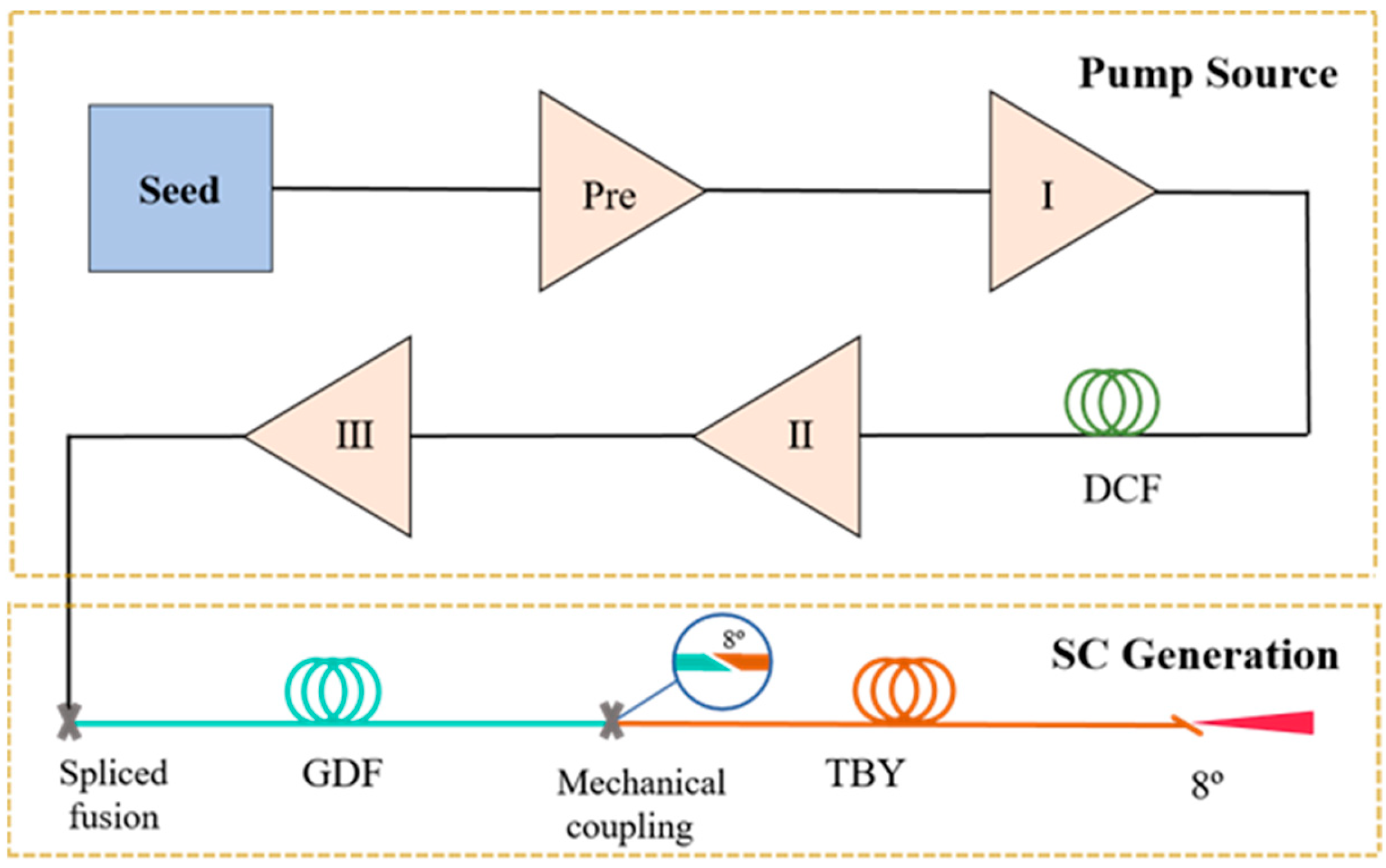
Figure 1 illustrates the cascaded experimental setup, which comprises a picosecond-pulsed TDFA, a GDF, and a TBY. The initial pulsed laser was generated by a mode-locked seed oscillator based on a semiconductor saturable absorber mirror (SESAM). The mode-locked oscillator has a repetition rate of 44.31 MHz, a pulse width of 29.7 ps, a central wavelength of 1998 nm, a 3 dB spectral bandwidth of 0.3 nm, and an output power of 4 mW. This pulse train was then amplified using a TDFA that incorporated multistage amplification and dispersion management techniques. A preamplifier is incorporated between the thulium-doped fiber amplifier and the mode-locked seed source. Specifically, a dispersion compensation fiber (DCF) was integrated into the amplifier to broaden the pulse width. This reduction in peak power effectively mitigated nonlinear effects during the subsequent amplification stages. The TDFA delivered picosecond pulses at a wavelength of approximately 2 μm and a repetition rate of 44.31 MHz, serving as the primary pump source for two sequential nonlinear conversion stages. The pump beam was first launched into an 18 cm long GDF with a core diameter of 12 μm. The GDF was fusion-spliced directly to the TDFA output fiber, forming an all-fiber, high-power first stage. The output from the GDF was then mechanically butt-coupled into a 35 cm long TBY with a core diameter of 7 μm. The cascaded configuration ensured a stepwise increase in fiber nonlinearity, effectively maintaining the soliton state of the pulse. The alignment between the GDF and TBY was optimized using a high-precision three-dimensional translation stage. This alignment process was guided by monitoring the output power and beam profile characteristics with a high-resolution charge-coupled device (CCD) camera. The GDF output end was cleaved at 8°, while the TBY ends were polished to an 8° angle. All fiber components were mounted on water-cooled plates for effective thermal management during operation.
The short GDF was employed as the primary nonlinear medium for spectral broadening. This fiber featured a core diameter of 12 µm and a GeO
2 concentration of 64 mol.%. Additionally, the GDF exhibits relatively low loss in the 2~3 µm region, with a sharp increase in loss observed at wavelengths exceeding 3 µm [
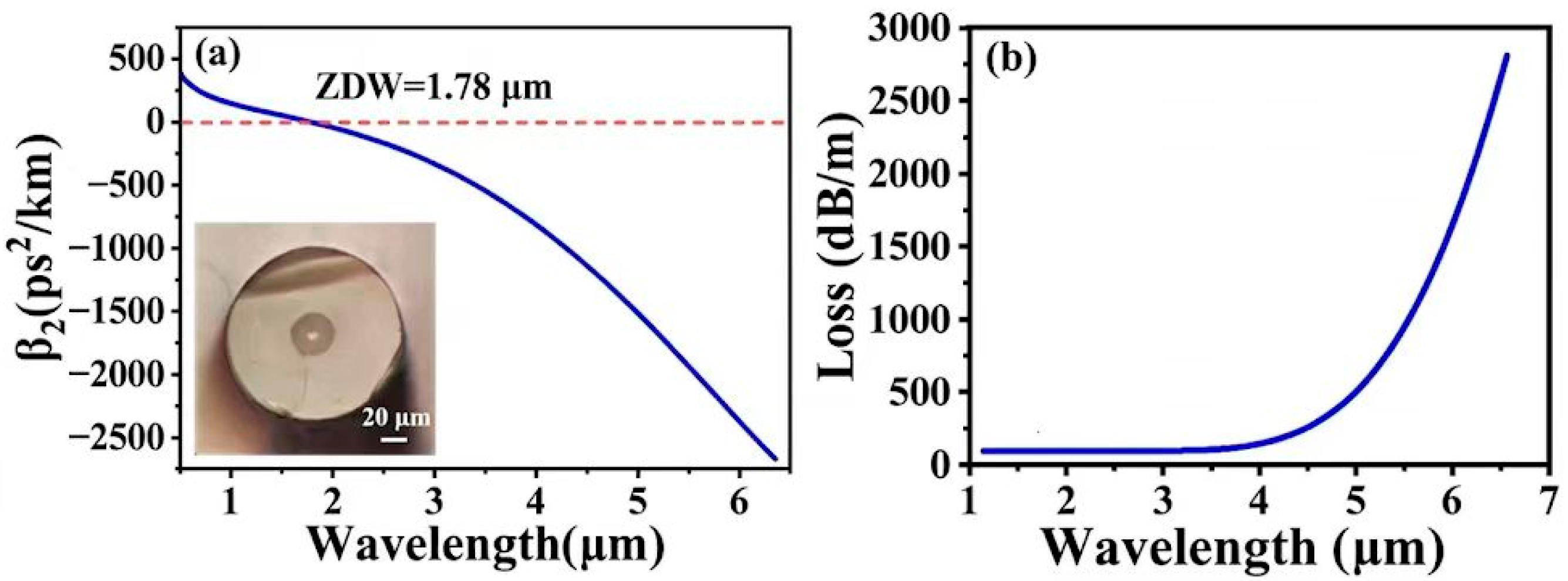
11]. We used a TBY with a 7 μm core diameter (cross-section shown in the inset of
Figure 2a). This fiber has a nonlinear coefficient of 155.13 W
−1 km
−1 at 2 μm, as calculated from its nonlinear refractive index. In our research, the GDF used in our experiments was purchased from a specialized fiber manufacturer. The second nonlinear fiber utilized is a TBY self-drawn using a combination of the suction injection method and the rod tube method, with dispersion controlled by adjusting the core size. The fiber core and inner cladding glass components are TeO
2:BaF
2:Y
2O
3 ratios of 70:20:10 and 65:25:10, respectively [
16]. As presented in
Figure 2a, the zero-dispersion wavelength (ZDW) for the fundamental Linearly Polarized mode 01 (LP
01) mode is 1.78 μm. Since the pump source operates in the anomalous dispersion regime beyond this ZDW, it is well-suited for exciting strong nonlinear effects. Furthermore, the confinement loss curve in
Figure 2b confirms that the fiber maintains low loss across the mid-infrared band, making it ideal for MIR SC generation [
17].
In the experiment, the laser spectrum from the amplifier output was characterized using a grating monochromator (Zolix, Beijing, China) combined with a liquid-nitrogen-cooled indium antimonide (InSb) detector and a lock-in amplifier. For the SC spectrum generated from the MIR nonlinear fiber, measurements were performed using a Yokogawa optical spectrum analyzer (AQ6377, measurement range: 1900~5500 nm) and a grating monochromator (Zolix, for a wavelength range below 1900 nm). The power characteristics of the output laser were measured using a Thorlabs power meter (S322C).
3. Results and Discussion
In the experiment, we found that self-starting mode-locking of the seed source was readily achieved when the 1570 nm pump power exceeded the laser threshold of 338 mW. The mode-locked pulses exhibited a 22.54 ns pulse interval, corresponding to a 44.31 MHz repetition rate that matched the 2.3 m cavity length. The seed source operated continuously for 30 min without intensity fluctuations, during which the RMS value reached 0.5%, demonstrating excellent stability. The sech
2 curve fitting yielded a 29.7 ps pulse width. The mode-locked laser had a 1998 nm central wavelength with 0.3 nm 3-dB bandwidth. These results confirm the reliability of our homemade mode-locked seed source, providing stable pulses with well-defined temporal and spectral characteristics suitable for high-power SC generation [
11].
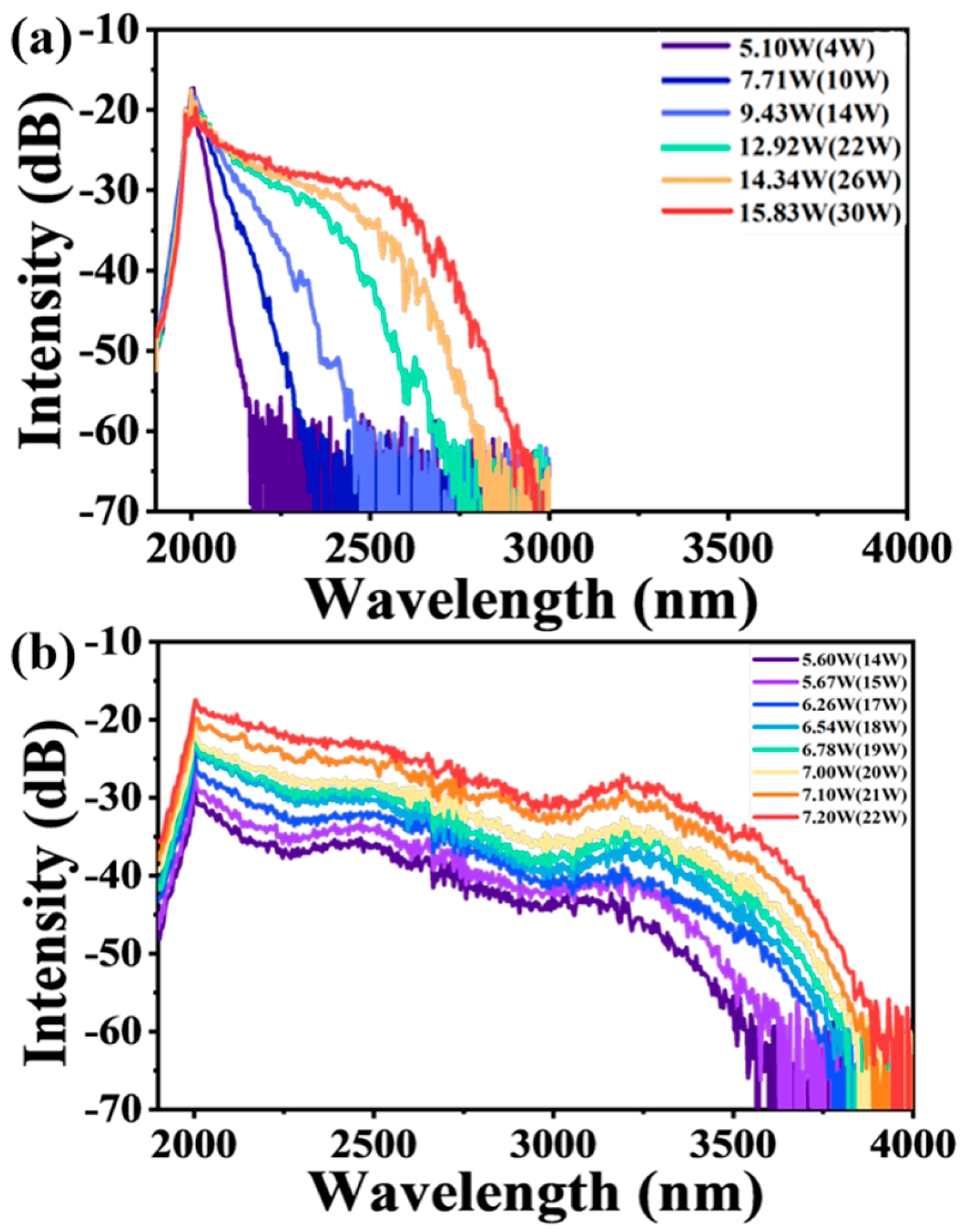
After pre-amplification, the pulsed laser from the seed oscillator had a 3dB spectral width of 0.4 nm and an output power above 1 W. The pulses were then temporally stretched in a 100 m dispersion-compensating fiber (UHNA4, Coherent (Nufern), East Granby, CT, USA) and further amplified in a single-mode TDFA (home-made) to increase the average power. When pumped with a 793 nm laser diode (LD, BWT Beijing Ltd., Beijing, China) at 22 W, the amplifier delivered an output power of 15.20 W; the spectrum measured using a grating monochromator spanned from 1.8 to 2.2 μm. The maximum output power reached 18.50 W at a pump power of 30 W, with further power scaling limited by the available pump power. Based on the optimization of the aforementioned parameters, we enabled the pump pulses to achieve sufficient peak power while delivering high average power, thereby facilitating effective spectral broadening in the subsequent nonlinear fibers. A trade-off among the pulse parameters of the pump source is necessitated during the experiment. Increasing the repetition rate facilitates the enhancement of average power but may compromise the broadening efficiency in the long-wavelength region. The pulse width directly determines the peak power and excites distinct nonlinear effects in nonlinear fibers. This TDFA was used to pump an 18 cm long GDF (Coherent (Nufern), East Granby, CT, USA) (64 mol.%). The splice loss between the TDFA and the GDF was measured at 0.2 dB. The output power and spectral evolution after the GDF are shown in
Figure 3a. The output power increased linearly with pump power without saturation, achieving a slope efficiency of 42.2% relative to the pump power of the main amplifier. At the maximum pump power of 30 W, the output power after the GDF was 15.83 W. As the output power rose, the SC spectrum from the GDF broadened progressively toward longer wavelengths. However, further broadening was constrained by the available pump power and the material loss of the GDF at longer wavelengths. At an output power of 12.92 W, the long-wavelength edge of the SC extended to ~2.7 μm. At 15.83 W, the long-wavelength edge reached approximately 3 μm, with a spectral absorption peak observed at 2.7 μm due to water molecules. The primary broadening mechanisms included self-phase modulation, modulation instability, higher-order soliton fission, and soliton self-frequency shift [
18,
19].
To further extend the SC spectrum, we mechanically butt-coupled an 18 cm long GDF (12 μm core) to a 35 cm long TBY (7 μm core). We optimized the alignment using a high-resolution CCD camera (Yifang Development Co., Ltd., Zhuhai, China) and precision 3D translation stages while monitoring the output power and beam profile. Owing to mode-field mismatch and intrinsic butt-coupling losses, the coupling efficiency was measured at 66.2%. The output power after the TBY was measured with a thermal power meter (Thorlabs S322C, Thorlabs Inc., Newton, NJ, USA). When pumped at 12.92 W from the GDF, the TBY delivered an average output power of 7.20 W, corresponding to a slope efficiency of 22.8% relative to the main amplifier’s pump power.
Figure 3b shows the SC spectra generated in the TBY (home-made) at different output powers. As the power increased, nonlinear effects—including soliton fission and soliton self-frequency shift—gradually broadened the spectrum toward longer wavelengths. At an output power of 5.60 W, the long-wavelength edge already exceeded 3.5 μm. With further power increase, high-energy soliton pulses at shorter wavelengths acted as pumps for longer-wavelength pulses, thereby driving further red-shifting and enhancing the power proportion in the long-wavelength region. At the maximum output power of 7.20 W, significant broadening occurred, extending the long-wavelength edge to 3.96 μm. The primary constraint on further extending the output power and spectral range lies in the pump power. This broadband generation is attributed to the high peak power delivered by the cascaded pump source and the high nonlinear coefficient of the TBY. When GDF is used, the pulse peak power that can be retained while achieving the same spectral broadening state as in the first stage is higher than that obtained when using TBY alone, exciting stronger nonlinear effects in the highly nonlinear TBY and enabling substantial spectral extension. Notably, the SC has not yet reached the infrared cutoff edge of the TBY, indicating potential for further power scaling and spectral broadening. Both the GDF and TBY exhibited excellent thermal stability and damage resistance, maintaining robust operation over extended periods. This reliability is a key advantage for the practical implementation of these MIR SC sources.
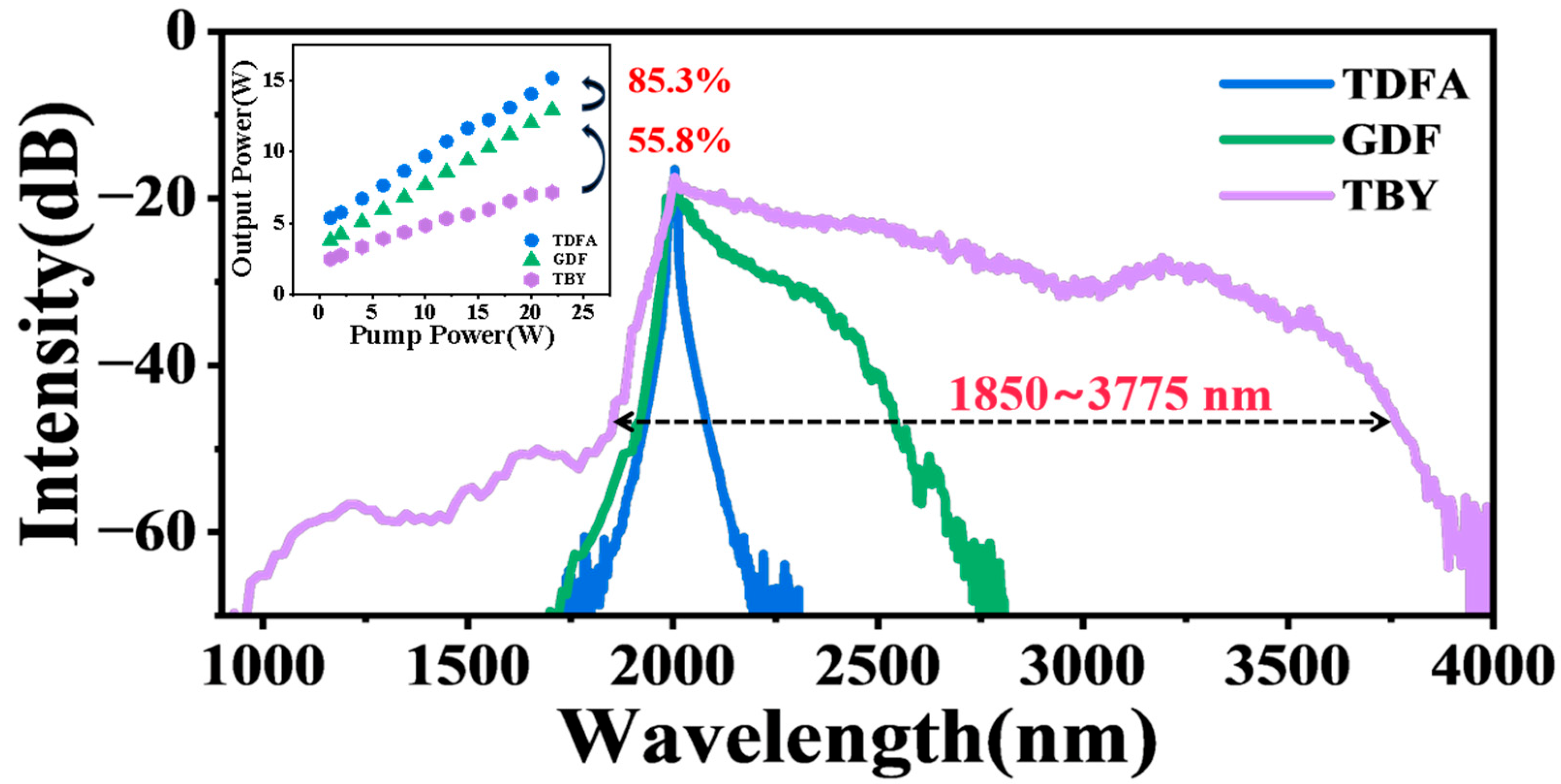
Figure 4 shows the comparison of output spectra from a TDFA, GDF, and TBY. At an amplifier pump power of 22 W, the output powers of the TDFA, GDF, and TBY were 15.20 W, 12.92 W, and 7.20 W, respectively, with corresponding spectral long-wavelength edges extending to ~2.2 μm, ~2.8 μm, and ~4 μm bands. The transmission efficiency from the TDFA to GDF was 85.0%, while from GDF to the TBY, it was 55.7%. These efficiency values represent a decrease compared to low-power operation, primarily attributed to nonlinear spectral broadening effects. At an output power of 7.20 W from the TBY, the 30 dB spectral range of the SC covered 1850~3775 nm. The power proportions at wavelengths greater than 2.5 μm, 3.0 μm, and 3.5 μm were 56.3%, 32.8%, and 11.2%, respectively.
The cascaded pumping scheme employed picosecond pulses first pumped in the anomalous dispersion region of a GDF. This generated pulses with higher soliton order in the 2–2.8 μm band. This initial, segmented broadening primed the system for subsequent SC generation in the TBY. When these energetic mid-infrared solitons were launched into the anomalous dispersion region of the TBY, modulation instability temporally split them into a train of shorter soliton pulses. After propagating over a certain distance, each soliton underwent further spectral broadening toward longer wavelengths under the combined effects of soliton splitting and Raman-induced soliton self-frequency shift. Meanwhile, the blue-shift phenomenon was induced by the resonant radiation process generated in the normal dispersion region based on the phase-matching condition. Ultimately, cascading the GDF with the TBY produced significant spectral broadening and enhanced the power proportion in the long-wavelength region, thereby validating this technical route for SC extension and long-wave power optimization. Experimentally, we observed that using a cascaded nonlinear fiber shorter than the optimal length reduced the number of solitons shifting to longer wavelengths. This limited the energy transfer to the long-wave region and degraded the SC generation efficiency in the next fiber stage. Conversely, an excessively long nonlinear fiber caused the soliton pulses to broaden temporally, reducing their peak power and consequently weakening the nonlinear effects in the following stage. Moreover, the unnecessary extra fiber length introduced additional absorption loss, diminishing the longer-wavelength power and resulting in lower average output power and inferior spectral broadening. Therefore, in this scheme, the length of each nonlinear fiber stage must be carefully optimized to simultaneously maximize the spectral range and output power.
To investigate the SC broadening mechanism in the cascaded GDF and TBY, a theoretical model for SC generation via picosecond pulse laser propagation was applied for numerical calculations. The numerical simulation was performed by solving the generalized nonlinear Schrödinger equation (GNLSE) using the split-step Fourier transform (SSFT).
A(
z,T): Complex envelope amplitude of the optical pulse,
z: Propagation distance along the fiber,
T: Time variable,
β: Dispersion coefficient,
γ: Nonlinear coefficient,
g: Gain coefficient,
α: Linear loss coefficient, and
R(T): Medium nonlinear response function [
20,
21].
The theoretical model comprises a 3.5 m gain fiber, an 18 cm GDF, and a 35 cm TBY. For accurate resolution in both spectral and temporal domains, a grid of 2
19 points and a 3000 ps time window were used in the simulations. Furthermore, Gaussian white noise was incorporated into the model to enhance the reliability of the results and improve their agreement with experimental data. We took these parameters for numerical simulation using MATLAB, including an operating wavelength of 2 μm, a pulse width of 29.7 ps, and a repetition rate of 44.3 MHz of the pump source; the calculated nonlinear coefficients of GDF, GVD profile, and loss curve derived from Ref. [
11]; the calculated nonlinear coefficients of TBY, GVD profile, and loss curve mentioned in
Figure 2; and the Raman response function derived from the Raman gain spectrum of GDF and TBY glass [
22]. The GDF and TBY have a nonlinear coefficient of 3.74 W
−1 km
−1 and 155.13 W
−1 km
−1 at 2 μm. For the simulation of GDF, our previous study reveals the physical mechanisms by which modulation instability leads to pulse splitting and how soliton dynamics and soliton self-frequency shift achieve spectral broadening [
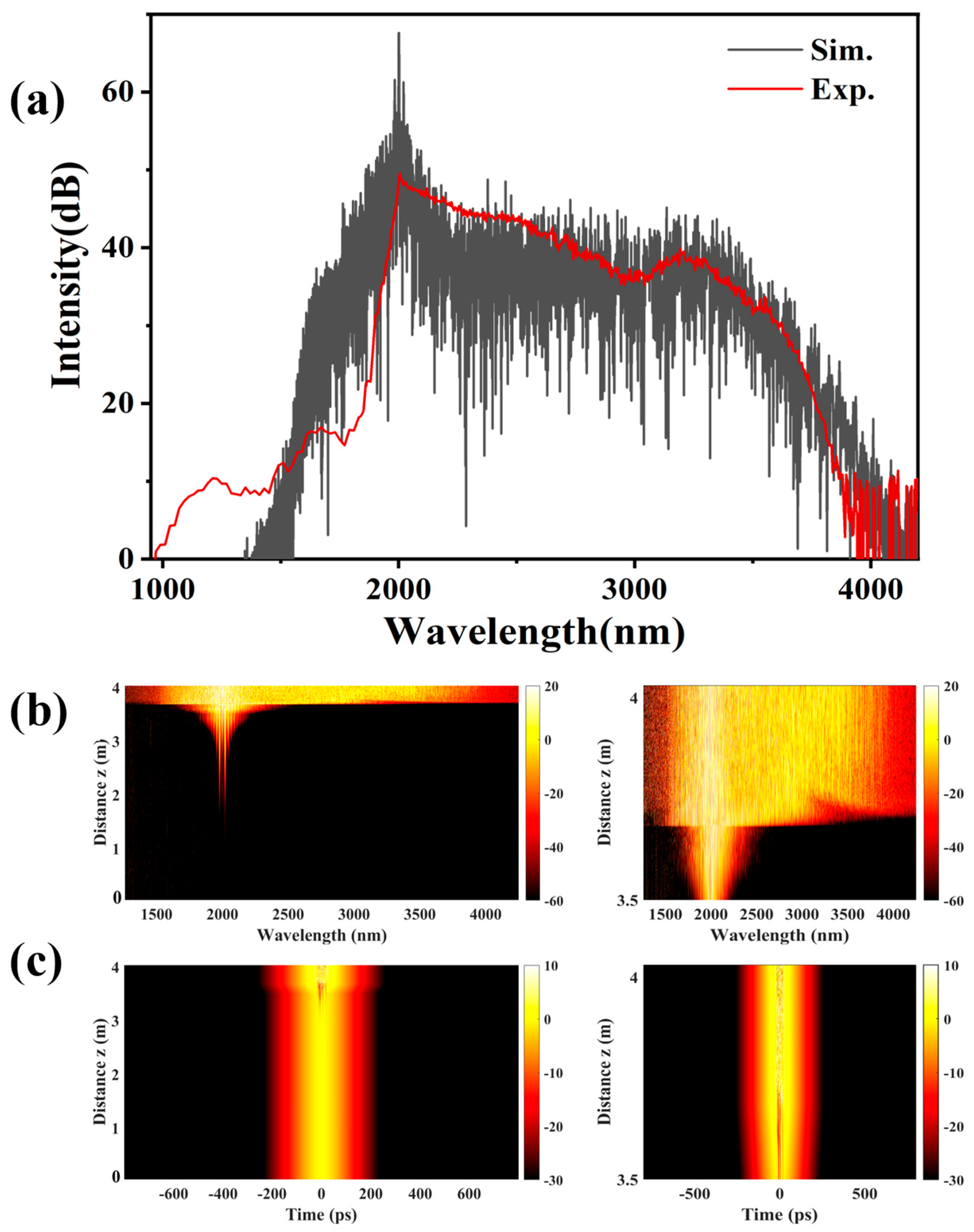
11]. At the same injected pump power, the simulation results (black curve) agree well with the experimental results (red curve) of the SC spectrum measured through the TBY, indicating that the parameters used in the simulation are appropriate, as shown in
Figure 5a. Furthermore, the frequency-domain and time-domain evolution processes of SC generation were simulated, as shown in
Figure 5b,c, along with detailed evolution profiles after a propagation distance of 3.5 m. Due to modulation instability, the pulse developed distinct symmetric sidebands on both sides of the central wavelength at 1.6 m in the gain fiber, while the pulse within the thulium ion gain spectrum was amplified. After propagating through a certain length, as shown in
Figure 5c, the pulse splits into a series of ultrafast sub-pulses at the 3.5 m position within the gain fiber. As the pulse continued propagating in the GDF fiber, modulation instability gradually intensified, exciting abundant soliton dynamics in the TBY. Subsequently, soliton pulses with high peak power further induced modulation instability, soliton fission, and soliton self-frequency shift (SSFS) in the 35 cm long TBY, which broadened the spectrum to longer wavelengths.
Our core idea is to divide the nonlinear spectral broadening process into two optimized stages, each performed in a dedicated fiber: The first stage’s objective is for power scaling and preliminary broadening. The GDF is chosen for its excellent compatibility with a silica-based TDFA, allowing for a robust, all-fiber, high-power setup. This stage primarily aims to efficiently convert the 2 μm pump laser into a higher-power source already extended toward 3 μm, thereby accumulating substantial power in the spectral region that will serve as the pump for the next stage. The second stage objective is for efficient final broadening. The output from the GDF is then injected into a TBY. This fiber is selected for its superior nonlinearity and wider infrared transparency compared to GDF. The pre-broadened and red-shifted pump spectrum from the first stage allows the nonlinear effects in the TBY to be initiated more efficiently and at longer wavelengths, leading to dramatic spectral expansion with effective power transfer to the 3–4 μm band. This segmented strategy effectively decouples the power scaling and extreme spectral broadening processes, overcoming the limitations of using a single fiber and enabling superior overall performance.