Abstract
In this work, we experimentally demonstrate a scheme for generating a multi-band FMCW signal with a tunable sweep bandwidth and inter-band interval. For such a scheme, an original FMCW signal is first acquired by directly current-modulating a master distributed feedback semiconductor laser (DFB-SCL) using a pre-distorted triangular waveform. Then, the original FMCW signal is injected into a slave DFB-SCL, in which a multi-band FMCW signal is generated via the four-wave mixing (FWM) effect. The experiment results show that, under appropriate injection parameters, a tri-band FMCW signal can be obtained, which is composed of a regenerated original FMCW signal (named as main band) and two newly generated FMCW signals originating from idler waves (named as upper band and lower band, respectively). Under the optical injection with negative frequency detuning, the sweep-frequency bandwidth for upper band is the same as that of the original FMCW signal, and the sweep-frequency bandwidth for lower band is twice that of the original FMCW signal. Meanwhile, the interval between the central frequencies of two adjacent bands depends on the frequency detuning between two DFB-SCLs operating at free-running. By adjusting the sweep-frequency bandwidth of the original FMCW signal and the temperature of the slave DFB-SCL, the sweep-frequency bandwidth of each band and the interval between two adjacent bands of the generated FMCW signal can be tuned. For demonstration of a proof of concept, we inspect the case that the original FMCW signal with a sweep-frequency bandwidth varied within 3 GHz~7 GHz and the frequency detuning varied within 44 GHz~59 GHz. The corresponding results demonstrate that each band with the different sweep-frequency bandwidth possesses high linearity of R2 > 0.990 under the frequency detuning fixing at 59 GHz. Such a scheme offers a simplified architecture for generating multi-band FMCW signals with a tunable sweep-frequency bandwidth and inter-band interval.
1. Introduction
Over the last few years, light detection and ranging (LiDAR) has become a key technology for the next-generation sensor due to its advantages of contactless measurement and rapid response [1,2,3,4,5,6,7,8]. At present, this technology can mainly be classified into two categories: time-of-flight LiDAR and frequency-modulated continuous-wave LiDAR (FMCW LiDAR). In contrast to time-of-flight LiDAR, the emission source of the FMCW LiDAR usually possesses a characteristic of continuous frequency scanning, and the range and velocity information are decoupled by measuring the frequency difference between the transmitted and echo signal [9]. In particular, FMCW LiDAR can achieve the target measurement with a sub-centimeter resolution under low-reflectivity or multi-target situations by relying on the principle of coherent detection, and can thus be widely applied in many fields such as autonomous vehicles, robots, and precision industrial metrology [10,11].
Currently, the most common emission sources in FMCW LiDAR are based on the single-band laser source [12,13,14,15,16,17,18,19,20,21]. In 2009, based on the current-modulated distributed feedback semiconductor laser (DFB-SCL), Naresh et al. proposed a single-band emission source scheme for an FMCW LiDAR system, which is utilized to measure the distance of an object moving along a sliding rail [12]. For a distance of 520.0 mm, the distance resolution achieves 1.5 mm. In 2024, Wang et al. theoretically investigated the thermal effect on the performance of a single-band emission source of FMCW LiDAR based on a current-modulated DFB-SCL [13]. Through selecting optimized thermal parameters of the DFB-SCL, high-precision distance measurement with a relative error of 0.340% under a distance of 200.0 mm can be achieved. In 2024, Yang et al. experimentally demonstrated a high-performance single-band emission FMCW source based on an adaptive pre-distortion algorithm [20]. Based on this algorithm, the source can achieve high-accuracy measurement with a standard deviation of 0.11 mm under a distance of around 0.689 mm. In 2025, Zou et al. proposed a Fourier domain pre-distortion method to enhance the measurement performance of the single-band emission FMCW source [21]. Their results showed that the optical fiber delay lines with a length of around 120.0 m can be precisely measured. However, simply adjusting the emission direction of the single-band source to detect the target is insufficient for rapidly distinguishing or simultaneously tracking multiple spatially separated targets. In contrast, a multi-band emission source offers several discrete frequency bands, enabling parallel detection across different spectral regions and enhancing the detection speed and robustness [22,23]. Therefore, researchers have turned their attention toward the development of adjustable multi-band emission sources [24,25,26,27]. In 2024, Xiao et al. proposed a two-band FMCW emission source based on a dual-sideband suppressed-carrier modulation technology [26]. Their results showed that the emission source exhibits excellent performance in linearity. Taking such a two-wavelength emission source to measure a fixed distance of 4916.44 m, which is far beyond the coherence length, a relative error of 0.011% can be achieved. In 2024, Li et al. proposed a tunable multi-band linearly frequency-modulated waveform generator by optical heterodyne detection technology [27]. Their results indicated that by using a continuous-wave (CW) laser injected into a Mach–Zehnder modulator (MZM) and altering the frequency of the RF signal loaded on the MZM, a tunable multi-band FMCW signal can be generated. The bandwidth and the center frequency difference between frequency bands have tuning ranges from 0.7 to 6.7 GHz, and 2.0 to 6.7 GHz, respectively. Although the multi-band emission sources mentioned above already have relatively good performance, most of them rely on the modulators, and it is hard to control the costs. In addition, the sweep-frequency bandwidth of the generated FMCW signal is limited by the bandwidth of the used modulator and photodetector. These issues restrict the further development of such schemes.
To address this problem, we propose and experimentally demonstrate a multi-band FMCW signal generator with a tunable sweep-frequency bandwidth and inter-band interval based on the four-wave mixing (FWM) effect in DFB-SCL. For such a scheme, an original FMCW signal is generated by using a pre-distortion current to modulate the master DFB-SCL. Then, the original FMCW signal is injected into the slave DFB-SCL to obtain a tri-band FMCW signal. The frequency detuning and the amplitude of the modulation voltage are selected, respectively, from 44 GHz to 59 GHz and from 3V to 5V for demonstrating such a proof of concept, and the results show that a tri-band FMCW signal with the tunable inter-band interval and sweep-frequency bandwidth can be generated. In addition, we also find that, due to the FWM effect, each FMCW signal within the tri-band can effectively replicate the linearity of the original FMCW signal. This scheme provides a future development direction for generating an adjustable multi-band FMCW signal with high linearity.
2. Experimental Setup and Methods
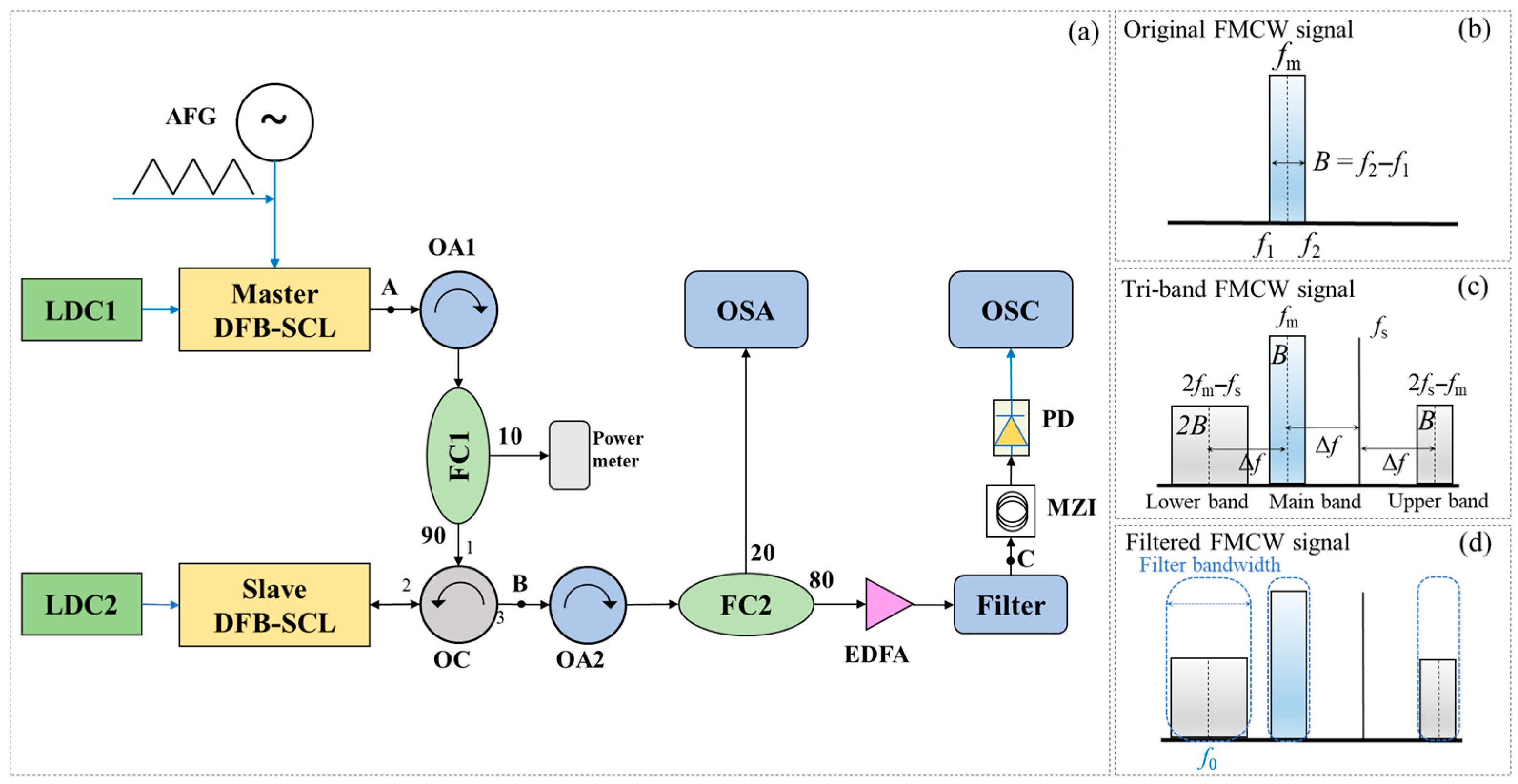
Figure 1a illustrates the experimental setup for a multi-band FMCW signal generator. A commercial distributed feedback semiconductor laser (DFB-SCL, GYSCIENTECH DFB-1550-02, Wuhan, China) with a Lorentz linewidth of 453.00 kHz is taken as the master DFB-SCL. Such a DFB-SL with specific linewidth is selected just for a proof of concept, and it can be predicted that the performances of the multi-band FMCW signal can be further enhanced if a DFB-SCL with a smaller linewidth is utilized. The bias current and temperature of the master DFB-SCL are controlled by a low-noise laser diode controller (LDC1, Koheron CTL-200-1-B600, Lorient, France), which possesses a current and temperature resolution of 0.015 mA and 0.1 °C, respectively. During the experiment, the bias current and temperature of the master DFB-SCL are set at 80.00 mA and 20.0 °C, respectively. After using a pre-distortion current generated from an arbitrary function generator (AFG, RIGOL DG1022z, Suzhou, China) to modulate the master DFB-SCL, the original FMCW signal is generated. The original FMCW signal is directly injected into a slave DFB-SCL (ETSC DFB-DC-13) for generating a multi-band FMCW signal after passing through an optical attenuator (OA), a 90:10 fiber coupler (FC1), and an optical circulator (OC), where the slave DFB-SCL is also a commercial device with no optical isolator and controlled by a laser diode controller (LDC2, Newport LDCX3724C, Newport, RI, USA), and its current and temperature resolution are 0.01 mA and 0.1 °C, respectively. During the experiment, the current of slave DFB-SCL is fixed at 60.04 mA. Through adjusting the temperature of slave DFB-SCL from 23.0 °C to 25.0 °C, different frequency detuning between the master and slave DFB-SCL can be obtained. After passing through the OC, OA, and an 80:20 FC2, the multi-band FMCW signal outputs from the slave DFB-SCL is divided into two parts. Twenty percent of the output is utilized for observation by an optical spectrum analyzer (OSA, BOSA Lite+, 20 MHz, Zaragoza, Spain). The remaining 80% of the output is passed through an Er-doped fiber amplifier (EDFA), a filter (EXFO, XTM-50-SCL-S, Quebec, QC, Canada), a Mach–Zehnder interferometer (MZI), a photodetector (PD, New Focus 1544-B 12 GHz, Sunnyvale, CA, USA), and an oscilloscope (OSC, Agilent-DSO-X910604A, Santa Clara, CA, USA) to extract the time–frequency curves of each band of the generated FMCW signal. The filter is utilized to capture the FMCW signals of different frequency bands, and the MZI consists of two 50:50 FCs and a 10 m fiber delay line.
Figure 1.
(a) Experimental setup for a multi-band FMCW signal generator. (b–d) Sketch diagrams of the optical spectra at point A to point C in Figure 1a. LDC: laser diode controller, DFB-SCL: Distributed feedback semiconductor laser, AFG: arbitrary function generator, OA: optical attenuator, FC: fiber coupler, OC: optical circulator, EDFA: Er-doped fiber amplifier, MZI: Mach–Zehnder interferometer, OSA: optical spectrum analyzer, OSC: oscilloscope.
Figure 1b–d are the sketch diagrams of the optical spectra for different FMCW signals. Figure 1b is the optical spectrum of the original FMCW signal, which is generated by the master DFB-SCL and observed at the point A in Figure 1a. fm is the center frequency of the original FMCW signal, and its sweep-frequency bandwidth can be calculated as B = f2 − f1. Figure 1c shows the optical spectrum of the generated tri-band FMCW signal, which is observed at the point B in Figure 1a. Under this case, the optical injection with negative frequency detuning is adopted, and the sweep-frequency bandwidths for upper band and lower band are B and 2B, respectively. The reason is as follows: for the slave DFB-SCL with a center frequency of fs subject to optical injection from the master DFB-SCL with a center frequency of fm, two sidebands can be generated via FWM effect. Under the case of optical injection with negative frequency detuning (fs > fm), the peak appears at 2fm − fs with lower frequency, and another appears at 2fs − fm with higher frequency [28]. Therefore, when the injection light is replaced by the original FMCW signal with the sweep-frequency bandwidth of B, two sidebands can be generated. The sweep-frequency bandwidth for the upper band is the same as that of the original FMCW signal, and the sweep-frequency bandwidth for lower band is twice that of the original FMCW signal. The inter-band interval is calculated as fs − fm, where fs is the lasing frequency of the slave DFB-SCL. Figure 1d is the filtered optical spectrum of the tri-band FMCW signal. By adjusting the center frequency f0 and filter bandwidth of the filter, each band can be completely captured to be analyzed.
During the experiment, the adopted pre-distortion method refers to Ref. [29], and the time-varied frequency information is obtained by using a Hilbert transform on the recorded time-series from the DSO. The adopted pre-distortion method mainly consists of three steps: collecting modulation currents and their corresponding outputs; building a forward neural network and training it using the collected data; solving the pre-distortion current via a backpropagation algorithm. For proof of concept, the modulation frequency of the pre-distorted voltage is maintained at 1.0 kHz, and the modulation amplitudes are set to 3V, 4V, and 5V to achieve the sweep-frequency bandwidths of 3 GHz, 5 GHz, and 7 GHz, respectively. Based on the previous investigations on the dynamics of the slave DFB-SCL under different injection parameters [28,30,31], we set the inter-band interval between the fm and the fs from 44 GHz to 59 GHz, and fix the injection power at 9.35 μW. Under these cases, two extra wavelengths with a fixed phase relationship are generated and located at the two sides of fm and fs due to the FWM effect in the slave DFB-SCL.
3. Results and Discussion
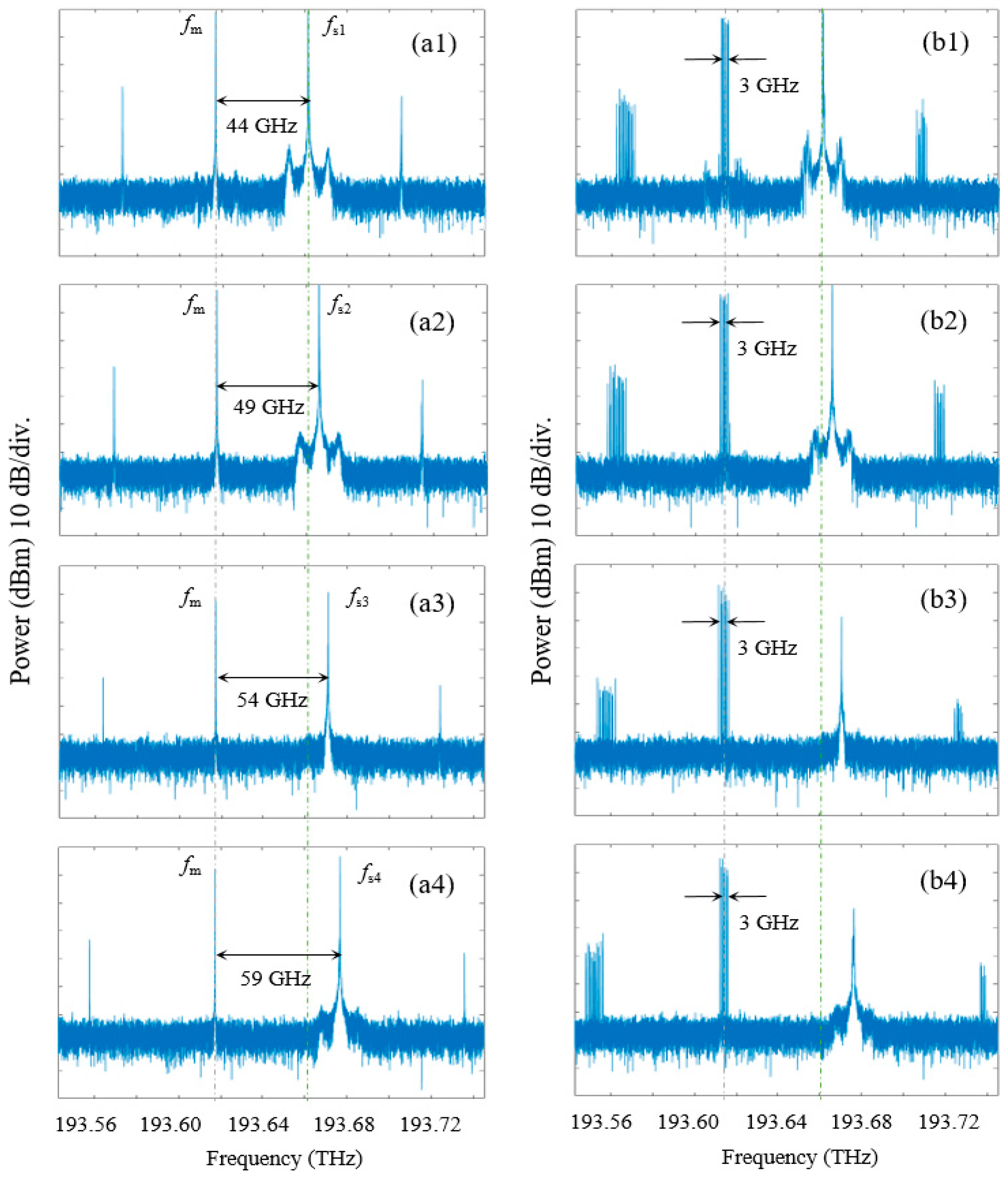
Firstly, we verified the tunability of this generator under a fixed amplitude of the pre-distortion current of 3V. In this part, the attenuation rate of the OA2 varies slightly in each recording process to ensure that each sideband is clearly presented. Therefore, the changes in power levels of each sideband are not given much attention. Figure 2(a1–a4) show the optical spectra measured at point B in Figure 1a under the master DFB-SCL without modulation. It can be seen that two additional spectral lines appear in the optical spectra of the slave DFB-SCL after introducing optical injection due to the FWM effect. The frequency interval between these spectral lines is consistent with the frequency detuning between the free-running master DFB-SCL (fm) and slave DFB-SCL (fs). The powers of the upper and lower sidebands are not identical, and such a phenomenon has been demonstrated in Ref. [30]. In addition, it can also be observed that, as the frequency of the slave DFB-SCL shifts from fs1 to fs4, the inter-band intervals between the four spectral lines gradually increase, and they always remain consistent with the frequency difference of fsi − fm. Furthermore, we apply a pre-distortion current with an amplitude of 3V to modulate the master DFB-SCL, and the corresponding results are recorded in Figure 2(b1–b4). It can be seen that the generated tri-band FMCW signals possess a relatively high signal-to-noise ratio (SNR), and SNRs are more than 25 dB for each band. The sweep-frequency bandwidth of lower band, main band, and upper band are around 6 GHz, 3 GHz, and 3 GHz, respectively. The inter-band intervals are 44 GHz, 49 GHz, 54 GHz, and 59 GHz, respectively. From Figure 2(a1,b1), it can also be observed that there is an obvious bump near fs, which is due to the enhanced relaxation oscillation of slave DFB-SCL under optical injection with a relatively small frequency detuning [28]. With the increase in frequency detuning, the effect of enhanced relaxation oscillation originating from optical injection is generally weakened, and such a bump is gradually suppressed.
Figure 2.
Optical spectra observed at point B in Figure 1a under the inter-band intervals are set at 44 GHz, 49 GHz, 54 GHz, and 59 GHz, respectively. (a1–a4) Master DFB-SCL is under no pre-distortion current modulation. (b1–b4) Master DFB-SCL is under the pre-distortion current modulation of 3V.
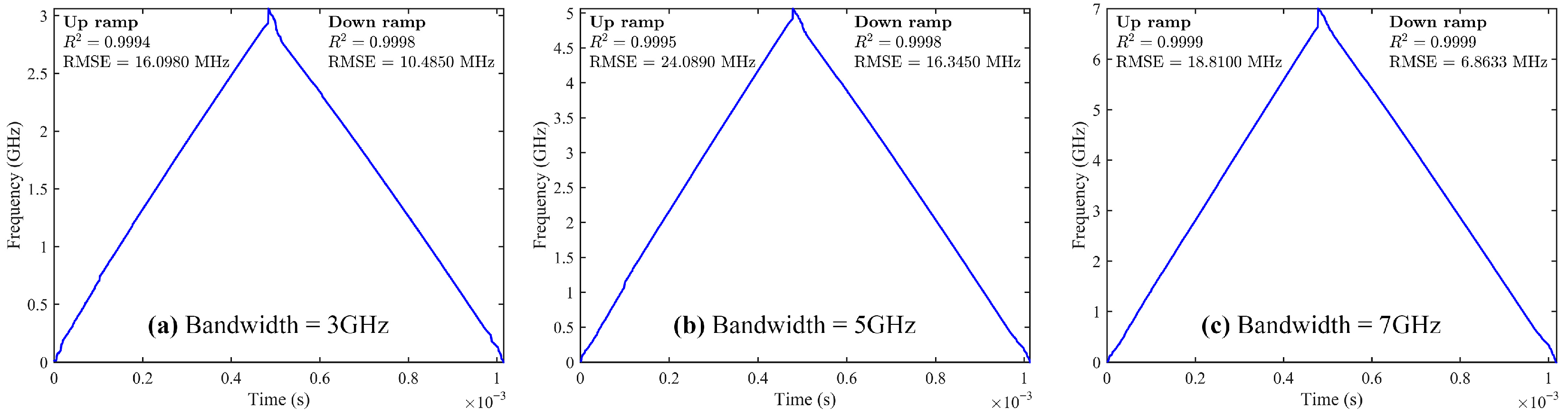
Considering that the performance of the generated tri-band FMCW signal is seriously dependent on the original FMCW signal, we first analyzed the performance of the original FMCW signal under sweep-frequency bandwidths of 3 GHz, 5 GHz, and 7 GHz, and the corresponding results are shown in Figure 3. In this work, 80% of the region of interest of the recorded time-varied frequency signal is taken to analyze. The linear regression coefficient is calculated as R2 = 1 − SSres/SStot, where SSres is the sum of squared residuals, SStot is the total sum of squares, and R2 is a constant less than 1. The higher the linearity, the closer R2 is to 1. The residual root-mean-square error (RMSE) is represented as an RMS of the difference between the swept-frequency optical signal and a standard linear fitting curve, and it can be expressed as RMSE = √(SSres/N), where N is the number of points of SSres. For the sweep-frequency bandwidth setting at 3 GHz, the R2 for up- and down-ramp FMCW signals are 0.9994 and 0.9998, respectively, and their corresponding RMSEs are 16.0980 MHz and 10.4805 MHz. For the sweep-frequency bandwidth increasing to 5 GHz, the R2 for up- and down-ramp FMCW signals are 0.9995 and 0.9998, respectively, and their corresponding RMSEs are 24.0890 MHz and 16.3450 MHz. For the sweep-frequency bandwidth fixing at 7 GHz, the R2 for up- and down-ramp FMCW signals are 0.9999 and 0.9999, respectively, and their corresponding RMSEs are 18.8100 MHz and 6.8633 MHz. The results indicate that the down-ramp possesses a relatively high linearity over the up-ramp, and the reason is that the linearity of the down-ramp is better than that of the up-ramp under conditions without pre-distortion. Additionally, there exists a distortion point between the up- and down-ramp, which results from the relaxation oscillation of the laser [32].
Figure 3.
R2 and RMSE for the original FMCW signal under the sweep-frequency bandwidth of (a) 3 GHz, (b) 5 GHz, and (c) 7 GHz.
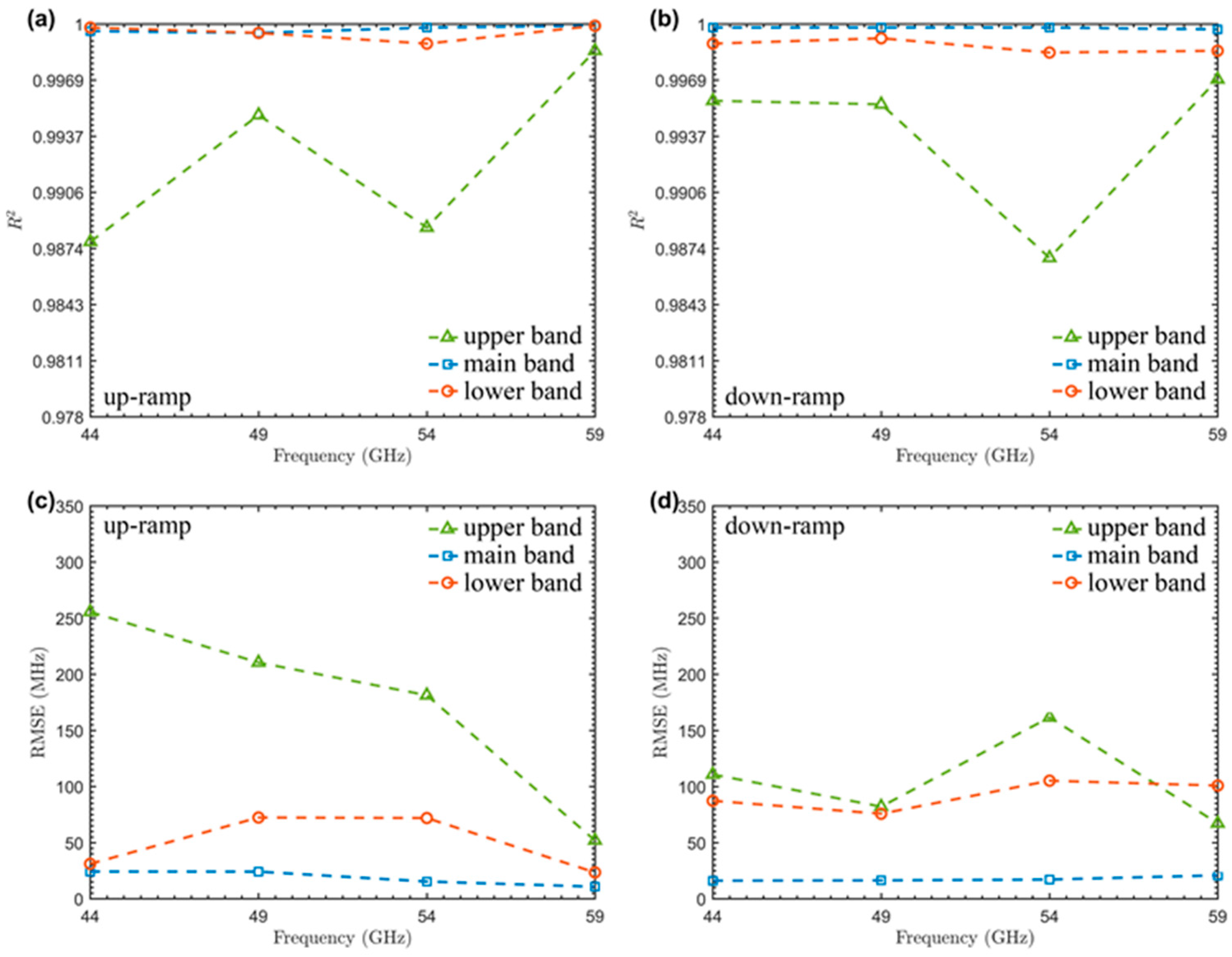
Next, by injecting the aforementioned original FMCW signal with a sweep-frequency bandwidth of 3 GHz into the slave DFB-SCL, we investigated the R2 and RMSE of the tri-band FMCW signal under different inter-band intervals. Figure 4a,b show the R2 for up and down-ramp tri-band FMCW signal under the inter-band interval of 44 GHz, 49 GHz, 54 GHz, and 59 GHz, respectively. It can be observed that the regenerated original FMCW signal can maintain excellent performance, followed by the lower band FMCW signal with a higher SNR of about 30 dB in the optical spectrum. However, due to the relatively low SNR of the upper band FMCW signal of about 15 dB, its performance is the poorest. Figure 4c,d show the RMSEs for up and down-ramp tri-band FMCW signals under the inter-band interval of 44 GHz, 49 GHz, 54 GHz, and 59 GHz, respectively, and similar results can be concluded. In addition, for the inter-channel spacing is fixed at 59 GHz, each band of the tri-band FMCW signal has an excellent performance. The reason is that the larger the frequency spacing, the less the spectral distribution near the center frequency of slave DFB-SCL is affected by the injection light [28]. As a result, these sidebands possess better performance in linearity under a larger frequency spacing.
Figure 4.
R2 and RMSEs for the tri-band FMCW signal under the inter-band intervals of 44 GHz, 49 GHz, 54 GHz, and 59 GHz, respectively, where the sweep-frequency bandwidth is fixed at 3 GHz. (a,b) R2 of the up- and down-ramp tri-band FMCW signal. (c,d) RMSEs of the up- and down-ramp tri-band FMCW signal.
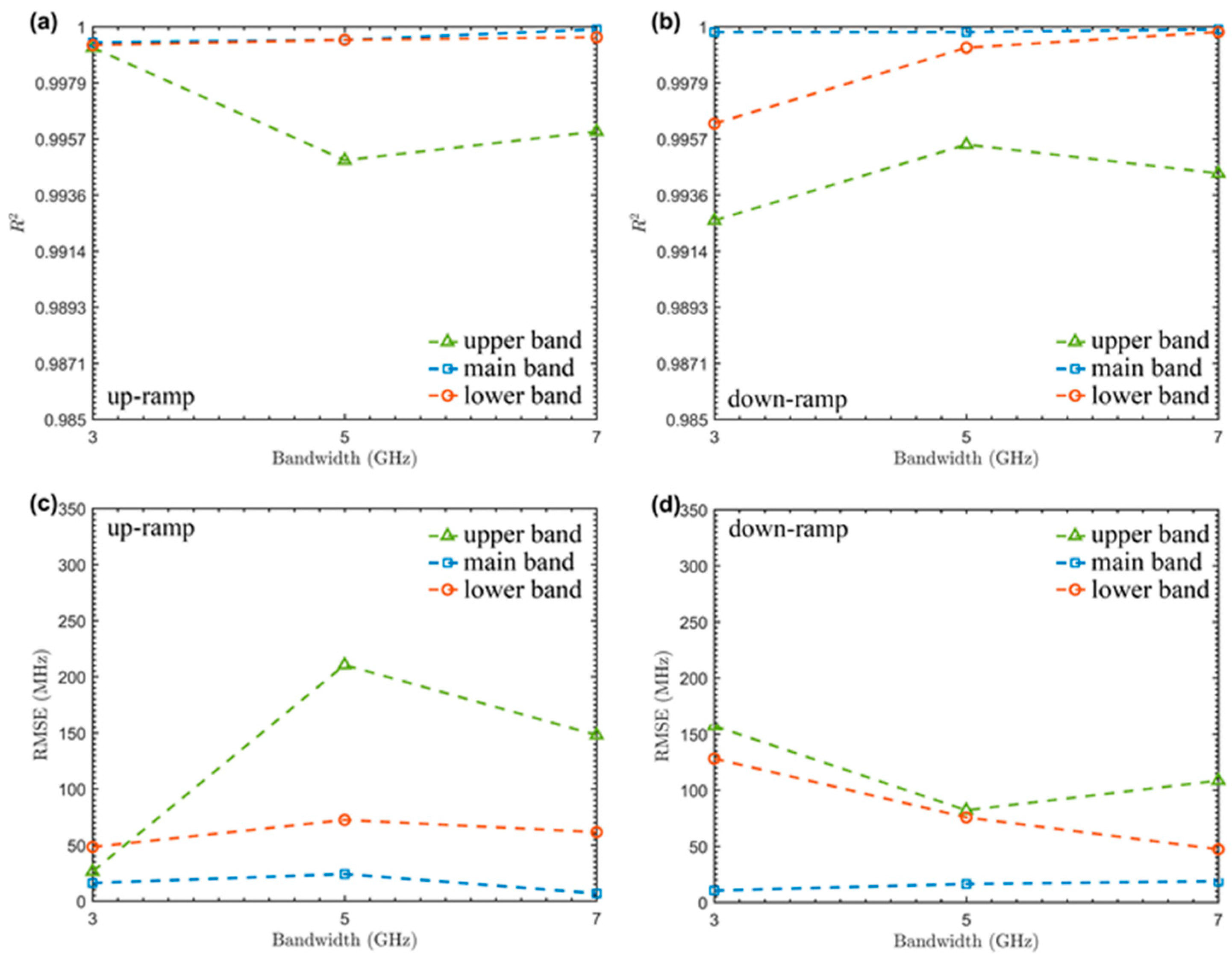
Finally, through fixing the inter-band interval at 59 GHz, the R2 and RMSE of the tri-band FMCW signal under different sweep-frequency bandwidths are investigated. Figure 5a,b are the R2 for up and down-ramp tri-band FMCW signal under the sweep-frequency bandwidth of 3 GHz, 5 GHz, and 7 GHz, respectively, and Figure 5c,d are the RSMEs for up and down-ramp tri-band FMCW signal under the sweep-frequency bandwidth of 3 GHz, 5 GHz, and 7 GHz, respectively. From these figures, it can be observed that the regenerated original FMCW signal and the lower band FMCW signal have the best performance, while the upper band FMCW signal has deteriorated. Based on the results reported in Ref. [33], the FMCW signals with such properties can be applied in an FMCW LiDAR system for realizing accurate measurement.
Figure 5.
R2 and RMSEs for the tri-band FMCW signal under the sweep-frequency bandwidths of 3 GHz, 5 GHz, and 7 GHz, respectively, where the inter-band interval is fixed at 59 GHz. (a,b) R2 of the up- and down-ramp tri-band FMCW signal. (c,d) RMSEs of the up- and down-ramp tri-band FMCW signal.
4. Conclusions
In summary, a tri-band FMCW signal generator with a tunable sweep-frequency bandwidth and inter-band interval has been proposed and experimentally demonstrated. In this scheme, an original FMCW is generated by using a pre-distortion current to modulate a master DFB-SCL, which is injected into a slave DFB-SCL for achieving a tri-band FMCW signal based on the four-wave mixing (FWM) effect. Through varying the modulation amplitude of the pre-distortion current and the temperature of the slave DFB-SCL, the sweep-frequency bandwidths and inter-band intervals of the tri-band FMCW signal can be detuned. Considering that the performance of the generated tri-band FMCW signal is seriously dependent on that of the original FMCW signal. Therefore, we first inspect the performance of the original FMCW signal under different sweep-frequency bandwidths, and the results show that the original FMCW signal possesses relatively high performance with an R2 over 0.9994 and RMSE below 25.0 MHz under the sweep-frequency bandwidths of 3 GHz, 5 GHz, and 7 GHz. Taking such an original FMCW signal and injecting it into the slave DFB-SCL, we investigate the performance of each band of the tri-band FMCW signal under the inter-band interval within 44 GHz~59 GHz and the sweep-frequency bandwidth within 3 GHz~7 GHz. The results indicate that tri-band FMCW signals with high linearity of R2 > 0.990 and RMSE < 200.0 MHz under different frequency bandwidth and fixing inter-band interval of 59 GHz can be achieved, which can be applied in FMCW LiDAR to realize accurate measurement both in distance and velocity. It should be pointed out that, for generating a tri-band FMCW signal, the slave DFB-SCL under optical injection should be operating at an FWM state. Therefore, for a given injection power, the frequency detuning will be limited within a certain region. Correspondingly, the inter-band interval of the generated FMCW signal is also limited within such a region.
Author Contributions
Conceptualization, M.M.-U.-R. and Q.W.; methodology, M.M.-U.-R., Q.W. and X.T.; validation, M.M.-U.-R., Q.W., X.T. and P.O.; formal analysis, M.M.-U.-R.; investigation, Q.W.; resources, G.X. and Z.W.; data curation, M.M.-U.-R.; writing—original draft preparation, M.M.-U.-R. and Q.W.; writing—review and editing, M.M.-U.-R., Q.W. and G.X.; visualization, M.M.-U.-R.; supervision, G.X. and Z.W.; project administration, G.X. and Z.W.; funding acquisition, G.X., Z.W. and Q.W. All authors have read and agreed to the published version of the manuscript.
Funding
This research was funded by the National Natural Science Foundation of China (62335015, 61875167), the Chongqing Natural Science Foundation (CSTB2022NSCQ-MSX0313) and the Postgraduates’ Research and Innovation Project of Chongqing (CYB23109).
Institutional Review Board Statement
Not applicable.
Informed Consent Statement
Not applicable.
Data Availability Statement
The data that support the findings of this study are available from the corresponding author upon reasonable request.
Conflicts of Interest
The authors declare that they have no known competing financial interests.
References
- Kim, I.; Martins, R.J.; Jang, J.; Badloe, T.; Khadir, S.; Jung, H.; Kim, H.; Kim, J.; Genevet, P.; Rho, J. Nanophotonics for light detection and ranging technology. Nat. Nanotechnol. 2021, 16, 508–524. [Google Scholar] [CrossRef]
- Qin, J.; Zhou, Q.; Xie, W.; Xu, Y.; Yu, S.; Liu, Z.; Tong, Y.; Dong, Y.; Hu, W. Coherence enhancement of a chirped DFB laser for frequency-modulated continuous-wave reflectometry using a composite feedback loop. Opt. Lett. 2015, 40, 4500–4503. [Google Scholar] [CrossRef] [PubMed]
- Zhu, G.; Miyamae, T.; Noda, K.; Lee, H.; Nakamura, K.; Mizuno, Y. High-speed high-resolution optical correlation-domain reflectometry without using electrical spectrum analyzer. Opt. Laser Technol. 2023, 161, 109120. [Google Scholar] [CrossRef]
- Yang, C.; Zhang, Y.; Jin, C.; Xu, L.; Yang, X.; Wang, Q.; Liu, Y.; Zhao, Y. A scheme of pulse compression lidar with enhanced modulated bandwidth for detection through scattering media. Opt. Commun. 2016, 381, 205–209. [Google Scholar] [CrossRef]
- Huber, R.; Wojtkowski, M.; Fujimoto, J.G. Fourier Domain Mode Locking (FDML): A new laser operating regime and applications for optical coherence tomography. Opt. Exp. 2006, 14, 3225–3237. [Google Scholar] [CrossRef]
- Vonderweid, J.P.; Passy, R.; Gisin, N. Mid-range coherent optical frequency domain reflectometry with a DFB laser diode coupled to an external cavity. J. Lightw. Technol. 1995, 13, 954–960. [Google Scholar] [CrossRef]
- Roos, P.A.; Reibel, R.R.; Berg, T.; Kaylor, B.; Barber, Z.W.; Babbitt, W.R. Ultrabroadband optical chirp linearization for precision metrology applications. Opt. Lett. 2009, 34, 3692–3694. [Google Scholar] [CrossRef]
- Kamata, M.; Tamanuki, T.; Kubota, R.; Baba, T. Ambient light immunity of a frequency-modulated continuous-wave (FMCW) LiDAR chip. Opt. Exp. 2024, 32, 3997–4012. [Google Scholar] [CrossRef]
- Jung, J.; Lim, S.; Kim, S.; Lee, S. Solving doppler-angle ambiguity of bpsk-mimo fmcw radar system. IEEE Access 2021, 9, 120347–120357. [Google Scholar] [CrossRef]
- Lin, C.X.; Wang, Y.F.; Tan, Y.D. High precision and sensitivity anti-interference 3D coherent ranging based on dual reversely chirped self-mixing lasers. Adv. Photon. Nexus 2024, 3, 066003. [Google Scholar] [CrossRef]
- Xiao, Z.Z.; Wu, Z.M.; Jiang, Z.F.; Yue, D.Z.; Xia, G.Q. Experimental investigation on the ranging resolution of a FMCW lidar. Photonics 2022, 9, 11. [Google Scholar] [CrossRef]
- Satyan, N.; Vasilyev, A.; Rakuljic, G.; Leyva, V.; Yariv, A. Precise control of broadband frequency chirps using optoelectronic feedback. Opt. Exp. 2009, 17, 15991–15999. [Google Scholar] [CrossRef] [PubMed]
- Wang, Q.; Xia, G.X.; Xie, Y.; Xie, Y.; Ou, P.; He, C.; Hu, S.; Zhang, F.; Zhao, M. Influences of Thermal Effect on the Performance of FMCW Signal Generated by Current-Modulated DFB-LDs. IEEE J. Quantum Electron. 2024, 60, 2200408. [Google Scholar] [CrossRef]
- Lihachev, G.; Riemensberger, J.; Weng, W.; Liu, J.; Tian, H.; Siddharth, A.; Snigirev, V.; Shadymov, V.; Voloshin, A.; Wang, R.; et al. Low-noise frequency-agile photonic integrated lasers for coherent ranging. Nature Commun. 2022, 13, 3522. [Google Scholar] [CrossRef] [PubMed]
- Snigirev, V.; Riedhauser, A.; Lihachev, G.; Churaev, M.; Riemensberger, J.; Wang, R.; Siddharth, A.; Huang, G.; Möhl, C.; Popoff, Y.; et al. Ultrafast tunable lasers using lithium niobate integrated photonics. Nature 2023, 615, 411. [Google Scholar] [CrossRef] [PubMed]
- Siddharth, A.; Attanasio, A.; Bianconi, S.; Lihachev, G.; Zhang, J.; Qiu, Z.; Bancora, A.; Kenning, S.; Wang, R.; Voloshin, A.; et al. Piezoelectrically tunable, narrow linewidth photonic integrated extended-DBR lasers. Optica 2024, 11, 1062–1069. [Google Scholar] [CrossRef]
- Tang, L.W.; Jia, H.X.; Shao, S.; Yang, S.G.; Chen, H.W.; Chen, M.H. Hybrid integrated low-noise linear chirp frequency-modulated continuous-wave laser source based on self-injection to an external cavity. Photon. Res. 2021, 9, 1948–1957. [Google Scholar] [CrossRef]
- Cao, X.Y.; Wu, K.; Li, C.; Zhang, G.J.; Chen, J.P. Highly efficient iteration algorithm for a linear frequency-sweep distributed feedback laser in frequency-modulated continuous wave lidar applications. J. Opt. Soc. Amer. B 2021, 38, D8–D14. [Google Scholar] [CrossRef]
- Wu, Y.; Deng, L.H.; Yang, K.Y.; Liang, W. Narrow linewidth external cavity laser capable of high repetition frequency tuning for FMCW LiDAR. IEEE Photon. Technol. Lett. 2022, 34, 1123–1126. [Google Scholar] [CrossRef]
- Yang, J.; Meng, Y.; Hu, X.; Yang, T.; Wang, Z.; Jia, D.; Ge, C. High-Ranging-Precision FMCW LiDAR with adaptive pre-distortion of current injection to a semiconductor laser. J. Lightw. Technol. 2024, 42, 1870–1876. [Google Scholar] [CrossRef]
- Zuo, G.M.; Xie, Q.J.; Na, Q.X.; Zhu, X.Q.; Liu, H.B.; Zhao, F.; Xu, Y.B.; Zhuang, D.W.; Zhang, H.; Wang, L.; et al. Fourier domain-based iterative predistortion method for high-repetition-rate optical linear frequency sweep. Measurement 2025, 244, 116583. [Google Scholar] [CrossRef]
- Hu, L.J.; Yang, H. Monitoring and analysis of sea fog in an offshore waterway using lidar. Opt. Eng. 2021, 60, 064103. [Google Scholar] [CrossRef]
- Kim, S.; Jeong, T.; Kim, S.; Choi, E.; Yang, E.; Song, M.; Eom, T.; Kim, C.; Gliserin, A.; Kim, S. Time division multiplexing based multi-spectral semantic camera for lidar applications. Sci. Rep. 2024, 14, 11445. [Google Scholar] [CrossRef] [PubMed]
- Zhou, P.; Zhang, R.H.; Li, N.Q.; Jiang, Z.D.; Pan, S.L. An RF-source-free reconfigurable microwave photonic radar with high-resolution and fast detection capability. J. Lightw. Technol. 2022, 40, 2862–2869. [Google Scholar] [CrossRef]
- Xiao, Z.Z.; Wu, Z.M.; Xia, G.Q. Broadband dual-chirp FMCW laser source based on DSB-SC modulation and cascaded FWM. Opt. Exp. 2023, 31, 29925–29933. [Google Scholar] [CrossRef]
- Xiao, Z.Z.; Wu, Z.M.; Xia, G.Q. Phase-noise-cancelled FMCW Lidar based on CS-DSB modulation and injection-locking technique. Opt. & Laser Technol. 2024, 168, 109936. [Google Scholar]
- Li, X.; Fan, Z.Q.; Su, J.; Wang, Y.X.; Shi, S.J.; Qiu, Q. Photonic generation of a tunable multi-band linearly frequency-modulated waveform. Opt. Commun. 2024, 553, 130117. [Google Scholar] [CrossRef]
- Simpson, T.B. Mapping the nonlinear dynamics of a distributed feedback semiconductor laser subject to external optical injection. Opt. Commun. 2003, 215, 135–151. [Google Scholar] [CrossRef]
- Tong, X.; Wang, Q.; Liu, J.; Ou, P.; Rashid, M.; Lei, Z.; Zhang, H.; Lu, D.; Xia, G.Q.; Wu, Z.M. Pre-distortion correction method for swept-frequency nonlinearity of FMCW LiDAR based on feedforward neural networks. Acta Phys. Sin. 2025, 74, 224201. [Google Scholar] [CrossRef]
- Chan, S.C.; Hwang, S.K.; Liu, J.M. Period-one oscillation for photonic microwave transmission using an optically injected semiconductor laser. Opt. Exp. 2007, 15, 14921–14935. [Google Scholar] [CrossRef]
- Hwang, S.K.; Liu, J.M.; White, J.K. Characteristics of period-one oscillations in semiconductor lasers subject to optical injection. J. Sel. Top. Quant. Electron. 2004, 10, 974–981. [Google Scholar] [CrossRef]
- Li, P.; Zhang, Y.; Yao, J. Rapid linear frequency swept frequency-modulated continuous wave laser source using iterative pre-distortion algorithm. Remote Sens. 2022, 14, 3455. [Google Scholar] [CrossRef]
- Jiang, Y.; Hu, M.; Xu, M.; Li, H.; Zhou, X.; Bi, M.; Pan, S.; Liu, C. Frequency modulation nonlinear correction and ranging in FMCW LiDAR. IEEE J. Quantum Electron. 2024, 60, 1400107. [Google Scholar] [CrossRef]
Disclaimer/Publisher’s Note: The statements, opinions and data contained in all publications are solely those of the individual author(s) and contributor(s) and not of MDPI and/or the editor(s). MDPI and/or the editor(s) disclaim responsibility for any injury to people or property resulting from any ideas, methods, instructions or products referred to in the content. |
© 2026 by the authors. Licensee MDPI, Basel, Switzerland. This article is an open access article distributed under the terms and conditions of the Creative Commons Attribution (CC BY) license.