
Optimization and Dynamic Adjustment of Tandem Columns for Separating an Ethylbenzene–Styrene Mixture Using a Multi-Objective Particle Swarm Algorithm



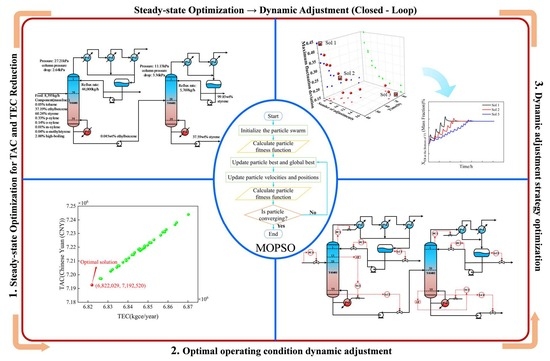
Abstract
Share and Cite
Jiang, G.; She, Y.; Song, Z.; Zhao, L.; Liu, G. Optimization and Dynamic Adjustment of Tandem Columns for Separating an Ethylbenzene–Styrene Mixture Using a Multi-Objective Particle Swarm Algorithm. Separations 2025, 12, 161. https://doi.org/10.3390/separations12060161
Jiang G, She Y, Song Z, Zhao L, Liu G. Optimization and Dynamic Adjustment of Tandem Columns for Separating an Ethylbenzene–Styrene Mixture Using a Multi-Objective Particle Swarm Algorithm. Separations. 2025; 12(6):161. https://doi.org/10.3390/separations12060161
Chicago/Turabian StyleJiang, Guangsheng, Yibo She, Zhongwen Song, Liwen Zhao, and Guilian Liu. 2025. "Optimization and Dynamic Adjustment of Tandem Columns for Separating an Ethylbenzene–Styrene Mixture Using a Multi-Objective Particle Swarm Algorithm" Separations 12, no. 6: 161. https://doi.org/10.3390/separations12060161
APA StyleJiang, G., She, Y., Song, Z., Zhao, L., & Liu, G. (2025). Optimization and Dynamic Adjustment of Tandem Columns for Separating an Ethylbenzene–Styrene Mixture Using a Multi-Objective Particle Swarm Algorithm. Separations, 12(6), 161. https://doi.org/10.3390/separations12060161