


Next Issue
Volume 16, February
Previous Issue
Volume 15, December


Eur. J. Investig. Health Psychol. Educ., Volume 16, Issue 1 (January 2026) – 15 articles
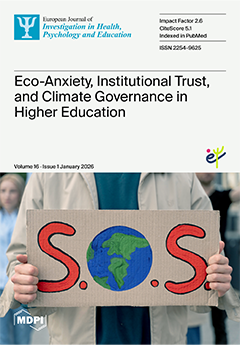
Cover Story (view full-size image): This study examines eco-anxiety among higher education professionals as a psychosocial response shaped by perceptions of institutional and governmental adequacy rather than solely by individual vulnerability. Based on a global mixed-methods survey of 556 participants, it identifies that perceived governmental inadequacy is strongly associated with climate-related distress, accounting for a substantial share of the variance in eco-anxiety. Universities are viewed more favourably, yet participants often describe their sustainability efforts as symbolic, which contributes to moral dissonance, professional fatigue, and reduced trust. Introducing the Institutional Appraisal Model of Eco-Anxiety, the paper integrates Cognitive Appraisal Theory with organisational legitimacy to frame eco-anxiety as a relational signal of governance alignment, with implications for leadership and the SDGs. View this paper
  • Issues are regarded as officially published after their release is announced to the table of contents alert mailing list.
  • You may sign up for e-mail alerts to receive table of contents of newly released issues.
  • PDF is the official format for papers published in both, html and pdf forms. To view the papers in pdf format, click on the "PDF Full-text" link, and use the free Adobe Reader to open them.
Order results
Result details
Select all
Export citation of selected articles as:
17 pages, 345 KB  
Article
Translating and Validating the Ghosting Questionnaire (GHOST) into French: Results Against the Romantic Ghosting Scale (RG-C)
by Haitham Jahrami, Waqar Husain, Zahra Saif, Achraf Ammar and Khaled Trabelsi
Eur. J. Investig. Health Psychol. Educ. 2026, 16(1), 15; https://doi.org/10.3390/ejihpe16010015 - 18 Jan 2026
Viewed by 219
Abstract
Background: Ghosting, the sudden cessation of communication without explanation, is a growing phenomenon in digital interactions. Objective: This study translated and validated the Ghosting Questionnaire (GHOST) into French to address the lack of a culturally appropriate tool for French-speaking populations. Methods: Using a [...] Read more.
Background: Ghosting, the sudden cessation of communication without explanation, is a growing phenomenon in digital interactions. Objective: This study translated and validated the Ghosting Questionnaire (GHOST) into French to address the lack of a culturally appropriate tool for French-speaking populations. Methods: Using a cross-sectional design, we followed rigorous translation protocols, including forward and back translation, expert review, and pilot testing. A diverse group of 274 French-speaking adults participated in a multisite study in Bahrain and Tunisia by completing the French language GHOST and the Romantic Ghosting Scale (RG-C). Results: Psychometric analyses revealed strong reliability (Cronbach’s α = 0.880, test–retest ICC = 0.920) and a unidimensional structure (CFI = 0.963, RMSEA = 0.058). Convergent validity was confirmed through significant correlations with RG-C subscales: Role of Aggressor (r = 0.899), Role of Victim (r = 0.829), and Emotional Impact (r = 0.632, all p < 0.001). Item response theory analysis demonstrated proper category functioning and meaningful item hierarchy across ghosting severity levels. Conclusions: The French GHOST offers a robust instrument for researchers and clinicians to explore ghosting’s psychological impacts in French-speaking communities. Full article
17 pages, 395 KB  
Article
Exploring Workers’ Experience in Public Administrations: Intergenerational Relations and Change as Difficulties and Potential
by Cristina Curcio and Anna Rosa Donizzetti
Eur. J. Investig. Health Psychol. Educ. 2026, 16(1), 14; https://doi.org/10.3390/ejihpe16010014 - 16 Jan 2026
Viewed by 239
Abstract
Background: In a context of profound transformation within Public Administration, the growing generational diversity of the workforce poses critical challenges to organisational well-being. While ageism is a known risk, the intersectionality of age and gender—manifesting as gendered ageism—remains an under-explored area that can [...] Read more.
Background: In a context of profound transformation within Public Administration, the growing generational diversity of the workforce poses critical challenges to organisational well-being. While ageism is a known risk, the intersectionality of age and gender—manifesting as gendered ageism—remains an under-explored area that can significantly undermine job satisfaction and employee health. Objective: This study aimed to explore the subjective work experience of public sector employees, specifically focusing on intergenerational relations and the impact of gendered ageism. Methods: A qualitative study was conducted involving 30 employees of the Italian Public Administration, recruited via purposive sampling. Data were collected through semi-structured interviews lasting approximately 38 min and analysed using a thematic analysis of elementary contexts via T-Lab software. Results: The analysis revealed four distinct thematic clusters positioned along two main factor axes (Individual/Organisation and Difficulties/Potential). The results show a dichotomy: while positive relationships with colleagues (Cluster 1) and the drive for change (Cluster 4) act as potential resources, the experience is marred by significant difficulties. These include organisational imbalances (Cluster 3) and, crucially, specific experiences of gendered ageism (Cluster 2), manifesting as stereotypes, pressure on women’s physical appearance, and exclusionary dynamics. Conclusions: The findings highlight that gendered ageism is a distinct stressor impacting workforce sustainability. Combating intersectional discrimination represents a strategic priority to safeguard well-being, retain skills, and build a healthy, resilient, and productive working environment. Full article
Show Figures

Graphical abstract

22 pages, 1114 KB  
Systematic Review
Supporting Mental Health with Apps: A Systematic Review of Potential and Quality of Implemented Behavior Change Techniques in Mobile Health Applications
by David Leistner and Fabio Richlan
Eur. J. Investig. Health Psychol. Educ. 2026, 16(1), 13; https://doi.org/10.3390/ejihpe16010013 - 14 Jan 2026
Viewed by 267
Abstract
The rapid digitalization of healthcare has led to the widespread availability of mobile health (mHealth) applications, including those aimed at mental health and well-being. The present study followed the PRISMA guidelines and systematically reviewed English and/or German mental health apps available in the [...] Read more.
The rapid digitalization of healthcare has led to the widespread availability of mobile health (mHealth) applications, including those aimed at mental health and well-being. The present study followed the PRISMA guidelines and systematically reviewed English and/or German mental health apps available in the Google Play Store to evaluate their functional quality and behavior-change potential. It utilized the Mobile App Rating Scale (MARS) to assess app quality, including engagement, functionality, esthetics, and information quality, and the App Behavior Change Scale (ABACUS) to evaluate the potential for behavior change by inclusion of behavior change techniques (BCTs). A total of 77 apps were reviewed, with findings indicating an average functional quality and moderate behavior-change potential, as the reviewed apps only utilized a limited amount of BCTs. Notably, only a small fraction of apps had been evaluated in randomized controlled trials (RCTs). Further analysis showed that MARS and ABACUS scores had limited predictive power regarding app popularity as measured by stars awarded by users and number of user ratings in the Google Play Store. The study highlights the need for more rigorous testing of mHealth apps and suggests that factors beyond those measured by MARS and ABACUS may influence app popularity. In addition to the scientific value, this review provides insights for both users interested in mental health support via apps and developers aiming to enhance the quality and impact of mental health applications. Full article
(This article belongs to the Topic Global Mental Health Trends)
Show Figures

Figure 1

24 pages, 956 KB  
Systematic Review
Cognitive Profile of Autism and Intellectual Disorder in Wechsler’s Scales: Meta-Analysis
by Gustavo Mortari Ferreira, Calliandra Maria de Souza Silva, Alexandre Sampaio Rodrigues Pereira, Larissa Sousa Silva Bonasser, Maria Gabriela do Nascimento Araújo, Marcelly de Oliveira Barros, Roniel Sousa Damasceno, Fauston Negreiros and Izabel Cristina Rodrigues da Silva
Eur. J. Investig. Health Psychol. Educ. 2026, 16(1), 12; https://doi.org/10.3390/ejihpe16010012 - 14 Jan 2026
Viewed by 385
Abstract
Autism spectrum disorder (ASD) and intellectual disability (ID) frequently coexist and share heterogeneous cognitive manifestations, yet their specific performance patterns on Wechsler scales remain poorly systematized. This meta-analysis synthesized data from 31 studies using the WISC-IV, WISC-V, WAIS-III, and WAIS-IV to compare cognitive [...] Read more.
Autism spectrum disorder (ASD) and intellectual disability (ID) frequently coexist and share heterogeneous cognitive manifestations, yet their specific performance patterns on Wechsler scales remain poorly systematized. This meta-analysis synthesized data from 31 studies using the WISC-IV, WISC-V, WAIS-III, and WAIS-IV to compare cognitive index profiles in individuals with ASD, ID and ASD+ID. Standardized mean differences (Hedges’ g) were calculated using random-effects models, adopting a normative reference of mean 100 and SD 15. Results showed a distinct profile for ASD, with greater impairments in the Processing Speed Index (PSI) and Working Memory Index (WMI), while the Vocabulary Comprehension Index (VCI), Perceptual/Fluid Reasoning Index (PRI/FRI), and Visual Processing Index (VPI) remained close to normative scores. In contrast, ID and ASD+ID exhibited generalized deficits across all indices, with the lowest scores in Full-Scale IQ (FSIQ) and broad effects above g = −2.5. No significant differences emerged between Wechsler versions or age-based test types. Heterogeneity was high in ASD and ID across outcomes, but negligible in ASD+ID due to reduced k. These findings reinforce that ASD presents a specific cognitive pattern, whereas ID and ASD+ID display diffuse impairment, and that Wechsler scales are consistent across versions for identifying these profiles. Full article
Show Figures

Figure 1

16 pages, 1050 KB  
Article
Workplace Demands, Control, and Identification as Predictors of Job Satisfaction
by Samuel Fernández-Salinero, Giulia Foti, Gabriele Giorgi, Gabriela Topa and Pablo Garmendia
Eur. J. Investig. Health Psychol. Educ. 2026, 16(1), 9; https://doi.org/10.3390/ejihpe16010009 - 5 Jan 2026
Viewed by 501
Abstract
Job satisfaction is a key component of organizational well-being and performance. This study explores the relationship between job characteristics (demands and resources), organizational and group identification, and affective job satisfaction, drawing on the Job Demands–Resources model and social identity theory. Methods: A cross-sectional [...] Read more.
Job satisfaction is a key component of organizational well-being and performance. This study explores the relationship between job characteristics (demands and resources), organizational and group identification, and affective job satisfaction, drawing on the Job Demands–Resources model and social identity theory. Methods: A cross-sectional design was used with a sample of 420 employed individuals (49% men and 51% women), with a mean age of 41.58 years (SD = 9.95). Participants completed an online questionnaire assessing job demands (quantity and complexity), job resources (competency development, use of competencies, and decision latitude), and identification (organizational and group). Most participants held a university degree (48.1%) and had a permanent contract (79.8%). A MIMIC model was applied to test the hypothesized relationships. Results: Job demands defined by quantity were inversely associated with job satisfaction, while competency development and use were positively associated. Organizational and group identification also showed significant positive relationships with job satisfaction. However, task complexity and decision latitude were not significant predictors. Discussion: These findings underscore the importance of integrating both job design and social identity factors to enhance job satisfaction and inform organizational strategies aimed at promoting employee well-being. Full article
Show Figures

Figure 1

17 pages, 460 KB  
Article
Health Inequalities in German Higher Education: A Cross-Sectional Study Reveals Poorer Health in First-Generation University Students and University Students with Lower Subjective Social Status
by Corinna A. Södel, Marga Motzkau, Marcel Wilfert, Raphael M. Herr and Katharina Diehl
Eur. J. Investig. Health Psychol. Educ. 2026, 16(1), 11; https://doi.org/10.3390/ejihpe16010011 - 5 Jan 2026
Viewed by 329
Abstract
University students worldwide experience considerable health challenges. We examined health inequalities in a nationwide, gender-balanced sample of 1105 German students, considering negative (stress, depression, burnout) and positive health outcomes (self-rated health [SRH], well-being) alongside vertical (subjective social status [SSS], parental academic background) and [...] Read more.
University students worldwide experience considerable health challenges. We examined health inequalities in a nationwide, gender-balanced sample of 1105 German students, considering negative (stress, depression, burnout) and positive health outcomes (self-rated health [SRH], well-being) alongside vertical (subjective social status [SSS], parental academic background) and horizontal (gender) determinants. Analyses used bivariate statistics, multivariate regressions, and interaction terms. Higher SSS was associated with better SRH (β = 0.322) and well-being (β = 0.355), and lower stress (β = −0.154), depression (β = −0.127), and burnout (β = −0.219). First-generation students reported highly significant poorer SRH and well-being than students with one (β = 0.114; β = 0.112) or two academic parents (β = 0.162; β = 0.192). Students with two academic parents showed lower stress (β = −0.087, p = 0.007) and burnout (β = −0.099, p = 0.002). Interactions suggest a protective effect of higher SSS on depression (β = −0.219, p = 0.026) and burnout (β = −0.264, p = 0.006), more pronounced among male students, who additionally benefited more from an academic household regarding SRH (β = 0.100, p = 0.044). These findings underscore intersectional and multifaceted inequalities among German students and the need for interventions. Full article
Show Figures

Figure 1

12 pages, 567 KB  
Article
Perceived Social Support, Shame, and Psychopathological Symptoms After Perinatal Loss in Portuguese Women
by Mariana Ribeiro, Paula Saraiva Carvalho, Ana Torres and Dário Ferreira
Eur. J. Investig. Health Psychol. Educ. 2026, 16(1), 10; https://doi.org/10.3390/ejihpe16010010 - 5 Jan 2026
Viewed by 288
Abstract
(1) Background: Perinatal loss is a deeply painful and often invisible experience, with a significant impact on mental health. This study aimed to assess levels of psychopathological symptoms, shame, and perceived social support according to the type of perinatal loss; explore the relationships [...] Read more.
(1) Background: Perinatal loss is a deeply painful and often invisible experience, with a significant impact on mental health. This study aimed to assess levels of psychopathological symptoms, shame, and perceived social support according to the type of perinatal loss; explore the relationships between these variables; and analyze the mediating effect of perceived social support on the relationship between shame and symptoms, as well as the moderating effect of the type of loss. (2) Methods: A total of 501 Portuguese women who had experienced perinatal loss participated in the study, recruited through an online questionnaire. Psychopathological symptoms, shame, perceived social support, and type of loss were assessed. Analyses included descriptive statistics, Spearman correlations, normality and homogeneity of variances tests, and mediation and moderation models with PROCESS. (3) Results: The results revealed high levels of anxiety and depression, and moderate levels of shame. Perceived social support, especially from partners and family members, was high. Shame correlated positively with symptoms and negatively with social support. Only social support from friends significantly mediated the relationship between shame and psychological distress. (4) Conclusions: These results reinforce the protective role of support networks and the importance of clinical interventions focused on reducing shame. Full article
Show Figures

Figure 1

22 pages, 726 KB  
Article
Mapping the Emotional Mind: Development and Psychometric Validation of the SIER-C as a Multifactorial Structure with Two Higher-Order Factors Model of Emotional Intelligence and Resilience in School-Age Children
by Elena-Nicoleta Bordea, Oana Alina Apostol, Corina Sporea, Cristian Gabriel Morcov, Ioana Elena Cioca, Angelo Pellegrini and Maria-Veronica Morcov
Eur. J. Investig. Health Psychol. Educ. 2026, 16(1), 8; https://doi.org/10.3390/ejihpe16010008 - 2 Jan 2026
Viewed by 335
Abstract
(1) Background: The present study aimed to develop and validate the Scale for the Identification of Emotional Resilience in Children (SIER-C), a psychometric instrument designed to assess key dimensions of emotional intelligence and resilience among children aged 6 to 12 years. (2) Methods: [...] Read more.
(1) Background: The present study aimed to develop and validate the Scale for the Identification of Emotional Resilience in Children (SIER-C), a psychometric instrument designed to assess key dimensions of emotional intelligence and resilience among children aged 6 to 12 years. (2) Methods: The sample comprised 367 participants (52.3% male, 47.7% female) drawn from both urban and rural educational settings across Romania, selected through stratified random sampling to ensure demographic representativeness. The SIER-C consists of 30 items distributed across six subscales: Recognition and Understanding of Emotions (RUE), Emotion Regulation (ER), Empathy (E), Attitude Toward Failure (ATF), Coping Strategies (CS), and Perseverance and Self-Motivation (PSM), with items rated on a 5-point Likert scale. An Exploratory Factor Analysis (EFA) was initially conducted to examine the underlying factor structure, followed by Confirmatory Factor Analysis (CFA) to validate the model. (3) Results: The EFA suggested a six-factor structure consistent with the intended subscales, which was subsequently confirmed by CFA, demonstrating satisfactory model fit indices and confirming the scale’s construct validity. Internal consistency indices and composite reliability coefficients further indicated robust psychometric properties across subscales. (4) Conclusions: The findings underscore the relevance of SIER-C as a reliable and valid tool for identifying nuanced profiles of emotional intelligence and resilience in children. These profiles provide valuable insights for early detection of emotional and adaptive vulnerabilities and for the design of targeted interventions within educational and clinical frameworks. Future research should explore the longitudinal stability of these constructs and examine the integration of SIER-C within social–emotional learning programs to support the development of emotional competencies from a preventive and developmental perspective. Full article
Show Figures

Figure 1

17 pages, 1128 KB  
Article
When Support Hurts: Re-Examining the Cyberbullying Victimization–Mental Health Relationship Among University Students in Saudi Arabia
by Ibrahim A. Elshaer, Alaa M. S. Azazz, Chokri Kooli and Mansour Alyahya
Eur. J. Investig. Health Psychol. Educ. 2026, 16(1), 7; https://doi.org/10.3390/ejihpe16010007 - 1 Jan 2026
Viewed by 399
Abstract
Cyberbullying generally reveals two leading players: the attacker side (perpetrator) and the victim side; each side has its distinctive social and psychological dynamics. In most prior empirical studies, the victim side is pivotal, as it bears the direct psychological and emotional consequences of [...] Read more.
Cyberbullying generally reveals two leading players: the attacker side (perpetrator) and the victim side; each side has its distinctive social and psychological dynamics. In most prior empirical studies, the victim side is pivotal, as it bears the direct psychological and emotional consequences of online aggression. Recently, cyberbullying victimisation has been elevated as a main psychological concern among university students. Nevertheless, the moderating role of family support remained untested, particularly in a collectivist cultural context such as the Kingdom of Saudi Arabia (KSA). This study tested the impacts of cyberbullying victimisation on mental health consequences (anxiety, stress, and depression) among KSA university students. The study further tested family support as a moderator in these relationships. Data was collected from 650 students employing a self-structured survey. The data obtained was analyzed using “Partial Least Squares Structural Equation Modelling” (PLS-SEM). The findings revealed that cyberbullying-victimization can significantly raise students’ anxiety, stress, and depressive signs, supporting its place as a critical psychological risk factor. Contrary to the “traditional stress-buffering theory”, family support failed to alleviate the influence of cyberbullying-victimization on anxiety and stress, and unexpectedly, higher levels of family support were related to higher depressive levels, suggesting a reverse-buffering impact. These results highlighted the complicated relationships between family support and emotional outcomes in the context of digital threats. The study stressed the urgent need for culturally delicate mediations, such as training sessions for digital resilience, and colleague-based supportive systems to successfully deal with the mental health consequences of cybervictimization. Full article
Show Figures

Figure 1

20 pages, 626 KB  
Article
Eco-Anxiety in Higher Education Professionals: Psychological Impacts, Institutional Trust, and Policy Implications
by Sarah Louise Steele
Eur. J. Investig. Health Psychol. Educ. 2026, 16(1), 6; https://doi.org/10.3390/ejihpe16010006 - 29 Dec 2025
Viewed by 412
Abstract
Eco-anxiety—emotional distress arising from awareness of environmental collapse—has become a critical dimension of social sustainability, linking mental well-being, professional functioning, institutional trust, and climate governance. This study investigates how higher education professionals (HEPs) experience and interpret eco-anxiety within their professional contexts, situating it [...] Read more.
Eco-anxiety—emotional distress arising from awareness of environmental collapse—has become a critical dimension of social sustainability, linking mental well-being, professional functioning, institutional trust, and climate governance. This study investigates how higher education professionals (HEPs) experience and interpret eco-anxiety within their professional contexts, situating it as a lens on institutional legitimacy from the perspective of those who produce, teach, and steward climate knowledge. A cross-sectional mixed-methods survey of 556 HEPs was conducted across a month in 2023, combining an adapted climate anxiety scale with open-ended narratives. Quantitative analyses identified perceived governmental inadequacy as the strongest correlate of climate worry (β = 0.48, p < 0.001), accounting for 26% of the variance, whereas institutional inadequacy had a weaker effect. Qualitative findings revealed pervasive emotions of moral injury, solastalgia, and exhaustion when sustainability rhetoric outpaced genuine action, with many respondents describing governmental and institutional “betrayal.” Integrating Cognitive Appraisal Theory with concepts of moral legitimacy, the study conceptualises eco-anxiety as a relational and ethically grounded emotion reflecting the perceived misalignment between knowledge and governance. Addressing it requires transparent climate leadership, participatory governance, and organisational care infrastructures to sustain motivation and trust within universities. Eco-anxiety thus may function not only as a personal pathology but also as a psychosocial response that can illuminate HEPs’ perceptions of institutional misalignment with sustainability commitments, with implications for higher education’s contribution to the Sustainable Development Goals. Full article
Show Figures

Figure 1

16 pages, 303 KB  
Article
Development and Preliminary Validation of the Parental Education in Physiotherapy Scale for Use in Spain: A Pilot Study
by Manuel Pacheco-Molero, Irene León-Estrada, Catalina Morales-Murillo and Mónica Gutiérrez-Ortega
Eur. J. Investig. Health Psychol. Educ. 2026, 16(1), 5; https://doi.org/10.3390/ejihpe16010005 - 26 Dec 2025
Viewed by 286
Abstract
Given the scarcity of specific instruments to assess parental education in pediatric physiotherapy, this study developed the Parental Education in Physiotherapy Scale (Spanish acronym, EPF) and calculated its preliminary psychometric properties, acceptability, and feasibility. A cross-sectional instrumental study was conducted: the EPF was [...] Read more.
Given the scarcity of specific instruments to assess parental education in pediatric physiotherapy, this study developed the Parental Education in Physiotherapy Scale (Spanish acronym, EPF) and calculated its preliminary psychometric properties, acceptability, and feasibility. A cross-sectional instrumental study was conducted: the EPF was designed based on a specifications matrix and validated by expert judges in two phases. Then it was administered digitally to 63 physiotherapists experienced in treating children under six years of age. They rated it on a 4-point Likert response scale, and qualitative observations on its clarity, usefulness, and acceptability were collected. The validation showed adequate content validity (I-CVI ≥ 0.86; 31/32 items had I-CVI = 1.00) and high inter-judge agreement (global W = 0.659; p < 0.001). In the pilot study, exploratory factor analysis identified three factors (Collaboration, Capacity-Building, and Reflection) that explained 59% of the variance. After refining it, the final version comprised 18 items, showing high internal consistency (ordinal α = 0.944, ω = 0.934). Acceptability was high (100% found it useful; 98.4% said it facilitated reflection; 95.2% found it clear). Overall, the EPF provides preliminary evidence of validity, internal consistency, acceptability, and feasibility, although larger samples and additional analyses are required for its consolidation. Full article
24 pages, 408 KB  
Article
Interpersonal Determinants of Suicide Risk Among Young Adults: A Cross-Cultural Study
by Noelia Lucía Martínez-Rives, Pilar Martín Chaparro and Yasuhiro Kotera
Eur. J. Investig. Health Psychol. Educ. 2026, 16(1), 4; https://doi.org/10.3390/ejihpe16010004 - 24 Dec 2025
Viewed by 577
Abstract
(1) Background: Understanding suicide risk across cultures requires examining both universal and culturally specific factors that inform assessment and intervention. This study explores the influence of interpersonal variables—such as interpersonal competence, perceived social support, and constructs from the Interpersonal Theory of Suicide (ITS)—on [...] Read more.
(1) Background: Understanding suicide risk across cultures requires examining both universal and culturally specific factors that inform assessment and intervention. This study explores the influence of interpersonal variables—such as interpersonal competence, perceived social support, and constructs from the Interpersonal Theory of Suicide (ITS)—on suicidal behaviour in two culturally distinct samples: young adults from Spain and Japan. (2) Methods: A total of [437] participants (Spanish sample: n = 260; Japanese sample: n = 177) completed validated measures assessing suicide risk, depression, perceived burdensomeness, thwarted belongingness, acquired capability for suicide, interpersonal competence, and perceived social support. Moderated mediation and SEM comparative analyses were conducted to identify predictors of suicide risk in each cultural context. (3) Results: Social support was a consistent protective factor against depression and suicidal ideation, and interpersonal competence showed more contextual protective effects, significant only in the Japanese sample. Perceived burdensomeness stood out as a robust predictor of depression and suicidal ideation in both samples, and suicidal ideation was strongly associated with suicidal behaviour, while acquired capability for suicide and interpersonal competence did not show a direct association with it. (4) Conclusions: The findings highlight the protective role of interpersonal competence and perceived social support in the progression to suicidal behavior, suggesting cultural similarities and differences in how these factors operate. Full article
17 pages, 459 KB  
Article
Exploring the Role of Sleep and Physical Activity in Academic Stress, Motivation, Self-Efficacy, and Dropout Intention Among Italian University Students
by Jessica Dagani, Chiara Buizza and Alberto Ghilardi
Eur. J. Investig. Health Psychol. Educ. 2026, 16(1), 3; https://doi.org/10.3390/ejihpe16010003 - 22 Dec 2025
Viewed by 461
Abstract
University years represent a period of major transition during which health-related behaviors, such as sleep and physical activity, may influence students’ academic functioning. This cross-sectional, single-center study, conducted at an Italian university, examined the associations between sleep, physical activity, and academic well-being. Students [...] Read more.
University years represent a period of major transition during which health-related behaviors, such as sleep and physical activity, may influence students’ academic functioning. This cross-sectional, single-center study, conducted at an Italian university, examined the associations between sleep, physical activity, and academic well-being. Students completed an online survey assessing sleep, physical activity, and several indicators of academic functioning (i.e., academic stress, self-efficacy, dropout intention, and motivation). Nonparametric tests (Kruskal–Wallis, Jonckheere–Terpstra) were used to explore differences in these indicators across sleep quality and physical activity categories, while linear regressions tested associations between sleep duration and Metabolic Equivalent of Task–minutes/week with the same academic outcomes. A total of 2192 students (15.55%) accessed the survey, and 1246 (8.84%) completed all questionnaires. Most participants were female (62.7%) and Italian (94.5%). Both sleep and physical activity showed significant but small associations with academic stress, dropout intention, and self-efficacy, whereas associations with academic motivation were weaker. These findings suggest that maintaining regular physical activity and healthy sleep habits may contribute to students’ academic adjustment, although the cross-sectional design limits causal interpretation and underscores the need for integrative models to better understand the underlying psychological mechanisms. Full article
Show Figures

Figure 1

88 pages, 5340 KB  
Systematic Review
Neuroscientific Framework of Cognitive–Behavioral Interventions for Mental Health Across Diverse Cultural Populations: A Systematic Review of Effectiveness, Delivery Methods, and Engagement
by Evgenia Gkintoni and Georgios Nikolaou
Eur. J. Investig. Health Psychol. Educ. 2026, 16(1), 2; https://doi.org/10.3390/ejihpe16010002 - 22 Dec 2025
Viewed by 679
Abstract
(1) Background: Mental health disparities persist across culturally diverse populations despite robust cognitive–behavioral therapy (CBT) efficacy evidence. Cultural neuroscience suggests that neurobiological processes underlying therapeutic mechanisms may exhibit culturally variable patterns, yet integration of neuroscientific frameworks into culturally adapted interventions remains limited. (2) [...] Read more.
(1) Background: Mental health disparities persist across culturally diverse populations despite robust cognitive–behavioral therapy (CBT) efficacy evidence. Cultural neuroscience suggests that neurobiological processes underlying therapeutic mechanisms may exhibit culturally variable patterns, yet integration of neuroscientific frameworks into culturally adapted interventions remains limited. (2) Methods: Following PRISMA 2020 guidelines, we systematically searched PubMed/MEDLINE, PsycINFO, Scopus, and Web of Science (January 2014–December 2024) for peer-reviewed studies examining CBT interventions targeting depression, anxiety, PTSD, or psychological distress in culturally diverse populations. Ninety-four studies were synthesized using narrative methods; methodological heterogeneity precluded meta-analytic pooling. (3) Results: Culturally adapted CBT interventions consistently demonstrated superior outcomes compared to standard protocols across diverse populations. Group formats showed exceptional retention in collectivistic cultures, while hybrid technology-enhanced models achieved strong completion rates across contexts. Cultural adaptation enhanced engagement (e.g., 84% vs. 52% retention in refugee populations) and maintenance of treatment gains. Individual studies reported effect sizes ranging from d = 0.29 to d = 2.4; substantial within-group variability was observed, and identified patterns likely reflect learned cultural adaptations rather than inherent biological differences. Direct neuroimaging evidence within included studies remained limited (13.8%). (4) Conclusions: The evidence supports culturally adapted interventions as essential for equitable mental health outcomes. Cultural experiences may influence therapeutic processes, suggesting potential benefit from considering culturally variable processing patterns alongside universal mechanisms. However, conclusions regarding specific neural pathways remain preliminary, and individual assessment remains paramount, with cultural background representing one factor among many in treatment planning. Full article
Show Figures

Figure 1

11 pages, 362 KB  
Article
Reliability and Validity of the Japanese Version of the eHealth Literacy Scale in Community-Dwelling Older Adults: A Cross-Sectional Study
by Takehiko Tsujimoto, Takafumi Abe, Yoko Kuroda, Masayuki Yamasaki and Minoru Isomura
Eur. J. Investig. Health Psychol. Educ. 2026, 16(1), 1; https://doi.org/10.3390/ejihpe16010001 - 19 Dec 2025
Viewed by 1061
Abstract
The Japanese version of the eHealth Literacy Scale (J-eHEALS) measure has primarily been applied to younger populations; however, the psychometric properties of the J-eHEALS in older adults have not been investigated. Therefore, in this cross-sectional study, we aimed to evaluate the psychometric properties [...] Read more.
The Japanese version of the eHealth Literacy Scale (J-eHEALS) measure has primarily been applied to younger populations; however, the psychometric properties of the J-eHEALS in older adults have not been investigated. Therefore, in this cross-sectional study, we aimed to evaluate the psychometric properties of the J-eHEALS in community-dwelling older adults. A total of 553 adults aged ≥ 65 years (mean age, 73.5 years) attending routine health checkups in a single Japanese municipality completed the J-eHEALS and the Japanese version of the 12-item Health Literacy Scale (J-HLS-Q12). We examined internal consistency, item characteristics, factorial validity using exploratory and confirmatory factor analyses, measurement invariance by sex, and convergent and criterion-related validity with general health literacy. The J-eHEALS scores indicated moderate to slightly low perceived eHealth literacy in this population. The scale demonstrated excellent internal consistency (Cronbach’s α = 0.94), a stable unidimensional factor structure with acceptable model fit across sexes, and moderate positive associations with general health literacy. Overall, these findings support the J-eHEALS as a reliable and valid instrument for assessing perceived eHealth literacy in older Japanese adults and its suitability for use in research and practice. Full article
Show Figures

Figure 1

Previous Issue
Next Issue
Back to TopTop
