
Perceived Social Support, Shame, and Psychopathological Symptoms After Perinatal Loss in Portuguese Women




Abstract
1. Introduction
2. Materials and Methods
3. Results
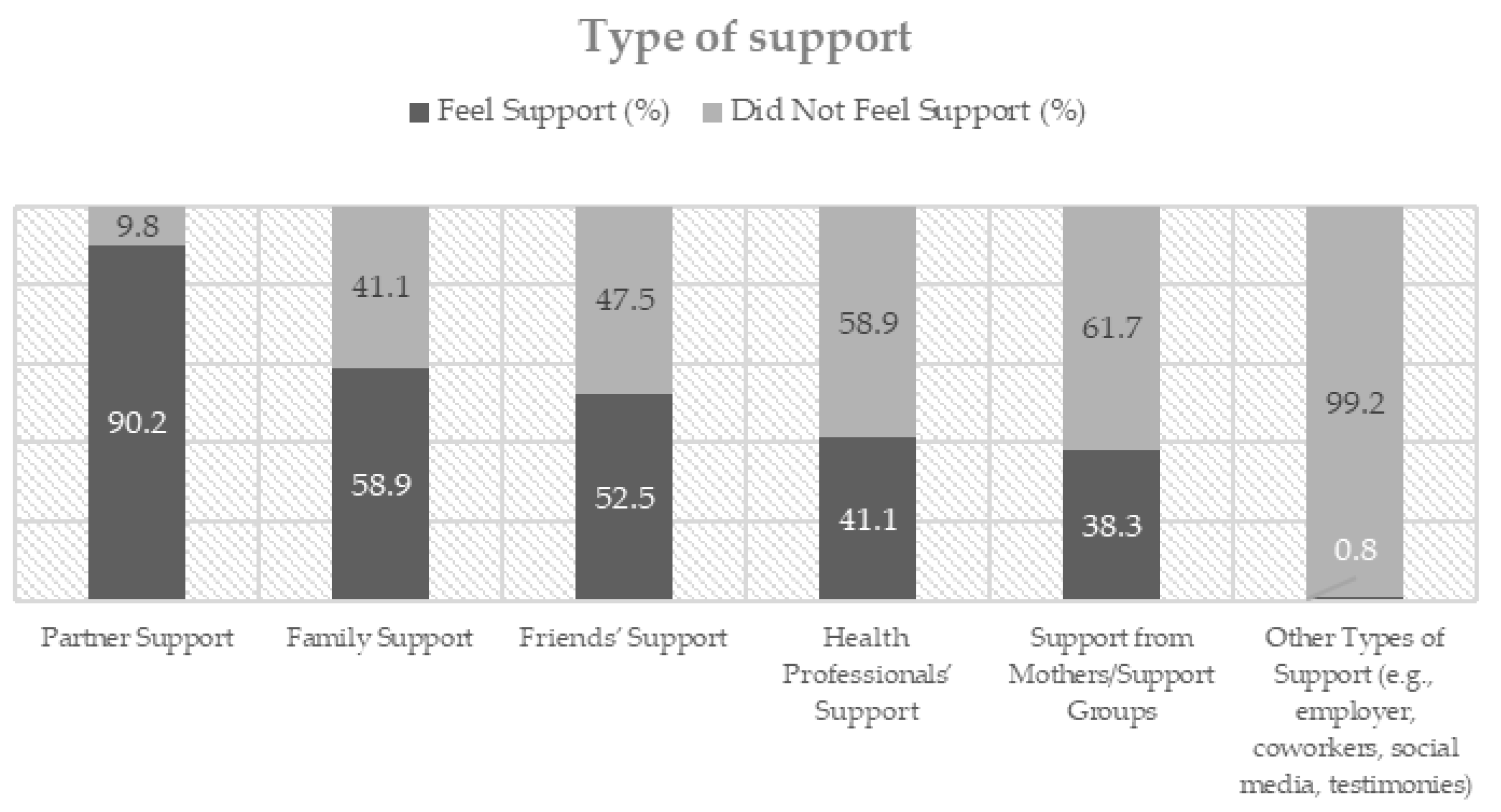
3.1. Sources of Perceived Social Support
3.2. Descriptive Statistics
3.3. Correlations
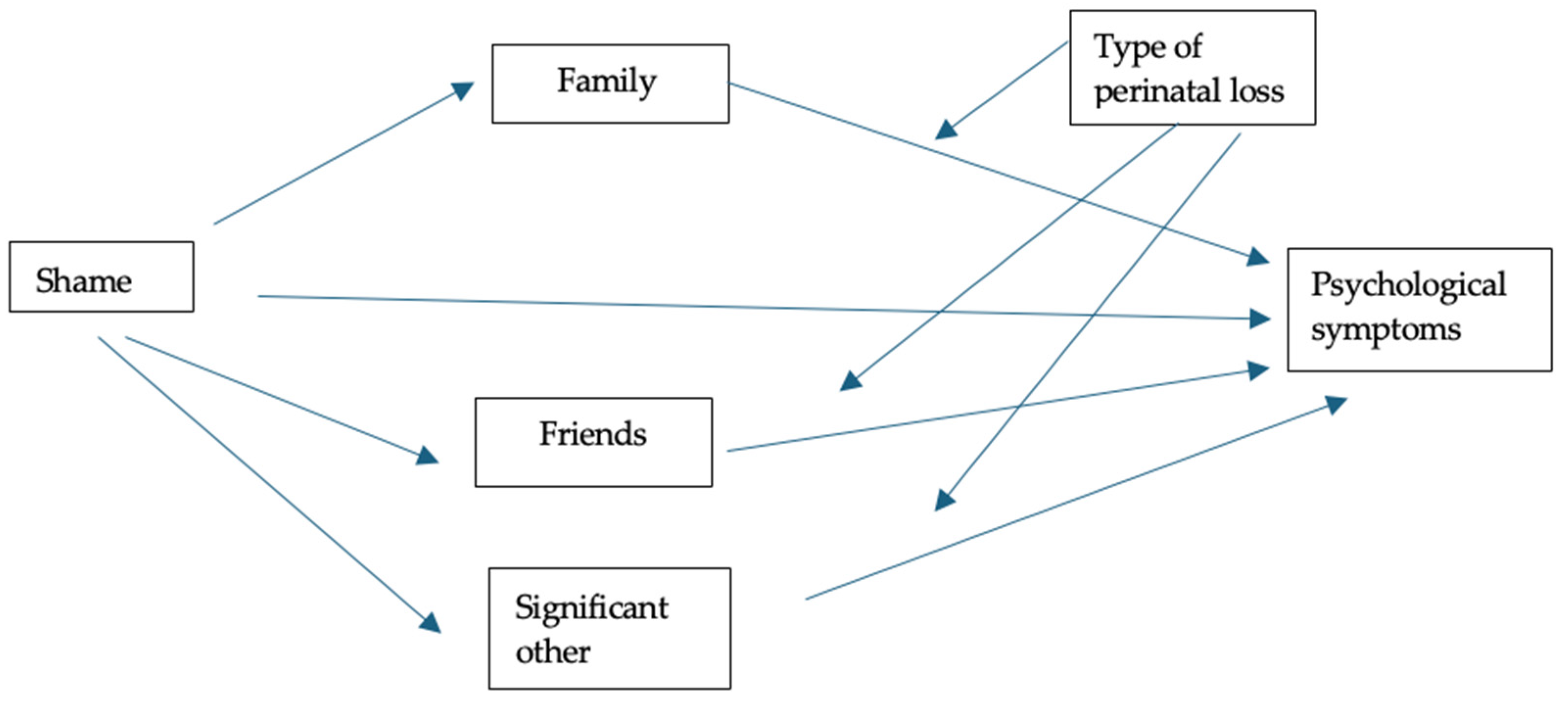
3.4. Mediation and Moderation Analyses
4. Discussion
4.1. Psychopathological Symptoms
4.2. Shame
4.3. Perceived Social Support
4.4. Limitations and Future Research
5. Conclusions
Author Contributions
Funding
Institutional Review Board Statement
Informed Consent Statement
Data Availability Statement
Acknowledgments
Conflicts of Interest
References
- Akbag, M., & Imamoglu, S. E. (2010). The prediction of gender and attachment styles on shame, guilt, and loneliness. Educational Sciences: Theory & Practice, 10, 669–682. [Google Scholar]
- Barr, K. R., Nguyen, T. A., Pickup, W., Cibralic, S., Mendoza Diaz, A., Barnett, B., & Eapen, V. (2024). Perinatal continuity of care for mothers with depressive symptoms: Perspectives of mothers and clinicians. Frontiers in Psychiatry, 15, 1385120. [Google Scholar] [CrossRef]
- Barr, P., & Cacciatore, J. (2008). Problematic emotions and maternal grief. OMEGA-Journal of Death and Dying, 56(4), 331–348. [Google Scholar] [CrossRef]
- Bennett, S. M., Litz, B. T., Lee, B. S., & Maguen, S. (2005). The scope and impact of perinatal loss: Current status and future directions. Professional Psychology: Research and Practice, 36, 180–187. [Google Scholar] [CrossRef]
- Bennett, S. M., Litz, B. T., Maguen, S., & Ehrenreich, J. T. (2008). An exploratory study of the psychological impact and clinical care of perinatal loss. Journal of Loss and Trauma, 13, 485–510. [Google Scholar] [CrossRef]
- Bhat, A., & Byatt, N. (2016). Infertility and perinatal loss: When the bough breaks. Current Psychiatry Reports, 18, 31. [Google Scholar] [CrossRef]
- Blackmore, E., Côté-Arsenault, D., Tang, W., Glover, V., Evans, J., Golding, J., & O’Connor, T. (2011). Previous prenatal loss as a predictor of perinatal depression and anxiety. British Journal of Psychiatry, 198, 373–377. [Google Scholar] [CrossRef] [PubMed]
- Burden, C., Bradley, S., Storey, C., Ellis, A., Heazell, A. E., Downe, S., Cacciatore, J., & Siassakos, D. (2016). From grief, guilt, pain and stigma to hope and pride: A systematic review and meta-analysis of mixed-method research of the psychosocial impact of stillbirth. BMC Pregnancy and Childbirth, 16, 9. [Google Scholar] [CrossRef]
- Cacciatore, J. (2009). The silent birth: A feminist perspective. Social Work, 54, 91–95. [Google Scholar] [CrossRef]
- Cacciatore, J. (2013). Psychological effects of stillbirth. Seminars in Fetal and Neonatal Medicine, 18, 76–82. [Google Scholar] [CrossRef] [PubMed]
- Cacciatore, J., Schnebly, S., & Froen, J. F. (2009). The effects of social support on maternal anxiety and depression after stillbirth. Health & Social Care in the Community, 17(2), 167–176. [Google Scholar] [CrossRef] [PubMed]
- Caldwell, J. M., Meredith, P., Whittingham, K., Ziviani, J., & Wilson, T. (2023). Women pregnant after previous perinatal loss: Relationships between adult attachment, shame, and prenatal psychological outcomes. Journal of Reproductive and Infant Psychology, 42(4), 653–667. [Google Scholar] [CrossRef]
- Canavarro, M. C., Nazaré, B., & Pereira, M. (2017). Inventário de sintomas psicopatológicos 18 (BSI-18). In M. M. Gonçalves, M. R. Simões, & L. Almeida (Eds.), Psicologia clínica e da saúde: Instrumentos de avaliação (pp. 115–130). Editora Pactor. [Google Scholar]
- Clauss, D. K. (2009). Psychological distress following miscarriage and stillbirth: An examination of grief, depression and anxiety in relation to gestational length, women’s attributions, perception of care and provision of information [Doctoral dissertation, Drexel University]. Available online: https://www.proquest.com/docview/304878488/ (accessed on 3 March 2025).
- Corbet-Owen, C. (2003). Women’s perceptions of partner support in the context of pregnancy loss(es). South African Journal of Psychology, 33, 19–27. [Google Scholar] [CrossRef]
- Derogatis, L. R. (1993). BSI brief symptom inventory: Administration, scoring, and procedures manual (4th ed.). National Computer Systems. [Google Scholar]
- Díaz-Pérez, E., Haro, G., & Echeverria, I. (2023). Psychopathology present in women after miscarriage or perinatal loss: A systematic review. Psychiatry International, 4, 126–135. [Google Scholar] [CrossRef]
- Duncan, C., & Cacciatore, J. (2015). A systematic review of the peer-reviewed literature on self-blame, guilt, and shame. OMEGA—Journal of Death and Dying, 71, 312–342. [Google Scholar] [CrossRef]
- Feasey, R. (2019). Pregnancy loss: Shame and silence over a shared experience. In Infertility and non-traditional family building (pp. 143–168). Springer. [Google Scholar] [CrossRef]
- Frøen, J. F., Cacciatore, J., McClure, E. M., Kuti, O., Jokhio, A. K., Islam, M., & Shiffman, J. (2011). Stillbirths: Why they matter. The Lancet, 377, 1353–1366. [Google Scholar] [CrossRef]
- Geada, M. (2003). Questionário de sentimentos pessoais. Manuscrito não publicado, Faculdade de Psicologia da Universidade de Lisboa. [Google Scholar]
- Gilbert, P. (2002). Body shame: A biopsychosocial conceptualisation and overview, with treatment implications. In P. Gilbert, & J. Miles (Eds.), Body shame: Conceptualisation, research and treatment (pp. 3–30). Brunner. [Google Scholar] [CrossRef]
- Gísladóttir, S. G. (2016). Prior pregnancy loss: Mental health during and after subsequent pregnancies [Master’s thesis, Reykjavík University]. Available online: https://skemman.is/handle/1946/25720?locale=en (accessed on 10 April 2025).
- Goss, K., & Allan, S. (2009). Shame, pride, and eating disorders. Clinical Psychology & Psychotherapy, 16, 4. [Google Scholar] [CrossRef] [PubMed]
- Harder, D., & Greenwald, D. F. (1999). Further validation of the shame and guilt scales of Harder’s Personal Feelings Questionnaire–2. Psychological Reports, 85, 271–281. [Google Scholar] [CrossRef] [PubMed]
- Irmscher, L., Marx, R., Linke, M., Zimmermann, A., Drössler, S., & Berth, H. (2024). Anxiety, depression, somatization and psychological distress before and 2–6 years after a late termination of pregnancy due to fetal anomalies. BMC Women’s Health, 24, 255. [Google Scholar] [CrossRef]
- Iwanowicz-Palus, G., Mróz, M., & Bień, A. (2021a). Quality of life, social support and self-efficacy in women after a miscarriage. Health and Quality of Life Outcomes, 19, 1. [Google Scholar] [CrossRef]
- Iwanowicz-Palus, G., Mróz, M., Bień, A., & Jurek, K. (2021b). Social support and subjective assessment of psychophysical condition, health, and satisfaction with quality of life among women after pregnancy loss. BMC Pregnancy and Childbirth, 21, 750. [Google Scholar] [CrossRef] [PubMed]
- Jacob, L., Polly, I., Kalder, M., & Kostev, K. (2017). Prevalence of depression, anxiety, and adjustment disorders in women with spontaneous abortion in Germany: A retrospective cohort study. Psychiatry Research, 258, 382–386. [Google Scholar] [CrossRef]
- Jones, K., Robb, M., Murphy, S., & Davies, A. (2019). New understandings of fathers’ experiences of grief and loss following stillbirth and neonatal death: A scoping review. Midwifery, 79, 102531. [Google Scholar] [CrossRef] [PubMed]
- Kay, T. L., Moulson, M. C., Vigod, S. N., Schoueri-Mychasiw, N., & Singla, D. R. (2024). The role of social support in perinatal mental health and psychosocial stimulation. Yale Journal of Biology and Medicine, 97, 3–16. [Google Scholar] [CrossRef] [PubMed]
- Kim, S., Thibodeau, R., & Jorgensen, R. S. (2011). Shame, guilt, and depressive symptoms: A meta-analytic review. Psychological Bulletin, 137, 68–96. [Google Scholar] [CrossRef]
- Kocourková, J., Konečná, H., Burcin, B., & Kučera, T. (2015). How old is too old? A contribution to the discussion on age limits for assisted reproduction technique access. Reproductive BioMedicine Online, 30(5), 482–492. [Google Scholar] [CrossRef]
- Lewkowitz, A. K., Rosenbloom, J. I., Keller, M., López, J. D., Macones, G. A., Olsen, M. A., & Cahill, A. G. (2019). Association between stillbirth ≥ 23 weeks’ gestation and acute psychiatric illness within 1 year of delivery. American Journal of Obstetrics and Gynecology, 221(5), 491.e1–491.e22. [Google Scholar] [CrossRef] [PubMed]
- Lobb, E. A., Kristjanson, L. J., Aoun, S. M., Monterosso, L., Halkett, G. K. B., & Davies, A. (2010). Predictors of complicated grief: A systematic review of empirical studies. Death Studies, 34, 673–698. [Google Scholar] [CrossRef]
- Lok, I. H., & Neugebauer, R. (2007). Psychological morbidity following miscarriage. Best Practice & Research Clinical Obstetrics & Gynaecology, 21, 229–247. [Google Scholar] [CrossRef]
- Meaney, S., Corcoran, P., & Spillane, N. (2017). Experience of miscarriage: An interpretative phenomenological analysis. BMJ Open, 7, e011382. [Google Scholar] [CrossRef]
- Mendes, D. C. G., Fonseca, A., & Cameirão, M. S. (2023). The psychological impact of early pregnancy loss in Portugal: Incidence and the effect on psychological morbidity. Frontiers in Public Health, 11, 1188060. [Google Scholar] [CrossRef]
- Monteiro, M. S. R. M. (2020). A influência da satisfação conjugal, do apoio social e dos estados emocionais negativos no processo de luto decorrente de uma perda gestacional [Master’s thesis, Faculdade de Psicologia, Universidade de Lisboa]. [Google Scholar]
- Obst, K. L., Due, C., Oxlad, M., & Middleton, P. (2020). Men’s grief following pregnancy loss and neonatal loss: A systematic review and emerging theoretical model. BMC Pregnancy and Childbirth, 20, 11. [Google Scholar] [CrossRef]
- Pineles, S. L., Street, A. E., & Koenen, K. C. (2006). The differential relationships of shame-proneness and guilt-proneness to psychological and somatization symptoms. Journal of Social and Clinical Psychology, 25, 688–704. [Google Scholar] [CrossRef]
- PORDATA. (2023). Fertility rate by age group. PORDATA. Available online: https://www.pordata.pt/pt/estatisticas/populacao/nascimentos-e-fecundidade/taxa-de-fecundidade-por-grupo-etario-0 (accessed on 4 August 2025).
- PORDATA. (2024). Óbitos fetais e neonatais. PORDATA. Available online: https://www.pordata.pt/pt/estatisticas/saude/mortalidade/obitos-fetais-e-neonatais (accessed on 4 August 2025).
- Public Health Agency of Canada. (2020). Family-centred maternity and newborn care: National guidelines (Chapter 7). Available online: https://www.canada.ca/en/public-health/services/publications/healthy-living/maternity-newborn-care-guidelines-chapter-7.html (accessed on 4 August 2025).
- Razurel, C., Kaiser, B., Antonietti, J.-P., Epiney, M., & Sellenet, C. (2017). Relationship between perceived perinatal stress and depressive symptoms, anxiety, and parental self-efficacy in primiparous mothers and the role of social support. Women & Health, 57, 154–172. [Google Scholar] [CrossRef]
- Sarper, E., & Rodrigues, D. L. (2024). The role of perceived social support in the grief experiences of more anxious and self-compassionate people. OMEGA—Journal of Death and Dying, 1–18. [Google Scholar] [CrossRef]
- Schoemann, A. M., Boulton, A. J., & Short, S. D. (2017). Determining power and sample size for simple and complex mediation models. Social Psychological and Personality Science, 8, 379–386. [Google Scholar] [CrossRef]
- Sutan, R., & Miskam, H. M. (2012). Psychosocial impact of perinatal loss among Muslim women. BMC Women’s Health, 12, 15. [Google Scholar] [CrossRef] [PubMed]
- Thoits, P. A. (2011). Mechanisms linking social ties and support to physical and mental health. Journal of Health and Social Behavior, 52, 145–161. [Google Scholar] [CrossRef]
- Thomas, S., Kanske, P., Schäfer, J., Hummel, K. V., & Trautmann, S. (2022). Examining bidirectional associations between perceived social support and psychological symptoms in the context of stressful event exposure: A prospective, longitudinal study. BMC Psychiatry, 22, 736. [Google Scholar] [CrossRef] [PubMed]
- Tsartsara, E., & Johnson, M. P. (2006). The impact of miscarriage on women’s pregnancy-specific anxiety and feelings of prenatal maternal–fetal attachment during the course of a subsequent pregnancy. Journal of Psychosomatic Obstetrics & Gynaecology, 27, 173–182. [Google Scholar] [CrossRef]
- Wagner, N. J., Vaughn, C. T., & Tuazon, V. (2018). Fathers’ lived experiences of miscarriage. The Family Journal, 26, 193–199. [Google Scholar] [CrossRef]
- Wei, M., Mallinckrodt, B., Larson, L. M., & Zakalik, R. A. (2005). Adult attachment, depressive symptoms, and validation from self versus others. Journal of Counseling Psychology, 52, 526. [Google Scholar] [CrossRef]
- World Health Organization. (2024). The unacceptable stigma and shame women face after baby loss must end. Available online: https://www.who.int/news-room/spotlight/why-we-need-to-talk-about-losing-a-baby/unacceptable-stigma-and-shame (accessed on 4 August 2025).



| Type of Perinatal Loss | ||||||
|---|---|---|---|---|---|---|
| Early Miscarriage (n = 316) | Late Miscarriage (n = 80) | Fetal and Neonatal Death (n = 105) | ||||
| Measures | Range (Min–Max) | M(SD) | Range (Min–Max) | M(SD) | Range (Min–Max) | M(SD) |
| BSI-18 | ||||||
| Anxiety | 0.00–23 | 7.14 (0.27) | 0.00–24 | 8.56 (0.51) | 0.00–22 | 8.23 (0.47) |
| Depression | 0.00–23 | 7.10 (0.29) | 0.00–22 | 8.42 (0.63) | 0.00–20 | 8.25 (0.47) |
| Somatization | 0.00–17 | 3.73 (0.21) | 0.00–18 | 4.54 (0.44) | 0.00–19 | 4.15 (0.41) |
| Global Severity Index | 0.00–56 | 17.98 (0.69) | 0.00–56 | 21.53 (1.41) | 0.00–56 | 20.63 (1.17) |
| MSPSS | ||||||
| Family | 0.00–7 | 7.14 (0.27) | 0.00–7 | 5.13 (0.22) | 0.50–7 | 5.41 (0.16) |
| Friends | 0.00–7 | 7.14 (0.27) | 0.00–7 | 4.71 (0.25) | 0.75–7 | 5.53 (0.14) |
| Significant Others | 0.00–7 | 7.14 (0.27) | 0.00–7 | 5.93 (0.20) | 1.50–7 | 6.28 (0.11) |
| Total Scale | 0.00–7 | 7.14 (0.27) | 0.00–7 | 5.26 (0.20) | 1.33–7 | 5.74 (0.12) |
| QAP—Shame | ||||||
| Total Scale | 0.00–33 | 7.14 (0.27) | 1.00–33 | 14.01 (0.81) | 0.00–33 | 11.44 (0.60) |
| Variables | 1 | 2 | 3 | 4 | 5 | 6 | 7 | 8 | 9 |
|---|---|---|---|---|---|---|---|---|---|
| 1. BSI-18—Anxiety | 1 | ||||||||
| 2. BSI-18—Depression | 0.753 ** | 1 | |||||||
| 3. BSI-18—Somatization | 0.689 ** | 0.556 ** | 1 | ||||||
| 4. Global Severity Index (BSI-18) | 0.929 ** | 0.900 ** | 0.798 ** | 1 | |||||
| 5. MSPSS—Family | −0.254 ** | −0.368 ** | −0.170 ** | −0.309 ** | 1 | ||||
| 6. MSPSS—Friends | −0.315 ** | −0.347 ** | −0.190 ** | −0.332 ** | 0.635 ** | 1 | |||
| 7. MSPSS—Significant Others | −0.255 ** | −0.325 ** | −0.171 ** | −0.292 ** | 0.585 ** | 0.617 ** | 1 | ||
| 8. MSPSS—Total Scale | −0.314 ** | −0.403 ** | −0.205 ** | −0.359 ** | 0.886 ** | 0.881 ** | 0.747 ** | 1 | |
| 9. QAP—Shame | 0.443 ** | 0.436 ** | 0.386 ** | 0.476 ** | −0.274 ** | −0.296 ** | −0.293 ** | −0.324 ** | 1 |
Disclaimer/Publisher’s Note: The statements, opinions and data contained in all publications are solely those of the individual author(s) and contributor(s) and not of MDPI and/or the editor(s). MDPI and/or the editor(s) disclaim responsibility for any injury to people or property resulting from any ideas, methods, instructions or products referred to in the content. |
© 2026 by the authors. Published by MDPI on behalf of the University Association of Education and Psychology. Licensee MDPI, Basel, Switzerland. This article is an open access article distributed under the terms and conditions of the Creative Commons Attribution (CC BY) license.
Share and Cite
Ribeiro, M.; Carvalho, P.S.; Torres, A.; Ferreira, D. Perceived Social Support, Shame, and Psychopathological Symptoms After Perinatal Loss in Portuguese Women. Eur. J. Investig. Health Psychol. Educ. 2026, 16, 10. https://doi.org/10.3390/ejihpe16010010
Ribeiro M, Carvalho PS, Torres A, Ferreira D. Perceived Social Support, Shame, and Psychopathological Symptoms After Perinatal Loss in Portuguese Women. European Journal of Investigation in Health, Psychology and Education. 2026; 16(1):10. https://doi.org/10.3390/ejihpe16010010
Chicago/Turabian StyleRibeiro, Mariana, Paula Saraiva Carvalho, Ana Torres, and Dário Ferreira. 2026. "Perceived Social Support, Shame, and Psychopathological Symptoms After Perinatal Loss in Portuguese Women" European Journal of Investigation in Health, Psychology and Education 16, no. 1: 10. https://doi.org/10.3390/ejihpe16010010
APA StyleRibeiro, M., Carvalho, P. S., Torres, A., & Ferreira, D. (2026). Perceived Social Support, Shame, and Psychopathological Symptoms After Perinatal Loss in Portuguese Women. European Journal of Investigation in Health, Psychology and Education, 16(1), 10. https://doi.org/10.3390/ejihpe16010010