

Eco-Anxiety in Higher Education Professionals: Psychological Impacts, Institutional Trust, and Policy Implications


Abstract
1. Introduction
1.1. Higher Education and the Emotional Dimensions of Sustainability
1.2. Eco-Anxiety Beyond Youth: The Professional Gap
1.3. Theoretical Integration: Cognitive Appraisal and Institutional Trust
- (1)
- the primary appraisal of threat significance, and
- (2)
- the secondary appraisal of coping capacity.
1.4. Study Rationale and Contribution
- To map the prevalence and emotional profile of eco-anxiety within higher education;
- To examine how perceived adequacy of governmental and institutional responses is associated with climate-related worry; and
- To interpret narrative accounts of moral and institutional appraisal to illuminate how professionals experience and rationalise sustainability dissonance.
2. Materials and Methods
2.1. Study Design and Rationale
2.2. Participants and Sampling
- (i)
- aged 18 years or older;
- (ii)
- currently or recently employed in a higher-education institution;
- (iii)
- English fluency; and
- (iv)
- a professional role primarily involving teaching, research, or leadership.
2.3. Data Collection and Instruments
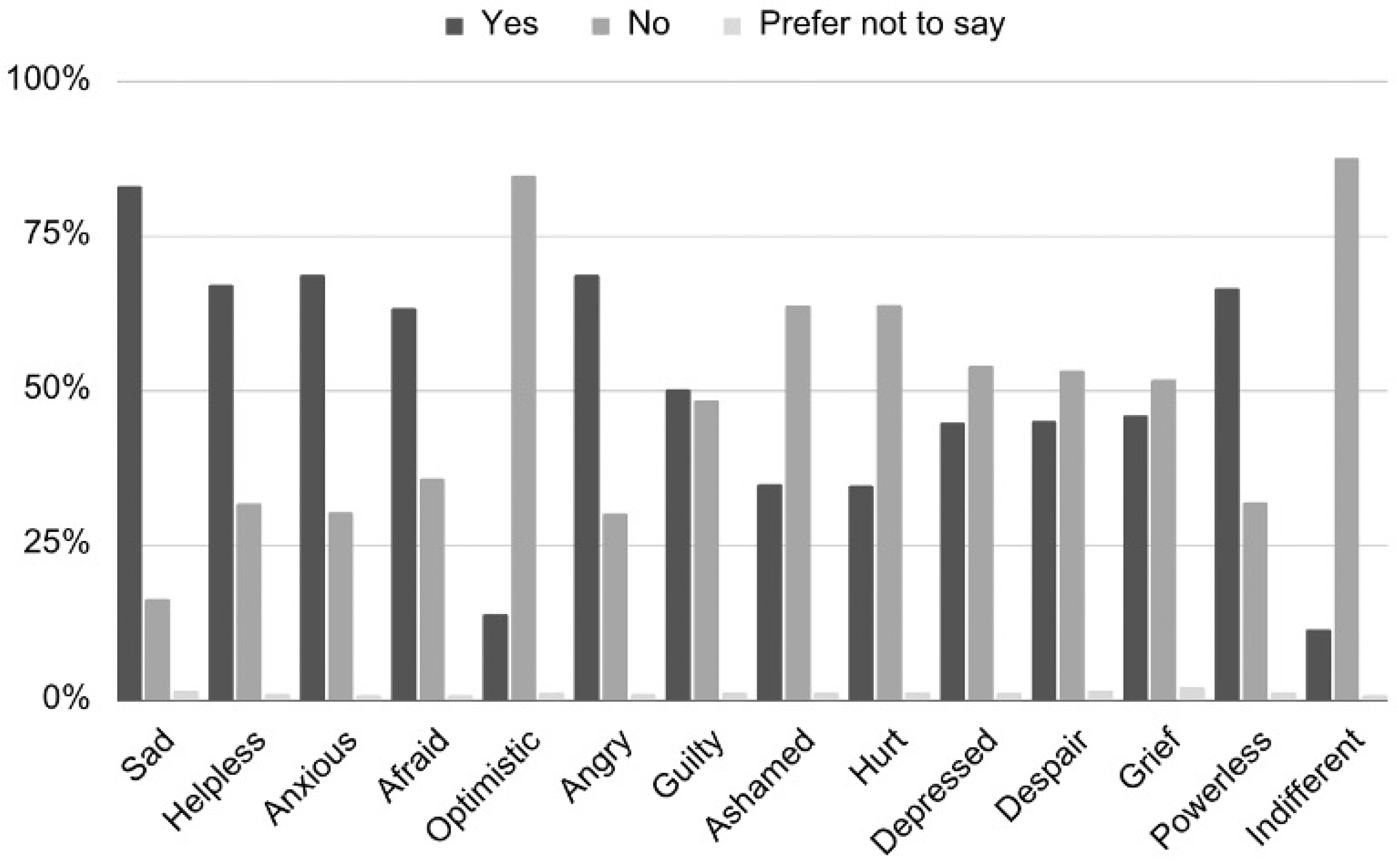
- Emotional responses to climate change (e.g., sadness, anxiety, guilt, anger);
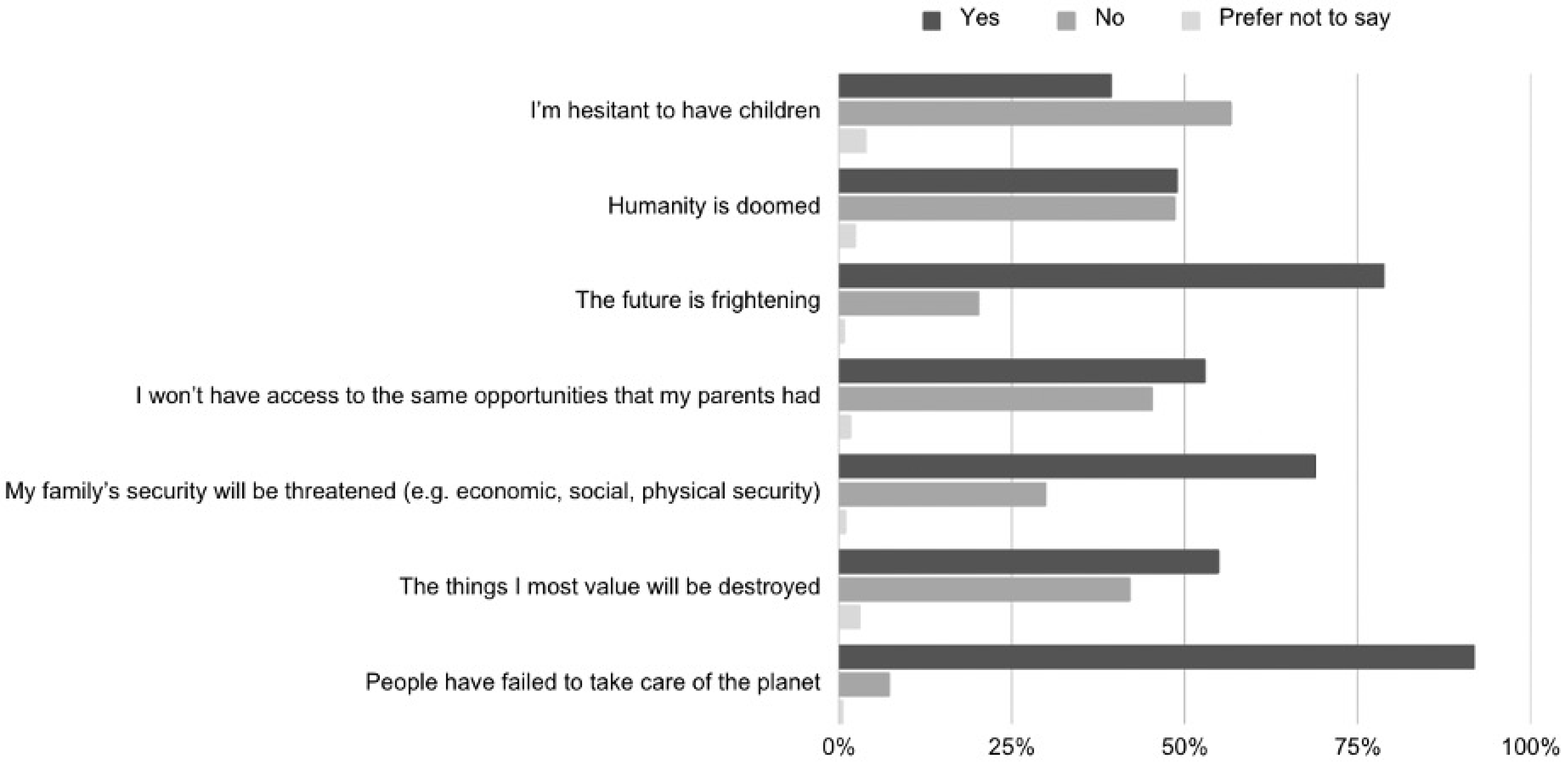
- Cognitive appraisals of the future (beliefs about ecological collapse and social failure);
- Functional impacts, such as difficulty concentrating, diminished professional motivation, or withdrawal from work-related activity; and
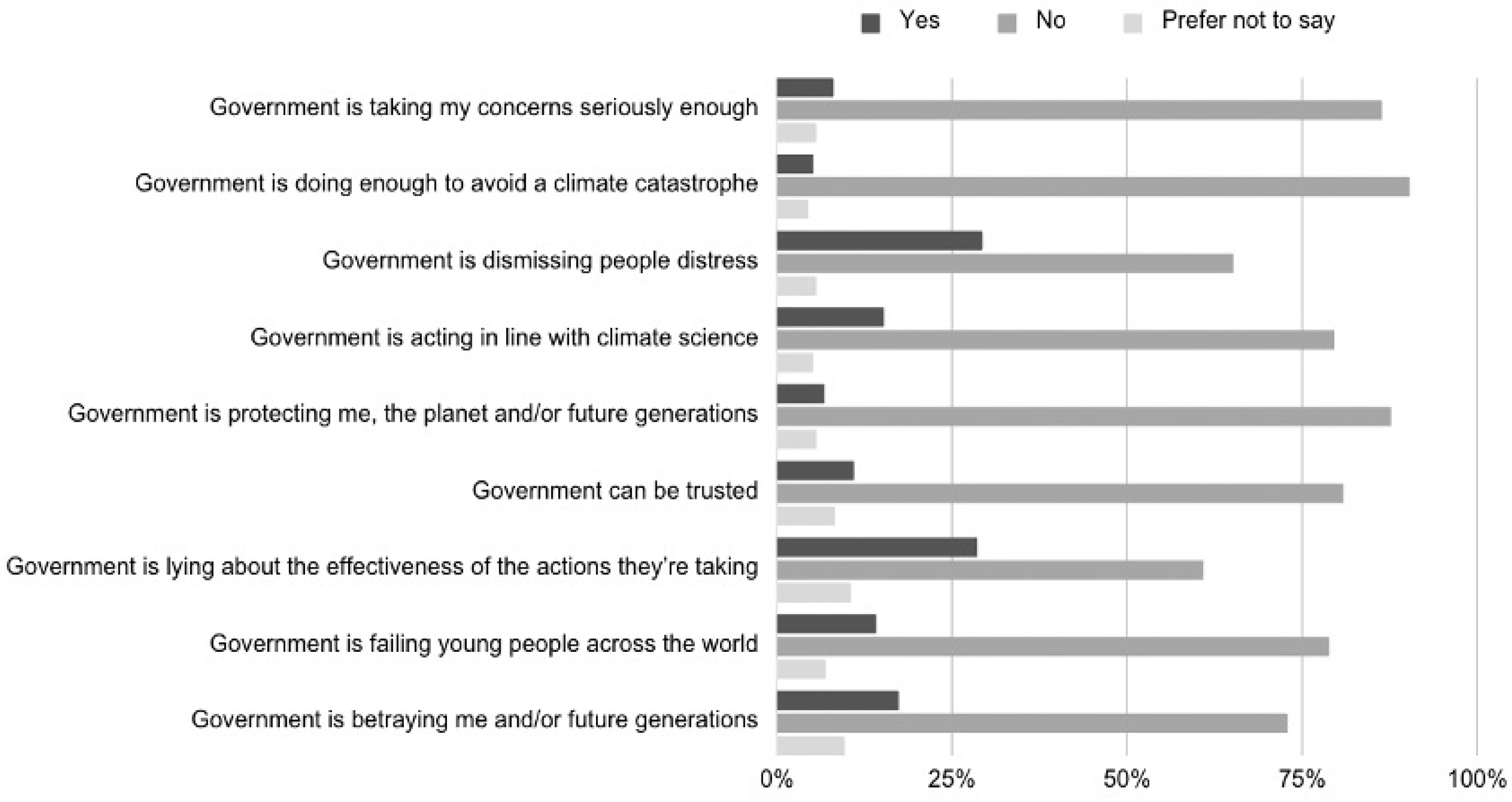
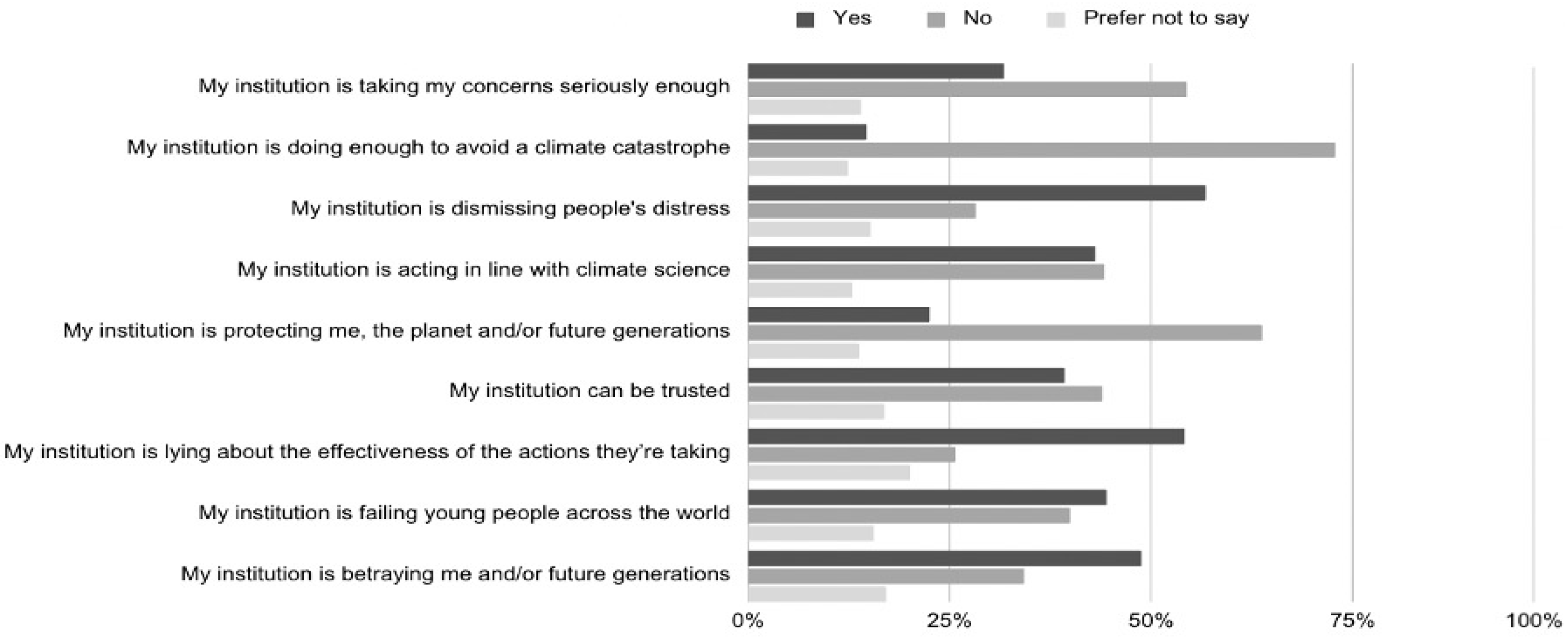
- Evaluations of collective response, assessing perceived adequacy, trust, hope, and betrayal toward governments and institutions.
2.4. Data Analysis
- Familiarisation with the full narrative dataset through repeated readings;
- Inductive open coding of meaningful units reflecting emotional, cognitive, and moral evaluations;
- Theme development and refinement, identifying patterned meanings related to betrayal, legitimacy, and ethical distress; and
- Interpretive synthesis, situating emergent themes within CAT constructs and dimensions of institutional trust.
2.5. Research Ethics and Integrity
3. Results
3.1. Primary Appraisal: Existential Threat and Loss
Another respondent described the persistent cognitive load associated with anticipating catastrophe:I experience eco-anxiety daily. I have tried to act in environmentally sustainable, mindful and compassionate ways for years because of eco-anxiety, which is why I ended up in academia. However, as is often the case, the more you know, the worse it gets. Being in a privileged position of knowing so much about climate science and the plethora of social injustices makes me feel a constant sense of guilt, worry, shame and fear.[P392, male, white, Europe and Central Asia, university]
I find it hard to maintain a hopeful positive mood sometimes because everywhere I go in life there are reminders that we are not doing enough. The most visible of these relate to transport so I can’t leave my house without seeing petrol cars driving down the road or when the sky is clear seeing airplane trails in the sky. I find this so depressing and it acts as a continual reminder of the lack of substantial rapid action. I am increasingly thinking about how best to position myself and those I care about for when the inevitable crises come in the future. It is hard to do this preparedness work and contribute to carbon reduction/mitigation while also carrying on with everyday life. It wouldn’t surprise me if one day we ended up with a climate lock down (like we had with COVID) but this still feels a long way off.[P58, male, white, Europe and Central Asia, university]
Others recalled specific events that triggered sustained distress:People think the effects of climate change will be felt in the future, but they’re happening now. My family and I were displaced because of a wildfire—we had to live in a hotel for over a month before they’d let us back into the neighbourhood, then we had to move entirely because everything was just burnt and gross. My parents had no power for two weeks and had to replace their roof because of a hurricane… My sister can’t go outside for two months out of the year because she lives in an ever increasingly hot and dry desert… People are in denial that they’re already dealing with the effects of climate change.[P34, female, white, North America, regional college]
It is not something that affects me every day… It’s more a sense of existential dread, particularly during the Australian 2019/2020 bushfires when it felt [like] the whole world was unravelling. I was in Europe at the time, but could not stop reading the Guardian to see what was happening.[P424, female, white, East Asia and the Pacific, vocational university-degree offering institution]
These reflections illustrate the primary appraisal process in CAT: climate change is interpreted as an immediate, uncontrollable, and morally significant threat. Respondents articulated both cognitive and affective manifestations like guilt, fear, helplessness, and insomnia, which extend beyond abstract concern to tangible disruption in personal and professional functioning. The intensity of these emotions was amplified among those who were most informed about climate science, suggesting that awareness may heighten rather than alleviate distress.My health is very poor in heatwaves and I cannot work or go outdoors, so my daily life is badly affected in 30C heat or above. I come from the south of England but cannot imagine moving back there now due to the heat. I used to enjoy summer as a child and teenager, and these last few years with successive heatwaves have found myself grieving for a season that is not there any more. I have turned forty so am probably around halfway through my life—when I think about how I will die I fully expect it to be as an elderly person succumbing to heat stress.[P83, non-binary, white, Europe and Central Asia, university]
Another concluded:My child is under 10. I’m terrified for their future. Although things were not great when they were born, it’s really ramped up now.[P28, female, white, Europe and Central Asia, university]
As a further example:I feel tremendous anxiety and guilty about having children. They’re doomed.[P289, female, white, North America, community college]
Another stated:A lot of my emotions on this are not for me but as a parent and on behalf of students I teach.[P410, female, white, Europe and Central Asia, university]
Since I am from the Philippines, an archipelagic nation in the Asia Pacific, greatly affected by disasters (especially extreme weather conditions such as typhoons and El Nino and heat waves), and very vulnerable because of limited resources (Third World country, almost half are living below poverty), the threat of climate change is felt everyday. I see destruction of lives and livelihood, threat in our food source, etc. I feel anxious and extremely sad for my young daughter.[P372, female, Filipino, East Asia and the Pacific, university]
Such reflections illustrate that eco-anxiety among HEPs is not an isolated emotional state but a cognitively and ethically embedded phenomenon. Their distress incorporates anticipatory fear, guilt, and moral concern for others, particularly younger and future generations. These findings reinforce the idea that the primary appraisal of climate change involves both the recognition of threat and the internalisation of moral responsibility, setting the stage for secondary appraisals focused on the perceived adequacy and legitimacy of institutional and governmental responses.I work in a department (International Development) which is specifically tackling climate change and its impacts with the most vulnerable people in the world… I resist all talk about doom, humanity is going to be wiped out, etc., because people, especially my young students, then feel there is no point in carrying on trying to find solutions… Doom talk is paralysing.[P55, white, female, North America, university]
3.2. Secondary Appraisal: Institutional Adequacy and Moral Disillusionment
This was echoed by another participant who stated:…All the little actions we do (recycling, not using planes, not using the car, growing our own food) are not enough to combat the private jets, the big cars, the overconsumption. The politicians are too busy backstabbing and bickering to make a difference.[P28, female, white, Europe and Central Asia, university]
Others emphasised geopolitical inequities and misplaced national priorities:I get very desperate when I see how governments and companies do not do their part to fight climate change. It is proven that it is not the individual who can do that much to prevent climate change. It is the governments and particularly the big companies who don’t give a [care] and just care about money and growth…[P120,female, white, Europe and Central Asia, university]
Another participant reflected:We are in a developing country and the concerns are more around poverty, corruption, poor health care, violent crime, gender-based violence… So climate change is quite far down the list of priorities.[P198, female, Indian, Sub-Saharan Africa, university]
This pervasive sense of betrayal appeared to cascade downward, shaping how participants appraised not only governmental authority but also the institutions in which they worked. The same emotional logic—rooted in perceived hypocrisy, moral dissonance, and the prioritisation of economic or reputational interests over ethical responsibility—extended to universities and research organisations. Many respondents suggested that governments and higher education institutions operate within a shared paradigm of performative sustainability, in which rhetorical commitments substitute for structural change. In this way, governmental inaction and institutional inertia were experienced as mutually reinforcing, eroding trust and amplifying distress among professionals whose work depends on credible leadership and collective moral purpose.…I am incredibly frustrated/angry by the lack of action on the part of our government, both to provide meaningful support on the global stage and to invest the money it has… in building climate resilience and adaptive capacity within the UK.[P416, female, white, Europe and Central Asia, university]
Another observed:One thing that is making me particularly angry is the greenwashing that takes place in higher education. Institutions pretend they are fighting climate change while they are in fact preserving their privileges and not changing a thing.[P236, female, declined to identify, Europe and Central Asia, university]
Several expressed resignation that institutional impact was ultimately constrained by governmental inaction:Universities (such as my employer) should be at the forefront in making the transition to carbon neutral. Unfortunately it is mostly hot air and very little action. There is an enormous gap between rhetoric and action in Higher Education. Unfortunately, the climate and ecological crisis does not respond to nice words, only action. My institution, like most others, is unwilling or unable to do what is needed, whether in terms of its own activities (e.g., dependence on funding from fossil fuel companies, reliance on extensive high-carbon travel) or holding power to account.[P206, male, white, Europe and Central Asia, university]
Across both contexts, the emotional vocabulary of respondents—“betrayed,” “manipulated,” “ignored,” “exhausted”—points to moral injury: a profound sense of disillusionment when institutions fail to uphold ethical obligations. This loss of faith often spilled into occupational withdrawal and existential fatigue:I don’t think the institution really has much of an impact on the outcomes of climate change. While they are doing research, it means little if governments don’t take the action that research recommends.[P517, male, white, North America, university]
Another stated:It has made me rethink the value of the research I do (it now feels pointless and I have more or less given it up).[P333, female, white, East Asia and the Pacific, university]
Thinking about leaving academia to go repair bicycles in the countryside.[P316, male, declined to identify, Europe and Central Asia, research institution]
I feel that while there is a lot of rhetoric around sustainability and action in terms of offering sustainability degree courses and centres of excellence across multiple disciplines, student societies, small scale growing on campus etc. but at the same operate under growth strategies (student numbers have increased from 6000 to 18,000 since 2000s) which have resulted in large parts of the city being demolished and rebuilt for student housing (owned by university and other businesses) and new development on green belt/previously agricultural land including wetland drainage to create lake landscapes. Further student expansion is planned (anecdotally +30%) focused on international recruit without knowledge/consideration of the environmental impact of international travel. This is echoed in the common practice of sending teams of academics to international conferences and even the environmental costs of such events. While I appreciate and support the diversity this can bring, it is a matter of priorities and maturity and being able to objectively evaluate where the benefit of in-person attendance against costs is significant enough to warrant travel (which should then be carbon offset). For example, sending a team and equipment overseas to showcase an piece of art created for virtual reality—as a digital project/product could this have been achieved without travel? I do not believe that we can continue operating within this ‘business as usual’ mode. We cannot change without change.[P114, female, white, Europe and Central Asia, university]
Eco-anxiety thus emerges as an affective index of both environmental degradation and institutional unsustainability—a psychological signal of systemic dysfunction rather than individual maladaptation.I feel that every decision I make now is affected by eco anxiety. It’s actually a valid response to an emergency situation so it’s not anxiety for no reason.[P346, female, white, Europe and Central Asia, university]
4. Discussion
5. Conclusions
Funding
Institutional Review Board Statement
Informed Consent Statement
Data Availability Statement
Conflicts of Interest
Abbreviations
| CAT | Higher Education Institution |
| HEPs | Higher Education Professionals |
| SDGs | Sustainable Development Goals |
References
- Albrecht, G., Sartore, G.-M., Connor, L., Higginbotham, N., Freeman, S., Kelly, B., Stain, H., Tonna, A., & Pollard, G. (2007). Solastalgia: The distress caused by environmental change. Australasian Psychiatry, 15(S1), S95–S98. [Google Scholar] [CrossRef] [Scilit] [PubMed]
- Braun, V., & Clarke, V. (2006). Using thematic analysis in psychology. Qualitative Research in Psychology, 3(2), 77–101. [Google Scholar] [CrossRef] [Scilit]
- Budziszewska, M., & Jonsson, S. E. (2022). Talking about climate change and eco-anxiety in psychotherapy: A qualitative analysis of patients’ experiences. Psychotherapy, 59(4), 606–615. [Google Scholar] [CrossRef] [Scilit] [PubMed]
- Clayton, S. (2020). Climate anxiety: Psychological responses to climate change. Journal of Anxiety Disorders, 74, 102263. [Google Scholar] [CrossRef] [Scilit]
- Clayton, S., & Karazsia, B. T. (2020). Development and validation of a measure of climate change anxiety. Journal of Environmental Psychology, 69, 101434. [Google Scholar] [CrossRef] [Scilit]
- Coffey, Y., Bhullar, N., Durkin, J., Islam, M. S., & Usher, K. (2021). Understanding eco-anxiety: A systematic scoping review of current literature and identified knowledge gaps. Journal of Climate Change and Health, 3, 100047. [Google Scholar] [CrossRef] [Scilit]
- Cunsolo, A., & Ellis, N. R. (2018). Ecological grief as a mental health response to climate-change-related loss. Nature Climate Change, 8(4), 275–281. [Google Scholar] [CrossRef] [Scilit]
- Faul, F., Erdfelder, E., Buchner, A., & Lang, A.-G. (2009). Statistical power analyses using G*Power 3.1: Tests for correlation and regression analyses. Behavior Research Methods, 41(4), 1149–1160. [Google Scholar] [CrossRef] [Scilit]
- Helmers, E., Chang, C. C., & Dauwels, J. (2021). Carbon footprinting of universities worldwide: Part I—Objective comparison by standardized metrics. Environmental Sciences Europe, 33(1), 30. [Google Scholar] [CrossRef] [Scilit]
- Hickman, C., Marks, E., Pihkala, P., Clayton, S., Lewandowski, R. E., Mayall, E. E., Wray, B., Mellor, C., & van Susteren, L. (2021). Climate anxiety in children and young people and their beliefs about government responses to climate change: A global survey. The Lancet Planetary Health, 5(12), e863–e873. [Google Scholar] [CrossRef] [Scilit]
- Hogg, T. L., Stanley, S. K., O’Brien, L. V., Wilson, M. S., & Watsford, C. R. (2021). The Hogg Eco-Anxiety Scale: Development and validation of a multidimensional scale. Global Environmental Change, 71, 102391. [Google Scholar] [CrossRef] [Scilit]
- Kelly, A. (2017). Eco-anxiety at university: Student experiences and academic perspectives on cultivating healthy emotional responses to the climate crisis. SIT Study Abroad. Available online: https://digitalcollections.sit.edu/cgi/viewcontent.cgi?article=3665&context=isp_collection (accessed on 17 July 2023).
- Kurth, C., & Pihkala, P. (2022). Eco-anxiety: What it is and why it matters. Frontiers in Psychology, 13, 981814. [Google Scholar] [CrossRef] [Scilit] [PubMed]
- Lazarus, R., & Folkman, S. (1984). Stress, appraisal, and coping. Springer. [Google Scholar]
- Leal Filho, W., Abubakar, I. R., Mifsud, M. C., Eustachio, J. H. P. P., Albrecht, C. F., Dinis, M. A. P., Borsari, B., Sharifi, A., Levesque, V. R., Ribeiro, P. C. C., LeVasseur, T. J., Pace, P., Trevisan, L. V., & Dibbern, T. A. (2025). Governance in the implementation of the UN sustainable development goals in higher education: Global trends. Environment, Development and Sustainability, 27, 20695–20718 . [Google Scholar] [CrossRef] [Scilit]
- Litz, B. T., Stein, N., Delaney, E., Lebowitz, L., Nash, W. P., Silva, C., & Maguen, S. (2009). Moral injury and moral repair in war veterans: A preliminary model and intervention strategy. Clinical Psychology Review, 29(8), 695–706. [Google Scholar] [CrossRef] [Scilit]
- Ogunbode, C. A., Doran, R., Böhm, G., Hein, C., Bhullar, N., Morgan, M., Umeh, C., & Poortinga, W. (2022). Climate anxiety, well-being and pro-environmental action: Correlates of negative emotional responses to climate change in 32 countries. Journal of Environmental Psychology, 84, 101887. [Google Scholar] [CrossRef] [Scilit]
- Ojala, M. (2017). Hope and anticipation in education for a sustainable future. Futures, 94, 76–84. [Google Scholar] [CrossRef] [Scilit]
- O’Neill, K. (2023). Can universities be climate leaders? In J. Dobson, & E. Ferrari (Eds.), Reframing the civic university: Rethinking university-community policy connections (pp. 63–81). Palgrave Macmillan. [Google Scholar]
- Phelan, L., & Lumb, M. (2021). Higher education for times of climate crisis: Critical awareness, purpose and community. International Studies in Sociology of Education, 30(1–2), 173–190. [Google Scholar] [CrossRef] [Scilit]
- Pihkala, P. (2020a). Anxiety and the ecological crisis: An analysis of eco-anxiety and climate anxiety. Sustainability, 12(19), 7836. [Google Scholar] [CrossRef] [Scilit]
- Pihkala, P. (2020b). Eco-anxiety and environmental education. Sustainability, 12(23), 10149. [Google Scholar] [CrossRef] [Scilit]
- Pihkala, P. (2022a). The process of eco-anxiety and ecological grief: A narrative review and a new proposal. Sustainability, 14(24), 16628. [Google Scholar] [CrossRef] [Scilit]
- Pihkala, P. (2022b). Toward a taxonomy of climate emotions. Frontiers in Climate, 3, 738154. [Google Scholar] [CrossRef] [Scilit]
- Ruiz-Mallén, I., & Heras, M. (2020). What sustainability? Higher education institutions’ pathways to reach the Agenda 2030 goals. Sustainability, 12(4), 1290. [Google Scholar] [CrossRef] [Scilit]
- Skilling, P., Hurd, F., Lips-Wiersma, M., & McGhee, P. (2022). Navigating hope and despair in sustainability education: A reflexive roadmap for being with eco-anxiety in the classroom. Management Learning. Advance online publication. [Google Scholar] [CrossRef] [Scilit]
- Tollefson, J. (2021). Top climate scientists are sceptical that nations will rein in global warming. Nature, 599(4), 22–24. [Google Scholar] [CrossRef] [Scilit]
- Verplanken, B., Marks, E., & Dobromir, A. (2020). On the nature of eco-anxiety: How constructive or unconstructive is habitual worry about global warming? Journal of Environmental Psychology, 72, 101528. [Google Scholar] [CrossRef] [Scilit]
- Wang, H., Safer, D. L., Cosentino, M., Cooper, R., van Susteren, L., Coren, E., Nosek, G., Lertzman, R., & Sutton, S. (2023). Coping with eco-anxiety: An interdisciplinary perspective for collective learning and strategic communication. The Journal of Climate Change and Health, 9, 100211. [Google Scholar] [CrossRef] [Scilit]
- Winfield, J. D., & Paris, J. H. (2024). A mixed method analysis of burnout and turnover intentions among higher education professionals during COVID-19. Journal of Education Human Resources, 42(2), 128–152. [Google Scholar] [CrossRef] [Scilit]



| Variable | Category | % |
|---|---|---|
| Gender | Female | 53.8 |
| Male | 43.1 | |
| Other/prefer not to say | 3.1 | |
| Age group | 18–34 | 15.6 |
| 35–44 | 30.8 | |
| 45–54 | 22.8 | |
| 55+ | 30.8 | |
| Ethnicity | White | 67.6 |
| Black | 15.6 | |
| Asian | 4.0 | |
| Mixed/Other | 12.8 | |
| Neurodiverse | Yes | 17.5 |
| Disabled | Yes | 8.8 |
| 1 | 2 | 3 | 4 | 5 | 6 | 7 | 8 | 9 | 10 | 11 | 12 | 13 | 14 | 15 | 16 | |
|---|---|---|---|---|---|---|---|---|---|---|---|---|---|---|---|---|
| 1: Worried about CC | 1 | 0.648 ** | 0.596 ** | 0.303 ** | 0.315 ** | 0.481 ** | −0.138 ** | −0.130 ** | −0.171 ** | −0.165 ** | 0.222 ** | 0.348 ** | 0.069 | −0.120 ** | −0.122 ** | −0.070 |
| 2: Negative feelings | 0.648 ** | 1 | 0.774 ** | 0.453 ** | 0.407 ** | 0.614 ** | −0.205 ** | −0.194 ** | −0.189 ** | −0.215 ** | 0.281 ** | 0.453 ** | 0.176 ** | −0.144 ** | −0.106 * | −0.090 * |
| 3: Negative thoughts | 0.596 ** | 0.774 ** | 1 | 0.549 ** | 0.351 ** | 0.593 ** | −0.153 ** | −0.136 ** | −0.132 ** | −0.165 ** | 0.329 ** | 0.486 ** | 0.212 ** | −0.124 ** | −0.134 ** | −0.093 * |
| 4: Negative functional impact | 0.303 ** | 0.453 ** | 0.549 ** | 1 | 0.168 ** | 0.407 ** | −0.019 | 0.002 | −0.048 | −0.042 | 0.193 ** | 0.359 ** | 0.073 | −0.018 | −0.044 | −0.005 |
| 5: Negative beliefs (government) | 0.315 ** | 0.407 ** | 0.351 ** | 0.168 ** | 1 | 0.507 ** | −0.503 ** | −0.454 ** | −0.499 ** | −0.512 ** | 0.316 ** | 0.208 ** | 0.174 ** | −0.120 * | −0.146 ** | −0.138 ** |
| 6: Feeling betrayed (government) | 0.481 ** | 0.614 ** | 0.593 ** | 0.407 ** | 0.507 ** | 1 | −0.285 ** | −0.265 ** | −0.270 ** | −0.264 ** | 0.284 ** | 0.626 ** | 0.141 ** | −0.002 | −0.026 | 0.026 |
| 7: Feeling reassured (government) | −0.138 ** | −0.205 ** | −0.153 ** | −0.019 | −0.503 ** | −0.285 ** | 1 | 0.433 ** | 0.523 ** | 0.553 ** | −0.197 ** | −0.107 * | −0.253 ** | 0.151 ** | 0.204 ** | 0.148 ** |
| 8: Feeling hopeful (government) | −0.130 ** | −0.194 ** | −0.136 ** | 0.002 | −0.454 ** | −0.265 ** | 0.433 ** | 1 | 0.613 ** | 0.605 ** | −0.221 ** | −0.133 ** | −0.234 ** | 0.272 ** | 0.219 ** | 0.213 ** |
| 9 Feeling protected (government) | −0.171 ** | −0.189 ** | −0.132 ** | −0.048 | −0.499 ** | −0.270 ** | 0.523 ** | 0.613 ** | 1 | 0.672 ** | −0.222 ** | −0.072 | −0.280 ** | 0.246 ** | 0.279 ** | 0.233 ** |
| 10: Feeling valued (government) | −0.165 ** | −0.215 ** | −0.165 ** | −0.042 | −0.512 ** | −0.264 ** | 0.553 ** | 0.605 ** | 0.672 ** | 1 | −0.185 ** | −0.077 | −0.261 ** | 0.281 ** | 0.264 ** | 0.259 ** |
| 11: Negative beliefs (institution) | 0.222 ** | 0.281 ** | 0.329 ** | 0.193 ** | 0.316 ** | 0.284 ** | −0.197 ** | −0.221 ** | −0.222 ** | −0.185 ** | 1 | 0.648 ** | 0.597 ** | −0.564 ** | −0.570 ** | −0.521 ** |
| 12: Feeling betrayed (institution) | 0.348 ** | 0.453 ** | 0.486 ** | 0.359 ** | 0.208 ** | 0.626 ** | −0.107 * | −0.133 ** | −0.072 | −0.077 | 0.648 ** | 1 | 0.390 ** | −0.289 ** | −0.226 ** | −0.306 ** |
| 13: Feeling reassured (institution) | 0.069 | 0.176 ** | 0.212 ** | 0.073 | 0.174 ** | 0.141 ** | −0.253 ** | −0.234 ** | −0.280 ** | −0.261 ** | 0.597 ** | 0.390 ** | 1 | −0.357 ** | −0.280 ** | −0.328 ** |
| 14: Feeling hopeful (institution) | −0.120 ** | −0.144 ** | −0.124 ** | −0.018 | −0.120 * | −0.002 | 0.151 ** | 0.272 ** | 0.246 ** | 0.281 ** | −0.564 ** | −0.289 ** | −0.357 ** | 1 | 0.816 ** | 0.790 ** |
| 15: Feeling protected (institution) | −0.122 ** | −0.106 * | −0.134 ** | −0.044 | −0.146 ** | −0.026 | 0.204 ** | 0.219 ** | 0.279 ** | 0.264 ** | −0.570 ** | −0.226 ** | −0.280 ** | 0.816 ** | 1 | 0.718 ** |
| 16: Feeling valued (institution) | −0.070 | −0.090 * | −0.093 * | −0.005 | −0.138 ** | 0.026 | 0.148 ** | 0.213 ** | 0.233 ** | 0.259 ** | −0.521 ** | −0.306 ** | −0.328 ** | 0.790 ** | 0.718 ** | 1 |
Disclaimer/Publisher’s Note: The statements, opinions and data contained in all publications are solely those of the individual author(s) and contributor(s) and not of MDPI and/or the editor(s). MDPI and/or the editor(s) disclaim responsibility for any injury to people or property resulting from any ideas, methods, instructions or products referred to in the content. |
© 2025 by the author. Published by MDPI on behalf of the University Association of Education and Psychology. Licensee MDPI, Basel, Switzerland. This article is an open access article distributed under the terms and conditions of the Creative Commons Attribution (CC BY) license.
Share and Cite
Steele, S.L. Eco-Anxiety in Higher Education Professionals: Psychological Impacts, Institutional Trust, and Policy Implications. Eur. J. Investig. Health Psychol. Educ. 2026, 16, 6. https://doi.org/10.3390/ejihpe16010006
Steele SL. Eco-Anxiety in Higher Education Professionals: Psychological Impacts, Institutional Trust, and Policy Implications. European Journal of Investigation in Health, Psychology and Education. 2026; 16(1):6. https://doi.org/10.3390/ejihpe16010006
Chicago/Turabian StyleSteele, Sarah Louise. 2026. "Eco-Anxiety in Higher Education Professionals: Psychological Impacts, Institutional Trust, and Policy Implications" European Journal of Investigation in Health, Psychology and Education 16, no. 1: 6. https://doi.org/10.3390/ejihpe16010006
APA StyleSteele, S. L. (2026). Eco-Anxiety in Higher Education Professionals: Psychological Impacts, Institutional Trust, and Policy Implications. European Journal of Investigation in Health, Psychology and Education, 16(1), 6. https://doi.org/10.3390/ejihpe16010006