Article

Impact of Gravity Segregation on Gas Injection Development in Condensate Gas Reservoirs: A Numerical Simulation Study

1
Tarim Oilfield Company, PetroChina, Korla 841000, China
2
R&D Center for Ultra-Deep Complex Reservoir Exploration and Development, CNPC—China National Petroleum Corporation, Korla 841000, China
3
Engineering Research Center for Ultra-Deep Complex Reservoir Exploration and Development, CNPC—China National Petroleum Corporation, Korla 841000, China
4
State Key Laboratory of Petroleum Resources and Prospecting, China University of Petroleum (Beijing), Beijing 102249, China
*
Author to whom correspondence should be addressed.
Processes 2025, 13(6), 1659; https://doi.org/10.3390/pr13061659
Submission received: 18 March 2025 / Revised: 8 May 2025 / Accepted: 19 May 2025 / Published: 26 May 2025

Abstract

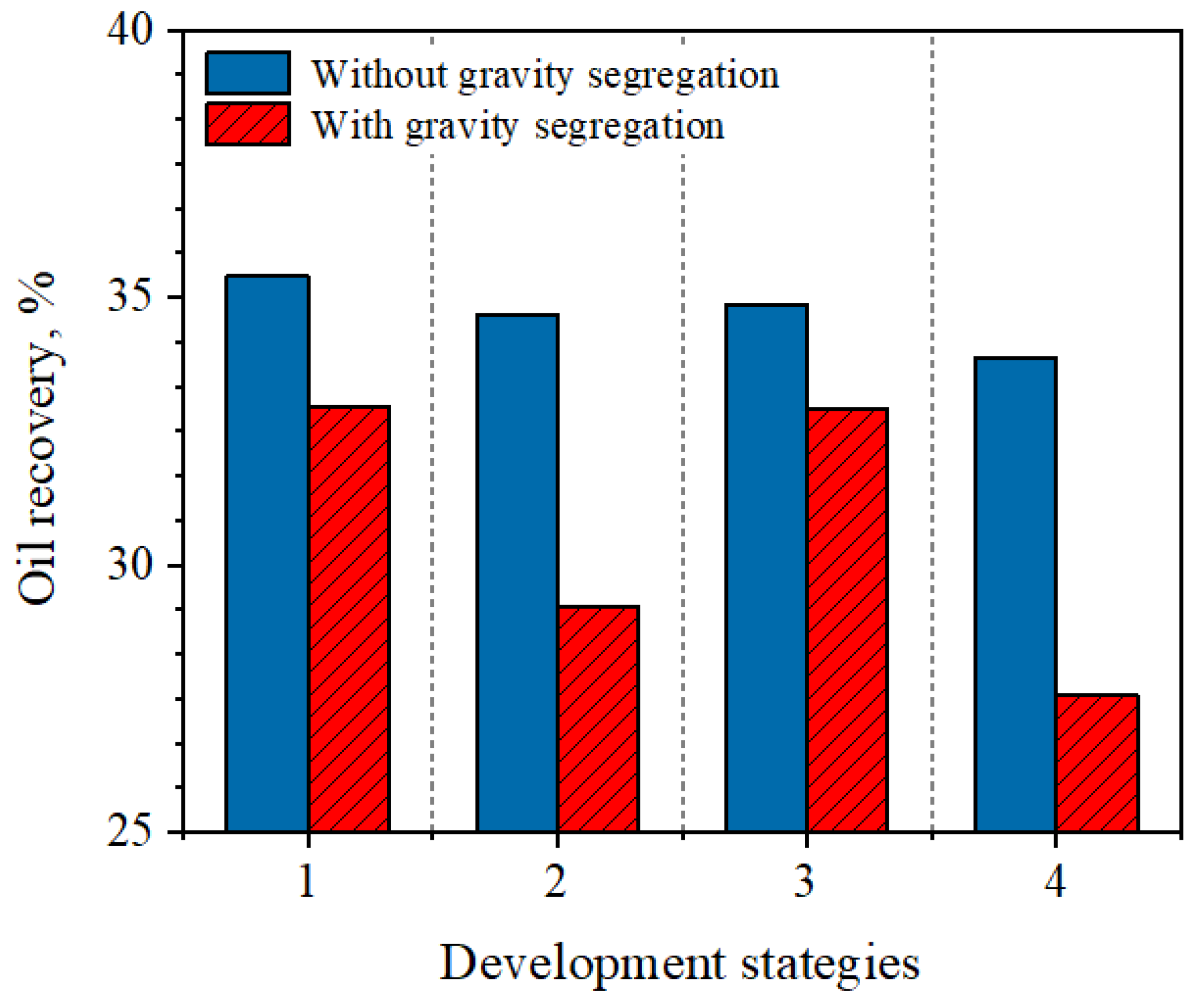
Gravity segregation is a critical phenomenon in thick condensate gas reservoirs, significantly influencing fluid composition and phase behavior. Reservoir-scale numerical simulation, serving as an indispensable technical approach in modern petroleum engineering, provides both quantitative data support and theoretical frameworks for development strategy optimization. However, the impact of gravity segregation on the distribution of initial fluid compositions is often overlooked in conventional numerical simulations due to data limitations or underestimated importance. This oversight leads to systematic deviations between simulated reservoir performance and actual field observations, ultimately compromising the efficient development of reservoirs. This study analyzed PVT data from reservoir fluid samples at different depths to determine the initial fluid composition distribution. Two models were developed: one incorporating gravity segregation and another neglecting it, to evaluate their performance during gas injection. Key findings include: (i) Gravity segregation alters the initial fluid composition, creating lighter components near the reservoir top and heavier ones at the bottom, resulting in distinct phase behaviors and production dynamics. (ii) The model accounting for gravity segregation aligns better with historical production data, while the model neglecting it underestimates oil production rates by about 9% and overestimates oil recovery by 2–5% during gas injection, due to inaccurate fluid composition assumptions. (iii) The model without gravity segregation also underestimates differences in oil recovery between injection–production strategies, such as top versus bottom injection. This study highlights the critical role of gravity segregation in reservoir simulation and provides valuable insights for optimizing the development of condensate gas reservoirs with complex fluid distributions. The findings reveal that accounting for gravity segregation in reservoir simulation models through proper initialization of fluid distribution leads to improved simulation accuracy, thereby enabling more precise development strategy design.
Keywords: gravity segregation; condensate gas reservoirs; gas injection; reservoir numerical simulation; enhanced oil recovery gravity segregation; condensate gas reservoirs; gas injection; reservoir numerical simulation; enhanced oil recovery