


Abstract
Virtual power plants (VPPs) provide essential regulation capabilities by aggregating diverse distributed energy resources (DERs). Accurately assessing the value of VPPs from the grid’s side is essential for improving market mechanism design and, in turn, encouraging participation of VPPs. However, existing assessment methods neglect the refined evaluations integrating Automatic Generation Control (AGC)-based operational simulations derived from economic dispatch results, thereby failing to comprehensively capture the multi-dimensional benefits VPPs contribute to the grid. To bridge this gap, this study proposes a multi-dimensional benefit assessment method of VPPs and a simulation method from the grid’s perspective. First, the environmental, security, and economic benefits of VPPs are characterized. A decoupled quantitative assessment framework based on the Vickrey-Clarke-Groves (VCG) mechanism is then established to evaluate these benefits by analyzing system cost variations induced by VPP aggregation. Next, the method of actual operation simulation based on scheduling outcomes is discussed. The corresponding system operation costs are obtained under various scenarios. Case studies utilizing real-world data from a provincial power grid in China analyzed the benefits of VPPs across multiple scenarios defined by varying renewable energy penetration rates, aggregation sizes, and output stability. Notably, the value of the VPP differs significantly across renewable energy penetration levels. Under high penetration, its value increases by 18.5% compared with the low-penetration case, and the value of security and ancillary services accounts for the largest share (50.3%), a component frequently overlooked in existing literature. These findings offer valuable insights for optimizing electricity market mechanisms.
1. Introduction
As the global energy transition accelerates, the share of renewable energy such as wind and solar power continues to increase. This trend is critical for achieving carbon reduction goals [1,2]. However, it also brings new challenges to traditional power systems. Renewable generation is inherently intermittent, volatile, and uncertain. These characteristics conflict with the power system’s need for real-time supply-demand balance. Limited flexibility of the system becomes a key bottleneck. Relying solely on conventional resources, the system cannot provide sufficient flexibility. It makes large-scale and efficient integration of renewables more difficult [3]. As a result, wind and solar curtailment or load shedding may increase, and the safe operation of the grid could be threatened [4]. Therefore, it is necessary to utilize distributed energy resources (DERs) on the user side.
Virtual power plants (VPPs) offer a promising solution [5]. By using advanced information and communication technologies, VPPs aggregate distributed generation, energy storage systems, and controllable loads [6]. These diverse resources are integrated into a unified and dispatchable entity. As a result, VPPs act as flexible system regulators and help address the shortage of dispatchable capacity under high renewable penetration [7,8].
Recent advances show that VPP development satisfies the industrial requirements and enables advancements in the energy sector. With the uncertainties of solar and wind generation, VPPs are essential for ensuring reliable and flexible operation. Industrial applications such as the EMS-based IVPP in [9] further demonstrate how VPPs can support peak demand reliability. These trends underline the need to evaluate VPPs in ways that reflect real industrial requirements.
Achieving reasonable profitability in the market is a prerequisite for the large-scale development of VPPs. As highlighted in [9], a concise definition of VPPs cannot capture the wide range of services they enable, including effective DER aggregation, demand-side management, flexible demand response (DR), and behind-the-meter (BTM) participation. The growing transition from consumers to prosumers—empowered by small-scale residential, commercial, and industrial generation—further strengthens the role of VPPs as aggregated, grid-visible entities that can provide system-level flexibility and peak-demand reduction. This broader commercial and technical landscape motivates the need for systematic value assessment, as existing studies still lack quantitative evaluations that support future market design. Meanwhile, China’s electricity market reform is progressing toward a more sophisticated structure [10]. A multi-tier market system, including spot markets and ancillary service markets, is being rapidly developed. The fundamental goal is to facilitate optimal resource allocation and enhance the integration of renewable energy. In China, the ongoing reform of the electricity market has led to greater diversification of participating resources and expanded the forms of participation in ancillary services. Industry regulations have already been established regarding the involvement of VPPs in frequency regulation ancillary service markets [11]. Through the coordinated dispatch of demand-side response resources, VPPs are enabled to participate in frequency regulation services within the electricity market. In the current regulations, VPPs are evaluated based on the same criteria as thermal power units. However, the resource characteristics of VPPs differ from those of conventional generators. Directly applying traditional rules cannot ensure a fair assessment of VPP value and may reduce their motivation to participate in the market. The absence of standardized metrics prevents the establishment of fair market rules [12,13]. The multi-dimensional benefit of VPPs remains uncoordinated in quantification: only the energy benefit is tradable, while security and environmental benefits are overlooked. Hence, accurately evaluating the benefits of VPPs is essential for guiding the design of effective market mechanisms.
In recent years, industrial and academic research on the participation of VPPs in the electricity market has made certain progress [14,15]. In China, the ongoing reform of the electricity market has led to greater diversification of participating resources and expanded the forms of participation in ancillary services [11]. In America, [16] has included the possibility of frequency control through VPP to guarantee power quality and system security. Current market rules do not adequately capture the benefits provided by VPPs. Through the coordinated dispatch of demand-side response resources, VPPs are enabled to participate in frequency regulation services within the electricity market.
At present, the benefit assessment of VPPs is a research hotspot in power systems. However, most existing studies take a fragmented perspective and do not fully reveal their overall regulatory benefit to the system. Some studies focus on a specific benefit dimension of VPPs. For example, reference [17] proposed an innovative method to evaluate the greenhouse gas emission reduction potential of VPPs, providing a quantitative basis for their environmental benefits. Similarly, reference [18] focused on the economic aspect and established indicators such as the market cost-saving rate to accurately assess the short-term economic benefits of VPPs in the energy market. However, these methods suffer from a fundamental limitation in their single analytical method. They can accurately quantify the contribution of a VPP in a single aspect, but they overlook the intrinsic coupling among different benefit dimensions. For instance, how enhanced flexibility can simultaneously bring about economic and security benefits. As a result, they fail to address the question of the overall utility of a VPP as a system-level regulation resource and assess how real operating conditions are affected based on actual operation simulations. Another research strand focuses on the physical aspects of system operation, seeking to measure the flexibility contributed by the VPPs. The ramping ability expectation metric is proposed in [19] to measure power system flexibility for use in long-term planning. To assess the operational flexibility in the system and facilitate the integration of renewable energies, measurement metrics are proposed in [20] for a more accurate and comprehensive representation of operational flexibility. Reference [21] accounts for the characteristics and uncertainties of renewable resources and incorporates advanced multi-objective optimization algorithms, which improve the system’s renewable energy utilization. However, it does not consider environmental or security values. Although these studies assess the benefit of one aspect, they fail to consider the multi-dimensional benefit of VPPs and lack a quantitative framework linking it to cost savings, curtailment reduction, or stability improvement.
Reference [22] proposes a multi-dimensional and multi-level quantitative evaluation index system that considers both the aggregation capability and regulation potential of VPPs under carbon-reduction requirements. This framework enables an accurate quantitative assessment of the regulation potential of VPPs under different carbon-reduction scenarios. Reference [23] quantifies the social benefits—specifically the economic benefits—of VPPs in South Korea using the Contingent Valuation Method (CVM). They have not refined their evaluations to include actual automatic generation control (AGC)-based operational simulations derived from economic dispatch results.
In summary, existing studies exhibit two key limitations: they are either confined to focusing on a single benefit dimension, or they rely on technical metrics that fail to translate into comprehensive, system-wide benefits. Critically, the practical impact on real operating conditions remains unevaluated due to the lack of actual operational simulation. This results in fundamental gaps in the current understanding of VPPs:
Accordingly, this paper takes VPPs as the research subject and explores a quantitative evaluation framework for their multi-dimensional benefit.
Therefore, this paper focuses on the actual VPP of a provincial power grid in China and proposes a multi-dimensional benefit assessment of VPP from the grid’s perspective. First, a multi-dimensional benefit assessment framework for VPPs is established. The framework is established based on the Vickrey-Clarke-Groves (VCG) system, in which system operation costs are derived through simulations of both the scheduling and actual operation processes. Second, the specific dispatch model and actual operation simulation approach are presented in detail. The dispatch model considers unit generation cost, renewable energy curtailment, load shedding, and frequency regulation reserve, while the real-time operation simulation reflects the actual dispatch clearing process and system response. Finally, by applying the proposed method through multi-scenario analyses, the proposed approach demonstrates and validates the benefit of VPPs under different system operating conditions.
This paper shows that VPP aggregation and regulation can effectively reduce system operation costs, enhance renewable energy utilization, and contribute to the grid. Multi-scenario analyses further demonstrate and validate how VPP aggregation and regulation enhance renewable utilization, improve system reliability, and support the design of more effective electricity market mechanisms encouraging participation of VPPs.
2. Framework of Proposed Benefit Assessment Method of VPPs
2.1. Benefit Connotations of VPPs
By aggregating distributed generation units, energy storage systems, and controllable loads, VPPs enable flexible scheduling and coordinated operation across heterogeneous resources. The benefits of VPPs can be broadly categorized into economic, security, and environmental dimensions, each reflecting a distinct aspect of their system-level value.
From an economic perspective, VPPs act as integrated market participants that capture economies of scale from distributed resources. Through coordinated operation and market participation, they facilitate peak shaving, valley filling, and active engagement in spot and ancillary service markets [24], thereby improving resource utilization and minimizing renewable curtailment, reducing system operating costs, and enhancing overall profitability.
In terms of system security, VPPs strengthen the reliability and flexibility of power systems. The coordinated response of diverse resources enables rapid balancing and frequency regulation, mitigating operational stress and reducing the need for load shedding. As a result, VPPs contribute to improved system stability and resilience under dynamic operating conditions.
Environmentally, VPPs play a crucial role in promoting renewable energy integration and reducing dependence on fossil-based generation [25]. By optimizing dispatch and minimizing the output of coal-fired generation, they effectively reduce carbon emissions and support sustainable, low-carbon energy transitions.
To systematically assess these multidimensional benefits, a comprehensive evaluation framework is required. This framework identifies key indicators for each benefit dimension, including system operating costs (economic), load curtailment costs (security), and emission-related costs (environmental), and quantifies their corresponding impacts. Subsequently, quantitative assessment based on VCG is employed to aggregate these indicators into an overall benefit index. Such a framework not only clarifies the connotations of VPP benefits but also provides a quantitative foundation for policy formulation and market mechanism design.
2.2. Framework for Multi-Dimensional Benefit Quantification of VPPs Based on VCG
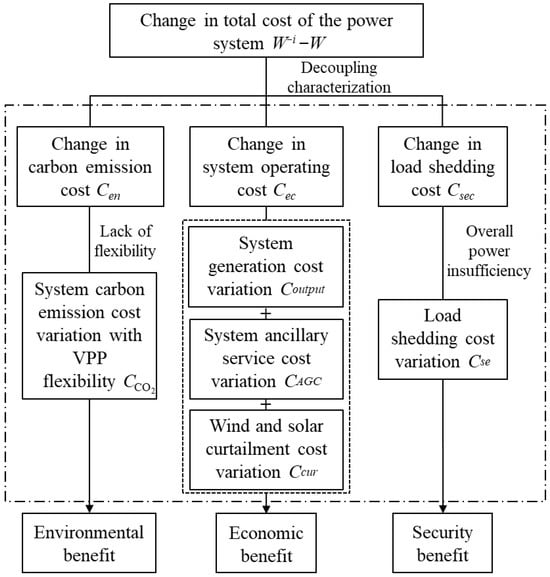
The VCG mechanism defines the benefit of a market participant as the incremental cost incurred by the rest of the system upon its removal [26,27,28], which reflects its substitutive benefit. Based on this principle, a comprehensive substitutive-benefit-based framework is proposed in this paper to quantify the overall benefit of VPPs.
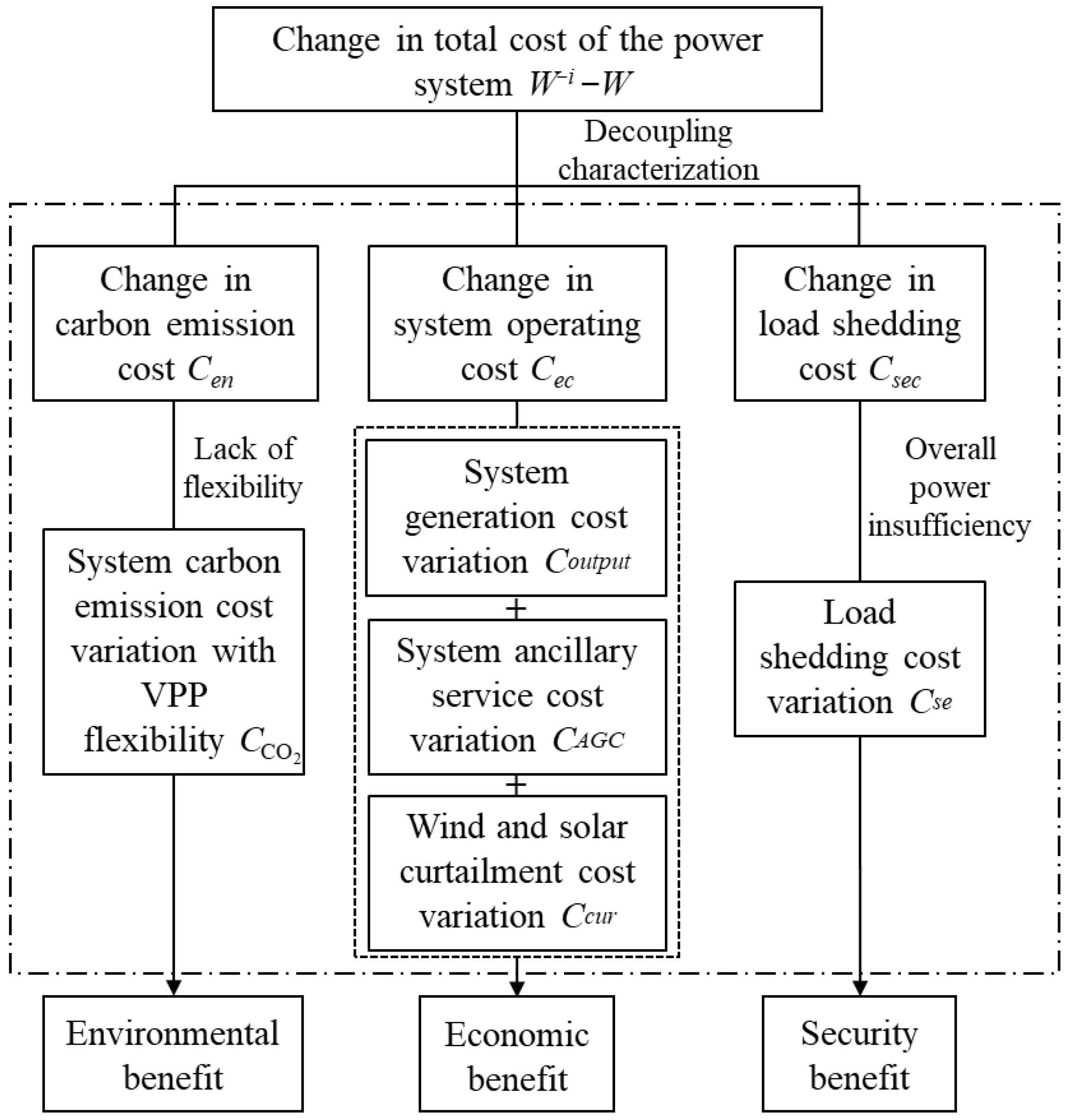
As shown in Figure 1, the framework quantifies the VPP’s benefit based on the change in system operating cost before and after its integration. The total system cost is a composite metric encompassing:
Figure 1.
Multi-dimensional Benefit Characterization Method for VPPs.
Economic Cost: generation costs of generators, ancillary service costs and wind and solar curtailment costs.
Environmental Cost: Carbon emission costs, reflecting the system’s low-carbon performance.
Security Cost: Load shedding costs, which indicate insufficient supply reliability.
By monetizing these aspects, the framework converts physical performance gains, such as reduced curtailment, into a unified and comparable benefit metric.
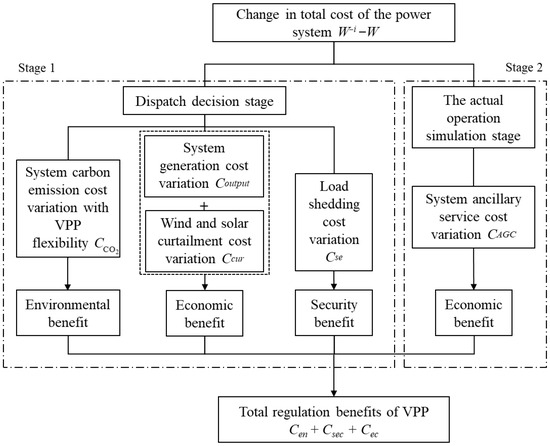
The value assessment of VPPs consists of two main stages. As illustrated in the framework diagram, the core of the proposed approach lies in quantifying the changes in various system costs before and after VPP aggregation and activation. The evaluation process involves two stages: the dispatch decision stage and the actual operation simulation stage. The dispatch decision stage determines the optimal power allocation and reserve configuration, while the actual operation stage simulates the system’s dynamic response under actual clearing and operating conditions. The detailed modeling and calculation procedures will be presented in Section 3.
A key innovation of this paper is the ability to decouple the different sources of the VPP’s benefit, enabling a more transparent and quantitative understanding of its contribution to the power system. The proposed framework decomposes the overall benefit into three primary dimensions—economic, security, and environmental—each represented by measurable indicators.
The economic benefit is captured by variations in system operation and market costs, including generation cost, ancillary service cost, and renewable curtailment cost. The security benefit reflects the enhancement of system reliability through reductions in load curtailment. The environmental benefit quantifies the reduction in carbon emission costs achieved through optimized dispatch and reduced coal-fired units.
By establishing a mapping relationship between these indicators and the system’s operating results under different scenarios, the model enables the isolation and quantitative attribution of each benefit source. This decoupled representation not only clarifies the internal composition of VPP value but also facilitates comparative analysis across policy designs and operation strategies. Consequently, it provides a solid analytical basis for assessing how the market mechanism affects the economic, security, and environmental performance of VPPs.
This approach offers more granular benefit information for market operators and VPPs, supporting both market mechanism design and internal performance optimization.
On the supply side, VPPs aggregate renewable generation, energy storage, and controllable loads to enhance system adequacy and flexibility reserves, thereby reducing renewable curtailment and improving integration capability. On the grid side, VPPs support long-term adequacy planning by mitigating peak supply shortages and reducing the need for involuntary load shedding. On the market side, their participation in capacity and ancillary service markets enables explicit recognition of supply security benefit, ensuring that sufficient resources are reserved for long-term system reliability. In addition, from a system development perspective, VPPs contribute to deferring large-scale infrastructure expansion by utilizing distributed flexibility resources, thereby lowering overall investment risks in generation and transmission planning.
When the power system has sufficient flexibility and reliable generation capacity, the removal of a VPP does not lead to significant increases in wind and solar curtailment or load shedding costs. In such cases, the economic benefit of a VPP can be directly represented by its regulation capacity, and its security benefit can be characterized by its installed capacity, which aligns with the current market mechanism. This study focuses on scenarios with high penetration of renewable energy, where system flexibility and supply reliability are constrained, aiming to assess the scarcity benefit of resources. Situations with surplus system capacity are not discussed in detail. Meanwhile, the introduction of VPPs enables effective organization and management of distributed energy resources before participating in the main grid dispatch. VPPs can directly provide the main grid with variable information related to flexibility regulation. This avoids information exchange barriers caused by privacy concerns among different energy entities. The main grid can avoid directly dispatching numerous internal variables of distributed resources during optimization, greatly reducing the computational burden. As this paper primarily focuses on the benefits of VPPs, no further assessment is made in this section.
Based on the above framework, the multi-dimensional benefit assessment of VPPs in terms of environmental performance, economic efficiency and operational safety can be quantitatively evaluated.
3. Quantitative Assessment of VPP Benefits Based on an Improved Modeling Framework
To comprehensively evaluate the benefits of VPPs, this study establishes an improved modeling framework that integrates both decision-making and operational processes. The framework considers not only the optimization effects achieved in the dispatch decision stage, but also the practical performance and market outcomes in the actual operation simulation stage.
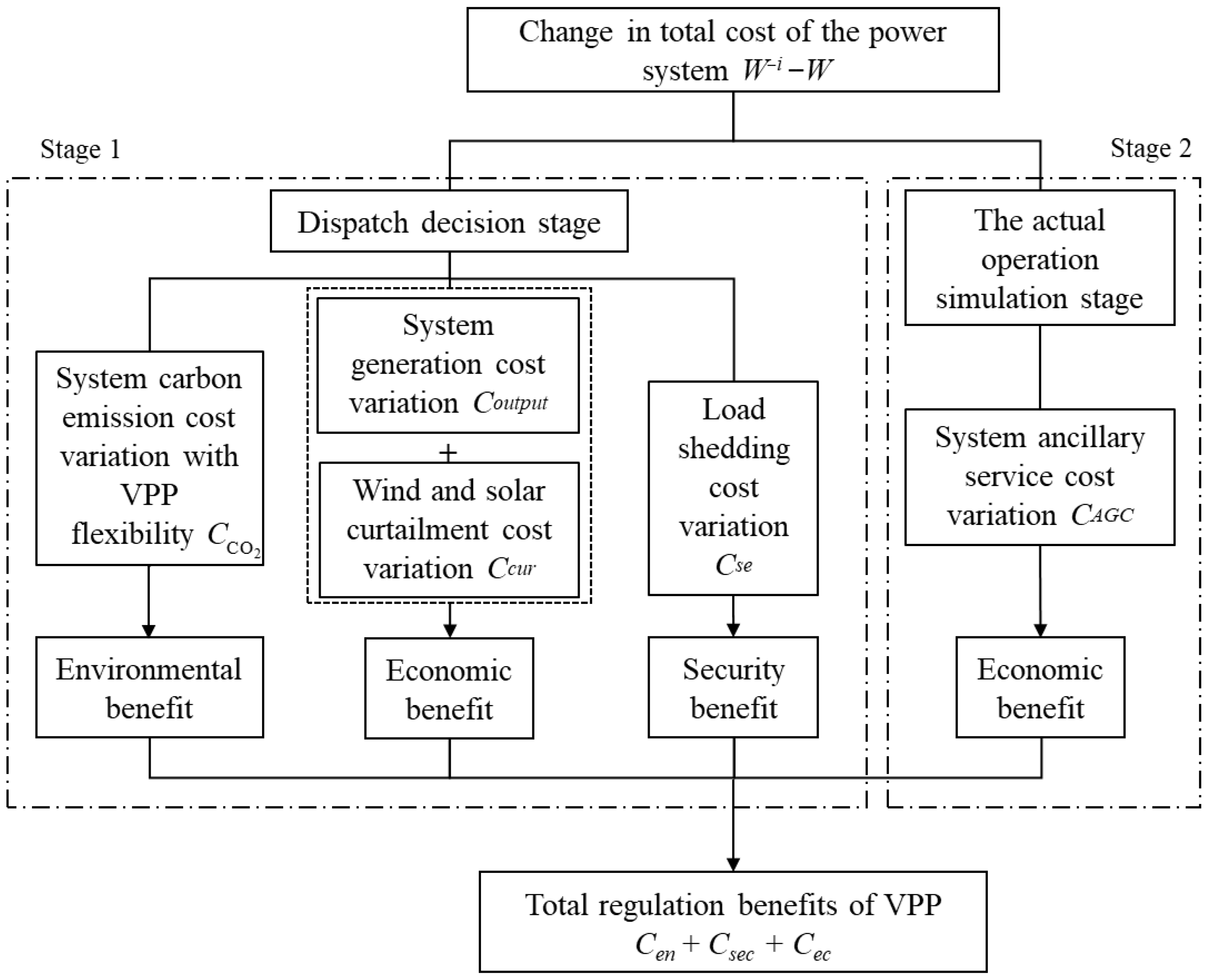
As illustrated in Figure 2, the overall benefit evaluation framework of the VPP consists of four parts. The first three modules quantify the benefits obtained during the dispatch decision stage, including the improvement of system carbon emission cost, generation cost, wind and solar curtailment and load shedding cost through optimal decision-making. The latter module corresponds to the actual operation and market clearing stage, where the VPP realizes tangible economic gains through real-time regulation performance and market transaction outcomes. Through actual operation clearing simulation, the practical regulation mileage of the VPP can be obtained, based on which the system ancillary service cost CAGC is further calculated. These four modules together reflect the multi-dimensional nature of VPP benefits, linking the decision-level contributions to system optimization with the operational-level performance in practical market environments.
Figure 2.
Overall framework for assessing the multi-dimensional benefits of VPPs in the two stages.
Building upon this framework, the following section develops quantitative models for each benefit dimension, defining mathematical formulations for scheduling optimization, regulation performance evaluation, and market-based revenue assessment, thereby providing a foundation for simulation validation.
3.1. Optimization Dispatch Model
3.1.1. Objective Function
After the introduction of a VPP, the optimization dispatch model of the main grid can be formulated as follows:
In the formula, the objective function aims to minimize the operational cost Cop of the main grid. T represents the set of scheduling periods (168 h). t represents the index of the scheduling period. , and represent the collection of coal-fired power units, virtual power plants and renewable energy units, respectively. , and represent the numbers of thermal power unit, virtual power plant and renewable energy units, respectively. represents the cost of coal-fired power units. represents the cost of VPP. represents the renewable energy units. represents the cost of wind abandonment. represents the punishment of power imbalance. represents the cost of the up or down frequency regulation capacity of coal-fired power units. represents the cost of the up or down frequency regulation capacity of VPPs. represents the bidding up or down frequency regulation capacity of coal-fired power units. represents the bidding up or down frequency regulation capacity of VPPs. represents the output of coal-fired power units. represents the output of VPPs. represents the amount of renewable energy. represents the unit carbon emission of coal-fired power units. represents the carbon price. represents the load-shedding amount, which characterizes the allowable reduction in load to maintain system equilibrium.
3.1.2. Constraints on Frequency Regulation Capacity
The frequency regulation capacity provided by the unit is limited by the maximum frequency regulation capacity it reports.
The sum of the frequency regulation capacities awarded to the units should meet the system’s frequency regulation capacity requirements.
The CVaR of this function at confidence level 1 − ε is defined as:
where represents the system’s up/down frequency regulation capacity requirements.
3.1.3. Constraints on Unit Operation
The upper and lower limits of the unit output are expressed as follows.
where represents the maximum or minimum output of a generating unit. represents the maximum or minimum output of a VPP. If the unit is awarded a regulation capacity, it must reserve the corresponding capacity, and therefore its scheduled output cannot reach the upper or lower limit.
3.1.4. Constraints on Power Balance
3.1.5. Constraints on the Ramping-Related Constraints
3.1.6. Constraints on Renewable Energy Output
3.1.7. Constraints on Other Operating Conditions
In addition to the above constraints, the scheduling decision model must also satisfy the following common operational constraints, which will not be elaborated here: the system must comply with the line flow constraints, and the thermal power generating unit and virtual power plant must adhere to the output upper and lower limits.
Before aggregation, distributed resources and loads are connected to the system in a decentralized manner and cannot be uniformly dispatched. The scheduling model can only treat them as part of the net load, which increases the balancing and regulation pressure on conventional units. After aggregation, the VPP is incorporated as a controllable entity into the optimization process. Its internal resources can directly participate in power dispatch and frequency regulation reserves. The originally uncertain and fluctuating distributed output is partially absorbed, reducing both the net load scale and its volatility. This enhances the system’s flexibility and economy in power balancing and security constraints.
3.2. Actual Operation Simulation Based on Scheduling Outcomes
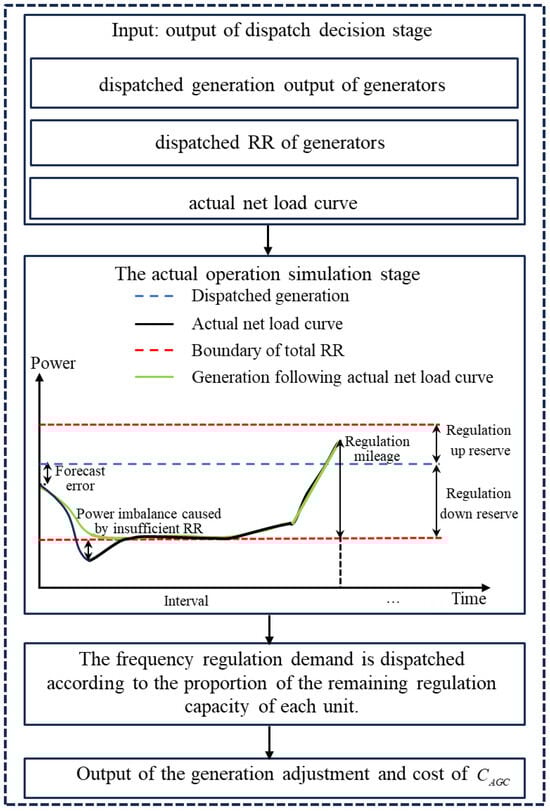
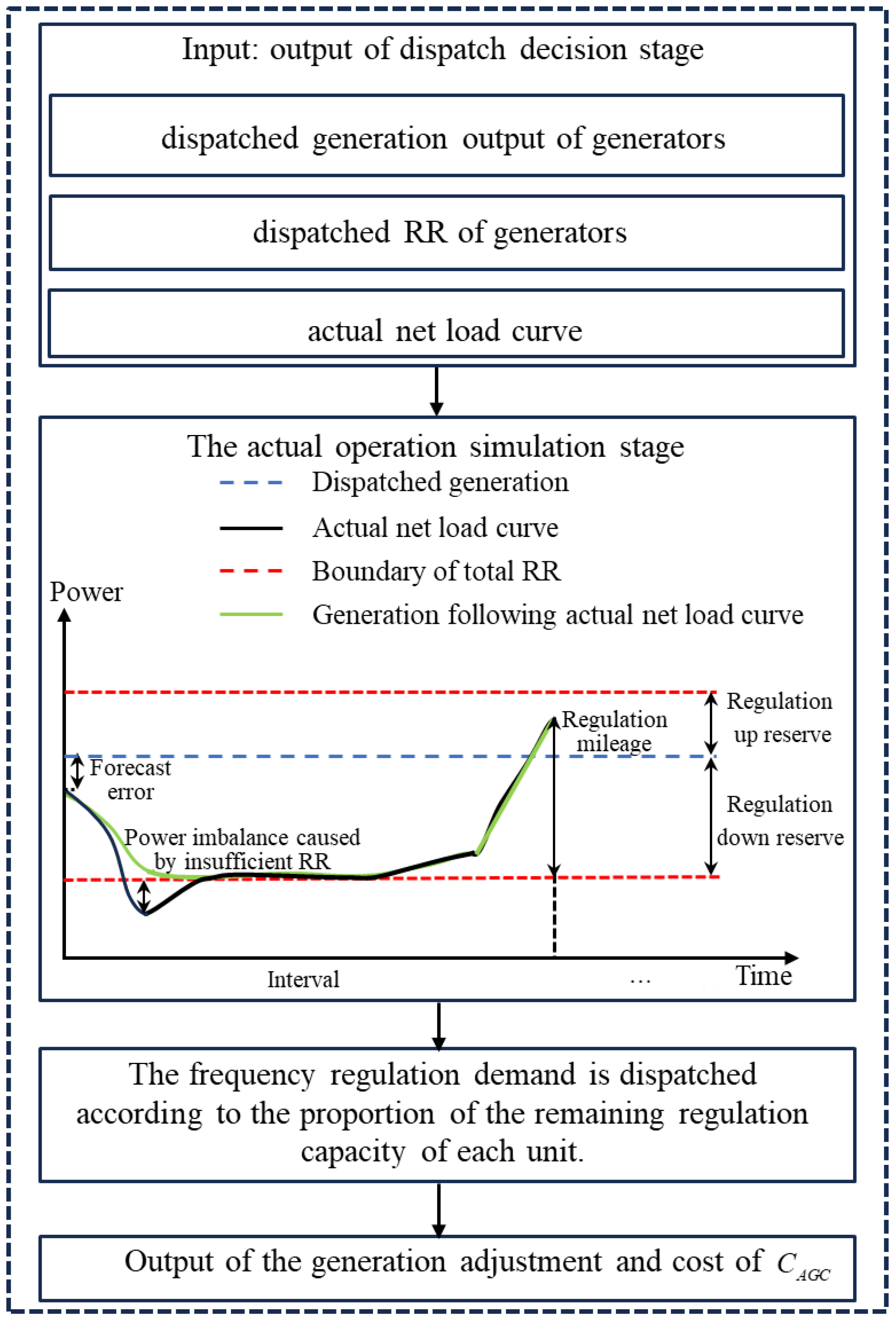
To evaluate the actual operation performance of the system under the given dispatch plan, an automatic generation control (AGC)-based actual operation simulation is carried out based on the dispatched generation results, the regulation reserves (RR) allocated to each generator, and the actual net load curve.
As illustrated in Figure 3, the simulation reproduces the intra-interval response of generators to net load fluctuations within each dispatch interval. Specifically, the dispatched generation outputs and corresponding RR serve as the initial boundary conditions. The actual 1 min net load curve is then used to determine the power imbalance, which reflects the difference between the scheduled generation and the actual load.
Figure 3.
Process of dispatch simulation reflecting the actual operation of power systems.
When a power imbalance occurs, the system calculates the regulation mileage (RM) requirement according to the deviation magnitude and direction. This requirement is distributed among generators in proportion to their dispatched RR and ramping capabilities. Each generator adjusts its output dynamically within its available regulation-up and regulation-down reserves, forming an intra-interval generation trajectory that follows the actual net load variation.
Through this process, the model simulates the actual AGC operation behavior of the system. The simulation outputs include: the intra-interval generation output of each generator, which enables the calculation of the actual operating costs; and the system power imbalance, which reflects the operational security and adequacy of the power system under the given dispatch schedule.
This AGC-based actual operation simulation bridges the gap between scheduling results and actual operation simulation, allowing a quantitative assessment of system economy and reliability under practical operating conditions.
3.3. Multidimensional Benefits Assessment Method
3.3.1. Environmental Benefit Assessment Model
The assessment of environmental benefit requires evaluating changes in the system’s total carbon emissions under different unit integration scenarios. The total carbon emissions mainly consider the operational emissions.
Based on the results of the dispatch model above, the output of each generating unit can be determined. The total operational carbon emissions cost of the system is calculated as the sum of all units’ operational emissions.
where represents the environmental benefits from VPP; represents the total operational carbon emissions cost without VPP.
3.3.2. Security Benefit Assessment Model
Based on the results of the dispatch model above, the cost of the load shedding of the system can be expressed as:
where represents the security benefit of VPP; represents the cost of the load shedding of the system without VPP.
3.3.3. Economic Benefit Assessment Model
The economic benefit is mainly reflected in the change in system operating costs before and after the aggregation of the VPP. In the traditional power system, distributed energy resources are connected in a scattered manner, and the dispatching process often fails to effectively coordinate different resources. As a result, conventional units must undertake more balancing and regulation tasks. This not only increases fuel consumption and carbon emissions but may also lead to wind and solar curtailment due to insufficient regulation, thereby raising the overall system operating cost.
The cost of wind and solar curtailment caused by insufficient flexibility can be expressed as:
The economic performance of the VPP regulation benefit is reflected in the change in the total system operating cost before and after resource aggregation, as expressed below.
where represents the generation cost of all units; represents the generation cost without VPP; represents the ancillary service cost without VPP; represents the cost of wind and solar curtailment without VPP.
The total benefit of VPP can be expressed as the total cost as follows:
4. Case Studies
4.1. Illustration of Case Studies
To verify the effectiveness of the proposed multi-dimensional benefit assessment framework, a case study is conducted on a system with high renewable energy penetration in a one-week (168 h) schedule. The test system includes three thermal units, a wind farm, and one aggregated VPP that provides both pre-scheduling flexibility and actual AGC simulation response. The load and wind power output data used in this simulation are collected from the actual data of a provincial power grid in China. The baseline VPP data is a real aggregated VPP in the province. In the simulation, the collected actual load and wind power output data were scaled to match the system parameters of the case study. This paper conducts case study simulations based on an improved IEEE 30-bus system. In addition to the original 6 thermal power units, a virtual power plant is added at node 3, and a wind power unit is added at node 12.
The AGC mileage price is 12 $/MW for thermal units and 8 $/MW for VPPs to reflect the lower marginal regulation cost and higher flexibility of aggregated DERs relative to conventional thermal units. The AGC capacity price is 2 $/MWh for all units. (The case study data are assumed values.)
The simulation system includes conventional generation units, wind power, and load units. These resources are aggregated to form a baseline VPP model supported by actual data. The VPP includes 29 MW of controllable industrial load, 6 MW of wind generation, 0.5 MW of energy storage, and 0.2 MW of commercial building loads. The aggregated resources data within the VPP are shown in Table 1, including their controllable capacities.
Table 1.
Parameters of Resources in Baseline VPP.
The overall performance metrics of the aggregated VPP are presented in Table 2.
Table 2.
Parameters of the Baseline Aggregated VPP.
The simulation summarizes a one-week simulation of VPP aggregation under three renewable penetration levels as follows:
Scenario S1: High Renewable Penetration.
Scenario S2: Medium Renewable Penetration.
Scenario S3: Low Renewable Penetration.
For each renewable level, the VPP aggregate size is tested at base (S_base), +50% (S_plus50) and −50% (S_minus50). Multi-dimensional benefits are computed relative to the corresponding no-VPP baseline for each renewable level.
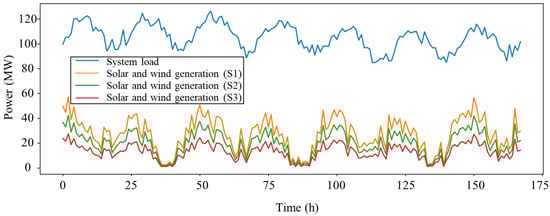
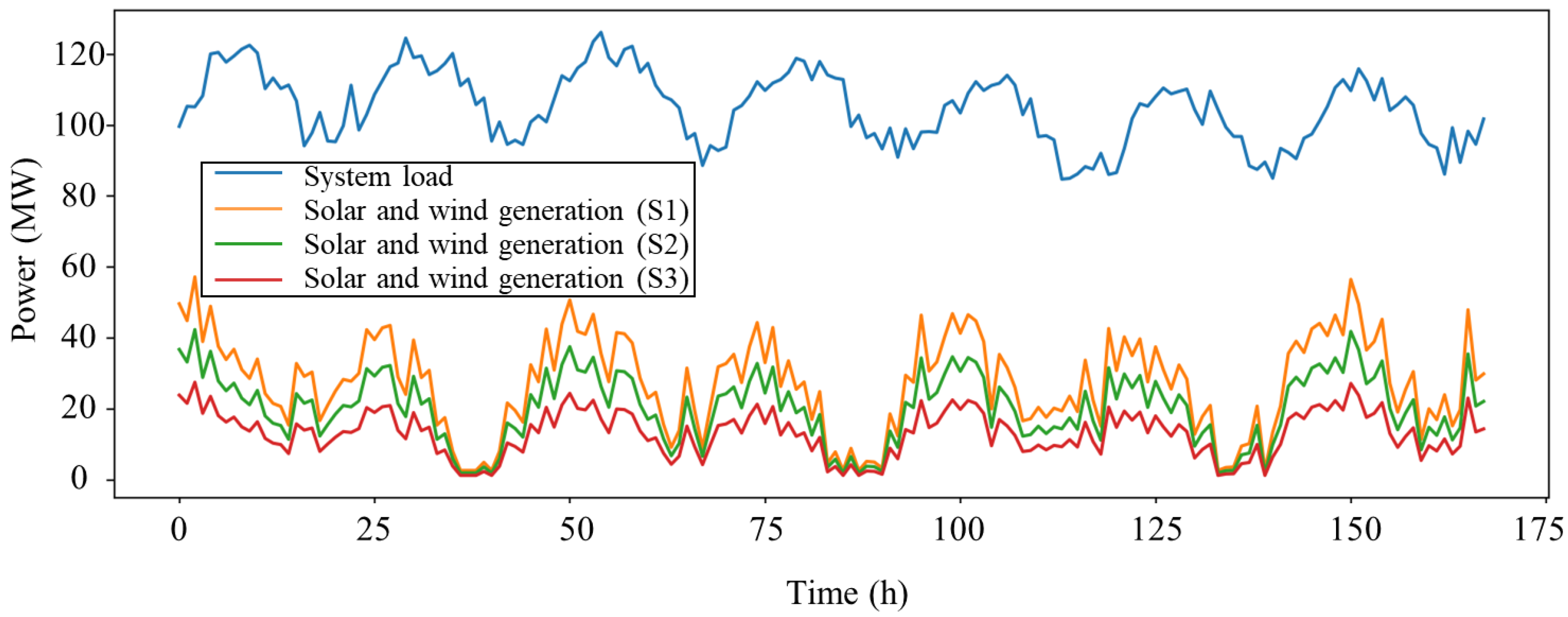
The system load and renewable energy generation used to generate scenarios are shown in Figure 4.
Figure 4.
Weekly system load and wind generation profiles.
Under the above scenarios, the benefits of the VPP are further evaluated across different dimensions:
V1: economic evaluation.
V2: environmental evaluation.
V3: security evaluation.
V4: Multi-dimensional evaluation.
Since the control strategy of the virtual power plant is not the focus of this study, the control strategy from literature [19] is adopted in the case study section of this paper. In the actual AGC-based operational simulations, the frequency regulation demand is dispatched according to the proportion of the remaining regulation capacity of each unit.
4.2. Benefits Analysis for VPP in the Electricity Market Under Different Scenarios
Run a weekly economic dispatch simulation for each scenario to obtain the optimal generation schedule and the corresponding cost components.
The 168 h simulation yields the following system benefits of basement VPP for each scenario, as detailed in Table 3. Typical data for one week are selected for analysis, which is applicable to longer time scales as well.
Table 3.
System weekly operational benefits under different scenarios under baseline VPP.
As shown in Table 3, progressing from S1 to S3 leads to a significant and sequential reduction in total system cost.
Under the baseline VPP aggregation scenario, the benefits of integrating VPP increase significantly with higher renewable penetration. As shown in the comparison across three scenarios, the total VPP benefit rises from 38,424.9 $ in S3 to 45,527.8 $ in S1. The main contributors to this improvement are the carbon emission benefits and renewable curtailment benefits, which grow rapidly as renewable generation expands. The system generation benefit also increases due to reduced fuel consumption from conventional thermal units, while the ancillary service benefit and load shedding benefit show moderate gains, reflecting improved frequency regulation performance and enhanced system reliability. Under high penetration, its value increases by 18.5% compared with the low-penetration case, and the value of security and ancillary services accounts for the largest share (50.3%). It is noteworthy that other methods ignore AGC regulation revenues in the ancillary services market. The proposed method considers them and shows a significant impact under high renewable energy penetration. Overall, the results indicate that VPPs provide greater economic and operational value in systems with higher renewable shares by mitigating variability, reducing carbon emissions, and lowering system regulation costs.
Based on the costs in Table 4, the baseline VPP’s multi-dimensional benefits of V1-V4 are presented in Table 4.
Table 4.
System weekly operational benefits under different scenarios.
As shown in Table 4, the benefits of the VPP primarily arise from its economic benefits. A higher renewable energy penetration level leads to greater economic value, mainly because higher penetration increases the AGC regulation demand to smooth renewable fluctuations. Meanwhile, the integration of the VPP effectively reduces wind and solar curtailment, thereby achieving higher economic benefits.
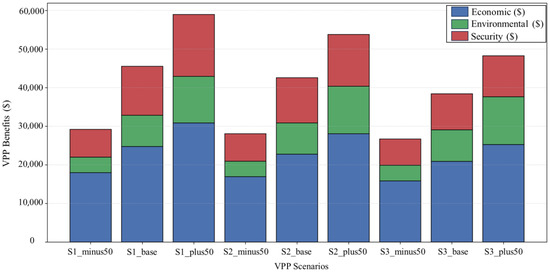
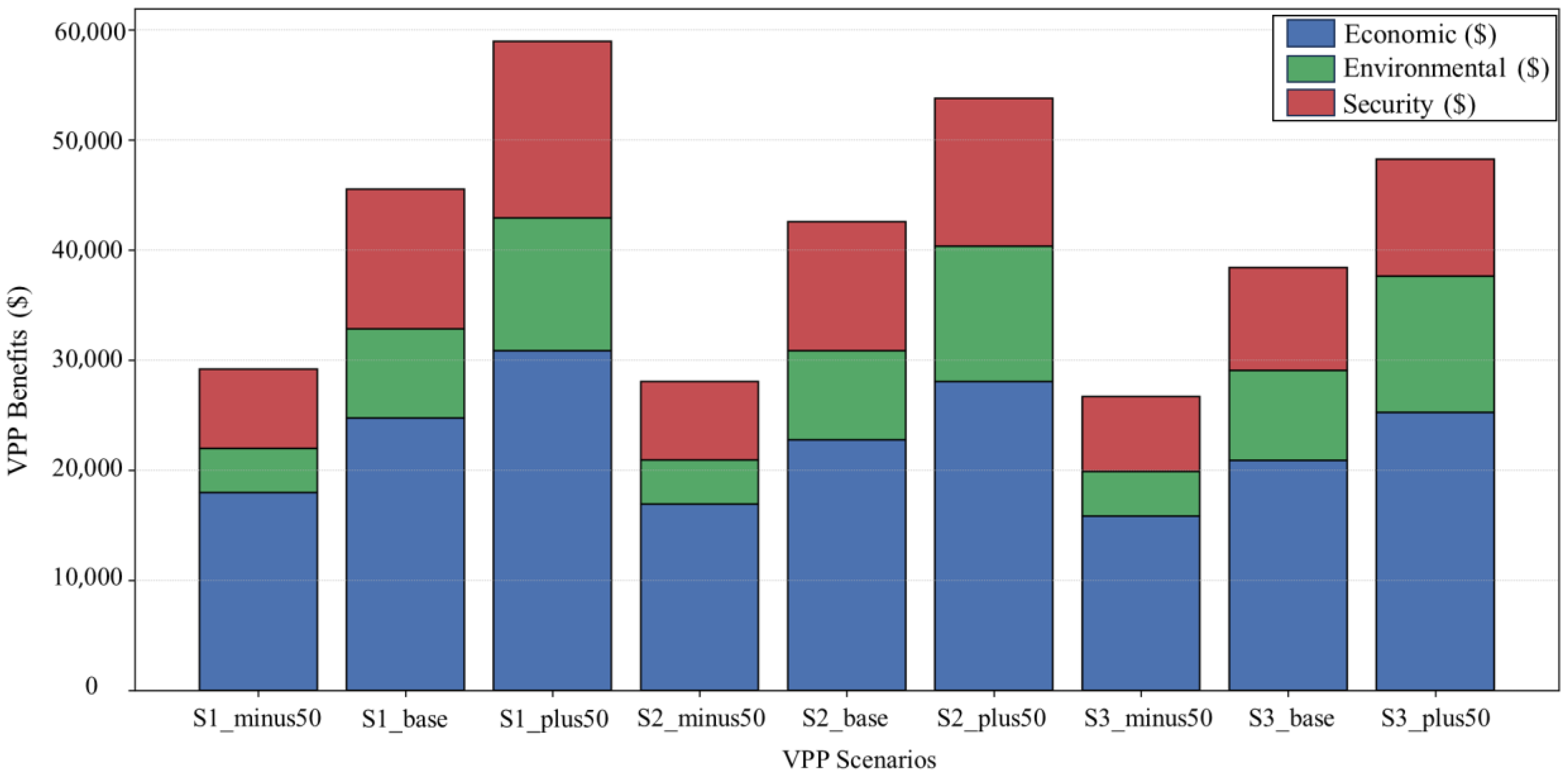
To better visualize the composition of the VPP’s total benefit under different aggregate sizes of VPP, the results are plotted in Figure 5, which decomposes the weekly benefit (Economic/Environmental/Security) for each scenario versus the no-VPP baseline for the corresponding renewable level.
Figure 5.
VPP multi-dimensional benefits decomposition by scenarios.
Figure 5 shows that the economic benefit dominates the overall VPP benefits across all scenarios, followed by the security and environmental benefits. With higher renewable energy penetration, the total benefit generally increases, driven mainly by the rise in AGC regulation demand and reduced renewable curtailment. This indicates that the integration of VPPs effectively enhances system flexibility and economic performance while improving environmental outcomes. Therefore, VPP deployment plays a crucial role in supporting high renewable energy integration and ensuring the stable operation of power systems.
- (1)
- Significant multi-dimensional benefit
The case study demonstrates that the VPP provides a substantial total daily benefit of more than 184.83 $/MW to the grid. This benefit is distributed across economic, environmental, and security dimensions, confirming the multi-dimensional nature of its contribution.
- (2)
- Security benefit is significant
The significant contribution of the VPP is its security benefit (124,704.2 $, 27.9% of total in S1_base), realized by completely eliminating the need for costly load shedding. This highlights the critical role of flexible resources like VPPs in ensuring grid reliability in systems with high renewable penetration, a benefit often not explicitly priced in traditional energy-only markets.
- (3)
- System ancillary benefit unlocks greater benefit
The analysis decouples the benefit of system ancillary services in the actual operation simulation. It reveals that ancillary service benefits contribute substantially to the overall VPP benefits, especially under scenarios with high renewable energy penetration. This is because the VPP provides flexible regulation capacity that mitigates renewable fluctuations and reduces system balancing costs. Consequently, incorporating ancillary service benefits offers a more comprehensive evaluation of VPP performance and highlights its role in enhancing system stability.
- (4)
- Implications for market design
The results expose a clear mismatch between the VPP’s demonstrated benefit and potential revenue in current market structures. While economic benefits (fuel savings) might be partially captured in the spot market, the immense security and environmental benefits are often poorly compensated. Meanwhile, the role of VPPs in participating in the ancillary services market has not received sufficient attention. This study demonstrates the growing demand for frequency regulation resources in future power systems with high renewable energy penetration and highlights the significant value that VPPs can provide in meeting this demand. Therefore, these findings strongly support the need for market mechanism reforms:
First, electricity markets should evolve toward comprehensive benefits recognition, incorporating not only energy and ancillary service revenues but also the environmental and reliability benefits of VPP participation. A multi-dimensional settlement framework should be established to internalize the system-wide advantages of carbon emission reduction, renewable curtailment mitigation, and avoided load shedding.
Second, frequency regulation and AGC compensation mechanisms should be refined. The current frequency regulation mileage and regulation capacity settlements can be enhanced by integrating performance-based factors that reward fast, accurate, and stable responses from VPPs. This would ensure that flexible aggregators are remunerated proportionally to their contribution to system stability.
Third, curtailment-linked incentives should be introduced. By valuing avoided renewable energy curtailment as an economic contribution, regulators can design credit mechanisms or renewable integration rewards within existing ancillary markets.
Finally, carbon pricing and flexibility markets should be integrated to ensure that low-carbon flexibility resources receive full recognition in both carbon and ancillary service revenues. Establishing long-term performance-based contracts with grid operators could further encourage sustained contributions to emission reduction, renewable integration, and reliability enhancement.
Overall, these reforms would transition current markets from a single-layer settlement framework toward a multi-value recognition mechanism, ensuring that VPPs are rewarded for their contributions to economic efficiency, environmental sustainability, and system security.
We further extend the time period to 720 h and include scenarios with varying levels of VPP output stability. This allows us to analyze the impact of overall output fluctuations of the VPP on its benefits.
To isolate the impact of VPP stability on its benefits, this case study fixes the system background and VPP size and only changes the output volatility of the VPP itself. All scenarios are compared with the VPP scenario to calculate the benefits.
Fixed Baseline System Setup:
S1: Represents a high renewable energy penetration scenario. This is the background where the system faces high volatility and pressure.
Test Scenarios:
S4: In the high-pressure background of S1, with the aggregation level of the VPP increased by 50%, the VPP output remains stable with the lowest internal volatility.
S5: In the high-pressure background of S1, with the aggregation level of the VPP increased by 50%, the VPP output exhibits moderate volatility.
S6: In the high-pressure background of S1, with the aggregation level of the VPP increased by 50%, the VPP output fluctuates drastically, with the poorest stability.
As shown in Table 5, for the VPP itself, the higher its internal stability, the greater the benefits to the power grid. The stability of the VPP’s output is highly negatively correlated with the total benefits (V4) generated by the VPP. This indicates that VPP aggregators should invest resources in managing and stabilizing their internal resources to ensure the maximization of benefits to the grid.
Table 5.
System monthly operational benefits under different stabilities of the VPP.
5. Conclusions
This paper analyzes the multi-dimensional benefit of virtual power plants in terms of environmental benefits, economic efficiency, and system security. It highlights that existing market mechanisms often fail to reflect the comprehensive benefit of integrated, flexible resources. To address this, a decoupled modeling and quantitative assessment method based on VCG is proposed. This method facilitates the assessment of distinct VPP benefit streams, including baseline clean energy provision and incremental flexibility services.
Case studies using real-world data demonstrate that VPPs provide significant multi-dimensional benefits to the system. Crucially, the analysis reveals that the benefit unlocked by the VPP is more than twice the benefit of its passive energy contribution alone. The security and ancillary benefits, in particular, represent the largest share of this benefit. However, the current market framework does not fully capture this, limiting incentives for VPP development and optimization. This provides quantitative justification for the urgent need to improve market mechanisms to properly recognize and remunerate the full spectrum of services provided by VPPs.
While this work quantifies the multi-dimensional benefit of VPPs and provides a reference for market mechanism design, future research should focus on designing the specific market-clearing algorithms and pricing rules that can internalize these externalities and effectively incorporate VPPs into centralized dispatch processes. Furthermore, the multi-dimensional value of virtual power plants under different market mechanisms warrants further exploration and analysis.
Author Contributions
Conceptualization, W.L.; methodology, W.L.; software, H.W.; validation, W.L.; formal analysis, X.Y.; investigation, X.Y.; resources, M.X.; data curation, C.Z.; writing—original draft preparation, W.L.; writing—review and editing, M.X.; visualization, H.W.; supervision, M.X.; project administration, X.Y.; funding acquisition, C.Z. All authors have read and agreed to the published version of the manuscript.
Funding
This research is supported by the Science and Technology Project of State Grid Corporation of China: Research and application of key technologies for supporting market mechanisms to improve the regulation capabilities of power grid source and load under the conditions of energy transformation in multi coal-fired power areas (5108-202415059A-1-1-ZN).
Data Availability Statement
The data presented in this study are available on request from the corresponding author.
Conflicts of Interest
Authors Xujia Yin, Ce Zhou and Haolin Wang were employed by Electricity Research Institute, State Grid Shanxi Electric Power Company. The remaining authors declare that the research was conducted in the absence of any commercial or financial relationships that could be construed as a potential conflict of interest. The authors declare that this study received funding from the Science and Technology Project of State Grid Corporation of China. The funder was not involved in the study design, collection, analysis, interpretation of data, the writing of this article or the decision to submit it for publication.
Abbreviations
The following abbreviations are used in this manuscript:
| VPP | Virtual power plant |
| VCG | Vickrey-Clarke-Groves |
| AGC | Automatic generation control |
| DR | Flexible demand response |
| DERs | Distributed energy resources |
| BTM | Behind the meter |
| CVM | Contingent valuation method |
| RR | Regulation reserves |
| RM | Regulation mileage |
| ESSs | Energy storage systems |
References
- Yang, Z.; Yong, P.; Xiang, M. Revisit power system dispatch: Concepts, models, and solutions. iEnergy 2023, 2, 43–62. [Google Scholar] [CrossRef] [Scilit]
- Brooks, A.E.; Lesieutre, B.C. A review of frequency regulation markets in three US ISO/RTOs. Electr. J. 2019, 32, 106668. [Google Scholar] [CrossRef] [Scilit]
- Prat, E.; Dukovska, I.; Nellikkath, R.; Thoma, M.; Herre, L.; Chatzivasileiadis, S. Network-Aware Flexibility Requests for Distribution-Level Flexibility Markets. IEEE Trans. Power Syst. 2024, 39, 2641–2652. [Google Scholar] [CrossRef] [Scilit]
- Fu, Y.; Sun, Q.; Wennersten, R.; Pang, X.Y.; Liu, W.X. Uncertainty-Based System Flexibility Evaluation and Multi-Objective Collaborative Optimization of Integrated Energy System. Processes 2025, 13, 2047. [Google Scholar] [CrossRef] [Scilit]
- Cao, W.S.; Yu, J.H.; Xu, M.M. Optimization Scheduling of Virtual Power Plants Considering Source-Load Coordinated Operation and Wind-Solar Uncertainty. Processes 2024, 12, 11. [Google Scholar] [CrossRef] [Scilit]
- Xie, T.; Wang, Q.; Zhang, G.; Zhang, K.S.; Li, H. Low-Carbon Economic Dispatch of Virtual Power Plant Considering Hydrogen Energy Storage and Tiered Carbon Trading in Multiple Scenarios. Processes 2024, 12, 90. [Google Scholar] [CrossRef] [Scilit]
- Pandey, A.K.; Jadoun, V.K.; Jayalakshmi, N.S.; Singh, M. Decentralization of renewable energy sources based optimum scheduling and management through a virtual power plant. Environ. Res. Commun. 2024, 6, 115021. [Google Scholar] [CrossRef] [Scilit]
- Bao, P.; Zhang, W.; Zhang, Y.X. Secondary Frequency Control Considering Optimized Power Support From Virtual Power Plant Containing Aluminum Smelter Loads Through VSC-HVDC Link. J. Mod. Power Syst. Clean Energy 2023, 11, 355–367. [Google Scholar] [CrossRef] [Scilit]
- Pandey, A.K.; Jadoun, V.K.; Sabhahit, J.N.; Sharma, S. Interconnected Operation and Economic Feasibility-Based Sustainable Planning of Virtual Power Plant in Multi-Area Context. Smart Cities 2025, 8, 37. [Google Scholar] [CrossRef] [Scilit]
- Lin, W.; Yang, Z.F. Non-convexity Pricing and Allocating Costs in Stochastic Electricity Markets. CSEE J. Power Energy Syst. 2024, 10, 1466–1477. [Google Scholar] [CrossRef] [Scilit]
- National Energy Administration; Central China Regulatory Bureau. Operating Rules for the Electricity Frequency Regulation Ancillary Service Market in Hubei, Jiangxi, and Chongqing. EB/OL. 31 March 2025. Available online: https://hzj.nea.gov.cn/xxgk/zcfg/202504/t20250402_279003.html (accessed on 1 August 2025).
- Setiawan, A.; Jufri, F.H.; Dzulfiqar, F.; Samual, M.G.; Arifin, Z.; Angkasa, F.F.; Aryani, D.R.; Garniwa, I.; Sudiarto, B. Opportunity Assessment of Virtual Power Plant Implementation for Sustainable Renewable Energy Development in Indonesia Power System Network. Sustainability 2024, 16, 1721. [Google Scholar] [CrossRef] [Scilit]
- Masoomi, M.; Panahi, M.; Samadi, R. Scenarios evaluation on the greenhouse gases emission reduction potential in Iran’s thermal power plants based on the LEAP model. Environ. Monit. Assess. 2020, 192, 14. [Google Scholar] [CrossRef] [Scilit]
- Zhou, K.L.; Yang, S.L.; Shao, Z. Energy Internet: The business perspective. Appl. Energy 2016, 178, 212–222. [Google Scholar] [CrossRef] [Scilit]
- Wang, Y.Q.; Zhang, M.; Ao, J.D.; Wang, Z.Z.; Dong, H.Q.; Zeng, M. Profit Allocation Strategy of Virtual Power Plant Based on Multi-Objective Optimization in Electricity Market. Sustainability 2022, 14, 6229. [Google Scholar] [CrossRef] [Scilit]
- Roozbehani, M.M.; Heydarian-Forushani, E.; Hasanzadeh, S.; Ben Elghali, S. Virtual Power Plant Operational Strategies: Models, Markets, Optimization, Challenges, and Opportunities. Sustainability 2022, 14, 12486. [Google Scholar] [CrossRef] [Scilit]
- Sillman, J.; Lakanen, L.; Annala, S.; Grönman, K.; Luoranen, M.; Soukka, R. Evaluation of greenhouse gas emission reduction potential of a demand–response solution: A carbon handprint case study of a virtual power plant. Clean Energy 2023, 7, 755–766. [Google Scholar] [CrossRef] [Scilit]
- Lossner, M.; Böttger, D.; Bruckner, T. Economic assessment of virtual power plants in the German energy market- A scenario-based and model-supported analysis. Energy Econ. 2017, 62, 125–138. [Google Scholar] [CrossRef] [Scilit]
- MacDougall, P.; Ran, B.; Klever, M.; Deconinck, G. Value assessment of aggregated energy flexibility when traded on multiple markets. In Proceedings of the 2017 14th International Conference on the European Energy Market (EEM), Dresden, Germany, 6–9 June 2017; pp. 1–6. [Google Scholar]
- Misconel, S.; Zöphel, C.; Möst, D. Assessing the value of demand response in a decarbonized energy system—A large-scale model application. Appl. Energy 2021, 299, 117326. [Google Scholar] [CrossRef] [Scilit]
- Xinfa, T.; Jingjing, W.; Yonghua, W.; Youwei, W. The Optimization of Supply-Demand Balance Dispatching and Economic Benefit Improvement in a Multi-Energy Virtual Power Plant within the Jiangxi Power Market. Energies 2024, 17, 4691. [Google Scholar] [CrossRef] [Scilit]
- Ullah, Z.; Arshad, A.; Nekahi, A. Virtual Power Plants: Challenges, Opportunities, and Profitability Assessment in Current Energy Markets. Electricity 2024, 5, 370–384. [Google Scholar] [CrossRef] [Scilit]
- Shim, D. Quantifying Social Benefits of Virtual Power Plants (VPPs) in South Korea: Contingent Valuation Method. Energies 2025, 18, 3006. [Google Scholar] [CrossRef] [Scilit]
- Qu, L.; Wang, Y.; Dong, Y.; Wang, H.; Wang, D.; Yi, Z.; Liu, Y.; Kuang, H. A Multi factor Modified VPP Benefit Allocation Strategy Based on Shapley Value Method. In Proceedings of the 2024 6th International Conference on Energy, Power and Grid (ICEPG), Guangzhou, China, 27–29 September 2024; pp. 1852–1859. [Google Scholar]
- Pimentel Pincelli, I.; Hinkley, J.; Brent, A. Life cycle assessment of a virtual power plant: Evaluating the environmental performance of a system utilising solar photovoltaic generation and batteries. Renew. Energ. 2024, 2, 27533735241285428. [Google Scholar] [CrossRef] [Scilit]
- Vickrey, W. Counterspeculation, auctions, and competitive sealed tenders. J. Financ. 1961, 16, 8–37. [Google Scholar] [CrossRef]
- Clarke, E.H. Multipart pricing of public goods. Public Choice 1971, 11, 17–33. [Google Scholar] [CrossRef] [Scilit]
- Groves, T. Incentives in teams. Econom. J. Econom. Soc. 1973, 41, 617–631. [Google Scholar] [CrossRef] [Scilit]

Disclaimer/Publisher’s Note: The statements, opinions and data contained in all publications are solely those of the individual author(s) and contributor(s) and not of MDPI and/or the editor(s). MDPI and/or the editor(s) disclaim responsibility for any injury to people or property resulting from any ideas, methods, instructions or products referred to in the content. |
© 2025 by the authors. Licensee MDPI, Basel, Switzerland. This article is an open access article distributed under the terms and conditions of the Creative Commons Attribution (CC BY) license (https://creativecommons.org/licenses/by/4.0/).