You are currently viewing a new version of our website. To view the old version click .
Processes
  • Article
  • Open Access

12 December 2025

Analysis of Structural Parameters’ Influence on Separation Performance in a Gas–Liquid Cyclone Separator


,
,
,
,
,
,
and
1
School of Mechanical Engineering, Yanshan University, Qinhuangdao 066004, China
2
Hebei Provincial Key Laboratory of Heavy Fluid Power Transmission and Control, Yanshan University, Qinhuangdao 066004, China
3
AECC Changchun Control Technology, Changchun 130102, China
4
Fujian Key Laboratory of Green Intelligent Drive and Transmission for Mobile Machinery, Xiamen 361021, China
This article belongs to the Section Separation Processes

Abstract

Hydraulic systems are widely used in industry, and gas contamination of hydraulic oil reduces reliability. This study quantifies how the primary geometry of a gas–liquid cyclone separator affects separation performance and proposes an optimal parameter matching scheme. An orthogonal design, combined with numerical simulations and visualization experiments, evaluated five factors: chamber diameter D, chamber height H, overflow pipe diameter Don, insertion depth of the overflow pipe Hon, and underflow orifice diameter Ddown. Considering mixture entrainment, three metrics were used: direct separation efficiency α, split ratio β, and the actual separation efficiency γ, defined as the product of α and β. Range analysis and variance analysis show that β is governed by outlet sizing, with Don contributing 56.87% and Ddown contributing 39.26%. γ is dominated by body scale parameters, with D contributing 58.79%, Hon contributing 21.18%, and H contributing 13.27%. The optimized geometry achieves γ of about 80.8%. Experiments confirm consistent trends from 0.5% to 8% gas volume fraction, with separation generally above 77% and simulation-to-experiment differences below 20% when the gas fraction exceeds 1%.

1. Introduction

Hydraulic systems are extensively utilized in marine, aerospace, and construction industries due to their high power-to-weight ratio, rapid response, and precise control capabilities [1,2,3,4]. Hydraulic oil is the primary working medium in hydraulic systems. Hydraulic oil contamination significantly degrades system performance, reducing volumetric efficiency. Statistics show that over 70% of hydraulic system failures stem from oil contamination [5]. Air is a major contaminant in hydraulic oil, with a typical dissolved gas content of 8–12% [6]. Changes in system pressure and temperature can induce gas exsolution, generating bubbles that trigger cavitation, component erosion, cylinder creeping, and other malfunctions [7,8,9]. Conventional separation methods for hydraulic systems, such as filtration and gravity separation, often suffer from inadequate efficiency, rendering them unsuitable for modern applications characterized by compact designs, high pressure, and large flow rates. As an efficient gas–liquid separation device with low energy consumption, cyclone separators have attracted extensive attention in a wide range of gas–liquid separation applications, from large-scale industrial droplet separators to compact devices for hydraulic-oil degassing in space-constrained hydraulic systems [10,11].
Separation efficiency is the key performance metric for the gas–liquid cyclone separator. The geometry of the main body plays a pivotal role in separation performance. Many researchers have focused on structural optimization, examining design parameters of the cyclone chamber, the overflow pipe, and the underflow orifice. Focusing on the cyclone chamber, Liu et al. [12] analyzed the influence of the chamber diameter, revealing that a smaller diameter strengthens the core vortex, suppresses fine entrainment, and improves separation efficiency, whereas a larger diameter lowers the swirl frequency and degrades performance. Han et al. [13] applied a cyclone separator to a refrigeration system and, using an orthogonal experimental design, analyzed multiple structural variables. Their results also identified the cyclone diameter as a dominant factor for gas–liquid separation performance, establishing a basis for subsequent diameter-centered co-optimization. The cyclone height also exerts a strong influence. Brar et al. [14] investigated the effects of total height by separating the roles of the cyclone chamber and conical sections, revealing nonlinear relationships between length scales, collection efficiency, and cut size. The research showed that chamber height regulates the effective residence time of separated particles and the streamwise evolution of turbulent kinetic energy. For a high-gravity cyclone separator, Zhang et al. [15] demonstrated that optimizing the overall height can achieve a better efficiency–energy trade-off under pressure drop constraints, with separation efficiency first increasing and then decreasing as the height increases.
The overflow pipe is the gas outlet of a gas–liquid separator and has a substantial impact on separation efficiency. The diameter of the overflow pipe is one of the key geometric parameters. Studying a solid–liquid cyclone, Liu et al. [16] found that enlarging the overflow pipe diameter weakens top short-circuiting and increases underflow concentration, but at the expense of overall separation efficiency. Conversely, reducing the diameter markedly elevates efficiency while incurring a pronounced pressure drop. Juengcharoensukying et al. [17] examined the influence of overflow pipe diameter and showed that decreasing it can raise collection efficiency to a high level, yet significantly increases pressure drop. For gas–liquid cyclone separators, Thiemsakul et al. [18] combined the Eulerian-Eulerian multiphase model and the standard k–ε turbulence model with an analysis of variance (ANOVA) test, taking the ratio of overflow diameter to diameter of the cyclone chamber as optimization variables. Zhang et al. [19] and Raeesi et al. [20] conducted structural optimizations for axial-inlet cyclones and liquid–liquid cyclones, respectively, proposing geometrically coordinated optima between overflow pipe diameter and insertion depth that yielded significant efficiency gains. Moreover, process-engineering studies coupling experiments with simulations have observed that moderately enlarging the overflow pipe diameter can enhance classification accuracy while keeping energy use within bounds, an observation echoed by review and application reports (Qiu et al. [21]; Xiong et al. [22]). Insertion depth is another key parameter of the overflow pipe. Early studies established that the depth strongly influences short-circuit flow, recirculation structure, and the split ratio. Numerical simulations by Hashe & Kunene [23] showed that increasing insertion depth weakens short-circuiting, prolongs residence time, and enhances separation efficiency, while decreasing the split ratio and potentially inducing gas-core instability at high inlet velocities. Duan et al. [24] discovered that the classification performance of the cyclone first increased and then decreased with the increase in the insertion depth of the overflow pipe, and proposed the optimal intrusion depth for the cyclone separator. Zhang et al. [19] further revealed pronounced interactions among overflow pipe insertion depth, overflow pipe diameter, and the short-cone length, and proposed a parameter-matching optimization scheme. Complementary experiments by Liu et al. [25] indicated that a smaller overflow pipe diameter combined with a moderate insertion depth helps balance separation accuracy and energy consumption.
The underflow orifice is the liquid outlet of a gas–liquid separator; its diameter directly determines the underflow restriction and concentration. Orthogonal-design results from Liu et al. [16] quantitatively established the primary role and effect size of the underflow orifice diameter on both underflow concentration and separation efficiency. Treating geometric ratios between the underflow and the cyclone body as design variables, Thiemsakul et al. [18] confirmed that the underflow orifice diameter, together with the overflow pipe diameter, forms a set of significant factors. Considering operating variability, Xiong et al. [22] reported, under powder-processing conditions, a strong relationship between inlet velocity and underflow orifice diameter; within a certain range, modestly enlarging the orifice mitigated mismatch caused by upstream particle-size fluctuations. In wastewater and complex slurry systems, Liu et al. [26] emphasized the criticality of the underflow orifice scale via geometry optimization.
In summary, although extensive studies have explored key structures such as the cyclone chamber, overflow pipe, and underflow orifice, most efforts rely on single-factor or few-parameter empirical optimization. As a result, the relative weights of main effects and interactions remain difficult to compare, and research on gas–liquid cyclone separators tailored to hydraulic applications is still in its infancy. To address these gaps, this study investigates five principal geometric parameters: the cyclone-chamber diameter, chamber height, overflow pipe diameter, overflow pipe insertion depth, and underflow orifice diameter, using an orthogonal experimental design. Range analysis is employed to evaluate the influence of each parameter on separation efficiency, while ANOVA is used to quantify the significance of these effects and elucidate the hierarchy of critical interactions. An optimal matching combination of key structural parameters was proposed. The study provides guidance for parameter optimization design of gas–liquid cyclone separators.

2. Materials and Methods

2.1. Cyclone Separator Structure

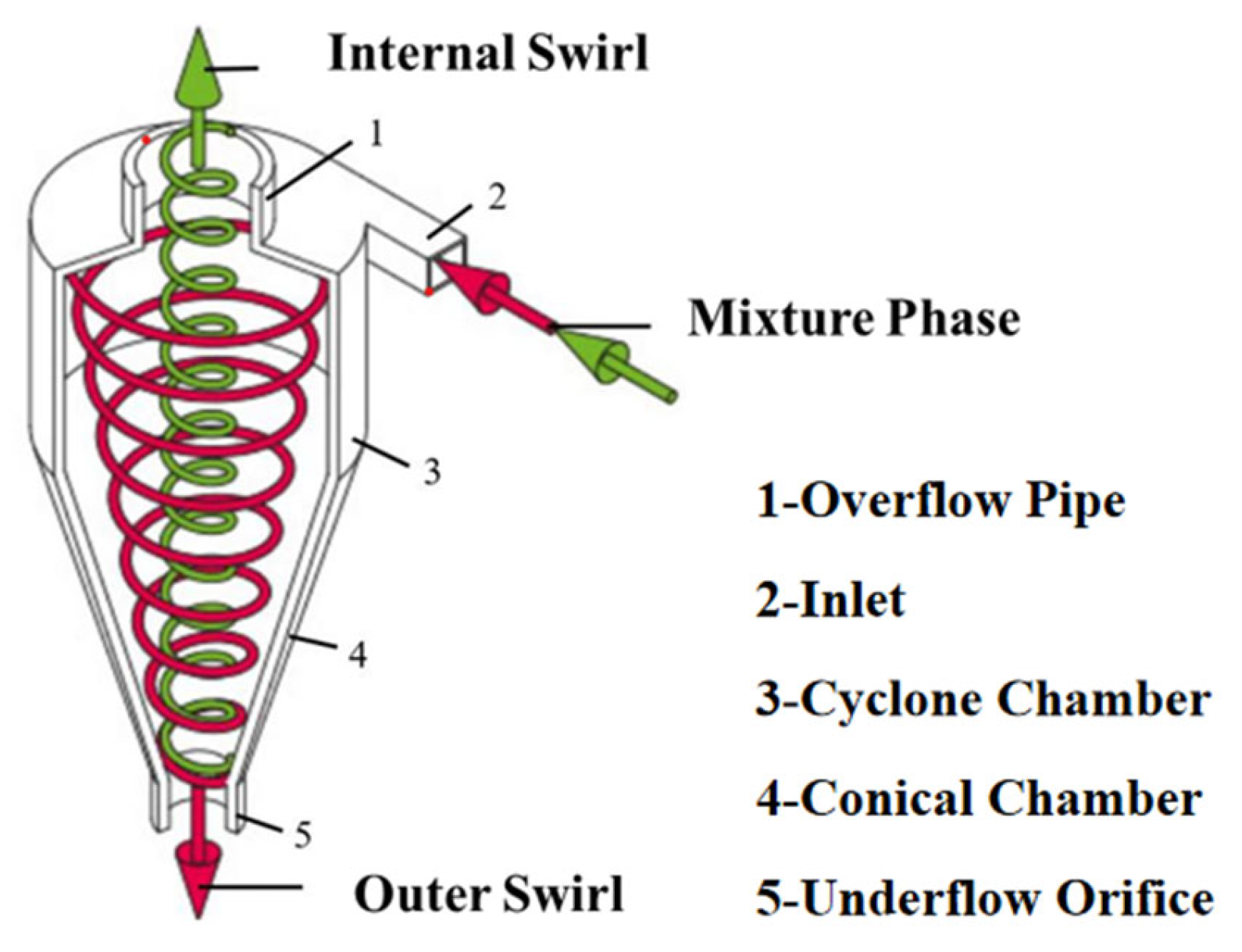
The basic structure of the gas–liquid cyclone separator is illustrated in Figure 1, comprising the overflow pipe, inlet, cyclone chamber, conical chamber, and underflow orifice. Separation is achieved through the density difference between the gas and liquid phases. When the mixture flows into the inlet, the outer swirling flow is generated and subsequently transformed into an upward internal swirling flow due to the reduction in the diameter of the conical chamber. The denser liquid is driven toward the wall by centrifugal force and is discharged through the underflow orifice, whereas the gas is concentrated in the core region and is released through the overflow pipe. To accommodate the limited installation space in hydraulic systems, the cyclone separator is designed with a compact cylindrical–conical configuration. The cylindrical section mainly serves to establish a stable swirling core and provide sufficient circumferential development length, whereas the conical section gradually reduces the cross-sectional area, enhances the centrifugal field, and directs the liquid toward the underflow outlet. This compact cylindrical–conical layout has recently been adopted in hydraulic oil degassing systems [10].
Figure 1. The structure of the cyclone separator and the main flow patterns.
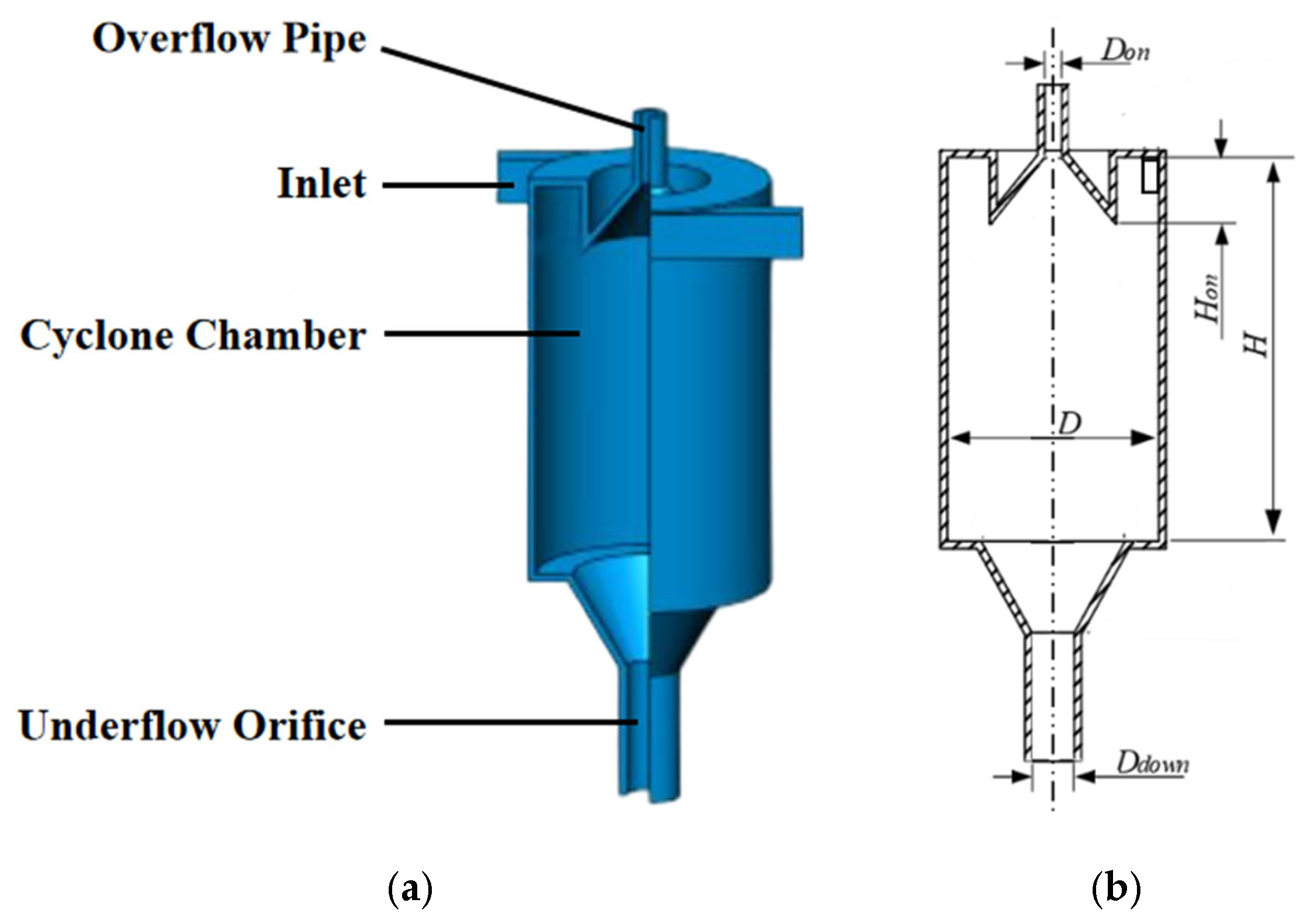
During gas–liquid separation, the cyclone operates primarily through the flow field induced by the swirling motion. Among its components, the structural parameters of the swirl chamber, cone chamber, and outports exert a significant influence on the separation efficiency and operational stability. Furthermore, the penetration depth of the overflow pipe affects the stability of the central gas core and the overall separation performance. To quantify these effects, five key structural parameters were selected for analysis, including the swirl chamber diameter D , the swirl chamber height H , the overflow pipe diameter D o n , the insertion depth of the overflow pipe H o n , and the underflow orifice diameter D d o w n . Considering that double-entry cyclones are widely used in engineering hydraulic systems and can generate a stronger and more uniform swirling field within a constrained space, a three-dimensional model of a double-inlet cyclone separator incorporating these parameters is presented in Figure 2.
Figure 2. (a) The three-dimensional model of the cyclone separator and (b) the main selected parameters.

2.2. Performance Index

Separation efficiency is commonly employed to evaluate the performance of cyclone separators [27]. The direct separation efficiency, denoted as α , is defined as the ratio of the gas-phase flow rate discharged through the overflow pipe to the gas-phase flow rate at the inlet, as expressed in Equation (1):
α = Q g a s o Q g a s i
where Q g a s o is the gas flow rate of the overflow pipe and Q g a s i is the gas flow rate of the inlet.
During the swirling process, a portion of the liquid phase is also carried out through the overflow pipe due to the internal swirling motion. This entrainment reduces effective gas–liquid separation efficiency. Therefore, the actual split ratio serves as an important indicator for quantifying the extent of liquid carryover and assessing the true separation performance. The actual split ratio, denoted as β , is defined in Equation (2):
β = 1 Q m i x o Q m i x i
where Q m i x o is the mixed phase flow rate of the overflow pipe and Q m i x i is the mixed phase flow rate of the inlet.
The parameters α and β represent different aspects of the cyclone separator’s separation performance. To obtain the true amount of gas separated, the influence of the entrained liquid phase in the overflow pipe must be accounted for. Accordingly, the actual separation efficiency, denoted as γ , is defined as the ratio of the direct separation efficiency α to the actual split ratio β , as expressed in Equation (3):
γ = α β
Considering that it is rather difficult to calculate the separation efficiency in the experiment, the experimental separation efficiency γ T is defined for the needs of verification experimental analysis. Through the visualization test (the test setup will be described in detail in Section 2.5), 10 images were captured from the inlet and downstream pipe bubble observation tubes every 12 milliseconds and binarized to ensure representative results. Measure the bubble area and take the average value. The definition of the experimental separation efficiency γ T is shown in Equation (4):
γ T = 1 S o u t S i n
where S o u t is the bubble mapping area of the underflow orifice and S i n is the bubble mapping area of the inlet.

2.3. Orthogonal Experimental Design

Multi-parameter and multi-factor matching design is essential for configuring the structural parameters of cyclone separators. Among the commonly used optimization techniques, response surface methodology, genetic algorithms, and orthogonal experimental design are widely adopted in related studies [28,29,30]. Compared with response surface methodology and genetic algorithms that typically require more experimental trials, orthogonal experimental design is distinguished by its efficiency in covering high-dimensional design spaces with far fewer experimental combinations. It not only yields reliable estimates of main effects but also enables intuitive ranking of factors based on their influence on separation performance. Therefore, this study employs an orthogonal experimental design to quantify the effects of key structural parameters across multiple levels, identify the optimal parameter combination through systematic matching, and ultimately improve the separation performance of cyclone separators.
The orthogonal experimental design employed the notation L n ( m k ) for identification, where n represents the number of experiments, m denotes the factor levels, and k indicates the number of factors. The operating flow rate of the gas–liquid separator was determined based on the test bench conditions. Following the principles of orthogonality and the empirically designed structural parameter sizes, four representative levels were selected for each of the five key structural parameters of the separator. These levels were chosen to be evenly distributed, systematically arranged, and directly comparable. The factor levels are summarized in Table 1, and the corresponding orthogonal test groups are presented in Table 2. The numbers in brackets indicate the specific level of each parameter.
Table 1. The factor levels of five key structural parameters.
Table 2. Orthogonal experimental group.

2.4. Numerical Simulation

2.4.1. Meshing

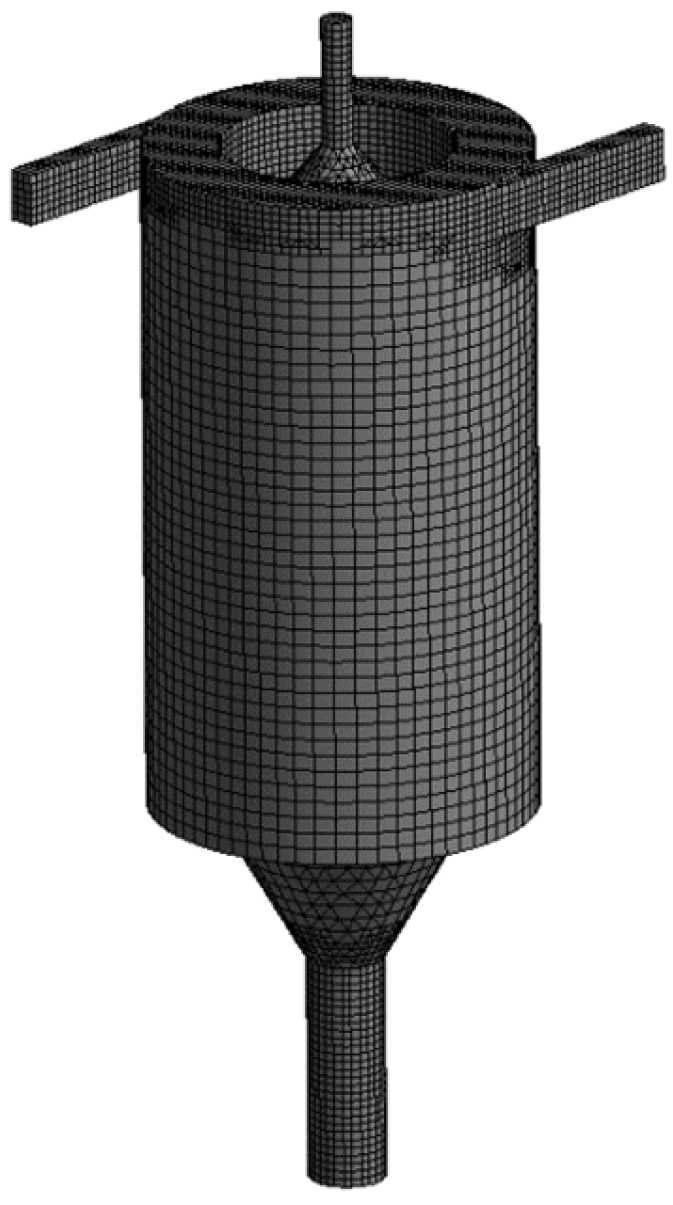
Three-dimensional models of the cyclone separators were constructed according to the structural configuration in Figure 2 and the orthogonal design in Table 2. The meshes were generated with the meshing module in ANSYS 2024R1 Workbench. Local refinement was applied at the inlet, the overflow pipe, and near-wall areas to better resolve flow gradients. The resulting mesh is shown in Figure 3.
Figure 3. Meshing diagram.
A grid independence study was carried out to verify that the numerical results are not sensitive to the mesh resolution. Three unstructured meshes with different global element sizes were generated: 1.60 mm (coarse mesh), 1.25 mm (medium mesh), and 1.00 mm (fine mesh). For all three meshes, the same meshing strategy was applied, and the computational domain and boundary conditions were kept identical. The total volume of the fluid region was 3.1049 × 10⁻⁴ m3.
Three representative quantities were selected as indicators of mesh sensitivity: (i) the area-weighted static pressure at the inlet, p i n , representing the overall pressure drop; (ii) the mixture volume flow rate at the overflow outlet, Q m i x o , characterizing the hydraulic split between the overflow and underflow; and (iii) the domain-averaged gas volume fraction, a g , representing the overall gas content in the separator. The mesh parameters and the corresponding values of these quantities are listed in Table 3.
Table 3. Grid independence verification.
When the mesh is refined from 1.60 mm to 1.25 mm, the inlet-averaged pressure and the domain-averaged gas volume fraction change by about 5.4% and 5.5%, respectively. This indicates that the coarse mesh tends to overestimate the pressure drop and underestimate the overall gas content. In contrast, the mixture volume flow rate at the overflow outlet varies by only 0.8%, suggesting that the hydraulic split is already weakly dependent on the mesh. Further refinement from 1.25 mm to 1.00 mm reduces the differences between the two meshes to 3.3% for the inlet pressure, 3.7% for the gas volume fraction, and 1.2% for the overflow mixture flow rate. All three quantities show a monotonic convergence trend with mesh refinement.
To quantify the remaining discretization error, the Grid Convergence Index (GCI) was evaluated between the fine and medium meshes [31]. The refinement ratios are r 23 = h 2 / h 3 = 1.25 between the fine and medium meshes and r 12 = h 1 / h 2 = 1.28 between the medium and coarse meshes. For the GCI evaluation, the ratio r 23 was used. A second-order spatial accuracy p = 2 was assumed, and a safety factor F S = 1.25 was adopted. For a generic monitored quantity ϕ , the GCI between the fine ( ϕ 3 ) and medium ( ϕ 2 ) meshes is defined as follows:
G C I 23 = F S | ϕ 3 ϕ 2 | ϕ 3 ( r 23 p 1 )
The relative differences between two successive meshes were computed as follows:
Δ 12 = | ϕ 1 ϕ 2 | | ϕ 2 | × 100 %
Δ 23 = | ϕ 2 ϕ 3 | | ϕ 3 | × 100 %
On this basis, the relative differences between grids and the GCI values for the three monitored quantities are summarized in Table 4.
Table 4. Relative differences between grids and the Grid Convergence Index (GCI) between the fine and medium meshes.
The GCI values are approximately 8.3% for the domain-averaged gas content, 7.4% for the inlet-averaged pressure, and 2.6% for the overflow mixture volume flow rate. These results indicate that the medium mesh with a global element size of 1.25 mm already provides solutions that are sufficiently close to those of the fine mesh, especially for the overflow hydraulic split, whereas the coarse mesh is not adequate. Therefore, the mesh with 1.25 mm was used in all subsequent simulations as a compromise between numerical accuracy and computational cost.
To ensure adequate near-wall resolution, wall-normal grid refinement was applied at all solid boundaries. For the final grid with a global element size of 1.25 mm, five prism inflation layers with smooth growth were generated along the walls. The dimensionless wall distance y+ was monitored after convergence. The area-weighted mean y+ on the main walls was approximately 29.6, and the local maximum remained below about 45. This range places most wall-adjacent cells in the buffer/log-law region, which is consistent with the requirements of the standard k–ε model with standard wall functions and is widely adopted in engineering simulations of cyclone separators. Together with the grid-independence study, these results indicate that the near-wall resolution of the present mesh is sufficient for the parametric optimization conducted in this work.

2.4.2. Mathematical Model

In this study, the swirling gas–liquid two-phase flow within a cyclone separator was simulated using ANSYS Fluent. Given that the hydraulic oil contains a non-negligible fraction of entrained and dissolved gas, and the flow is characterized by widespread dispersed phase distribution, the Eulerian–Eulerian multiphase model was adopted. This approach treats the phases as interpenetrating continua and is well-suited for predicting statistically steady volume fraction fields and macroscopic separation efficiency, eliminating the need to track detailed interface morphology.
For turbulence closure within the Reynolds-Averaged Navier–Stokes (RANS) framework, higher-order models such as the Reynolds Stress Model (RSM) or Large-Eddy Simulation (LES) can better capture flow anisotropy and vortex dynamics. In addition, curvature-corrected two-equation k–ε formulations have been proposed to partially account for streamline curvature effects in strongly swirling flows [32,33]. However, prior studies on similar cyclone separator flows under low-speed conditions reported discrepancies of less than 5% in key macroscopic indicators between the k–ε model, higher-fidelity models, and experimental data [34,35]. More recent CFD simulations of cyclone separators have also shown that standard k–ε models can reproduce the overall separation efficiency and pressure-drop trends in reasonable agreement with measurements without curvature correction, while keeping the computational cost affordable for multi-case parametric studies [32,33,35,36]. Furthermore, the standard k–ε model remains extensively applied in cyclone separator design and structural optimization, demonstrating consistent agreement with benchmark experiments and theoretical predictions [18,37,38]. Combined with the working condition of the hydraulic system, the inlet velocity in this study is approximately 10.4 m/s, which lies within the operational range where the standard k–ε model has been validated to yield sufficient accuracy. In the present simulations, the curvature-correction option was therefore not activated. The focus is on statistically steady, integral performance indicators rather than detailed local turbulence anisotropy, and the above studies indicate that non-curvature-corrected k–ε closures are adequate for optimization purposes of this study. Finally, considering the computational resources and the necessity to evaluate a large number of design configurations in an orthogonal experimental plan, the standard k–ε model was ultimately chosen for its robust performance and computational efficiency. Core equations of the standard k-ε model include the following:
Continuity equation:
ρ t + ( ρ u ) x + ( ρ v ) y + ( ρ w ) z = 0
where ρ is the fluid density, kg/m3; t is time, s; u , v , and w are velocity components in the x , y , and z directions, m/s.
Momentum conservation equation:
( ρ u ) t + ( ρ u u ) x + ( ρ u v ) y + ( ρ u w ) z = p x + τ z x x + τ y x y + τ z x z + ρ f z
( ρ v ) t + ( ρ v u ) x + ( ρ v v ) y + ( ρ v w ) z = p y + τ x y x + τ y y y + τ z y z + ρ f y
( ρ w ) t + ( ρ w u ) x + ( ρ w v ) y + ( ρ w w ) z = p z + τ z z x + τ y z y + τ z z z + ρ f z
where p is the pressure on the fluid micro-element, Pa; τ x x , τ x y , τ x z etc. are the components of viscous stress τ , Pa; and f x , f y , f z are the physical strength components of the micro-element body, N.
Energy conservation equation:
( ρ T ) t + ( ρ u T ) x + ( ρ v T ) y + ( ρ w T ) z = ρ x ( k c p T x ) + ρ y ( k c p T y ) + ρ z ( k c p T z ) + S T
where c p is specific heat capacity, J/(kg·K); T is temperature, K; k is the heat transfer coefficient of the fluid, W/(m·K); and S T is the viscous dissipation term, W/m3.
Transport equations of turbulent kinetic energy k and dissipation rate ε.
t ( ρ m k ) + · ( ρ m v m k ) = · ( μ t , m σ k k ) + G k , m ρ m ε
t ( ρ m k ) + · ( ρ m v m ϵ ) = · ( μ t , m σ ε ε ) + ε k ( C 1 ε G k , m C 2 ε ρ m ε )
where ρ m is the mixing density, kg/m3; v m is the mixing velocity, m/s; μ t , m is the turbulent viscosity; G k , m is the turbulent kinetic energy; C 1 ε , C 2 ε is the empirical constant, k is the turbulent kinetic energy and ε is the dissipation rate.

2.4.3. Boundary Conditions and Solver Settings

As described in Section 2.4.2, this study employs a steady RANS model with the standard k–ε turbulence closure. The pressure was set to standard atmospheric conditions, heat transfer between the fluid and the wall was neglected, and the wall was treated with a no-slip boundary condition. The finite volume method was applied for the governing equations, with the source and diffusion terms discretized using a second-order central difference scheme, and the convection term using a second-order upwind scheme. All simulations were carried out using the pressure-based segregated solver, and the Phase Coupled SIMPLE algorithm was employed for pressure–velocity coupling in the Eulerian multiphase formulation. Convergence was assumed when the normalized residuals of continuity, momentum, turbulence, and volume-fraction equations dropped below 10−5. To represent the typical operating conditions of the hydraulic system, the corresponding inlet parameters and main physical properties of the gas–liquid mixture are shown in Table 5.
Table 5. Numerical parameters of the simulation.

2.5. Validation Test Rig

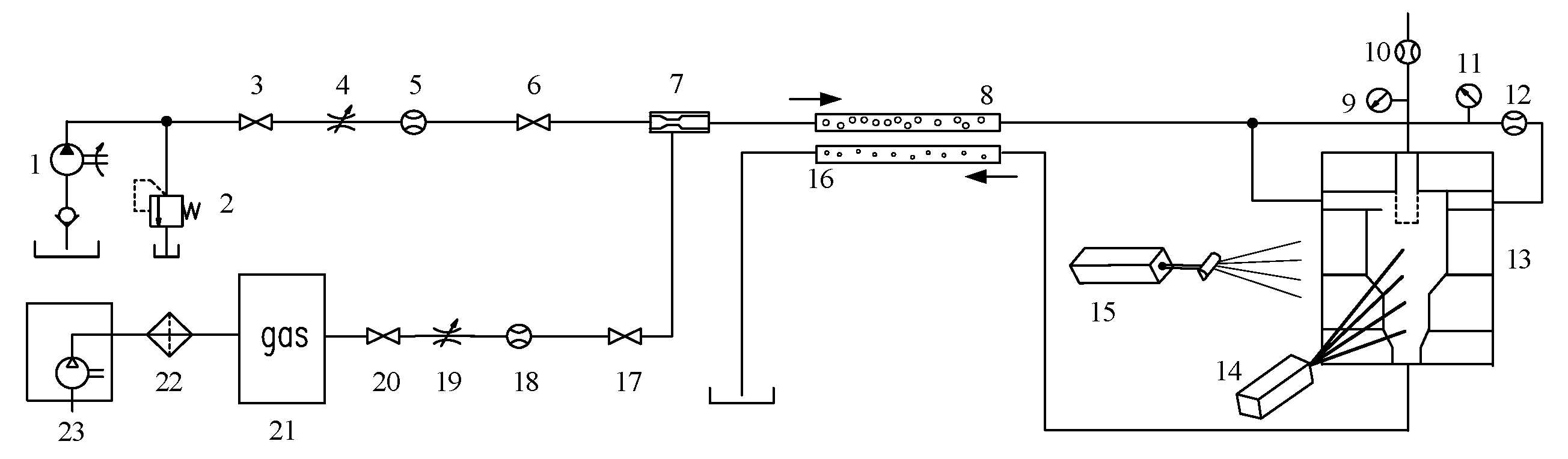
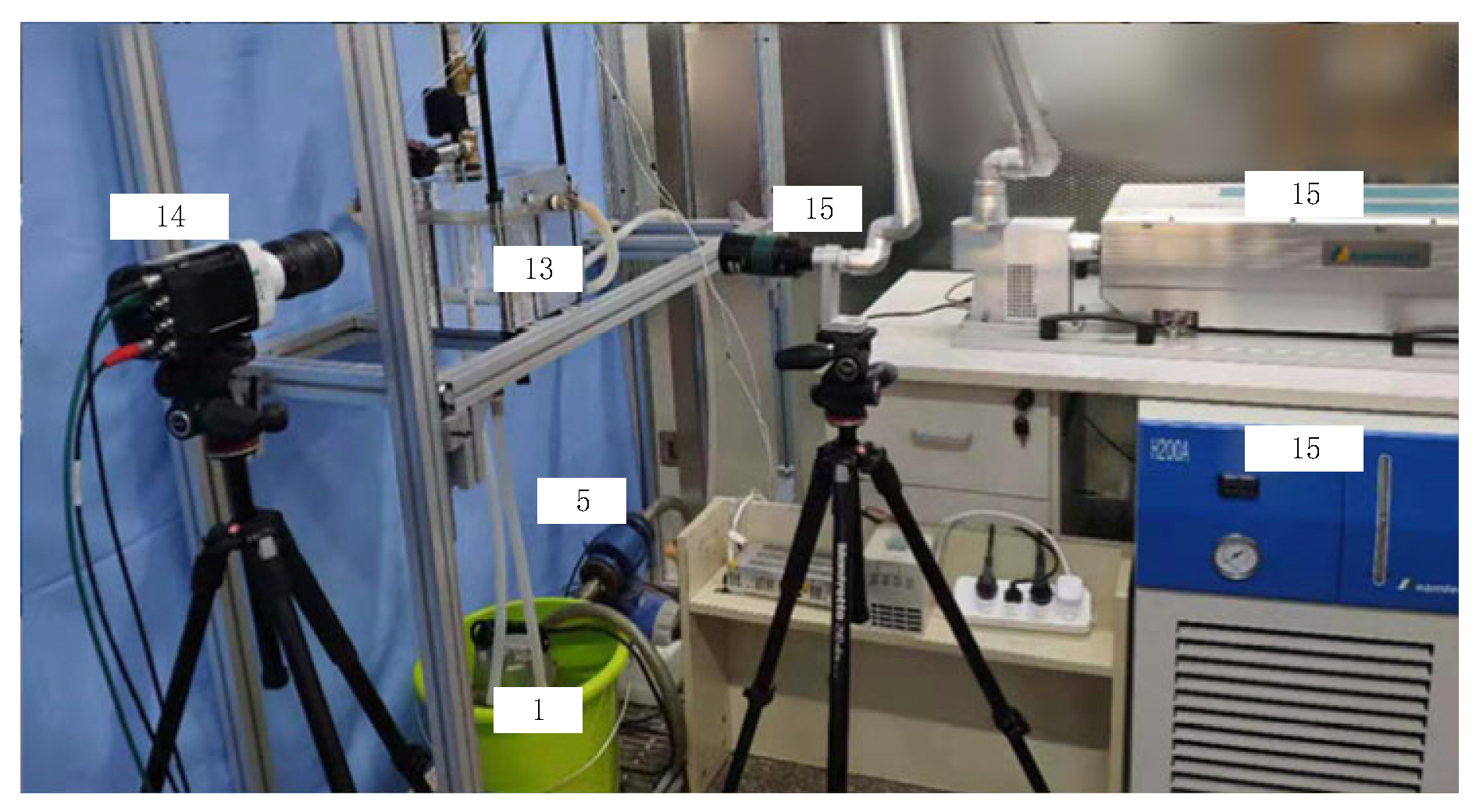
The validation experiment was conducted using image-based measurements. Images of the inlet and outlet pipelines were acquired with a charge-coupled device camera (CCD camera) integrated into the Particle Image Velocimetry (PIV) system, and the experimental separation efficiency γ T was calculated from the processed images after binarization. The schematic of the validation setup is shown in Figure 4, and the test bench is shown in Figure 5.
Figure 4. The schematic diagram of the verification test system. 1—fixed displacement pump, 2—overflow valve, 3, 6, 17, 20—cut-off valve, 4, 19—high accuracy throttle valve, 5, 10, 12, 18—flowmeter, 7—venturi bubble generator, 8, 16—bubble contrast tube, 9, 11—pressure transducer, 13—cyclone experimental assembly, 14—CCD camera, 15—laser/LED lamp board, 21—gas buffer tank, 22—gas filter, 23—gas compressor.
Figure 5. The test bench. 1—fixed displacement pump, 5—flowmeter, 13—cyclone experimental assembly, 14—CCD camera, 15—laser/LED lamp board.
The optical illumination system employed a solid-state laser (Tolar series Vlite-Hi-527, Beamtech Optronics Co., Ltd., White Rock, Canada). The repetition rate was 0.2–10 kHz, the output wavelength was 527 nm, the maximum pulse energy was ≥20 mJ per channel at 1 kHz with dual-channel combined-beam output, and the energy stability was <1%. The laser sheet had a minimum waist thickness of approximately 1 mm and an illuminated field of about 200 mm × 200 mm. The image acquisition system used a CCD high-speed camera (SpeedSense M310, Dantec Dynamics A/S, Skovlunde, Denmark) with a resolution of 1600 × 1200 pixels and a Nikon Micro-Nikkor 60 mm f/2.8 lens. A band-pass filter matched to 527 nm was mounted in front of the lens to improve particle-image contrast. Image processing and synchronization were performed in DynamicStudio V6, which controlled the CCD camera and laser triggering via a hardware synchronizer for the PIV system. The overall measurement uncertainty of the PIV system was approximately 1%. During the experiments, the laser triggering and image acquisition frequency were 800 Hz, the inter-frame time Δ t was 605.58 µs, and the trigger mode was dual-frame. A total of 800 images were recorded. The interrogation window was 64 × 64 pixels with 15% overlap. To obtain the time-averaged flow field on the cyclone center plane and reduce random noise, 200 high-quality images were selected from the dataset for averaging. The measurement error of this PIV system is approximately 1%.

3. Results

3.1. Orthogonal Test Result

3.1.1. Orthogonal Test Analysis

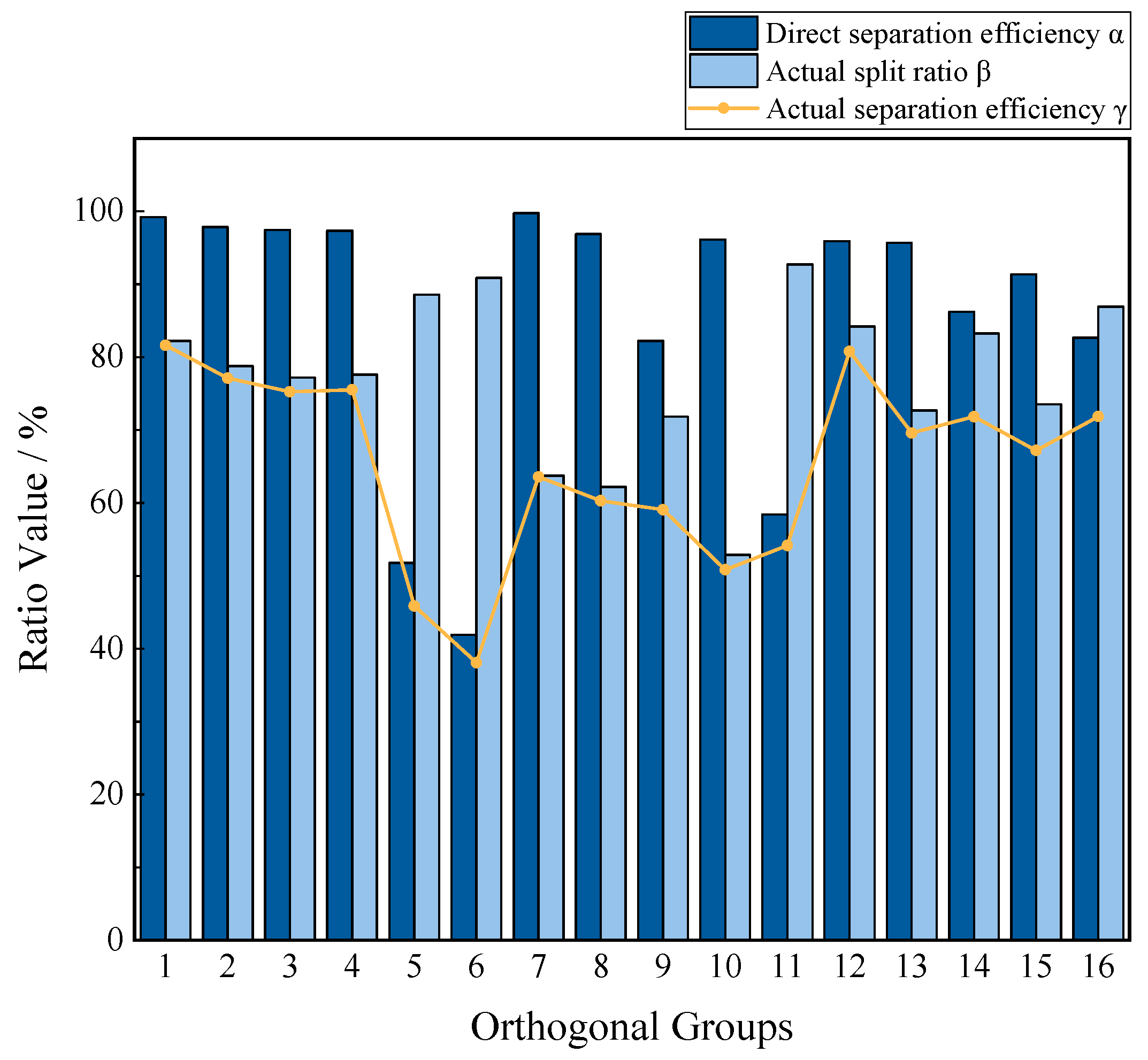
The separation performance of the cyclone separator with varying structural parameters was evaluated through numerical simulations, and the results are shown in Figure 6.
Figure 6. Simulation result of orthogonal groups.
The results of 16 experimental groups were compared. The direct separation efficiency α exceeded 90% in 10 groups, indicating that the selected parameter range was appropriate. Within the experimental range, the cyclone achieved excellent gas–liquid separation performance. Considering all three key indicators, the actual separation efficiency γ exceeded 80% only in group 1 and group 12. Although the direct separation efficiency α of group 1 was slightly higher than that of group 12 (1.03 times), the actual split ratio β of group 12 was greater (1.12 times), indicating that the structural configuration of group 12 achieves high separation efficiency while minimizing phase entrainment. Therefore, group 12 was identified as the optimal combination of structural parameters.

3.1.2. Flow Field Characteristics

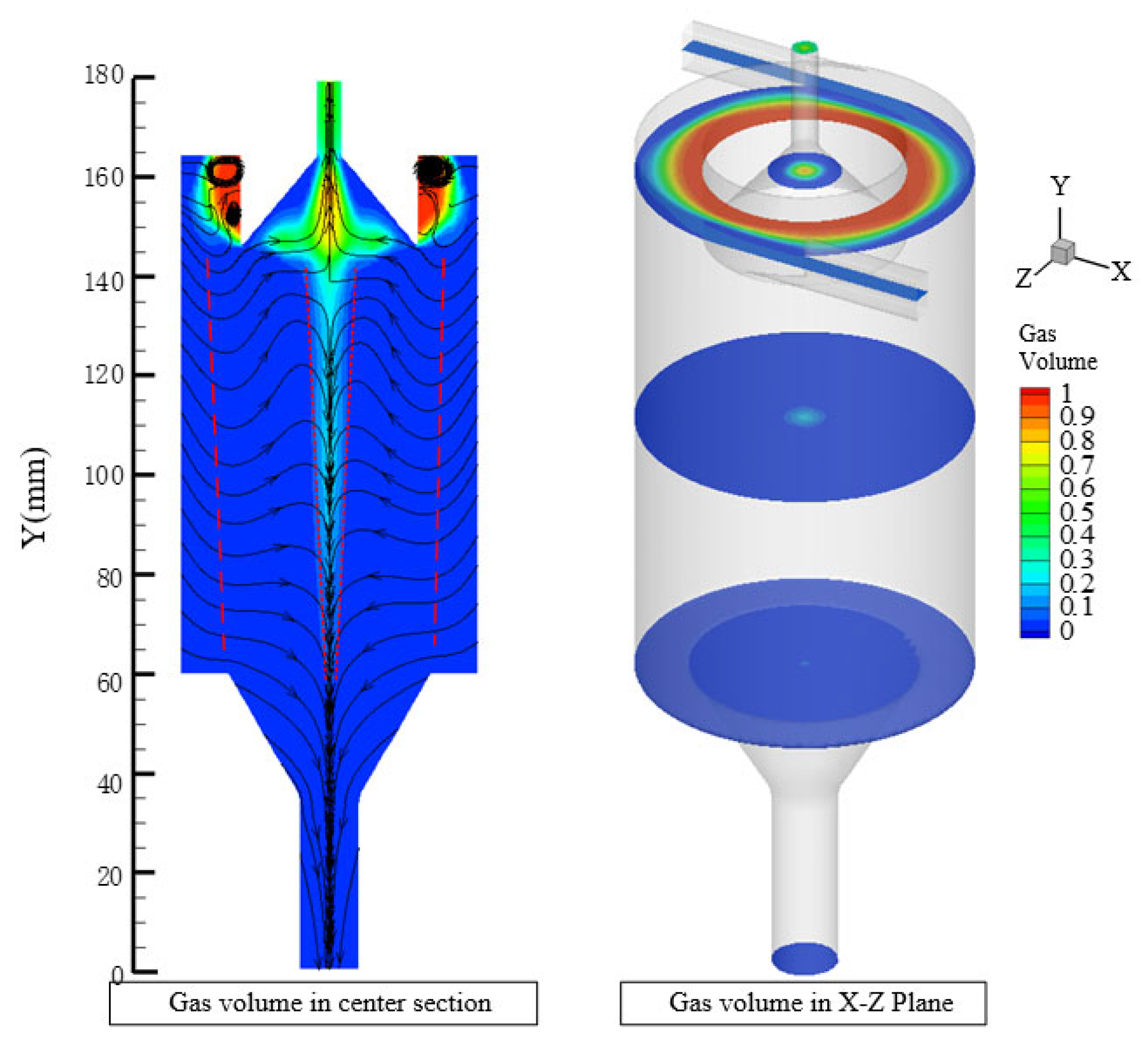
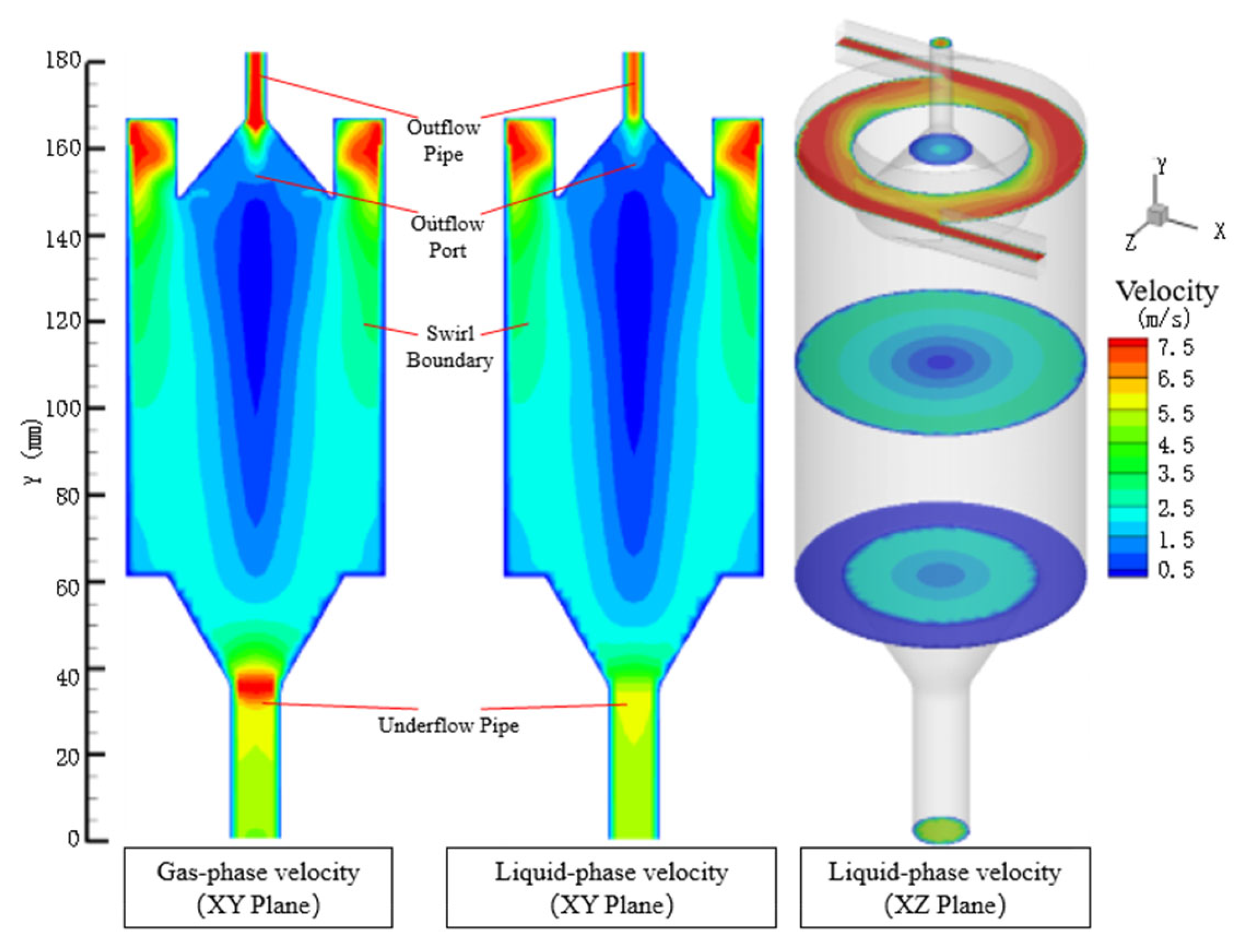
The simulation cloud diagrams further support structural optimization. The gas volume distribution diagrams illustrate the spatial distribution of the gas phase within the mixture, while the velocity distribution diagrams represent the flow state of the mixed phase. The gas volume cloud diagram of group 12 is shown in Figure 7. Similarly, the velocity distribution of group 12 is shown in Figure 8.
Figure 7. Gas volume cloud diagram of orthogonal group 12.
Figure 8. Velocity cloud diagram of the orthogonal group 12.
As shown in Figure 7, regions of relatively high gas fraction appear on both sides of the overflow pipe. This occurs because the vortex has not fully developed upon entry, and some liquid accumulates at the top, forming a short-circuit flow. This secondary flow is detrimental to gas–liquid separation and highlights the significant influence of the overflow pipe diameter D o n and the insertion depth of the overflow pipe H o n on this region. Within the main body of the separator, the denser oil liquid flows near the wall, while the less dense gas gathers at the center, forming an air column whose diameter decreases with depth. This flow structure is jointly influenced by the swirl chamber diameter D and the swirl chamber height H . It represents the primary vortex region and has a major effect on separation performance.
Figure 8 presents the velocity distribution cloud diagrams of group 12. Near the underflow orifice, the gas phase velocity is higher than that of the liquid phase. This indicates that, after passing through the cone chamber, the swirling intensity of the mixed phase increases and the gas concentrates at the center. With the influence of the internal swirling flow, the gas first gathers at the bottom and then moves upward. The underflow orifice affects the formation and stability of the gas column and increases the mixed-phase velocity, which enhances the vortex effect and improves separation performance. The distribution of this flow region is mainly related to the underflow orifice diameter D d o w n .

3.2. Validation Test Result

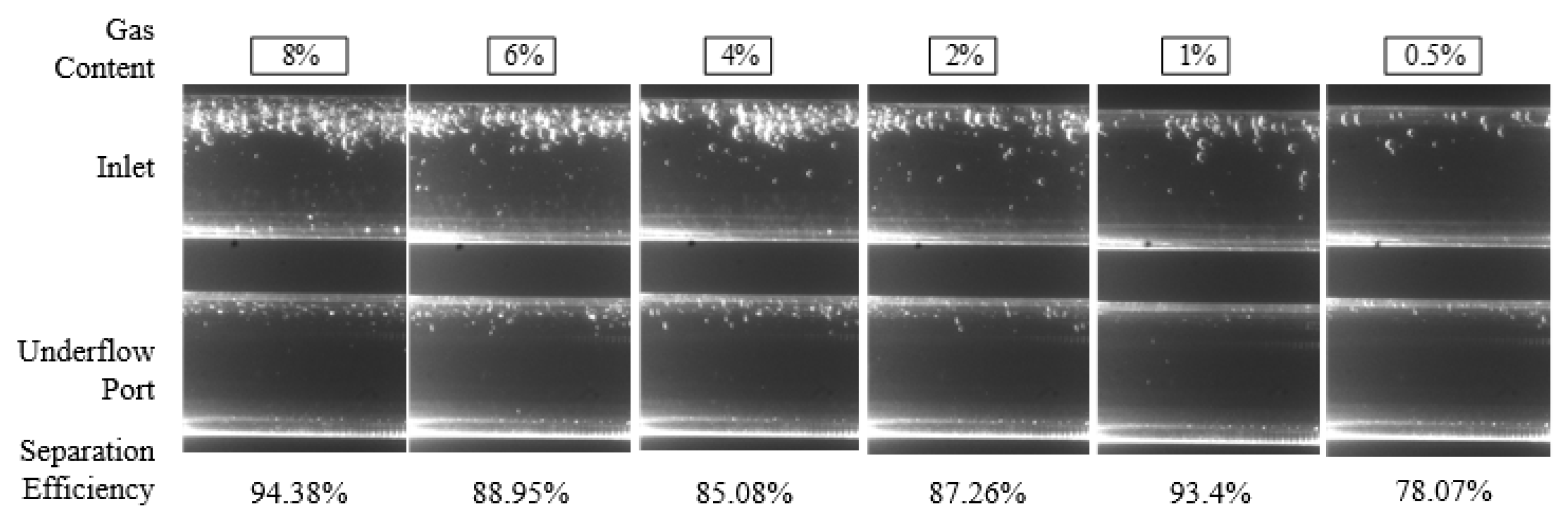
Based on the results and analysis of the orthogonal experiment, the structural parameters of experimental group 12 were adopted to fabricate the test prototype. Figure 9 presents the gas–liquid contrast images of two bubble observation tubes of the inlet and the underflow orifice. These images correspond to gas volume fractions of 8%, 6%, 4%, 2%, 1%, and 0.5%. As shown in Figure 9, the gas content after cyclone separation is significantly lower than the inlet bubble content for gas volume fractions ranging from 0.5% to 8%, demonstrating the high efficiency of the cyclone separator.
Figure 9. Gas–liquid contrast images of bubble observation tubes at the inlet and the underflow orifice for different gas volume fractions.
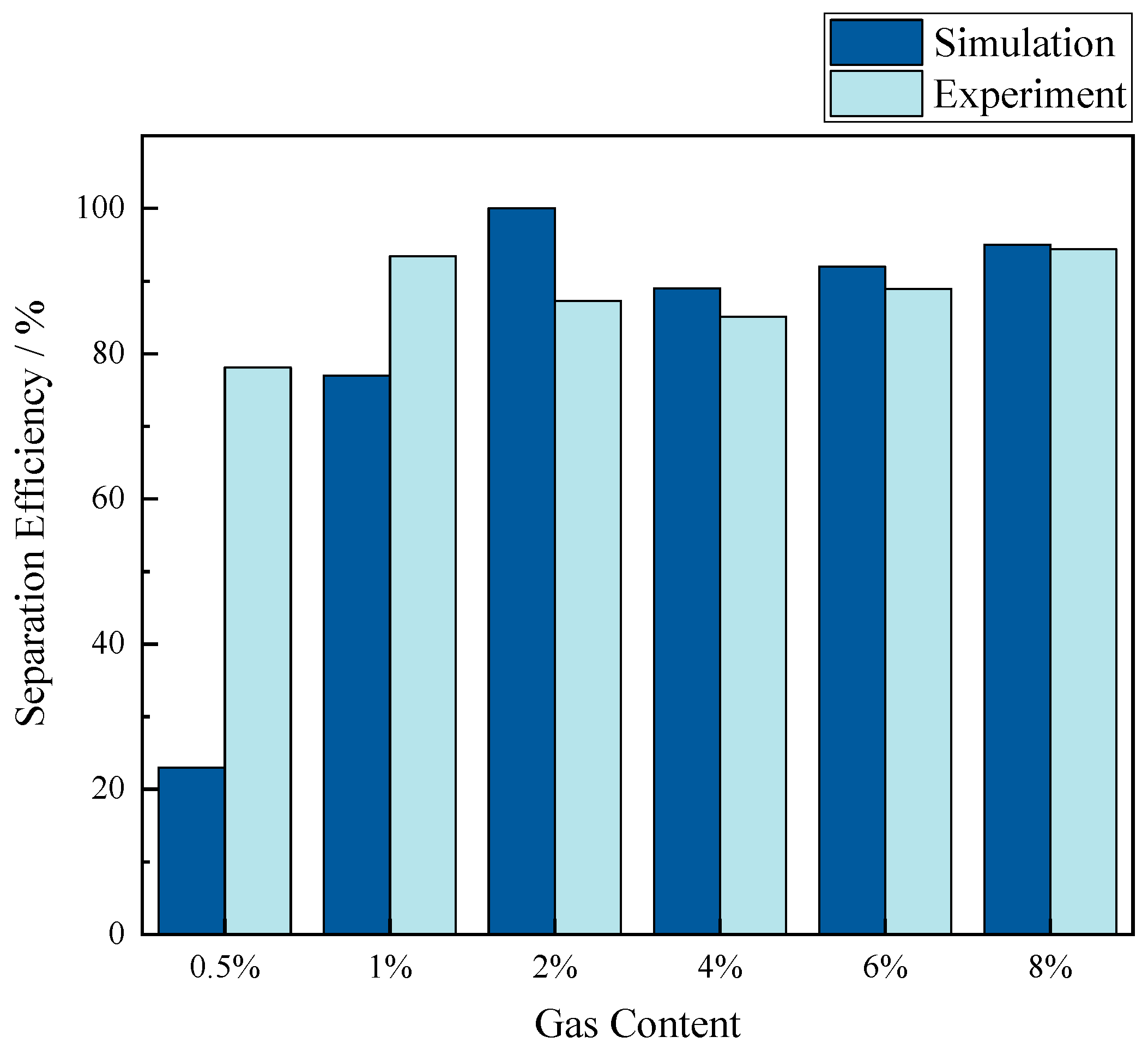
The experimental separation efficiency γ T was calculated based on Formula (4) through the processing method in Section 2.5, as shown in Figure 10.
Figure 10. Histogram of separation efficiency.
The comparison between experimental and simulated separation efficiencies reveals the consistent overall trends. In both cases, the separation efficiency first increases, then decreases, and increases again. The discrepancy between experiment and simulation increases as the gas content decreases. Both experimental and simulated efficiencies were lowest at 0.5% gas content. At this low gas content, the simulated efficiency was significantly lower than the experimental value, suggesting that the gas volume in the computational grid may be too small for the software to accurately predict, leading to a deviation in separation efficiency. The cyclone separator exhibits different separation performance for gas–liquid flows with varying gas contents. The relationship between gas content and separation efficiency under the same structure and operating conditions is not monotonic. Overall, the separation efficiency remained above 77%, maintaining favorable separation performance.

3.3. Sensitivity Analysis

3.3.1. Range Analysis

Range analysis was performed on the orthogonal test results to assess the influence of different factors on the performance indices. The mean values of the samples at different levels k i and the corresponding range R are calculated. The definition of the average level k i is given in Equation (15):
k i = 1 r j S i y j
where S i is the dataset consisting of all factors at the level i . y j is the result of the j th experiment and r is the number of experiments conducted for each factor at different levels. The definition of r is shown in Equation (16):
r = n m
The definitions of n and m have been provided in Section 2.3. Based on the average value k i , the range R can be calculated, as shown in Equation (17):
R = m a x ( k i ) m i n ( k i )
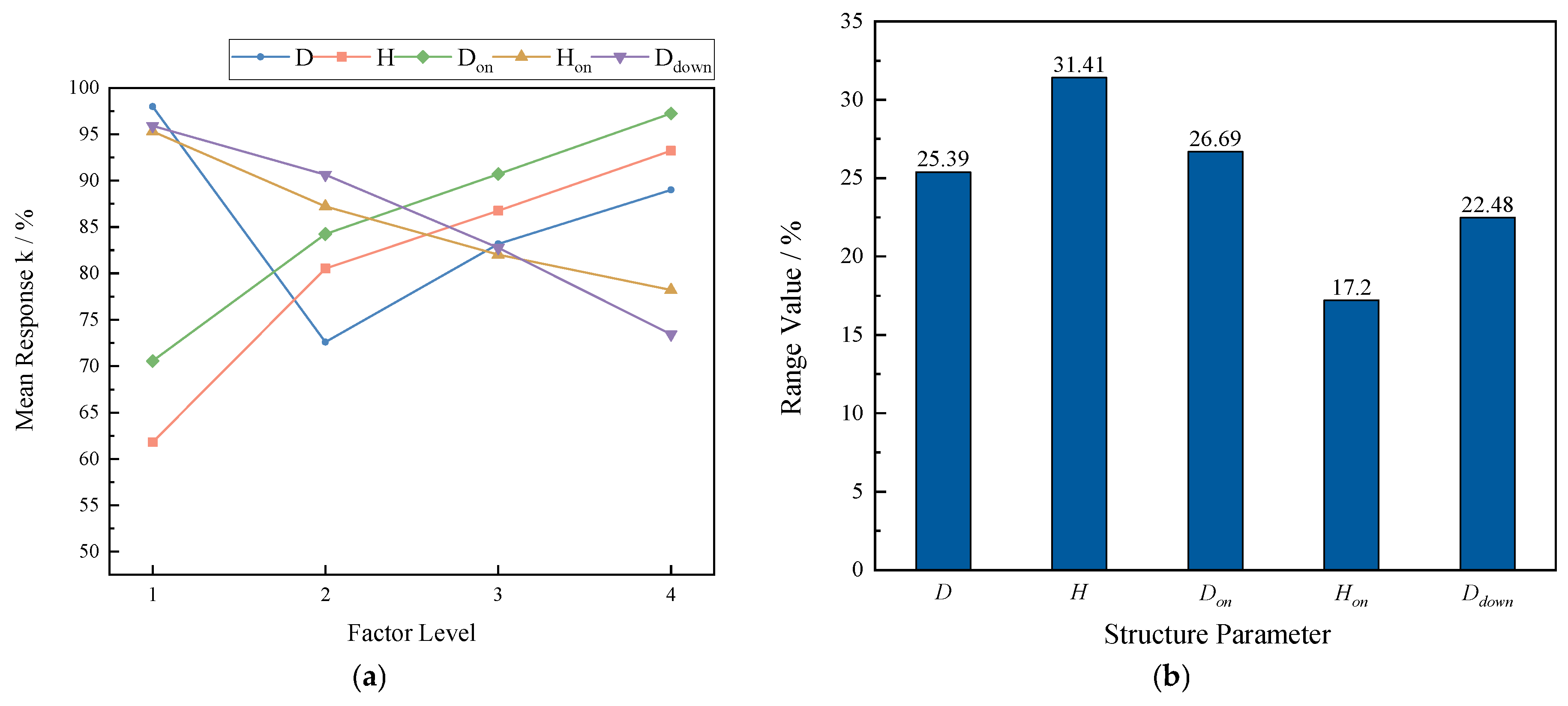
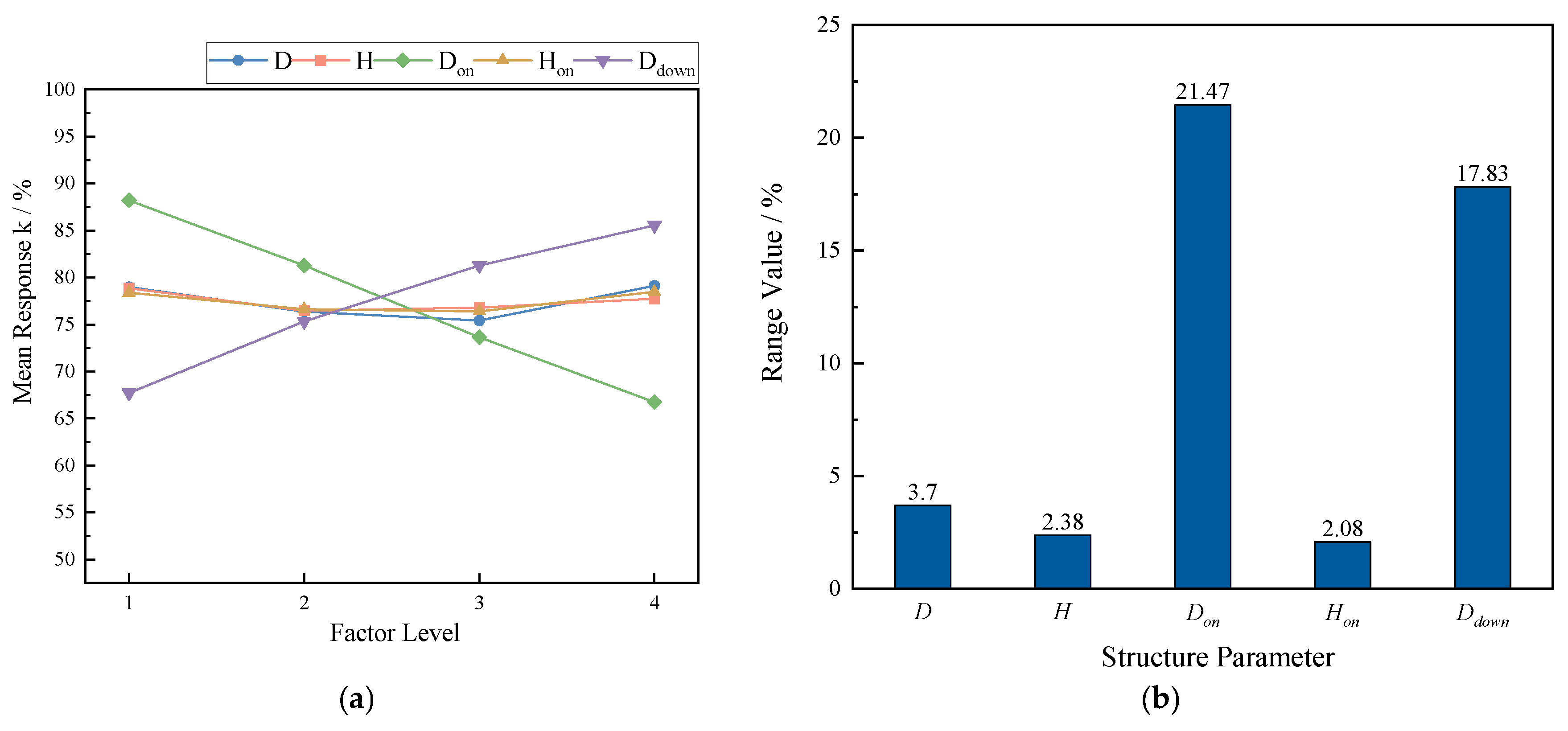
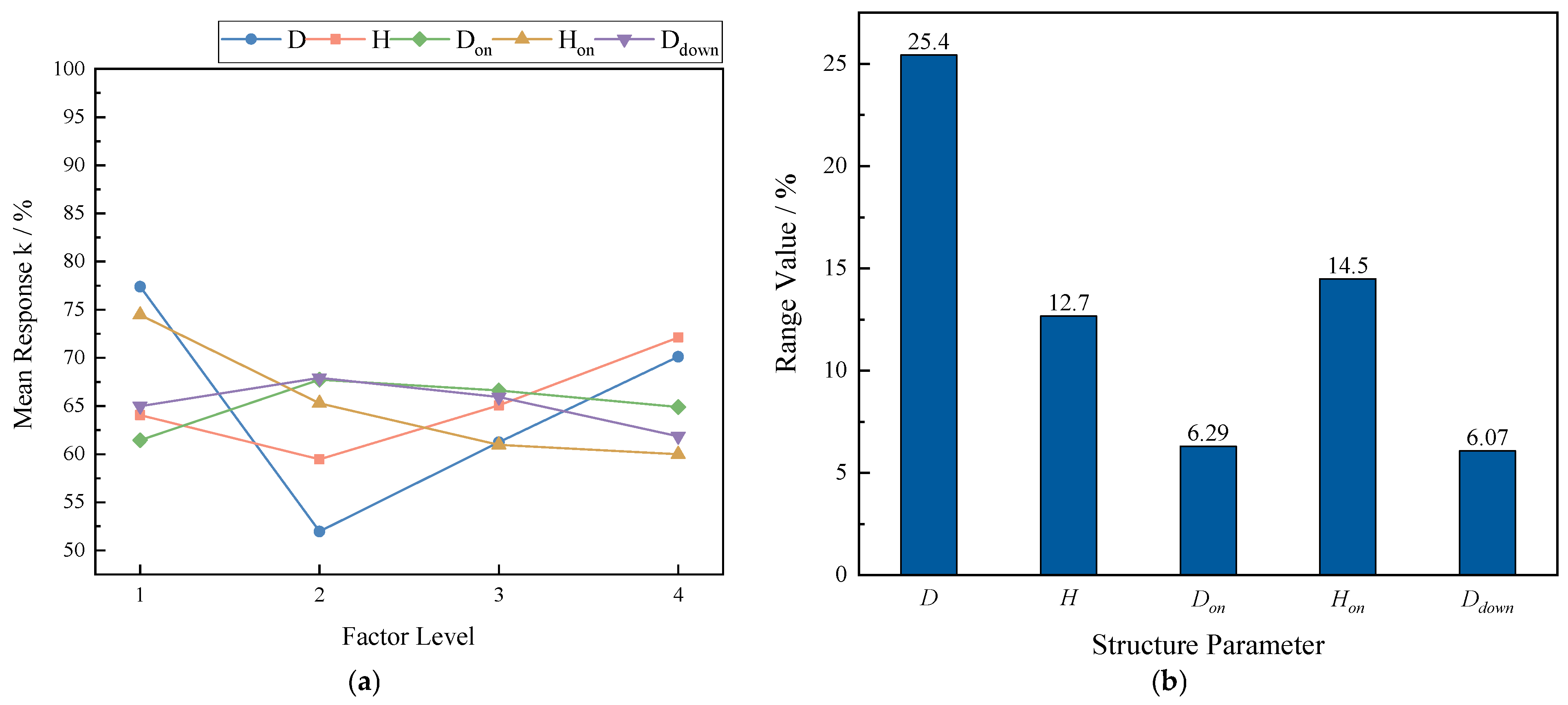
The average value k i can be used to analyze the optimization effect of the structure, and the range R can reflect the influence levels of different factors. The range analysis results of each group are shown in Figure 11, Figure 12 and Figure 13.
Figure 11. (a) The average value k i of the direct separation efficiency α ; (b) the range R of the direct separation efficiency α .
Figure 12. (a) The average value k i of the split ratio β ; (b) the range R of the split ratio β .
Figure 13. (a) The average value k i of the actual separation efficiency γ ; (b) the range R of the actual separation efficiency γ .
As shown in Figure 11, the direct separation efficiency α exhibits a positive correlation with H and D o n , while H o n and D d o w n show a negative correlation. The effect of D is more complex but remains primarily positive as the diameter increases enough. Among all parameters, H exerts the most significant influence on α .
As shown in Figure 12, the overall trend of the actual split ratio β is relatively gentle. The main influencing factors are D o n and D d o w n , indicating that the underflow pipe and the overflow pipe have an important impact on the entrainment performance of the mixed phase.
As shown in Figure 13, the swirl chamber diameter D exerts the most significant influence on the actual separation efficiency γ . It primarily affects the swirling flow intensity in the cyclone’s main body and acts as the decisive factor for gas–liquid separation.
The ranges of H and H o n are similar, and both factors mainly influence the height of the gas column in the cyclone. This indicates that reasonable matching of H and H o n is required to facilitate the formation of the gas column.
The influences of D o n and D d o w n are relatively weak. These two parameters primarily control the proportion of the gas–liquid mixture discharged from the overflow and underflow pipes and regulate the amount of liquid entrained by the gas phase.

3.3.2. ANOVA Analysis

Range analysis alone cannot establish statistical significance. In contrast, ANOVA quantifies the significance of influencing factors and has been widely applied in multi-parameter optimization studies of cyclone separators [39,40,41]. The mean values of the samples at different levels k i were defined in Equation (15). Other parameters of ANOVA analysis are as follows:
Grand mean k 0 ,
k 0 = 1 N j = 1 N y j
Total sum of squares S S T , Factor sum of squares S S K and Error sum of squares S S E ,
S S T = j = 1 N ( y j k 0 ) 2
S S K = i = 1 L n i ( k i k 0 ) 2
S S E = S S T K S S K
Total degrees of freedom d f T , Factor degrees of freedom d f K and Error degrees of freedom d f E .
d f T = N 1
d f K = L 1
d f E = d f T K d f K
In this study, the orthogonal design is saturated. The d f T equal the d f K , leaving d f E to be zero. To facilitate in-depth inference on the effects of each factor on separation performance, Taguchi pooling was adopted to merge statistically non-significant factors with small contributions into the error term, yielding a pooled error. The adjusted sums of squares and degrees of freedom follow the conventional pooled-error framework. The pooled error sum of squares S S p o o l e d and the pooled error degrees of freedom d f p o o l e d are as follows:
S S p o o l e d = S S E + K ψ S S K
d f p o o l e d = d f E K ψ d f K
On this basis, the principal ANOVA metrics are reported:
M S K = S S K d f K
M S p o o l e d = S S p o o l e d d f p o o l e d
F K = M S K M S p o o l e d
p K = P r ( F d f 1 , d f 2 F K )
P c t = S S K S S T S S p o o l e d × 100 %
where M S is the mean square, F is the F ratio, p is p-value and P c t is the percentage contribution.
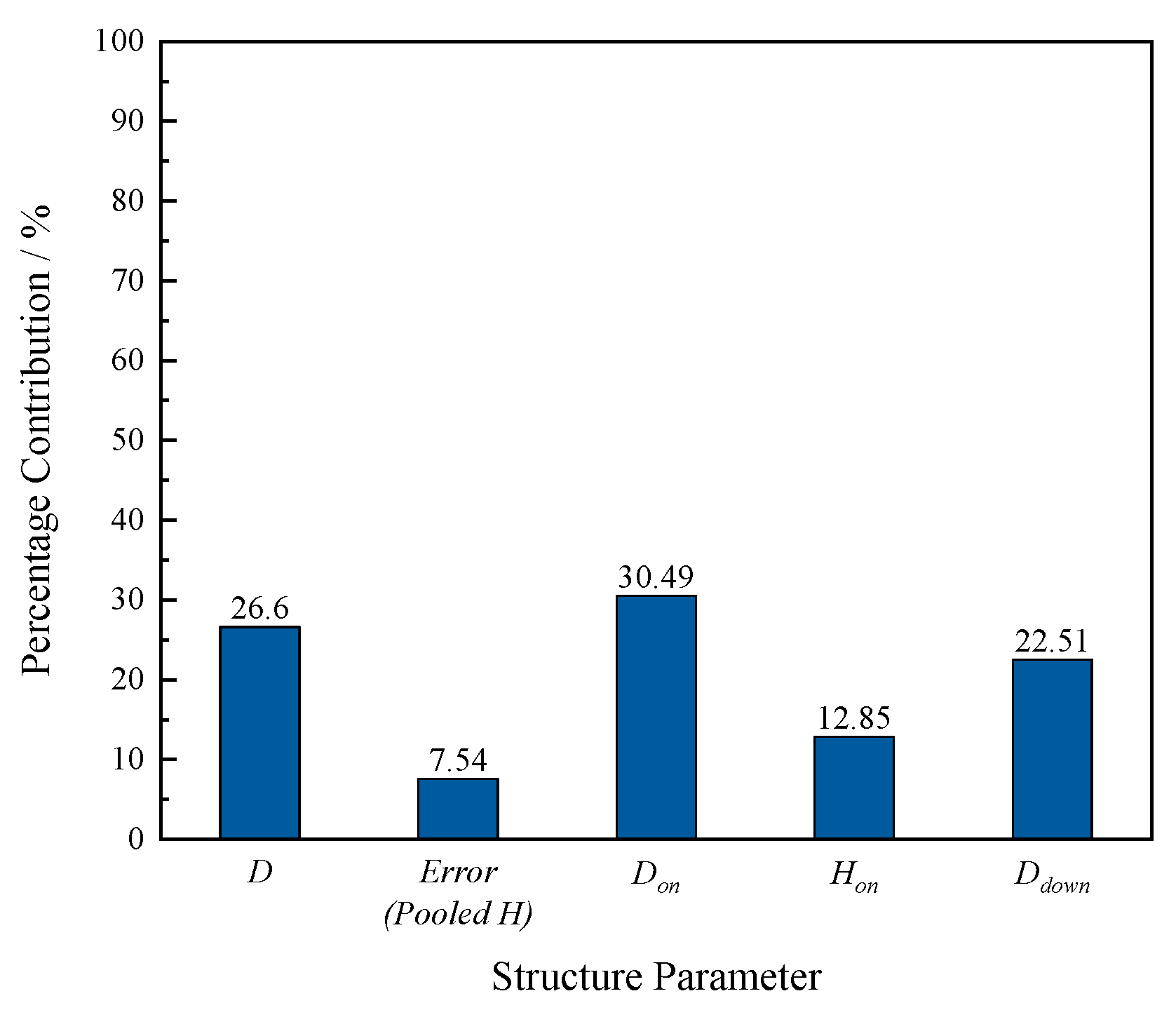
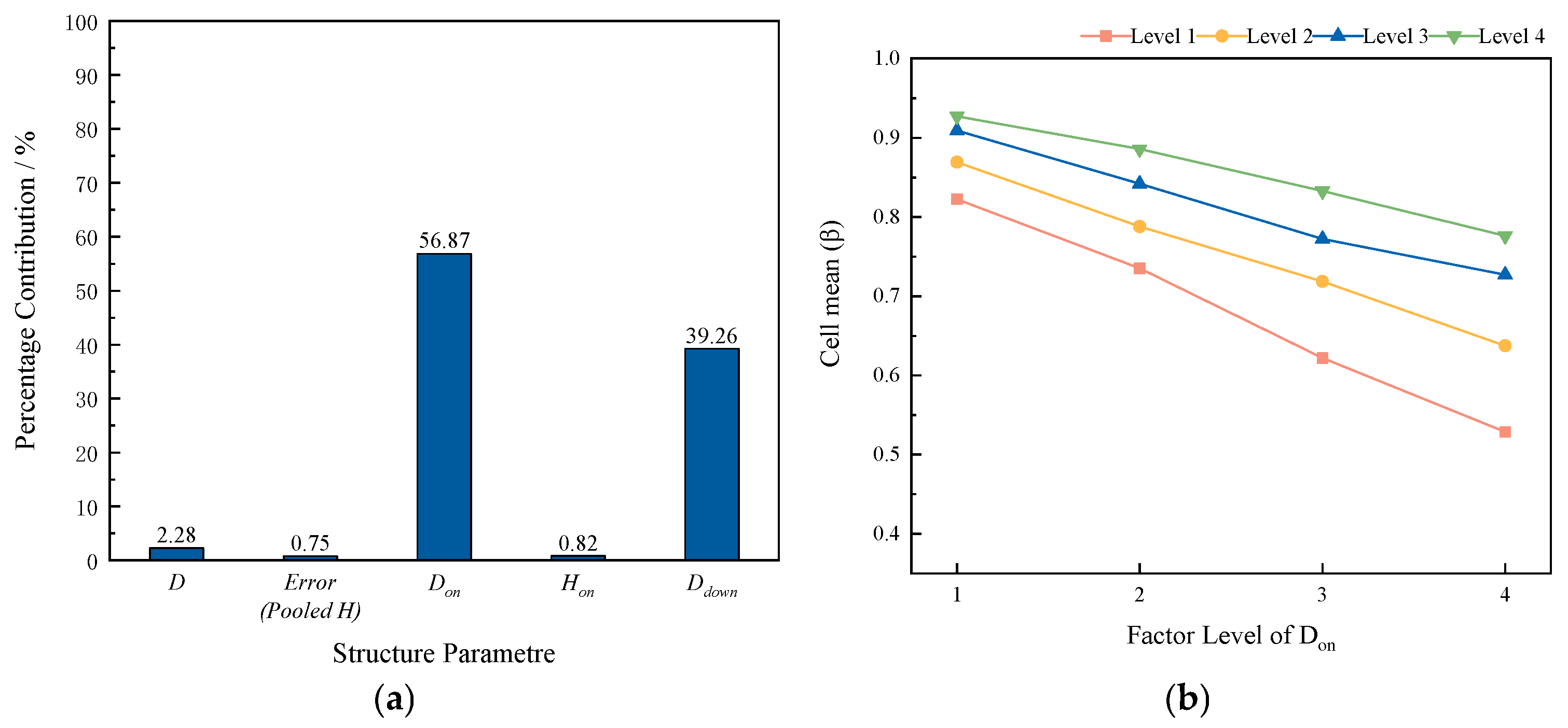
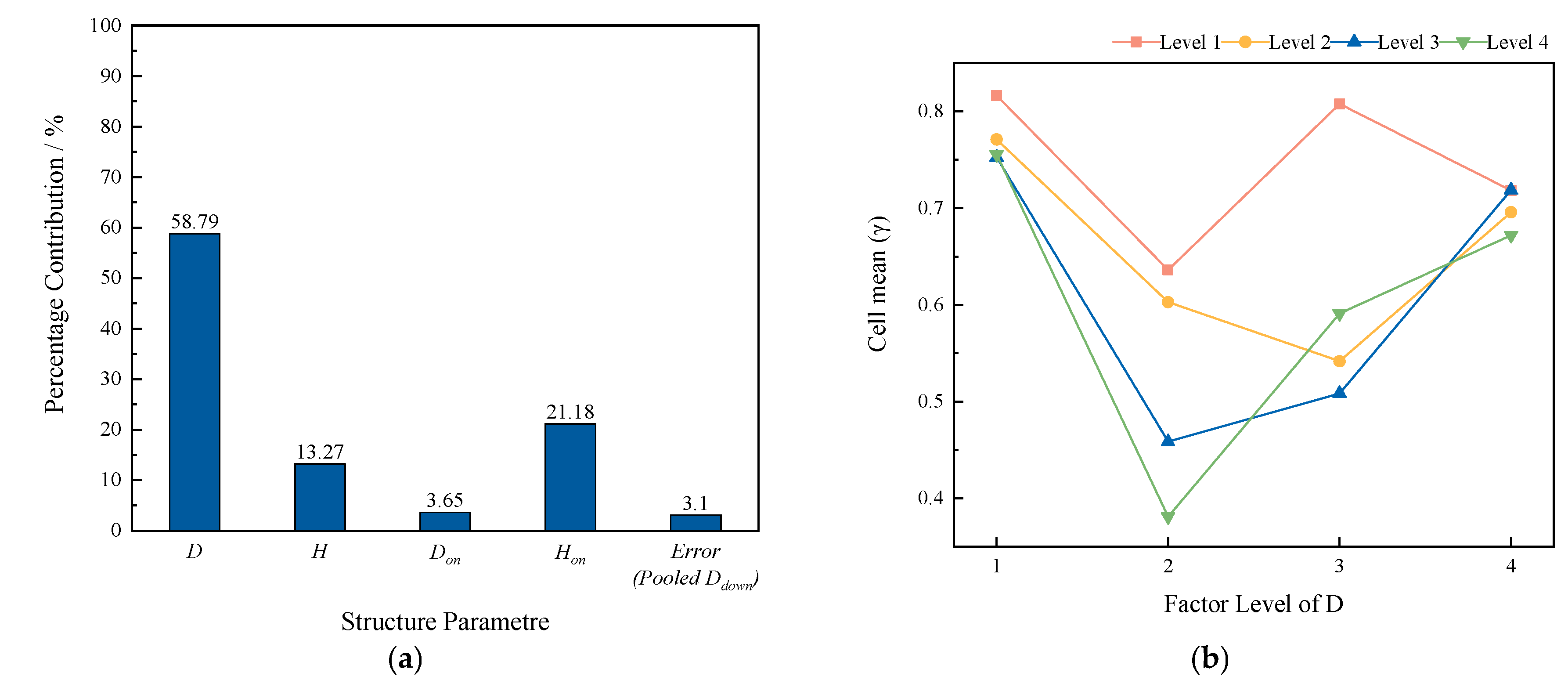
On the basis of the pooled-error ANOVA framework, Figure 14, Figure 15 and Figure 16 summarize the factor contributions to variance and the representative interaction effects for the three performance indices.
Figure 14. Factor contributions to the variance of α .
Figure 15. (a) Factor contributions to the variance of β ; (b) interaction between D o n and D d o w n on β .
Figure 16. (a) Factor contributions to the variance of γ ; (b) interaction between D and H o n on γ .
Figure 14 shows that for the direct separation efficiency α , the most prominent factors are D o n , D and D d o w n , with contributions of 30.49%, 26.60%, and 22.51%, totaling about 80%. Under the residual degrees of freedom after pooling, the test is not significant at α = 0.05. However, the effect sizes and percentage contributions consistently indicate that these three factors are the key parameters for engineering structure optimization. By comparison, H o n and H exert relatively weaker influences. This result highlights the intuitive impact of diameter matching among the primary structural elements on α .
From Figure 15a, D o n and D d o w n are decisive for the split ratio β , contributing 56.87% and 39.26%, respectively, for a combined contribution of approximately 96%. Both of the factors reach statistical significance under the pooled-error framework (p < 0.01). A comparable factor hierarchy was reported by Thiemsakul et al. [17]. Based on the ANOVA sums of squares for the water split in a microplastics–water hydrocyclone, the underflow and overflow diameter ratios account for approximately 57.07% and 42.59% of the total variance, respectively, whereas the other factors contribute less than 1%. Both outlet-related factors reach statistical significance under the pooled-error framework (p < 0.01). Although ref. [17] and the present work differ in application domain and in the specific definitions of structural parameters and performance indices, both studies consistently indicate that adjusting the outlet sizes is the primary means of controlling the partition of the carrier phase between the overflow and underflow. In contrast, D and H o n can be regarded as secondary. This clarifies that β is controlled primarily by the diameter setting of the overflow pipe and the underflow orifice. From Figure 15b, the interaction lines are nearly parallel across different levels, indicating that the influence of D o n and D d o w n are independent, and there is little interaction. A monotonic pattern is also evident: β decreases with D o n increase while the impact of D d o w n shows an opposite trend, which provides relatively simple optimization advice for adjusting the split ratio.
From Figure 16a, the actual separation efficiency γ is governed mainly by cyclone chamber diameter D , which contributes 58.79% and is statistically significant. The overflow pipe insertion depth H o n ranks second at 21.18%, near the boundary of statistical significance. Combined with the flow field of the cyclone separator, D and H o n determine the distribution of secondary flows in the separator, corroborating earlier reports [22]. From Figure 16b, the four lines for D and H o n are visibly non-parallel and locally reordered, providing graphical evidence of an actual interaction between D and H o n . Furthermore, the cyclone chamber height H ranks third at 13.27, and contributes less than these two factors. D , together with H , shape the swirl intensity and the residence time of the mixture. The weakening of secondary flow and the enhancement of swirl flow ultimately enhance γ . Accordingly, the gain in γ from increasing D depends on the chosen H o n and H level, reflecting a coupled “body-scale–inlet-momentum” control of the effective separation zone’s size and location.

4. Conclusions

The orthogonal design is coupled with numerical simulations to quantify the effects of five primary geometric parameters on separation performance in a cyclone separator. Range analysis was employed for rapid ranking, and Taguchi pooling ANOVA was used for statistical inference. PIV experiments were conducted to validate the simulated trends across operating gas volume fractions. The main conclusions are as follows:
  • To reflect the influence of mixed-phase entrainment, a more comprehensive evaluation framework is adopted. The direct separation efficiency α measures gas capture in the overflow stream, while the split ratio β describes the flow partition between the overflow pipe and the underflow orifice. The actual separation efficiency γ combines α and β and therefore represents gas removal under a given split, inherently accounting for liquid carryover. This metric provides a stronger basis for geometry optimization and for fair performance comparison across designs.
  • Range analysis provided a rapid screening of factor importance, which was then quantified by pooled-error analysis of variance; both methods converged to the same hierarchy. The split ratio β is set by outlet sizing. The overflow pipe diameter, Don, contributes 56.87%, and the underflow orifice diameter, Ddown, contributes 39.26%, together about 96%. Their effects are nearly independent and monotonic, enabling direct tuning of entrainment and flow split. The actual separation efficiency γ is governed by body-scale geometry. The chamber diameter D contributes 58.79%, the insertion depth Hon contributes 21.18%, and the chamber height H contributes 13.27%. Mechanistically, D controls swirl intensity and core strength, Hon adjusts axial extent and residence time, and H stabilizes the position and persistence of the effective separation zone. Range analysis revealed the same monotonic trends and indicated a meaningful interaction between D and Hon for γ, which the variance analysis confirmed.
  • A two-step design strategy is supported by the data. First, set the target β by matching Don and Ddown so that entrainment is bounded at the required operating split. Second, maximize γ by coordinating D and Hon, using H as an auxiliary lever to stabilize the gas core and the internal swirling field. The optimized geometry achieves a γ of about 80.8%. Experiments confirm consistent trends across 0.5% to 8% gas volume fraction, with separation generally above 77% and simulation-to-experiment differences below 20% when the gas fraction is at least 1%. These results provide an optimization method from geometry to performance for rapid screening and refinement of gas–liquid cyclone separators.
Future research on the structure and separation performance of gas–liquid cyclone separators remains rich in opportunities, and the present study still has several limitations that indicate directions for further work. The current simulations cannot fully resolve small-scale transient vortices, bubble breakup and coalescence, or detailed gas–liquid core dynamics. The numerical description of the internal swirling flow should therefore be strengthened in future work by adopting more reliable turbulence closures and improving the treatment of multiphase interactions. Developing predictive models that link key geometric parameters to separation metrics will be a central task. In addition, the roles of operating conditions and fluid properties should be systematically investigated to assess robustness and guide scalable design. The design space should be extended to include inlet geometry, operating conditions, and other influential factors, combined with response-surface or other optimization algorithms for global structural optimization. Moreover, future studies should move beyond separation efficiency alone and simultaneously consider system pressure drop and internal flow-field characteristics, thereby enabling multi-objective optimization and a more comprehensive enhancement of the overall performance of gas–liquid cyclone separators.

Author Contributions

Conceptualization, D.C., J.Z., R.L. and Y.L.; Methodology, D.C., R.L. and T.L.; Software, D.C. and R.L.; Validation, D.C., J.Z., Y.L. and R.L.; Formal analysis, D.C., J.Z., X.L. and X.K.; Investigation, D.C. and R.L.; Resources, X.L., X.K., T.L. and S.W.; Data curation, R.L.; Writing—original draft preparation, D.C. and R.L.; Writing—review and editing, J.Z., X.L., Y.L., X.K., T.L. and S.W.; Visualization, R.L.; Supervision, X.L. and X.K.; Project administration, J.Z. All authors have read and agreed to the published version of the manuscript.

Funding

This research was partially supported by the Open Foundation of the State Key Laboratory of Taihang Laboratory (Grant No. QTJLHT202404090002), the industry-university-research cooperation project of Aviation Engine Corporation of China (Grant No. HFZL2024CXY014), and the Open Foundation of Fujian Key Laboratory of Green Intelligent Drive and Transmission for Mobile Machinery (No. GIDT-202303).

Data Availability Statement

The datasets used and/or analyzed during the current study are available from the corresponding author on reasonable request.

Conflicts of Interest

Authors Xiao Li and Shengrong Wang were employed by the company AECC Changchun Control Technology. The remaining authors declare that the research was conducted in the absence of any commercial or financial relationships that could be construed as a potential conflict of interest.

Abbreviations

The following abbreviations are used in this manuscript:
ANOVAAnalysis of variance
CCDCharge-coupled device
CFDComputational fluid dynamics
PIVParticle Image Velocimetry
RANSReynolds-Averaged Navier–Stokes
GCIGrid Convergence Index

References

  1. Xu, B.; Shen, J.; Liu, S.; Su, Q.; Zhang, J. Research and development of electro-hydraulic control valves oriented to industry 4.0: A review. Chin. J. Mech. Eng. 2020, 33, 29. [Google Scholar] [CrossRef]
  2. Chen, G.; Wang, Y.; Zhong, N.; Fan, Z.; Wang, G. Design and research of a heavy load fatigue test system based on hydraulic control for full-size marine low-speed diesel engine bearings. Ocean Eng. 2023, 288, 116174. [Google Scholar] [CrossRef]
  3. Du, S.; Zhou, J.; Hong, J.; Zhao, J.; Ma, S. Application and progress of high-efficiency electro-hydrostatic actuator technology with energy recovery: A comprehensive review. Energy Convers. Manag. 2024, 321, 119041. [Google Scholar] [CrossRef]
  4. Fan, Q.; Zhang, J.; Li, R.; Fan, T. Review of research on hydrostatic transmission systems and control strategies. Processes 2025, 13, 317. [Google Scholar] [CrossRef]
  5. Novak, N.; Trajkovski, A.; Kalin, M.; Majdič, F. Degradation of hydraulic system due to wear particles or medium test dust. Appl. Sci. 2023, 13, 7777. [Google Scholar] [CrossRef]
  6. Polášek, T.; Bureček, A.; Hružík, L.; Ledvoň, M.; Dýrr, F.; Olšiak, R.; Kolář, D. Experimental study of multiphase flow occurrence caused by cavitation during mineral oil flow. Phys. Fluids 2024, 36, 113377. [Google Scholar] [CrossRef]
  7. Zhou, J.; Yuan, S.; Jing, C.; Li, X. Research on the model of bubble radius and gas content in hydraulic oils. J. Mech. Eng. 2018, 54, 195–201. [Google Scholar] [CrossRef]
  8. Yang, S.; Ji, H.; Li, S.; Sun, F.; Wang, S. Prediction and verification for the models of temperature rising by medium bubbles in hydraulic system. Adv. Mech. Eng. 2022, 14, 16878132221085431. [Google Scholar] [CrossRef]
  9. Wang, C.; Zhang, Y.; Zhu, J.; Yuan, Z.; Lu, B. Effect of cavitation and free-gas entrainment on the hydraulic performance of a centrifugal pump. Proc. Inst. Mech. Eng. Part A J. Power Energy 2021, 235, 440–453. [Google Scholar] [CrossRef]
  10. Bai, Y.; Ji, H.; Liu, Y.; Li, L.; Yang, S. Analysis of bubble flow mechanism and characteristics in gas–liquid cyclone separator. Processes 2021, 9, 123. [Google Scholar] [CrossRef]
  11. Dudaško, J.; Semlitsch, B. On the Numerical Efficacy Evaluation of Industrial Droplet Separators. In Proceedings of the ASME Power Conference, Washington, DC, USA, 15–18 September 2024; American Society of Mechanical Engineers: New York, NY, USA; Volume 88186, p. V001T04A008. [Google Scholar] [CrossRef]
  12. Liu, L.; Chen, J.; Zhao, L.; Wang, Y.; Zhang, S.; Yang, K.; Jiang, M. Influence mechanism of hydrocyclone main diameter on separation performance. Phys. Fluids 2024, 36, 063315. [Google Scholar] [CrossRef]
  13. Han, Q.; Zhang, C.; Xu, B.; Chen, J. The effect of geometry and operation conditions on the performance of a gas-liquid cylindrical cyclone separator with new structure. In Proceedings of the AIP Conference, Assergi, Italy, 10–12 April 2013; American Institute of Physics: College Park, Maryland, 2013; Volume 1547, pp. 350–361. [Google Scholar] [CrossRef]
  14. Brar, L.S.; Sharma, R.P.; Elsayed, K. The effect of the cyclone length on the performance of Stairmand high-efficiency cyclone. Powder Technol. 2015, 286, 668–677. [Google Scholar] [CrossRef]
  15. Zhang, Z.; Shao, M.; Ling, X. Experimental study on the separation performance of a novel gas–liquid separator. Adv. Powder Technol. 2022, 33, 103795. [Google Scholar] [CrossRef]
  16. Liu, P.; Wang, H.; Jiang, L.; Zhang, Y.; Li, X.; Zhang, Y.; Li, Z. Experimental study on the separation performance of an intermittent discharge concentrated hydrocyclone. Separations 2023, 10, 161. [Google Scholar] [CrossRef]
  17. Juengcharoensukying, J.; Poochinda, K.; Chalermsinsuwan, B. Effects of cyclone vortex finder and inlet angle on solid separation using CFD simulation. Energy Procedia 2017, 138, 1116–1121. [Google Scholar] [CrossRef]
  18. Thiemsakul, D.; Piemjaiswang, R.; Sema, T.; Feng, Y.; Piumsomboon, P.; Chalermsinsuwan, B. Effect of hydrocyclone design in microplastics-water separation by using computational fluid dynamics simulations. Results Eng. 2024, 22, 102034. [Google Scholar] [CrossRef]
  19. Zhang, Y.; Zhang, Y.; Liu, W.; Yi, H.; Wang, H. Research on structural parameter optimization of a new axial inlet hydrocyclone separator based on response surface optimization method. PLoS ONE 2024, 19, e0295978. [Google Scholar] [CrossRef]
  20. Raeesi, S.; Soltani Goharrizi, A.; Abolpour, B. Numerical investigation of a hydro-cyclone for separating organic and aqueous phases. J. Inst. Eng. Ser. C 2021, 102, 995–1005. [Google Scholar] [CrossRef]
  21. Qiu, S.; Zhong, L.; Wang, G.; Fang, X.; Yang, Y.; Liu, Q. Effect of structural parameters on the performance of axial-flow inlet hydrocyclones for in situ desanding from natural gas hydrate mixed slurry. ACS Omega 2023, 8, 28531–28542. [Google Scholar] [CrossRef]
  22. Xiong, Z.; Xu, J.; Liu, C. Interaction effects of inlet velocity and apex diameter on the separation performance of two-stage cone hydrocyclones. Powder Technol. 2023, 422, 118446. [Google Scholar] [CrossRef]
  23. Hashe, V.T.; Kunene, T.J. Numerical analysis of the effect of the vortex finder on the hydrocyclone’s split water ratio and separation performance. Math. Comput. Appl. 2023, 28, 50. [Google Scholar] [CrossRef]
  24. Duan, Y.; Zhang, Y.; Liu, P.; Yang, X.; Xu, M. Effect of Insertion Length of Overflow Tube on Flow Field and Classification Performance of Hydrocyclone. In Proceedings of the 4th International Conference on Advances in Civil and Ecological Engineering Research: ACEER2022, Xi’an, China, 4–7 July 2022; Springer Nature Singapore: Singapore, 2022; pp. 187–197. [Google Scholar] [CrossRef]
  25. Liu, H.; Yin, Q.; Huang, Q.; Geng, S.; He, T.; Chen, A. Experimental investigation on interaction of vortex finder diameter and length in a small hydrocyclone for solid-liquid separation. Sep. Sci. Technol. 2022, 57, 733–748. [Google Scholar] [CrossRef]
  26. Liu, P.; Chen, B.; Hou, D.; Yang, X.; Zhang, W.; Lu, Y. Designing the spigot structure of hydrocyclones to reduce fine particle misplacement in underflow. Water 2024, 16, 1070. [Google Scholar] [CrossRef]
  27. Mikheev, N.; Saushin, I.; Paereliy, A.; Kratirov, D.; Levie, K. Cyclone separator for gas-liquid mixture with high flux density. Powder Technol. 2018, 339, 326–333. [Google Scholar] [CrossRef]
  28. Chen, S.; Li, D.; Li, J.; Zhong, L. Optimization design of hydrocyclone with overflow slit structure based on experimental investigation and numerical simulation analysis. Sci. Rep. 2024, 14, 18410. [Google Scholar] [CrossRef]
  29. Ghasemi, A.; Shams, M.; Heyhat, M.M. A numerical scheme for optimizing gas liquid cylindrical cyclone separator. Proc. Inst. Mech. Eng. Part E J. Process Mech. Eng. 2017, 231, 836–848. [Google Scholar] [CrossRef]
  30. Dehnavi, A.; Adelpour, N. Optimization of closed underflow mini-hydrocyclones for separating sand from well water by two indices of mass efficiency and cut diameter using the Taguchi method: A case study of Mashhad, Iran. Water Pract. Technol. 2022, 17, 2485–2498. [Google Scholar] [CrossRef]
  31. Celik, I.B.; Ghia, U.; Roache, P.J.; Freitas, C.J. Procedure for estimation and reporting of uncertainty due to discretization in CFD applications. J. Fluids Eng.-Trans. ASME 2008, 130, 078001. [Google Scholar] [CrossRef]
  32. Barua, S.; Batcha, M.F.M.; Mohammed, A.N.; Saif, Y.; Al-Alimi, S.; Al-fakih, M.A.; Zhou, W. Numerical Investigation of Inlet Height and Width Variations on Separation Performance and Pressure Drop of Multi-Inlet Cyclone Separators. Processes 2024, 12, 1820. [Google Scholar] [CrossRef]
  33. Chauhan, J.; Salvi, B.L.; Khidiya, M.S.; Agrawal, C. Computational fluid dynamic analysis of cyclone separator for flue gas cleaning by using standard k-epsilon model. In Advancement in Materials, Manufacturing and Energy Engineering, Vol. II: Select Proceedings of ICAMME 2021; Springer Nature Singapore: Singapore, 2022; pp. 25–34. [Google Scholar] [CrossRef]
  34. Durango-Cogollo, M.; Garcia-Bravo, J.; Newell, B.; Gonzalez-Mancera, A. CFD modeling of hydrocyclones—A study of efficiency of hydrodynamic reservoirs. Fluids 2020, 5, 118. [Google Scholar] [CrossRef]
  35. Vermande Paganel, T.; Fabrice Alban, E.; Cyrille, M.A.; Ngayihi Abbe, C.V. CFD Simulation of an Industrial Dust Cyclone Separator: A Comparison with Empirical Models: The Influence of the Inlet Velocity and the Particle Size on Performance Factors in Situation of High Concentration of Particles. J. Eng. 2024, 2024, 5590437. [Google Scholar] [CrossRef]
  36. Alfarge, D.; Rashid, F.L.; Al-Obaidi, M.A.; Kadhim, Z.; Fanons, Z.; Heliel, Z.A.H.; Saeed, B.S. Numerical Simulation of Two-Phase (Gas-Oil) Flow in Gas-Liquid Cylindrical Cyclone Separator. In Engineering Techniques “Technical and Scientific Solutions for Sustainable Future”; Middle Technical University: Baghdad, Iraq, 2024; p. 156. [Google Scholar] [CrossRef]
  37. Chowdhury, R.; Billah, M.M.; Roy, S.; Banik, S.C.; Barua, A. Analyzing the effect of the density of medium on efficiency of hydrocyclone separator in sorting of PVC and PET using CFD. Results Mater. 2024, 21, 100497. [Google Scholar] [CrossRef]
  38. Tomescu, S.G.; Mălăel, I.; Conțiu, R.; Voicu, S. Experimental Validation of the Numerical Model for Oil–Gas Separation. Inventions 2023, 8, 125. [Google Scholar] [CrossRef]
  39. Fatahian, H.; Fatahian, E.; Erfani, R. Square cyclone separator: Performance analysis optimization and operating condition variations using CFD-DPM and Taguchi method. Powder Technol. 2023, 428, 118789. [Google Scholar] [CrossRef]
  40. Wang, L.; Du, W.; Liu, R.; Feng, J.; Peng, X.; Cao, F. Multi-Objective optimization of oil–gas cyclone separators considering liquid storage in the tank bottom. Sep. Purif. Technol. 2025, 374, 133521. [Google Scholar] [CrossRef]
  41. Zhang, Z.; Qin, H.R.; Zhao, Y.J.; Li, J.; Pan, H.J.; Hu, C.H.; Liu, L. Multi-objective Optimization of Combined Internal Components with a Vortex Stabilizer and Apex Cone for Performance Improvement of Cyclone Separator. J. Appl. Fluid Mech. 2025, 18, 2066–2084. [Google Scholar] [CrossRef]
Disclaimer/Publisher’s Note: The statements, opinions and data contained in all publications are solely those of the individual author(s) and contributor(s) and not of MDPI and/or the editor(s). MDPI and/or the editor(s) disclaim responsibility for any injury to people or property resulting from any ideas, methods, instructions or products referred to in the content.

Article Metrics

Citations

Article Access Statistics

Multiple requests from the same IP address are counted as one view.