Investigation into the Mechanical Response of Shield Lining Under Simultaneous Construction of Subway Station and Tunnel
Abstract
1. Summary
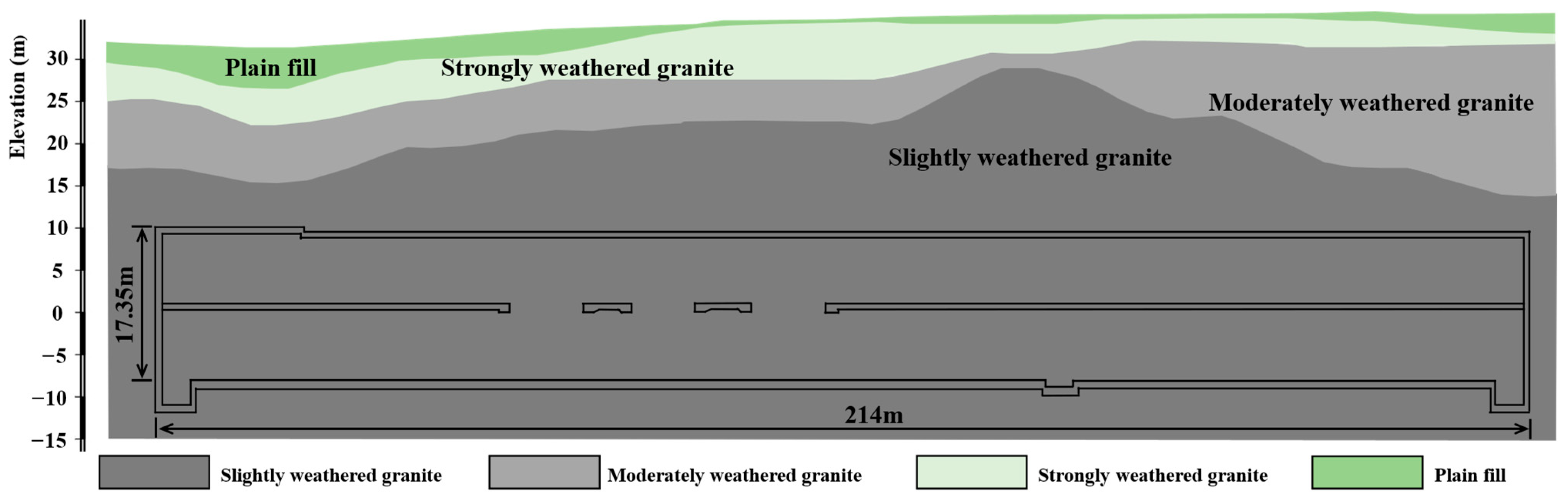
2. Project Description
3. Numerical Modeling
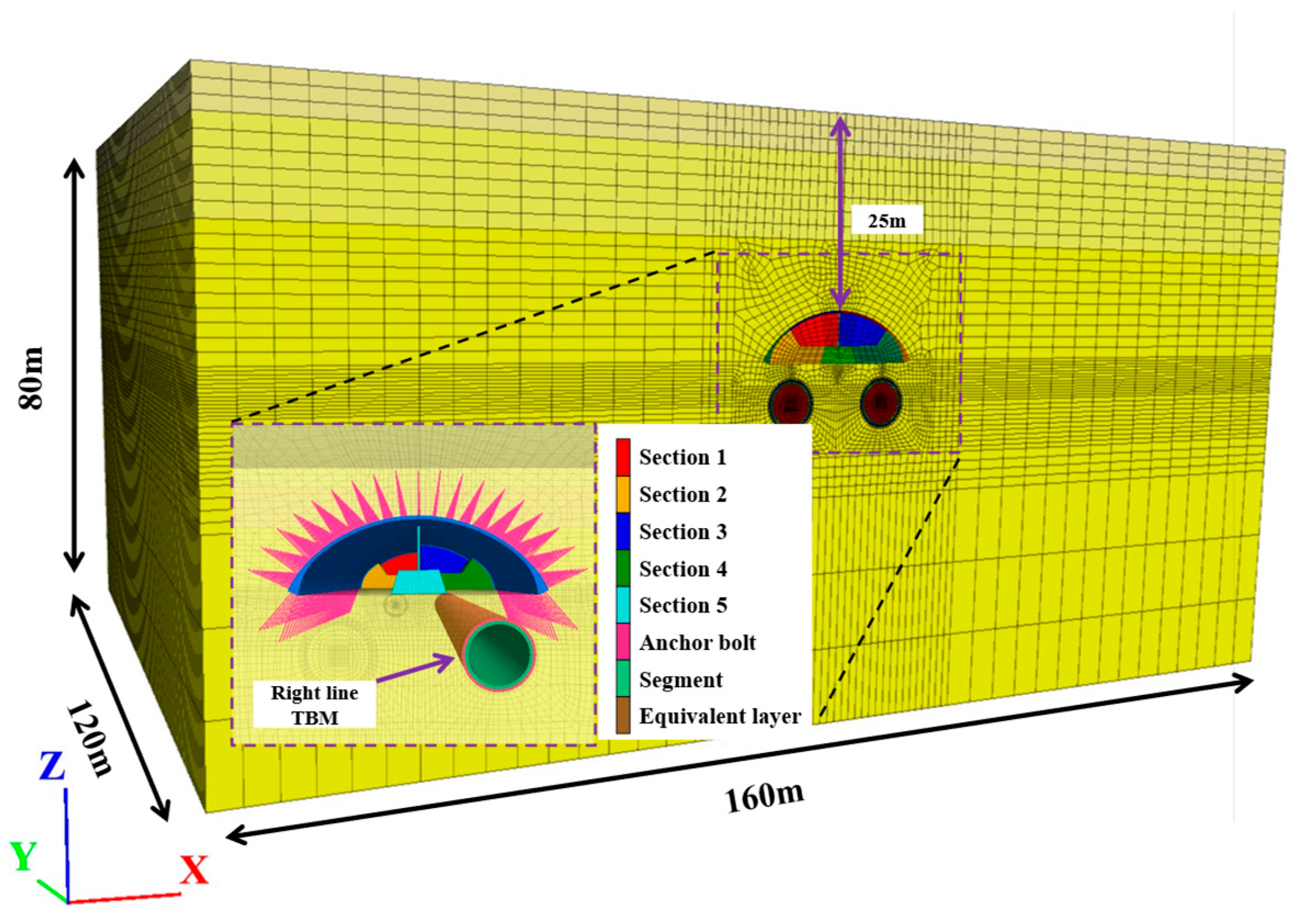
3.1. Establishment of the Numerical Model
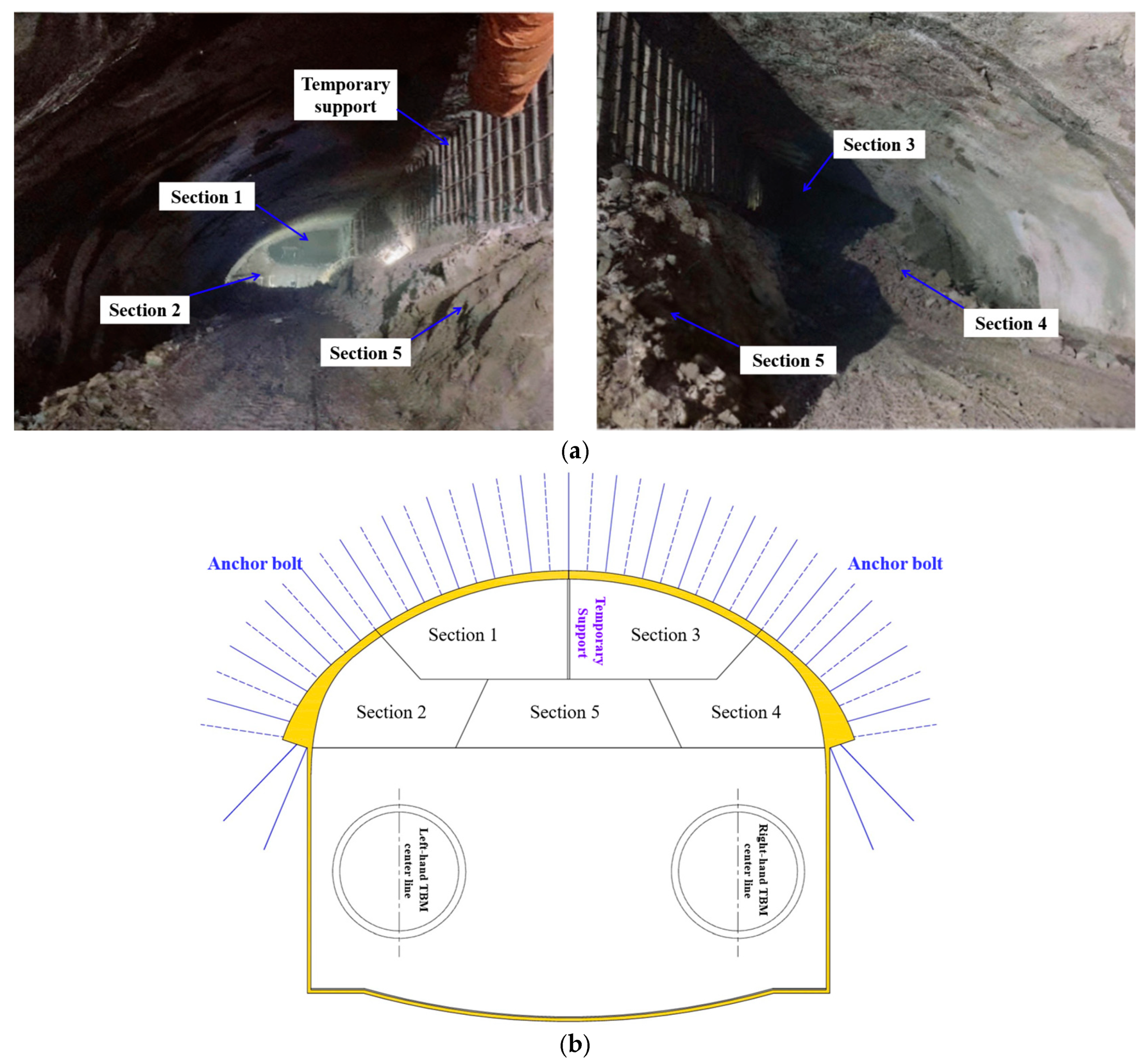
3.2. Construction Procedure
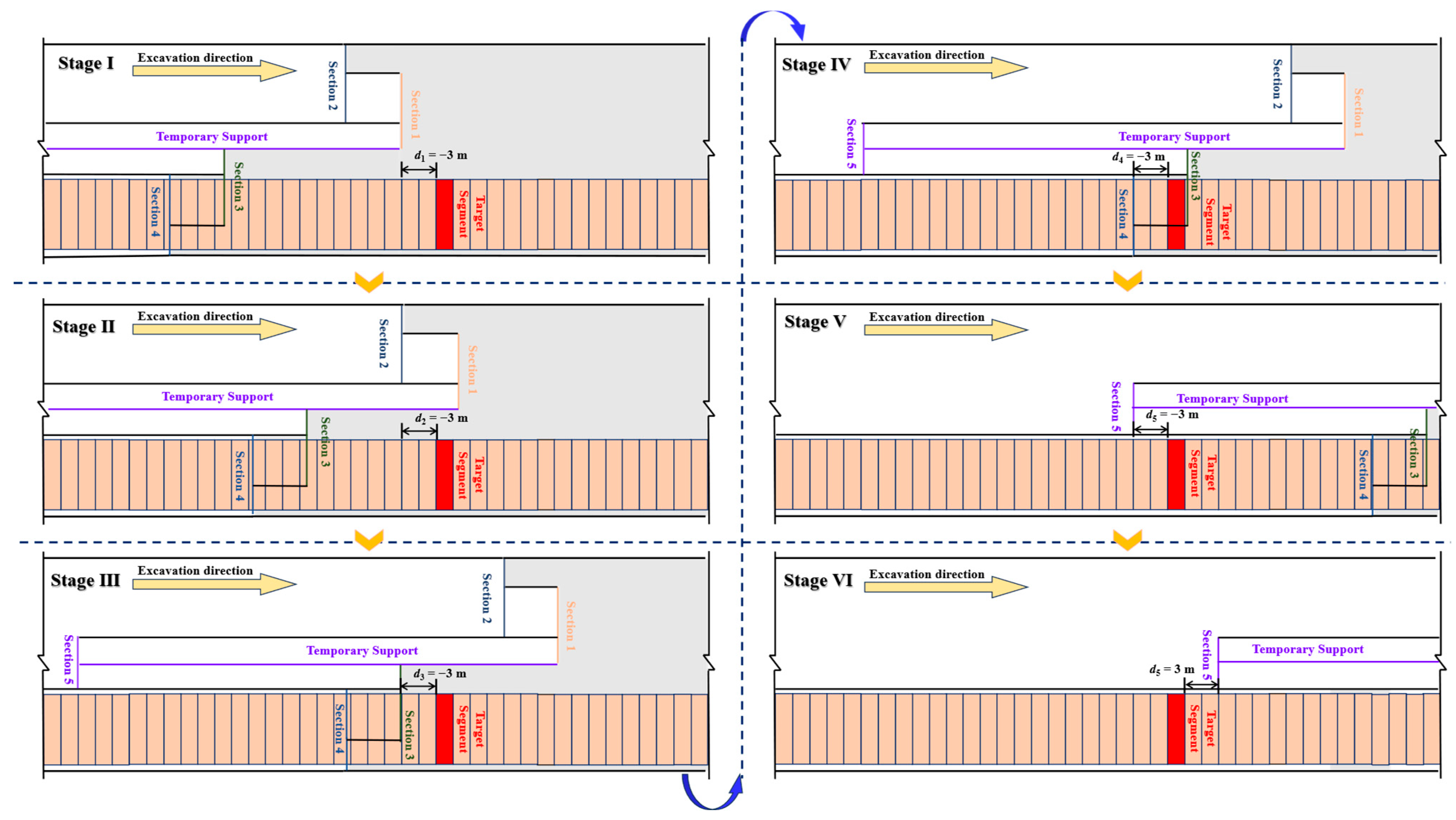
3.3. Division of Construction Stages
4. Result
4.1. Displacement Distribution and Trend
4.2. Distribution State of Bending Moments and Axial Forces
5. Discussion
6. Conclusions
- (1)
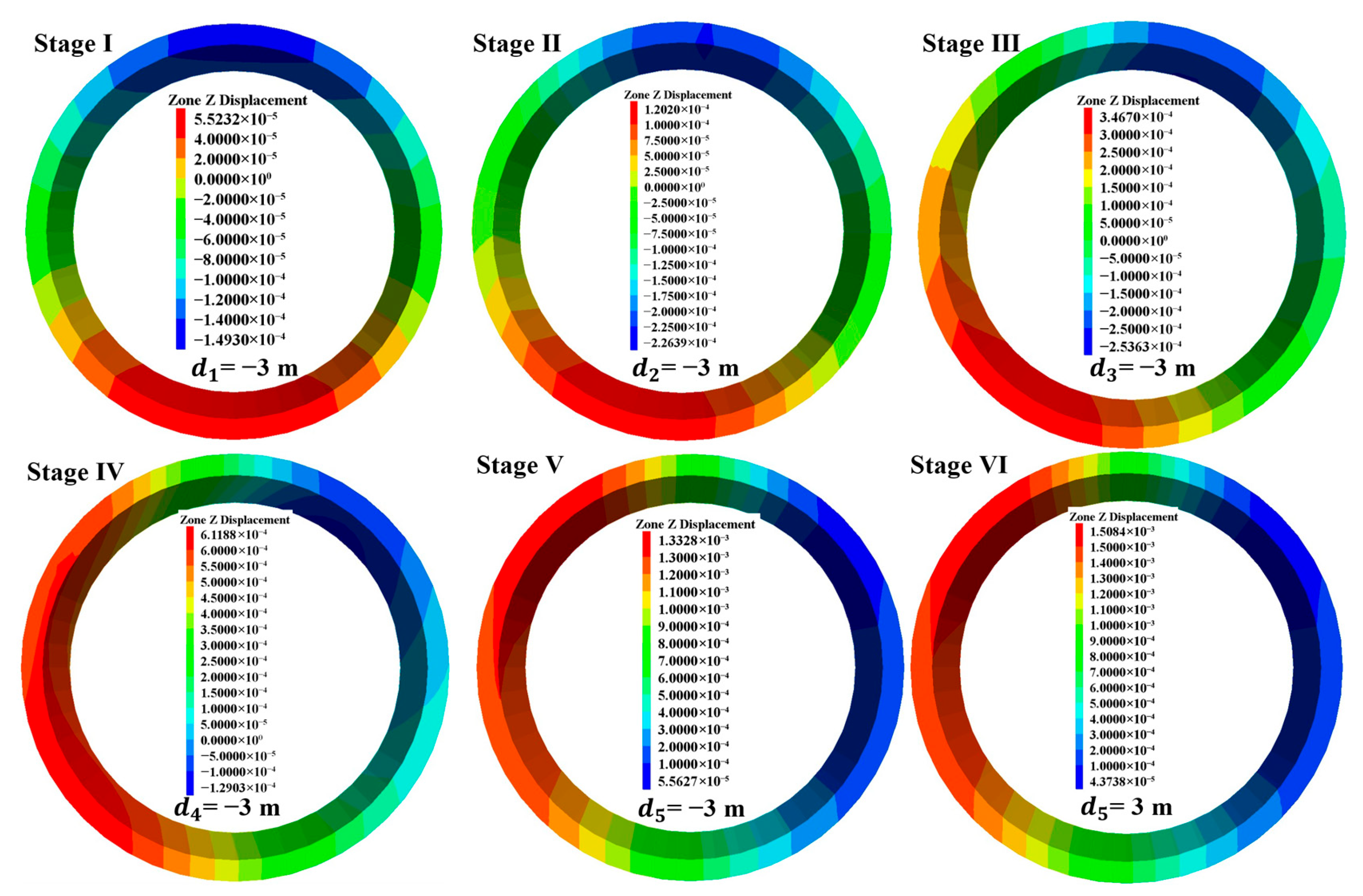
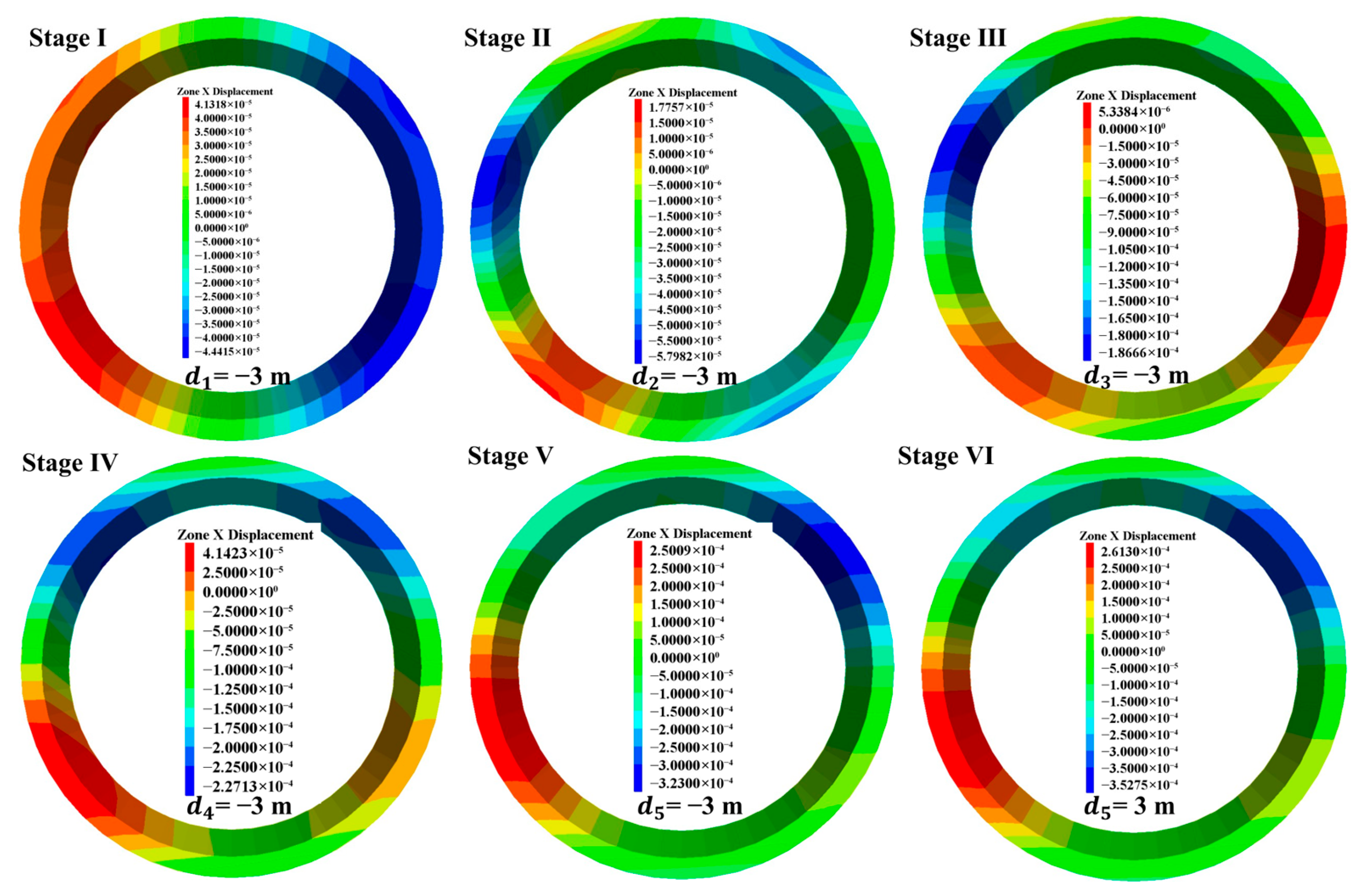
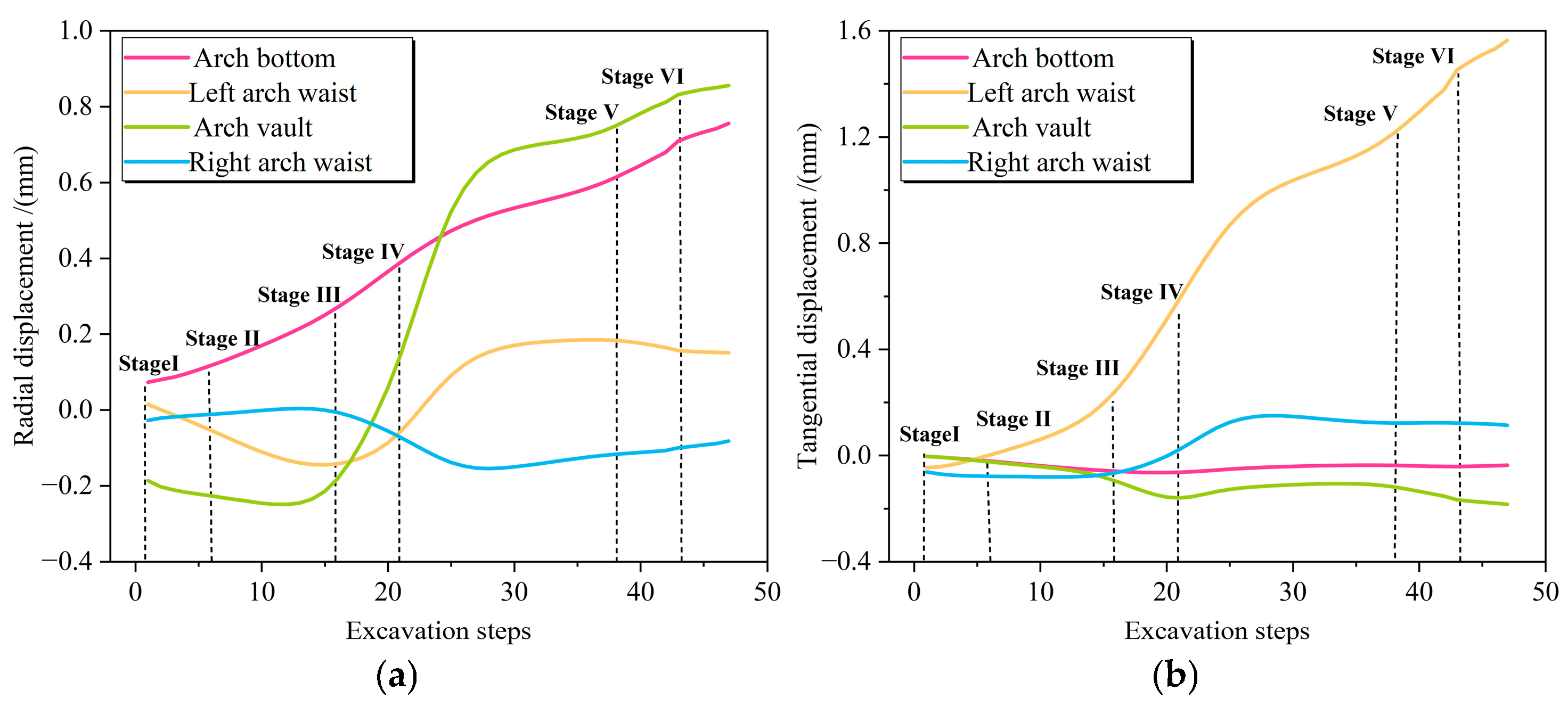
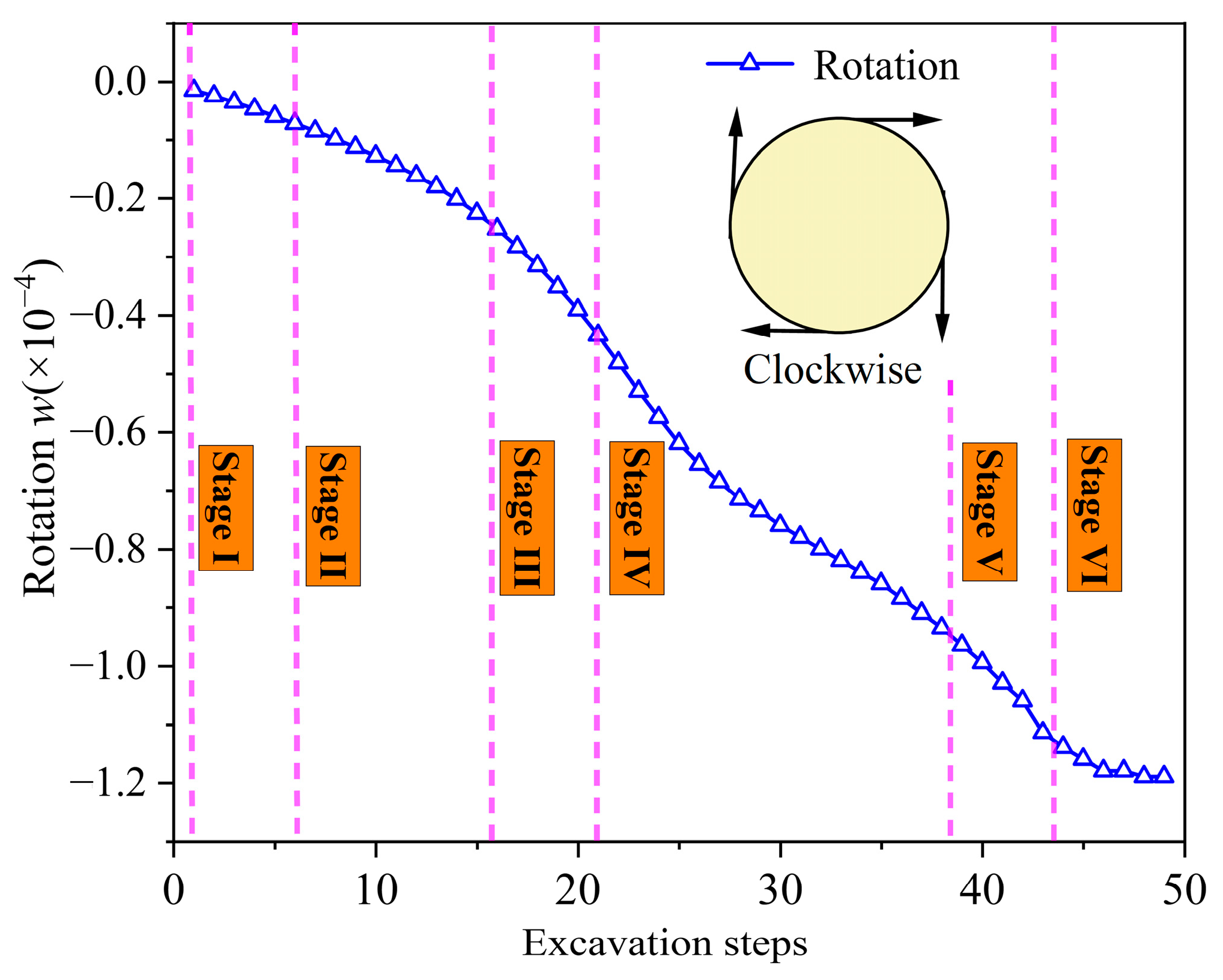
- The tunnel–station synchronous construction method offers notable advantages in practical engineering applications. This study investigated the mechanical response characteristics of target segments during different stages of this construction process. As excavation advanced, significant variations were observed in the displacement, internal forces, and residual bearing capacity coefficient of the target segment. The vertical displacement of temporary segments was considerably affected by the unloading of the arch surrounding rock, while the horizontal displacement exhibited an asymmetric evolution pattern, with the arch waist region showing the highest sensitivity.
- (2)
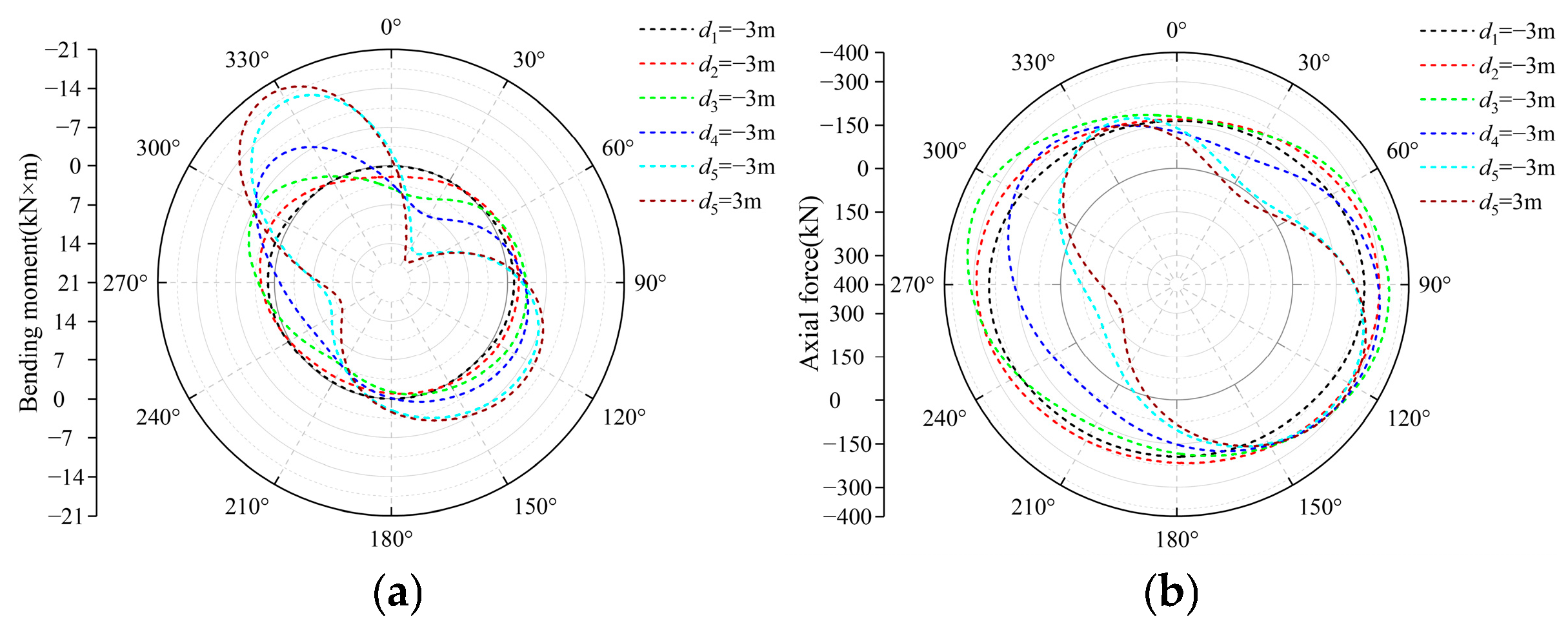
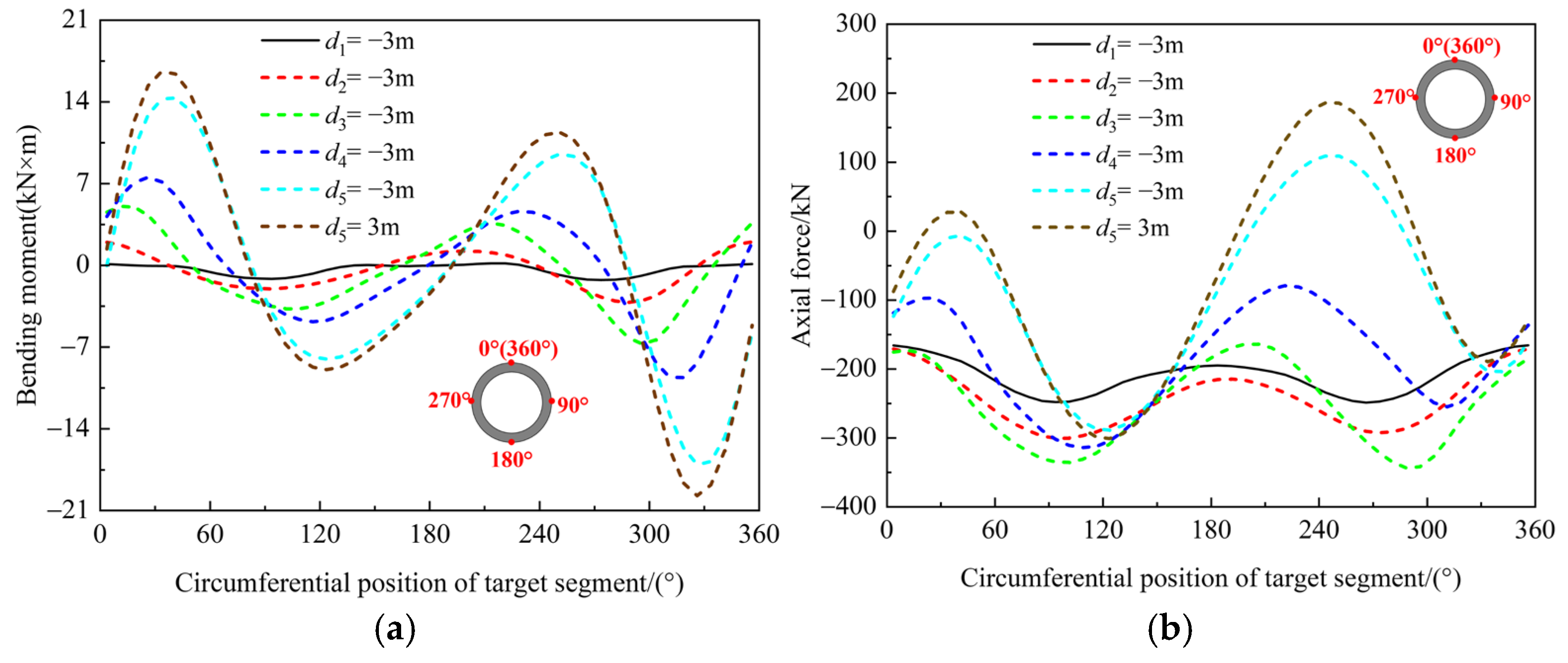
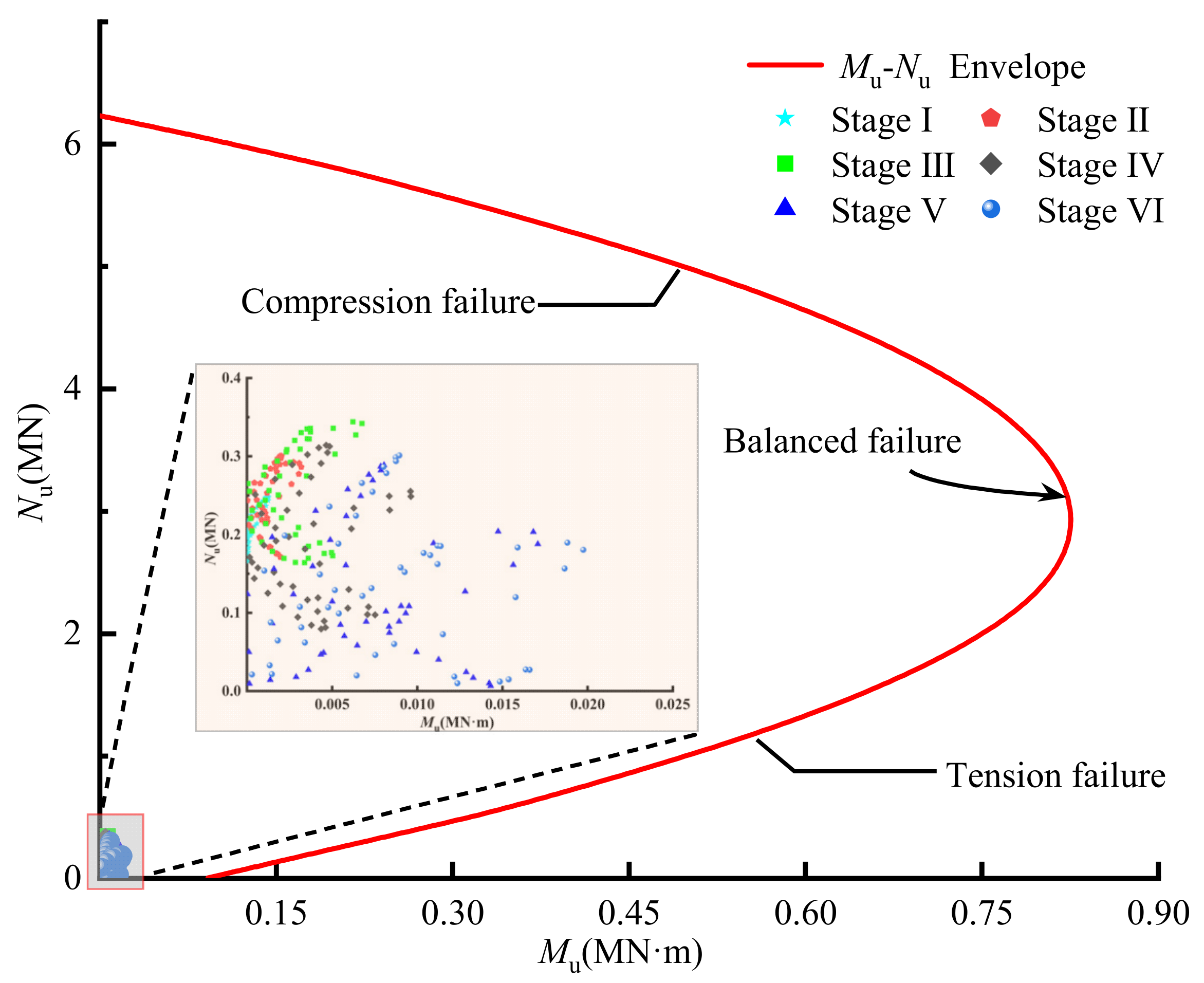
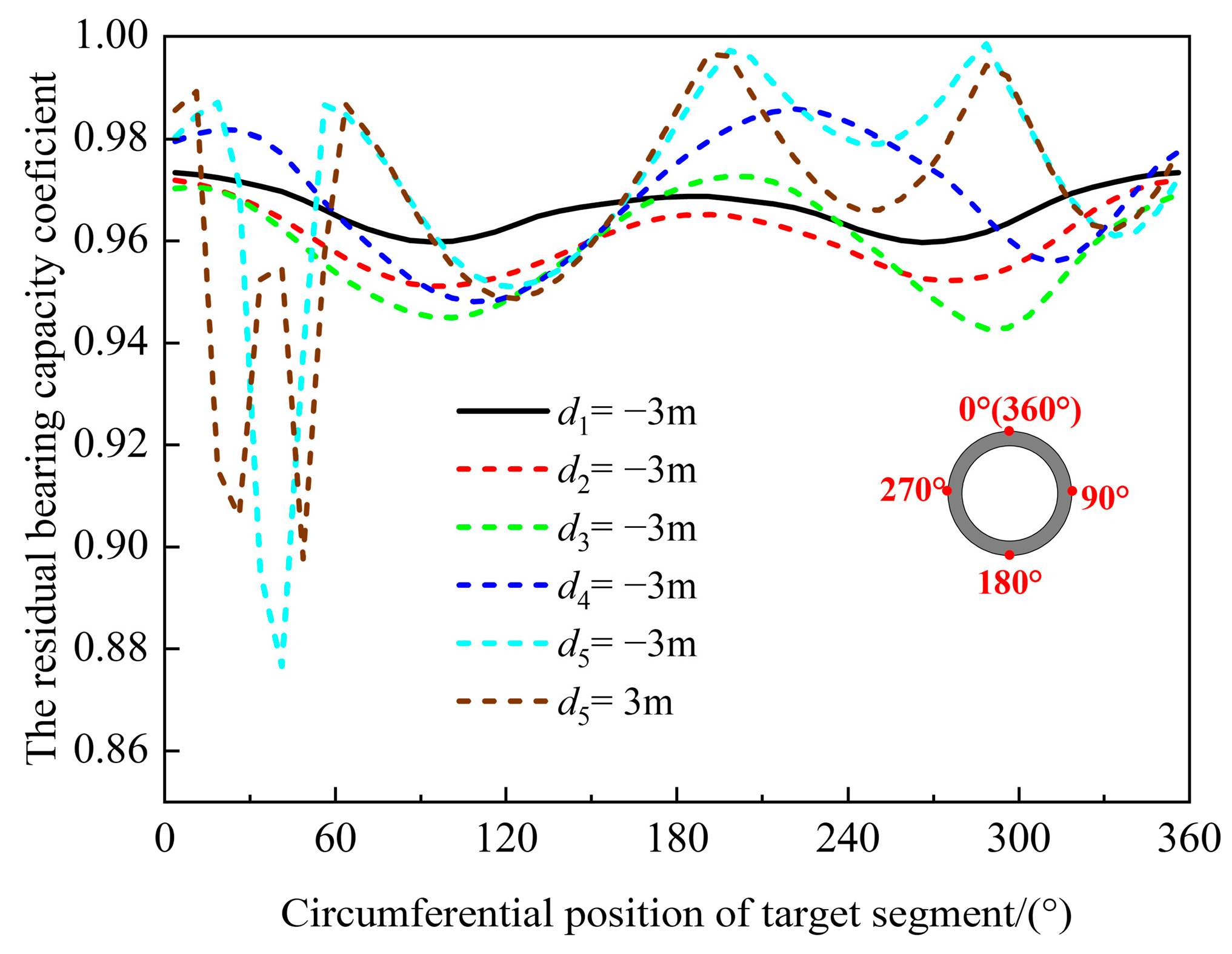
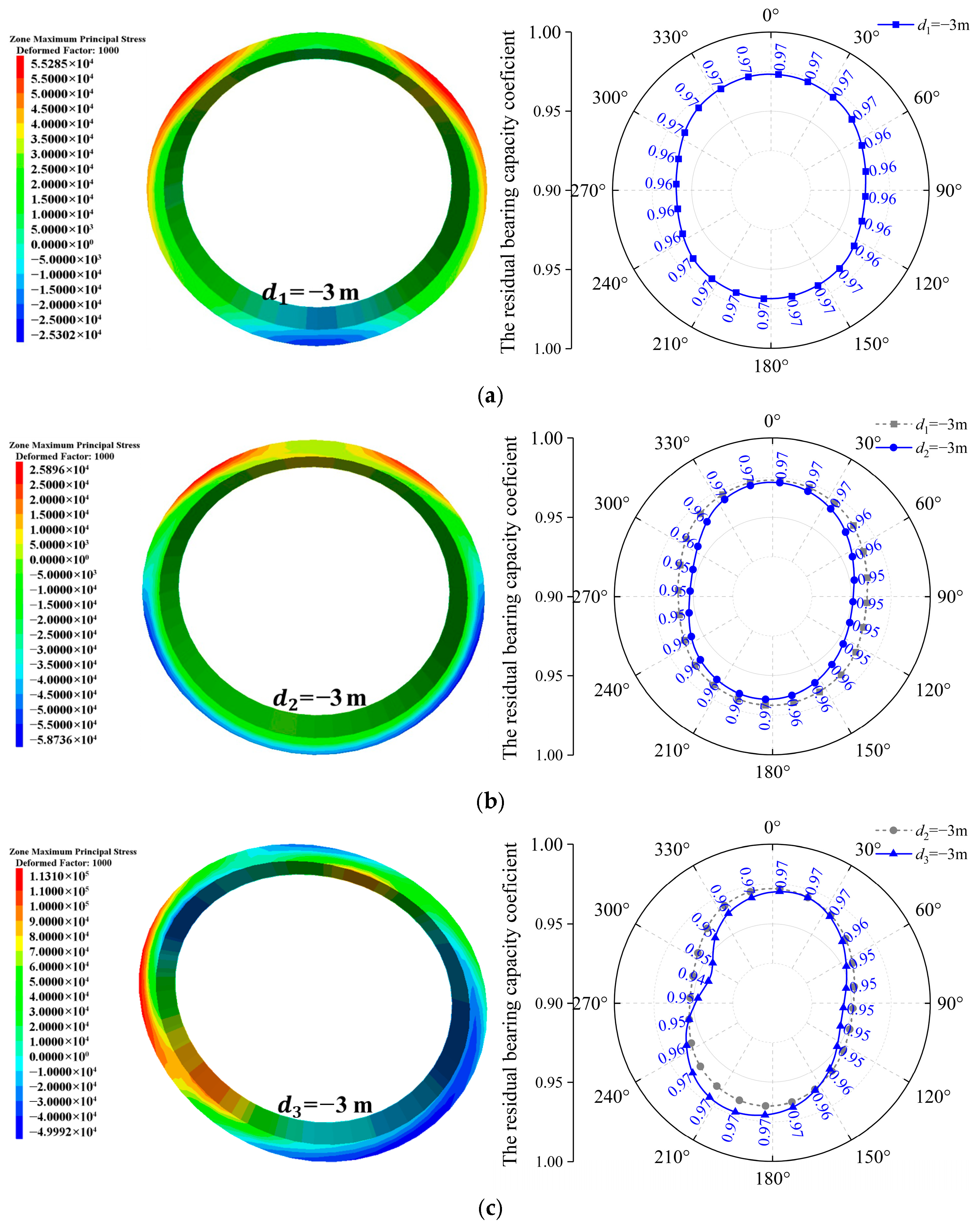
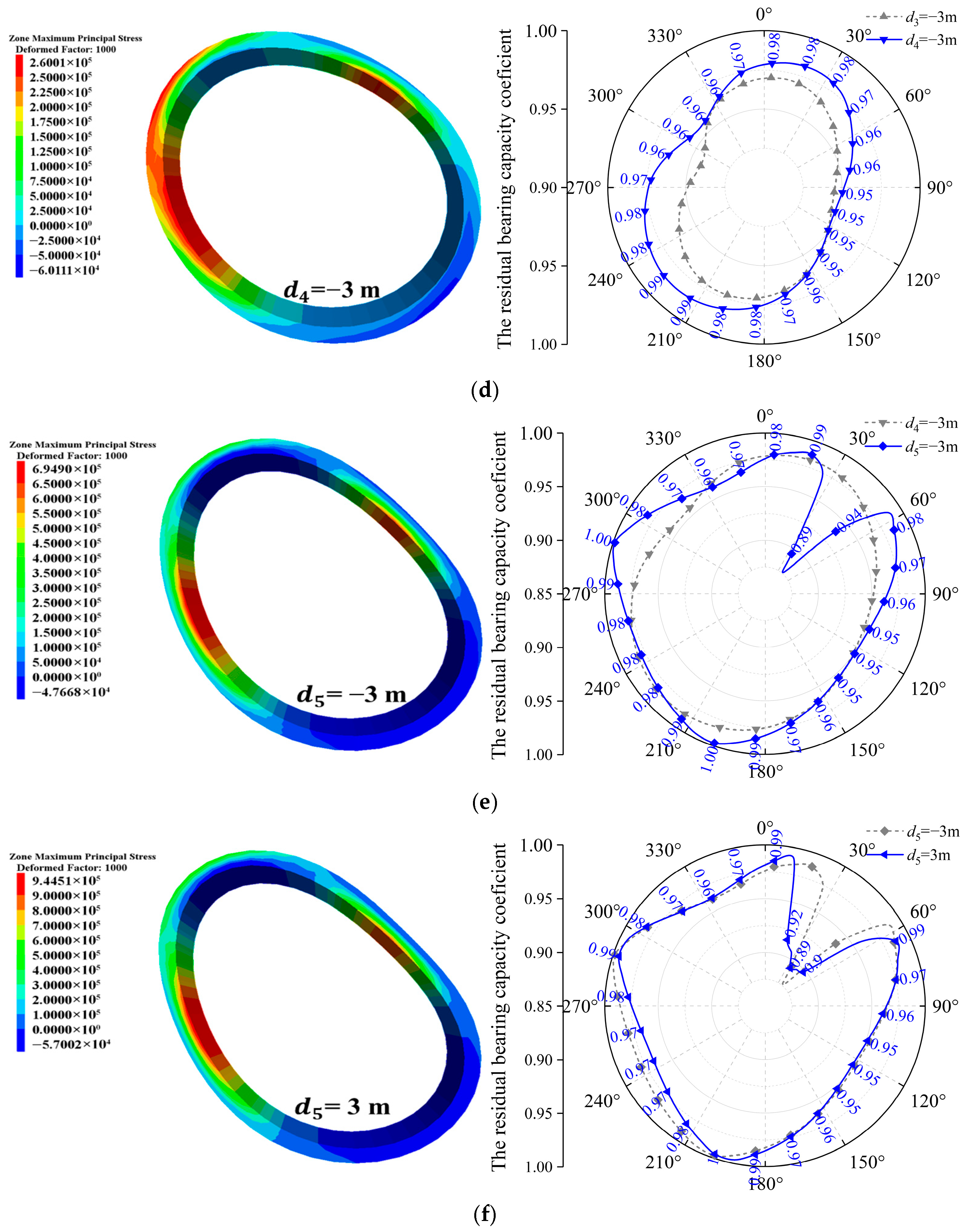
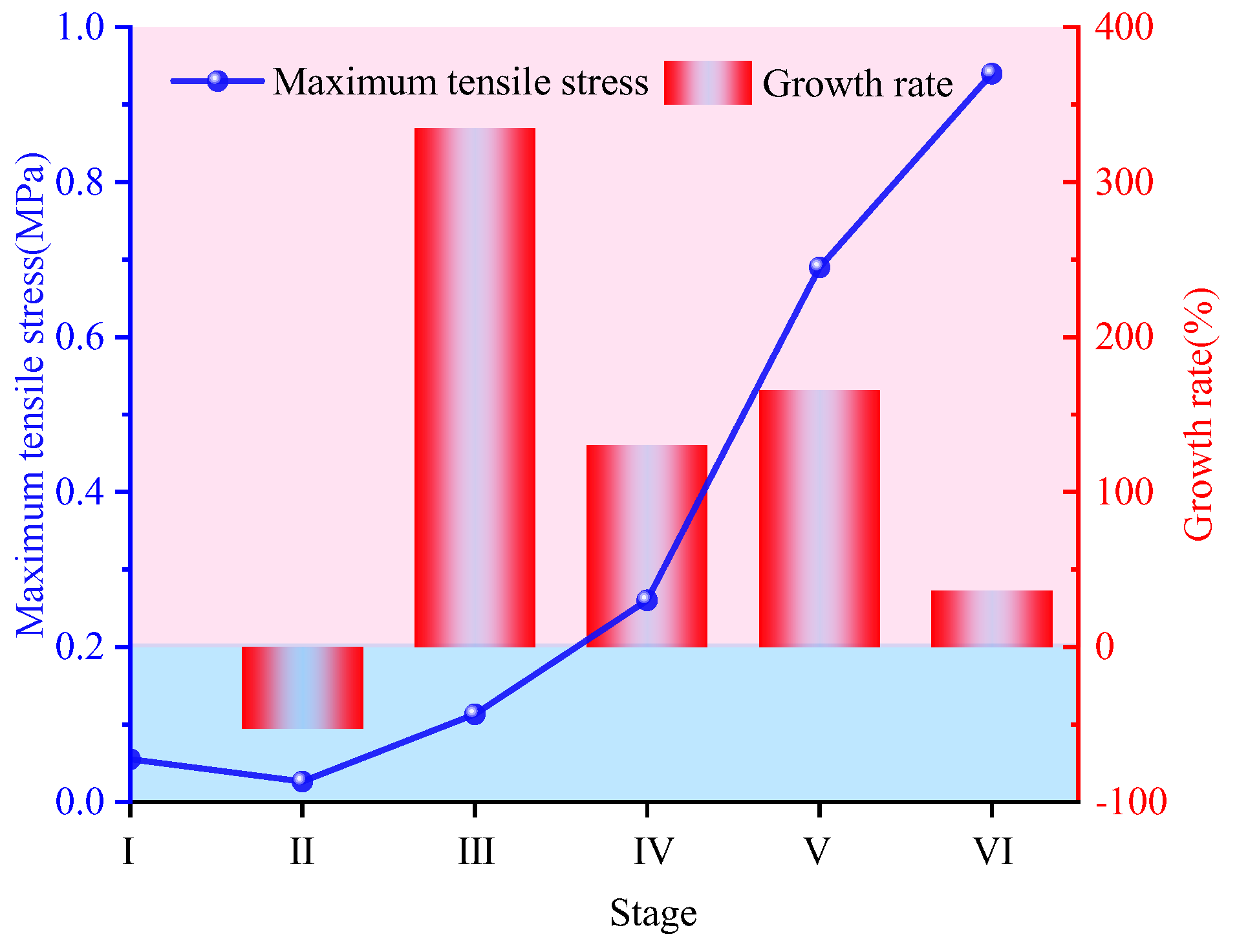
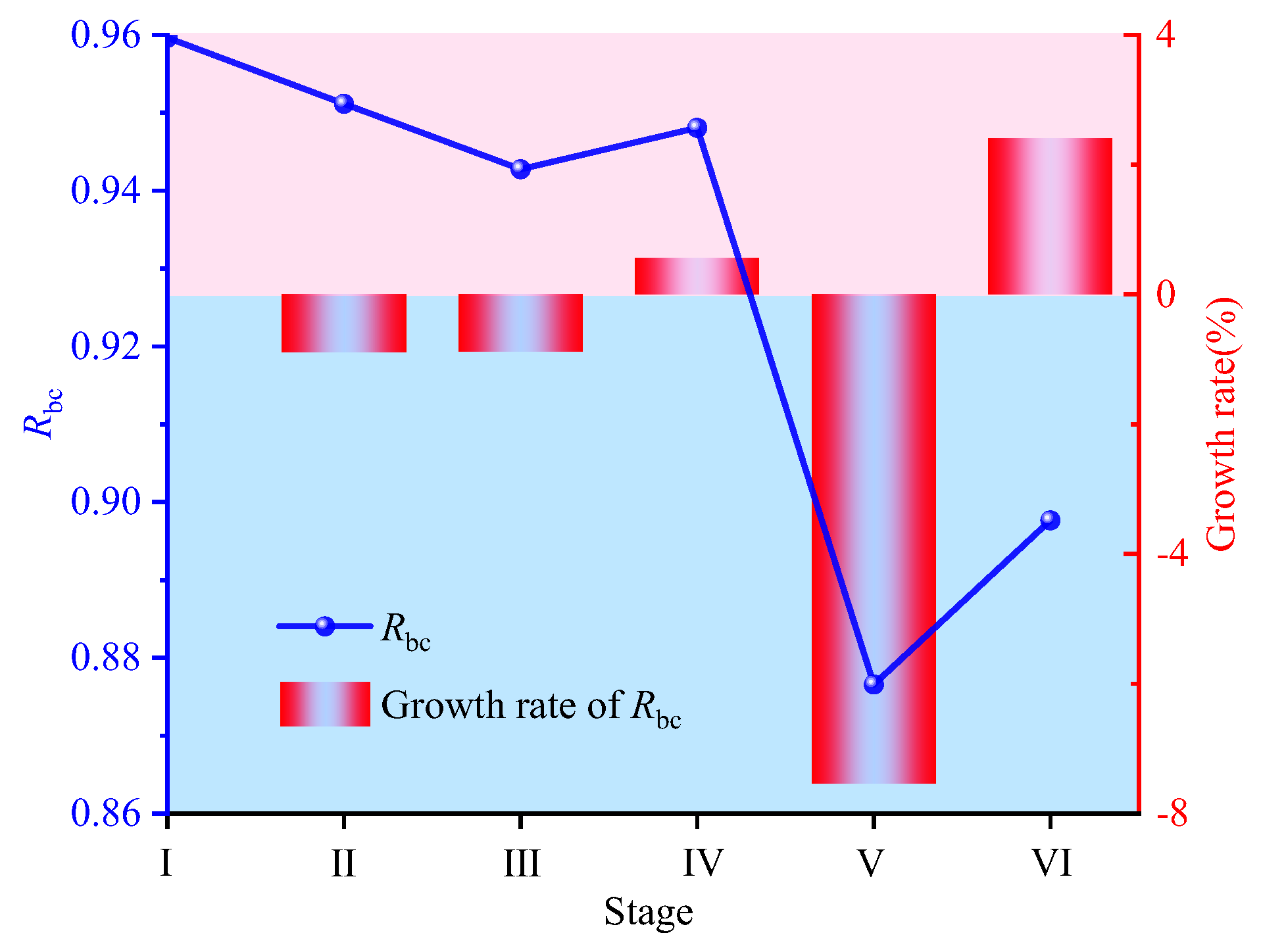
- Asymmetric unloading during station arch excavation led to an increase and clockwise shift in the bending moments of the target segment. Axial forces transitioned from compression to tension at specific locations (40° and 240°), whereas the removal of temporary supports had a limited influence. The maximum tensile stress of the target segment increased by 3.35 times in Stage III and reached 0.69 MPa in Stage V, representing a 1.65-fold increase compared to the previous stage. Although the residual bearing capacity coefficient generally satisfied safety requirements throughout construction, it decreased to a minimum value of 0.88 in Stage V (7% reduction from Stage IV).
- (3)
- In the Qingdao Metro project, the tunnel–station synchronous construction method achieved a time saving of 4.5 months compared to the conventional construction method (where the TBM must remain idle until the main station structure is completed). Under the conventional approach, the TBM idle time amounts to approximately 90 days for station construction, followed by an additional 44 days for completing the tunnel excavation through the station section. Therefore, adopting the synchronous construction method significantly reduces the overall construction timeline.
- (4)
- Through an in-depth analysis of the loading characteristics of the target segment under synchronous construction conditions, the design of temporary segments could be optimized, reducing the strength grade from C50 to C30. This optimization ensured structural stability and met construction requirements while achieving a reasonable control of costs. The numerical simulation methodology and findings of this study could provide valuable references for design optimization and risk control in the integrated construction of metro tunnels and stations in similar complex urban environments.
Author Contributions
Funding
Data Availability Statement
Conflicts of Interest
References
- Fan, G.; Li, C.; Shao, X.; Zhen, F.; Huang, Y. A New Type of Sustainable Operation Method for Urban Rail Transit: Joint Optimization of Train Route Planning and Timetabling. Sustain. Futures 2025, 10, 101084. [Google Scholar] [CrossRef]
- Hong, X.; Li, S.; Sun, W.; Ji, X. Assessment and Spatial Variation Analysis of the Collaborative Development Potential between Underground Public Spaces and Urban Rail Transit in China’s Urban Central Areas. Tunn. Undergr. Space Technol. 2025, 158, 106415. [Google Scholar] [CrossRef]
- Sadaghiani, M.H.; Dadizadeh, S. Study on the Effect of a New Construction Method for a Large Span Metro Underground Station in Tabriz-Iran. Tunn. Undergr. Space Technol. 2010, 25, 63–69. [Google Scholar] [CrossRef]
- Liu, J.; Wang, F.; He, S.; Wang, E.; Zhou, H. Enlarging a Large-Diameter Shield Tunnel Using the Pile-Beam-Arch Method to Create a Metro Station. Tunn. Undergr. Space Technol. 2015, 49, 130–143. [Google Scholar] [CrossRef]
- Dobashi, H.; Shiratori, A.; Miyama, D.; Nagura, H.; Miyawaki, T. Design and Construction of Enlarging Shield Tunnel Sections of Large Dimensional Shield Tunnels for the Non-Open-Cut Method. Tunn. Undergr. Space Technol. 2006, 21, 249. [Google Scholar] [CrossRef]
- Liu, X.; Liu, Y.; Yang, Z.; He, C. Numerical Analysis on the Mechanical Performance of Supporting Structures and Ground Settlement Characteristics in Construction Process of Subway Station Built by Pile-Beam-Arch Method. KSCE J. Civ. Eng. 2017, 21, 1690–1705. [Google Scholar] [CrossRef]
- Xu, X.; Li, Z.; Fang, Q.; Zheng, H. Challenges and Countermeasures for Using Pile-Beam-Arch Approach to Enlarge Large-Diameter Shield Tunnel to Subway Station. Tunn. Undergr. Space Technol. 2020, 98, 103326. [Google Scholar] [CrossRef]
- Wang, L.; Chen, X.; Su, D.; Liu, S.; Liu, X.; Jiang, S.; Gao, H.; Yang, W. Mechanical Performance of a Prefabricated Subway Station Structure Constructed by Twin Closely-Spaced Rectangular Pipe-Jacking Boxes. Tunn. Undergr. Space Technol. 2023, 135, 105062. [Google Scholar] [CrossRef]
- Cao, L.; Fang, Q.; Zhang, D.; Chen, T. Subway Station Construction Using Combined Shield and Shallow Tunnelling Method: Case Study of Gaojiayuan Station in Beijing. Tunn. Undergr. Space Technol. 2018, 82, 627–635. [Google Scholar] [CrossRef]
- Wang, L.; Chen, K.; Chen, X.; Su, D.; Liu, S.; Sun, B.; Li, W.; Yang, W.; Zhou, S. Low-Carbon Effects of Constructing a Prefabricated Subway Station Using a Trenchless Method: A Case Study in Shenzhen, China. Tunn. Undergr. Space Technol. 2024, 144, 105557. [Google Scholar] [CrossRef]
- Lei, M.; Zhao, C.; Jia, C.; Shi, C. Study on the Geological Adaptability of the Arch Cover Method for Shallow-Buried Large-Span Metro Stations. Tunn. Undergr. Space Technol. 2023, 132, 104897. [Google Scholar] [CrossRef]
- Song, C.; He, W.; Fei, M. Study on Mechanical Characteristics of Support System for Shallow-Buried Single-Arch Subway Station in Rock Stratum. Tunn. Undergr. Space Technol. 2022, 124, 104447. [Google Scholar] [CrossRef]
- Guo, X.; Jiang, A. Study on the Stability of a Large-Span Subway Station Constructed by Combining with the Shaft and Arch Cover Method. Tunn. Undergr. Space Technol. 2022, 127, 104582. [Google Scholar] [CrossRef]
- Ng, C.W.W.; Fong, K.Y.; Liu, H.L. The Effects of Existing Horseshoe-Shaped Tunnel Sizes on Circular Crossing Tunnel Interactions: Three-Dimensional Numerical Analyses. Tunn. Undergr. Space Technol. 2018, 77, 68–79. [Google Scholar] [CrossRef]
- Zhang, C.; Zhang, X.; Fang, Q. Behaviors of Existing Twin Subway Tunnels Due to New Subway Station Excavation below in Close Vicinity. Tunn. Undergr. Space Technol. 2018, 81, 121–128. [Google Scholar] [CrossRef]
- Liu, B.; Li, T.; Chang, W.; Han, Y.; Fu, C.; Yu, Z. Mechanical Response of Horseshoe-Shaped Tunnel Lining to Undercrossing Construction of a New Subway Station. Tunn. Undergr. Space Technol. 2022, 128, 104652. [Google Scholar] [CrossRef]
- Ye, X.W.; Ma, S.Y.; Liu, Z.X.; Chen, Y.B.; Lu, C.R.; Song, Y.J.; Li, X.J.; Zhao, L.A. LSTM-Based Deformation Forecasting for Additional Stress Estimation of Existing Tunnel Structure Induced by Adjacent Shield Tunneling. Tunn. Undergr. Space Technol. 2024, 146, 105664. [Google Scholar] [CrossRef]
- Pu, Y.; Sun, C.; Ao, Y.; Jin, C.; Tao, Q. Stratigraphic Response and Control Measures Induced by Excavation of Shallow Underpass Tunnels. Eng. Fail. Anal. 2025, 170, 109286. [Google Scholar] [CrossRef]
- Tan, Q.; Hu, B.; Liu, L.; Cheng, Y.; Sharifzadeh, M. Comparative Analysis of Creep Mechanical Characteristics of Yellow Mudstone Tunnel in Natural and Saturated Conditions: Insights from Experiments and Numerical Modeling. Eng. Fail. Anal. 2025, 182, 110121. [Google Scholar] [CrossRef]
- Zhang, R.; Wu, W.; Li, Q.; Liu, J.; Wang, A. A Dynamic Calculation Method for Safety Step Distance in Mechanized Soft Rock Tunnel Construction Using Multi-Source Data Integration. Tunn. Undergr. Space Technol. 2025, 165, 106867. [Google Scholar] [CrossRef]
- Miao, J.; Lu, D.; Lin, Q.; Kong, F.; Du, X. Time-Dependent Surrounding Soil Pressure and Mechanical Response of Tunnel Lining Induced by Surrounding Soil Viscosity. Sci. China Technol. Sci. 2021, 64, 2453–2468. [Google Scholar] [CrossRef]
- Zheng, G.; Lu, P.; Diao, Y. Computers and Geotechnics Advance Speed-Based Parametric Study of Greenfield Deformation Induced by EPBM Tunneling in Soft Ground. Comput. Geotech. 2015, 65, 220–232. [Google Scholar] [CrossRef]
- GB50157-2013; Code for Design of Metro. China Architecture & Building Press: Beijing, China, 2014.
- TB10003-2016; Code for Design of Railway Tunnel. China Railway Publishing House: Beijing, China, 2017.
- GB/T51438-2021; Standard for Design of Shield Tunnel Engineering. China Architecture & Building Press: Beijing, China, 2021.
- Zhang, Y.; Tao, L.; Liu, J.; Zhao, X.; Guo, F.; Tan, L.; Wang, Z. Construction Techniques and Mechanical Behavior of Newly-Built Large-Span Tunnel Ultra-Short Distance Up-Crossing the Existing Shield Tunnel with Oblique Angle. Tunn. Undergr. Space Technol. 2023, 138, 105162. [Google Scholar] [CrossRef]
- Zhang, L.; Feng, K.; Gou, C.; He, C.; Liang, K.; Zhang, H. Failure Tests and Bearing Performance of Prototype Segmental Linings of Shield Tunnel under High Water Pressure. Tunn. Undergr. Space Technol. 2019, 92, 103053. [Google Scholar] [CrossRef]
- Hatzigeorgiou, G.D.; Beskos, D.E. Soil—Structure Interaction Effects on Seismic Inelastic Analysis of 3-D Tunnels. Soil Dyn. Earthq. Eng. 2010, 30, 851–861. [Google Scholar] [CrossRef]



| Material | Thickness (m) | Density (kg/m3) | Elastic Modulus (GPa) | Poisson’s Ratio | Cohesion (MPa) | Internal Friction Angle (°) |
|---|---|---|---|---|---|---|
| Plain fill | 5 | 1800 | 0.005 | 0.33 | 0.015 | 15 |
| Rank IV Rock | 11 | 2300 | 1.3 | 0.23 | 0.01 | 45 |
| Rank III Rock | 64 | 2640 | 25 | 0.19 | 0.02 | 65 |
| Material | Density(kg/m3) | Elastic Modulus (GPa) | Poisson’s Ratio |
|---|---|---|---|
| Primary Support | 2300 | 30.32 | 0.2 |
| Temporary Support | 2300 | 30.32 | 0.23 |
| Anchor Bolt | / | 210 | / |
| Shield Shell | 7850 | 200 | 0.3 |
| Equivalent Layer | 2400 | 0.12 | 0.25 |
| Temporary Segments | 2500 | 25.5 | 0.2 |
Disclaimer/Publisher’s Note: The statements, opinions and data contained in all publications are solely those of the individual author(s) and contributor(s) and not of MDPI and/or the editor(s). MDPI and/or the editor(s) disclaim responsibility for any injury to people or property resulting from any ideas, methods, instructions or products referred to in the content. |
© 2025 by the authors. Licensee MDPI, Basel, Switzerland. This article is an open access article distributed under the terms and conditions of the Creative Commons Attribution (CC BY) license (https://creativecommons.org/licenses/by/4.0/).
Share and Cite
He, X.; Liu, Y.; Zhang, S.; Shi, X.; Cao, Y.; Li, X.; Zhang, S. Investigation into the Mechanical Response of Shield Lining Under Simultaneous Construction of Subway Station and Tunnel. Processes 2025, 13, 3968. https://doi.org/10.3390/pr13123968
He X, Liu Y, Zhang S, Shi X, Cao Y, Li X, Zhang S. Investigation into the Mechanical Response of Shield Lining Under Simultaneous Construction of Subway Station and Tunnel. Processes. 2025; 13(12):3968. https://doi.org/10.3390/pr13123968
Chicago/Turabian StyleHe, Xusu, Yang Liu, Shilin Zhang, Xuantao Shi, Yanhua Cao, Xiaowei Li, and Sulei Zhang. 2025. "Investigation into the Mechanical Response of Shield Lining Under Simultaneous Construction of Subway Station and Tunnel" Processes 13, no. 12: 3968. https://doi.org/10.3390/pr13123968
APA StyleHe, X., Liu, Y., Zhang, S., Shi, X., Cao, Y., Li, X., & Zhang, S. (2025). Investigation into the Mechanical Response of Shield Lining Under Simultaneous Construction of Subway Station and Tunnel. Processes, 13(12), 3968. https://doi.org/10.3390/pr13123968