Article

Mechanism and Parameter Optimization of Surfactant-Assisted CO2 Huff-n-Puff for Enhanced Oil Recovery in Tight Conglomerate Reservoirs


1
Research Institute of Exploration and Development, Xinjiang Oilfield Company, Petro China, Karamay 834000, China
2
Key Laboratory of Unconventional Oil & Gas Development, China University of Petroleum (East China), Ministry of Education, Qingdao 266580, China
3
School of Petroleum Engineering, China University of Petroleum (East China), Qingdao 266580, China
*
Author to whom correspondence should be addressed.
Processes 2025, 13(12), 3888; https://doi.org/10.3390/pr13123888
Submission received: 4 November 2025 / Revised: 19 November 2025 / Accepted: 26 November 2025 / Published: 2 December 2025
(This article belongs to the Special Issue Flow Mechanisms and Enhanced Oil Recovery)

Abstract

China possesses abundant tight conglomerate oil resources. However, these reservoirs are typically characterized by low porosity and permeability, high clay mineral content, and complex pore structures, resulting in poor performance of conventional waterflooding development. Challenges including insufficient energy replenishment and high flow resistance ultimately lead to low oil recovery factors. This study systematically investigates surfactant-assisted CO2 huff-n-puff (SA-CO2-HnP) for enhanced oil recovery in tight conglomerate reservoirs. For a tight conglomerate reservoir in a Xinjiang block, a fully implicit, multiphase, multicomponent dual-porosity numerical model was established. By integrating pore–throat distributions acquired through high-pressure mercury intrusion with a self-developed MATLAB PVT package, nanoconfinement-induced shifts in the phase envelope were rigorously embedded into the simulation framework. The calibrated model was subsequently employed to conduct a comprehensive sensitivity analysis, quantitatively delineating the influence of petrophysical, completion, and operational variables on production performance. Simulation results demonstrate that compared to conventional CO2 huff-n-puff, the addition of surfactants increases the cumulative recovery factor by 3.5 percentage points over a 20-year production period. The enhancement mechanisms primarily include reducing CO2–oil interfacial tension (IFT) and minimum miscibility pressure (MMP), improving reservoir wettability, and promoting CO2 dissolution and diffusion in crude oil. Sensitivity analysis reveals that injection duration, injection pressure, and injection rate significantly influence recovery efficiency, while soaking time exhibits relatively limited impact. Moreover, an optimal surfactant concentration (0.0003 mole fraction) exists; excessive concentrations lead to diminished enhancement effects due to competitive adsorption and pore blockage. This study demonstrates that SA-CO2-HnP technology offers favorable economic viability and operational feasibility, providing theoretical foundation and parameter optimization guidance for efficient tight conglomerate oil reservoir development.

1. Introduction

China possesses abundant tight conglomerate oil resources with proven geological reserves reaching 28.3 billion tons [1]. As a strategic alternative resource in China’s oil and gas sector, tight conglomerate oil plays a vital role in ensuring national energy security [2,3]. However, compared to conventional reservoirs, tight conglomerate oil reservoirs are characterized by low porosity and permeability, strong heterogeneity, and complex pore structures. These petrophysical characteristics pose significant challenges to the efficient development of tight conglomerate oil resources [4].
Early development practices have demonstrated that tight conglomerate oil reservoirs, mainly characterized by secondary dissolution pores, small pore throats, and poor sorting, severely restrict oil and gas flow capacity, resulting in difficulties in reservoir energy replenishment and poor performance of conventional waterflooding. During tight conglomerate development, the high flow resistance caused by complex pore throats and continuous reservoir energy depletion induced by long-term production have become the primary technical bottlenecks constraining sustained stable production and efficient development of tight conglomerate oil reservoirs [5,6,7]. Therefore, reducing flow resistance in pore throats and achieving effective energy replenishment through fluid injection have become critical to overcoming the technical barriers in tight conglomerate reservoir enhanced oil recovery (EOR). As a key EOR technology, gas injection has gradually emerged as one of the most promising technical approaches in tight conglomerate oil production enhancement due to its unique physicochemical mechanisms.
Gas-injection-enhanced oil recovery technology has emerged as a research hotspot in unconventional reservoir development, with significant progress achieved in related studies. Based on the phase behavior characteristics between injected gas and crude oil, gas injection methods can be categorized into miscible and immiscible flooding. According to injection timing, gas injection can be classified as continuous gas injection (CGI), cyclic gas injection (huff-n-puff), and intermittent gas injection. Studies have demonstrated that cyclic gas injection exhibits more pronounced advantages in replenishing tight conglomerate reservoir energy and enhancing tight conglomerate oil recovery. Commonly used injection gases include N2, CO2, natural gas, associated gas, and air. Among these, CO2 injection demonstrates the most outstanding performance in improving crude oil properties [8] and enhancing oil recovery. With increasing CO2 injection volumes, mechanisms such as diffusion, oil swelling, viscosity reduction, miscibility development, and energy replenishment are progressively intensified, facilitating miscible displacement with crude oil and thereby significantly enhancing oil recovery [9].
Extensive studies have demonstrated that the miscibility condition between CO2 and crude oil is a critical factor determining oil displacement efficiency. Miscible displacement can significantly reduce oil–gas interfacial tension (IFT) and improve sweep efficiency and displacement efficiency, thereby substantially enhancing oil recovery. Minimum miscibility pressure (MMP) is a core parameter for evaluating CO2 flooding performance, defined as the minimum pressure required for CO2 and crude oil to achieve complete miscibility through multiple contacts. When the injection pressure exceeds MMP, CO2 and crude oil can achieve dynamic miscibility, eliminating interfacial tension and significantly improving displacement efficiency [10]. However, reservoir pressures in many fields are below MMP, resulting in immiscible or near-miscible CO2 flooding conditions. While near-miscible flooding can induce complex phase behavior shifts that may enhance oil recovery compared to purely immiscible conditions through mechanisms such as the transition toward liquid–liquid equilibrium [11], the displacement efficiency remains constrained relative to fully miscible flooding. Currently, MMP determination methods primarily include experimental approaches such as slim tube tests, the rising bubble method, and the vanishing interfacial tension (VIT) method, as well as theoretical prediction methods including equation of state (EOS) and empirical correlations [12,13]. Hemmati-Sarapardeh et al. [14] measured the MMP between crude oil and CO2 using axisymmetric drop shape analysis, demonstrating that MMP is primarily influenced by crude oil composition (particularly the C5+ heavy component content), reservoir temperature, and CO2 purity. Generally, light crude oils exhibit relatively lower MMP values, while heavy crude oils require higher pressures to achieve miscible displacement.
Field practices have demonstrated that actual reservoir pressures in most fields are significantly lower than miscibility pressure, failing to meet the pressure requirements for miscible displacement. Consequently, reducing MMP has become a critical research direction for expanding the applicability of CO2 flooding. Among various MMP reduction methods, surfactant addition has attracted considerable attention due to its economic viability and technical feasibility [15]. Surfactants can reduce the miscibility pressure of CO2–oil systems through multiple mechanisms. Surfactant molecules possess amphiphilic structures and can orient and adsorb at the CO2–oil interface, thereby significantly reducing IFT. Zhang et al. [16] employed ethanol as a co-solvent, substantially enhancing the solubility of four surfactants in CO2, intensifying CO2 extraction of light hydrocarbon components from crude oil, and effectively reducing both IFT and MMP of the CO2–oil system. Liu et al. [17] quantitatively investigated the influence of different surfactant types on CO2–oil miscibility pressure, revealing that CO2-philic groups in ether-based surfactants paradoxically weakened miscibility, while ester-based surfactants could significantly reduce MMP through synergistic effects of symmetric short-chain structures and ester groups. Additionally, surfactants can improve crude oil rheological properties and enhance CO2 diffusion coefficients in crude oil. Li et al. [18] utilized microfluidic visualization technology to design straight and curved channel micromodels, investigating the effects of two nonionic surfactants on CO2–oil interaction mechanisms and finding that surfactant addition could accelerate miscibility development and optimize oil rheological performance. In recent years, development of CO2-philic surfactants has become a research focus, primarily including fluorocarbon surfactants, organosilicon surfactants, and novel surfactants containing CO2-philic functional groups. Fluorocarbon surfactants exhibit excellent solubility and interfacial activity in supercritical CO2 systems due to their unique hydrophobic and oleophobic properties [19,20,21]. However, these surfactants present environmental risks including high synthesis costs and strong bioaccumulation potential, constraining their large-scale field application. Therefore, developing efficient, economical, and environmentally friendly surfactants for CO2 flooding remains a critical scientific challenge requiring urgent resolution.
As a cyclic injection-production process, CO2 huff-n-puff has demonstrated distinct advantages in the development of low-permeability and unconventional reservoirs. This process comprises three sequential stages: injection, soaking, and production. Extensive research has been conducted by scholars worldwide to elucidate the mechanisms of CO2 huff-n-puff under multicomponent and multimechanism coupling effects. Based on the reservoir parameters of the middle Bakken member, Jia et al. [22] developed a dual-porosity dual-permeability numerical model using a compositional simulator. Their findings indicated that molecular diffusion causes a slight decline in average reservoir pressure during the soaking stage, while during the production stage, diffusion retards the pressure depletion rate, reduces the gas–oil ratio (GOR), and extends the plateau production period. The study by Peng et al. [23] further confirmed that prolonging the soaking time enhances the contribution of CO2 molecular diffusion to recovery factor improvement. Yang et al. [24] systematically summarized the mechanisms and influencing factors of CO2 huff-n-puff in tight conglomerate oil reservoirs, highlighting that molecular diffusion predominates during the soaking stage. CO2 penetrates into pores and low-permeability zones through molecular diffusion, then contacts and dissolves into the crude oil, thereby inducing multiple effects including oil swelling, viscosity reduction, and oil–gas miscibility. During the production stage, the primary driving force is the pressure gradient, with CO2 and crude oil flowing together toward the wellbore. As early as the 1980s, Haskin et al. [25] conducted a CO2 huff-n-puff pilot test in the field, demonstrating that compared to continuous CO2 flooding, CO2 huff-n-puff offers advantages including lower initial investment, faster response, and greater operational flexibility, making it particularly suitable for reservoirs with imperfect pressure systems or where injection-production well patterns have not yet been established. Field applications have demonstrated that CO2 huff-n-puff technology has achieved remarkable production enhancement in North American tight conglomerate oil reservoirs, Xinjiang Oilfield in China, and other sites, with cumulative incremental production per well ranging from 30% to 150%. However, this technology also exhibits limitations such as rapid cycle production decline and short effective cycle duration. Optimizing injection parameters (injection volume, injection rate, soaking time, etc.) and prolonging CO2 residence time in the reservoir are critical to enhancing huff-n-puff performance. Zuloaga et al. [26] conducted a sensitivity analysis on four uncertain parameters in the Bakken reservoir—matrix permeability, well count, well pattern, and fracture half-length—using response-surface methodology coupled with numerical simulation. The results revealed that CO2 huff-n-puff outperforms continuous gas injection when matrix permeability is below 0.03 mD. Sheng [27] conducted an optimization study on CO2 huff-n-puff operational parameters by comprehensively considering field production conditions and reservoir property constraints (maximum injection/production rate, maximum injection pressure, and minimum production pressure). The simulation results indicated that the optimal injection and production durations should continue until the near-wellbore pressure reaches its extremum, while the soaking time and number of huff-n-puff cycles should be determined based on economic benefits.
Although CO2 huff-n-puff technology has demonstrated promising application prospects for production enhancement in tight conglomerate oil reservoirs, conventional CO2 huff-n-puff still faces numerous technical challenges: (1) under immiscible or near-miscible conditions, the interfacial tension between CO2 and crude oil remains relatively high, constraining displacement efficiency; (2) the slow diffusion rate of CO2 in the matrix makes it difficult to effectively sweep deep reservoir zones during the soaking stage; (3) as huff-n-puff cycles progress, reservoir pressure continuously declines, resulting in a gradual decrease in recovery per cycle. To address these challenges, integrating surfactants with CO2 huff-n-puff processes and developing surfactant-assisted CO2 huff-n-puff technology has emerged as a significant research direction for enhanced tight conglomerate oil recovery.
The incorporation of surfactants can synergistically enhance CO2 huff-n-puff performance from multiple perspectives. Wei et al. [28] conducted laboratory physical simulation experiments on CO2 huff-n-puff and proposed a synergistic enhanced oil recovery strategy combining surfactant-assisted spontaneous imbibition with CO2 huff-n-puff. They found that surfactants can significantly reduce the CO2–crude oil interfacial tension and MMP, enabling the system to approach or achieve miscibility at lower pressures, thereby enhancing CO2 extraction efficiency. Furthermore, surfactants can alter reservoir surface wettability, reduce capillary forces, and promote oil desorption from nanopores. Meanwhile, by enhancing the solubility and diffusion capacity of CO2 in crude oil, they shorten the required soaking time and improve sweep efficiency. Haeri et al. [29] systematically investigated the synergistic enhancement effect of nonionic surfactants on CO2 huff-n-puff through core flooding experiments. The results demonstrated that surfactant addition can increase the recovery factor by 8–15 percentage points and effectively retard the production decline rate across huff-n-puff cycles. Aboahmed et al. [30] conducted a numerical simulation study on surfactant-assisted CO2 huff-n-puff in tight oil reservoirs, revealing that the surfactant concentration, injection timing, and co-injection scheme significantly influence ultimate recovery. The optimized surfactant–CO2 hybrid system can enhance cumulative oil production by more than 20%.
In conclusion, although the surfactant-assisted CO2 huff-n-puff technology itself is already widely known, this study has achieved important advancements and innovations in its application to tight conglomerate reservoirs. First of all, a multiphase and multicomponent dual-porosity medium numerical simulation model was developed. By integrating the pore size data obtained from mercury intrusion experiments and a self-written MATLAB (R2024a) phase behavior program, the phase diagram of this reservoir under the nanoconfinement effect was mapped. Additionally, the phase diagram was fitted by adjusting the oil-phase components in CMG (2022), thus considering the impact of the nanoconfinement effect on the phase behavior of tight conglomerates in the numerical simulation. Finally, based on the strong heterogeneity of tight conglomerates, the key parameters of surfactant-assisted CO2 huff-n-puff were identified. This provides a highly targeted, cost-effective parameter optimization guide for field practice and is of great guiding significance for the development of Xinjiang Oilfield and similar basins.

2. Mathematical Model

To simulate the huff-n-puff process of surfactant-assisted CO2 in tight conglomerate oil reservoirs, a multiphase, multicomponent, and multiscale coupled flow mathematical model is developed. The model is based on the following assumptions: (1) three phases (oil, gas, and water) coexist in the reservoir, and all phase fluids are compressible; (2) component exchange occurs between CO2 and crude oil, satisfying phase equilibrium conditions; (3) surfactants dissolve in the aqueous phase and enhance displacement efficiency by reducing oil–water interfacial tension and altering wettability. This assumption is justified for the water-soluble surfactants considered in this study, as their partitioning into the oleic and supercritical CO2 phases is expected to be negligible under reservoir conditions, which represents a common and validated simplification in analogous simulation studies [31,32]; (4) the reservoir is represented by a dual-medium model comprising two pore systems: matrix and fracture; (5) the effects of gravity, temperature variations, and chemical reactions are neglected.
The model employs a compositional approach to describe the multiphase multicomponent flow process. For component i ( i = 1, 2, …, N c ), the mass conservation equation is expressed as
t ϕ ρ o S o x i + ρ g S g y i + ρ o x i v o + ρ g y i v g = q i
For the water phase,
t ϕ ρ w S w + ρ w v w = q w
where x i and y i represent the mole fractions of component i in the oil and gas phases, respectively; ρ α is the density of the phase α ( α = o , g , w representing the oil, gas, and water phases, respectively); S α is the saturation; v α is the flow velocity of phase α ; q i and q w represent the source term and sink term, respectively;
The flow velocity of each phase is given by Darcy’s law:
v α = k k r α μ α Φ α
where Φ α is the flow potential of phase α ; k is the absolute permeability; k r α is the relative permeability; μ α is the phase viscosity.
The saturation constraints are
S o + S g + S w = 1
The component mole fraction constraints are
i = 1 N c x i = 1 , i = 1 N c y i = 1

3. Nanoconfined Phase State Model

To accurately characterize the phase state and mass transfer behavior of fluids in the nanoscale pores of tight conglomerates, this study characterizes the nanoconfinement effect as a key mechanism into a numerical model. The traditional macroscopic phase model cannot accurately describe the physical property changes in fluids in nanopores caused by the capillary curvature effect and the change in fluid–pore wall interaction force. For this purpose, the influence of the nanoscale confinement effect on development was taken into account in the numerical model, combining experimental data with theoretical calculations.
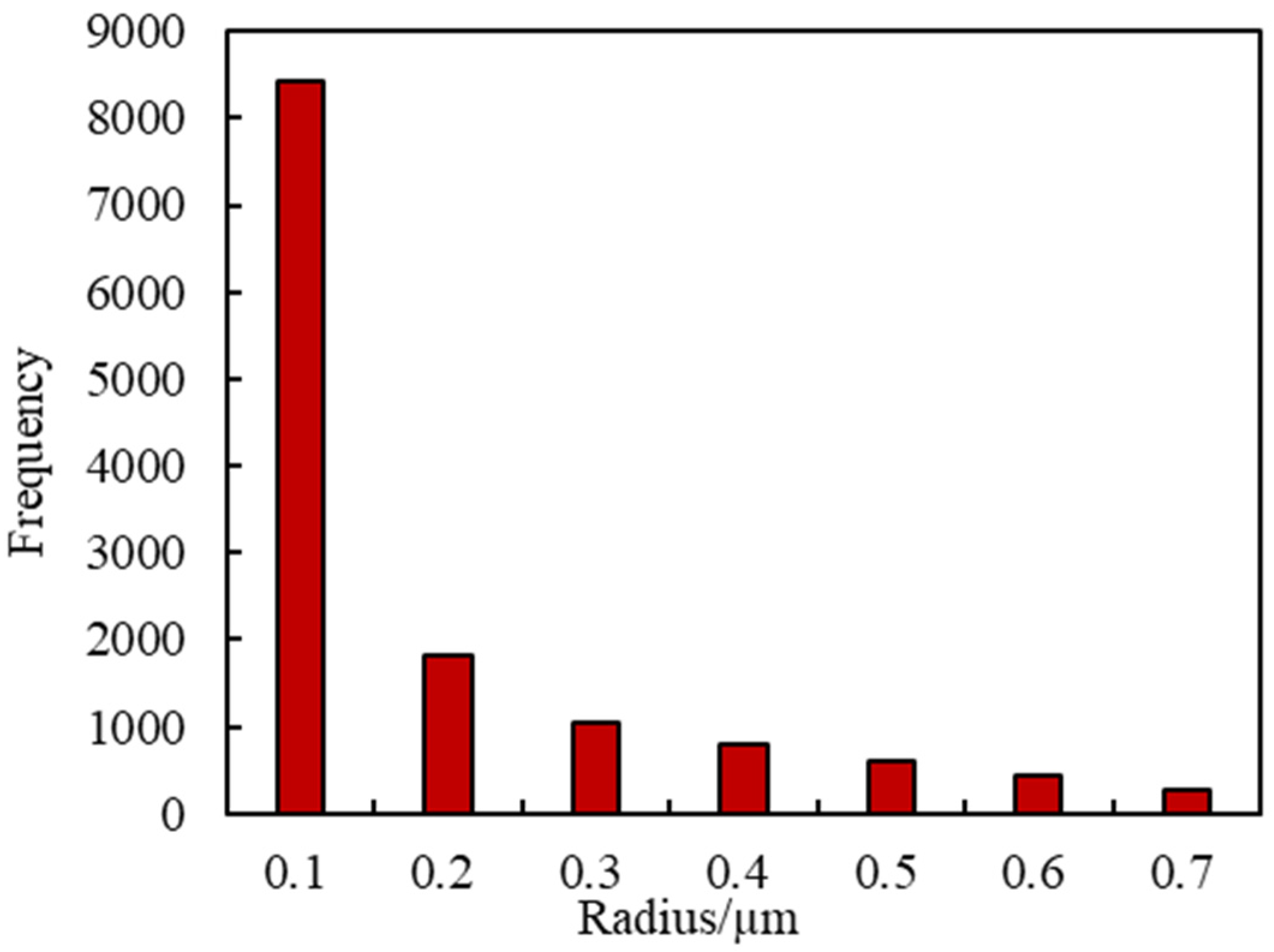
The target reservoir of this study is from a typical tight conglomerate block in Xinjiang Oilfield. Through high-pressure mercury injection experiments, we obtained the pore size distribution data of the core, as shown in Figure 1. The experimental results show that the pore structure of this reservoir is mainly nanoscale pores, with an average pore radius of approximately 140 nm.
Many studies [33,34] have demonstrated that conventional equations of state (EOSs), exemplified by the Peng–Robinson (PR) EOS, are calculated for bulk fluid, only considering the intermolecular attractive force while neglecting repulsive interactions. When applied without modification to confined fluid, these EOS inevitably introduce substantial phase behavior deviations. Therefore, the equations proposed by Zarragoicoechea and Kuz. [35], Equations (6) and (7), in which the critical pressure and temperature are adjusted to adapt to the phase evaluation of nanoconfined fluids, according to the pore radius of confined space.
Δ T c = T c T c m T c = 0.9409 ( σ i j r p ) 0.2415 ( σ i j r p ) 2
Δ P c = P c P c m P c = 0.9409 ( σ i j r p ) 0.2415 ( σ i j r p ) 2
where T c and P c are the conventional critical temperature and pressure of the pure components, respectively; T c m and P c m are the confined critical temperature and pressure of the pure components, respectively; σ i j is the Lennard-Jones associated with fluid molecular size. r p is the radius of the pore.
In the nanopore, the Vapor Liquid Equilibrium (VLE) can be affected by the capillary force. The capillary force can be calculated by Equation (8):
P c a p = 2 σ cos θ R
where P c a p is the capillary force between the gas and the liquid; The gas–liquid interfacial force can be evaluated by the Parachor mode:
σ 0.25 = ρ L P L ρ V P V
P L = i = 1 N c x i P i
P V = i = 1 N c y i P i
where ρ is the molar density; P i is the Parachor parameter of the pure component; x i and y i are the mole fraction of component i in the liquid phase and gas phase, respectively.
Assuming an oil reservoir consists of n components with a total mole number of 1.0, if gas and liquid are in balance, the following equations are fulfilled.
1 N x i = 1 N y i = 1 N z i
V y i + L x i = z i
where V and L are the mole fraction of the liquid phase and gas phase, respectively; z i is the total mole number of component i .
The gas fugacity and liquid fugacity are equal, when the phase is balanced. The MATLAB program was coded to simulate phase behavior.

4. Numerical Model Development and Parameter Configuration

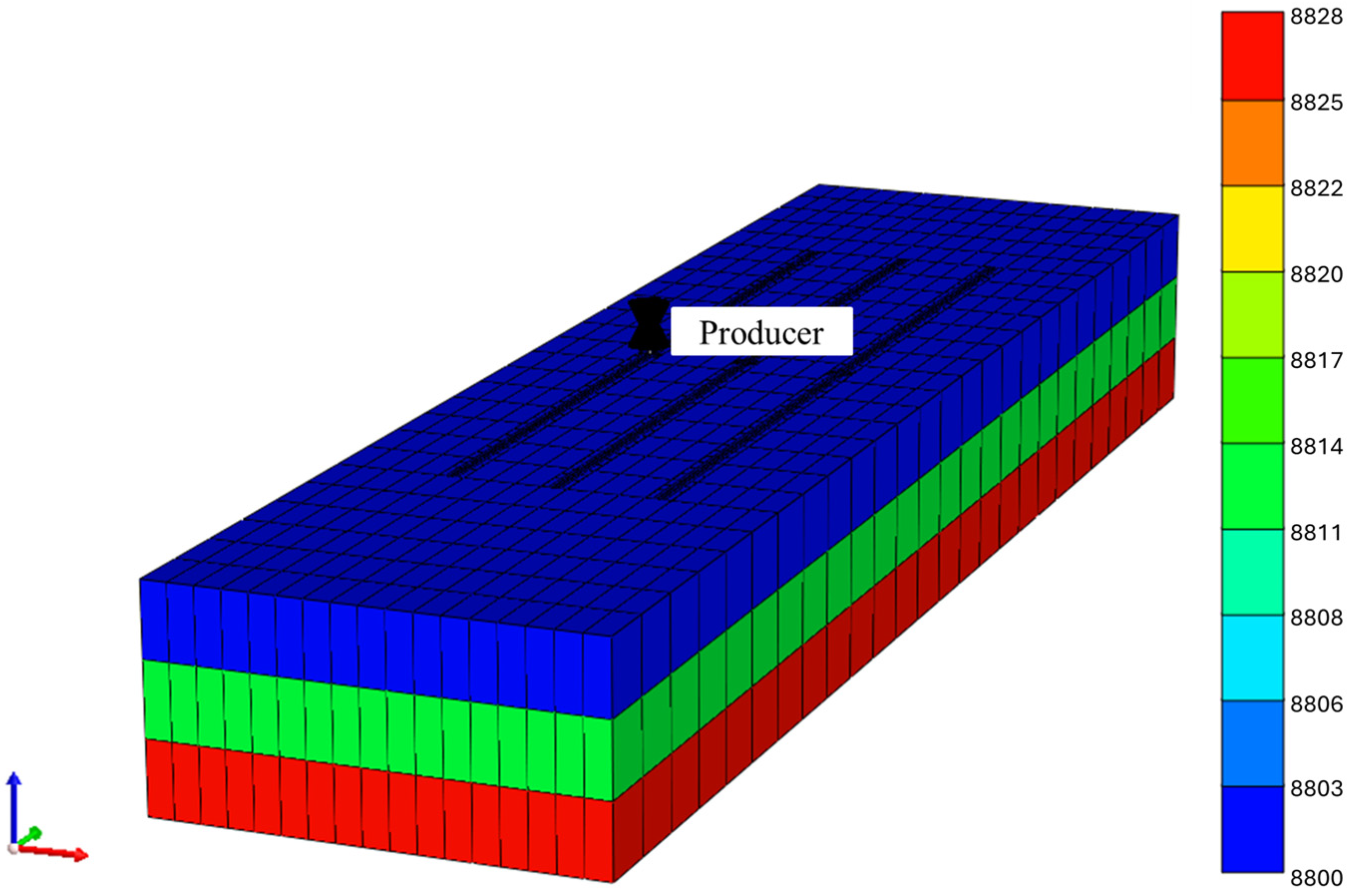
The commercial reservoir simulator CMG is employed to conduct simulation studies on surfactant-assisted CO2 huff-n-puff for tight conglomerate oil development. Coupling between the phase behavior model and the reservoir numerical model is achieved through matching and calibration of the phase equilibrium calculation model with numerically simulated phase diagrams. Based on the geological parameters of a tight conglomerate oil reservoir block, a dual-porosity medium numerical model is established. The model grid dimensions are 340 ft × 1300 ft × 42 ft, with grid numbers of 17 × 26 × 3 in the i, j, and k directions, respectively. The reservoir top depth is 8800 ft, with a porosity of 8%, matrix permeability of 0.005 × 10⁻³ μm2, and reservoir temperature of 115 °C. Key model parameters are presented in Table 1, and the established model is illustrated in Figure 2.
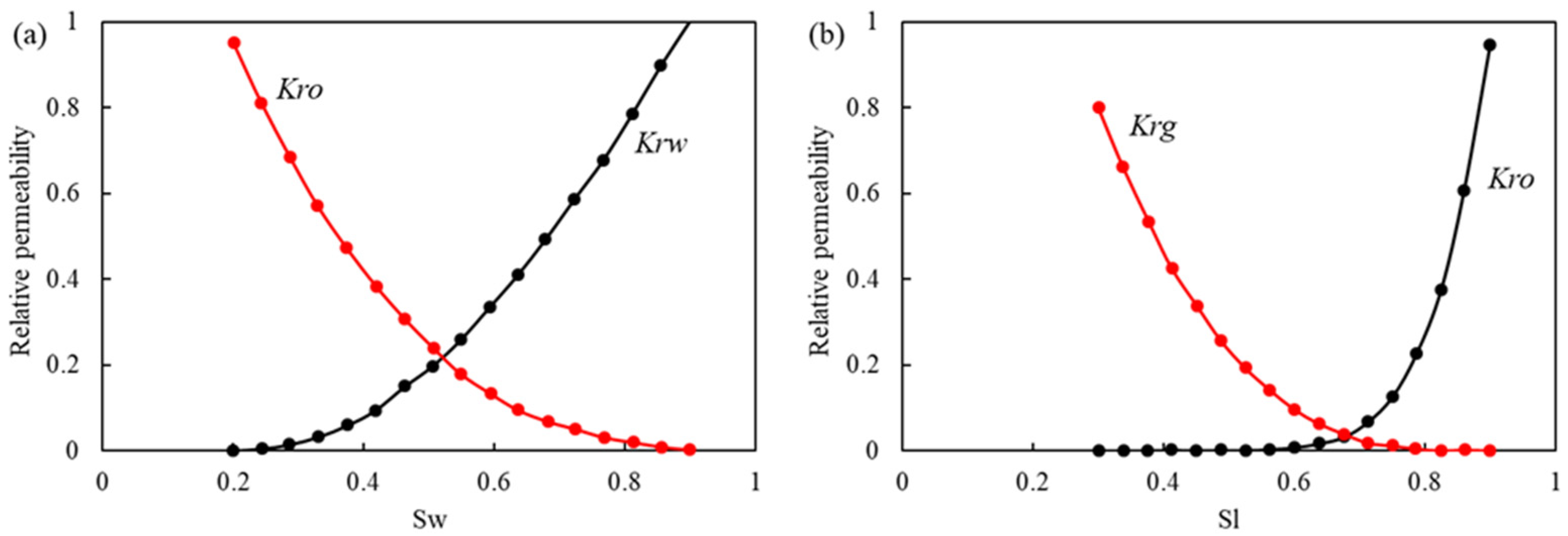
Based on the established numerical model, relative permeability data are incorporated for subsequent model calculations and dynamic simulation development. The oil–water and oil–gas relative permeability curves obtained from field experimental data are presented in Figure 3.
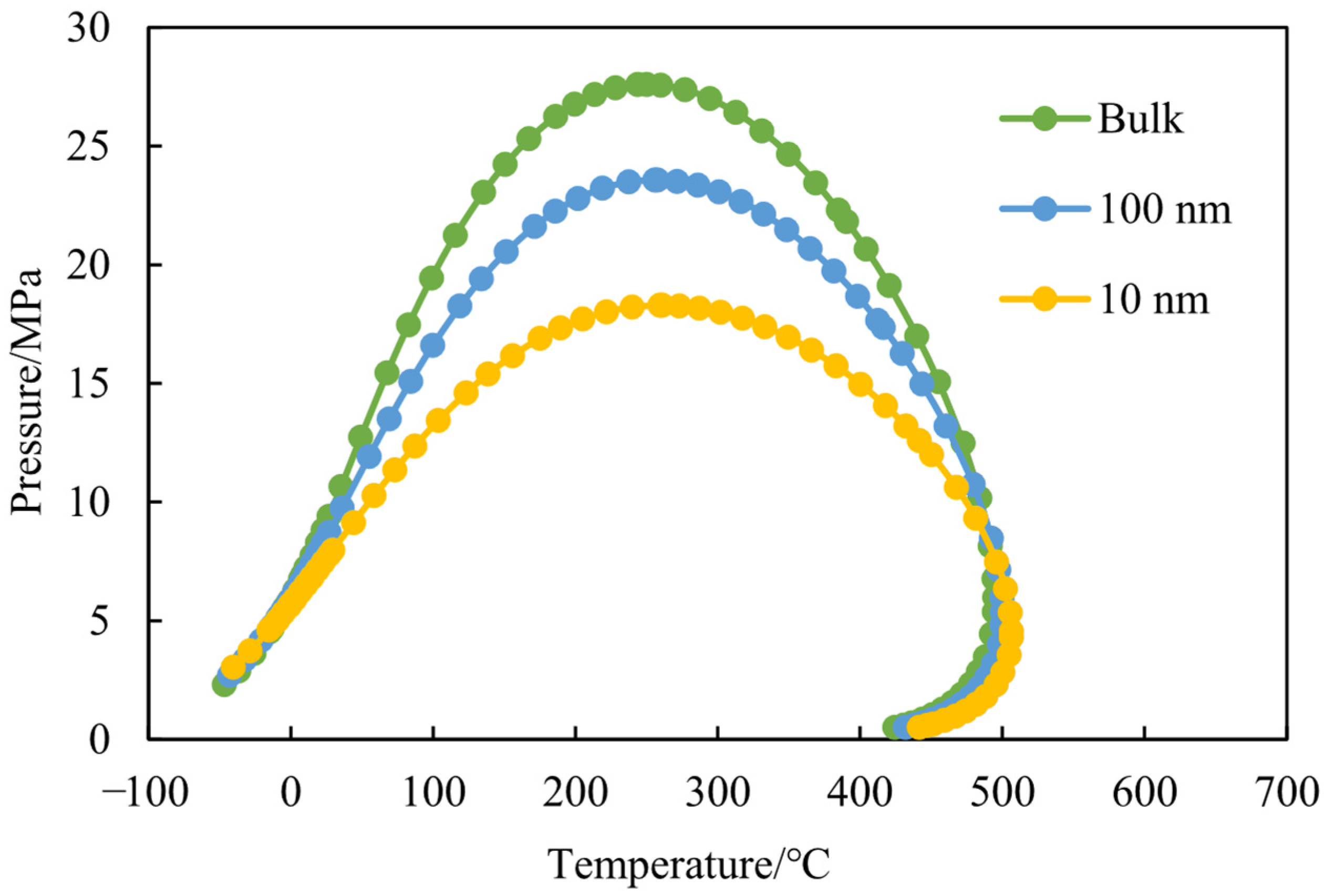
Since the number of fluid components significantly affects the accuracy and computational speed of numerical simulations, the crude oil components are lumped into six pseudo-components based on the principle of similar compositional properties without compromising simulation results, as shown in Table 2. The six pseudo-components of crude oil defined in Table 2 were supplied as feed to the MATLAB code described earlier; their phase envelopes were computed at the reservoir-mean pore diameter, as shown in Figure 4. Based on the CMG winprop module, the PT phase diagram at a pore size of 100 nm by adjusting the component parameters was fitted. Ultimately, the adjusted component parameter data was input into the CMG simulator as the input for the fluid model.
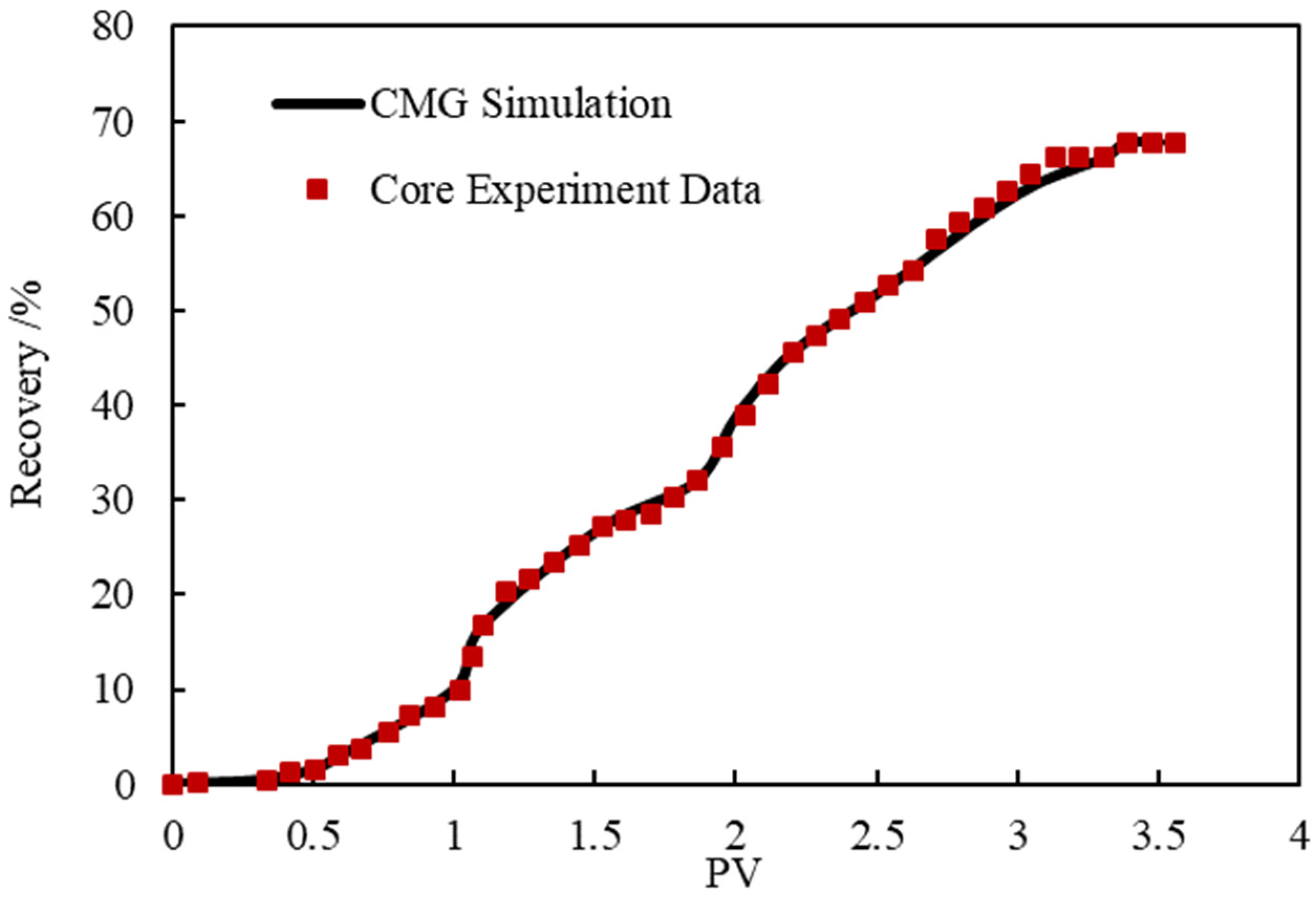
To ensure the reliability of the numerical model, the simulation results were validated against laboratory core-flooding experimental data [36]. The core’s permeability, porosity, and fluid properties used in the experiments were similar to the reservoir conditions defined in this study. A one-dimensional model representing the core was constructed to replicate the surfactant-assisted CO2 flooding process conducted in the laboratory. As shown in the Figure 5, the simulated cumulative oil recovery and displacement pressure difference show a strong agreement with the experimentally measured values. This close match provides a credible foundation for the subsequent field-scale predictive studies.
To explicitly simulate the surfactant-assisted CO2 huff-n-puff (SA-CO2-HnP) process, a fixed injection schedule was adopted. Surfactant is assumed to be fully dissolved in the formation water and is injected as a single aqueous slug. The operational sequence for every cycle is as follows: (1) Inject 1000 bbl of an aqueous slug that contains a set mole fraction of surfactant (e.g., 0.0003). (2) Immediately after the water slug, inject CO2 until the target cumulative volume or maximum pressure is reached. (3) Conduct a shut-in period, followed by a back-production phase that follows the same procedure as a conventional CO2 huff-n-puff.

5. Analysis of Influencing Factors on Surfactant-Assisted CO2 Huff-n-Puff Performance in Tight Conglomerate Oil Reservoirs

5.1. Performance Analysis of Surfactant-Assisted CO2 Huff-n-Puff

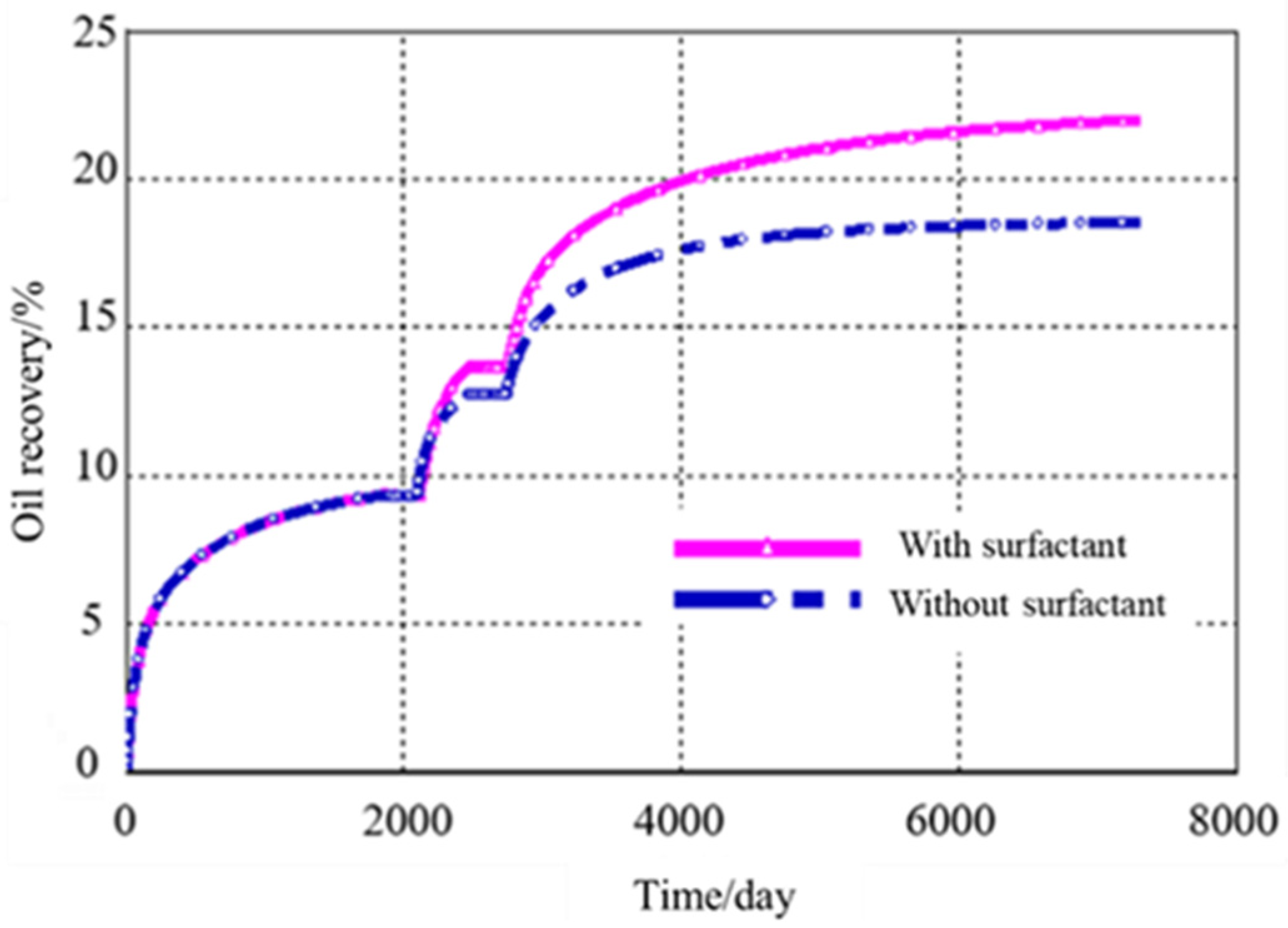
To evaluate the development performance of surfactant-assisted CO2 huff-n-puff in tight conglomerate oil reservoirs, numerical simulation studies are conducted based on the established numerical model, with comparative analysis against conventional CO2 huff-n-puff. Figure 6 presents the reservoir recovery factor variation curves over a 20-year development period. The results indicate that the ultimate recovery factor for the surfactant-enhanced scheme reaches 22%, whereas the conventional CO2 cyclic injection-production scheme achieves an ultimate recovery factor of 18.5%. After 20 years of development, the surfactant-assisted scheme increases the recovery factor by 3.5% points compared to the conventional scheme, demonstrating significant production enhancement potential.
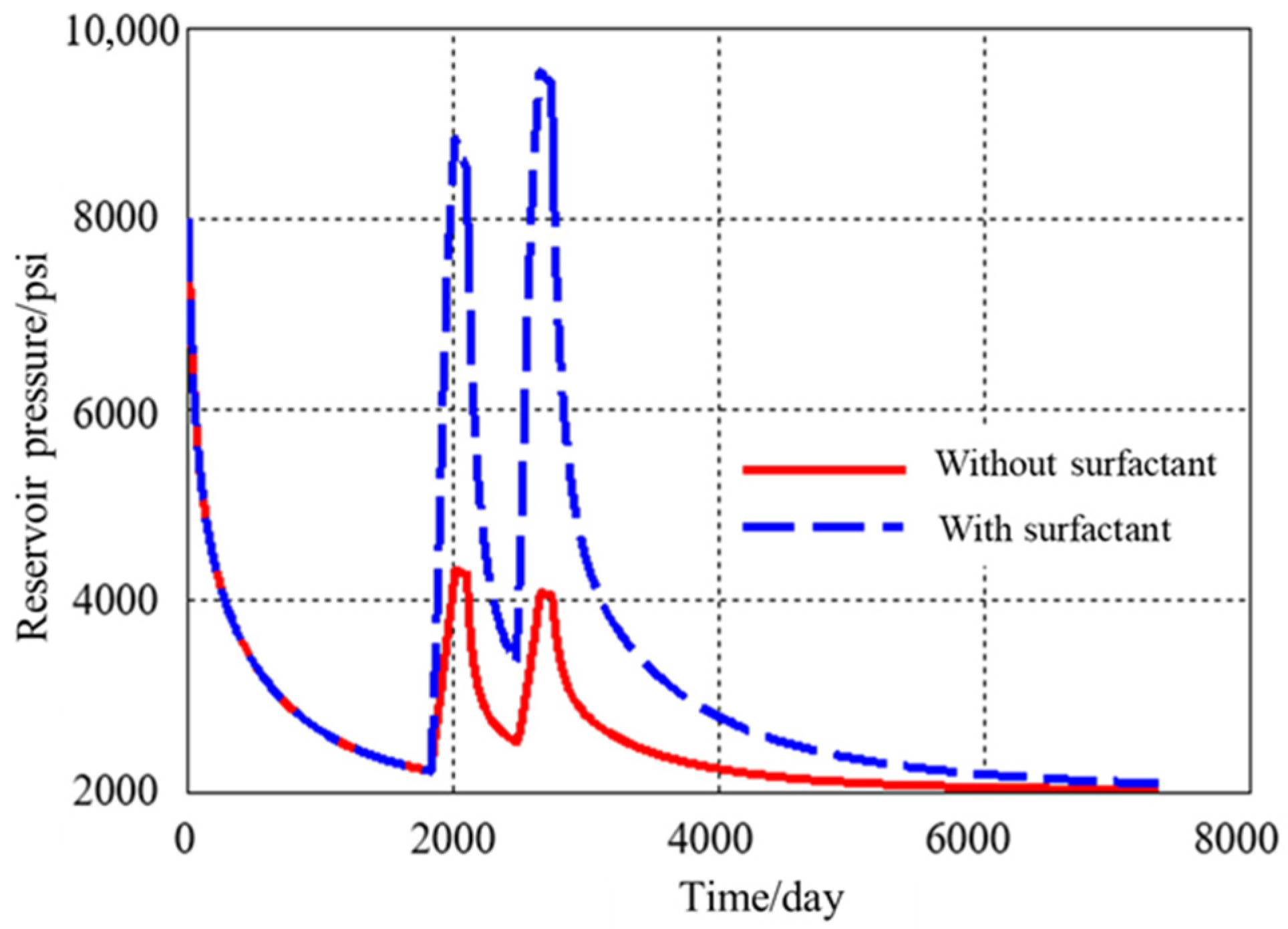
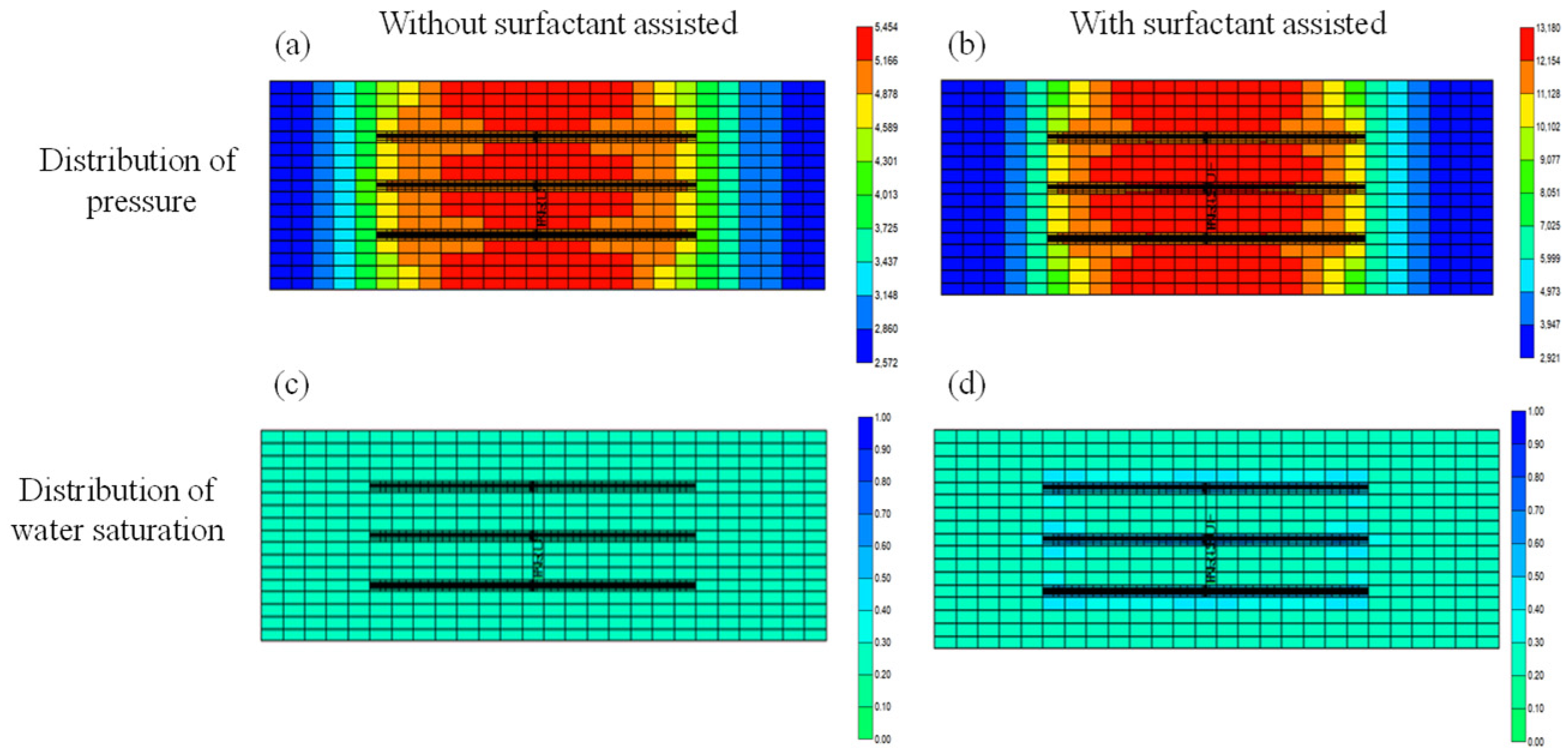
Figure 7 presents a comparison of reservoir pressure variations during development for schemes with and without surfactant addition. Compared to conventional CO2 huff-n-puff, surfactant-assisted huff-n-puff results in a more pronounced increase in reservoir pore pressure, provides superior formation energy replenishment, and is conducive to enhanced oil recovery. Figure 7 illustrates the pressure field and water saturation distribution characteristics for both schemes after completion of the first soaking cycle. As shown in Figure 8a,b, the pressure increment after soaking for the surfactant-enhanced scheme is 2.5 times that of the non-surfactant scheme, with high-pressure zones predominantly distributed in the hydraulic fracture regions. As shown in Figure 8c,d, water saturation remains consistently at the irreducible water saturation of 0.25 in the non-surfactant scheme, whereas in the surfactant-enhanced scheme, water saturation in the fracture system and surrounding matrix increases significantly.
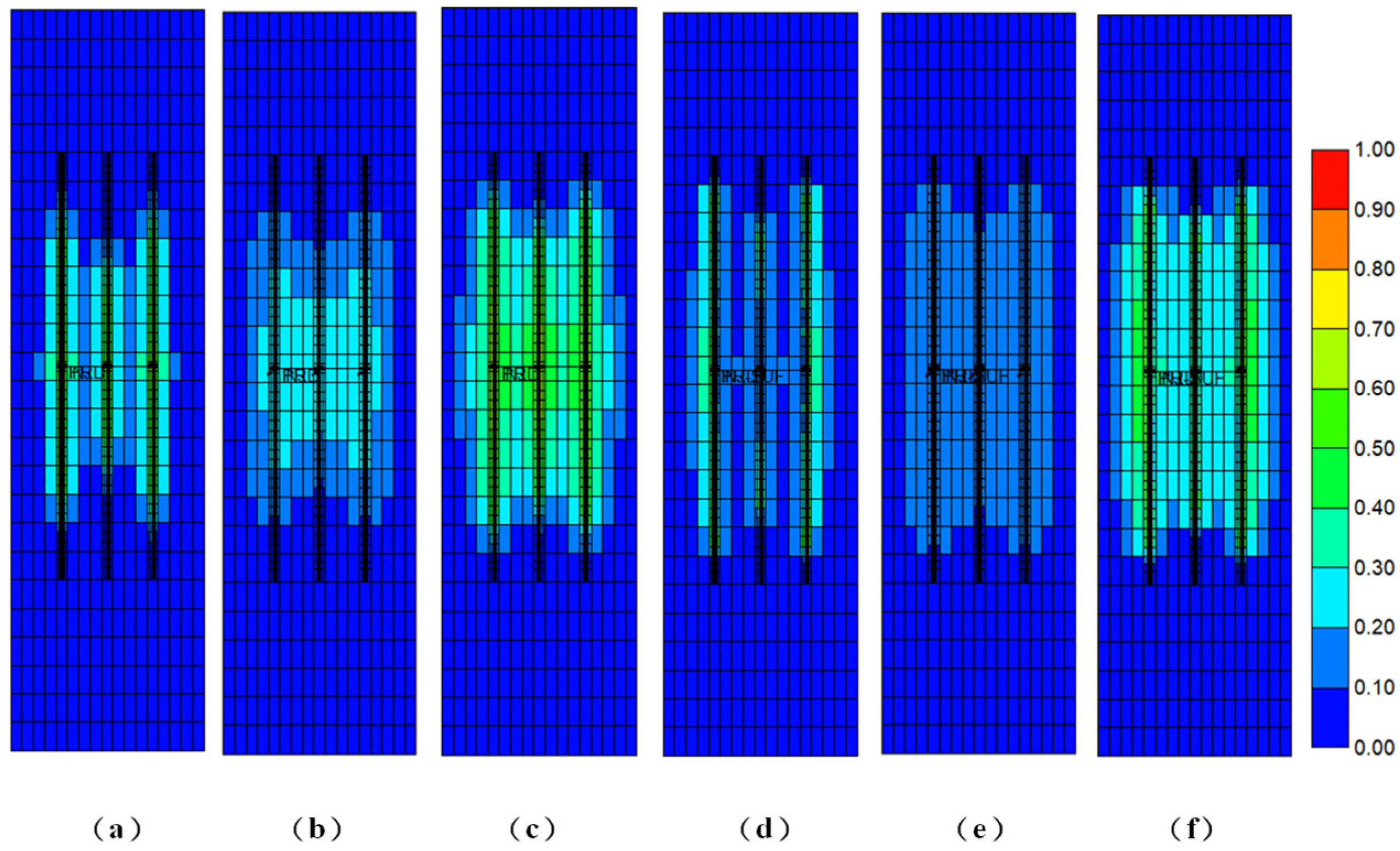
Figure 9 compares the CO2 mole fraction distribution characteristics in reservoir crude oil at different development stages for both schemes. A comparative analysis is conducted for three representative time points: after the first soaking cycle, after the first production period, and after the second soaking cycle. The results reveal that in the non-surfactant scheme, CO2 concentration in the crude oil near the wellbore is relatively high; however, residual CO2 content around the wellbore after production is also elevated, indicating limited CO2 diffusion into the deeper reservoir. In contrast, in the surfactant-enhanced scheme, CO2 can penetrate to deeper reservoir zones with greater sweep volume, which is beneficial for improving oil recovery.

5.2. Soaking Time Analysis

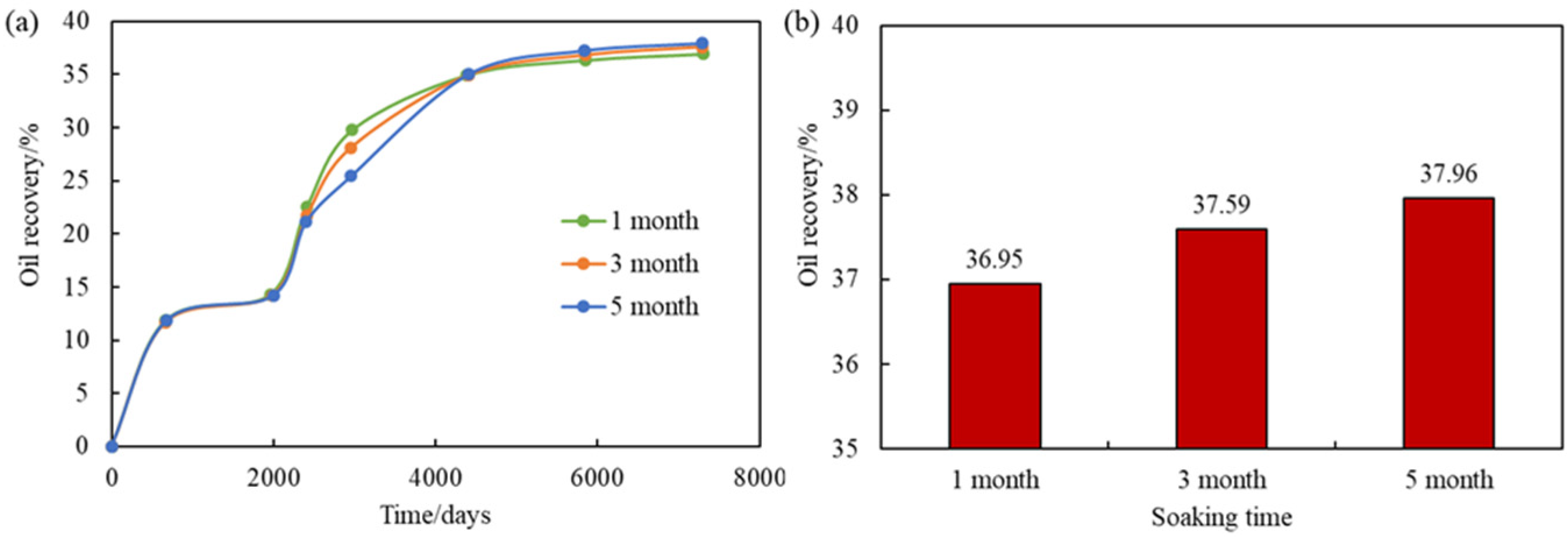
The soaking stage is a critical phase during which CO2 fully contacts the crude oil, undergoes interphase mass transfer, and reduces interfacial tension. Figure 10 illustrates the recovery factor variation patterns under different soaking time conditions. The simulation results demonstrate that when soaking times are set at 1 month, 3 months, and 5 months, respectively, the difference in the ultimate recovery factor is less than 2%, indicating that soaking time has a relatively minor influence on the recovery factor.
The fundamental reason for this phenomenon lies in the extreme physical properties of tight conglomerate reservoirs that restrict the mass transfer process. Although a longer soaking time theoretically provides a longer duration for mass exchange, under the combined effect of low matrix permeability and complex nanopore structure, the migration of CO2 to the deep matrix mainly depends on a slow molecular diffusion mechanism, which is dependent on the square root of time. This leads to a rapid decline in the rate at which its effective spread radius increases over time. Therefore, simply extending the soaking time does not linearly expand the effective range of CO2, thereby creating a natural bottleneck effect on the increase in the final recovery rate. Furthermore, although the addition of surfactants promotes the emulsification and mass transfer of CO2 to a certain extent by reducing interfacial tension, their main synergistic effect has been fully exerted in the injection stage (pre-improving wettability and reducing injection pressure). During the soaking stage, as the fluid as a whole is in a static state, the enhancing effect of surfactants on the diffusion coefficient is insufficient to overcome the physical upper limit of mass transfer set by the inherent physical properties of the reservoir. Therefore, in field practice, excessively prolonging the soaking time does not yield significant economic benefits for enhancing oil recovery [37].

5.3. Injection Time Analysis

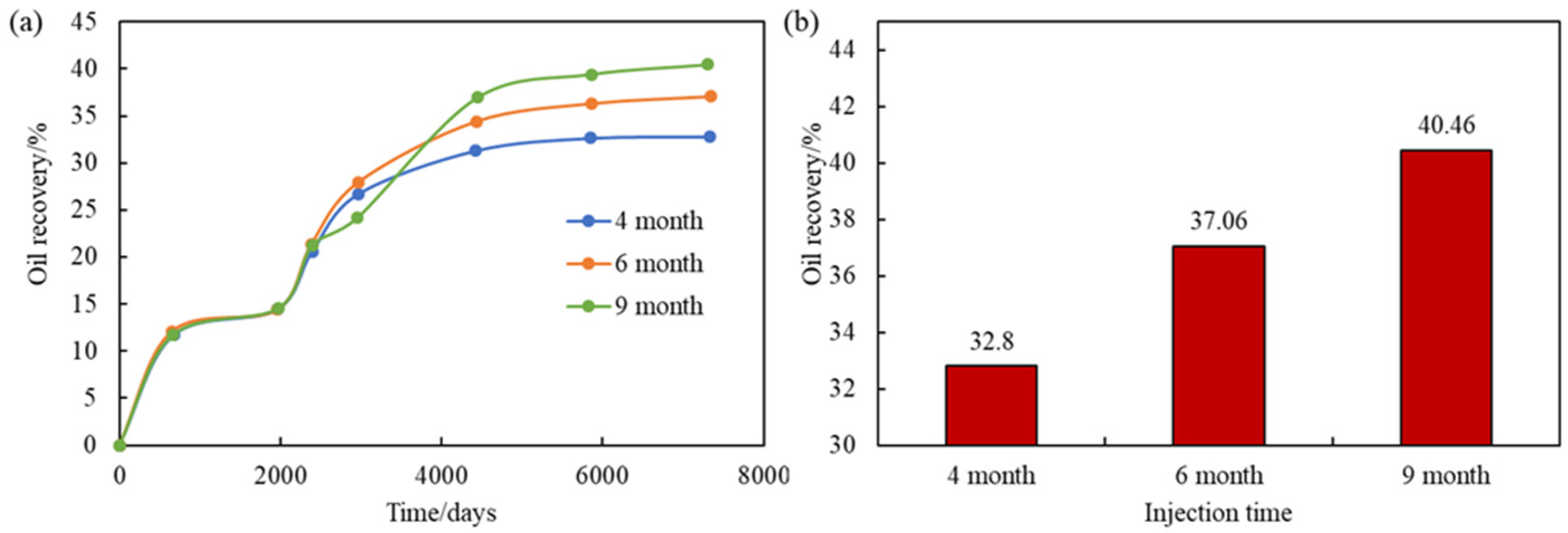
Injection time directly influences the sweep range and effectiveness of CO2 and surfactants in the reservoir. As shown in Figure 11, as the injection time is extended from 4 months to 9 months, tight conglomerate oil recovery increases from 32.80% to 40.46%, representing an increment of 7.66%.
This substantial improvement is attributed to several interconnected mechanisms. A longer injection stage allows for a greater volumetric injection of CO2, which directly expands the contact area with the crude oil in both the fracture network and the matrix, thereby establishing a more extensive and stable miscible zone. The prolonged contact time also enables more sufficient adsorption of surfactant molecules onto the rock surfaces, leading to a more profound and widespread reduction in oil–water interfacial tension and a significant improvement in the wettability state, which collectively enhances crude oil mobility. Furthermore, continuous injection acts as an effective reservoir energy maintenance strategy. By sustaining higher reservoir pressure, it not only facilitates the miscibility process but also suppresses the adverse effects of oil shrinkage and retrograde condensation, while simultaneously providing a stronger driving force to counteract high capillary pressures in nanopores, thereby significantly improving the overall displacement efficiency.

5.4. Surfactant Concentration Effect Analysis

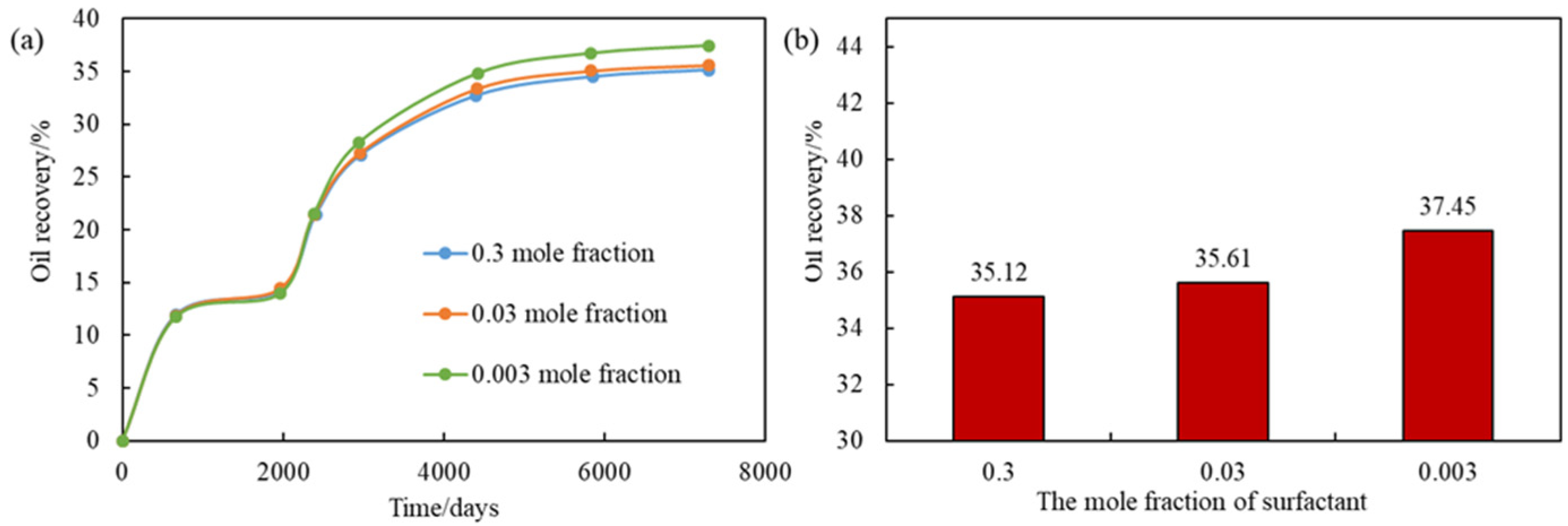
Surfactant injection concentration is a critical operational parameter in surfactant-assisted CO2 cyclic injection-production. Comparative simulations are performed with three surfactant mole fractions (0.0003, 0.03, and 0.3), and the results indicate that the recovery factor exhibits a declining trend with increasing concentration, as illustrated in Figure 12. The low-concentration (0.0003) scheme achieves the highest recovery of 37.45%, while the high-concentration (0.3) scheme shows a reduced recovery of 35.12%, representing a decrease of 2.33%. The primary reasons for this phenomenon include the following: (1) high-concentration surfactants readily form stable foam in porous media, causing pore blockage and restricting CO2 flow capacity; (2) excessive surfactant competitive adsorption on rock surfaces may impede effective contact between CO2 and crude oil. Conversely, low-concentration surfactants primarily function through interfacial tension reduction and wettability alteration, effectively promoting CO2 dissolution and diffusion in crude oil, thereby improving displacement efficiency at the pore scale.

5.5. Injection Pressure Analysis

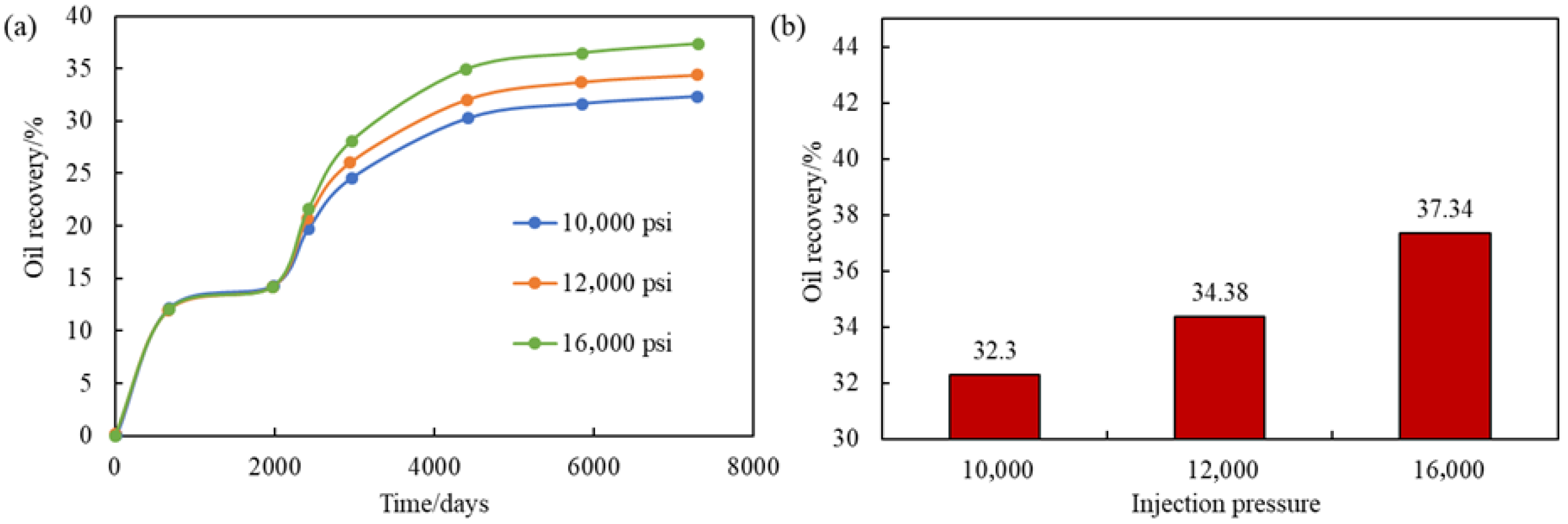
Injection pressure directly affects CO2 injectivity and miscibility degree. Figure 13 presents the temporal evolution of oil production degree under different injection pressures. Simulation results demonstrate that as injection pressure increases from 10,000 psi to 16,000 psi, recovery factor rises from 32.30% to 47.34%, yielding an increment of 15.04%.
This enhancement is driven by fundamental shifts in both fluid properties and flow dynamics under elevated pressure. Increased injection pressure markedly raises CO2 density, thereby improving its solubility in crude oil and promoting the development of miscible conditions. This miscible front effectively eliminates interfacial tension, drastically reducing capillary forces that otherwise trap oil droplets. Concurrently, the elevated pressure provides the necessary driving force to overcome the substantial capillary resistance inherent in the micro- and nanopores of the tight conglomerate [38], enabling the drainage of previously inaccessible oil and significantly expanding the effective sweep volume. The synergistic role of surfactants is also amplified under these conditions, as higher pressure improves their penetration into narrow pore throats, where they more effectively alter wettability and reduce interfacial tension, thereby working in concert with CO2 to enhance oil mobilization. Consequently, maintaining injection pressure at an optimally high level is crucial for maximizing recovery in tight conglomerate reservoirs, as it simultaneously enhances miscibility, improves pore-scale access, and amplifies the effectiveness of chemical additives.

5.6. Surface Water Injection Rate

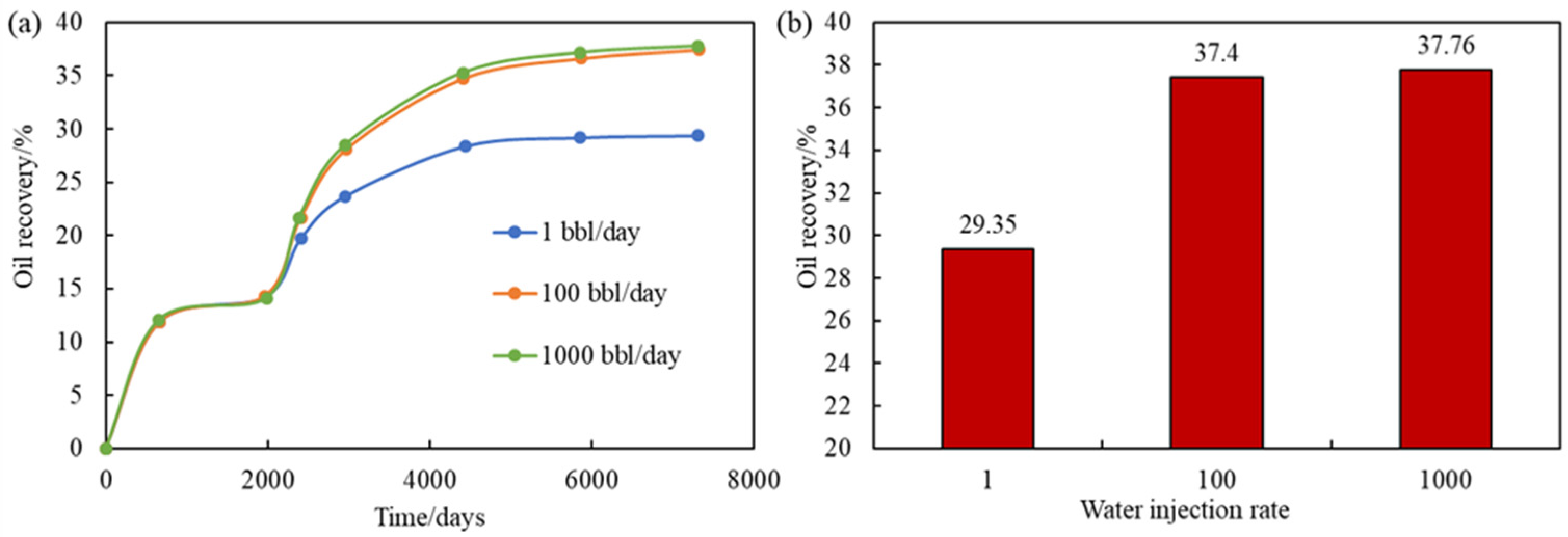
The water injection rate determines the surfactant transport efficiency and formation energy replenishment capacity. Comparative simulations are conducted with three injection rates (1, 100, and 1000 bbl/day), and the results shown in Figure 14 reveal that the recovery factor exhibits an initial increase followed by stabilization as the injection rate increases. When the water injection rate increases from 1 bbl/day to 100 bbl/day, the recovery factor rises from 29.35% to 37.40%. This substantial improvement of 8.05% is attributed to enhanced convective transport. A moderate increase in injection rate improves the delivery and distribution of surfactants deeper into the reservoir, ensuring more effective coverage. It also accelerates the advancement of the CO2 front, leading to improved contact with the crude oil and a more robust displacement process.
However, when the water injection rate further increases to 1000 bbl/day, the recovery increment is merely 0.36% with limited production enhancement. This plateau effect occurs because the benefits of increased convective transport are counteracted by adverse flow dynamics. Excessively high injection rates can promote viscous fingering and cause premature gas breakthrough, where CO2 preferentially channels through high-permeability pathways or fractures instead of uniformly displacing the oil. This results in a reduction in the volumetric sweep efficiency, thereby limiting additional gains in oil recovery. Therefore, an optimal water injection rate range exists and should be optimized based on reservoir heterogeneity characteristics and fracture network development.

6. Conclusions

A mathematical model for surfactant-assisted CO2 huff-n-puff has been established, and a corresponding numerical simulation model has been developed using the commercial software CMG to systematically investigate the influencing factors of surfactant-assisted CO2 development in tight conglomerate oil reservoirs. The study demonstrates that surfactant-assisted CO2 cyclic injection-production technology is an effective approach for enhancing tight conglomerate oil recovery. The main conclusions are as follows:
(1) The influence of injection time on the recovery factor is significantly greater than that of soaking time. Prolonging soaking time has limited contribution to ultimate recovery enhancement, with a recovery increment of less than 2 percentage points, whereas extending injection time can increase recovery by 7.66 percentage points. From a techno-economic perspective, field applications should prioritize optimization of injection time rather than excessively prolonging soaking time.
(2) Surfactant concentration exhibits a negative correlation with the ultimate recovery factor. Excessive surfactant competitive adsorption on rock surfaces impedes effective contact between CO2 and crude oil, and low-concentration surfactant schemes demonstrate superior production enhancement performance.
(3) Higher recovery factors can be achieved under high injection pressure and appropriate injection rate conditions. Under high-pressure conditions, CO2 solubility in crude oil increases, facilitating enhanced miscible displacement and overcoming capillary resistance in nanopores. When the injection rate increases from 100 bbl/day to 1000 bbl/day, the recovery increment is only 0.36 percentage points—indicating insignificant improvement. Moderately increasing the injection rate enhances the surfactant migration and distribution capacity, accelerates CO2 advancement in the reservoir, and expands the volumetric sweep coefficient. However, excessively high injection rates readily induce viscous fingering and increase the risk of gas breakthrough.

Author Contributions

Writing—original draft, M.L.; writing—review and editing, J.Z., Y.Z., and L.L.; visualization, M.N. and L.L.; validation, M.N., G.Z., and J.L.; supervision, G.Z.; resources, M.W.; supervision, J.L.; project administration, M.W.; methodology, G.Z., J.L., and Y.Z.; investigation, J.Z. and M.N.; funding acquisition, M.L. and Y.Z.; formal analysis, J.Z.; conceptualization, M.L.; data curation, M.L. All authors have read and agreed to the published version of the manuscript.

Funding

This work was financial supported by the Shandong Provincial Universities Youth Innovation and Technology Support Program, grant number 2022KJ065, and the National Key Research and Development Program of China, grant numbers 2025ZD1406206-04 and 2025ZD1406206-06.

Data Availability Statement

Dataset available on request from the authors.

Conflicts of Interest

Authors Ming Li, Jigang Zhang, Meng Ning, Yong Zhao, Guoshan Zhang, and Jiaxing Liu were employed by Research Institute of Exploration and Development, Xinjiang Oilfield Company. The remaining authors declare that the research was conducted in the absence of any commercial or financial relationships that could be construed as a potential conflict of interest.

Abbreviations

The following abbreviations are used in this manuscript:
SA-CO2-HnPSurfactant-assisted CO2 huff-n-puff
IFTInterfacial tension
MMPMinimum miscibility pressure
EOREnhanced oil recovery
CGIContinuous gas injection
VITVanishing interfacial tension
EOSEquation of state
GORGas–oil ratio

References

  1. Wu, W.; Tang, Y.; Zhao, J.; Wu, T.; Wu, H. Model of Tight Conglomerate Oil Accumulation in the Mahu Sag, Junggar Basin, Northwest China. J. Earth Sci. 2025, 36, 1149–1167. [Google Scholar] [CrossRef]
  2. Jiang, M.; Chen, D.; Wang, Q.; Wang, F.; Wang, X.; Ma, K.; Wang, Y.; Lei, W.; Wang, Y.; Yang, Z.; et al. Occurrence Mechanism of Crude Oil Components in Tight Reservoirs: A Case Study of the Chang 7 Tight Oil in the Jiyuan Area, Ordos Basin, China. Energies 2025, 18, 1440. [Google Scholar] [CrossRef]
  3. Yu, Z.; Wang, Z.; Jiang, Q.; Wang, J.; Feng, Y.; Zheng, J.; Baffour, B.A. Evaluation of low permeability conglomerate reservoirs based on petrophysical facies: A case study from the Triassic Baikouquan Formation, northern Mahu Sag, Junggar Basin, China. J. Pet. Sci. Eng. 2022, 219, 111082. [Google Scholar] [CrossRef]
  4. Zeng, L.; Gong, L.; Guan, C.; Zhang, B.; Wang, Q.; Zeng, Q.; Lyu, W. Natural fractures and their contribution to tight gas conglomerate reservoirs: A case study in the northwestern Sichuan Basin, China. J. Pet. Sci. Eng. 2022, 210, 110028. [Google Scholar] [CrossRef]
  5. Xiao, M.; Wu, S.; Yuan, X.; Cao, Z.; Xie, Z. Diagenesis effects on the conglomerate reservoir quality of the Baikouquan Formation, Junggar Basin, China. J. Pet. Sci. Eng. 2020, 195, 107599. [Google Scholar] [CrossRef]
  6. Xiao, M.; Wu, S.; Yuan, X.; Xie, Z. Conglomerate Reservoir Pore Evolution Characteristics and Favorable Area Prediction: A Case Study of the Lower Triassic Baikouquan Formation in the Northwest Margin of the Junggar Basin, China. J. Earth Sci. 2021, 32, 998–1010. [Google Scholar] [CrossRef]
  7. Tan, C.; Yu, X.; Liu, B.; Qu, J.; Zhang, L.; Huang, D. Conglomerate categories in coarse-grained deltas and their controls on hydrocarbon reservoir distribution: A case study of the Triassic Baikouquan Formation, Mahu Depression, NW China. Pet. Geosci. 2017, 23, 403–414. [Google Scholar] [CrossRef]
  8. Chen, X.; Yu, H.; Cao, A.; Yang, Z.; Li, W.; Niu, Z.; Chang, Y.; Du, M. Study on Enhanced Oil Recovery Mechanism of CO2 Miscible Flooding in Heterogeneous Reservoirs under Different Injection Methods. ACS Omega 2023, 8, 24663–24672. [Google Scholar] [CrossRef] [PubMed]
  9. Kumar, N.; Augusto Sampaio, M.; Ojha, K.; Hoteit, H.; Mandal, A. Fundamental aspects, mechanisms and emerging possibilities of CO2 miscible flooding in enhanced oil recovery: A review. Fuel 2022, 330, 125633. [Google Scholar] [CrossRef]
  10. Lu, M.; Qian, Q.; Zhong, A.; Zhang, Z.; Zhang, L. Investigation on the flow behavior and mechanisms of water flooding and CO2 immiscible / miscible flooding in shale oil reservoirs. J. CO2 Util. 2024, 80, 102660. [Google Scholar] [CrossRef]
  11. Chen, Z.; Xu, L.; Zhou, Y.; Li, R.; Li, H. A robust and efficient algorithm for vapor-liquid-equilibrium/liquid-liquid-equilibrium (VLE/LLE) phase boundary tracking. Chem. Eng. Sci. 2023, 266, 118286. [Google Scholar]
  12. Shokrollahi, A.; Arabloo, M.; Gharagheizi, F.; Mohammadi, A.H. Intelligent model for prediction of CO2—Reservoir oil minimum miscibility pressure. Fuel 2013, 112, 375–384. [Google Scholar] [CrossRef]
  13. Chen, G.; Gao, H.; Fu, K.; Zhang, H.; Liang, Z.; Tontiwachwuthikul, P. An improved correlation to determine minimum miscibility pressure of CO2–oil system. Green Energy Environ. 2020, 5, 97–104. [Google Scholar] [CrossRef]
  14. Hemmati-Sarapardeh, A.; Ayatollahi, S.; Ghazanfari, M.-H.; Masihi, M. Experimental Determination of Interfacial Tension and Miscibility of the CO2–Crude Oil System; Temperature, Pressure, and Composition Effects. J. Chem. Eng. Data 2014, 59, 61–69. [Google Scholar] [CrossRef]
  15. Almobarak, M.; Wu, Z.; Zhou, D.; Fan, K.; Liu, Y.; Xie, Q. A review of chemical-assisted minimum miscibility pressure reduction in CO2 injection for enhanced oil recovery. Petroleum 2021, 7, 245–253. [Google Scholar] [CrossRef]
  16. Zhang, C.; Xi, L.; Wu, P.; Li, Z. A novel system for reducing CO2-crude oil minimum miscibility pressure with CO2-soluble surfactants. Fuel 2020, 281, 118690. [Google Scholar] [CrossRef]
  17. Liu, S.Y.; Li, M.F.; Chen, J.Y.; Teng, Y.; Wang, P.F.; Liu, J.R. Experimental investigation of surfactants and their ethanol blends for CO2–oil miscibility enhancement in CO2-EOR. Pet. Sci. 2025, 22, 4271–4281. [Google Scholar] [CrossRef]
  18. Li, L.; Zhou, X.; Wang, R.; Zhang, X.; Ma, S.; Su, Y.; Wang, C.; Luo, W.; Sun, H. Microscopic experiment study on mechanisms of oil-gas interaction and CO2-surfactant flooding with different temperatures and pressures. J. CO2 Util. 2023, 69, 102389. [Google Scholar] [CrossRef]
  19. Liu, B.; Lei, X.; Feng, D.; Ahmadi, M.; Wei, Z.; Chen, Z.; Jiang, L. Nanoconfinement effect on the miscible behaviors of CO2/shale oil/surfactant systems in nanopores: Implications for CO2 sequestration and enhanced oil recovery. Sep. Purif. Technol. 2025, 356, 129826. [Google Scholar] [CrossRef]
  20. Lei, X.; Liu, B.; Hou, Q.; Wang, Y.; Ahmadi, M.; Liu, Z.; Chen, Z. Switchability and synergistic effect of a CO2-responsive surfactant with co-surfactants at an O/W interface: A molecular insight. J. Mol. Liq. 2024, 405, 125051. [Google Scholar] [CrossRef]
  21. Ahmadi, M.; Hou, Q.; Wang, Y.; Lei, X.; Liu, B.; Chen, Z. Spotlight on reversible emulsification and demulsification of tetradecane-water mixtures using CO2/N2 switchable surfactants: Molecular dynamics (MD) simulation. Energy 2023, 279, 128100. [Google Scholar] [CrossRef]
  22. Jia, B.; Tsau, J.S.; Barati, R. Role of molecular diffusion in heterogeneous, naturally fractured shale reservoirs during CO2 huff-n-puff. J. Pet. Sci. Eng. 2018, 164, 31–42. [Google Scholar] [CrossRef]
  23. Peng, Z.; Sheng, J. Diffusion Effect on Shale Oil Recovery by CO2 Huff-n-Puff. Energy Fuels 2023, 37, 2774–2790. [Google Scholar] [CrossRef]
  24. Yang, Y.L.; Hu, Y.; Zhu, Y.T.; Zhang, J.G.; Song, P.; Qin, M.; Wu, H.R.; Song, Z.J.; Hou, J.R. Similarity-based laboratory study of CO2 huff-n-puff in tight conglomerate cores. Pet. Sci. 2023, 20, 362–369. [Google Scholar] [CrossRef]
  25. Haskin, H.K.; Alston, R.B. An Evaluation of CO2 Huff ‘n’ Puff Tests in Texas. J. Pet. Technol. 1989, 41, 177–184. [Google Scholar] [CrossRef]
  26. Zuloaga, P.; Yu, W.; Miao, J.; Sepehrnoori, K. Performance evaluation of CO2 Huff-n-Puff and continuous CO2 injection in tight oil reservoirs. Energy 2017, 134, 181–192. [Google Scholar] [CrossRef]
  27. Sheng, J.J. Optimization of huff-n-puff gas injection in shale oil reservoirs. Petroleum 2017, 3, 431–437. [Google Scholar] [CrossRef]
  28. Wei, J.; Zhou, X.; Zhou, J.; Li, J.; Wang, A. CO2 Huff-n-Puff after Surfactant-Assisted Imbibition to Enhance Oil Recovery for Tight Oil Reservoirs. Energy Fuels 2020, 34, 7058–7066. [Google Scholar] [CrossRef]
  29. Haeri, F.; Burrows, L.; Lemaire, P.; Alenzi, A.; Shah, P.; Tapriyal, D.; Enick, R.; Crandall, D.; Goodman, A. Laboratory-Scale CO2 Huff ‘n Puff EOR using Single Phase Solutions of CO2 and CO2 Soluble, Nonionic, Wettability Altering Additives. In Proceedings of the SPE Annual Technical Conference and Exhibition, Virtual, 27–29 October 2020. [Google Scholar]
  30. Aboahmed, A.; Mohanty, K. Chemical Huff and Puff for Shale Oil Recovery Using Surfactants, Nanoparticles and Ketones. In Proceedings of the SPE/AAPG/SEG Unconventional Resources Technology Conference, Houston, TX, USA, 9–11 June 2025. [Google Scholar]
  31. Daniel, E.K.; Cary, T.C.; Robin, S.H. Effect of some petroleum sulfonate surfactants on the apparent water solubility of organic compounds. Environ. Sci. Technol. 1990, 24, 205–208. [Google Scholar] [CrossRef]
  32. Larry, L.; Russell, T.J.; William, R.R.; Gary, A.P. Fundamentals of Enhanced Oil Recovery; Society of Petroleum Engineers: Richardson, TX, USA, 2014. [Google Scholar]
  33. Chen, X.; Tang, L.; Jia, C.; Yue, P.; Zhang, Z.; Liu, W. Phase behavior of hydrocarbon fluids in shale reservoirs, considering pore geometries, adsorption, and water film. ACS Omega 2024, 9, 2104–2112. [Google Scholar] [CrossRef]
  34. LIUBo, G. Comprehensive outlook into critical roles of pressure, volume, and temperature (PVT) and phase behavior on the exploration and development of shale oil. Energy Fuels 2022, 36, 14534. [Google Scholar] [CrossRef]
  35. Luo, Q.; Li, M.; Liang, B.; Liu, J.; Shi, G.; Wang, M.; Li, L. Experimental Investigation on the Mechanism of CO2-Enhanced Oil Recovery in Tight Conglomerate Reservoirs with Surfactant Assistance. ACS Omega 2025, 10, 50077–50087. [Google Scholar]
  36. Zarragoicoechea, G.; Kuz, V. Critical shift of a confined fluid in a nanopore. Fluid Phase Equilibria 2004, 220, 7–9. [Google Scholar] [CrossRef]
  37. Quan, F.; Lu, W.; Song, Y.; Sheng, W.; Qin, Z.; Luo, H. Multifractal Characterization of Heterogeneous Pore Water Redistribution and Its Influence on Permeability During Depletion: Insights from Centrifugal NMR Analysis. Fractal Fract. 2025, 9, 536. [Google Scholar] [CrossRef]
  38. Wang, Z.; Xiong, J.; Zhang, Y.; Tao, G.; Pan, J.; Niu, Q. Investigation of Permeability Stress Induced Damage Evolution of Shallow and Deep Coal Reservoirs in the Junggar Basin, China. Rock Mech. Rock Eng. 2025, 1–28. [Google Scholar] [CrossRef]
Figure 1. Histogram of core pore radius distribution.
Processes 13 03888 g001
Figure 2. Numerical model established for CO2 huff-n-puff development in tight conglomerate oil reservoir.
Processes 13 03888 g002
Figure 3. (a) Relative permeability of oil phase (Kro) and water phase (Krw) measured under core saturation conditions. (b) Relative permeability of oil phase (Kro) and gas phase (Krg) measured under core saturation conditions.
Processes 13 03888 g003
Figure 4. PT phase diagrams of reservoir fluids under different pore diameters.
Processes 13 03888 g004
Figure 5. Verification of simulation and experimental results.
Processes 13 03888 g005
Figure 6. Comparison of recovery factor with and without surfactant addition.
Processes 13 03888 g006
Figure 7. Formation pressure variations during huff-n-puff development with and without surfactant addition.
Processes 13 03888 g007
Figure 8. After the first soaking cycle under CO2 huff-n-puff (a) the pressure distribution without surfactant assistance; (b) the pressure distribution with surfactant assistance; (c) the water saturation distribution without surfactant assistance; (d) the water saturation distribution with surfactant assistance.
Processes 13 03888 g008
Figure 9. Comparison of CO2 mole fraction in formation oil at different production stages with and without surfactant addition ((a) after the first cycle soaking without surfactant; (b) after the first cycle production without surfactant; (c) after the second cycle soaking without surfactant; (d) after the first cycle soaking with surfactant; (e) after the first cycle production with surfactant; (f) after the second cycle soaking with surfactant).
Processes 13 03888 g009
Figure 10. (a) Oil production degree versus time curves under different soaking times. (b) Oil recovery factor histogram.
Processes 13 03888 g010
Figure 11. (a) Oil production degree versus time curves under different injection times. (b) Oil recovery factor histogram.
Processes 13 03888 g011
Figure 12. (a) Oil production degree versus time curves under different surfactant injection concentrations. (b) Oil recovery factor histogram.
Processes 13 03888 g012
Figure 13. (a) Oil production degree versus time curves under different injection pressures. (b) Oil recovery factor histogram.
Processes 13 03888 g013
Figure 14. (a) Oil production degree versus time curves under different surface water injection rates. (b) Oil recovery factor histogram.
Processes 13 03888 g014
Table 1. Basic parameters.
ParameterValueParameterValue
Matrix permeability/mD0.005Reservoir top depth/ft8800
Fracture permeability/D10Fracture half-length/ft350
Porosity/%8Fracture width/ft0.001
Formation temperature/°C115Formation pressure/psi8000
Table 2. Pseudo-component division of crude oil.
ComponentField Values
N2 to CH40.2704
C2 to NC40.2563
IC5 to C70.127
C8 to C120.2215
C13 to C190.074
C20 to C300.0508
Total1.0
N2 to CH40.2704
Disclaimer/Publisher’s Note: The statements, opinions and data contained in all publications are solely those of the individual author(s) and contributor(s) and not of MDPI and/or the editor(s). MDPI and/or the editor(s) disclaim responsibility for any injury to people or property resulting from any ideas, methods, instructions or products referred to in the content.