


Abstract
The COVID-19 pandemic has revealed the digital vulnerability of many citizens of the rural world. This article identifies and analyzes the proposals made by academic literature to overcome the digital divide in the European rural world for the five-year period 2016–2020. A scoping review has been carried out according to the PRISMA methodology in the two dimensions of the digital divide: access and connectivity, and use and exploitation. Online databases were used to identify scientific articles from which, after screening, 28 key documents were selected. The results update Salemink systematic review of articles published between 1991 and 2014 on digital and rural development in Western countries and it also intends to go beyond by extracting recommendations. A variety of political, social, educational, technical and economic issues has been exposed, with a common emphasis on the empowerment of rural populations. The findings provide actionable evidence and proposals to facilitate decision-making in current policy information to overcome rural digital divide. From them, seven recommendations that could have a wide and rapid impact to minimize the effects of the COVID-19 pandemic linked to the rural digital divide are synthesized. Three lines of action in the medium term are also proposed: the evaluation of national and regional public policies; the consideration of digital inclusion as a potential instrument to reduce rural depopulation; and the training in advanced digital skills to improve the social communication processes, considered key to promote empowerment and entrepreneurship.
1. Introduction
1.1. Context: The Digital Transformation of Society and the COVID-19
The European Council stated in the Lisbon Strategy (23 and 24 March 2000) that Information and Communication Technologies (ICT) were the basis of a competitive, dynamic, and knowledge-based economy. This document, also known as the Lisbon Agenda, was the turning point for the advancement of the information society and the birth of e-government policies in the European Union. This project of information society was founded on the creation, distribution, use, and reuse of information through ICT, promoting wider access to knowledge, opening up new ways and opportunities to participate in social life, growing in a sustainable way with more and better jobs, and creating the conditions for greater prosperity and social cohesion [1].
Fifteen years later, the EU Digital Single Market Strategy launched The eGovernment Action Plan 2016–2020, with three policy priorities: upgrading the public administration with ICT, using key digital enablers; achieving interoperable digital public services to allow cross-border mobility, simplifying the access to markets, increasing confidence and stimulating competition; and facilitating easy digital interaction between administrations and citizens and businesses [2]. This action plan establishes the following underlying principles: digital vision by default, “once only” principle, inclusiveness and accessibility, openness and transparency, cross-border level by default, interoperability by default and trustworthiness and security [3]. The countries of the European Union have designed, based on this action plan and its antecedents, their own national and regional e-government plans, being at different stages of implementation.
Simultaneously, the European Union has taken decisive actions to establish an open internet, without which the information society would be a fallacy. This open internet means the recognition of the “ability of end-users to access and distribute information or run applications and services of their choice”, whenever they comply with legal obligations and do not jeopardize the security and integrity of the network; and that providers of internet access “shall not block, slow down, alter, restrict, interfere with, degrade or discriminate” specific content, applications or services [4]. The raise of use and profit of information, respectful of intellectual property rights, to create new knowledge, establish new social interactions and minimize social barriers, would not be possible without a legal frame based on these principles. The creation of a hyper-connected European society through applications, networks and social media in a safe, open, creative, and reliable technological environment is nowadays a priority objective of the general policy and innovation programs of the European Union [5].
The year 2020 will go down in history for the great boost that the information society, e-government and social hyper-connectivity had in Europe due to the social distancing measures of the population, and even confinement, adopted by the majority of the national governments. Teleworking has grown exponentially throughout the service sector. The digitization of the economy and electronic commerce has made significant progress. Public services have closed or restricted physical access to offices and have established that many processes and formalities can be carried out exclusively digitally. Citizens have been forced to interact through ICT to access essential services such as education and healthcare. Social media has become for many people the main means of access to information, the major channel of communication and even in some cases the only way of social interaction. Everything indicates that these transformations have come to stay. This acceleration of the digitization of human relationships, which began more than three decades ago, is the central factor of social change today, rather than the fact itself of the action of an exogenous element, such as the health crisis caused by COVID-19.
The expansion of the information society depends on something more than just the conjunctural presence of an accelerating catalyst. First and foremost, citizens are required to have access to ICTs, be competent in their use, and be able to benefit from it. However, the COVID-19 pandemic has highlighted the digital vulnerability of many citizens in these three dimensions: connectivity, use and exploitation; and it has also revealed the serious consequences of that vulnerability: the pandemic has caused a situation in which the access to the internet seems to have become necessary even for survival, especially if it is related to health issues [6]. In a situation with strict measures of social and physical distancing, the access to new digital services, provided to date through face-to-face or by phone, requires for the applicant to be connected to the internet and to know how to interact with ICT.
Consequently, those on the wrong side of the digital divide are completely left out of these services, having a greater risk of social exclusion. As stated by the World Summit on the Information Society [7], only when all the people and communities can create, consult, use and share information and knowledge they have the necessary requirements for promoting sustainable development and improving their quality of life. More recently, the three types of social exclusion the digital divide can cause have been synthesized: political, in the exercise of civil and human rights; participation in social activities, being deprived of information and effective communication with other citizens; and economic, as access to better education is reduced and therefore professional training is downgraded and the risk of unemployment and low income increases [8].
Although there is a long tradition of debate on the digital divide, there is now renewed interest, relevance, and urgency to investigate this issue. Information Science and Communication Studies, as places of interdisciplinary meetings that analyzes everything related to the development of information and communicative processes in the society and in a special way the relationships between social and communicative changes, cannot remain oblivious to the problems that generate the gap and its digital vulnerability.
1.2. Background: Digital Divide and Digital Inclusion
Digital divide is currently understood as the difference between individuals, companies, regions, and countries in the access and use of ICT [9]. It consists of a difference of approach to technological tools and services such as mobile telephony, computers and the internet that generates an inequality of opportunities to satisfy needs and improve living conditions, which is intolerable in a democratic society. This concept has been popular since 1995 when it was used in the Falling through the Net report of the U.S. Department of Commerce to express unequal access to emerging ICT between and within countries [10].
The digital divide had two dimensions in first studies about the subject, one related to whom has access to technology and another that emphasizes inequality in the skills to use technology among those who have access, as Riggins and Dewan [11] first stated in their pioneering study, now classic, on research trends in this matter. Later researchers, such as De’ et al. [6], decompose the use dimension into two: technical skills, on the one hand, and high-level use in complex situations such as education and commerce, on the other. In contrast, the concept of digital inclusion emerged referring to the objective and the process of implementing measures by a government or a public or private entity to bring the knowledge and use of ICT closer to those who do not already have it [12]. There is a consensus that the debate on digital inclusion is not only about people being connected, but it should also focus on the degree and models of use of ITC [13] and the conditioning factors [14]. Hence, actions to bridge the digital divide must be directed towards diverse aspects, depending on the differences arising from the available resources to access ICT or from geographic, demographic, educational, socioeconomic and cultural disparities that condition the ability and skills to use these technologies.
The unforeseen and sudden phenomenon of the COVID-19 pandemic has highlighted in all its rawness the reality where the digital divide not only has a social nature but also a territorial difference that overlaps as a second layer to each of these specific starting situations in a transversal and decisive way. This is the digital territorial divide, which occurs not only between countries but also within them, between urban and rural areas, and in particular between unpopulated or low-population territories compared to the rest. Depending on the place of residence, access to the internet will be available or not and that access will be of higher or lower quality, regardless of the demographic and socioeconomic profile of the individual or user group. The paradox of this territorial difference is that rural communities need more and better digital connectivity to compensate for their remoteness, but the fact we face is that these communities are generally less and worse connected by technologies and, therefore, their inhabitants and their companies are less digitally included. For example, rural broadband coverage is lower than national coverage in all the states of the European Union without exception, and just over a half of rural households (52.3%) had access to next-generation high-speed services in 2018 [15].
In short, the digital divide in connectivity and use is greater among the rural population, which also has by means of their age a greater exposure to the risks and consequences of COVID-19, creating an important pocket of marginalization and social exclusion. Older adults in rural areas are among the most likely to be left out of any creative and technologically based adaptation to meet social and other needs during this crisis. Additionally, as people stay home to slow the spread of COVID-19, inequalities in the loneliness of rural seniors are exacerbated, especially among those who do not have opportunities to connect virtually [16]. Internet access can be seen as a public good that is required to provide the population with other public services, such as health, education, social services, and e-government. As Philip et al. described [17], the digital divide has become a facet of well-established exclusion in rural communities and, in a fast-changing economy, remote micro-businesses are at risk of being left behind.
The digital divide not only increases the risks of social exclusion during the pandemic in the rural areas, but also prevents taking advantage of opportunities derived from the social change that is occurring. For example, telework has grown significantly in the European Union, reaching an average of 39% in April for all countries. Although it is foreseeable that after the COVID-19 crisis this percentage will be reduced, it is also very likely that it will maintain higher rates in all countries, age groups, gender and population sites than before the crisis. However, telework may lead to what a technical report by the European Commission has characterized in May 2020 as a new digital divide, founded on the type of settlement conditions: only 29% of workers living in the rural world have accessed telework compared to 44% of those living in large cities and 35% in the suburbs during the pandemic. Simultaneously, it is expected that in the long term the demand for accommodation, office space and catering and health services in metropolitan areas may shift to small cities and rural areas [18].
Teleworking can help balance the current differences in growth and development between the rural and urban worlds. Connectivity and increased use of technology are also vital for small businesses in the rural environment, basically agricultural and livestock facilities and processing companies, to transform their products, to overcome the limitations of their location and to face the challenges in integrating into e-commerce networks. However, these and other opportunities will be lost if the connectivity of the rural world is not improved.
2. Rural Digital Divide: State of the Art
The early state of the art of Riggins and Dewan on the digital divide [11] examined the effects of the two meanings of this concept (gap in access and inequality in ability of use) from three levels of analysis: individual, organizational, and global. The theoretical perspective adopted, the research methodology used, and the key results obtained by the research carried out up to that date were studied in each level. This showed the little research existing in the field of the digital divide from a territorial perspective or focused on the specific problems of the rural world, except for Zhang and Wolff’s economic feasibility analysis [19] on the cost-effective affordable proposal to combine high gain antennas, dynamically steerable beamforming antennas, and multihop routing to provide high-speed wireless internet access in rural or remote areas. Riggins and Dewan [11] also suggested twelve research topics to conduct a more in-depth examination of the digital divide and how it affects citizens, managers and economies, which have had broad echoes in later literature; but none of their recommendations were related to the digital divide between urban and rural worlds.
However, due to the social interest of the matter, numerous studies on the digital divide in the rural world were undertaken, becoming the subject three years ago of a systematic review of 157 articles published between 1991 and 2014 on digital and rural development in Western countries, mainly focused on the aspects of connectivity and inclusion [20]. Regarding the first aspect, it was evident that public policies aimed at the implementation or improvement of technological infrastructures in the rural world are generally sensitive to the needs of these territories, but their achievements are quickly obsolete by rapid technological development, as they are more reactive than anticipating and not very sensitive to market failure. Obstacles to the adoption and use of technologies arising from the existence of a lower average level of education and computer skills in rural areas than urban ones were proven. Generic policies in this field were concluded to neglect particular local needs, as not all rural communities are the same, so it was proposed that future researches should focus on specific communities, while addressing connectivity and inclusion issues to support more personalized public policies. This idea has been taken up for Australia, indicating that national policies could better reduce digital inequality between the urban and rural world by supporting and empowering local solutions [21].
There is a consensus in the academic literature that poor rural telecommunication infrastructures hinder rural development, increase regional growth gaps, and ultimately affect the competitiveness of national economies [20]. However, it is also true that digital inequality is also a reflection of previous social inequalities [22], as important as youth migration, geographical isolation, and lack of economic resources in the case of rural communities. These phenomena can be decisive, since, even with broadband access to the internet, many rural communities may be unable to exploit the full potential of this technology and remain at a disadvantage compared to cities [23]. It has also been noted that even when broadband reaches a rural community, many residents do not participate in the modern online society due to a lack of capacity or even willingness to adapt to new technologies [24]. Having access to digital connections does not imply that people use them [25]. Due to this, the adoption of digital technologies in the rural world has been considered the result of the interaction of individual factors such as personality, motivations, or innovative capacity, with other contextual factors of sociocultural nature [26]. From this background, the need to implement digital education programs aimed at mediating agents who can act as animators of vulnerable groups has also been deduced, favoring their digital and social inclusion [27].
Other systematic reviews carried out on the digital divide between companies [9] and on the approach to the problem with a social perspective [12] have not considered the rural territorial factor. Neither has the systematic review of studies on the second and third levels of the digital divide (mastering of internet search skills and obtaining tangible results from internet use) published by Scheerder et al. [28] pay attention to the territorial origin gap. The effects of the digital divide have not been considered by the growing body of literature on the use of social networks in risk and crisis communication either [29].
3. Research Problem: Ending the Gap of the Rural Digital Divide
The described acceleration of the process of digitization of society, together with the possible resurgence of the COVID-19 pandemic or the likelihood of other crisis situations requiring restricting mobility, coincidence in common spaces and physical contact between persons, will require from citizens a universal, intensive, continuous and, even exclusive, use of ICT. At the same time, public authorities are obliged to design policies, make decisions, and implement urgent and quickly effective measures that minimize digital gaps of any kind, including those of territorial origin, especially in the rural areas. If such work is not carried out, there will be an inequality of citizens and territories in their participation in the information and knowledge society.
Epstein et al. [30] suggested that the digital divide research not only covers a variety of ideas about the nature of the problem itself, but also deals with the manner in which it should be resolved, being the most responsible element for doing so. The study on spatial dimensions of this divide and their solution is needed given the increasing importance of broadband for the development of disadvantaged rural communities [31]. As Mack et al. recently concluded [32], the digital divide remains a topic of global research inquiry and a focal concern for policymakers, particularly with regard to rural areas. Therefore, helping to determine which analyses were carried out about rural digital divide and which policies, decisions and measures based on scientific studies have been proposed, with particular attention to those of prompt implementation in view of the current pandemic, has become a research problem of obvious scientific and social relevance.
The pandemic has given rise to abundant scientific literature, focused, among others, on topics as varied as the availability of infrastructure to generate economic growth and social opportunities without compromising environmental protection [33] or the interconnections between COVID-19, the food system and the circular economy [34]. There are also case studies on The Rural Digital Divide, with empowerment as the theoretical lens and focused on non-European realities [8]. The aim of our research is to provide an overview of the recommendations made by the academic literature in the five-year period 2016–20 to overcome the digital divide in the European rural world by carrying out a scoping review.
From the selected documents, three research questions will be elucidated:
- RQ1: In which areas has the academic literature proposed to act to overcome the rural digital divide in Europe?
- RQ2: What recommendations based on social research methods and techniques have been proposed?
- RQ3: Can recommendations of broad and rapid impact, which may be applicable to the current situation, be distinguished?
The defined temporal scope is agreed to collect only studies carried out after the rapid deployment of 4G mobile phone technology, which after its introduction in major cities during 2012 and 2013 had already reached more than 90% of the territory in most European Union countries by the end of 2016 [35]. The 20 times higher transmission speed of 4G technology than 3G and its lower latency in data transmission, led to the generalization of the smartphone and the conversion of solutions based on the wiring of depopulated territories in technically obsolete and economically inefficient. Focusing on publications that match 4G technology has greater social relevance, as it will allow to put the focus on finding suitable recommendations for the present moment. Likewise, from a perspective of scientific relevance, the scoping review will allow to check if the research on the digital divide in the rural world has evolved towards the study of particular situations proposed by Salemink et al. [20].
4. Materials and Methods
Systematic reviews to synthesize existing knowledge in a discipline or on a subject are very adequate to facilitate decision-making, so they are increasingly used [36]. Scoping review is a type of systematic review that is revealed as a useful methodology for providing actionable and relevant evidence efficiently when time or cost factors are important [37]. Scoping reviews respect the key principles of systematic reviews, including the clear statement of the objectives of the review, the pre-definition of eligibility criteria, the assessment of the validity of results and the systematic presentation of results [38], with the exception that processes are accelerated and optimized. In situations where urgent decisions are required, governments, stakeholders in the health system, international organizations and civil society request rapid reviews [39]. Additionally, the scoping review questions are useful to bring together evidence from heterogeneous sources and knowledge areas [40]. For these reasons, the publication of this kind of report has become commonplace in a wide variety of areas in recent years [41]. For example, Communication Studies has participated in this actual research trend, with 70 revisions on communication issues since 2015 until June 2020, according to the Scopus database.
These revisions are rigorous and explicit in the method and, therefore, systematic, but they make concessions to the breadth or depth of the review process by limiting some aspects. Several valid techniques are used in order to achieve this, such as shortening the study time, carefully focusing the question, using less sophisticated searching strategies, restricting the amount of grey literature, or extracting only key variables [42]. Consequently, they involve fewer stakeholders, fewer discussions, fewer iterations, and greater use of the previous lessons learned [43]. The preparation of such reviews is an important challenge, due to the difficulty of responding in the short term, with scientific rigor and with a standard of transparency acceptable to everything concerned, although these difficulties do not undermine their validity [44].
According to the recommendations of Hartling et al. [45], this research on the rural digital divide is characterized by the transparency of the method followed and the clarity of its purpose. The review was carried out in accordance with the Preferred Reporting Items for Systematic Reviews and Meta-Analyses PRISMA protocol [46]. PRISMA was developed by a group of experts who identified the minimum criteria for systematic reviews for high-quality scientific publications. A PRISMA checklist is available to increase its transparency [47], which has been used to facilitate traceability of the entire process followed in general and the flow of information in particular.
Once the research topic was defined, a four-stage process was followed: identification of relevant studies, selection of studies, mapping of data, and synthesis and reporting of the results. The final product is a narrative presentation, with minimal statistical data, that provides information to contribute to the research, practice and policy, and which, in addition to the intrinsic value that this has in itself, can serve as a starting point for future researches [48]. The inclusion and exclusion criteria were specified and documented, as described in Table 1. It was decided to use research papers published in academic journals or in proceedings of scientific conferences between 2016 and 2020 in English, French or Spanish. Monographs and chapters edited in collective books were excluded because their diffusion and impact factor are much minor. The official literature, status reports and opinion pieces in magazines were not considered because our purpose was to identify and analyze proposals based on scientific studies.

Table 1.
Inclusion and exclusion criteria.
On 15 June 2020, an exhaustive search was carried out on the following bibliographical reference databases: Scopus, Web of Science, ProQuest, GoogleScholar, InDICEs CSIC and Cairn. To construct the optimal search equation, terms related to the digital divide, the rural world, and depopulation were searched and combined, both in English, Spanish, and French, the adequacy of which was tested in Scopus with the following results:
- The search “digital divide” into title, abstract, and keywords resulted in 6353 documents. This high figure is an indicator of the existence of extensive terminological standardization, so the compound term was considered adequate.
- Next, within the results, articles originally written in Spanish and French were searched to obtain equivalent terms that would allow searching databases in those languages (InDICEs CSIC, Cairn and Google Scholar). The results were “brecha digital” with 32 documents and “fracture numérique” with 19 searched documents.
- The terms selected for the scope of analysis of the digital divide chosen were three. After searching within the results for the word “rural”, we proceeded to select the most appropriate terms “rural communities” with 25,817 results in the title, abstract, and keywords, and “rural areas” with 131,729 results in the entire database. The specific term “depopulation” was also added to avoid possible silences, which yielded 4760 results.
- The following search equation was considered valid to express the semantic content of the information request: (TITLE-ABS-KEY (“digital divide”)) AND (((TITLE-ABS-KEY (“rural areas”)) OR (TITLE-ABS-KEY (“rural communities”))) OR (TITLE-ABS-KEY (depopulation))). Result: 479 documents.
- To develop the definitive search equation, we included limiters that were appropriate to the inclusion criteria for time and type of publication. The expression of the equation according to the Scopus interrogation language was this: (TITLE-ABS-KEY (“digital divide”)) AND (((TITLE-ABS-KEY (“rural areas”)) OR (TITLE-ABS- KEY (“rural communities”))) OR (TITLE-ABS-KEY (depopulation))) AND (LIMIT-TO (PUBYEAR, 2020) OR LIMIT-TO (PUBYEAR, 2019) OR LIMIT-TO (PUBYEAR, 2018) OR LIMIT-TO (PUBYEAR, 2017) OR LIMIT-TO (PUBYEAR, 2016)) AND (LIMIT-TO (SRCTYPE, “j”) OR LIMIT-TO (SRCTYPE, “p”)). Result: 131 documents.
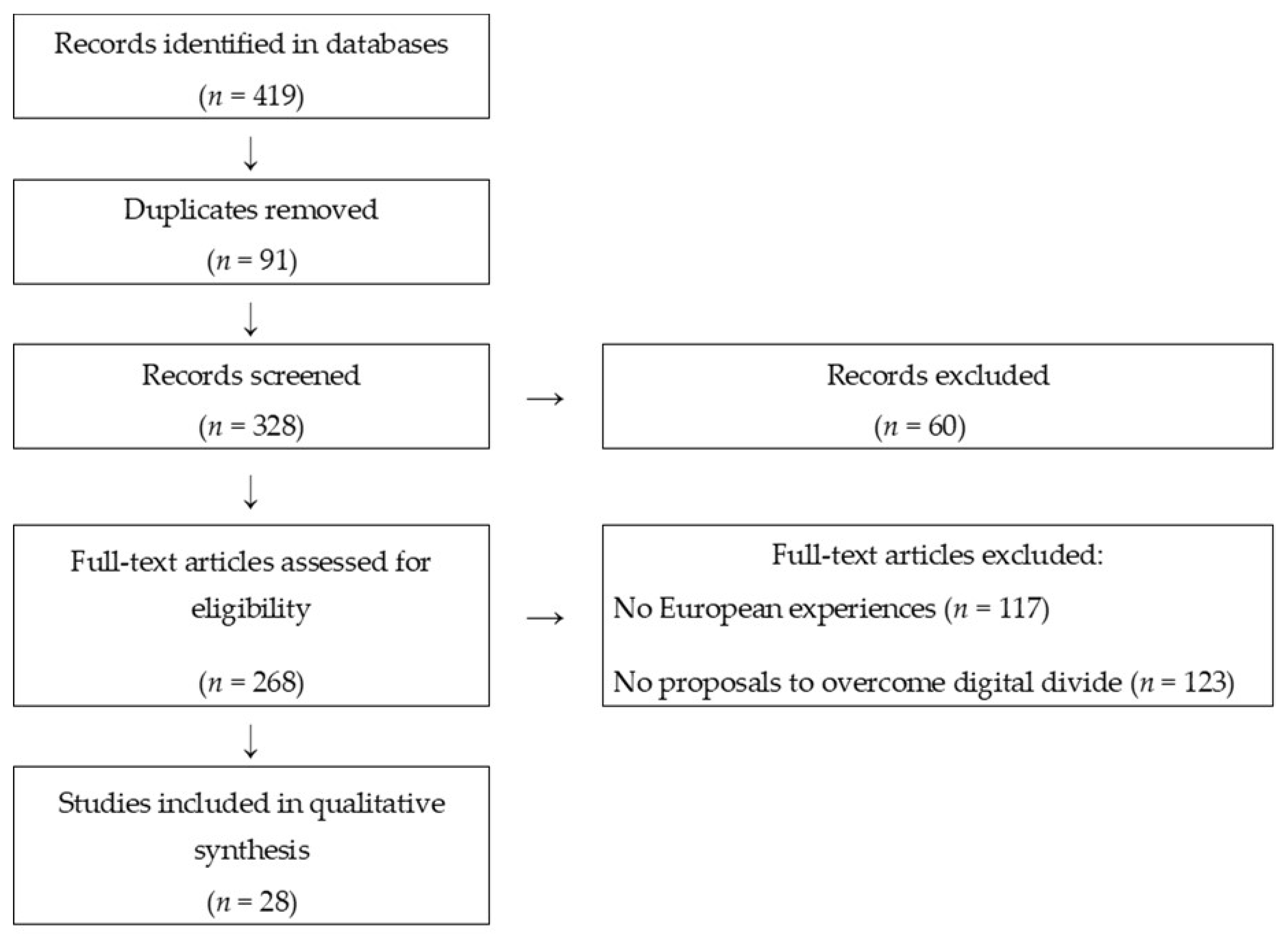
Searches with the help of this equation or its analogs in French and Spanish in the rest of the databases, appropriate to the specific interrogation languages, yielded a total of 419 references. These results of the searches were exported to the EndNote reference manager software: 91 duplicate items were removed, leaving the sample at 328 references.
An evidence examination based on the title and the abstract was performed for the selection of the studies. Sixty papers were excluded because they did not meet the objective of the study from the perspective of the social sciences or because they were not based on the use of a quantitative, qualitative, or mixed research method and techniques. Then, an evaluation of the degree of interest of the 268 documents selected was carried out, discarding 117 documents focused on experiences or problems of non-European countries together with 123 more that eluded the proposal and intervention actions to overcome the digital divide. As a final result, 28 documents were selected for the qualitative synthesis. Figure 1 shows the inclusion decision flow diagram with the steps of the review decision process (identification, selection, eligibility, and inclusion) according to the PRISMA standard.
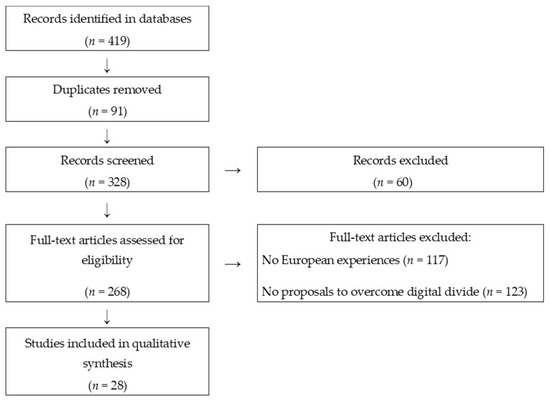
Figure 1.
Flowchart of inclusion decisions. Source: The Authors from PRISMA standard.
5. Recommendations Related to Access and Connectivity
The results of the analysis of academic literature about the rural digital divide in Europe in the last five years allow obtaining relevant answers to the three proposed research questions. First, there is a comprehensive analysis of all dimensions of the digital divide, but the articles are specialized in one of them: technical or social. In general, the studies centered on the social dimension are focused more on aspects related to the exploitation of the internet to promote personal and territorial development, than in the training on technical skills in ICT. Seen as a whole, the literature covers the main aspects of the general environment of the rural digital divide, configuring, in a certain way, a PEST analysis: political, economic, social, and technological. Second, most of the studies are not limited to explaining and analyzing the state of a rural community or a social group, but also propose specific intervention measures, which has made it possible to develop seven recommendations for the short term and new lines of research and social intervention in the medium term, which are summarized in the conclusions section. Finally, despite the fact that studies were obviously carried out without the horizon of the current pandemic situation, most of these recommendations and lines of action can be carried out quickly because they do not require structural changes, but rather determined and coordinated government actions.
5.1. Broadband as an Essential Requirement
Rural areas remain at a disadvantaged position due to poor connectivity, a problem that needs to be addressed by governments to correct imbalances, encourage proactive attitudes, and limit the brain drain of qualified people moving to urban areas, often outside the country. Wilson and Hopkins [49] highlight the need to focus on the most disadvantaged areas to avoid further inequalities in the countryside and they propose to act region by region, rather than on the technological infrastructure of the area. Besides, they emphasize that investment in technology should not be seen as the goal, but as the means to achieve many other improvements that can “rescue” rural areas.
Broadband is a key technology that not only ensures connectivity, but also has a decisive impact on companies’ ability to innovate and grow [50]. The absence of broadband leads small agri-food companies to take a passive approach to growth opportunities, particularly posing a serious barrier to diversification and internationalization. In their study on micro and small rural enterprises (Rural Public Access Wi-Fi Service (PAWS) project), Philip and Williams [23] analyze micro and small enterprises in the agriculture, tourism and art sectors, concluding that, in order to ensure the future of micro and small rural enterprises, the quality of connectivity and digital skills are fundamental, and so the former is necessary to enable the latter. They also argue that small and micro rural enterprises cannot be ignored in technological development programs, and more research should be carried out to study the relationship between connectivity and the development of rural economy.
In contrast to the findings described, the evaluation work of Duvivier et al. [51] of the Auvergne très haut débit programme in France concludes that the deployment of fiber and high speed has not significantly stimulated the creation of enterprises, having affected positively only to the creation of companies in specific sectors: hostelry; public administration, education, health and social work; and other activities in the services sector. While the deployment of fiber and high speed does not appear to be sufficient on its own to drive rural economic development, it may be a lever for development when certain conditions, related to the territorial economic context and design of digital policy, are met [51]. From the opposite perspective, the existence of faster internet technologies can even increase the urban–rural digital divide, as they are more expensive and difficult to obtain in rural areas [52].
5.2. The Role of Governments in Connectivity
State aid measures for broadband have flourished in the European Union, but knowledge of the effectiveness and efficiency of this policy is extremely scarce. In fact, the digital broadband gap between the Member States of the Union and the less developed rural areas has not been eliminated [53]. Matteucci [54] highlights a positive balance between the pros and cons of public intervention, as when looking at the performance of auction prices and the cost accounting of public works it seems that state intervention was carried out in a non-distorting and market-friendly manner. Besides, in acquisitions, despite being focused on technical quality, there was also a particular focus on greater efficiency, which broadly confirms the adequacy of the European Union’s procurement law. Matteucci [54] also points out important criticisms, such as the fact that the evolution of technology (5G, Internet of Things, Industry 4.0, etc.) requires faster deployment throughout the territory of the latest generation networks, as a technological prerequisite for the launch of services.
Governments have also been criticized for inefficient implementations, lack of customer focus and poor consideration of risk factors and potential obstacles [55]. It has already been designated, as Salemink et al. emphasized [20], that policies aimed at improving technological access in rural areas have been underprized due to their generic nature and lack of anticipation of future technological developments, so that at the time of their implementation they were already outdated. Therefore, they consider that specific policies are needed relying on the local knowledge of the numerous rural actors and meeting their specific demands and needs. These authors suggest adopting a community approach that falls between the national and individual levels since closing the digital divide in the European Union requires a combination of regional and national political measures [56].
The relationship between regional governments and citizens’ initiatives in this area is also problematic, resulting in inadequate policies. The findings of Salemink and Strijker [57] reveal that even when governments develop supportive policies for citizens’ initiatives, people can feel government efforts as limiting factors: if a government calls for citizen participation, what is expected from this call must be made clear in advance to reduce misinterpretations by both parties.
The role of public intervention is essential to ensure the survival of local communities, and when investment occurs is a key success factor. Investments should be timely, and connections should work quickly; if this does not happen, infrastructure may be at risk of becoming rapidly obsolete and not contributing to the economic viability of rural communities [58]. The least attractive areas for the implementation of 5G and broadband technology should get more support from governments’ digital strategy programs [23]. A population density-based classification criterion is suggested to be applied in analyses of ultra-fast broadband deployment in rural areas. This would allow for more information and understanding not only of the effects of rurality, but also of population scarcity, since it is precisely the most depopulated areas that present the most logistical and economic problems when implementing this type of technology. It is necessary to focus on the most disadvantaged areas, as this can lead to new inequalities between rural zones with coverage and those without [49].
5.3. Design and Implementation of Policies and Programs
Policymakers will need to address several issues to promote the deployment of broadband networks in rural areas: the development of broadband demands studies in these places, defining how the digital divide can be avoided within the same rural area, and the cost assessment and technical capacity of wireless networks in rural areas [59].
Established and competitive service providers already offer solutions for urban and suburban areas, but there is little or no commitment to connecting zones that include smaller cities and rural villages [60]. The study of the role of niche technology infrastructure providers in the UK carried out by Gerli et al. [61] suggests that alternative suppliers may take advantage of unmet demand for ultra-fast broadband. These companies tend to develop unique business models, based on key partnerships and a modular approach, which compensates for problems associated with their small scale. Policymakers should consider this factor when planning public interventions to close the digital divide.
Policymakers in Europe are increasingly aware of the contribution of specialist providers to the dissemination of state-of-the-art broadband. However, additional measures must be considered to ensure efficient allocation of public resources and minimize competitive distortion in this market. Both regulation and public subsidies should be reviewed to consider the emergence of new actors. This is likely to require a different approach to public intervention in broadband markets, which still focuses on a simplistic juxtaposition between competition in urban areas and market failure in rural ones. Indeed, public intervention has proven incapable of recognizing and harnessing potential incentives for private investment in areas where the market is supposed to fail. The positive experience of the United Kingdom analyzed by Gerli et al. [61] shows the potential contribution of niche suppliers to broadband development, under the European regulatory framework.
The implementation of new solutions should begin with pilot projects, and the projects implemented should be measured according to their effectiveness, their efficiency, and the degree of achievement of their objectives [55]. The permanent monitoring of the digital dissemination is a necessary condition for the evaluation of the management and the choice of preventive and stimulating measures. Without this scientific approach it is impossible to identify the barriers to progressive changes in the agrarian sector of economy [62]. The efficiency of the measures adopted can be evaluated with the help of indicators such as percentage of households with a computer, percentage of households with internet, fixed (wired) broadband subscriptions per 100 inhabitants, mobile (wireless) broadband subscriptions per 100 inhabitants, speed (bit/s) per internet user, number of secure servers per million inhabitants and percentage of individuals who use the internet regularly [63].
5.4. Technological Solutions
Although many technological options are proposed in the literature, satellite communication has been identified as the only possible solution for most rural areas, due to its global coverage. Pereira [60] points to the combination of cable with wireless technologies as the most cost-effective option. Philip et al. [17] suggest implementing satellite or wireless connections, as expanding coverage through satellite systems would improve geographic coverage and connection speed. They stress the difficulty of installing xDSL (Digital Subscriber Lines) and propose BFWA (Broadband Fixed Wireless Access), DVB-S (Digital Video Broadcasting by Satellite) and WiMAX (Worldwide Interoperability for Microwave Access) as alternatives. They also recommend redefining the models of collaboration between telecommunications service providers and the public sector.
Chiha et al. [64] propose the combination of backhaul satellite communication with 4G fronthaul networks. Likewise, they prove that caching the most popular content to reduce traffic carried over the satellite link leads to a significant decrease in operating cost (more than 60%), which also implies a significant decrease in average cost per user.
6. Recommendations Related to the Use of ICTs
6.1. Social Recommendations
The traditional digital divide based on access is giving way to a new digital divide, based on the individuals’ use of the network. This new second-generation digital divide separates users who use the internet exclusively to look for information and communicate, from users who use it more broadly through the consumption of advanced internet services.
Based on the evidence and analysis collected in the studies of Richmond et al. [65], an evolution in the form of the digital divide between rural and urban areas seems to have been concluded. The distance in terms of high-speed internet access has been greatly minimized and replaced by a large difference in the use of digital business practices. Small businesses in rural areas have not adopted the cutting-edge business practices necessary to effectively reach the modern customer. Political efforts should therefore focus on the use of new technologies and not just their availability in rural areas. Understanding whether it is a lack of resources, knowledge, competitive pressure or any other factor or combination of factors is essential to implement practices that help rural e-companies at this level. The simple implementation of new digital technologies is not enough: awareness, education and training on usability and their possible benefits are critical [55].
Community resilience studies support the idea that social, cultural and institutional barriers have an influence on digital inclusion and remain once the digital access-related divide has been overcomed, as indicated in the theoretical background. The development of digital rural policies that promote community resilience has been suggested to favor the adoption of new technologies by rural communities [66].
The use of social networks in rural areas promotes social inclusion, especially in older adult women without studies [67]. Seniors are another group with very specific characteristics. In a quantitative and qualitative study on the elderly in the rural environment of Castilla y León (a depopulated inland region of Spain), Morales [68] proposes to adopt an intergenerational perspective, involving the generation support in the elderly learning process, since one of the greatest motivations in this sector is the desire to connect with their families. He also proposes strategies focused on community engagement or community media literacy based on dialog learning.
6.2. Educational Recommendations
Having the basic digital skills needed for the use of e-commerce, online training, banking, e-administration and remote work can generate a great impact, especially in peripheral rural areas, that would reduce or reverse their regressive dynamics, improving the quality of life and increasing employment and business opportunities. Actions aimed at promoting the use of advanced services to overcome this new digital divide are needed [69]. Cruz-Jesús et al. [63] believe that the digital divide will be difficult to overcome as long as there are significant educational disparities. It might be thought, perhaps with optimism, that as time goes on an increasing number of people will be born in the digital world and so grow up surrounded by ICT, which will result in a better assimilation of these technologies and their complexity. There is evidence that the role of education as a driver of the digital divide has diminished; however, to generate digital development, more attention could be paid to specific training programs related to ICTs, which would mitigate the role of complexity in their adoption [63].
Continuous innovation processes, particularly those based on ICTs, which are intended to be transferred to remote rural areas, should be supported by training and public advice actions. These actions must have a great flexibility tin order to act effectively and efficiently on the different situations existing: a diffusion of knowledge that is too homogeneous could lead to certain blocking phenomena, due to an excessive cognitive proximity [58].
Developing policies that encourage higher education and prevent early school leaving has positive effects on narrowing the digital divide. In the case of rural schools, teachers, through their motivation and predisposition towards the use of ICTs, have a key role in the digital literacy of students. It is recommended to implement training courses for these professionals, aimed at teaching the potential of technologies and implementing them in the educational programs [70].
Sánchez [71] presents a system based on blended education in which families and teachers participate actively and with ICT as protagonists. However, this author points out that both family members and teachers are required to have prior e-skills training in accordance with rigorous time planning and the establishment of a series of indicators to measure if prior expectations are met.
Rural libraries can also play an important role [72], for instance by providing internet access through the public use of computers and equipment adapted for people with disabilities, teaching basic digital skills to their users, influencing aspects of security, privacy and social media, or building their collections based on the needs of their users. Due to the shortage of staff and resources, Petri [71] proposes leaning on volunteers or organizations.
Although positive effects have been achieved in training oriented to the use of social networks and the handling of devices and places from where to connect to the internet, the need to promote actions aimed at the level of use, focused on increasing the autonomy of the user, turning their employment into a routine, and meeting the need to diversify training actions to learn the different profiles and motivations of users are unanimously highlighted.
6.3. Economic Recommendations
Rural development policies must go beyond the primary sector and gravitate in pluriactivity. The process of creating development programs and strategies should include more criteria than demographics, bearing in mind the diversity of the rural environment and designing initiatives that promote smart, sustainable and inclusive growth [69].
Ievoli et al. [58] highlight the importance of enhancing new business models for their ability to respond to the need to revitalize remote rural areas socially and economically, characterized by low economic density. The relevance of new forms of entrepreneurship in agriculture, based on environmental and social values, is such that it must be adequately supported; for example, encouraging farmers and entrepreneurs to push ICT-related cultural boundaries. Other key aspects would be the creation of new economic and social relationships, with consumers able and willing to pay more for products and services from geographically remote rural areas, and the attraction of highly qualified young entrepreneurs who, through the new ICT tools, can overcome the main obstacles of the remote countryside such as physical, social and cultural isolation.
Farmers could benefit from these initiatives by developing parallel off-farm activities to complement their agricultural income or developing more efficient agricultural practices through automation [50]. Meijere and Tambovceva [55] reaffirm that ICTs can be a very beneficial and powerful tool to facilitate the development of rural areas, especially in the e-commerce, e-health and e-management services sectors. The experiences discussed by Meijere and Tambovceva [55] allow to conclude that considerable attention should be devoted to create awareness of new opportunities to ensure the use of ICT solutions and tools among rural people, placing the focus on encouraging small and medium-sized enterprises in the countryside to adopt the use of such solutions and tools.
According to Räisänen and Tuovinen [52] the key elements to support the dissemination of digital innovations in rural micro-enterprises are communication, opinion leaders, agents of change and trust, which can be easily performed in all these aspects. Overcoming resistance to change and improving the general conditions of the environment (laws, regulations, infrastructures, etc.) is also important, not so much the possibility of influencing them. Policymakers wishing to promote rural economies must address not only the existence of an internet infrastructure, but also the willingness and ability of small businesses to use it effectively [65].
Following Cruz-Jesús et al. [63] income disparities remain the most important antecedent of digital asymmetries in all countries. Despite the increasing affordability of technology prices, their study shows that countries with different economic performance will also have different levels of digital development. Therefore, policies should be insisted on subsidizing or publicly funding the acquisition of equipment (especially since the most modern technology is usually the most expensive) or providing public access (for example, internet kiosks, community centers, etc.).
Morales [68] also proposes an increase in public investment and an optimization of resources in the rural environment with measures such as the use of computers in rural schools when school hours are over. The implementation of living labs [73], based on social innovation, can generate a great impact in rural areas, improving rural policies, entrepreneurship and rural business, and social and individual well-being. The creation of projects at the regional level with the collaboration of provincial councils to bring the necessary resources to the most isolated areas would be another measure in this sense [68].
7. Conclusions
This scoping review noted that academic literature continues to approach the two aspects of the digital divide: access and use. In the first case, there is a greater focus on issues related to the role and activity of public authorities in the design and implementation of policies and programs, than on technical issues, where satellite-related technologies are found unanimity, as well as an inclination to explore solutions linked to local specificities and the participation of the supplier companies and social agents of the territory. Additionally, in terms of use, recommendations of varying spectrum, both social, educational and economic, are detected, with a common insistence on the empowerment of rural populations and the need to prevent resistance to the use of technologies by appealing to the resilience of these populations.
Regarding the specific recommendations that can have a broad and rapid impact, essential in the current pandemic situation, the following ideas stand out from the qualitative analysis carried out among the selected sources, if there is a political will to carry them out:
- R1: Linking the improvement of connectivity to the dynamization of new business models and to the diversification of activities in the rural environment.
- R2: Ensuring the coherence of European, national, and regional initiatives.
- R3: Prioritizing the “speed of implementation” variable to ensure access to state-of-the-art technologies.
- R4: Exploiting the potential contribution of niche providers to broadband development.
- R5: Designing flexible training actions, adapted to the needs and circumstances of teachers who must deploy them in the areas of interest.
- R6: Optimizing the use of available resources, such as those in rural libraries.
- R7: Planning specific initiatives for vulnerable groups.
Finally, from the main findings and gaps identified, three lines of research and social intervention in the medium term are proposed:
- The evaluation of the effectiveness and efficiency of the national and regional public policies adopted in the last decade to reverse the reduction of the rural digital divide.
- The analysis of the relationship between connectivity and economic development in the rural environment. In particular, it is interesting to explore and assess the effectivity of digital inclusion as a potential instrument to retain and attract population and slow down the depopulation process in isolated areas and districts with negative population growth rates. The existing literature lacks approaches that study the possible effects of overcoming the digital divide to reverse the depopulation and to promote the development of the rural world; while some authors argue that an ageing population can be a major obstacle to get the expected positive results.
- The design and implementation of digital skills training programs specifically aimed at people living in the countryside to improve social communication processes in general, considered key to promote social leadership, rural empowerment, and resilience, and to enable innovative business initiatives.
The Next Generation European Union, a recovery fund for 2021–2027 to reverse the negative effects of the COVID-19 pandemic, approved by the European Council in its meeting of 17–21 July 2020, could be a great opportunity to implement the above recommendations and to promote the proposed lines of intervention by the academic literature because it presents a firm commitment to digital inclusion and the green deal. In this sense, bridging the rural digital divide must be a specific action of the territorial cohesion policies and the research and innovation program, via Horizon Europe.
Author Contributions
Conceptualization, M.-Á.E.-N. and T.M.-N.; methodology, M.-Á.G.-M.; software, T.M.-N.; validation, A.-I.N.-B.; formal analysis, M.-Á.E.-N.; investigation, M.-Á.G.-M. and T.M.-N.; resources, M.-Á.E.-N.; data curation, M.-Á.G.-M. and T.M.-N.; writing—original draft preparation, M.-Á.E.-N.; writing—review and editing, M.-Á.G.-M. and A.-I.N.-B.; visualization, M.-Á.G.-M.; supervision, M.-Á.E.-N.; project administration, M.-Á.E.-N.; funding acquisition, M.-Á.E.-N. All authors have read and agreed to the published version of the manuscript.
Funding
This work was supported by S29_20R-GICID (Research Group on Digital Communication and Information), Government of Aragon–Spain, BOA No. 62, dated 26/03/2020. Resolution of 13 March 2020: 8574-8655). Funded by the European Social Fund for Regional Development (ERDF).
Conflicts of Interest
The authors declare no conflict of interest.
References
- European Council. Lisbon European Council 23 and 24 March 2000. Presidency Conclusions. 2000. Available online: https://www.europarl.europa.eu/summits/lis1_en.htm (accessed on 6 July 2020).
- European Commission. Communication from the Commission to the European Parliament, the Council, the European Economic and Social Committee and the Committee of the Regions. A Digital Single Market Strategy for Europe. COM (2015) 192 Final. 2015. Available online: https://eur-lex.europa.eu/legal-content/EN/TXT/HTML/?uri=CELEX:52015DC0192andfrom=ES (accessed on 20 August 2020).
- European Commission. Communication from the Commission to the European Parliament, the Council, the European Economic and Social Committee and the Committee of the Regions. EU eGovernment Action Plan 2016–2020. Accelerating the Digital Transformation of Government. COM/2016/0179 Final. 2016. Available online: https://eur-lex.europa.eu/legal-content/EN/TXT/HTML/?uri=CELEX:52016DC0179andfrom=EN (accessed on 10 August 2020).
- European Union. Regulation (EU) 2015/2120 of the European Parliament and of the Council of 25 November 2015 Laying down Measures Concerning Open Internet Access. 2015. Available online: https://eur-lex.europa.eu/legal-content/EN/TXT/?uri=CELEX:32015R2120 (accessed on 19 August 2020).
- European Commission. Shaping Europe’s Digital Future: Social Media and Networks, Innovation and Policy. 2020. Available online: https://ec.europa.eu/digital-single-market/en/policies/social-media-and-networks-innovation-and-policy (accessed on 30 October 2020).
- De’, R.; Pandey, N.; Pal, A. Impact of Digital Surge during Covid-19 Pandemic: A Viewpoint on Research and Practice. Int. J. Inf. Manag. 2020, 55, 10217. [Google Scholar] [CrossRef]
- UN (United Nations) and ITU (International Telecommunication Union). World Summit on the Information Society. Declaration of Principles. Building the Information Society: A Global Challenge in the New Millennium. 2004. Available online: https://www.itu.int/net/wsis/docs/geneva/official/dop.html (accessed on 26 June 2020).
- Ye, L.; Yang, H. From Digital Divide to Social Inclusion: A Tale of Mobile Platform Empowerment in Rural Areas. Sustainability 2020, 12, 2424. [Google Scholar] [CrossRef]
- Pejic, M.; Zoroja, J.; Bosilj, V. Review of corporate digital divide research: A decadal analysis (2003–2012). Int. J. Inf. Syst. Proj. Manag. 2013, 1, 41–55. [Google Scholar] [CrossRef]
- Yu, L. The divided views of the information and digital divides: A call for integrative theories of information inequality. J. Inf. Sci. 2011, 37, 660–679. [Google Scholar] [CrossRef]
- Riggins, F.J.; Dewan, S. The Digital Divide: Current and Future Research Directions. J. Assoc. Inf. Syst. 2005, 6, 298–337. [Google Scholar] [CrossRef]
- López, J.J.S.; Castañeda, L.A.R. Digital inclusion and social perspective—Critical discussion based on a systematic review of the literature. In Proceedings of the 14th International Conference WWW/Internet 2015, Maynooth, Ireland, 24–26 October 2015; pp. 209–212. [Google Scholar]
- Gilbert, M. Theorizing Digital and Urban Inequalities: Critical geographies of ‘race’, gender and technological capital. Inf. Commun. Soc. 2010, 13, 1000–1018. [Google Scholar] [CrossRef]
- Helsper, E.J. Corresponding Fields Model for the Links between Social and Digital Exclusion. Commun. Theory 2012, 22, 403–426. [Google Scholar] [CrossRef]
- European Commission. Broadband Coverage in Europe (2018). Mapping Progress towards the Coverage Objectives of the Digital Agenda. 2019. Available online: https://ec.europa.eu/newsroom/dae/document.cfm?doc_id=62760 (accessed on 17 July 2020).
- Henning-Smith, C. The Unique Impact of COVID-19 on Older Adults in Rural Areas. J. Aging Soc. Policy 2020, 32, 396–402. [Google Scholar] [CrossRef]
- Philip, L.J.; Cottrill, C.D.; Farrington, J.; Williams, F.; Ashmore, F.H. The digital divide: Patterns, policy and scenarios for connecting the ‘final few’ in rural communities across Great Britain. J. Rural Stud. 2017, 54, 386–398. [Google Scholar] [CrossRef]
- Sostero, M.; Milasi, S.; Hurley, J.; Fernández-Macías, E.; Bisello, M. Teleworkability and the COVID-19 Crisis: A New Digital Divide? European Commission, Seville, JRC121193. 2020. Available online: https://ec.europa.eu/jrc/en/publication/eur-scientific-and-technical-research-reports/teleworkability-and-covid-19-crisis-new-digital-divide (accessed on 23 July 2020).
- Zhang, M.; Wolff, R.S. Crossing the Digital Divide: Cost-Effective Broadband Wireless Access for Rural and Remote Areas. IEEE Commun. Mag. 2004, 42, 99–105. [Google Scholar] [CrossRef]
- Salemink, K.; Strijker, D.; Bosworth, G. Rural development in the digital age: A systematic literature review on unequal ICT availability, adoption, and use in rural areas. J. Rural Stud. 2017, 54, 360–371. [Google Scholar] [CrossRef]
- Freeman, J.; Park, S.; Middleton, C. Technological literacy and interrupted internet access. Inf. Commun. Soc. 2019, 23, 1947–1964. [Google Scholar] [CrossRef]
- Robinson, L.; Cotten, S.R.; Ono, H.; Quan-Haase, A.; Mesch, G.; Chen, W.; Schulz, J.; Hale, T.; Stern, M. Digital inequalities and why they matter. Inf. Commun. Soc. 2015, 18, 569–582. [Google Scholar] [CrossRef]
- Philip, L.J.; Williams, F. Remote rural home-based businesses and digital inequalities: Understanding needs and expectations in a digitally underserved community. J. Rural Stud. 2019, 68, 306–318. [Google Scholar] [CrossRef]
- Townsend, L.; Wallace, C.; Fairhurst, G.; Anderson, A. Broadband and the creative industries in rural Scotland. J. Rural Stud. 2017, 54, 451–458. [Google Scholar] [CrossRef]
- Pávez, I.; Correa, T.; Contreras, J. Meanings of (dis)connection: Exploring non-users in isolated rural communities with internet access infrastructure. Poetics 2017, 63, 11–21. [Google Scholar] [CrossRef]
- Correa, T.; Pávez, I. Digital Inclusion in Rural Areas: A Qualitative Exploration of Challenges Faced by People from Isolated Communities. J. Comput. Mediat. Commun. 2016, 21, 247–263. [Google Scholar] [CrossRef]
- Pérez-Calle, B.; Marta-Lazo, C.; Nogales-Bocio, A.I. Diseño de un proyecto de capacitación en competencias digitales de los colectivos vulnerables, mediadores en educación permanente y MYPES-PYMES en Aragón. Index Comun. 2020, 10, 75–96. Available online: https://journals.sfu.ca/indexcomunicacion/index.php/indexcomunicacion/article/view/497 (accessed on 26 June 2020). [CrossRef]
- Scheerder, A.; van Deursen, A.; van Dijk, J. Determinants of Internet skills, uses and outcomes. A systematic review of the second- and third-level digital divide. Telemat. Inform. 2017, 34, 1607–1624. [Google Scholar] [CrossRef]
- Rasmussen, J.; Ihlen, O. Risk, crisis, and social media: A systematic review of seven years’ research. Nord. Rev. 2017, 38, 1–17. [Google Scholar] [CrossRef]
- Epstein, D.; Nisbet, E.C.; Gillespie, T. Who’s Responsible for the Digital Divide? Public Perceptions and Policy Implications. Inf. Soc. 2011, 27, 92–104. [Google Scholar] [CrossRef]
- Strover, S. Rural internet connectivity. Telecommun. Policy 2001, 25, 331–347. [Google Scholar] [CrossRef]
- Mack, E.; Dutton, W.H.; Rikard, R.V.; Yankelevich, A. Mapping and measuring the information society: A social science perspective on the opportunities, problems, and prospects of broadband Internet data in the United States. Inf. Soc. 2019, 35, 57–68. [Google Scholar] [CrossRef]
- D’Adamo, I.; Rosa, P. How Do You See Infrastructure? Green Energy to Provide Economic Growth after COVID-19. Sustainability 2020, 12, 4738. [Google Scholar] [CrossRef]
- Giudice, F.; Caferra, R.; Morone, P. COVID-19, the Food System and the Circular Economy: Challenges and Opportunities. Sustainability 2020, 12, 7939. [Google Scholar] [CrossRef]
- BEREC. BEREC and RSPG Joint Report on Facilitating Mobile Connectivity in “Challenge Areas” (Report BoR (17) 256). Body of European Regulators for Electronic Communications. 2017. Available online: https://berec.europa.eu/eng/document_register/subject_matter/berec/download/0/7574-berec-and-rspg-joint-report-on-facilitat_0.pdf (accessed on 1 August 2020).
- Bosch-Capblanch, X.; Lavis, J.N.; Lewin, S.; Atun, R.; Røttingen, J.-A.; Dröschel, D.; Beck, L.; Abalos, E.; El-Jardali, F.; Gilson, L.; et al. Guidance for Evidence-Informed Policies about Health Systems: Rationale for and Challenges of Guidance Development. PLoS Med. 2012, 9, e1001185. [Google Scholar] [CrossRef]
- Tricco, A.C.; Antony, J.; Zarin, W.; Strifler, L.; Ghassemi, M.; Ivory, J.; Perrier, L.; Hutton, B.; Moher, D.; Straus, S.E. A scoping review of rapid review methods. BMC Med. 2015, 13, 224. [Google Scholar] [CrossRef]
- Langlois, E.V.; Straus, S.E.; Mijumbi-Deve, R.; Lewin, S.; Tricco, A.C. The need for rapid reviews to inform health policy and systems. In Rapid Reviews to Strengthen Health Policy and Systems: A Practical Guide; Tricco, A.C., Langlois, E.V., Straus, S.E., Eds.; World Health Organization: Geneva, Switzerland, 2017. [Google Scholar]
- Tricco, A.C.; Zarin, W.; Nincic, V.; Rios, P.; Khan, P.A.; Ghassemi, M.; Motiwala, S.S.; Pham, B.; Oliver, S.; Straus, S.E.; et al. Engaging policy-makers and health systems managers in the conduct of rapid reviews. In Rapid Reviews to Strengthen Health Policy and Systems: A Practical Guide; Tricco, A.C., Langlois, E.V., Straus, S.E., Eds.; World Health Organization: Geneva, Switzerland, 2017. [Google Scholar]
- Peters, M.D.; Godfrey, C.; McInerney, P.; Baldini Soares, C.; Khalil, H.; Parker, D. Chapter 11: Scoping Reviews (2020 version). In Joanna Briggs Institute Reviewer’s Manual; Edoardo, A., Zachary, M., Eds.; Joanna Briggs Institute: Adelaide, Australia, 2020. [Google Scholar]
- Plüddemann, A.; Aronson, J.K.; Onakpoya, I.; Heneghan, C.; Mahtania, K.R. Redefining Rapid Reviews: A Flexible Framework for Restricted Systematic Reviews. BMJ Evid. Based Med. 2018, 23, 201–203. [Google Scholar] [CrossRef]
- Grant, M.J.; Booth, A. A typology of reviews: An analysis of 14 review types and associated methodologies. Health Inf. Libr. J. 2009, 26, 91–108. [Google Scholar] [CrossRef]
- Oliver, S.; Wilson, M.; Melendez-Torres, G.J.; Bangpan, M.; Dickson, K.; Vigurs, C. Selecting rapid review methods for complex questions related to health policy and system improvements. In Rapid Reviews to Strengthen Health Policy and Systems: A Practical Guide; Tricco, A.C., Langlois, E.V., Straus, S.E., Eds.; World Health Organization: Geneva, Switzerland, 2017; pp. 55–70. [Google Scholar]
- Watt, A.M.; Cameron, A.; Sturm, L.; Lathlean, T.; Babidge, W.J.; Blamey, S.; Facey, K.; Hailey, D.; Norderhaug, I.; Maddern, G.J. Rapid reviews versus full systematic reviews: An inventory of current methods and practice in health technology assessment. Int. J. Technol. Assess. Health Care 2008, 24, 133–139. [Google Scholar] [CrossRef]
- Hartling, L.; Guise, J.M.; Kato, E.; Anderson, J.; Belinson, S.; Berliner, E.; Dryden, D.M.; Featherstone, R.; Mitchell, M.D.; Motu’Apuaka, M.; et al. A taxonomy of rapid reviews links report types and methods to specific decision-making contexts. J. Clin. Epidemiol. 2015, 68, 1451–1462.e3. [Google Scholar] [CrossRef] [PubMed]
- Moher, D.; Liberati, A.; Tetzlaff, J.; Altman, D.G. The PRISMA Group. Preferred Reporting Items for Systematic Reviews and Meta-Analyses: The PRISMA Statement. BMJ 2009, 339, b2535. [Google Scholar] [CrossRef] [PubMed]
- O’Brien, K.K.; Colquhoun, H.; Levac, D.; Baxter, L.; Tricco, A.C.; Straus, S.; Wickerson, L.; Nayar, A.; Moher, D.; O’Malley, L. Advancing scoping study methodology: A web-based survey and consultation of perceptions on terminology, definition and methodological steps. BMC Health Serv. Res. 2016, 16, 305. [Google Scholar] [CrossRef] [PubMed]
- Peterson, J.; Pearce, P.F.; Ferguson, L.A. Understanding scoping reviews: Definition, purpose, and process. J. Am. Assoc. Nurse Pract. 2017, 29, 12–16. [Google Scholar] [CrossRef]
- Wilson, R.; Hopkins, J. The Changing Shape of Scotland’s Digital Divide. Eur. Countrys. 2019, 11, 563–583. [Google Scholar] [CrossRef]
- Bowen, R.; Morris, W. The digital divide: Implications for agribusiness and entrepreneurship.Lessons from Wales. J. Rural Stud. 2019, 72, 75–84. [Google Scholar] [CrossRef]
- Duvivier, C.; Truchet, S.; Mauhé, N.; Mbarek, M. Déploiement du très haut débit et création d’entreprises dans les zones rurales: Une évaluation du programme Auvergne très haut débit. Économie Prévision 2018, 214, 97–139. [Google Scholar] [CrossRef]
- Räisänen, J.; Tuovinen, T. Digital innovations in rural micro-enterprises. J. Rural Stud. 2020, 73, 56–67. [Google Scholar] [CrossRef]
- Polykalas, S.E.; Vlachos, K.; Ellinas, G. Technologies and architectures for broadband Digital Divide elimination. In Proceedings of the 24th International Conference on Telecommunications (ICT), Limassol, Cyprus, 3–5 May 2017; pp. 1–6. [Google Scholar] [CrossRef]
- Matteucci, N. The EU State aid policy for broadband: An evaluation of the Italian experience with first generation networks. Telecommun. Policy 2019, 43, 101830. [Google Scholar] [CrossRef]
- Meijere, S.; Tambovceva, T. Information communication technologies as enabler for rural development. In Proceedings of the 2017 International Conference “Economic Science for Rural Development”, Jelgava, Latvia, 27–28 April 2017; pp. 110–115. [Google Scholar]
- Szeles, M.R. New insights from a multilevel approach to the regional digital divide in the European Union. Telecommun. Policy 2018, 42, 452–463. [Google Scholar] [CrossRef]
- Salemink, K.; Strijker, D. The participation society and its inability to correct the failure of market players to deliver adequate service levels in rural areas. Telecommun. Policy 2018, 42, 757–765. [Google Scholar] [CrossRef]
- Ievoli, C.; Belliggiano, A.; Marandola, D.; Milone, P.; Ventura, F. Information and communication infrastructures and new business models in rural areas: The case of Molise region in Italy. Eur. Countrys. 2019, 11, 475–496. [Google Scholar] [CrossRef]
- Schneir, J.R.; Xion, Y. A cost study of fixed broadband access networks for rural areas. Telecommun. Policy 2016, 40, 755–773. [Google Scholar] [CrossRef]
- Pereira, J.P.R. Broadband access and digital divide. In New Advances in Information Systems and Technologies; Rocha, Á., Correia, A.M., Adeli, H., Reis, L.P., Costanzo, S., Eds.; Springer: Cham, Switzerland, 2016; pp. 363–368. [Google Scholar]
- Gerli, P.; Wainwright, D.; Whalley, J. Infrastructure investment on the margins of the market: The role of niche infrastructure providers in the UK. Telecommun. Policy 2017, 41, 743–756. [Google Scholar] [CrossRef][Green Version]
- Kupriyanova, M.; Dronov, V.; Gordova, T. Digital Divide of Rural Territories in Russia. AGRIS On-line Pap. Econ. Inf. 2019, 11, 85–90. [Google Scholar] [CrossRef]
- Cruz-Jesús, F.; Oliveira, T.; Bacao, F. The Global Digital Divide: Evidence and Drivers. J. Glob. Inf. Manag. 2018, 26, 1–26. [Google Scholar] [CrossRef]
- Chiha, A.; Van der Wee, M.; Colle, D.; Verbrugge, S. Techno-economic viability of integrating satellite communication in 4G networks to bridge the broadband digital divide. Telecommun. Policy 2020, 44, 101874. [Google Scholar] [CrossRef]
- Richmond, W.; Rader, S.; Lanier, C. The “Digital Divide” for rural small businesses. J. Res. Mark. Entrep. 2017, 19, 94–104. [Google Scholar] [CrossRef]
- Roberts, E.; Anderson, B.A.; Skerratt, S.; Farrington, J. A review of the rural-digital policy agenda from a community resilience perspective. J. Rural Stud. 2017, 54, 372–385. [Google Scholar] [CrossRef]
- Vico-Bosch, A.; Rebollo-Catalán, A. Impact of digital inclusion policies in the use of social networks of rural women. Prism. Soc. 2018, 21, 263–281. [Google Scholar] [CrossRef]
- Morales, N. The challenge of the digital divide and elderly in Spanish rural areas. The case of Castilla y Leon. Fonseca J. Commun. 2016, 13, 169–189. [Google Scholar] [CrossRef][Green Version]
- Morales, N. ICT and pupils of rural areas: Between the digital gap and inclusive education. Bordón Rev. Pedagog. 2017, 69, 41–56. [Google Scholar] [CrossRef]
- Armas-Quinta, F.X.; Lois-Gonzalez, R.C.; Macia-Arce, X.C. Advanced Internet Services: New opportunities for rural territorial development. An. Geogr. Univ. Complut. 2018, 38, 271–287. [Google Scholar] [CrossRef]
- Sánchez, F. Rural blended education. Proyecto de educación semipresencial para frenar la despoblación de las zonas rurales. 3C TIC Cuad. Desarro. Apl. TIC 2019, 8, 74–95. [Google Scholar] [CrossRef]
- Petri, C. Rural libraries and the human right to internet access. In Rural and Small Public Libraries: Challenges and Opportunities; Emerald Publishing Limited: Bingley, UK, 2017; Volume 43, pp. 13–35. [Google Scholar] [CrossRef]
- Tirziu, A. Promoting social innovation in rural areas through living labs. In Proceedings of the 4th ACADEMOS Conference, Bucharest, Romania, 15–18 June 2017; Available online: https://papers.ssrn.com/sol3/papers.cfm?abstract_id=2992217 (accessed on 27 June 2020).
Publisher’s Note: MDPI stays neutral with regard to jurisdictional claims in published maps and institutional affiliations. |
© 2020 by the authors. Licensee MDPI, Basel, Switzerland. This article is an open access article distributed under the terms and conditions of the Creative Commons Attribution (CC BY) license (http://creativecommons.org/licenses/by/4.0/).