The Role of Screentime and Family Resiliency in Overweight/Obesity in Children and Children with Developmental Disabilities Before and During COVID-19
 , and
, and
Highlights
- Prevalence of all children and children with developmental disabilities identified as overweight/obese reporting ≥4 h of screentime use increased from pre-COVID-19 to during COVID-19 years.
- Among all children, screentime was positively associated with overweight/obesity both before and during COVID-19, and associations with family resilience varied by resilience level and pandemic timepoint. For children with developmental disabilities, screentime associations and family resiliency were generally weaker across both pre- and during COVID-19.
- The rise in the proportion of children and children with developmental disabilities spending more than 4 h on screens during COVID-19 is an important factor to consider for childhood obesity interventions and policies.
- Family resiliency may play a protective role in preventing overweight/obesity and needs to be further investigated so that best practices in supporting children and families with early overweight/obesity screening can be paired with culturally sensitive programs.
Abstract
1. Background
2. Methods
2.1. Measures
2.2. Statistical Analysis
3. Results
4. Discussion
5. Conclusions
Author Contributions
Funding
Institutional Review Board Statement
Informed Consent Statement
Data Availability Statement
Acknowledgments
Conflicts of Interest
References
- Ng, M.; Dai, X.; Cogen, R.M.; Abdelmasseh, M.; Abdollahi, A.; Abdullahi, A.; Aboagye, R.G.; Abukhadijah, H.J.; Adeyeoluwa, T.E.; Afolabi, A.A.; et al. National-level and state-level prevalence of overweight and obesity among children, adolescents, and adults in the USA, 1990–2021, and forecasts up to 2050. Lancet 2024, 404, 2278–2298. [Google Scholar] [CrossRef] [PubMed]
- Ogden, C.L.; Carroll, M.D.; Kit, B.K.; Flegal, K.M. Prevalence of Childhood and Adult Obesity in the United States, 2011–2012. JAMA 2014, 311, 806. [Google Scholar] [CrossRef] [PubMed]
- August, G.P.; Caprio, S.; Fennoy, I.; Freemark, M.; Kaufman, F.R.; Lustig, R.H.; Silverstein, J.H.; Speiser, P.W.; Styne, D.M.; Montori, V.M.; et al. Prevention and treatment of pediatric obesity: An endocrine society clinical practice guideline based on expert opinion. J. Clin. Endocrinol. Metab. 2008, 93, 4576–4599. [Google Scholar] [CrossRef] [PubMed]
- APA. EPA Report America’s Children and the Environment, 3rd ed.; EPA: Washington, DC, USA, 2015. [Google Scholar]
- Lipkin, P.H.; Macias, M.M.; Council on Children with Disabilities (COCWD). Promoting Optimal Development: Identifying Infants and Young Children With Developmental Disorders Through Developmental Surveillance and Screening. Pediatrics 2020, 145, e20193449. [Google Scholar] [CrossRef]
- Broder-Fingert, S.; Brazauskas, K.; Lindgren, K.; Iannuzzi, D.; Van Cleave, J. Prevalence of overweight and obesity in a large clinical sample of children with autism. Acad. Pediatr. 2014, 14, 408–414. [Google Scholar] [CrossRef]
- Minihan, P.M.; Must, A.; Anderson, B.; Popper, B.; Dworetzky, B. Children with special health care needs: Acknowledging the dilemma of difference in policy responses to obesity. Prev. Chronic Dis. 2011, 8, A95. [Google Scholar]
- Farooqi, I.S.; Keogh, J.M.; Yeo, G.S.; Lank, E.J.; Cheetham, T.; O’Rahilly, S. Clinical spectrum of obesity and mutations in the melanocortin 4 receptor gene. N. Engl. J. Med. 2003, 348, 1085–1095. [Google Scholar] [CrossRef]
- Must, A.; Phillips, S.M.; Curtin, C.; Anderson, S.E.; Maslin, M.; Lividini, K.; Bandini, L.G. Comparison of sedentary behaviors between children with autism spectrum disorders and typically developing children. Autism 2014, 18, 376–384. [Google Scholar] [CrossRef]
- Barlow, S.E. Expert Committee Recommendations Regarding the Prevention, Assessment, and Treatment of Child and Adolescent Overweight and Obesity: Summary Report. Pediatrics 2007, 120, S164–S192. [Google Scholar] [CrossRef]
- Lange, S.J.; Kompaniyets, L.; Freedman, D.S.; Kraus, E.M.; Porter, R.; Blanck, H.M.; Goodman, A.B. Longitudinal Trends in Body Mass Index Before and During the COVID-19 Pandemic Among Persons Aged 2–19 Years—United States, 2018–2020. MMWR Morb. Mortal. Wkly. Rep. 2021, 70, 1278–1283. [Google Scholar] [CrossRef]
- Wong, C.A.; Ming, D.; Maslow, G.; Gifford, E.J. Mitigating the Impacts of the COVID-19 Pandemic Response on At-Risk Children. Pediatrics 2020, 146, e20200973. [Google Scholar] [CrossRef]
- Wiecha, J.L.; Peterson, K.E.; Ludwig, D.S.; Kim, J.; Sobol, A.; Gortmaker, S.L. When children eat what they watch: Impact of television viewing on dietary intake in youth. Arch. Pediatr. Adolesc. Med. 2006, 160, 436–442. [Google Scholar] [CrossRef] [PubMed]
- Rundle, A.G.; Park, Y.; Herbstman, J.B.; Kinsey, E.W.; Wang, Y.C. COVID-19–Related School Closings and Risk of Weight Gain Among Children. Obesity 2020, 28, 1008–1009. [Google Scholar] [CrossRef] [PubMed]
- Bronfenbrenner, U. The Ecology of Human Development; Harvard University Press: Cambridge, MA, USA, 1979. [Google Scholar]
- Bakour, C.; Mansuri, F.; Johns-Rejano, C.; Crozier, M.; Wilson, R.; Sappenfield, W. Association between screen time and obesity in US adolescents: A cross-sectional analysis using National Survey of Children’s Health 2016–2017. PLoS ONE 2022, 17, e0278490. [Google Scholar] [CrossRef] [PubMed]
- Fang, K.; Mu, M.; Liu, K.; He, Y. Screen time and childhood overweight/obesity: A systematic review and meta-analysis. Child Care Health Dev. 2019, 45, 744–753. [Google Scholar] [CrossRef]
- Maher, C.; Olds, T.S.; Eisenmann, J.C.; Dollman, J. Screen time is more strongly associated than physical activity with overweight and obesity in 9-to 16-year-old Australians. Acta Paediatr. 2012, 101, 1170–1174. [Google Scholar] [CrossRef]
- Marshall, S.J.; Biddle, S.J.H.; Gorely, T.; Cameron, N.; Murdey, I. Relationships between media use, body fatness and physical activity in children and youth: A meta-analysis. Int. J. Obes. 2004, 28, 1238–1246. [Google Scholar] [CrossRef]
- Shang, L.; Wang, J.; O’Loughlin, J.; Tremblay, A.; Mathieu, M.È.; Henderson, M.; Gray-Donald, K. Screen time is associated with dietary intake in overweight Canadian children. Prev. Med. Rep. 2015, 2, 265–269. [Google Scholar] [CrossRef]
- Sigman-Grant, M.; Hayes, J.; VanBrackle, A.; Fiese, B. Family Resiliency: A Neglected Perspective in Addressing Obesity in Young Children. Child Obes. 2015, 11, 664–673. [Google Scholar] [CrossRef]
- Heerman, W.J.; Samuels, L.R.; González Peña, T.; van Wyk, C.; Mayberry, L.S.; Lounds Taylor, J.; Martin, N.C. Family resilience and childhood obesity among children exposed to adverse childhood experiences in a national survey. Obes. Sci. Pract. 2022, 8, 3–11. [Google Scholar] [CrossRef]
- Black, K.; Lobo, M. A conceptual review of family resilience factors. J. Fam. Nurs. 2008, 14, 33–55. [Google Scholar] [CrossRef] [PubMed]
- Everri, M.; Messena, M.; Nearchou, F.; Fruggeri, L. Parent–Child Relationships, Digital Media Use and Parents’ Well-Being during COVID-19 Home Confinement: The Role of Family Resilience. Int. J. Environ. Res. Public Health 2022, 19, 15687. [Google Scholar] [CrossRef] [PubMed]
- Merkaš, M.; Perić, K.; Žulec, A. Parent distraction with technology and child social competence during the COVID-19 pandemic: The role of parental emotional stability. J. Fam. Commun. 2021, 21, 186–204. [Google Scholar] [CrossRef]
- Walsh, F. Strengthening Family Resilience; Guilford Publications: New York, NY, USA, 2015. [Google Scholar]
- Poulain, T.; Sobek, C.; Ludwig, J.; Igel, U.; Grande, G.; Ott, V.; Kiess, W.; Körner, A.; Vogel, M. Associations of Green Spaces and Streets in the Living Environment with Outdoor Activity, Media Use, Overweight/Obesity and Emotional Wellbeing in Children and Adolescents. Int. J. Environ. Res. Public Health 2020, 17, 6321. [Google Scholar] [CrossRef]
- Yusuf, Z.I.; Dongarwar, D.; Yusuf, R.A.; Bell, M.; Harris, T.; Salihu, H.M. Social determinants of overweight and obesity among children in the United States. Int. J. Matern. Child Health AIDS 2020, 9, 22. [Google Scholar] [CrossRef]
- Ogden, C.L.; Carroll, M.D.; Fakhouri, T.H.; Hales, C.M.; Fryar, C.D.; Li, X.; Freedman, D.S. Prevalence of Obesity Among Youths by Household Income and Education Level of Head of Household—United States 2011–2014. MMWR Morb. Mortal. Wkly. Rep. 2018, 67, 186–189. [Google Scholar] [CrossRef]
- Child and Adolescent Health Measurement Initiative. 2021 National Survey of Children’s Health (NSCH) Data Query. Data Resource Center for Child and Adolescent Health. Available online: https://www.childhealthdata.org (accessed on 25 June 2022).
- American Academy of Pediatrics. AAP medical home initiatives for children with special needs project advisory committee: The medical home. Pediatrics 2002, 110, 184–186. [Google Scholar] [CrossRef]
- Foster, B.A.; Weinstein, K. Moderating effects of components of resilience on obesity across income strata in the national survey of children’s health. Acad. Pediatr. 2019, 19, 58–66. [Google Scholar] [CrossRef]
- Weden, M.M.; Brownell, P.B.; Rendall, M.S.; Lau, C.; Fernandes, M.; Nazarov, Z. Parent-reported height and weight as sources of bias in survey estimates of childhood obesity. Am. J. Epidemiol. 2013, 178, 461–473. [Google Scholar] [CrossRef]
- Eales, L.; Ferguson, G.M.; Gillespie, S.; Smoyer, S.; Carlson, S.M. Family resilience and psychological distress in the COVID-19 pandemic: A mixed methods study. Dev. Psychol. 2021, 57, 1563–1581. [Google Scholar] [CrossRef]
- Messiah, S.E.; Lebron, C.; Moise, R.; Mathew, M.S.; Sardinas, K.; Chang, C.; Palenzuela, J.; Walsh, J.; Shelnutt, K.P.; Spector, R.; et al. Healthy caregivers-healthy children (HC2) phase 2: Integrating culturally sensitive childhood obesity prevention strategies into childcare center policies. Contemp. Clin. Trials 2017, 53, 60–67. [Google Scholar] [CrossRef]



| Characteristic | All Children | Children with DD | ||
|---|---|---|---|---|
| Pre-COVID Weighted % (n = 26,205 1; Wt. n = 4,403,706 2) (32.8% 3) | During COVID Weighted % (n = 35,368 1; Wt. n = 4,752,235 2) (35.8% 3) | Pre-COVID Weighted % (n = 7572 1; Wt. n = 1,282,728 2) (37.4% 3) | During COVID Weighted % (n = 11,024 1; Wt. n = 1,482,444 2) (39.3% 3) | |
| Screentime (Hours) | ||||
| <1–1.5 | 13.9 | 10.1 | 13.0 | 8.6 |
| 2–3 | 52.6 | 48.3 | 47.1 | 41.9 |
| ≥4 | 33.5 | 41.6 | 39.9 | 49.4 |
| Family Resilience | ||||
| Low | 9.7 | 6.9 | 12.5 | 9.5 |
| Medium | 12.0 | 11.1 | 17.1 | 15.5 |
| High | 78.3 | 82.0 | 70.4 | 74.9 |
| Health Insurance Type | ||||
| Private Only | 51.1 | 48.4 | 45.7 | 43.3 |
| Public Only | 37.5 | 37.5 | 40.5 | 44.0 |
| Public and Private | 4.8 | 5.9 | 8.6 | 7.1 |
| Uninsured | 6.7 | 8.2 | 5.3 | 5.5 |
| Care Met Medical Home Criteria | ||||
| Yes | 43.2 | 42.5 | 38.8 | 40.8 |
| No | 56.8 | 57.5 | 61.2 | 59.2 |
| Household Income Level | ||||
| 0–99% FPL | 22.4 | 21.6 | 25.3 | 23.0 |
| 100–199% FPL | 27.0 | 26.2 | 26.5 | 24.2 |
| 200–399% FPL | 28.2 | 29.7 | 26.9 | 31.5 |
| ≥400% FPL | 22.4 | 22.4 | 21.2 | 21.4 |
| Parents’ Education | ||||
| Less Than High School | 15.0 | 13.0 | 8.8 | 10.4 |
| High School Degree/GED | 24.2 | 25.5 | 26.7 | 24.9 |
| Some College/Technical | 25.0 | 24.1 | 29.7 | 25.9 |
| College Degree or Higher | 35.8 | 37.4 | 34.8 | 38.8 |
| Family Structure | ||||
| Two Parents, Currently Married | 55.7 | 57.0 | 50.9 | 52.8 |
| Two Parents, Not Currently Married | 9.1 | 7.5 | 9.4 | 7.8 |
| Single Parent (Mother/Father) | 29.0 | 29.5 | 31.7 | 30.5 |
| Grandparent/Other Family | 6.2 | 6.0 | 8.1 | 9.0 |
| Age (Years) | ||||
| 10–12 | 41.4 | 42.5 | 39.8 | 38.4 |
| 12–15 | 36.1 | 35.7 | 37.4 | 37.2 |
| 15–17 | 22.5 | 21.8 | 22.7 | 24.4 |
| Race/Ethnicity | ||||
| Non-Hispanic White | 44.5 | 42.2 | 53.1 | 49.1 |
| Non-Hispanic Black | 17.3 | 15.6 | 16.9 | 13.6 |
| Hispanic | 30.5 | 33.5 | 23.3 | 28.9 |
| Asian | 2.4 | 3.1 | 0.7 | 0.9 |
| AI/AN, Native Hawaiian, PI | 0.7 | 0.7 | 0.5 | 0.6 |
| Multi-Race/Other | 4.6 | 4.9 | 5.4 | 6.8 |
| Sex | ||||
| Male | 54.4 | 56.1 | 59.5 | 60.6 |
| Female | 45.6 | 43.9 | 40.5 | 39.4 |
| Neighborhood Amenities | ||||
| No Amenity | 12.7 | 12.2 | 12.6 | 12.2 |
| One Amenity | 12.5 | 13.0 | 12.3 | 12.8 |
| Two Amenities | 19.5 | 18.5 | 18.2 | 20.1 |
| Three Amenities | 20.4 | 22.9 | 24.6 | 24.1 |
| Four Amenities | 35.0 | 33.3 | 32.4 | 30.8 |
| Household Food Situation | ||||
| Always Had Nutritious Food | 58.1 | 61.4 | 49.1 | 54.0 |
| Afford to Eat, Not Always Nutritious | 34.2 | 32.7 | 38.9 | 36.4 |
| Sometimes/Often Could Not Afford | 7.7 | 5.9 | 11.9 | 9.6 |
| Health Status | ||||
| Excellent/Very Good | 81.9 | 79.9 | 71.0 | 66.6 |
| Good | 14.6 | 16.8 | 21.3 | 26.2 |
| Fair/Poor | 3.6 | 3.3 | 7.7 | 7.1 |
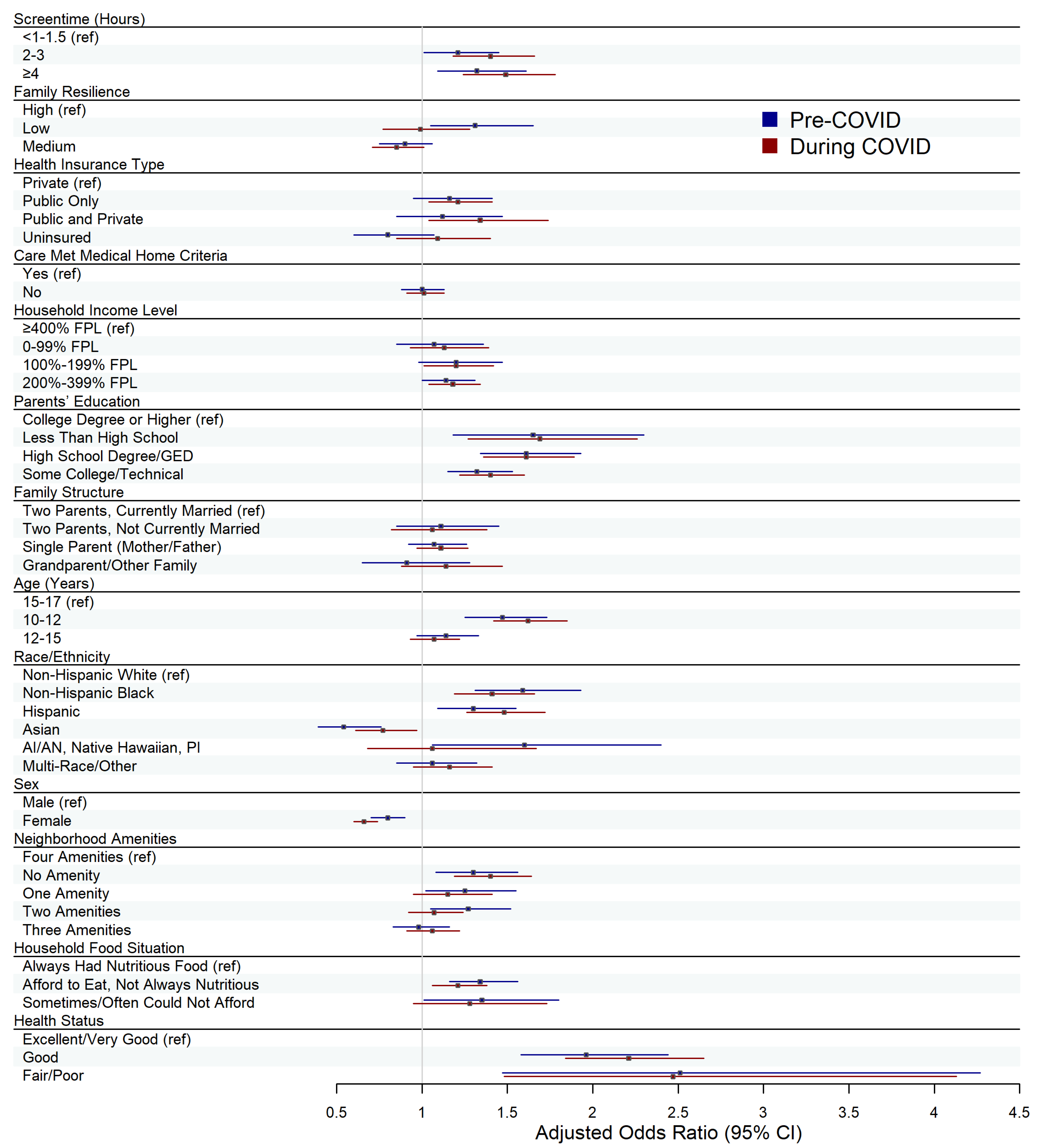
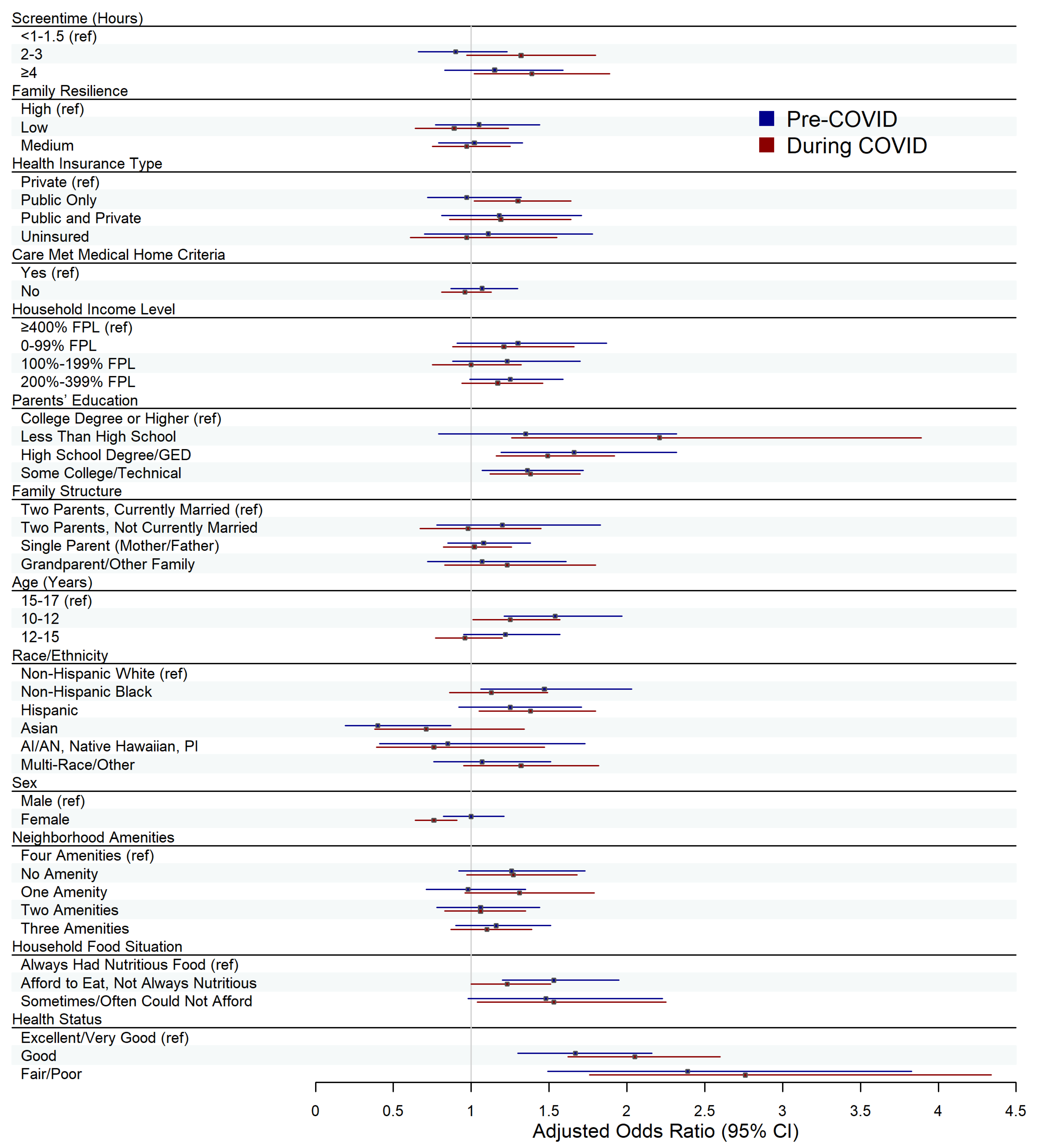
| Characteristic | All Children | Children with DD | ||
|---|---|---|---|---|
| Model 1: Pre-COVID aOR (95% CI) | Model 2: During COVID aOR (95% CI) | Model 3: Pre-COVID aOR (95% CI) | Model 4: During COVID aOR (95% CI) | |
| Screentime (Hours) | ||||
| <1–1.5 (ref) | - | - | - | - |
| 2–3 | 1.21 * (1.01, 1.45) | 1.40 † (1.18, 1.66) | 0.90 (0.66, 1.23) | 1.32 (0.97, 1.80) |
| ≥4 | 1.32 § (1.09, 1.61) | 1.49 † (1.24, 1.78) | 1.15 (0.83, 1.59) | 1.39 * (1.02, 1.89) |
| Family Resilience | ||||
| High (ref) | - | - | - | - |
| Low | 1.31 * (1.05, 1.65) | 0.99 (0.77, 1.28) | 1.05 (0.77, 1.44) | 0.89 (0.64, 1.24) |
| Medium | 0.90 (0.75, 1.06) | 0.85 (0.71, 1.01) | 1.02 (0.79, 1.33) | 0.97 (0.75, 1.25) |
| Health Insurance Type | ||||
| Private (ref) | - | - | - | - |
| Public Only | 1.16 (0.95, 1.41) | 1.21 * (1.04, 1.41) | 0.97 (0.72, 1.32) | 1.30 * (1.02, 1.64) |
| Public and Private | 1.12 (0.85, 1.47) | 1.34 * (1.04, 1.74) | 1.18 (0.81, 1.71) | 1.19 (0.86, 1.64) |
| Uninsured | 0.80 (0.60, 1.07) | 1.09 (0.85, 1.40) | 1.11 (0.70, 1.78) | 0.97 (0.61, 1.55) |
| Care Met Medical Home Criteria | ||||
| Yes (ref) | - | - | - | - |
| No | 1.00 (0.88, 1.13) | 1.01 (0.91, 1.13) | 1.07 (0.87, 1.30) | 0.96 (0.81, 1.13) |
| Household Income Level | ||||
| ≥400% FPL (ref) | - | - | - | - |
| 0–99% FPL | 1.07 (0.85, 1.36) | 1.13 (0.93, 1.39) | 1.30 (0.91, 1.87) | 1.21 (0.88, 1.66) |
| 100–199% FPL | 1.20 (0.98, 1.47) | 1.20 * (1.01, 1.42) | 1.23 (0.88, 1.70) | 1.00 (0.75, 1.32) |
| 200–399% FPL | 1.14 (1.00, 1.31) | 1.18 * (1.04, 1.34) | 1.25 (0.99, 1.59) | 1.17 (0.94, 1.46) |
| Parents’ Education | ||||
| College Degree or Higher (ref) | - | - | - | - |
| Less Than High School | 1.65 § (1.18, 2.30) | 1.69 † (1.27, 2.26) | 1.35 (0.79, 2.32) | 2.21 § (1.26, 3.89) |
| High School Degree/GED | 1.61 † (1.34, 1.93) | 1.61 † (1.36, 1.89) | 1.66 § (1.19, 2.32) | 1.49 § (1.16, 1.92) |
| Some College/Technical | 1.32 † (1.15, 1.53) | 1.40 † (1.22, 1.60) | 1.36 * (1.07, 1.72) | 1.38 § (1.12, 1.70) |
| Family Structure | ||||
| Two Parents, Currently Married (ref) | - | - | - | - |
| Two Parents, Not Currently Married | 1.11 (0.85, 1.45) | 1.06 (0.82, 1.38) | 1.20 (0.78, 1.83) | 0.98 (0.67, 1.45) |
| Single Parent (Mother/Father) | 1.07 (0.92, 1.26) | 1.11 (0.97, 1.27) | 1.08 (0.85, 1.38) | 1.02 (0.82, 1.26) |
| Grandparent/Other Family | 0.91 (0.65, 1.28) | 1.14 (0.88, 1.47) | 1.07 (0.72, 1.61) | 1.23 (0.83, 1.80) |
| Age (Years) | ||||
| 15–17 (ref) | - | - | - | - |
| 10–12 | 1.47 † (1.25, 1.73) | 1.62 † (1.42, 1.85) | 1.54 † (1.21, 1.97) | 1.25 * (1.01, 1.57) |
| 12–15 | 1.14 (0.97, 1.33) | 1.07 (0.93, 1.22) | 1.22 (0.95, 1.57) | 0.96 (0.77, 1.20) |
| Race/Ethnicity | ||||
| Non-Hispanic White (ref) | - | - | - | - |
| Non-Hispanic Black | 1.59 † (1.31, 1.93) | 1.41 † (1.19, 1.66) | 1.47 * (1.06, 2.03) | 1.13 (0.86, 1.49) |
| Hispanic | 1.30 § (1.09, 1.55) | 1.48 † (1.26, 1.72) | 1.25 (0.92, 1.71) | 1.38 * (1.05, 1.80) |
| Asian | 0.54 † (0.39, 0.76) | 0.77 * (0.61, 0.97) | 0.40 * (0.19, 0.87) | 0.71 (0.38, 1.34) |
| AI/AN, Native Hawaiian, PI | 1.60 * (1.06, 2.40) | 1.06 (0.68, 1.67) | 0.85 (0.41, 1.73) | 0.76 (0.39, 1.47) |
| Multi-Race/Other | 1.06 (0.85, 1.32) | 1.16 (0.95, 1.41) | 1.07 (0.76, 1.51) | 1.32 (0.95, 1.82) |
| Sex | ||||
| Male (ref) | - | - | - | - |
| Female | 0.80 † (0.70, 0.90) | 0.66 † (0.60, 0.74) | 1.00 (0.82, 1.21) | 0.76 § (0.64, 0.91) |
| Neighborhood Amenities | ||||
| Four Amenities (ref) | - | - | - | - |
| No Amenity | 1.30 § (1.08, 1.56) | 1.40 † (1.19, 1.64) | 1.26 (0.92, 1.73) | 1.27 (0.97, 1.68) |
| One Amenity | 1.25 * (1.02, 1.55) | 1.15 (0.95, 1.41) | 0.98 (0.71, 1.35) | 1.31 (0.96, 1.79) |
| Two Amenities | 1.27 * (1.05, 1.52) | 1.07 (0.92, 1.24) | 1.06 (0.78, 1.44) | 1.06 (0.83, 1.35) |
| Three Amenities | 0.98 (0.83, 1.16) | 1.06 (0.91, 1.22) | 1.16 (0.90, 1.51) | 1.10 (0.87, 1.39) |
| Household Food Situation | ||||
| Always Had Nutritious Food (ref) | - | - | - | - |
| Afford to Eat, Not Always Nutritious | 1.34 † (1.16, 1.56) | 1.21 § (1.06, 1.38) | 1.53 † (1.20, 1.95) | 1.23 * (1.00, 1.51) |
| Sometimes/Often Could Not Afford | 1.35 * (1.01, 1.80) | 1.28 (0.95, 1.73) | 1.48 (0.98, 2.23) | 1.53 * (1.04, 2.25) |
| Health Status | ||||
| Excellent/Very Good (ref) | - | - | - | - |
| Good | 1.96 † (1.58, 2.44) | 2.21 † (1.84, 2.65) | 1.67 † (1.30, 2.16) | 2.05 † (1.62, 2.60) |
| Fair/Poor | 2.51 † (1.47, 4.27) | 2.47 † (1.48, 4.13) | 2.39 † (1.49, 3.83) | 2.76 † (1.76, 4.34) |
Disclaimer/Publisher’s Note: The statements, opinions and data contained in all publications are solely those of the individual author(s) and contributor(s) and not of MDPI and/or the editor(s). MDPI and/or the editor(s) disclaim responsibility for any injury to people or property resulting from any ideas, methods, instructions or products referred to in the content. |
© 2025 by the authors. Licensee MDPI, Basel, Switzerland. This article is an open access article distributed under the terms and conditions of the Creative Commons Attribution (CC BY) license.
Share and Cite
Mudnal, P.S.; Chuang, E.; Lindly, O.J.; Needleman, J.; Ganz, D.A.; Kuo, A.A. The Role of Screentime and Family Resiliency in Overweight/Obesity in Children and Children with Developmental Disabilities Before and During COVID-19. Children 2026, 13, 66. https://doi.org/10.3390/children13010066
Mudnal PS, Chuang E, Lindly OJ, Needleman J, Ganz DA, Kuo AA. The Role of Screentime and Family Resiliency in Overweight/Obesity in Children and Children with Developmental Disabilities Before and During COVID-19. Children. 2026; 13(1):66. https://doi.org/10.3390/children13010066
Chicago/Turabian StyleMudnal, Purnima S., Emmeline Chuang, Olivia J. Lindly, Jack Needleman, David A. Ganz, and Alice A. Kuo. 2026. "The Role of Screentime and Family Resiliency in Overweight/Obesity in Children and Children with Developmental Disabilities Before and During COVID-19" Children 13, no. 1: 66. https://doi.org/10.3390/children13010066
APA StyleMudnal, P. S., Chuang, E., Lindly, O. J., Needleman, J., Ganz, D. A., & Kuo, A. A. (2026). The Role of Screentime and Family Resiliency in Overweight/Obesity in Children and Children with Developmental Disabilities Before and During COVID-19. Children, 13(1), 66. https://doi.org/10.3390/children13010066