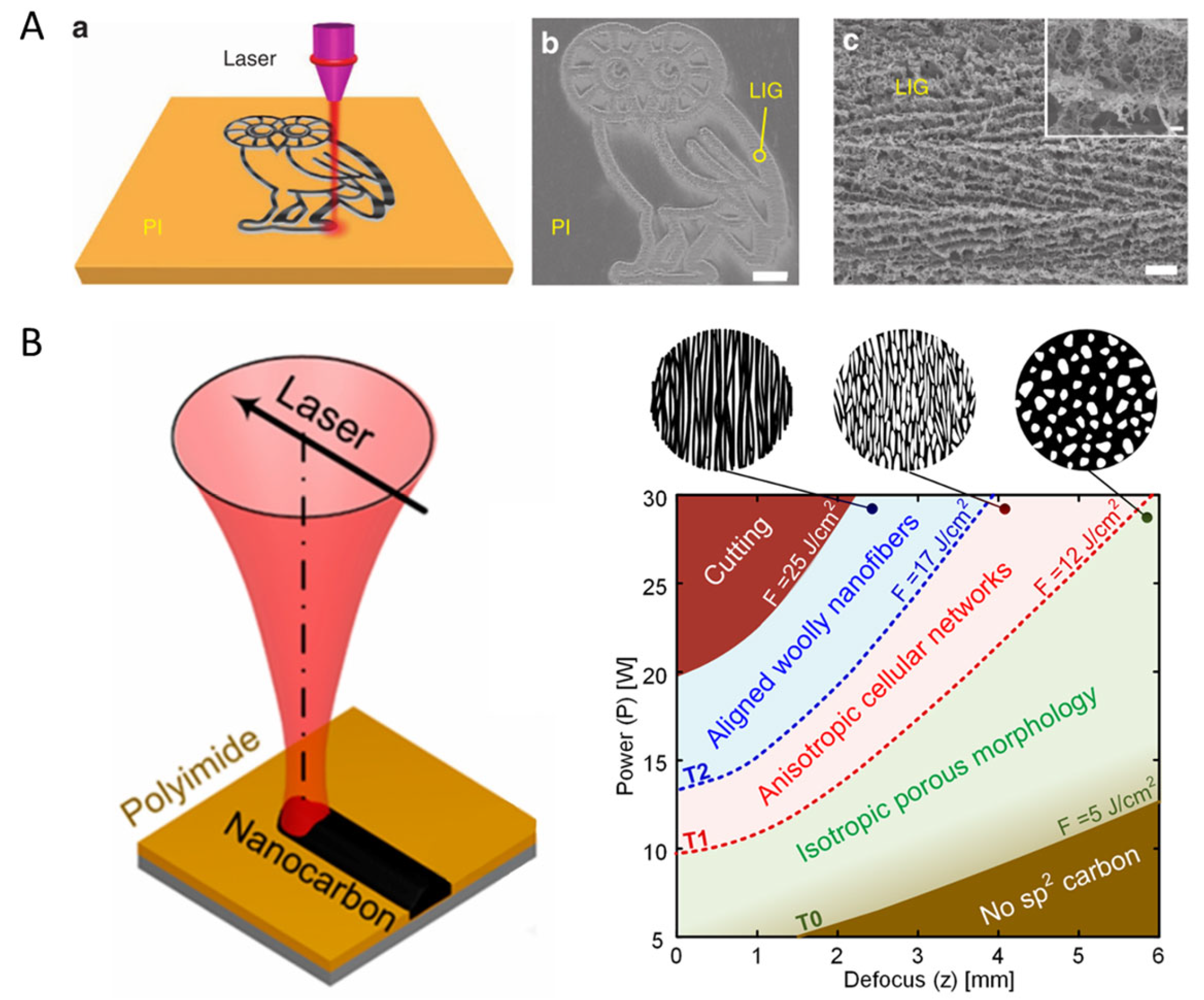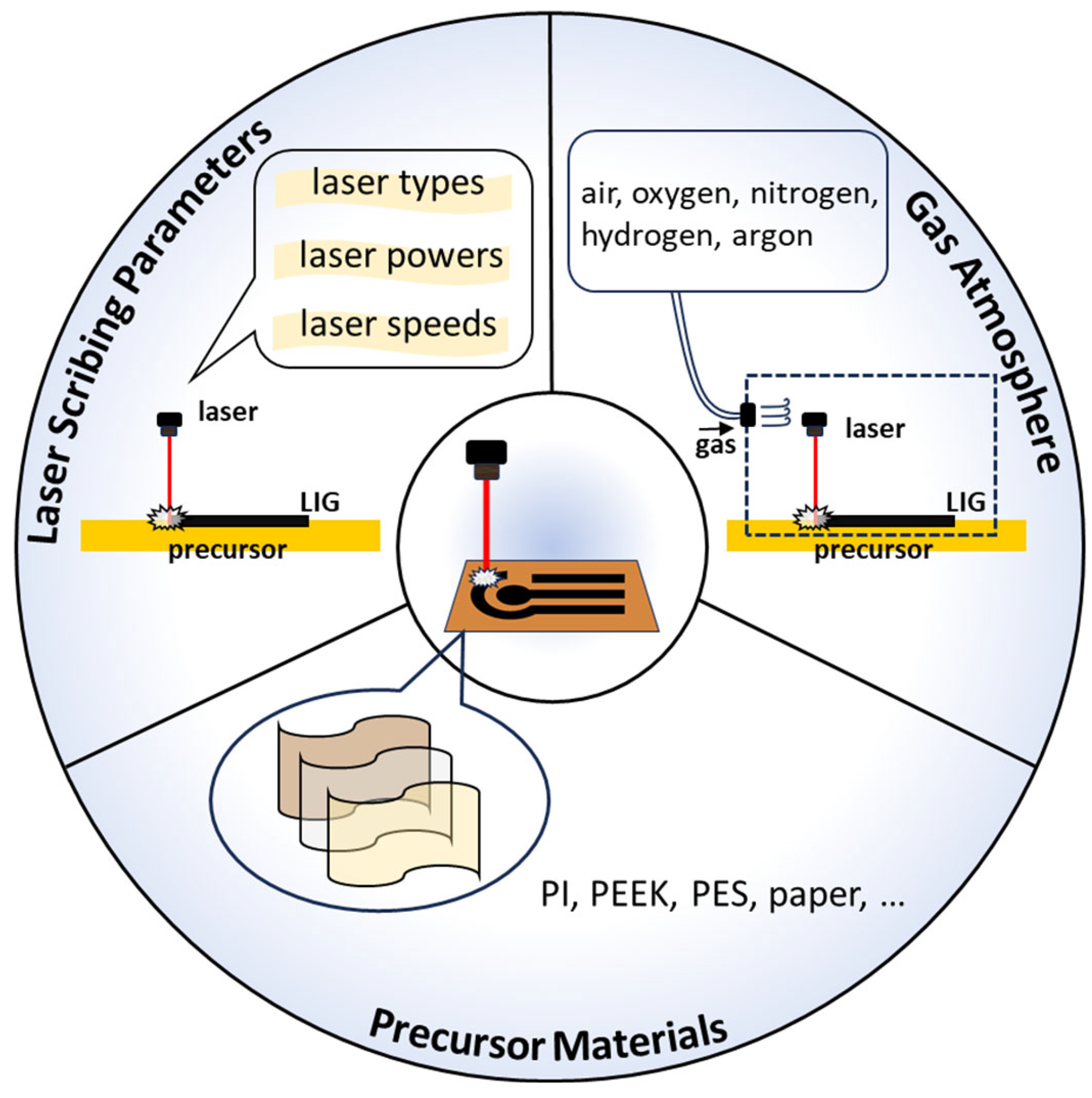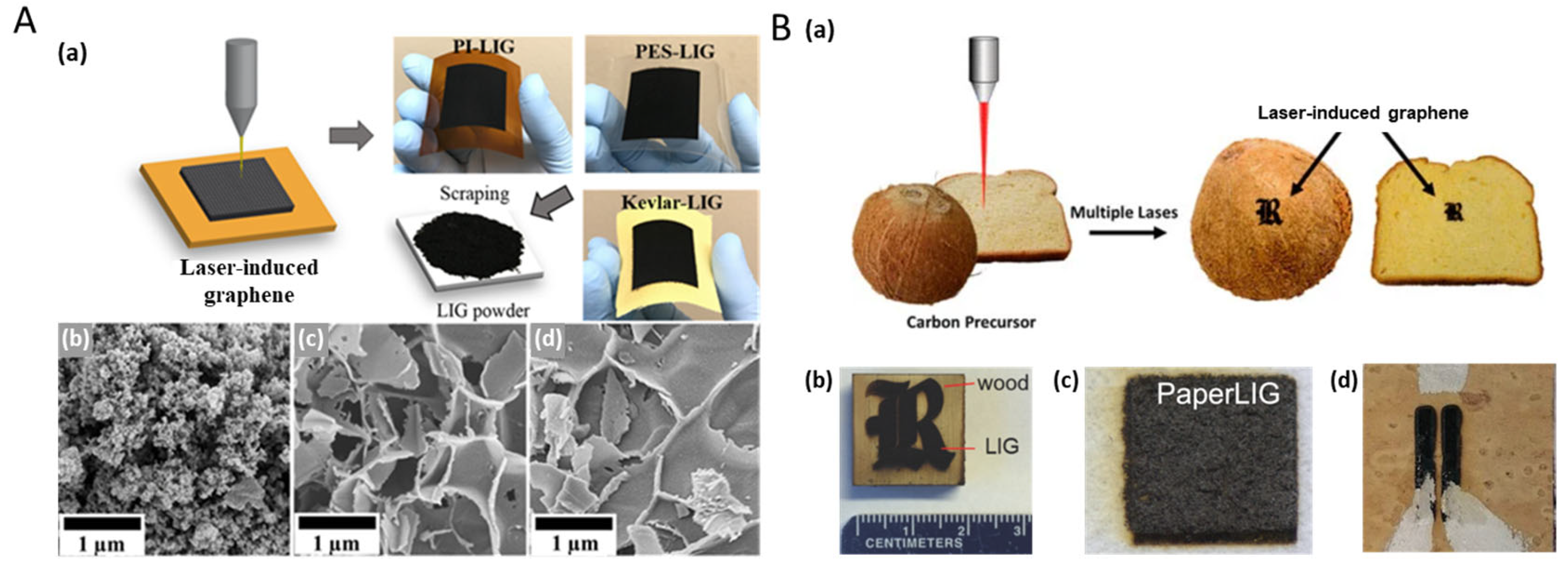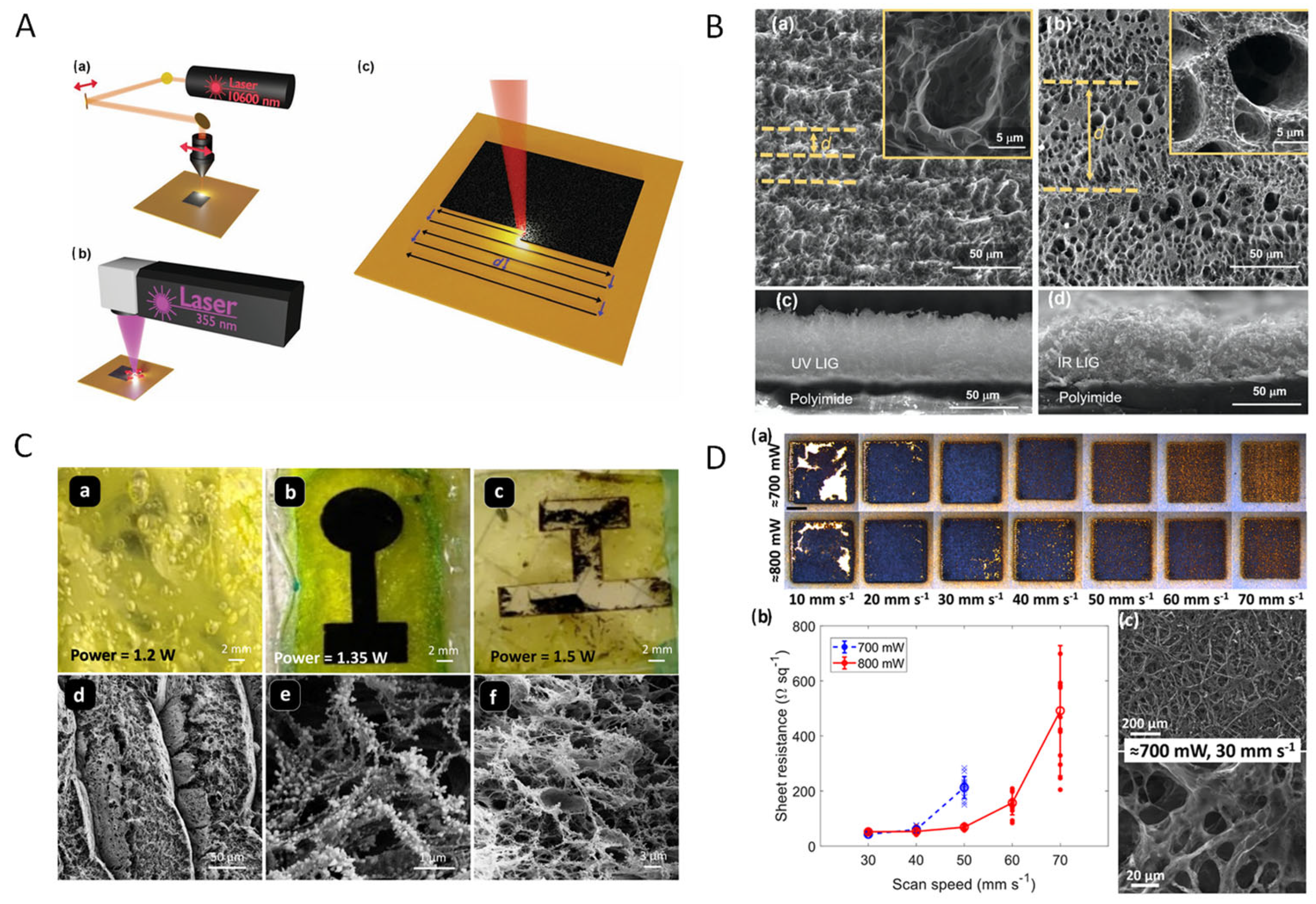
Laser-Induced Graphene Electrochemical Sensors: An Emerging Platform for Agri-Food and Environmental Detection

Abstract
1. Introduction
2. Factors Affecting Characteristics of LIG
2.1. Precursor Materials

2.2. Laser-Scribing Parameters

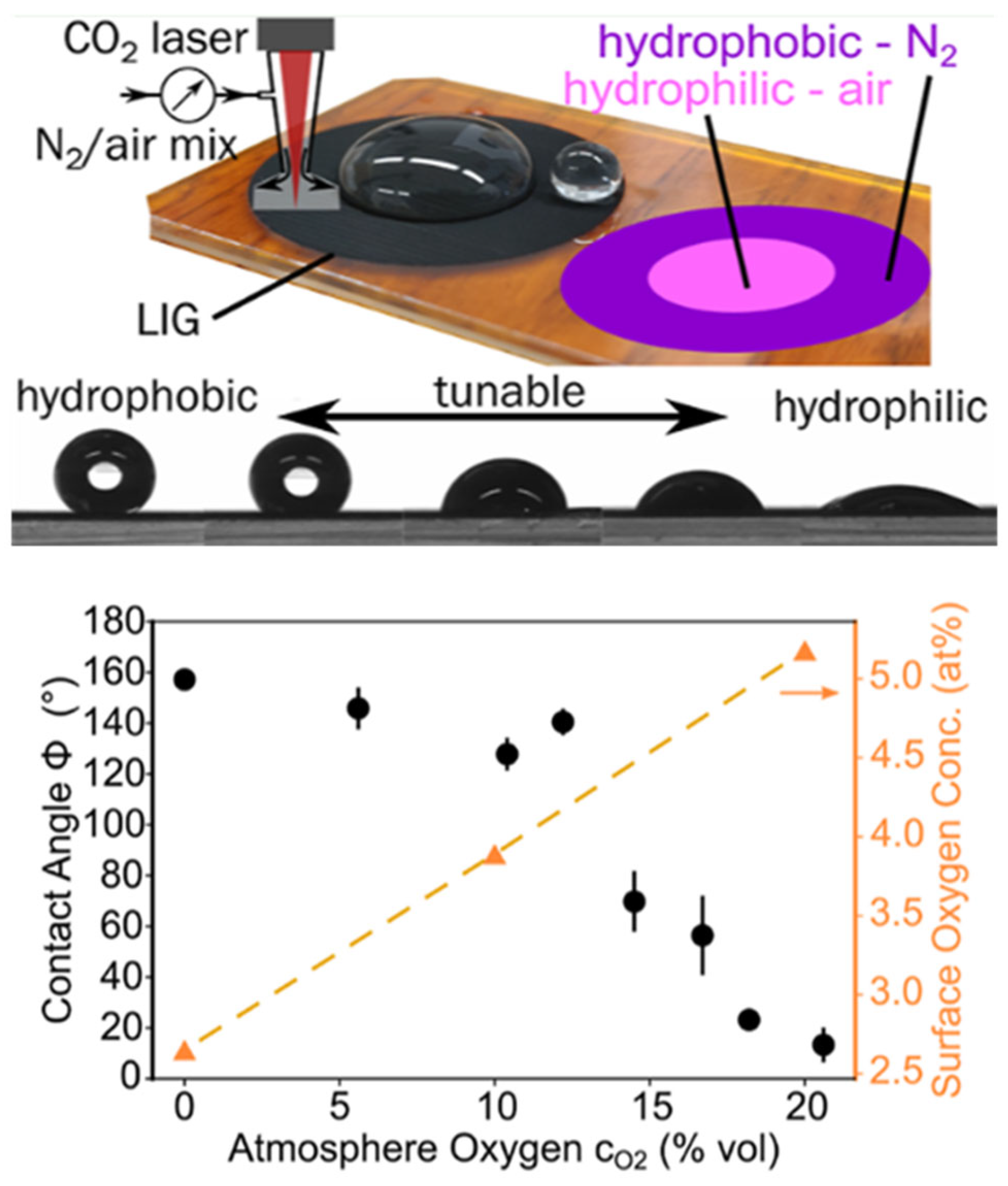
2.3. Gas Atmosphere
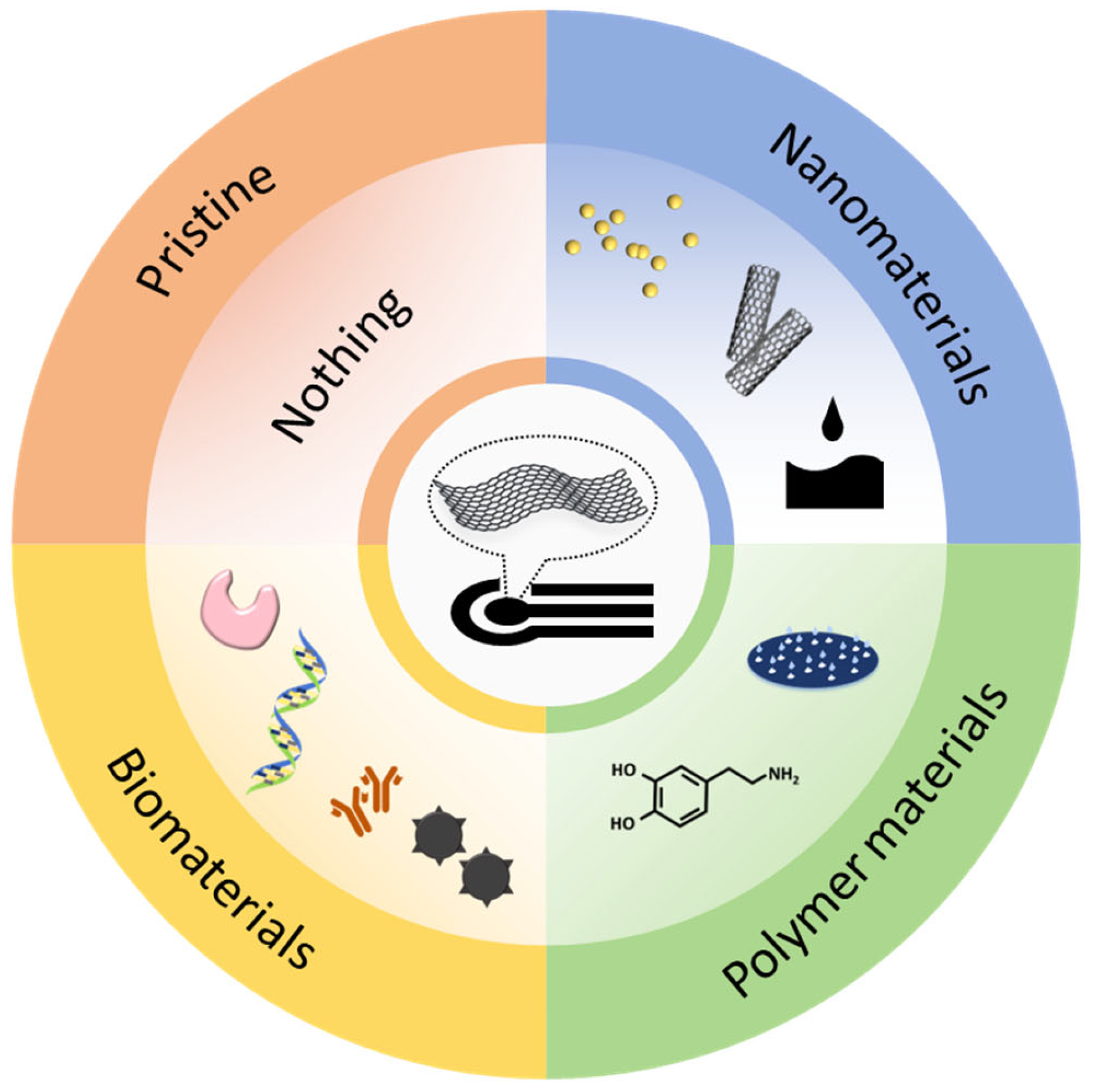
3. LIG-Based Electrochemical Sensors
3.1. Electrochemical Sensors Based on Pristine LIG
3.2. Nanomaterials Functionalized LIG Electrochemical Sensors
3.3. Biomolecule-Functionalized LIG Electrochemical Sensors
3.4. Polymer-Functionalized LIG Electrochemical Sensors
4. LIG-Based Electrochemical Sensors for Food Analysis and Agricultural Environmental Detection
4.1. Detection of Functional Components in Agricultural Product
4.2. Detection of Additives in Food
4.3. Detection of Agrochemicals
4.4. For Agri-Environmental Detection
5. Conclusions and Perspective
Supplementary Materials
Funding
Institutional Review Board Statement
Informed Consent Statement
Data Availability Statement
Conflicts of Interest
References
- Villamiel, M.; Méndez-Albiñana, P. Update of challenges for food quality and safety management. J. Agric. Food Res. 2022, 10, 100393. [Google Scholar] [CrossRef]
- Wang, K.; Lin, X.; Zhang, M.; Li, Y.; Luo, C.; Wu, J. Review of electrochemical biosensors for food safety detection. Biosensors 2022, 12, 959. [Google Scholar] [CrossRef] [PubMed]
- Sun, Y.; Xu, H.; Zhou, D.; Xia, C.; Liu, W.; Cui, A.; Wang, Z.; Zheng, W.; Shan, G.; Huang, J.; et al. A portable Integrated electrochemical sensing system for on-site nitrite detection in food. Small 2023, 20, 2309357. [Google Scholar] [CrossRef] [PubMed]
- Abedeen, M.Z.; Sharma, M.; Singh Kushwaha, H.; Gupta, R. Sensitive enzyme-free electrochemical sensors for the detection of pesticide residues in food and water. TrAC Trends Anal. Chem. 2024, 176, 117729. [Google Scholar] [CrossRef]
- Tian, Y.; Liu, J.; Qiao, J.; Ge, F.; Yang, Y.; Zhang, Q. Advancements in electrochemical sensing technology for heavy metal ions detection. Food Chem. X 2025, 25, 102204. [Google Scholar] [CrossRef]
- Wanjari, V.P.; Reddy, A.S.; Duttagupta, S.P.; Singh, S.P. Laser-induced graphene-based electrochemical biosensors for environmental applications: A perspective. Environ. Sci. Pollut. Res. 2022, 30, 42643–42657. [Google Scholar] [CrossRef]
- Ji, C.; Sun, X.; Fang, Y.; Li, P. Determination of aflatoxin b1 in grains by aptamer affinity column enrichment and purification coupled with high performance liquid chromatography detection. Foods 2024, 13, 640. [Google Scholar] [CrossRef]
- Xu, S.; Huang, X.; Lu, H. Advancements and applications of raman spectroscopy in rapid quality and safety detection of fruits and vegetables. Horticulturae 2023, 9, 843. [Google Scholar] [CrossRef]
- Vats, M.; Cillero-Pastor, B.; Cuypers, E.; Heeren, R.M.A. Mass spectrometry imaging in plants, microbes, and food: A review. Analyst 2024, 149, 4553–4582. [Google Scholar] [CrossRef]
- Dvorakova, D.; Tsagkaris, A.S.; Pulkrabova, J. Novel strategies for the determination of plastic additives derived from agricultural plastics in soil using ultrahigh-performance liquid chromatography tandem mass spectrometry (UHPLC-MS/MS). Sci. Total Environ. 2024, 946, 174492. [Google Scholar] [CrossRef]
- Ghosh, S.; AlKafaas, S.S.; Bornman, C.; Apollon, W.; Hussien, A.M.; Badawy, A.E.; Amer, M.H.; Kamel, M.B.; Mekawy, E.A.; Bedair, H. The application of rapid test paper technology for pesticide detection in horticulture crops: A comprehensive review. Beni-Suef Univ. J. Basic Appl. Sci. 2022, 11, 73. [Google Scholar] [CrossRef]
- Wang, Z.; Liu, M.; Shi, S.; Zhou, X.; Wu, C.; Wu, K. Ti3C2Tx/laser-induced graphene-based micro-droplet electrochemical sensing platform for rapid and sensitive detection of benomyl. Anal. Chim. Acta 2024, 1304, 342526. [Google Scholar] [CrossRef] [PubMed]
- Vivaldi, F.M.; Dallinger, A.; Bonini, A.; Poma, N.; Sembranti, L.; Biagini, D.; Salvo, P.; Greco, F.; Di Francesco, F. Three-dimensional (3D) laser-induced graphene: Structure, properties, and application to chemical sensing. ACS Appl. Mater. Interfaces 2021, 13, 30245–30260. [Google Scholar] [CrossRef] [PubMed]
- Gao, J.; He, S.; Nag, A. Electrochemical detection of glucose molecules using laser-induced graphene sensors: A review. Sensors 2021, 21, 2818. [Google Scholar] [CrossRef]
- Wu, J.; Liu, H.; Chen, W.; Ma, B.; Ju, H. Device integration of electrochemical biosensors. Nat. Rev. Bioeng. 2023, 1, 346–360. [Google Scholar] [CrossRef]
- Gibi, C.; Liu, C.-H.; Barton, S.C.; Anandan, S.; Wu, J.J. Carbon materials for electrochemical sensing application—A mini review. J. Taiwan Inst. Chem. Eng. 2024, 154, 105071. [Google Scholar] [CrossRef]
- Elizalde-Herrera, F.J.; Flores-Soto, P.A.; Mora-Cortes, L.F.; González, F.J.; Soria-Arguello, G.; Avalos-Belmontes, F.; Narro-Céspedes, R.I.; Hoyos, M. Recent development of graphene-based composites for electronics, energy storage, and biomedical applications: A review. J. Compos. Sci. 2024, 8, 481. [Google Scholar] [CrossRef]
- Liu, Q.; Zhou, Q.; Jiang, G. Nanomaterials for analysis and monitoring of emerging chemical pollutants. TrAC Trends Anal. Chem. 2014, 58, 10–22. [Google Scholar] [CrossRef]
- Bobrinetskiy, I.I.; Knezevic, N.Z. Graphene-based biosensors for on-site detection of contaminants in food. Anal. Methods 2018, 10, 5061–5070. [Google Scholar] [CrossRef]
- Harini, U.; Ponraj, C. Review—Graphene-based electrochemical sensors for detecting environmental pollutants. J. Electrochem. Soc. 2024, 171, 027521. [Google Scholar] [CrossRef]
- Yi, M.; Shen, Z. A review on mechanical exfoliation for the scalable production of graphene. J. Mater. Chem. A 2015, 3, 11700–11715. [Google Scholar] [CrossRef]
- Liu, B.; Ma, S. Precise synthesis of graphene by chemical vapor deposition. Nanoscale 2024, 16, 4407–4433. [Google Scholar] [CrossRef] [PubMed]
- Mahmun, A.; Deoghare, A.B. A comparative study on coconut shell-derived graphene oxide and reduced graphene oxide. Curr. Appl. Phys. 2024, 62, 12–21. [Google Scholar] [CrossRef]
- Abbas, Q.; Shinde, P.A.; Abdelkareem, M.A.; Alami, A.H.; Mirzaeian, M.; Yadav, A.; Olabi, A.G. Graphene synthesis techniques and environmental applications. Materials 2022, 15, 7804. [Google Scholar] [CrossRef] [PubMed]
- Lin, J.; Peng, Z.; Liu, Y.; Ruiz-Zepeda, F.; Ye, R.; Samuel, E.L.G.; Yacaman, M.J.; Yakobson, B.I.; Tour, J.M. Laser-induced porous graphene films from commercial polymers. Nat. Commun. 2014, 5, 5714. [Google Scholar] [CrossRef]
- Bai, S.; Tang, Y.; Lin, L.; Ruan, L.; Song, R.; Chen, H.; Du, Y.; Lin, H.; Shan, Y.; Tang, Y. Investigation of micro/nano formation mechanism of porous graphene induced by CO2 laser processing on polyimide film. J. Manuf. Process. 2022, 84, 555–564. [Google Scholar] [CrossRef]
- Abdulhafez, M.; Tomaraei, G.N.; Bedewy, M. Fluence-dependent morphological transitions in laser-induced graphene electrodes on polyimide substrates for flexible devices. ACS Appl. Nano Mater. 2021, 4, 2973–2986. [Google Scholar] [CrossRef]
- Trusovas, R.; Ratautas, K.; Račiukaitis, G.; Barkauskas, J.; Stankevičienė, I.; Niaura, G.; Mažeikienė, R. Reduction of graphite oxide to graphene with laser irradiation. Carbon 2013, 52, 574–582. [Google Scholar] [CrossRef]
- Chen, X.; Yan, X.; Qiu, J.; Zhang, X.; Zhang, Y.; Zhou, H.; Zhao, Y.; Han, L.; Zhang, Y. An rGO-doped laser induced graphene electrochemical biosensor for highly sensitive exosome detection. Sens. Diagn 2024, 3, 1724–1732. [Google Scholar] [CrossRef]
- Martins, B.R.; Andrade, C.M.R.; Simao, G.F.; de Paula Martins, R.; de Faria, L.V.; Matias, T.A.; Junior, V.R.; Munoz, R.A.A.; Alves, R.P. Electrochemical immunosensors on laser-induced graphene platforms for monitoring of anti-RBD antibodies after SARS-CoV-2 infection. Biosensors 2024, 14, 514. [Google Scholar] [CrossRef]
- Chen, Z.; Dong, N.; Wang, Y.; Li, Y.; Li, W.; Liu, D.; You, T. All in laser-induced graphene to fabricate the electrochemical biosensor for on-site detection of microcystin-LR. Sens. Actuators B Chem. 2024, 419, 136437. [Google Scholar] [CrossRef]
- Zhang, W.; Sun, Q.; Zhang, X.; Yuan, W.; Wu, J. A laser-induced graphene-based sensor modified with CeO2 for determination of organophosphorus pesticides with improved performance. Sensors 2023, 23, 9605. [Google Scholar] [CrossRef] [PubMed]
- Zeng, Y.; Tang, Y.; Gan, T.; Wu, C. Flexible self-supporting laser-induced graphene electrode devices for highly sensitive electrochemical analysis of Allura Red. Carbon Lett. 2023, 34, 985–995. [Google Scholar] [CrossRef]
- Kaneva, M.; Levshakova, A.; Tumkin, I.; Fatkullin, M.; Gurevich, E.; Manshina, A.; Rodriguez, R.D.; Khairullina, E. Simultaneous electrochemical detection of hydroquinone and catechol using flexible laser-induced metal-polymer composite electrodes. Microchem. J. 2024, 204, 111106. [Google Scholar] [CrossRef]
- Zhao, P.; Zhang, Y.; Liu, Y.; Huo, D.; Hou, J.; Hou, C. Wearable electrochemical patch based on iron nano-catalysts incorporated laser-induced graphene for sweat metabolites detection. Biosens. Bioelectron. 2024, 249, 116012. [Google Scholar] [CrossRef]
- Adachi, T.; Kitazumi, Y.; Shirai, O.; Kano, K. Direct electron transfer-type bioelectrocatalysis of redox enzymes at nanostructured electrodes. Catalysts 2020, 10, 236. [Google Scholar] [CrossRef]
- Xia, H.; Zeng, J. Rational surface modification of carbon nanomaterials for improved direct electron transfer-type bioelectrocatalysis of redox enzymes. Catalysts 2020, 10, 1447. [Google Scholar] [CrossRef]
- Zhang, Z.; Zhu, H.; Zhang, W.; Zhang, Z.; Lu, J.; Xu, K.; Liu, Y.; Saetang, V. A review of laser-induced graphene: From experimental and theoretical fabrication processes to emerging applications. Carbon 2023, 214, 118356. [Google Scholar] [CrossRef]
- Ye, X.; Yang, Z.; Zheng, X.; Qiang, H.; Wei, M.; Li, Y.; Chen, M.; Luo, N. A review on the laser-induced synthesis of graphene and its applications in sensors. J. Mater. Sci. 2024, 59, 11644–11668. [Google Scholar] [CrossRef]
- Hu, X.; Wang, J.; Feng, C.; Yuan, J.; Wei, Q.; Wang, H. A comprehensive review of laser-induced-graphene for sensor applications: Fabrication, properties, and performance evaluation. J. Mater. Chem. C 2025, 13, 1573–1591. [Google Scholar] [CrossRef]
- Aftab, S.; Koyyada, G.; Mukhtar, M.; Kabir, F.; Nazir, G.; Memon, S.A.; Aslam, M.; Assiri, M.A.; Kim, J.H. Laser-induced graphene for advanced sensing: Comprehensive review of applications. ACS Sens. 2024, 9, 4536–4554. [Google Scholar] [CrossRef] [PubMed]
- Zhao, L.; Liu, Z.; Chen, D.; Liu, F.; Yang, Z.; Li, X.; Yu, H.; Liu, H.; Zhou, W. Laser synthesis and microfabrication of micro/nanostructured materials toward energy conversion and storage. Nano-Micro Lett. 2021, 13, 49. [Google Scholar] [CrossRef] [PubMed]
- Jo, S.G.; Ramkumar, R.; Lee, J.W. Recent advances in laser-induced graphene-based materials for energy storage and conversion. ChemSusChem 2023, 17, e202301146. [Google Scholar] [CrossRef] [PubMed]
- Xia, H.Q.; Zhu, C.; Qiu, D.; Zeng, J. A smartphone-based electrochemical sensing platform for the portable and simultaneous determination of flavonoids in Citri Reticulatae Pericarpium. Anal Chim Acta 2024, 1319, 342981. [Google Scholar] [CrossRef]
- Wanjari, V.P.; Kumar, P.; Duttagupta, S.P.; Singh, S.P. Adsorption-enhanced sensitivity for electrochemical sensing of diclofenac by poly(ether sulfone)-based laser-induced graphene. Langmuir 2025, 41, 152–161. [Google Scholar] [CrossRef]
- Yang, D.; Nam, H.K.; Lee, Y.; Kwon, S.; Lee, J.; Yoon, H.; Kim, Y.J. Laser-induced graphene smart textiles for future space suits and telescopes. Adv. Funct. Mater. 2024, 35, 2411257. [Google Scholar] [CrossRef]
- Liu, J.; Zhang, L.; Yang, C.; Tao, S. Preparation of multifunctional porous carbon electrodes through direct laser writing on a phenolic resin film. J. Mater. Chem. A 2019, 7, 21168–21175. [Google Scholar] [CrossRef]
- Zhan, C.; Zhang, J.; Hao, J.; Liu, Z.; Hu, C. Scalable drop-casting construction of light-addressable photoelectrochemical biosensor on laser-induced graphene electrode arrays for high-throughput drug screening. Biosens. Bioelectron. 2024, 261, 116497. [Google Scholar] [CrossRef]
- Thakur, A.K.; Lin, B.; Nowrin, F.H.; Malmali, M. Comparing structure and sorption characteristics of laser-induced graphene (LIG) from various polymeric substrates. ACS EST Water 2021, 2, 75–87. [Google Scholar] [CrossRef]
- Xia, H.-q.; Qiu, D.; Chen, W.; Mao, G.; Zeng, J. In situ formed and fully integrated laser-induced graphene electrochemical chips for rapid and simultaneous determination of bioflavonoids in citrus fruits. Microchem. J. 2023, 188, 108474. [Google Scholar] [CrossRef]
- Chyan, Y.; Ye, R.; Li, Y.; Singh, S.P.; Arnusch, C.J.; Tour, J.M. Laser-induced graphene by multiple lasing: Toward electronics on cloth, paper, and food. ACS Nano 2018, 12, 2176–2183. [Google Scholar] [CrossRef] [PubMed]
- Ghavipanjeh, A.; Sadeghzadeh, S. Simulation and experimental evaluation of laser-induced graphene on the cellulose and lignin substrates. Sci. Rep. 2024, 14, 4475. [Google Scholar] [CrossRef] [PubMed]
- Ye, R.; Chyan, Y.; Zhang, J.; Li, Y.; Han, X.; Kittrell, C.; Tour, J.M. Laser-induced graphene formation on wood. Adv. Mater. 2017, 29, 1702211. [Google Scholar] [CrossRef] [PubMed]
- Kulyk, B.; Pereira, S.O.; Fernandes, A.J.S.; Fortunato, E.; Costa, F.M.; Santos, N.F. Laser-induced graphene from paper for non-enzymatic uric acid electrochemical sensing in urine. Carbon 2022, 197, 253–263. [Google Scholar] [CrossRef]
- Gao, P.; Kasama, T.; Shin, J.; Huang, Y.; Miyake, R. A mediated enzymatic electrochemical sensor using paper-based laser-induced graphene. Biosensors 2022, 12, 995. [Google Scholar] [CrossRef]
- Vaughan, E.; Santillo, C.; Setti, M.; Larrigy, C.; Quinn, A.J.; Gentile, G.; Lavorgna, M.; Iacopino, D. Sustainable laser-induced graphene electrochemical sensors from natural cork for sensitive tyrosine detection. Adv. Sens. Res. 2023, 2, 2300026. [Google Scholar] [CrossRef]
- Yuan, M.; Wang, Z.; Rao, Y.; Wang, Y.; Gao, B.; Yu, J.; Li, H.; Chen, X. Laser direct writing O/N/S Co-doped hierarchically porous graphene on carboxymethyl chitosan/lignin-reinforced wood for boosted microsupercapacitor. Carbon 2023, 202, 296–304. [Google Scholar] [CrossRef]
- Hamidi, H.; Levieux, J.; Larrigy, C.; Russo, A.; Vaughan, E.; Murray, R.; Quinn, A.J.; Iacopino, D. Laser induced graphene (LIG) biosensors derived from chitosan: Towards sustainable and green electronics. Biosens. Bioelectron. X 2023, 15, 100403. [Google Scholar] [CrossRef]
- Lee, C.-W.; Jeong, S.-Y.; Kwon, Y.-W.; Lee, J.-U.; Cho, S.-C.; Shin, B.-S. Fabrication of laser-induced graphene-based multifunctional sensing platform for sweat ion and human motion monitoring. Sens. Actuators A Phys. 2022, 334, 113320. [Google Scholar] [CrossRef]
- Pinheiro, T.; Rosa, A.; Ornelas, C.; Coelho, J.; Fortunato, E.; Marques, A.C.; Martins, R. Influence of CO2 laser beam modelling on electronic and electrochemical properties of paper-based laser-induced graphene for disposable pH electrochemical sensors. Carbon Trends 2023, 11, 100271. [Google Scholar] [CrossRef]
- Pinheiro, T.; Caetano, J.; Fortunato, E.; Sales, M.G.F.; Almeida, H.; Martins, R. One-step laser synthesis of copper nanoparticles and laser-induced graphene in a paper substrate for non-enzymatic glucose sensing. Adv. Sens. Res. 2024, 3, 2400052. [Google Scholar] [CrossRef]
- Cheng, J.; Lin, Z.; Wu, D.; Liu, C.; Cao, Z. Aramid textile with near-infrared laser-induced graphene for efficient adsorption materials. J. Hazard. Mater. 2022, 436, 129150. [Google Scholar] [CrossRef] [PubMed]
- Le, T.S.D.; Phan, H.P.; Kwon, S.; Park, S.; Jung, Y.; Min, J.; Chun, B.J.; Yoon, H.; Ko, S.H.; Kim, S.W.; et al. Recent advances in laser-induced graphene: Mechanism, fabrication, properties, and applications in flexible electronics. Adv. Funct. Mater. 2022, 32, 2205158. [Google Scholar] [CrossRef]
- Liu, M.; Zhao, G.; Yang, C.; Wang, H.; Cheng, J. An enzymatic electrochemical biosensing interface developed by the laser-induced graphene electrode. Adv. Mater. Interfaces 2023, 10, 2300235. [Google Scholar] [CrossRef]
- Zhang, Z.; Huang, L.; Chen, Y.; Qiu, Z.; Meng, X.; Li, Y. Portable glucose sensing analysis based on laser-induced graphene composite electrode. RSC Adv 2024, 14, 1034–1050. [Google Scholar] [CrossRef]
- Yuan, X.; Wu, X.; Ling, Y.; Li, S.; Chen, J.; Zhang, Z. In situ bismuth ion exchange plating micro-electrochemical sensor based on laser-induced graphene for trace Cd2+ and Pb2+ detection. J. Environ. Chem. Eng. 2024, 12, 112161. [Google Scholar] [CrossRef]
- Santos, N.F.; Pereira, S.O.; Moreira, A.; Girão, A.V.; Carvalho, A.F.; Fernandes, A.J.S.; Costa, F.M. IR and UV laser-induced graphene: Application as dopamine electrochemical sensors. Adv. Mater. Technol. 2021, 6, 2100007. [Google Scholar] [CrossRef]
- Wang, L.; Wang, Z.; Bakhtiyari, A.N.; Zheng, H. A comparative study of laser-induced graphene by CO2 infrared laser and 355 nm ultraviolet (UV) laser. Micromachines 2020, 11, 1094. [Google Scholar] [CrossRef]
- Mikheev, G.M.; Bulatov, D.L.; Syugaev, A.V.; Zonov, R.G.; Mikheev, K.G. The effect of line-by-line laser scanning on the properties of laser-induced graphene. Phys. Solid State 2022, 64, 579. [Google Scholar] [CrossRef]
- Murray, R.; Burke, M.; Iacopino, D.; Quinn, A.J. Design of experiments and optimization of laser-induced graphene. ACS Omega 2021, 6, 16736–16743. [Google Scholar] [CrossRef]
- Chen, Y.; Long, J.; Zhou, S.; Shi, D.; Huang, Y.; Chen, X.; Gao, J.; Zhao, N.; Wong, C.P. UV laser-induced polyimide-to-graphene conversion: Modeling, fabrication, and application. Small Methods 2019, 3, 1900208. [Google Scholar] [CrossRef]
- Zafar, U.; Rai, P.K.; Gupta, A.; Korvink, J.G.; Badilita, V.; Islam, M. Laser-induced copper/carbon nanocomposite from anodically electrodeposited chitosan for H2O2 sensing. C 2024, 10, 28. [Google Scholar] [CrossRef]
- Liu, M.; Wu, J.; Cheng, H. Effects of laser processing parameters on properties of laser-induced graphene by irradiating CO2 laser on polyimide. Sci. China Technol. Sci. 2021, 65, 41–52. [Google Scholar] [CrossRef]
- Adiraju, A.; Al-Hamry, A.; Jalasutram, A.; Wang, J.; Kanoun, O. Multifaceted experiments and photothermal simulations based analysis of laser induced graphene and its fibers. Discov. Nano 2024, 19, 59. [Google Scholar] [CrossRef]
- Kulyk, B.; Silva, B.F.R.; Carvalho, A.F.; Silvestre, S.; Fernandes, A.J.S.; Martins, R.; Fortunato, E.; Costa, F.M. Laser-induced graphene from paper for mechanical sensing. ACS Appl. Mater. Interfaces 2021, 13, 10210–10221. [Google Scholar] [CrossRef]
- Guo, Y.; Zhang, C.; Chen, Y.; Nie, Z. Research progress on the preparation and applications of laser-induced graphene technology. Nanomaterials 2022, 12, 2336. [Google Scholar] [CrossRef]
- Diédhiou, I.; Raouafi, A.; Hamzaoui, S.; Fall, M.; Raouafi, N. Optimizing the preparation of laser-derived 3D porous graphene electrodes for modification-free sensing of heavy metal ions. Sens. Diagn. 2025, 4, 202–215. [Google Scholar] [CrossRef]
- Li, Y.; Luong, D.X.; Zhang, J.; Tarkunde, Y.R.; Kittrell, C.; Sargunaraj, F.; Ji, Y.; Arnusch, C.J.; Tour, J.M. Laser-induced graphene in controlled atmospheres: From superhydrophilic to superhydrophobic surfaces. Adv. Mater. 2017, 29, 1700496. [Google Scholar] [CrossRef]
- Dallinger, A.; Steinwender, F.; Gritzner, M.; Greco, F. Different roles of surface chemistry and roughness of laser-induced graphene: Implications for tunable wettability. ACS Appl. Nano Mater. 2023, 6, 16201–16211. [Google Scholar] [CrossRef]
- Soares, R.R.A.; Hjort, R.G.; Pola, C.C.; Jing, D.; Cecon, V.S.; Claussen, J.C.; Gomes, C.L. Ion-selective electrodes based on laser-induced graphene as an alternative method for nitrite monitoring. Microchim. Acta 2023, 190, 43. [Google Scholar] [CrossRef]
- Zhu, X.; Lin, L.; Wu, R.; Zhu, Y.; Sheng, Y.; Nie, P.; Liu, P.; Xu, L.; Wen, Y. Portable wireless intelligent sensing of ultra-trace phytoregulator alpha-naphthalene acetic acid using self-assembled phosphorene/Ti3C2-MXene nanohybrid with high ambient stability on laser induced porous graphene as nanozyme flexible electrode. Biosens. Bioelectron. 2021, 179, 113062. [Google Scholar] [CrossRef] [PubMed]
- Cai, M.; Yao, H.; Li, M.; Yan, Y.; Cao, Y.; Li, J.; Su, H.; Zhang, W.; Zhu, H.; Cui, F. Copper ferrite nanoparticles anchored laser-induced graphene as novel nanoenzyme for the electrochemical catalyzing and sensing of β-estradiol in serum. Chem. Eng. J. 2024, 492, 152148. [Google Scholar] [CrossRef]
- Huang, M.; Ye, L.; Yu, L.; Zhang, Y.; Zeng, T.; Yang, J.; Tian, F.; Wu, Z.; Zhang, X.; Hu, C.; et al. Incorporation of laser-induced graphene with hierarchical NiCo layered double hydroxide nanosheets for electrochemical determination of glucose in food and serum. Anal. Chim. Acta 2024, 1329, 343194. [Google Scholar] [CrossRef] [PubMed]
- Le, N.T.H.; Viet, N.X.; Anh, N.V.; Bach, T.N.; Thu, P.T.; Ngoc, N.T.; Manh, D.H.; Ky, V.H.; Lam, V.D.; Kodelov, V.; et al. Non-enzymatic electrochemical sensor based on ZnO nanoparticles/porous graphene for the detection of hypoxanthine in pork meat. AIP Adv. 2024, 14, 025034. [Google Scholar] [CrossRef]
- Wang, D.; Han, M.; Liu, F.; Yang, W.; Wang, G.; Luo, S. Single-step laser irradiation for synchronous formation of graphene-platinum nanohybrids with tunable microstructures toward high-performance enzyme-free glucose sensors. Adv. Mater. Technol. 2024, 9, 2400058. [Google Scholar] [CrossRef]
- Yen, Y.K.; Huang, G.W.; Shanmugam, R. Laser-scribing graphene-based electrochemical biosensing devices for simultaneous detection of multiple cancer biomarkers. Talanta 2024, 266, 125096. [Google Scholar] [CrossRef]
- Vignesh, K.; Senthil Kumar, A.; Arumugam Napoleon, A.; Govindasamy, M.; Yusuf, K. Ag-La(OH)3@Dy2O3 hybrid composite modified laser-induced graphene surface for simultaneous electrochemical detection of bisphenol A and tartrazine. Appl. Surf. Sci. 2024, 676, 160901. [Google Scholar] [CrossRef]
- Nong, J.; Zhang, N.; Wen, A.; Hu, C. Anti-biofouling laser-scribed graphene electrochemical sensor for reliable detection of uric acid in human saliva. J. Electroanal. Chem. 2024, 952, 117982. [Google Scholar] [CrossRef]
- Chu, G.; Yu, S.; Wang, Y.; Zhang, W.; Xue, B.; Huang, J.; Wang, Z.; Luo, J.; Sun, X.; Li, M. A wearable electrochemical sensor for the monitoring of neonicotinoid insecticides, salicylic acid and the pH in plant guttation. Chem. Eng. J. 2024, 498, 155340. [Google Scholar] [CrossRef]
- Liu, X.; Wang, X.; Li, J.; Qu, M.; Kang, M.; Zhang, C. Nonmodified laser-induced graphene sensors for lead-ion detection. ACS Appl. Nano Mater. 2023, 6, 3599–3607. [Google Scholar] [CrossRef]
- Sain, S.; Roy, S.; Mathur, A.; Rajesh, V.M.; Banerjee, D.; Sarkar, B.; Roy, S.S. Electrochemical sensors based on flexible laser-induced graphene for the detection of paraquat in water. ACS Appl. Nano Mater. 2022, 5, 17516–17525. [Google Scholar] [CrossRef]
- Rajendrachari, S.; Ramakrishna, D. Functionalized nanomaterial-based electrochemical sensors: A sensitive sensor platform. In Functionalized Nanomaterial-Based Electrochemical Sensors; Woodhead Publishing: Sawston, UK, 2022; pp. 3–25. [Google Scholar]
- Elattar, R.H.; Magdy, G.; Abdel Salam, R.A.; Hadad, G.M.; El-Deen, A.K. Cutting-edge progress in carbon nanomaterial-functionalized silver nanoparticles for enhanced optical and electrochemical sensing applications. TrAC Trends Anal. Chem. 2024, 181, 117995. [Google Scholar] [CrossRef]
- Wang, L.; Li, M.; Li, B.; Wang, M.; Zhao, H.; Zhao, F. Electrochemical sensor based on laser-induced graphene for carbendazim detection in water. Foods 2023, 12, 2277. [Google Scholar] [CrossRef]
- Liu, W.; Chen, Q.; Huang, Y.; Wang, D.; Li, L.; Liu, Z. In situ laser synthesis of Pt nanoparticles embedded in graphene films for wearable strain sensors with ultra-high sensitivity and stability. Carbon 2022, 190, 245–254. [Google Scholar] [CrossRef]
- Liu, X.; Xiang, J.; Xue, Y.; Zhao, J.; Ma, X.; Ge, L.; Li, F.; Gai, P. Plant wearable sensor based on flexible laser-induced Fe-doped graphene for in situ monitoring salicylic acid under salt stress. Sens. Actuators B Chem. 2025, 440, 137931. [Google Scholar] [CrossRef]
- Díez-Pascual, A.M. Carbon-based nanomaterials. Int. J. Mol. Sci. 2021, 22, 7726. [Google Scholar] [CrossRef]
- Ayanda, O.S.; Mmuoegbulam, A.O.; Okezie, O.; Durumin Iya, N.I.; Mohammed, S.a.E.; James, P.H.; Muhammad, A.B.; Unimke, A.A.; Alim, S.A.; Yahaya, S.M.; et al. Recent progress in carbon-based nanomaterials: Critical review. J. Nanopart. Res. 2024, 26, 106. [Google Scholar] [CrossRef]
- Ghosh, D.; Tabassum, R.; Sarkar, P.P.; Rahman, M.D.A.; Jalal, A.H.; Islam, N.; Ashraf, A. Graphene nanocomposite ink coated laser transformed flexible electrodes for selective dopamine detection and immunosensing. ACS Appl. Bio Mater. 2024, 7, 3143–3153. [Google Scholar] [CrossRef]
- Nasraoui, S.; Ameur, S.; Al-Hamry, A.; Ben Ali, M.; Kanoun, O. Development of an efficient voltammetric sensor for the monitoring of 4-aminophenol based on flexible laser induced graphene electrodes modified with MWCNT-PANI. Sensors 2022, 22, 833. [Google Scholar] [CrossRef]
- Wang, L.; Li, X.; Ai, Y.; Mohan, B.; Li, H.; Lu, Z.; Wang, B.; Sun, W. Sustainable precursor-based titanium dioxide–graphene nanocomposite electrochemical sensor for sensitive detection of diuron in vegetables. Foods 2025, 14, 2946. [Google Scholar] [CrossRef]
- Lahcen, A.A.; Rauf, S.; Beduk, T.; Durmus, C.; Aljedaibi, A.; Timur, S.; Alshareef, H.N.; Amine, A.; Wolfbeis, O.S.; Salama, K.N. Electrochemical sensors and biosensors using laser-derived graphene: A comprehensive review. Biosens. Bioelectron. 2020, 168, 112565. [Google Scholar] [CrossRef] [PubMed]
- Settu, K.; Chiu, P.-T.; Huang, Y.-M. Laser-induced graphene-based enzymatic biosensor for glucose detection. Polymers 2021, 13, 2795. [Google Scholar] [CrossRef] [PubMed]
- Soares, R.R.A.; Hjort, R.G.; Pola, C.C.; Parate, K.; Reis, E.L.; Soares, N.F.F.; McLamore, E.S.; Claussen, J.C.; Gomes, C.L. Laser-induced graphene electrochemical immunosensors for rapid and label-free monitoring of salmonella enterica in chicken broth. ACS Sens. 2020, 5, 1900–1911. [Google Scholar] [CrossRef] [PubMed]
- Abera, B.D.; Ortiz-Gómez, I.; Shkodra, B.; Romero, F.J.; Cantarella, G.; Petti, L.; Salinas-Castillo, A.; Lugli, P.; Rivadeneyra, A. Laser-induced graphene electrodes modified with a molecularly imprinted polymer for detection of tetracycline in milk and meat. Sensors 2021, 22, 269. [Google Scholar] [CrossRef]
- Barber, R.; Davis, J.; Papakonstantinou, P. Stable chitosan and prussian blue-coated laser-induced graphene skin sensor for the electrochemical detection of hydrogen peroxide in sweat. ACS Appl. Nano Mater. 2023, 6, 10290–10302. [Google Scholar] [CrossRef]
- Ding, X.; Chen, R.; Xu, J.; Hu, J.; Zhao, Z.; Zhang, C.; Zheng, L.; Cheng, H.; Weng, Z.; Wu, L. Highly stable scalable production of porous graphene-polydopamine nanocomposites for drug molecule sensing. Talanta 2025, 282, 126990. [Google Scholar] [CrossRef]
- Suryanarayanan, V.; Wu, C.T.; Ho, K.C. Molecularly imprinted electrochemical sensors. Electroanalysis 2010, 22, 1795–1811. [Google Scholar] [CrossRef]
- Zheng, C.; Liu, R.; Chen, J.; Li, S.; Ling, Y.; Zhang, Z. Development of a selective electrochemical microsensor based on molecularly imprinted polydopamine/ZIF-67/laser-induced graphene for point-of-care determination of 3-nitrotyrosine. Biosens. Bioelectron. 2024, 255, 116246. [Google Scholar] [CrossRef]
- Marques, A.C.; Cardoso, A.R.; Martins, R.; Sales, M.G.F.; Fortunato, E. Laser-induced graphene-based platforms for dual biorecognition of molecules. ACS Appl. Nano Mater. 2020, 3, 2795–2803. [Google Scholar] [CrossRef]
- Johnson, Z.T.; Jared, N.; Peterson, J.K.; Li, J.; Smith, E.A.; Walper, S.A.; Hooe, S.L.; Breger, J.C.; Medintz, I.L.; Gomes, C.; et al. Enzymatic laser-induced graphene biosensor for electrochemical sensing of the herbicide glyphosate. Glob. Chall. 2022, 6, 2200057. [Google Scholar] [CrossRef]
- Xu, S.; Wang, H.; Liang, X.; Lu, H. Research progress on methods for improving the stability of non-destructive testing of agricultural product quality. Foods 2024, 13, 3917. [Google Scholar] [CrossRef] [PubMed]
- Yi, Z.; Chen, D.; Zhou, X.; Guo, J.; Chen, K.; Ye, C.; Liu, C.; Liu, J. A simple narrative review of progress on the processing and utilization of functional rice. Foods 2024, 13, 3911. [Google Scholar] [CrossRef] [PubMed]
- Kongkaew, S.; Srilikhit, A.; Janduang, S.; Thipwimonmas, Y.; Kanatharana, P.; Thavarungkul, P.; Limbut, W. Single laser synthesis of gold nanoparticles-polypyrrole-chitosan on laser-induced graphene for ascorbic acid detection. Talanta 2024, 278, 126446. [Google Scholar] [CrossRef]
- Devi, M.; Praharaj, S.; Rout, D. Electrochemical sensing devices for estimation of food additives and flavours. In Real-Time Applications of Advanced Electrochemical Sensing Devices; IOP Publishing: Bristol, UK, 2024; pp. 15-1–15-23. [Google Scholar]
- Yuan, X.; Chen, L.; Liu, R.; Li, S.; Wu, X.-w.; Ling, Y. Smartphone-assisted portable electrochemical sensing platform for point-of-care detection of thiocyanate using a laser-induced graphene composite electrode. Anal. Chim. Acta 2025, 1368, 344365. [Google Scholar] [CrossRef] [PubMed]
- Tang, H.; Zhong, Y.; Zeng, X.; Sang, Y.; Lin, F.; Zhu, Y.; Chen, Z.; Xu, L.; Huang, Z.; Zhou, P. Preparation of platinum decorated laser-induced graphene flexible electrode and its application for clenbuterol detection. Int. J. Electrochem. Sci. 2022, 17, 220241. [Google Scholar] [CrossRef]
- Chen, J.; Ling, Y.; Yuan, X.; He, Y.; Li, S.; Wang, G.; Zhang, Z.; Wang, G. Highly sensitive detection of formaldehyde by laser-induced graphene-coated silver nanoparticles electrochemical sensing electrodes. Langmuir 2023, 39, 12762–12773. [Google Scholar] [CrossRef]
- Zhang, F.; Li, D.; Li, G.; Xu, S. New horizons in smart plant sensors: Key technologies, applications, and prospects. Front. Plant Sci. 2025, 15, 1490801. [Google Scholar] [CrossRef]
- Li, M.; Zhou, P.; Wang, X.; Wen, Y.; Xu, L.; Hu, J.; Huang, Z.; Li, M. Development of a simple disposable laser-induced porous graphene flexible electrode for portable wireless intelligent votammetric nanosensing of salicylic acid in agro-products. Comput. Electron. Agric. 2021, 191, 106502. [Google Scholar] [CrossRef]
- Zribi, R.; Johnson, Z.T.; Ellis, G.; Banwart, C.; Opare-Addo, J.; Hooe, S.L.; Breger, J.; Foti, A.; Gucciardi, P.G.; Smith, E.A.; et al. Molybdenum disulfide/diselenide-laser-induced graphene-glycine oxidase composite for electrochemical sensing of glyphosate. ACS Appl Mater Interfaces 2025, 17, 247–259. [Google Scholar] [CrossRef]
- Zhao, F.; He, J.; Li, X.; Bai, Y.; Ying, Y.; Ping, J. Smart plant-wearable biosensor for in-situ pesticide analysis. Biosens. Bioelectron. 2020, 170, 112636. [Google Scholar] [CrossRef]
- Sulthana, S.F.; Iqbal, U.M.; Suseela, S.B.; Anbazhagan, R.; Chinthaginjala, R.; Chitathuru, D.; Ahmad, I.; Kim, T.-h. Electrochemical sensors for heavy metal ion detection in aqueous medium: A systematic review. ACS Omega 2024, 9, 25493–25512. [Google Scholar] [CrossRef] [PubMed]
- Reyes-Loaiza, V.; De La Roche, J.; Hernandez-Renjifo, E.; Idarraga, O.; Da Silva, M.; Valencia, D.P.; Ghneim-Herrera, T.; Jaramillo-Botero, A. Laser-induced graphene electrochemical sensor for quantitative detection of phytotoxic aluminum ions (Al3+) in soils extracts. Sci. Rep. 2024, 14, 5772. [Google Scholar] [CrossRef] [PubMed]
- Garland, N.T.; McLamore, E.S.; Cavallaro, N.D.; Mendivelso-Perez, D.; Smith, E.A.; Jing, D.; Claussen, J.C. Flexible laser-induced graphene for nitrogen sensing in soil. ACS Appl. Mater. Interfaces 2018, 10, 39124–39133. [Google Scholar] [CrossRef] [PubMed]
- Ohk, S.H.; Koo, O.K.; Sen, T.; Yamamoto, C.M.; Bhunia, A.K. Antibody-aptamer functionalized fibre-optic biosensor for specific detection of Listeria monocytogenes from food. J. Appl. Microbiol. 2010, 109, 808–817. [Google Scholar] [CrossRef]
- Lee, S.-H.; Ahn, J.-Y.; Lee, K.-A.; Um, H.-J.; Sekhon, S.S.; Sun Park, T.; Min, J.; Kim, Y.-H. Analytical bioconjugates, aptamers, enable specific quantitative detection of Listeria monocytogenes. Biosens. Bioelectron. 2015, 68, 272–280. [Google Scholar] [CrossRef]
- Cavallaro, N.; Moreira, G.; Vanegas, D.; Xiang, D.; Datta, S.P.A.; Gomes, C.; McLamore, E.S. A Listeria monocytogenes aptasensor on laser inscribed graphene for food safety monitoring in hydroponic water. Discov. Food 2024, 4, 169. [Google Scholar] [CrossRef]
- Zhang, Q.; Ma, S.; Zhan, X.; Meng, W.; Wang, H.; Liu, C.; Zhang, T.; Zhang, K.; Su, S. Smartphone-based wearable microfluidic electrochemical sensor for on-site monitoring of copper ions in sweat without external driving. Talanta 2024, 266, 125015. [Google Scholar] [CrossRef]
- Nashruddin, S.N.A.B.M.; Salleh, F.H.M.; Yunus, R.M.; Zaman, H.B. Artificial intelligence-powered electrochemical sensor: Recent advances, challenges, and prospects. Heliyon 2024, 10, e37964. [Google Scholar] [CrossRef]
- Li, A.; Yang, H.; Yu, W.; Liu, T.; Luo, B.; Zhao, C. Application of machine learning to improve the accuracy of electrochemical sensors: A review. TrAC Trends Anal. Chem. 2025, 193, 118469. [Google Scholar] [CrossRef]
- Perdomo, S.A.; Valencia, D.P.; Velez, G.E.; Jaramillo-Botero, A. Advancing abiotic stress monitoring in plants with a wearable non-destructive real-time salicylic acid laser-induced-graphene sensor. Biosens. Bioelectron. 2024, 255, 116261. [Google Scholar] [CrossRef]
- Lopes, B.V.; Maron, G.K.; Masteghin, M.G.; Balboni, R.D.C.; Silva, S.R.P.; Carreno, N.L.V. Direct-detection of glyphosate in drinking water via a scalable and low-cost laser-induced graphene sensor. Anal. Methods 2024, 17, 808–815. [Google Scholar] [CrossRef] [PubMed]
- Zeng, Q.; Wen, Y.; Li, W.; Xiao, H.; Fu, X.; Shi, Z.; Li, A.; Liang, J.; Tan, C.; Xu, Q.; et al. Smartphone electrochemical sensor based on laser-induced graphene integrated electrode for on-site sulfadimidine detection in beef and milk. Microchim. Acta 2025, 192, 1–14. [Google Scholar] [CrossRef] [PubMed]
- Liu, X.; Cheng, H.; Zhao, Y.; Wang, Y.; Li, F. Portable electrochemical biosensor based on laser-induced graphene and MnO2 switch-bridged DNA signal amplification for sensitive detection of pesticide. Biosens. Bioelectron. 2022, 199, 113906. [Google Scholar] [CrossRef] [PubMed]
- Saqib, M.; Dorozhko, E.V.; Barek, J.; Korotkova, E.I.; Semin, V.O.; Kolobova, E.; Erkovich, A.V. Sensitive electrochemical sensing of carbosulfan in food products on laser reduced graphene oxide sensor decorated with silver nanoparticles. Microchem. J. 2024, 207, 112253. [Google Scholar] [CrossRef]
- Nasraoui, S.; Al-Hamry, A.; Teixeira, P.R.; Ameur, S.; Paterno, L.G.; Ben Ali, M.; Kanoun, O. Electrochemical sensor for nitrite detection in water samples using flexible laser-induced graphene electrodes functionalized by CNT decorated by Au nanoparticles. J. Electroanal. Chem. 2021, 880, 114893. [Google Scholar] [CrossRef]


Disclaimer/Publisher’s Note: The statements, opinions and data contained in all publications are solely those of the individual author(s) and contributor(s) and not of MDPI and/or the editor(s). MDPI and/or the editor(s) disclaim responsibility for any injury to people or property resulting from any ideas, methods, instructions or products referred to in the content. |
© 2025 by the authors. Licensee MDPI, Basel, Switzerland. This article is an open access article distributed under the terms and conditions of the Creative Commons Attribution (CC BY) license (https://creativecommons.org/licenses/by/4.0/).
Share and Cite
Cui, X.; Gu, T.; Ma, K.; Zeng, J.; Xia, H. Laser-Induced Graphene Electrochemical Sensors: An Emerging Platform for Agri-Food and Environmental Detection. Chemosensors 2025, 13, 432. https://doi.org/10.3390/chemosensors13120432
Cui X, Gu T, Ma K, Zeng J, Xia H. Laser-Induced Graphene Electrochemical Sensors: An Emerging Platform for Agri-Food and Environmental Detection. Chemosensors. 2025; 13(12):432. https://doi.org/10.3390/chemosensors13120432
Chicago/Turabian StyleCui, Xinyang, Tingting Gu, Kexin Ma, Jiwu Zeng, and Hongqi Xia. 2025. "Laser-Induced Graphene Electrochemical Sensors: An Emerging Platform for Agri-Food and Environmental Detection" Chemosensors 13, no. 12: 432. https://doi.org/10.3390/chemosensors13120432
APA StyleCui, X., Gu, T., Ma, K., Zeng, J., & Xia, H. (2025). Laser-Induced Graphene Electrochemical Sensors: An Emerging Platform for Agri-Food and Environmental Detection. Chemosensors, 13(12), 432. https://doi.org/10.3390/chemosensors13120432