Commentary

What Can COVID-19 Teach Us about Using AI in Pandemics?


1
Department of Anesthesiology and Critical Care, Hospital of the University of Pennsylvania, Philadelphia, PA 19104, USA
2
Leonard Davis Institute of Health Economics, University of Pennsylvania, Philadelphia, PA 19104, USA
3
The Wharton School, University of Pennsylvania, Philadelphia, PA 19104, USA
4
Department of Internal Medicine, Thomas Jefferson University Hospital, Philadelphia, PA 19107, USA
5
Department of Biology, University of Pennsylvania, Philadelphia, PA 19104, USA
6
The New Group Organizational Consulting Inc., Philadelphia, PA 19104, USA
*
Author to whom correspondence should be addressed.
Healthcare 2020, 8(4), 527; https://doi.org/10.3390/healthcare8040527

Submission received: 23 October 2020 / Revised: 23 November 2020 / Accepted: 24 November 2020 / Published: 1 December 2020
(This article belongs to the Special Issue COVID-19 Pandemic: Challenges Facing the Health System)

Abstract

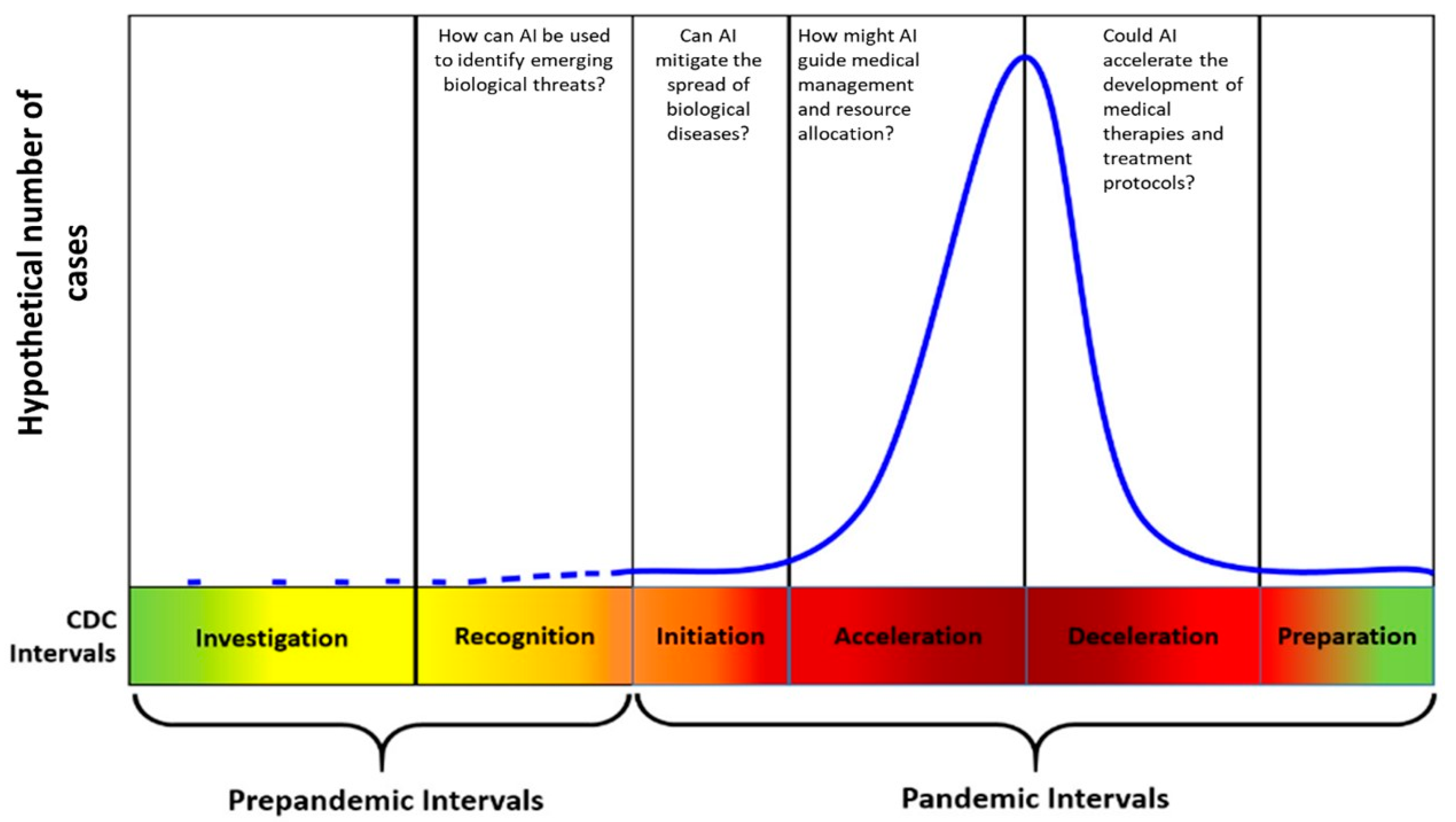
The COVID-19 pandemic put significant strain on societies and their resources, with the healthcare system and workers being particularly affected. Artificial Intelligence (AI) offers the unique possibility of improving the response to a pandemic as it emerges and evolves. Here, we utilize the WHO framework of a pandemic evolution to analyze the various AI applications. Specifically, we analyzed AI from the perspective of all five domains of the WHO pandemic response. To effectively review the current scattered literature, we organized a sample of relevant literature from various professional and popular resources. The article concludes with a consideration of AI’s weaknesses as key factors affecting AI in future pandemic preparedness and response.
Keywords: pandemic; COVID-19; artificial intelligence; demand constraints; innovation pandemic; COVID-19; artificial intelligence; demand constraints; innovation