


Abstract
The central objective of the proposed work in this research is to introduce the innovative concept of an m-polar fuzzy set (m-PFS) in semigroups, that is, the expansion of bipolar fuzzy set (BFS). Our main focus in this study is the generalization of some important results of BFSs to the results of m-PFSs. This paper provides some important results related to m-polar fuzzy subsemigroups (m-PFSSs), m-polar fuzzy ideals (m-PFIs), m-polar fuzzy generalized bi-ideals (m-PFGBIs), m-polar fuzzy bi-ideals (m-PFBIs), m-polar fuzzy quasi-ideals (m-PFQIs) and m-polar fuzzy interior ideals (m-PFIIs) in semigroups. This research paper shows that every m-PFBI of semigroups is the m-PFGBI of semigroups, but the converse may not be true. Furthermore this paper deals with several important properties of m-PFIs and characterizes regular and intra-regular semigroups by the properties of m-PFIs and m-PFBIs.
Keywords:
m-PF subsemigroups; m-PF generalized bi-ideals; m-PF bi-ideals; m-PF quasi-ideals; m-PF interior ideals MSC:
03E72; 18B40
1. Introduction
In 2014, Chen et al. [1] presented the m-PFS as an expansion of the BFS. The mathematical theories of a 2-polar fuzzy set and BFS are equivalent, and we can see that one connected to the other. The BFS is expanded into an m-PFS by applying the notion of one-to-one correspondence. Sometimes, different things are monitored in different ways. The m-PFS is effective in assigning degrees of membership to various objects in multi-polar data. The m-PFS gives only a positive degree of membership to each element. The m-PFS has an extensive range of implementations in real world problems related to the multi-agent, multi-objects, multi-polar information, multi-index and multi-attributes. This theory is applicable when a company decides to construct an item, a country elects its political leaders, or a group of friends wants to visit a country, with various options. It can be used in decision making, co-operative games, disease diagnosis, to discuss the confusions and conflicts of communication signals in wireless communications and as a model to define clusters or categorization and multi-relationships. In sum, an m-PFS on H is a mapping .
Here, we will make a model-based example on m-PFS, and use it to conveniently select an appropriate employee in a company. Here, the selection of an employee is based on 4-PFS with their four qualities, which are honesty, punctuality, communication skills, and being hardworking. Let be the set of five employees in a company. We shall characterize them according to four qualities in the form of 4-PFS, given in Table 1:

Table 1.
Table of qualities in persons with their membership values.
Therefore, we attain a 4-PFS of H such that
Figure 1 is the graphical representation of 4-PFS:
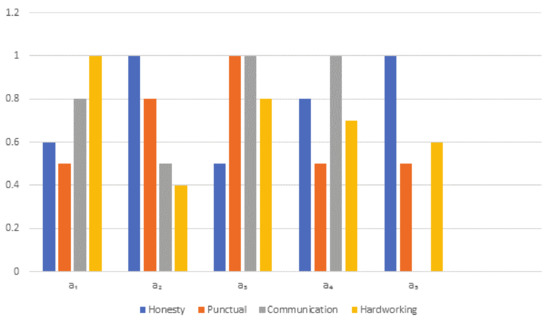
Figure 1.
Graphical representation of 4-polar fuzzy subset.
Here, 1 represents good remarks, 0.5 represents average and 0 represents bad remarks. Similarly, we can solve any other problem with uncertainty in multiple directions.
Zhang [2] proposed that the function is mapped to the interval rather than in BFS theory. Lee [3] coined the term bipolar fuzzy ideals. BFS is useful for solving uncertain problems with two poles of a situation: positive and negative pole. For more applications of BFS, see [4,5,6,7,8,9]. In medical science, environmental research, and engineering, we may find data or information that are ambiguous or complicated. All mathematical equations and techniques in classical mathematics are exact, they cannot deal with such problems. Many tools have been developed to deal with such issues. After extensive effort, Zadeh [10] was the first to propose fuzzy set theory as a solution to such complicated issues. This idea is used in a variety of areas, including logic, measure theory, topological space, ring theory, group theory and real analysis. The theory of fuzzy group was first intitated by Rosenfeld [11]. Kuroki [12] and Mordeson [13] have extensively explored fuzzy semigroups.
Semigroups are very useful in many applications containing dynamical systems, control problems, partial differential equations, sociology, stochastic differential equations, biology, etc. Some examples of semigroups are the collection of all mappings of a set, under the composition of functions (termed a full transformation monoid) and the set of natural numbers under either addition or multiplication. The word “semigroup” was introduced to provide a title for some structures that were not groups but were created through the expansion of consequences. The proper semigroup theory was initiated by the working of Russian mathematician Anton Kazimirovich Suschkewitsch [14]. Quasi-ideals in semigroups were introduced by Otto Steinfeld [15].
The study of m-PF algebraic structures began with the concept of m-PF Lie subalgebras [16]. After that, the m-PF Lie ideals were studied in Lie algebras [17]. In 2017, Sarwar and Akram worked on new applications of m-PF matroids [18]. In 2019, Ahmad and Al-Masarwah introduced the concept of m-PF (commutative) ideals and m-polar -fuzzy ideals in BCK/BCI-algebras [19,20]. To continue their work, they introduced a new aspect of generalized m-PF ideals and studied the normalization of m-PF subalgebras in [21,22]. Recently, Muhiuddin and Al-Kadi presented interval-valued m-PF BCK/BCI-Algebras [23]. Shabir et al. [24] studied regular and intra-regular semirings in terms of BFIs. Then, Bashir et al. [25,26] studied regular ordered ternary semigroups and semirings in terms of BFIs. Shabir et al. extended the work of [24], initiated the concept of m-PFIs in LA-semigroups and characterized the regular LA-semigroups according to the properties of these m-PFIs [27]. By extending the work of [24,27], the concept of m-PFIs in semigroups was introduced and characterizations of regular and intra-regular semigroups according to the properties of m-PFIs are given in this paper.
This paper is charaterized as follows: We present some basic concepts related to m-PFS in Section 2. The major part of this paper is Section 3, the m-PFSSs, m-PFIs (left, right), m-PFBIs, m-PFGBIs, m-PFQIs, m-PFIIs of semigroups are discussed with examples. In Section 4, the regular and intra-regular semigroups are characterized by the properties of m-PFIs. A comparison between this research and previous work is shown in Section 5. In Section 6, we also talk about the conclusions and future work.
The list of acronyms used in the research article is given in Table 2.
Table 2.
List of acronyms.
2. Preliminaries
In this Section, we have studied the fundamental but essential definitions and preliminary findings based on semigroups that are important in their own right. These are necessary for later Sections.
If a groupoid satisfies the associative property, then it is called a semigroup. Throughout this paper, P will denote the semigroup, unless specified otherwise. A non-empty subset H of P is called a subsemigroup of P if for every . In this paper, subsets mean non-empty subsets. A subset H of P is called a left ideal (resp. right ideal) of P if (resp. . If H is left and right ideal, then H is called a two-sided ideal or ideal of P [28].
A subset H of P is called a generalized bi-ideal of P if . The subsemigroup H of P is called a bi-ideal of P if . A subset H of P is called a quasi-ideal of P if . The subsemigroup H of P is called an interior ideal of P if [28].
A fuzzy subset of P is a mapping from P to closed interval , that is [10]. A bipolar fuzzy subset of P is a mapping from P to closed interval written as , where and It can differentiate between unrelated and contrary components of fuzzy problems. A natural one-to-one correspondence exists among the BFS and 2-polar fuzzy set (-set). When data for real world complex situations come from m factors , then m-PFS is used to deal with such problems. An m-PFS (or a -set) on P is a function . More generally, the m-PFS is the m-tuple of membership degree function of P that is where is the mapping for every . Here, is the smallest value in and is the largest value in [1].
The set of all m-PFSs of P is represented by . We define relation ≤ on as follows: For any m-PFSs and of P, means that for every and . The symbols and mean the following m-PFSs of P. and that is for each and ; for each and . For two m-PFSs and , the product of is defined as
for all The next example shows the product of m-PFSs and of P for .
Example 1.
Consider the semigroup given in Table 3.
Table 3.
Table of multiplication of P.
We define 4-PFSs and as follows:
and
By defintion, we obtain
Hence, the product of and is defined by
Definition 1.
Let be an m-PFS of P.
- 1.
- Define for all t, where that is, for all . Then, is called t-cut or a level set.
- 2.
- The support of is defined as the set m-tuple that is for all
Definition 2.
An m-PFS of P is called an m-PFSS of P if, for all that is, for all
Definition 3.
An m-PFS of P is called an m-PFI left (resp. right) of P for all (resp. that is (resp. for all
An m-PFS of P is called an m-PFI of P if is both an m-PFI (left) and m-PFI (right) of P.
The example given below is of 4-PFI of P.
Example 2.
Let be a semigroup given in Table 4.
Table 4.
Table of multiplication of P.
We define a 4-PFS of P as follows:
Clearly, is both 4-PFIs (left and right) of P. Hence is a 4-PFI of P.
Definition 4.
Let a subset H of P. Then, the m-polar characteristic function is defined as
3. Characterization of Semigroups by m-Polar Fuzzy Sets
This is the most essential portion, because here we make our major contributions. With the help of several lemmas, theorems, and examples, the notions of m-PFSSs and m-PFIs of semigroups are explained in this section. We have proved that every m-PFBI of P is m-PFGBI, but the converse does not hold. For LA-semigroups, Shabir et al. [27] has proved this result. We have generalized the results in Shabir et al. [27] for semigroups. In whole paper, is an m-PFS of P that maps each element of P on (1, 1, . . . , 1).
Lemma 1.
Consider two subsets H and I of P. Then
- 1.
- 2.
- 3.
Proof.
The proof of (1) and (2) are obvious.
(3): Case 1: Let . This implies that for some and . Therefore, . Since and , we have or . Now,
Therefore, Case 2: If . This implies that , since for every and . Therefore
Hence □
Lemma 2.
Let H be a subset of P. Then, the given statements hold.
- 1.
- H is a subsemigroup of P if, and only if, is an m-PFSS of
- 2.
- H is a left ideal (resp. right) of P if and only if is an m-PFI left (resp. right) of P.
Proof.
(1) Consider H as the subsemigroup of P. We have to show that for all . Now, we consider some cases:
Case 1: Let . Then, . As H is a subsemigroup of P, so implies that . Hence .
Case 2: Let . Then, . Hence,
Case 3: Let . Then, . Clearly, .
Case 4: Let . Then, and . Clearly,
Conversely, let be an m-PFSS of P. Let . Then, . By definition, we have . This implies that that is H is a subsemigroup of P.
(2) Suppose that H is the left ideal of P. We have to show that for every . Now, consider the two cases:
Case 1: Let and . Then, . Since H is a left ideal of P, implies that . Hence
Case 2: Let and . Then, . Clearly, .
Conversely, let be an m-PFI (left) of P. Let and . Then, . By definition, we have . This implies that that is H is a left ideal of P.
In the same way, we can show that H is right ideal of P if, and only if, is an m-PFI (right) of P. Therefore, H is an ideal of P if, and only if, is an m-PFI of P. □
Lemma 3.
For m-PFS of the following properties hold.
- 1.
- η is an m-PFSS of P if, and only if,
- 2.
- η is an m-PFI (left) of P if, and only if,
- 3.
- η is an m-PFI (right) of P if, and only if,
- 4.
- η is an m-PFI of P if, and only if, and where δ is the m-PFS of P that maps each element of P on
Proof.
(1) Assume that is an m-PFSS of P, that is, for all Let . If p is not expressible as for some ; then, . Hence, . However, if p is expressible as for some then
Hence, Conversely, let and . Then
Hence, . Thus, is m-PFSS of P.
(2) Assume that is m-PFI (left) of P, that is, for all and Let . If p is not expressible as for some , then . Hence, However, if p is expressible as for some then
Hence Conversely, let and . Then,
Hence, . Thus, is m-PFI (left) of P.
(3) This can be proved similarly to the proof of part of Lemma 3.
(4) The proof of this follows from parts and of Lemma 3. □
Lemma 4.
The given statements are true in P.
- Let and be two m-PFSSs of P. Then, is also an m-PFSS of
- Let and be two m-PFIs of P. Then, is also an m-PFI of
Proof.
Straightforward. □
Proposition 1.
Let be an m-PFS of P. Then, is an m-PFSS (resp. m-PFI) of P if, and only if, is a subsemigroup (resp. ideal) of P for all
Proof.
Let be an m-PFSS of P. Let . Then, and for all . As is an m-PFSS of P, this implies for all . Therefore, Then is a subsemigroup of
Conversely, let be a subsemigroup of P. On the contrary, let us consider that is not an m-PFSS of P. Suppose such that for some . Take for all . Then, but there is a contradiction. Hence, . Thus, is an m-PFSS of Other cases can be proved on the same lines. □
Now, we define the m-PFGBI of a semigroup.
Definition 5.
An m-PFS η of P is called an m-PFGBI of P if for all that is for all
Lemma 5.
A subset H of P is generalized bi-ideal of P if and only if is an m-PFGBI of P.
Proof.
This Lemma 5 can be proved similarly to the proof of Lemma 2. □
Lemma 6.
An m-PFS η of P is m-PFGBI of P if and only if, , where δ is the m-PFS of P that maps each element of P on .
Proof.
Suppose is the m-PFGBI of that is, for all and Let . If p is not expressible as for some , then . Hence, . However, if p is expressible as for some . Then
Hence, Conversely, let and . Then,
Hence, . Thus, is m-PFGBI of P. □
Proposition 2.
Assume that is an m-PFS of P. Then, η is an m-PFGBI of P if, and only if, is a generalized bi-ideal of P for all
Proof.
Let be an m-PFGBI of Let and . Then, and for all . Since is m-PFGBI of P, we have for all . Therefore, . That is is a GBI of P.
Conversely, assuming that is a GBI of P. On the contrary, assume that is not m-PFGBI of P. Suppose , such that for some . Take for all . Then, but which is a contradiction. Hence, that is, is m-PFGBI of □
Next, we define the m-PFBI of a semigroup.
Definition 6.
A subsemigroup of P is called an m-PFBI of P if for all that is, for all
Lemma 7.
A subset H of P is a bi-ideal of P if, and only if, is an m-PFBI of P.
Proof.
Follows from Lemmas 2 and 5. □
Lemma 8.
An m-PFSS η of P is an m-PFBI of P if and only if, , where δ is the m-PFS of P, which maps each element of P on .
Proof.
Follows from Lemma 6. □
Proposition 3.
Let be a subsemigroup of P. Then is an m-PFBI of P if and only if, is a bi-ideal of P for all
Proof.
Follows from Proposition 2. □
Remark 1.
Every m-PFBI of P is an m-PFGBI of P.
The Example 3 illustrates that the converse of above Remark may not be true.
Example 3.
Let be a semigroup given in Table 5.
Table 5.
Table of multiplication of P.
We define a 4-PFS of P as follows: Then, simple calculations show that the is a 4-PFGBI of P.
Now, . Therefore, is not a bi-ideal of P. Next, we define the m-PFQI of a semigroup.
Definition 7.
An m-PFS of P is called an m-PFQI of P if that is for all
Lemma 9.
A subset H of P is a quasi ideal of P if and only if is an m-PFQI of
Proof.
Let H be a quasi ideal of P, that is . We show that that is, for every . We study the following cases:
Case 1: If then . Hence .
Case 2: If then . This implies that and for some and . Therefore, either or that is . Hence
Conversely, let . Then and , where and . Since is an m-PFQI of P, we have
Therefore, . Hence, □
Proposition 4.
An m-PFS η of P is an m-PFQI of P if, and only if, is a quasi ideal of P for all
Proof.
Let is an m-PFQI of P. To show that . Let . Then, and . Therefore, and for some and . Therefore, for all
Now
So
Now
So
Therefore, for all . So, . Since so Hence, is a quasi ideal of P.
Conversely, consider that is not quasi ideal of P. Let be such that for some . Choose , such that for all . This implies that and but for some . Hence, and but , which is a contradiction. Hence, □
Lemma 10.
Every m-PF one-sided ideal of P is an m-PFQI of P.
Proof.
This proof follows from Lemma 3. □
In the next example, it is shown that the converse of the above Lemma may not be true.
Example 4.
Consider the semigroup given in Table 6.
Table 6.
Table of multiplication of P.
Define a 3-PFS of P as follows:
Then, simple calculations show that is QI of Therefore, by using Proposition 4, is 3-PFQI of P. Now,
So is not 3-PFI (right) of P.
Lemma 11.
Let and be two m-PFI(right) and m-PFI(left) of respectively. Then is m-PFQI of P.
Proof.
Let . If for some . Then, . If for some then -4.6cm0cm
Hence, that is, is m-PFQI of P. □
Now, we define the m-PFII of a semigroup.
Definition 8.
An m-PFSS η of P is called an m-PFII of P if for all , that is, for all
Lemma 12.
A subset H of P is an interior ideal of P if, and only if, is an m-PFII of P.
Proof.
Let H be any interior ideal of P. From Lemma 2, is an m-PFSS of P. Now we show that for every . We consider the following two cases:
Case 1: Let and . Then . Since H is an interior ideal of P, then . Then, . Hence, .
Case 2: Let and . Then, . Clearly, . Hence, of H is an m-PFII of P.
Conversely, consider of H is an m-PFII of P. Then by Lemma 2, H is a subsemigroup of P. Let and . Then By hypothesis, Hence . This implies that that is H is an interior ideal of P. □
Lemma 13.
An m-PFSS η of P is an m-PFII of P if, and only if,
Proof.
Let be m-PFII of P. We show that . Let Then, for all
Therefore
Conversely, let . We only show that for every and for all . Let . Now, for all
Therefore, for all . Hence, is m-PFII of P. □
Proposition 5.
A subset η of P is m-PFII of P if, and only if, is an interior ideal of P for all .
Proof.
This is the same as the proof of Propositions 1 and 2. □
4. Characterization of Regular and Intra-Regular Semigroups by -Polar Fuzzy Ideals
A semigroup P is called regular iffor all there exists an element such that . A semigroup P is called an intra-regular semigroup if for all there exists elements such that . Regular and intra-regular semigroups have been studied by several authors, see [24,28]. The characterizations of the regular and intra-regular semigroups in terms of m-PF ideals and m-PFBI are discussed with the help of many theorems in this section.
Theorem 1
([28]). The following results are equivalent in P.
- P is regular;
- , for every right ideal H and left ideal I of P;
- , for every quasi ideal J of
Theorem 2.
Each m-PFQI η of P is an m-PFBI of P.
Proof.
Suppose that be m-PFQI of P. Let . Then,
So, Now, let Then,
Therefore, for all Since so for some . Therefore,
Therefore, for all Now, by our supposition
Therefore, Hence, is m-PFBI of P. □
Theorem 3.
The given statements are equivalent in P.
- 1.
- P is regular;
- 2.
- for every m-PFI(right)η and m-PFI(left) of P.
Proof.
Let and be two m-PFI(right) and m-PFI(left) of P. Let we have
Therefore, As P is regular, then for every, there exists, such that
So, Therefore,
Let . Then, is a left ideal of P and is a right ideal of P generated by o. Then, by using Lemma 2, and the m-polar fuzzy characteristic fuctions of and are m-PFI(left) and m-PFI(right) of P, respectively. Then, we have
Therefore, . As a result, Theorem 1 shows that P is regular. □
Theorem 4.
The following statements are equivalent in P.
- 1.
- P is regular;
- 2.
- for every m-PFGBI η of P;
- 3.
- for every m-PFQI η of P.
Proof.
Let be an m-PFGBI of P and . Since P is regular, there exists such that . Therefore, we have
Hence, Since is an m-PFGBI of P. Therefore, we have
So, Therefore,
It is obvious.
Let be m-PFI (right) and m-PFI (left) of P, respectively. Then is an m-PFQI of P. According to hypothesis
However, always hold. Hence, that is Therefore by Theorem 3, P is a regular semigroup. Hence, proved. □
Theorem 5.
The following statements are equivalent in P.
- P is regular;
- for every m-PFI(right) ρ, every m-PFGBI and every m-PFI(left) η of
- for every m-PFI(right) ρ, every m-PFBI and every m-PFI(left) η of
- for every m-PFI(right) ρ, every m-PFQI and every m-PFI(left) η of
Proof.
Consider b is any element of P. As P is regular, there exists such that It follows that for each and P is semigroup. Hence, we have
Therefore, . So implies .
Straightforward.
As is an m-PFQI of P, by the supposition, we have
Therefore . But always. So, . Hence, by using Theorem 3, P is regular. □
Theorem 6
([28]). The following conditions are equivalent in P.
- P is intra-regular;
- for every right ideal H and every left ideal I of P.
Definition 9
([24]). A semigroup P is both regular and intra-regular if and only if for every bi-ideal H of P.
Theorem 7.
A semigroup P is intra-regular if, and only if for every m-PFI(left) η and, for every, m-PFI(right) ρ of P.
Proof.
Consider a is any element of P. As P is intra-regular, there exists such that Hence, we have
This implies
Conversely, assume that for all m-PFI(left) and m-PFI(right) of Let H be a right ideal and I be a left ideal of P, then is an m-PFI(right) and is an m-PFI(left) of By Lemma 1, which implies that Therefore, by Theorem 6, P is intra-regular. □
Theorem 8.
For every m-PFBI η of P, if and only if, P is both regular and intra-regular.
Proof.
Let P be both regular and intra-regular semigroup. Let be an m-PFBI of Thus, for there exists such that and Therefore, Hence, we have
This implies By Lemma 3, holds always. Therefore,
Conversely, let H be a bi-ideal of P. Since every m-PFBI is m-PFSS of P. Then, Lemma 2, implies that is m-PFBI of P. Hence, by our supposition, Thus, . Therefore, by Theorem 9, P is both regular and intra-regular. □
5. Comparative Study and Discussion
This section explains how this paper and the previous one are related to Shabir et al. [27]. Shabir et al. [24] studied regular and intra-regular semiring in terms of BFIs. Shabir et al. extended the work of [24] and initiated the concept of m-PFIs in LA-semigroups and characterized the regular LA-semigroups by the properties of these m-PFIs [27]. By extending the work of [24,27], the concept of m-PFIs in semigroups is introduced, and characterizations of regular and intra-regular semigroups by the properties of m-PFIs are given in this paper. Our approach is superior to that of Shabir et al. [27] because the associative property in LA-semigroups does not hold. There are also numerous structures that are handled by semigroups but not by LA-semigroups. If we take any non-empty set and define the operation on it as , then it is a semigroup, but not an LA-semigroup. To overcome this problem, we used a semigroup to generalize the whole results of Shabir et al. [27] and, as a result, our methodology offers a broader variety of applications than Shabir et al. [27].
6. Conclusions
When data for real world complex situations come from m factors , then m-PFS is used to deal such problems. The structure of semigroups is investigated using the idea of m-PFS in this research paper. Shabir et al. [27] used LA-semigroups as the basis for their algebraic structure, which we converted into semigroups. Most importantly, we proved some results related to fuzzy ideals in semigroups in terms of m-PFIs in semigroups. This paper presents a significant number of m-PFS theory applications. We also studied the characterization of regular and intra-regular semigroups by m-PFIs (left) (resp. m-PFIs right) and m-PFBI.
Our future plans are to study the m-PFIs in terms of semirings, ternary semigroups, ternary semirings, near rings and hyperstructures.
Author Contributions
Conceptualization: S.B. and M.S.; Methodology: S.S.; Software: S.B.; Validation: A.N.A.-K.; Formal Analysis: S.S.; Investigation: S.S.; Resources: A.N.A.-K.; Data Curation, M.S.; Writing—Original Draft Preparation: S.S.; Writing—Review and Editing: S.B.; Visualization: S.S.; Supervision: S.B.; Project Administration: S.S.; funding acquisition: A.N.A.-K. All authors have read and agreed to the published version of the manuscript.
Funding
This research received no external funding.
Institutional Review Board Statement
Not applicable.
Informed Consent Statement
Not applicable.
Data Availability Statement
We didn’t use any data for this research work.
Conflicts of Interest
The authors declare that they have no conflict of interest.
References
- Chen, J.; Li, S.; Ma, S.; Wang, X. m-polar fuzzy sets: An extension of bipolar fuzzy sets. Sci. World J. 2014, 2014, 416530. [Google Scholar] [CrossRef] [Green Version]
- Zhang, W.R. Bipolar fuzzy sets and relations: A computational framework for cognitive modeling and multiagent decision analysis. In Proceedings of the NAFIPS/IFIS/NASA’94, First International Joint Conference of the North American Fuzzy Information Processing Society Biannual Conference, San Antonio, TX, USA, 18–21 December 1994; pp. 305–309. [Google Scholar]
- Lee, K.M. Bipolar-valued fuzzy sets and their operations. In Proceedings of the International Confefence on Intelligent Technologies, Bangkok, Thailand, 12–14 December 2000; pp. 307–312. [Google Scholar]
- Saqib, M.; Akram, M.; Bashir, S.; Allahviranloo, T. A Runge–Kutta numerical method to approximate the solution of bipolar fuzzy initial value problems. Comput. Appl. Math. 2021, 40, 1–43. [Google Scholar] [CrossRef]
- Saqib, M.; Akram, M.; Bashir, S. Certain efficient iterative methods for bipolar fuzzy system of linear equations. J. Intelligent Fuzzy Syst. 2020, 39, 3971–3985. [Google Scholar] [CrossRef]
- Saqib, M.; Akram, M.; Bashir, S.; Allahviranloo, T. Numerical solution of bipolar fuzzy initial value problem. J. Intell. Fuzzy Syst. 2021, 40, 1309–1341. [Google Scholar] [CrossRef]
- Mehmood, M.A.; Akram, M.; Alharbi, M.G.; Bashir, S. Optimization of-Type Fully Bipolar Fuzzy Linear Programming Problems. Mathematical Problems in Engineering. Math. Probl. Eng. 2021, 2021, 1199336. [Google Scholar]
- Mehmood, M.A.; Akram, M.; Alharbi, M.G.; Bashir, S. Solution of Fully Bipolar Fuzzy Linear Programming Models. Math. Eng. 2021, 2021, 9961891. [Google Scholar]
- Shabir, M.; Abbas, T.; Bashir, S.; Mazhar, R. Bipolar fuzzy hyperideals in regular and intra-regular semihypergroups. Comput. Appl. Math. 2021, 40, 1–20. [Google Scholar] [CrossRef]
- Zadeh, L.A. Fuzzy sets. Inf. Control. 1965, 8, 338–353. [Google Scholar] [CrossRef] [Green Version]
- Rosenfeld, A. Fuzzy groups. J. Math. Appl. 1971, 35, 512–517. [Google Scholar] [CrossRef] [Green Version]
- Kuroki, N. Fuzzy bi-ideals in semigroups. Rikkyo Daigaku Sugaku Zasshi 1980, 28, 17–21. [Google Scholar]
- Mordeson, J.N.; Malik, D.S.; Kuroki, N. Fuzzy Semigroups; Springer: Berlin/Heidelberg, Germany, 2012; p. 131. [Google Scholar]
- Hollings, C. The early development of the algebraic theory of semigroups. Arch. Hist. Exact Sci. 2009, 63, 497–536. [Google Scholar] [CrossRef]
- Steinfeld, O. Quasi-Ideals in Rings and Semigroups; Akadémiai Kiadó: Budapest, Hungary, 1978. [Google Scholar]
- Akram, M.; Farooq, A.; Shum, K.P. On m-polar fuzzy lie subalgebras. Ital. J. Pure Appl. Math. 2016, 36, 445–454. [Google Scholar]
- Akram, M.; Farooq, A. m-polar fuzzy Lie ideals of Lie algebras. Quasigroups Relat. Syst. 2016, 24, 141–150. [Google Scholar]
- Sarwar, M.; Akram, M. New applications of m-polar fuzzy matroids. Symmetry 2017, 9, 319. [Google Scholar] [CrossRef] [Green Version]
- Al-Masarwah, A. m-polar fuzzy ideals of BCK/BCI-algebras. J. King Saud-Univ.-Sci. 2019, 31, 1220–1226. [Google Scholar] [CrossRef]
- Al-Masarwah, A.; Ahmad, A.G. m-polar (α,β)-fuzzy ideals in BCK/BCI-algebras. Symmetry 2019, 11, 44. [Google Scholar] [CrossRef] [Green Version]
- Al-Masarwah, A.N.A.S.; Ahmad, A.G. A new form of generalized m-PF ideals in BCK/BCI-algebras. Ann. Commun. Math. 2019, 2, 11–16. [Google Scholar]
- Al-Masarwah, A. On (complete) normality of m-pF subalgebras in BCK/BCI-algebras. AIMS Math. 2019, 4, 740–750. [Google Scholar] [CrossRef]
- Muhiuddin, G.; Al-Kadi, D. Interval Valued m-polar Fuzzy BCK/BCI-Algebras. Int. J. Comput. Intell. 2021, 14, 1014–1021. [Google Scholar] [CrossRef]
- Shabir, M.; Liaquat, S.; Bashir, S. Regular and intra-regular semirings in terms of bipolar fuzzy ideals. Comput. Appl. Math. 2019, 38, 1–19. [Google Scholar] [CrossRef]
- Bashir, S.; Fatima, M.; Shabir, M. Regular ordered ternary semigroups in terms of bipolar fuzzy ideals. Mathematics 2019, 7, 233. [Google Scholar] [CrossRef] [Green Version]
- Bashir, S.; Mazhar, R.; Abbas, H.; Shabir, M. Regular ternary semirings in terms of bipolar fuzzy ideals. Comput. Appl. Math. 2020, 39, 1–18. [Google Scholar] [CrossRef]
- Shabir, M.; Aslam, A.; Pervaiz, F. m-polar fuzzy ideals in terms of LA-semigroups. Pak. Acad. Sci. (submitted).
- Shabir, M.; Nawaz, Y.; Aslam, M. Semigroups characterized by the properties of their fuzzy ideals with thresholds. World Appl. Sci. J. 2011, 14, 1851–1865. [Google Scholar]
Publisher’s Note: MDPI stays neutral with regard to jurisdictional claims in published maps and institutional affiliations. |
© 2021 by the authors. Licensee MDPI, Basel, Switzerland. This article is an open access article distributed under the terms and conditions of the Creative Commons Attribution (CC BY) license (https://creativecommons.org/licenses/by/4.0/).