


Abstract
The ABS (atom-bond sum-connectivity) index of a graph G is denoted by and is defined as , where represents the degree of the vertex x in G. In this paper, we derive the best possible upper bounds on the ABS index for fixed-order trees possessing a given maximum degree, which provides a solution to the open problem proposed quite recently by Hussain, Liu and Hua.
MSC:
05C05; 05C07; 05C09
1. Introduction
For terminology and notions concerning graph theory or chemical graph theory, we refer the reader to books [1,2] or [3,4], respectively.
A property of graphs that remains the same under graph isomorphism is referred to as a graph invariant [5]. The graph invariants that take only numerical quantities are commonly known as topological indices in chemical graph theory [4]. It is important to note that the choice of topological index depends on the specific application and the structural features of interest.
Various topological indices capture different aspects of molecular structure and properties to aid in the prediction of molecular characteristics, and they are often used in QSPR (quantitative structure–property relationship) studies and cheminformatics to correlate the structure of chemical compounds with their properties or activities [6].
A common tool in mathematical chemistry to predict the physico-chemical characteristics of chemical compounds is the connectivity index [7], which is a topological index introduced in the mid-1970s. For a graph G, this index is represented by and is defined as
where is used for representing the edge set of G, and is used for representing the degree of the vertex x in G. (If two or more graphs are under consideration at once, then we use instead of to represent the degree of x in G.) To discover more about the connectivity index, see the books [8,9,10] and survey papers [11,12].
The atom-bond connectivity index (ABC index) [13,14] as well as the sum-connectivity (SC) index [15] are variants of the connectivity index, which were introduced with the aim of improving QSAR studies involving topological indices. These two indices for a graph G are defined as
We remark here that both the SC index and the connectivity index take into account only the degrees of atoms in a molecular graph, while the ABC index takes into account the degrees of both atoms and bonds in a molecular graph, providing a more detailed characterization compared to some indices that focus only on atoms or bonds individually. To discover more about the ABC index, see the surveys [16,17,18,19,20] and the related papers cited therein. Particularly, the reader can consult [21,22] for the solution of a well-researched problem on this index. Moreover, the surveys [19,23] and the related papers cited therein can be consulted for additional information about the SC index.
The atom-bond sum-connectivity index (ABS index) [24] can be considered as a variant of each of the ABC, connectivity and SC indices. For a graph G, this index is defined as
We remark that the ABS is a particular form of a more general index studied in [25].
Although the ABS index has been introduced quite recently, a considerable number of publications on this index have already appeared. In [26,27,28], this index was not only examined for its chemical applications but its mathematical aspects were also investigated. Some results regarding the extremum values of the ABS index of trees having a fixed number of degree-one and fixed-order vertices can be found in [29,30]. The ABS index was directly compared with the SC index in [31]; see also [32], where several relationships between the ABS index and some other connectivity indices were derived; see [33] for the general case. The greatest values of this index over certain families of graphs with given parameters were studied in [34]. The study on the extremum values of this index of fixed-order chemical trees, chemical unicyclic graphs, chemical bicyclic graphs and chemical tricyclic graphs was carried out in [35]. The ABS index of line graphs was studied in [36]. Some other extremal problems regarding the ABS index of trees were addressed in [37,38].
For a graph G and , we define ; particularly, every element of this set is referred to as a neighbor of x. Also, x is a pendent vertex if , and x is branching if . Moreover, x is referred to as a claw if of its neighbors are pendent. Let represent the set of pendent vertices of G. Define . The maximum degree of G is represented as . The graph that results from G by removing is represented by . Also, the graph that results from G by deleting is represented as . Similarly, if , then represents the graph that is constructed from G after inserting the edge . A pendent path in a graph G is a nontrivial path such that = 1, , and whenever . We call the vertices and as the end vertices of P. The number r is called the length of the pendent path P. When r equals 1, P represents a pendent edge. Consider T as a tree with and . When equals 2, then . Also, when equals , then . Thus, for the subsequent discussion, we assume that lies between 3 and .
We are interested in the following problem, posed recently in [39]:
Problem 1.
Let denote the class of all n-order trees with a maximum degree of . Find the tree(s) possessing the largest ABS index over .
The next section gives a solution to Problem 1 when . In Section 3, a solution to Problem 1 is provided when . Finally, Problem 1 with the constraints is addressed in Section 4, where we utilize computer software to determine trees possessing the largest ABS index over for every pair satisfying and . Based on the structures of the obtained extremal trees, we pose two conjectures.
2. Trees with Maximum Degree 3 or 4
This section is concerned with a solution to Problem 1 when . The solution to Problem 1 for and follows from Theorem 12 of [24] because the trees possessing the largest ABS index over have a maximum degree of 4 for (see Theorem 12 in [24]). Also, consists of exactly one graph. The graphs with the greatest ABS index in with are given in Figure 1; these trees are found by utilizing computer software. In what follows, we provide a solution to Problem 1 when .
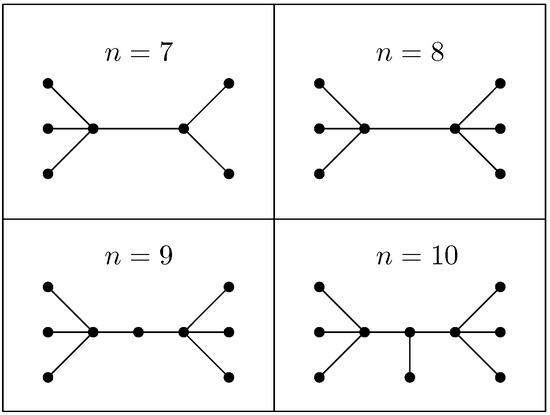
Figure 1.
The trees possessing the greatest ABS index in with .
The number of edges in an n-order tree T with a maximum degree of 3 that join the vertices of degrees and is denoted by . The ABS index can therefore be expressed in terms of , as given below:
Let represent the number of degree vertices in tree T. Then,
Theorem 1.
Let denote the class of all n-order trees such that .
- (a).
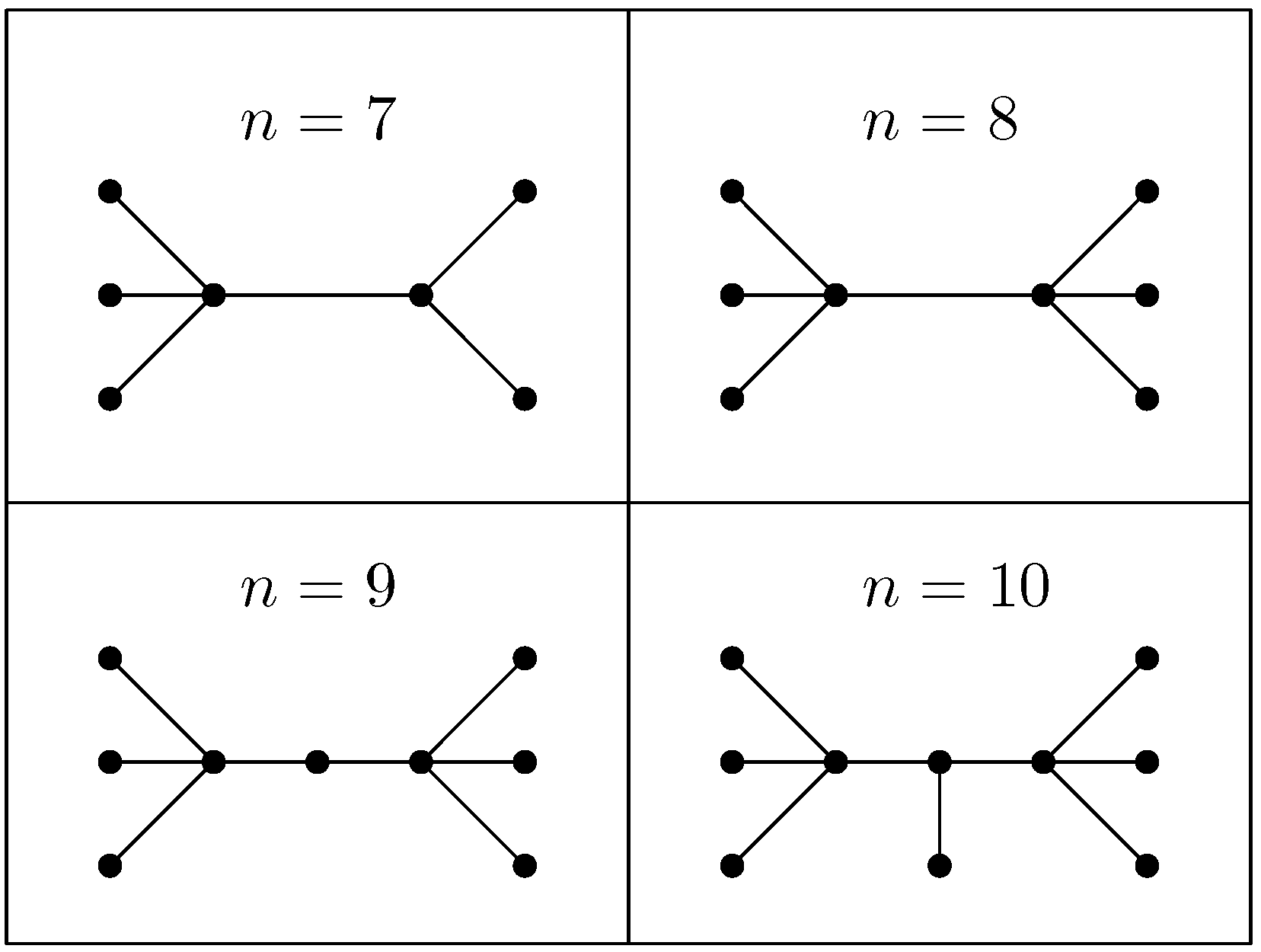
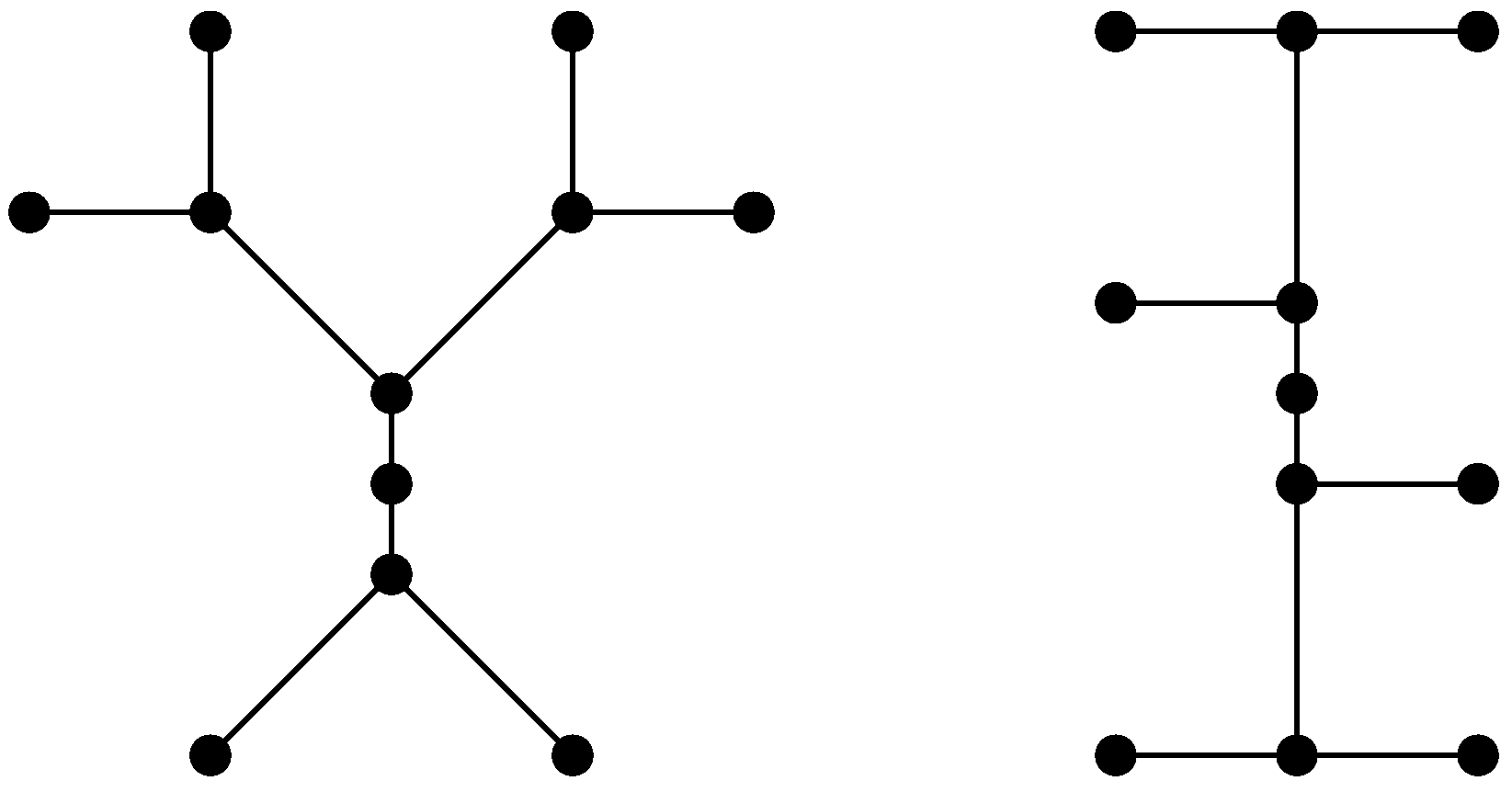
- If n is even and , then the largest ABS index in iswhich is possessed by only those trees that consist of vertices of degrees 1 and 3; for an example, see Figure 2.
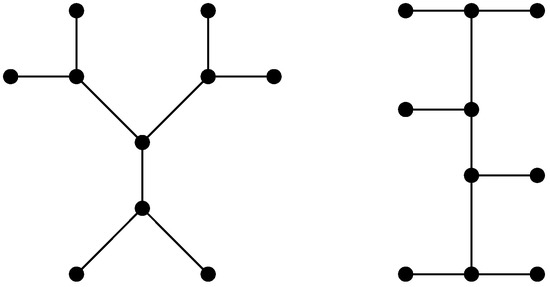 Figure 2. Examples of trees possessing the greatest ABS index in the class .
 - (b).
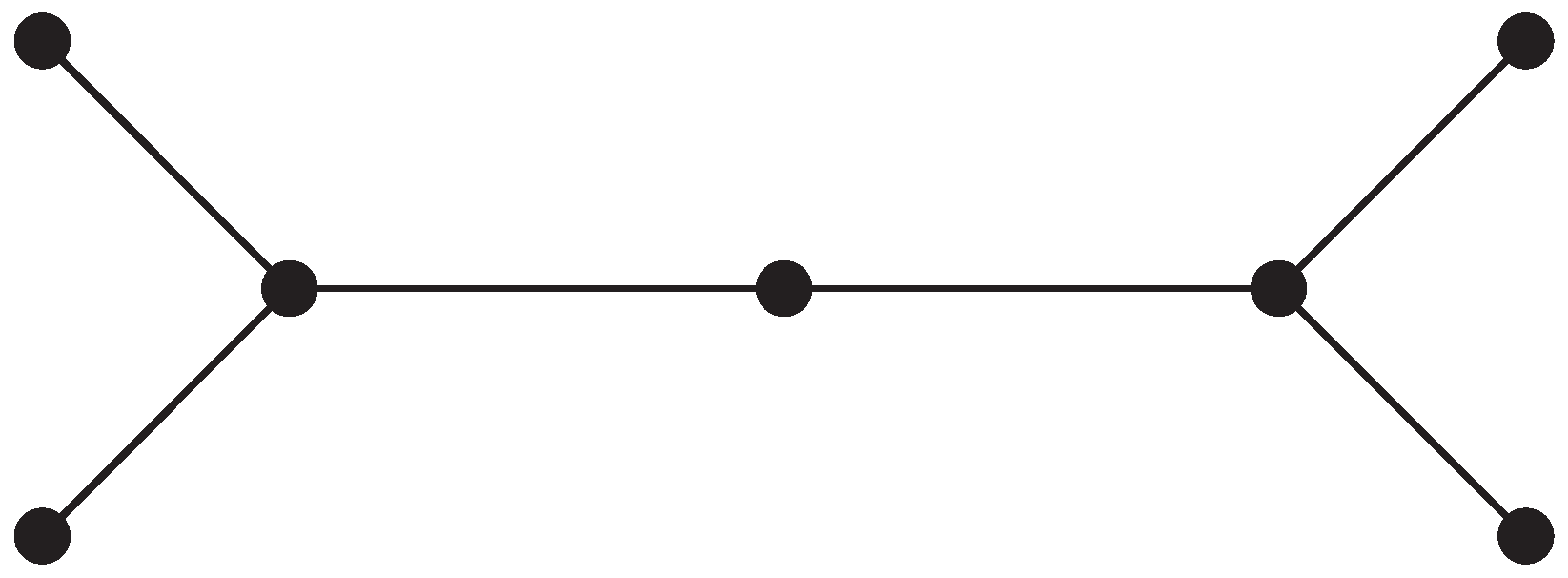
- If n is odd and , then the largest ABS index in iswhich is possessed by only those trees that have only one vertex with a degree of 2, whose both neighbors have degree 3; for an example, see Figure 3.
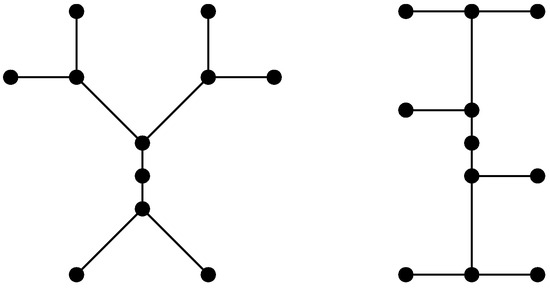 Figure 3. Examples of trees possessing the greatest ABS index in the class .
Proof.
Let
Thus, Equation (7) can be rewritten as follows:
Observe that
which means that it suffices to search tree T for which is maximum in order to achieve the greatest values of the ABS index of T.
(a). Suppose that n is even and . Let be the star graph of order 4. Let denote the tree formed by attaching two new pendent vertices at a pendent vertex of . Thus, it is always possible to construct an n-order tree consisting of only vertices of degrees 1 and 3 when n is even and ; for such a tree, the value of is 0. Thus, part (a) now follows from (8) and (10).
(b). Suppose that n is odd and . Then, every n-order tree T with a maximum degree of 3 possesses at least one vertex of degree 2. However, (8) or (10) imply that
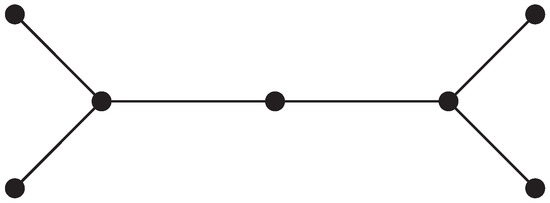
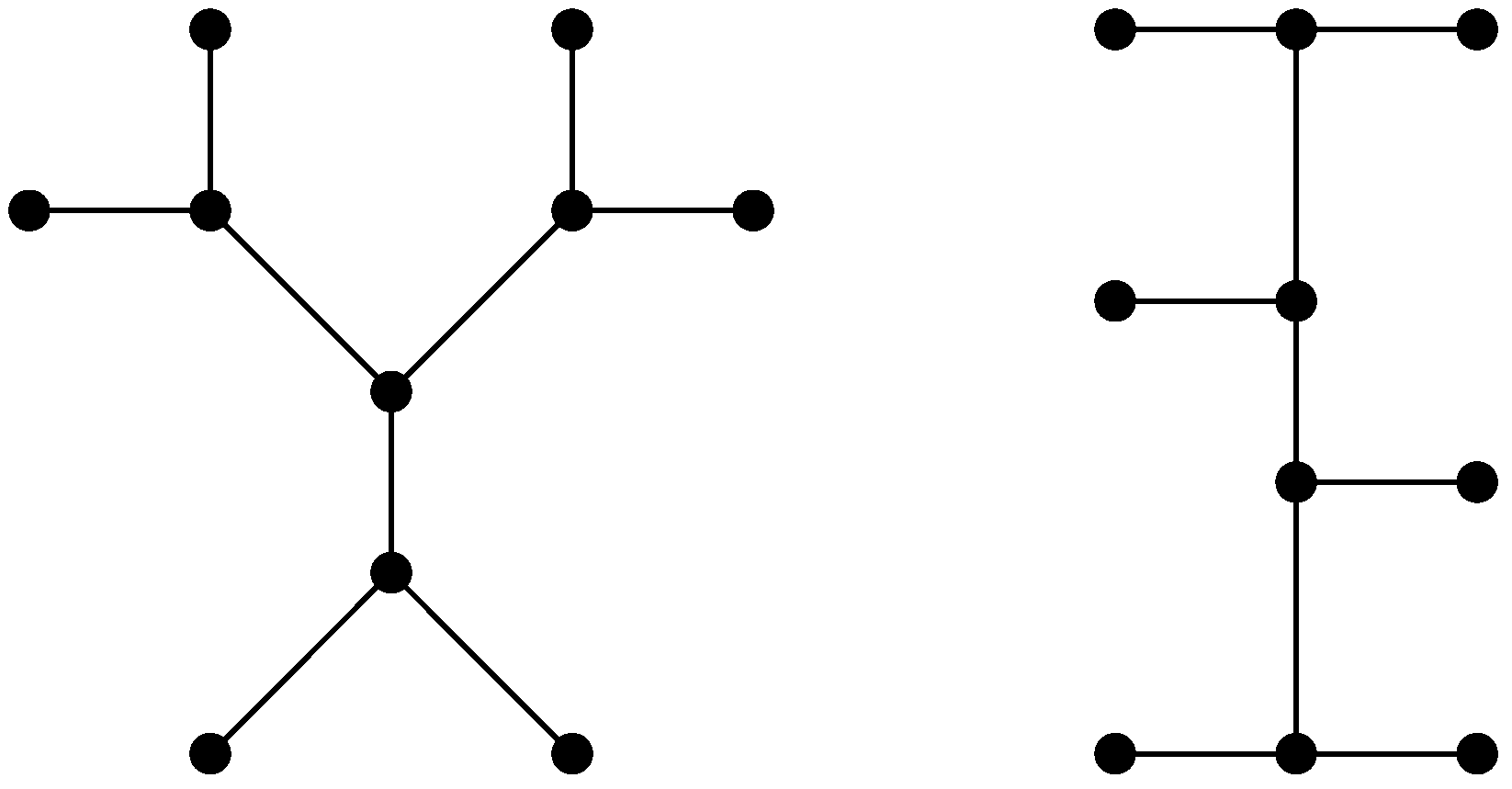
with equality if and only if , and . Let denote the tree with 7 vertices depicted in Figure 4. Denote the constructed tree by by attaching two new pendent vertices at a pendent vertex of for odd . Thus, it is always possible to construct an n-order tree such that and where it only has a single vertex with a degree of 2, whenever n is odd and ; for such a tree, the value of is . Thus, part (b) now follows from (8) and (11).
Figure 4.
The tree used in the proof of Theorem 1.
□
3. On -Order Trees of Maximum Degree at Least
This section is devoted to finding a solution to Problem 1 when . Before proving the main result of the present section, we prove a crucial lemma.
Lemma 1.
For a tree T, take , satisfying . Also, take , where is pendent and does not lie on the unique path connecting x and y. Let with . Assume that is the tree formed from T by removing the edges and inserting the edges . Then,
Proof.
Observe that
The derivative of the function defined by
is
where and are fixed integers satisfying , and
Certainly, the function is strictly decreasing for ; thus, for . Hence, ; thus, (12) yields
As the function defined by
is strictly decreasing, one gets from (13). □
Now, we prove the main result of this section.
Theorem 2.
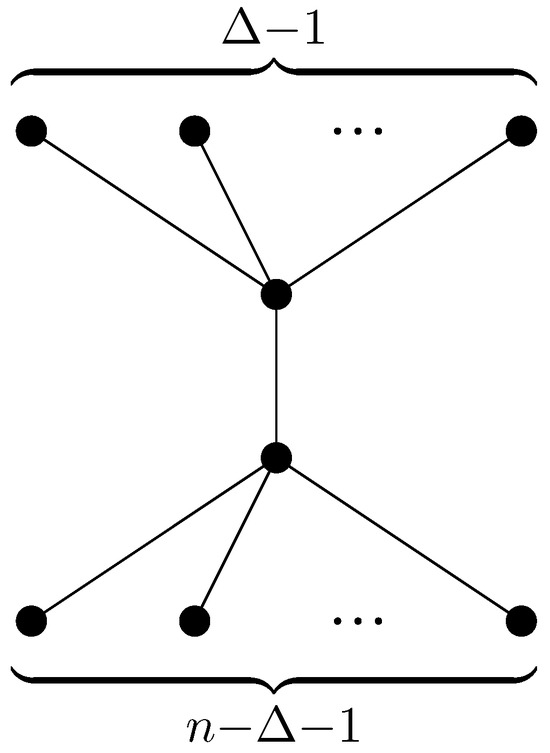
If T is an n-order tree of maximum degree satisfying the condition then
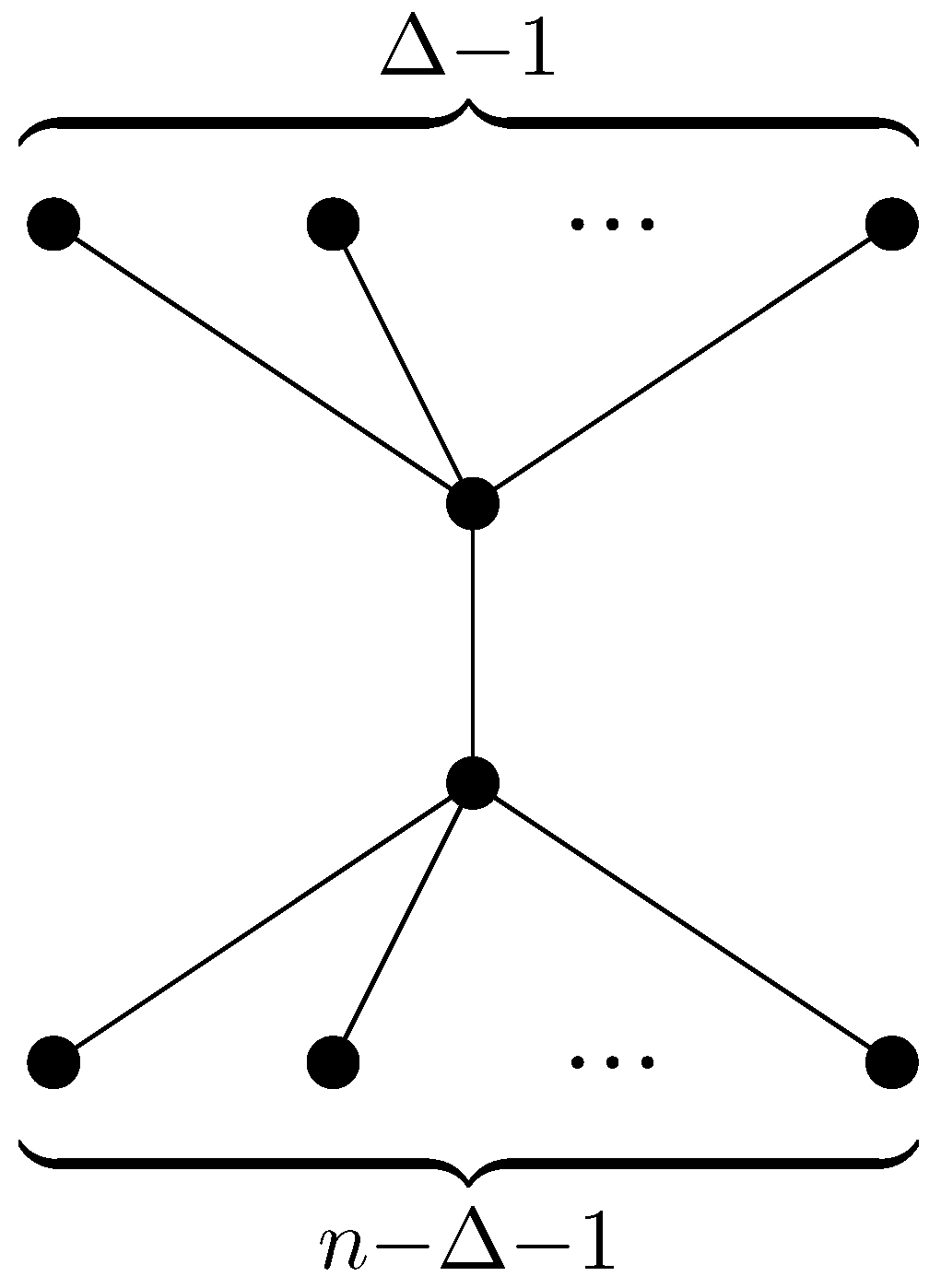
The sufficient and necessary condition for the equality in (14) is , where is the graph constructed by attaching pendent vertices to one pendent vertex of (see Figure 5).
Figure 5.
The tree defined in Theorem 2.
Proof.
If T is isomorphic to , then
Next, we establish (14).
Among all n-order trees of maximum degree satisfying the given condition, we assume that T is the one for which is maximum. Suppose that there exists , provided that , where . Given that is greater than or equal to , it follows that is not an empty set. Now, let us choose a vertex from , such that forms an edge in . Our primary goal is to illustrate two crucial facts.
Fact 1.
The vertex z is a claw.
Proof of Fact 1.
Suppose that z does not exhibit a claw-like structure. Let us consider a vertex y from excluding z, such that there exists an edge within , where belongs to . Under this condition, we can identify a vertex x within that is not a part of and does not lie on the unique path connecting z and y. Let us take , where . Given that is greater than or equal to and y is distinct from z, we can deduce that
Set
Note that has maximum degree and that . By utilizing Lemma 1, we conclude that
which contradicts the choice we made regarding T. □
According to Fact 1, we have the option to designate a vertex x such that it is the unique vertex with an edge in , and is greater than or equal to 2. Now, consider the sub-tree which includes the vertex x in the graph obtained by removing vertex z from graph T.
Fact 2.
Proof of Fact 2.
Let us assume that is not isomorphic to In this case, there must be an edge in the sub-tree where neither y nor is a pendent vertex. Additionally, let us denote the degrees of and y as s and t, respectively, where both s and t are greater than or equal to 2. We select edge in such a way that the distance between z and y is maximized. Consequently, y takes the form of a claw with its neighbors in the set denoted as Now, we define as the result of removing the edges and adding the edges to the original graph Then,
which contradicts the choice we made regarding T. □
Now, in view of Facts 1 and 2, the proof of Theorem 2 is completed. □
4. On -Order Trees of Maximum Degree Less than
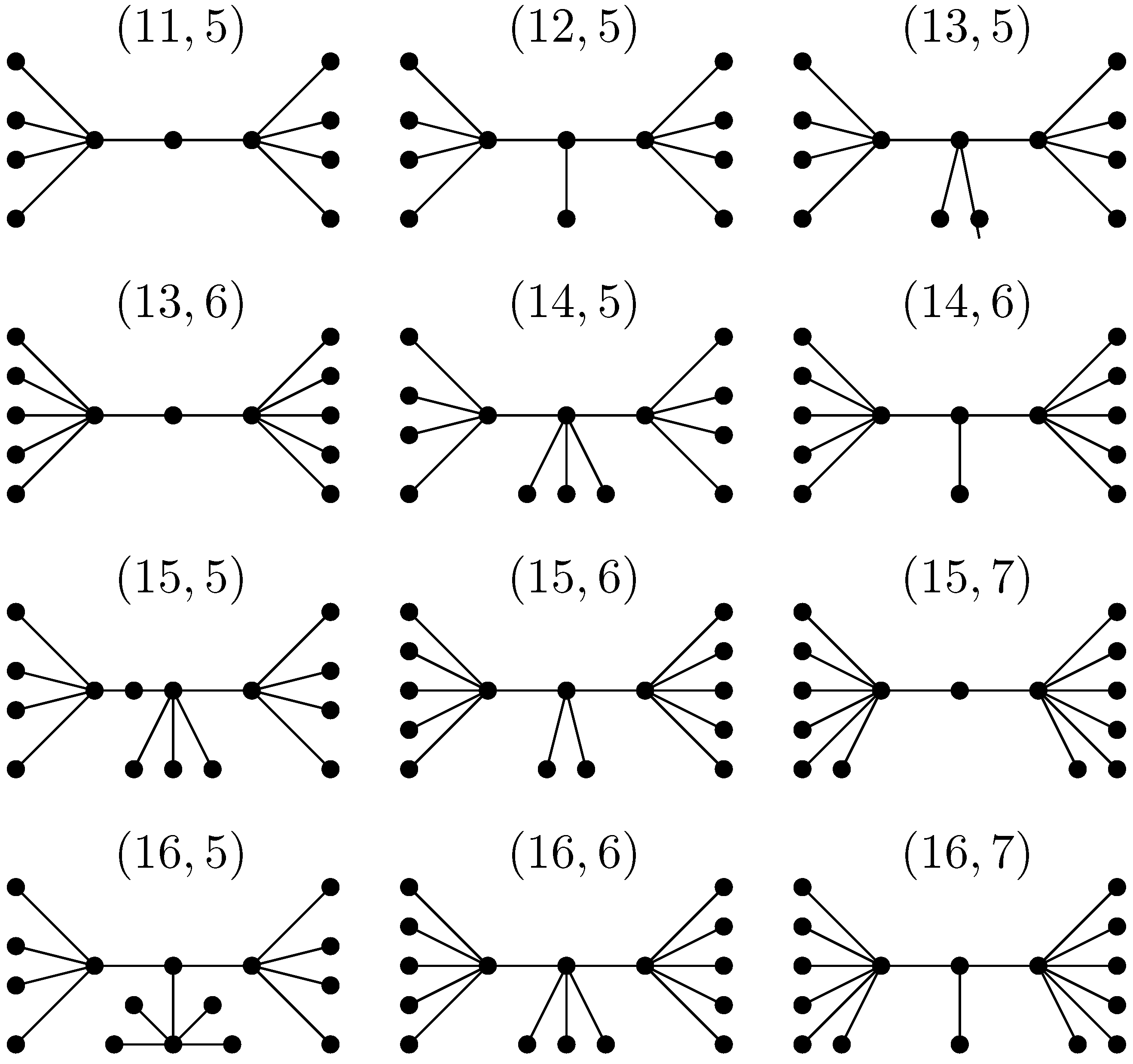
In this section, we consider Problem 1 when . We use a computer program to find a tree possessing the largest ABS index over for every pair satisfying and ; these trees with the largest ABS index are depicted in Figure 6 (The authors would like to thank Tariq Alraqad for helping in obtaining the trees shown in Figure 6). Based on the structures of these trees, we pose the following conjectures.
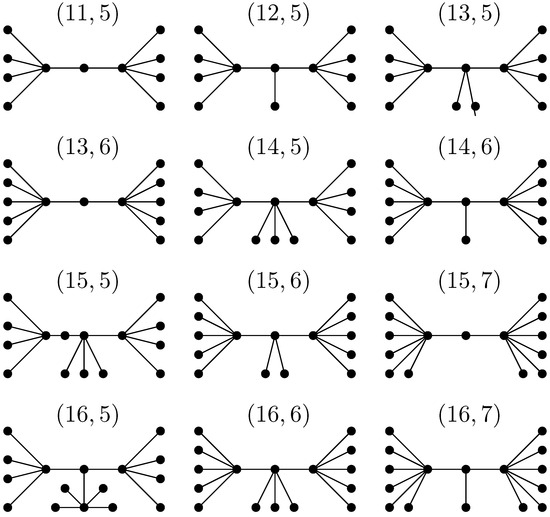
Figure 6.
The trees that have the greatest ABS indices in for every pair satisfying and .
Conjecture 1.
If T is a graph possessing the largest ABS index over with , then T has at most a single vertex of degree t, where .
Conjecture 2.
Let T denote a graph possessing the largest ABS index over with . If T contains a vertex u with a degree of t, with , and if is fixed, then there exists an integer , provided that for every , all the neighbors of u have degree .
5. Concluding Remarks
In this paper, the best possible upper bounds on the index for fixed-order trees possessing a given maximum degree under certain constraints are derived. In particular, a solution to Problem 1 (that was posed quite recently by Hussain, Liu and Hua in [39]) is provided when . Problem 1 with the constraints is also addressed by utilizing computer software to determine trees possessing the largest ABS indices over the class for every pair satisfying and . Based on the structures of the obtained extremal trees for , we posed two conjectures, namely Conjectures 1 and 2. Consequently, Problem 1 with the constraints is generally open for further research. Also, the present study can be extended towards the fixed-order and fixed-size graphs containing cycles with a given maximum degree; for instance, fixed-order unicyclic graphs, bicyclic graphs, and tricyclic graphs, with a given maximum degree.
Author Contributions
Conceptualization, V.M., S.E. and S.B.; methodology, V.M., S.E. and S.B.; software, S.E. and A.A.; validation, S.E., A.A., S.B. and A.A.A.; formal analysis, V.M., S.E. and S.B.; investigation, V.M., S.E. and S.B.; writing—original draft preparation, V.M., S.E. and S.B.; writing—review and editing, S.E., A.A., S.B., H.S. and A.A.A.; supervision, A.A.A.; project administration, A.A. and A.A.A.; funding acquisition, A.A., H.S. and A.A.A. All authors have read and agreed to the published version of the manuscript.
Funding
This research was funded by the Scientific Research Deanship at the University of Ha’il—Saudi Arabia through project number RG-23 093.
Data Availability Statement
No new data were created or analyzed in this study. Data sharing is not applicable to this article.
Conflicts of Interest
The authors declare no conflicts of interest.
References
- Bondy, J.A.; Murty, U.S.R. Graph Theory; Springer: London, UK, 2008. [Google Scholar]
- Chartrand, G.; Lesniak, L.; Zhang, P. Graphs & Digraphs; CRC Press: Boca Raton, FL, USA, 2016. [Google Scholar]
- Wagner, S.; Wang, H. Introduction to Chemical Graph Theory; CRC Press: Boca Raton, FL, USA, 2018. [Google Scholar]
- Trinajstić, N. Chemical Graph Theory, 2nd ed.; CRC Press: Boca Raton, FL, USA, 1992. [Google Scholar]
- Gross, J.L.; Yellen, J. Graph Theory and Its Applications, 2nd ed.; CRC Press: Boca Raton, FL, USA, 2005. [Google Scholar]
- Devillers, J.; Balaban, A.T. Topological Indices and Related Descriptors in QSAR and QSPAR; CRC Press: Boca Raton, FL, USA, 1999. [Google Scholar]
- Randić, M. On characterization of molecular branching. J. Am. Chem. Soc. 1975, 97, 6609–6615. [Google Scholar] [CrossRef]
- Kier, L.B.; Hall, L.H. Molecular Connectivity in Chemistry and Drug Research; Academic Press: New York, NY, USA, 1976. [Google Scholar]
- Kier, L.B.; Hall, L.H. Molecular Connectivity in Structure–Activity Analysis; Wiley: New York, NY, USA, 1986. [Google Scholar]
- Randić, M.; Novič, M.; Plavšić, D. Solved and Unsolved Problems in Structural Chemistry; CRC Press: Boca Raton, FL, USA, 2016. [Google Scholar]
- Li, X.; Shi, Y. A survey on the Randić index. MATCH Commun. Math. Comput. Chem. 2008, 59, 127–156. [Google Scholar]
- Swartz, E.; Vetrík, T. Survey on the general Randić index: Extremal results and bounds. Rocky Mountain J. Math. 2022, 52, 1177–1203. [Google Scholar] [CrossRef]
- Estrada, E.; Torres, L.; Rodríguez, L.; Gutman, I. An atom-bond connectivity index: Modelling the enthalpy of formation of alkanes. Indian J. Chem. Sec. A 1998, 37, 849–855. [Google Scholar]
- Gutman, I.; Tošović, J.; Radenković, S.; Marković, S. On atom–bond connectivity index and its chemical applicability. Indian J. Chem. 2012, 51A, 690–694. [Google Scholar]
- Zhou, B.; Trinajstić, N. On a novel connectivity index. J. Math. Chem. 2009, 46, 1252–1270. [Google Scholar] [CrossRef]
- Gutman, I.; Furtula, B.; Ahmadi, M.B.; Hosseini, S.A.; Nowbandegani, P.S.; Zarrinderakht, M. The ABC index conundrum. Filomat 2013, 27, 1075–1083. [Google Scholar] [CrossRef][Green Version]
- Azari, M.; Iranmanesh, A. Atom-bond connectivity index. In New Frontiers in Nanochemistry: Concepts, Theories, and Trends; Apple Academic Press: Cambridge, MA, USA, 2020. [Google Scholar]
- Ali, A.; Das, K.C.; Dimitrov, D.; Furtula, B. Atom-bond connectivity index of graphs: A review over extremal results and bounds. Discrete Math. Lett. 2021, 5, 68–93. [Google Scholar]
- Li, X.; Peng, D. Extremal problems for graphical function-indices and f-weighted adjacency matrix. Discrete Math. Lett. 2022, 9, 57–66. [Google Scholar]
- Dimitrov, D.; Du, Z. The ABC index conundrum’s complete solution. MATCH Commun. Math. Comput. Chem. 2024, 91, 5–38. [Google Scholar] [CrossRef]
- Dimitrov, D.; Du, Z. Complete characterization of the minimal-ABC trees. Discrete Appl. Math. 2023, 336, 148–194. [Google Scholar] [CrossRef]
- Hosseini, S.A.; Mohar, B.; Ahmadi, M.B. The evolution of the structure of ABC-minimal trees. J. Combin. Theory Ser. B 2022, 152, 415–452. [Google Scholar] [CrossRef]
- Ali, A.; Zhong, L.; Gutman, I. Harmonic index and its generalization: Extremal results and bounds. MATCH Commun. Math. Comput. Chem. 2019, 81, 249–311. [Google Scholar]
- Ali, A.; Furtula, B.; Redžepović, I.; Gutman, I. Atom-bond sum-connectivity index. J. Math. Chem. 2022, 60, 2081–2093. [Google Scholar] [CrossRef]
- Tang, Y.; West, D.B.; Zhou, B. Extremal problems for degree-based topological indices. Discrete Appl. Math. 2016, 203, 134–143. [Google Scholar] [CrossRef]
- Ali, A.; Gutman, I.; Redžepović, I. Atom-bond sum-connectivity index of unicyclic graphs and some applications. Electron. J. Math. 2023, 5, 1–7. [Google Scholar]
- Aarthi, K.; Elumalai, S.; Balachandran, S.; Mondal, S. Extremal values of the atom-bond sum-connectivity index in bicyclic graphs. J. Appl. Math. Comput. 2023, 69, 4269–4285. [Google Scholar] [CrossRef]
- Nithya, P.; Elumalai, S.; Balachandran, S.; Mondal, S. Smallest ABS index of unicyclic graphs with given girth. J. Appl. Math. Comput. 2023, 69, 3675–3692. [Google Scholar] [CrossRef]
- Noureen, S.; Ali, A. Maximum atom-bond sum-connectivity index of n-order trees with fixed number of leaves. Discrete Math. Lett. 2023, 12, 26–28. [Google Scholar]
- Du, J.; Sun, X. On bond incident degree index of chemical trees with a fixed order and a fixed number of leaves. Appl. Math. Comput. 2024, 464, 128390. [Google Scholar] [CrossRef]
- Gowtham, K.J.; Gutman, I. On the difference between atom-bond sum-connectivity and sum-connectivity indices. Bull. Classe Sci. Math. Nat. Sci. Math. 2022, 47, 55–65. [Google Scholar]
- Lin, Z. On relations between atom-bond sum-connectivity index and other connectivity indices. Bull. Int. Math. Virtual Inst. 2023, 13, 249–252. [Google Scholar]
- Jahanbani, A.; Redzepović, I. On the generalized ABS index of graphs. Filomat 2023, 37, 10161–10169. [Google Scholar] [CrossRef]
- Li, F.; Ye, Q.; Lu, H. The greatest values for atom-bond sum-connectivity index of graphs with given parameters. Discrete Appl. Math. 2024, 344, 188–196. [Google Scholar] [CrossRef]
- Zuo, X.; Jahanbani, A.; Shooshtari, H. On the atom-bond sum-connectivity index of chemical graphs. J. Molecul. Struct. 2024, 1296, 136849. [Google Scholar] [CrossRef]
- Ge, Y.; Lin, Z.; Wang, J. Atom-bond sum-connectivity index of line graphs. Discrete Math. Lett. 2023, 12, 196–200. [Google Scholar]
- Hu, Y.; Wang, F. On the Maximum atom-bond sum-connectivity index of trees. MATCH Commun. Math. Comput. Chem. 2024, 91, 709–723. [Google Scholar] [CrossRef]
- Zhang, Y.; Wang, H.; Su, G.; Das, K.C. Extremal problems on the atom-bond sum-connectivity indices of trees with given matching number or domination number. Discrete Appl. Math. 2024, 345, 190–206. [Google Scholar] [CrossRef]
- Hussain, Z.; Liu, H.; Hua, H. Bounds for the atom-bond sum-connectivity index of graphs. MATCH Commun. Math. Comput. Chem. 2024; in press. [Google Scholar]
Disclaimer/Publisher’s Note: The statements, opinions and data contained in all publications are solely those of the individual author(s) and contributor(s) and not of MDPI and/or the editor(s). MDPI and/or the editor(s) disclaim responsibility for any injury to people or property resulting from any ideas, methods, instructions or products referred to in the content. |
© 2024 by the authors. Licensee MDPI, Basel, Switzerland. This article is an open access article distributed under the terms and conditions of the Creative Commons Attribution (CC BY) license (https://creativecommons.org/licenses/by/4.0/).