Abstract
This paper deals with optimal consensus problems of a general heterogeneous nonlinear multi-agent system. A novel filter is proposed for each agent by integrating local gradients with neighboring output information. Using this filter and introducing an appropriate auxiliary variable, the event-triggered control algorithm is obtained within the framework of the prescribed performance control. One of the remarkable properties of the proposed algorithm is that it can save resources by updating control signals only when necessary rather than periodically while achieving optimal consensus. Theoretical and simulation verifications of the algorithm without the Zeno behavior are carefully studied. Instructions are also presented for control parameter selection to keep the residual errors as small as desired.
MSC:
93D50
1. Introduction
Due to its broad application in quadrotors, mobile robots, and network optimization of resource allocation, research on distributed control of multi-agent systems has emerged extensively in the past two decades. Consensus control as a critical distributed feature of networks, where all agents incorporate only local perception to yield a common state, is now a subject of active research [1,2]. Consensus problems for multi-agent systems have yielded many interesting results, ranging from simple integrators to complex nonlinear dynamics and from fixed communication topologies to switched topologies; see [3,4,5,6,7] and references therein. In practice, resource allocation in computer networks and collision avoidance in multi-robot systems can be modeled as distributed optimization problems. Recently, so-called optimal consensus techniques have been proposed, in which established consensus problems and distributed optimization problems are simultaneously solved [8].
By combining set valued stability analysis with convex analysis, continuous-time distributed optimization of convex function sums was realized under a weight-balanced digraph in [9]. By requiring the local cost function to be twice-differentiable, an average consensus strategy was presented such that each agent can asymptotically tend towards the minimum of the global cost function in [10]. This requirement has been removed by [11], where gradient-based distributed algorithms were proposed under both directed and undirected graphs. A common feature of the above works [9,10,11] is that the inherent nonlinear properties and possible disturbances of the agent are not considered. In the presence of external disturbance, an internal-model-based approach was developed to handle dynamic optimization problems in [12]. The disturbances need to satisfy the matching condition, which means the disturbance can only occur in the exact same equation as the control input. These requirements limit the application of the developed methods to a relatively specific class of systems. Recently, by applying three types of disturbance estimators, distributed optimization strategies have been extended to address second-order systems with mismatched and matched disturbances in [13]. In practice, this extension considering only second-order systems and time-dependent perturbations may not be sufficient due to ubiquitous higher-order dynamics and agent state-dependent uncertainty. However, with few exceptions, research on distributed optimal consensus control of more general uncertain higher-order nonlinear systems has received little attention. By constructing an optimal consensus proportional and integral variable, optimal consensus issues of pure-feedback systems have been solved in [14]. Most of the above results rely on the classic time-triggered control paradigm, where the update of the control signal is periodic even when the system is performing well. This can lead to wasted computing and communication resources, as remarked by [15,16].
In this work, we study the optimal consensus problem for nonlinear systems, focusing on saving resources by updating control signals only when necessary rather than periodically. In particular, a more general heterogeneous multi-agent system is investigated where mismatched uncertainties and possibly agent nonidentical dynamical orders are considered. A novel filter for each agent is proposed which combines local gradients with neighboring output information. Subsequently, we complete the optimal consensus control law design by introducing an event-triggered condition and adopting the backstepping design procedure. Using the integrating factor method and the Lyapunov function, we rigorously demonstrate that all agents achieve the approximate optimal consensus under the proposed protocol, and Zeno behavior can be ruled out. The feasibility of implementing our algorithm is demonstrated on a group of single-link manipulators. Compared with the current results, the main contributions are as follows:
- Different from the classical time-triggered setting, our proposed event-triggered method is able to significantly reduce the unnecessary control input updates while ensuring the approximate optimal consensus.
- In contrast to the study of first- and second-order multi-agent systems, where external disturbances are assumed to be bounded a priori, we study a more general nonlinear dynamics where uncertainty is allowed to grow arbitrarily as the variation of agent states and higher-order heterogeneous dynamics are involved.
The rest of this manuscript is organized as follows. In Section 2, the preliminary knowledge and the optimal consensus problem to be addressed are introduced. Section 3 introduces our novel filter system and event-triggered control algorithm. Section 4 illustrates simulation results of a group of manipulators, while Section 5 draws conclusions and discusses recommendations and outlook.
Notation: Let and denote, respectively, the vectors of zeros and ones with length ℓ. For a function , we say that if .
2. Problem Formulation and Preliminaries
2.1. Preliminaries
Let represent the graph describing the communication topology, where , , and represent node set, edge set, and adjacency matrix, respectively. An edge indicates that node j can obtain information from node i, node i is the neighbor of node j, and necessarily for an undirected graph. The set of all neighbors of node i is denoted by . An undirected graph is connected if for each distinct pair of nodes i and j, there is a path from i to j. Let if and otherwise. The Laplacian matrix related to is defined as and .
Lemma 1.
([17]). If the undirected graph is connected, then there exists a nonsingular matrix such that
where with being the positive real eigenvalues of , , are right eigenvectors of associated with , , and .
2.2. Problem Formulation
Consider a multi-agent system composed of n nonlinear agents. Each agent can be described by the following strict-feedback dynamics [18]:
in which , , are the state vectors. and represent the agent’s output and the control input, respectively. are nonlinear dynamics functions with unknown analytical expressions. denotes uncertain disturbances. Moreover, and are locally Lipschitz in and are piecewise continuous in t. Agent i has a differentiable local cost function , which is strongly convex and has a Lipschitz gradient, i.e., there is a constant satisfying for all
Our control goal is to develop a distributed event-triggered controller in (1) such that the agent outputs achieve the approximate optimal consensus, i.e., for all , where is the optimal solution of , and is a positive constant that can be made arbitrarily small. In addition, all closed-loop signals are bounded.
To achieve the control goal, we make the following standard assumptions about the agent (1).
Assumption 1.
The communication graph is undirected and connected.
Assumption 2.
Unknown , , are bounded. There are strictly positive functions and continuous such that for all . Furthermore, the sign of is known.
3. Main Result
3.1. Controller Design
To realize the optimal consensus goal in a distributed manner, we propose a novel third-order filter for agent i utilizing locally available information. Inspired by [5,11], the filter is defined as follows:
where and are constants. Furthermore, the auxiliary variable is defined as
Subsequently, a backstepping design method is proposed for each agent by adopting the prescribed performance control technique presented in [19,20]. Specifically, let us define the error variables:
where are the virtual control. A performance function is introduced as , where , , and are positive constants satisfying and . Without loss of generality, let us assume . The virtual control laws are proposed as
where are positive gains, , and . We propose the event-triggered distributed controller on the ith agent as
where , , , and is a positive design parameter.
The strategy behind (3) is to use only relative output measurements and local gradients to generate the reference output. The purpose of introducing (2) is to include an integral term for the tracking error between the output and the reference output to facilitate stability analysis; similar efforts can also be found in time-triggered control consensus methods [5,14].
3.2. Stability Analysis
Theorem 1.
Consider a group of n uncertain heterogeneous nonlinear agents (1) controlled by the distributed event-triggered controller (6) with the filter (3). Under Assumptions 1 and 2, it holds that each agent can realize the approximate optimal consensus while all signals in the closed-loop system remain bounded. Furthermore, Zeno behavior can be avoided, i.e., there is a constant satisfying for all
Proof.
Note that and are functions of . Therefore, they can be expressed as . Accordingly, the dynamics of , , and in (3) can be rewritten as
Noting from (6) that , the time derivatives of , are given by
where . Let us define the column vector and the nonempty and open set . Since , , it holds that . According to (8)–(11), the map f of the closed-loop dynamics over the set is piecewise continuous and locally Lipschitz. Therefore, a unique maximal solution of (8)–(11) over on exists, i.e., .
Now we show that , , and are bounded on . Applying the integrating factor method to (2) yields
It follows from (12) and that is bounded for any bounded . Thus, we can conclude that . To analyze the boundedness of and , we define and , where for . Denote the regulation errors as and , which have the following dynamics:
where with and . Motivated by [14], let us consider the following Lyapunov function
where , is positive constant only introduced for stability analysis purposes, and P and are defined in Lemma 1. A straightforward computation similar to [14] gives
Here , , and are positive constants whose values depend only on , , , the Laplacian matrix , and the Lipschitz constant for . Since and are bounded on , we can conclude from (15) that V is bounded on . As a result, we have . It then follows from (8) that .
Since , for all , , and , , and are always bounded, considering the continuity of and and applying the extreme value theorem and Assumption 2 can obtain that , for positive constants and for all . This together with the fact that gives:
Therefore, provided , . We obtain
Hence, the virtual control is bounded on . By taking the inverse logarithmic function in , we obtain
where and . In addition, noting (9) and , we have and are bounded on .
Step m (). Applying the method from step 1 recursively to the remaining steps and selecting , we can obtain
where and are constants satisfying:
It then follows from (19) that
Consequently, the virtual control is bounded on and satisfies
where and . In addition, noting (10) and (11) and , we have , , and are bounded on . Notice by (18), (21), and that for all , where is a nonempty and compact subset of . Therefore, the solution is global, i.e., .
Next, we show that all agents can realize the approximate optimal consensus. Invoking (12) and (18) leads to
This indicates that
In addition, by (15), we further have
Noting that and (22), we can conclude and exponentially converge to the compact set and , respectively. Furthermore, we can conclude from (23) that V also converges exponentially to the compact set . which can be kept arbitrarily small by reducing . By the definition of V in (14), and tend towards an arbitrarily small neighborhood around zero. Recalling and , we can conclude that all agents can reach the approximate optimal consensus, i.e., for all , where is a positive constant that can be made arbitrarily small by decreasing .
We are now in a position to show that there is a constant such that for all . Recalling for all , we have . Since is bounded, there exists a positive constant such that . Considering that and , it can be inferred that there must exist a positive constant satisfying . Thus, we have completed proving that the resulting control input updates are free from Zeno behavior. □
4. Simulation Results
We illustrate the application of our method with a numerical example involving six single-link robotic manipulators, as shown in Figure 1. The ith manipulator is described by the following dynamics:
where with and representing the angle of the link and the angular velocity, respectively. denotes the control torque. , , , , and are uncertain physical parameters whose definition can be found in [21]. The communication topology between the manipulators is shown in Figure 2. The parameters of the manipulator models are: , , and . The local cost functions are chosen as:
Figure 1.
Single-link manipulator.
Figure 2.
Communication topology.
The initial configurations of the manipulators are , , , , , and . The filter (2) and (3) and controller (6) are implemented with the parameters , , , , and . The performance functions are set to and .
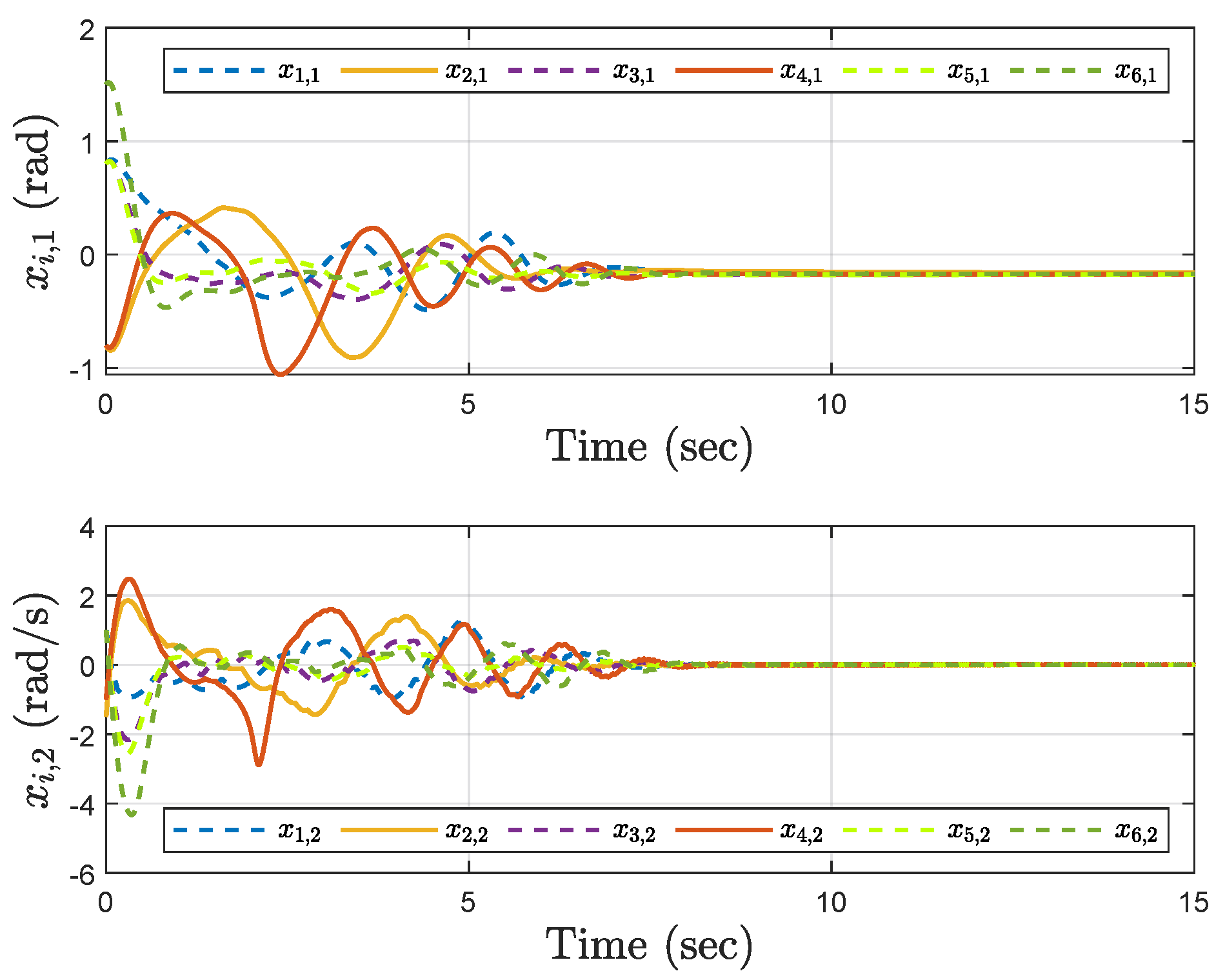
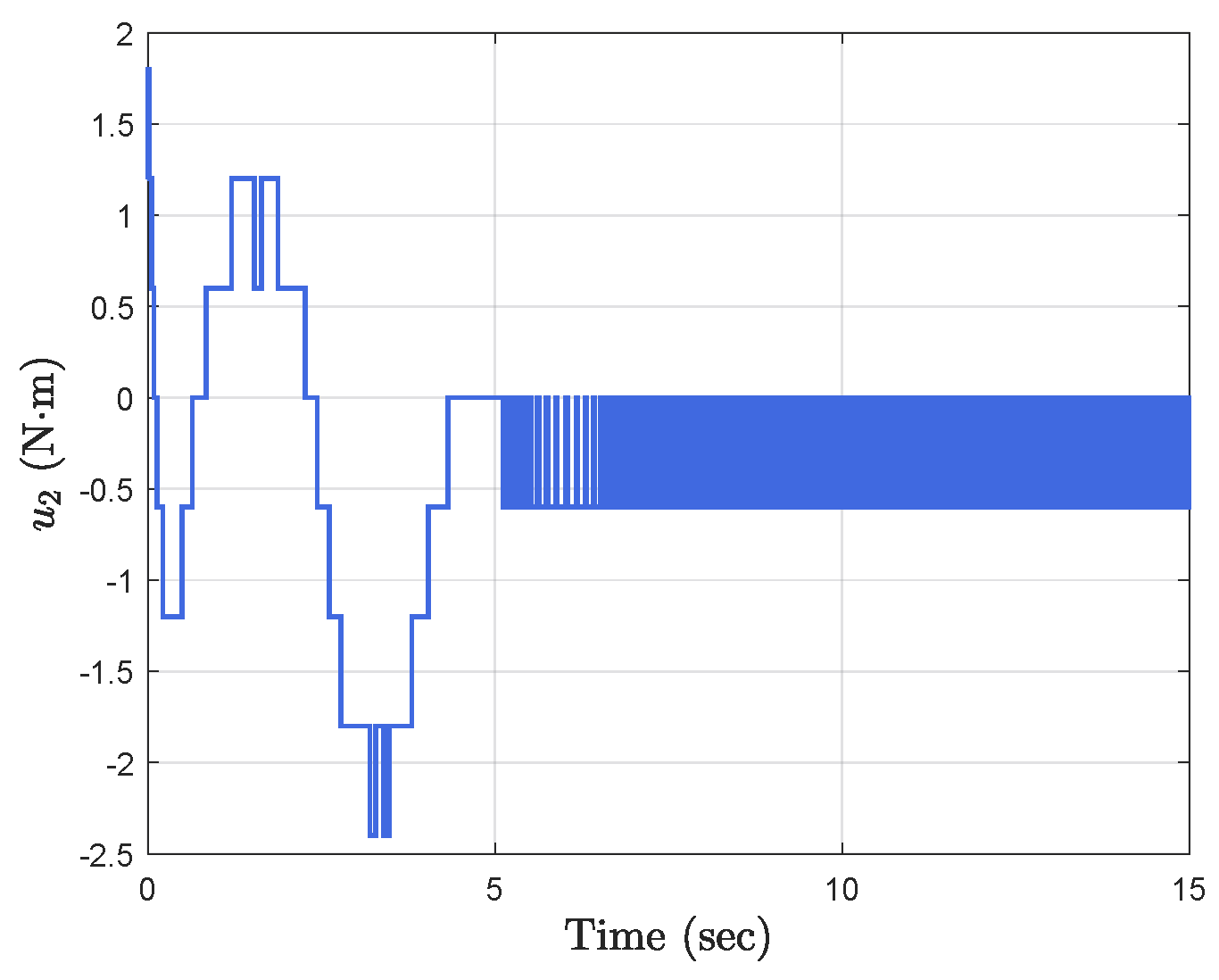
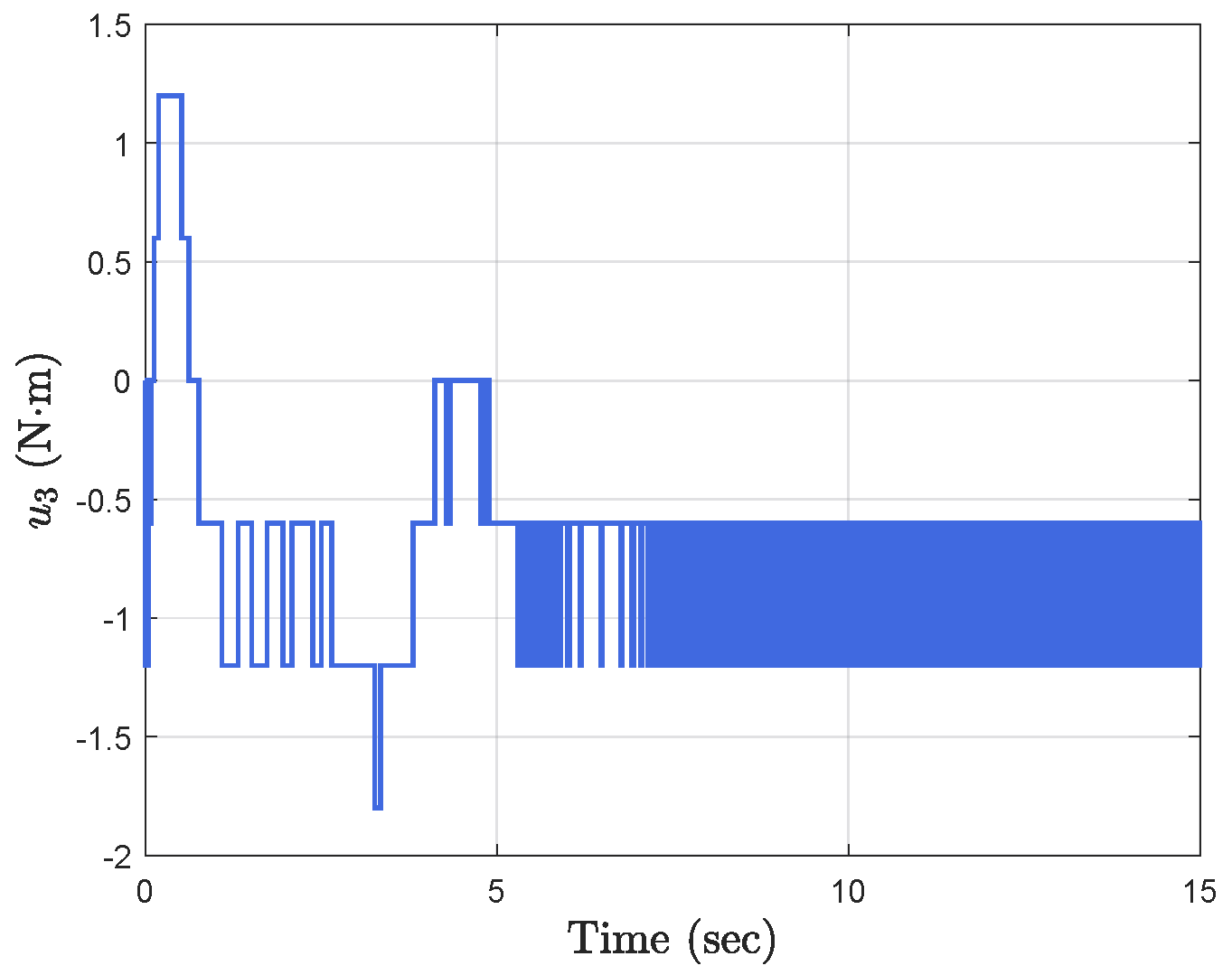
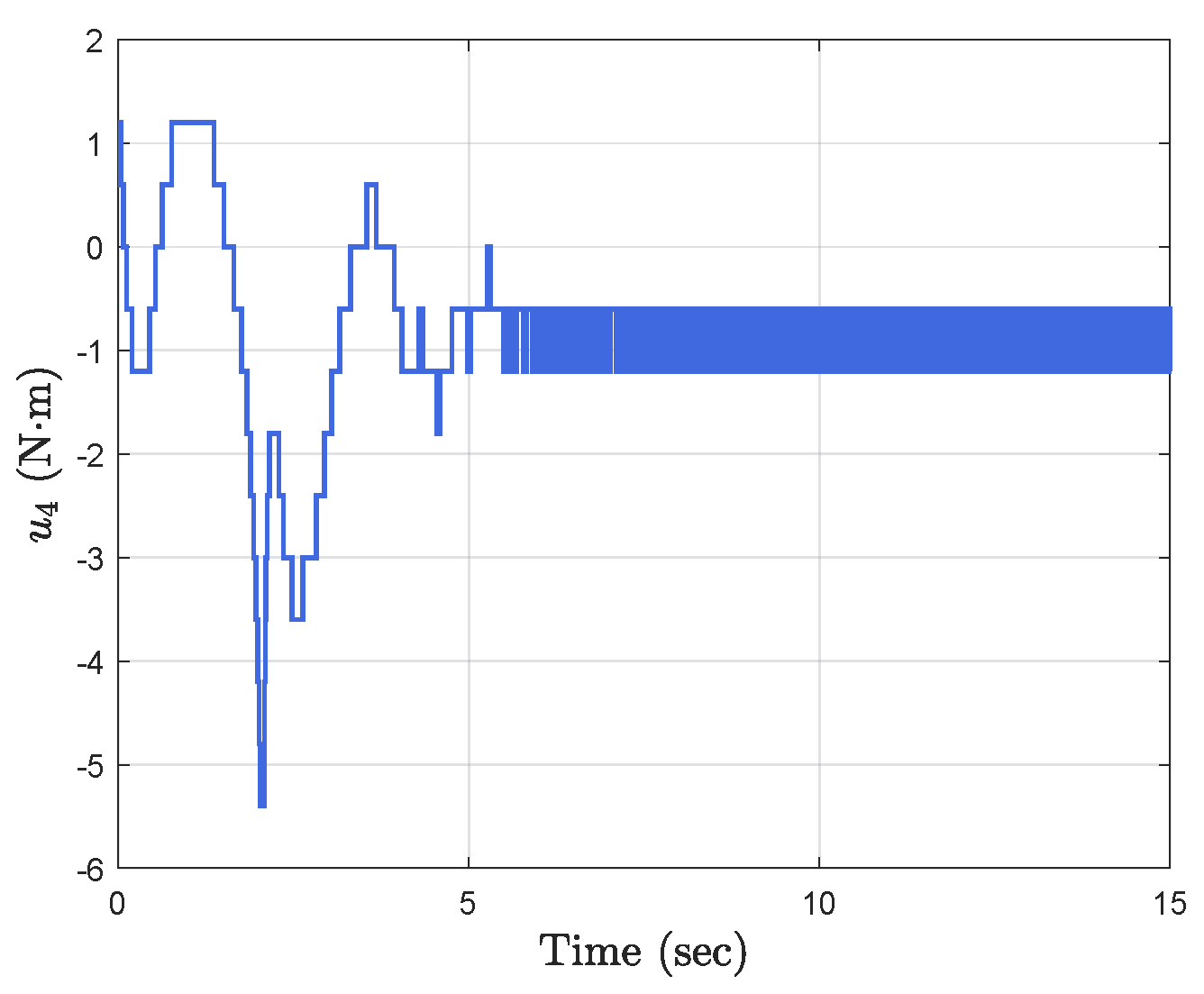
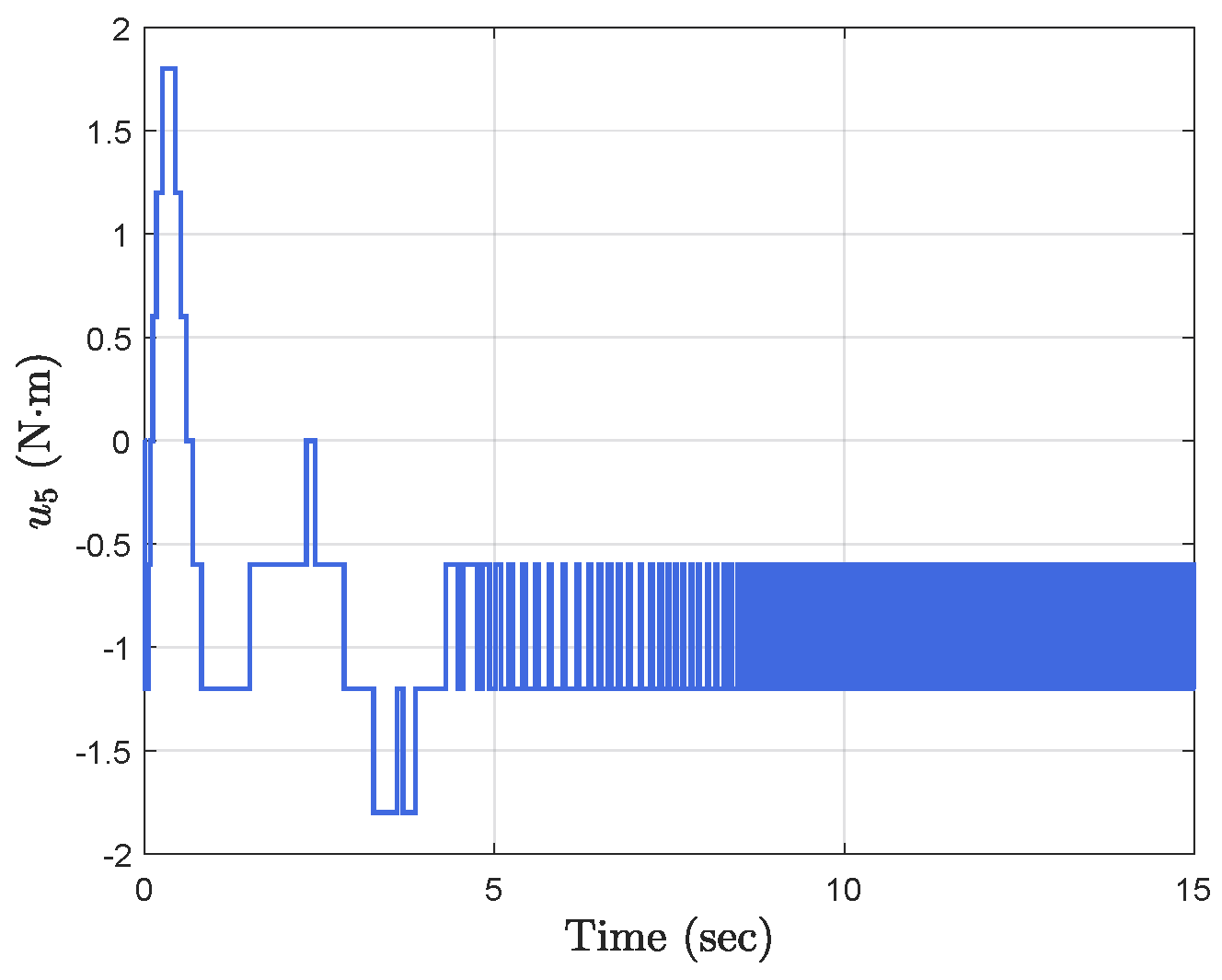
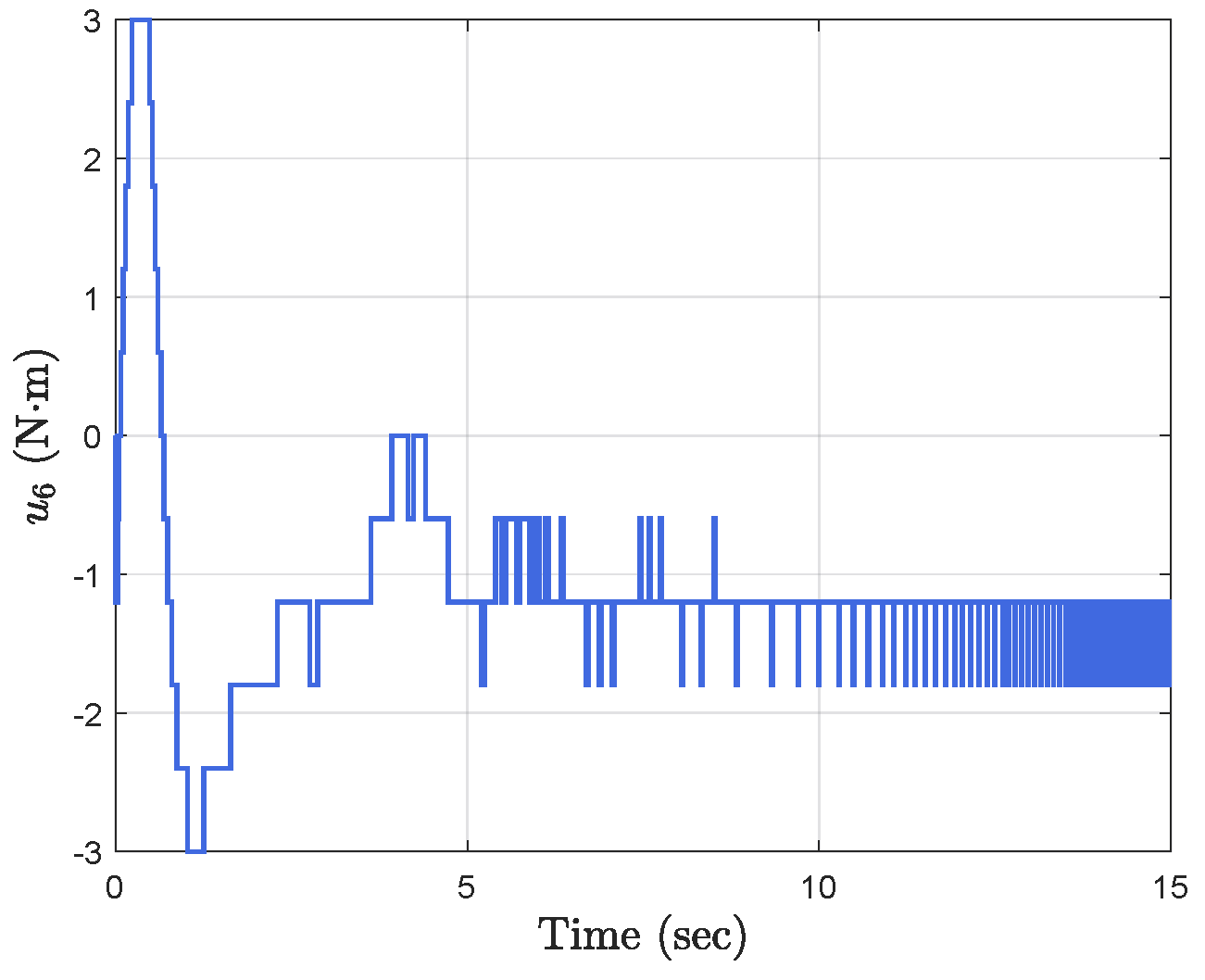
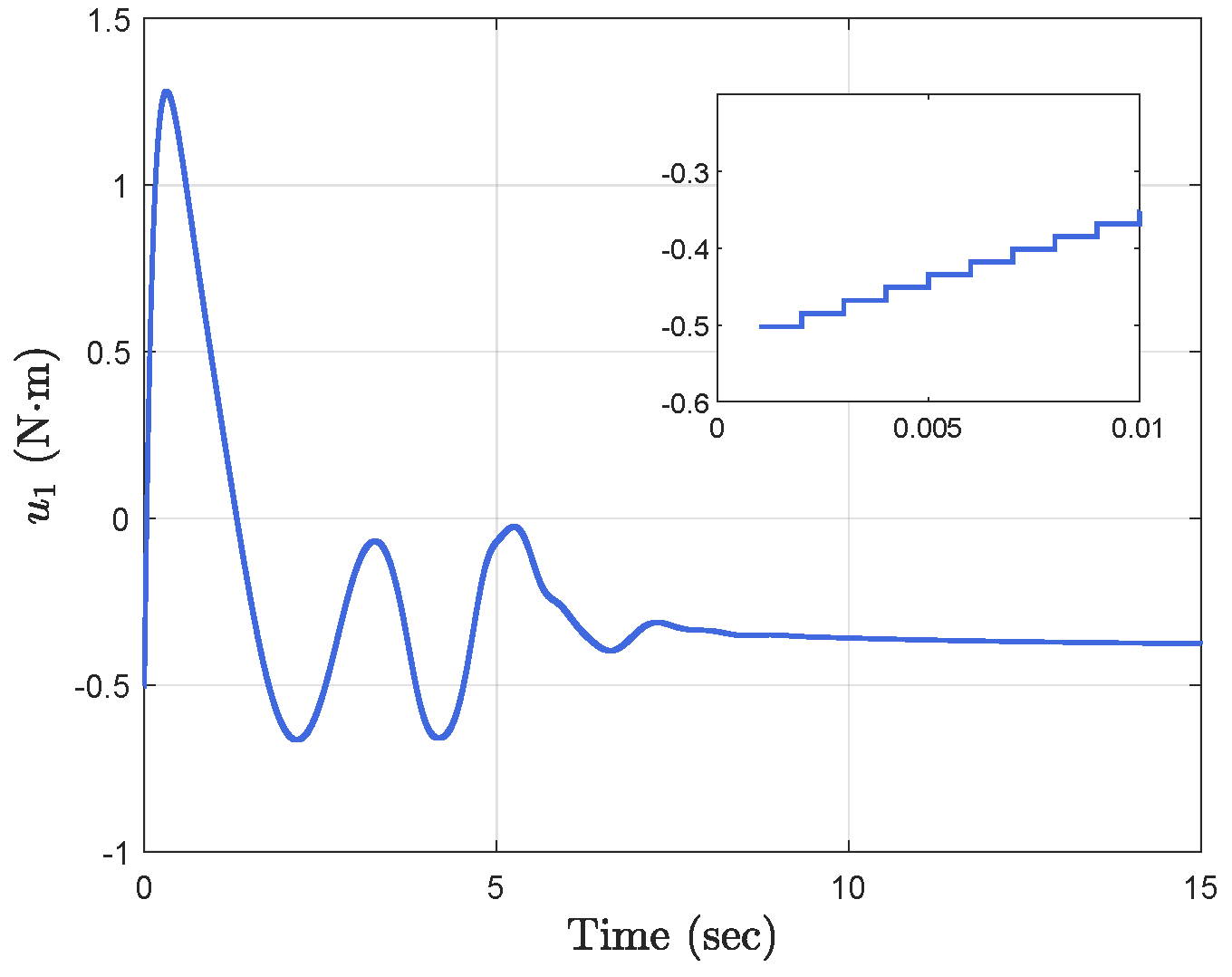
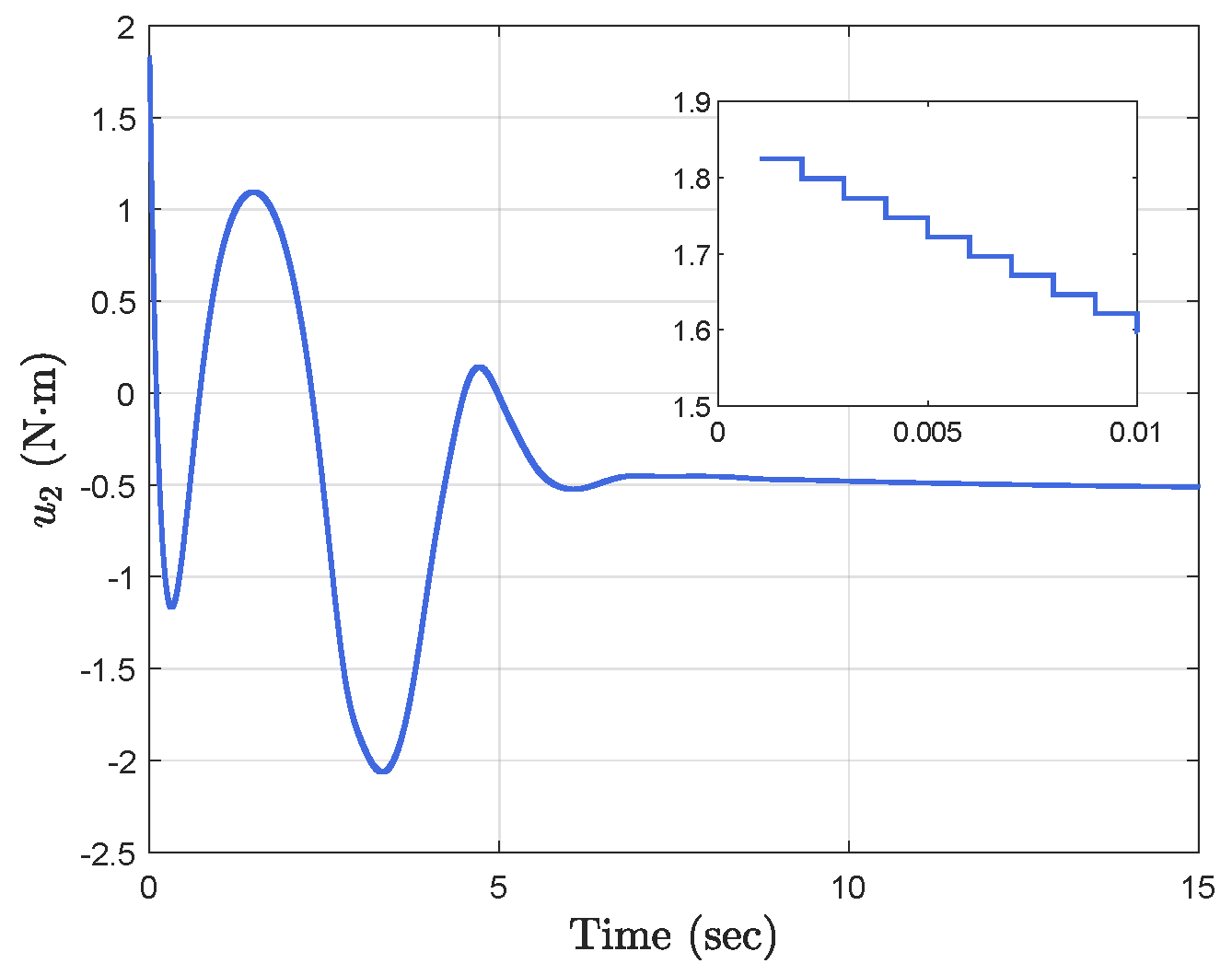
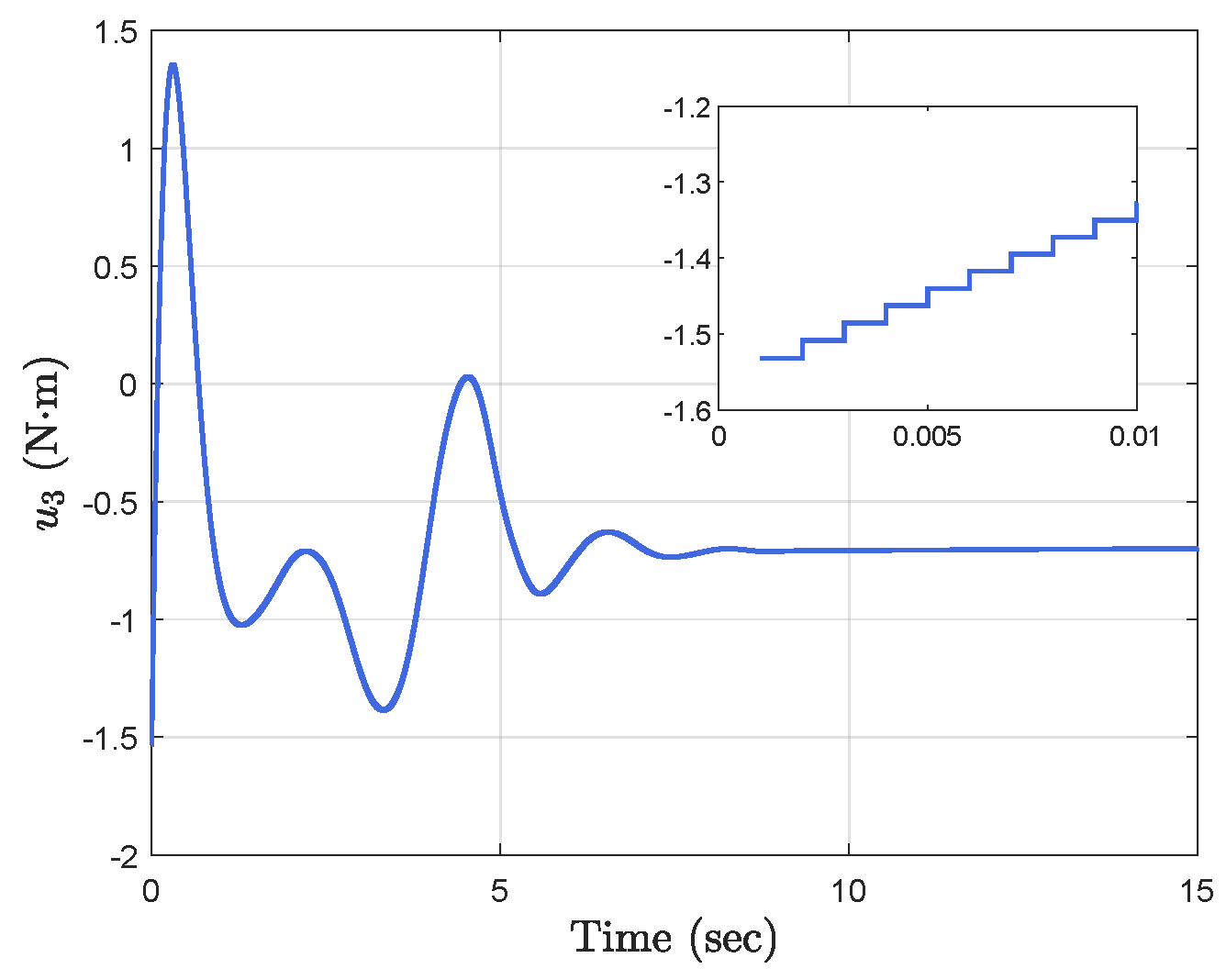
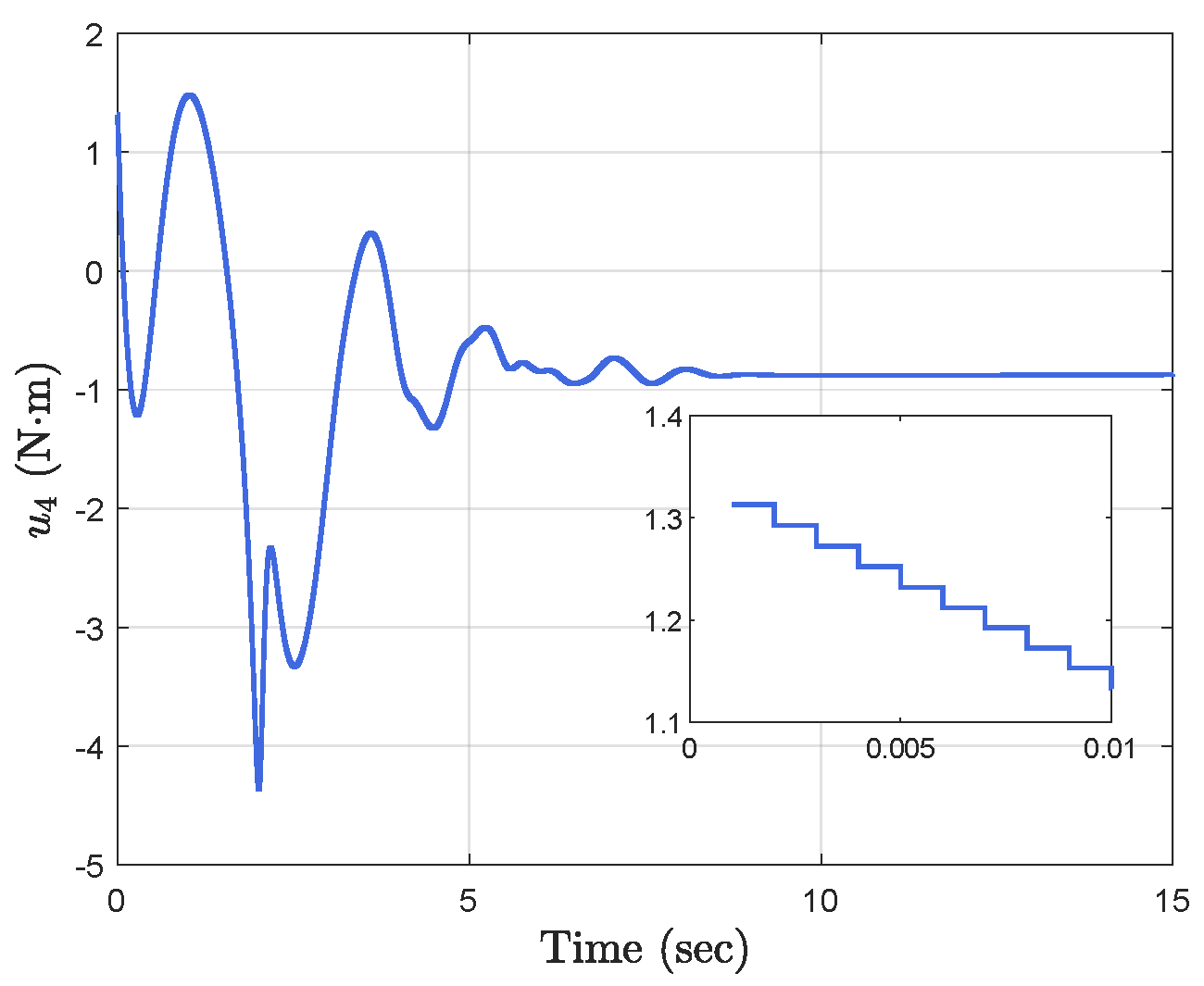
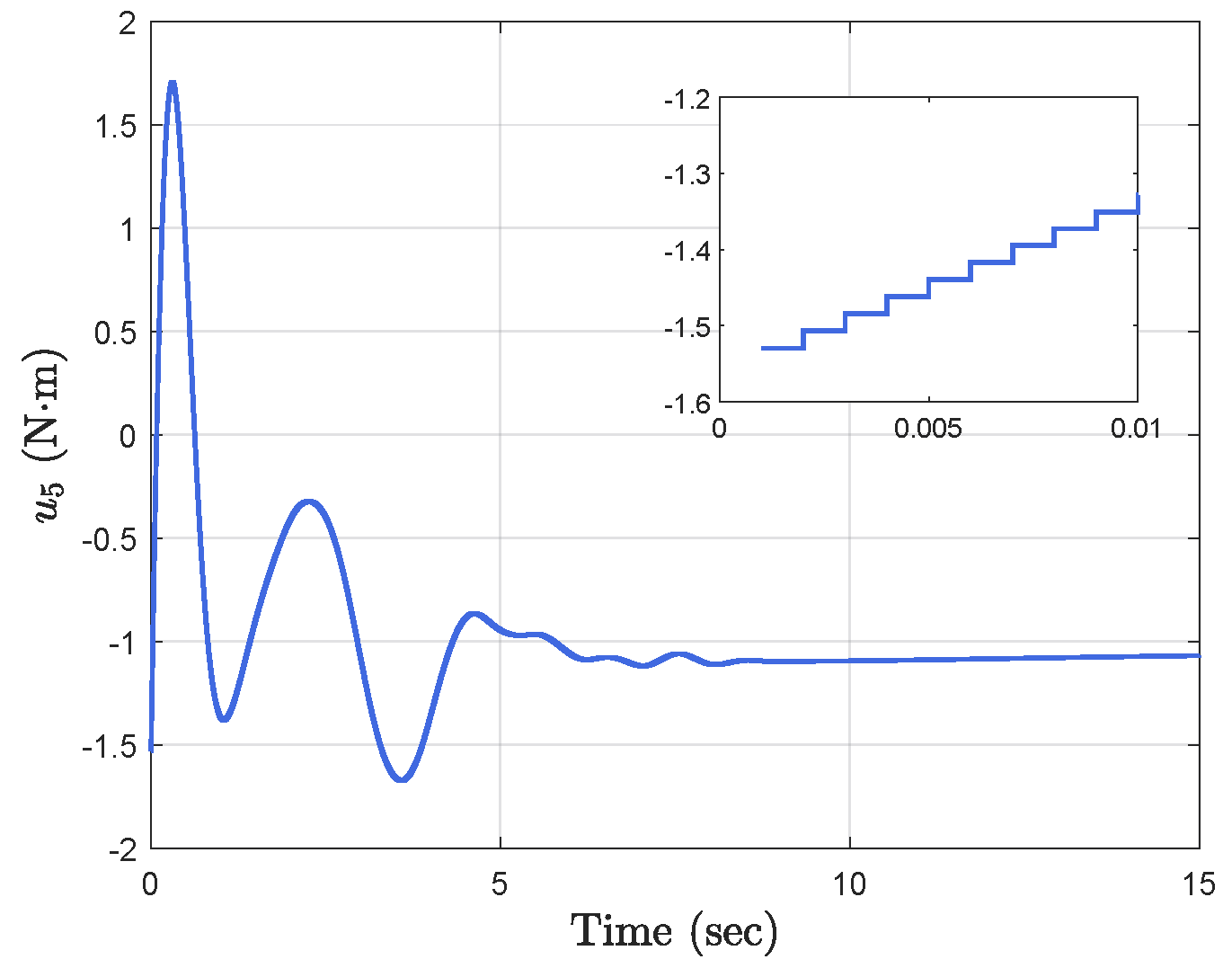
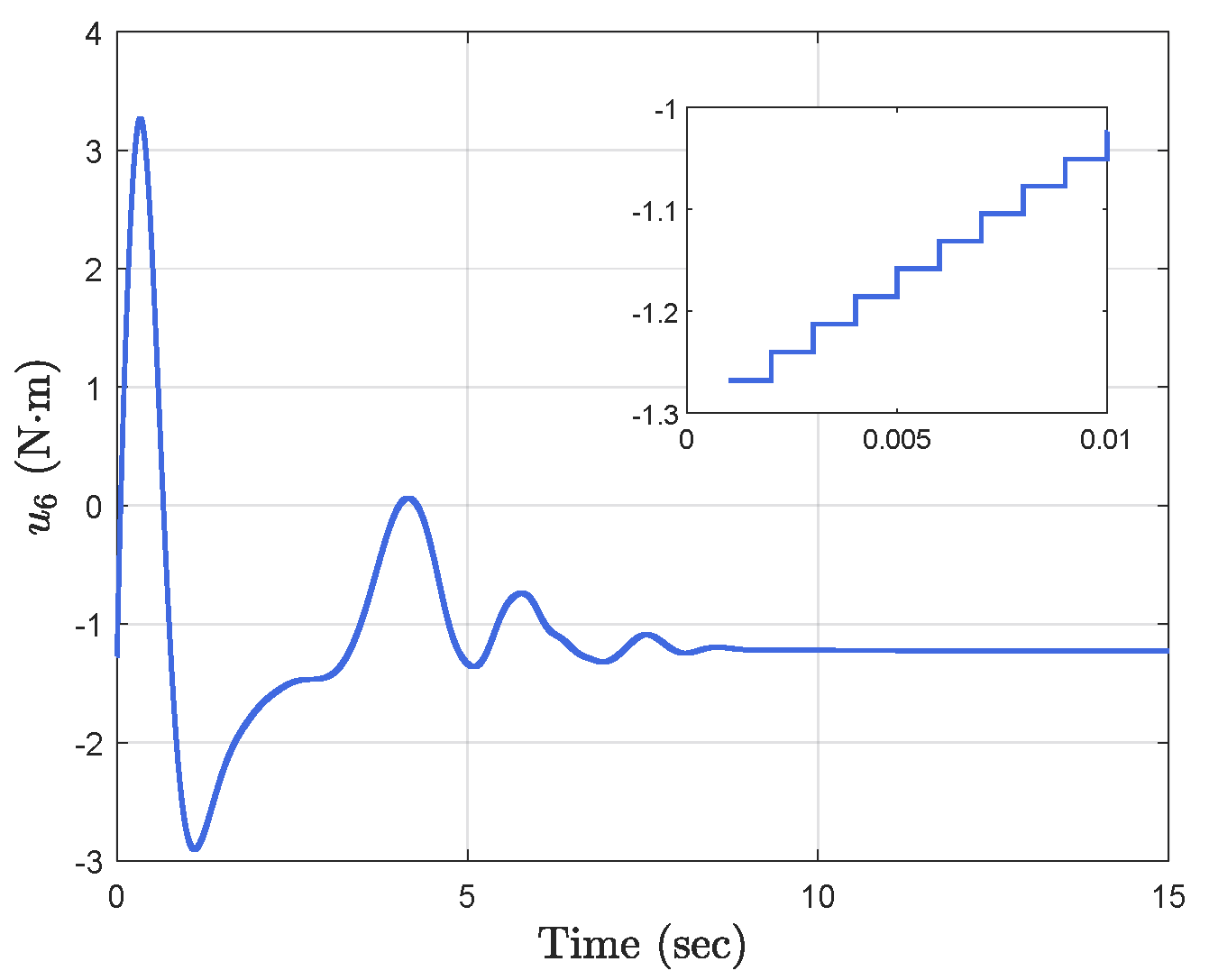
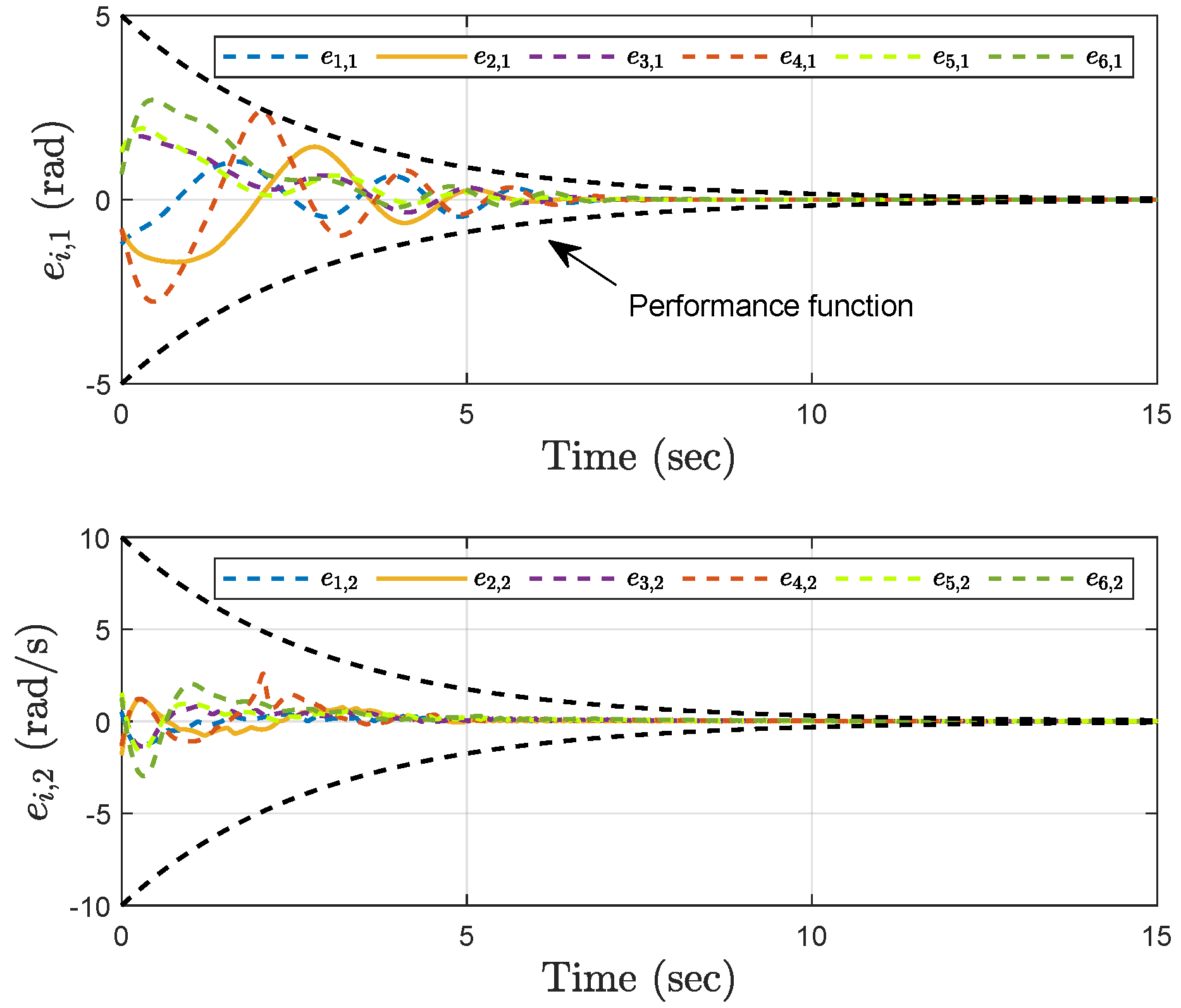
Simulation results show the performance of the proposed event-triggered controller in Figure 3, Figure 4, Figure 5, Figure 6, Figure 7, Figure 8, Figure 9 and Figure 10. The manipulator angles and velocities are exhibited in Figure 3, from which a satisfactory consensus has been reached. Furthermore, the minimizer of the global cost function is . Figure 3 also reveals that each manipulator angle converges to , although only the neighboring output information and local gradients are available. In addition, as the optimal consensus approaches, the velocity of the manipulator decreases and converges to zero. The evolution of the errors and is shown in Figure 4 along with their corresponding performance functions. Clearly, and always fulfill the predefined performance specification, as manifested by the theoretical analysis, despite the presence of event-triggered control inputs. The required control input of each manipulator is pictured in Figure 5, Figure 6, Figure 7, Figure 8, Figure 9 and Figure 10, respectively. We can observe from Figure 5, Figure 6, Figure 7, Figure 8, Figure 9 and Figure 10 that the value of the manipulator control is updated aperiodically, only when certain conditions violate the specification (refer to (6)). If the condition is not violated, the value of the control will remain as the value of the last updated controller. To show the advantages of the proposed event-triggered method, a comparative simulation is also carried out, in which the control signal update is periodic and the period is chosen as 1 ms. Simulation results show the performance of the time-triggered controller in Figure 11, Figure 12, Figure 13, Figure 14, Figure 15, Figure 16 and Figure 17. Furthermore, Table 1 summarizes the corresponding update times of the five manipulator control signals under the event-triggered controller and the time-triggered controller. These results confirm that our event-triggered control method can achieve the approximate optimal consensus similar to the time-triggered controller, while greatly reducing the number of control signal updates and saving computation and communication resources.
Figure 3.
Trajectories of the angles and the velocities under the event−triggered control.
Figure 4.
Trajectories of the errors and under the event−triggered control.
Figure 5.
Event−triggered control input .
Figure 6.
Event−triggered control input .
Figure 7.
Event−triggered control input .
Figure 8.
Event−triggered control input .
Figure 9.
Event−triggered control input .
Figure 10.
Event−triggered control input .
Figure 11.
Trajectories of the angles and the velocities under the time−triggered control.
Figure 12.
Time−triggered control input .
Figure 13.
Time−triggered control input .
Figure 14.
Time−triggered control input .
Figure 15.
Time−triggered control input .
Figure 16.
Time−triggered control input .
Figure 17.
Time−triggered control input .
Table 1.
The number of updates for controls under event-triggered controllers and periodic time-triggered controllers.
5. Conclusions
A novel event-triggered control framework has been presented in this work to realize optimal consensus control of nonlinear agents. It saves resources without sacrificing consensus convergence by proposing new filters and introducing event-triggered rules to reduce unnecessary control signal updates. Furthermore, we confirmed the Zeno-free nature of the method by demonstrating that there is a positive lower bound between two consecutive updates of the control input. Simulation results of single-link manipulators validated our theoretical finding. Some open questions are worthy of further investigation, including the extension of the current results to more general switching topologies and robust analysis of communication delays.
Author Contributions
Conceptualization, G.W.; Investigation, Y.J.; Writing — review and editing, Y.J., Q.L. and C.W.; Project administration, G.W. All authors have read and agreed to the published version of the manuscript.
Funding
This research was funded by Natural Science Foundation of Shanghai under Grant 22ZR1443600 and the Shanghai Artificial Intelligence Innovation and Development Special Support Project under Grant 2019RGZN01041.
Institutional Review Board Statement
Not applicable.
Informed Consent Statement
Not applicable.
Data Availability Statement
Not applicable.
Conflicts of Interest
The authors declare no conflict of interest.
References
- Psillakis, H.E. Consensus in networks of agents with unknown high-frequency gain signs and switching topology. IEEE Trans. Autom. Control 2017, 62, 3993–3998. [Google Scholar] [CrossRef]
- Abdessameud, A.; Tayebi, A. Distributed consensus algorithms for a class of high-order multi-agent systems on directed graphs. IEEE Trans. Autom. Control 2018, 63, 3464–3470. [Google Scholar] [CrossRef]
- Ren, W. On consensus algorithms for double-integrator dynamics. IEEE Trans. Autom. Control 2008, 53, 1503–1509. [Google Scholar] [CrossRef]
- Wang, G. Distributed control of higher-order nonlinear multi-agent systems with unknown non-identical control directions under general directed graphs. Automatica 2019, 110, 108559. [Google Scholar] [CrossRef]
- Wang, G. Consensus control in heterogeneous nonlinear multiagent systems with position feedback and switching topologies. IEEE Trans. Netw. Sci. Eng. 2022, 9, 3546–3557. [Google Scholar] [CrossRef]
- Wang, Q.; Psillakis, H.E.; Sun, C. Cooperative control of multiple agents with unknown high-frequency gain signs under unbalanced and switching topologies. IEEE Trans. Autom. Control 2019, 64, 2495–2501. [Google Scholar] [CrossRef]
- Mei, J.; Ren, W.; Chen, J. Distributed consensus of second-order multi-agent systems with heterogeneous unknown inertias and control gains under a directed graph. IEEE Trans. Autom. Control 2016, 61, 2019–2034. [Google Scholar] [CrossRef]
- Yang, F.; Yu, Z.; Huang, D.; Jiang, H. Distributed optimization for second-order multi-agent systems over directed networks. Mathematics 2022, 10, 3803. [Google Scholar] [CrossRef]
- Gharesifard, B.; Cortés, J. Distributed continuous-time convex optimization on weight-balanced digraphs. IEEE Trans. Autom. Control 2014, 59, 781–786. [Google Scholar] [CrossRef]
- Zanella, F.; Varagnolo, D.; Cenedese, A.; Pillonetto, G.; Schenato, L. Newton-Raphson consensus for distributed convex optimization. In Proceedings of the 2011 50th IEEE Conference on Decision and Control and European Control Conference, Orlando, FL, USA, 12–15 December 2011; pp. 5917–5922. [Google Scholar]
- Kia, S.S.; Cortés, J.; Martínez, S. Distributed convex optimization via continuous-time coordination algorithms with discrete-time communication. Automatica 2015, 55, 254–264. [Google Scholar] [CrossRef]
- Wang, X.; Yi, P.; Hong, Y. Dynamic optimization for multi-agent systems with external disturbances. Control Theory Technol. 2014, 12, 132–138. [Google Scholar] [CrossRef]
- Wang, X.; Li, S.; Wang, G. Distributed optimization for disturbed second-order multiagent systems based on active antidisturbance control. IEEE Trans. Neural Netw. Learn. Syst. 2019, 31, 2104–2117. [Google Scholar] [CrossRef] [PubMed]
- Gkesoulis, A.K.; Psillakis, H.E.; Lagos, A.R. Optimal consensus via OCPI regulation for unknown pure-feedback agents with disturbances and state-delays. IEEE Trans. Autom. Control 2022, 67, 4338–4345. [Google Scholar] [CrossRef]
- Xing, L.; Wen, C.; Liu, Z.; Su, H.; Cai, J. Event-triggered adaptive control for a class of uncertain nonlinear systems. IEEE Trans. Autom. Control 2017, 62, 2071–2076. [Google Scholar] [CrossRef]
- Zhuang, J.; Li, Z.; Hou, Z.; Yang, C. Event-triggered consensus control of nonlinear strict feedback multi-agent systems. Mathematics 2022, 10, 1596. [Google Scholar] [CrossRef]
- Bai, H.; Arcak, M. Instability mechanisms in cooperative control. IEEE Trans. Autom. Control 2009, 55, 258–263. [Google Scholar] [CrossRef]
- Wang, G.; Wang, C.; Ding, Z.; Ji, Y. Distributed consensus of nonlinear multi-agent systems with mismatched uncertainties and unknown high-frequency gains. IEEE Trans. Circuits Syst. II Express Briefs 2021, 68, 938–942. [Google Scholar] [CrossRef]
- Bechlioulis, C.P.; Rovithakis, G.A. A low-complexity global approximation-free control scheme with prescribed performance for unknown pure feedback systems. Automatica 2014, 50, 1217–1226. [Google Scholar] [CrossRef]
- Bechlioulis, C.P.; Rovithakis, G.A. Robust adaptive control of feedback linearizable MIMO nonlinear systems with prescribed performance. IEEE Trans. Autom. Control 2008, 53, 2090–2099. [Google Scholar] [CrossRef]
- Spong, M.W.; Hutchinson, S.; Vidyasagar, M. Robot Modeling and Control; John Wiley & Sons: Hoboken, NJ, USA, 2020. [Google Scholar]
Publisher’s Note: MDPI stays neutral with regard to jurisdictional claims in published maps and institutional affiliations. |
© 2022 by the authors. Licensee MDPI, Basel, Switzerland. This article is an open access article distributed under the terms and conditions of the Creative Commons Attribution (CC BY) license (https://creativecommons.org/licenses/by/4.0/).