Abstract
In this article, we derived conditions on the coefficient functions and of the differential equations and such their solution with normalization is starlike in the lemniscate domain, equivalently . We provide several examples with graphical presentations for a clear view of the obtained results.
Keywords:
lemniscate starlike; differential equations; subordination; Bessel functions; hypergeometric functions MSC:
30C45; 33C10; 33C15; 33C05
1. Introduction
Let denote the class of functions f in the open unit disk , and normalized by the conditions . If f and g are analytic in , then f is subordinate [1] to g, written or , if there is an analytic self-map of satisfying and such that , . In particular, if g is univalent and , then .
Denote by and , respectively, the important subclasses of consisting of univalent starlike and convex functions. Geometrically if the linear segment , lies completely in whenever , while if is a convex domain. Related to these subclasses is the Cárathèodory class consisting of analytic functions p satisfying and in . Analytically, if , while if .
A function is lemniscate convex if lies in the region bounded by right half of lemniscate of Bernoulli given by , which is equivalent to the subordination . Similarly, the function f is lemniscate starlike if . On the other hand, the function is lemniscate Carathéodory if . Clearly, lemniscate Carathéodory function is a Carathéodory function and hence is univalent.
For studying different classes of analytical functions, the principle of differential subordination [2,3] is a vital tool. Following Lemma 1, derived by using the principle of differential subordination is useful in sequence to study geometric properties related to the lemniscate.
Lemma 1
([4]). Let with and . Let , and satisfy
whenever and for , ,
If for , then in .
Using Lemma 1, we derived conditions on and for which the solution of the above differential equations are lemniscate starlike. The work is motivated by the articles [5,6] where several geometric properties of the solution of general ordinary differential equations are considered. In Section 3, we demonstrate the special cases by choosing and which leads to several well known special differential Equations [7] like as confluent hypergeometric, Bessel, etc,. We also provide some graphical demonstrations and highlight open problems.
2. Lemniscate Starlike Functions
In this section, we state and prove our main results. We consider two ordinary differential equations and derived the conditions by which the solution of those differential equations is lemniscate starlike. It is worth noting here that the existence of the solution of those differential equations is altogether a different case of study. Here, with examples we show that there are functions that are the solution of considered differential equations.
Theorem 1.
Suppose that is the solution of the differential equation
with the normalization , . Suppose that for all . If the analytic functions a and b satisfy the inequality
then is lemniscate starlike in .
Proof.
Suppose that () is a solution of the differential Equation (4) with the condition and . Define
A computation yield
Since, is the solution of (4), it follows
This along with (6) and (7) gives
Let , and the function is defined by
Then, from (8), it follows By considering r and s as mention in Lemma 1 along with (9) and inequalities in (3) gives
This implies that . From Lemma 1, it follows that . □
Theorem 2 (Lemniscate Starlike functions).
Let a and b be two analytic functions defined in for which the differential equation
has the solution satisfying , and for all . Suppose that
Then, is lemniscate starlike in .
Proof.
The proof is simlar to the proof of Theorem 1, we omit the details. In this case, the function is defined by
and
The rest of the explanation as given in the proof of Theorem 1. □
3. Examples of Leminscate Starlike Functions
In this section, we present some examples involving special functions which prove that the solution set of the differential Equations (4) and (10) is non-empty. Further, we provide conditions for which those solutions are lemniscate starlike.
3.1. Example Involving Error Function
Our first example involves the error function. The error function, denoted by erf [8] is defined as
The error function can also be expressed by the confluent hypergeometric functions through . Functional inequalities involving the real error functions can be found in [9]. In [10], Coman determined the radius of starlikeness of the error function. Now, we state and prove our first Theorem involving the error function.
The function
is lemniscate starlike for .
Since , it follows that . Taking derivative of both side of (13), it follows
Clearly, . Further, a derivative of (14) yields
A computation gives
Thus, is a solution of the differential equation .
Let and in (5). Then
provided .
Clearly for , the function
To investigate the minimum value of , we experiment graphically for various values of . From Figure 1, it is certain that for , however, it is also evident that can be lower down to a number between . Based on this fact, we state an open PB as below:
Figure 1.
for .
Open Problem 1.
There exist a , such that is lemniscate starlike for .
3.2. Example Involving Classical Bessel Function
The Bessel function of order is the solution of the differential equation
Several results related to the geometric properties of the Bessel function and its generalizations can be seen in [11,12,13,14,15,16,17,18,19,20,21,22] and references therein.
Here, we consider the function
Clearly,
A careful computation as in [5] (Example 3, Page 561), it follows that and is the solution of the differential equation
For and , (5) implies
Thus, an application of Theorem 1 conclude that for fixed , if there exist a for which
then is Lemniscate starlike in .
To investigate about the existence of and corresponding for which the inequality (17) holds, we found that it is possible only when .
3.3. Example Involving Airy Functions
In this example, we consider the function
Here, and are well-known Airy functions [8] which are independent solutions of the differential equation with initial value
Thus,
and
Further computation yields that is the solution of the differential equation
Thus, by (5), is lemniscate starlike for .
3.4. Example Involving Generalized Bessel Functions
One of the most significant functions included in the literature of geometric functions theory is the generalized and normalized Bessel functions of the form
which is the solution of
For , the function represents the normalized Bessel function of order p, while for , the function represents the normalized modified Bessel function of order p. The Spherical Bessel function can also be obtain by using , .
The inclusion of in various subclasses of univalent functions theory is extensively studied by many authors [11,12,13,14,15,17,19,23,24] and some references therein. Recently, the lemniscate convexity and other properties of is studied in [24].
Now consider
A differentiation gives
Differentiate again we have
All the above calculation together with (18) implies that is the solution of the differential equation
Choosing and .
Finally, by (11), the function is lemniscate starlike if
In particular, the normalized Bessel and normalized modified Bessel is lemniscate starlike for
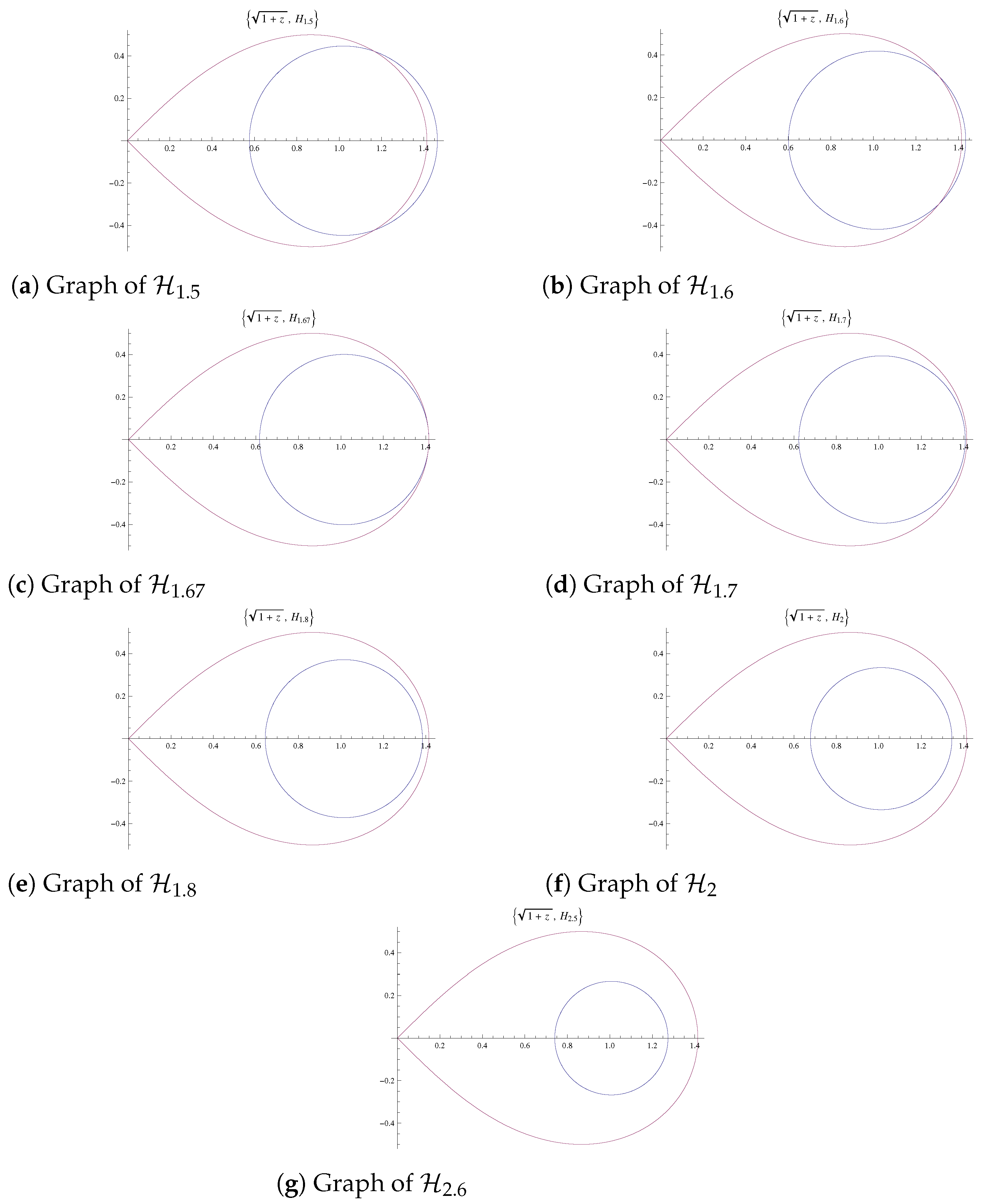
The range of p is slightly better than Corollary [4] (Corollary 2.5). Clearly, this is a very small range of p. By curiosity, we try to understand the possibility of increasing the range of p, through experimenting graphically the image of
It is evident that for , the image of lies slightly inside the lemniscate . On the other hand when , lies inside . It is also clear that when p increases, the image of shrinks and always lies inside the lemniscate . Based on this we can state the following open PB:
Open Problem 2.
There exist a for which the normalized Bessel function is lemniscate starlike for .
3.5. Example Involving Confluent Hypergeometric Functions
The geometric functions theory has a close association with the hypergeometric functions and the confluent hypergeometric functions (refer to the articles [5,25,26,27,28,29,30,31]).
The differential equation
have the solution .
Now consider the function . Then, is lemniscate starlike if
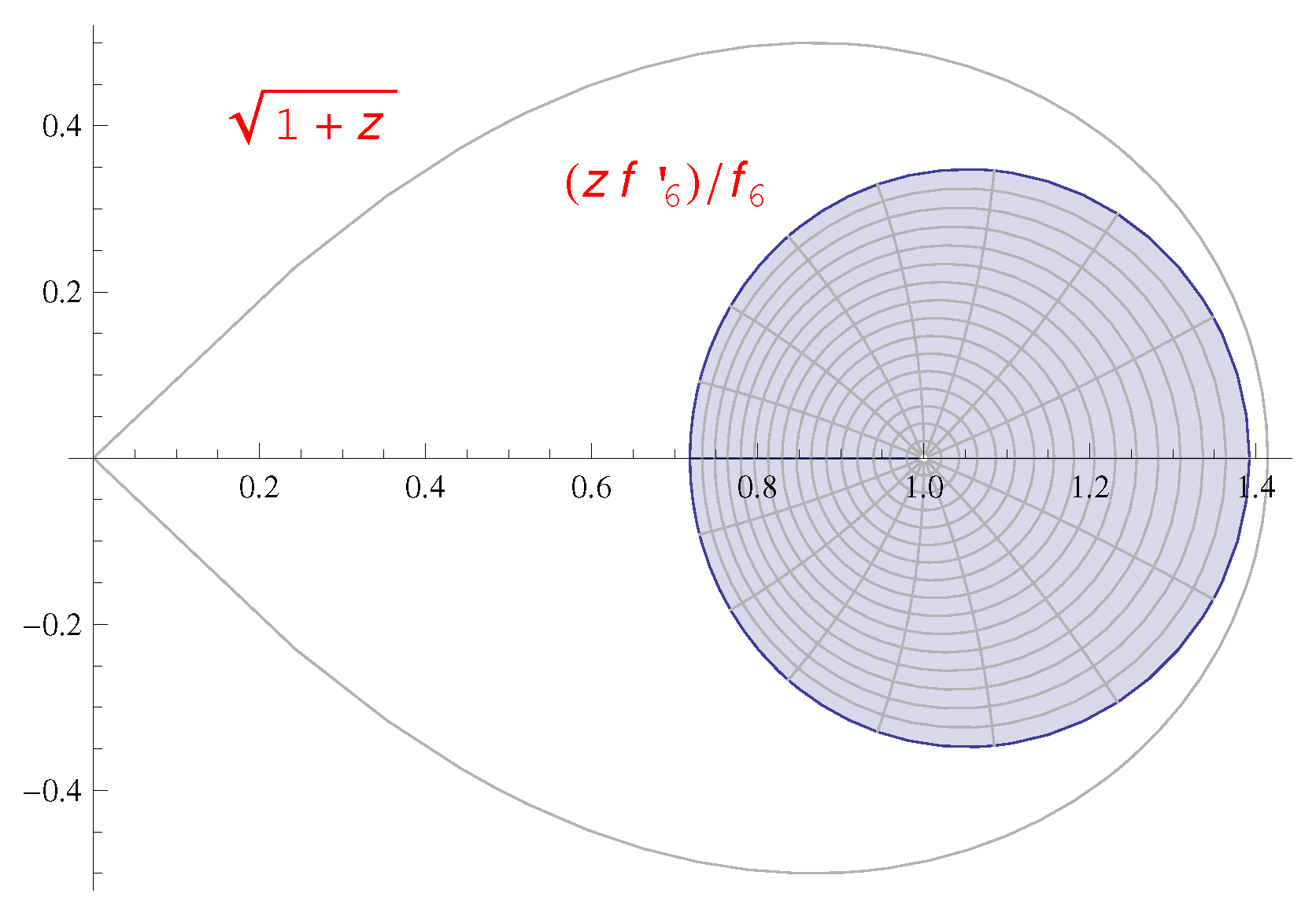
Consider a special case by taking and . Then, we have . Clearly, the inequality (20) holds in this case. Figure 2 represents that .
Figure 2.
.
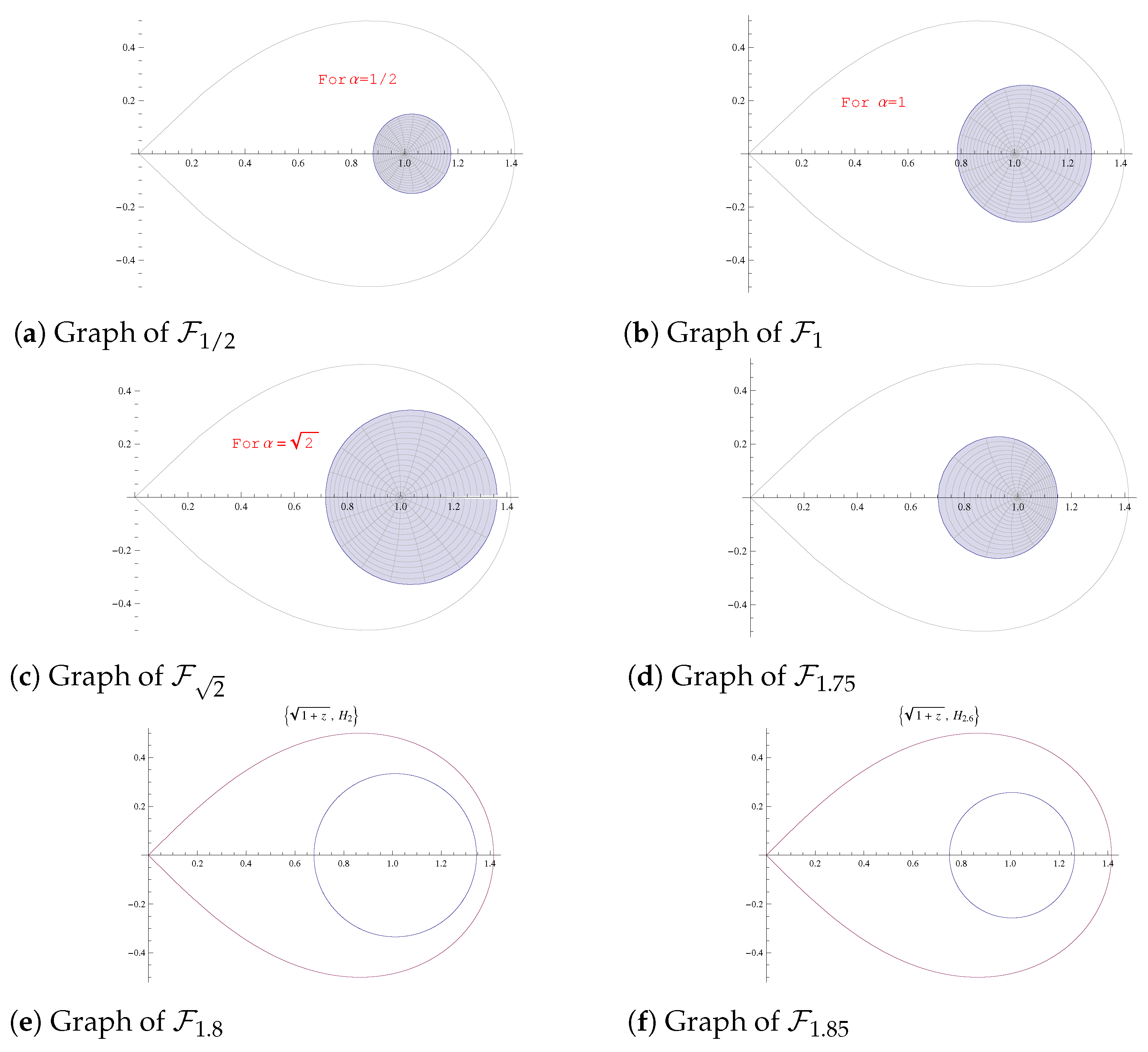
Next take ( for ). In this case, the inequality (20) holds for . Thus,
However, the graphical experiment in Figure 3 indicates that the subordination may holds for . We state the following possible improvement from Figure 3e,f.
Figure 3.
for .
Open Problem 3.
For , the function is lemniscate starlike provided .
4. Conclusions
As presented in Section 2, we considered two second-order differential equations. We derived the conditions on the coefficient functions and , respectively, for and in the differential equation, for which the solution of the differential equations are lemniscate starlike. The judicious choice of and provides different functions as the solution of the differential equation and that is presented in Section 3. We also highlight some open PBs in Section 3 based on graphical experiment.
Funding
This work was supported by the Deanship of Scientific Research, Vice Presidency for Graduate Studies and Scientific Research, King Faisal University, Saudi Arabia [Project No. Grant361].
Institutional Review Board Statement
Not applicable.
Informed Consent Statement
Not applicable.
Data Availability Statement
Not applicable.
Conflicts of Interest
The authors have no relevant financial or non-financial interest to disclose.
References
- Duren, P.L. Univalent Functions; Grundlehren der mathematischen Wissenschaften, 259; Springer: New York, NY, USA, 1983. [Google Scholar]
- Miller, S.S.; Mocanu, P.T. Differential subordinations and inequalities in the complex plane. J. Differ. Equ. 1987, 67, 199–211. [Google Scholar] [CrossRef]
- Miller, S.S.; Mocanu, P.T. Differential Subordinations; Monographs and Textbooks in Pure and Applied Mathematics, 225; Dekker: New York, NY, USA, 2000. [Google Scholar]
- Madaan, V.; Kumar, A.; Ravichandran, V. Starlikeness associated with lemniscate of Bernoulli. Filomat 2019, 33, 1937–1955. [Google Scholar] [CrossRef]
- Ali, R.M.; Lee, S.K.; Mondal, S.R. Geometric features of general differential solutions. Bull. Belg. Math. Soc. Simon Stevin 2019, 26, 551–570. [Google Scholar] [CrossRef]
- Owa, S.; Saitoh, H.; Srivastava, H.M.; Yamakawa, R. Geometric properties of solutions of a class of differential equations. Comput. Math. Appl. 2004, 47, 1689–1696. [Google Scholar] [CrossRef]
- Temme, N.M. Special Functions; A Wiley-Interscience Publication; John Wiley & Sons, Inc.: New York, NY, USA, 1996. [Google Scholar]
- Abramowitz, M.; Stegun, I.A. Handbook of Mathematical Functions with Formulas, Graphs, and Mathematical Tables; A Wiley-Interscience Publication; John Wiley & Sons, Inc.: New York, NY, USA, 1984. [Google Scholar]
- Alzer, H. Error function inequalities. Adv. Comput. Math. 2010, 33, 349–379. [Google Scholar] [CrossRef]
- Coman, D. The radius of starlikeness for the error function. Studia Univ. Babeş-Bolyai Math. 1991, 36, 13–16. [Google Scholar]
- Baricz, Á.; Ponnusamy, S. Starlikeness and convexity of generalized Bessel functions. Integral Transforms Spec. Funct. 2010, 21, 641–653. [Google Scholar] [CrossRef]
- Baricz, Á. Geometric properties of generalized Bessel functions of complex order. Mathematica 2006, 48, 13–18. [Google Scholar]
- Baricz, Á. Geometric properties of generalized Bessel functions. Publ. Math. Debrecen 2008, 73, 155–178. [Google Scholar]
- Baricz, Á. Generalized Bessel Functions of the First Kind; Lecture Notes in Mathematics; Springer: Berlin, Germany, 2010; Volume 1994. [Google Scholar]
- Baricz, Á.; Szász, R. The radius of convexity of normalized Bessel functions of the first kind. Anal. Appl. 2014, 12, 485–509. [Google Scholar] [CrossRef]
- Brown, R.K. Univalence of Bessel functions. Proc. Am. Math. Soc. 1960, 11, 278–283. [Google Scholar] [CrossRef]
- Kanas, S.; Mondal, S.R.; Mohammed, A.D. Relations between the generalized Bessel functions and the Janowski class. Math. Inequal. Appl. 2018, 21, 165–178. [Google Scholar]
- Kreyszig, E.O.A.; Todd, J. The radius of univalence of Bessel functions I. Not. Am. Math. Soc. 1958, 5, 664. [Google Scholar] [CrossRef]
- Mondal, S.R.; Swaminathan, A. Geometric properties of generalized Bessel functions. Bull. Malays. Math. Sci. Soc. 2012, 35, 179–194. [Google Scholar]
- Selinger, V. Geometric properties of normalized Bessel functions. Pure Math. Appl. 1995, 6, 273–277. [Google Scholar]
- Szász, R.; Kupán, P.A. About the univalence of the Bessel functions. Stud. Univ. Babeş-Bolyai Math. 2009, 54, 127–132. [Google Scholar]
- Mehrez, K. Some geometric properties of a class of functions related to the Fox–Wright functions. Banach J. Math. Anal. 2020, 14, 1222–1240. [Google Scholar] [CrossRef]
- Mondal, S.R.; Dhuain, M.A. Inclusion of the generalized Bessel functions in the Janowski class. Int. J. Anal. 2016, 2016, 4740819. [Google Scholar]
- Madaan, V.; Kumar, A.; Ravichandran, V. Lemniscate convexity of generalized Bessel functions. Studia Sci. Math. Hungar. 2019, 56, 404–419. [Google Scholar] [CrossRef]
- Ali, R.M.; Mondal, S.R.; Ravichandran, V. On the Janowski convexity and starlikeness of the confluent hypergeometric function. Bull. Belg. Math. Soc. Simon Stevin 2015, 22, 227–250. [Google Scholar] [CrossRef]
- Miller, S.S.; Mocanu, P.T. Univalence of Gaussian and confluent hypergeometric functions. Proc. Am. Math. Soc. 1990, 110, 333–342. [Google Scholar] [CrossRef]
- Ponnusamy, S.; Vuorinen, M. Univalence and convexity properties for confluent hypergeometric functions. Complex Var. Theory Appl. 1998, 36, 73–97. [Google Scholar] [CrossRef]
- Ponnusamy, S.; Vuorinen, M. Univalence and convexity properties for Gaussian hypergeometric functions. Rocky Mt. J. Math. 2001, 31, 327–353. [Google Scholar] [CrossRef]
- Ruscheweyh, S.; Singh, V. On the order of starlikeness of hypergeometric functions. J. Math. Anal. Appl. 1986, 113, 1–11. [Google Scholar] [CrossRef]
- Naz, A.; Nagpal, S.; Ravichandran, V. Exponential starlikeness and convexity of confluent hypergeometric, Lommel, and Struve functions. Mediterr. J. Math. 2020, 17, 204. [Google Scholar] [CrossRef]
- Kanas, S.; Stankiewicz, J. Univalence of confluent hypergeometric functions. Ann. Univ. Mariae Curie-Skłodowska Sect. A 1998, 52, 51–56. [Google Scholar]
Publisher’s Note: MDPI stays neutral with regard to jurisdictional claims in published maps and institutional affiliations. |
© 2022 by the author. Licensee MDPI, Basel, Switzerland. This article is an open access article distributed under the terms and conditions of the Creative Commons Attribution (CC BY) license (https://creativecommons.org/licenses/by/4.0/).