1. Introduction
John Dewey argues that learning should occur “through occupation and not for occupation” (
Dewey, 1916, p. 307), emphasising the importance of authentic, experience-based learning. This orientation remains highly relevant in vocational education, where the relation between school-based instruction and future professional practice is central (
Schwede et al., 2025). In Danish vocational education, practical orientation, meaningful participation, and perceived relevance are all important conditions for students’ engagement and retention (
Schoop et al., 2023).
At the same time, mathematics often occupies a difficult position in vocational education (
Adelabu, 2024). Although mathematics is embedded in many work practices, it frequently remains invisible to learners.
Nicol (
2002) points to the invisibility of mathematics in social and work practices, and
Devlin (
1996) similarly notes that one of the strengths of mathematics is also its weakness: when it works well, it can mask the complexity of the phenomena it models. This invisibility makes it difficult for students to recognise how school mathematics matters in relation to vocational practice.
An important question in vocational mathematics education is how learners come to perceive mathematics as relevant to their future craft and professional practice. This raises the question of how mathematical ideas and techniques can be made more visible during teaching activities and within student materials, potentially supporting students’ ability to apply mathematics in real-world contexts. This suggests a Science, Technology, Engineering and Mathematics (STEM) approach (
Bybee, 2013;
Kelley & Knowles, 2016). By investigating how instruction can be connected to tasks and situations that reflect the students’ work in their workshops, mathematics could be experienced not merely as a theoretical subject, but as a practical tool for problem-solving and decision-making. Such an approach may help to overcome the perception of mathematics as inaccessible, while also highlighting its potential relevance to vocational development. At the same time, this is not only a question of content, but of how learning environments are configured and coordinated, shaping participation, integration, and meaning-making in STEM education (
Svendsen, 2026).
What is particularly interesting to investigate is how this can be realised in practice. Although the relevance and visibility of mathematics in vocational education have each been a focus for some time, integrating these principles effectively in everyday teaching remains challenging. The LabSTEM+ project has directly addressed this issue, exploring concrete ways to integrate mathematics into vocational workshops so that it is meaningful and applicable to students’ future professional lives.
The present article is situated within a broader line of research developed through the projects LabSTEM and LabSTEM+, which are both funded by the Novo Nordisk Foundation. LabSTEM ran from 2020 to 2022 and was elongated into LabSTEM+, which was concluded in 2025. Both projects focus on how learning environments, collaboration, and material arrangements shape STEM integration (
Svabo et al., 2024). It also resonates with recent work in our research environment that conceptualises educational practice as relational and performative, where what counts as meaningful mathematical participation emerges through specific configurations of tasks, artefacts, expectations, and socio-material relations (
Svendsen, 2026).
2. Mathematics in Vocational Education: Invisible but Important
Knud, a vocational mathematics teacher, shakes his head and says, “I know that mathematics is useful, but my students will never understand why.” He faces a major challenge: How can mathematics be made relevant and meaningful for students who would much rather work with their hands than with numbers? Although he himself sees the practical value of the discipline, many of his students struggle to connect mathematical concepts with their future professions. This disconnect can also affect student engagement, as learners are less likely to invest effort or show curiosity when they do not see the practical application of what they are learning (
Svabo et al., 2024). When teaching starts from theory rather than concrete, real-world applications, the question arises: How can educators foster both understanding and engagement so that students recognise how mathematics can be directly useful in their future work? This challenge also connects to earlier STEM education work, where participant orientation, relevance and the configuration of learning environments are identified as important conditions for engagement and participation (
Svabo et al., 2024).
This question becomes particularly pressing given the invisibility of mathematics in social and work practices (
Nicol, 2002): “The invisibility of mathematics has increased, thereby pushing the understanding of mathematics and mathematical structures into black boxes. As a result, mathematics becomes more hidden and implicit in our social and work practices. While mathematics is everywhere in our lives, it is nowhere to be seen” (p. 301).
Devlin (
1998), who Nicol refers to, made a similar observation: “As the role of mathematics has grown more and more significant over the past half century, it has become more and more hidden from view …” (p. 12) These dynamics make it difficult to identify and describe the mathematical reasoning and actions required in workplace tasks, further complicating the task of connecting school mathematics to vocational practice. In this article, we treat this invisibility not only as a problem of student recognition, but as a relational and pedagogical issue shaped by how classroom and workshop practices are organised. The issue of invisibility is unavoidable, since it is a direct consequence of the nature of modern mathematics. It must then be addressed for effective instruction to occur.
Devlin (
1998) explains how the whole purpose of mathematics is, and from a modern perspective always has been, to make visible—and manipulable—regularities and structures in our world, in order both to understand them and utilise them in precisely defined and often quantifiable ways. Sizes of collections and the shapes of two-dimensional figures were the first regularities so treated, giving rise to numbers and arithmetic, and to geometry, respectively. For instance, to take an example much utilised by school physics teachers, Kepler’s experiment of rolling balls down inclined planes led to his formulation of the precise and quantifiable law that an object’s acceleration under gravity is constant and independent of its mass. The human eye can detect that a rolling ball speeds up as it descends, but the aspects captured by Kepler’s law are, in a genuinely literal sense, invisible. To the mind of a mathematician or scientifically trained person, they become visible by expressing them with an equation. To such individuals, the equations of mathematics are the equivalent of the night-vision goggles that police, soldiers, and others use to see things in the dark, or the X-rays, CT scans, etc. that enable doctors to see features of organs invisible to the human eye. Of course, this increased visibility is achieved only through mastery of the language of mathematics itself, hence the main title
Devlin (
1998) gave to his book; it is mathematics as an expressive medium that provides access to invisible regularities. In contrast, the machinery of mathematics—computations, algebraic calculations, etc., is what is then required to analyse, and in due course apply, the hidden regularities that emerge as a result of the increased visibility.
The students of mathematics bring everyday experience and are asked to master a new language to describe, in a novel way, a way instructors know to be powerful, what they already “know” from their everyday experience. This contrast is particularly acute for a student at a vocational school, who brings an often considerable familiarity and deep, but tacit, understanding of the domain they work in. And yet, apart from relatively basic instances, real progress in the world frequently requires mastery of both kinds of expertise.
Research suggests that applied, workplace-oriented approaches to mathematics can offer a way forward.
Nicol (
2002) emphasises that “applied academics courses designed to provide students with workplace relevance has promise. Students learn mathematics in the process of searching for solutions to meaningful work-related problems. This contrasts with typical situations where students are asked to show their understanding of mathematics through application problems located at the end of the chapter” (p. 291). However, the nature of mathematical reasoning in the workplace differs from that in school contexts (
Lave, 1988;
Nunes et al., 1993).
Smith (
1999) highlights how purposes, structures, and products frame mathematical practices differently in work and school. For example, standard numerical algorithms taught in school are often not the ones used by workers on the job (
Hoyles et al., 2001).
The challenge is further compounded by the educational background of vocational mathematics teachers in Denmark, where there is no formal teacher education specifically for vocational school teachers. Approximately 60% of mathematics teachers in vocational programmes do not hold a formal mathematics qualification, such as a degree in mathematics or even a primary school teaching qualification (
Børne- og Undervisningsministeriet, 2022). Instead, vocational qualifications and relevant work experience are prioritised. This makes collaboration, local curriculum development, and practice-based professional development especially important in vocational mathematics education.
At the beginning of the 1990s, over 40% of individuals aged 25–30 in Denmark had completed a vocational education as their highest qualification; by 2019, this proportion had declined to 24% (
Danmarks Statistik, 2019). Enrolment in Danish vocational schools has followed a similar downward trend, with over 120,000 students in 2011 compared to 107,100 in 2018, while withdrawal rates remain high, reaching 24% in 2015. Research from
Mahler et al. (
2023) suggests that multiple factors contribute to student withdrawal, and preventive initiatives have been developed to address them. One of the central conclusions of
Mahler et al. (
2023) is that student motivation and engagement are highly dependent on teachers, instructors, and the activities offered by the vocational school. Specifically, varied teaching methods with practical orientation, real-world relevance, and active student involvement are associated with higher professional pride and reduced withdrawal. Conversely, students often disengage when theoretical courses are perceived as disconnected from practice or when the relevance of a course is unclear. Younger age and low levels of social well-being further exacerbate the risk of withdrawal. These findings make engagement a central concern for vocational education and underline that engagement is shaped not only by the student, but by pedagogical, relational and environmental conditions.
Regarding mathematics, both
Hetmar (
2013) and
Danmarks Statistik (
2019) found that lower secondary school grades in mathematics and Danish strongly predict the likelihood of completing a vocational education.
Hetmar’s (
2013) qualitative study further demonstrated that negative experiences with mathematics from earlier schooling tend to persist in vocational learning, while support for seeing practical applications in mathematics can have positive effects. Similarly,
FitzSimons and Wedege (
2007) emphasised that practical orientation must apply not only to problems presented but also to the methods used in instruction. International studies support these findings:
Gillespie (
2000) and
Dalby and Noyes (
2015) both observed that vocational students prioritise work-related skills, and engagement in mathematics increases when learning is aligned with vocational contexts. On the other side, misalignment between vocational and mathematics pedagogy, including differences in culture and social structure, can create challenges. In this way, engagement in vocational mathematics appears closely connected to whether students are able to recognise mathematics as part of meaningful vocational activity.
Several studies highlight strategies for enhancing vocationally relevant mathematics teaching. Teachers visiting workplaces to observe and interview practitioners (
Hogan & Morony, 2000;
Nicol, 2002;
Noss et al., 2000) can gain insights into authentic applications of mathematics. While this approach can generate practical teaching ideas, challenges remain in translating workplace practices into classroom instruction due to differences in methods, language, and context.
Noss et al. (
2000) further emphasise the complex, interactive relationship between knowing and doing: mathematical understanding and practical application develop reciprocally. In Denmark,
Lindenskov (
2014) showed that designing mathematics courses with vocational relevance and hands-on materials, combined with teacher professional development, effectively supports student engagement and retention. An international review (
Alsina et al., 2025) also identifies six effective approaches for teacher development in mathematics: reflection on teaching practice, creation of learning environments, content instruction, lesson study, inquiry-based learning, and flipped classrooms, with the latter two being underutilised in research. For the present study, the emphasis on learning environments is particularly relevant, as the alignment between mathematics and welding was developed not only through content but through changes in material arrangements, artefacts, and collaboration across settings (
Svendsen, 2026).
Collectively, these findings underline the importance of integrating vocational relevance into mathematics instruction, aligning pedagogical practices with students’ practical experiences, and supporting teachers through targeted professional development to reduce withdrawal and enhance student engagement. They also point toward the importance of understanding engagement relationally: as emerging through the ways learners, teachers, tools, tasks, and environments are brought together in practice.
Taken together, these challenges underscore the importance of investigating how mathematics can be made relevant, visible, and meaningful in vocational education—not merely as an abstract school subject, but as a tool for professional practice. Understanding and addressing this issue is central to initiatives such as the LabSTEM+ project, which explores practical ways to integrate mathematics into vocational workshops, linking it directly to future work life and students’ professional development.
We ask the following questions:
How does structural alignment between school mathematics and vocational practice support:
- (1)
Students’ recognition of mathematics as relevant?
- (2)
Student engagement across transitions between classroom and workshop learning environments?
3. LabSTEM+
The context of this study is the research and development project LabSTEM+ (2023–2025), funded by the Novo Nordisk Foundation, which aims to design and test STEM learning modules across different educational levels, including lower secondary school, upper secondary school, and vocational education. This article focuses only on the vocational school context. Earlier work from LabSTEM and LabSTEM+ has contributed to the development of STEM didactics, the laboratory model, the role of mathematics in STEM, and the importance of learning environments for STEM integration (
Svabo et al., 2024;
Larsen et al., 2024). At the vocational school, we established what we refer to as a STEM laboratory, in which teachers from different disciplines collaborated to design interdisciplinary teaching modules. In our previous work, this laboratory model has been described as a practice-based approach to professional development and interdisciplinary design, where teachers develop new forms of teaching through collaboration around concrete educational experiments (
Svabo et al., 2024). This is important in the present study, as the vocational mathematics intervention did not emerge from mathematics teaching alone, but from collaboration across disciplinary practices and learning environments. The laboratory brought together mathematics teachers from the mandatory courses and workshop instructors, including representatives from the welding programme and the industrial technician programme. Within this setting, three mathematics teachers and two workshop teachers met four times to engage in joint development work. The sessions involved opportunities for the teachers to get to know each other, to receive input from the authors, and to dedicate time to co-developing interdisciplinary modules. During these meetings, time was deliberately allocated for instructors to observe each other’s practices. Mathematics teachers visited the welding workshops to discuss how mathematics was used in the metalworking processes, including which machines relied on mathematical knowledge and how mathematical concepts were embedded in their operation. For example, they examined how geometry and measurement are applied when using milling machines to achieve precise cuts, illustrating how mathematical reasoning is integral to many workshop tasks.
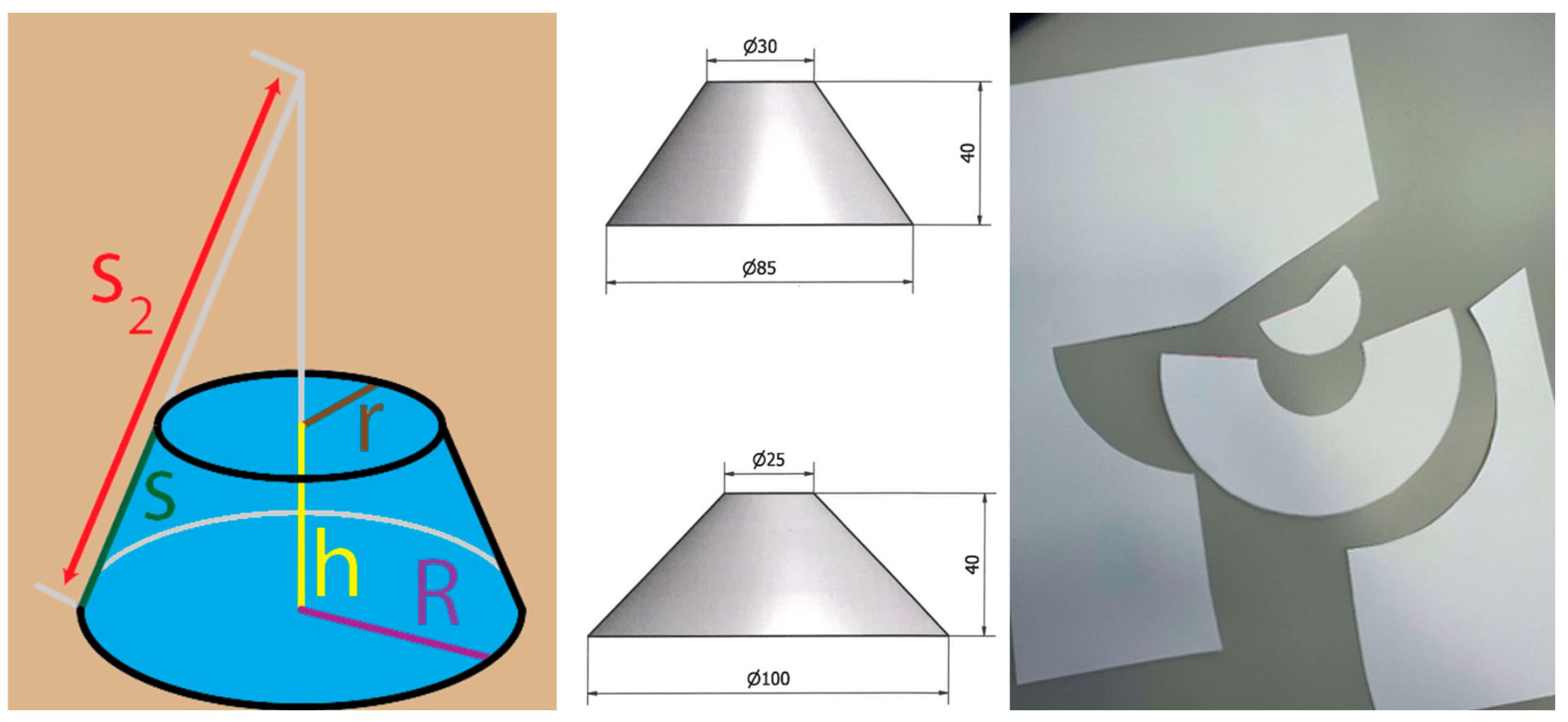
The teachers then collaboratively designed two interdisciplinary modules. One focuses on the industrial technician program, and the other focuses on the welding workshop. In this article, we focus on the welding workshop, which is centred on the production of a metal lampshade in the form of a truncated cone. The teaching sequence began in the mathematics classroom, where students used trigonometric methods to draw the net of the truncated cone (see
Figure 1). Following this, the students continued in the workshop, where they cut out the developed figure in sheet metal and welded it together to form the lampshade (see
Figure 1). In this way, the module created a concrete transition between school mathematics and vocational craft practice, allowing us to study how relevance and engagement were shaped across classroom and workshop settings.
4. Methods
For this study, we collected video material from the entire teaching sequence in the LabSTEM+ laboratory at this vocational school. We had video observation from both the mathematics classroom and the welding workshop. In parallel, field notes were taken by the two participating researchers during all four teacher meetings. The intervention involved two teachers: one mathematics teacher and one welding teacher. The mathematics teacher was educated as a lower secondary school teacher and had previous teaching experience from lower secondary education, but only limited experience teaching in vocational education. The welding teacher was a trained welder with more than ten years of professional and teaching experience in vocational education. The final oral evaluation with the teachers and three students (Students 1, 2 and 3) was audio-recorded and subsequently transcribed. The three students participated voluntarily in the evaluation interview because they indicated that they wished to contribute their perspectives. Interviews were conducted with the mathematics teacher and the welding teacher; all interviews were video-recorded and fully transcribed. The interviews were framed as semi-structured interviews (
Brinkmann & Kvale, 2009) to combine thematic guidance with openness to the participants’ own perspectives. The study was conducted at a vocational school located in a provincial town in Denmark. The collected material additionally enabled the production of a short film based on key scenes from the classes and workshop (
Syddansk Universitet, 2025). All data collection and handling comply with the
European Parliament and Council of the European Union (
2016) regulations. The empirical material was generated in and around an intervention that deliberately connected two educational settings that are often separated in vocational education: the mathematics classroom and the workshop. This made it possible to examine not only what students and teachers said about relevance, but also how mathematics was enacted across different socio-material arrangements. Data analysis was carried out using Cultural–Historical Activity Theory (
Engeström, 2001), through iterative collaborative discussions in the research team, which enabled us to connect and interpret patterns across video data, field notes and interview transcripts.
Methodologically, this study can be understood as a single qualitative study of an interdisciplinary intervention in a vocational school setting. The purpose is therefore not statistical generalisation, but analytical generalisation, where insights from the study may contribute to broader theoretical understandings of how structural alignment between vocational and mathematical learning environments can support students’ recognition of relevance and engagement. In this sense, the findings should be interpreted as context-sensitive but theoretically informative beyond the immediate setting.
4.1. Analytical Framework: Cultural–Historical Activity Theory
Cultural–Historical Activity Theory (CHAT) is a learning theory that situates learning within social systems, where context, artefacts, rules, norms, and community shape the activity (
Engeström, 2001). The theory was initiated by Vygotsky in the 1920s as a critique of the separation between organism and environment (
Vygotsky, 1978,
1987;
Yamagata-Lynch, 2010). The framework is dynamic and evolving across generations. Engeström (
Engeström, 2001) outlines that the second generation of CHAT is primarily based on Leontiev’s work (
Leontiev, 1981). Leont’ev expanded the CHAT framework such that it incorporated the possibility that several individuals could be viewed as a group within the system of activity, since one of the critical comments on Vygotsky’s work (
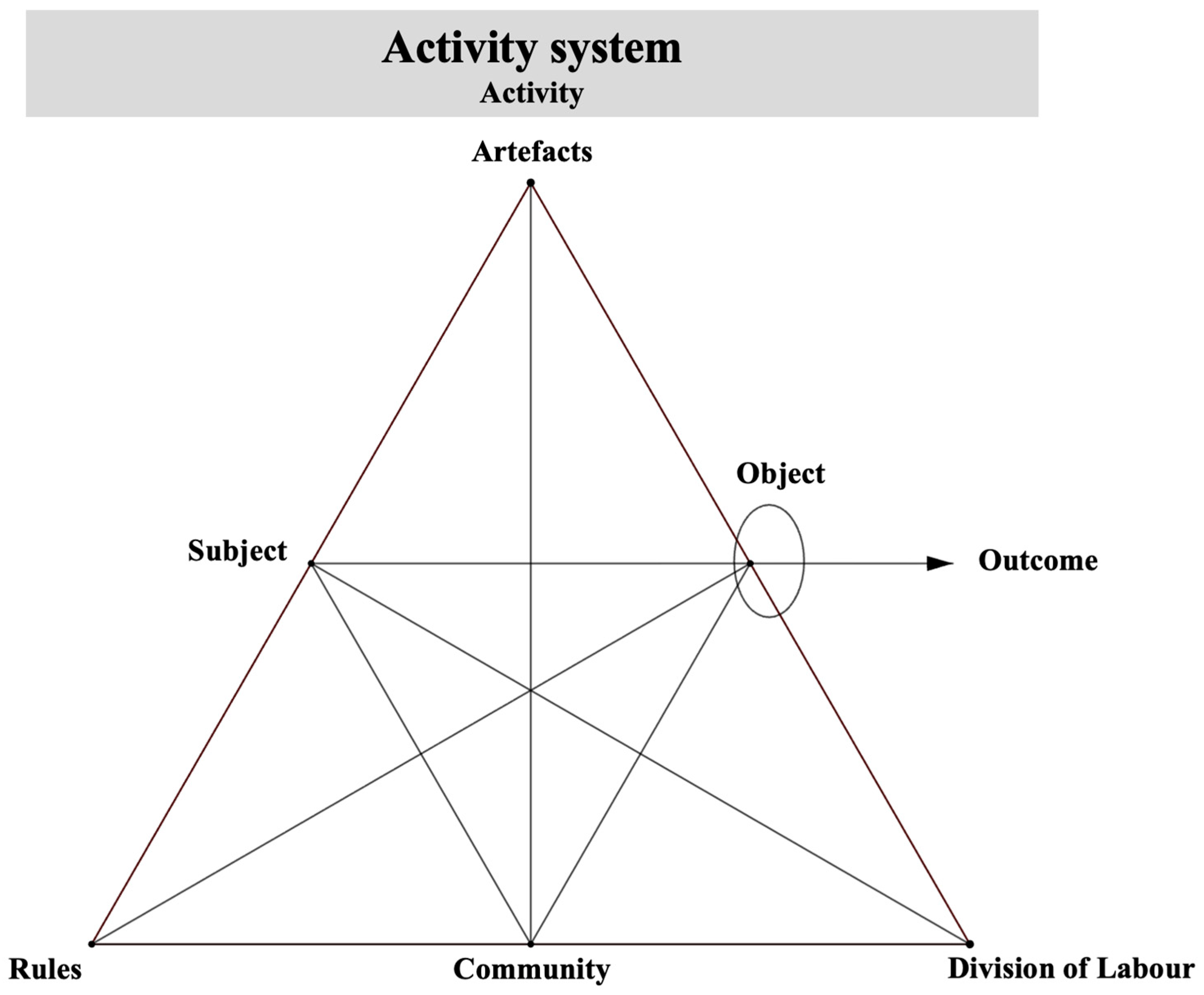
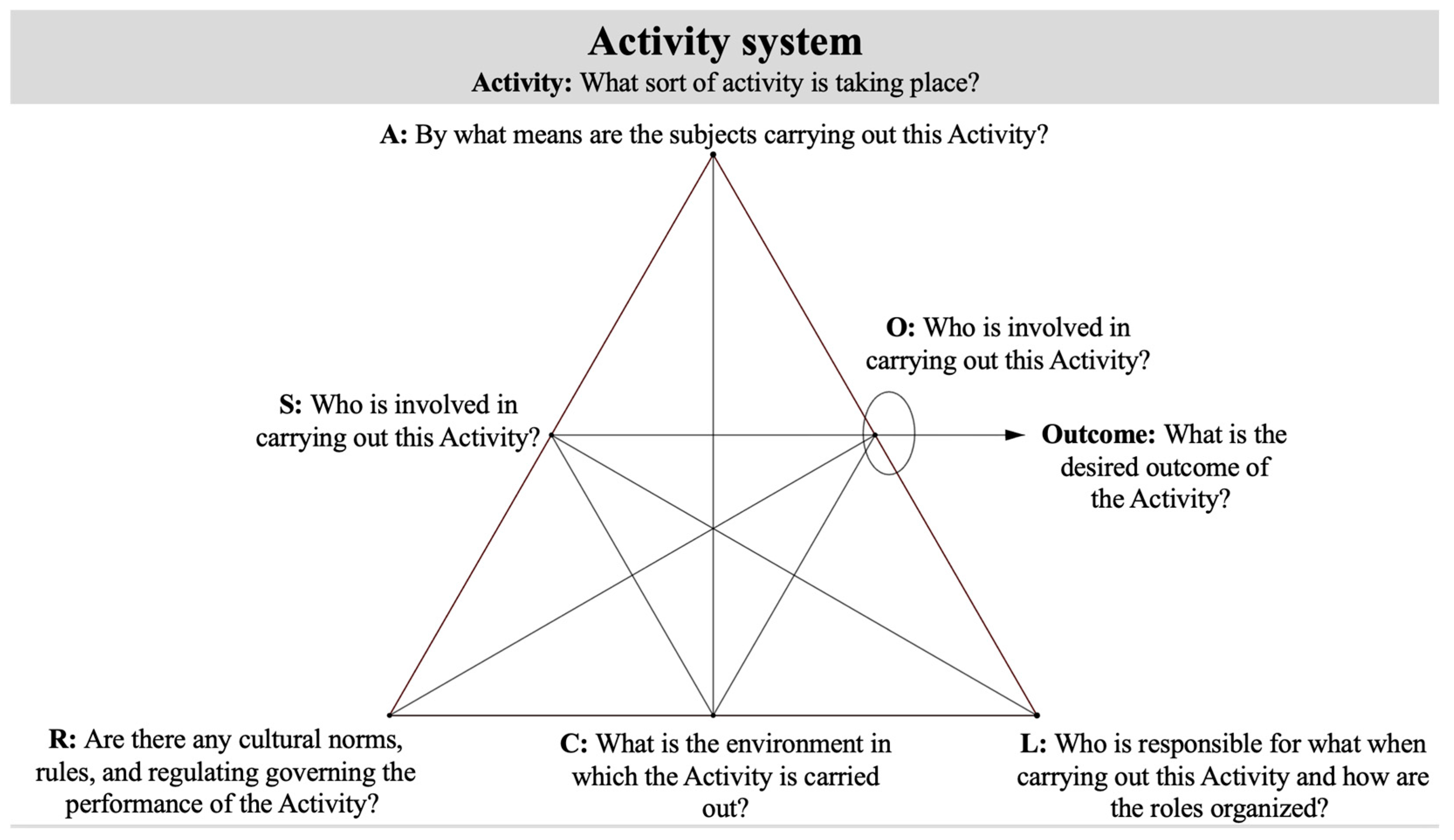
Yamagata-Lynch, 2010) was that it was too focused on the individual. The second generation of CHAT was later graphically visualised and popularised by Engeström, as seen in
Figure 2.
In this article, CHAT is used because it offers a way of analysing how mathematics teaching and vocational workshop practice are organised through different objects, tools, rules, and divisions of labour. At the same time, our use of CHAT is informed by our broader line of work on mediated learning environments and practice-based educational development, where environments, materials, and artefacts are understood as active in shaping participation and sense-making (
Svabo, 2009) and by recent work in our group that conceptualises educational practice as relational and performative (
Svendsen, 2026;
Borch, 2026).
The model, called an activity system, consists of the following nodes: subject, object, artefacts, community, rules, and division of labour. The subject is the individual or group engaged in the activity, while the object is the motive for action. Artefacts are mediating tools, internal or external, supporting the activity (
Vygotsky, 1978). The community encompasses the social and physical context, shaping the rules and division of labour, which define norms and task allocation. Cultural–historical influences are particularly evident in rules, community, and division of labour, as they are shaped by societal expectations and historical context (
Engeström, 1996,
2001). The Outcome is the intended result of the activity. Importantly,
Engeström (
2001) underlines how the model and CHAT framework should be viewed as dynamic and ever-changing:
“An activity system is always a community of multiple points of view, traditions and interests, …, Activity systems take shape and get transformed over lengthy periods of time.”
The CHAT framework, moreover, offers a structured model for analysing complex data, with the advantage of comparability and clear visual representation (
Yamagata-Lynch, 2010). Activity system analysis (ASA) uses CHAT to identify systemic contradictions—tensions inherent in human activity that can drive change (
Engeström, 1996,
2001). Contradictions may be primary (within a node), e.g., a method of calculation and a calculator could both be in the artefacts node, which then could cause tension whenever the activity of calculation happens. This type of contradiction is often described from an old/new element within a node; in this case, the old artefact is the method of calculation, and the new artefact is the calculator. Contradictions may be secondary (between nodes), e.g., a calculator is in the artefacts node, and a rule in the exam is not to use the calculator, causing a contradiction. Moreover, contradictions may be tertiary (between old and new activities), potentially triggering system development and reconfiguration (
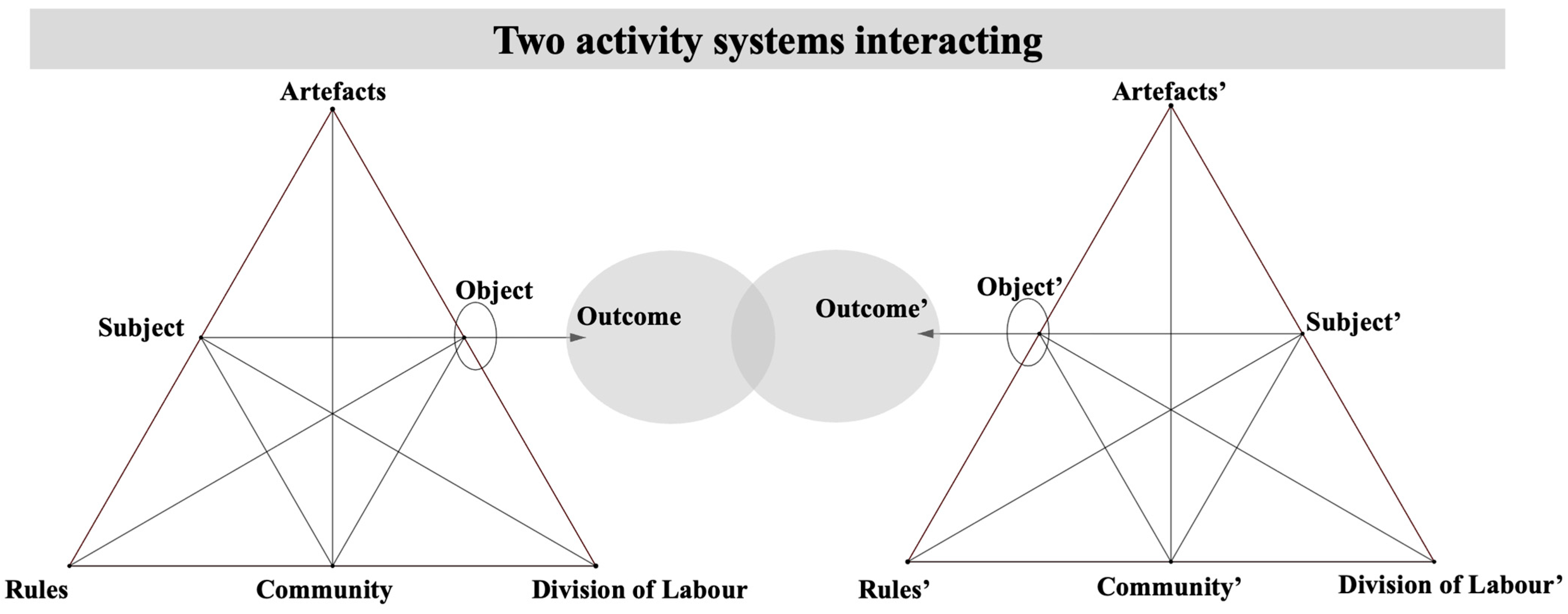
K. Foot & Groleau, 2011), e.g., the teacher changes teaching methods from lecturing to inquiry-based teaching. Multi-voicedness highlights how interactions within and between activity systems shape the activity, and third-generation CHAT extends this by incorporating multiple interacting systems and researcher interventions to examine induced contradictions (
Engeström, 2001;
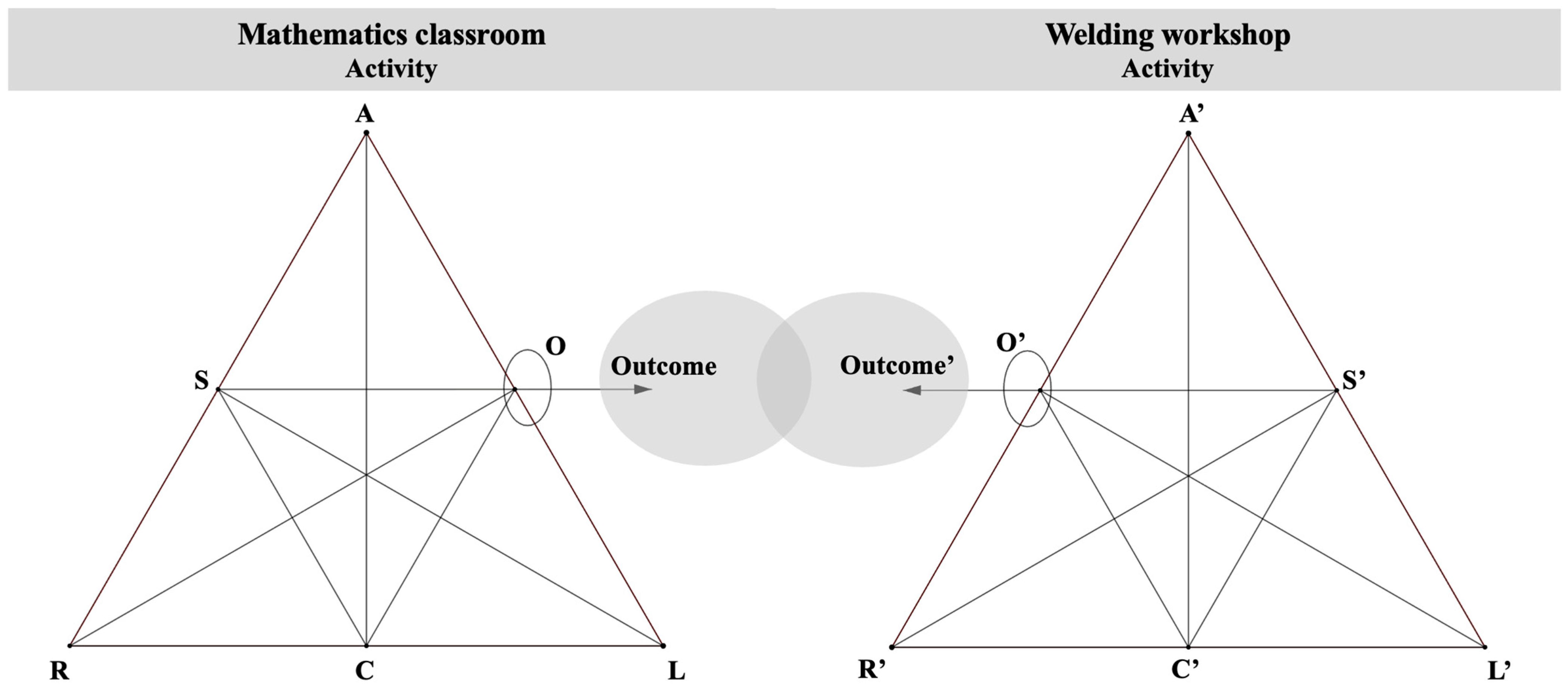
Yamagata-Lynch, 2010). The interaction between neighbouring systems that may or may not have aligned outcomes is visualised in
Figure 3. The figure shows two activity systems interacting; however, the third-generation CHAT framework allows for several interacting activity systems.
The analysis of activity systems (ASA) regarding tension and contradictions, now in the third generation, allows for tension between the neighbouring activity systems. This type of tension is referred to as a quaternary contradiction (between activity systems) (
K. Foot & Groleau, 2011), e.g., this could occur in interdisciplinary teaching due to different artefacts, rules, communities, etc. in each discipline.
The third generation of CHAT opens a new perspective of analysis, especially in school systems, which are typically discipline-based. It allows one to view and analyse the interplay between different disciplinary classrooms as activity systems and their interplay. This is exactly why the CHAT framework fits the LabSTEM+ project well. More specifically, it enables us to analyse the relationship between mathematics and welding not only as a matter of curricular integration, but as an interaction between differently configured learning environments.
4.2. Analytical Approach in LabSTEM+
With the goal in mind to investigate how the LabSTEM+ project impacted the students’ recognition of the relevance and applicability of mathematics in their future careers, along with their engagement and motivation to actively use mathematical concepts, we set up the analysis in the following way. Building on the theoretical foundation of CHAT, we analysed the two key activity systems in the LabSTEM+ project: the mathematics classroom and the welding workshop. CHAT’s focus on historical, cultural, and social factors provides a lens to understand how these classrooms operate, interact, and evolve over time. This analysis consisted of first describing the state of these activity systems before the LabSTEM+ project, while deducing the corresponding contradictions at this state. We called this the Pre-LabSTEM+ phase. Then the activity systems were updated and evolved from the influence of the LabSTEM+ project and contradictions, to gain insight into: the impact of the LabSTEM+ project, the two classrooms as activity systems, and the progress of tensions in these systems over time.
In this way, the analysis moved between two related concerns: first, how mathematics and welding were differently organised before the intervention, and second, how the intervention reconfigured relations between them. This allowed us to examine not only whether students found mathematics relevant, but also how such relevance became possible through changes in tools, artefacts, roles, and shared activity. By using the framework of CHAT, we implicitly adopted the position that historical and cultural factors are crucial in analysing the activity, state, and progress of a classroom. Since one of the largest factors for preventing student withdrawal from the Danish vocational schools is the level of social well-being (
Mahler et al., 2023), the cultural and social factors should indeed be taken into consideration. The historically limited visibility of mathematics in vocational workplaces (
Noss et al., 2000;
Hogan & Morony, 2000;
Nicol, 2002), combined with vocational students’ general preference for practice-oriented mathematics teaching (
Mahler et al., 2023), creates an opportunity for interaction and interplay between the mathematics and welding classrooms as interconnected activity systems. As
K. A. Foot (
2014, p. 337) notes, “contradictions are a sign of richness in the activity system,” highlighting that such tensions can drive development and learning. In LabSTEM+, the establishment of learning laboratories among teachers fosters these interactions. This also aligns with our earlier work, in which educational development has been approached through collaborative laboratory settings and thorough attention to how participation is shaped by concrete pedagogical and material arrangements (
Svabo et al., 2024). To describe the activity systems, we used
Mwanza’s (
2002) eight-step model (
Figure 4), which was developed to operationalize the activity system model. Note that the original model is visualised in a table format. However, we have here visualised the model, so that it can be seen in the context of an activity system.
When analysing contradictions and tensions over time, the eight-step model also helps operationalise how changes in one part of an activity system may generate tensions in others. For example, a change in the node subject (S) or community (C) could provide a contradiction in the node division of labour (L), since the question regarding the division of labour regards whoever is involved in the activity of the system. Similarly, the most tension at a single change could be created if the node activity of an activity system changes. Since all the questions in the eight-step model relate to the given activity of the system, the change would immediately cause primary contradictions in each node of the system, as the content of the nodes no longer provides correct answers to the questions in the eight-step model. This latter example is indeed relevant for this case, as the LabSTEM+ project changed the activity of each activity system, therefore creating contradictions in each node and thereby changing the systems.
Concretely, the data from the interview sessions and observations were first used to answer the above questions in the eight-step model for both activity systems, in the state that these were in, before the LabSTEM+ project began. This coding was done by the first author and then carefully read through and validated by the second author to ensure a certain level of reliability.
The first author then analysed these activity systems for contradictions, and these were then coded by category, with the ongoing revision, validation and discussion from the second author. This analysis provided a snapshot of the state of the activity systems pre-LabSTEM+. Using the observation data primarily, with support of the interview statements, the entire progression of both activity systems was systematically described from contradictions and the change that these provide, along with the changes coming naturally. The new contradictions coming from the changes were again analysed by category. This was then iteratively done until there were no more data, providing a state of the activity systems at the end of the project. This state of the activity systems was then compared with the final interview data to investigate whether the final state from the activity system analysis fitted the interview data. Again, the analysis was conducted primarily by the first author with discussions, revisions, and validation iterations from the second author. A consensus was reached in each discussion. In the final iteration, the other co-authors revised, validated, and provided input on the analysis.
5. Results
The mathematics classroom and the welding workshop, through the lens of Cultural–Historical Activity Theory (CHAT), highlight how differences in the organisation of each activity system shape students’ learning and engagement.
5.1. Pre-LabSTEM+: Separate Activity Systems
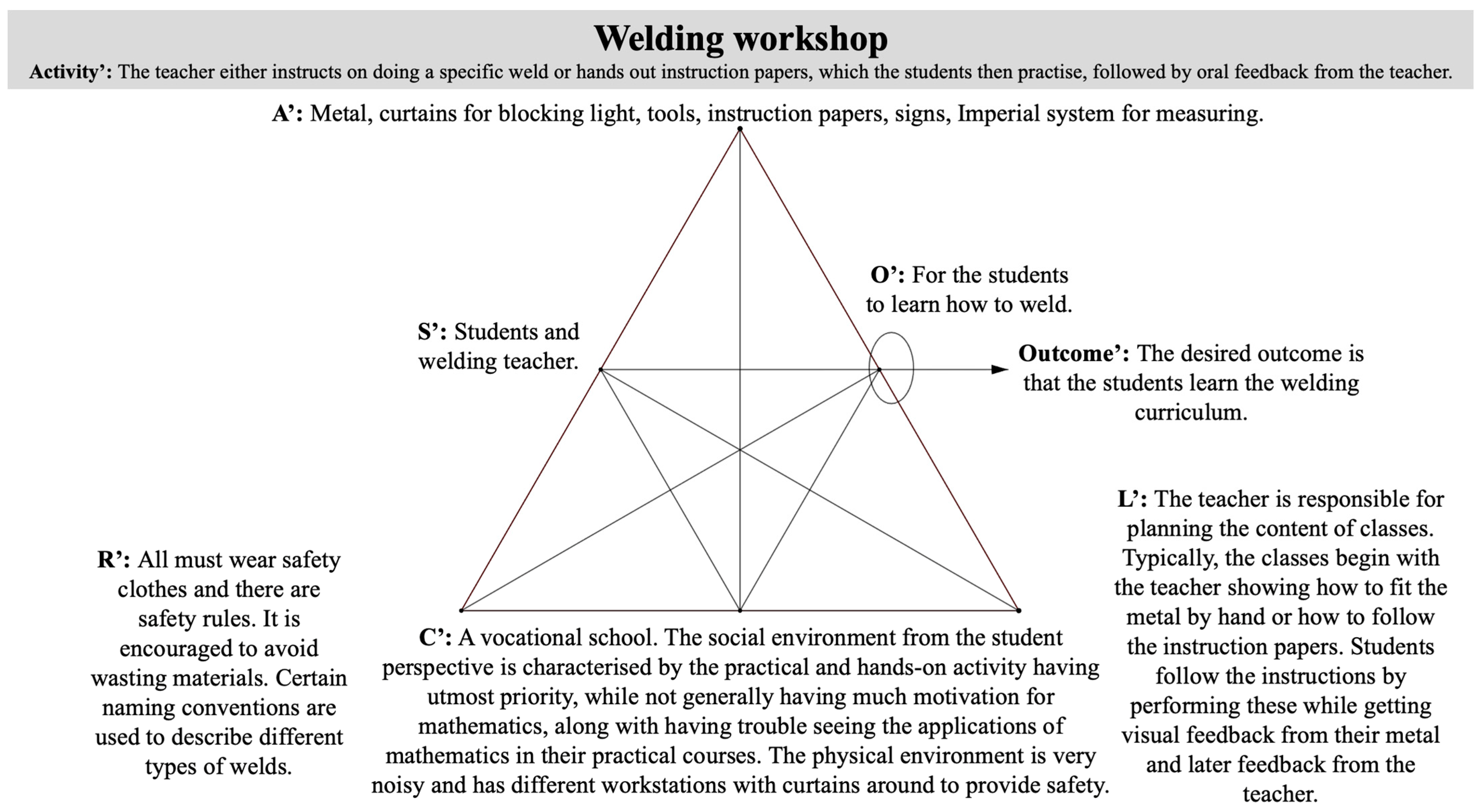
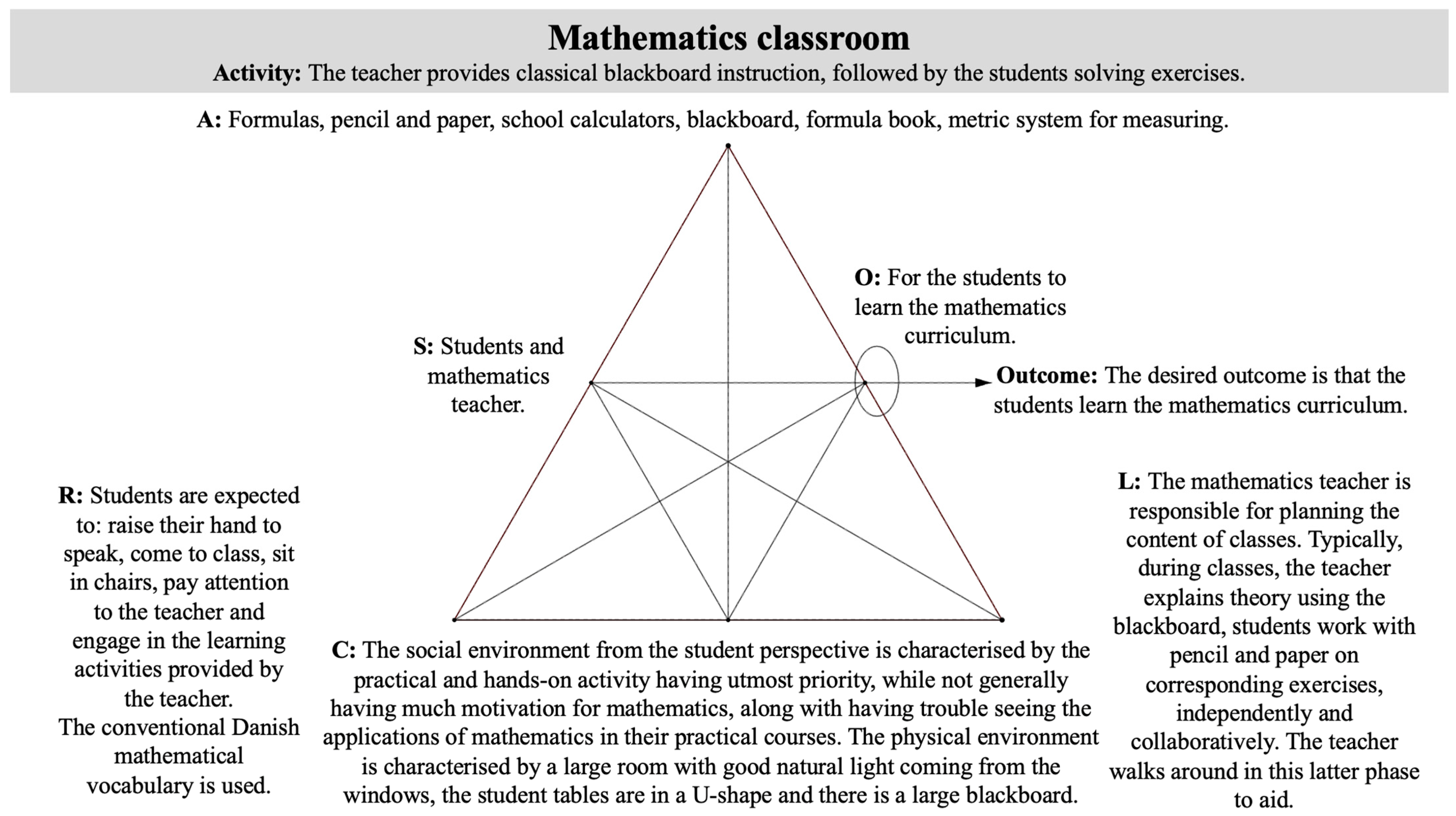
In this phase, the retrospective data analysis described and visualised the state of the welding workshop,
Figure 5, and the mathematics classroom,
Figure 6, respectively, in the eight-step model,
Figure 4. The text in both
Figure 5 and
Figure 6 is written out in a comparative table,
Table 1, below.
Notice that we used the mark, ’, for the nodes in the activity system of the welding workshop, for example, the node subject of the welding workshop is denoted (S’), whereas the corresponding node in the mathematics classroom is denoted (S). In both contexts (
Figure 5 and
Figure 6), the subjects (S) and (S’) are vocational students and their corresponding teachers, yet their roles and approaches differ considerably. From the interviews and observations, it was clear that in this pre-LabSTEM+ phase, the two activity systems were separate. The mathematics teacher and the welding teachers had not met each other, and the mathematics teacher had not seen the welding classroom/workshop. The community nodes of the mathematics classroom (C) and the welding classroom (C’) overlapped socially, since both activity systems were within the environment of a vocational school.
“Young people don’t find mathematics very interesting, but if they can see that it relates to their work, I think they will be more engaged.”
[17:17–17:25]
This is a retrospective reflection from Student 1, which suggests an environment where mathematics is, from the community’s perspective, not very interesting. Similarly, the community preferred a more practical approach, as the mathematics teacher observes retrospectively:
“Almost all the students there, however, grab the angle, measure, and fit things by hand. They want to work practically first, before they work with the theoretical part.”
[10:43–10:49]
The observation data from the welding workshop positions the students as active practitioners, with the object (O’) of acquiring practical welding skills. Here, learning is mediated through concrete artefacts (A’), including metal, welding equipment, safety curtains, and instruction papers. Rules (R’) are oriented toward safety, material efficiency, and standardised naming conventions for weld types. The division of labour (L’) is more practice-centred: the teacher demonstrates techniques, provides visual feedback, and guides students as they perform welding tasks. The desired outcome is proficiency in welding rather than theoretical knowledge. As Student 1 explains in a retrospective reflection,
“There is a big difference, especially in how this education is set up. There is a lot of disconnection between the tool work and the mathematics taught in the classroom. [In workshops] Our work mostly involves measuring and using the drawings we have to build things, so mathematics is implied or assumed.”
[15:17–15:42]
This big difference is affirmed in the comparison with the mathematics classroom: in the mathematics classroom, the observation data suggest that the same students (S) are positioned primarily as learners of abstract theory, with the object (O) of mastering the formal mathematics curriculum. The observation suggested that the activity is mediated by symbolic artefacts (A) such as formulas, pencil and paper, calculators, and the blackboard, and is governed by formal norms (R): students primarily remain seated, and follow the teacher’s instructions, using conventional mathematical vocabulary. The division of labour (L) places the teacher as the planner and primary source of knowledge while students work individually or collaboratively on exercises. Finally, the intended outcome is mastery of the mathematics curriculum.
Viewed through CHAT, the mathematics classroom reveals a secondary contradiction between its theoretical focus and the community’s more embodied and practice-oriented learning preferences. Moreover, the data regarding the encouragement to avoid wasting materials (R’) suggests a tertiary contradiction in the welding workshop, since this is not visibly enforced by the activity of the welding workshop.
Comparing the two activity systems reveals a systemic contrast: the mathematics classroom emphasises abstract reasoning and symbolic mediation, whereas the welding workshop prioritises hands-on practice and embodied knowledge. The tools, rules, and division of labour in each context reinforce these priorities, shaping students’ engagement and motivation, both positively and negatively. These differences also illustrate why students often struggle to connect formal mathematics with practical vocational tasks, as the object and mediating tools of each system operate under fundamentally different logics. In this sense, the contrast between the two systems helps explain why mathematics may remain invisible or appear irrelevant when the relation between disciplinary practices is not actively organised. The comparison underscores the challenge of integrating theoretical knowledge with applied practice in vocational education and highlights the importance of designing activity systems that bridge these epistemic and practical divides.
5.2. LabSTEM+: Reconfiguring Activity Systems
The collaboration between the mathematics teacher and welding teacher was initiated in the LabSTEM+ project, and their interdisciplinary-designed and -planned teaching activity began with the students in the mathematics classroom and continued afterwards in the welding workshop. An important aspect of this interdisciplinary process was that both teachers were present in the teaching sessions, enabling the creation of meaningful connections between the two subject areas. For the mathematics teachers, participating in the welding workshop was a novel experience, just as it was new for the welding teachers to engage in the mathematics classroom. From a Cultural–Historical Activity Theory (CHAT) perspective, this development can be understood as the interaction between two activity systems, while changing the activities of each system, causing numerous contradictions, as was predicted due to the nature of the eight-step model (
Figure 4). Again, such contradictions are in CHAT regarded as drivers of development, initiating processes of change and transformation within and between the activity systems. Here, the central point is not merely that mathematics was contextualised through welding, but that the relations between the two systems were reorganised through shared planning, co-presence, new artefacts, and new objects of activity.
In contrast to the pre-LabSTEM+ phase, in
Figure 7, we have not provided the state of each node. This is due to the nodes changing numerous times, but not simultaneously, throughout the period of the LabSTEM+ project, causing tension in other nodes, then causing new contradictions and changes. The analysis was conducted by handling every node and contradiction in order of occurrence, also including all the predicted contradictions from the interdependent nature of the eight-step model. We will instead now describe the overall changes in the systems coming from numerous contradictions.
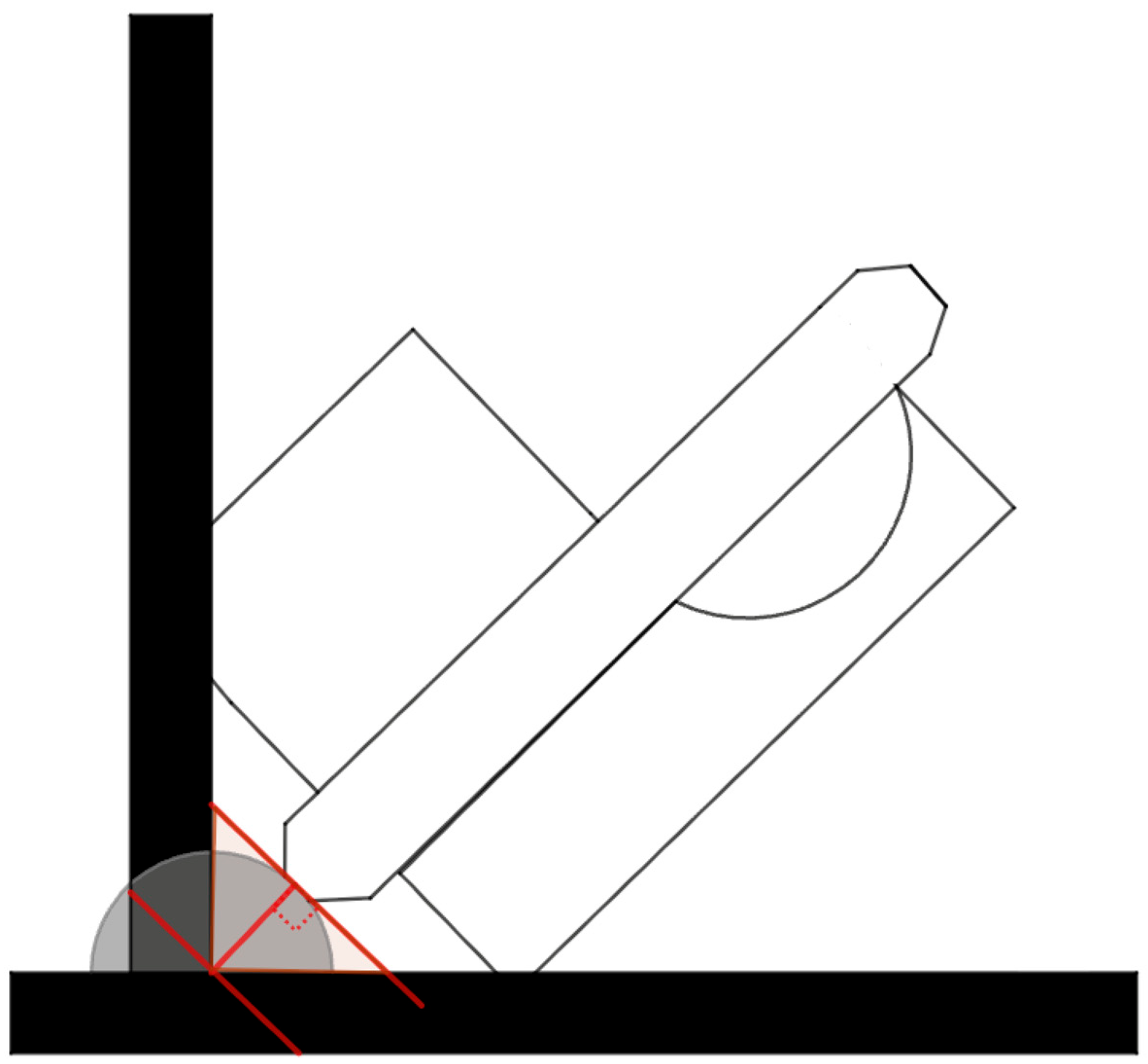
The interdisciplinary module changed the activities of each system, thereby creating contradictions in other nodes and leading to further changes. A notable change in the division of labour (L’) was not only seen in the collaborative preparation of the module, but also when the welding instructor began the module by explaining different types of welds that the students were about to learn when making the specific lampshade. In this context, he also told them about various welding techniques. During the demonstration, a measurement known as “A-dimension”, visualised in
Figure 8, was introduced.
The A-dimension is part of the welding curriculum, and it serves as an indicator of the quality of a weld, which must neither be too large nor too small. It provides a tangible criterion, a distance marked with red between the two parallel red lines in
Figure 8, for assessing the precision and effectiveness of a weld, highlighting the importance of precise measurement in practical applications. Upon hearing this, the mathematics teacher immediately guided the students to consider the geometry underlying this concept, specifically asking which measurement in a triangle corresponds to this distance marked with red in
Figure 8—the height in a triangle. This illustrates a clear interplay between the two disciplines. The welding instructor could have independently highlighted connections to concepts typically taught in the mathematics classroom, but he did not consider this. However, the mathematics teacher actively engaged with the workshop context by adopting its terminology and practical examples to demonstrate to students how a mathematical concept could be applied in this setting. By bringing the language and tangible relevance of the welding environment into the mathematics classroom, the mathematics teacher was able to enhance students’ understanding of the real-world applicability of mathematical concepts and the connection between abstract measurements and technical practice. Overall, the mathematics teacher demonstrated a positive view of adapting instructional practices when confronted directly with the secondary contradiction (between S and C) arising from students’ more embodied and practice-oriented preferences in learning. As the mathematics teacher explained,
“If you notice it as a math teacher, I would immediately start with pencil and paper if I were solving that task. Almost all the students there, however, grab the angle, measure, and fit things by hand. They want to work practically first, before they work with the theoretical part. So, I think there is a lot to gain in terms of understanding when we actually combine the practical and the technical aspects”
[10:36–10:54]
This reflects a change in the artefacts (A) as the mathematics teacher began to incorporate several artefacts (A) from the welding workshop into the mathematics classroom, thereby further strengthening the connections between the two disciplines. One notable example concerned the units of measurement used in the workshop, where welds and other components were routinely assessed in inches and in fractional-inch notation. This practice came as a surprise to the mathematics teacher, as such units were not part of the standard mathematics curriculum, which relied exclusively on the metric system—metres, centimetres, and millimetres. Similarly, this caused a quaternary (between activity systems) contradiction in the rules (R) of the mathematics classroom regarding the conventional Danish mathematical vocabulary. This contradiction led to the incorporation of conventional welding vocabulary, where both the A-dimension and the imperial metric system were included in (R). This discrepancy highlighted a new opportunity for interdisciplinary alignment: The teachers became more aware that introducing these practical units into the mathematics classroom could help bridge the gap between theoretical instruction and real-world application. By familiarising students with both metric and imperial systems, the educators could enhance students’ practical understanding and better connect mathematical concepts to the workshop context. Similarly to the mathematics teacher incorporating welding vocabulary (R) and artefacts (A) in the mathematics classroom, the welding teacher saw opportunities in bringing mathematics into the workshop:
“We are also trying to bring mathematics into the workshop by looking at what kinds of tasks are involved, where we may have previously taken a more pragmatic approach, measuring things directly. So, we try to show our students that instead of drawing something and measuring it, you can also calculate it using some triangle calculations. […] At first, you could more or less guesstimate it on paper and calculate how it would turn out. But how can you draw it on this board before rolling it onto this cone-shaped piece? By using some trigonometry, you can calculate the sides of the cone so that you get the mathematical measurements. In this way, we can bring some trigonometry from mathematics into the workshop.”
[1:01–1:25] & [1:39–2:09]
The statement suggests that the artefacts (A’) and division of labour (L’) of the welding classroom are transformed such that the new triangle calculations, where the A-dimension is connected to trigonometry, also become an artefact (A’) in the welding-classroom system. Moreover, the students’ engagement with these calculations in the welding workshop modifies both the Activity’ and the division of labour (L’). In the Pre-LabSTEM+ phase, a primary contradiction in (R’) regarded avoiding metal waste in the welding workshop. Whether the decision to bring the precision from mathematics into the workshop was caused by this contradiction is difficult to conclude. However, the precision of mathematics incorporated in the welding workshop may lower metal waste, thereby reducing this tension. This aspect could also provide another argument for the relevance of mathematics in welding.
In bringing trigonometry from mathematics into the workshop, many nodes in the two systems became more aligned, and the connection between the courses grows stronger, to the benefit of both. The welding teacher continued:
“The collaboration between our math teacher and us as workshops teachers has a significant impact. On one hand, it allows the math teacher to present concrete, workshop-related tasks that are more meaningful for the students. The students can see the purpose: why are we sitting here, and why do we need to calculate this? They can connect it directly to something they will actually do in the workshop afterwards” … “And we, as subject teachers, also become a bit sharper on the mathematics part. That certainly doesn’t hurt.”
[2:53–3:25]
This latter comment shows a positive affective view on mathematics and its role in welding teaching. This emphasises that the connection between the disciplines is not only practical but also affective. Since the teachers are part of the communities (C) and (C’), this suggests a primary contradiction in both (C) and (C’), as the general community, as previously mentioned, has a more negative view on the theoretical approach that was the Pre-LabSTEM+ version of the mathematics teaching and trouble “seeing” the role of mathematics in the welding classroom. If the teachers’ views influence the students, this could, over time, influence the communities’ view on mathematics and its role in welding. Already, the welding teacher suggests an increase in the students' understanding of and view on mathematics:
“The students’ understanding of mathematics increases as they see that they can use it directly for the tasks they need to perform. This has a lot to do with the fact that the precision of their work improves, because they can calculate it accurately. They transfer the mathematics they have learned—their calculations—into practice in the workshop and see that it actually works out perfectly in reality.”
[2:16–2:43]
Student 1 supports this claim:
“The teacher starts [Pre-LabSTEM+] by showing us how to simply draw things and do them by hand, which is what I did at first. But afterwards [During LabSTEM+], I got the mathematics hand-out showing how they wanted it done mathematically, and I can actually see the advantage of that when I go through the drawing… Now I at least know that it’s really useful to apply Mathematics in our work.”
[15:00–15:19]
This shows a change in the student view on mathematics, and this strengthens the primary contradiction in (C) and (C’), while again supporting that the connection built between the disciplines is effective. This tension is also suggested by Student 3:
“We’ve learned what it is, basically. When we first have it in our hands and also some theory about it, we gain a better understanding of it before we go out and actually do it in a practical way”.
[5:41–5:52]
This was again supported by Student 2:
“Well, for the whole year, I think… I still don’t find mathematics the most exciting subject, but it also makes sense that it’s important to have it, because you actually end up using it when you go out to work" ... “Sometimes, during mathematics class, you might think, “What am I actually going to use this for?” But in this course [LabSTEM+], you really get an insight into how it’s used in real life. For me, the best part of the course has been gaining a clearer understanding of what I will actually use mathematics for in practice, instead of just wondering why I need it.”
[6:45–6:53] & [8.01–8:16]
These student quotes all suggest a nuanced view on mathematics in contrast with the Pre-LabSTEM+ general view of the community (C, C’). It suggests that they have a positive new insight regarding the relevance of mathematics for their future work and practice in school, from bringing mathematics into the workplace and vice versa. The mathematics teacher elaborated on this connection:
“If you were to do it [Directly use mathematics in the workplace] every single time, it would simply take too long for the reality they face in the workplace. So sometimes you skip steps where the risk is lowest and rely on tables instead. I hope the students understand that there is mathematics behind it; otherwise, we wouldn’t be able to know all that we do. But we have scaled it down so that it’s also efficient to use, and I hope they get an idea of that.”
[11:51–12:11]
This shows that the teacher reflects on the future possibilities for realistically evolving the connection between mathematics and the welding workshop. Taken together, these developments illustrate how the LabSTEM+ collaboration gradually reconfigured both activity systems, reducing long-standing quaternary contradictions between theoretical mathematics and practical welding. By renegotiating the nodes of each activity system, the teachers and students collectively forged new pathways for integrating conceptual and embodied forms of knowledge. The emerging practical and affective connections between the disciplines suggest not only improved learning outcomes in the short term but also the potential for more sustainable interdisciplinary practices within vocational education.
6. Discussion
The pre-LabSTEM+ configuration closely resembles patterns described in vocational mathematics research, such as disciplinary separation, different epistemic purposes of school and workplace mathematics, and the persistent invisibility of mathematical reasoning in practice (
Lave, 1988;
Nunes et al., 1993;
Smith, 1999;
Hoyles et al., 2001). Mathematics in the classroom was organised around symbolic mastery, whereas in the welding workshop, it functioned as embedded, tacit reasoning subordinated to craft production. In this sense, the case confirms
Devlin’s (
1996) observation that mathematics often masks the complexity of phenomena's structures. However, while earlier research primarily describes this separation as a structural difference between school and workplace cultures, the LabSTEM+ study makes visible how this divergence is reproduced and stabilised through the configuration of activity systems. The lack of teacher coordination, the absence of shared artefacts, and the compartmentalised division of labour did not merely reflect epistemic differences—they actively maintained them. Mathematics appeared disconnected, not because it was irrelevant to welding, but because the mediating structures between the two domains were institutionally absent. This points to a shift from understanding relevance as a property of content toward understanding it as an effect of mediated relations within and across learning environments. Much prior research frames the problem as one of relevance (
Nicol, 2002;
Noss et al., 2000). The present findings suggest that the challenge may be more precisely understood as one of relational organisation. The invisibility of mathematics was not simply a cognitive deficit in students’ recognition of relevance, but a systemic outcome of how disciplinary boundaries were enacted in practice. This aligns with
Svendsen’s (
2026) performative approach to educational practice, where what becomes visible and meaningful as mathematics depends on how tasks, artefacts, expectations, and participation are configured.
6.1. Relevance as Structural Alignment
Vocational policy and learning theory, from
Dewey (
1916) to contemporary Danish policy (
Børne- og Undervisningsministeriet, 2022), emphasise the need for education “through occupation”. Similarly,
Nicol (
2002) argues for applied, workplace-oriented approaches that move beyond textbook contextualization. The LabSTEM+ project can initially be read as an enactment of this principle. Yet what differentiates this case from typical contextualization strategies is not merely the use of vocational examples, but the restructuring of relations between teachers, artefacts, and objects of activity. The A-dimension episode illustrates this shift. Rather than adding a workplace-themed problem to mathematics instruction, the teachers co-constructed a shared object where precision in welding was taught as geometrically structured measurement. In this way, welding terminology entered mathematics discourse, and geometric reasoning was reinterpreted in light of craft practice. What became visible here was not only the applicability of mathematics but the interdependence of disciplinary perspectives. This extends earlier accounts of reciprocal knowing and doing (
Noss et al., 2000) by showing how such reciprocity is not situated within a single practice but orchestrated across environments through deliberate coordination. Thus, relevance did not arise spontaneously from authentic tasks; it emerged from structural realignment between disciplines—a realignment that can be seen as a curated reconfiguration of the conditions under which knowing becomes possible. At the same time, the study confirms longstanding cautions that school and workplace mathematics differ fundamentally in structure and purpose (
Lave, 1988;
Nunes et al., 1993). Calculations were often completed in the mathematics classroom rather than directly in the workshop. Environmental noise, spatial constraints, and production rhythms limited extended symbolic work in situ. Therefore, integration should not be interpreted as disciplinary fusion. Instead, what emerged was a partial alignment that preserved epistemic differences while enabling conceptual bridges.
6.2. From Motivation to Recognition
Students’ reported shifts in perception align with research linking engagement to vocational relevance (
Dalby & Noyes, 2015;
Gillespie, 2000;
Hetmar, 2013). Students articulated a clearer understanding of why mathematics mattered when it was connected to workshop tasks. However, interpreting this change solely as increased motivation risks overstating attitudinal change and overlooking the relational, material, affective, and experiential dimensions of learning environments, where engagement emerges through situated participation (
Svendsen, 2026). What appears to have shifted was not necessarily students’ intrinsic appreciation of mathematics as a subject, but their recognition of its function within craft practice. Mathematics moved from being experienced as an externally imposed theory to becoming an internal resource for improving precision. In this respect, the findings suggest a nuance that perceived relevance may operate through changes in how disciplinary objects are positioned within students’ professional identities. Still, caution is necessary. The study does not provide longitudinal evidence of retention effects (
Danmarks Statistik, 2019;
Mahler et al., 2023). What can be concluded is that during the intervention, students articulated stronger recognition of mathematics’s applicability. Whether this recognition translates into durable engagement remains an open empirical question.
6.3. Teacher Collaboration
Earlier research emphasises teacher engagement with workplace contexts as a strategy for improving vocational relevance (
Hogan & Morony, 2000;
Nicol, 2002;
Noss et al., 2000). In this study, collaboration did not merely supply contextual examples, but it also altered divisions of labour. The mathematics teacher adopted workshop artefacts and measurement systems, while the welding teacher incorporated geometric reasoning into craft tasks. This mutual transformation reflects a redistribution of epistemic responsibility across professional roles, where knowledge production becomes a shared and negotiated process (
Engeström, 2001). Yet such reconfiguration obviously introduces new demands. Cross-classroom collaboration requires time, planning, institutional support, and willingness to renegotiate professional routines. Given that a substantial proportion of vocational mathematics teachers lack formal mathematical qualifications (
Børne- og Undervisningsministeriet, 2022), sustaining such collaboration may depend on systematic professional development rather than individual initiative. The present case demonstrates what becomes possible under coordinated conditions. It does not establish that such alignment persists beyond project support. Thus, the findings raise an institutional question:
Are interdisciplinary collaborations in vocational mathematics structurally enabled or project-bound exceptions?
On the note of collaboration, we must also keep in mind that the findings show a collaborative dynamic of willing teachers with an open mindset to actively learn from each other, which raises the following question:
To what extent does the collaborative dynamic between instructors in an interdisciplinary context play an enabling factor for success?
6.4. Materiality
Workplace mathematics has long been described as contextually embedded and operational rather than formally articulated (
Lave, 1988;
Nunes et al., 1993;
Hoyles et al., 2001). The present findings deepen this insight by showing how material conditions actively shape what mathematics becomes. Environmental noise, safety rules, and production constraints limited extended symbolic calculation in the workshop. Mathematics, therefore, functioned as pre-calculation, approximation, or table-based reasoning, enacted differently across environments. This supports a view of mathematics as materially mediated and contextually reconfigured rather than simply transferred between domains (
Svendsen, 2026). The imperial-metric discrepancy provides a concrete example of this. What initially appeared as curricular misalignment became a boundary object linking formal mathematical systems with embedded workshop practices. Rather than treating the discrepancy as a deficit, teachers leveraged it as a site of translation. In this sense, the case shows that mathematics in vocational education does not travel unchanged from classroom to workshop, but it is enacted differently depending on spatial, temporal, and practical conditions.
Socio-Materiality
Building on our analysis of how relevance emerged through structural alignment between the mathematics classroom and the welding workshop, this concept can be further specified through a sociomaterial, practice-based perspective (
Svabo, 2009). In our study, structural alignment is not understood as a static correspondence between curriculum and vocational practice, but as a reconfiguration of relations between artefacts, division of labour, rules, and objects of activity across learning environments. From a practice-based perspective on materiality, such alignment can be seen as an ongoing sociomaterial accomplishment. Rather than being given, alignment emerges through the coordination and mediation of human and non-human elements in practice, where artefacts such as tools and mathematical representations actively participate in shaping action and meaning-making. In this sense, the alignment we observed in the LabSTEM+ intervention, such as the integration of the A-dimension and the circulation of artefacts across settings, can be understood as temporary stabilisations of relations that enabled mathematics to become visible and meaningful within vocational activity.
This also nuances the question of sustainability. If relevance emerges through such sociomaterial alignments, it cannot be secured solely through a time-bound intervention. Instead, its persistence depends on whether these relations continue to be reproduced in practice. As practice-based approaches emphasise, stability is not an inherent property of structures, but an effect of ongoing performance and alignment work (
Svabo, 2009). This implies that long-term relevance requires that the reconfigured relations, like shared artefacts and coordinated teaching practices, become embedded in everyday teaching routines and institutional arrangements.
6.5. Toward a Relational Understanding of Vocational Mathematics
Taken together, the findings confirm core patterns identified in vocational mathematics research: disciplinary separation, invisibility of mathematical reasoning, and engagement challenges when relevance is unclear. However, the case extends the prior understanding in three ways:
Invisibility is seen as a relational outcome of institutional configurations rather than solely a cognitive recognition problem.
Relevance emerges through structural alignment between activity systems, not merely through contextualised tasks.
The material co-production of mathematical form is highlighted as important, showing that vocational mathematics is reconfigured rather than simply applied.
Across these points, the study contributes to a line of research that understands educational environments as shaping the conditions under which disciplinary knowledge is visible, usable, and meaningful. Importantly, the findings do not suggest that vocationalisation alone resolves motivational or structural challenges. Rather, sustainable integration appears to depend on coordinated pedagogical structures that acknowledge differences between school and workplace reasoning while deliberately negotiating their relations. Thus, the contribution of this study lies in showing how such relevance is enacted through the reorganisation of disciplinary relations, artefacts, and professional practices. In this sense, the case illustrates how transitions in STEM education can be understood as transformations in mediated relations across environments rather than as shifts in learner attitudes alone.




 ,
,