Lecturer Agency in the Enactment of CEFR-Based Curriculum Internationalisation: Lessons Learned from Indonesian Higher Education


 ,
,
Abstract
1. Introduction
2. Materials and Methods
2.1. Research Design
2.2. Research Context and Materials
2.3. Participants
2.4. Data Collection Procedures
2.5. Data Analysis
2.6. Trustworthiness and Ethical Considerations
2.7. Data Availability
3. Results
The global trend at the moment is that our alumni expect to work as English lecturers at universities in Indonesia or around the world. … We have no choices but to let them go with at least 500 TOEFL scores or C1 or C2 levels of CEFR. … this proficiency is integrated in all units in the curriculum.(AM, 56 y.o., head of department)
3.1. Iterational–Interpretive Agency: Reframing CEFR C1/C2 in Curriculum Documents
…. To teach at ASEAN levels, you need to have C1 level of competency. We do not have the capacity to assess you. The only thing we could do is publishing an article in accredited journals. We can do it, right?(KM, 60 y.o., EBE lecturer)
Secondly, 10 out of iterational-interpretive dimensions of agency exercise are related to status and identities. The lecturers have also made use of the statuses of the department and the identities of the lecturers and the students. Being in the Global South, the department’s curriculum has promoted local sociocultural contexts of Lombok, Nusatenggara and Indonesia as parts of its core contents while at the same time integrating them with those of the global world. The lecturers being professionally trained at doctorate levels at internationally recognised institutions have established professional experiences in the target standards and they, thus, have the capacity to assist students attaining the target goals. The students being EFL learners in the Extended Circle with limited access to English and low English proficiency (i.e., average TOEFL score of 435 out of 667) are in need of access to English and extra language trainings and the department’s curriculum accommodate these needs with courses related to language skills such as Grammar for Language Teachers and Writing for Publication in addition to oral and written paper presentation as student’s outcomes in all units of the study. One of the lecturers narrated in interview her successful experience of helping student’s publication amidst the limitation,
At the beginning, we were doubtful if students could attain the [global] standards. Attainable. After hard work, all our alumni could publish at international journals. No reasons for our current students to abandon it.(YN, 50 y.o., CDW lecturer, emphasis added)
…. [S]tudents producing oral and written papers in all courses have been the cur-rent standards. In the past, we focused on examinations. Now, we change. The lecturers and the students collaborate for the standards.(GKM team leader, 54 y.o. our translation)
3.2. Practical–Evaluative–Adaptive Agency: Enacting CEFR C1/C2 Through Classroom Practices
I know you don’t like reading that much. You have to do it. Like it or not, reading is the key [to success]. With the assignment [that] you have submitted to me I am not really happy with them. At least you need to sign of analysis, synthesis and evaluation in it as you are at postgraduate level.(YD, 63 y.o. CELT lecturer, emphasis added)
My class deal with ELT business proposal and report. [The students] need to have ELT-related businesses, which they don’t always have. I invited a former student and a [successful] entrepreneur to work with them. She helped a lot.(BH, 60 y.o. EBE lecturer, emphasis added)
In CDW, [the students] critically engage with workplace discourses. Emails, meeting transcripts, [and] office documents are analysed, power dynamics [are] discussed. [it is difficult] [but] I am not seeking flawless English. I desire for students to comprehend the manner in which language functions in actual professional settings. That is a more advanced level for me.(MQ, 65 y.o. CDW lecturer, emphasis added)
3.3. Projective–Transformative Agency: Re-Envisioning CEFR and Curriculum Internationalisation
4. Discussion
5. Conclusions
Author Contributions
Funding
Institutional Review Board Statement
Informed Consent Statement
Data Availability Statement
Conflicts of Interest
Abbreviations
| CEFR | Common European Framework of Reference for Languages |
| CDW | Critical Discourse in Workplaces |
| CELT | Contemporary English Language Teaching |
| EBE | ELT-Based Entrepreneurship |
References
- Ahmad Afip, L., Hamid, M. O., & Renshaw, P. (2019). Common European framework of reference for languages (CEFR): Insights into global policy borrowing in Malaysian higher education. Globalisation, Societies and Education, 17(3), 378–393. [Google Scholar] [CrossRef] [Scilit]
- Ali, Z. M., Razzaly, W., Muhamad, I. I., Razak, M. A., Ali, Z., Abidin, I., Abdullah, S., & Akmal, S. (2018). Towards strategic internationalisation and global prominence: Modelling continuous quality improvement for sustainable internationalisation of the Malaysian technical universities. In ICERI2018 Proceedings (pp. 6898–6908). IATED. [Google Scholar]
- Archanjo, R. (2017). Moving globally to transform locally? Academic mobility and language policy in Brazil. Language Policy, 16(3), 291–312. [Google Scholar] [CrossRef] [Scilit]
- Bakar, E. W. (2020). Can-do descriptors—Realigning English language curriculum at higher education institution to CEFR. International Journal of Modern Languages and Applied Linguistics (IJMAL), 4(2), 84–97. [Google Scholar] [CrossRef] [Scilit]
- Baldauf, R. B. (2006). Rearticulating the case for micro language planning in a language ecology context. Current Issue in Language Planning, 7(2–3), 147–170. [Google Scholar] [CrossRef] [Scilit]
- Baldauf, R. B., & Hamid, M. O. (2018). Language planning “schools” and their approaches and methodologies. In F. Lisa, N. Jiri, & S. Marian (Eds.), The language management approach: A focus on research methodology (pp. 43–66). P I E—Peter Lang. [Google Scholar]
- Biesta, G., & Tedder, M. (2006). How is agency possible? Towards an ecological understanding of agency-as-achievement. Learning Lives Work Papers, 5, 1–40. Available online: http://hdl.handle.net/10993/13718 (accessed on 21 January 2026).
- Byram, M. (2022). Politics, origins and futures of the CEFR. The Language Learning Journal, 50(5), 586–599. [Google Scholar] [CrossRef] [Scilit]
- Canagarajah, A. S. (2005). Reclaiming the local in language policy and practice. Routledge. [Google Scholar]
- Council of Europe. (2001). Common European framework of reference for languages: Learning, teaching, assessment. Cambridge University Press. Available online: https://www.coe.int/t/dg4/linguistic/Source/Framework_EN.pdf (accessed on 18 March 2025).
- Demirel, İ. F., & Fakazlı, Ö. (2021). A CEFR-based comparison of English and Turkish language teaching course books in terms of speaking and writing skills. Journal of Theoretical Educational Science, 14(2), 167–185. [Google Scholar] [CrossRef] [Scilit]
- de Wit, H. (2019). Internationalization in higher education, a critical review. SFU Educational Review, 12(3), 9–17. [Google Scholar] [CrossRef] [Scilit]
- de Wit, H., & Altbach, P. G. (2021). Internationalization in higher education: Global trends and recommendations for its future. Policy Reviews in Higher Education, 5(1), 28–46. [Google Scholar] [CrossRef] [Scilit]
- Du, X., & Curdt-Christiansen, X. L. (2026). Teacher agency in practiced language policy in higher education in East and Southeast Asia (2010–2025): A systematic review. Teaching and Teacher Education, 171, 105345. [Google Scholar] [CrossRef] [Scilit]
- Dwinalida, K., & Maulia, B. P. (2024). Does CEFR (Common European Framework of Reference) fit the expectation: Voices from the classroom. INSANIA: Jurnal Pemikiran Alternatif Kependidikan, 29(2), 168. [Google Scholar] [CrossRef] [Scilit]
- Ellis, V., & Spendlove, D. (2020). Mediating ‘School Direct’: The enactment of a reform policy by university-based teacher educators in England. British Educational Research Journal, 46(5), 949–966. [Google Scholar] [CrossRef] [Scilit]
- Foley, J. (2022). CLT using CEFR and EIL in Southeast Asia and East Asia in the English language classroom. RELC Journal, 53(1), 240–252. [Google Scholar] [CrossRef] [Scilit]
- Franz, J., & Teo, A. (2018). ‘A2 is normal’—Thai secondary school English teachers’ encounters with the CEFR. RELC Journal, 49(3), 322–338. [Google Scholar] [CrossRef] [Scilit]
- Guarda, M. (2025). Fostering educational change at the intersection of macro-level institutional narratives and micro-level classroom experiences. Education Sciences, 15, 472. [Google Scholar] [CrossRef] [Scilit]
- Hamid, H. A., Fakhruddin, W. F. W. W., Afip, L. A., & Hamid, M. O. (2025). Navigating global standards in local contexts: A systematic review of CEFR-aligned English language curriculum in the ASEAN region. Journal of Nusantara Studies (JONUS), 10(1), 324–352. [Google Scholar] [CrossRef] [Scilit]
- Hamid, M., & Ali, M. (2022, November 22). Language planning and education in Asia. Oxford Research Encyclopedia of Education. Available online: https://oxfordre.com/education/view/10.1093/acrefore/9780190264093.001.0001/acrefore-9780190264093-e-1804 (accessed on 29 January 2026).
- Hamid, M. O. (2016). The politics of language in education in a global polity. In K. Mundy, A. Green, B. Lingard, & A. Verger (Eds.), The handbook of global education policy (pp. 259–274). Wiley Blackwell. [Google Scholar]
- Hamid, M. O., & Nguyen, H. T. M. (2016). Globalization, English language policy, and teacher agency: Focus on Asia. The International Education Journal: Comparative Perspectives, 15(1), 26–44. [Google Scholar]
- Higgins, R. M., & Brady, A. (2018). Language policy, planning, and enactment: The necessity and empowering potential at the local level. In Language policy and planning in universities (pp. 12–29). Routledge. [Google Scholar]
- Hoinbala, F. R. (2025). The need for a standardized framework for language assessment in Indonesia: Could the CEFR be a solution? In N. N. Benu, & P. M. Jonathans (Eds.), Innovations in language learning: Pedagogical strategies and linguistic insights (pp. 112–131). Artha Wacana Press. [Google Scholar]
- Hornberger, N. H. (2015). Selecting appropriate research methods in LPP research. In F. M. Hult, & D. C. Johnson (Eds.), Research methods in language policy and planning (pp. 9–20). Wiley Blackwell. [Google Scholar]
- Jehdo, K., Yossiri, V., Hayeesani, M., Vongsvivut, S., & Paramal, N. (2024). Challenges and benefits of developing CEFR for languages-aligned writing assessments for Thai EFL learners: A case study on Yala Rajabhat University Test of English Proficiency. Arab World English Journal, 15(1), 352–367. [Google Scholar] [CrossRef] [Scilit]
- Johnson, D. C., & Freeman, R. (2010). Appropriating language policy on the local level: Working the spaces for bilingual education. In Negotiating language policies in schools (pp. 27–45). Routledge. [Google Scholar]
- Kang, H. S. (2025). Language teacher agency and identity in internationalized higher education: An ecological perspective. International Journal of Applied Linguistics, 35(2), 555–565. [Google Scholar] [CrossRef] [Scilit]
- Kanjananiyot, P., & Chaitiamwong, C. (2018). The internationalization of Thai higher education over the decades: Formidable challenges remain! In Education in Thailand: An old elephant in search of a new mahout (pp. 271–321). Springer. [Google Scholar]
- Kentmen, H., Debreli, E., & Yavuz, M. A. (2023). Assessing tertiary Turkish EFL learners’ pragmatic competence regarding speech acts and conversational implicatures. Sustainability, 15(4), 3800. [Google Scholar] [CrossRef] [Scilit]
- Lee, H. Y., Hamid, M. O., & Hardy, I. (2024). Language policy at the supranational level: English and the ASEAN (Vol. 37). Springer Nature. [Google Scholar]
- Li, Z., Li, J. Z., Zhang, X., & Reynolds, B. L. (2024). Mastery of listening and reading vocabulary levels in relation to CEFR: Insights into student admissions and English as a medium of instruction. Languages, 9(7), 239. [Google Scholar] [CrossRef] [Scilit]
- Lingard, B. (2018). Reforming education: The spaces and places of education policy and learning. In E. Hultqvist, S. Lindblad, & T. Popkewitz (Eds.), Critical analyses of educational reforms in an era of transnational governance (Vol. 7, pp. 37–49). Springer. [Google Scholar] [CrossRef] [Scilit]
- Lingard, B. (2020). Globalisation and education: Theorising and researching changing imbrications in education policy. In Globalisation and education (pp. 1–27). Routledge. [Google Scholar]
- Maryo, F. A. A. (2021). The issues of the implementation of CEFR in Indonesia. Aplinesia (Journal of Applied Linguistics Indonesia), 5(1), 18–22. [Google Scholar]
- Mohamad Uri, N. F., & Abd Aziz, M. S. (2018). Neoliberalism and its impact on English as a medium of instruction in Malaysia, Thailand and Vietnam. Journal of Creative Practices in Language Learning and Teaching (CPLT), 6(1), 17–29. [Google Scholar]
- Muliastuti, L. (2024). CEFR-based model of Indonesian grammar teaching materials for foreign students. KnE Social Sciences. [Google Scholar]
- Namgung, W., Moate, J., & Ruohotie-Lyhty, M. (2023). An ecological approach to teacher agency in English curriculum design at Korean secondary schools. Curriculum and Teaching, 38(1), 67–84. [Google Scholar] [CrossRef] [Scilit]
- Nguyen, V. H., & Hamid, M. O. (2021). The CEFR as a national language policy in Vietnam: Insights from a sociogenetic analysis. Journal of Multilingual and Multicultural Development, 42(7), 650–662. [Google Scholar] [CrossRef] [Scilit]
- Normand-Marconnet, N., & Lo Bianco, J. (2015). The Common European Framework of Reference down under: A survey of its use and non-use in Australian universities. Language Learning in Higher Education, 5(2), 281–307. [Google Scholar] [CrossRef] [Scilit]
- Pereira, A., & Kobayashi, E. (2021). Internationalization and English language in a public institution. Independent Journal of Management & Production, 12(9), s794–s811. [Google Scholar] [CrossRef] [Scilit]
- Phantharakphong, P., & Liyanage, I. (2026). The professional development (PD) paradox: How policy shapes English teacher identity and constrains authentic learning in Thailand. Education Sciences, 16(1), 117. [Google Scholar] [CrossRef] [Scilit]
- Priestley, M., Biesta, G., & Robinson, S. (2015). Teacher agency: An ecological approach. Bloomsbury. [Google Scholar]
- Priestley, M., & Drew, V. (2019). Professional enquiry: An ecological approach to developing teacher agency. In An ecosystem for research-engaged schools (pp. 154–169). Routledge. [Google Scholar]
- Priestley, M., Robinson, S., & Biesta, G. (2011, 20 September). Mapping teacher agency: An ecological approach to understanding teachers’ work. Paper presented at the Oxford Ethnography and Education Conference, Oxford, UK. [Google Scholar]
- Rehner, K., & Lasan, I. (2023). Developing second language learners’ sociolinguistic competence: How teachers’ CEFR-related professional learning aligns with learner-identified needs. Education Sciences, 13(3), 282. [Google Scholar] [CrossRef] [Scilit]
- Sanoh, M., & Ambele, E. A. (2024). Internationalization and Englishes in Thai higher education: Surveying insights from international mobile students in Thailand [Doctoral dissertation, Mahasarakham University]. [Google Scholar]
- Savski, K. (2020). Local problems and a global solution: Examining the recontextualization of CEFR in Thai and Malaysian language policies. Language Policy, 19(4), 527–547. [Google Scholar] [CrossRef] [Scilit]
- Savski, K. (2023). CEFR and the ELT practitioner: Empowerment or enforcement? ELT Journal, 77(1), 62–71. [Google Scholar] [CrossRef] [Scilit]
- Savski, K. (2025). Ideological (dis)entanglements of English in higher education: Comparing an Asian and a European ecology. In Critical intercultural and English language issues in the internationalisation of higher education (pp. 24–37). Routledge. [Google Scholar]
- Soe, N. W., Mangulabnan, P., & Arrecis, A. L. (2023). Reading through English curricula of Cambodia, Guatemala, Japan, Myanmar, and the Philippines: A case study of teacher reflections. In Global perspectives on education research (Vol. II, pp. 169–195). Routledge. [Google Scholar]
- Steiner-Khamsi, G. (2016). New directions in policy borrowing research. Asia Pacific Education Review, 17(3), 381–390. [Google Scholar] [CrossRef] [Scilit]
- Tan, C., & Reyes, V. (2016). Curriculum reform and education policy borrowing in China: Towards a hybrid model of teaching. In C. Chou, & J. Spangler (Eds.), Chinese education models in a global age, education in the Asia-Pacific region (Vol. 31, pp. 37–49). Springer. [Google Scholar]
- Trudell, B., & Piper, B. (2014). Whatever the law says: Language policy implementation and early-grade literacy achievement in Kenya. Current Issues in Language Planning, 15(1), 4–21. [Google Scholar] [CrossRef] [Scilit]
- Tsagari, D., & Armostis, S. (2025). Contextualizing language assessment literacy: A comparative study of teacher beliefs, practices, and training needs in Norway and Cyprus. Educational Sciences, 15(7), 927. [Google Scholar] [CrossRef] [Scilit]
- Umaya, S. (2023). Internationalization of the French language curriculum through the application of the common European framework of reference. Inovasi Kurikulum, 20(1), 61–72. [Google Scholar] [CrossRef] [Scilit]
- Uri, N. F. M. (2021). CEFR in Malaysia: The appropriacy of English syllabus and assessment, stakeholders’ perspectives and challenges [Unpublished doctoral dissertation, Universiti Kebangsaan Malaysia]. [Google Scholar]
- Wang, L. (2022). English language teacher agency in response to curriculum reform in China: An ecological approach. Frontiers in Psychology, 13, 935038. [Google Scholar] [CrossRef] [Scilit] [PubMed]
- Wang, L., & Li, D. (2025). An ecological perspective on language teacher agency in educational reform. Journal of Educational Change, 26(4), 579–598. [Google Scholar] [CrossRef] [Scilit]
- Yusra, K., Hanafi, N., & Lestari, Y. B. (2020). The implementation of common ASEAN tourism curriculum (CATC) in Indonesia. The Asian ESP Journal, 16(2), 90–115. [Google Scholar]
- Yusra, K., Lestari, Y. B., & Hamid, M. O. (2021). Teacher agency and the implementation of CEFR-like policies for English for tourism and hospitality: Insights from local vocational contexts. Current Issues in Language Planning, 23(3), 233–253. [Google Scholar] [CrossRef] [Scilit]
- Yusra, K., Lestari, Y. B., & Susanti, N. W. M. (2023). Integrating supranational and national frameworks into local tourism-related English courses. World Journal of English Language, 13(5), 331–346. [Google Scholar] [CrossRef] [Scilit]
- Zhang, Y. (2025). Higher education regionalization in East and Southeast Asia: Between decolonization, recolonization, and self-colonization. Higher Education, 89(6), 1603–1618. [Google Scholar] [CrossRef] [Scilit]


| Level | Descriptors | |
|---|---|---|
| C1 | 1 | Can understand a wide range of demanding, longer texts and recognise implicit meaning. |
| 2 | Can express ideas fluently and spontaneously without much obvious searching for expressions. | |
| 3 | Can use language flexibly and effectively for social, academic, and professional purposes. | |
| 4 | Can produce clear, well-structured, detailed texts on complex subjects, showing controlled use of organisational patterns, connectors, and cohesive devices. | |
| C2 | 1 | Can understand with ease virtually everything heard or read. |
| 2 | Can summarise information from different spoken and written sources, reconstructing arguments and accounts in a coherent presentation. | |
| 3 | Can express themselves spontaneously, very fluently, and precisely, differentiating finer shades of meaning even in complex situations. | |
| CEFR | Dimensions of Agency Exercises | |||||||
|---|---|---|---|---|---|---|---|---|
| Iterational–Interpretative | Practical–Evaluative–Adaptive | Projective–Transformative | Total | |||||
| F | % | F | % | F | % | F | % | |
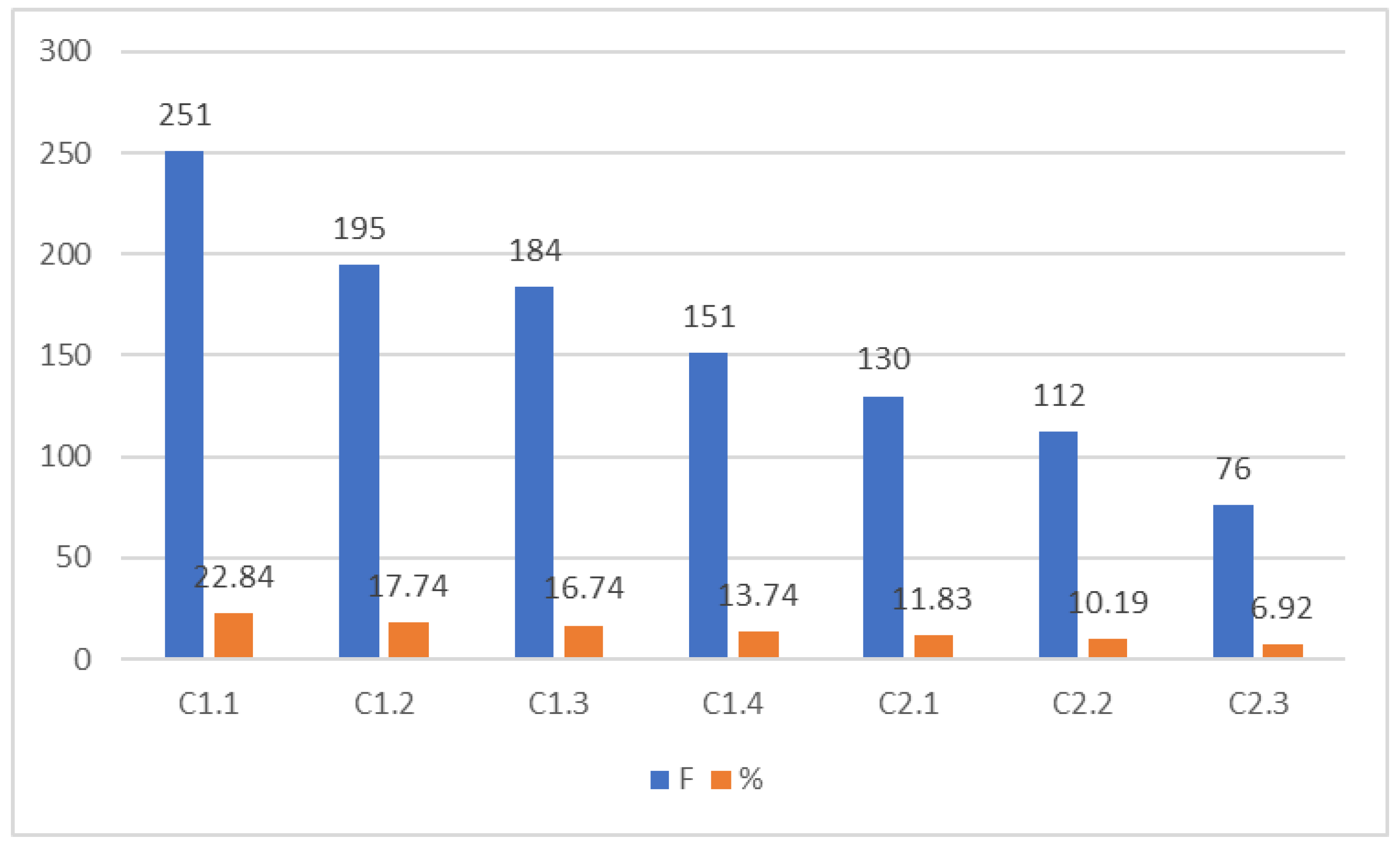
| C1.1 | 76 | 30.28 | 121 | 27.13 | 54 | 63.53 | 251 | 22.84 |
| C1.2 | 60 | 23.90 | 90 | 20.18 | 45 | 52.94 | 195 | 17.74 |
| C1.3 | 51 | 20.32 | 108 | 24.22 | 25 | 29.41 | 184 | 16.74 |
| C1.4 | 40 | 15.94 | 81 | 18.16 | 30 | 35.29 | 151 | 13.74 |
| C2.1 | 33 | 13.15 | 73 | 16.37 | 24 | 28.24 | 130 | 11.83 |
| C2.2 | 28 | 11.16 | 62 | 13.90 | 22 | 25.88 | 112 | 10.19 |
| C2.3 | 20 | 7.97 | 40 | 8.97 | 16 | 18.82 | 76 | 6.92 |
| Total | 308 | 28.03 | 575 | 52.32 | 216 | 19.65 | 1099 | |
Disclaimer/Publisher’s Note: The statements, opinions and data contained in all publications are solely those of the individual author(s) and contributor(s) and not of MDPI and/or the editor(s). MDPI and/or the editor(s) disclaim responsibility for any injury to people or property resulting from any ideas, methods, instructions or products referred to in the content. |
© 2026 by the authors. Licensee MDPI, Basel, Switzerland. This article is an open access article distributed under the terms and conditions of the Creative Commons Attribution (CC BY) license.
Share and Cite
Lestari, Y.B.; Yusra, K.; Nuriadi, N.; Muhaimi, L.; Nawawi, N.; Wanasatya, B.J.O. Lecturer Agency in the Enactment of CEFR-Based Curriculum Internationalisation: Lessons Learned from Indonesian Higher Education. Educ. Sci. 2026, 16, 369. https://doi.org/10.3390/educsci16030369
Lestari YB, Yusra K, Nuriadi N, Muhaimi L, Nawawi N, Wanasatya BJO. Lecturer Agency in the Enactment of CEFR-Based Curriculum Internationalisation: Lessons Learned from Indonesian Higher Education. Education Sciences. 2026; 16(3):369. https://doi.org/10.3390/educsci16030369
Chicago/Turabian StyleLestari, Yuni Budi, Kamaludin Yusra, Nuriadi Nuriadi, Lalu Muhaimi, Nawawi Nawawi, and Baiq Jihan Olvy Wanasatya. 2026. "Lecturer Agency in the Enactment of CEFR-Based Curriculum Internationalisation: Lessons Learned from Indonesian Higher Education" Education Sciences 16, no. 3: 369. https://doi.org/10.3390/educsci16030369
APA StyleLestari, Y. B., Yusra, K., Nuriadi, N., Muhaimi, L., Nawawi, N., & Wanasatya, B. J. O. (2026). Lecturer Agency in the Enactment of CEFR-Based Curriculum Internationalisation: Lessons Learned from Indonesian Higher Education. Education Sciences, 16(3), 369. https://doi.org/10.3390/educsci16030369