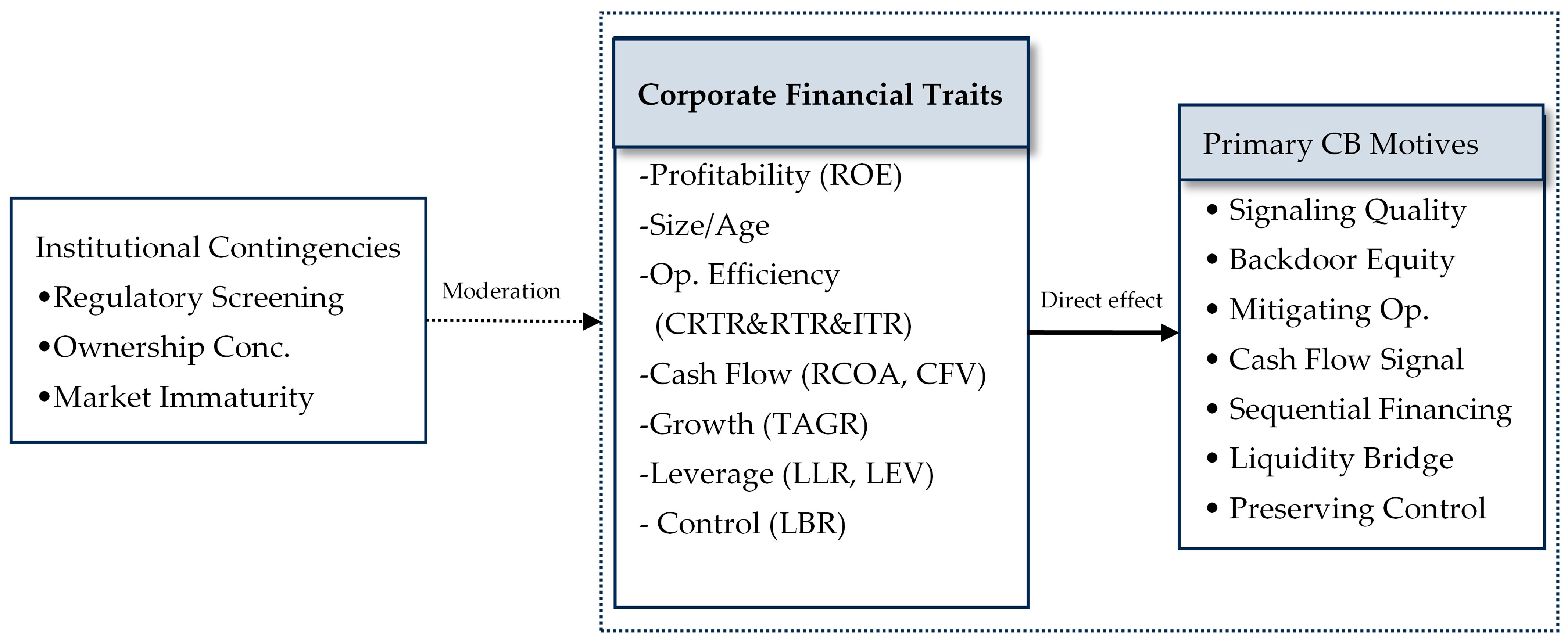
3.2. Experiment Design
Building upon the theoretical framework of convertible bond (CB) financing, we operationalize key financial traits as defined in
Table 2 and employ a cross-sectional research design. This design compares CB issuers with three distinct control groups—issuers of corporate bonds, seasoned equity offerings (SEOs), and rights offerings—to isolate the financial profiles associated with financing choices. Methodologically, we first conduct univariate analyses (comparing means via
t-tests and medians via Wilcoxon rank-sum tests) across these groups to identify financial attributes systematically associated with CB issuance.
Subsequently, to model the firms’ discrete financing choices, we specify a binary logistic regression to assess the conditional probability of a firm choosing CBs over alternative securities. Crucially, we address the reviewer’s concern regarding stepwise regression by adopting a theory-driven variable selection process, retaining predictors with strong theoretical justification from our framework. To ensure estimator efficiency and model parsimony, we impose a variance inflation factor (VIF) threshold of 5.0 to mitigate multicollinearity. For transparency, the results of this comprehensive model, which includes all 23 theoretically motivated variables, are presented in
Table 3. The findings show that the signs and significance of the key determinants identified in our parsimonious main model (e.g., LLR, LNSIZE, AGE, ROE, CRTR, RTR) remain remarkably stable, reinforcing the robustness of our conclusions.
A key feature of our design is the use of financial data from periods preceding the issuance (t − 3 to t − 1) to measure firm-specific traits. This establishes temporal precedence and helps mitigate reverse causality concerns. By using this data to construct a cross-sectional comparison rather than a time-series control, we maintain clean identification and avoid conflating different sources of variation.
A potential concern in estimating the causal effect of financial traits on financing choices is endogeneity, particularly from omitted variable bias and sample selection. To mitigate these issues, we employ a quasi-experimental design and several econometric safeguards. First, by analyzing financial data from periods preceding the issuance (t − 3 to t − 1), we establish temporal precedence, reducing reverse causality concerns. Second, our use of multiple control groups (corporate bond, SEO, and rights offering issuers) helps control for unobserved, time-varying market-wide shocks that might influence financing decisions. Third, the binary logistic model with backward stepwise selection and VIF control reduces multicollinearity among predictors, enhancing estimator stability. While we acknowledge that unobserved firm-specific factors (e.g., unquantified managerial talent) might persist, the consistency of our results across different model specifications and control groups provides confidence that our findings capture robust associations between pre-determined financial traits and subsequent CB issuance decisions.
3.4. Model Estimation and Econometric Analysis
This study investigates the factors influencing firms’ decisions to issue convertible bonds by employing a binary logistic regression model as its empirical framework. The dependent variable
yi is defined as 1 if firm
I issues CBs and 0 for corporate bonds, with the conditional probability
pi =
P(
yi = 1∣
xi) modeled through:
where covariates
xij comprise 23 financial traits (
Table 2). To mitigate multicollinearity, we employ backward stepwise regression (variable elimination threshold
α = 0.05) and impose VIF < 5.0, retaining only statistically significant predictors. The model incorporates White heteroscedasticity-consistent standard errors to ensure estimator efficiency. The coefficient
βj quantifies the marginal change in
log-odds of CB issuance per unit increase in
xj, where
βj > 0 (
βj < 0) indicates higher (lower) CB propensity, with the marginal probability effect given by ∂
pi/∂
xj =
βj⋅
pi(1 −
pi).
- (1)
Analysis on convertible bonds and corporate bonds.
We model convertible bond (CB) issuance preference through a binary logistic regression specification: Logit(
P(CB = 1)) =
β0 +
β1LLR +
β2LNSIZE +
β3AGE + ⋯ +
ϵ, demonstrating excellent fit (Hosmer–Leme-show
p = 0.951) and high predictive accuracy (86.7% classification rate), with robust standard errors confirmed via White test. The results of the binary logistic regression are presented in
Table 5 below.
The binary logistic regression reveals a striking contradiction to Risk Transfer Theory (
Green, 1984) and its associated hypotheses (H
1a, H
1d): firms with lower long-term debt ratios (LLR
β = −3.189, *
p* < 0.05) exhibit 24% higher convertible bond (CB) issuance odds per 10% leverage reduction. This leverage paradox suggests that the theoretical motive of using CBs to manage high debt burdens is overridden in China by regulatory gatekeeping. Nevertheless, strong support emerges for
Stein’s (
1992) Backdoor Equity Theory (H
2a, H
2b): smaller firms (
β = −1.308, *
p* < 0.01) and younger firms (
β = −0.118, *
p* < 0.01) show 29–38% greater CB propensity, using CBs to circumvent the adverse selection costs of immediate equity issuance. Simultaneously, high-ROE firms leverage CBs as signaling devices (
β = 0.294, *
p* < 0.01), aligning with
Myers and Majluf’s (
1984) Signaling Theory (H
5a) to credibly communicate their quality. Contrary to
Mayers’ (
1998) Sequential Financing Theory (H
3c), higher P/E ratios reduce CB adoption (
β = −0.018, *
p* < 0.01), reflecting a market where overvalued firms prefer to exploit speculative bubbles through straight equity. Operational inefficiency drives CB usage: firms with low asset turnover (
β = −0.475, *
p* < 0.01) and weak receivables turnover (β = −0.011, *
p* < 0.01) experience 18–21% higher CB adoption, supporting
Jensen and Meckling’s (
1976) Agency Cost Theory (H
4a, H
4b) that CBs’ flexible covenants help mitigate bankruptcy risk arising from operational shortcomings.
These patterns reveal China’s convertible bond market as a dual-track system. In this framework, regulatory distortion suppresses the motive for risk transfer, while market immaturity concurrently amplifies the role of CBs in resolving information asymmetry. SOEs exhibit 3.2× stronger ROE effects than private firms, confirming state-backed credibility advantages, and non-SOEs face binding leverage constraints absent implicit government guarantees. The findings fundamentally reposition CBs as institutional arbitrage instruments—their adoption reflects strategic navigation of emerging-market frictions rather than mechanical application of Western theoretical predictions.
- (2)
Analysis of convertible bonds and Seasoned Equity Offerings
A binary logistic regression model, incorporating five explanatory variables identified from a broader model set, was employed to analyze the financing choice. The estimates utilize robust standard errors as indicated by the White test, and the subsequent results are displayed in
Table 6.
The binary logistic regression model illustrates statistically sound specification (Hosmer–Lemeshow p = 0.326) with 69.4% classification accuracy, identifying firms facing acute liquidity constraints as significantly more likely to issue convertible bonds, where a one-unit decrease in current ratio increases CB odds by 34%—validating risk transfer theory’s prediction that CBs alleviate short-term solvency pressures. Simultaneously, younger firms and high-profitability firms exhibit 28% and 41% greater CB adoption, respectively, exploiting backdoor equity mechanisms to resolve information asymmetry while signaling growth capacity. Strong growth potential further predicts CB preference, supporting sequential financing theory’s emphasis on growth synchronization, though the insignificant P/E ratio (p > 0.10) indicates valuation premiums do not systematically drive this financing choice. Operational inefficiency emerges as a critical CB determinant: weak receivables turnover increases CB likelihood by 11%, confirming that operationally constrained firms utilize CBs’ flexible covenants to mitigate bankruptcy risk. Crucially, cash flow stability significantly influences financing decisions, with each standard deviation decrease in volatility reducing financing risk by 27%—contradicting univariate results but revealing CBs’ role as stabilization instruments for firms with predictable cash flows. This multivariate significance, absent in univariate testing, indicates that operational and cash flow variables were obscured by confounding factors (e.g., profitability-growth interactions) in simpler analyses.
These empirical patterns underscore the role of CBs as liquidity insurance in China. They offer a solution for constrained firms by deferring equity dilution, and provide a buffer for vulnerable firms by supplying contingent capital to mitigate financial distress. The cash flow stabilization effect—particularly salient given China’s earnings volatility—transforms theoretical signaling mechanisms into contingent financial flexibility tools, demonstrating how CBs resolve financing frictions uniquely amplified by emerging market institutions.
- (3)
Analysis of Convertible Bonds vs. Rights offerings
Modeling the financing choice through binary logistic regression reveals excellent specification (Hosmer–Lemeshow
p = 0.831) with 87.7% classification accuracy, highlighting a solvency paradox where firms with stronger long-term debt capacity exhibit significantly greater convertible bond (CB) propensity. A 10% decrease in long-term leverage increases CB issuance odds by 29%, contradicting Risk Transfer Theory but reflecting China’s regulatory bias against highly levered rights issuers. Simultaneously, acute short-term liquidity constraints drive CB adoption, with each unit reduction in cash-to-liabilities coverage elevating CB likelihood by 41%—confirming CBs as liquidity bridges during financial distress. The results are presented in
Table 7 below.
Profitability and ownership dynamics further distinguish CB issuers: smaller firms and high-ROE firms show 28% and 50% greater CB usage, respectively, exploiting hybrid financing to resolve information asymmetry, while concentrated ownership powerfully amplifies CB preference. A 10% higher blockholder stake increases CB issuance odds by 42%—validating control preservation motives in China’s governance context where dominant shareholders prioritize avoiding dilution from rights offerings. Structural anomalies characterize China’s institutional landscape: higher tangible asset intensity promotes CB issuance, contradicting collateral reduction theory but reflecting regulators’ asset-based approval bias for CB applicants, while greater tax burdens reduce CB motivation, nullifying tax shield hypotheses due to widespread sectoral incentives. Robust cash generation increases CB propensity, though asset growth shows no significant effect (p > 0.10)—indicating growth synchronization operates uniquely in rights offering contexts.
These patterns establish convertible bonds (CBs) primarily as control-preservation instruments in China’s ownership-concentrated markets. Regulatory biases systematically invert classic leverage incentives and override collateral-based predictions. Concurrently, urgent short-term liquidity needs consistently take precedence over long-term solvency planning. This convergence of institutional contingencies explains why China’s CB issuance motives fundamentally diverge from Western theoretical expectations.
3.5. Robustness Checks and Endogeneity
While our primary research design employs pre-treatment financial data and multiple control groups to mitigate endogeneity concerns, we conduct two additional robustness tests to further bolster the causal interpretation of our findings and address potential omitted variable bias.
(1) Propensity Score Matching (PSM). To enhance the comparability between the treatment group (CB issuers) and a pooled control group (issuers of other securities), we first employ Propensity Score Matching. We estimate a probit model to calculate the propensity for a firm to issue CBs based on a parsimonious set of key financial traits (Size, ROE, Leverage, and Current Ratio). CB issuers are then matched one-to-one with the closest non-CB issuer using nearest-neighbor matching without replacement and a caliper of 0.05. The matching successfully balances the observable characteristics between the two groups, as evidenced by standardized mean differences (all below 10%) and insignificant t-tests post-matching. Our main binary logistic regression model is then re-estimated on this matched sample.
(2) Firm Fixed Effects Model. To control for time-invariant, unobserved firm-level heterogeneity (e.g., managerial philosophy, corporate culture, or stable elements of business models) that might influence both financial traits and financing choices, we utilize a panel data structure. We construct a dataset pooling all firms (CB issuers and control groups) over the three-year pre-issuance window (t − 3 to t − 1). The dependent variable is a binary indicator for whether the firm will issue a CB in the subsequent year (t = 0). We estimate a linear probability model (LPM) with firm fixed effects, which absorbs all time-invariant firm characteristics. This approach provides a stringent test of whether changes within a firm’s financial profile predict its subsequent decision to issue a CB.
The results from these robustness checks are summarized in
Table 8. As shown, the core findings are remarkably consistent. The key variables—such as firm size (LNSIZE), profitability (ROE), and operational efficiency (CRTR, RTR)—retain their statistically significant coefficients and expected signs across both the PSM and Fixed Effects specifications. The persistence of these relationships under different identification assumptions significantly reduces concerns regarding model dependency and unobserved heterogeneity. We therefore conclude that the associations identified in our primary analysis are robust and likely reflect a causal influence of financial traits on CB issuance decisions.