Article

Bayesian Spatio-Temporal Trajectory Prediction and Conflict Alerting in Terminal Area

College of Civil Aviation, Nanjing University of Aeronautics and Astronautics, Nanjing 210016, China
*
Author to whom correspondence should be addressed.
Aerospace 2025, 12(9), 855; https://doi.org/10.3390/aerospace12090855

Submission received: 7 August 2025 / Revised: 10 September 2025 / Accepted: 16 September 2025 / Published: 22 September 2025
(This article belongs to the Section Air Traffic and Transportation)

Abstract

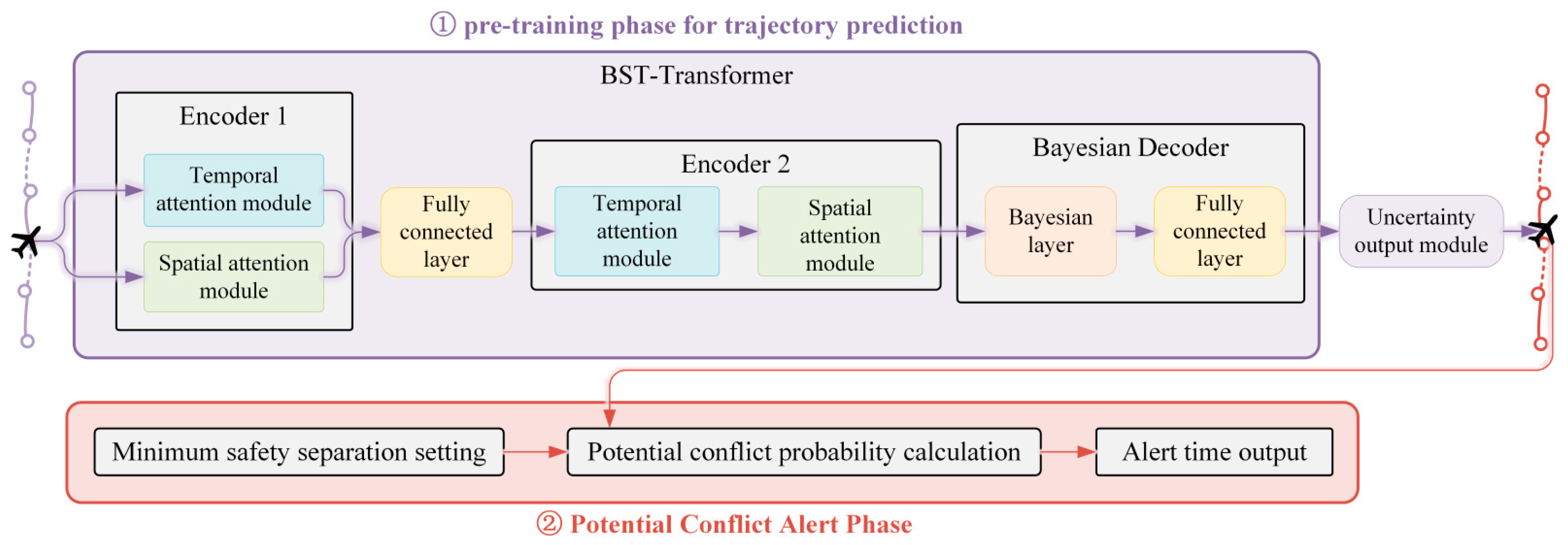
Precise trajectory prediction in the airspace of a high-density terminal area (TMA) is crucial for Trajectory Based Operations (TBO), but frequent aircraft interactions and maneuvering behaviors can introduce significant uncertainties. Most existing approaches use deterministic deep learning models that lack uncertainty quantification and explicit spatial awareness. To address this gap, we propose the BST-Transformer, a Bayesian spatio-temporal deep learning framework that produces probabilistic multi-step trajectory forecasts and supports probabilistic conflict alerting. The framework first extracts temporal and spatial interaction features via spatio-temporal attention encoders and then uses a Bayesian decoder with variational inference to yield trajectory distributions. Potential conflicts are evaluated by Monte Carlo sampling of the predictive distributions to produce conflict probabilities and alarm decisions. Experiments based on real SSR data from the Guangzhou TMA show that this model performs exceptionally well in improving prediction accuracy by reducing MADE 60.3% relative to a deterministic ST-Transformer with analogous reductions in horizontal and vertical errors (MADHE and MADVE), quantifying uncertainty and significantly enhancing the system’s ability to identify safety risks, and providing strong support for intelligent air traffic management with uncertainty perception capabilities.
Keywords: air traffic management; aircraft trajectory prediction; bayesian deep learning; probabilistic conflict detection; transformer air traffic management; aircraft trajectory prediction; bayesian deep learning; probabilistic conflict detection; transformer