


Abstract
This paper is dedicated to identifying stable equilibrium positions of the tether systems attached to the L1 or L2 libration points of the Mars–Phobos system. The orbiting spacecraft deploying the tether is at the L1 or L2 libration point and is held at one of these unstable points by the low thrust of its engines. In this paper, the analysis is performed assuming that the tether length is constant. The equation of motion for the system in the polar reference frame is obtained. The stable equilibrium positions are found and the dependence of the tether angular oscillation period on the tether length is determined. An analytical solution in the vicinity of the stable equilibrium positions for small angles of deflection of the tether from the local vertical is obtained in Jacobi elliptic functions. The comparison of the numerical and analytical solutions for small angles of deflection is performed. The results show that the dependencies of the oscillation period on the length of the tether are fundamentally different for L1 and L2 points. Analytical expressions for the tether tension are derived, and the influence of system parameters on this force is investigated for static and dynamic cases.
1. Introduction
The space tether is a type of tether that is made of high-strength fiber used to connect spacecraft to each other or to other masses. The space tether systems allow us to perform missions that are impossible, impractical or unprofitable to accomplish with the help of other space equipment. For example, tether systems can be used for docking between spacecraft [1], as a space elevator [2,3,4,5,6], for payload orbital transfer [7,8], for exploring deep space [9], the atmosphere and the surface of the planets and their moons [10], as well as asteroids. For instance, Mashayekhi and Misra studied the effect of attaching a tether and ballast mass to an asteroid with subsequent cutting of the tether [11]. In recent decades, the use of space tethers near the collinear Lagrangian points has received considerable attention [12,13,14,15]. Ref. [14] focused on the development of a new mission to explore Phobos using a tether system anchored below the L1 Mars–Phobos libration point and deployed toward Mars at a length slightly greater than the distance from Phobos. Paper [15] showed the maintenance of an L1-type artificial equilibrium point in the Sun (Earth + Moon) circular restricted three-body problem by means of an electric solar wind sail. The tether capture system is also a promising method for removing space debris [16,17,18,19,20,21]. The topic of dynamics and control of tether systems has received substantial attention [22,23,24,25,26,27,28,29,30,31,32,33,34,35,36]. Huang et al. examined several new applications for the space tether during operation in orbit, focusing on the structure, dynamics and control [23]. Paper [24] discussed the diversity of tether modelling that has been undertaken recently, and showed that dynamics and control are the two fundamentally important aspects of all tether concepts, designs and mission architectures.
In 2017, NASA proposed the PHLOTE mission (Phobos L1 Operational Tether Experiment) to explore the surface of Phobos using a tether system ‘‘anchored’’ at the L1 libration point of the Mars–Phobos system [10]. The tether release point was proposed to be an orbiting spacecraft hovering in the vicinity of the L1 point. Once deployed, the small vehicle with a sensor package attached to the tether was expected to investigate Phobos. This mission concept is a synthesis of new technologies that would provide a unique platform for multiple sensors directed at Phobos as well as at Mars. The PHLOTE ConOps describes the PHLOTE mission and provides a key systems engineering document to support future mission development. However, such a complex innovative mission requires an additional theoretical justification and a variety of analytical models of the system motion. The work of [37] considers a mission similar to the PHLOTE mission, where a detailed study of the behavior of the tether system attached at the L1 collinear libration point was performed using the classical Nehvil equations.
The purpose of the present work is to find the stable equilibrium positions of the tether system attached at the L1 or L2 collinear libration points of the Mars–Phobos system and to study the features of the tether motion near these positions. The system consists of the tether and the end mass attached to its end. The mathematical model is based on the differential equations of the classical circular restricted three-body problem [38,39,40,41,42]. The equation of motion for the tether system of constant length under the action of two gravitational fields (Mars–Phobos) and the centrifugal force associated with the rotation of the frame of the Mars–Phobos system are obtained in polar coordinates. The first integral of this differential equation is found and used to determine the phase trajectories and the stable equilibrium positions. The approximate analytical solutions of the equation of motion for the tether system are obtained using Jacobi elliptic functions. Next, the dependence of the oscillation period on the length of the tether is found. Finally, analytical expressions for the tether tension are derived, and the influence of system parameters on this force is investigated for static and dynamic cases. The results of this work can be used for PHLOTE-like mission design. It is worth noting that the obtained solutions for small tether deflection angles are of interest for the creation of the space elevator at the L1 and L2 libration points of the Mars–Phobos system in the future.
2. Mathematical Model: Finding Sustainable Positions
In this section, the behavior of the tether system of constant length attached to the or libration point under the action of two massive attracting bodies, and (Mars and Phobos), is described using the differential equations of the classical circular restricted three-body problem [38,39,40,41,42]. It is assumed that the mass of the body is much less than the mass of the bodies and . As a result, the body has negligible influence on other bodies. In addition, it is assumed that the eccentricity of the two bodies of the primary orbit is and the distance between them is
where is the semilatus rectum. The orbiter is located at the L1 or L2 libration points, either of which can be the attachment point for the tether.
In the following subsections, we consider two cases characterized by different values of the tether deflection angle, namely, and .
2.1. Tether Deflection Angle
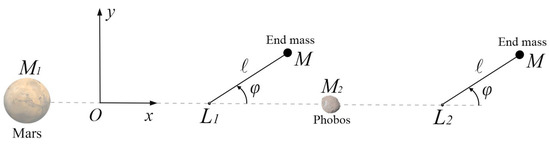
The equations of motion of the circular restricted three-body problem [42] in the polar reference frame (see Figure 1) for the constant length tether can be written as
where
is the mean motion, is the Newtonian gravitational constant, and are masses of the bodies and , respectively, are the distances from the origin to the and libration points, respectively is the mass ratio,
Figure 1.
Frame Oxy and the polar frame .
is the distance between the primary 1 and the end mass,
is the distance between the primary 2 and the end mass,
Equation (2) has the following energy integral:
where is the total energy. The potential energy can be written as
It follows from the Equations (6) and (7) that the equation of phase trajectories has the form
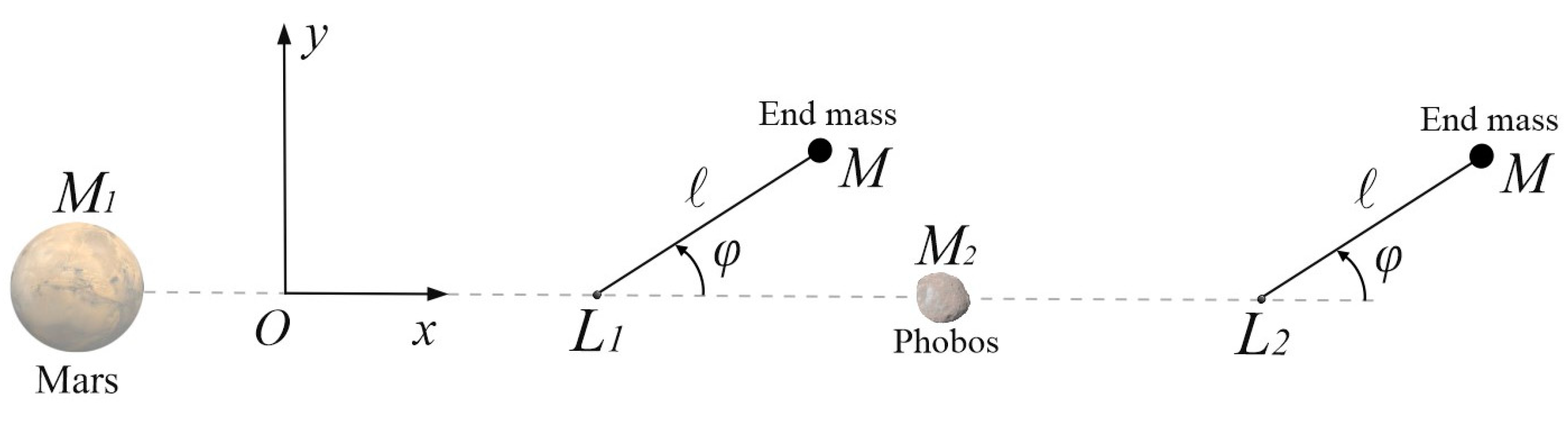
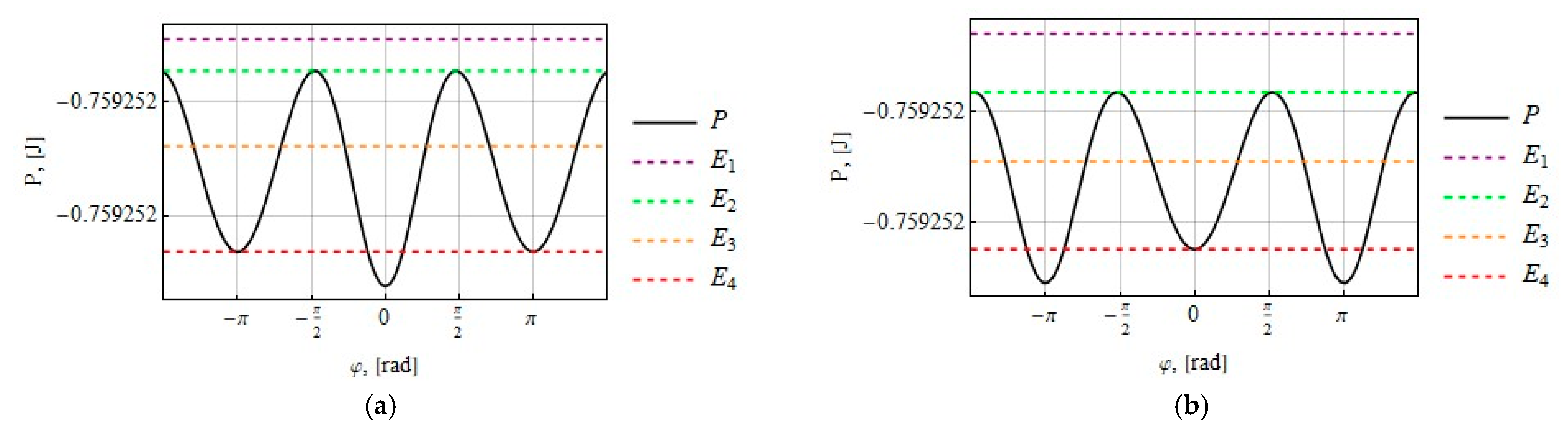
Figure 2 shows the potential energy (7) and the corresponding phase portrait of the system (2) for the tether length m and the following parameters:
Figure 2.
(a) The potential energy for the tether system attached at the libration point; (b) the potential energy for the tether system attached at the libration point; (c) phase trajectories corresponding to different levels of the total energy for the tether system attached at the libration point; (d) phase trajectories corresponding to different levels of the total energy for the tether system attached at the libration point.
The stationary positions for can be found from the equation
The stable equilibrium positions are , and the unstable positions are .
2.2. Tether Deflection Angle
To consider this case, let us represent the deflection angle of the tether as
The equations of motion in polar coordinates for the constant tether length are
where
is the distance between the primary 1 and the end mass,
is the distance between the primary 2 and the end mass,
Equation (11) has the following energy integral:
where is the total energy. The potential energy is
It follows from the equations (15) and (16) that the equation of phase trajectories has the form
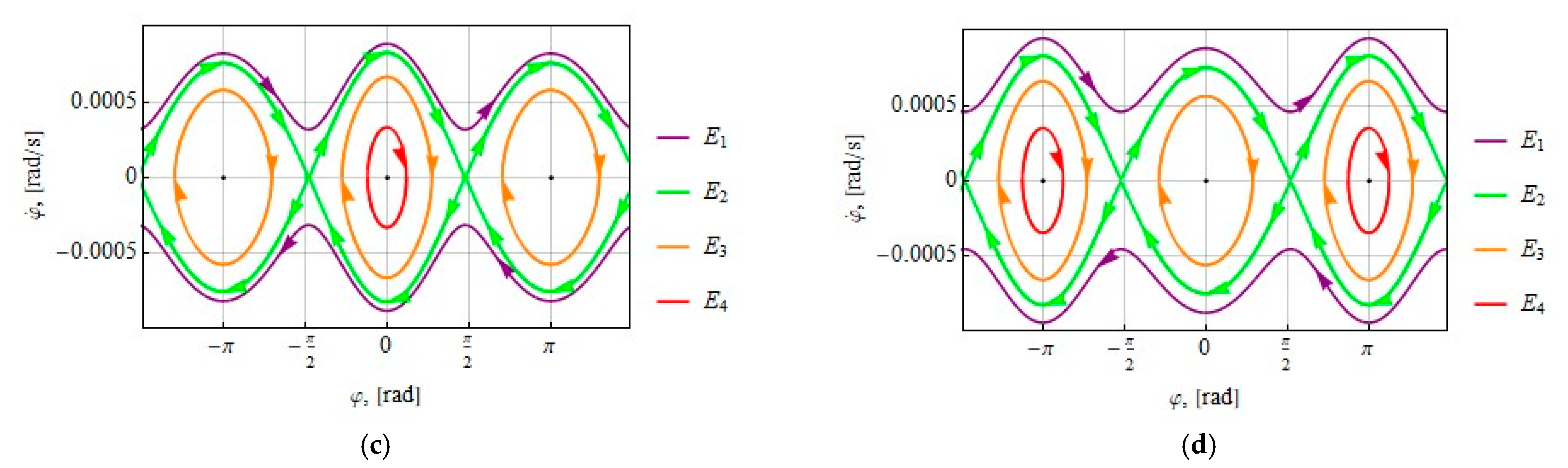
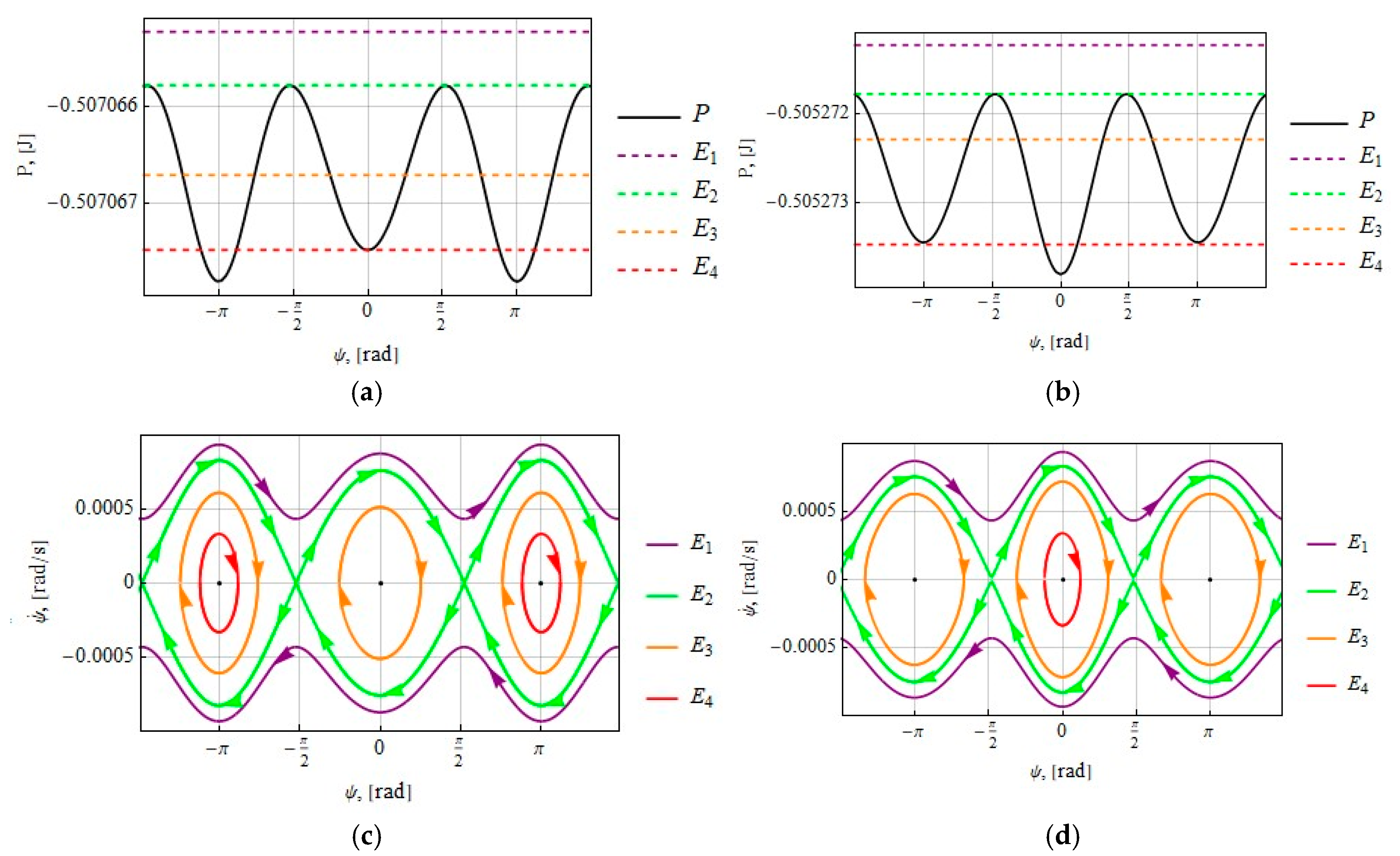
Figure 3 depicts the potential energy (16) and the corresponding phase portrait of the system (11) for the tether length m and the following parameters:
Figure 3.
(a) The potential energy for the tether system attached at the libration point; (b) the potential energy for the tether system attached at the libration point; (c) the separatrices in the phase space corresponding to different levels of the total energy for the tether system attached at the libration point; (d) the separatrices in the phase space corresponding to different levels of the total energy for the tether system attached at the libration point.
Equating the generalized force (12) to zero,
leads to two types of stationary positions for . The stable equilibrium positions are , and the unstable positions are .
3. Approximate Analytical Solutions
In this section, the approximate analytical solutions of the equations of motion of the tether system in Jacobi elliptic functions [43] for small deflection angles are found and compared with the numerical solutions.
3.1. Tether Deflection Angle
The following notation for the small tether deflection angle is used:
Let us expand the right hand side of Equation (2), which is an odd periodic function, into a Taylor series and keep the first two terms:
where and are coefficients depending on the system parameters
The phase trajectory equation for the Equation (20) in this case is
where and is determined from the initial conditions , being the initial tether deflection angle measured from the x-axis. Separating variables in the Equation (23) leads to
The polynomial under the root of the expression (24) [] can be factored as
The roots of the polynomial (25) have the form
where . The right part of expression (24) is an elliptic integral. To reduce it to the canonical form, it is necessary to calculate the modulus, which is determined by [43].
where . Now the expression (24) can be reduced to the form
where , is the elliptic integral of the first kind,
Converting the elliptic integral from the expression (28) and using an elliptic sine , we obtain the approximate analytical solution:
where .
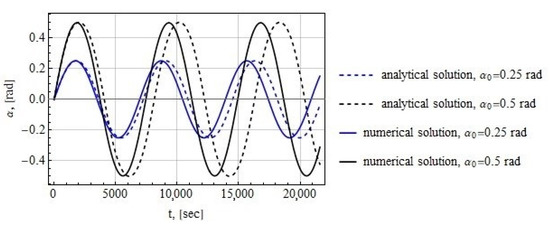
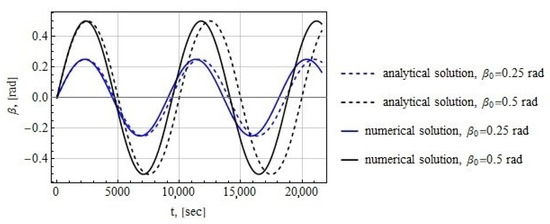
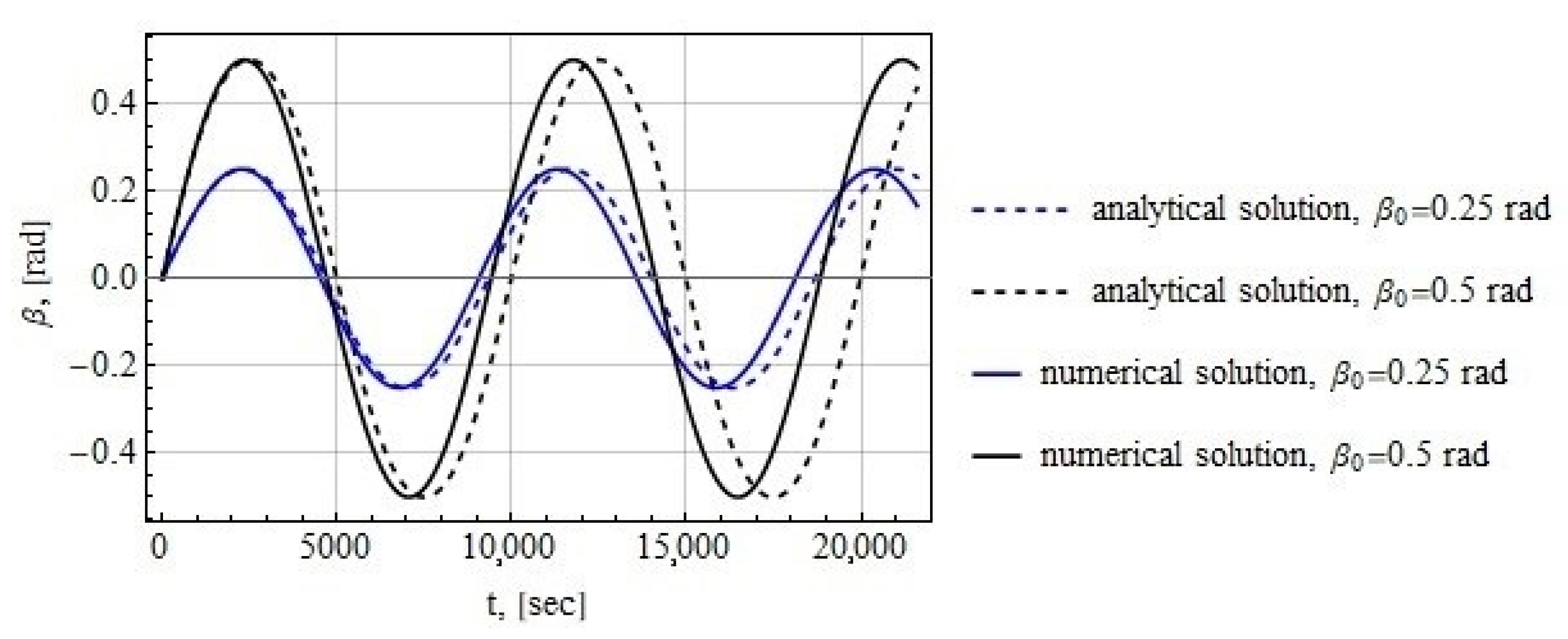
Let us compare the obtained analytical solution Equation (30) with the results of numerical integration of the initial Equation (2). Figure 4 illustrates the simulation results for m and the following initial conditions for the tether system attached in the libration point:
Figure 4.
Time history of the tether deflection angle for the tether system attached in the libration point.
rad, rad/s
and
rad, rad/s.
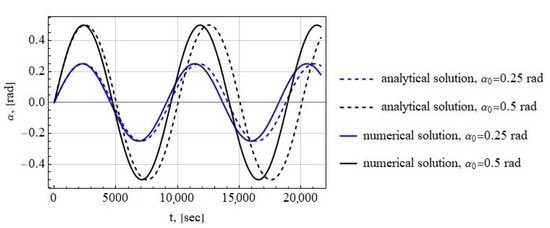
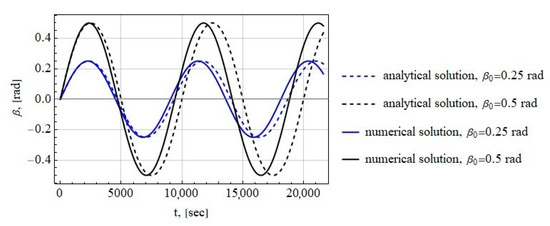
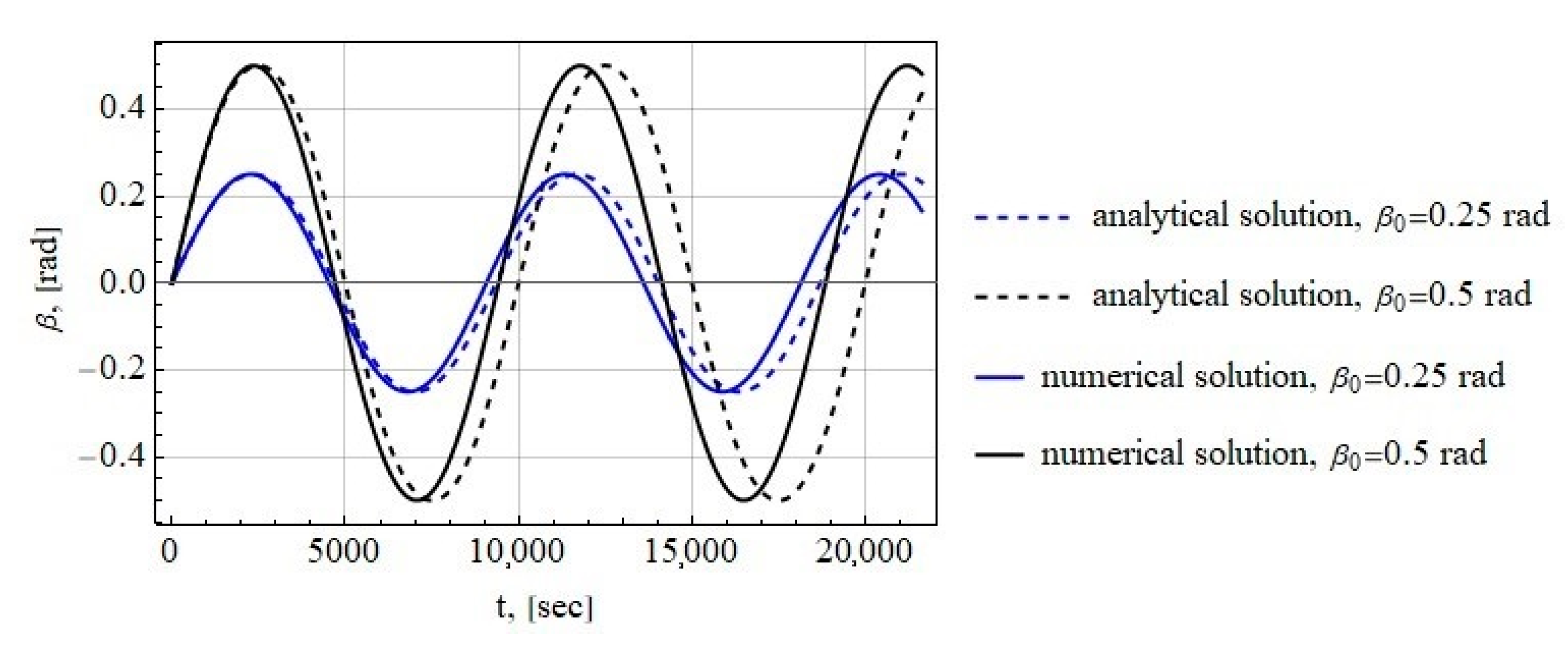
Figure 5 shows the simulation results for m and the following initial conditions for the tether system attached in the libration point:
Figure 5.
Time history of the tether deflection angle for the tether system attached in the libration point.
rad, rad/s
and
rad, rad/s.
3.2. Tether Deflection Angle
If the deflection angles are small, one can write, using Equations (10) and (19), that
In this case, the approximate analytical solution can be written as
where is the initial deflection angle of the tether measured from the x-axis,
Figure 6 shows the simulation results for m and the following initial conditions of the tether system attached in the libration point:
Figure 6.
Time history of the tether deflection angle for the tether system attached in the libration point.
rad, rad/s
and
rad, rad/s.
Figure 7 shows the simulation result for m and the following initial conditions for the tether system attached in the libration point:
Figure 7.
Time history of the tether deflection angle for the tether system attached in the libration point.
rad, rad/s
and
rad, rad/s.
The comparison of the numerical and analytical results shows that the approximate analytical solutions are able to accurately predict the amplitudes of tether angular oscillations, but not the frequencies. However, in the considered case, the amplitudes are much more important for the analysis of tether oscillations, so the approximate analytical solutions are quite consistent with the numerical solutions.
4. Oscillation Period of the Tether near the Stable Position
4.1. Tether Deflection Angle
According to Equation (28) and Ref. [43], the oscillation period of Equation (30) is determined by the formula
where is the complete elliptic integral of the first kind,
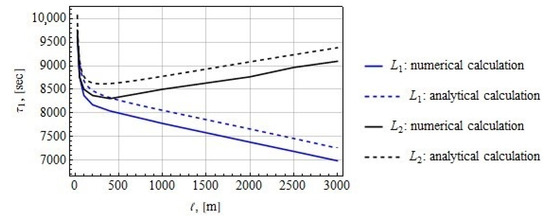
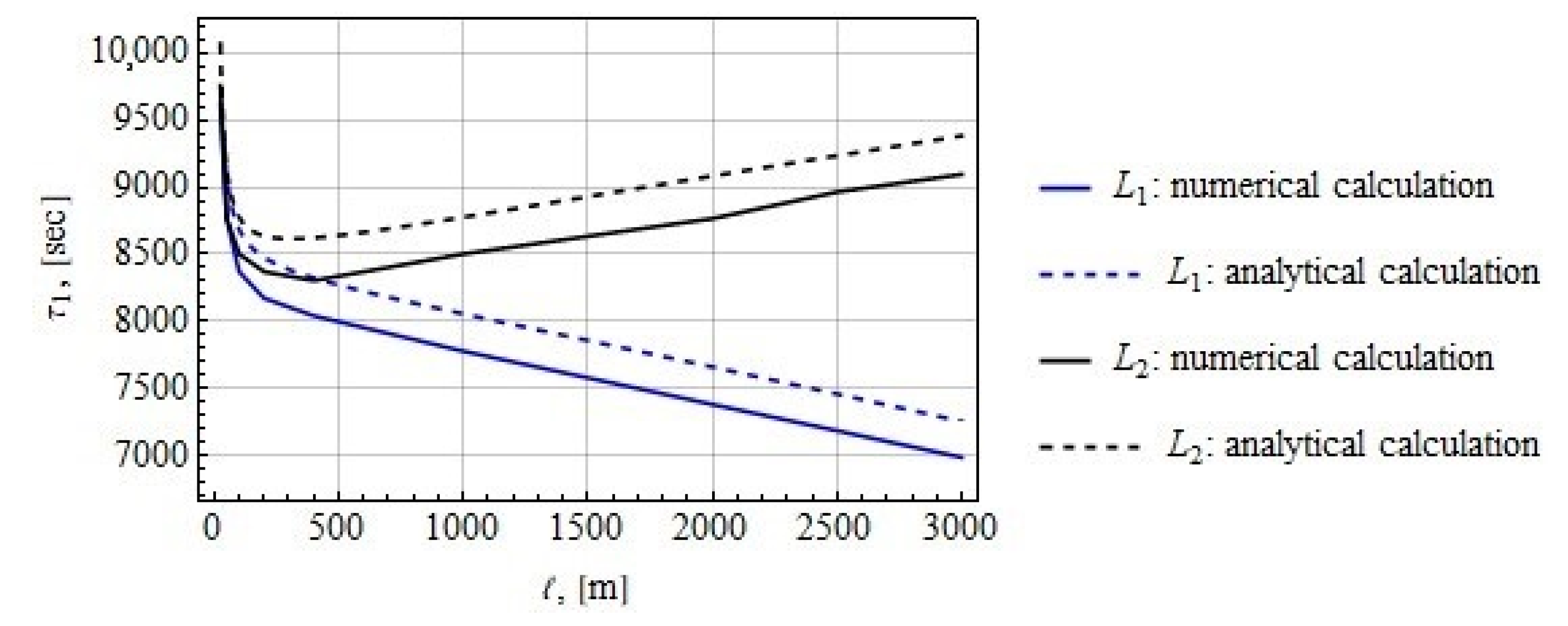
Figure 8 shows the dependence of the oscillation period on the length of the tether attached at the and libration points based on analytical and numerical calculations for the initial deflection angle of the tether rad.
Figure 8.
The oscillation periods of the tether systems attached at the and libration points.
The difference between the numerical and analytical calculations is approximately 300 s. As the tether length increases for the case when the tether system is fixed at the libration point , the period decreases. If the tether is attached at the libration point, the period of oscillation of the tether decreases at m, but begins to increase at m. This change in the character of the dependence of the oscillation period on the tether length requires further study. For the tether length m, the analytical calculation gives the oscillation period of about 7000 s ≈ 1.94 h for the tether attached at the point and 9081 s ≈ 2.52 h for the point, while the orbital period of Phobos around Mars is 27,540 s ≈ 7.65 h.
4.2. Tether Deflection Angle
According to Ref. [43], the oscillation period of Equation (32) is determined by the formula
where is the complete elliptic integral of the first kind,
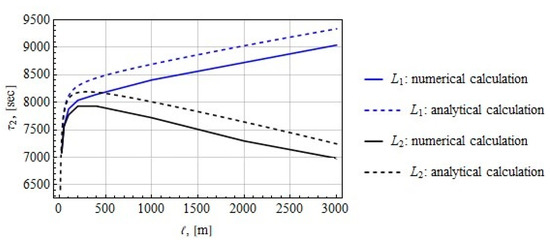
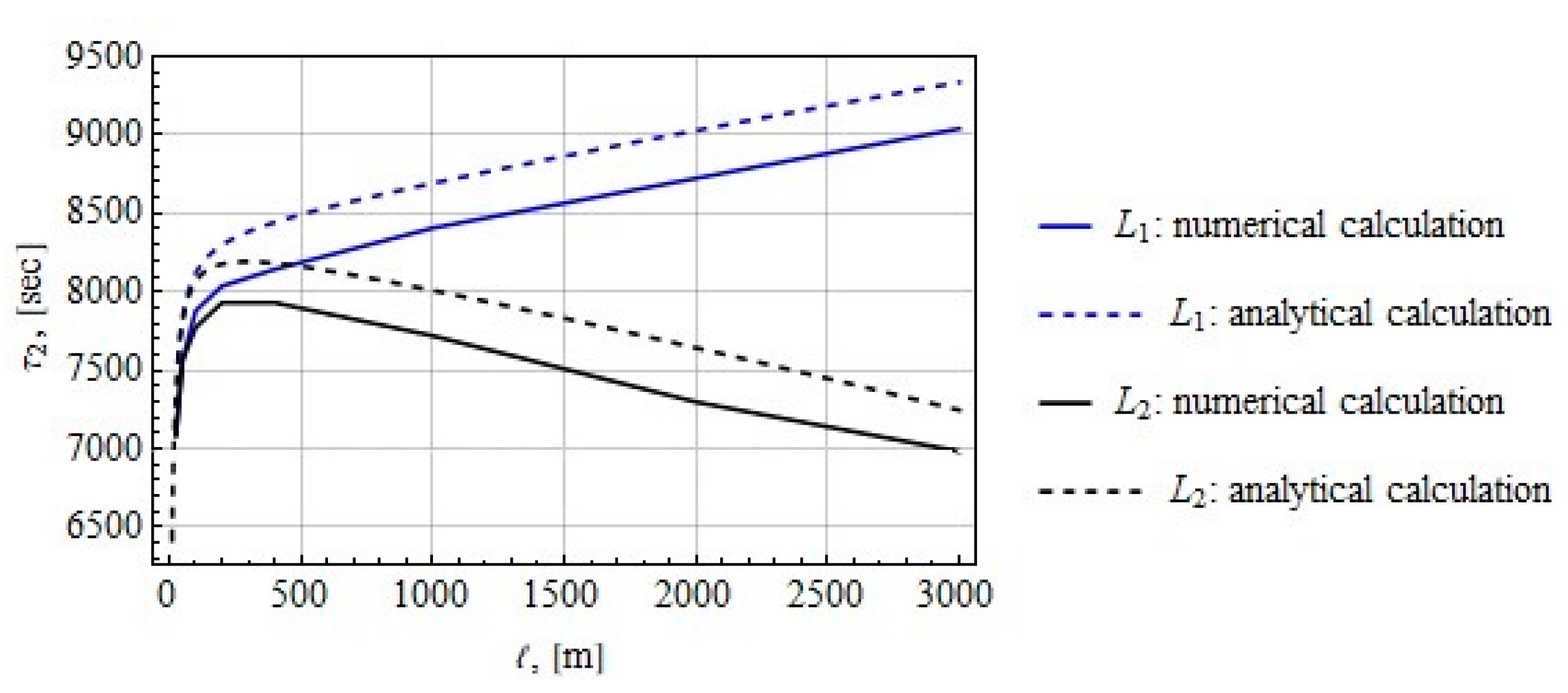
Figure 9 shows the dependence of the oscillation period on the length of the tether attached in the and libration points based on analytical and numerical calculations for the initial tether deflection angle rad.
Figure 9.
The oscillation periods of the tether systems attached at the and libration points.
The difference between the numerical and analytical calculations is approximately 300 s. As the tether length increases for the case when the tether system is fixed at the libration point , the period rises. If the tether is attached at the libration point, the period of oscillation of the tether increases at m, but begins to decrease at m. At the tether length of m, attached in the or libration point, the oscillation period according to the analytical calculation is equal to, respectively, 6982 s ≈ 1.94 h и 9028 s ≈ 2.51 h.
5. Tether Tension Force
In this section, the equations of motion of the end mass in the polar reference frame are derived for the angle , in order to obtain the tension of the tether. Note that the equations will be the same for the angle . Analytical expressions for the tether tension force are given and the influence of tether system parameters on this force is investigated in both dynamic and static cases.
Consider the equations of planar motion for the end mass in the Oxy coordinate frame within the scope of the classical restricted three-body problem [42]. In the presence of tether tension, these equations can be written as
where is the tether tension force acting on the end mass from the tether. Position of the body relative to the origin of coordinates in the polar reference frame is defined by
In the polar reference frame , the Equations (35) and (36) can be written as
where is the magnitude of the tether tension force acting on the end mass from the tether,
is the distance between the primary 1 and the end mass,
is the distance between the primary 2 and the end mass,
5.1. Static Tension
The static tension of the constant length tether can be calculated using Equation (39) according to the following formula:
where .
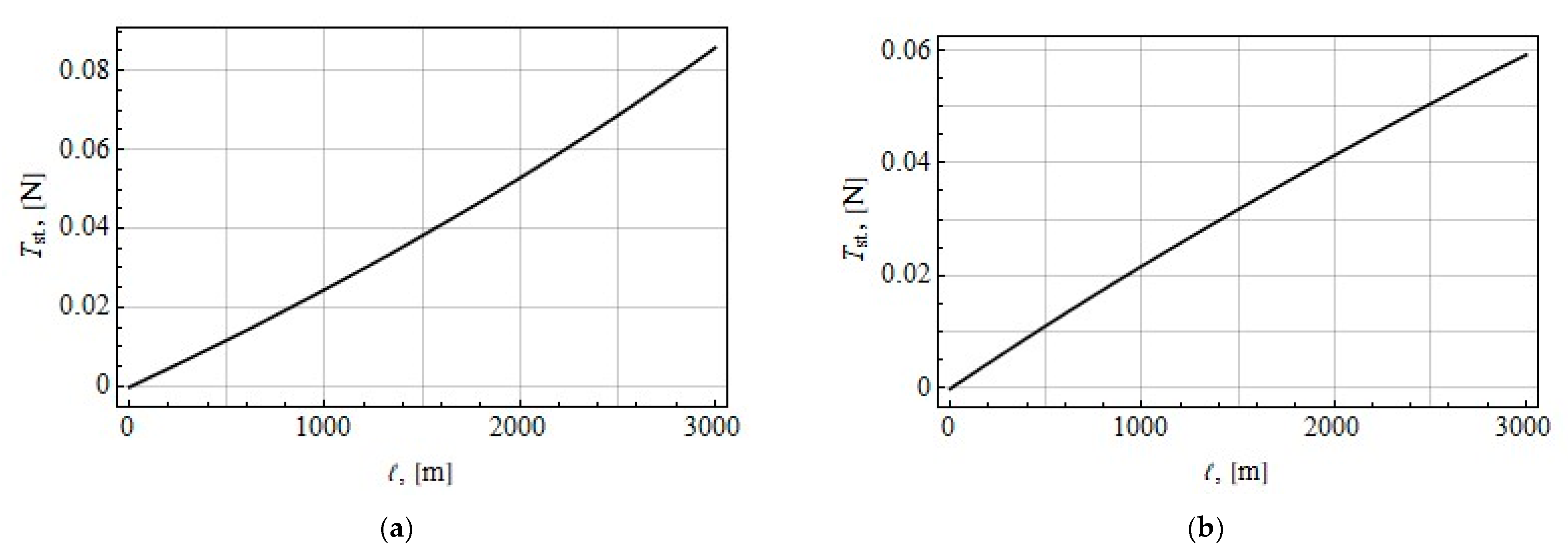
Figure 10 shows that the tension force is almost proportional to the length of the tether.
Figure 10.
Tension force of the tether, as a function of its length for the end mass of 50 kg: (a) tether attached at the libration point; (b) tether attached at the libration point.
For the 50 kg end mass and the tether length of 3000 m attached in the libration point, Equation (44) gives the tension force of 0.086 N. When considering the libration point, the tension force is 0.059 N.
5.2. Dynamic Tension
The dynamic tether tension force can be found using Equations (39) and (41) as
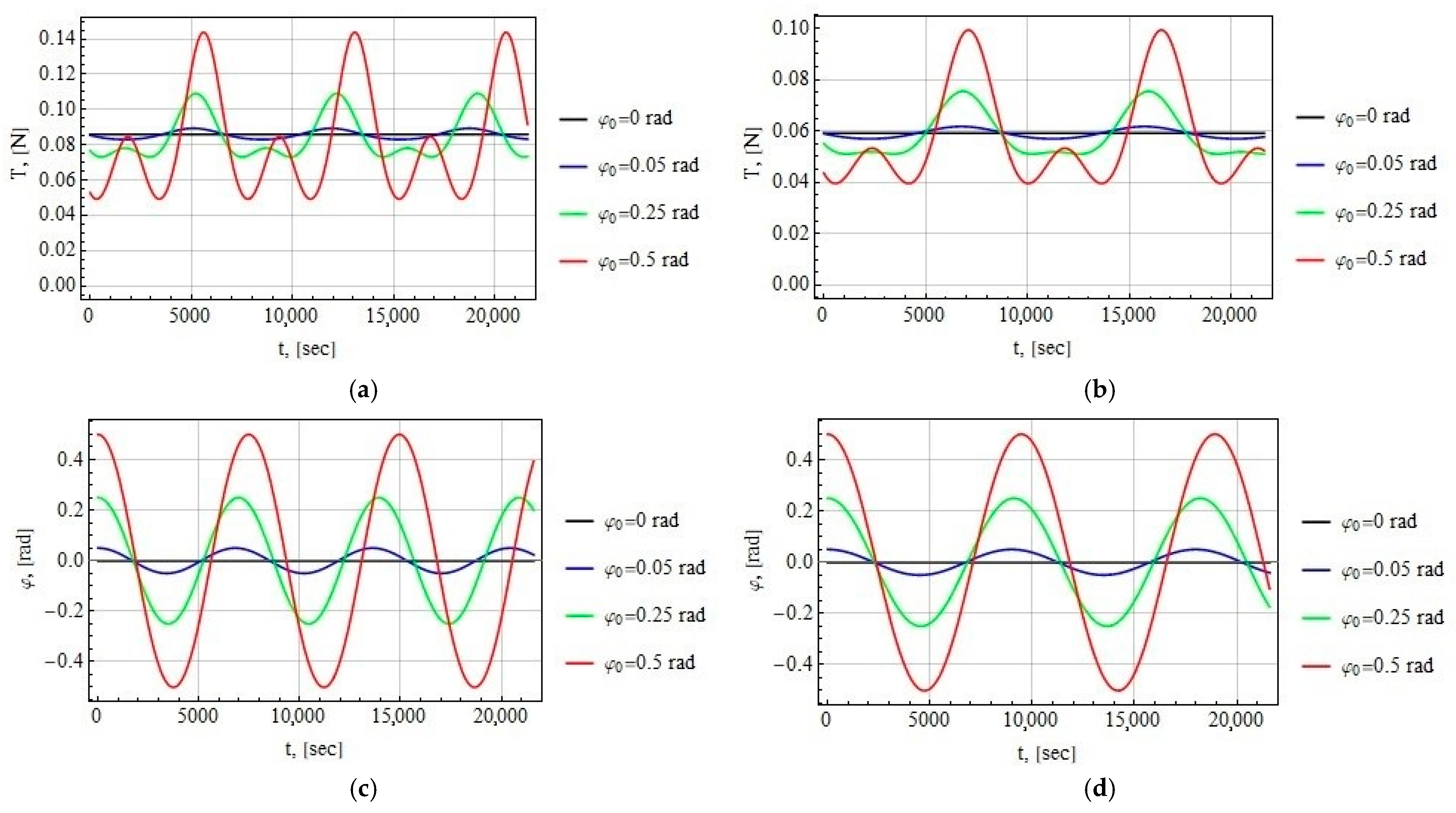
Figure 11 shows the tether tension force and the tether deflection angle from the gravitational vertical for the end mass of 50 kg and the tether length of 3000 m.
Figure 11.
(a) Tension force for the tether attached in the libration point; (b) tension force for the tether attached in the libration point; (c) tether deflection angle for the tether attached in the libration point; (d) tether deflection angle for the tether attached in the libration point.
The graphs in Figure 11 allow us to make the following conclusions:
- The tether is stretched in all cases considered;
- The greater the amplitude of oscillation of the tether, the greater the period of oscillation.
6. Conclusions
For the tether system attached at the L1 or L2 collinear libration points of the Mars–Phobos system, the equations of motion for the system for the case of massless and non-extensible tether with the end mass have been obtained. The first integrals of these differential equations have been found and used to determine the phase trajectories and the stable equilibrium positions. Simplified equations for small tether deflection angles in Jacobi elliptic functions have been obtained. The oscillation period of the system has been analytically found. It has been shown that the dependencies of the oscillation period on the tether length for L1 and L2 points are different. The obtained approximate analytical solutions and the results of the numerical integration of the original equations of motion for small angles of deflection of the tether are in good agreement. Analytical expressions have been obtained to determine the tether tension, and it has been shown that for the end mass of 50 kg, this force is small and does not exceed 1 N both for the static and dynamic states of the tether.
The results of this study confirm the possibility of a PHLOTE-like mission and give it some theoretical justification. The prospects of using similar tether systems in the future to create a space elevator anchored at the L1 or L2 libration point is a good stimulus for future research, which will also focus on the consideration of an elastic tether.
Author Contributions
Conceptualization: V.S.A.; investigation: V.S.A. and D.V.N.; methodology: V.S.A. and D.V.N.; software: D.V.N.; writing—original draft: D.V.N.; writing—review and editing: V.S.A. All authors have read and agreed to the published version of the manuscript.
Funding
This study was supported by the Russian Science Foundation (Project No. 19-19-00085).
Institutional Review Board Statement
Not applicable.
Informed Consent Statement
Not applicable.
Data Availability Statement
Not applicable.
Conflicts of Interest
The authors declare no conflict of interest.
References
- Olivieri, L.; Sansone, F.; Duzzi, M.; Francesconi, A. TED Project: Conjugating Technology Development and Educational Activities. Aerospace 2019, 6, 73. [Google Scholar] [CrossRef] [Scilit]
- Shi, G.; Zhu, Z.H. Cooperative game-based multi-objective optimization of cargo transportation with floating partial space elevator. Acta Astronaut. 2023, 205, 110–118. [Google Scholar] [CrossRef] [Scilit]
- Luo, S.; Cui, N.; Wang, X.; Fan, Y.; Shi, R. Model and Optimization of the Tether for a Segmented Space Elevator. Aerospace 2022, 9, 278. [Google Scholar] [CrossRef] [Scilit]
- Aslanov, V.S.; Ledkov, A.S.; Misra, A.K.; Guerman, A.D. Dynamics of Space Elevator After Tether Rupture. J. Guid. Control. Dyn. 2013, 36, 986–992. [Google Scholar] [CrossRef] [Scilit]
- Burov, A.A.; Guerman, A.D.; Kosenko, I.I. Tether orientation control for lunar elevator. Celest. Mech. Dyn. Astron. 2014, 120, 337–347. [Google Scholar] [CrossRef] [Scilit]
- Weiwei, W.; Zhigang, W.; Jiafu, L. Conceptual Design and Mechanical Analysis of a Lunar Anchored Cislunar Tether. Cosm. Res. 2023, 61, 80–89. [Google Scholar] [CrossRef] [Scilit]
- Ziegler, S.W.; Cartmell, M.P. Using Motorized Tethers for Payload Orbital Transfer. J. Spacecr. Rocket. 2001, 38, 904–913. [Google Scholar] [CrossRef] [Scilit]
- Aslanov, V.S.; Ledkov, A.S. Swing Principle in Tether-Assisted Return Mission from an Elliptical Orbit. Aerosp. Sci. Technol. 2017, 71, 156–162. [Google Scholar] [CrossRef] [Scilit]
- Luo, C.; Wen, H.; Jin, D.; Xu, S. Dynamics of a flexible multi-tethered satellite formation in a Halo orbit with uncertain parameters. Commun. Nonlinear Sci. Numer. Simul. 2021, 99, 105828. [Google Scholar] [CrossRef] [Scilit]
- Kempton, K.; Pearson, J.; Levine, E.; Carroll, J.; Amzajerdian, F. Phase 1 Study for the Phobos L1 Operational Tether Experiment (PHLOTE). End Report. NASA 2018, 1, 1–91. Available online: https://ntrs.nasa.gov/citations/20190000916 (accessed on 1 September 2021).
- Mashayekhi, M.J.; Misra, A.K. Optimization of tether-assisted asteroid deflection. J. Guid. Control. Dyn. 2014, 37, 898–906. [Google Scholar] [CrossRef] [Scilit]
- Baião, M.F.; Stuchi, T.J. Dynamics of tethered satellites in the vicinity of the Lagrangian point L2 of the Earth–Moon system. Astrophys. Space Sci. 2017, 362, 134. [Google Scholar] [CrossRef] [Scilit]
- Wong, B.; Patil, R.; Misra, A. Attitude dynamics of rigid bodies in the vicinity of the Lagrangian points. J. Guid. Control. Dyn. 2008, 31, 252–256. [Google Scholar] [CrossRef] [Scilit]
- Aslanov, V.S. Dynamics of a Phobos-anchored tether near the L1 libration point. Nonlinear Dyn. 2023, 111, 1269–1283. [Google Scholar] [CrossRef] [Scilit]
- Niccolai, L.; Caruso, A.; Quarta, A.A.; Mengali, G. Artificial Collinear Lagrangian Point Maintenance With Electric Solar Wind Sail. IEEE Trans. Aerosp. Electron. Syst. 2020, 56, 4467–4477. [Google Scholar] [CrossRef] [Scilit]
- Shan, M.; Shi, L. Comparison of Tethered Post-Capture System Models for Space Debris Removal. Aerospace 2022, 9, 33. [Google Scholar] [CrossRef] [Scilit]
- Lv, S.; Zhang, H.; Zhang, Y.; Ning, B.; Qi, R. Design of an Integrated Platform for Active Debris Removal. Aerospace 2022, 9, 339. [Google Scholar] [CrossRef] [Scilit]
- Huang, P.; Zhang, F.; Cai, J.; Wang, D.; Meng, Z.; Guo, J. Dexterous tethered space robot: Design, measurement, control, and experiment. IEEE Trans. Aerosp. Electron. Syst. 2017, 53, 1452–1468. [Google Scholar] [CrossRef] [Scilit]
- Feng, G.; Zhang, C.; Zhang, H.; Li, W. Theoretical and Experimental Investigation of Geomagnetic Energy Effect for LEO Debris Deorbiting. Aerospace 2022, 9, 511. [Google Scholar] [CrossRef] [Scilit]
- Bourabah, D.; Field, L.; Botta, E.M. Estimation of uncooperative space debris inertial parameters after tether capture. Acta Astronaut. 2023, 202, 909–926. [Google Scholar] [CrossRef] [Scilit]
- Zhang, F.; Sharf, I.; Misra, A.; Huang, P. On-line estimation of inertia parameters of space debris for its tether-assisted removal. Acta Astronaut. 2015, 107, 150–162. [Google Scholar] [CrossRef] [Scilit]
- Aslanov, V.S.; Yudintsev, V.V. Chaos in Tethered Tug–Debris System Induced by Attitude Oscillations of Debris. J. Guid. Control. Dyn. 2019, 42, 1630–1637. [Google Scholar] [CrossRef] [Scilit]
- Huang, P.; Zhang, F.; Chen, L.; Meng, Z.; Zhang, Y.; Liu, Z.; Hu, Y. A review of space tether in new applications. Nonlinear Dyn. 2018, 94, 1–19. [Google Scholar] [CrossRef] [Scilit]
- Cartmell, M.P.; McKenzie, D.J. A Review of Space Tether Research. Prog. Aerosp. Sci. 2008, 44, 1–21. [Google Scholar] [CrossRef] [Scilit]
- Shi, G.; Zhu, Z.H. Adaptive Anti-Saturation Prescribed-Time Control for Payload Retrieval of Tethered Space System. IEEE Trans. Aerosp. Electron. Syst. 2023, 99, 1–11. [Google Scholar] [CrossRef] [Scilit]
- Salazar, F.J.T.; Prado, A.B.A. Deployment and Retrieval Missions from Quasi-Periodic and Chaotic States under a Non-Linear Control Law. Symmetry 2022, 14, 1381. [Google Scholar] [CrossRef] [Scilit]
- Salazar, F.J.; Prado, A.F. Suppression of Chaotic Motion of Tethered Satellite Systems Using Tether Length Control. J. Guid. Control. Dyn. 2022, 45, 580–586. [Google Scholar] [CrossRef] [Scilit]
- Misra, A.K.; Modi, V.J. Deployment and Retrieval of Shuttle Supported Tethered Satellites. J. Guid. Control. Dyn. 1982, 5, 278–285. [Google Scholar] [CrossRef] [Scilit]
- Xu, S.; Sun, G.; Ma, Z.; Li, X. Fractional-order fuzzy sliding mode control for the deployment of tethered satellite system under input saturation. IEEE Trans. Aerosp. Electron. Syst. 2018, 55, 747–756. [Google Scholar] [CrossRef] [Scilit]
- Ma, Z.; Huang, P. Discrete-Time Sliding Mode Control for Deployment of Tethered Space Robot With Only Length and Angle Measurement. IEEE Trans. Aerosp. Electron. Syst. 2019, 56, 585–596. [Google Scholar] [CrossRef] [Scilit]
- Kang, J.; Zhu, Z.H.; Santaguida, L.F. Analytical and Experimental Investigation of Stabilizing Rotating Uncooperative Target by Tethered Space Tug. IEEE Trans. Aerosp. Electron. Syst. 2021, 57, 2426–2437. [Google Scholar] [CrossRef] [Scilit]
- Kang, J.; Zhu, Z.H. Passivity-Based Model Predictive Control for Tethered Despin of Massive Space Objects by Small Space Tug. IEEE Trans. Aerosp. Electron. Syst. 2022, 59, 1239–1248. [Google Scholar] [CrossRef] [Scilit]
- Ismail, N.A.; Cartmell, M.P. Three dimensional dynamics of a flexible Motorised Momentum Exchange Tether. Acta Astronaut. 2016, 120, 87–102. [Google Scholar] [CrossRef] [Scilit]
- Chen, S.; Chen, W.; Chen, T.; Kang, J. In-Plane Libration Suppression of a Two-Segment Tethered Towing System. Aerospace 2023, 10, 286. [Google Scholar] [CrossRef] [Scilit]
- Kim, M.; Hall, C.D. Control of a rotating variable-length tether system. J. Guid. Control. Dyn. 2004, 27, 849–858. [Google Scholar] [CrossRef] [Scilit]
- Singh, S.; Junkins, J.; Anderson, B.; Taheri, E. Eclipse-conscious transfer to lunar gateway using ephemeris-driven terminal coast arcs. J. Guid. Control. Dyn. 2021, 44, 1972–1988. [Google Scholar] [CrossRef] [Scilit]
- Aslanov, V.S. Prospects of a tether system deployed at the L1 libration point. Nonlinear Dyn. 2021, 106, 2021–2033. [Google Scholar] [CrossRef] [Scilit]
- Szebehely, V. The Restricted Problem of Three Bodies; Academic Press: New York, NY, USA, 1967; 668p. [Google Scholar]
- Koon, W.S.; Lo, M.W.; Marsden, J.E.; Ross, S.D. Dynamical Systems, the Three-Body Problem and Space Mission Design; Springer: New York, NY, USA, 2011; 327p. [Google Scholar]
- Schaub, H.; Junkins, J.L. Analytical Mechanics of Space Systems; Aiaa: San Diego, CA, USA, 2003; 819p. [Google Scholar]
- Roy, A.E. Orbital Motion; CRC Press: Boca Raton, FL, USA, 2020; 505p. [Google Scholar]
- Kluever, C.A. Space Flight Dynamics; John Wiley & Sons: Hoboken, NJ, USA, 2018; 583p. [Google Scholar]
- Janke, E.; Emde, F.; Losch, F. Tafeln Hoherer Funktionen; BG Teubner Verlagsgeselschaft: Leipzig, Germany, 1960; 322p. [Google Scholar]

Disclaimer/Publisher’s Note: The statements, opinions and data contained in all publications are solely those of the individual author(s) and contributor(s) and not of MDPI and/or the editor(s). MDPI and/or the editor(s) disclaim responsibility for any injury to people or property resulting from any ideas, methods, instructions or products referred to in the content. |
© 2023 by the authors. Licensee MDPI, Basel, Switzerland. This article is an open access article distributed under the terms and conditions of the Creative Commons Attribution (CC BY) license (https://creativecommons.org/licenses/by/4.0/).