1. Introduction
Urban heat dynamics refer to the complex processes governing the spatial and temporal variability of temperature within urban environments. Temperature variability in cities is largely shaped by the interplay between land cover, built structures, and local atmospheric conditions within the urban environment. Urban areas generally experience higher temperatures than their surrounding rural regions, a pattern commonly referred to as the urban heat island (UHI) effect [
1,
2]. This phenomenon arises from several factors, including the replacement of natural surfaces with impervious materials, the configuration and scale of buildings, and the heat-retaining properties of urban materials such as asphalt and concrete. Beyond increasing surface and air temperatures, the UHI effect can also modify local meteorology by influencing wind flow, enhancing cloud and fog formation, and affecting humidity and precipitation patterns [
2,
3]. UHI can be classified into two major categories depending on where and how it is formed [
4]: atmospheric urban heat island (AUHI) and surface urban heat island (SUHI). AUHI extends from the Earth’s surface to a certain height above the average building height, and it is usually measured with sensors at weather stations or mounted on vehicles. However, this kind of data can be time-consuming and often limited in coverage. Due to these challenges, many studies focus more on SUHI, which can be conceptualized as the ground temperature difference identified between urban and non-urban areas. In
Urban Climates by Timothy R. Oke in 2017 [
5], numerous studies highlighted the observed urban heat trends, demonstrating that localized temperature increases are strongly influenced by the geometry and configuration of urban structures, thereby contributing significantly to the SUHI effect [
6,
7,
8]. On the other hand, vegetation and green infrastructure play an important role in moderating temperature, as shading and evapotranspiration help mitigate surface and air temperature extremes [
9,
10]. Urban heat dynamics is therefore essential for planning cities in a sustainable way, adapting to climate change; the Mediterranean cities in particular, have been experiencing a progressive shift toward warmer and drier climatic conditions, accompanied by an increase in the intensity, frequency, and duration of extreme weather events [
11,
12,
13], thus urban heat analysis is increasingly important for local planning and policy decisions.
Recent research has shown that land surface temperature (LST), a key indicator of the SUHI effect, is significantly correlated with urban morphological parameters such as building density, height, impervious surface fraction and green-space abundance [
14,
15,
16,
17]. In the study of Esposito et al. [
18], for example, the identified urban morphological parameters that most strongly influence surface urban heat island intensity (SUHII) in Milan and Lecce were the impervious surface fraction (ISF) and mean building height (HM). Another example can be seen in the works of Yin et al. [
19], where they studied how urban form influences LST in Nanjing using a multi-scale geographically weighted regression (MGWR) model. The results highlighted that altitude and green space reduce LST while building height, building density, and roads increase it. At the same time, vegetation cover has been the subject matter of a series of studies [
9,
20,
21,
22], as it acts as a cooling factor through processes of shading and evapotranspiration, thereby influencing the urban heat dynamics. Urban morphological indices, on the other hand, provide quantifiable measures of the physical structure of urban environments. Common parameters such as building height, density, sky view factor (SVF), surface roughness, and impervious surface fraction have increasingly been used to analyze how urban form influences LST [
16,
23,
24]. Several studies show that urban morphology correlates significantly with SUHI intensity, with the weakest correlations in winter and strong links in summer, when using both horizontal and vertical urban form indices [
24,
25,
26]. In dense urban environments, building density (BD) and floor area ratio (FAR) are often used to assess urban heat dynamics [
27,
28]. In contrast, the SVF remains more controversial, as it has been found to both reduce and increase LST values depending on the balance between solar exposure and urban ventilation [
29,
30,
31,
32]. Scarano and Mancini [
32], for example, suggest that a digital database able to represent urban features at a suitable spatial scale is a requirement for a reliable analysis. Another study of Sangiorgio [
33] quantified the relative contributions of morphological indices to maximum UHI intensity and found that building height contributed about 8% of variance, with canyon width, canyon orientation and albedo playing larger roles. From a planning perspective, morphological indices are therefore critical: they allow a shift from coarse land-use categories toward a finer form of understanding the urban thermal behaviour; this advantage can support various targeted mitigation strategies, such as adjusting building form, increasing vegetation, or optimizing street canyon geometry.
Estimating LST from remote sensing data has been widely explored in the scientific literature [
25,
34,
35,
36,
37]. As LST changes across both space and time due to the complexity of the Earth’s surface, satellite imagery offers a major advantage; it can provide consistent and repeated coverage over large areas, from dense urban environments to more remote regions. In Chrysoulakis et al.’s [
38] scientific report, it is stated that although satellite approaches of LST estimation were found to underestimate measured turbulent heat fluxes, they can highlight spatial patterns allowing hotspots to be identified, therefore supporting both urban planning and urban climate modelling.
While previous studies in Greece have provided valuable insights into UHI and SUHI patterns using land-use classifications and landscape composition metrics [
39,
40,
41], few studies have examined the influence of detailed urban morphological parameters on LST at fine spatial scales. Most existing approaches rely on aggregated land-use categories or administrative units, which may overlook the structural variability of the urban fabric and its role in shaping local thermal conditions. Detailed assessments of urban morphological parameters such as building configuration, surface roughness, and structural density remain comparatively limited in the Greek context, particularly when derived exclusively from Earth observation data. Addressing this gap, this study adopts a city-block-scale perspective and investigates the spatial relationship between multiple urban morphological indicators and LST. Our goal is to characterize urban heat trends and understand how urban morphology modulates the spatial distribution of surface temperature of the examined study area, using exclusively satellite-based data. Specifically, we seek to answer the following research questions: (1) How do detailed urban morphological and structural characteristics influence spatial variations in LST? (2) Which of these parameters most strongly contributes to heat intensity patterns in the study area? (3) Can freely available satellite data effectively capture fine-scale spatial variability in surface thermal conditions without relying on in situ measurements? To achieve these objectives, we employ Landsat-8 data in combination with high-resolution WorldView-2 imagery within the Google Earth Engine (GEE) platform.
The applied methodology integrates three-dimensional structural indicators of the urban fabric with thermal remote sensing data using a fully satellite-based workflow. This approach enables a consistent characterization of urban morphology while avoiding reliance on extensive field measurements or local cadastral datasets. In addition, the use of freely accessible and reproducible Earth observation data enhances the transferability of the methodology to other cities in Greece with limited data availability. The relationships identified in this study between detailed morphological indicators and surface temperature patterns are further explored using statistical regression analysis and one-way analysis of variance (ANOVA). These approaches provide insights that can support evidence-based urban climate planning, including the identification of thermal hotspots and the assessment of mitigation strategies such as urban greening and the use of reflective materials.
2. Materials and Methods
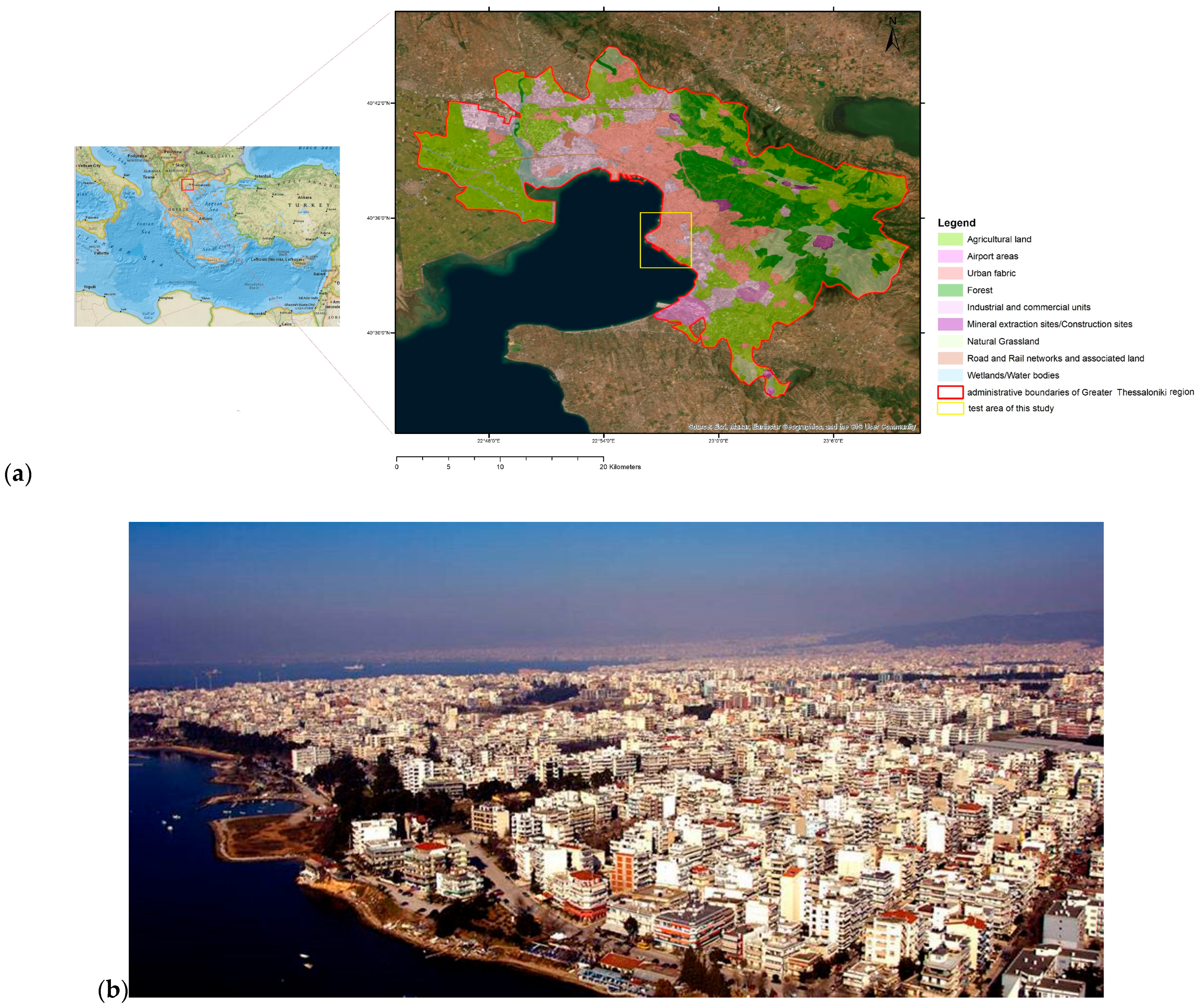
The study area of this research is a compact suburb of the city of Thessaloniki, Greece. Thessaloniki is a highly urbanized and densely populated city situated along the coast in Northern Greece (coordinates: 40°37′45.3684″ N, 22°56′50.6832″ E) (
Figure 1). As Greece’s second-largest city, it functions as a key economic and cultural centre in the region. Its advantageous coastal position, active port, and numerous academic institutions make it a major attraction due to employment prospects and urban lifestyle opportunities. This growing attractiveness and population increase have driven an unprecedented expansion of Thessaloniki’s built-up areas over recent decades, leaving open and green spaces as a scarce minority within the urban fabric.
In the city’s core, this development pattern has resulted in exceptionally low green-space availability per resident. The study of Latinopoulos et al. [
43] reports that the proportion of green space available to each resident in Thessaloniki is only 2.6 m
2, whereas the World Health Organization (WHO) recommends a minimum of 9 m
2 of accessible green space per person for a healthy urban environment [
44,
45]. What is remarkable, though, is that this indicator has remained unchanged since the 1980s, despite decades of urban growth and modernization [
46]. This fact reflects a long-standing absence of effective urban planning strategies and environmental policies, and underscores the limited prioritization of sustainable urban development in Thessaloniki, where redevelopment efforts have often focused on economic and infrastructural expansion rather than improving livability and ecological balance.
The climate of Thessaloniki is characterized as warm and temperate, and classified as a Csa climate, also known as a hot-summer Mediterranean climate, based on the Köppen climate classification scheme [
47]. The average annual air temperature is 17.1 °C, based on data from the European Centre for Medium-Range Weather Forecasts [
48]. However, in recent years, Thessaloniki has faced a growing frequency of extreme weather events, such as heavy rainstorm-induced floods and heatwaves [
17,
44]. Moreover, due to the observed UHI effect in the Thessaloniki region [
49], the urban fabric exhibits the highest discomfort index when compared to the surrounding rural areas (
Figure 1a).
2.1. Data Collection and Processing
The satellite data used in this study were Landsat-8 imagery for the LST extraction and WorldView-2 imagery for the land-use extraction. The Landsat imagery was retrieved and processed from the GEE platform. GEE offers access to a wide range of satellite imagery, including high-resolution optical images from Landsat. Landsat-8 in particular is ideal for LST extraction in GEE due to its reliable thermal infrared sensors (TIRS1/TIRS2), consistent radiometric calibration, and long-term global coverage, which together enable robust, comparable, and spatially detailed surface temperature retrievals [
28,
50]. To derive the land-use classes for the study area, high spatial resolution imagery was used from WorldView-2 (formerly distributed by Maxar Technologies, now Vantor Enterprises, Westminster, Colorado, USA). WorldView-2, the first commercial satellite to feature 8-band multispectral imaging, orbits at an altitude of 770 km and delivers panchromatic imagery with 46 cm resolution alongside multispectral data at 1.85 m resolution, allowing for high-detail mapping of land use within the study area.
Table 1 presents the functional overview of WorldView-2 bands for urban environment analysis.
The temporal window for selecting Landsat-8 imagery was focused on the summer season to capture the most pronounced differences in LST across different land uses. As the thermal intensity in Greek cities is most evident during the warmer months, when urban areas tend to retain heat more strongly than surrounding rural or vegetated areas, for this study, we identified and used Landsat imagery captured on a cloudless day during summer 2025. This allowed for the clearer identification and analysis of spatial temperature variations associated with different land-cover types.
2.2. Classification of WorldView-2 Imagery
The WorldView-2 imagery was processed within the eCognition software (version 9.5, Trimble, Munich, Germany), applying object-based segmentation classification. Object-based analysis of multispectral data introduces the concept of segmenting an image into meaningful objects. Instead of analyzing the spectral behaviour of individual pixels, neighbouring pixels are grouped together to form objects that carry semantic information and correspond to real-world entities. In object-based image classification, the processing occurs in two main stages: (a) segmentation of the image into discrete, non-overlapping objects based on specific criteria, and (b) classification of the resulting objects [
51,
52]. A major advantage of object-based analysis is that image objects are composed of groups of pixels, allowing the computation of descriptive features for each object. In addition to spectral information, characteristics such as shape, size, texture, and spatial relationships can also be calculated [
53,
54].
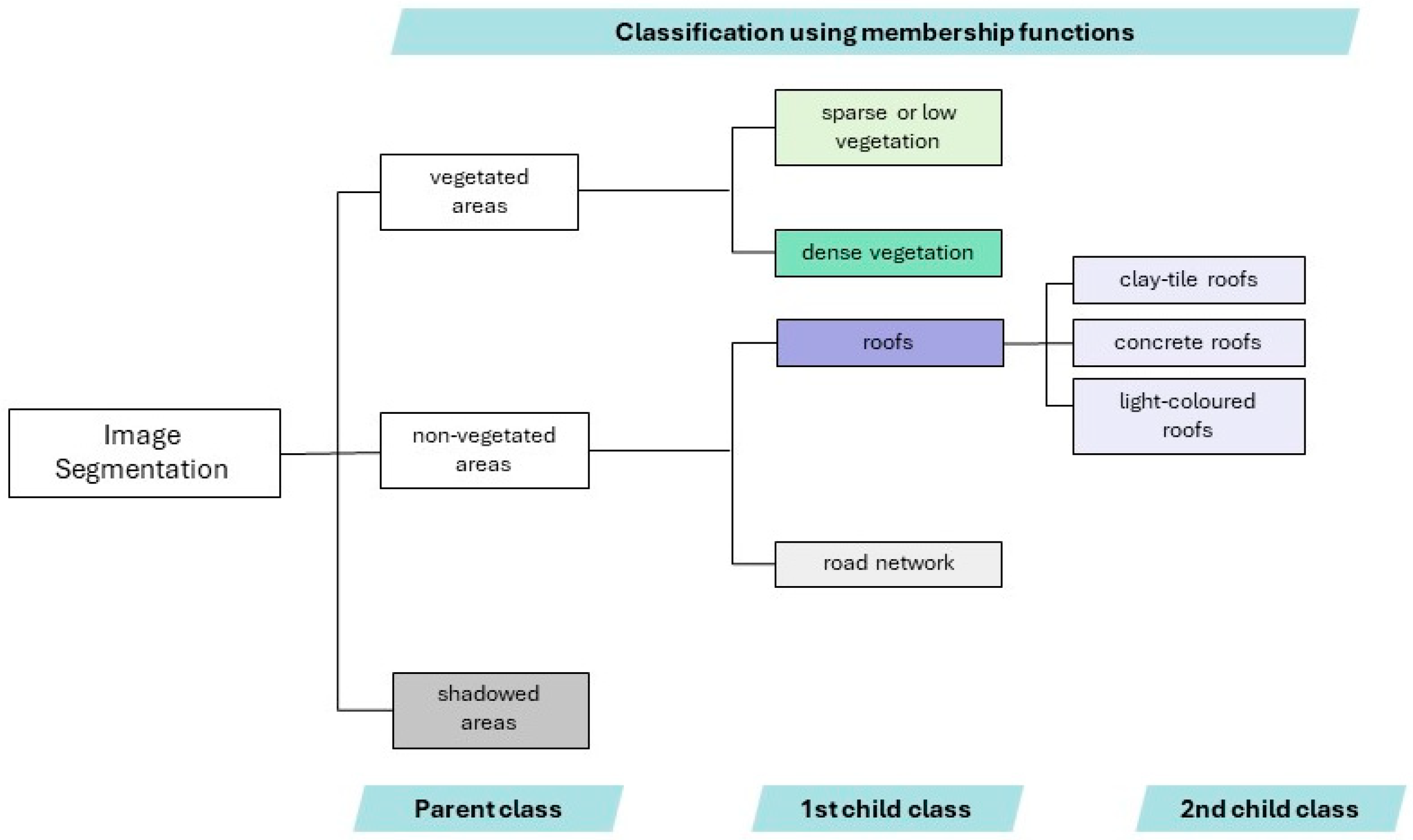
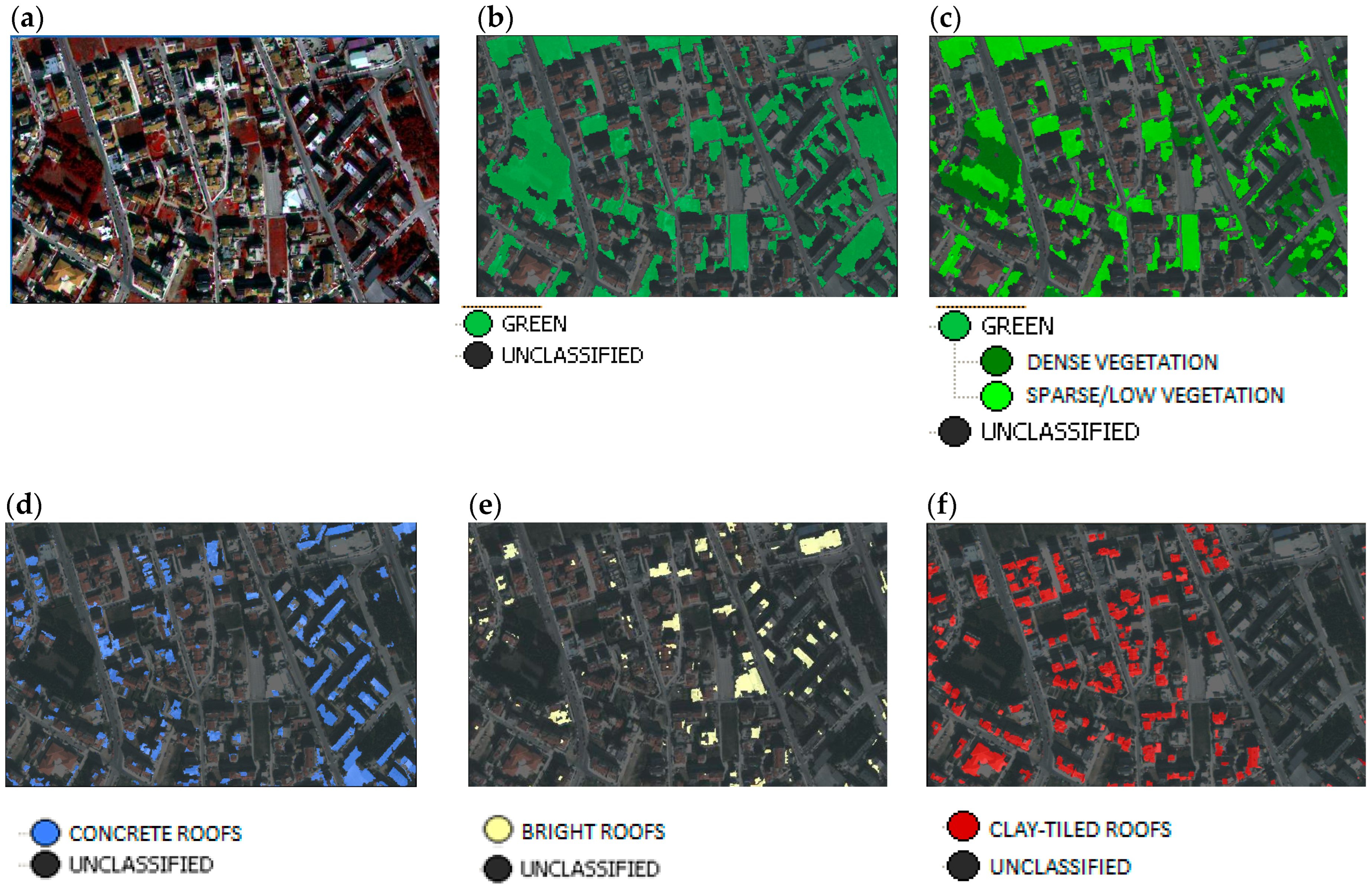
A rule-based object-oriented classification was implemented in eCognition Developer, adopting a hierarchical class structure combined with fuzzy logic membership functions (
Figure 2). The classification scheme comprised the following land-cover classes: dense vegetation, sparse or low vegetation, concrete roofs, clay-tile roofs, high-reflectance (light-coloured) roofs, road network, and shadowed areas. To define class-specific membership functions, representative samples of every class were identified, and by using the ‘assign class’ tool in eCognition, these samples were temporarily tagged for reference. The classes were organized in a parent-child hierarchy, where each child class inherited the properties of its parent while also introducing class-specific attributes (
Figure 3,
Table 2). This hierarchical organization enabled the integration of semantic relationships and contextual constraints, improving both the robustness and interpretability of the classification process [
55]. At the top level, objects were first separated into vegetated, non-vegetated, and shadowed areas. Vegetated objects were subsequently subdivided into dense vegetation and sparse or low vegetation, while non-vegetated objects were further classified into roof types and road networks. Classification was finalized using fuzzy logic, where each image object was assigned a membership value ranging from 0 to 1 for each candidate class. Membership functions were defined based on spectral, textural, shape, and contextual attributes derived from the segmented objects. Each object was ultimately assigned to the class for which it exhibited the highest membership value, allowing gradual transitions between classes and reducing hard classification boundaries (
Table 2).
The indices used as membership functions in the applied object-oriented classification are presented below. These indices were selected to capture the spectral and physical characteristics of the target land-cover classes and to support the implementation of the rule-based classification scheme.
- -
The Normalized Difference Vegetation Index (NDVI). The NDVI was calculated twice; one as the normalized difference between the near-infrared 1 (B7) and red (B5) bands, and one as the normalized difference between the near-infrared 2 (B8) and red (B5) bands, reflecting vegetation health:
where NIR1: near-infrared band (B7), NIR2: near-infrared band (B8) and RED: red band (B5).
- -
Optimized Soil Adjusted Vegetation Index (OSAVI). This index was used for separating low and high vegetation:
where NIR1: near-IR1 (B7), RED: red band (B5) and YELLOW: yellow band (B4).
- -
Normalized Difference in Red-Edge and Coastal Blue Bands Index (RECB). This index was used for identifying shadowed areas, as low values of the index indicate areas where Red-Edge and Coastal Blue reflectance are similarly low, typical of shadows.
where REDEDGE: Red-Edge band (B6) and COASTAL BLUE: coastal band (B1).
- -
Normalized Difference in Green and Yellow Bands Index (NDYG). The applied NDYG index was found useful for distinguishing tiled roofs from the rest of the buildings, as the yellow band captures the terracotta reflectance peak:
where GREEN: green band (B3) and YELLOW: yellow (B4).
In addition to spectral indices, several object-based features and rule sets provided by the eCognition software were incorporated into the classification process. These included statistical, textural, and geometric attributes such as band-wise standard deviation, homogeneity, length-to-width ratio, rectangular fit, and the relative border to neighbouring objects. Class-specific membership functions were defined by combining spectral and spatial criteria in order to maximize class separability. The corresponding membership functions are summarized in
Table 2.
Vegetated areas were initially identified using NDVI-based thresholds, while dense and sparse vegetation were distinguished through a combination of vegetation indices (NDVI and OSAVI), object brightness, and spectral homogeneity, reflecting differences in canopy density and soil background influence. Roof types were separated based on spectral reflectance characteristics and geometric properties, with concrete and bright roofs identified using brightness and blue-band information combined with a rectangular fit, and clay-tile roofs further distinguished using the NDYG index and red-band reflectance. The road network class was characterized by elongated object geometry, low spectral variability, and spatial coherence, using length-to-width ratio, homogeneity measures, and contextual rules that were based on relative borders with neighbouring road objects. Finally, shadowed areas were detected using low brightness and blue-band reflectance values, as well as using the RECB index, which enables robust separation from dark non-shadowed surfaces.
2.3. LST Extraction with Landsat-8 Imagery
The LST was estimated using the NDVI-adjusted emissivity method (NBEM) [
17,
56] with Landsat-8, Collection-2/Level-2 in the GEE platform. Although Level-2 products include atmospherically corrected surface reflectance and thermal bands, LST was derived in this study to ensure methodological consistency with the NDVI-based emissivity approach. Operating in a polar, sun-synchronous orbit at 705 km altitude, Landsat-8 completes 232 orbits in 16 days, allowing it to image the entire Earth within this period [
57]. The selected Landsat image for processing was captured on a cloudless day during summer 2025 (acquisition date 25 July 2025), corresponding to 10 am (+/−15 min) mean local time. The NBEM approach is based on the method previously developed by the authors [
17], which accounts for land-cover-dependent emissivity variations by incorporating fractional vegetation cover (FVC) to model the combined contribution of vegetated and bare surfaces. LST was then calculated from the satellite’s thermal infrared brightness temperature using the inverse Planck function [
58]:
where LST is the LST in Celsius (°C), Tb is the at-sensor brightness temperature derived from band 10 using the USGS scaling factors of converting digital numbers (DN) to brightness temperature (0.00341802 × DN + 149), λ is the wavelength of emitted radiance for band 10 of Landsat-8 (λ = 10.9 μm.), ρ is a constant derived as h × (c/σ) × (1.438 × 10
−2) mK, where σ is the Boltzmann constant (1.38 × 10
−23 J/K), h is the Planck’s constant (6.626 × 10
−34 Js) and c is the velocity of light (2.998 × 10
8 m/s).
The LST values were consequently assigned to the study area’s city blocks, based on their thermal category (
Table 3), using the available vector dataset of the study area. For each city block, LST values of all intersecting pixels were aggregated using the arithmetic mean values. This approach provided a representative surface temperature for every block. The mean value was chosen over median or maximum values as it best reflects the overall thermal condition in each polygon, allowing meaningful comparison with block-level morphological indicators.
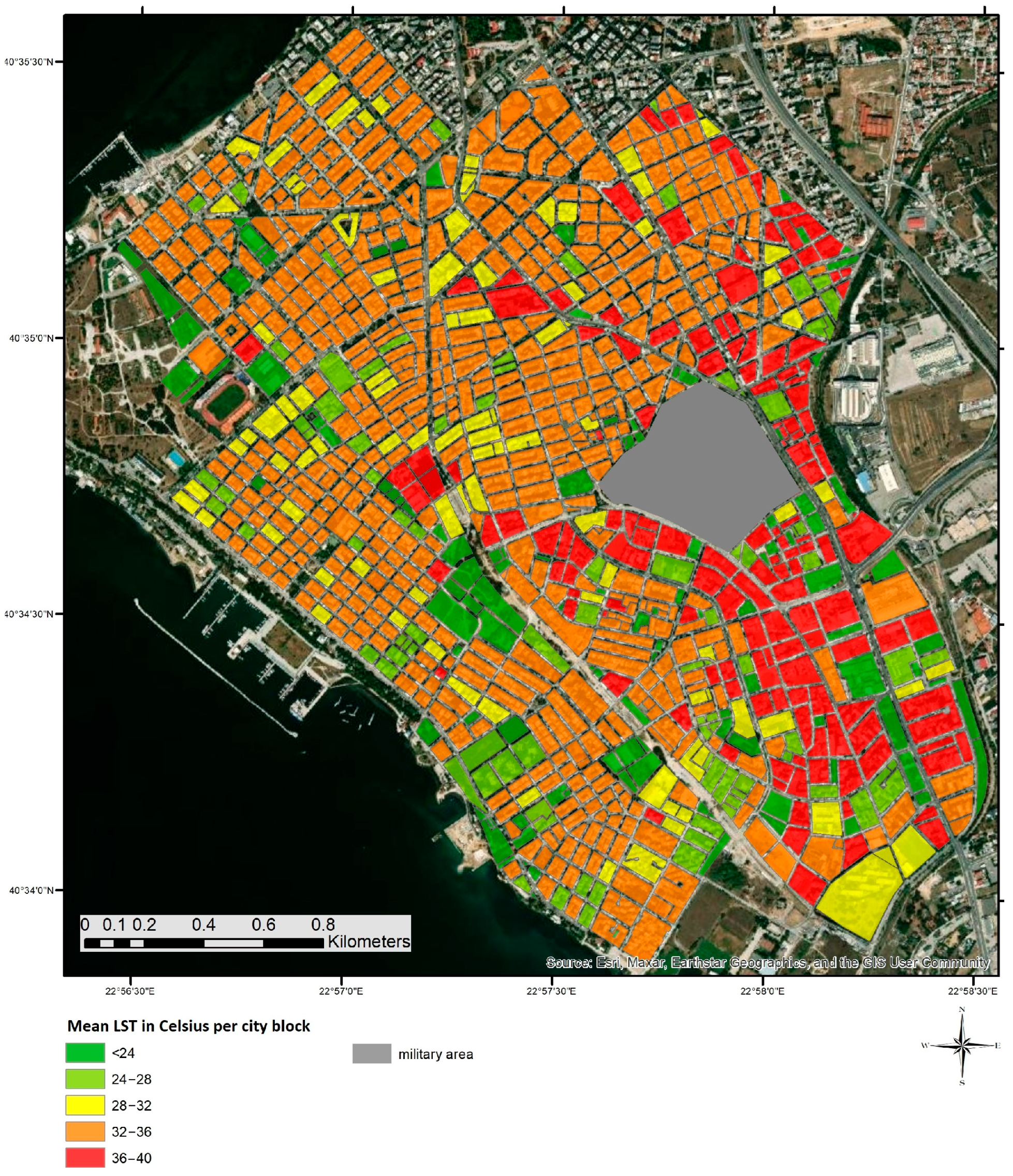
The resulting image with the distribution of LST values per city block is presented in
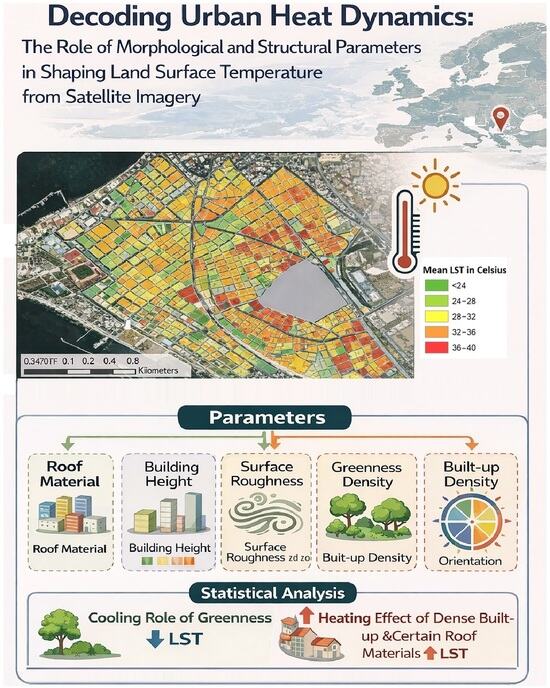
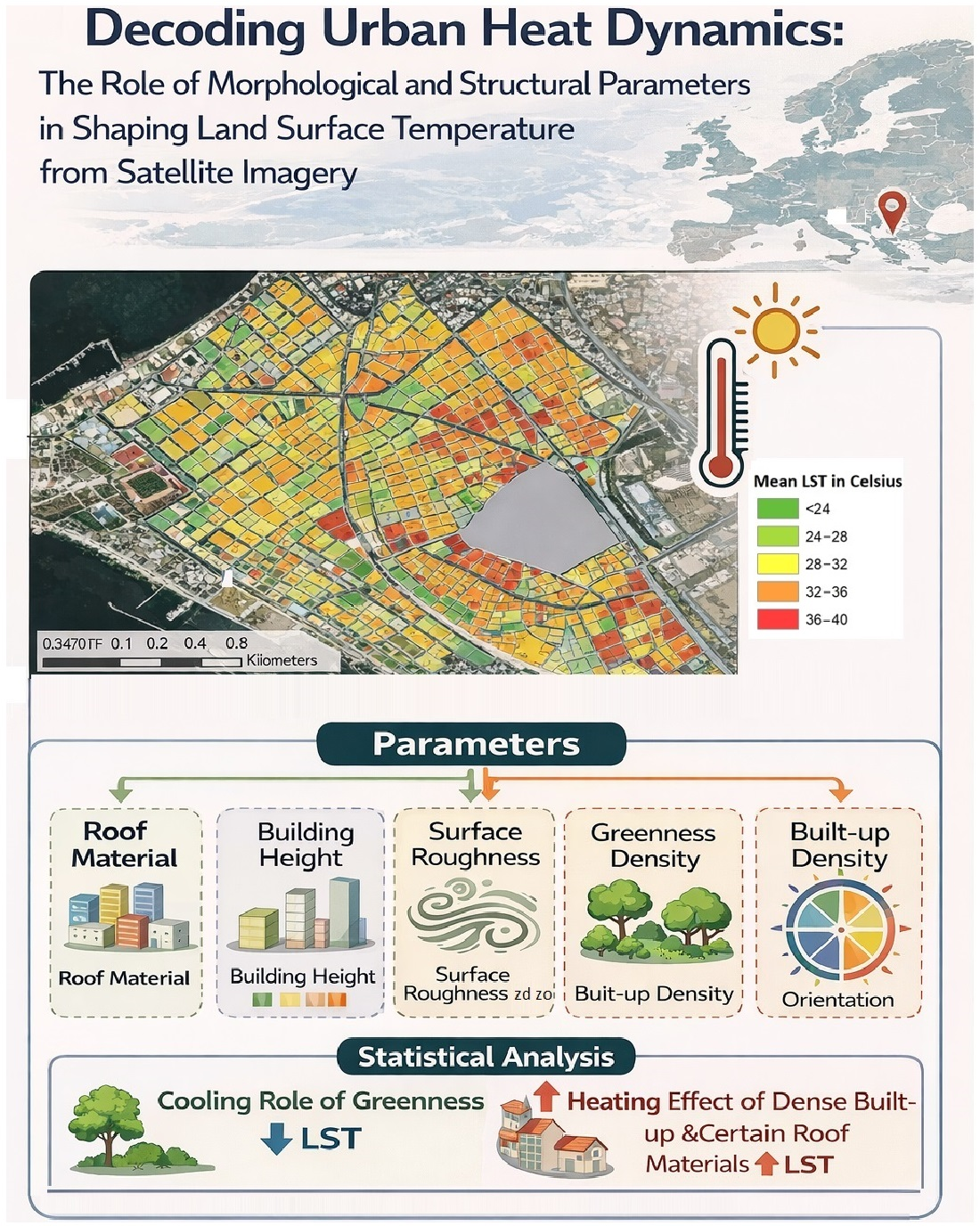
Figure 3. As shown in the figure, the results indicate a clear predominance of elevated thermal conditions across the study area, above 32 °C. In particular, class 4 (orange colour in the figure that represents temperatures between 36 and 40 °C) is the most frequent class of all, accounting for 54.1% of the area. At the same time, very high LST values (class 5: 36 to 40 °C) cover an additional 14.8%, meaning that nearly 69% of the study area experiences pronounced heat intensity. In contrast, very low and low LST classes (classes 1 and 2, <28 °C) represent only 21.5% of the area. This finding highlights the limited spatial extent of thermally mitigating surfaces. LST values between 28 and 32 °C that mainly reflect transitional or mixed land-cover zones, occupy only the 9.5% of the area.
3. Results
The applied classification scheme produced a classified image of the test area, where the seven distinct land-cover classes were identified. The spatial datasets displayed in figures, were processed and analyzed using Esri’s ArcGIS Desktop v10.4.
Figure 4 presents key stages of the classification process. Classification performance was evaluated using independent validation samples that were excluded from the classification process (approximately 20 per class, 210 in total). A confusion matrix was constructed, from which standard accuracy metrics, including overall accuracy and the Kappa coefficient, were calculated. The corresponding results are presented in
Table 4.
The classification achieved an overall accuracy of 84.80% and a Kappa coefficient of 0.82, indicating strong agreement between the classified data and reference samples. High producers’ and users’ accuracies for vegetation and roof classes demonstrate the effectiveness of the applied spectral and geometric membership functions, while shadowed areas were also identified with high reliability. Lower accuracy for the road network class reflects the inherent challenges of extracting linear features in complex urban environments. Overall, the results confirm the robustness of the classification scheme for subsequent urban analysis.
For consequent analyses, the road network and shadowed area classes were excluded from further processing, as the focus of this study was on identifying urban morphological structures that influence LST, emphasizing building-related and green characteristics. The analysis to follow is conducted at the city-block level, using the available vector shapefile of city blocks in the test area, thereby excluding the road network from further consideration. As a result, only the remaining six raster-based classes were converted into vector format to facilitate further spatial analysis and integration with GIS workflows. The geodatabase that was created encompassed detailed information for each class that includes object geometries and associated class membership values, providing a comprehensive dataset for analysis and interpretation.
3.1. Extraction of Morphological and Structural Parameters
To investigate the influence of urban morphological and structural characteristics on the spatial variability of LST, a detailed analysis was conducted at the city-block scale. The spatial unit of city-blocks was chosen over the local climate zone (LCZ) categories, as a dedicated LCZ classification typically relies on the integration of observational data and/or numerical modelling [
59,
60], which was beyond the scope of this study. Therefore, administrative city blocks were adopted as the unit of analysis, enabling a fine-scale, policy-relevant assessment of intra-urban variability in LST. For this purpose, a series of morphological indicators was extracted and quantified from the available city block shapefiles of the study area. The selected indicators were grouped into two categories: (i) building-level attributes, including roof type, building height, and building orientation, and (ii) block-level characteristics, encompassing built-up density, green-space density, and surface roughness parameters. All these parameters are known to modulate the local thermal environment through various mechanisms, such as solar radiation absorption, heat storage, and ventilation patterns. It should be noted that for building-level attributes, it is assumed that building footprints are represented by roof-type polygons derived from WV-2 classification. Specifically, roof type can impact the LST variation through its material, colour, and geometry, as it is associated with solar radiation absorption, heat storage, and shading patterns. Building height and orientation, on the other hand, influence the interception of sunlight and the generation of shadows, which can alter local heat accumulation and airflow within urban canyons. At the block level, it is well known that built-up density increases the proportion of impervious surfaces, thus enhancing heat retention. Conversely, green-space density can provide cooling through shading and evapotranspiration. Finally, the surface roughness parameters, z
d and z
o [
1,
2,
28], can offer advanced morphological characteristics of an urban environment, as they can capture the vertical and aerodynamic complexity of urban structures identified in a selected area. In particular, z
d reflects obstacles to wind flow, with higher values impeding convective cooling and possibly influencing the increasing of LST, whereas z
o represents aerodynamic roughness that enhances turbulent mixing [
2].
3.1.1. Allocating Building-Level Attributes
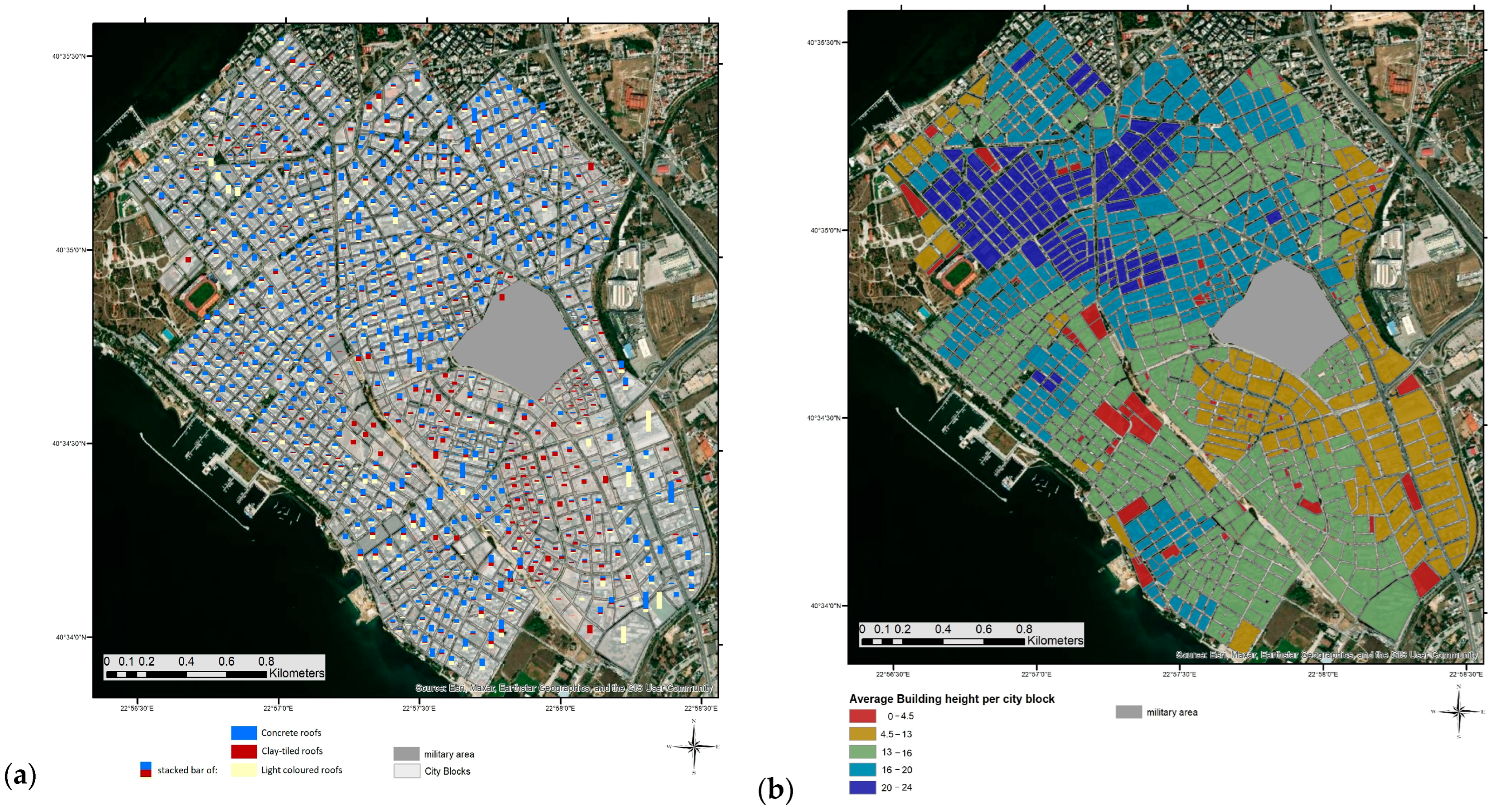
The roof type classes derived from the WorldView-2 satellite image classification, as the resulting classified raster, in which each pixel was assigned a specific roof type class, were subsequently vectorized through a raster-to-polygon conversion. The generated discrete polygons that delineate individual roof surfaces provide a vector dataset in which each polygon represents a building roof with an associated roof-type attribute. In this way, both the spatial extent of the built-up footprint (represented by roof-type polygons) and the categorical roof information are integrated into a single file, resulting in more than 5000 records containing building footprint geometry, roof type, area, and associated spatial attributes (
Figure 5a). The distribution of roof types across the city blocks shows that, on average, concrete roofs cover the largest proportion, with a mean of 51.7% (StdDev = 13.2%), followed by light-coloured roofs at 21.4% (StdDev = 10.9%) and clay-tile roofs at 19.9% (StdDev = 9.3%). However, the relatively high standard deviations suggest considerable variability in roof composition across different blocks.
Figure 5b displays the average building height within every city block of the study area. For this procedure, it is assumed that the building footprints correspond to the rooftop classes derived from the classification. Building heights were derived using the global raster of modelled building heights (~30 m resolution) [
61], produced by the Joint Research Centre of the European Union [
62]. Since the roof polygons derived from WV-2 imagery have a significantly finer spatial resolution, a spatial aggregation approach was applied to address this scale mismatch. The integration of this dataset provided the average height in metres for each pixel assigned to the three rooftop type classes based on the WP-2 satellite imagery. Thus, in GEE, the vectorized building footprints were overlaid on this raster, and height values were assigned to each building footprint using a reducer mean to calculate the average building height within each polygon. The resulting feature collection attaches a height attribute to every building. This approach allows the integration of detailed building footprints with coarser height information while maintaining a consistent representation of vertical urban structure at the city-block scale. It should be noted, however, that these height values represent estimates rather than direct measurements of building heights; however, these height values represent estimates rather than direct measurements. Nevertheless, they are considered sufficiently reliable for the purposes of this study, which focuses on morphological characteristics influencing LST variability at the city-block level.
The results indicate that high-rise buildings (50.6%) dominate the city blocks of the study area. City blocks with mid-rise buildings represent 33.1%, and blocks with low-rise buildings account for only 5.1%. On the other hand, blocks with very high-rise buildings represent 11.2%. These percentages show that nearly 89% of city blocks fall into the mid to high-rise category, demonstrating that taller building structures dominate the urban morphology of the study area.
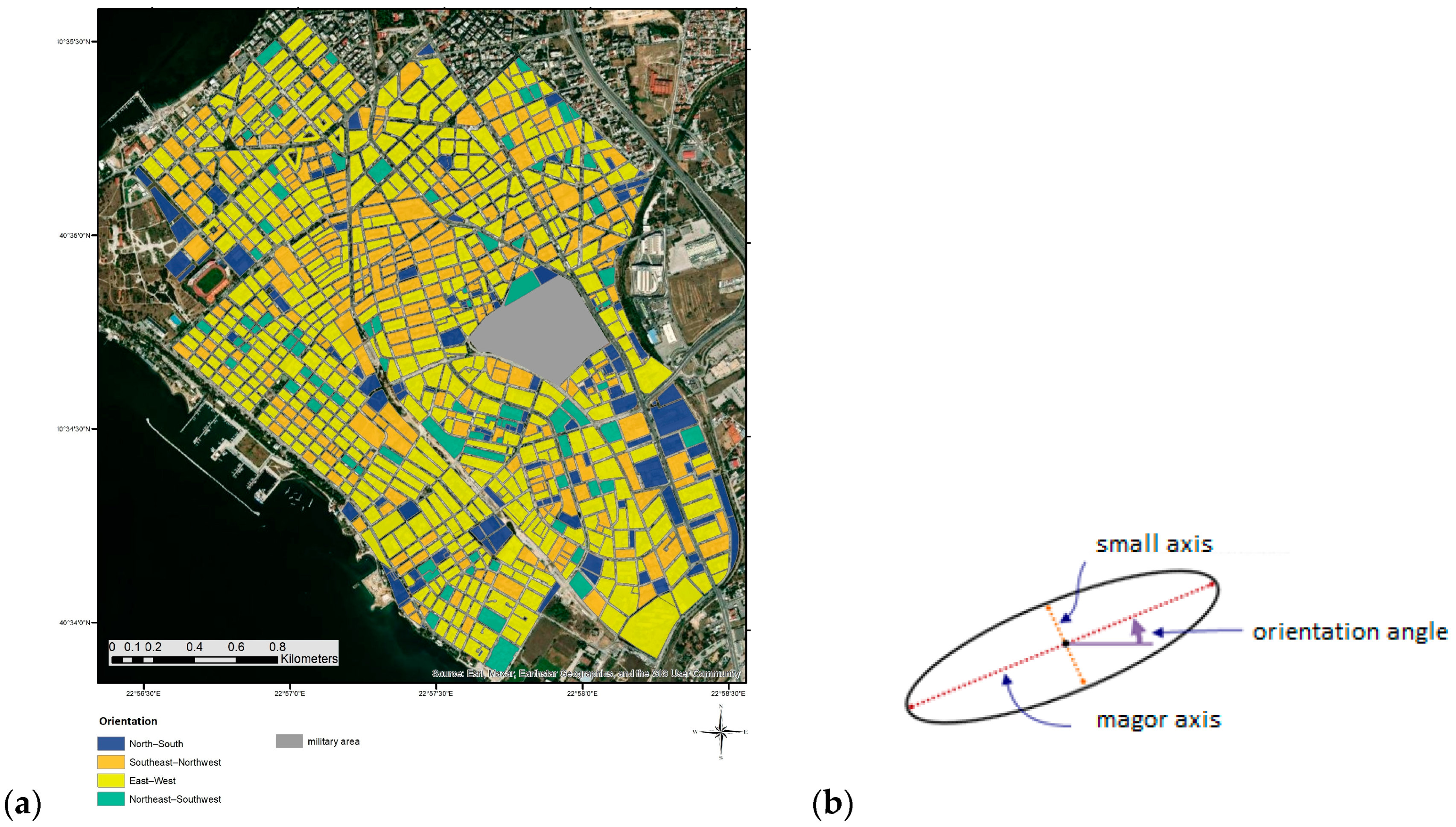
The orientation of individual buildings was derived using a geometric approach within the ArcGIS 10.4.1 platform. For each building footprint (roof type class), a minimum bounding ellipse was calculated to best fit the shape of the polygon. The major axis of the ellipse was then used to define the primary orientation of the building. To facilitate analysis, building orientations were classified into four directional classes based on the angle of the major axis relative to true north:
0–22.5° and 157.5–180°: North–South
22.5–67.5°: Southeast–Northwest
67.5–112.5°: East–West
112.5–157.5°: Northeast–Southwest
As a result, by fitting the minimum bounding ellipse to each building footprint and deriving the major axis as the primary orientation, it was possible to efficiently assign orientation to every building footprint in the study area (
Figure 6). However, it is important to note that this procedure can entail some sources of error, as buildings with highly irregular footprints, non-rectangular shapes, or multiple roof segments may yield bounding ellipses that do not perfectly align with the functional orientation of the building. Despite this limitation, for a dataset exceeding 5000 buildings, this procedure provided a consistent and scalable measure of orientation that is useful for further analysis.
The results show that the orientation of buildings across the city blocks shows that East–West orientations are the most common, accounting for 50.6% of blocks, followed by Southeast–Northwest (28.1%), North–South (12.6%), and Northeast–Southwest (8.7%). These results indicate a general tendency for building placement to optimize solar access, as the predominant orientations maximize sunlight exposure.
3.1.2. Calculating Block-Level Characteristics
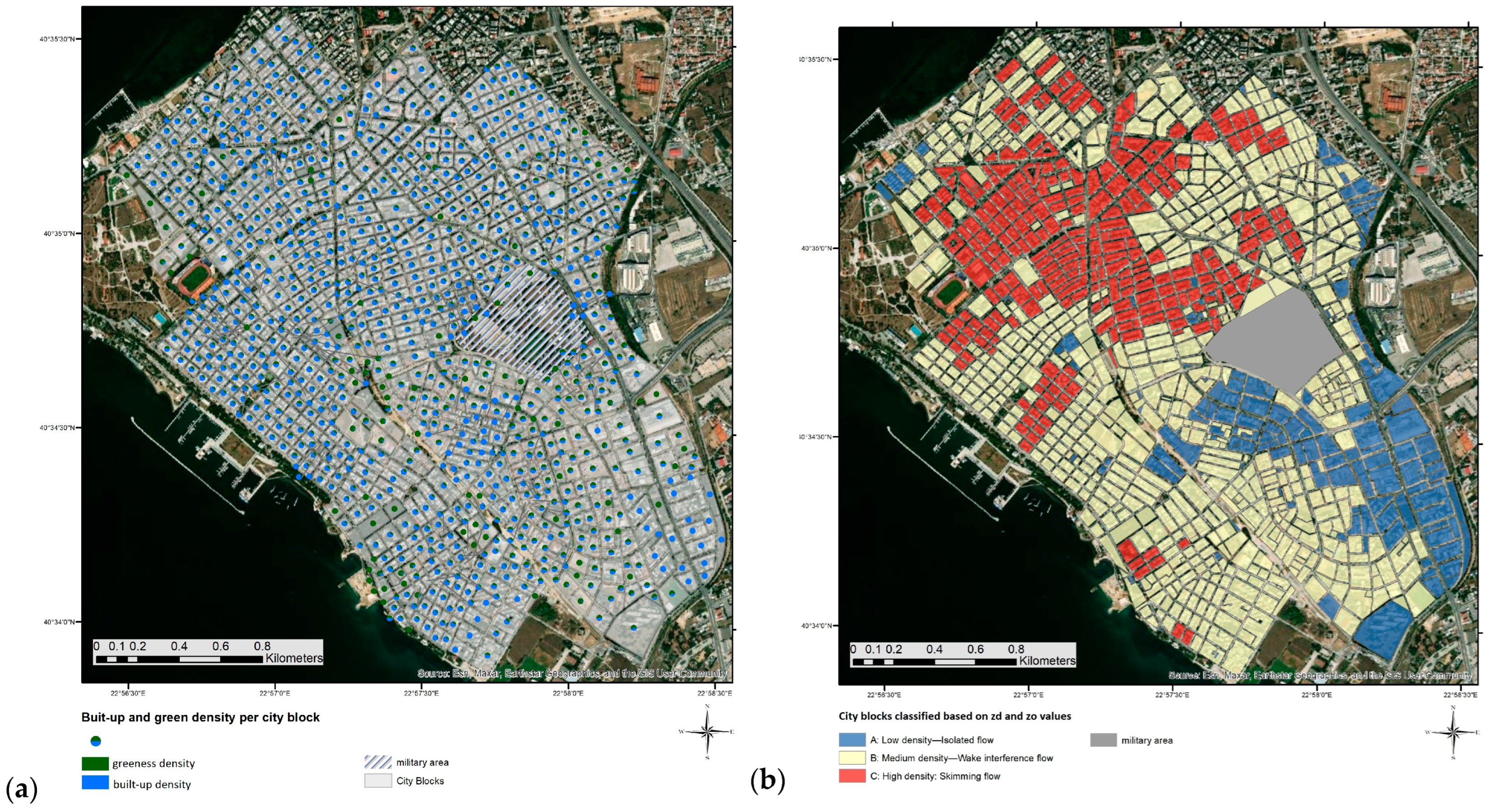
The built-up density is calculated with the following formula:
Denbuilt-up is the ratio of the area covered by the built-up features, expressed in square metres, to the total area of the geographical area under study. Using this formula, the building density of every city block (AT) of the study area can be calculated.
The green-space density is calculated according to the following formula:
Dengreen is the ratio of the area covered by the green-space features, expressed in square metres, to the total area of the geographical area under study.
The results reveal that the built-up density across the city blocks has a mean value of 0.53 (StdDev = 1.14), ranging from 0 to 24.50, indicating that some blocks are densely built while others have little to no built-up area. Green-space area density is lower on average, with a mean of 0.22 (StdDev = 0.52) and a range from 0 to 13.19, reflecting that vegetated or open areas occupy a smaller proportion of most city blocks (
Figure 7a).
The surface roughness parameters were calculated following the methodology described in the author’s previous work [
28]. These parameters are defined as the set of obstacles, in this case, the building stock, that wind can encounter in the study area, and represent simplified proxies of the aerodynamic characteristics of the urban area. It is important to note that the objective of this analysis is not to derive detailed micrometeorological measurements, but rather to provide spatially consistent and indicative estimates suitable for urban-scale interpretation. The zero-plane displacement height (z
d) and the roughness length (z
o) were calculated using the extracted classes of building footprints (namely buildings with concrete roofs, buildings with light-coloured roofs, and buildings with clay-tile roofs). The assigned building height data from the global raster of modelled building heights were also used for the calculation of the above-mentioned indicators with the following formula:
where z
Hmean is the mean built-up height within an area, f
d is an empirical coefficient that depends on the built-up and vegetation density [
1,
2], and f
o is an empirical coefficient that depends on the frontal area density of the buildings.
With these formulas, the z
d and z
o, were calculated for every city block, using for f
d the value of 0.5 for sparsely built-up areas (Den
built-up values ranging from 0.05 to 0.2), 0.6 for moderately to densely built-up areas (Den
built-up values ranging between 0.2 and 0.4), and 0.7 for densely built-up areas (Den
built-up values between 0.4 and 0.8), and the value of 0.1 for the f
o. The identified values of the surface parameters can indicate the wind flow type within the examined areas (city blocks), and can further be used to classify the city blocks’ urban density, based on the suggested categorization seen in the works of Timothy R. Oke [
1], Gao [
63] and Ayodeji E. Oke and Aigbavboa [
64]. This classification is displayed in
Figure 7b. The results show that the majority of city blocks fall within the medium-density wake interference flow category (59.9%), reflecting a moderately dense urban environment. High-density skimming flow conditions account for 24.7% of the blocks, suggesting compact urban areas with strong aerodynamic coupling above roof level. In contrast, 15.4% of the blocks are characterized by low-density isolated flow conditions, typically associated with sparse or detached building arrangements.
3.2. Associations Between LST and Morphological and Structural Parameters
As the core objective of this analysis is to examine how detailed urban morphological and structural characteristics influence the spatial variability of LST, and to identify the parameters that most strongly contribute to the formation of local SUHI patterns, the next step involved the application of statistical analyses between the derived LST values and the above-mentioned parameters. The goal was to quantify these relationships and reveal any underlying trends in LST variation. All dependent and independent variables were aggregated to the city-block scale to ensure consistency, with the mean LST per city block as the dependent variable and building height, roof material composition, green-space density, and built-up density as independent variables. The selected variables represent different aspects of urban morphology, which reduces redundancy among predictors. It has to be mentioned, though, that the regression models aim to identify statistical associations between urban characteristics and LST variability, rather than establish direct causal relationships.
3.2.1. Regression Analysis
Initially, regression analysis using SPSS 19 software was employed to assess the influence of urban morphological and structural characteristics on the spatial variability of summer LST. Diagnostic tests were conducted to verify model assumptions. Residuals were inspected for linearity, normality, and homoscedasticity by calculating Q-Q plots and scatterplots, and no major deviations were observed. The first regression test investigated the relationship between LST, roof types and building height; the mean LST value per city block was considered as the dependent variable while the parameters of building height and roof types were the independent variables (
Table 5).
The results reveal that these parameters significantly influence LST variability at the city-block scale. The model shows a strong overall fit (R2 = 0.514) and reveals that the buildings with concrete roofs are the strongest statistical predictor of LST variability at the city-block scale (β = 0.320, p < 0.001). The area of buildings with clay-tile roofs also has a significant positive effect (β = 0.184, p < 0.001), while light-coloured roofs exhibit a weaker influence on LST (β = 0.062, p = 0.037). This result confirms that light-coloured surfaces can mitigate heat better than concrete or tile roofs, because their thermal effect is weaker. Building height is another significant positive predictor (β = 0.151, p < 0.001). Overall, the results show that roof material composition and building height are strongly associated with summer LST variability at the city-block scale, and, as expected, this analysis confirms that high-thermal-capacity materials exert the strongest influence, while light-coloured roofing plays a minor role. The regression coefficients reflect changes in mean LST associated with variations in fractional land-cover composition at the city-block scale, rather than direct thermal responses at sensor-level accuracy. Therefore, the results should be interpreted as indicative spatial relationships rather than precise thermodynamic effects.
The second regression analysis involved the relationship between LST and green space and built-up space density (
Table 6). It is acknowledged that building-related LST and ground-level green spaces represent different vertical domains; however, our study follows a widely adopted approach by using LST as a surface-based proxy to analyze spatial relationships with urban morphology at the city-block scale.
The results of the second regression analysis indicate that built-up density and green density have statistically meaningful effects on mean summer LST in the study area. Built-up density shows a positive association with LST (β = 0.139, p < 0.001), confirming that areas with a higher proportion of impervious and built-up surfaces tend to experience increased surface temperatures. On the other hand, green density reflects a negative relationship with LST (β = −0.078, p = 0.049). This finding confirms the notion that higher vegetation presence contributes to surface cooling. Although the magnitude of the green density effect is weaker than that of built-up density, its statistical significance can support the cooling role of vegetation. It should be noted that these findings describe spatial associations between land cover and LST and not the causation; however, the results highlight the importance of green spaces in urban environments, especially in areas where SUHI effects are more intense.
3.2.2. One-Way Analysis of Variance
The influence of orientation and surface roughness parameters was tested using the one-way analysis of variance (ANOVA) [
65]; this statistical method is used to determine whether the means of a continuous dependent variable (in our case the LST) differ significantly across two or more groups (categories) of an independent categorical variable (in this case the orientation categories and the urban density categories defined by surface roughness parameters) [
66]. As mentioned before, all LST values were aggregated at the city-block level, ensuring consistency between observations and independent categorical variables. This aggregation can result in larger observed mean differences compared to single-pixel LST values, as city blocks integrate multiple surface types, building geometries, and orientations. Post -hoc comparisons were performed using the Games-Howell test, which accounts for unequal variances and sample sizes between groups.
The effect of building orientation on mean surface temperature with the one-way ANOVA test (
Table 7) revealed a highly significant overall effect (F (4, 993) = 375.80). This could indicate that orientation accounts for a substantial proportion of surface temperature variability. Post-hoc pairwise comparisons using the Games-Howell test showed statistically significant differences among most orientation classes (
p < 0.05). In particular, buildings in the study city blocks, with a North–South orientation, exhibited consistently lower LST compared to East–West and diagonal orientations. East–West oriented buildings experienced the highest LST values; although the results reflect aggregated effects of orientation on surface heating, not a direct causal mechanism, they can confirm the concept that the prolonged exposure to direct solar radiation during morning and afternoon hours can result in temperature rises.
The analysis of LST values among the urban density classes that were defined based on surface roughness parameters provided another approach to interpreting the LST variation (
Table 8). Again, these temperature differences reflect the aggregate effects of urban surface characteristics, building density, and flow regimes, rather than direct causation at the micro-scale. However, the results revealed again that there are statistically significant differences in mean temperature between all pairs of density classes (
p < 0.01). In detail, the one-way ANOVA shows that low-density areas are significantly cooler than both medium-density and high-density areas. Additionally, medium-density areas are also significantly cooler than high-density areas (approx. 4.6 °C temperature difference). These findings confirm that there is a clear thermal gradient associated with increasing urban density and flow regime transition, providing a more detailed analysis compared with the regression analysis presented in
Table 6.
4. Discussion
This paper presents an analysis of how urban structural and morphological composition influences the urban thermal climate in the region of Thessaloniki, Greece. A cloudless summer image from Landsat-8 for deriving LST, along with a WorldView-2 image for extracting urban classes, and the global raster of modelled building heights was used to assign heights in the study area. The climate-related variable of LST was calculated using the NDVI-based emissivity method in GEE, representing the thermal conditions of the study area. The LST distribution across the study area was accomplished by applying zonal statistics using the available shapefile of the city blocks as reference zones in the area under study. This approach enabled the more detailed examination of urban morphology within the urban fabric. A series of morphological indicators was also extracted and quantified per city block in order to assess their influence on the spatial variability of LST. The selected indicators were grouped into two categories: (i) building-level attributes, including roof type, building height, and building orientation, and (ii) block-level characteristics, encompassing built-up density, green-space density, and surface roughness parameters. All these parameters were calculated and extracted using exclusively satellite-derived data. Several statistical tests were conducted to further analyze and evaluate these relationships.
With the proposed approach, city blocks were set as the basic spatial unit, and morphological parameters were derived and assigned to them using solely Earth observation data. The advantage of this approach is twofold; first, it enables a physically meaningful and spatially consistent characterization of the urban fabric, going beyond the conventional approaches of urban morphology analysis, which often rely on demographic indicators or on administratively defined units to present their analysis [
67,
68]. Second, the spatial analysis of structural and morphological indicators that were calculated allowed us to create a geodatabase that includes all this valuable information for every city block of the study area. Furthermore, the proposed framework enhances comparability across different urban areas, as freely accessible and reproducible datasets of satellite data ensure the transferability and scalability of the method.
Our findings revealed a noticeable LST variability, with evidence of a gradual warming trend associated with increasing urban built-up density. The pronounced temperature differences between low, medium, and high-density flow areas that were calculated based on the surface roughness parameters of zd and zo confirmed that the increasing urban compactness can amplify surface warming. Temperature differences between urban density classes reached approximately 4.6 °C between medium- and high-density areas and up to 12.9 °C between low- and high-density zones (p < 0.01). This pattern can be explained by the modification of urban airflow regimes within dense building configurations. In the majority of Greek urban environments, the ratio between building height and street width often favours the ‘skimming flow’ type. Under these conditions, the exchange of heat between the canyon interior and the atmosphere becomes limited and consequently reduces the ventilation efficiency.
Greenness was also found to be related to lower LST values, confirming once again the cooling role of vegetation, especially on a hot summer day. In terms of building-related characteristics of the study area, the results show that concrete roofs dominate the area. However, the wide standard deviation highlights spatial contrasts between blocks; this might be explained by the fragmented and non-uniform urban fabric. The predominance of mid to high-rise buildings further characterizes the area as a vertically dense environment. This is also a typical feature of Greek cities that plays an important role in heat storage intensification. Such vertical density contributes not only to increased thermal mass but also modifies the surface roughness that can influence the turbulence generation. Thus, the identified urban areas with increased roughness may limit air exchange and enhance turbulence. The orientation analysis shows a prevalence of East–West and diagonal building orientations. This is another proof that in Greek urban environments, the urban layout is designed in order to maximize solar exposure. However, this configuration affects the radiative balance of street canyons. East–West oriented streets can receive prolonged solar exposure on buildings, especially during summer days, so the absorbed radiation increases and consequently the surface temperatures increase. Moreover, narrow canyons with tall buildings tend to promote multiple reflections of solar radiation between buildings and ground surfaces. When combined with limited ventilation, these radiative trapping processes contribute to higher surface temperatures.
The performed statistical regression analysis and the one-way analysis of variance offered an interesting perspective for the analysis of LST variations and relationships with the morphological characteristics of the study area. The derived structural and morphological indicators were found to exert a statistically significant and physically meaningful influence on summer LST variability. Roof material composition emerged as a primary driver, with concrete and clay-tile roofs showing strong positive associations with LST (β = 0.320, p < 0.001 and β = 0.184, p < 0.001 respectively). These results confirm their high thermal capacity and heat retention properties. In contrast, light-coloured roofs exhibited a markedly weaker effect, a result that can support their potential role in mitigating surface heating through increased reflectance. The examination of building heights with LST results suggests that taller buildings contribute to increased surface temperatures. These results are consistent with the aerodynamic and radiative mechanisms that occur in dense urban canopies. Higher buildings increase the height-to-width ratio of street canyons, which favours the development of ‘skimming flow’ conditions. On the other hand, taller buildings increase the effective surface area available for heat storage in walls and roofs, which allows more solar energy to be absorbed during the day.
The one-way ANOVA test using orientation groups provided additional insight beyond regression results. North–South and Northeast–Southwest orientations consistently exhibited lower LST values, whereas East–West-oriented blocks experienced the highest temperatures, highlighting the cumulative impact of solar geometry. This orientation pattern may be beneficial for daylighting and for the implementation of solar panelling or other green-oriented interventions (green roofs); however, our analysis demonstrates that it is linked with surface heating during a hot summer day. These effects are expected to be more pronounced under Mediterranean climatic conditions, which are characterized by high solar radiation, clear skies and limited summer precipitation. Finally, it should be noted that the aggregation of variables at the city-block scale and the use of LST as a proxy for surface thermal conditions may introduce moderate bias in the estimated regression coefficients. However, based on the observed stability of coefficient signs and significance levels, this effect is expected to result in variations on the order of approximately ±10% in standardized coefficients, without affecting the overall interpretation of predictor influence.
4.1. Positioning of Results Within Existing Literature
The proposed methodology offers several key advantages: First, it offers a fine-scale thermal mapping that bridges the gap between city-level and city block-scale analyses. This is beneficial in spatial understanding of urban heat heterogeneity; additionally, the applied methodology integrates 3D urban structure metrics (e.g., surface roughness, building height, and orientation) that contribute to a more comprehensive evaluation of how built form modulates LST. Despite the fact that there is a great variety of studies that have investigated LST variations, the majority focus primarily on relationships between LST and LULC types; for instance in [
69] the vegetation index was found to have a strong negative relationship with LST, but a positive relationship with impervious index (NDISI), dry built-up index (DBI), and bare soil index (BSI. Similarly, in the study of [
34], the authors reported a strong correlation between LST and the land-use/land-cover indices using NDVI, NDWI, NDBI, and NDDI. In [
70], Mohamed A. analyzed the relationship between LST and NDVI in Damascus and Aleppo (Syria), identifying a clear negative linear relationship between the two, supported by comparisons across LULC classes and LST values. Another analysis can be seen in [
14] for the city of São Paulo, Brazil, where the authors reported a difference in LST between the built-up space and rural area. In contrast to these approaches, which primarily rely on LULC-based analyses, our proposed methodology advances the field by incorporating morphological and structural urban characteristics. This enables a more nuanced interpretation of LST variability as it captures intra-urban heterogeneity more effectively. Moreover, compared to previous studies, the strength of relationships observed in this study is comparable or stronger. Typical LST and NDVI relationships range from moderate (R
2 = 0.26-0.37) [
71] to strong (R
2 = −0.51-0.73) [
72], while some studies report even higher values under specific conditions (R
2 up to 0.86) [
73]. Similarly, LST and NDBI relationships often explain 60–70% of LST variability [
74]. In contrast, our study demonstrates that incorporating 3D urban morphological parameters achieves comparable explanatory performance (R
2 = 0.514) while additionally capturing intra-urban variability and thermal differences (up to 12.9 °C) that are not explicitly quantified in traditional LULC-based approaches.
Furthermore, it provides useful material-based characteristics for a whole city, without the need for in-situ measurements, providing useful insights of their thermal behaviour. The use of exclusively and freely accessible and reproducible datasets ensures the transferability and scalability of the workflow to other urban areas. This is especially relevant in the Greek context, where limitations in the availability of reliable temperature and morphological data make it difficult to adequately characterize the distinctive thermal dynamics of urban areas. Finally, the proposed methodology can support evidence-based urban climate planning, as it offers a data-driven framework that is really useful for identifying thermal hotspots and evaluating potential mitigation strategies such as green roofs, reflective materials, and urban greening.
Our results highlight that urban compactness, building height, and street orientation interact to influence urban heat dynamics. Integrating such morphological insights into urban planning strategies could therefore contribute to the mitigation of SUHI effects, for example, improved ventilation corridors, increased urban greenery, and the adoption of reflective or high-albedo materials.
4.2. Limitations and Future Directions
Several limitations of the present study should be acknowledged. Since the indicators analyzed were primarily derived from the classification of the WorldView-2 image, a degree of uncertainty is inevitably introduced. Image classification is an automated process that assigns land-use classes and is therefore subject to classification errors; in our case, the overall accuracy was approximately 85%. Such inaccuracies may propagate into the calculation of morphological and structural parameters of the study area. Nevertheless, our methodological choice was to rely exclusively on satellite-derived information, avoiding any supplementary data related to urban form, in order to ensure that the proposed workflow remains widely applicable and transferable to different urban environments. Consequently, the results should be interpreted as indicating general trends and tendencies rather than as precise or deterministic estimates.
Furthermore, the LST estimation was carried out using satellite imagery acquired during the summer of 2025, which limits the investigation to peak thermal conditions and does not account for seasonal variability in surface temperature patterns. We intentionally focused on a single cloud-free Landsat-8 image, representing a typical peak-summer day, in order to examine how urban structural and morphological parameters influence LST under extreme summer conditions. In the Greek context, specific meteorological disturbances such as rainfall or strong winds are rarely present during July, making this snapshot reasonably representative of general summer thermal patterns. Nevertheless, our approach was to rely solely on freely available Earth observation data, ensuring methodological consistency and enhancing the applicability of this method in urban areas with limited data availability. Extending the analysis to a multi-temporal and multi-seasonal framework would provide a more complete understanding of urban microclimatic dynamics in the study area. This spatio-temporal approach constitutes an important direction for future research.
Another limitation concerns the availability of in-situ observations for validation purposes. In Greece, openly accessible temperature measurements are primarily provided by the Hellenic National Meteorological Service at an aggregated (city-wide) scale. These data, though, are insufficient for direct validation at the city-block level addressed in this study, as only one value of air temperature cannot provide comparable ground truth data for our study. This absence of spatially detailed ground measurements restricts the ability to perform point-based validation of the LST satellite-derived results. The detailed statistical analyses based on urban morphological characteristics, however, can provide an internal consistency framework. Our results of coherent and physically interpretable thermal variations across different urban typologies could support the reliability of the retrieved LST patterns, as it indicates that the proposed methodology can capture meaningful spatial variability. The results have effectively highlighted trends and variations in LST that go beyond any discrepancies with air temperature data, as it focuses on differences in morphological structures. As such, our findings should be interpreted as indicative rather than definitive; they could offer a spatially informed overview of LST patterns based on urban morphological and structural parameters, rather than direct meteorological validation. Despite these limitations, the exclusive use of freely available datasets ensures methodological transparency and spatial consistency. This makes the proposed framework particularly suitable for comparative studies and applications in data-limited urban environments.
As a future direction, this research should aim to complement satellite-based analyses with field measurements and ideally through collaboration with environmental monitoring initiatives. These actions can provide the comprehensive validation that is missing in the present study, and moreover, they can improve the framework applied. Moreover, the results of the statistical analyses reveal significant associations between building orientation, urban density, airflow type, and mean summer LST at the city-block scale. Our findings reflect patterns of spatial variability rather than direct causation at the individual building level. An important direction for future research is to conduct a comparative analysis with LCZ-based classification frameworks. Such an approach would enable the evaluation of how morphology-driven LCZ classes correspond to administratively defined city blocks, particularly in relation to observed patterns of LST. Furthermore, future research could extend this analysis by applying generalized additive models (GAM) to capture potential nonlinear relationships or GWR/MGWR to account for spatial heterogeneity across the study area. Finally, future work should build upon the present analysis by incorporating advanced geospatial modelling approaches. Spatial regression techniques, for example, geographically weighted regression and machine learning algorithms, could offer an enhanced identification of spatial heterogeneity and improve the predictive understanding of SUHI patterns.