Article

Poly-(γ-glutamic acid) Production and Optimization from Agro-Industrial Bioresources as Renewable Substrates by Bacillus sp. FBL-2 through Response Surface Methodology

by
Da-Young Song
1,
Lebaka Veeranjaneya Reddy
1,2,*,
Dimitris Charalampopoulos
3 and
Young-Jung Wee
1,*
1
Department of Food Science and Technology, Yeungnam University, Gyeongsan Gyeongbuk 38541, Korea
2
Department of Microbiology, Yogi Vemana University, Kadapa (A.P.) 516003, India
3
Department of Food and Nutritional Sciences, University of Reading, Whiteknights, P.O. Box 226, Reading RG6 6AP, UK
*
Authors to whom correspondence should be addressed.
Biomolecules 2019, 9(12), 754; https://doi.org/10.3390/biom9120754
Submission received: 30 October 2019 / Revised: 16 November 2019 / Accepted: 19 November 2019 / Published: 20 November 2019
(This article belongs to the Special Issue Biology, Biotechnology and Bioprospecting of Microbial Biomolecules)

Abstract

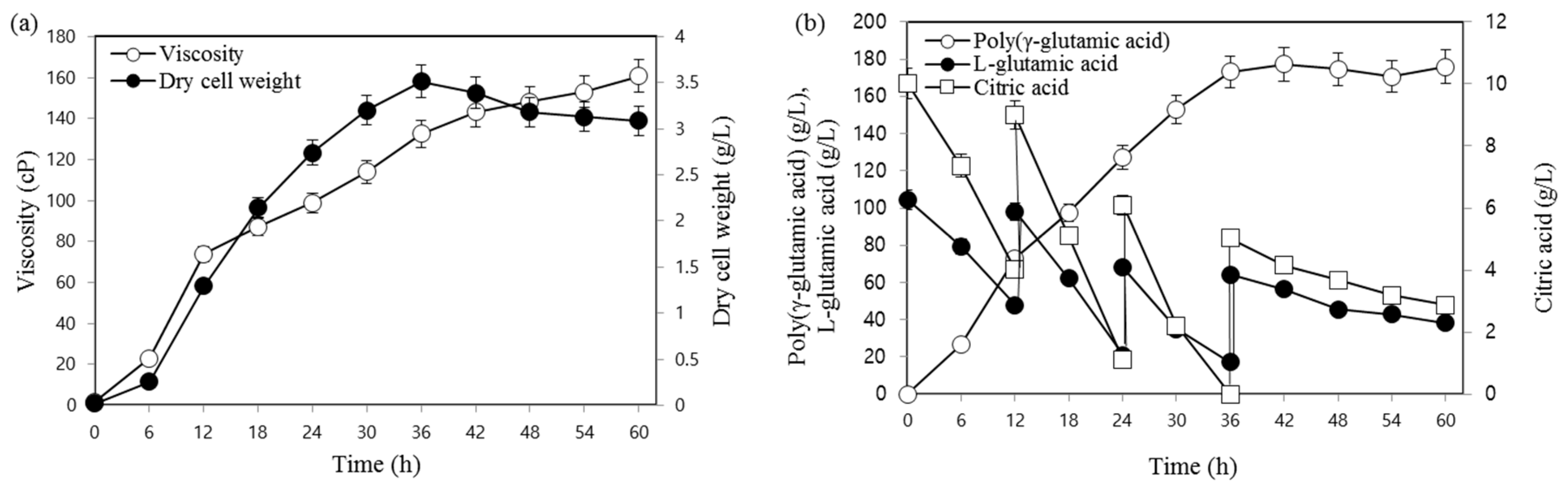
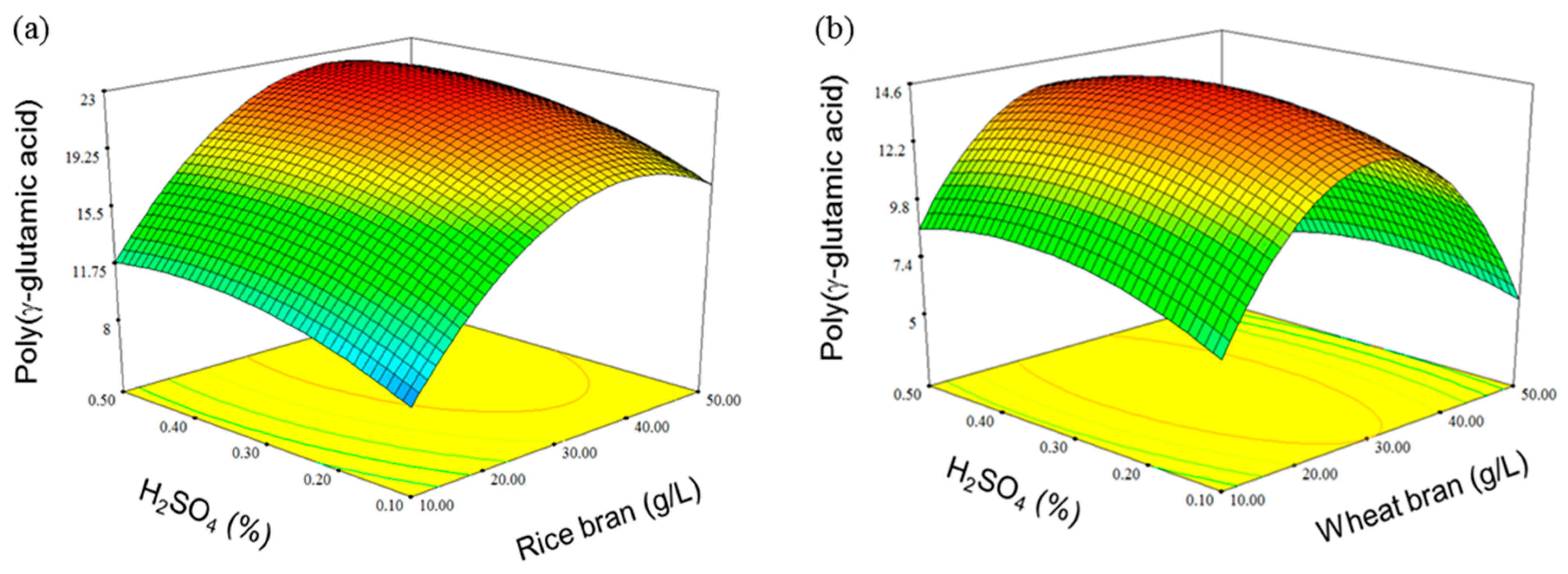
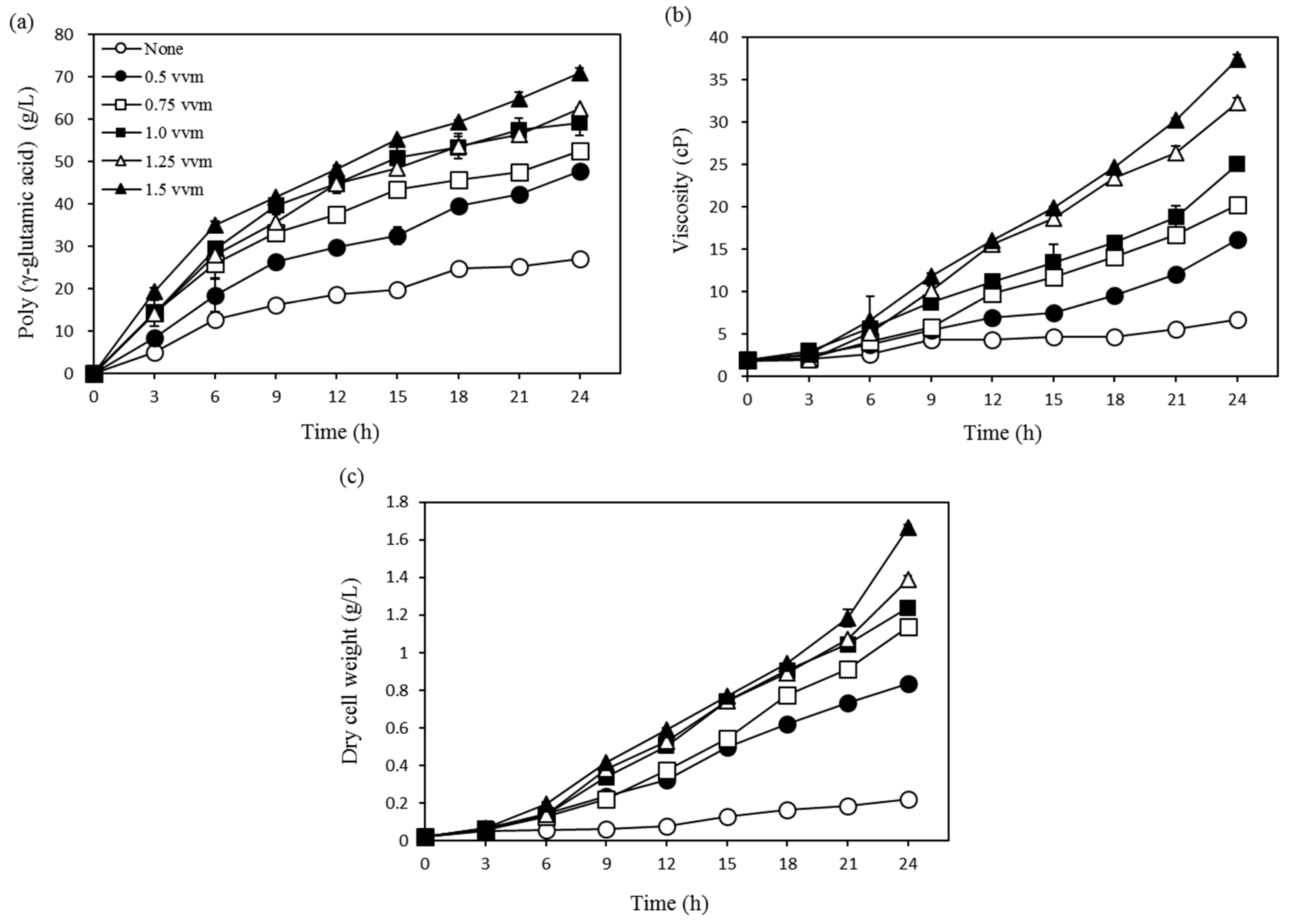
We optimized culture conditions using Bacillus sp. FBL-2 as a poly-(γ-glutamic acid) (PGA) producing strain isolated from cheonggukjang. All experiments were performed under aerobic conditions using a laboratory scale 2.5 L fermentor. We investigated the effects of fermentation parameters (temperature, pH, agitation, and aeration) and medium components (glutamic acid, citric acid, and yeast extract) on poly-(γ-glutamic acid) production, viscosity, and dry cell mass. A non-optimized fermentation method (1.5 vvm, 350 rpm, and 37 °C) yielded PGA, viscosity, and dry cell mass at levels of 100.7 g/L, 483.2 cP, and 3.4 g/L, respectively. L-glutamic acid, citric acid, and yeast extract supplementation enhanced poly-(γ-glutamic acid) production to 175.9 g/L. Additionally, the production of poly-(γ-glutamic acid) from rice bran and wheat bran was assessed using response surface methodology (central composite rotatable design). Agricultural byproducts (rice bran and wheat bran) and H2SO4 were selected as factors, and experiments were performed by combining various component concentrations to determine optimal component concentrations. Our experimentally-derived optimal parameters included 38.6 g/L of rice bran, 0.42% of H2SO4, 28.0 g/L of wheat bran, and 0.32% of H2SO4. Under optimum conditions, rice bran medium facilitated poly-(γ-glutamic acid) production of up to 22.64 g/L, and the use of wheat bran medium yielded up to 14.6 g/L. Based on a validity test using the optimized culture conditions, poly-(γ-glutamic acid) was produced at 47.6 g/L and 36.4 g/L from these respective mediums, and both results were higher than statistically predicted. This study suggests that rice bran can be used as a potential alternative substrate for poly-(γ-glutamic acid) production.
Keywords: Bacillus sp. FBL-2; optimization; rice bran; poly-(γ-glutamic acid); wheat bran Bacillus sp. FBL-2; optimization; rice bran; poly-(γ-glutamic acid); wheat bran