Article

Scheduling Precedence Constraints among Charging Tasks in Wireless Rechargeable Sensor Networks †

1
Department of Information Engineering, Nanjing University of Aeronautics and Astronautics Jincheng College, Nanjing 211156, China
2
State Key Laboratory for Novel Software Technology, Nanjing University, Nanjing 210023, China
*
Authors to whom correspondence should be addressed.
This paper is an extended version of our paper published in the 25th IEEE Symposium on Computers and Communications (ISCC), Rennes, France, 7–10 July 2020.
Electronics 2024, 13(2), 346; https://doi.org/10.3390/electronics13020346

Submission received: 14 November 2023 / Revised: 7 January 2024 / Accepted: 9 January 2024 / Published: 13 January 2024
(This article belongs to the Special Issue Advances in Wireless Sensor Networks)

Abstract

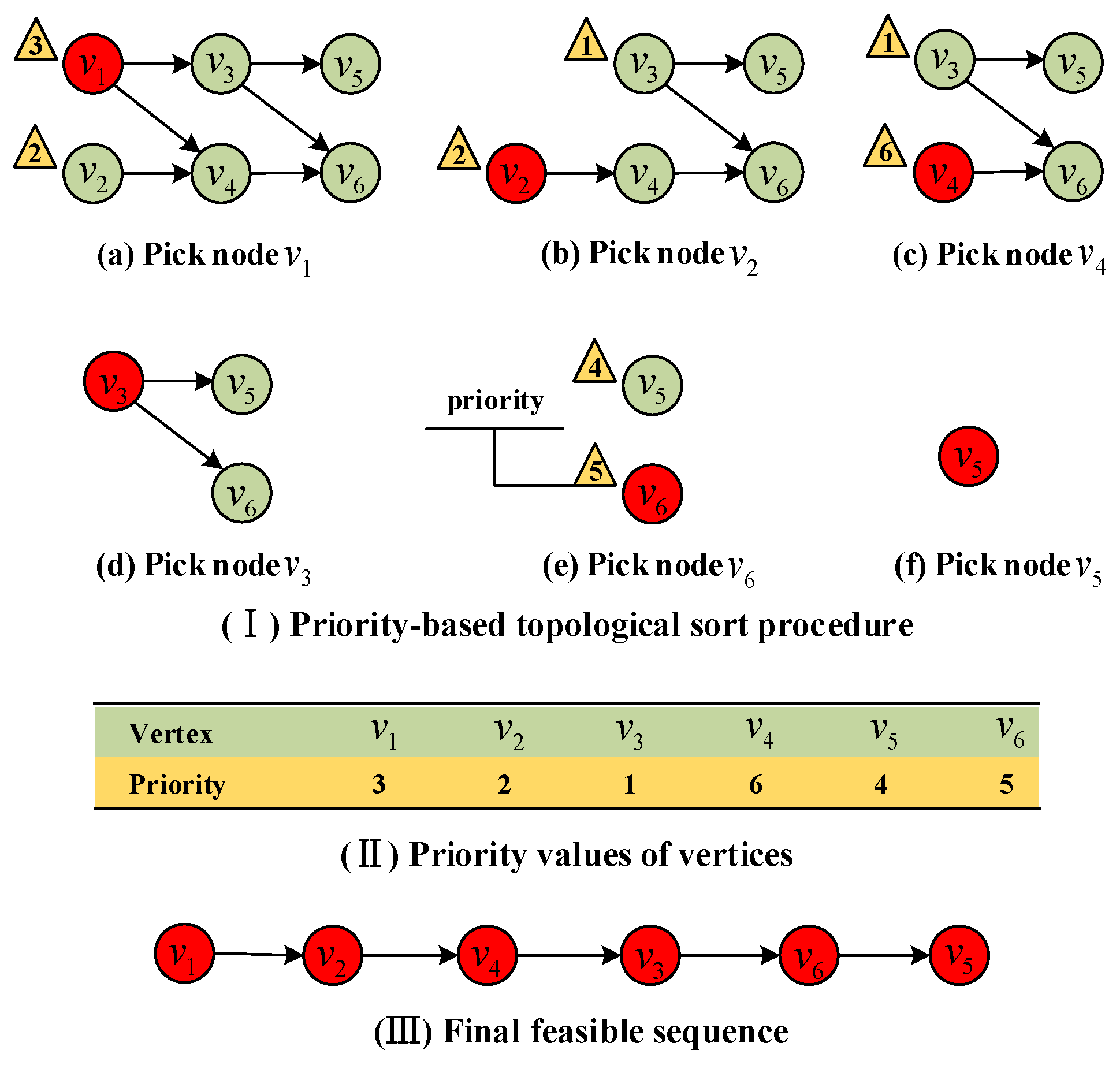
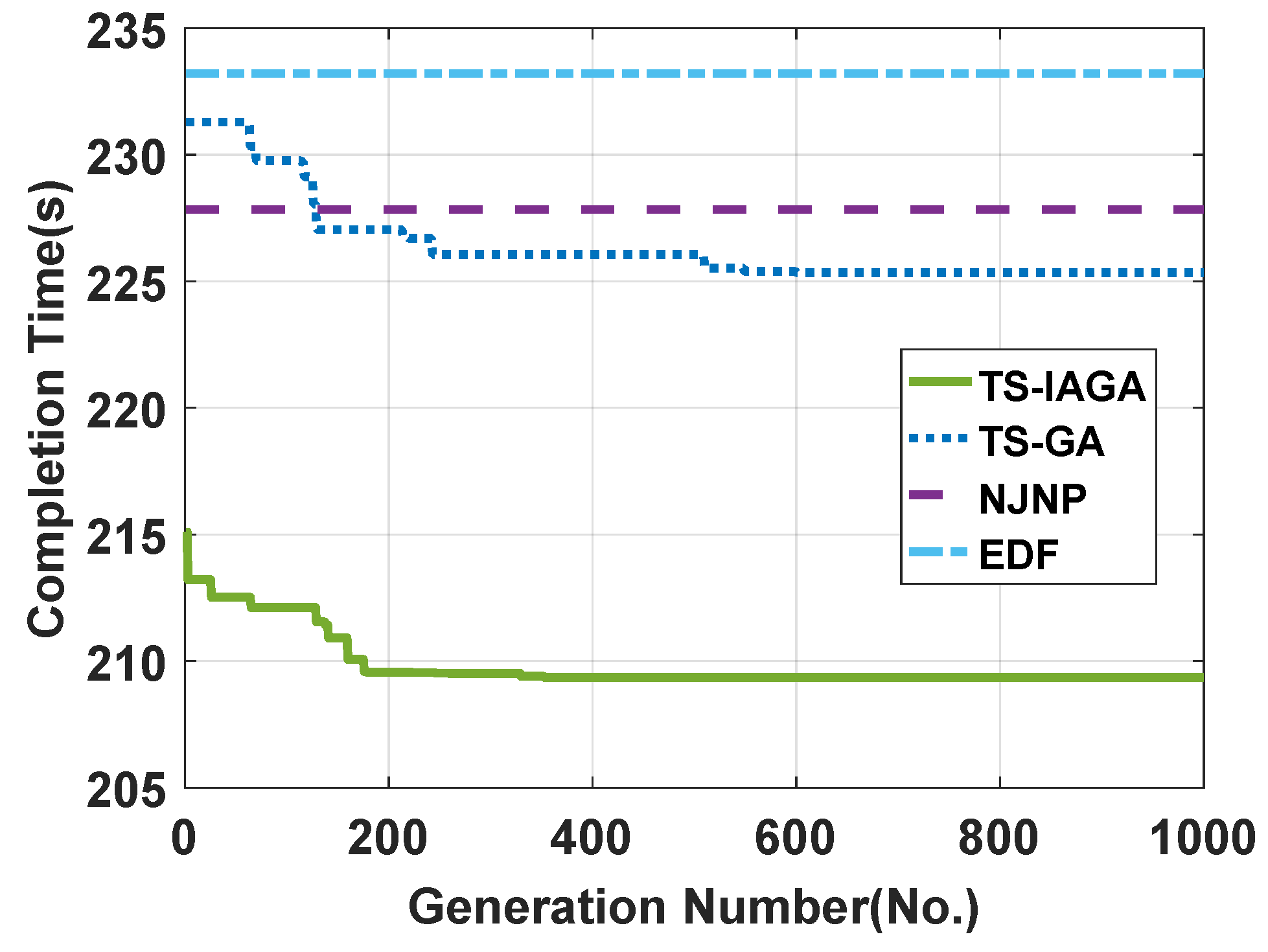
The development of wireless power transfer (WPT) facilitates wireless rechargeable sensor networks (WRSNs) receiving considerable attention in the sensor network research community. Most existing works mainly focus on general charging patterns and metrics while overlooking the precedence constraints among tasks, resulting in charging inefficiency. In this paper, we are the first to advance the issue of scheduling wireless charging tasks with precedence constraints (SCPC), with the optimization objective of minimizing the completion time of all the charging tasks under the precedence constraints while guaranteeing that the energy capacity of the mobile charger (MC) is not exhausted and the deadlines of charging tasks are not exceeded. In order to address this problem, we first propose a priority-based topological sort scheme to derive a unique feasible sequence on a directed acyclic graph (DAG). Then, we combine the proposed priority-based topological sort scheme with the procedure of a genetic algorithm to obtain the final solution through a series of genetic operators. Finally, we conduct extensive simulations to validate our proposed algorithm under the condition of three different network sizes. The results show that our proposed algorithm outperformed the other comparison algorithms by up to 11.59% in terms of completion time.
Keywords: wireless charging; WRSNs; precedence constraints; genetic algorithm wireless charging; WRSNs; precedence constraints; genetic algorithm