Skip to Content
  • Feature Paper
  • Article
  • Open Access

7 October 2024

A Design Review for Biomedical Wireless Power Transfer Systems with a Three-Coil Inductive Link through a Case Study for NICU Applications


,
,
and
Department of Electrical and Computer Engineering, Worcester Polytechnic Institute, Worcester, MA 01609, USA
*
Author to whom correspondence should be addressed.
These authors contributed equally to this work.

Abstract

This paper outlines a design approach for biomedical wireless power transfer systems with a focus on three-coil inductive links for neonatal intensive care unit applications. The relevant literature has been explored to support the design approach, equations, simulation results, and the process of experimental analysis. The paper begins with a brief overview of various power amplifier classes, followed by an in-depth examination of the most common power amplifiers used in biomedical wireless power transfer systems. Among the traditional linear and switching amplifier classes, class-D and class-E switching amplifiers are highlighted for their enhanced efficiency and straightforward implementation in biomedical contexts. The impact of load variation on these systems is also discussed. This paper then explores the basic concepts and essential equations governing inductive links, comparing two-coil and multi-coil configurations. In the following, the paper discusses foundational coil parameters and provides theoretical and experimental analysis of both two-coil and multi-coil inductive links through step-by-step measurement techniques using lab equipment and addressing the relevant challenges. Finally, a case study for neonatal intensive care unit applications is presented, showcasing a wireless power transfer system operating at 13.56 MHz for powering a wearable device on a patient lying on a mattress. An inductive link with a transmitter coil embedded in a mattress is designed to supply power to a load at distances ranging from 4 cm to 12 cm, simulating the mattress-to-chest distance of an infant. the experimental results of a three-coil inductive link equipped with a Class-E power amplifier are reported, demonstrating power transfer efficiency ranging from 75% to 25% and power delivery to a 500 Ω -load varying from 340 mW to 25 mW over various distances.

1. Introduction

Wireless power transfer (WPT) has generated significant interest across various domains due to its ability to deliver power across a broad spectrum, ranging from nanowatts in certain Internet of Things (IoT) applications [1] to milliwatts in wearable and implantable medical devices [2,3,4], to watts in assisted living or industrial applications [5,6], and even kilowatts in electric vehicles (EV) [7]. Inductive coupling is a prevalent method for transmitting power to medical devices within WPT systems, encompassing near-field, mid-field, and far-field modes. These modes differ fundamentally in electromagnetic (EM) field characteristics and antenna dimensions. In the context of biomedical applications within the industrial, scientific, and medical (ISM) band, the near-field radio frequency (RF) signal experiences lower attenuation in human tissue [8], thus offering an efficient power transfer mechanism dependent on medical device size and power delivery requirements [9,10,11,12,13]. Near-field inductive WPT systems serve various purposes, including continuous powering of electronic medical devices [9,10,11,12,13] and temporary recharging of batteries [14,15] or super-capacitors [16,17]. These lightweight systems offer several benefits, such as eliminating the need for disposable batteries to reduce infection risks in implantable devices [18] and enabling continuous monitoring of vital signs like heart rate, respiratory rate, and body temperature without requiring human intervention, thereby allowing patients to maintain their normal daily activities and behaviors. A recent intriguing example showcased the enabling of skin-to-skin contact between parents and newborns, a vital aspect of the healing process for newborns, in neonatal intensive care unit (NICU) settings when wireless wearable sensors are deployed [19].
A WPT system fundamentally consists of a transmitter coil (Tx), a receiver coil (Rx), and a power amplifier (PA). The Tx coil produces an electromagnetic field to facilitate power transfer. The PA, integrated within the Tx, boosts the signal strength to ensure efficient power transmission. The Rx coil captures the electromagnetic field and converts it back into electrical power for the target device. Together, these components enable the effective wireless transfer of power.
Inductive links encounter challenges primarily due to the attenuation of mutual inductance, which occurs due to variations in coil distance or misalignment. This attenuation necessitates a high power transfer efficiency (PTE) to ensure adequate power delivery for intended applications. Various strategies have been proposed to address this challenge. For instance, the insertion of metamaterials (MTMs) between the Tx and Rx coils has been utilized to enhance efficiency [20]. MTMs are engineered materials with unique electromagnetic properties, such as wave amplification, which can potentially boost PTE [21]. The impact of MTMs on PTE improvement is discussed in [22]. Configuring MTMs, positioning them in the inductive link, and number of MTMs can enhance efficiency. In [23], two slabs of high-dielectric MTM resonators with cubic configuration are positioned in front of the Tx and Rx coils. This design leverages high-dielectric MTMs for superior efficiency, 58.5% improvement, and size reduction, 3.6 × 3.6 cm 2 , with high-dielectric materials. In [24], two slabs of spiral MTM resonators with square configuration are positioned at the two sides of Tx and Rx coils. It is demonstrated that side-positioned MTM slabs can significantly enhance WPT performance by 15.4%, achieving the same or better transmission efficiency as center-positioned slabs.
However, MTMs present several challenges compared to conventional inductive links [25]. For example, their intricate design complicates fabrication and integration, and they are sensitive to frequency shifts, which can affect performance stability. Moreover, the advanced manufacturing requirements lead to higher costs [26]. These issues can render MTMs challenging compared to simpler, cost-effective inductive coil systems [25]. Therefore, further research is needed to address these challenges associated with MTMs.
Moreover, multi-coil inductive links, discussed in [2,27,28,29], offer improved PTE performance over traditional two-coil setups, especially over longer distances. Recent advancements, including using multi-coil array structures [30,31], enable flexible coil positioning while improving efficiency.
Cage-based inductive link arrays have been introduced in experiments involving small animals [32,33,34]. These arrays are less sensitive to coil position and orientation, allowing animals to move freely within the cage with minimal impact on PTE. Enhanced PTE reduces heat dissipation and limits tissue exposure to strong magnetic fields, contributing to compliance with specific absorption rate (SAR) regulations [35,36]. Additionally, improved PTE minimizes power generation by the PA, which reduces interference with nearby communication devices [37]. In short, optimizing the efficiency of the entire WPT system is crucial to overcoming the mentioned challenges.
Given the significance of each component in the WPT system, careful consideration is necessary in PA design. Researchers explore various classes of PAs [38,39,40], providing comprehensive insights into design processes and equations. In inductive WPT systems, series configurations are common on the Tx side, particularly in biomedical WPT systems, as series configurations simplify impedance matching between the transmitter and receiver, enhancing PTE. Driving low impedance is essential in such configurations, making Class-E and -D PAs preferred options due to their high efficiency [3,41,42].
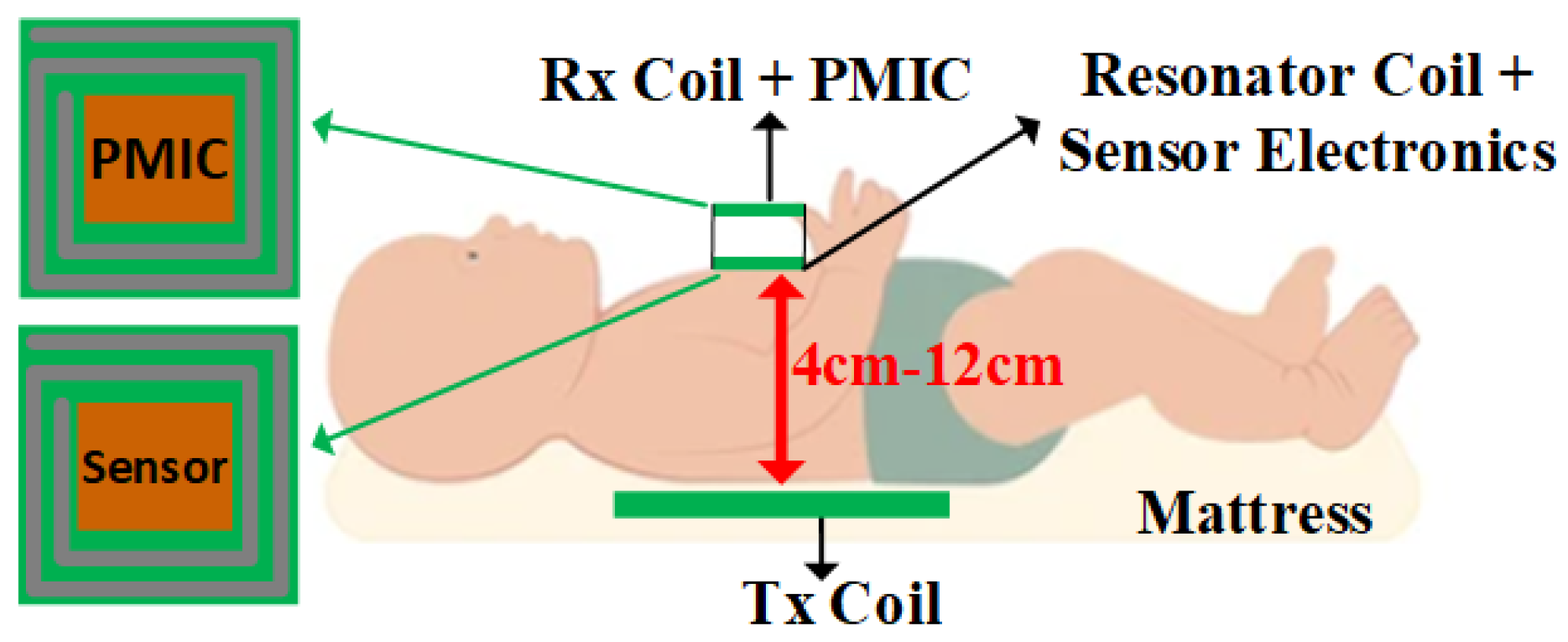
This study explores near-field inductive WPT systems, where resonance frequencies typically lie within the MHz range and operational distances span only a few centimeters [43,44]. A comprehensive review of previous advancements in biomedical WPT systems is provided and an in-depth analysis of the various parameters that influence the design of PAs and inductive links, accompanied by relevant equations. Additionally, a practical case study involving a three-coil inductive link operating at 13.56 MHz is presented, specifically tailored to the NICU applications, to illustrate a practical application of the theoretical principles governing each component. Figure 1 illustrates the conceptual three-coil WPT system for NICU set-up, where the Tx coil is embedded inside the mattress. The resonator and Rx coils are housed at a specific distance from each other according to the design requirement, and the distance from the Tx coil and resonator varies from 4 cm to 12 cm from patient to patient [45]. Rx coil and the power management integrated circuit (PMIC) are integrated on one board where PMIC regulates the power received by Rx based on the application power requirement. The regulated power is conducted to the wearable device through the via.
Figure 1. Conceptual set-up for a NICU application.
The remainder of this manuscript is organized as follows. Section 2 reviews the most commonly used PAs in biomedical WPT systems. Section 3 elaborates on the basic principles of induction in inductive links, while Section 4 discusses the important factors in coil design. Section 5 gives an overview of two-coil and multi-coil inductive links and compares them. Then, Section 6 presents a detailed case study on a three-coil inductive link, articulating the design details and sharing the results of experimental tests. Finally, Section 7 concludes the paper by summarizing the main findings.

2. Power Amplifiers for Wireless Power Transfer Systems

To enable the transmission of power through the inductive link in wireless power systems, a PA is employed within the transmitter. The PA serves as a DC-AC converter, addressing the inherent limitation of DC signals to propagate through the inductive link utilized in WPT systems. In contrast to their significance in audio applications, where considerations such as signal distortion and harmonics are dominating [46], the key specifications for PAs in WPT systems revolve around efficiency and delivered power [47].
PAs are classified into several classes based on their operational characteristics, with notable classes including class-A, -B, -AB, -C, -D, and -E. These classes are further categorized as either linear or switching amplifiers, contingent on their mode of operation. Linear amplifiers, encompassing Class-A, -B, -AB, and -C, function in accordance with the conduction angle of the input signal, thereby driving the active device, such as a bipolar junction transistor (BJT) or a metal-oxide-semiconductor field-effect transistor (MOSFET). Linear amplifiers are known for their inefficiency because the power transistor operates continuously throughout most, if not the entire, input signal cycle, leading to consistent current conduction. As a result, the amplifier consumes a substantial amount of power, even without an input signal, rendering it unsuitable for WPT applications [48,49,50].
Conversely, switching PAs, exemplified by Class-D and -E amplifiers, theoretically attain 100% efficiency under conditions of zero-voltage or zero-current switching [48]. Nonetheless, the efficiency of switching amplifiers is primarily compromised by losses and parasitic elements within the switching elements. Driven by square wave signals, these amplifiers experience efficiency degradation; however, such losses can be mitigated through the implementation of optimization techniques and adherence to specific operating conditions [42,51,52]. This section will articulate the operational and design principles of the most prevalent PA classes utilized in WPT systems, specifically Class-D and -E. Additionally, it will encompass an overview of cutting-edge implementations and optimization strategies geared toward maximizing efficiency.

2.1. Class-D Power Amplifier

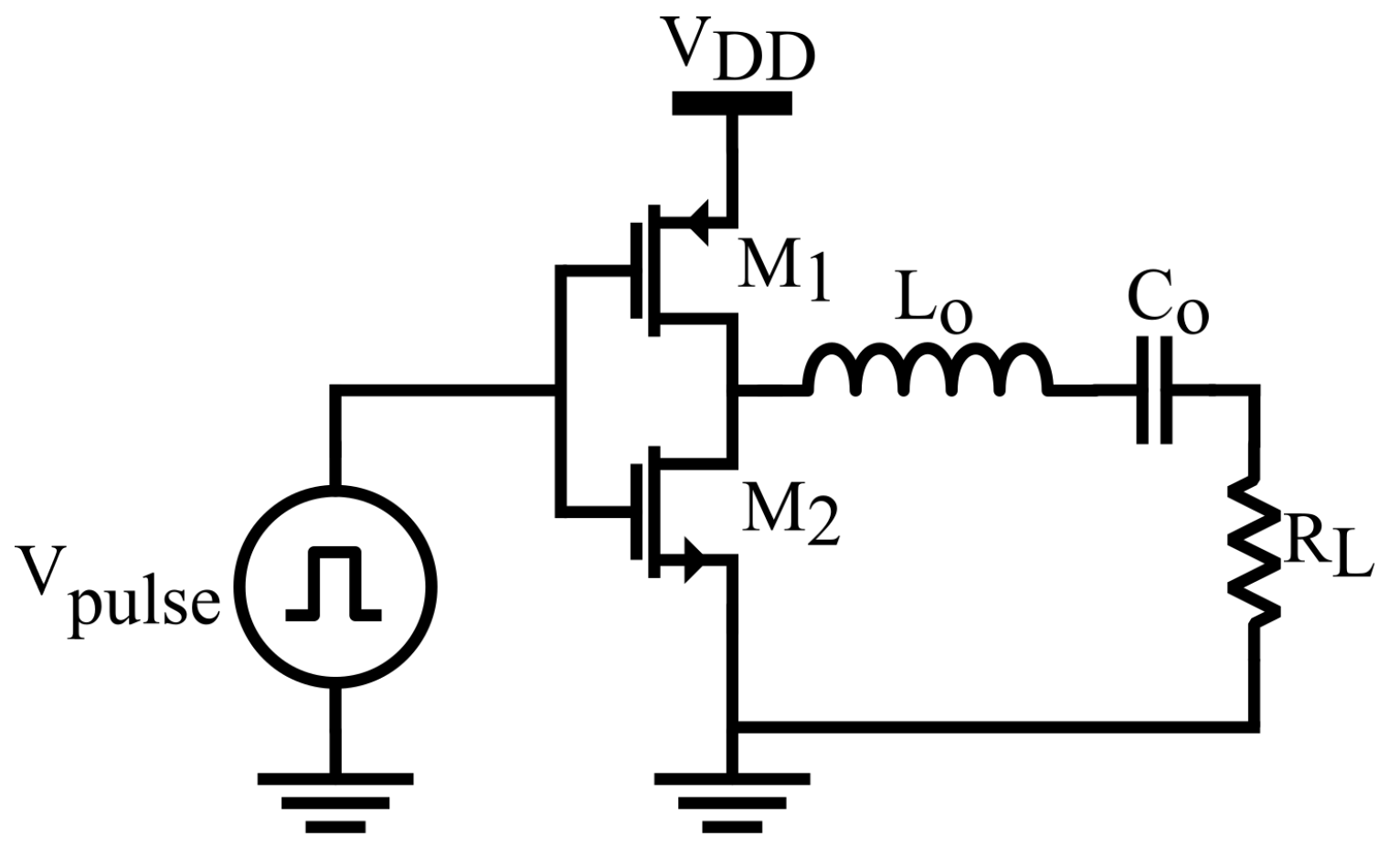
The Class-D PA, illustrated in Figure 2, first introduced in [53], consists of a pair of switching devices, M 1 and M 2 , the resonant network, L o and C o , tuned at the desired carrier frequency, and a load resistor R L . The switching devices, commonly MOSFETs, act as a two-pole switch that operates alternatively between the supply and ground rails, generating a rectangular voltage or current waveform. The output circuit acts as a filter that removes the harmonics of the rectangular waveform, resulting in a sinusoidal output. While the ideal efficiency of a Class-D PA is 100%, losses in the switching devices make this theoretical value unattainable in practical implementations with losses reaching 30%. To achieve high efficiency, non-overlapping complementary signals must be used to drive the gates of the n-channel and p-channel MOSFET switches. This ensures the switches are never conducting simultaneously, which would cause significant losses in the PA. A comprehensive analytical model of the Class-D PA has been presented in [54,55].
Figure 2. Simplified schematic of a Class-D power amplifier.
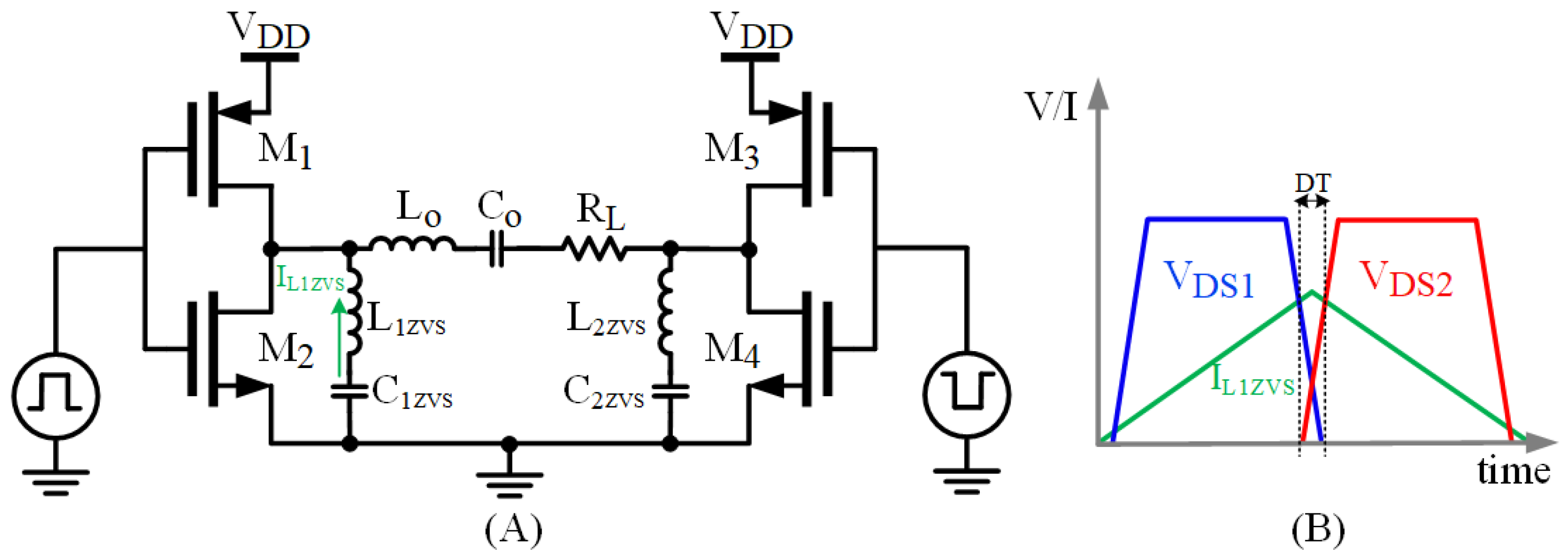
In [56], a full-bridge Class-D PA with zero-voltage switching (ZVS) implementation has been proposed, illustrated in Figure 3A. The full-bridge amplifier topology uses two half-bridge inverters operating in a differential mode. ZVS is an operating mode that aims to improve PA efficiency by using a capacitor and an inductor, referred to as the ZVS tank, to smoothly transition the switching node voltage of the amplifier, which reduces the typical overlap losses due to switching device parasitic capacitances [57]. In the proposed PA, ZVS operating conditions are achieved while also implementing dynamic dead-time control (DDTC), which controls dead-time (DT) dynamically between the gate signals for each V D D value. The ideal waveforms for the ZVS tank’s current and the drain-source voltage of M 1 and M 2 switches are shown in Figure 3B. These conditions allow for reduced system losses by dynamically changing the DT to prevent large current spikes due to input voltage variation. This implementation can achieve higher steady-state efficiency and lower operating temperature than fixed DT PAs. Researchers in [58] present a similar PA with DT control along with the implementation of transistor width switching. Similar to [59,60], the transistor width switching scheme allows for improved efficiency over a wide load range by compromising between conduction losses and driving losses which are inversely proportional to each other based on transistor width. Using 1X, 2X, 4X, and 8X transistor sizes, small transistor widths are used for low-load currents, while larger widths are used for high-load currents.
Figure 3. (A) Class-D full-bridge PA with ZVS LC tank, and (B) ideal waveforms.
In ZVS systems, the addition of the ZVS tank to achieve ZVS conditions results in the loading of the inductor appearing purely inductive. This causes the PA output current to lag behind the switching voltage, achieving ZVS operation. However, if the output current changes, the PA no longer operates at optimal ZVS conditions. While implementations such as [57] have attempted to improve this through an additional ZVS tank, the scheme relies on large inductor and capacitor values which makes it impractical for many applications. Ref. [61] proposes a discontinuous conduction mode (DCM) ZVS scheme for a Class-D PA. The proposed DCM PA uses additional switches in the ZVS tank and dual-loop control to adjust the turn-on time of the loops to achieve similar results as [57] while reducing the sizes of the ZVS inductor and capacitor.
PAs such as [62], for biomedical implants, are commonly required to provide constant voltage levels independent of the coil coupling. This can be achieved by implementing a control loop that adjusts the power delivered to the implant based on the coupling between the coils [63,64], or by adjusting the carrier frequency [65]. Table 1 compares WPT systems that have been implemented with a Class-D PA.
Table 1. Comparison table of class-D PAs in WPT systems.

2.2. Class-E Power Amplifier

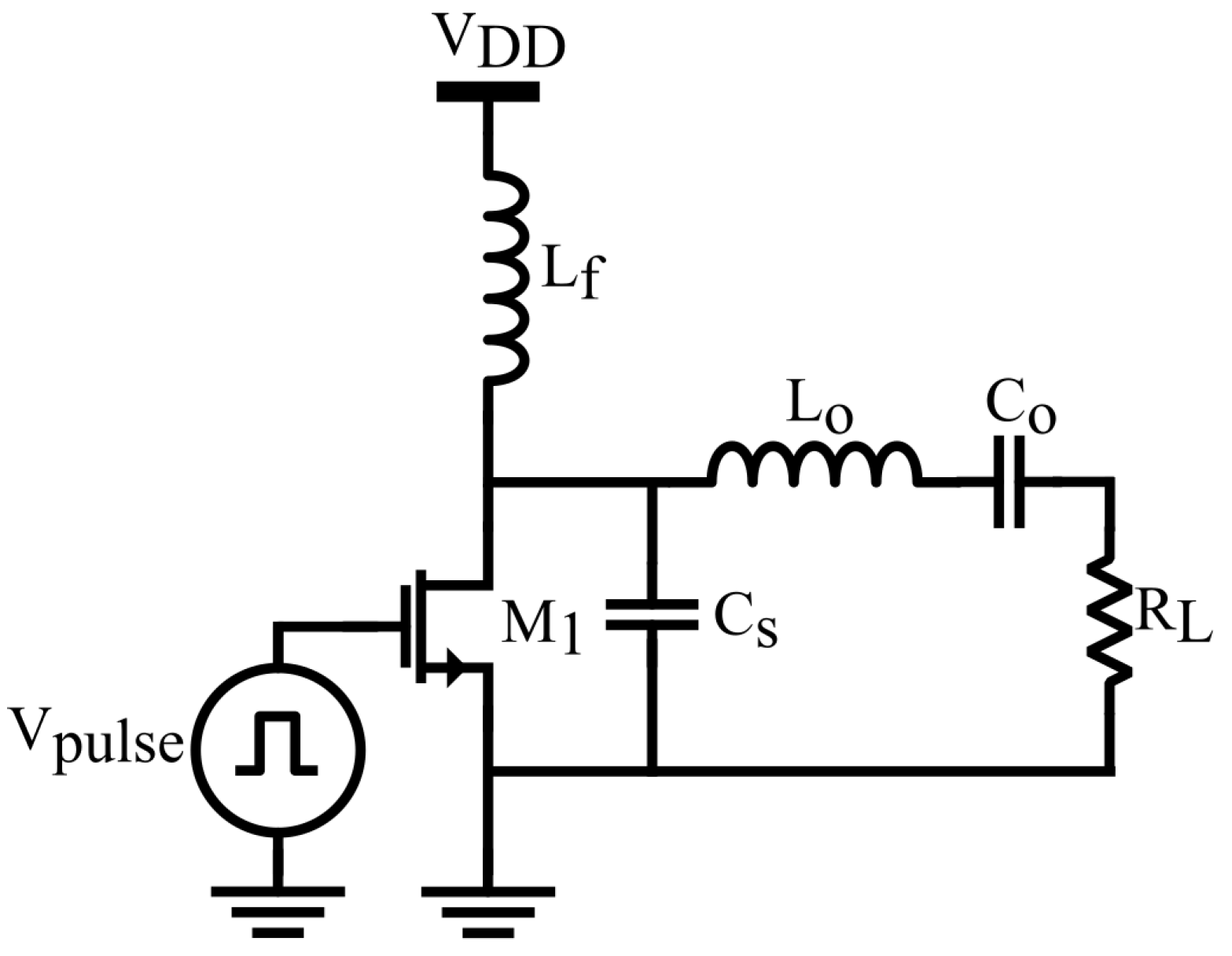
The Class-E PA was initially introduced in [66], highlighting the significance of minimizing the overlap of substantial current or voltage waveforms to mitigate switching losses within the PA. Due to its efficacy with just one switch element, the Class-E PA finds extensive application in biomedical and implantable devices. as illustrated in Figure 4, the fundamental circuit comprises a solitary n-channel power MOSFET, a shunt capacitor C s , a series resonance output circuit L o and C o , along with an RF choke inductor L f . C s ensures zero-voltage switching conditions for the non-ideal switch, while the output resonance network is tuned to the operational frequency, delivering a sinusoidal output. The gate of the MOSFET is driven by a square wave signal matching the operational frequency of the PA [67]. A comprehensive time domain analysis and explicit design equations for Class-E PA were presented in [68], showing that even with switch on-resistance, Class-E conditions remain achievable. Moreover, it suggests that substituting RF choke with finite DC-feed inductance can lead to efficiency improvements, with outcomes influenced by transistor technology and operational frequency.
Figure 4. Simplified schematic of a Class-E power amplifier.
Due to the reliance on resonant operation, the Class-E PA achieves maximum efficiency when the load value, R L , is carefully calculated. Deviating from the ideal value results in load-dependent output power, power efficiency, peak voltages, and peak currents, leading to reliability issues [69]. This is common in WPT systems, as the load resistance changes due to factors such as coil misalignment, which affects the coupling coefficient [70,71]. The most common solution to this problem is to implement a passive impedance matching network at the output of the PA. In [72], a modified Π matching network is implemented to increase the efficiency of the PA over a wide range of loads. This modification improves the amplifier’s efficiency from 50–90% to 80–88% over the load range of 1–100 Ω . Another solution is to replace the fixed passive circuit components with automatic tuning components, as discussed in [73,74]. Table 2 presents a comparison of WPT systems that have been implemented with a Class-E PA.
Table 2. Comparison table of Class-E PAs in WPT systems.

3. Principles of Induction

This section explores induction fundamentals critical for WPT systems, covering Faraday’s Law, self-inductance, mutual-inductance, and the coupling coefficient.

3.1. Faraday’s Law

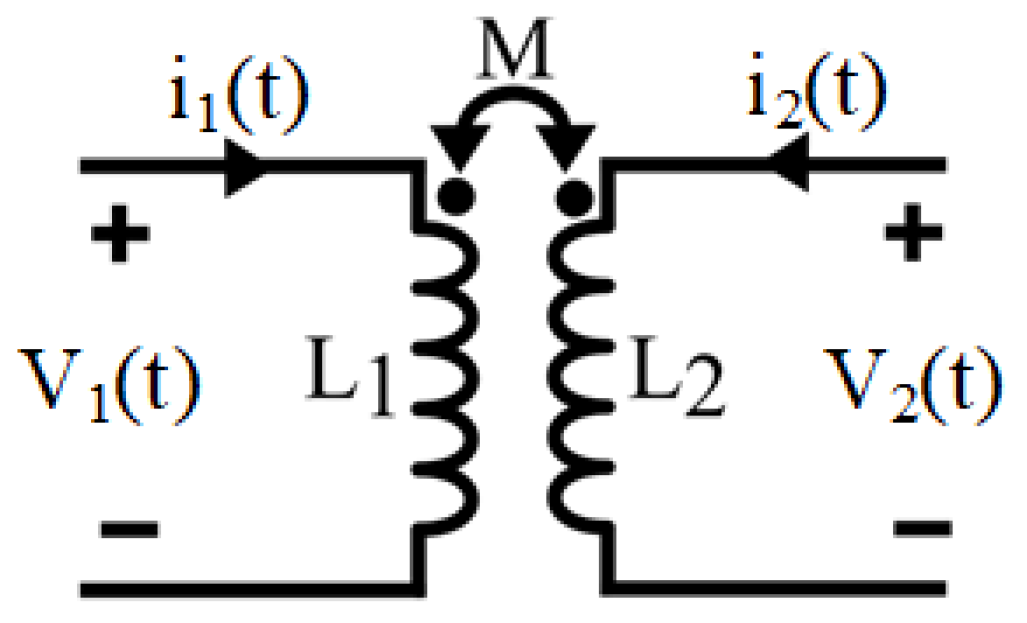
The basics of WPT systems are built upon Faraday’s principle of electromagnetic induction. As illustrated in Figure 5, when a time-varying current, i 1 ( t ) , flows through the primary coil L 1 , also known as Tx, it generates a time-varying magnetic field. The resulting magnetic field flux lines traverse the secondary coil L 2 , also known as Rx, inducing a voltage difference across Rx terminals. This voltage difference enables a time-varying current, i 2 ( t ) , to flow through the R X .
Figure 5. A generic architecture of an inductive WPT system.

3.2. Self-Inductance

When a time-varying current flows through a coil, it generates a magnetic field surrounding the conductor. This magnetic field creates an electromotive force (EMF) in the coil terminals that results in a voltage drop on the coil. v ( t ) = j ω L i ( t ) , where ( ω = 2 π f ), shows the relationship between the time-varying voltage and current with the self-inductance of a coil at the operating frequency of f. The inductance of a coil is measured in Henry (H), representing its ability to resist changes in the current.

3.3. Mutual-Inductance and Coupling Coefficient

The magnetic flux lines generated by the T X coil that passes through the R X coil can be quantified as the mutual inductance (M) representing the coupling strength between the coils. This can be translated as the part of the energy generated by the T X coil, which is received by the R X coil. Mutual inductance depends on the coils’ geometries, as well as the distance and alignment between the coils. A simplified closed-form expression for the mutual inductance for a pair of circular solenoid coils is
M 12 = π μ 0 n 1 r 1 2 n 2 r 2 2 2 ( r 1 2 + d 2 ) 3 c o s ( θ ) ,
where μ 0 is the permeability of free space, n 1 and n 2 represent the number of turns, r 1 and r 2 are the radii of the coils, and d is the distance between the two coils. The angle θ represents the alignment between the center of two coils, where it becomes maximum when they are completely aligned. The mutual inductance is often normalized with respect to the coils forming the link as k = M L 1 L 2 , facilitating comparison and providing a clearer sense of the coupling between two coils. k can take values from 0 to 1, where a value close to 0 indicates a loosely coupled system, while a value close to 1 represents a strongly coupled system.

4. Coils

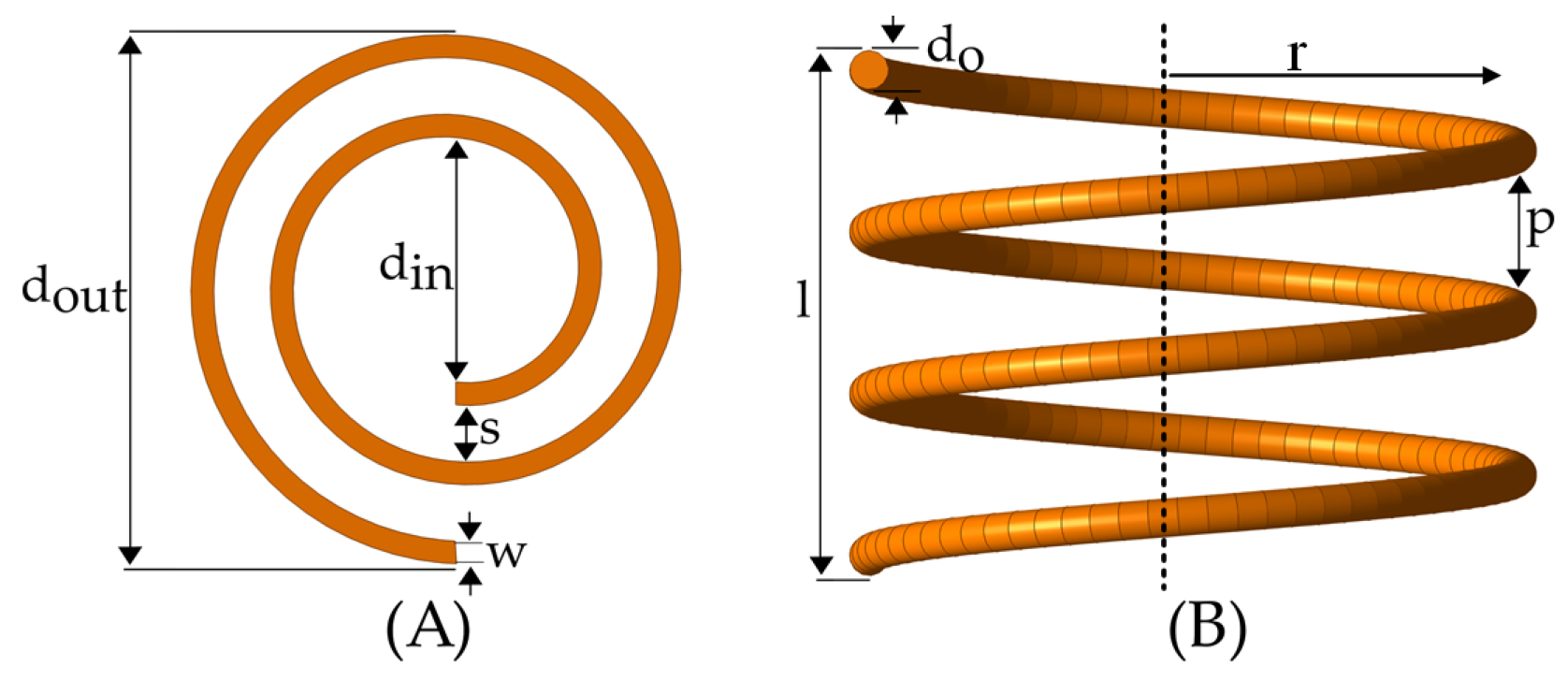
Based on the coils’ manufacturing method, they can be broadly categorized into two groups, printed spiral coils (PSC) and helical coils, as depicted in Figure 6. The selection of coil shape is primarily dictated by the specific application’s required geometry. For instance, PSCs offer easy customization and cost-effective mass production through lithography. They are preferred in situations where device thickness is limited, such as with credit cards, or when flexibility is needed to conform to curved surfaces like the human body. However, they face limitations such as difficulties in increasing the number of turns without expanding their diameter, leading to narrower conductive traces, higher equivalent series resistance (ESR), and lower Q-factor.
Figure 6. (A) Spiral and (B) helical coil structures with annotated parameters.
In contrast, helical coils cannot be mass-produced as economically and necessitate specialized winding equipment. Nonetheless, they generally face fewer restrictions and can offer significantly higher Q-factors as the cylindrical form of helical coils amplifies the concentration of magnetic fields. An advancement in the additive manufacturing electronic (AME) process [77] has introduced the capability to produce helical coils directly within substrates, enabling the creation of compact systems for miniaturized biomedical devices. It is important to note that this technology is not yet widely accessible; therefore, its cost and manufacturing time are not comparable to those of standard PSC manufacturing. The following sections will explain the essential equations for inductance, resistance, and parasitic capacitance of various geometries.

4.1. Self-Inductance

The self-inductance of a PSC coil depends on the geometric characteristics and is calculated in [78] using the following equations:
Circular : L = μ n 2 d avg 2 ln 2.46 ϕ + 0.2 ϕ 2 ,
Square : L = 1.27 μ n 2 d avg 2 ln 2.07 ϕ + 0.18 ϕ + 0.13 ϕ 2 ,
Hexagonal : L = 1.09 μ n 2 d avg 2 ln 2.23 ϕ + 0.17 ϕ 2 ,
Octagonal : L = 1.07 μ n 2 d avg 2 ln 2.29 ϕ + 0.19 ϕ 2 ,
where μ = μ r · μ o represents the permeability that for nonmagnetic materials, μ r is assumed to be 1. The average diameter is expressed as d avg = d out + d in 2 , and n is the number of turns. The fill factor ( ϕ ), ranging from 0 to 1, depends on the amount of area filled with the conductor that is calculated through ϕ = d out d in d out + d in .
The self-inductance of a helical coil is obtained through the following equation [79]:
L = μ 0 π r 2 n 2 κ l ,
where μ 0 is the permeability of the free space, r is the coil radius, n is the number of turns, l is the coil length, and κ is the Nagaoka’s coefficient obtained through the following equation:
κ = z k ln 1 + 1 z k + 1 k 0 + k 1 l d + k 2 l d 2 + w 1 w 2 2 + d / l v ,
where z k = l / ( π r ) ), k 0 , k 1 , k 2 refer to the correction coefficients and have the following values; k 0 = 2.30038 , k 1 = 3.437 , k 2 = 1.76356 , w 1 and w 2 are Weaver’s coefficients to reduce the error and they have the following values; w 1 = 0.47 , w 2 = 0.755 , and v = 1.44 [3,79].

4.2. Parasitic Resistance

The parasitic resistance of a coil is divided into DC resistance and AC resistance. R D C , is calculated straightforwardly through R D C = ρ l A as it primarily depends on material resistivity ( ρ ), the conductor cross-section area (A), and the length of the coil (l).
In contrast to its DC counterpart, the AC resistance is influenced by an additional frequency factor, contributing to its computational intricacy. Within the realm of PSCs, two significant phenomena associated with AC resistance are the skin effect and the proximity effect. The skin effect, symbolized as R s k i n and formulated in Equation (8), exhibits a strong reliance on parameters such as frequency ( ω ), trace width (w), and thickness ( t 0 ). With increasing frequency, a skin depth ( δ ) is established according to Equation (9), and begins to form around the conductor that represents the effective cross-sectional area through which the current can flow.
R s k i n = R D C t 0 δ 1 e t 0 δ 1 1 + t 0 w .
δ = 2 ρ ω μ .
The proximity effect exacerbates the coil resistance, denoted as R p r o x , arising from the magnetic field generated by the interaction of current flow in neighboring traces within the coil. This magnetic field induces eddy currents, which in turn elevate the coil resistance. The approximate estimation of R p r o x is given as follows
R prox = R D C 10 ω ω crit 2 ,
where ω c r i t is the critical frequency and signifies the frequency threshold at which current crowding prevails and the proximity effect becomes dominant [80]. It is calculated as
ω crit = 3.1 μ 0 ( w + s ) ρ w 2 t 0 ,
where s is the spacing between the adjacent traces.
Ultimately, the total ESR, R s , is derived by combining the resistances attributed to both the skin effect and the proximity effect.
R s = R s k i n + R p r o x .

4.3. Parasitic Capacitance

The gap between traces inadvertently forms a capacitor in parallel with the coil, reducing its self-resonant frequency. It is important to evaluate this frequency to ensure it remains well separated from the operating frequency. Otherwise, the stability of the inductance value could be compromised, presenting difficulties in circuit tuning. Two types of insulating materials influence the value of parasitic capacitance. The first type is the material between two adjacent traces, which can be air or another coating. The parasitic capacitance due to this material is denoted as C p c . The second type is the substrate, which can be ceramic, FR4, or polyimide. The parasitic capacitance associated with the substrate is denoted as C p s . Ref. [81] has proposed an equation to estimate the parasitic capacitance, which includes these two parameters:
C P = C p c + C p s α ε r c + β ε r s ε 0 t 0 s l g ,
where ε 0 is the vacuum permittivity, l g is the length of the gap, which can be estimated through Equation (14). ε r c and ε r s represent the relative permittivity of the coating and substrate materials, respectively. Assuming the coating is air and the substrate is FR4, the coefficients α and β for these components are 0.9 and 1.1, respectively. Furthermore, the values of ε r c and ε r s , are 1 and 4.4, respectively.
l g = 4 d o u t w · n ( n 1 ) 4 s · n ( n + 1 ) .

4.4. Quality Factor (Q)

The quality factor of a coil is determined by comparing its reactance, which includes parasitic elements contributing to the overall reactance, to its parasitic resistance. To achieve a strong magnetic field with a specific inductance, a high value of Q is necessary. A Q value less than 1 indicates that losses dominate over the inductive properties. For a well-designed coil for a particular frequency, Q peaks at the desired frequency and then drops close to the self-resonance frequency [82]. The quality factor, estimated in [81], is
Q = ω L ω R S 2 + ω 2 L 2 C P R S .

4.5. Mutual Inductance for PSC

To determine the mutual inductance between two PSC coils, the turns of each coil are conceptualized as a series of concentric loops. The individual mutual inductance between the i th turn of one coil and j th turn of the other coil is calculated as
M i j = 2 μ α r i · r j 1 α 2 2 K ( α ) E ( α ) ,
where r i and r j denote the radius of each turn, K ( α ) and E ( α ) represent the complete elliptic integral of the first and second kind, respectively, and α is derived as
α = 2 r i · r j r i + r j 2 + D 2 ,
where D is the center-to-center distance between the coils. The total mutual inductance is obtained by adding up the individual mutual inductance between each turn of the coils as
M = g i = 1 n 1 j = 1 n 2 M i j r i , r j , D ,
where the parameter g is the correction factor determined based on the coil geometry and estimated in [81]. For a pair of hexagonal coils, g is 0.95; for a pair of circular coils, it is 1.0; and for a pair of square coils, it is 1.1.

7. Conclusions

This paper provides an overview of key concepts related to inductive power transfer systems, including the significance of the quality factor in coil design, the principles governing mutual inductance calculations for multi-coil systems, and the fundamental configurations of inductive links. Building upon this theoretical foundation, the paper presented a detailed case study focused on the design, simulation, and experimental validation of a three-coil inductive link tailored for powering physiological monitoring sensors in NICU applications. Through a systematic approach to coil optimization, the study aims to achieve high PTE and reliable power delivery over varying distances between the Tx and Rx. This approach underscores the potential of inductive power transfer technology to facilitate continuous monitoring solutions in critical care settings. Finally, the concept introduced in this paper will be further developed and modified to incorporate sensors for neonatal care into a comprehensive system.

Author Contributions

Conceptualization, U.G. and A.H.M.; methodology, U.G., A.H.M. and M.G.; software, M.G., N.R. and A.H.M.; validation, A.H.M., M.G., N.R. and U.G.; formal analysis, M.G. and A.H.M.; investigation, M.G., N.R. and A.H.M.; resources, M.G., N.R. and A.H.M.; data curation, A.H.M.; writing—original draft preparation, M.G., N.R. and A.H.M.; writing—review and editing, U.G. and A.H.M.; visualization, A.H.M.; supervision, U.G.; project administration, U.G. and A.H.M.; funding acquisition, U.G. All authors have read and agreed to the published version of the manuscript.

Funding

This work was supported by the National Institute of Health (NIH) under Grant 1R01HL172293.

Data Availability Statement

Data is contained within the article.

Conflicts of Interest

The authors declare no conflict of interest.

Abbreviations

Wireless Power Transfer (WPT); Internet of Things (IoT); Electric Vehicles (EV); Electromagnetic (EM); Industrial, Scientific, and Medical (ISM); Radio Frequency (RF); Neonatal Intensive Care Unit (NICU); Power Amplifier (PA); Power Transfer Efficiency (PTE); Metamaterials (MTMs); Specific Absorption Rate (SAR); Power Management Integrated Circuit (PMIC); Bipolar Junction Transistor (BJT); Metal-Oxide-Semiconductor Field-Effect Transistor (MOSFET); Zero-Voltage Switching (ZVS); Dynamic Dead-Time Control (DDTC); Dead-Time (DT); Discontinuous Conduction Mode (DCM); Electromotive Force (EMF); Printed Spiral Coils (PSC); Equivalent Series Resistance (ESR); Additive Manufacturing Electronic (AME); Power Delivered to Load (PDL); Anteroposterior (AP); Vector Network Analyzer (VNA); Surface Mount Device (SMD).

References

  1. Chiu, M.T.; Chiu, C.Y.; Ng, C.; Wong, L.O.; Shen, S.; Murch, R. An Ambient RF Powered Wireless Sensor System. IEEE Open J. Antennas Propag. 2022, 3, 1382–1393. [Google Scholar] [CrossRef]
  2. Kiani, M.; Jow, U.M.; Ghovanloo, M. Design and Optimization of a 3-Coil Inductive Link for Efficient Wireless Power Transmission. IEEE Trans. Biomed. Circuits Syst. 2011, 5, 579–591. [Google Scholar] [CrossRef] [PubMed]
  3. Schormans, M.; Valente, V.; Demosthenous, A. Practical Inductive Link Design for Biomedical Wireless Power Transfer: A Tutorial. IEEE Trans. Biomed. Circuits Syst. 2018, 12, 1112–1130. [Google Scholar] [CrossRef] [PubMed]
  4. Saha, R.; Kaffash, Z.; Mirbozorgi, S.A. Multi-Resonator Wireless Inductive Power Link for Wearables on the 2D Surface and Implants in 3D Space of the Human Body. IEEE Trans. Biomed. Circuits Syst. 2024, 18, 1024–1036. [Google Scholar] [CrossRef]
  5. Fu, M.; Yin, H.; Zhu, X.; Ma, C. Analysis and Tracking of Optimal Load in Wireless Power Transfer Systems. IEEE Trans. Power Electron. 2015, 30, 3952–3963. [Google Scholar] [CrossRef]
  6. Abdullahi, Q.S.; Joshi, R.; Podilchak, S.K.; Khan, S.R.; Chen, M.; Rooney, J.; Rooney, J.; Sun, D.; Desmulliez, M.P.; Georgiadis, A.; et al. Design of a wireless power transfer system for assisted living applications. Wirel. Power Transf. 2019, 6, 41–56. [Google Scholar] [CrossRef]
  7. Li, S.; Mi, C.C. Wireless Power Transfer for Electric Vehicle Applications. IEEE J. Emerg. Sel. Top. Power Electron. 2015, 3, 4–17. [Google Scholar] [CrossRef]
  8. Barbruni, G.L.; Ros, P.M.; Demarchi, D.; Carrara, S.; Ghezzi, D. Miniaturised Wireless Power Transfer Systems for Neurostimulation: A Review. IEEE Trans. Biomed. Circuits Syst. 2020, 14, 1160–1178. [Google Scholar] [CrossRef]
  9. Park, Y.; Koh, S.T.; Lee, J.; Kim, H.; Choi, J.; Ha, S.; Kim, C.; Je, M. A Wireless Power and Data Transfer IC for Neural Prostheses Using a Single Inductive Link With Frequency-Splitting Characteristic. IEEE Trans. Biomed. Circuits Syst. 2021, 15, 1306–1319. [Google Scholar] [CrossRef]
  10. Soltani, N.; ElAnsary, M.; Xu, J.; Filho, J.S.; Genov, R. Safety-Optimized Inductive Powering of Implantable Medical Devices: Tutorial and Comprehensive Design Guide. IEEE Trans. Biomed. Circuits Syst. 2021, 15, 1354–1367. [Google Scholar] [CrossRef]
  11. Lyu, H.; Babakhani, A. A 13.56-MHz −25-dBm-Sensitivity Inductive Power Receiver System-on-a-Chip with a Self-Adaptive Successive Approximation Resonance Compensation Front-End for Ultra-Low-Power Medical Implants. IEEE Trans. Biomed. Circuits Syst. 2021, 15, 80–90. [Google Scholar] [CrossRef] [PubMed]
  12. Chakravarti, A.; Marangalou, A.H.; Costanzo, I.M.; Sen, D.; Sciulli, M.; Tsuno, Y.; Guler, U. Wireless Photometry Prototype for Tri-Color Excitation and Multi-Region Recording. Micromachines 2022, 13, 727. [Google Scholar] [CrossRef] [PubMed]
  13. Kirschner, R.; Hazrati Marangalou, A.; Tsuno, Y.; Guler, U. Digitally Controllable ASIC for Tri-Color Wireless Photometry. In Proceedings of the 2022 IEEE Biomedical Circuits and Systems Conference (BioCAS), Taipei, Taiwan, 13–15 October 2022; pp. 549–553. [Google Scholar] [CrossRef]
  14. Yang, S.Y.; Sencadas, V.; You, S.S.; Jia, N.Z.X.; Srinivasan, S.S.; Huang, H.W.; Ahmed, A.E.; Liang, J.Y.; Traverso, G. Powering Implantable and Ingestible Electronics. Adv. Funct. Mater. 2021, 31, 2009289. [Google Scholar] [CrossRef] [PubMed]
  15. Choi, M.; Jang, T.; Jeong, J.; Jeong, S.; Blaauw, D.; Sylvester, D. A Resonant Current-Mode Wireless Power Receiver and Battery Charger with −32 dBm Sensitivity for Implantable Systems. IEEE J. Solid-State Circuits 2016, 51, 2880–2892. [Google Scholar] [CrossRef]
  16. Gao, C.; Huang, J.; Xiao, Y.; Zhang, G.; Dai, C.; Li, Z.; Zhao, Y.; Jiang, L.; Qu, L. A seamlessly integrated device of micro-supercapacitor and wireless charging with ultrahigh energy density and capacitance. Nat. Commun. 2021, 12, 2647. [Google Scholar] [CrossRef]
  17. Lee, H.M.; Ghovanloo, M. A Power-Efficient Wireless Capacitor Charging System Through an Inductive Link. IEEE Trans. Circuits Syst. II Express Briefs 2013, 60, 707–711. [Google Scholar] [CrossRef]
  18. Kim, H.; Rigo, B.; Wong, G.; Lee, Y.J.; Yeo, W.H. Advances in Wireless, Batteryless, Implantable Electronics for Real-Time, Continuous Physiological Monitoring. Nano-Micro Lett. 2024, 16, 52. [Google Scholar] [CrossRef]
  19. Chung, H.U.; Kim, B.H.; Lee, J.Y.; Lee, J.; Xie, Z.; Ibler, E.; Lee, K.; Banks, A.; Jeong, J.; Kim, J.; et al. Binodal, wireless epidermal electronic systems with in-sensor analytics for neonatal intensive care. Science 2019, 363, eaau0780. [Google Scholar] [CrossRef]
  20. Liu, W.; Liu, Y.; Li, F.; Liu, H.; Wang, J. Design and Optimization of a Compact Wireless Power Transfer System with Metamaterial-Based Resonant Structures. IEEE Trans. Microw. Theory Tech. 2023, 71, 1356–1367. [Google Scholar]
  21. Rong, C.; Lu, C.; Zeng, Y.; Tao, X.; Liu, X.; Liu, R.; He, X.; Liu, M. A critical review of metamaterial in wireless power transfer system. IET Power Electron. 2021, 14, 1541–1559. [Google Scholar] [CrossRef]
  22. Kim, H.S.; Choi, J.H.; Kim, H.S.; Lee, S.H.; Kim, K.H. Design and Performance Analysis of a High-Power Wireless Power Transfer System Using Metamaterials. IEEE Trans. Power Electron. 2020, 35, 8261–8273. [Google Scholar]
  23. Das, R.; Basir, A.; Yoo, H. A Metamaterial-Coupled Wireless Power Transfer System Based on Cubic High-Dielectric Resonators. IEEE Trans. Ind. Electron. 2019, 66, 7397–7406. [Google Scholar] [CrossRef]
  24. Zhu, S.; Zhao, C.; Huang, Z.; Zhang, Y.; Luo, X. Enhancement of Wireless Power Transmission Based on Side-Positioned Metamaterials. In Proceedings of the 2018 IEEE PES Asia-Pacific Power and Energy Engineering Conference (APPEEC), Kota Kinabalu, Malaysia, 7–10 October 2018; pp. 241–245. [Google Scholar] [CrossRef]
  25. Rong, C.; Yan, L.; Li, L.; Li, Y.; Liu, M. A Review of Metamaterials in Wireless Power Transfer. Materials 2023, 16, 6008. [Google Scholar] [CrossRef] [PubMed]
  26. Chen, Z.; Guo, B.; Yang, Y.; Cheng, C. Metamaterials-based enhanced energy harvesting: A review. Phys. B Condens. Matter 2014, 438, 1–8. [Google Scholar] [CrossRef]
  27. RamRakhyani, A.K.; Lazzi, G. On the Design of Efficient Multi-Coil Telemetry System for Biomedical Implants. IEEE Trans. Biomed. Circuits Syst. 2013, 7, 11–23. [Google Scholar] [CrossRef]
  28. Yang, X.; Jiang, L.; Giri, S.; Ostadabbas, S.; Abdollah Mirbozorgi, S. A Wearable Walking Gait Speed-Sensing Device using Frequency Bifurcations of Multi-Resonator Inductive Link. In Proceedings of the 2021 43rd Annual International Conference of the IEEE Engineering in Medicine & Biology Society (EMBC), Guadalajara, Mexico, 1–5 November 2021; pp. 7272–7275. [Google Scholar] [CrossRef]
  29. Yeon, P.; Mirbozorgi, S.A.; Ghovanloo, M. Optimal design of a 3-coil inductive link for millimeter-sized biomedical implants. In Proceedings of the 2016 IEEE Biomedical Circuits and Systems Conference (BioCAS), Shanghai, China, 17–19 October 2016; pp. 396–399. [Google Scholar] [CrossRef]
  30. Mirbozorgi, S.A.; Bahrami, H.; Sawan, M.; Gosselin, B. A Smart Multicoil Inductively Coupled Array for Wireless Power Transmission. IEEE Trans. Ind. Electron. 2014, 61, 6061–6070. [Google Scholar] [CrossRef]
  31. Saha, R.; Patel, S.A.; Yildirim, A.; Mirbozorgi, S.A. Toward a Highly Scalable Smart System for Small Animal Body Sensing and Tracking using an Inductive Multi-Resonator Array. In Proceedings of the 2022 IEEE International Symposium on Circuits and Systems (ISCAS), Austin, TX, USA, 27 May–1 June 2022; pp. 600–604. [Google Scholar] [CrossRef]
  32. Mirbozorgi, S.A.; Bahrami, H.; Sawan, M.; Gosselin, B. A Smart Cage with Uniform Wireless Power Distribution in 3D for Enabling Long-Term Experiments with Freely Moving Animals. IEEE Trans. Biomed. Circuits Syst. 2016, 10, 424–434. [Google Scholar] [CrossRef]
  33. Lee, B.; Jia, Y.; Mirbozorgi, S.A.; Connolly, M.; Tong, X.; Zeng, Z.; Mahmoudi, B.; Ghovanloo, M. An Inductively-Powered Wireless Neural Recording and Stimulation System for Freely-Behaving Animals. IEEE Trans. Biomed. Circuits Syst. 2019, 13, 413–424. [Google Scholar] [CrossRef]
  34. Jow, U.M.; McMenamin, P.; Kiani, M.; Manns, J.R.; Ghovanloo, M. EnerCage: A Smart Experimental Arena with Scalable Architecture for Behavioral Experiments. IEEE Trans. Biomed. Eng. 2014, 61, 139–148. [Google Scholar] [CrossRef]
  35. Kopanoglu, E. Actual patient position versus safety models: Specific Absorption Rate implications of initial head position for Ultrahigh Field Magnetic Resonance Imaging. NMR Biomed. 2023, 36, e4876. [Google Scholar] [CrossRef]
  36. Uche, U.I.; Naidenko, O.V. Development of health-based exposure limits for radiofrequency radiation from wireless devices using a benchmark dose approach. Environ. Health 2021, 20, 84. [Google Scholar] [CrossRef] [PubMed]
  37. Baikova, E.N.; Valtchev, S.S.; Melício, R.; Pires, V.M. Electromagnetic Interference Impact of Wireless Power Transfer System on Data Wireless Channel. In Proceedings of the Technological Innovation for Cyber-Physical Systems, Costa de Caparica, Portugal, 11–13 April 2016. [Google Scholar]
  38. Sahan, N.; Inal, M.E.; Demir, S.; Toker, C. High-Power 20-100-MHz Linear and Efficient Power-Amplifier Design. IEEE Trans. Microw. Theory Tech. 2008, 56, 2032–2039. [Google Scholar] [CrossRef]
  39. Kouhalvandi, L.; Matekovits, L.; Peter, I. Amplifiers in Biomedical Engineering: A Review from Application Perspectives. Sensors 2023, 23, 2277. [Google Scholar] [CrossRef] [PubMed]
  40. Kazimierczuk, M.K. RF Power Amplifiers; John Wiley & Sons: Hoboken, NJ, USA, 2014. [Google Scholar]
  41. Lee, B.; Kiani, M.; Ghovanloo, M. A Triple-Loop Inductive Power Transmission System for Biomedical Applications. IEEE Trans. Biomed. Circuits Syst. 2016, 10, 138–148. [Google Scholar] [CrossRef]
  42. Liu, H.; Shao, Q.; Fang, X. Modeling and Optimization of Class-E Amplifier at Subnominal Condition in a Wireless Power Transfer System for Biomedical Implants. IEEE Trans. Biomed. Circuits Syst. 2017, 11, 35–43. [Google Scholar] [CrossRef]
  43. Pérez-Nicoli, P.; Silveira, F.; Ghovanloo, M. Wireless Power Transfer for Medical Microsystems. In Proceedings of the 2021 IEEE MTT-S International Wireless Symposium (IWS), Nanjing, China, 23–26 May 2021; pp. 6–7. [Google Scholar] [CrossRef]
  44. Guler, U.; Hazrati Marangalou, A.; Kirschner, R.; Ghovanloo, M. Wireless Power Delivery. In Current and Emerging Communication Technologies for Medical Implants; Deniz Unluturk, B., Ashammakhi, N., Eds.; Springer Nature: Cham, Switzerland, 2023; pp. 1–53. [Google Scholar]
  45. Jin, S.Y.; Oh, S.B.; Kim, Y.O. Estimation of optimal pediatric chest compression depth by using computed tomography. Clin. Exp. Emerg. Med. 2016, 3, 27–33. [Google Scholar] [CrossRef]
  46. Berkhout, M.; Dooper, L. Class-D Audio Amplifiers in Mobile Applications. IEEE Trans. Circuits Syst. I Regul. Pap. 2010, 57, 992–1002. [Google Scholar] [CrossRef]
  47. Ben Fadhel, Y.; Ktata, S.; Rahmani, S.; Ai-Haddad, K. Design and Simulation of Wireless Power Transfer System for Brain Implant. In Proceedings of the 2018 15th International Multi-Conference on Systems, Signals & Devices (SSD), Yasmine Hammamet, Tunisia, 19–22 March 2018; pp. 292–297. [Google Scholar] [CrossRef]
  48. Grebennikov, A.; Sokal, N.O. Switchmode RF Power Amplifiers; Communications Engineering Series; Elsevier: Amsterdam, The Netherlands; Newnes: Boston, MA, USA, 2007. [Google Scholar]
  49. Van Mulders, J.; Delabie, D.; Lecluyse, C.; Buyle, C.; Callebaut, G.; Van der Perre, L.; De Strycker, L. Wireless Power Transfer: Systems, Circuits, Standards, and Use Cases. Sensors 2022, 22, 5573. [Google Scholar] [CrossRef]
  50. Kilinc, E.G.; Ture, K.; Maloberti, F.; Dehollain, C. Design and comparison of class-C and class-D power amplifiers for remotely powered systems. In Proceedings of the 2013 IEEE 20th International Conference on Electronics, Circuits, and Systems (ICECS), Abu Dhabi, United Arab Emirates, 8–11 December 2013; pp. 461–464. [Google Scholar] [CrossRef]
  51. Cipriani, E.; Colantonio, P.; Giannini, F.; Giofre, R. Optimization of Class E Power Amplifier Design above Theoretical Maximum Frequency. In Proceedings of the 2008 38th European Microwave Conference, Amsterdam, The Netherlands, 27–31 October 2008; pp. 1541–1544. [Google Scholar] [CrossRef]
  52. Shi, L.; Rodriguez, J.; Carrizosa, M.J.; Alou, P. ZVS Tank Optimization for Class-D Amplifiers in High Frequency WPT Applications. In Proceedings of the 2021 IEEE Applied Power Electronics Conference and Exposition (APEC), Phoenix, AZ, USA, 14–17 June 2021; pp. 1593–1598. [Google Scholar] [CrossRef]
  53. Baxandall, P.J. Transistor Sine-Wave LC Oscillators. Some General Considerations and New Developments. Proc. IEE—Part B Electron. Commun. Eng. 1959, 106, 748–758. [Google Scholar] [CrossRef]
  54. Tao, Y.; Ktistis, C.; Zhao, Y.; Yin, W.; Peyton, A.J. A Class D Power Amplifier for Multifrequency Eddy Current Testing Based on Multisimultaneous-Frequency Selective Harmonic Elimination Pulsewidth Modulation. IEEE Trans. Ind. Electron. 2020, 67, 8799–8807. [Google Scholar] [CrossRef]
  55. Luo, W.; Yin, Y.; Xiong, L.; Li, T.; Xu, H. Nonlinear Analytical Model for Switched-Capacitor Class-D RF Power Amplifiers. IEEE Trans. Circuits Syst. I Regul. Pap. 2019, 66, 2309–2321. [Google Scholar] [CrossRef]
  56. Tebianian, H.; Salami, Y.; Jeyasurya, B.; Quaicoe, J.E. A 13.56-MHz Full-Bridge Class-D ZVS Inverter with Dynamic Dead-Time Control for Wireless Power Transfer Systems. IEEE Trans. Ind. Electron. 2020, 67, 1487–1497. [Google Scholar] [CrossRef]
  57. de Rooij, M.A. The ZVS voltage-mode class-D amplifier, an eGaN® FET-enabled topology for highly resonant wireless energy transfer. In Proceedings of the 2015 IEEE Applied Power Electronics Conference and Exposition (APEC), Charlotte, NC, USA, 15–19 March 2015; pp. 1608–1613. [Google Scholar] [CrossRef]
  58. Wang, Q.; Liu, A.; Mai, S. A 6.78 MHz High-Efficiency Wireless Power Transfer Transmitter with Adaptive Dead-Time Control and Transistor-Width Switching for Implantable Medical Devices. In Proceedings of the 2022 IEEE Asia Pacific Conference on Circuits and Systems (APCCAS), Shenzhen, China, 11–13 November 2022; pp. 77–81. [Google Scholar] [CrossRef]
  59. Huang, C.; Mok, P.K.T. An 84.7% Efficiency 100-MHz Package Bondwire-Based Fully Integrated Buck Converter with Precise DCM Operation and Enhanced Light-Load Efficiency. IEEE J. Solid-State Circuits 2013, 48, 2595–2607. [Google Scholar] [CrossRef]
  60. Musunuri, S.; Chapman, P. Improvement of Light-Load Efficiency Using Width-Switching Scheme for CMOS Transistors. IEEE Power Electron. Lett. 2005, 3, 105–110. [Google Scholar] [CrossRef]
  61. Ge, X.; Cheng, L.; Ki, W.H. A DCM ZVS Class-D Power Amplifier for Wireless Power Transfer Applications. In Proceedings of the 2019 IEEE Asian Solid-State Circuits Conference (A-SSCC), Macau, Macao, 4–6 November 2019; pp. 43–44. [Google Scholar] [CrossRef]
  62. Valente, V.; Eder, C.; Donaldson, N.; Demosthenous, A. A High-Power CMOS Class-D Amplifier for Inductive-Link Medical Transmitters. IEEE Trans. Power Electron. 2015, 30, 4477–4488. [Google Scholar] [CrossRef]
  63. Wang, G.; Liu, W.; Sivaprakasam, M.; Kendir, G. Design and Analysis of an Adaptive Transcutaneous Power Telemetry for Biomedical Implants. IEEE Trans. Circuits Syst. I Regul. Pap. 2005, 52, 2109–2117. [Google Scholar] [CrossRef]
  64. Valente, V.; Eder, C.; Demosthenous, A.; Donaldson, N. Towards a closed-loop transmitter system with integrated class-D amplifier for coupling-insensitive powering of implants. In Proceedings of the 2012 19th IEEE International Conference on Electronics, Circuits, and Systems (ICECS 2012), Seville, Spain, 9–12 December 2012; pp. 29–32. [Google Scholar] [CrossRef]
  65. Ma, H.; van der Zee, R.; Nauta, B. 17.1 An Integrated 80V 45W Class-D Power Amplifier with Optimal-Efficiency-Tracking Switching Frequency Regulation. In Proceedings of the 2014 IEEE International Solid-State Circuits Conference Digest of Technical Papers (ISSCC), San Francisco, CA, USA, 9–13 February 2014; pp. 286–287. [Google Scholar] [CrossRef]
  66. Sokal, N.; Sokal, A. Class E—A new class of high-efficiency tuned single-ended switching power amplifiers. IEEE J. Solid-State Circuits 1975, 10, 168–176. [Google Scholar] [CrossRef]
  67. Abbas, S.M.; Hannan, M.A.; Salina, A.S. Efficient Class-E design for inductive powering wireless biotelemetry applications. In Proceedings of the 2012 International Conference on Biomedical Engineering (ICoBE), Penang, Malaysia, 27–28 February 2012; pp. 445–449. [Google Scholar] [CrossRef]
  68. Acar, M.; Annema, A.J.; Nauta, B. Analytical Design Equations for Class-E Power Amplifiers with Finite DC-Feed Inductance and Switch On-Resistance. In Proceedings of the 2007 IEEE International Symposium on Circuits and Systems (ISCAS), New Orleans, LA, USA, 27–30 May 2007; pp. 2818–2821. [Google Scholar] [CrossRef]
  69. Ghahremani, A.; Annema, A.J.; Nauta, B. Load Mismatch Sensitivity of Class-E Power Amplifiers. IEEE Trans. Microw. Theory Tech. 2019, 67, 216–230. [Google Scholar] [CrossRef]
  70. Pinuela, M.; Yates, D.C.; Lucyszyn, S.; Mitcheson, P.D. Maximizing DC-to-Load Efficiency for Inductive Power Transfer. IEEE Trans. Power Electron. 2013, 28, 2437–2447. [Google Scholar] [CrossRef]
  71. Aldhaher, S.; Luk, P.C.K.; Whidborne, J.F. Tuning Class E Inverters Applied in Inductive Links Using Saturable Reactors. IEEE Trans. Power Electron. 2014, 29, 2969–2978. [Google Scholar] [CrossRef]
  72. Liu, S.; Liu, M.; Fu, M.; Ma, C.; Zhu, X. A high-efficiency Class-E power amplifier with wide-range load in WPT systems. In Proceedings of the 2015 IEEE Wireless Power Transfer Conference (WPTC), Boulder, CO, USA, 13–15 May 2015; pp. 1–3. [Google Scholar] [CrossRef]
  73. Aldhaher, S.; Luk, P.C.K.; Whidborne, J.F. Wireless power transfer using Class E inverter with saturable DC-feed inductor. IEEE Energy Convers. Congr. Expo. 2013, 50, 1902–1909. [Google Scholar] [CrossRef]
  74. Aldhaher, S.; Luk, P.C.K.; Whidborne, J.F. Electronic Tuning of Misaligned Coils in Wireless Power Transfer Systems. IEEE Trans. Power Electron. 2014, 29, 5975–5982. [Google Scholar] [CrossRef]
  75. Chang, F.W.; Hsieh, P.H. A 13.56-MHz Wireless Power Transfer Transmitter with Impedance Compression Network for Biomedical Applications. In Proceedings of the 2020 IEEE International Symposium on Circuits and Systems (ISCAS), Seville, Spain, 12–14 October 2020; pp. 1–5. [Google Scholar] [CrossRef]
  76. Lidow, A.; Rooij, A.D. Performance Evaluation of Enhancement-Mode GaN Transistors in Class-D and Class-E Wireless Power Transfer Systems. Efficient Power Conversion Corporation. May 2014. Available online: https://epc-co.com/epc/events-and-news/news/artmid/1627/articleid/1576/performance-evaluation-of-enhancement-mode-gan-transistors-in-class-d-and-class-e-wireless-power-transfer-systems (accessed on 16 August 2024).
  77. Marangalou, A.H.; Arturo Gonzalez, M.; Guler, U. Additively Manufactured Receiver Design for Wirelessly-Powered Biomedical Applications. In Proceedings of the 2023 IEEE Biomedical Circuits and Systems Conference (BioCAS), Toronto, ON, Canada, 19–21 October 2023; pp. 1–5. [Google Scholar] [CrossRef]
  78. Mohan, S.; del Mar Hershenson, M.; Boyd, S.; Lee, T. Simple accurate expressions for planar spiral inductances. IEEE J. Solid-State Circuits 1999, 34, 1419–1424. [Google Scholar] [CrossRef]
  79. Knight, D.W. An Introduction to the Art of Solenoid Inductance Calculation with Emphasis on Radio-Frequency Applications. 2016. Available online: https://api.semanticscholar.org/CorpusID:52997793 (accessed on 16 August 2024).
  80. Kuhn, W.; Ibrahim, N. Analysis of current crowding effects in multiturn spiral inductors. IEEE Trans. Microw. Theory Tech. 2001, 49, 31–38. [Google Scholar] [CrossRef]
  81. Jow, U.M.; Ghovanloo, M. Design and Optimization of Printed Spiral Coils for Efficient Transcutaneous Inductive Power Transmission. IEEE Trans. Biomed. Circuits Syst. 2007, 1, 193–202. [Google Scholar] [CrossRef]
  82. Ludwig, R.; Bogdanov, G. RF Circuit Design; Pearson: Upper Saddle River, NJ, USA, 2009. [Google Scholar]
  83. Lotfi Navaii, M.; Sadjedi, H.; Sarrafzadeh, A. Efficient ASK Data and Power Transmission by the Class-E with a Switchable Tuned Network. IEEE Trans. Circuits Syst. I Regul. Pap. 2018, 65, 3255–3266. [Google Scholar] [CrossRef]
  84. Lan, L.; Arteaga, J.M.; Yates, D.C.; Mitcheson, P.D. A Reflected Impedance Estimation Technique for Inductive Power Transfer. In Proceedings of the 2019 IEEE PELS Workshop on Emerging Technologies: Wireless Power Transfer (WoW), London, UK, 18–21 June 2019; pp. 45–48. [Google Scholar] [CrossRef]
  85. Seo, D.W. Design Method of Three-Coil WPT System Based on Critical Coupling Conditions. IEEE J. Emerg. Sel. Top. Power Electron. 2021, 9, 3802–3811. [Google Scholar] [CrossRef]
  86. Lee, B.; Kiani, M.; Ghovanloo, M. A Smart Wirelessly Powered Homecage for Long-Term High-Throughput Behavioral Experiments. IEEE Sens. J. 2015, 15, 4905–4916. [Google Scholar] [CrossRef]
  87. Jia, Y.; Mirbozorgi, S.A.; Lee, B.; Khan, W.; Madi, F.; Weber, A.; Li, W.; Ghovanloo, M. A mm-sized free-floating wirelessly powered implantable optical stimulating system-on-a-chip. In Proceedings of the 2018 IEEE International Solid-State Circuits Conference—(ISSCC), San Francisco, CA, USA, 11–15 February 2018; pp. 468–470. [Google Scholar] [CrossRef]
  88. Jia, Y.; Mirbozorgi, S.A.; Lee, B.; Khan, W.; Madi, F.; Inan, O.T.; Weber, A.; Li, W.; Ghovanloo, M. A mm-Sized Free-Floating Wirelessly Powered Implantable Optical Stimulation Device. IEEE Trans. Biomed. Circuits Syst. 2019, 13, 608–618. [Google Scholar] [CrossRef]
  89. Jia, Y.; Mirbozorgi, S.A.; Wang, Z.; Hsu, C.C.; Madsen, T.E.; Rainnie, D.; Ghovanloo, M. Position and Orientation Insensitive Wireless Power Transmission for EnerCage-Homecage System. IEEE Trans. Biomed. Eng. 2017, 64, 2439–2449. [Google Scholar] [CrossRef]
  90. Karimi, M.; Jouaicha, H.; Lellouche, F.; Bouchard, P.A.; Sawan, M.; Gosselin, B. A 6.78-MHz Robust WPT System with Inductive Link Bandwidth Extended for cm-Sized Implantable Medical Devices. In Proceedings of the 2020 42nd Annual International Conference of the IEEE Engineering in Medicine & Biology Society (EMBC), Montreal, QC, Canada, 20–24 July 2020; pp. 4196–4199. [Google Scholar] [CrossRef]
  91. Mirbozorgi, S.A.; Yeon, P.; Ghovanloo, M. Robust Wireless Power Transmission to mm-Sized Free-Floating Distributed Implants. IEEE Trans. Biomed. Circuits Syst. 2017, 11, 692–702. [Google Scholar] [CrossRef] [PubMed]
Disclaimer/Publisher’s Note: The statements, opinions and data contained in all publications are solely those of the individual author(s) and contributor(s) and not of MDPI and/or the editor(s). MDPI and/or the editor(s) disclaim responsibility for any injury to people or property resulting from any ideas, methods, instructions or products referred to in the content.

Article Metrics

Citations

Article Access Statistics

Multiple requests from the same IP address are counted as one view.