Abstract
As reconfigurable intelligent surfaces (RISs) have been gradually brought to reality, a large amount of research has been conducted to investigate the immense benefits of RISs. That is because RISs enable us to artificially direct the radio wave propagating through the environment at a relatively low cost. This paper investigates the trade-off between spectral efficiency (SE) and energy efficiency (EE) in the RIS-aided multi-user multiple-input single-output downlink. We develop an optimization framework for designing the transmitting precoding at the base station and the phase shift values at the RIS to balance the EE-SE trade-off. The proposed iterative optimization framework for the design includes quadratic transform, alternating optimization, and weighted minimization mean-square error conversion. Simulation results illustrate our optimization framework algorithm exhibits effectiveness and a fast convergence rate.
1. Introduction
As increasingly more 5G technology is being brought from concept to reality, the era of 5G has already started. A concept named reconfigurable intelligent surface (RIS) is proposed to achieve a higher data rate and increased availability and soon became a hot research topic. In practice, RIS is an artificial radio structure composed of low-cost units which can be programmed to reflect incoming radio-frequency waves to specified directions [1]. What makes RIS unique as a part of the environment is that it can control its reaction to the impinging radio wave by changing the inside current compared to the conventional surface [2,3]. According to the physical laws, the traditional surface, such as a wall, has a fixed reflection characteristic. As RIS can adapt to time-varying wireless communication environments, it makes the concept of intelligent radio environments possible [3]. The propagation environments become reconfigurable by adding RISs into the wireless environments. The process of installing RISs on or removing RISs from walls or ceilings has a low implementation cost as the hardware footprints are relatively low [4,5,6,7]. Therefore, RIS is expected to be the cost-efficient and energy-saving technology to improve system performance, becoming one of the hot topics in future communication networks [8,9,10,11].
Through the research of channel modeling [12,13], channel estimation [14], and performance evaluation of the communication system based on the RIS [15,16,17], the potential benefits of the communication environments based on RIS are discussed. In the resource allocation design of RIS-aided communication, large amounts of work focus on optimizing the spectral efficiency (SE) of the system [18]. Furthermore, we treat energy efficiency (EE), which is another important topic in the research on RIS [19,20], as one of the optimization objectives. However, most of the existing work has focused on the optimization of either SE or EE. SE performance is sometimes sacrificed for the maximization of EE, especially when the value of Signal to Interference plus Noise Ratio (SINR) is large [21,22]. Therefore, we try to find a way to attain a balance between EE and SE.
In this paper, a trade-off between SE and EE is investigated while the transmitting precoding at the base station (BS) side and the phase shift values at the RIS of RIS-aided multi-user multiple-input single-output (MISO) downlink are jointly optimized. The main contributions made by this paper are listed as follows.
We consider a RIS-aided multiuser downlink system to attain an EE-SE trade-off. Next, we propose an optimization framework for the problem in joint optimization. Then, we develop an optimization algorithm to design the transmitting precoding at the BS side and the phase shift values at the RIS to attain this trade-off. We first use the alternating optimization (AO) method to decouple the optimization variables. We also use quadratic transform and weighted minimization mean-square error (WMMSE) to turn the problem into a strictly convex problem.
The rest of this article is organized as follows. We introduce the optimization problem of the RIS-aided multiuser MISO downlink system in Section 2. Then, we present an algorithm framework to handle the problem in Section 3. In Section 4, we present further numerical analysis according to simulation results. At last, we provide the conclusion of this paper in Section 5.
Notation 1.
We use to denote a matrix, while and denote the -th element and the k-th column vector of matrix , respectively. We also use to denote a column vector, while and denote the i-th element and the Euclidean norm of vector , respectively. An identity matrix is denoted by in this paper. The notation denotes the modulus value of complex scalar b. The operator is used as the diagonalization operator in this paper. We use to denote Circular symmetric complex Gaussian distribution. The conjugate, argument, and real part of a complex number Φ are denoted by , , and , respectively.
2. System Model and Problem Formulation
2.1. Channel Model
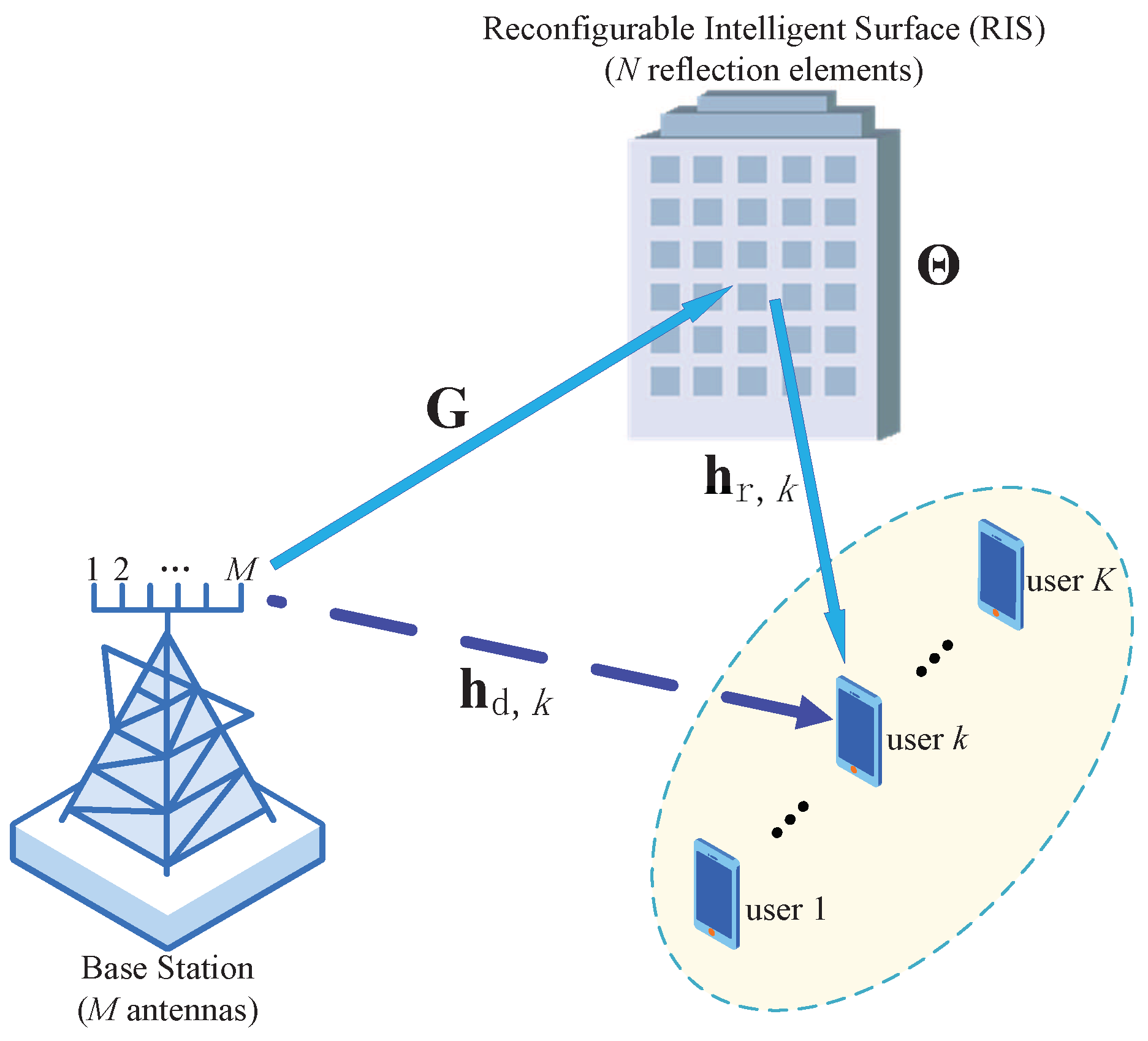
The paper considers a multiuser MISO downlink communication based on RIS, as shown in Figure 1. The messages are sent from one M-antenna BS to K users, and each user is equipped with a single antenna. The RIS in the system is equipped with N reflection elements to form a new communication path from the BS to the K users. We use , , and , , to denote the channel vectors from the BS to user k, from the BS to RIS, and from RIS to user k, respectively.
Figure 1.
The reconfigurable intelligent surface (RIS)-aided multi-user multiple-input single-output (MISO) downlink system.
The reflection operation, which is finished by the N RIS elements, directed by an intelligent controller in RIS, will change the incident signal by multiplying it with , where refers to the feasible set of reflection coefficient (RC).The RIS will then forward this composite signal just like transmitting it from a point source [15].
Moreover, only the first-time-reflected signals are considered in the communication model considering substantially high path loss [18,23]. We use a diagonal matrix , where indicates the reflection efficiency, to denote the RIS phase-shift operation.
2.2. Signal Model
We can express the transmitted signal at the BS as
where is used to denote corresponding transmit precoding vector, while denotes the transmit message to user k. It is assumed that , , are independent random variables with zero mean and unit variance. Then, we use to denote the signal received by user k. The expression of is given below. Note that the difference between the two paths is usually negligible as the RIS is usually placed close to the transmitter or receiver to get minimal path loss. Otherwise, it needs to conduct an estimation of the delay at the BS [5,24] and phase compensation at the receiver when the difference between the two propagation delays gets large [25].
where refers to the additive white Gaussian noise (AWGN) in the channel [26].
2.3. Problem Formulation
All the signals from other users (i.e., ) are treated as interference by the k-th user. Therefore, the decoding SINR of can be expressed as
According to Equation (3), EE and SE of this RIS-aided downlink communication system can be expressed as
where is the reciprocal of the transmit power amplifier efficiency, and refers to the weight in the SE of the system given to k-th user. In Equation (4a), the term is the sum of the static hardware power consumed by the BS, the RIS, and the users. It refers to the fixed power consumed by the system [5]. Let . Thus, we can get the joint optimization problem below.
where a refers to the weight of EE, , and (5b) refers to the constraint on the transmit power at the BS side. In this paper, is chosen as the continuous phase set [4,27,28,29], which means that . Therefore, can be expressed as
The problem in (5a) is non-convex with the fractional expression of EE, and it is harder than the problem that only chooses SE as the objective. This paper tries to optimize the objective in problem with low computational complexity.
3. Joint Optimization of EE-SE
3.1. Quadratic Transform
As the fractional expression in the problem brings difficulties in designing an algorithm, we can get the equivalently transformed expression of by applying the quadratic transform in [30]. Therefore, we change the fractional problem into a new form without the fraction to simplify the optimization problem. The new problem is expressed as
where is an auxiliary variable brought by the quadratic transform algorithm.
Next, the square root of the SE part contained in the objective function in problem is replaced with variable t. Furthermore, a new constraint on t needs to be added to ensure that the problem is reformulated equivalently.
Therefore, optimizing the objective in problem over and is equivalently turned to the process of finding the optimal , , y, and t for the problem . As the problem makes it difficult to find the optimal values of the four variables simultaneously, the AO method is then adopted to conduct the optimization by organizing the original problem into several sub-problems. The iteration step is repeated until the convergence is reached. First and foremost, y and t are optimized, while the algorithm to optimize and alternately will be introduced in Section 3.2. During the process of optimizing the objective over y and t, we can have
By setting the derivative of the target function in to zero, the expression of can be obtained. The objective function in appears after substituting and for y and t in problem , which also proves that problem is equivalent to problem .
3.2. WMMSE Algorithm
When optimizing and for problem , we first focus on optimizing the latter part, which refers to the weighted sum-rate term, in problem . Therefore, we obtain the new problem as
As problem is also non-convex, it is still hard to conduct the optimization. According to the work in [31], the WMMSE algorithm can be applied to optimize the SE of the system. We can equivalently transform problem into a convex optimization problem by introducing two auxiliary variables, while we can get the closed-form expression of the optimal solutions for these two variables. The equivalently formed problem is
where , , and are auxiliary variables introduced by the algorithm. The first two variables and refer to and , respectively. The rest variable is expressed as
When optimizing and for problem , we can remove some irrelevant items. With the equivalence relation between problems and , we can turn problem into
Next, we will alternately optimize , , , and for problem . The optimization of and will be introduced in the following, while the optimal and are obtained by setting the derivatives to zero, respectively:
where .
3.2.1. Optimization of Transmit Precoding for Given Phase-Shifting Values
To optimize the objective in problem over , we remove the terms that are independent of and get
Then, we rewrite as below. Therefore, we can rewrite the objective function and transform problem equivalently into new problem below.
where and denotes an identity matrix.
Considering that , , , , new problem is convex. Then, we can use standard convex optimization algorithms [32] to find the optimal value of .
3.2.2. Optimization of Phase-Shifting Values for Given Transmitting Precoding
To optimize problem over , the terms which do not correlate with can be omitted, and new problem forms as
As variable is a diagonal matrix, we can transform the variable of problem into vector through some substitution and operation and rewrite the objective function in problem in the quadratic form of . Therefore, we add some auxiliary variables and . Thus, we have , where [26]. Then, we can transform into the new form below to simplify the expression of the optimization problem. Therefore, we can rewrite the objective function in Equation (18), and problem can be equivalently expressed as new problem below.
where
Next, we change the variable into to conduct the optimization of new problem . Then, we optimize the new problem over in turn [26]. While conducting the optimization over one variable , , the values of are fixed. In addition, the and in the new problem can be transformed as
Then, we need to conduct the optimization over . Therefore, the expression of problem can be adapted to the optimization problem below by removing the unrelated items.
The value of the first part of the objective function is independent of , so only the second part of the expression is needed to be considered while doing the optimization as . It can be easily seen that
where .
So far, we have managed to propose a complete framework for problem with low complexity. We first introduce auxiliary variable y by using the quadratic transform and replace the square root term with variable t, combining with the corresponding constraint, to turn the original problem into problem equivalently. Then, we use the AO method to decouple the optimization variables while optimizing the objective in the new problem. When optimizing the objective function in problem , we use the WMMSE transform to turn problem into a convex problem. Then, we can use standard convex optimization algorithms [32] to find the solution.
4. Numerical Results
In this section, we will provide some simulation results to evaluate the performance of the framework for the trade-off of the EE and SE. During the simulation, we use the 3GPP spatial channel model under the suburban macro-cell propagation scenario [33,34]. The adopted parameters during the simulation are shown in the Table 1 below for clarity [35].
Table 1.
Simulation setup parameters.
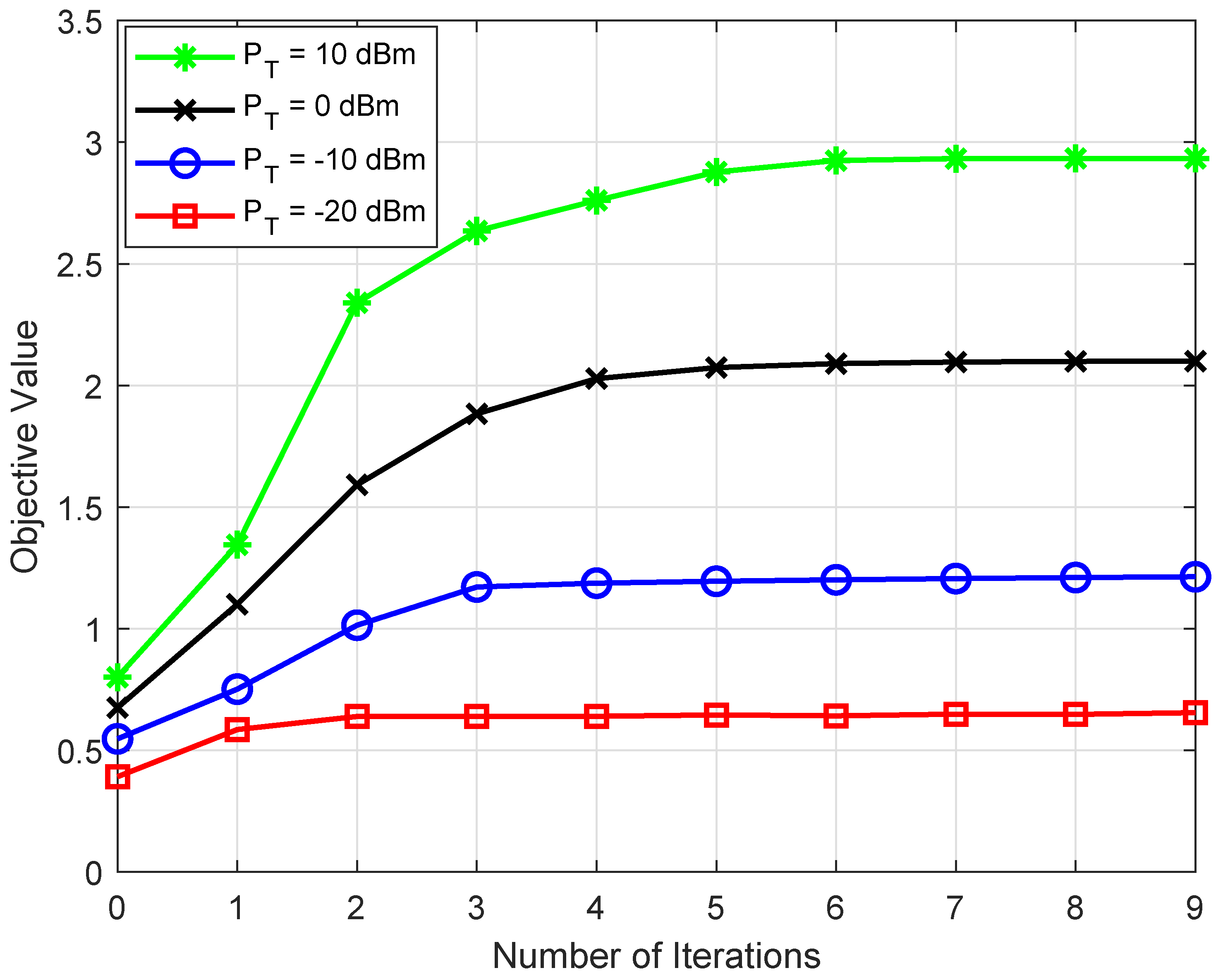
The average convergence performance of the proposed algorithm is illustrated in Figure 2. The result demonstrates that the convergence is achieved with a small number of iterations.
Figure 2.
Average convergence performances versus the number of iterations for .
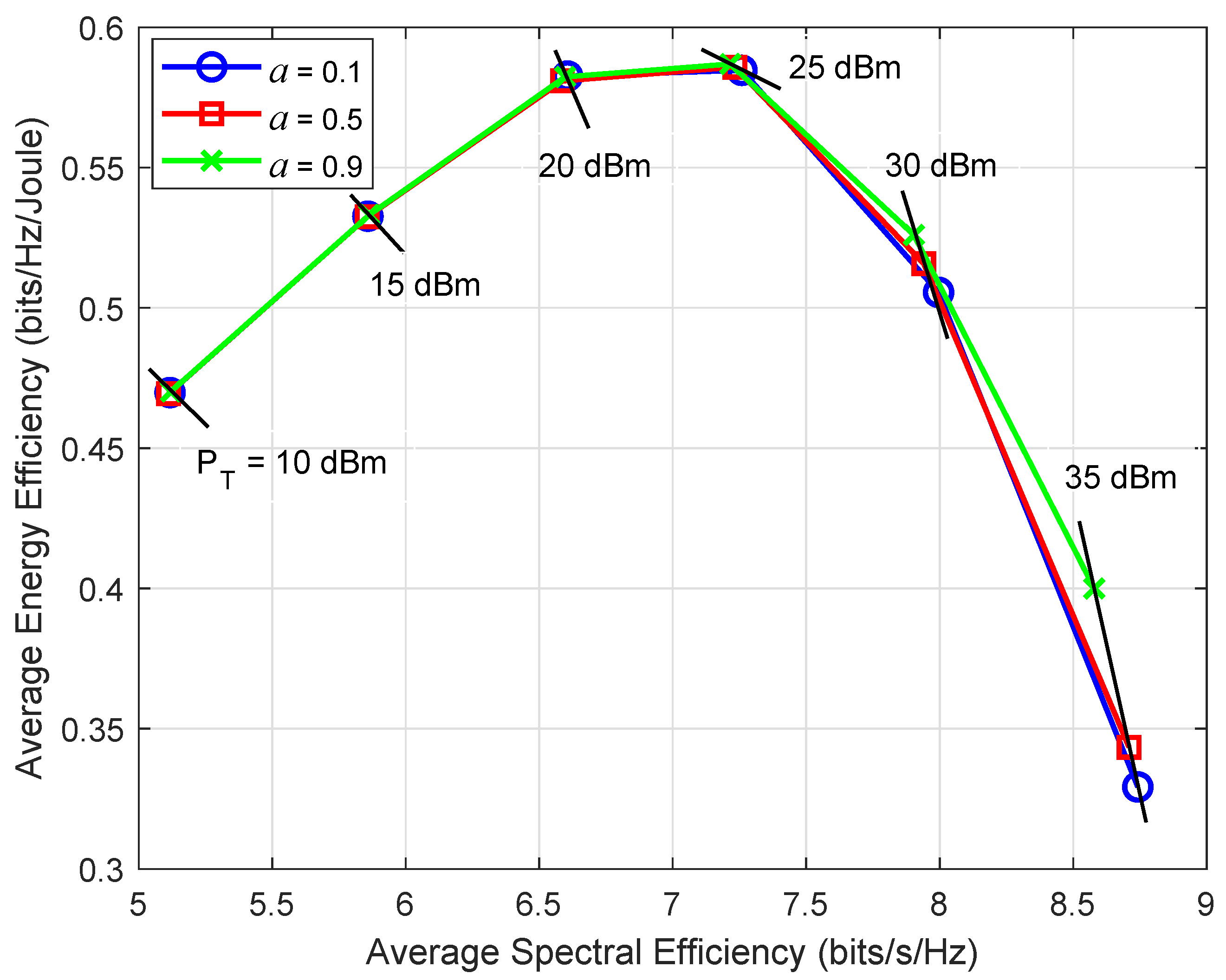
The EE-SE trade-off curves attained by the algorithm framework under different values of BS power constraint and weight a are shown in Figure 3. Obviously, EE-SE trade-offs under different weighting factors are similar to each other when the value of is small, approximately when dBm, as all available power of BS can be fully utilized and both EE and SE are maximized when is small. Therefore, changes in values of a have little impact on the EE-SE trade-off when is small. When gets high, the EE-SE trade-offs under different a differ greatly. It is observed that the increasing of a brings about an increase in EE optimization and a decrease in SE, and the decreasing of a causes a decrease in EE and an increase in SE. That is because larger weight is given to EE for larger a, and thus more focus is transferred to EE when conducting the optimization. However, more focus is transferred to the SE optimization when a smaller weight is given to EE for smaller a.
Figure 3.
Average EE-SE trade-offs with different a under different transmit power budgets .
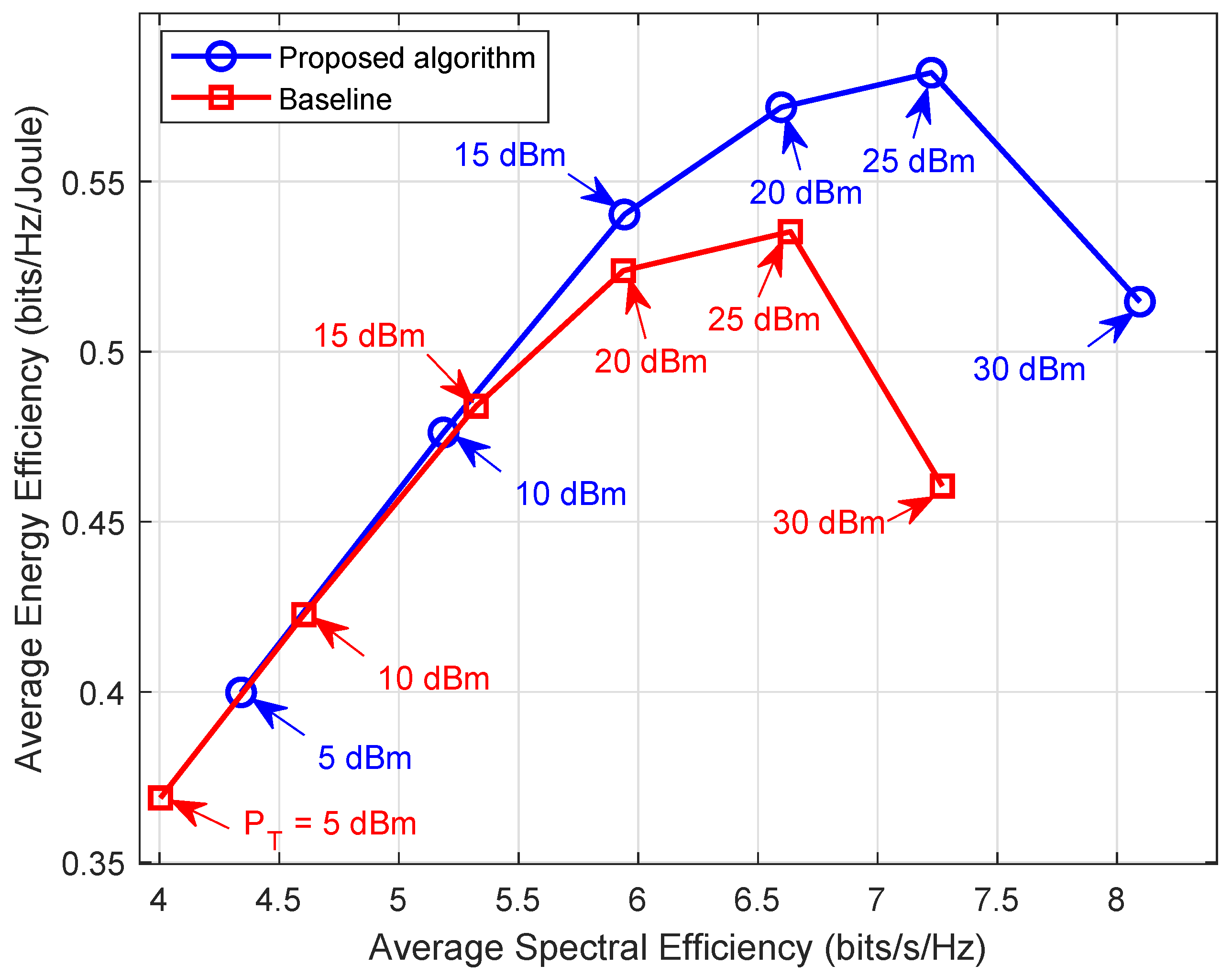
In Figure 4, we show the EE-SE trade-offs of the system under the condition of . In order to illustrate the necessity of jointly optimizing the transmit precoding matrix and the phase shift values for optimizing the system SE and EE, the results of the EE-SE trade-off is provided in a baseline case. In the baseline, the phase shift values at the RIS are given randomly and are not optimized. It can also be observed that under the same transmission power constraint of the BS, the EE and SE results of the joint optimization are greater than those of the baseline, respectively. It indicates that jointly optimizing the transmit precoding matrix and the phase shift values is beneficial for improving the SE and EE of the system.
Figure 4.
Average EE-SE trade-offs under proposed algorithm and baseline, with .
5. Conclusions
A RIS-aided multi-user MISO downlink system was investigated in this paper. An optimization model was used to design the transmit precoding matrix at the BS and the phase shift values at the RIS to conduct the maximization of the weighted sum of EE and SE, considering the power constraint at the BS, RIS’s RC with constant modulus, and RIS’s phase shifters with continuous values. We finally attained EE-SE trade-off under different circumstances by changing the value of the weight factor and got the closed-form solution of phase shift values at the RIS, while the optimal precoding matrix was obtained through the standard convex optimization algorithms. Simulations results illustrated that the presented optimization algorithm possesses fast convergence rates under different values of the power budget at the BS. It also showed that the optimization over the RC of RIS could significantly improve the EE and SE of the system.
Author Contributions
L.Y. perceived the idea. M.Z. wrote the manuscript, performed the analytic calculations, and derived the models. K.H. performed the simulations and analyzed the data. L.T. contributed to the revising and proofreading. All authors have read and agreed to the published version of the manuscript.
Funding
This work was supported in part by the Fundamental Research Funds for the Central Universities and School of Information Science and Engineering of Southeast University through Student Research Training Program.
Conflicts of Interest
The authors declare no conflict of interest.
References
- Liaskos, C.; Nie, S.; Tsioliaridou, A.; Pitsillides, A.; Ioannidis, S.; Akyildiz, I. A New Wireless Communication Paradigm through Software-Controlled Metasurfaces. IEEE Commun. Mag. 2018, 56, 162–169. [Google Scholar] [CrossRef]
- Ma, Y.; Shen, Y.; Yu, X.; Zhang, J.; Song, S.H.; Letaief, K.B. A Low-Complexity Algorithmic Framework for Large-Scale IRS-Assisted Wireless Systems. In Proceedings of the 2020 IEEE Globecom Workshops (GC Wkshps), Taipei, Taiwan, 7–11 December 2020; pp. 1–6. [Google Scholar]
- Huang, C.; Hu, S.; Alexandropoulos, G.C.; Zappone, A.; Yuen, C.; Zhang, R.; Renzo, M.D.; Debbah, M. Holographic MIMO Surfaces for 6G Wireless Networks: Opportunities, Challenges, and Trends. IEEE Wirel. Commun. 2020, 27, 118–125. [Google Scholar] [CrossRef]
- Wu, Q.; Zhang, R. Intelligent Reflecting Surface Enhanced Wireless Network via Joint Active and Passive Beamforming. IEEE Trans. Wirel. Commun. 2019, 18, 5394–5409. [Google Scholar] [CrossRef]
- Huang, C.; Zappone, A.; Alexandropoulos, G.C.; Debbah, M.; Yuen, C. Reconfigurable Intelligent Surfaces for Energy Efficiency in Wireless Communication. IEEE Trans. Wirel. Commun. 2019, 18, 4157–4170. [Google Scholar] [CrossRef]
- Zhou, G.; Pan, C.; Ren, H.; Wang, K.; Nallanathan, A. Intelligent Reflecting Surface Aided Multigroup Multicast MISO Communication Systems. IEEE Trans. Signal Process. 2020, 68, 3236–3251. [Google Scholar] [CrossRef]
- Huang, C.; Mo, R.; Yuen, C. Reconfigurable Intelligent Surface Assisted Multiuser MISO Systems Exploiting Deep Reinforcement Learning. IEEE J. Sel. Areas Commun. 2020, 38, 1839–1850. [Google Scholar] [CrossRef]
- Wu, Q.; Zhang, R. Beamforming Optimization for Wireless Network Aided by Intelligent Reflecting Surface With Discrete Phase Shifts. IEEE Trans. Commun. 2020, 68, 1838–1851. [Google Scholar] [CrossRef]
- ElMossallamy, M.A.; Zhang, H.; Song, L.; Seddik, K.G.; Han, Z.; Li, G.Y. Reconfigurable Intelligent Surfaces for Wireless Communications: Principles, Challenges, and Opportunities. IEEE Trans. Cogn. Commun. Netw. 2020, 6, 990–1002. [Google Scholar] [CrossRef]
- Zhang, J.; Björnson, E.; Matthaiou, M.; Ng, D.W.K.; Yang, H.; Love, D.J. Prospective Multiple Antenna Technologies for Beyond 5G. IEEE J. Sel. Areas Commun. 2020, 38, 1637–1660. [Google Scholar] [CrossRef]
- Di Renzo, M.; Zappone, A.; Debbah, M.; Alouini, M.S.; Yuen, C.; de Rosny, J.; Tretyakov, S. Smart Radio Environments Empowered by Reconfigurable Intelligent Surfaces: How It Works, State of Research, and The Road Ahead. IEEE J. Sel. Areas Commun. 2020, 38, 2450–2525. [Google Scholar] [CrossRef]
- Özdogan, O.; Björnson, E.; Larsson, E.G. Intelligent Reflecting Surfaces: Physics, Propagation, and Pathloss Modeling. IEEE Wirel. Commun. Lett. 2020, 9, 581–585. [Google Scholar] [CrossRef]
- Di Renzo, M.; Danufane, F.H.; Xi, X.; de Rosny, J.; Tretyakov, S. Analytical Modeling of the Path-Loss for Reconfigurable Intelligent Surfaces—Anomalous mirror or scatterer? In Proceedings of the 2020 IEEE 21st International Workshop on Signal Processing Advances in Wireless Communications (SPAWC), Atlanta, GA, USA, 26–29 May 2020; pp. 1–5. [Google Scholar]
- You, C.; Zheng, B.; Zhang, R. Channel Estimation and Passive Beamforming for Intelligent Reflecting Surface: Discrete Phase Shift and Progressive Refinement. IEEE J. Sel. Areas Commun. 2020, 38, 2604–2620. [Google Scholar] [CrossRef]
- Jung, M.; Saad, W.; Jang, Y.; Kong, G.; Choi, S. Performance Analysis of Large Intelligent Surfaces (LISs): Asymptotic Data Rate and Channel Hardening Effects. IEEE Trans. Wirel. Commun. 2020, 19, 2052–2065. [Google Scholar] [CrossRef]
- Gao, Y.; Yong, C.; Xiong, Z.; Niyato, D.; Xiao, Y.; Zhao, J. Reconfigurable Intelligent Surface for MISO Systems with Proportional Rate Constraints. In Proceedings of the ICC 2020—2020 IEEE International Conference on Communications (ICC), Dublin, Ireland, 7–11 June 2020; pp. 1–7. [Google Scholar]
- Zou, Y.; Gong, S.; Xu, J.; Cheng, W.; Hoang, D.T.; Niyato, D. Joint Energy Beamforming and Optimization for Intelligent Reflecting Surface Enhanced Communications. In Proceedings of the 2020 IEEE Wireless Communications and Networking Conference Workshops (WCNCW), Online, 25–28 May 2020; pp. 1–6. [Google Scholar]
- Abeywickrama, S.; Zhang, R.; Wu, Q.; Yuen, C. Intelligent Reflecting Surface: Practical Phase Shift Model and Beamforming Optimization. IEEE Trans. Commun. 2020, 68, 5849–5863. [Google Scholar] [CrossRef]
- Yang, Z.; Shi, J.; Li, Z.; Chen, M.; Xu, W.; Shikh-Bahaei, M. Energy Efficient Rate Splitting Multiple Access (RSMA) with Reconfigurable Intelligent Surface. In Proceedings of the 2020 IEEE International Conference on Communications Workshops (ICC Workshops), Dublin, Ireland, 7–11 June 2020; pp. 1–6. [Google Scholar]
- Xiong, J.; You, L.; Huang, Y.; Ng, D.W.K.; Wang, W.; Gao, X. Reconfigurable Intelligent Surfaces Assisted MIMO-MAC with Partial CSI. In Proceedings of the ICC 2020—2020 IEEE International Conference on Communications (ICC), Dublin, Ireland, 7–11 June 2020; pp. 1–6. [Google Scholar]
- Tang, J.; So, D.K.; Alsusa, E.; Hamdi, K.A. Resource Efficiency: A New Paradigm on Energy Efficiency and Spectral Efficiency Tradeoff. IEEE Trans. Wirel. Commun. 2014, 13, 4656–4669. [Google Scholar] [CrossRef]
- Mahapatra, R.; Nijsure, Y.; Kaddoum, G.; Ul Hassan, N.; Yuen, C. Energy Efficiency Tradeoff Mechanism Towards Wireless Green Communication: A Survey. IEEE Commun. Surv. Tutor. 2015, 18, 686–705. [Google Scholar] [CrossRef]
- Pan, C.; Ren, H.; Wang, K.; Xu, W.; Elkashlan, M.; Nallanathan, A.; Hanzo, L. Multicell MIMO Communications Relying on Intelligent Reflecting Surfaces. IEEE Trans. Wirel. Commun. 2020, 19, 5218–5233. [Google Scholar] [CrossRef]
- Zhao, M.M.; Wu, Q.; Zhao, M.J.; Zhang, R. Exploiting Amplitude Control in Intelligent Reflecting Surface Aided Wireless Communication with Imperfect CSI. arXiv 2020, arXiv:2005.07002. [Google Scholar]
- Wu, Q.; Zhang, S.; Zheng, B.; You, C.; Zhang, R. Intelligent Reflecting Surface Aided Wireless Communications: A Tutorial. arXiv 2020, arXiv:2007.02759. [Google Scholar]
- Guo, H.; Liang, Y.; Chen, J.; Larsson, E.G. Weighted Sum-Rate Maximization for Reconfigurable Intelligent Surface Aided Wireless Networks. IEEE Trans. Wirel. Commun. 2020, 19, 3064–3076. [Google Scholar] [CrossRef]
- Zhao, M.M.; Wu, Q.; Zhao, M.J.; Zhang, R. Two-timescale Beamforming Optimization for Intelligent Reflecting Surface Enhanced Wireless Network. In Proceedings of the 2020 IEEE 11th Sensor Array and Multichannel Signal Processing Workshop (SAM), Hangzhou, China, 8–11 June 2020; pp. 1–5. [Google Scholar]
- Wang, P.; Fang, J.; Yuan, X.; Chen, Z.; Li, H. Intelligent Reflecting Surface-Assisted Millimeter Wave Communications: Joint Active and Passive Precoding Design. IEEE Trans. Veh. Technol. 2020, 69, 14960–14973. [Google Scholar] [CrossRef]
- Yu, X.; Xu, D.; Schober, R. MISO Wireless Communication Systems via Intelligent Reflecting Surfaces: (Invited Paper). In Proceedings of the 2019 IEEE/CIC International Conference on Communications in China (ICCC), Changchun, China, 11–13 August 2019; pp. 735–740. [Google Scholar]
- Shen, K.; Yu, W. Fractional Programming for Communication Systems—Part I: Power Control and Beamforming. IEEE Trans. Signal Process. 2018, 66, 2616–2630. [Google Scholar] [CrossRef]
- Shi, Q.; Razaviyayn, M.; Luo, Z.; He, C. An Iteratively Weighted MMSE Approach to Distributed Sum-Utility Maximization for a MIMO Interfering Broadcast Channel. IEEE Trans. Signal Process. 2011, 59, 4331–4340. [Google Scholar] [CrossRef]
- Boyd, S.; Vandenberghe, L. Convex Optimization; Cambridge University Press: Cambridge, UK, 2004. [Google Scholar]
- Salo, J.; Del Galdo, G.; Salmi, J.; Kyösti, P.; Milojevic, M.; Laselva, D.; Schneider, C. MATLAB implementation of the 3GPP Spatial Channel Model (3GPP TR 25.996). Available online: http://www.tkk.fi/Units/Radio/scm/ (accessed on 1 June 2005).
- Xiong, J.; You, L.; Ng, D.W.K.; Yuen, C.; Wang, W.; Gao, X. Energy Efficiency and Spectral Efficiency Tradeoff in RIS-Aided Multiuser MIMO Uplink Systems. In Proceedings of the GLOBECOM 2020—2020 IEEE Global Communications Conference, Taipei, Taiwan, 7–11 December 2020; pp. 1–6. [Google Scholar]
- You, L.; Xiong, J.; Ng, D.W.K.; Yuen, C.; Wang, W.; Gao, X. Energy Efficiency and Spectral Efficiency Tradeoff in RIS-Aided Multiuser MIMO Uplink Transmission. IEEE Trans. Signal Process. 2021, 69, 1407–1421. [Google Scholar] [CrossRef]
Publisher’s Note: MDPI stays neutral with regard to jurisdictional claims in published maps and institutional affiliations. |
© 2021 by the authors. Licensee MDPI, Basel, Switzerland. This article is an open access article distributed under the terms and conditions of the Creative Commons Attribution (CC BY) license (https://creativecommons.org/licenses/by/4.0/).