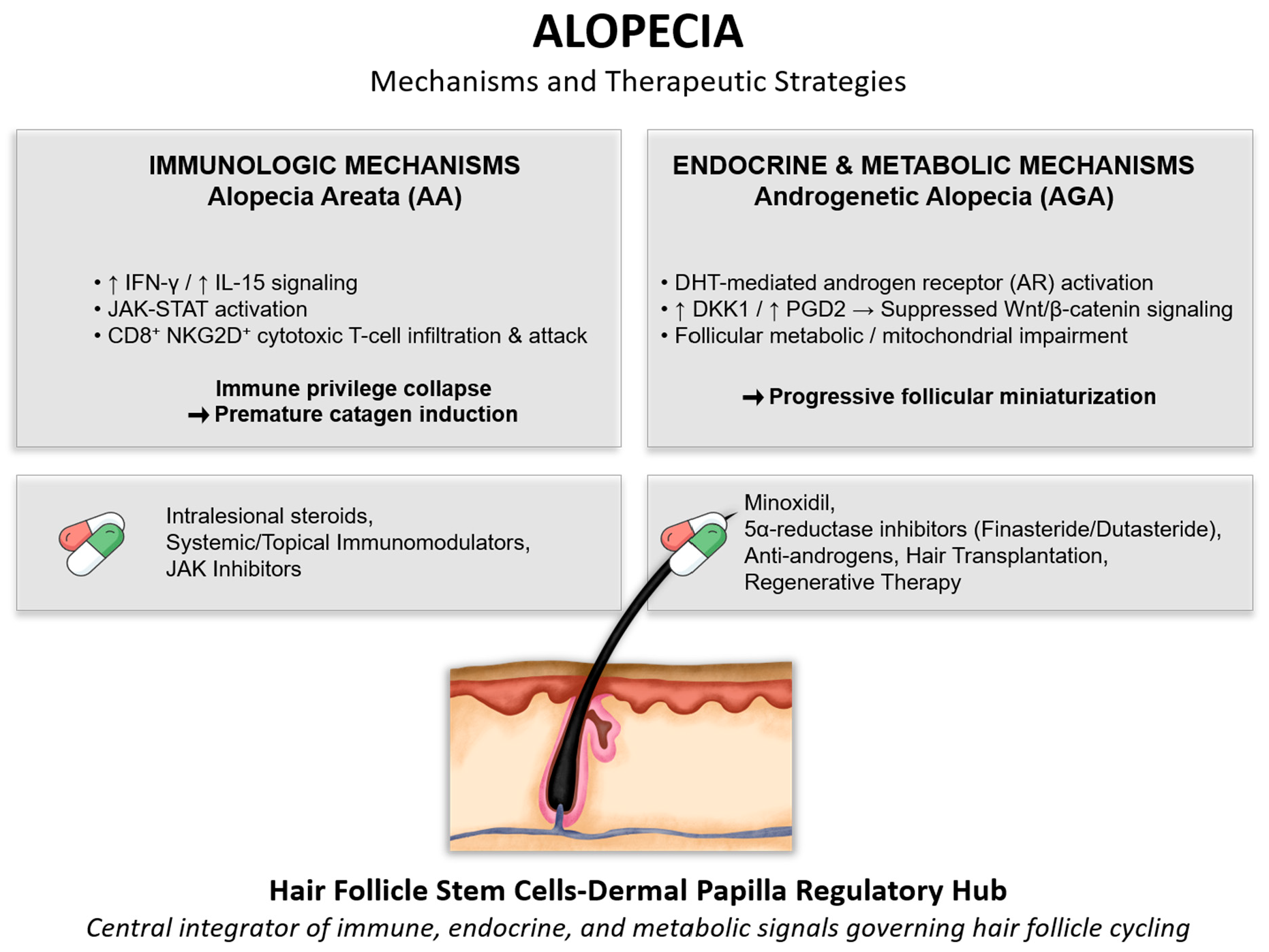

Advancements in Bioactive Compounds and Therapeutic Agents for Alopecia: Trends and Future Perspectives

Abstract
1. Introduction
2. Alopecia Areata (AA)
2.1. Pathobiology and Therapeutic Rationale
2.2. JAK Inhibitors and Emerging Therapeutics

| Agent | Primary Target | Mechanism of Action | Development Stage | Reference |
|---|---|---|---|---|
| Baricitinib | JAK1/2 | IFN-γ-STAT1 inhibition | Approved | [61,62,63] |
| Ritlecitinib | JAK3/TEC | IL-15 blockade | Approved | [65,66] |
| Deuruxolitinib | JAK1/2 | Immune homeostasis restoration | Phase III | [68,69] |
| TYK2 inhibitors | TYK2 | IL-12/23, IFN-α modulation | Phase II | [79] |
| CoQ10 *, MitoQ ** | Mitochondria | Antioxidant, redox support | Preclinical | [70,71,72,73] |
2.3. Other Immunomodulators and Adjunct Strategies
3. Androgenetic Alopecia (AGA)
3.1. Pathobiology and Core Therapeutics
3.2. Adjuncts, Devices, and Female Pattern Considerations
4. Molecular and Cellular Signaling Framework in Alopecia
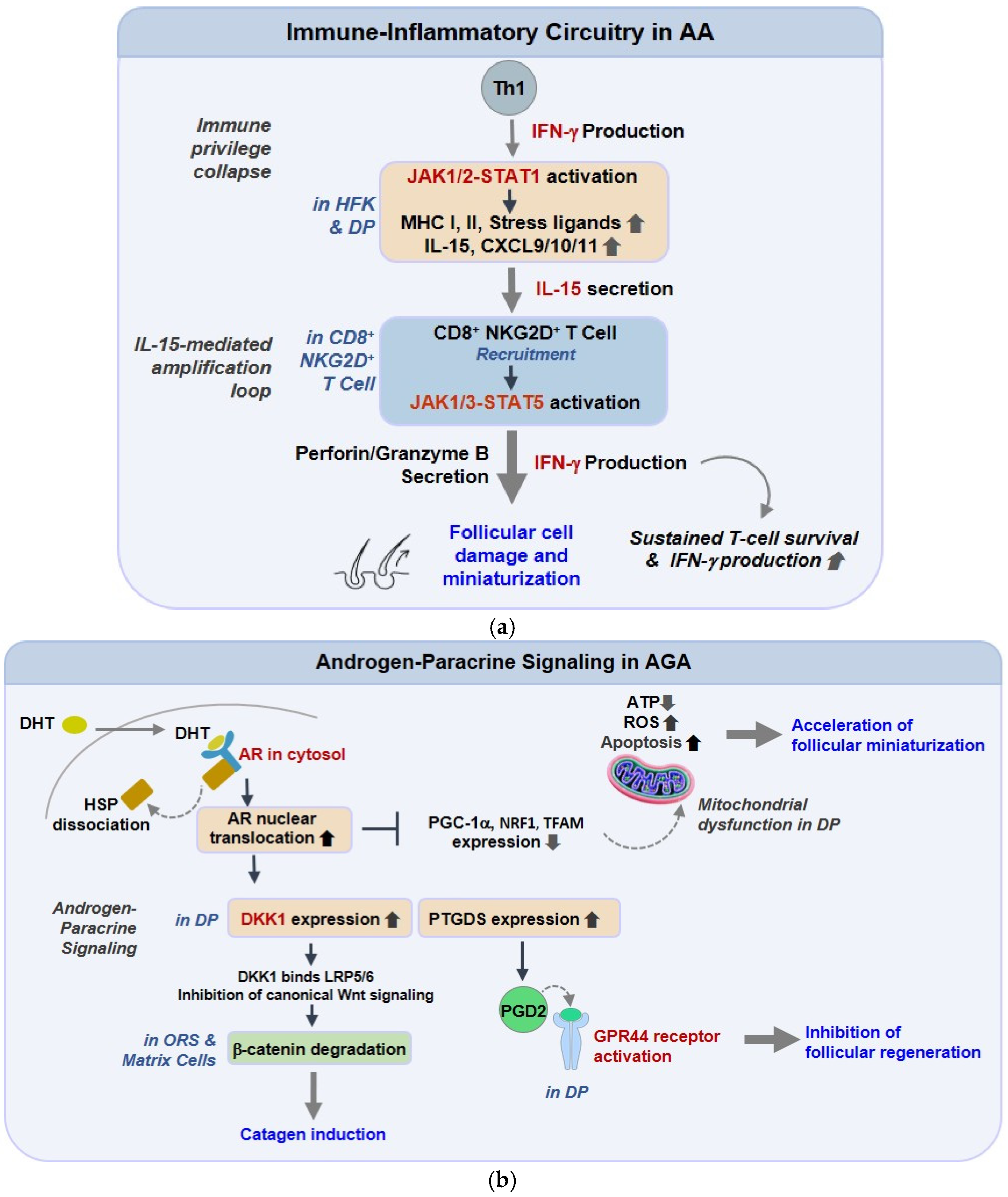
4.1. Immune-Inflammatory Circuitry in Alopecia Areata (AA)
4.2. Androgen-Paracrine Signaling in Androgenetic Alopecia (AGA)
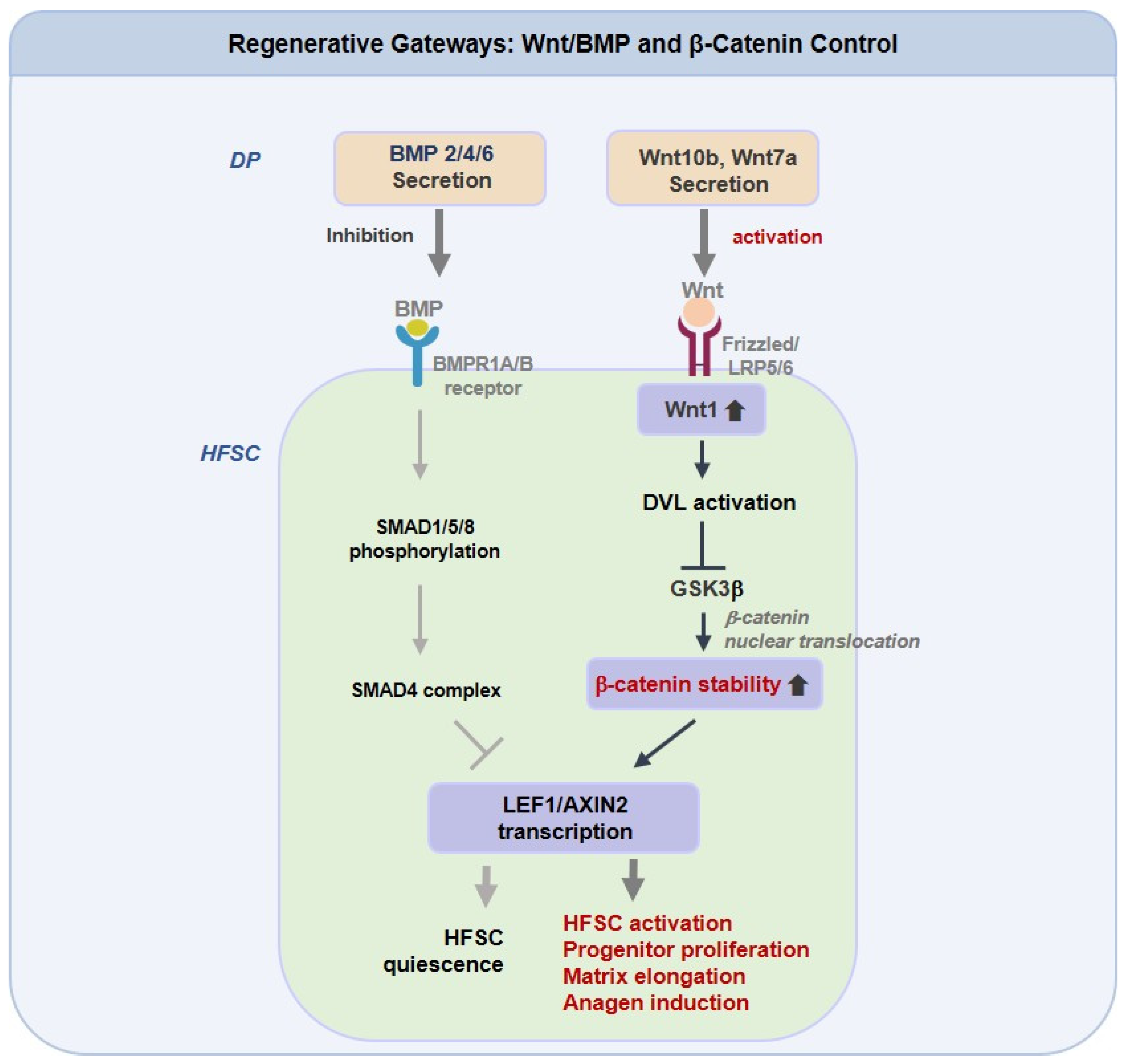
4.3. Regenerative Gateways: Wnt/BMP and β-Catenin Control
4.4. Mitochondrial-Redox and Stress Integration
4.5. Nutrient-Sensing and Growth Control: AMPK-mTOR Crosstalk
4.6. Apoptotic and Survival Checkpoints
5. Stem Cell and Regenerative Approaches
6. Microbiome-Linked Studies
7. Conclusions
Funding
Institutional Review Board Statement
Informed Consent Statement
Data Availability Statement
Conflicts of Interest
Abbreviations
| AA | Alopecia Areata |
| AGA | Androgenetic Alopecia |
| AR | Androgen Receptor |
| DHT | Dihydrotestosterone |
| JAK | Janus Kinase |
| STAT | Signal Transducer and Activator of Transcription |
| HFSCs | Hair Follicle Stem Cells |
| MSC | Mesenchymal Stem Cell |
| Wnt | Wingless-type MMTV integration site family, member 1 |
| LLLT | Low-Level Light Therapy |
| PRP | Platelet-Rich Plasma |
| NF-κB | Nuclear Factor Kappa B |
| AMPK | AMP-Activated Protein Kinase |
| ROS | Reactive Oxygen Species |
| SCFA | Short-Chain Fatty Acid |
| VEGF | Vascular Endothelial Growth Factor |
| PGC-1α | Peroxisome Proliferator-Activated Receptor Gamma Coactivator 1-alpha |
| TYK2 | Tyrosine Kinase 2 |
| SIRT1 | Sirtuin 1; NAD-dependent deacetylase sirtuin 1 |
| TEC | Tyrosine-protein kinase TEC |
| DKK1 | Dickkopf Wnt signaling pathway inhibitor 1 |
| KATP | ATP-sensitive potassium channel |
References
- Paus, R.; Cotsarelis, G. The biology of hair follicles. N. Engl. J. Med. 1999, 341, 491–497. [Google Scholar] [CrossRef] [PubMed]
- Hordinsky, M.; Ericson, M. Autoimmunity: Alopecia areata. J. Investig. Dermatol. Symp. Proc. 2004, 9, 73–78. [Google Scholar] [CrossRef]
- Petukhova, L.; Duvic, M.; Hordinsky, M.; Norris, D.; Price, V.; Shimomura, Y.; Kim, H.; Singh, P.; Lee, A.; Chen, W.V.; et al. Genome-wide association study in alopecia areata implicates both innate and adaptive immunity. Nature 2010, 466, 113–117. [Google Scholar] [CrossRef]
- Alkhalifah, A. Alopecia areata update. Dermatol. Clin. 2013, 31, 93–108. [Google Scholar] [CrossRef]
- Liu, Y.; Tosti, A.; Wang, E.C.E.; Heilmann-Heimbach, S.; Aguh, C.; Jimenez, F.; Lin, S.J.; Kwon, O.; Plikus, M.V. Androgenetic alopecia. Nat. Rev. Dis. Primers 2025, 11, 73. [Google Scholar] [CrossRef] [PubMed]
- Gilhar, A.; Keren, A.; Paus, R. A new humanized mouse model for alopecia areata. J. Investig. Dermatol. Symp. Proc. 2013, 16, S37–S38. [Google Scholar] [CrossRef] [PubMed]
- Gilhar, A.; Keren, A.; Shemer, A.; d’Ovidio, R.; Ullmann, Y.; Paus, R. Autoimmune disease induction in a healthy human organ: A humanized mouse model of alopecia areata. J. Investig. Dermatol. 2013, 133, 844–847. [Google Scholar] [CrossRef] [PubMed]
- Xing, L.; Dai, Z.; Jabbari, A.; Cerise, J.E.; Higgins, C.A.; Gong, W.; de Jong, A.; Harel, S.; DeStefano, G.M.; Rothman, L.; et al. Alopecia areata is driven by cytotoxic T lymphocytes and is reversed by JAK inhibition. Nat. Med. 2014, 20, 1043–1049. [Google Scholar] [CrossRef] [PubMed]
- Kaufman, K.D. Androgens and alopecia. Mol. Cell. Endocrinol. 2002, 198, 89–95. [Google Scholar] [CrossRef] [PubMed]
- Inui, S.; Itami, S. Molecular basis of androgenetic alopecia: From androgen to paracrine mediators through dermal papilla. J. Dermatol. Sci. 2011, 61, 1–6. [Google Scholar] [CrossRef]
- Brown, D.I.; Griendling, K.K. Regulation of signal transduction by reactive oxygen species in the cardiovascular system. Circ. Res. 2015, 116, 531–549. [Google Scholar] [CrossRef] [PubMed]
- Meyer, K.C.; Klatte, J.E.; Dinh, H.V.; Harries, M.J.; Reithmayer, K.; Meyer, W.; Sinclair, R.; Paus, R. Evidence that the bulge region is a site of relative immune privilege in human hair follicles. Br. J. Dermatol. 2008, 159, 1077–1085. [Google Scholar] [CrossRef] [PubMed]
- Moussa, A.; Eisman, S.; Sinclair, R.D.; Bhoyrul, B. Treatment of alopecia areata of the beard with baricitinib. J. Am. Acad. Dermatol. 2023, 88, 948–950. [Google Scholar] [CrossRef] [PubMed]
- Polak-Witka, K.; Rudnicka, L.; Blume-Peytavi, U.; Vogt, A. The role of the microbiome in scalp hair follicle biology and disease. Exp. Dermatol. 2020, 29, 286–294. [Google Scholar] [CrossRef] [PubMed]
- Zouboulis, C.C.; Coenye, T.; He, L.; Kabashima, K.; Kobayashi, T.; Niemann, C.; Nomura, T.; Olah, A.; Picardo, M.; Quist, S.R.; et al. Sebaceous immunobiology—Skin homeostasis, pathophysiology, coordination of innate immunity and inflammatory response and disease associations. Front. Immunol. 2022, 13, 1029818. [Google Scholar] [CrossRef] [PubMed]
- Li, Y.; Liao, X.; Tang, S.; Wang, Q.; Lin, H.; Yu, X.; Xiao, Y.; Tao, X.; Zhong, T. Potential Therapeutic Targets for Androgenetic Alopecia (AGA) in Obese Individuals as Revealed by a Gut Microbiome Analysis: A Mendelian Randomization Study. Nutrients 2025, 17, 1892. [Google Scholar] [CrossRef] [PubMed]
- Ho, B.S.; Ho, E.X.P.; Chu, C.W.; Ramasamy, S.; Bigliardi-Qi, M.; de Sessions, P.F.; Bigliardi, P.L. Microbiome in the hair follicle of androgenetic alopecia patients. PLoS ONE 2019, 14, e0216330. [Google Scholar] [CrossRef] [PubMed]
- Liu, Z.; Liu, X. Gut microbiome, metabolome and alopecia areata. Front. Microbiol. 2023, 14, 1281660. [Google Scholar] [CrossRef] [PubMed]
- Otberg, N.; Finner, A.M.; Shapiro, J. Androgenetic alopecia. Endocrinol. Metab. Clin. N. Am. 2007, 36, 379–398. [Google Scholar] [CrossRef]
- Mirmirani, P. Hormones and clocks: Do they disrupt the locks? Fluctuating estrogen levels during menopausal transition may influence clock genes and trigger chronic telogen effluvium. Dermatol. Online J. 2016, 22, 13030/qt32r353c4. [Google Scholar] [CrossRef]
- Moya, E.C.; Bruinsma, R.L.; Kelly, K.A.; Feldman, S.R. How suitable are JAK inhibitors in treating the inflammatory component in patients with alopecia areata and vitiligo? Expert Rev. Clin. Immunol. 2022, 18, 189–191. [Google Scholar] [CrossRef] [PubMed]
- Blumeyer, A.; Tosti, A.; Messenger, A.; Reygagne, P.; Del Marmol, V.; Spuls, P.I.; Trakatelli, M.; Finner, A.; Kiesewetter, F.; Trueb, R.; et al. Evidence-based (S3) guideline for the treatment of androgenetic alopecia in women and in men. J. Dtsch. Dermatol. Ges. J. Ger. Soc. Dermatol. JDDG 2011, 9, S1–S57. [Google Scholar] [CrossRef]
- Kwack, M.H.; Sung, Y.K.; Chung, E.J.; Im, S.U.; Ahn, J.S.; Kim, M.K.; Kim, J.C. Dihydrotestosterone-inducible dickkopf 1 from balding dermal papilla cells causes apoptosis in follicular keratinocytes. J. Investig. Dermatol. 2008, 128, 262–269. [Google Scholar] [CrossRef] [PubMed]
- Tsuboi, R.; Niiyama, S.; Irisawa, R.; Harada, K.; Nakazawa, Y.; Kishimoto, J. Autologous cell-based therapy for male and female pattern hair loss using dermal sheath cup cells: A randomized placebo-controlled double-blinded dose-finding clinical study. J. Am. Acad. Dermatol. 2020, 83, 109–116. [Google Scholar] [CrossRef]
- Festa, E.; Fretz, J.; Berry, R.; Schmidt, B.; Rodeheffer, M.; Horowitz, M.; Horsley, V. Adipocyte lineage cells contribute to the skin stem cell niche to drive hair cycling. Cell 2011, 146, 761–771. [Google Scholar] [CrossRef] [PubMed]
- Maekawa, M.; Ohnishi, T.; Balan, S.; Hisano, Y.; Nozaki, Y.; Ohba, H.; Toyoshima, M.; Shimamoto, C.; Tabata, C.; Wada, Y.; et al. Thiosulfate promotes hair growth in mouse model. Biosci. Biotechnol. Biochem. 2019, 83, 114–122. [Google Scholar] [CrossRef]
- Cummins, D.M.; Chaudhry, I.H.; Harries, M. Scarring Alopecias: Pathology and an Update on Digital Developments. Biomedicines 2021, 9, 1755. [Google Scholar] [CrossRef] [PubMed]
- Sundberg, J.P.; Hordinsky, M.K.; Bergfeld, W.; Lenzy, Y.M.; McMichael, A.J.; Christiano, A.M.; McGregor, T.; Stenn, K.S.; Sivamani, R.K.; Pratt, C.H.; et al. Cicatricial Alopecia Research Foundation meeting, May 2016: Progress towards the diagnosis, treatment and cure of primary cicatricial alopecias. Exp. Dermatol. 2018, 27, 302–310. [Google Scholar] [CrossRef]
- Dlova, N.C.; Salkey, K.S.; Callender, V.D.; McMichael, A.J. Central Centrifugal Cicatricial Alopecia: New Insights and a Call for Action. J. Investig. Dermatol. Symp. Proc. 2017, 18, S54–S56. [Google Scholar] [CrossRef]
- Sharquie, K.E.; Schwartz, R.A.; Aljanabi, W.K.; Janniger, C.K. Traction Alopecia: Clinical and Cultural Patterns. Indian J. Dermatol. 2021, 66, 445. [Google Scholar] [CrossRef] [PubMed]
- Kim, S.R.; Craiglow, B.G. Treatment of traction alopecia with oral minoxidil. JAAD Case Rep. 2022, 23, 112–113. [Google Scholar] [CrossRef]
- Kwon, O.; Senna, M.M.; Sinclair, R.; Ito, T.; Dutronc, Y.; Lin, C.Y.; Yu, G.; Chiasserini, C.; McCollam, J.; Wu, W.S.; et al. Efficacy and Safety of Baricitinib in Patients with Severe Alopecia Areata over 52 Weeks of Continuous Therapy in Two Phase III Trials (BRAVE-AA1 and BRAVE-AA2). Am. J. Clin. Dermatol. 2023, 24, 443–451. [Google Scholar] [CrossRef] [PubMed]
- Rubin, R. First Systemic Treatment for Severe Alopecia Is Approved. JAMA 2022, 328, 235. [Google Scholar] [CrossRef] [PubMed]
- Yan, T.; Wang, T.; Tang, M.; Liu, N. Comparative efficacy and safety of JAK inhibitors in the treatment of moderate-to-severe alopecia areata: A systematic review and network meta-analysis. Front. Pharmacol. 2024, 15, 1372810. [Google Scholar] [CrossRef] [PubMed]
- Papierzewska, M.; Waskiel-Burnat, A.; Rudnicka, L. Safety of Janus Kinase inhibitors in Patients with Alopecia Areata: A Systematic Review. Clin. Drug Investig. 2023, 43, 325–334. [Google Scholar] [CrossRef] [PubMed]
- Khera, M.; Than, J.K.; Anaissie, J.; Antar, A.; Song, W.; Losso, B.; Pastuszak, A.; Kohn, T.; Mirabal, J.R. Penile vascular abnormalities in young men with persistent side effects after finasteride use for the treatment of androgenic alopecia. Transl. Androl. Urol. 2020, 9, 1201–1209. [Google Scholar] [CrossRef] [PubMed]
- Nguyen, D.D.; Marchese, M.; Cone, E.B.; Paciotti, M.; Basaria, S.; Bhojani, N.; Trinh, Q.D. Investigation of Suicidality and Psychological Adverse Events in Patients Treated With Finasteride. JAMA Dermatol. 2021, 157, 35–42. [Google Scholar] [CrossRef] [PubMed]
- Ali, A.K.; Heran, B.S.; Etminan, M. Persistent Sexual Dysfunction and Suicidal Ideation in Young Men Treated with Low-Dose Finasteride: A Pharmacovigilance Study. Pharmacotherapy 2015, 35, 687–695. [Google Scholar] [CrossRef] [PubMed]
- Choi, G.S.; Kim, J.H.; Oh, S.Y.; Park, J.M.; Hong, J.S.; Lee, Y.S.; Lee, W.S. Safety and Tolerability of the Dual 5-Alpha Reductase Inhibitor Dutasteride in the Treatment of Androgenetic Alopecia. Ann. Dermatol. 2016, 28, 444–450. [Google Scholar] [CrossRef] [PubMed]
- Lee, S.; Kim, J.E.; Lew, B.L.; Huh, C.H.; Kim, J.; Kwon, O.; Kim, M.B.; Lee, Y.W.; Lee, Y.; Park, J.; et al. Efficacy and Safety of Low-Dose (0.2 mg) Dutasteride for Male Androgenic Alopecia: A Multicenter, Randomized, Double-Blind, Placebo-Controlled, Parallel-Group Phase III Clinical Trial. Ann. Dermatol. 2025, 37, 183–190. [Google Scholar] [CrossRef]
- Hirshburg, J.M.; Kelsey, P.A.; Therrien, C.A.; Gavino, A.C.; Reichenberg, J.S. Adverse Effects and Safety of 5-alpha Reductase Inhibitors (Finasteride, Dutasteride): A Systematic Review. J. Clin. Aesthetic Dermatol. 2016, 9, 56–62. [Google Scholar]
- Perera, E.; Sinclair, R. Treatment of chronic telogen effluvium with oral minoxidil: A retrospective study. F1000Research 2017, 6, 1650. [Google Scholar] [CrossRef] [PubMed]
- Vano-Galvan, S.; Pirmez, R.; Hermosa-Gelbard, A.; Moreno-Arrones, O.M.; Saceda-Corralo, D.; Rodrigues-Barata, R.; Jimenez-Cauhe, J.; Koh, W.L.; Poa, J.E.; Jerjen, R.; et al. Safety of low-dose oral minoxidil for hair loss: A multicenter study of 1404 patients. J. Am. Acad. Dermatol. 2021, 84, 1644–1651. [Google Scholar] [CrossRef] [PubMed]
- Feaster, B.; Onamusi, T.; Cooley, J.E.; McMichael, A.J. Oral minoxidil use in androgenetic alopecia and telogen effluvium. Arch. Dermatol. Res. 2023, 315, 201–205. [Google Scholar] [CrossRef] [PubMed]
- Obi, A.; McKinley, J.; Oladunjoye, E.; Williams, A.; Li, V.; Wu, J.; Yang, C.; Darwin, E.; Gulati, N.; Haskin, A.; et al. Doxycycline for central centrifugal cicatricial alopecia: A single center retrospective analysis. J. Am. Acad. Dermatol. 2024, 91, 331–333. [Google Scholar] [CrossRef] [PubMed]
- Chiang, C.; Sah, D.; Cho, B.K.; Ochoa, B.E.; Price, V.H. Hydroxychloroquine and lichen planopilaris: Efficacy and introduction of Lichen Planopilaris Activity Index scoring system. J. Am. Acad. Dermatol. 2010, 62, 387–392. [Google Scholar] [CrossRef] [PubMed]
- Griffin, M.O.; Ceballos, G.; Villarreal, F.J. Tetracycline compounds with non-antimicrobial organ protective properties: Possible mechanisms of action. Pharmacol. Res. 2011, 63, 102–107. [Google Scholar] [CrossRef] [PubMed]
- Mirmirani, P.; Willey, A.; Price, V.H. Short course of oral cyclosporine in lichen planopilaris. J. Am. Acad. Dermatol. 2003, 49, 667–671. [Google Scholar] [CrossRef] [PubMed]
- Cho, B.K.; Sah, D.; Chwalek, J.; Roseborough, I.; Ochoa, B.; Chiang, C.; Price, V.H. Efficacy and safety of mycophenolate mofetil for lichen planopilaris. J. Am. Acad. Dermatol. 2010, 62, 393–397. [Google Scholar] [CrossRef]
- George, S.J.; Hsu, S. Lichen planopilaris treated with thalidomide. J. Am. Acad. Dermatol. 2001, 45, 965–966. [Google Scholar] [CrossRef]
- Dainichi, T.; Iwata, M.; Kaku, Y. Alopecia areata: What’s new in the epidemiology, comorbidities, and pathogenesis? J. Dermatol. Sci. 2023, 112, 120–127. [Google Scholar] [CrossRef] [PubMed]
- Connell, S.J.; Jabbari, A. The current state of knowledge of the immune ecosystem in alopecia areata. Autoimmun. Rev. 2022, 21, 103061. [Google Scholar] [CrossRef] [PubMed]
- Sutic Udovic, I.; Hlaca, N.; Massari, L.P.; Brajac, I.; Kastelan, M.; Vicic, M. Deciphering the Complex Immunopathogenesis of Alopecia Areata. Int. J. Mol. Sci. 2024, 25, 5652. [Google Scholar] [CrossRef] [PubMed]
- Suzuki, T.; Cheret, J.; Scala, F.D.; Rajabi-Estarabadi, A.; Akhundlu, A.; Demetrius, D.L.; Gherardini, J.; Keren, A.; Harries, M.; Rodriguez-Feliz, J.; et al. Interleukin-15 is a hair follicle immune privilege guardian. J. Autoimmun. 2024, 145, 103217. [Google Scholar] [CrossRef] [PubMed]
- Passeron, T.; King, B.; Seneschal, J.; Steinhoff, M.; Jabbari, A.; Ohyama, M.; Tobin, D.J.; Randhawa, S.; Winkler, A.; Telliez, J.B.; et al. Inhibition of T-cell activity in alopecia areata: Recent developments and new directions. Front. Immunol. 2023, 14, 1243556. [Google Scholar] [CrossRef] [PubMed]
- Rivera-Ruiz, I.; Gay-Mimbrera, J.; Gomez-Arias, P.J.; Aguilar-Luque, M.; Juan-Cencerrado, M.; Mochon-Jimenez, C.; Parra-Peralbo, E.; Isla-Tejera, B.; Gomez-Garcia, F.; Ruano, J. Meta-Analysis of Gene Expression Reveals the Core Transcriptomic Profile of Lesional Scalp in Alopecia Areata. Dermatol. Ther. 2025, 15, 2729–2748. [Google Scholar] [CrossRef] [PubMed]
- Lei, X.; Qu, Y.; Huang, J. Evaluating the Causal Relationship Between Human Blood Metabolites and the Susceptibility to Alopecia Areata. J. Cosmet. Dermatol. 2025, 24, e70248. [Google Scholar] [CrossRef] [PubMed]
- Perlmutter, J.; Akouris, P.P.; Fremont, S.; Yang, B.; Toth, E.; Eze, M.; Wiseman, M. The Role of Reactive Oxygen Species in the Pathogenesis of Alopecia Areata: A Systematic Review and Meta-Analysis. Ski. Pharmacol. Physiol. 2025, 38, 59–67. [Google Scholar] [CrossRef] [PubMed]
- King, B.A.; Craiglow, B.G. Janus kinase inhibitors for alopecia areata. J. Am. Acad. Dermatol. 2023, 89, S29–S32. [Google Scholar] [CrossRef] [PubMed]
- Lee, H.; Park, S.H.; Lew, B.L.; Park, H. The new era of JAK inhibitors: Impelling updates in Alopecia Areata Guideline. J. Eur. Acad. Dermatol. Venereol. 2024, 38, e602–e606. [Google Scholar] [CrossRef]
- Taylor, S.; Korman, N.J.; Tsai, T.F.; Shimomura, Y.; Feely, M.; Dutronc, Y.; Wu, W.S.; Somani, N.; Tosti, A. Efficacy of Baricitinib in Patients with Various Degrees of Alopecia Areata Severity: Post-Hoc Analysis from BRAVE AA1 and BRAVE AA2. Dermatol. Ther. 2023, 13, 3181–3191. [Google Scholar] [CrossRef] [PubMed]
- Senna, M.; Mostaghimi, A.; Ohyama, M.; Sinclair, R.; Dutronc, Y.; Wu, W.S.; Yu, G.; Chiasserini, C.; Somani, N.; Holzwarth, K.; et al. Long-term efficacy and safety of baricitinib in patients with severe alopecia areata: 104-week results from BRAVE-AA1 and BRAVE-AA2. J. Eur. Acad. Dermatol. Venereol. 2024, 38, 583–593. [Google Scholar] [CrossRef] [PubMed]
- Ko, J.M.; Mayo, T.T.; Bergfeld, W.F.; Dutronc, Y.; Yu, G.; Ball, S.G.; Somani, N.; Craiglow, B.G. Clinical Outcomes for Uptitration of Baricitinib Therapy in Patients With Severe Alopecia Areata: A Pooled Analysis of the BRAVE-AA1 and BRAVE-AA2 Trials. JAMA Dermatol. 2023, 159, 970–976. [Google Scholar] [CrossRef] [PubMed]
- King, B.; Ohyama, M.; Kwon, O.; Zlotogorski, A.; Ko, J.; Mesinkovska, N.A.; Hordinsky, M.; Dutronc, Y.; Wu, W.S.; McCollam, J.; et al. Two Phase 3 Trials of Baricitinib for Alopecia Areata. N. Engl. J. Med. 2022, 386, 1687–1699. [Google Scholar] [CrossRef] [PubMed]
- Hordinsky, M.; Hebert, A.A.; Gooderham, M.; Kwon, O.; Murashkin, N.; Fang, H.; Harada, K.; Law, E.; Wajsbrot, D.; Takiya, L.; et al. Efficacy and safety of ritlecitinib in adolescents with alopecia areata: Results from the ALLEGRO phase 2b/3 randomized, double-blind, placebo-controlled trial. Pediatr. Dermatol. 2023, 40, 1003–1009. [Google Scholar] [CrossRef] [PubMed]
- Blair, H.A. Ritlecitinib: First Approval. Drugs 2023, 83, 1315–1321. [Google Scholar] [CrossRef] [PubMed]
- King, B.; Zhang, X.; Harcha, W.G.; Szepietowski, J.C.; Shapiro, J.; Lynde, C.; Mesinkovska, N.A.; Zwillich, S.H.; Napatalung, L.; Wajsbrot, D.; et al. Efficacy and safety of ritlecitinib in adults and adolescents with alopecia areata: A randomised, double-blind, multicentre, phase 2b-3 trial. Lancet 2023, 401, 1518–1529. [Google Scholar] [CrossRef] [PubMed]
- Coppinger, A.J.; Wambier, C.G. Most men choose eyebrows versus scalp hair: Response to Mostaghimi et al., “Evaluation of eyebrow and eyelash regrowth and patient satisfaction in the phase 3 THRIVE-AA2 trial of deuruxolitinib in adult patients with alopecia areata”. J. Am. Acad. Dermatol. 2025, 92, e203–e204. [Google Scholar] [CrossRef]
- King, B.; Senna, M.M.; Mesinkovska, N.A.; Lynde, C.; Zirwas, M.; Maari, C.; Prajapati, V.H.; Sapra, S.; Brzewski, P.; Osman, L.; et al. Efficacy and safety of deuruxolitinib, an oral selective Janus kinase inhibitor, in adults with alopecia areata: Results from the Phase 3 randomized, controlled trial (THRIVE-AA1). J. Am. Acad. Dermatol. 2024, 91, 880–888. [Google Scholar] [CrossRef] [PubMed]
- Zhao, Y.; Xiong, R.; Jin, S.; Li, Y.; Dong, T.; Wang, W.; Song, X.; Guan, C. MitoQ alleviates H2O2-induced mitochondrial dysfunction in keratinocytes through the Nrf2/PINK1 pathway. Biochem. Pharmacol. 2025, 234, 116811. [Google Scholar] [CrossRef] [PubMed]
- Alsaati, A.A.; Kaliyadan, F.; Alsaadoun, D.; Alzakry, L.M.; Alzabadin, R.A.; Hakami, T.H.; Rubaian, N.F.B. Vitamin D and its Analogs in Treatment of Mild to Moderate Alopecia Areata: Systematic Review and Meta-Analysis. Indian Dermatol. Online J. 2025. online ahead of print. [Google Scholar] [CrossRef] [PubMed]
- Kirkman, D.L.; Stock, J.M.; Shenouda, N.; Bohmke, N.J.; Kim, Y.; Kidd, J.; Townsend, R.R.; Edwards, D.G. Effects of a mitochondrial-targeted ubiquinol on vascular function and exercise capacity in chronic kidney disease: A randomized controlled pilot study. Am. J. Physiol. Renal. Physiol. 2023, 325, F448–F456. [Google Scholar] [CrossRef] [PubMed]
- Jimenez-Herrera, E.A.; Lopez-Zenteno, B.E.; Corona-Rodarte, E.; Parra-Guerra, R.; Zubiran, R.; Cano-Aguilar, L.E.; Barrera-Ochoa, C.; Asz-Sigall, D. Vitamin D and Alopecia Areata: From Mechanism to Therapeutic Implications. Ski. Appendage Disord. 2025, 520–530, online ahead of print. [Google Scholar] [CrossRef]
- Garros, N.; Bustos-Salgados, P.; Domenech, O.; Rodriguez-Lagunas, M.J.; Beirampour, N.; Mohammadi-Meyabadi, R.; Mallandrich, M.; Calpena, A.C.; Colom, H. Baricitinib Lipid-Based Nanosystems as a Topical Alternative for Atopic Dermatitis Treatment. Pharmaceuticals 2023, 16, 894. [Google Scholar] [CrossRef] [PubMed]
- Li, Q.; Wang, Y.; Guo, Q.; Cao, J.; Feng, Y.; Ke, X. Nanostructured lipid carriers promote percutaneous absorption and hair follicle targeting of tofacitinib for treating alopecia areata. J. Control. Release 2024, 372, 778–794. [Google Scholar] [CrossRef] [PubMed]
- Ytterberg, S.R.; Bhatt, D.L.; Connell, C.A. Cardiovascular and Cancer Risk with Tofacitinib in Rheumatoid Arthritis. N. Engl. J. Med. 2022, 386, 1768. [Google Scholar] [CrossRef] [PubMed]
- Hamanaka, R.B.; Glasauer, A.; Hoover, P.; Yang, S.; Blatt, H.; Mullen, A.R.; Getsios, S.; Gottardi, C.J.; DeBerardinis, R.J.; Lavker, R.M.; et al. Mitochondrial reactive oxygen species promote epidermal differentiation and hair follicle development. Sci. Signal. 2013, 6, ra8. [Google Scholar] [CrossRef] [PubMed]
- Singh, B.; Schoeb, T.R.; Bajpai, P.; Slominski, A.; Singh, K.K. Reversing wrinkled skin and hair loss in mice by restoring mitochondrial function. Cell Death Dis. 2018, 9, 735. [Google Scholar] [CrossRef] [PubMed]
- Beard, A.; Trotter, S.C. JAK 1-3 inhibitors and TYK-2 inhibitors in dermatology: Practical pearls for the primary care physician. J. Fam. Med. Prim. Care 2024, 13, 4128–4134. [Google Scholar] [CrossRef]
- Mikhaylov, D.; Pavel, A.; Yao, C.; Kimmel, G.; Nia, J.; Hashim, P.; Vekaria, A.S.; Taliercio, M.; Singer, G.; Karalekas, R.; et al. A randomized placebo-controlled single-center pilot study of the safety and efficacy of apremilast in subjects with moderate-to-severe alopecia areata. Arch. Dermatol. Res. 2019, 311, 29–36. [Google Scholar] [CrossRef] [PubMed]
- Guttman-Yassky, E.; Renert-Yuval, Y.; Bares, J.; Chima, M.; Hawkes, J.E.; Gilleaudeau, P.; Sullivan-Whalen, M.; Singer, G.K.; Garcet, S.; Pavel, A.B.; et al. Phase 2a randomized clinical trial of dupilumab (anti-IL-4Ralpha) for alopecia areata patients. Allergy 2022, 77, 897–906. [Google Scholar] [CrossRef] [PubMed]
- Kageyama, R.; Ito, T.; Hanai, S.; Morishita, N.; Nakazawa, S.; Fujiyama, T.; Honda, T.; Tokura, Y. Immunological Properties of Atopic Dermatitis-Associated Alopecia Areata. Int. J. Mol. Sci. 2021, 22, 2618. [Google Scholar] [CrossRef]
- David, E.; Shokrian, N.; Del Duca, E.; Meariman, M.; Glickman, J.; Ghalili, S.; Jung, S.; Tan, K.; Ungar, B.; Guttman-Yassky, E. Dupilumab induces hair regrowth in pediatric alopecia areata: A real-world, single-center observational study. Arch. Dermatol. Res. 2024, 316, 487. [Google Scholar] [CrossRef]
- Tavoletti, G.; Chiei-Gallo, A.; Barei, F.; Marzano, A.V.; Ferrucci, S.M. Tralokinumab as a therapeutic option for patients with concurrent atopic dermatitis and alopecia areata. Int. J. Dermatol. 2024, 63, 374–375. [Google Scholar] [CrossRef] [PubMed]
- Kussini, J.; Pfutzner, W.; Muhlenbein, S. A Case of Unexpected Successful Treatment of Alopecia Areata With Tralokinumab in a Patient With Atopic Dermatitis. Int. J. Dermatol. 2025, 64, 1905–1906. [Google Scholar] [CrossRef]
- Babadjouni, A.; Reddy, M.; Zhang, R.; Raffi, J.; Phong, C.; Mesinkovska, N. Melatonin and the Human Hair Follicle. J. Drugs Dermatol. 2023, 22, 260–264. [Google Scholar] [CrossRef]
- Lai, C.M.; Chen, W.J.; Qin, Y.; Xu, D.; Lai, Y.K.; He, S.H. Innovative Hydrogel Design: Tailoring Immunomodulation for Optimal Chronic Wound Recovery. Adv. Sci. 2025, 12, e2412360. [Google Scholar] [CrossRef] [PubMed]
- Shi, H.W.; Yang, B.C.; Ren, Y.Q.; Xue, Y. Applications of Antioxidant Nanoparticles in Immune-Mediated Inflammatory Diseases. Antioxidants 2025, 14, 1128. [Google Scholar] [CrossRef] [PubMed]
- Cuevas-Diaz Duran, R.; Martinez-Ledesma, E.; Garcia-Garcia, M.; Bajo Gauzin, D.; Sarro-Ramirez, A.; Gonzalez-Carrillo, C.; Rodriguez-Sardin, D.; Fuentes, A.; Cardenas-Lopez, A. The Biology and Genomics of Human Hair Follicles: A Focus on Androgenetic Alopecia. Int. J. Mol. Sci. 2024, 25, 2542. [Google Scholar] [CrossRef] [PubMed]
- Randall, V.A. Androgens and hair growth. Dermatol. Ther. 2008, 21, 314–328. [Google Scholar] [CrossRef] [PubMed]
- Inui, S.; Fukuzato, Y.; Nakajima, T.; Kurata, S.; Itami, S. Androgen receptor co-activator Hic-5/ARA55 as a molecular regulator of androgen sensitivity in dermal papilla cells of human hair follicles. J. Investig. Dermatol. 2007, 127, 2302–2306. [Google Scholar] [CrossRef] [PubMed]
- Sawaya, M.E.; Price, V.H. Different levels of 5alpha-reductase type I and II, aromatase, and androgen receptor in hair follicles of women and men with androgenetic alopecia. J. Investig. Dermatol. 1997, 109, 296–300. [Google Scholar] [CrossRef]
- Ceruti, J.M.; Leiros, G.J.; Balana, M.E. Androgens and androgen receptor action in skin and hair follicles. Mol. Cell. Endocrinol. 2018, 465, 122–133. [Google Scholar] [CrossRef] [PubMed]
- Zhi, J.; Feng, M.; Feng, X.; Niu, X.; Chen, W.; Jiang, X.; Bai, R. Wnt/beta-Catenin Signaling Pathway Targeting Androgenetic Alopecia: How Far Can We Go Beyond Minoxidil and Finasteride? J. Med. Chem. 2025, 68, 18829–18856. [Google Scholar] [CrossRef]
- Cheng, H.; Liu, F.; Zhou, M.; Chen, S.; Huang, H.; Liu, Y.; Zhao, X.; Zhang, Q.; Zhou, X.; Li, Z.; et al. Enhancement of hair growth through stimulation of hair follicle stem cells by prostaglandin E2 collagen matrix. Exp. Cell. Res. 2022, 421, 113411. [Google Scholar] [CrossRef]
- Deng, Z.; Chen, M.; Liu, F.; Wang, Y.; Xu, S.; Sha, K.; Peng, Q.; Wu, Z.; Xiao, W.; Liu, T.; et al. Androgen Receptor-Mediated Paracrine Signaling Induces Regression of Blood Vessels in the Dermal Papilla in Androgenetic Alopecia. J. Investig. Dermatol. 2022, 142, 2088–2099.e9. [Google Scholar] [CrossRef]
- Zhang, Y.; Huang, J.; Fu, D.; Liu, Z.; Wang, H.; Wang, J.; Qu, Q.; Li, K.; Fan, Z.; Hu, Z.; et al. Transcriptome Analysis Reveals an Inhibitory Effect of Dihydrotestosterone-Treated 2D- and 3D-Cultured Dermal Papilla Cells on Hair Follicle Growth. Front. Cell Dev. Biol. 2021, 9, 724310. [Google Scholar] [CrossRef] [PubMed]
- Oh, H.G.; Jung, M.; Jeong, S.Y.; Kim, J.; Han, S.D.; Kim, H.; Lee, S.; Lee, Y.; You, H.; Park, S.; et al. Improvement of androgenic alopecia by extracellular vesicles secreted from hyaluronic acid-stimulated induced mesenchymal stem cells. Stem Cell Res. Ther. 2024, 15, 287. [Google Scholar] [CrossRef] [PubMed]
- Chew, E.G.Y.; Lim, T.C.; Leong, M.F.; Liu, X.; Sia, Y.Y.; Leong, S.T.; Yan-Jiang, B.C.; Stoecklin, C.; Borhan, R.; Heilmann-Heimbach, S.; et al. Observations that suggest a contribution of altered dermal papilla mitochondrial function to androgenetic alopecia. Exp. Dermatol. 2022, 31, 906–917. [Google Scholar] [CrossRef] [PubMed]
- Matsusaka, H.; Wu, T.; Furuya, K.; Yamada-Kato, T.; Bai, L.; Tomita, H.; Sugano, E.; Ozaki, T.; Kiyono, T.; Okunishi, I.; et al. Comprehensive transcriptome data to identify downstream genes of testosterone signalling in dermal papilla cells. Sci. Data 2022, 9, 731. [Google Scholar] [CrossRef] [PubMed]
- Rebora, A. Pathogenesis of androgenetic alopecia. J. Am. Acad. Dermatol. 2004, 50, 777–779. [Google Scholar] [CrossRef]
- Prodi, D.A.; Pirastu, N.; Maninchedda, G.; Sassu, A.; Picciau, A.; Palmas, M.A.; Mossa, A.; Persico, I.; Adamo, M.; Angius, A.; et al. EDA2R is associated with androgenetic alopecia. J. Investig. Dermatol. 2008, 128, 2268–2270. [Google Scholar] [CrossRef]
- Lee, M.J.; Cha, H.J.; Lim, K.M.; Lee, O.K.; Bae, S.; Kim, C.H.; Lee, K.H.; Lee, Y.N.; Ahn, K.J.; An, S. Analysis of the microRNA expression profile of normal human dermal papilla cells treated with 5alpha-dihydrotestosterone. Mol. Med. Rep. 2015, 12, 1205–1212. [Google Scholar] [CrossRef]
- Lukasik, A.; Kozicka, K.; Pisarek, A.; Wojas-Pelc, A. The role of CYP19A1 and ESR2 gene polymorphisms in female androgenetic alopecia in the Polish population. Postepy Dermatol. Alergol. 2022, 39, 708–713. [Google Scholar] [CrossRef] [PubMed]
- Boersma, I.H.; Oranje, A.P.; Grimalt, R.; Iorizzo, M.; Piraccini, B.M.; Verdonschot, E.H. The effectiveness of finasteride and dutasteride used for 3 years in women with androgenetic alopecia. Indian J. Dermatol. Venereol. Leprol. 2014, 80, 521–525. [Google Scholar] [CrossRef] [PubMed]
- Choi, G.S.; Sim, W.Y.; Kang, H.; Huh, C.H.; Lee, Y.W.; Shantakumar, S.; Ho, Y.F.; Oh, E.J.; Duh, M.S.; Cheng, W.Y.; et al. Long-Term Effectiveness and Safety of Dutasteride versus Finasteride in Patients with Male Androgenic Alopecia in South Korea: A Multicentre Chart Review Study. Ann. Dermatol. 2022, 34, 349–359. [Google Scholar] [CrossRef] [PubMed]
- Olsen, E.A.; Hordinsky, M.; Whiting, D.; Stough, D.; Hobbs, S.; Ellis, M.L.; Wilson, T.; Rittmaster, R.S.; Dutasteride Alopecia Research, T. The importance of dual 5alpha-reductase inhibition in the treatment of male pattern hair loss: Results of a randomized placebo-controlled study of dutasteride versus finasteride. J. Am. Acad. Dermatol. 2006, 55, 1014–1023. [Google Scholar] [CrossRef] [PubMed]
- Stough, D.B.; Rao, N.A.; Kaufman, K.D.; Mitchell, C. Finasteride improves male pattern hair loss in a randomized study in identical twins. Eur. J. Dermatol. 2002, 12, 32–37. [Google Scholar] [PubMed]
- Piraccini, B.M.; Blume-Peytavi, U.; Scarci, F.; Jansat, J.M.; Falques, M.; Otero, R.; Tamarit, M.L.; Galvan, J.; Tebbs, V.; Massana, E.; et al. Efficacy and safety of topical finasteride spray solution for male androgenetic alopecia: A phase III, randomized, controlled clinical trial. J. Eur. Acad. Dermatol. Venereol. 2022, 36, 286–294. [Google Scholar] [CrossRef] [PubMed]
- Lee, S.W.; Juhasz, M.; Mobasher, P.; Ekelem, C.; Mesinkovska, N.A. A Systematic Review of Topical Finasteride in the Treatment of Androgenetic Alopecia in Men and Women. J. Drugs Dermatol. 2018, 17, 457–463. [Google Scholar] [PubMed]
- Vahabi-Amlashi, S.; Layegh, P.; Kiafar, B.; Hoseininezhad, M.; Abbaspour, M.; Khaniki, S.H.; Forouzanfar, M.; Sabeti, V. A randomized clinical trial on therapeutic effects of 0.25 mg oral minoxidil tablets on treatment of female pattern hair loss. Dermatol. Ther. 2021, 34, e15131. [Google Scholar] [CrossRef] [PubMed]
- Pirmez, R.; Salas-Callo, C.I. Very-low-dose oral minoxidil in male androgenetic alopecia: A study with quantitative trichoscopic documentation. J. Am. Acad. Dermatol. 2020, 82, e21–e22. [Google Scholar] [CrossRef] [PubMed]
- Vastarella, M.; Cantelli, M.; Patri, A.; Annunziata, M.C.; Nappa, P.; Fabbrocini, G. Efficacy and safety of oral minoxidil in female androgenetic alopecia. Dermatol. Ther. 2020, 33, e14234. [Google Scholar] [CrossRef] [PubMed]
- Ramos, P.M.; Sinclair, R.D.; Kasprzak, M.; Miot, H.A. Minoxidil 1 mg oral versus minoxidil 5% topical solution for the treatment of female-pattern hair loss: A randomized clinical trial. J. Am. Acad. Dermatol. 2020, 82, 252–253. [Google Scholar] [CrossRef] [PubMed]
- Zhang, X.; Ji, Y.; Zhou, M.; Zhou, X.; Xie, Y.; Zeng, X.; Shao, F.; Zhang, C. Platelet-Rich Plasma for Androgenetic Alopecia: A Systematic Review and Meta-Analysis of Randomized Controlled Trials. J. Cutan. Med. Surg. 2023, 27, 504–508. [Google Scholar] [CrossRef] [PubMed]
- Li, M.; Qu, K.; Lei, Q.; Chen, M.; Bian, D. Effectiveness of Platelet-Rich Plasma in the Treatment of Androgenic Alopecia: A Meta-Analysis. Aesthetic Plast. Surg. 2024, 48, 977–984. [Google Scholar] [CrossRef]
- Olisova, O.; Potapova, M.; Suvorov, A.; Koriakin, D.; Lepekhova, A. Meta-analysis on the Efficacy of Platelet-rich Plasma in Patients with Androgenetic Alopecia. Int. J. Trichology 2023, 15, 117–126. [Google Scholar] [CrossRef] [PubMed]
- Yao, J.; Zhu, L.; Pan, M.; Shen, L.; Tang, Y.; Fan, L. The additive value of platelet-rich plasma to topical Minoxidil in the treatment of androgenetic alopecia: A systematic review and meta-analysis. PLoS ONE 2024, 19, e0308986. [Google Scholar] [CrossRef] [PubMed]
- Lopes-Silva, R.; Santos, M.; Sequeira, M.L.; Silva, A.; Antunes, T.; Valejo-Coelho, P.; Neiva-Sousa, M. Platelet-Rich Plasma Effectiveness in Treating Androgenetic Alopecia: A Comprehensive Evaluation. Cureus 2025, 17, e77371. [Google Scholar] [CrossRef] [PubMed]
- Lu, C.; Ding, Y.; Zhang, R.; Du, Y.; Bi, L.; Zhao, M.; Wang, C.; Wu, Q.; Jing, H.; Fan, W. Platelet-rich plasma-derived exosomes stimulate hair follicle growth through activation of the Wnt/beta-Catenin signaling pathway. Regen. Ther. 2025, 29, 435–446. [Google Scholar] [CrossRef] [PubMed]
- Zhou, Y.; Seo, J.; Tu, S.; Nanmo, A.; Kageyama, T.; Fukuda, J. Exosomes for hair growth and regeneration. J. Biosci. Bioeng. 2024, 137, 1–8. [Google Scholar] [CrossRef] [PubMed]
- Karimi, N.; Dincsoy, A.B. The Role of Mesenchymal Stem Cell-Derived Exosomes in Skin Regeneration, Tissue Repair, and the Regulation of Hair Follicle Growth. Adv. Exp. Med. Biol. 2025, 1479, 1–17. [Google Scholar] [CrossRef] [PubMed]
- Chandrashekar, B.S.; Lobo, O.C.; Fusco, I.; Madeddu, F.; Zingoni, T. Effectiveness of 675-nm Wavelength Laser Therapy in the Treatment of Androgenetic Alopecia Among Indian Patients: Clinical Experimental Study. JMIR Dermatol. 2024, 7, e60858. [Google Scholar] [CrossRef] [PubMed]
- Thomas, M.; Stockslager, M.; Oakley, J.; Womble, T.M.; Sinclair, R. Clinical Safety and Efficacy of Dual Wavelength Low-Level Light Therapy in Androgenetic Alopecia: A Double-Blind Randomized Controlled Study. Dermatol. Surg. 2025, 51, 416–421. [Google Scholar] [CrossRef] [PubMed]
- Pillai, J.K.; Mysore, V. Role of Low-Level Light Therapy (LLLT) in Androgenetic Alopecia. J. Cutan. Aesthetic Surg. 2021, 14, 385–391. [Google Scholar] [CrossRef] [PubMed]
- Lueangarun, S.; Visutjindaporn, P.; Parcharoen, Y.; Jamparuang, P.; Tempark, T. A Systematic Review and Meta-analysis of Randomized Controlled Trials of United States Food and Drug Administration-Approved, Home-use, Low-Level Light/Laser Therapy Devices for Pattern Hair Loss: Device Design and Technology. J. Clin. Aesthetic Dermatol. 2021, 14, E64–E75. [Google Scholar]
- Yoon, J.S.; Ku, W.Y.; Lee, J.H.; Ahn, H.C. Low-level light therapy using a helmet-type device for the treatment of androgenetic alopecia: A 16-week, multicenter, randomized, double-blind, sham device-controlled trial. Medicine 2020, 99, e21181. [Google Scholar] [CrossRef] [PubMed]
- Werachattawatchai, P.; Khunkhet, S.; Harnchoowong, S.; Lertphanichkul, C. Efficacy and safety of oral spironolactone for female pattern hair loss in premenopausal women: A randomized, double-blind, placebo-controlled, parallel-group pilot study. Int. J. Women’s Dermatol. 2025, 11, e227. [Google Scholar] [CrossRef] [PubMed]
- Devjani, S.; Ezemma, O.; Jothishankar, B.; Saberi, S.; Kelley, K.J.; Makredes Senna, M. Efficacy of Low-Dose Spironolactone for Hair Loss in Women. J. Drugs Dermatol. 2024, 23, e91–e92. Available online: https://jddonline.com/articles/efficacy-of-low-dose-spironolactone-for-hair-loss-in-women-S1545961624P0e91X/ (accessed on 14 October 2025). [PubMed]
- Kaiser, M.A.; Almeida, S.M.; Rodriguez, M.; Issa, N.; Issa, N.T.; Jimenez, J.J. Low-Level Light Therapy and Minoxidil Combination Treatment in Androgenetic Alopecia: A Review of the Literature. Ski. Appendage Disord. 2023, 9, 104–110. [Google Scholar] [CrossRef] [PubMed]
- Yuan, J.; He, Y.; Wan, H.; Gao, Y. Effectiveness of platelet-rich plasma in treating female hair loss: A systematic review and meta-analysis of randomized controlled trials. Ski. Res. Technol. 2024, 30, e70004. [Google Scholar] [CrossRef] [PubMed]
- Yun, S.I.; Lee, S.K.; Goh, E.A.; Kwon, O.S.; Choi, W.; Kim, J.; Lee, M.S.; Choi, S.J.; Lim, S.S.; Moon, T.K.; et al. Weekly treatment with SAMiRNA targeting the androgen receptor ameliorates androgenetic alopecia. Sci. Rep. 2022, 12, 1607. [Google Scholar] [CrossRef]
- Han, X.; Zhao, L.; Xiang, W.; Miao, B.; Qin, C.; Wang, M.; Xu, T.; McEachern, D.; Lu, J.; Wang, Y.; et al. Discovery of ARD-2051 as a Potent and Orally Efficacious Proteolysis Targeting Chimera (PROTAC) Degrader of Androgen Receptor for the Treatment of Advanced Prostate Cancer. J. Med. Chem. 2023, 66, 8822–8843. [Google Scholar] [CrossRef] [PubMed]
- Mao, X.; Hu, W.; Wu, M.; Jin, Y.; Zhao, J.; Xu, Y.; Li, B.; Wang, W.; Wu, Y.; Zhang, J.; et al. Discovery of a Novel Non-invasive AR PROTAC Degrader for the Topical Treatment of Androgenetic Alopecia. J. Med. Chem. 2024, 67, 22218–22244. [Google Scholar] [CrossRef] [PubMed]
- Bertolini, M.; McElwee, K.; Gilhar, A.; Bulfone-Paus, S.; Paus, R. Hair follicle immune privilege and its collapse in alopecia areata. Exp. Dermatol. 2020, 29, 703–725. [Google Scholar] [CrossRef]
- Fitzhugh, M.H.; Hansen, J.G.; Jabbari, A.; Berrebi, K.G. Pathophysiology of Alopecia Areata in the Pediatric Patient. Pediatr. Dermatol. 2025, 42, 24–30. [Google Scholar] [CrossRef] [PubMed]
- Mattsson, J.; Israelsson, E.; Bjorhall, K.; Yrlid, L.F.; Thorn, K.; Thoren, A.; Toledo, E.A.; Jinton, L.; Oberg, L.; Wingren, C.; et al. Selective Janus kinase 1 inhibition resolves inflammation and restores hair growth offering a viable treatment option for alopecia areata. Ski. Health Dis. 2023, 3, e209. [Google Scholar] [CrossRef] [PubMed]
- Lee, E.Y.; Dai, Z.; Jaiswal, A.; Wang, E.H.C.; Anandasabapathy, N.; Christiano, A.M. Functional interrogation of lymphocyte subsets in alopecia areata using single-cell RNA sequencing. Proc. Natl. Acad. Sci. USA 2023, 120, e2305764120. [Google Scholar] [CrossRef] [PubMed]
- de Jong, A.; Jabbari, A.; Dai, Z.; Xing, L.; Lee, D.; Li, M.M.; Duvic, M.; Hordinsky, M.; Norris, D.A.; Price, V.; et al. High-throughput T cell receptor sequencing identifies clonally expanded CD8+ T cell populations in alopecia areata. JCI Insight 2018, 3, e121949. [Google Scholar] [CrossRef] [PubMed]
- Shimizu, H.; Morgan, B.A. Wnt signaling through the beta-catenin pathway is sufficient to maintain, but not restore, anagen-phase characteristics of dermal papilla cells. J. Investig. Dermatol. 2004, 122, 239–245. [Google Scholar] [CrossRef] [PubMed]
- Kwack, M.H.; Kim, M.K.; Kim, J.C.; Sung, Y.K. Dickkopf 1 promotes regression of hair follicles. J. Investig. Dermatol. 2012, 132, 1554–1560. [Google Scholar] [CrossRef]
- Mahmoud, E.A.; Elgarhy, L.H.; Hasby, E.A.; Mohammad, L. Dickkopf-1 Expression in Androgenetic Alopecia and Alopecia Areata in Male Patients. Am. J. Dermatopathol. 2019, 41, 122–127. [Google Scholar] [CrossRef] [PubMed]
- Garza, L.A.; Liu, Y.; Yang, Z.; Alagesan, B.; Lawson, J.A.; Norberg, S.M.; Loy, D.E.; Zhao, T.; Blatt, H.B.; Stanton, D.C.; et al. Prostaglandin D2 inhibits hair growth and is elevated in bald scalp of men with androgenetic alopecia. Sci. Transl. Med. 2012, 4, 126ra34. [Google Scholar] [CrossRef] [PubMed]
- Ryu, Y.C.; Park, J.; Kim, Y.R.; Choi, S.; Kim, G.U.; Kim, E.; Hwang, Y.; Kim, H.; Han, G.; Lee, S.H.; et al. CXXC5 Mediates DHT-Induced Androgenetic Alopecia via PGD(2). Cells 2023, 12, 555. [Google Scholar] [CrossRef] [PubMed]
- Wu, P.; Zhang, Y.; Xing, Y.; Xu, W.; Guo, H.; Deng, F.; Ma, X.; Li, Y. The balance of Bmp6 and Wnt10b regulates the telogen-anagen transition of hair follicles. Cell Commun. Signal. 2019, 17, 16. [Google Scholar] [CrossRef] [PubMed]
- Ryu, Y.C.; Kim, Y.R.; Park, J.; Choi, S.; Kim, G.U.; Kim, E.; Hwang, Y.; Kim, H.; Bak, S.S.; Lee, J.E.; et al. Wnt/beta-catenin signaling activator restores hair regeneration suppressed by diabetes mellitus. BMB Rep. 2022, 55, 559–564. [Google Scholar] [CrossRef]
- Yoon, M.; Kim, E.; Seo, S.H.; Kim, G.U.; Choi, K.Y. KY19382 Accelerates Cutaneous Wound Healing via Activation of the Wnt/beta-Catenin Signaling Pathway. Int. J. Mol. Sci. 2023, 24, 11742. [Google Scholar] [CrossRef] [PubMed]
- Ryu, Y.C.; Lee, D.H.; Shim, J.; Park, J.; Kim, Y.R.; Choi, S.; Bak, S.S.; Sung, Y.K.; Lee, S.H.; Choi, K.Y. KY19382, a novel activator of Wnt/beta-catenin signalling, promotes hair regrowth and hair follicle neogenesis. Br. J. Pharmacol. 2021, 178, 2533–2546. [Google Scholar] [CrossRef] [PubMed]
- Xiong, L.; Zhevlakova, I.; West, X.Z.; Gao, D.; Murtazina, R.; Horak, A.; Brown, J.M.; Molokotina, I.; Podrez, E.A.; Byzova, T.V. TLR2 regulates hair follicle cycle and regeneration via BMP signaling. Elife 2024, 12, RP89335. [Google Scholar] [CrossRef] [PubMed]
- Hao, L.; Nam, K.H.; Lee, G.J.; Kim, D.; Shin, J.M.; Lee, Y.; Kim, C.D.; Kim, S.J.; Yun, S.K.; Park, B.H.; et al. SIRT1 downregulation provokes immune-inflammatory responses in hair follicle outer root sheath cells and may contribute to development of alopecia areata. J. Dermatol. Sci. 2023, 111, 2–9. [Google Scholar] [CrossRef] [PubMed]
- Dong, T.R.; Li, Y.J.; Jin, S.Y.; Yang, F.L.; Xiong, R.X.; Dai, Y.Q.; Song, X.Z.; Guan, C.P. Progress on mitochondria and hair follicle development in androgenetic alopecia: Relationships and therapeutic perspectives. Stem Cell Res. Ther. 2025, 16, 44. [Google Scholar] [CrossRef] [PubMed]
- Natarelli, N.; Gahoonia, N.; Aflatooni, S.; Bhatia, S.; Sivamani, R.K. Dermatologic Manifestations of Mitochondrial Dysfunction: A Review of the Literature. Int. J. Mol. Sci. 2024, 25, 3303. [Google Scholar] [CrossRef] [PubMed]
- Kloepper, J.E.; Baris, O.R.; Reuter, K.; Kobayashi, K.; Weiland, D.; Vidali, S.; Tobin, D.J.; Niemann, C.; Wiesner, R.J.; Paus, R. Mitochondrial function in murine skin epithelium is crucial for hair follicle morphogenesis and epithelial-mesenchymal interactions. J. Investig. Dermatol. 2015, 135, 679–689. [Google Scholar] [CrossRef] [PubMed]
- Lee, S.; Ohn, J.; Kang, B.M.; Hwang, S.T.; Kwon, O. Activation of mitochondrial aldehyde dehydrogenase 2 promotes hair growth in human hair follicles. J. Adv. Res. 2024, 64, 237–247. [Google Scholar] [CrossRef] [PubMed]
- Golubnitschaja, O.; Sargheini, N.; Bastert, J. Mitochondria in cutaneous health, disease, ageing and rejuvenation-the 3PM-guided mitochondria-centric dermatology. EPMA J. 2025, 16, 1–15. [Google Scholar] [CrossRef]
- Micucci, M.; Gianfanti, F.; Donati Zeppa, S.; Annibalini, G.; Canonico, B.; Fanelli, F.; Saltarelli, R.; Osman, R.; Montanari, M.; Lopez, D.; et al. Q-Der: A next-generation CoQ10 analogue supercharging neuroprotection by combating oxidative stress and enhancing mitochondrial function. Front. Mol. Biosci. 2025, 12, 1525103. [Google Scholar] [CrossRef]
- Suzuki, T.; Cheret, J.; Scala, F.D.; Akhundlu, A.; Gherardini, J.; Demetrius, D.L.; O’Sullivan, J.D.B.; Kuka Epstein, G.; Bauman, A.J.; Demetriades, C.; et al. mTORC1 activity negatively regulates human hair follicle growth and pigmentation. EMBO Rep. 2023, 24, e56574. [Google Scholar] [CrossRef] [PubMed]
- Jin, X.; Song, X. Autophagy Dysfunction: The Kernel of Hair Loss? Clin. Cosmet. Investig. Dermatol. 2024, 17, 1165–1181. [Google Scholar] [CrossRef]
- Sun, P.; Wang, Z.; Li, S.; Yin, J.; Gan, Y.; Liu, S.; Lin, Z.; Wang, H.; Fan, Z.; Qu, Q.; et al. Autophagy induces hair follicle stem cell activation and hair follicle regeneration by regulating glycolysis. Cell Biosci. 2024, 14, 6. [Google Scholar] [CrossRef]
- Lee, J.O.; Kim, Y.J.; Jang, Y.N.; Lee, J.M.; Shin, K.; Jeong, S.; Chung, H.J.; Kim, B.J. ICP5249 Promotes Hair Growth by Activating the AMPK-Autophagy Signaling Pathway. J. Microbiol. Biotechnol. 2024, 34, 1810–1818. [Google Scholar] [CrossRef] [PubMed]
- Manzoor, M.; Chen, D.; Lin, J.; Wang, Y.; Xiang, L.; Qi, J. Isoquercitrin promotes hair growth through induction of autophagy and angiogenesis by targeting AMPK and IGF-1R. Phytomedicine 2025, 136, 156289. [Google Scholar] [CrossRef]
- Chen, Y.; Fan, Z.; Wang, X.; Mo, M.; Zeng, S.B.; Xu, R.H.; Wang, X.; Wu, Y. PI3K/Akt signaling pathway is essential for de novo hair follicle regeneration. Stem Cell Res. Ther. 2020, 11, 144. [Google Scholar] [CrossRef]
- Nelson, A.M.; Loy, D.E.; Lawson, J.A.; Katseff, A.S.; Fitzgerald, G.A.; Garza, L.A. Prostaglandin D2 inhibits wound-induced hair follicle neogenesis through the receptor, Gpr44. J. Investig. Dermatol. 2013, 133, 881–889. [Google Scholar] [CrossRef] [PubMed]
- Jeong, K.H.; Jung, J.H.; Kim, J.E.; Kang, H. Prostaglandin D2-Mediated DP2 and AKT Signal Regulate the Activation of Androgen Receptors in Human Dermal Papilla Cells. Int. J. Mol. Sci. 2018, 19, 556. [Google Scholar] [CrossRef]
- Choi, Y.H.; Shin, J.Y.; Kim, J.; Kang, N.G.; Lee, S. Niacinamide Down-Regulates the Expression of DKK-1 and Protects Cells from Oxidative Stress in Cultured Human Dermal Papilla Cells. Clin. Cosmet. Investig. Dermatol. 2021, 14, 1519–1528. [Google Scholar] [CrossRef] [PubMed]
- Poddar, N.; Aratikatla, A.; Gupta, A. Therapeutic potential of stem cell-derived exosomes in hair regeneration: A systematic review. World J. Stem Cells 2025, 17, 108519. [Google Scholar] [CrossRef] [PubMed]
- Xing, Y.Z.; Guo, H.Y.; Xiang, F.; Li, Y.H. Recent progress in hair follicle stem cell markers and their regulatory roles. World J. Stem Cells 2024, 16, 126–136. [Google Scholar] [CrossRef] [PubMed]
- Zhang, Y.; Cui, J.; Cang, Z.; Pei, J.; Zhang, X.; Song, B.; Fan, X.; Ma, X.; Li, Y. Hair follicle stem cells promote epidermal regeneration under expanded condition. Front. Physiol. 2024, 15, 1306011. [Google Scholar] [CrossRef] [PubMed]
- Xiao, L.; Tang, Y.; Zhang, F.; Zhang, J. From Spheroid to Sprouting: Microenvironmental Modulation Boosts Hair Follicle Organoid Morphogenesis in 3D Culture. Cell. Biol. Int. 2025, 49, 939–951. [Google Scholar] [CrossRef] [PubMed]
- Chu, X.; Zhou, Z.; Qian, X.; Shen, H.; Cheng, H.; Zhang, J. Functional regeneration strategies of hair follicles: Advances and challenges. Stem Cell Res. Ther. 2025, 16, 77. [Google Scholar] [CrossRef] [PubMed]
- Hamida, O.B.; Kim, M.K.; Sung, Y.K.; Kim, M.K.; Kwack, M.H. Hair Regeneration Methods Using Cells Derived from Human Hair Follicles and Challenges to Overcome. Cells 2024, 14, 7. [Google Scholar] [CrossRef] [PubMed]
- Yu, A.; Zhang, Y.; Zhong, S.; Yang, Z.; Xie, M. Human umbilical cord mesenchymal stem cell-derived exosomes enhance follicular regeneration in androgenetic alopecia via activation of Wnt/beta-catenin pathway. Stem Cell Res. Ther. 2025, 16, 418. [Google Scholar] [CrossRef]
- Zheng, J.; Yang, B.; Liu, S.; Xu, Z.; Ding, Z.; Mo, M. Applications of Exosomal miRNAs from Mesenchymal Stem Cells as Skin Boosters. Biomolecules 2024, 14, 459. [Google Scholar] [CrossRef] [PubMed]
- Liang, Y.; Tang, X.; Zhang, X.; Cao, C.; Yu, M.; Wan, M. Adipose Mesenchymal Stromal Cell-Derived Exosomes Carrying MiR-122-5p Antagonize the Inhibitory Effect of Dihydrotestosterone on Hair Follicles by Targeting the TGF-beta1/SMAD3 Signaling Pathway. Int. J. Mol. Sci. 2023, 24, 5703. [Google Scholar] [CrossRef]
- Al Ameer, M.A.; Alnajim, A.T.; Al Ameer, A.; Alsalman, Z.; Al Ameer, G.A.; Alnajim, S.T.; Alghamdi, A.A.; Moideen, R.; Al Hadi, E.M. Exosomes and Hair Regeneration: A Systematic Review of Clinical Evidence Across Alopecia Types and Exosome Sources. Clin. Cosmet. Investig. Dermatol. 2025, 18, 2215–2227. [Google Scholar] [CrossRef] [PubMed]
- Chen, Y.C.; Tsai, W.C.; Li, Z.X.; Lin, W.J.; Lin, H.Y.; Hsieh, Y.J.; Wang, K.H.; Chen, Y.Y.; Hwang, T.L.; Lin, T.Y. Exosomes from human umbilical cord mesenchymal stem cells promote the growth of human hair dermal papilla cells. PLoS ONE 2025, 20, e0320154. [Google Scholar] [CrossRef] [PubMed]
- Chen, H.; Xue, H.; Zeng, H.; Dai, M.; Tang, C.; Liu, L. 3D printed scaffolds based on hyaluronic acid bioinks for tissue engineering: A review. Biomater. Res. 2023, 27, 137. [Google Scholar] [CrossRef] [PubMed]
- Wang, X.; Wang, J.; Guo, L.; Wang, X.; Chen, H.; Wang, X.; Liu, J.; Tredget, E.E.; Wu, Y. Self-assembling peptide hydrogel scaffolds support stem cell-based hair follicle regeneration. Nanomedicine 2016, 12, 2115–2125. [Google Scholar] [CrossRef] [PubMed]
- Motter Catarino, C.; Cigaran Schuck, D.; Dechiario, L.; Karande, P. Incorporation of hair follicles in 3D bioprinted models of human skin. Sci. Adv. 2023, 9, eadg0297. [Google Scholar] [CrossRef]
- Ma, X.; Zhu, X.; Lv, S.; Yang, C.; Wang, Z.; Liao, M.; Zhou, B.; Zhang, Y.; Sun, S.; Chen, P.; et al. 3D bioprinting of prefabricated artificial skin with multicomponent hydrogel for skin and hair follicle regeneration. Theranostics 2025, 15, 2933–2950. [Google Scholar] [CrossRef] [PubMed]
- Zoio, P.; Oliva, A. Skin-on-a-Chip Technology: Microengineering Physiologically Relevant In Vitro Skin Models. Pharmaceutics 2022, 14, 682. [Google Scholar] [CrossRef]
- Vatanashevanopakorn, C.; Sartyoungkul, T. iPSC-based approach for human hair follicle regeneration. Front. Cell Dev. Biol. 2023, 11, 1149050. [Google Scholar] [CrossRef] [PubMed]
- Sivamani, P.; Rajendran, R.L.; Gangadaran, P.; Ahn, B.C. An induced pluripotent stem cell-based approach for hair follicle development and regeneration. Regen. Ther. 2024, 26, 502–507. [Google Scholar] [CrossRef] [PubMed]
- Gomez-Arias, P.J.; Gay-Mimbrera, J.; Rivera-Ruiz, I.; Aguilar-Luque, M.; Juan-Cencerrado, M.; Mochon-Jimenez, C.; Gomez-Garcia, F.; Sanchez-Gonzalez, S.; Ortega-Hernandez, A.; Gomez-Garre, D.; et al. Association Between Scalp Microbiota Imbalance, Disease Severity, and Systemic Inflammatory Markers in Alopecia Areata. Dermatol. Ther. 2024, 14, 2971–2986. [Google Scholar] [CrossRef] [PubMed]
- Townsend, N.; Hazan, A.; Dell’Acqua, G. New Topicals to Support a Healthy Scalp While Preserving the Microbiome: A Report of Clinical and in Vitro Studies. J. Clin. Aesthetic Dermatol. 2023, 16, S4–S11. [Google Scholar]
- Won, E.J.; Jang, H.H.; Park, H.; Kim, S.J. A Potential Predictive Role of the Scalp Microbiome Profiling in Patients with Alopecia Areata: Staphylococcus caprae, Corynebacterium, and Cutibacterium Species. Microorganisms 2022, 10, 864. [Google Scholar] [CrossRef] [PubMed]
- Zeng, L.; Qian, Y.; Cui, X.; Zhao, J.; Ning, Z.; Cha, J.; Wang, K.; Ge, C.; Jia, J.; Dou, T.; et al. Immunomodulatory role of gut microbial metabolites: Mechanistic insights and therapeutic frontiers. Front. Microbiol. 2025, 16, 1675065. [Google Scholar] [CrossRef]
- Zheng, W.; Liu, M.; Lv, X.; He, C.; Yin, J.; Ma, J. AhR governs lipid metabolism: The role of gut microbiota. Front. Microbiol. 2025, 16, 1442282. [Google Scholar] [CrossRef] [PubMed]
- Tsai, W.H.; Fang, Y.T.; Huang, T.Y.; Chiang, Y.J.; Lin, C.G.; Chang, W.W. Heat-killed Lacticaseibacillus paracasei GMNL-653 ameliorates human scalp health by regulating scalp microbiome. BMC Microbiol. 2023, 23, 121. [Google Scholar] [CrossRef] [PubMed]
- Wang, Y.; Li, J.; Wu, J.; Gu, S.; Hu, H.; Cai, R.; Wang, M.; Zou, Y. Effects of a Postbiotic Saccharomyces and Lactobacillus Ferment Complex on the Scalp Microbiome of Chinese Women with Sensitive Scalp Syndrome. Clin. Cosmet. Investig. Dermatol. 2023, 16, 2623–2635. [Google Scholar] [CrossRef] [PubMed]
| Type of Hair Loss | Characteristics | Mechanism | Treatment Methods | Reference |
|---|---|---|---|---|
| Alopecia Areata | Autoimmune disorder, patchy hair loss | Autoimmune attack on hair follicles | Steroid Injections, Immunotherapy, Corticosteroids, JAK Inhibitors | [19,20,21] |
| Androgenetic Alopecia | Genetic factors, hormonal imbalance, hairline and crown thinning | DHT binds to hair follicles, causing miniaturization | Minoxidil, Finasteride, Dutasteride, Hair Transplant, Regenerative Therapy | [22,23,24] |
| Telogen Effluvium | Temporary hair loss due to stress, childbirth, and nutritional deficiencies | Stress-induced hair shedding | Nutritional Supplements, Stress Management, Minoxidil | [25,26] |
| Cicatricial (Scarring) Alopecia | Permanent hair loss due to follicle destruction and scarring | Chronic inflammation-induced fibrosis of hair follicles | Antibiotics, Anti-inflammatory drugs, Immunosuppressants, Hair Transplant | [27,28,29] |
| Traction Alopecia | Mechanical stress and marginal hair loss | Mechanical tension-induced damage to hair follicles | Protective hairstyling, minoxidil | [30,31] |
| Type of Hair Loss | Drug Type/FDA Approval Year (Dosage, Route) | Common Side Effects |
|---|---|---|
| Alopecia Areata |
(2) Ritlecitinib/2023 (50 mg daily, oral) (3) Deuruxolitinib/2024 (8 mg twice daily, oral) | |
| Androgenetic Alopecia |
|
|
| Telogen Effluvium |
| |
| Cicatricial (Scarring) Alopecia | [Anti-inflammatories] (1) Doxycycline/1967 (100 mg daily, oral) (2) Hydroxy-chloroquine/1955 (200–400 mg daily, oral) (3) Tetracycline/1953 (500 mg twice daily, oral) [Immunosuppressants] (1) Cyclosporine/1983 (2.5 mg/kg/day) (2) Mycophenolate Mofetil/1995 (1–1.5 g twice daily, oral) (3) Thalidomide/1998 (100 mg daily, oral) |
|
| Traction Alopecia |
|
|
| Agent/Method | Primary Target | Mechanism of Action | Clinical Stage | Reference |
|---|---|---|---|---|
| Dutasteride | 5α-reductase I & II | Dual androgen blockade | Approved | [105,106] |
| Finasteride | 5α-reductase II | DHT suppression | Approved | [107,108,109,110] |
| LDOM (Minoxidil) * | KATP channel ** | Vasodilation and VEGF upregulation | Clinical | [111,112,113,114] |
| PRP *** | Growth factors (PDGF, IGF-1) | Stem-cell activation and angiogenesis | Clinical | [115,116,117,118,119,120,121,122] |
| LLLT **** | Cytochrome c oxidase | ATP synthesis and anti-inflammatory | Device | [123,124,125,126,127] |
| Spironolactone/ Flutamide | AR blockade | Anti-androgenic effect (female pattern hair loss) | Clinical | [128,129] |
| Molecular Control Module | Pathway | Key Regulators | Functional Role in Hair Follicle | Therapeutic Modulation /Agents | Reference |
|---|---|---|---|---|---|
| Immune/ inflammatory mechanism | IFN-γ/JAK-STAT | JAK1/2/3, STAT1/3/5, IL-15, CXCL9/10/11 | Mediates immune privilege collapse in AA; promotes T-cell infiltration and cytokine amplification | Baricitinib, Ritlecitinib, Deuruxolitinib, TYK2 inhibitors | [135,136,137,138,139] |
| Androgen/ Paracrine Signaling | AR/ Paracrine Axis | DHT, AR, DKK1, PGD2, GPR44 | Induces catagen transition and miniaturization via Wnt inhibition and apoptotic signaling | Finasteride, Dutasteride, Anti-GPR44 inhibitors, PROTAC-AR **, SAMiRNA-AR *** | [140,141,142,143,144] |
| Regenerative Gateways | Wnt/β-Catenin/BMP | Wnt10b, Wnt7a, β-catenin, LEF1, BMP2/4 | Controls stem-cell activation and anagen initiation; imbalance causes impaired regeneration | Valproic acid, KY19382, Lithium chloride, Wnt agonists, BMP inhibitors | [78,145,146,147,148,149] |
| Mitochondrial-Redox and Stress Integration | PGC-1α/ SIRT1/ ROS | PGC-1α, SIRT1, NF-κB, ROS | Maintains mitochondrial respiration and redox homeostasis; dysfunction triggers inflammation. | CoQ10, MitoQ ****, NAD+ precursors, SIRT1 activators | [150,151,152,153,154,155,156] |
| Nutrient-Sensing and Growth Control | AMPK/ mTOR | AMPKα, mTORC1, ULK1 | Integrates nutrient signals and controls HFSCs’ quiescence and autophagy | Metformin, AICAR *****, Rapamycin, AMPK activators | [157,158,159,160,161] |
| Apoptotic and Survival Checkpoints | Apoptosis/Survival Balance | Caspase-3/9, p53, FOXO3a, AKT, Bcl-2 | Determines follicular regression vs. regeneration; excessive apoptosis locks catagen | AKT activators, Antioxidants, DKK1/PGD2 inhibitors | [162,163,164,165] |
Disclaimer/Publisher’s Note: The statements, opinions and data contained in all publications are solely those of the individual author(s) and contributor(s) and not of MDPI and/or the editor(s). MDPI and/or the editor(s) disclaim responsibility for any injury to people or property resulting from any ideas, methods, instructions or products referred to in the content. |
© 2025 by the author. Licensee MDPI, Basel, Switzerland. This article is an open access article distributed under the terms and conditions of the Creative Commons Attribution (CC BY) license (https://creativecommons.org/licenses/by/4.0/).
Share and Cite
Roh, E. Advancements in Bioactive Compounds and Therapeutic Agents for Alopecia: Trends and Future Perspectives. Cosmetics 2025, 12, 287. https://doi.org/10.3390/cosmetics12060287
Roh E. Advancements in Bioactive Compounds and Therapeutic Agents for Alopecia: Trends and Future Perspectives. Cosmetics. 2025; 12(6):287. https://doi.org/10.3390/cosmetics12060287
Chicago/Turabian StyleRoh, Eunmiri. 2025. "Advancements in Bioactive Compounds and Therapeutic Agents for Alopecia: Trends and Future Perspectives" Cosmetics 12, no. 6: 287. https://doi.org/10.3390/cosmetics12060287
APA StyleRoh, E. (2025). Advancements in Bioactive Compounds and Therapeutic Agents for Alopecia: Trends and Future Perspectives. Cosmetics, 12(6), 287. https://doi.org/10.3390/cosmetics12060287