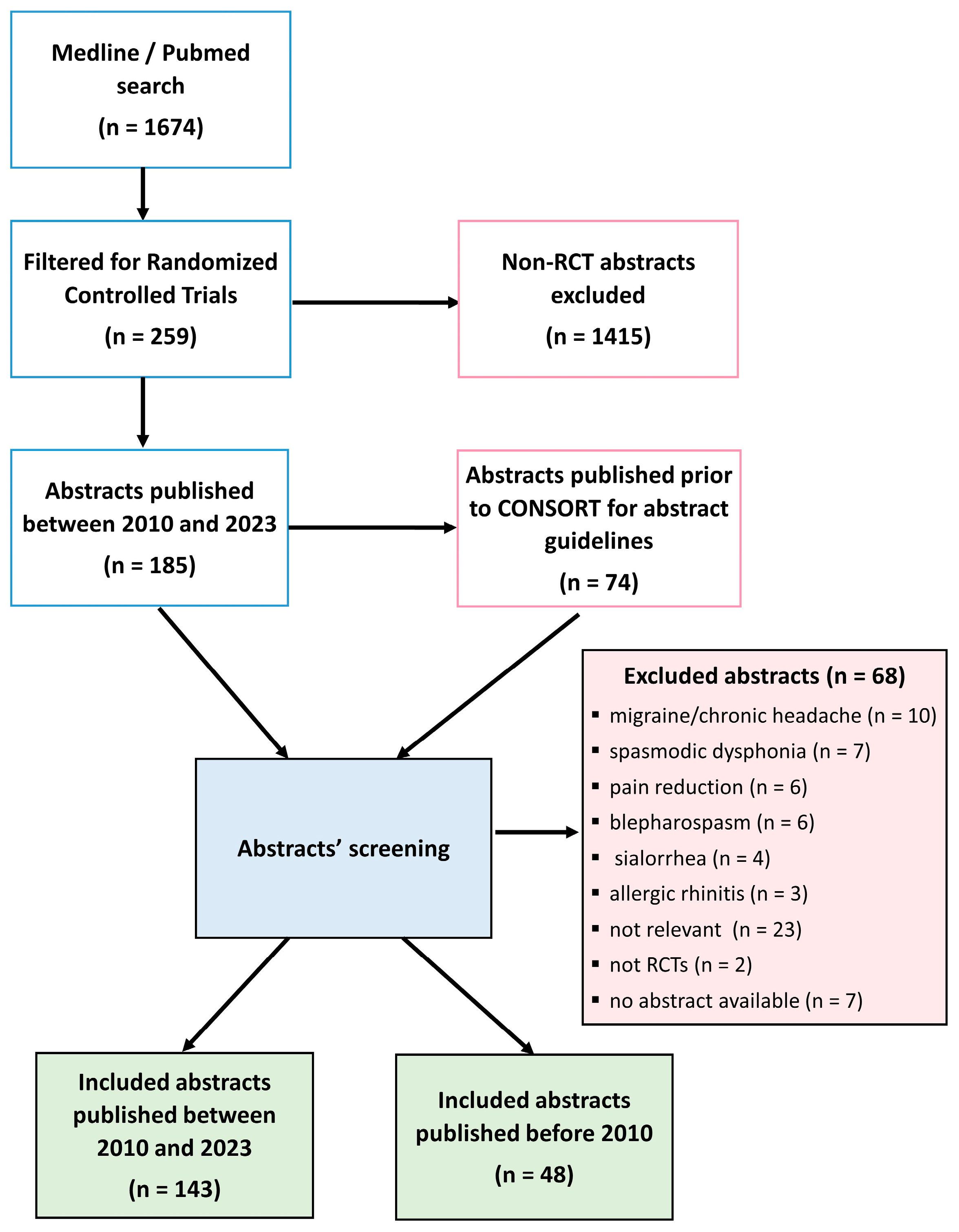

Reporting Quality of Randomized Controlled Trial Abstracts on Aesthetic Use of Botulinum Toxin: How Much Do Abstracts Actually Tell Us?


 ,
,  ,
,  ,
,  and
and Abstract
Share and Cite
Sucic, A.; Perisin, A.S.; Zuvela, T.; Leskur, D.; Rusic, D.; Modun, D.; Bukic, J. Reporting Quality of Randomized Controlled Trial Abstracts on Aesthetic Use of Botulinum Toxin: How Much Do Abstracts Actually Tell Us? Cosmetics 2023, 10, 119. https://doi.org/10.3390/cosmetics10050119
Sucic A, Perisin AS, Zuvela T, Leskur D, Rusic D, Modun D, Bukic J. Reporting Quality of Randomized Controlled Trial Abstracts on Aesthetic Use of Botulinum Toxin: How Much Do Abstracts Actually Tell Us? Cosmetics. 2023; 10(5):119. https://doi.org/10.3390/cosmetics10050119
Chicago/Turabian StyleSucic, Ante, Ana Seselja Perisin, Tomislav Zuvela, Dario Leskur, Doris Rusic, Darko Modun, and Josipa Bukic. 2023. "Reporting Quality of Randomized Controlled Trial Abstracts on Aesthetic Use of Botulinum Toxin: How Much Do Abstracts Actually Tell Us?" Cosmetics 10, no. 5: 119. https://doi.org/10.3390/cosmetics10050119
APA StyleSucic, A., Perisin, A. S., Zuvela, T., Leskur, D., Rusic, D., Modun, D., & Bukic, J. (2023). Reporting Quality of Randomized Controlled Trial Abstracts on Aesthetic Use of Botulinum Toxin: How Much Do Abstracts Actually Tell Us? Cosmetics, 10(5), 119. https://doi.org/10.3390/cosmetics10050119