
Modeling the Synergistic Integration of Financial Geographic and Virtual Agglomerations: A Systems Perspective



Abstract
1. Introduction
2. Literature Review and Theoretical Connotation
2.1. Literature Review
2.1.1. Research Framework on Financial Geographic Agglomeration
2.1.2. Evolution of Virtual Agglomeration Research
2.1.3. Theoretical Origins of the Synergistic Integration of Financial Dual Agglomeration
2.2. Financial Dual Agglomeration: Theory and Measurement
2.2.1. Theoretical Connotations of Financial Dual Agglomeration Synergy
- (1)
- Institutional Innovation Synergy. Based on the theory of institutional complementarity, different institutional arrangements can form systemic synergy through functional complementarities, generating mutual support and reinforcing effects [29]. Accordingly, institutional innovation synergy can be deconstructed as follows: financial geographic agglomeration provides the foundation for the effective implementation of institution (example, financial institution entry rules, prudential regulatory frameworks), thereby establishing a stable operational framework for financial activities [30]; financial virtual agglomeration, on the other hand, offers a practical environment for the innovation of digital rules (e.g., data flow standards, algorithmic governance norms), driving the expansion of institutional boundaries [31,32]. The two dimensions interact through a dynamic complementary mechanism of “anchoring the foundation, breaking boundaries,” jointly constructing an institutional innovation system that spans both geographic and digital spaces. This complementarity reduces institutional friction costs, stimulates institutional innovation, and ultimately optimizes the efficiency of financial resource allocation. A typical example is the joint issuance by the China Banking and Insurance Regulatory Commission and the Shanghai Municipal Government in June 2025 of the Action Plan to Support the Construction of Shanghai as an International Financial Center. The plan exhibits a clear dual-layered synergy: the first article, “Promoting the Clustering of Financial Institutions”, strengthens the anchoring function of institution; the third article, “Expanding Institutional Openness”, highlights the breakthrough effect of digital rule innovation. This institutional paradigm provides a systematic solution that balances stability and innovation for financial development in the digital economy era.
- (2)
- Spatial Structure Reconstruction. Based on the research of Wójcik and Macdonald-Korth [33] on the agglomeration of British financial resources toward national financial centers, spatial structure reconstruction can be deconstructed as follows: credit anchors established through localized institutional networks, including formal rules and social trust networks, form the foundation for the formation and maintenance of financial geographic agglomeration. The deep application of digital technologies, in turn, drives financial virtual agglomeration, breaking the constraints of traditional geographic boundaries. The two dimensions evolve synergistically, forming a core–periphery network topology.In the context of national-level strategic layouts, the core geographic agglomeration areas (example, Shanghai, Beijing) serve a dual function: acting both as hubs of physical element aggregation and as key nodes in the virtual agglomeration network. Through the integration model of geographic-space physical carriers + digital-space virtual scenarios, technologies such as blockchain and API interfaces enable the digital representation and efficient transmission of financial resources. Consequently, core regions can establish close digital connections with hub nodes in central and western regions (example, Chengdu, Chongqing, Guizhou). This spatial structure not only maintains the scale and scope economies of financial geographic agglomeration but also extends the reach of financial services through technological spillovers and radiation effects from virtual agglomeration. This is consistent with the dual agglomeration integration framework for digital industries proposed by Zhao and Zhang [34], ultimately constructing a hierarchical, wide-reaching system for the coordinated allocation of financial resources.
- (3)
- Element Flow and Sharing. Based on the research of Zhao and Zhang [34] on how dual agglomeration in digital industries promotes cross-temporal and cross-spatial sharing of physical and digital elements, element flow and sharing can be deconstructed as follows: leveraging digital technologies, it drives the bidirectional transformation and cross-enablement of physical elements (e.g., financial institutions, talent) and digital elements (e.g., data assets, algorithmic resources), thereby enhancing the efficiency of financial resource allocation. An example of the transformation from physical to digital elements is the codification of tacit knowledge and experience in the physical domain. For instance, risk control experience in traditional financial institutions can be modeled algorithmically to establish platform rules, realizing the effectiveness of physical elements in digital space. Conversely, the transformation from digital to physical elements occurs when digital tools optimize decision-making and operational processes in physical institutions. For example, digital credit scoring models based on big data can be deeply integrated into the credit decision-making processes of financial institutions, creating feedback effect from digital elements to the real economy. It is noteworthy that this bidirectional transformation does not occur in isolation but operates through deep coupling to form a cross-enablement mechanism. By reducing information asymmetry and risk identification costs, this mechanism ultimately improves the precision of financial resource allocation.
- (4)
- Functional Coordination and Complementarity. Drawing on industrial agglomeration theory and digital economy theory, financial geographic agglomeration and financial virtual agglomeration jointly construct a risk-control and governance framework through functional complementarity, thereby strengthening financial security and enhancing resource allocation efficiency. In financial geographic agglomeration, localized social networks and geographic proximity facilitate repeated interactions and the formation of reputation mechanisms among financial institutions, effectively mitigating information asymmetry and its associated problems such as adverse selection and moral hazards. In financial virtual agglomeration, digital risk-control systems dynamically identify and manage information asymmetry and related risks from a technological perspective. The synergistic effect of these two dimensions provides a composite risk governance foundation for the financial system. Furthermore, by leveraging digital platforms and algorithmic optimization capabilities built within financial virtual agglomeration, financial institutions can achieve efficient cross-domain allocation of financial resources and risk diversification, significantly enhancing the efficiency of financial resource allocation. This functional complementarity mechanism contributes to a dynamic balance between financial security and allocation efficiency.
2.2.2. Construction of the Evaluation Indicator System
Indicator Selection for Financial Geographic Agglomeration
Indicator Selection for Financial Virtual Agglomeration
3. Materials and Methods
3.1. Entropy Method
3.2. Coupling Coordination Degree Model
3.3. Coefficient of Variation
3.4. Kernel Density Estimation
3.5. Spatial Correlation Analysis
3.6. Data Sources
4. Evolutionary Paths in Financial Geographic and Virtual Agglomerations
4.1. Evolutionary Characteristics of Financial Geographic Agglomeration
4.1.1. Temporal Characteristics
- (1)
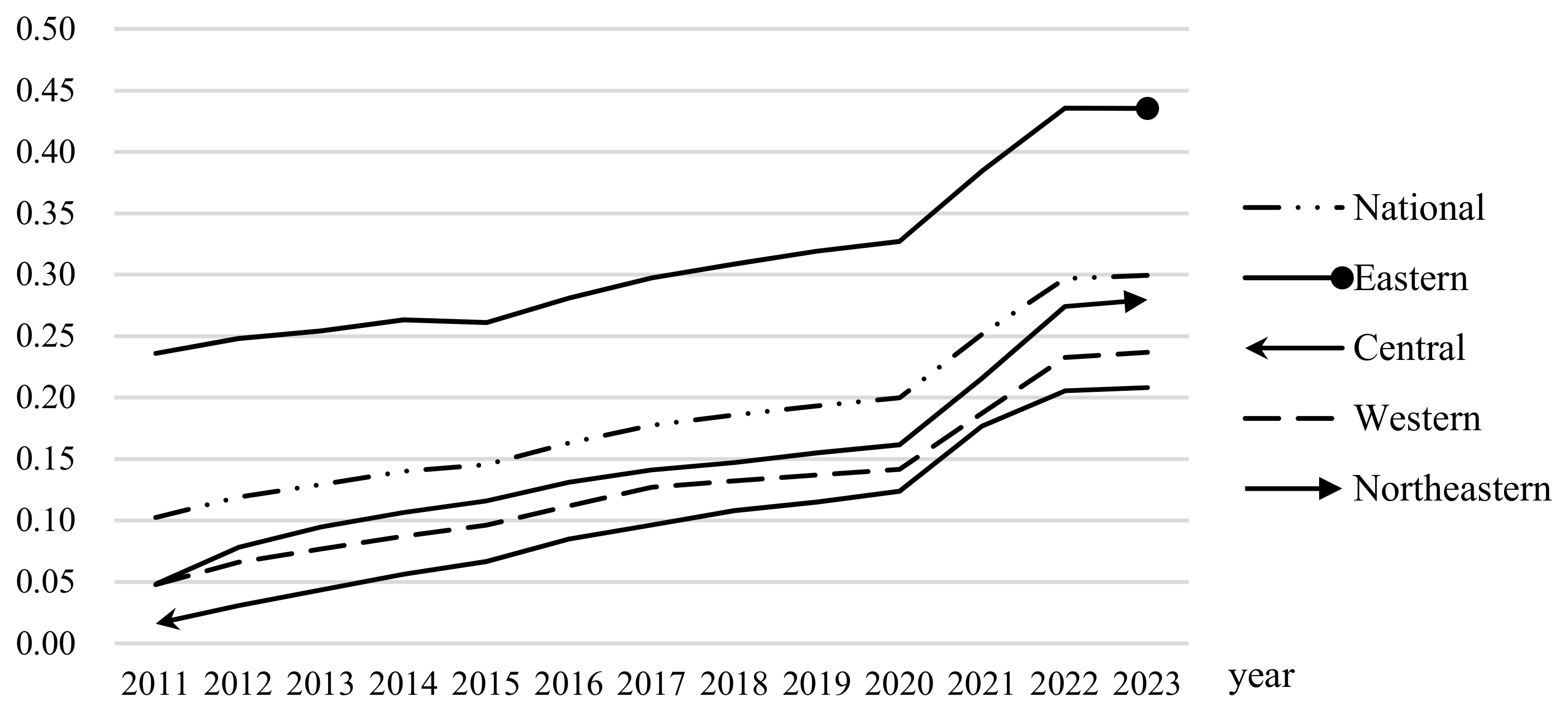
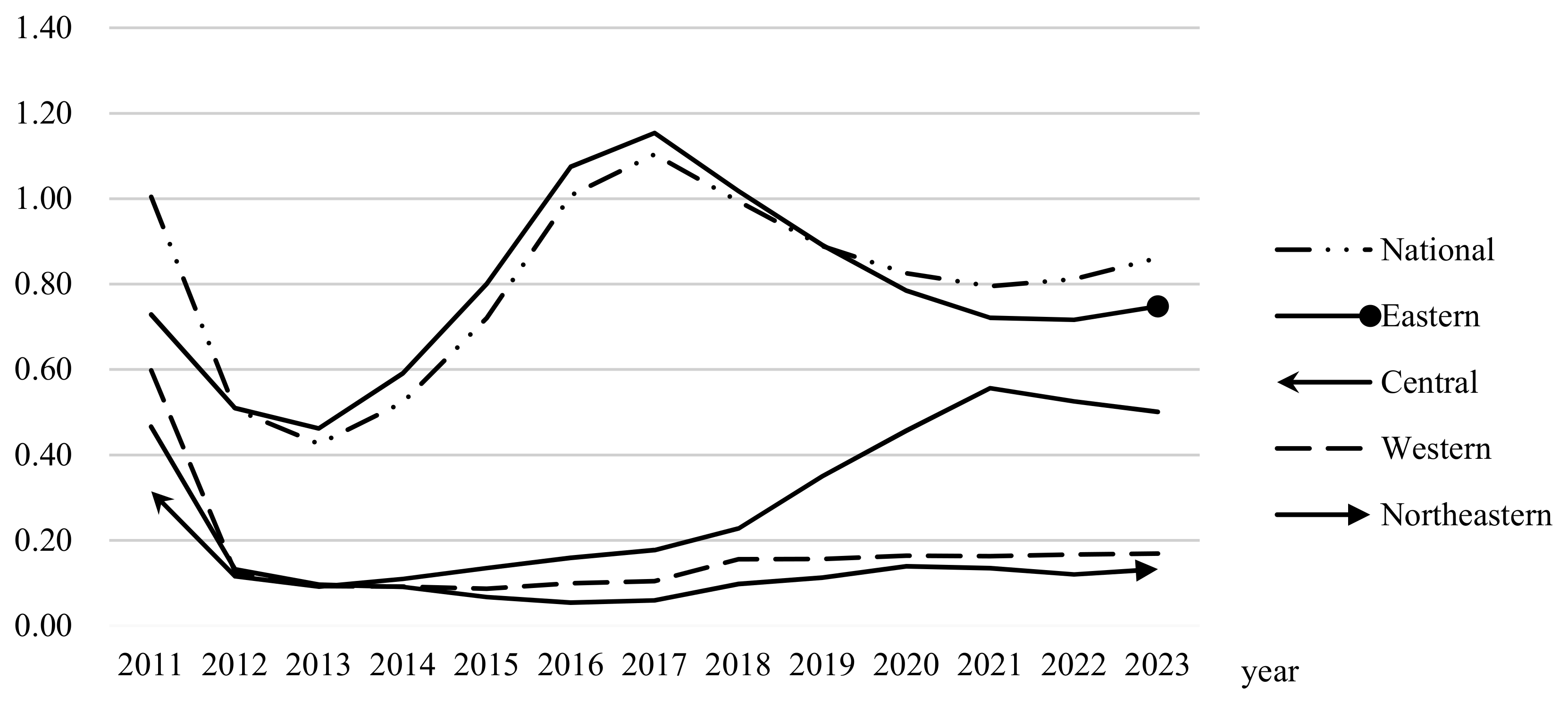
- Changes in Financial Geographic Agglomeration
- (2)
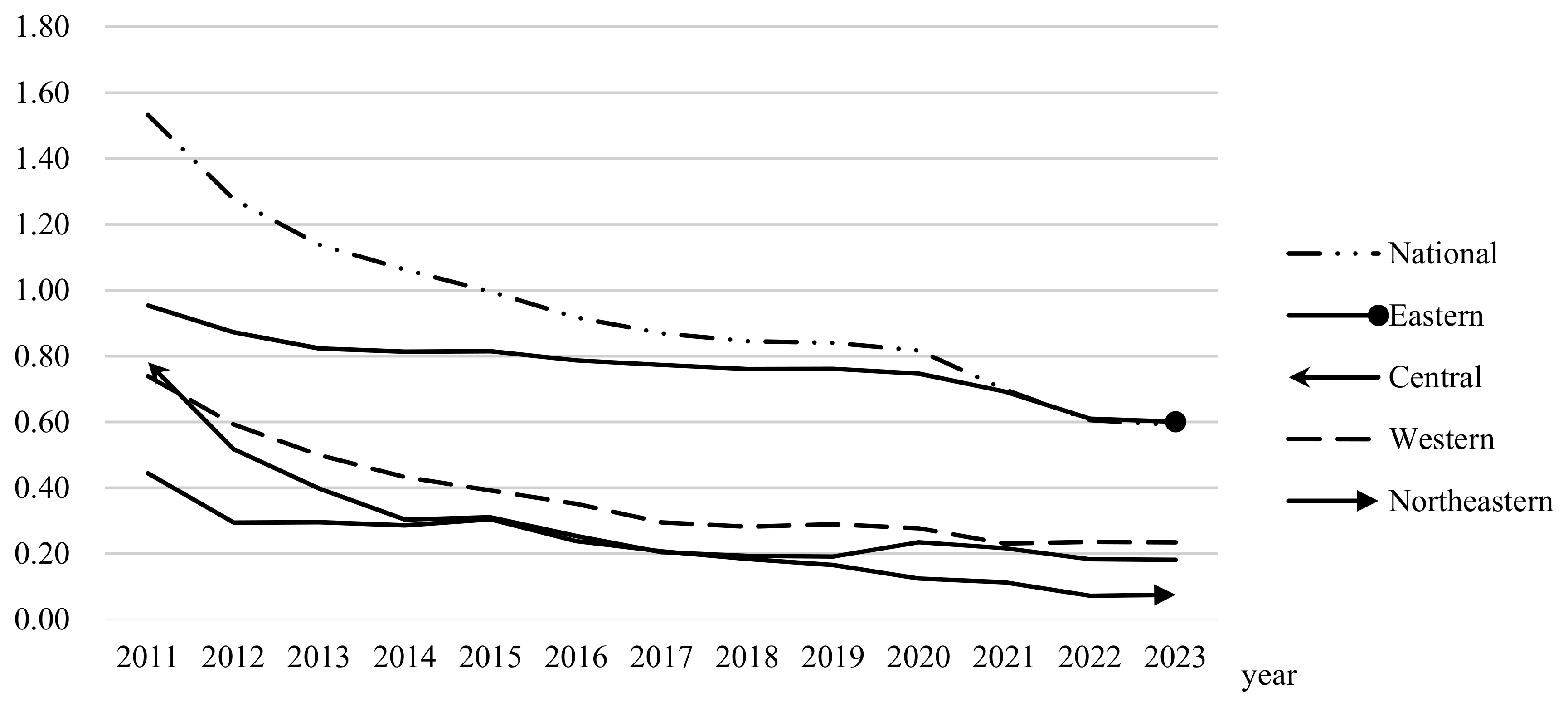
- Convergence Characteristics of Financial Geographic Agglomeration
4.1.2. Spatial Characteristics
- (1)
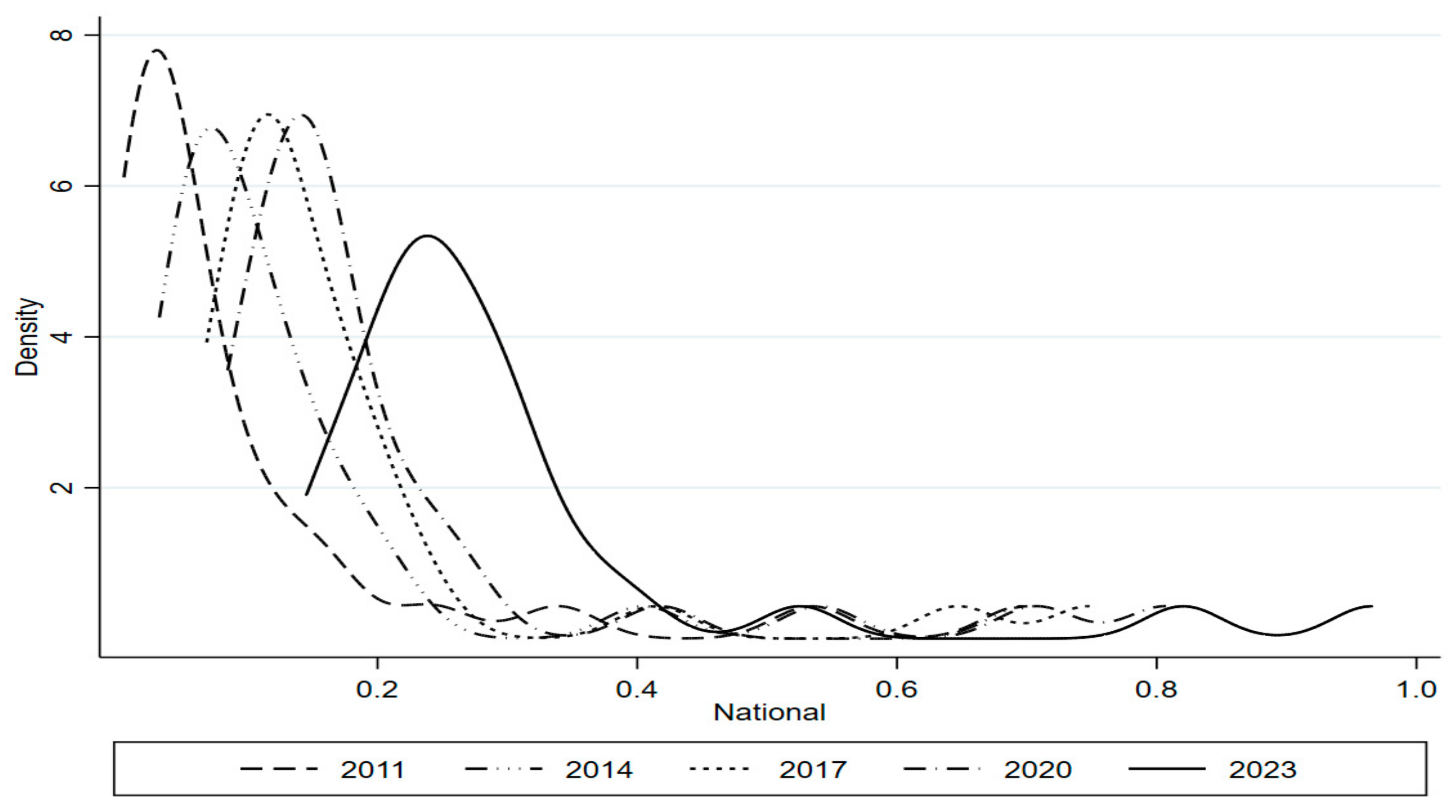
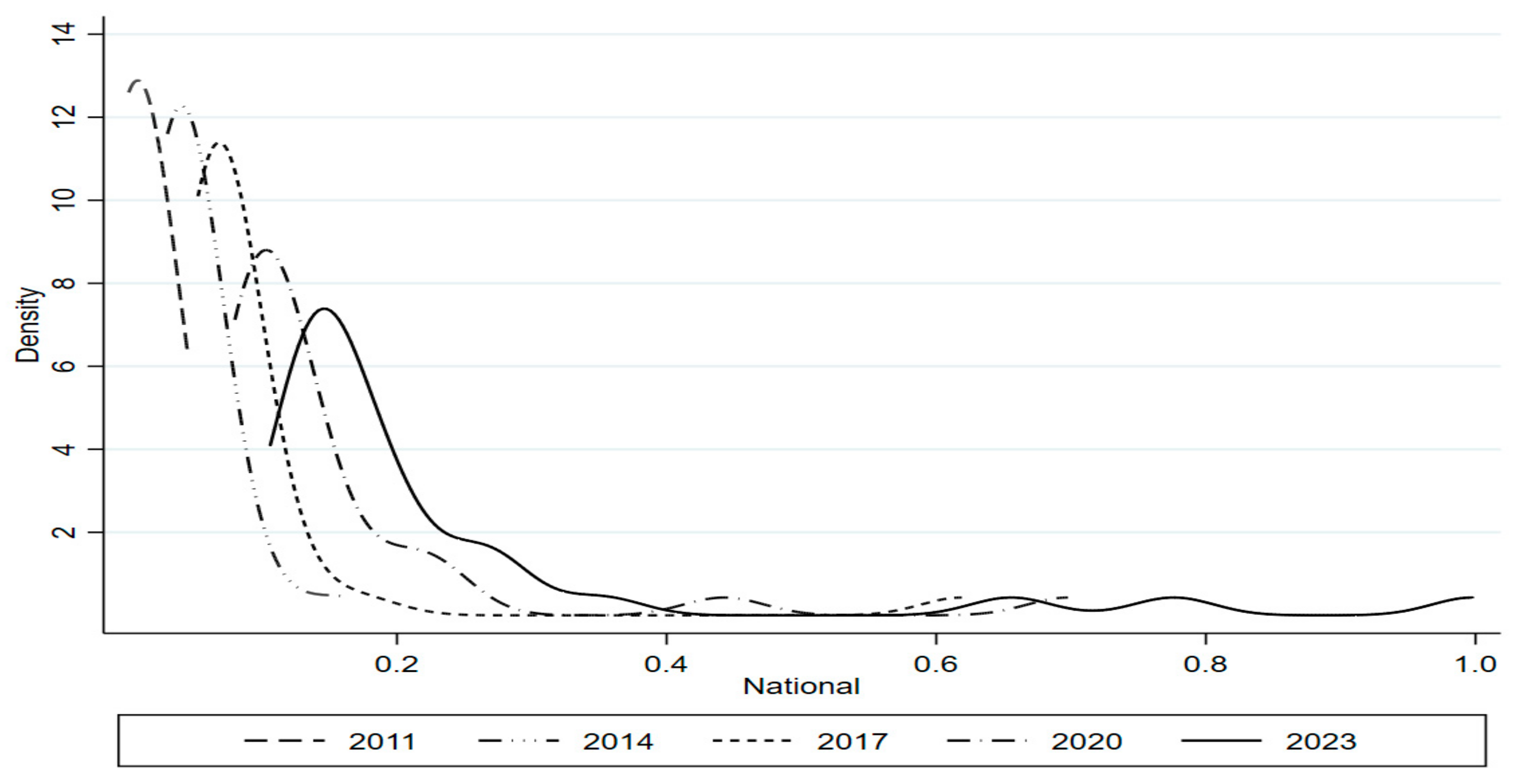
- Kernel Density Analysis
- (2)
- Spatial Correlation Analysis
4.2. Evolutionary Characteristics of Financial Virtual Agglomeration
4.2.1. Temporal Features
- (1)
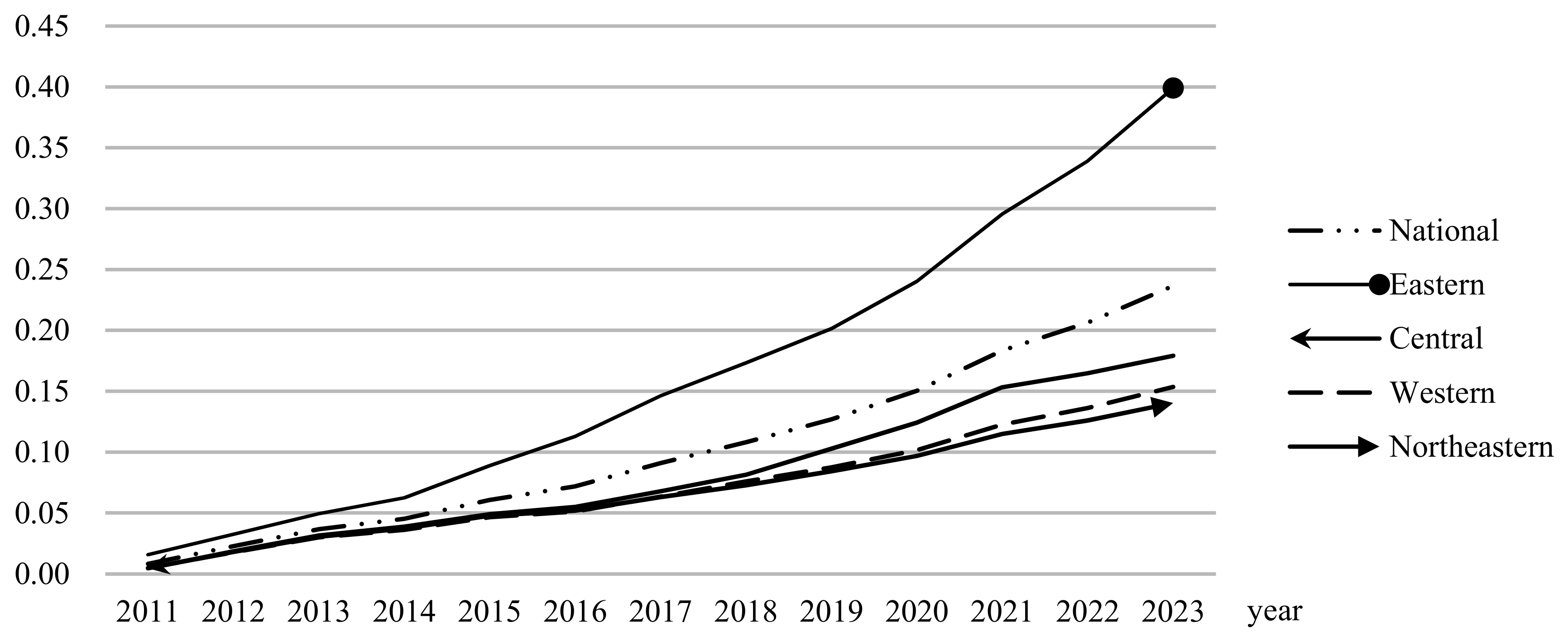
- Changes in Financial Virtual Agglomeration
- (2)
- Convergence Characteristics of Financial Virtual Agglomeration
4.2.2. Spatial Characteristics
- (1)
- Kernel Density Analysis
- (2)
- Spatial Correlation Analysis
5. Evolutionary Characteristics of the Synergistic Integration of Financial Dual Agglomeration
5.1. Evolutionary Characteristics of Financial Dual Agglomeration Coordination
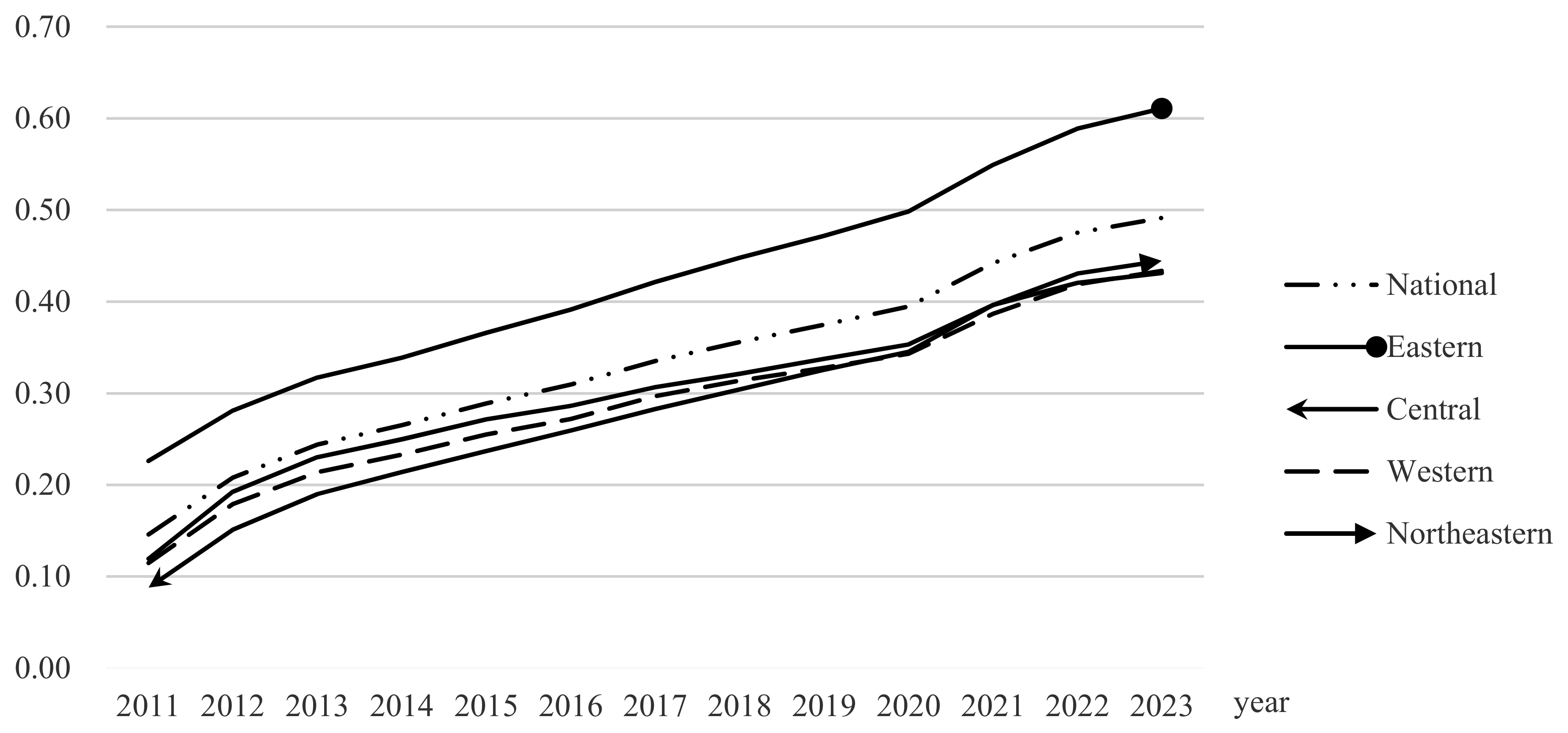
5.1.1. National Level: Gradual Progress from Severely Disordered to Nearly Disordered
5.1.2. Regional Level: Eastern Region Leading, Central, Western, and Northeastern Regions Following a Gradient
- (1)
- Eastern Region: Pioneering the Coordination Threshold and Entering the Primary Coordination Stage
- (2)
- Central, Western, and Northeastern Regions: Continuous Improvement but Still in the Transition from Disordered to Coordinated
5.2. Convergence Characteristics of Financial Dual Agglomeration Synergy Levels: Gradual Reduction in Intra-Regional Disparities
- (1)
- National level: The coefficient of variation for financial dual agglomeration synergy decreased from 0.5528 in 2011 to 0.2704 in 2023, representing an overall decline of approximately 51.09%.
- (2)
- Eastern region: The coefficient of variation fell from 0.4256 to 0.2956, showing a convergence trend. Nevertheless, its variation remains higher than that of the other three regions, reflecting relatively pronounced differences in the financial dual agglomeration synergy among provinces within the Eastern region.
- (3)
- Central, Western, and Northeastern regions: The coefficients of variation in these regions all exhibit declining trends and remain relatively low in the long term (0.1153 in the Central region, 0.0756 in the Western region, and 0.0525 in the Northeastern region in 2023). This indicates that intra-regional disparities in financial dual agglomeration synergy are small; however, due to the overall lower level of synergy, these regions still display a “low-level equilibrium” pattern.
5.3. Analysis of Provincial Financial Dual Agglomeration Synergy Levels and Driving Types in 2023
- (1)
- Highly coordinated: Beijing. The financial geographic agglomeration index and financial virtual agglomeration index of Beijing reached 0.9654 and 0.9977, respectively, reflecting its dual advantage as the national center for financial decision-making and digital financial innovation, where both agglomeration types form a highly efficient, mutually reinforcing cycle.
- (2)
- Well-coordinated: Shanghai. As an international financial center, Shanghai exhibits a high level of financial geographic agglomeration (0.8204) and financial virtual agglomeration (0.6554), achieving effective coordination between the two.
- (3)
- Primary coordinated: Tianjin and Hainan. Tianjin’s coordination is primarily driven by financial geographic agglomeration (0.5252), while Hainan relies on financial virtual agglomeration (0.7762), illustrating differentiated regional financial development pathways.
- (4)
- Barely coordinated: Jiangsu, Zhejiang, Fujian, Hunan, Guangdong, and Chongqing. Although these provinces exhibit some synergy between the two agglomeration types, the overall level remains relatively low.
- (5)
- Nearly disordered and mildly disordered: Henan and Yunnan are in a mildly disordered stage, while the remaining 19 provinces are classified as nearly disordered. This indicates that in most provinces, there exists a structural imbalance between the two agglomeration types, and the coordination mechanisms remain underdeveloped.
- (1)
- Geographically driven agglomeration (S): covering 23 provinces. This indicates that traditional physical financial institutions (example, banks, securities firms) remain the main driving force for financial development, whereas virtual agglomeration lags behind.
- (2)
- Virtually driven agglomeration (U): Hainan, Guizhou, and Hunan. In these provinces, the financial virtual agglomeration index exceeds the geographic one, making digital finance the dominant force in regional financial development. This illustrates how late-developing regions can achieve “leapfrogging” through digital finance. The following section provides a detailed analysis using Hainan and Guizhou as examples.
- (3)
- Synchronously driven agglomeration (T): Beijing, Anhui, Shandong, Guangdong, and Yunnan. Beijing achieves “high-level coordination” due to both agglomeration indices being high, whereas Anhui, Shandong, and Yunnan display “low-level coordination” as both indices remain low.
6. Conclusions and Policy Recommendations
6.1. Conclusions
6.2. Policy Recommendations
Author Contributions
Funding
Data Availability Statement
Conflicts of Interest
References
- Gawer, A. Digital platforms and ecosystems: Remarks on the dominant organizational forms of the digital age. Innov. Organ. Manag. 2022, 24, 110–124. [Google Scholar] [CrossRef]
- Kari, A.; Bellin, P.; Matzner, M.; Gersch, M. Governing the emergence of network-driven platform ecosystems. Electron. Mark. 2025, 35, 4. [Google Scholar] [CrossRef]
- United Nations Environment Programme. 14th Five Year Plan for the Development of Digital Economy. 2021. Available online: https://leap.unep.org/en/countries/cn/national-legislation/14th-five-year-plan-development-digital-economy (accessed on 31 October 2025).
- Xinhua. Plan Focuses on Digital Economy Development During 14th Five-Year Plan Period. 2022. Available online: https://english.www.gov.cn/policies/latestreleases/202201/12/content_WS61de9a35c6d09c94e48a385f.html (accessed on 31 October 2025).
- Bian, W.; Ge, T.; Ji, Y.; Wang, X. How is Fintech reshaping the traditional financial markets? New evidence from InsurTech and insurance sectors in China. China Econ. Rev. 2023, 80, 102004. [Google Scholar] [CrossRef]
- Engelen, E.; Grote, M. Stock exchange virtualisation and the decline of second-tier financial centres: The cases of Amsterdam and Frankfurt. J. Econ. Geogr. 2009, 9, 679–696. [Google Scholar] [CrossRef]
- Yue, H.; Wang, H.; Jin, P. Financial geographic structure and innovation quality: Evidence from Chinese firms amid economic policy uncertainty. Econ. Anal. Policy 2024, 84, 1370–1380. [Google Scholar] [CrossRef]
- Zhao, J.; Wang, Y.; Lv, K.; Ru, L.; Miao, C. The evolutionary mechanism of financial industry agglomeration in central cities of inland China: A case study of Zhengdong New District in Zhengzhou. Acta Geogr. Sin. 2017, 72, 1392–1407. [Google Scholar] [CrossRef]
- Chen, X.; Liu, C.; Jiang, Y.; Gao, C. What causes the virtual agglomeration of creative industries? Sustainability 2021, 13, 9232. [Google Scholar] [CrossRef]
- Zhang, Q.; Ru, S.; Cheng, Y. Research on the measurement and characteristics of virtual agglomeration based on social network analysis: Evidence from 29 manufacturing industries in China. Systems 2023, 11, 571. [Google Scholar] [CrossRef]
- Pflüger, M. Tabuchi, Comparative advantage, agglomeration economies and trade costs. Urban. Econ. 2019, 109, 1–13. [Google Scholar] [CrossRef]
- Zhao, S.; Cai, J.; Zhang, L. Asymmetric information as a key determinant for locational choice of MNC headquarters and the development of financial centers: A case for China. China Econ. Rev. 2005, 16, 308–331. [Google Scholar] [CrossRef]
- Xie, M.; Yu, B.; Zhong, C. Financial agglomeration and firms’ domestic value added in exports: Evidence from China. Int. Rev. Econ. Financ. 2025, 103, 104424. [Google Scholar] [CrossRef]
- Zhang, Y.; Wang, F.; Zhou, Y.; Zhao, N. Financial geographic structure, Market competition, and corporate financialization. Financ. Res. Lett. 2025, 75, 106806. [Google Scholar] [CrossRef]
- Molina, A.; Flores, M. A virtual enterprise in Mexico: From concepts to practice. J. Intell. Robot. Syst. 1999, 26, 289–302. [Google Scholar] [CrossRef]
- Brown, D.; Lockett, N. Engaging SMEs in e-commerce: The role of intermediaries within E-cluster. Electron. Mark. 2001, 11, 52–58. [Google Scholar] [CrossRef]
- Deng, P.; Wen, L.; Wang, D. Assessing the environmental impact of digital and manufacturing industry co-agglomeration: Dual perspectives of geographical and virtual agglomeration. J. Environ. Manage. 2025, 375, 124369. [Google Scholar] [CrossRef]
- Yang, J.; Wu, R.; Yang, H. Digital transformation and enterprise sustainability: The moderating role of regional virtual agglomeration. Sustainability 2023, 15, 7597. [Google Scholar] [CrossRef]
- Hendrikse, R.; Van Meeteren, M.; Bassens, D. Strategic coupling between finance, technology and the state: Cultivating a Fintech ecosystem for incumbent finance. Environ. Plann. A 2019, 11, 1516–1538. [Google Scholar] [CrossRef]
- Lai, K.; Samers, M. Towards an economic geography of FinTech. Prog. Hum. Geog. 2021, 45, 720–739. [Google Scholar] [CrossRef]
- Tsai, C.H.; Peng, K.J. The FinTech Revolution and Financial Regulation: The Case of Online Supply-Chain Financing. Asian. J. Law. Soc. 2017, 4, 109–132. [Google Scholar] [CrossRef]
- Cockayne, D.; Loomis, J. Geographies of fintech and everyday life: Reconfiguring spaces, practices, and scales of digital money and finance. Geogr. Compass 2025, 19, e12689. [Google Scholar] [CrossRef]
- Abudy, M.; Mugerman, Y.; Shust, E. National pride, investor sentiment, and stock markets. J. Int. Financ. Mark. I. 2023, 89, 101879. [Google Scholar] [CrossRef]
- Lin, M.; Viswanathan, S. Home bias in online investments: An empirical study of an online crowdfunding market. Manage. Sci. 2016, 62, 1393–1414. [Google Scholar] [CrossRef]
- Zeng, F.; Sun, H. Spatial network analysis of coupling coordination between digital financial inclusion and common prosperity in the Yangtze River Delta urban agglomeration. Mathematics 2024, 12, 1285. [Google Scholar] [CrossRef]
- Lin, T.; Zhang, L.; Li, J.L. Coupling and coordinated development of green finance and renewable energy industry in China: Spatiotemporal differentiation and driving factors. Renew. Energy 2024, 235, 121255. [Google Scholar] [CrossRef]
- Huang, J.; Yang, Z. On Financial Agglomeration; China Social Sciences Press: Beijing, China, 2006; ISBN 7-80106-418-6. Available online: https://www.csspw.cn/search_%25E9%2587%2591%25E8%259E%258D%25E9%259B%2586%25E8%2581%259A%25E8%25AE%25BA__1_2_1_title_0_0_0_0.jhtml (accessed on 4 December 2025).
- Wójcik, D. Financial geography II: The impacts of fintech-financial sector and centres, regulation and stability, inclusion and governance. Prog. Hum. Geog. 2021, 45, 878–889. [Google Scholar] [CrossRef]
- Landini, F.; Pagano, U. Stakeholders’ conflicts and corporate assets: An institutional meta-complementarities approach. Socio-Econ. Rev. 2018, 18, 53–80. [Google Scholar] [CrossRef]
- Li, W.; Wang, X. Towards a mega-regional economy: A financial geography perspective to understanding Shanghai’s role in the Yangtze River Delta integration. Geoforum 2019, 101, 1–9. [Google Scholar] [CrossRef]
- Bu, Y.; Jin, W.; Wang, Y.; Tang, M.; Li, H. Regulatory sandbox system and its impact on financial efficiency: A quasi-natural experiment study. Appl. Econ. 2025, 4, 1–19. [Google Scholar] [CrossRef]
- Venkatraman, S.; Parvin, S. Developing an IOT identity management system using blockchain. Systems 2022, 10, 39. [Google Scholar] [CrossRef]
- Wójcik, D.; Macdonald-Korth, D. The British and the German financial sectors in the wake of the crisis: Size, structure and spatial concentration. J. Econ. Geogr. 2015, 15, 1033–1054. [Google Scholar] [CrossRef]
- Zhao, F.; Zhang, M. Integration of geographical and virtual agglomeration in the digital industry to advance Chinese-style modernization. J. Shanxi Univ. (Philos. Soc. Sci. Ed.) 2025, 48, 27–35. [Google Scholar]
- Fracasso, A.; Vittucci Marzetti, G. Estimating dynamic localization economies: The inadvertent success of the specialization index and the location quotient. Reg. Stud. 2018, 52, 119–132. [Google Scholar] [CrossRef]
- Wei, M.; Li, J.; Wang, S. Does digital financial agglomeration help promote high-quality economic development? Bus. Res. 2024, 4, 65–73. Available online: https://www.ncpssd.cn/Literature/articlelist?sType=0&search=KElLVEU9IuaVsOWtl+mHkeiejembhuiBmuacieWKqeS6juS/g+i/m+e7j+a1jumrmOi0qOmHj+WPkeWxleWQlz8iIE9SIElLUFlURT0i5pWw5a2X6YeR6J6N6ZuG6IGa5pyJ5Yqp5LqO5L+D6L+b57uP5rWO6auY6LSo6YeP5Y+R5bGV5ZCXPyIgT1IgSUtFVD0i5pWw5a2X6YeR6J6N6ZuG6IGa5pyJ5Yqp5LqO5L+D6L+b57uP5rWO6auY6LSo6YeP5Y+R5bGV5ZCXPyIp&searchname=6aKY5ZCNPSLmlbDlrZfph5Hono3pm4bogZrmnInliqnkuo7kv4Pov5vnu4/mtY7pq5jotKjph4/lj5HlsZXlkJc/Ig==&nav=0&ajaxKeys=5pWw5a2X6YeR6J6N6ZuG6IGa5pyJ5Yqp5LqO5L+D6L+b57uP5rWO6auY6LSo6YeP5Y+R5bGV5ZCXPw== (accessed on 4 December 2025).
- Guo, F.; Wang, J.; Wang, F.; Kong, T.; Zhang, X.; Cheng, Z. Measuring the development of digital inclusive finance in China: Index compilation and spatial characteristics. Econ. Q. 2020, 19, 1401–1418. [Google Scholar]
- Wei, Y.; Wang, M.; Wei, X.; Yuan, F.; Fan, J.; Ba, S. Spatial patterns and influencing factors of financial agglomeration in Guangdong-Hong Kong-Macao Greater Bay Area. PLoS ONE 2024, 19, e0306301. [Google Scholar] [CrossRef] [PubMed]
- Song, M.; Zhou, P.; Si, H. FinTech and total factor productivity of enterprises: Perspectives of “empowerment” and credit allocation. China Ind. Econ. 2021, 4, 138–155. [Google Scholar]
- Zhao, F.; Li, W.; Ma, W. Evolution characteristics and coupling relationship between geographical and virtual agglomeration from the perspective of the digital economy. J. Soc. Sci. Jilin Univ. 2024, 64, 117–132+238. Available online: https://www.ncpssd.cn/Literature/articleinfo?id=JLDXSHKXXB2024001011&synUpdateType=&type=journalArticle&typename=%E4%B8%AD%E6%96%87%E6%9C%9F%E5%88%8A%E6%96%87%E7%AB%A0 (accessed on 4 December 2025).
- Xu, J.; Zhou, M. Dynamic coordinated development and influencing factors of China’s two-way FDI. Soft Sci. 2021, 35, 63–69. [Google Scholar]



| Dimension | Indicator | Indicator Calculation or Description | Unit | Attribute |
|---|---|---|---|---|
| Financial Geographic Agglomeration | Financial Industry Location Entropy | - | Positive | |
| Financial Institution Density | Number of financial institutions in the province/provincial population | Institutions per 100 million | Positive | |
| Financial Virtual Agglomeration | Level of Digital Financial Development | Peking University Digital Inclusive Finance Index | - | Positive |
| FinTech Enterprise Density | Number of FinTech enterprises in the province/provincial population | Enterprises per 100 million people | Positive |
| Province | 2011 | 2023 | Province | 2011 | 2023 |
|---|---|---|---|---|---|
| Beijing | 0.6963 | 0.9654 | Hainan | 0.0403 | 0.2295 |
| Shanghai | 0.5345 | 0.8204 | Shanxi | 0.0380 | 0.2643 |
| Tianjin | 0.3392 | 0.5252 | Heilongjiang | 0.0253 | 0.2553 |
| Zhejiang | 0.2423 | 0.3969 | Guangxi | 0.0245 | 0.1767 |
| Guangdong | 0.1601 | 0.2967 | Gansu | 0.0244 | 0.2316 |
| Jiangsu | 0.1593 | 0.3606 | Hebei | 0.0237 | 0.2008 |
| Chongqing | 0.1237 | 0.3197 | Yunnan | 0.0221 | 0.1453 |
| Fujian | 0.1112 | 0.3346 | Sichuan | 0.0199 | 0.2419 |
| Ningxia | 0.0929 | 0.2497 | Hubei | 0.0195 | 0.2321 |
| Inner Mongolia | 0.0797 | 0.2990 | Henan | 0.0189 | 0.1534 |
| Liaoning | 0.0678 | 0.2939 | Guizhou | 0.0148 | 0.1575 |
| Xinjiang | 0.0614 | 0.2124 | Tibet | 0.0142 | 0.2935 |
| Shandong | 0.0531 | 0.2236 | Hunan | 0.0090 | 0.1963 |
| Qinghai | 0.0518 | 0.2585 | Anhui | 0.0059 | 0.1920 |
| Jilin | 0.0512 | 0.2897 | Jiangxi | 0.0047 | 0.2108 |
| Shaanxi | 0.0446 | 0.2567 |
| Year | Global Moran’s I | Z | p |
|---|---|---|---|
| 2011 | 0.282 | 4.091 | 0.000 |
| 2012 | 0.300 | 4.305 | 0.000 |
| 2013 | 0.302 | 4.331 | 0.000 |
| 2014 | 0.286 | 4.129 | 0.000 |
| 2015 | 0.247 | 3.655 | 0.000 |
| 2016 | 0.231 | 3.460 | 0.000 |
| 2017 | 0.237 | 3.544 | 0.000 |
| 2018 | 0.243 | 3.637 | 0.000 |
| 2019 | 0.226 | 3.428 | 0.000 |
| 2020 | 0.220 | 3.342 | 0.000 |
| 2021 | 0.186 | 2.916 | 0.002 |
| 2022 | 0.227 | 3.400 | 0.000 |
| 2023 | 0.232 | 3.475 | 0.000 |
| Year | High–High (HH) Regions | Low–High (LH) Regions | Low–Low (LL) Regions | High–Low (HL) Regions |
|---|---|---|---|---|
| 2011 | Beijing, Tianjin, Jiangsu, Shanghai, Zhejiang, Fujian | Hebei, Shandong, Liaoning, Inner Mongolia, Anhui | Shanxi, Jilin, Heilongjiang, Jiangxi, Henan, Hubei, Hunan, Guangxi, Hainan, Sichuan, Guizhou, Yunnan, Shaanxi, Gansu, Qinghai, Ningxia, Xinjiang, Tibet | Guangdong, Chongqing |
| 2023 | Beijing, Tianjin, Jiangsu, Shanghai, Zhejiang, Fujian | Hebei, Shandong, Anhui | Shanxi, Jilin, Heilongjiang, Jiangxi, Henan, Hubei, Hunan, Guangxi, Hainan, Sichuan, Guizhou, Yunnan, Shaanxi, Gansu, Qinghai, Ningxia, Xinjiang, Tibet | Chongqing |
| Province | 2011 | 2023 | Province | 2011 | 2023 |
|---|---|---|---|---|---|
| Beijing | 0.0445 | 0.9977 | Sichuan | 0.0057 | 0.1519 |
| Shanghai | 0.0241 | 0.6554 | Guangxi | 0.0048 | 0.1451 |
| Guangdong | 0.0161 | 0.2821 | Anhui | 0.0046 | 0.1951 |
| Zhejiang | 0.0159 | 0.1874 | Shanxi | 0.0043 | 0.1294 |
| Fujian | 0.0143 | 0.2649 | Hebei | 0.0042 | 0.1318 |
| Tianjin | 0.0116 | 0.2669 | Heilongjiang | 0.0041 | 0.1201 |
| Jiangsu | 0.0114 | 0.1837 | Ningxia | 0.0041 | 0.1489 |
| Tibet | 0.0100 | 0.1402 | Inner Mongolia | 0.0039 | 0.1431 |
| Hainan | 0.0100 | 0.7762 | Jiangxi | 0.0035 | 0.1468 |
| Qinghai | 0.0094 | 0.1129 | Yunnan | 0.0032 | 0.1399 |
| Chongqing | 0.0072 | 0.1997 | Henan | 0.0029 | 0.1061 |
| Liaoning | 0.0071 | 0.1566 | Jilin | 0.0028 | 0.1446 |
| Shaanxi | 0.0069 | 0.1842 | Xinjiang | 0.0017 | 0.1459 |
| Hunan | 0.0068 | 0.3525 | Guizhou | 0.0016 | 0.1956 |
| Shandong | 0.0061 | 0.2443 | Gansu | 0.0011 | 0.1367 |
| Hubei | 0.0059 | 0.1456 |
| Year | Global Moran’s I | Z | p |
|---|---|---|---|
| 2011 | 0.104 | 1.926 | 0.027 |
| 2012 | 0.107 | 2.093 | 0.018 |
| 2013 | 0.073 | 1.595 | 0.055 |
| 2014 | 0.033 | 1.164 | 0.122 |
| 2015 | −0.016 | 0.386 | 0.350 |
| 2016 | −0.031 | 0.066 | 0.474 |
| 2017 | −0.042 | −0.268 | 0.395 |
| 2018 | −0.034 | −0.023 | 0.491 |
| 2019 | −0.034 | −0.005 | 0.498 |
| 2020 | −0.027 | 0.100 | 0.460 |
| 2021 | −0.022 | 0.149 | 0.441 |
| 2022 | −0.010 | 0.296 | 0.384 |
| 2023 | −0.002 | 0.408 | 0.341 |
| Coupling Coordination Range | Coupling Coordination Level | Coupling Coordination Range | Coupling Coordination Level |
|---|---|---|---|
| (0.0–0.1) | Extremely Disordered (Extremely D) | [0.5–0.6) | Barely Coordinated (Barely C) |
| [0.1–0.2) | Severely Disordered (Severely D) | [0.6–0.7) | Primary Coordinated (Primary C) |
| [0.2–0.3) | Moderately Disordered (Moderately D) | [0.7–0.8) | Intermediate Coordination (Intermediate C) |
| [0.3–0.4) | Mildly Disordered (Mildly D) | [0.8–0.9) | Well-Coordinated (Well C) |
| [0.4–0.5) | Nearly Disordered (Nearly D) | [0.9–1.0) | Highly Coordinated (Highly C) |
| National | Eastern Region | Central Region | Western Region | Northeastern Region | ||||||
|---|---|---|---|---|---|---|---|---|---|---|
| Year | Coupling Coordination Degree | Coupling Coordination Type | Coupling Coordination Degree | Coupling Coordination Type | Coupling Coordination Degree | Coupling Coordination Type | Coupling Coordination Degree | Coupling Coordination Type | Coupling Coordination Degree | Coupling Coordination Type |
| 2011 | 0.1460 | Severely D | 0.2262 | Moderately D | 0.0879 | Extremely D | 0.1148 | Severely D | 0.1195 | Severely D |
| 2012 | 0.2079 | Moderately D | 0.2811 | Moderately D | 0.1511 | Severely D | 0.1792 | Severely D | 0.1926 | Severely D |
| 2013 | 0.2443 | Moderately D | 0.3173 | Mildly D | 0.1900 | Severely D | 0.2140 | Moderately D | 0.2305 | Moderately D |
| 2014 | 0.2652 | Moderately D | 0.3387 | Mildly D | 0.2143 | Moderately D | 0.2332 | Moderately D | 0.2498 | Moderately D |
| 2015 | 0.2889 | Moderately D | 0.3661 | Mildly D | 0.2370 | Moderately D | 0.2550 | Moderately D | 0.2715 | Moderately D |
| 2016 | 0.3095 | Mildly D | 0.3912 | Mildly D | 0.2595 | Moderately D | 0.2721 | Moderately D | 0.2865 | Moderately D |
| 2017 | 0.3353 | Mildly D | 0.4215 | Nearly D | 0.2828 | Moderately D | 0.2970 | Moderately D | 0.3066 | Mildly D |
| 2018 | 0.3560 | Mildly D | 0.4480 | Nearly D | 0.3043 | Mildly D | 0.3138 | Mildly D | 0.3212 | Mildly D |
| 2019 | 0.3749 | Mildly D | 0.4720 | Nearly D | 0.3258 | Mildly D | 0.3278 | Mildly D | 0.3376 | Mildly D |
| 2020 | 0.3947 | Mildly D | 0.4984 | Nearly D | 0.3455 | Mildly D | 0.3433 | Mildly D | 0.3534 | Mildly D |
| 2021 | 0.4421 | Nearly D | 0.5493 | Barely C | 0.3965 | Mildly D | 0.3869 | Mildly D | 0.3963 | Mildly D |
| 2022 | 0.4752 | Nearly D | 0.5889 | Barely C | 0.4206 | Nearly D | 0.4189 | Nearly D | 0.4308 | Nearly D |
| 2023 | 0.4914 | Nearly D | 0.6108 | Primary C | 0.4314 | Nearly D | 0.4336 | Nearly D | 0.4447 | Nearly D |
| Coefficients of Variation | National | Eastern Region | Central Region | Western Region | Northeastern Region |
|---|---|---|---|---|---|
| 2011 | 0.5528 | 0.4256 | 0.2107 | 0.2709 | 0.2087 |
| 2012 | 0.3715 | 0.3407 | 0.1234 | 0.1707 | 0.1067 |
| 2013 | 0.3196 | 0.3090 | 0.1008 | 0.1482 | 0.0981 |
| 2014 | 0.3102 | 0.3243 | 0.0730 | 0.1251 | 0.0950 |
| 2015 | 0.3184 | 0.3535 | 0.0792 | 0.1163 | 0.0919 |
| 2016 | 0.3300 | 0.3834 | 0.0706 | 0.0976 | 0.0721 |
| 2017 | 0.3276 | 0.3892 | 0.0645 | 0.0810 | 0.0644 |
| 2018 | 0.3175 | 0.3701 | 0.0620 | 0.0827 | 0.0663 |
| 2019 | 0.3125 | 0.3600 | 0.0787 | 0.0833 | 0.0644 |
| 2020 | 0.3071 | 0.3450 | 0.0976 | 0.0839 | 0.0630 |
| 2021 | 0.2837 | 0.3211 | 0.1205 | 0.0759 | 0.0532 |
| 2022 | 0.2694 | 0.2975 | 0.1166 | 0.0771 | 0.0484 |
| 2023 | 0.2704 | 0.2956 | 0.1153 | 0.0756 | 0.0525 |
| Province | Financial Geographic Agglomeration Index | Financial Virtual Agglomeration Index | Coupling Coordination Degree | Coupling Coordination Level | Financial Geographic Agglomeration Index/Financial Virtual Agglomeration Index | Driving Type |
|---|---|---|---|---|---|---|
| Beijing | 0.9654 | 0.9977 | 0.9907 | Highly C | 0.9676 | T |
| Tianjin | 0.5252 | 0.2669 | 0.6119 | Primary C | 1.9678 | S |
| Hebei | 0.2008 | 0.1318 | 0.4033 | Nearly D | 1.5235 | S |
| Shanxi | 0.2643 | 0.1294 | 0.4300 | Nearly D | 2.0425 | S |
| Inner Mongolia | 0.2990 | 0.1431 | 0.4548 | Nearly D | 2.0894 | S |
| Liaoning | 0.2939 | 0.1566 | 0.4632 | Nearly D | 1.8768 | S |
| Jilin | 0.2897 | 0.1446 | 0.4524 | Nearly D | 2.0035 | S |
| Heilongjiang | 0.2553 | 0.1201 | 0.4185 | Nearly D | 2.1257 | S |
| Shanghai | 0.8204 | 0.6554 | 0.8563 | Well C | 1.2518 | S |
| Jiangsu | 0.3606 | 0.1837 | 0.5073 | Barely C | 1.9630 | S |
| Zhejiang | 0.3969 | 0.1874 | 0.5222 | Barely C | 2.1179 | S |
| Anhui | 0.1920 | 0.1951 | 0.4399 | Nearly D | 0.9841 | T |
| Fujian | 0.3346 | 0.2649 | 0.5456 | Barely C | 1.2631 | S |
| Jiangxi | 0.2108 | 0.1468 | 0.4194 | Nearly D | 1.4360 | S |
| Shandong | 0.2236 | 0.2443 | 0.4835 | Nearly D | 0.9153 | T |
| Henan | 0.1534 | 0.1061 | 0.3572 | Mildly D | 1.4458 | S |
| Hubei | 0.2321 | 0.1456 | 0.4287 | Nearly D | 1.5941 | S |
| Hunan | 0.1963 | 0.3525 | 0.5129 | Barely C | 0.5569 | U |
| Guangdong | 0.2967 | 0.2821 | 0.5379 | Barely C | 1.0518 | T |
| Guangxi | 0.1767 | 0.1451 | 0.4002 | Nearly D | 1.2178 | S |
| Hainan | 0.2295 | 0.7762 | 0.6497 | Primary C | 0.2957 | U |
| Chongqing | 0.3197 | 0.1997 | 0.5027 | Barely C | 1.6009 | S |
| Sichuan | 0.2419 | 0.1519 | 0.4378 | Nearly D | 1.5925 | S |
| Guizhou | 0.1575 | 0.1956 | 0.4190 | Nearly D | 0.8052 | U |
| Yunnan | 0.1453 | 0.1399 | 0.3776 | Mildly D | 1.0386 | T |
| Shaanxi | 0.2567 | 0.1842 | 0.4663 | Nearly D | 1.3936 | S |
| Gansu | 0.2316 | 0.1367 | 0.4219 | Nearly D | 1.6942 | S |
| Qinghai | 0.2585 | 0.1129 | 0.4133 | Nearly D | 2.2896 | S |
| Ningxia | 0.2497 | 0.1489 | 0.4391 | Nearly D | 1.6770 | S |
| Xinjiang | 0.2124 | 0.1459 | 0.4196 | Nearly D | 1.4558 | S |
| Tibet | 0.2935 | 0.1402 | 0.4504 | Nearly D | 2.0934 | S |
Disclaimer/Publisher’s Note: The statements, opinions and data contained in all publications are solely those of the individual author(s) and contributor(s) and not of MDPI and/or the editor(s). MDPI and/or the editor(s) disclaim responsibility for any injury to people or property resulting from any ideas, methods, instructions or products referred to in the content. |
© 2026 by the authors. Licensee MDPI, Basel, Switzerland. This article is an open access article distributed under the terms and conditions of the Creative Commons Attribution (CC BY) license.
Share and Cite
Guan, C.; Feng, Z.; Chinnaswamy, A.; Huang, J. Modeling the Synergistic Integration of Financial Geographic and Virtual Agglomerations: A Systems Perspective. Systems 2026, 14, 84. https://doi.org/10.3390/systems14010084
Guan C, Feng Z, Chinnaswamy A, Huang J. Modeling the Synergistic Integration of Financial Geographic and Virtual Agglomerations: A Systems Perspective. Systems. 2026; 14(1):84. https://doi.org/10.3390/systems14010084
Chicago/Turabian StyleGuan, Chunyan, Zhen Feng, Anitha Chinnaswamy, and Jieyu Huang. 2026. "Modeling the Synergistic Integration of Financial Geographic and Virtual Agglomerations: A Systems Perspective" Systems 14, no. 1: 84. https://doi.org/10.3390/systems14010084
APA StyleGuan, C., Feng, Z., Chinnaswamy, A., & Huang, J. (2026). Modeling the Synergistic Integration of Financial Geographic and Virtual Agglomerations: A Systems Perspective. Systems, 14(1), 84. https://doi.org/10.3390/systems14010084