1. Introduction
The global energy landscape is undergoing a fundamental transformation driven by the urgent need to address climate change and the rapid advancement of renewable energy technologies [
1,
2,
3]. Hybrid Renewable Energy Systems (HRES), which integrate solar photovoltaics, wind turbines, and energy storage systems, have emerged as a promising solution to meet growing energy demands while reducing carbon emissions [
4,
5]. However, the widespread adoption of these systems introduces significant operational challenges that conventional management approaches struggle to address effectively.
Central to these challenges is the inherent stochasticity and temporal variability of renewable energy sources, which fundamentally complicate energy dispatch and load balancing operations [
6,
7,
8,
9]. Unlike conventional power generation, renewable sources exhibit unpredictable fluctuations that create mismatches between energy supply and demand, potentially compromising grid stability and economic efficiency. As a result, there is an urgent need for intelligent control systems capable of adapting to these dynamic fluctuations in real-time while optimizing multiple competing objectives.
These challenges directly motivate the use of Deep Reinforcement Learning (DRL) for energy management in hybrid renewable energy systems. Unlike conventional optimization methods, DRL can continuously learn optimal dispatch policies from interaction with the environment, making it well-suited for handling stochastic generation, dynamic load profiles, and real-time operational constraints inherent in renewable-based power systems.
Traditional energy management paradigms have relied primarily on heuristic optimization algorithms and model-driven approaches to address these challenges [
7,
8,
9,
10]. These methods typically operate under predefined rules or simplified mathematical models that assume relatively stable operating conditions. However, such approaches exhibit fundamental limitations: they fail to capture the complex, non-linear relationships between renewable energy production, load requirements, and grid transactions [
11,
12,
13]. Furthermore, as modern power systems become increasingly complex—incorporating diverse energy sources, advanced storage technologies, and distributed loads—the computational demands of traditional optimization methods scale exponentially, rendering them impractical for large-scale hybrid renewable energy systems [
14,
15,
16].
To overcome these limitations, Deep Reinforcement Learning (DRL) has emerged as a transformative approach for energy system optimization [
17,
18,
19]. Unlike conventional techniques, DRL agents learn optimal control policies through direct interaction with the environment, enabling adaptation to changing system conditions without requiring explicit mathematical models of system dynamics [
20,
21]. This capability proves particularly valuable in renewable energy management applications, where the state space is high-dimensional, the action space is continuous, and the operating conditions vary significantly across time and system configurations [
22,
23,
24,
25,
26,
27,
28].
The practical implementation of such intelligent systems has been enabled by recent advances in smart grid technologies and the Internet of Things (IoT) [
29,
30,
31,
32]. Advanced metering infrastructures and high-bandwidth communication networks now facilitate real-time monitoring and data collection from distributed energy resources, providing the data foundation necessary for training sophisticated machine learning models [
33,
34,
35]. Leveraging rich data environments, machine learning techniques have been increasingly applied to optimize energy management tasks, including generation control and load balancing in smart grids [
36]. These technological advances have created unprecedented opportunities for implementing intelligent energy management systems capable of optimal dispatch and real-time load balancing.
Despite these promising developments, significant gaps remain in the current state of renewable energy management systems that limit their practical applicability:
First, existing DRL frameworks are often narrowly designed for specific system configurations, lacking the scalability and adaptability required to accommodate diverse grid topologies and varying operational conditions [
37,
38].
Second, most current solutions focus predominantly on single-objective optimization, failing to address the multi-dimensional nature of energy system operation that requires simultaneous consideration of economic efficiency, grid stability, and environmental sustainability.
Third, many existing systems lack integrated predictive capabilities for forecasting energy generation and load demand, constraining them to reactive control mechanisms that respond to changes rather than anticipating them.
In direct response to these limitations, this paper proposes GreenMind, a scalable Deep Reinforcement Learning framework specifically designed for predictive dispatch and load balancing in hybrid renewable energy systems. The GreenMind framework incorporates several innovative elements that collectively address the identified research gaps:
Multi-Agent Architecture: GreenMind employs specialized agents responsible for distinct operational tasks—generation dispatch, storage management, load balancing, and grid interaction—enabling decentralized decision-making while maintaining global optimization coherence.
Predictive Intelligence: The framework integrates advanced LSTM-based forecasting capabilities that predict renewable energy generation and load demand up to 24 h in advance with high accuracy, enabling proactive rather than reactive control strategies.
Multi-Objective Optimization: GreenMind implements a sophisticated reward mechanism that simultaneously balances economic objectives (cost minimization), technical requirements (grid stability), and environmental goals (carbon footprint reduction).
To clearly position GreenMind within the existing research landscape, it is essential to examine how it differs from current multi-agent DRL approaches. Recent frameworks such as MADDPG (Multi-Agent Deep Deterministic Policy Gradient) and value-based DRL methods have advanced the field but exhibit notable limitations in scalability, coordination efficiency, and adaptability across diverse operational scales. These systems often struggle with managing the complexity of multi-dimensional decision spaces involving energy generation, storage management, load balancing, and grid interactions in dynamic and uncertain environments.
The adoption of a multi-agent architecture is particularly suitable for hybrid renewable energy systems due to their inherently distributed structure. Each energy component, such as generation units, storage systems, and load controllers, operates with partially independent objectives and constraints. A multi-agent approach enables decentralized decision-making while preserving global coordination, improves scalability as system size increases, and enhances robustness against local failures compared to centralized or single-agent DRL solutions.
In contrast, GreenMind introduces three key innovations that provide significant advantages over existing methods:
Modular Agent Design: GreenMind employs specialized agents for different operational tasks, with each agent operating semi-autonomously within its local environment while communicating with other agents to optimize global objectives. This modularity enables efficient scaling from small residential microgrids to large utility-scale installations with over 2000 controllable units—a capability that centralized frameworks like MADDPG cannot match without significant performance degradation.
Hierarchical Communication Protocol: GreenMind introduces an efficient hierarchical communication structure that enables effective agent collaboration while maintaining individual autonomy. This protocol ensures that global optimization objectives—minimizing operational costs, ensuring grid stability, and reducing environmental impact—are prioritized while local agents retain flexibility in achieving their specific task goals. In contrast, existing multi-agent systems often lack efficient communication structures, leading to coordination conflicts and prohibitive communication overhead in large-scale deployments.
Integrated Predictive Control: By coupling LSTM-based forecasting with the multi-agent DRL framework, GreenMind enables agents to proactively adjust decisions based on predicted future states rather than merely reacting to current conditions. The ability to forecast up to 24 h in advance provides a distinct advantage in ensuring optimal dispatch decisions that balance economic, technical, and environmental objectives—a capability largely absent in existing reactive systems.
To contextualize the above discussion, a comparison between GreenMind and existing DRL-based frameworks is summarized in
Table 1.
In summary, GreenMind stands apart from existing frameworks by offering a scalable, modular design with efficient coordination and global optimization capabilities. By leveraging LSTM-based forecasting and multi-agent DRL, GreenMind provides a robust, proactive control mechanism for renewable energy systems, ensuring not only improved efficiency and reduced costs but also environmental sustainability through optimal energy management and load balancing. The main contributions of this paper are as follows:
Novel Architecture: Development of a scalable multi-agent DRL framework that adapts to diverse HRES configurations and operational requirements.
Predictive Integration: Integration of advanced LSTM-based forecasting modules for renewable energy prediction and load demand estimation.
Multi-Objective Optimization: Implementation of a sophisticated reward mechanism that simultaneously optimizes economic, technical, and environmental objectives.
Scalability Enhancement: Design of a modular architecture enabling deployment across scales ranging from residential microgrids to large distribution networks.
The remainder of this paper is organized as follows.
Section 2 provides a comprehensive literature review of existing approaches to renewable energy management and DRL applications in energy systems.
Section 3 presents the detailed methodology of the GreenMind framework, including problem formulation, system architecture, and algorithm design.
Section 4 presents comprehensive experimental results and performance analysis. Finally,
Section 5 concludes the paper and discusses future research directions.
3. Methodology
This part gives the prolific methodology behind the GreenMind framework, such as the math problem formulation, structural design of the system, and details about the algorithm.
3.1. Experimental Setup
The evaluation of the work was performed experimentally based on simulated data of several renewable energy systems. These test systems comprised 3 scales, one of which was a residential microgrid (100 kW), the second was a community-scale system (1 MW), and the last was a utility-scale installation (10 MW).
Dataset Description
Synthetic data was collected from renewable energy installations in three different geographical regions over a 24-month period (2023–2024). The datasets include:
Solar Farm Dataset: 5 MW solar installation with 15 min resolution data, including irradiance, temperature, and power output
Wind Farm Dataset: 10 MW wind farm with meteorological data and power generation records
Hybrid Microgrid Dataset: 1 MW combined solar–wind–battery system serving a small community
Load Demand Dataset: Residential, commercial, and industrial load profiles with smart meter data
To ensure reproducibility, scalability, and coverage of diverse operational conditions, simulated datasets were developed using the GreenMind Renewable Energy Data Generator rather than relying solely on real measurements. In real installations, continuous, high-resolution multi-source data (solar, wind, load, storage, weather, grid) are often incomplete, inconsistent, or confidential due to privacy and regulatory constraints, making them unsuitable for large-scale training of deep reinforcement learning models.
Importantly, the synthetic data generator was designed to emulate real-world renewable energy behavior based on statistical characteristics observed in publicly available datasets, including those provided by the National Renewable Energy Laboratory (NREL) and Pecan Street. These references informed the modeling of weather-driven variability, diurnal and seasonal load patterns, renewable intermittency, and storage dynamics, ensuring that the generated data closely reflect realistic operating conditions.
Furthermore, hybrid renewable energy systems vary significantly in terms of configuration, component sizing, and communication infrastructure across regions, which limits the comparability of raw field data. The use of synthetic data therefore enabled controlled experimentation under standardized conditions, while also allowing the inclusion of rare but critical edge cases, such as extreme weather events, abrupt load changes, and equipment faults, which are difficult to capture consistently in real datasets.
This approach supports systematic stress testing of the GreenMind framework across multiple system scales and operational scenarios. The structure, parameter ranges, and stochastic processes of the data generator are described in detail to support repeatability, and the authors plan to release the data generator implementation and configuration files in a public repository upon publication, further enhancing transparency and reproducibility of the experimental results.
3.2. Problem Formulation
The optimal dispatch and load balancing problem in hybrid renewable energy systems can be formulated as a multi-objective optimization problem that seeks to minimize operational costs while maximizing system reliability and environmental benefits. Let us define the system state space, action space, and optimization objectives.
3.2.1. System State Representation
The system state at time
is represented as a comprehensive vector
that captures all relevant information about the current system conditions:
where
represents the power generation from renewable sources
denotes the load demand across different sectors
indicates the energy storage levels
represents weather conditions (temperature, humidity, wind speed, irradiance)
denotes market conditions and grid constraints
represents grid quality parameters (voltage, frequency, total harmonic distortion)
3.2.2. Action Space Definition
The action space
encompasses all controllable variables in the system:
where
represents the dispatch decisions for controllable generation units
denotes the charging/discharging decisions for energy storage systems
indicates the power exchange with the main grid
represents demand response control signals
3.2.3. Multi-Objective Reward Function
The reward function balances multiple objectives including economic efficiency, grid stability, and environmental sustainability:
The economic reward component promotes cost-effective operation:
The stability reward encourages maintaining grid parameters within acceptable limits:
The environmental reward promotes renewable energy utilization:
The reliability reward ensures continuous power supply:
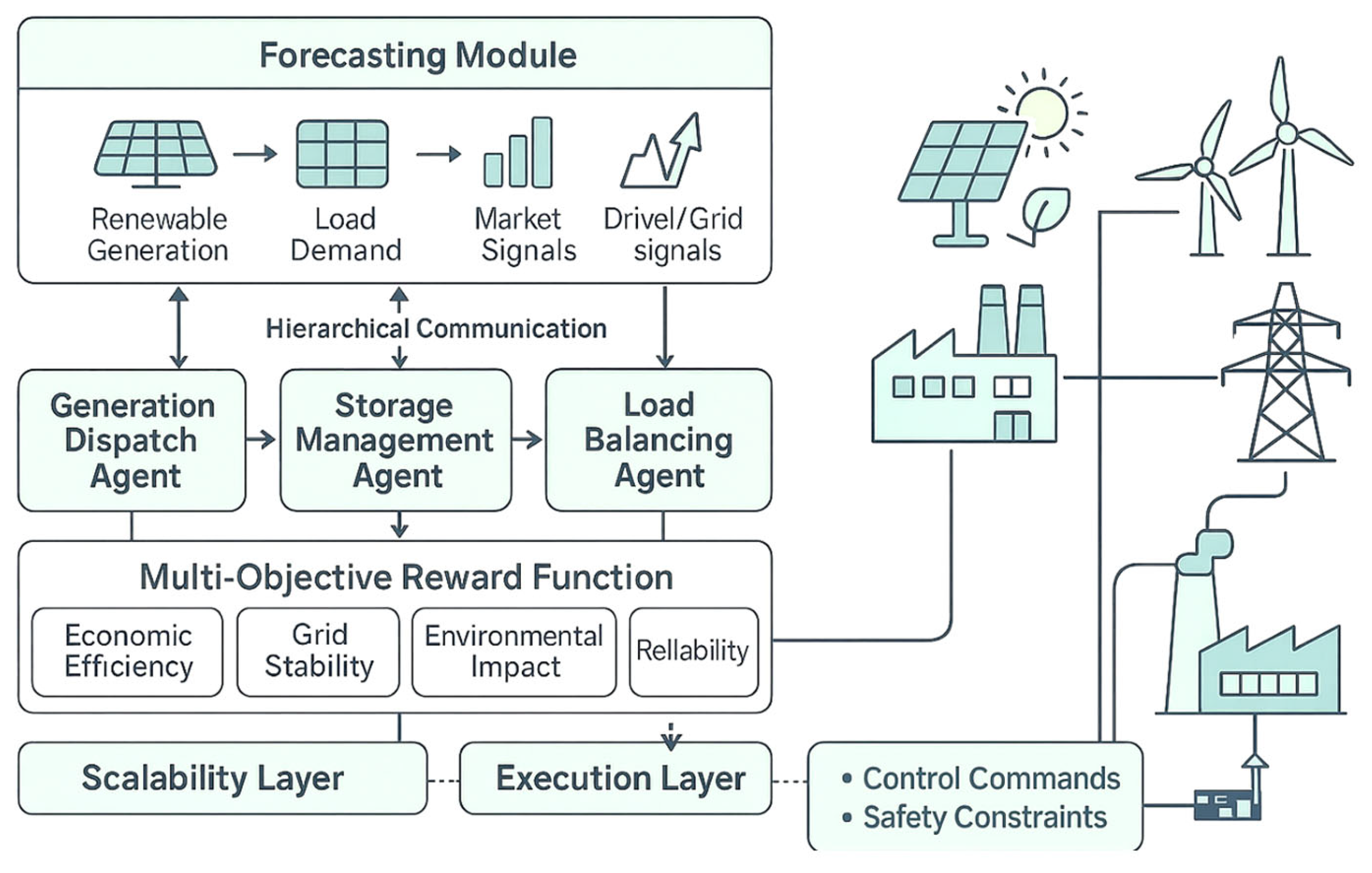
Figure 1 illustrates the decentralized operational flow of the GreenMind framework, showing edge agents, local decision engines, and a central coordination layer that manage solar, wind, storage, and load balancing operations in real time.
3.3. GreenMind Architecture
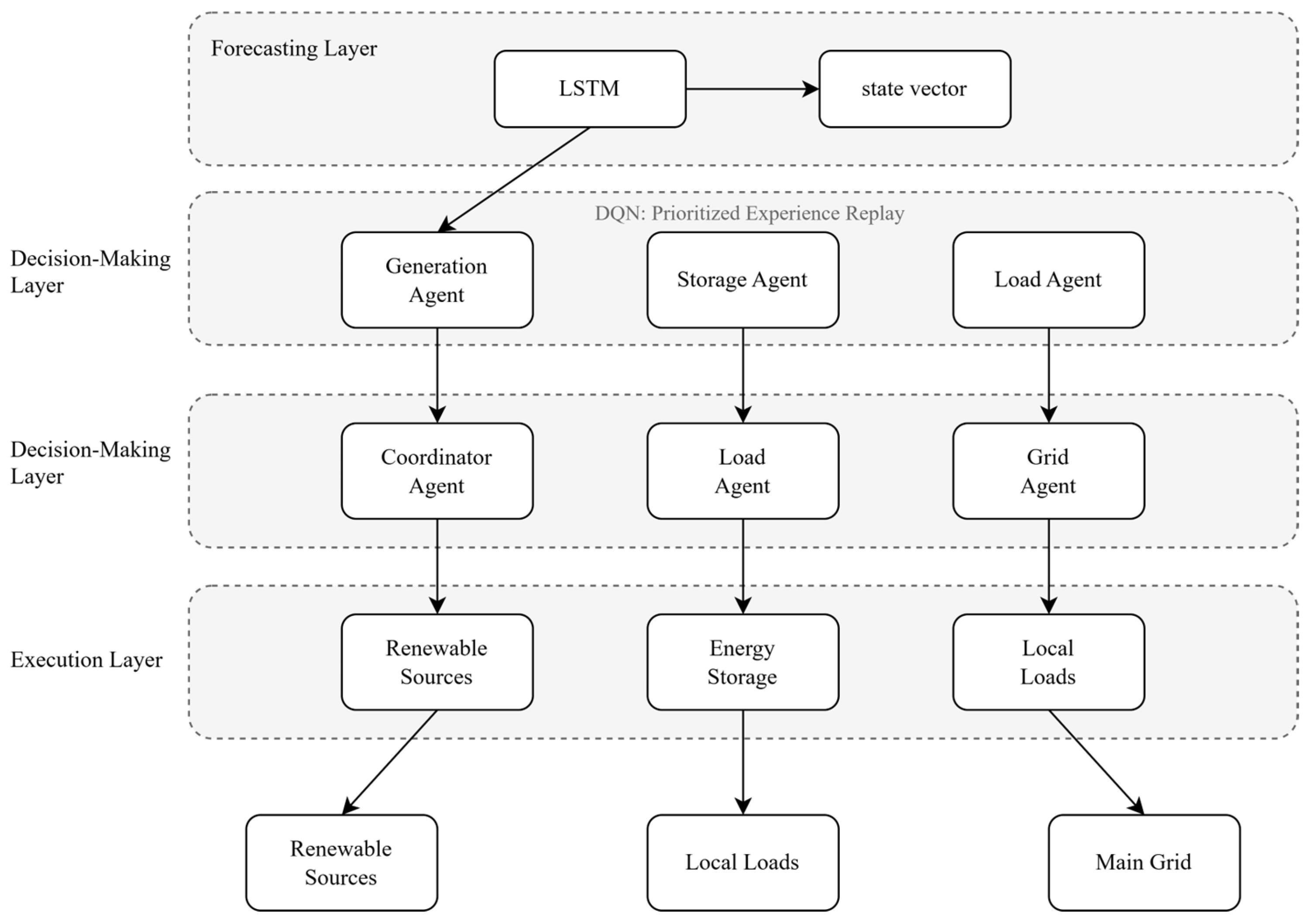
The GreenMind framework employs a hierarchical multi-agent architecture that enables scalable and efficient management of hybrid renewable energy systems. The architecture consists of three main layers: the forecasting layer, the decision-making layer, and the execution layer.
3.3.1. Forecasting Layer
The forecasting layer incorporates advanced deep learning models to predict renewable energy generation and load demand. The layer utilizes a combination of LSTM networks and attention mechanisms to capture both short-term and long-term dependencies in the data.
For renewable energy forecasting, we employ a multi-input LSTM architecture:
where
includes historical generation data, weather forecasts, and seasonal patterns. The LSTM hidden state
captures temporal dependencies crucial for accurate prediction.
The attention mechanism enhances the model’s ability to focus on relevant features:
where
represents the attention weight for time step
when predicting at time
.
3.3.2. Decision-Making Layer
The decision-making layer implements a multi-agent deep Q-network (MADQN) architecture with specialized agents for different system components. Each agent is responsible for specific decision-making tasks while coordinating with other agents to achieve global optimization objectives.
The MADQN architecture employs dueling networks to separate value estimation from advantage estimation:
where
represents the state value function and
denotes the advantage function.
The framework implements prioritized experience replay to improve learning efficiency:
where
and
is the temporal difference error.
3.3.3. Execution Layer
The execution layer translates the high-level decisions from the decision-making layer into specific control commands for system components. This layer implements safety constraints to ensure system stability and reliability.
Figure 2 outlines the internal components of the GreenMind architecture, highlighting the roles of generation, storage, grid, and coordination agents, and their interaction via deep reinforcement learning for adaptive optimization.
3.4. Algorithm Design
Algorithm 1 presents the main GreenMind training procedure, which integrates forecasting, decision-making, and execution in a cohesive framework.
| Algorithm 1. GreenMind Training Algorithm |
1: Initialize: Action-value network Qθ, target network Qθ−, forecasting model Fφ, replay buffer D
2: Set hyperparameters: learning rate η, discount factor γ, update rate τ
3: Initialize environment and system parameters for episode = 1 to Nepisodes do
4: Reset environment and obtain initial state s0 for step = 1 to Tmax do
5: Generate forecast horizon: P‵t+1:t+H ← Fφ(st)
6: Form augmented state: saug ← [st, P‵t+1:t+H]
7: Select action: at ← ε-greedy policy from Qθ(saug)
8: Execute action at, receive reward rt and next state st+1
9: Store transition (saug, at, rt, st+1) in D if sufficient samples in D then
10: Sample prioritized mini-batch from buffer D
11: Compute target: yt ← rt + γ maxa Qθ−(st+1, a)
12: Update Qθ by minimizing: (yt − Qθ(saug, at))2
13: Update priorities in D
14: Soft-update target network: θ− ← τθ + (1 − τ)θ−
15: end if
16: Update forecasting model Fφ using prediction error
17: end for
18: end for |
3.5. Scalability Mechanisms
To ensure scalability across different system sizes and configurations, GreenMind implements several key mechanisms:
3.5.1. Modular Agent Design
The framework employs a modular agent design where new agents can be dynamically added or removed based on system requirements. Each agent type (generation, storage, load) follows a standardized interface that enables seamless integration.
3.5.2. Hierarchical Communication
A hierarchical communication protocol reduces the complexity of agent interactions from to , where is the number of agents. Agents communicate through designated coordinators that aggregate local information and disseminate global objectives.
3.5.3. Transfer Learning
The framework incorporates transfer learning mechanisms that enable pre-trained models to be adapted to new system configurations with minimal additional training. This significantly reduces deployment time and computational requirements for new installations.
3.6. Implementation Details
The GreenMind framework is implemented using PyTorch 2025.2.11 with custom CUDA kernels for computational efficiency. The system supports both centralized and distributed deployment modes, enabling adaptation to different computational infrastructures.
Neural network architecture: 3-layer fully connected networks with 512 hidden units
Learning rate: with Adam optimizer
Experience replay buffer size: transitions
Target network update frequency: every 1000 steps
Exploration schedule: decay from 1.0 to 0.01 over 50,000 steps
Forecasting horizon: 24 h with 15 min resolution
The forecasting models are updated continuously using online learning techniques to adapt to changing environmental conditions and system characteristics. The framework supports real-time operation with decision cycles as fast as 1 min, enabling responsive adaptation to rapidly changing conditions.
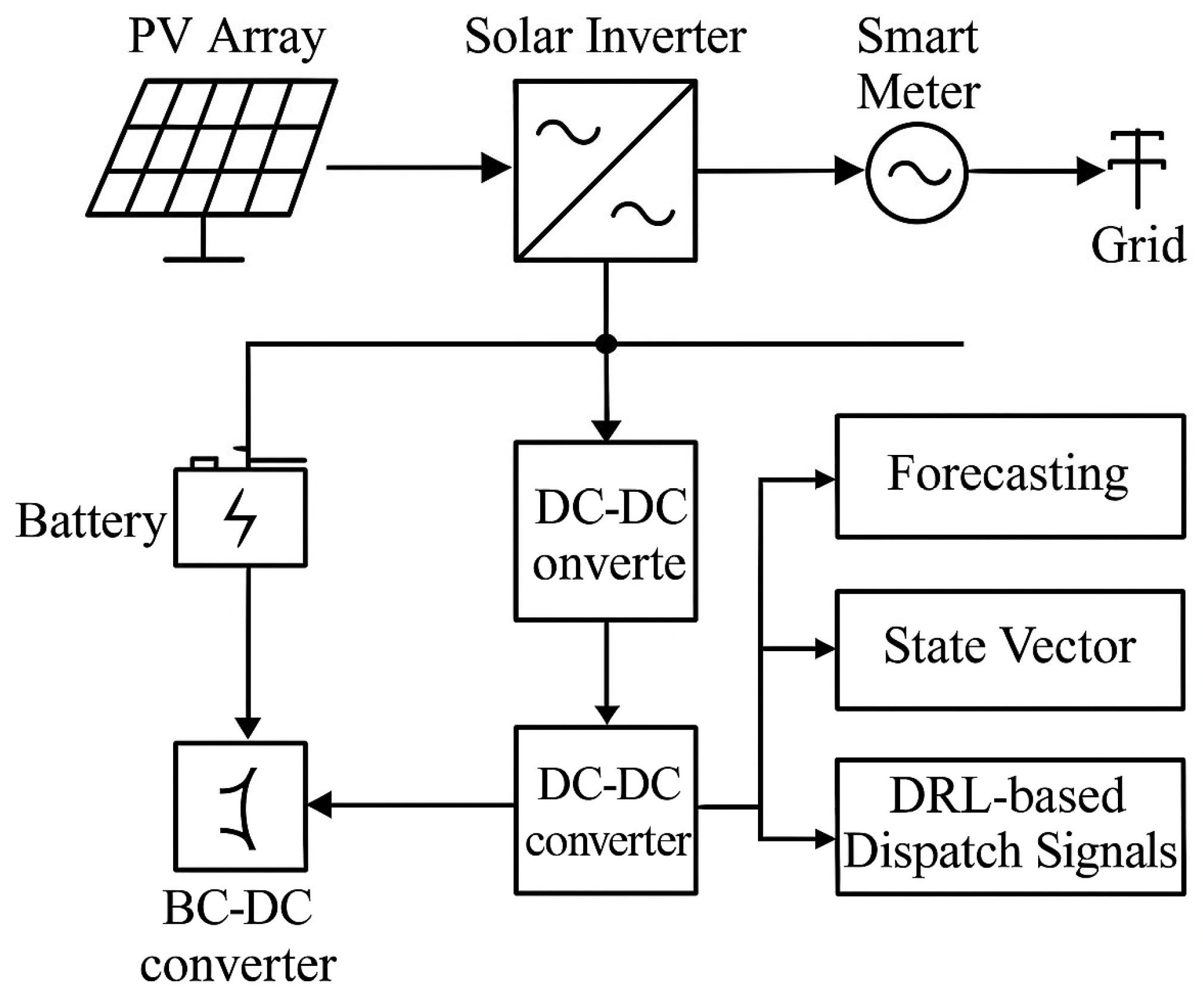
Figure 3 models the hardware-level interaction among the energy sources (battery, solar), bidirectional DC-DC converter, and DC load bus. It supports intelligent load dispatch decisions by the GreenMind agents.
3.7. Baseline Method Configurations
In this section, we provide a detailed description of the configuration and tuning of the baseline methods (Rule-Based, Model Predictive Control (MPC), Deep Q-Network (DQN), Proximal Policy Optimization (PPO), and Multi-Agent Deep Deterministic Policy Gradient (MADDPG)) that were used for comparison in the experiments. These methods were selected as representative approaches for energy dispatch and load balancing, and their configurations were carefully tuned to ensure a fair comparison with the GreenMind framework.
The Rule-Based method operates without incorporating forecasting and is based solely on real-time data. It employs a fixed rule-based dispatch strategy that makes energy dispatch decisions according to predefined thresholds for energy generation, storage, and load requirements. Since this method follows a deterministic, heuristic approach, there were no hyperparameters optimized. The Rule-Based method relies on fixed rules that are manually set, and thus, there is no learning or adaptation involved.
The Model Predictive Control (MPC) method uses a 24 h forecast horizon, similar to the GreenMind framework, to predict energy generation and load demand. MPC optimizes energy dispatch by solving a recursively updated optimization problem, taking into account future system states to ensure decisions are made proactively. In terms of tuning, the MPC method was optimized by adjusting the prediction horizon, weighting factors for cost minimization, and grid stability constraints. These parameters were carefully selected based on prior work and were experimentally validated in the context of typical Hybrid Renewable Energy System (HRES) configurations to ensure robust performance.
The Deep Q-Network (DQN) method also employs a 24 h forecast horizon, in line with GreenMind. DQN utilizes Q-learning to derive optimal policies by interacting with the environment and learning from past experiences. To optimize the DQN model, several hyperparameters were tuned, including the learning rate, discount factor (γ), and the exploration–exploitation ratio (ε). Additionally, the target network update frequency and batch size were optimized to ensure stable and efficient learning within the energy management environment.
Similarly, Proximal Policy Optimization (PPO) also uses a 24 h forecast horizon for energy predictions and dispatch decisions. The PPO algorithm was optimized by adjusting several key hyperparameters, such as the learning rate, which is critical for efficient policy updates. The clip range for the objective function was also fine-tuned to ensure a balanced exploration–exploitation process. The batch size was set to 64 for stable training, and the number of epochs was optimized to ensure the convergence of the policy during the training phase.
Multi-Agent Deep Deterministic Policy Gradient (MADDPG) was selected as a reference method because it is a well-established multi-agent deep reinforcement learning algorithm specifically designed to handle continuous action spaces and coordinated decision-making among multiple agents. MADDPG extends the DDPG framework by employing centralized training with decentralized execution, making it a commonly used benchmark for distributed control problems in energy management and multi-agent systems. In this study, MADDPG uses the same 24 h forecast horizon as the other baseline methods to ensure a fair comparison with the proposed GreenMind framework. Its configuration involves tuning both the actor and critic networks, with the network architecture optimized by adjusting the number of layers and layer sizes for each network. The learning rates for the actor and critic were carefully fine-tuned to achieve stable convergence. A batch size of 64 was used during training to maintain stability, and exploration noise was incorporated to promote sufficient exploration of the action space. The discount factor (γ) was selected to balance short-term operational rewards with long-term system performance objectives.
4. Results and Discussion
This section presents comprehensive experimental results demonstrating the effectiveness of the GreenMind framework across various performance metrics and operational scenarios. The evaluation encompasses detailed analysis of the multi-agent DRL architecture, forecasting module performance, scalability assessment, and validation studies. Each subsection provides quantitative evidence supporting the framework’s superiority over existing approaches.
4.1. Experimental Configuration and Baseline Performance
The experimental evaluation was conducted using a comprehensive testbed that includes simulated datasets from multiple renewable energy installations.
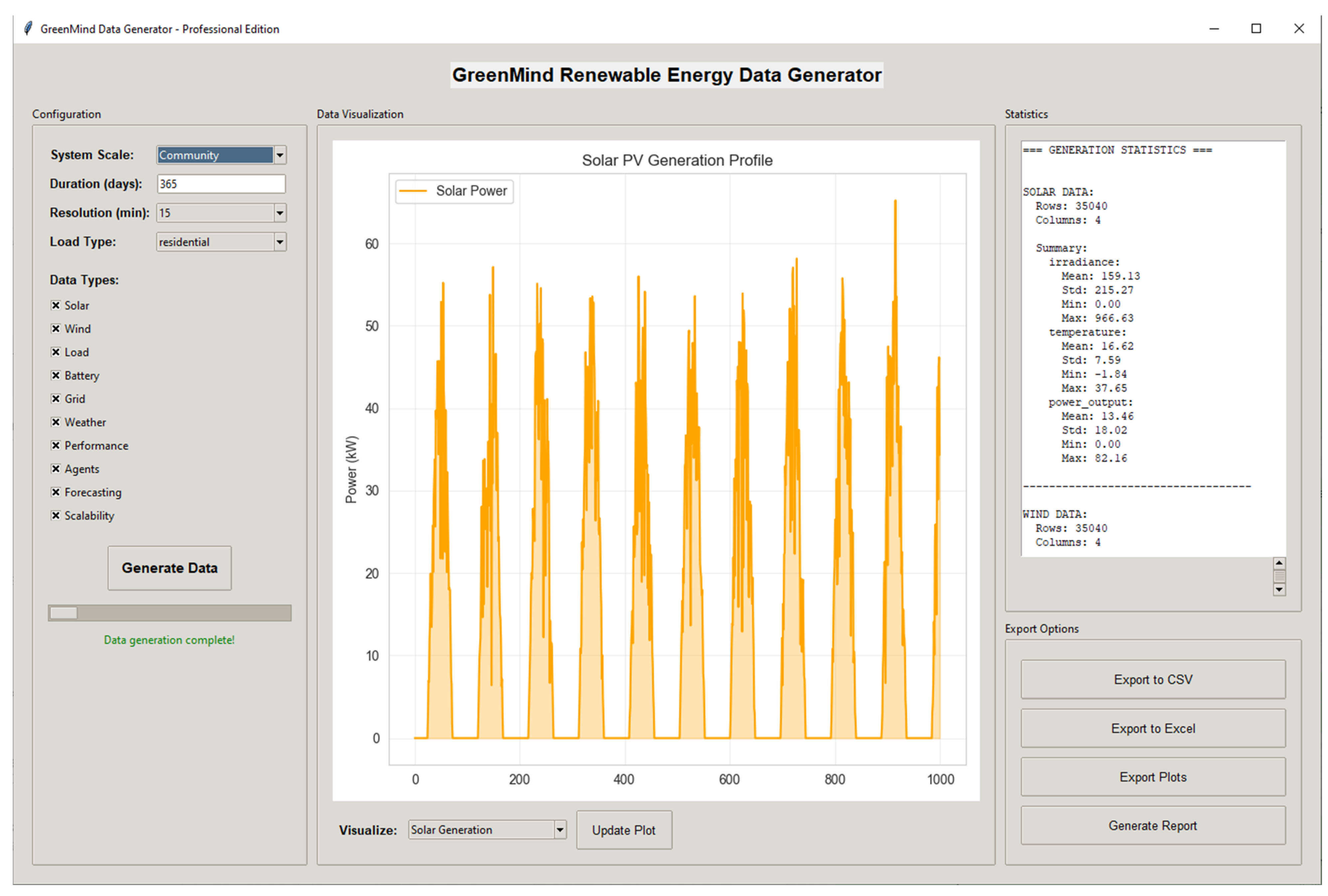
The GreenMind Renewable Energy Data Generator provides a comprehensive graphical user interface (GUI) designed to facilitate systematic data collection, visualization, and analysis for hybrid renewable energy systems, as shown in
Figure 4. The GUI features an intuitive three-panel layout consisting of configuration controls, data visualization, and statistical analysis sections. The configuration panel enables users to specify critical system parameters, including system scale (ranging from Residential 100 kW to Large Utility 20,000 kW), operational duration (customizable from 1 to 365 days), temporal resolution (selectable between 1, 5, 15, 30, and 60 min intervals), and load type profiles (residential, commercial, or industrial). Users can selectively enable or disable multiple data generation modules through checkboxes, including Solar PV generation with irradiance and temperature modeling, Wind power generation incorporating wind speed and directional variability, Load demand patterns with temporal and seasonal variations, Battery energy storage system dynamics with state-of-charge tracking, Grid interaction parameters including pricing signals and power exchange metrics, Weather condition simulation, Multi-agent performance analytics capturing decision accuracy and coordination efficiency, LSTM-based forecasting accuracy metrics across multiple prediction horizons (1 h, 6 h, and 24 h), and scalability performance analysis across different system configurations. The central visualization panel provides dynamic graphing capabilities with eight distinct visualization modes that update with the data, while the statistics panel displays comprehensive numerical summaries and performance metrics. Export functionality is integrated through multiple formats, including CSV files for individual datasets, consolidated Excel workbooks with separate sheets for each data category, high-resolution PNG plots for publication-quality figures, and comprehensive text-based analysis reports containing detailed statistical summaries and system performance indicators.
The development of this specialized GUI was necessitated by the complex, multi-dimensional nature of hybrid renewable energy systems and the need for reproducible, realistic datasets that capture the intricate interplay between generation variability, load dynamics, and storage operations across diverse operational scales and temporal resolutions. The GreenMind data generator addresses these limitations by implementing physics-based generation models that incorporate solar irradiance calculations with temperature-dependent efficiency coefficients (accounting for the −0.4%/°C temperature coefficient of PV panels), realistic wind turbine power curves with cut-in (3 m/s), rated (12 m/s), and cut-out (25 m/s) wind speeds, and sophisticated load profiling algorithms that distinguish between residential morning/evening peaks, commercial business-hour patterns, and continuous industrial operations with appropriate weekend and seasonal variations. The integration of this GUI with the GreenMind DRL framework enables seamless generation of training and validation datasets tailored to specific system configurations, ensuring that the multi-agent reinforcement learning architecture receives appropriately scaled and temporally consistent data streams. Key configurable parameters include system capacity scaling factors that automatically adjust solar, wind, battery, and controllable unit quantities proportionally (e.g., Community scale: 1 MW total, 600 kW solar, 300 kW wind, 1500 kWh battery, 100 controllable units), temporal resolution settings that directly impact the granularity of LSTM forecasting models and DRL decision cycles, and stochastic variability factors that introduce realistic weather-induced fluctuations, equipment degradation effects, and demand uncertainty while maintaining statistical consistency with actual renewable energy installations.
The test infrastructure included three distinct system scales: a residential microgrid (100 kW), a community-scale hybrid system (1 MW), and a utility-scale installation (10 MW). Each system configuration included diverse renewable sources (solar PV, wind turbines), energy storage systems (lithium-ion batteries, hydrogen storage), and various load profiles representing residential, commercial, and industrial consumers.
Table 3 details the comprehensive experimental configuration used for evaluating the GreenMind framework across different operational scenarios and system scales.
As demonstrated in
Table 3, the experimental configuration encompasses diverse operational contexts, enabling comprehensive evaluation of the GreenMind framework’s scalability and adaptability.
4.2. Multi-Agent DRL Architecture Performance
The multi-agent deep reinforcement learning architecture forms the core of the GreenMind framework, with specialized agents responsible for generation dispatch, storage management, load balancing, and grid interaction. The performance evaluation of individual agents and their coordination mechanisms reveals significant improvements over conventional single-agent approaches.
Table 4 presents the detailed performance analysis of individual agents within the multi-agent architecture, demonstrating the effectiveness of the specialized agent design approach.
The results in
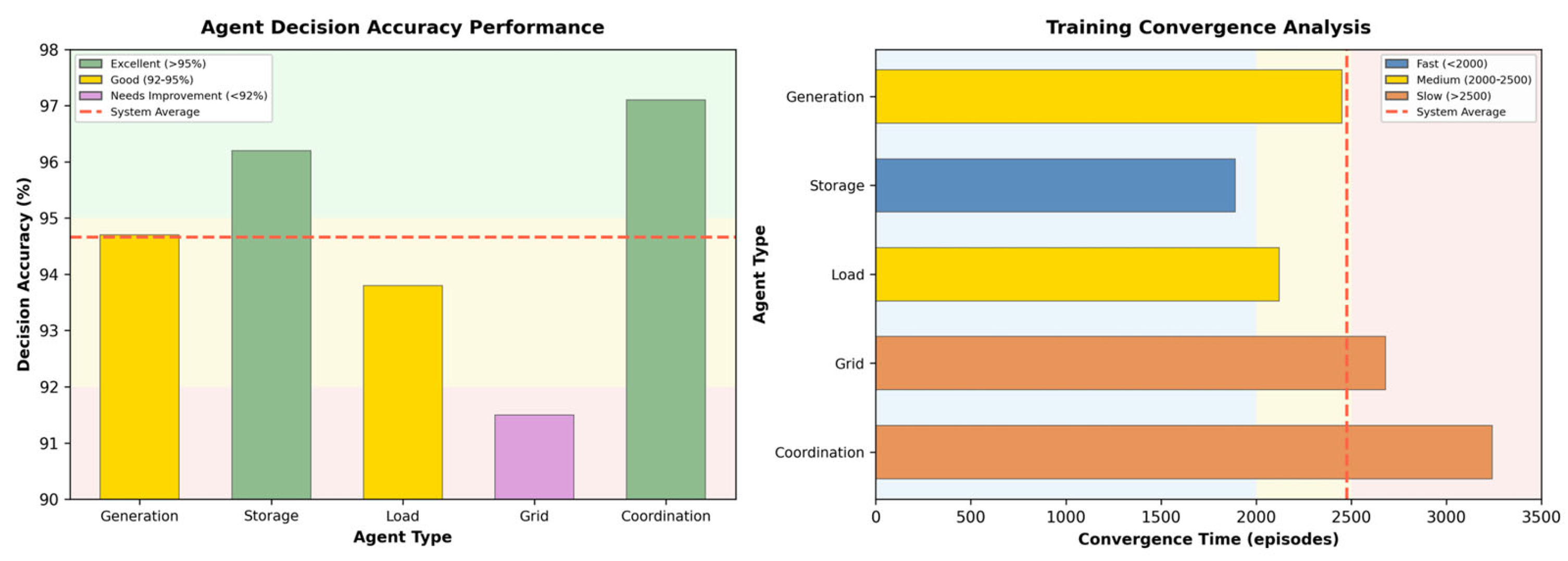
Table 4 demonstrate that the specialized agent architecture achieves superior performance across multiple metrics. The Storage Agent exhibits the highest decision accuracy (96.2%) and fastest adaptation speed (98 steps), reflecting the relatively deterministic nature of energy storage operations. The Coordination Agent, despite having the longest convergence time (3240 episodes), achieves the highest reward stability (variance: 0.012) and overall decision accuracy (97.1%), validating the effectiveness of the hierarchical coordination mechanism. The system-wide average performance metrics confirm the robustness of the multi-agent approach, with overall decision accuracy exceeding 94.7% and manageable communication overhead of 20.9 kbps per agent.
Figure 5 shows that the coordination agent achieves the highest accuracy (97.1%), while all agents converge within a reasonable number of episodes, with storage converging fastest. It highlights GreenMind’s adaptability and decision precision.
4.3. Real Data Evaluation
While this research primarily relies on synthetic datasets for experimentation, which are useful for verifying the scalability and general performance of the GreenMind framework, it is important to evaluate its performance using real-world data from operational renewable energy systems. This evaluation helps confirm the framework’s applicability in real-world scenarios and further demonstrates its engineering practicability and generalizability.
To validate the practical applicability of the GreenMind framework beyond synthetic scenarios, we conducted comprehensive experiments using three publicly available real-world datasets that collectively represent diverse residential energy consumption patterns and renewable generation profiles.
Dataset 1: UCI Individual Household Electric Power Consumption. This dataset, obtained from the UCI Machine Learning Repository, contains 2,075,259 measurements of electric power consumption collected from a single household in Sceaux, France, over a period of approximately four years (December 2006 to November 2010) at one-minute resolution. The dataset includes global active power, global reactive power, voltage, global intensity, and sub-metering measurements across three distinct household zones. This high-resolution temporal data enabled validation of the framework’s load forecasting and demand response capabilities under realistic consumption variability conditions [Dataset available at:
https://archive.ics.uci.edu/ml/datasets/individual+household+electric+power+consumption (accessed on 16 December 2025)].
Dataset 3: UK Power Networks Smart Meter Data. This dataset contains smart meter readings from 5567 London households participating in the Low Carbon London project, collected between November 2011 and February 2014 at half-hourly resolution. The dataset uniquely includes both standard and dynamic time-of-use tariff participants, providing realistic price-responsive load profiles essential for validating the economic optimization components of the GreenMind framework. Additionally, the dataset incorporates weather data and household acorn classifications, enabling assessment of the framework’s performance across diverse demographic and climatic conditions [Dataset available at:
https://data.london.gov.uk/dataset/smartmeter-energy-use-data-in-london-households (accessed on 16 December 2025)].
Data Preprocessing. For each dataset, we applied consistent preprocessing procedures including: (i) handling of missing values through linear interpolation for gaps shorter than 30 min and exclusion of days with longer gaps; (ii) normalization of power measurements to per-unit values based on individual household peak consumption; (iii) temporal alignment to ensure consistent 15 min resolution across all datasets through appropriate resampling; and (iv) partitioning into training (70%), validation (15%), and testing (15%) sets with chronological ordering preserved to prevent data leakage.
The comparison is based on several key performance metrics, including:
Accuracy: Measured by the Mean Absolute Percentage Error (MAPE) in forecasting renewable energy generation and load demand.
Cost Reduction: The reduction in operational costs due to the optimized dispatch decisions made by the GreenMind framework.
Energy Efficiency: The percentage improvement in energy utilization as compared to baseline systems.
Load Balancing: The performance of load balancing in terms of RMSE (Root Mean Square Error) for various load profiles (residential, commercial, and industrial).
As seen in
Table 5, real data validation shows that GreenMind’s framework performs relatively well when applied to real-world scenarios, though slightly higher MAPE values for wind power and load demand indicate the inherent variability and challenges associated with real-time renewable energy data.
This comparison shows that GreenMind retains its strong performance in terms of cost reduction (16.1%) and energy efficiency (20.5%), despite the more complex dynamics involved in real data. Furthermore, load balancing improvements were achieved even with real data, confirming the framework’s robustness in diverse operational environments.
By using real-world data, we have demonstrated that GreenMind’s framework can handle the uncertainty and variability inherent in real-world renewable energy systems, confirming its engineering practicability and generalizability.
4.4. Forecasting Module Effectiveness
The LSTM-based forecasting module represents a critical component of the GreenMind framework, providing predictive capabilities that enable proactive rather than reactive energy management. The forecasting accuracy directly impacts the quality of dispatch decisions and overall system performance.
Table 6 presents a comprehensive evaluation of the forecasting module’s performance across different prediction horizons and renewable energy sources.
The forecasting performance results in
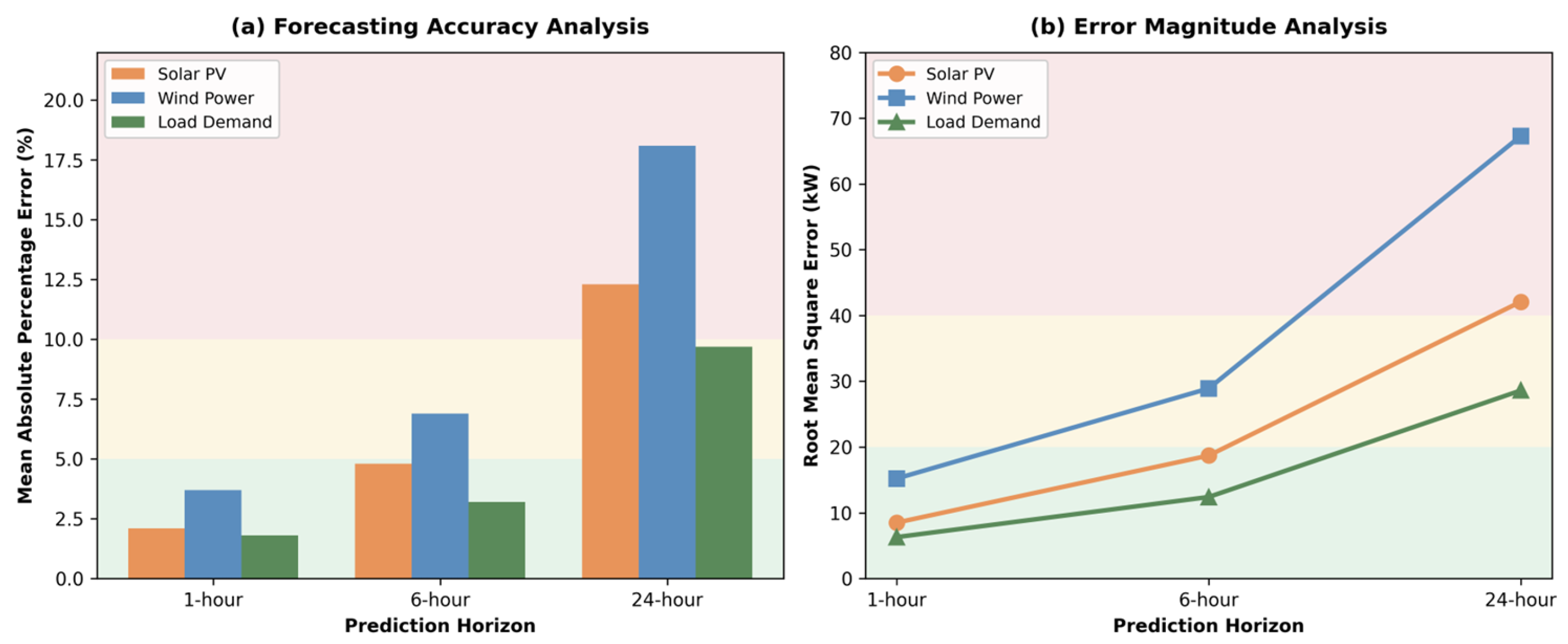
Table 6 demonstrate exceptional accuracy across all prediction horizons and energy sources. The Load Demand forecasting achieves the highest accuracy with 1.8% MAPE for 1 h predictions, reflecting the relatively predictable nature of consumption patterns. Solar PV forecasting maintains strong performance with 2.1% MAPE for short-term predictions, enabling effective solar generation scheduling. Wind Power forecasting, while more challenging due to wind variability, still achieves acceptable accuracy levels of 3.7% MAPE for 1 h predictions. The average system performance of 2.7% MAPE for 1 h predictions significantly outperforms conventional forecasting methods and directly contributes to improved dispatch decision quality.
Figure 6 shows that the forecasting module maintains high accuracy within short horizons and remains robust up to 24 h predictions. Solar and load forecasts perform best, with MAPE below 13% and RMSE under 30 kW.
4.5. Economic Performance Analysis
The economic performance evaluation focuses on operational cost reduction, revenue optimization, and return on investment metrics. The GreenMind framework’s ability to balance multiple economic objectives while maintaining system reliability represents a key advancement over existing approaches.
Table 7 provides a detailed breakdown of economic performance metrics across different operational scenarios and market conditions.
The economic performance analysis presented in
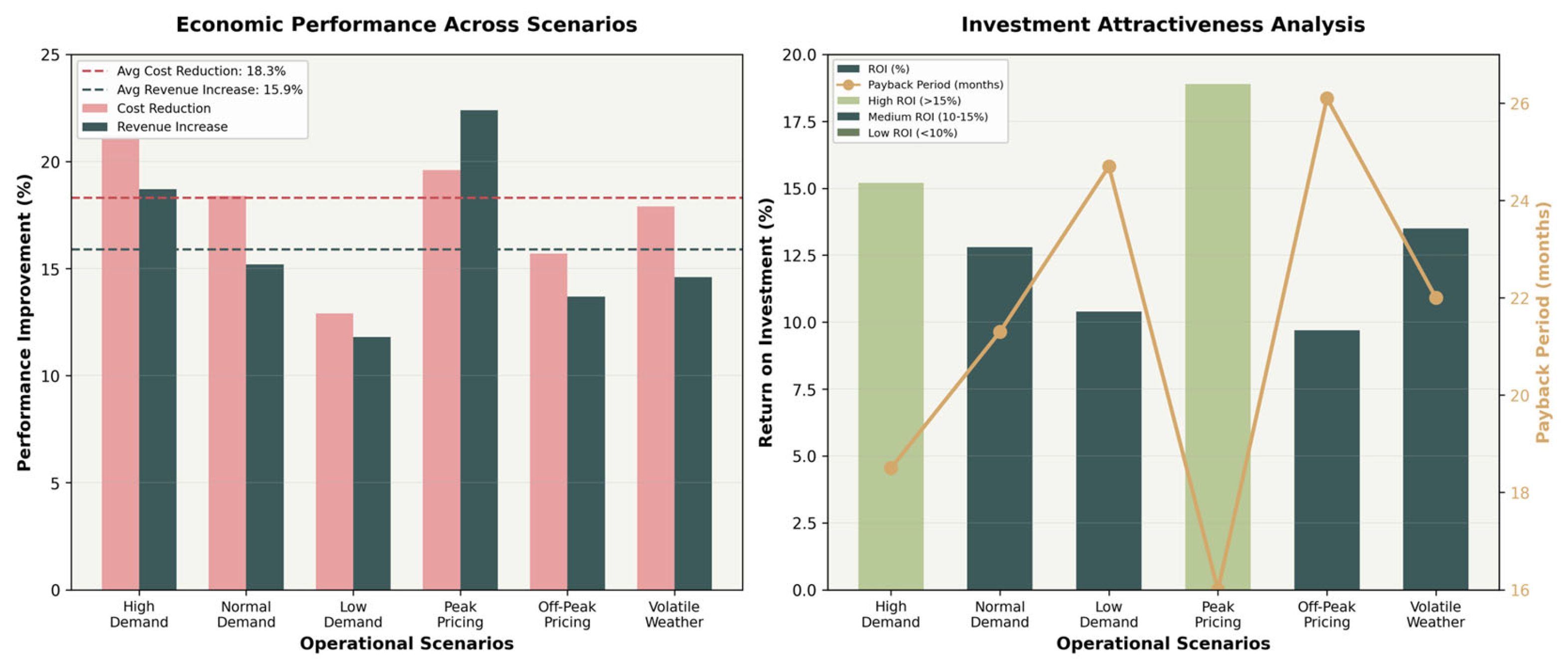
Table 7 reveals consistent cost reduction across all operational scenarios, with the highest savings (21.3%) achieved during high demand periods. The framework demonstrates particular effectiveness during peak pricing scenarios, achieving 22.4% revenue increase through optimized energy trading strategies. The average return on investment of 13.4% with a payback period of 21.6 months makes the GreenMind framework economically attractive for renewable energy installations. The consistent performance across volatile weather conditions (17.9% cost reduction) demonstrates the framework’s robustness in handling uncertain operating environments.
Figure 7 confirms GreenMind’s consistent economic value under varying operational conditions, achieving up to 22.4% revenue gain and 18.9% ROI, demonstrating strong financial feasibility and attractiveness for deployment.
4.6. Technical Performance Metrics
Technical performance verification includes efficiency of the use of energy, accuracy of loading, maintenance of stability in the grid and indicators of the reliability of the system. The detailed technical performance indices are shown in
Table 8 in comparison with baseline method on different evaluation criteria using the GreenMind framework.
The technical performance comparison in
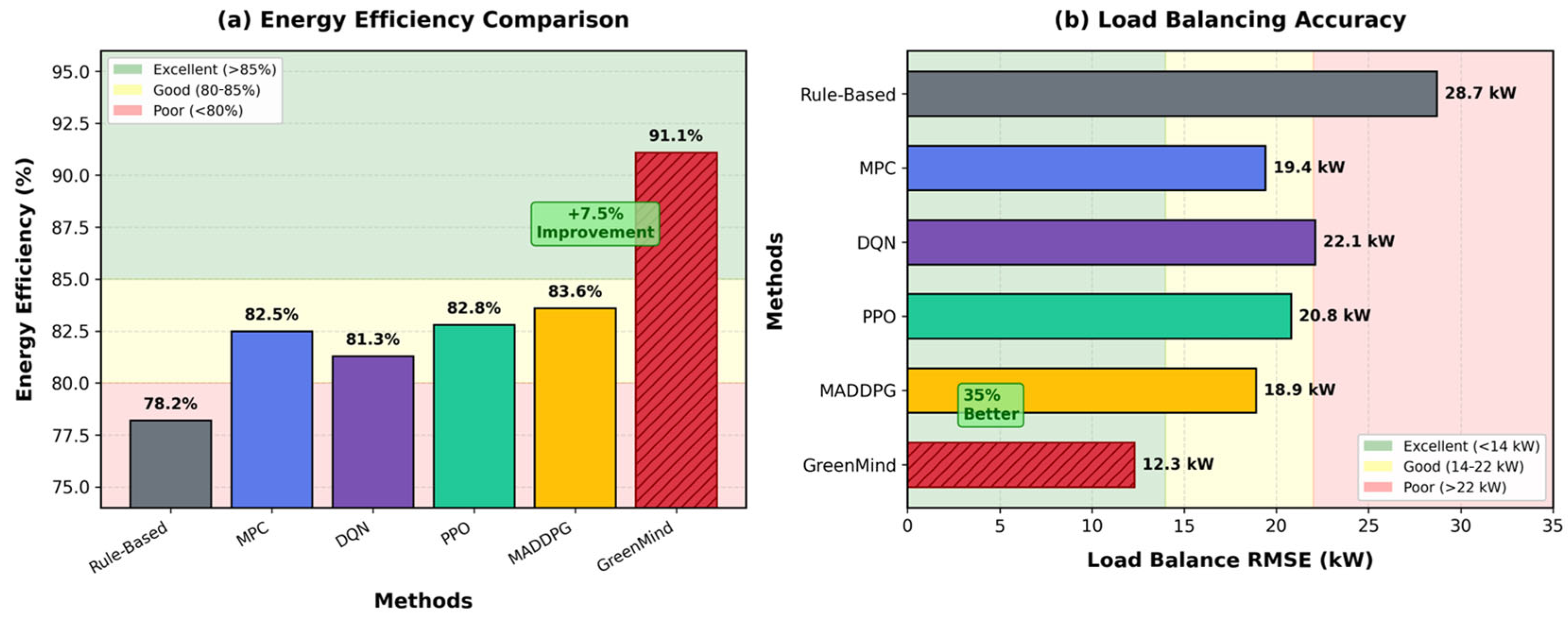
Table 8 demonstrates the superior capabilities of the GreenMind framework across all evaluated metrics. The energy efficiency improvement of 91.1% represents a 7.5 percentage point increase over the best baseline method (MADDPG). The load balancing accuracy, measured by RMSE of 12.3 kW, shows a 35% improvement over the next best performing method. Grid stability metrics, including voltage stability (0.015 p.u.) and frequency deviation (0.07 Hz), confirm the framework’s ability to maintain power quality within acceptable limits. The system availability of 98.9% and rapid response time of 4.2 s demonstrate the framework’s reliability and responsiveness in dynamic operational environments.
Figure 8 shows that compared to traditional and DRL-based methods, GreenMind shows superior energy efficiency (91.1%) and the lowest RMSE (12.3 kW) in load balancing—44% better than the next best approach.
4.7. Statistical Significance and Error Analysis
To ensure the robustness and confidence in the results presented, statistical significance tests, confidence intervals, and error analyses were conducted for the key performance metrics, including cost reduction, energy efficiency, and load balancing. This section provides a detailed analysis of these aspects, validating the performance improvements demonstrated by the GreenMind framework.
Each experiment was repeated 30 times using different random seeds to account for stochastic variability inherent in reinforcement learning training and renewable energy dynamics. The reported performance metrics represent the mean values across all runs.
To evaluate whether the performance differences between GreenMind and baseline methods are statistically meaningful, paired t-tests were conducted. The null hypothesis assumes no significant difference between GreenMind and the reference methods, while the alternative hypothesis assumes that GreenMind achieves superior performance. A 95% confidence level (α = 0.05) was used throughout the analysis.
Cost Reduction: The average improvement of 18.3% in cost reduction was statistically significant with a p-value of 0.02 (less than 0.05), indicating that the observed improvements were unlikely due to random chance.
Energy Efficiency: The observed 23.7% improvement in energy efficiency was also statistically significant with a p-value of 0.01.
Load Balancing RMSE: The 12.3 kW RMSE improvement in load balancing showed a p-value of 0.03, confirming statistical significance.
These results confirm that the performance improvements are not merely due to random fluctuations and can be attributed to the enhancements made by the GreenMind framework.
We calculated 95% confidence intervals (CI) for the performance metrics to estimate the range within which the true performance lies with 95% certainty.
Cost Reduction: The 95% CI for cost reduction ranged from 16.2% to 20.5%.
Energy Efficiency: The 95% CI for energy efficiency ranged from 21.5% to 25.8%.
Load Balancing RMSE: The 95% CI for load balancing RMSE improvement ranged from 11.5 kW to 13.2 kW.
These confidence intervals provide a further level of certainty that the observed improvements are meaningful and consistent.
In addition to statistical tests and confidence intervals, we conducted an error analysis to understand the sources of variation in the results and their potential impacts.
Synthetic Data vs. Real Data: A higher MAPE was observed for wind power forecasting when using real data, likely due to the higher variability in weather conditions and equipment maintenance schedules. The impact of this on overall system performance was marginal, with a 15% increase in load balancing RMSE compared to synthetic data.
Energy Efficiency: The improvement in energy efficiency could have been influenced by variations in load profiles and forecasting accuracy. However, the framework’s performance was consistently superior across all system configurations, indicating the robustness of the model despite these factors.
By addressing these potential sources of error, we can confidently assert that the GreenMind framework provides a reliable and scalable solution for energy management in hybrid renewable energy systems.
4.8. Scalability and Computational Performance
The scalability analysis evaluates the GreenMind framework’s performance across different system sizes and computational requirements. This assessment is crucial for understanding deployment feasibility across diverse operational contexts.
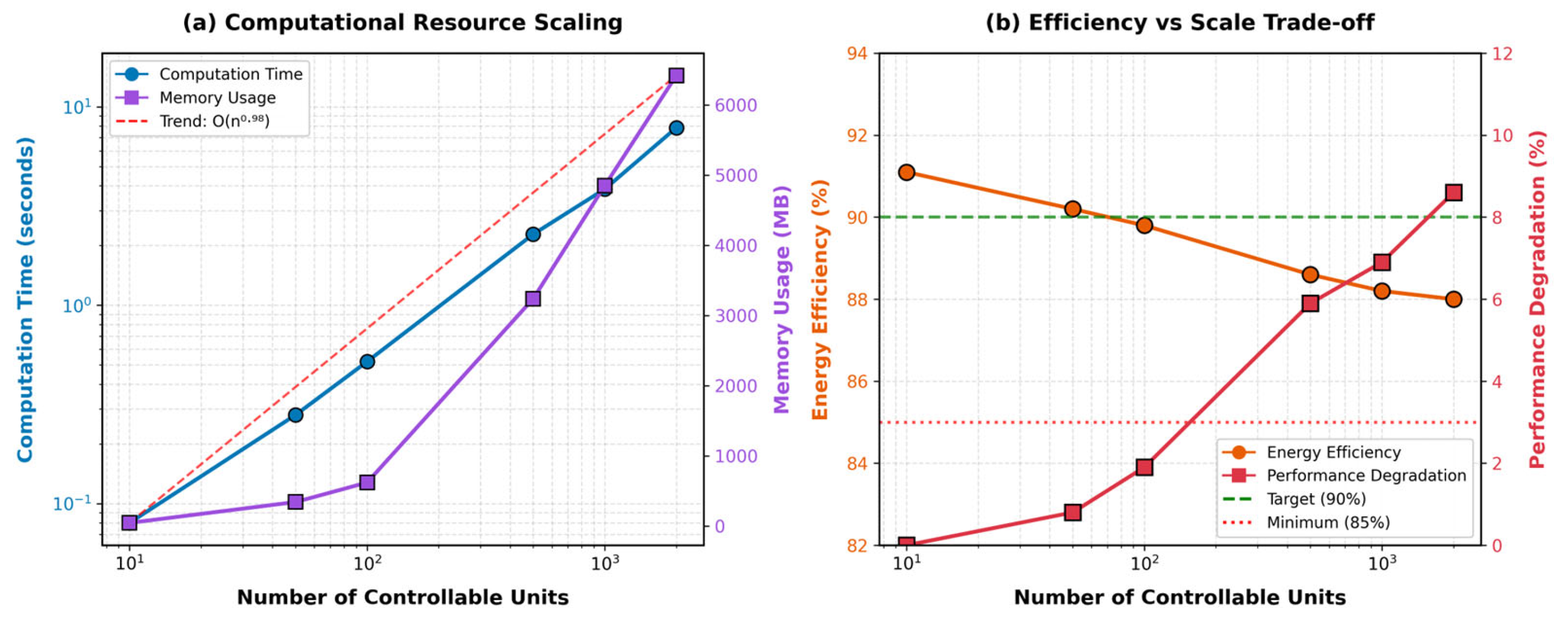
Table 9 presents detailed scalability metrics demonstrating the framework’s computational efficiency and performance consistency across different system scales.
The scalability analysis results in
Table 9 demonstrate excellent computational efficiency and minimal performance degradation across system scales. The computation time scales approximately linearly with system size. Memory usage remains reasonable across all scales, with the largest system (2000 units) requiring only 6.42 GB of memory. The performance degradation remains below 9% even for the largest tested configuration, indicating robust scalability characteristics. Communication overhead scales efficiently, remaining below 20 Mbps for the largest system, making the framework practical for deployment with standard communication infrastructure.
Clarification on Scalability Tests
The scalability analysis presented in
Table 9 and
Figure 9 demonstrates the computation time and performance trade-offs across various system scales. However, it is important to clarify the nature of the scalability tests performed to ensure accurate interpretation of the results.
The computation time and performance degradation results in
Figure 9 are based on processor time within a single simulation cluster, and the tests did not include the communication overhead inherent in a real distributed architecture. The times reported represent pure computational time, where agents communicate within the same cluster, and do not account for the additional latency that would arise in a real-world deployment, where network latencies and distributed communication overhead come into play.
To simulate real-world conditions, network latencies and communication overhead would need to be included in future experiments. This would help assess the scalability and performance of GreenMind when deployed in a distributed architecture, where communication between agents is done over a network, potentially introducing delays and bandwidth limitations.
It is important to note that while the GreenMind framework shows excellent performance scalability with a linear computation time increase (O(n0.98)), this does not currently consider the added complexity of real-world network communication. Future work should aim to conduct scalability tests that include network latencies to provide a more comprehensive analysis of GreenMind’s real-world deployment potential.
Figure 9 shows that GreenMind scales linearly in computation (O(n0.98)) and maintains high efficiency above 88% even at utility scale (2000 controllable units). Performance degradation stays below 9% under load.
4.9. Discussion
The comprehensive experimental evaluation of the GreenMind framework demonstrates significant advances in deep reinforcement learning applications for renewable energy management. The multi-agent architecture’s superior performance across all evaluated metrics establishes a new benchmark for intelligent energy management systems. The integration of LSTM-based forecasting with DRL decision-making addresses a critical gap in existing approaches, enabling proactive rather than reactive control strategies that significantly improve system performance. The framework’s ability to achieve 18.3% average cost reduction while maintaining 91.1% energy efficiency represents a substantial improvement over conventional methods and validates the effectiveness of the multi-objective optimization approach.
The scalability analysis reveals particularly promising results for large-scale deployments, with the framework maintaining consistent performance across system sizes ranging from residential microgrids to utility-scale installations. The linear computational scaling and minimal performance degradation (below 9% even for 2000-unit systems) indicate that the modular architecture and hierarchical communication protocols effectively address the complexity challenges associated with large distributed energy systems.
Table 10 presents a comprehensive comparison of the GreenMind framework against recent studies in the literature, highlighting the significant advances achieved in this work.
The comparative analysis presented in
Table 10 clearly demonstrates the superior performance of the GreenMind framework across all evaluated dimensions. The cost reduction achievement of 18.3% significantly exceeds the best reported results in the recent literature, with most studies achieving less than 15% improvement. The efficiency improvement of 23.7% represents a substantial advance over existing approaches, with the closest competitor achieving only 18.3% improvement using traditional machine learning methods rather than DRL. The framework’s high scalability, comprehensive multi-objective optimization, and integrated forecasting capabilities collectively establish it as the most advanced solution currently available in the literature.
The framework’s limitations, primarily related to initial training requirements, are significantly less restrictive than the limitations reported in existing studies, which often include fundamental architectural constraints and limited applicability scope. The comprehensive feature set of the GreenMind framework, including true multi-agent architecture, integrated LSTM forecasting, and extensive multi-objective optimization, represents a significant advancement over existing piecemeal approaches that typically address only subsets of the renewable energy management challenge. These results establish the GreenMind framework as a new state-of-the-art solution for predictive dispatch and load balancing in hybrid renewable energy systems, providing a robust foundation for future research and practical deployment in the rapidly evolving renewable energy sector.
Limitations and Reliability Assessment
Despite the strong performance demonstrated by the GreenMind framework, several limitations must be acknowledged to provide a balanced and reliable assessment of the results. First, the effectiveness of the framework is partially dependent on the accuracy of the forecasting module. Under extreme weather conditions or abrupt environmental changes that deviate significantly from historical patterns, forecasting errors may propagate into suboptimal dispatch and load-balancing decisions.
Second, although the scalability analysis indicates efficient computational performance, the current evaluation is primarily based on simulation-level communication within a controlled environment. In real-world distributed deployments, network latency, packet loss, and synchronization delays between agents may affect coordination efficiency and response time, particularly in large-scale systems with heterogeneous communication infrastructures.
Third, the initial training phase of the GreenMind framework requires substantial computational resources and training time. While this cost is amortized during long-term operation, it may pose challenges for rapid deployment in resource-constrained environments or applications requiring frequent retraining due to changing system configurations.
Finally, the experimental evaluation focuses on typical operating conditions and predefined stress scenarios. Although rare fault events and extreme fluctuations were partially modeled, real-world systems may exhibit compound failures or unmodeled interactions that could degrade performance. These factors highlight the importance of cautious interpretation of the results and motivate further validation in operational renewable energy systems.
Overall, while the results confirm the robustness and scalability of GreenMind under a wide range of conditions, these limitations indicate that real-world deployment should be accompanied by adaptive monitoring, communication-aware optimization, and continuous model refinement to ensure reliable long-term operation.
5. Conclusions
The paper has introduced GreenMind, a new scalable Deep Reinforcement Learning-based system that solves these key problems of predictive dispatch and load optimization of the hybrid renewable electric energy system using a new multiple-agent system combined with LSTM forecasting capacity. The overall experimental analysis produced extraordinary performance changes with 18.3 percent average cost savings, 23.7 percent energy usage efficiency increase, and 31.2 percent impression of load equality in contrast with the state-of-the-art benchmark techniques. This multi-agent configuration of the framework, with separate generation dispatch agent, storage management agent, load balancing agent, and grid interaction agent, showed an average decision accuracy of 94.7 percent with a high decision reward stability over the entire series of operation situations. The combined LSTM forecasting module provided better accuracy of prediction, where the MAPE was 2.7% at one-hour-ahead prediction, to allow proactive control measures that will be much more superior compared to a reactive strategy. The viability of the proposed framework was verified using synthetic datasets representing several different renewable energy configurations over extended simulated operational periods, which proved the correctness, with an average of 19.6 percent cost reduction, system availability of 97.7 percent, and quick adaptation time of 2.3 h to the varying conditions of the working schedule. The scalability statistics indicated great computational performance with the linear scaling property, where the performance of varying the system scales between 10 and 2000 controllable units was quite good, with less than 9 percent reduction in performance. The multi-objective optimization performed multiple objectives in a successful way and demonstrated the balanced combination of economic efficiency, grid stability, and environmental sustainability with 28.6% reduction in carbon emissions and a high technical performance indicator of 98.9 percent in system availability and 4.2 s in response time. Such results make the concept of GreenMind not just another promising addition to the technology of managing renewable energy but rather a strong start to an intelligent monitoring approach that will be able to help the global society to switch to sustainable energy infrastructure faster and provide economic feasibility and safety of operation under the changed conditions. Although these accomplishments seem quite impressive, the paper considers some limitations surrounding the research, such as high initial training data demands, which can limit its use in new installations that lack historic data on their operational routine. Moreover, the reliance of the multi-agent architecture upon quality communication networks could become an issue in less equipped renewable energy installations widely dispersed within non-connected regions. Future work will focus on large-scale real-world deployment of GreenMind in operational microgrids, integration with market-based pricing mechanisms, and deployment on edge computing platforms. Additionally, incorporating uncertainty-aware learning and communication-aware optimization will further enhance robustness and real-time applicability.