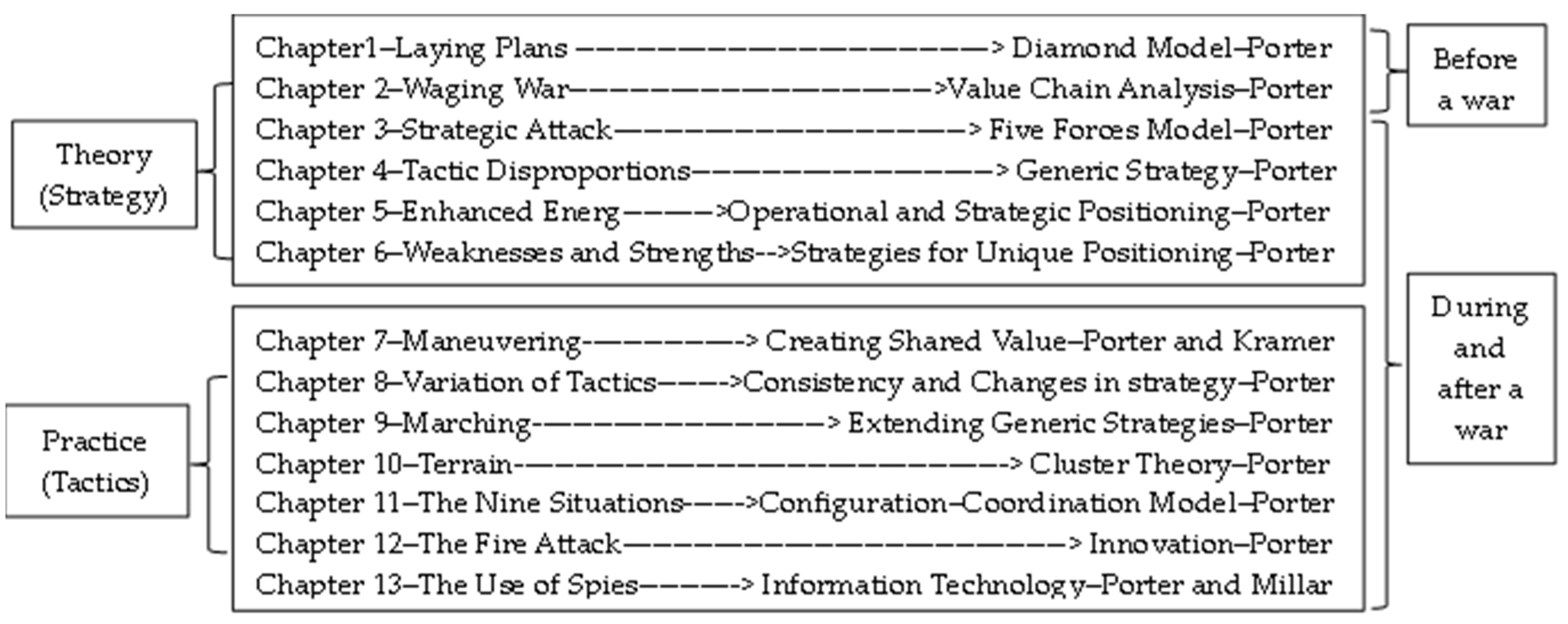
Strategy, Structure and Systems: Sun Tzu’s Thinking and the Holonic Network of the Toyota Dealer System (TDS)—A Romanian Case Study

 ,
,  , , ,
, , ,
Abstract
1. Introduction
2. Literature Review
- (a)
- Autonomy: Each holon has its own organization and functions relatively independently from other holons.
- (b)
- Self-preservation: The holon has characteristics that allow it to maintain its structure “as such”/as a model independent of the material of which it is composed.
- (c)
- Self-adaptation: The holon is part of a larger whole and must be able to adapt and connect with other higher-order holons, reacting mechanically, biologically, or intentionally to stimuli received from other higher-order holons.
- (d)
- Auto transcendence: The holon has its own new and emerging qualities that are not found in the holons it includes.
- (e)
- Self-dissolution: Holons can be divided along the same vertical lines.
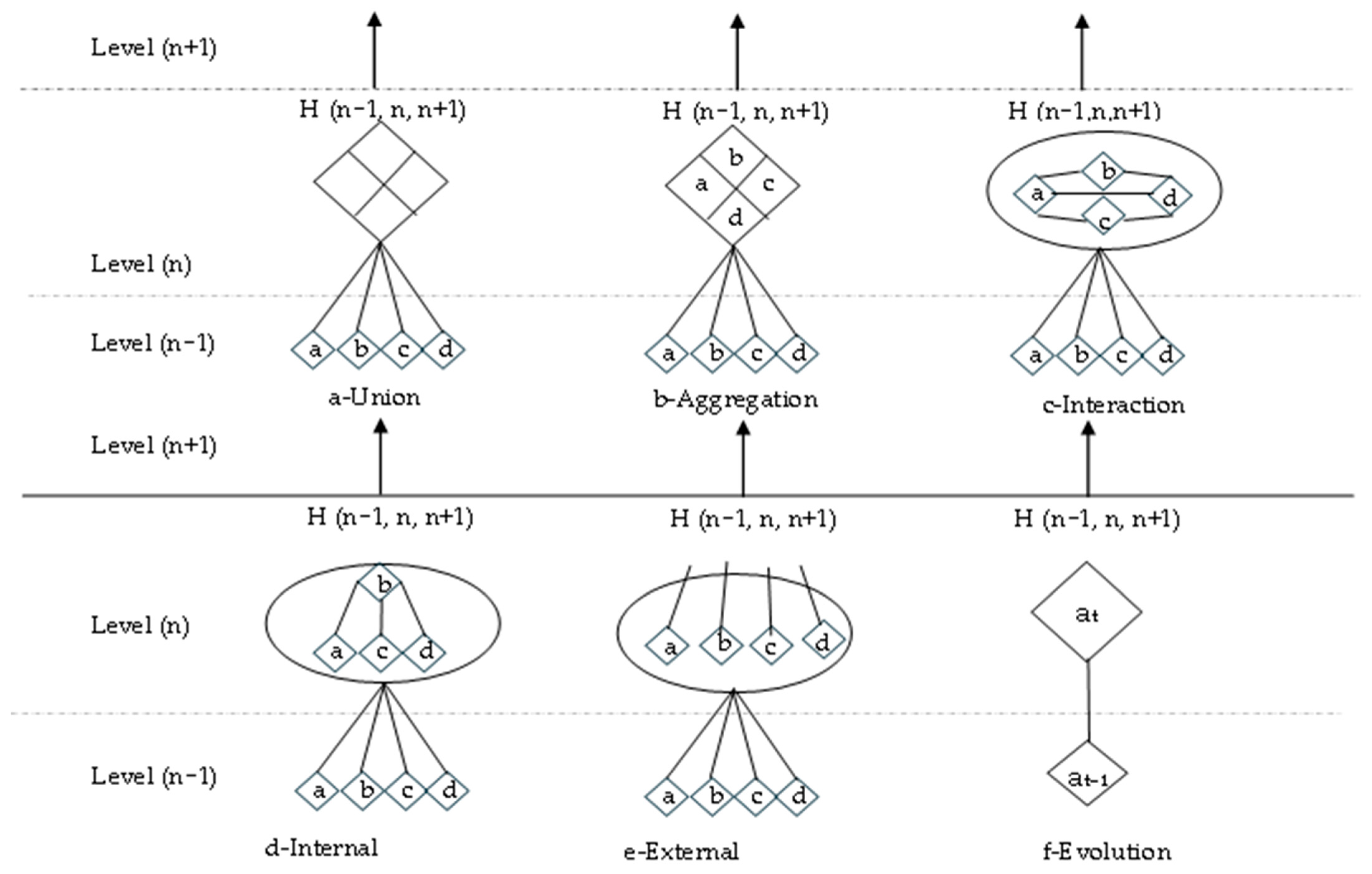
- Union: Holons of level (n − 1) merge with those of level n, where they are no longer distinguishable (Figure 1a);
- Aggregation: Subordinate holons join together, thereby losing their individuality; they can still be monitored by the superordinate holon (Figure 1b);
- Interaction: Subordinate holons interact, but remain disaggregated and monitored/coordinated separately by the superordinate holon (Figure 1c);
- Internal coordination: Subordinate holons are coordinated by the superordinate holon; one of the holons serves as coordinator (Figure 1d);
- External coordination: Subordinate holons are coordinated on the basis of a stable model, through a superordinate holon (Figure 1e);
- Evolution: The temporal reference of the holon of level (n) is the period (t); this holon results from the evolution of one or more holons from level (n − 1) with reference to period (t − 1); the levels correspond to successive time periods (Figure 1f).
3. Research Methodology
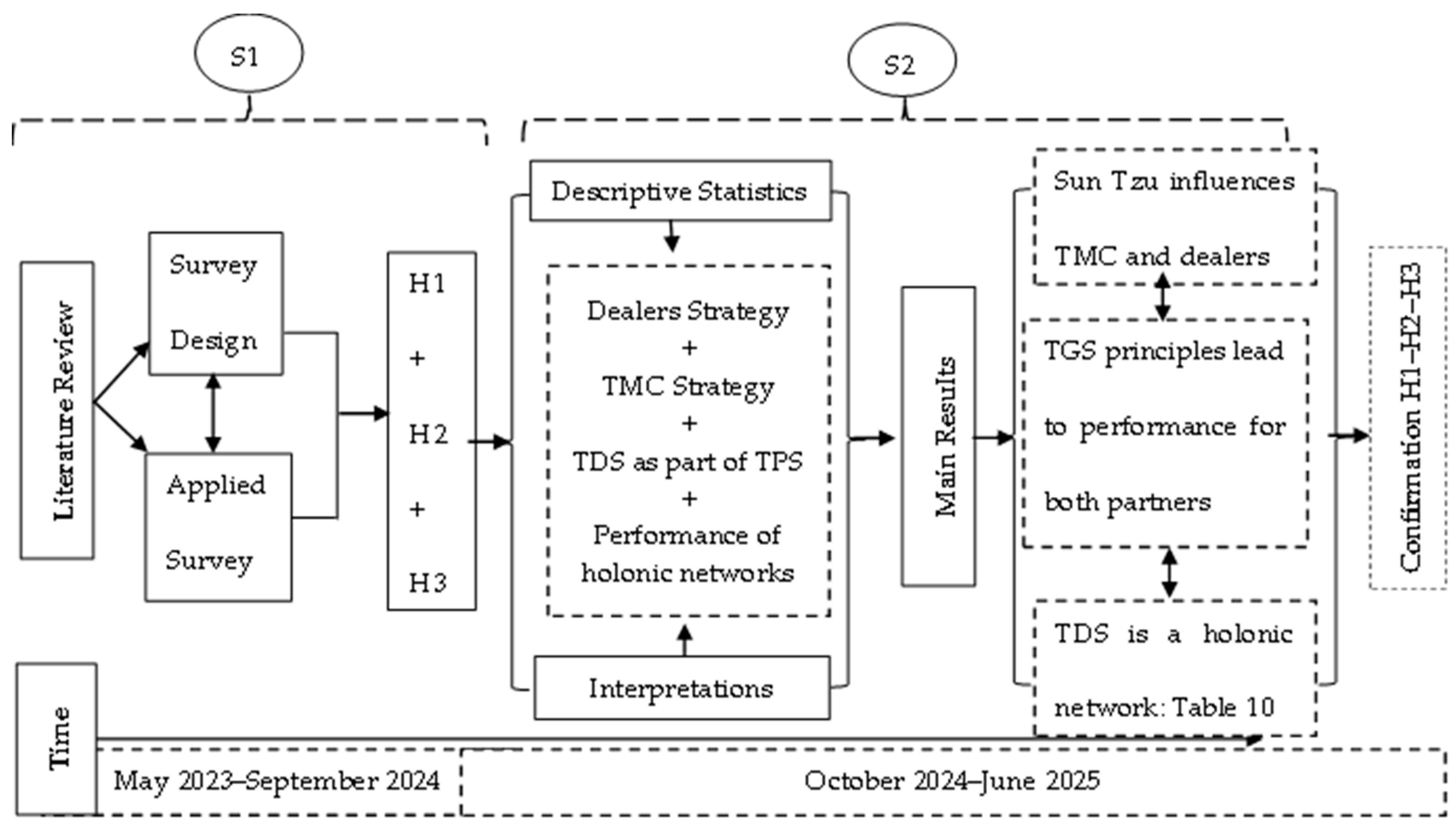
3.1. Research Stages and Flowchart
3.2. Research Design and Sampling
- (a)
- The firms selected must be in operation, i.e., have their accounts filed and operate in the year the research starts.
- (b)
- The selected companies must have at least 10 employees.
- (c)
- The sample of companies selected by us covers all development regions of Romania, and the distribution of questionnaires in Appendix B, Table A4, and the synthesis of interviews in Table A6, shows national representativeness. Almost all Toyota dealers in Romania were included in the sample, except for six companies that started operations relatively recently and whose managers did not have the necessary experience to answer the questionnaire items. In addition, only five companies that had been in business for approximately three years at the time of the study (September 2024) were removed from the sample in order to avoid distortions in the statistical processing of the results (as of August 2025, there were 36 Toyota representatives in Romania, some of which were established after the end of the study).
3.3. Data Collection and Description
4. Main Results
4.1. Introductory Analysis
4.2. Rotated Component Matrix: Dimensions 1 and 2
- -
- Both dealers and the TMC are constantly adapt to the market trends and customers demands;
- -
- The existing vision at the TMC and dealer levels is partly based on Sun Tzu’s thinking;
- -
- Innovation within the TDS and the optimization of processes start from customers and the information provided periodically by each dealer;
- -
- In the context of periods of crisis, the TMC also financially supports dealers within its network;
- -
- Innovations, digital technologies, and employees are at the heart of the optimization of the entire TDS network;
- -
- ”De facto”, the entire TDS network functions as a holonic system/network.
4.3. KMO and Bartlett’s Test
4.4. Principal Component Analysis
4.5. Correlation Analysis by Dimensions and Main Factors
5. Discussion
6. Conclusions
7. Study Limits
8. Future Research Direction
Author Contributions
Funding
Data Availability Statement
Acknowledgments
Conflicts of Interest
Abbreviations
| COR | Classification of Occupations in Romania |
| D | Dimension (Survey) |
| EV | Electric Vehicle |
| GST | General Theory of Systems |
| GVC | Global Value Chain |
| HN | Holonic Network |
| HQ | Headquarters |
| PCA | Principal Component Analysis |
| TDS | Toyota Dealer System |
| TMC | Toyota Motor Corporation |
| TPS | Toyota Production System |
| TQM | Total Quality Management |
Appendix A

| Nr. Crt. | Period | Name, Status | Strategies | Implications |
|---|---|---|---|---|
| 1. | 1941–1950 | Kiichiro Toyoda—CEO | Founder of Toyota Motor Corporation. | First CEO |
| 2. | 1950–1961 | Taizo Ishida—CEO | After a series of unfortunate events and suspicions of manufacturing defects, Toyota was on the verge of bankruptcy in 1950. Starting in the 1950s, Toyota avoided being dependent on commercial banks. | Second chairman |
| 3. | 1954–1980 | Taiichi Ohno—CEO | Implemented the TPS. | - |
| 4. | 1961–1967 | Fukio Nakagawa—CEO | - | - |
| 5. | 1967–1982 | Eiji Toyoda—CEO | Cousin of Kiichiro Toyoda, the company’s founder. | Currently, honorary director and honorary advisor |
| 6. | 1982–1992 | Shoichiro Toyoda—CEO | Son of Kiichiro Toyoda, the company’s founder. | Currently, honorary advisor |
| 7. | 1992–1995 | Tatsuro Toyoda—CEO | Son of Kiichiro Toyoda, the company’s founder. | Former deputy chairman |
| 8. | 1995–1999 | Hiroshi Okuda—CEO | ||
| 9. | 1999–2005 | Fujio Cho—CEO | Former deputy chairman | |
| 10. | 2005–2009 | Katsuaki Watanabe—CEO | During the 2008 fuel crisis, Toyota sought and found solutions to balance the types of vehicles produced, based on supply and demand, and continued to implement the production of small, fuel-efficient vehicles. | First deputy chairman |
| 11. | 2009–1 April 2023 | Akio Toyoda—CEO | In 2020, according to UNCTAD, the Top 100 Non-Financial Multinational Companies in the World, the Toyota Motor Corporation was in first place. | On 1 April 2023, he resigned from the position of CEO |
| 12. | 1 April 2023–present | Koji Sato—CEO | President and CEO. | Since 2020, president of the Toyota Lexus division and the GAZOO Racing Company |
| 13. | 2013–1 April 2023 | Takeshi Uchiyamada—Chairman | Chairman of the Board of Directors. | |
| 14. | 1 April 2023–present | Takeshi Uchiyamada—Chairman | Chairman of the Board of Directors. | |
| 15. | 1 April 2023–present | Akio Toyoda—Chairman | Chairman of the Board of Directors. |
| Period | Education, Career Path | Education, Career Path, etc. | Implications |
|---|---|---|---|
| 1920 | He graduated from the Faculty of Engineering at Tokyo Imperial University, Department of Mechanical Engineering. He was an excellent student. | During 1920–1921, he worked at the Tokyo Imperial University, at the Faculty of Law, for approximately seven months. | |
| July 1921–February 1922 | Kiichirō visited San Francisco, London, Manchester, etc., to learn about the spinning and weaving industry and then returned from Marseille via Shanghai. | Kiichiro Toyoda was a follower of Sun Tzu’s teachings on the detailed knowledge of competition and the market. | |
| 1926 | He founded Toyota Industries Corporation and became its director. | ||
| September 1929–April 1930 | Established an automobile manufacturing department (later the automobile department) in the Toyota Industries Corporation. | He traveled to Europe and the US and observed that the automobile industry, which was in its infancy at the time, would develop in the future. | |
| 1933 | Established an automobile manufacturing department (later the automobile department) in the Toyota Industries Corporation. | ||
| 1936 | The firm was designated as a licensed company under the Automobile Manufacturing Act. | ||
| 1937 | The company became independent as the Toyota Motor Corporation, with Kiichirō becoming vice president (the president was Rizaburo Toyoda). | ||
| 1941 | Kiichiro took over as president. | He represents an iconic figure in paving the way for the Japanese automotive industry. | |
| 1941–1950 | CEO of Toyota. | He simplified operations for the mass production of cars and implemented prompt measures for the domestic production of automobile parts. As part of the occupation policy of Japan, Toyota received contracts to repair US military vehicles in Japan. This was a good opportunity for Toyota employees, including Kiichiro, to learn about US car technology. They absorbed this knowledge, then used it to develop their own cars. Kiichiro carefully studied the Ford management and production system, and these studies led him to the idea of just-in-time. These studies led to Taiichi Ohno’s later establishment of the Toyota Production System based on the kanban system that we know today. | Kiichiro Toyoda had a Confucian upbringing. The “Five Principles of Toyoda” are a written statement of Kiichiro Toyoda’s teachings, first released on 30 October 1935, the fifth anniversary of the death of his predecessor, Sakichi. Since then, these five principles have served as a guide to conduct for all employees. |
| Period | Education, Career Path | Education, Career Path, etc. | Implications |
|---|---|---|---|
| 1920 | He graduated from the Faculty of Engineering at Tokyo Imperial University, Department of Mechanical Engineering. He was an excellent student. | During 1920–1921, he worked at the Tokyo Imperial University, at the Faculty of Law, for approximately seven months. | |
| July 1921–February 1922 | Kiichirō visited San Francisco, London, Manchester, etc., to learn about the spinning and weaving industry and then returned from Marseille via Shanghai. | Kiichiro Toyoda was a follower of Sun Tzu’s teachings on detailed knowledge of competition and the market. | |
| 1926 | He founded Toyota Industries Corporation and became its director. | ||
| September 1929–April 1930 | Established an automobile manufacturing department (later the automobile department) in the Toyota Industries Corporation. | He traveled to Europe and the US and observed that the automobile industry, which was in its infancy at the time, would develop in the future. | |
| 1933 | Established an automobile manufacturing department (later the automobile department) in the Toyota Industries Corporation. | ||
| 1936 | The firm has been designated as a licensed company under the Automobile Manufacturing Act | ||
| 1937 | The company became independent as the Toyota Motor Corporation, with Kiichirō becoming vice president (the president was Rizaburo Toyoda). | ||
| 1941 | Kiichiro took over as president. | He represents an iconic figure in paving the way for the Japanese automotive industry. | |
| 1941–1950 | CEO OF Toyota. | He simplified operations for the mass production of cars and implemented prompt measures for the domestic production of automobile parts. As part of the occupation policy of Japan, Toyota received contracts to repair US military vehicles in Japan. This was a good opportunity for Toyota employees, including Kiichiro, to learn about US car technology. They absorbed this knowledge, then used it to develop their own cars. Kiichiro carefully studied the Ford management and production system, and these studies led him to the idea of just-in-time. These studies led to Taiichi Ohno’s later establishment of the Toyota Production System based on the kanban system that we know today. | Kiichiro Toyoda had a Confucian upbringing. The “Five Principles of Toyoda” are a written statement of Kiichiro Toyoda’s teachings, first released on 30 October 1935, the fifth anniversary of the death of his predecessor, Sakichi. Since then, these five principles have served as a guide to conduct for all employees. |
Appendix B
| Toyota Dealers | Questionnaires Number Applied to | ||
|---|---|---|---|
| Managers | Specialists | ||
| 1 | BACAU | 1 | 6 |
| 2 | IASI | 2 | 6 |
| 3 | PIATRA NEAMT | 1 | 5 |
| Total North-East development region | 4 | 17 | |
| 4 | BRAILA | 1 | 6 |
| 5 | BUZAU | 1 | 6 |
| 6 | CONSTANTA | 2 | 6 |
| 7 | FOCSANI | 2 | 5 |
| Total South-East development region | 6 | 23 | |
| 8 | PITESTI | 2 | 6 |
| 9 | PLOIESTI | 2 | 5 |
| Total South Muntenia development region | 4 | 11 | |
| 10 | CRAIOVA | 2 | 6 |
| 11 | VALCEA | 1 | 5 |
| Total South-West Oltenia development region | 3 | 11 | |
| 12 | TIMISOARA | 2 | 7 |
| 13 | ORADEA | 2 | 6 |
| Total Western development region | 4 | 13 | |
| 14 | BISTRITA | 2 | 6 |
| 15 | CLUJ NAPOCA | 2 | 7 |
| 16 | BAIA MARE | 2 | 6 |
| Total North-West development region | 6 | 19 | |
| 17 | ALBA IULIA | 2 | 6 |
| 18 | BRASOV | 2 | 7 |
| 19 | ODORHEI | 1 | 6 |
| 20 | SIBIU | 2 | 7 |
| 21 | TARGU MURES | 2 | 6 |
| Total Central development region | 9 | 32 | |
| 22 | BUCHAREST EAST | 2 | 6 |
| 23 | BUCHAREST NORTH | 2 | 6 |
| 24 | BUCHAREST SOUTH | 2 | 6 |
| 25 | BUCHAREST WEST | 2 | 6 |
| Total Bucharest—Ilfov development region | 8 | 24 | |
| GENERAL TOTAL: | 44 | 150 | |
| No. | ITEM | To a Very Small Extent (1) | To a Small Extent (2) | To Some Extent (3) | To a Large Extent (4) | To a Very Large Extent (5) | I Don’t Know |
|---|---|---|---|---|---|---|---|
| 1. | The growth/development of the company over the years has been based on market opportunities | ||||||
| 2. | Improving customer and market relations is based on the qualification and continuous training of the company’s employees | ||||||
| 3. | The company’s top management has always had a clear/coherent vision for strengthening the dealer’s position and the Toyota brand in Romania | ||||||
| 4. | Over time, the company’s management has had a clear/coherent vision for strengthening innovative activity within the organization | ||||||
| 5. | The clear/coherent vision of top management is partly based on Sun Tzu’s concept | ||||||
| 6. | The company knows and applies the competitive principle of “know your enemy” (Sun Tzu) | ||||||
| 7. | The company knows and applies the competitive principle of “know yourself” (Sun Tzu) | ||||||
| 8. | Improving customer and market relations is based on employees, but also on the introduction of digital technology into the company’s daily activities | ||||||
| 9. | The company’s top management allocates separate funds each year for employee training and the acquisition of new knowledge | ||||||
| 10. | The company’s top management allocates annual funds for the acquisition of digital technologies | ||||||
| 11. | Over the last 5 years, the company’s innovative activity has focused on new ways of distribution and customer/consumer relations | ||||||
| 12. | In the last 5 years, social innovation in the company has also focused on designing new organizational structures, such as hierarchical levels, departments, etc. | ||||||
| 13. | Employees within the organization are motivated (through financial and non-financial instruments provided by the company) to continuously learn how to manage new technologies | ||||||
| 14. | Innovations (process, marketing, and organizational) are based on the acquisition and processing of new knowledge | ||||||
| 15. | Innovations (process, marketing, and organizational) are influenced by similar innovations made by competitors. | ||||||
| 16. | The organization you work for regularly sets up various project teams, task forces, and other teams to interact with the market | ||||||
| 17. | Annual investments in employee training have gradually improved the company’s market position | ||||||
| 18. | Annual investments in the acquisition of new digital technologies/equipment have gradually been reflected in the improvement of the company’s market position | ||||||
| 19. | The company managed the social crisis caused by COVID-19 (2020–2022) fairly well | ||||||
| 20. | The influences generated by the war in Ukraine were well managed by dealers | ||||||
| 21. | The vision at the top of the organization chart has imposed a few key values around which an organizational culture has been built over time that supports the achievement of top performance |
- (a)
- Toyota enters into contractual relationships for distribution and service with independent companies (dealers), both on behalf of the parent company, the Toyota Motor Co. (TMC), and on behalf of the distribution company, Toyota Parts Center Europe (TPCE);
- (b)
- Each Toyota dealer in Romania has certain obligations to represent the Toyota brand, as well as a certain degree of managerial and financial autonomy (in terms of annual results);
- (c)
- The most famous work on strategic thinking in business and/or military thinking remains Sun Tzu’s The Art of War, published around the 5th century BC.
- (d)
- The principles of strategic thinking in any type of competition, as set out by Sun Tzu, are interpreted/applied in business doctrine, as appropriate, at the level of each keiretsu group in Japan (in the case we studied, Toyota), as well as at the level of each dealer of the parent company (by parent company we mean TMC, Toyota European Parts Center (TPCE) and any other company within the group).
- Field of activity of the company:
- Production of auto parts/components;
- Car sales;
- Warranty and post-warranty service.
- Category of enterprise, by size:
- Microenterprise (fewer than 9 employees);
- Small (10–49 employees);
- Medium (50–249 employees).
- Does your company have an innovation and market relations department to improve the Toyota brand image and customer satisfaction?
- Yes;
- No
- I don’t know.
- Through your company’s contractual and representation relationship with TMC, does top management aim to achieve social/technical innovations (designs, symbols, directions for the application of digital technology in market relations, etc.) that can be protected, at least partially (registration with OSIM), through instruments such as:
- License;
- Copyright;
- Factory/trade names;
- Designations of origin;
- Others
- With regard to the annual turnover indicator (according to public data available from the Ministry of Finance), please specify the share of the two sources of income specific to each dealer:
- (a)
- Based on the number of cars sold annually .............. (%);
- (b)
- Based on after-sales service, repair, and maintenance activities .................. (%);
- (c)
- Other sources .............................. (%).
| No. | ITEM | To a Very Small Extent (1) | To a Small Extent (2) | To Some Extent (3) | To a Large Extent (4) | To a Very Large Extent (5) | I Don’t Know |
| 1. | TMC’s top management (CEO and/or chairman) has always had a clear/coherent vision for strengthening the entire Toyota group | ||||||
| 2. | To what extent does the development of the parent company’s (TMC) business strategies influence current decisions and/or strategies at the dealer level? | ||||||
| 3. | Based on your daily working relationship with TMC, please provide some comments: To what extent has Sun Tzu’s thinking been reflected in the key strategies formulated by Akio Toyoda up to April 2023? | ||||||
| 4. | Based on your daily working relationship with TMC, please provide some comments: To what extent has Sun Tzu’s concept been reflected in the key strategies formulated by Takeshi Uchiyamada up to April 2023? | ||||||
| 5. | Based on your daily work relationship with TMC, please provide some comments: To what extent has Sun Tzu’s concept been reflected in the key strategies formulated by Koji Sato from April 2023 to the present? | ||||||
| 6. | Have there been situations (e.g., 2020–2021, caused by COVID-19) in which the parent company, TMC, provided financial support to its dealers in Romania to help them overcome such crisis situations? | ||||||
| 7. | Does TMC regularly provide dealers with software and digital equipment to improve communication between dealers and headquarters? | ||||||
| 8. | TMC regularly provides dealers with software and digital equipment to improve communication between dealers and customers | ||||||
| 9. | TMC’s key competencies are determined primarily by the TPS (Toyota Production System—Lean Production) | ||||||
| 10. | TMC’s key competencies are determined primarily by the TQM (Total Quality Management) system | ||||||
| 11. | TMC’s key competencies are determined primarily by the distribution and service dealer network that has been built up over time in various countries | ||||||
| 12. | TMC’s key competencies are determined primarily by the conservative strategy at HQ level with regard to cash flow management | ||||||
| 13. | TMC’s key competencies are determined primarily by the keiretsu structure of the group, i.e., the horizontal network consisting of several thousand companies worldwide | ||||||
| 14. | TMC’s key competencies are determined primarily by its KM (Knowledge Management) strategy and continuous innovation | ||||||
| 15. | TMC generally adopts medium- and long-term strategies | ||||||
| 16. | Toyota avoids direct competition/disputes with other manufacturers in the automotive industry and prefers a “step-by-step” strategic approach to successively improve its strategic position ( ) (Sun Tzu) | ||||||
| 17. | TMC currently collaborates with research institutes, universities, and other entities to develop new innovations (in products, processes, marketing, and organization) | ||||||
| 18. | TCM has managed the trade war between the US and China that began in 2017 well. | ||||||
| 19. | TCM adapted relatively quickly to the social context imposed by COVID-19 (2020–2022) and managed to get through this period with minimal losses | ||||||
| 20. | Toyota had minimal exposure (around 3%) to the Russian market and managed to adapt quickly to this international crisis | ||||||
| 21. | After the start of the war in Ukraine, Toyota was among the Western MNCs that decided to voluntarily withdraw from the Russian market | ||||||
| 22. | To what extent do the values and vision at the CEO level determine the building/consolidation of the Toyota Group’s organizational culture? |
- (a)
- In a comparative assessment, which of the two TMC CEOs do you think had a more profound/beneficial strategic thinking for the Toyota group?
- ☐
- Akio Toyoda
- ☐
- Koji Sato
- (b)
- In a comparative assessment, TMC’s strategic decisions are more influenced by:
- ☐
- CEO
- ☐
- Chairman
- (c)
- A competitive principle that can be deduced from Sun Tzu’s thinking is stated as follows: “the most difficult battle is the battle/knowledge with yourself” and not with other competitors. This principle is found de facto in the dealer’s strategic thinking with the following remark:
- ☐
- The battle with yourself is more difficult;
- ☐
- It is considered more difficult to overcome established competitors in the market;
- ☐
- Both components of competition are equally difficult.
- (d)
- The same competitive principle in Sun Tzu’s thinking is stated as shown in point c). This principle is found in the strategic thinking of TMC in its relationship with other global car manufacturers and applies as follows:
- ☐
- It is more difficult to fight against yourself;
- ☐
- It is considered more difficult to overcome established competitors in the market;
- ☐
- Both components of competition are equally difficult.
| No. | Variable\Factor | Item (5 Main Factors) (Please Rank from 1 to 5, Where 1 Represents No Influence; 2 Represents Minimal Influence; 3 Represents Moderate Influence on the Variable; 4 Represents Significant Influence; 5 Represents the Greatest Influence of the Factor on the Variable) | ||||
| 1. | The company’s profitability over the last five years has been determined by: | The vision and/or strategic thinking of top management | The TPS system | The horizontal network of the keiretsu group | The global economic situation (the 2008 financial crisis, the COVID-19 crisis, the war started by Russia in Ukraine) | Human resources management (continuous training for employees) |
| 2. | TMC’s key competencies were determined by: | |||||
| 3. | Successful cash flow management for the entire Toyota group was determined by: | |||||
Your position within the business organization:
Age Gender
|
| Interview Script |
| In order to clarify the basic idea around which this study is structured, we would like to make the following clarifications/comments (following a careful study of Toyota’s working strategy in the US, Europe, and other regions of the world regarding its working relationship with dealers and other types of representatives of the keiretsu group): |
|
| The 10 open-ended questions are: |
|
| Thank you for participating in this study under the auspices of the “Ștefan cel Mare” University of Suceava! |
| Nr. Interview | Interview Questions | Conclusion | |||||||||
|---|---|---|---|---|---|---|---|---|---|---|---|
| 1 | 2 | 3 | 4 | 5 | 6 | 7 | 8 | 9 | 10 | ||
| 1. |
|
| To a large extent | To a large extent | Very good strategy | Lean production (LP) TQM KM | Yes, very much | Very good strategy | Yes | Yes | Strategy based on Sun Tzu’s thinking |
| 2. |
|
| Very much | Very much | A solid strategic line based on Sun Tzu’s thinking | Lean production TQM KM | Yes | Very good with the accelerated EV evolution | Yes | Yes | Strategy based on Sun Tzu’s principles and thinking |
| 3. |
|
| Very much | Very much | A very good strategic line based on Sun Tzu’s principles and thinking | LP TQM KM | Yes | Very timely in the current car market conditions | Yes | Yes | Strategic line based on Sun Tzu’s principles |
| 4. |
|
| Very much | Very much | The right strategic line based on Sun Tzu’s principles | LP TQM KM | Yes | Very good | Yes | Yes | Strategy based on Sun Tzu’s thinking |
| 5. |
|
| We always have to win | These are the principles we keep in mind | Very good It was based on, but did not keep up with, the pace of technological development | Lean production TQM Sales strategies | Yes | Positive trend | Yes | Yes | Strategy based on Sun Tzu’s principles and thinking |
| 6. |
|
| Very much | Very much | A very good strategy based on Sun Tzu’s principles | LM TQM KM | Yes, very much | Very good, on trend | Yes | Yes | Strategic line based on Sun Tzu’s principles |
| 7. |
|
| To a very great extent | To a very great extent | Excellent strategy, also based on Sun Tzu’s principles | TPS Lean production TQM KM | Yes | Very good | Yes | Yes | Strategy based on Sun Tzu’s thinking |
| 8. |
|
| To a very large extent | To a very great extent | Very good strategy based on long experience and Sun Tzu’s principles | Lean production TQM KM | Yes, supported financially but also logistically | Very good | Yes, no question | There is a unified vision | Strategy based on Sun Tzu’s principles and thinking |
| 9. |
|
| Very much | Basic | Good strategy Yes | Lean production TQM KM | Yes | Very beneficial | Yes | Yes | Strategic line based on Sun Tzu’s principles |
| 10. |
|
| Very much | These principles are basic | A very good strategic line Yes, based on Sun Tzu’s principles | LP TQM KM | Yes | Very good, profit generating | Yes, definitely | Yes | Strategy based on Sun Tzu’s thinking |
| 11. |
|
| To a large extent | To a large extent | Good | LP KM TQM TPS | Yes | High | Yes | Yes | Strategy based on the principles and thinking of Sun Tzu |
| 12. |
|
| To a large extent | Largely | Very good | Lean production TQM KM TPS | Yes | Very good | Yes | Yes | Strategic line based on Sun Tzu’s principles |
| 13. |
|
| To a large extent | To a great extent | It is a good strategic line that is based on Sun Tzu’s thinking | Lean production TQM KM | Yes | Very good and necessary | Yes | Yes | Strategy based on Sun Tzu’s thinking |
| 14. |
|
| To a large extent | To a great extent | Very good | LP KM TQM TPS | Yes | High | Yes | Yes | Strategy based on Sun Tzu’s principles and thinking |
| 15. |
|
| To a large extent | To a great extent | It is a good strategic line that is based on Sun Tzu’s thinking | Lean production TQM KM | Yes | Very good and necessary | Yes | Yes | Strategic line based on Sun Tzu’s principles |
| 16. |
|
| To a large extent | To a large extent | It is a very good strategic line | Lean production TPS TQM KM | Yes, very much | Very good | Yes | Yes | Strategy based on Sun Tzu’s thinking |
| 17. |
|
| Very much | Very much | A very good strategy based on Sun Tzu’s principles | LM TQM KM | Yes, very much | Very good, on trend | Yes | Yes | Strategy based on Sun Tzu’s principles and thinking |
| 18. |
|
| To a large extent | Largely | Yes, it was based on the principles of Sun Tzu | Lean production KM TQM | Yes | High | Yes | Yes | Strategic line based on Sun Tzu’s principles |
| 19. |
|
| Very much | Very much | The right strategic line based on Sun Tzu’s principles | LP TQM KM | Yes | Very good | Yes | Yes | Strategy based on Sun Tzu’s thinking |
| 20. |
|
| To a large extent | To a great extent | Very good strategy based on Sun Tzu’s principles | LP TQM KM | Yes | Very good | Yes | Yes | Strategy based on Sun Tzu’s principles and thinking |
| 21. |
|
| To a large extent | Largely | A very good strategy in line with the current trend | Lean production TQM KM | Yes, very much | Very good strategy | Yes | Yes | Strategic line based on Sun Tzu’s principles |
| 22. |
|
| Very much | Very much | A very good strategic line, based on Sun Tzu’s principles and thinking | LP TQM KM | Yes | Very timely in the current car market conditions | Yes | Yes | Strategy based on Sun Tzu’s thinking |
| 23. |
|
| Very much | Basic | Good strategy/yes | L P TQM Cash-flow well managed KM | Yes | Very beneficial | Yes | Yes | Strategy based on Sun Tzu’s principles and thinking |
| 24. |
|
| To a large extent | To a great extent | Very good | Lean production TQM KM | Yes | Very good | Yes | Yes | Strategic line based on Sun Tzu’s principles |
| 25. |
|
| To a very great extent | To a very great extent | Excellent strategy, also based on Sun Tzu’s principles | TPS Lean production TQM KM | Yes | Very good | Yes | Yes | Strategy based on Sun Tzu’s thinking |
| 26. |
|
| To a large extent | To a large extent | Very good and up to date, grounded in reality | LP TQM KM | Yes | Very good | Yes | Yes | Strategy based on Sun Tzu’s principles and thinking |
| 27. |
|
| To a large extent | To a great extent | Very good | LP KM TQM TPS | Yes | High | Yes | Yes | Strategic line based on Sun Tzu’s principles |
| 28. |
|
| To a large extent | To a great extent | A very good strategy based on experience and Sun Tzu’s principles | Lean production TQM KM | Yes | Very good | Yes | Yes | Strategy based on Sun Tzu’s thinking |
| 29. |
|
| Very much | Very much | A solid strategic line based on Sun Tzu’s thinking | Lean production TQM KM | Yes | Very good | Yes | Yes | Strategy based on Sun Tzu’s principles and thinking |
| 30. |
|
| Mostly | Mostly | Very good | Lean production TQM TPS | Yes | Very good | Yes | Yes | Strategic line based on Sun Tzu’s principles |
| 31. |
|
| To a very large extent | To a very great extent | Very good strategy based on long experience and Sun Tzu’s principles | Lean production TQM KM | Yes, supported financially but also logistically | Very good | Yes | Yes | Strategy based on Sun Tzu’s thinking |
| 32. |
|
| To a large extent | To a great extent | Very good | Lean production TQM KM TPS | Yes | Very good | Yes | Yes | Strategy based on Sun Tzu’s principles and thinking |
| 33. |
|
| Very much | These principles are basic | A very good strategic line Yes, based on Sun Tzu’s principles | LP TQM KM | Yes | Very good, profit generating | Yes, definitely | Yes | Strategic line based on Sun Tzu’s principles |
| 34. |
|
| - | These are the principles we consider | Very good It was based on it, but did not maintain the pace imposed by technological development | Lean production TQM Sales strategies | Yes | On a positive trend | Yes | Yes | Strategy based on Sun Tzu’s thinking |
| 35. |
|
| To a large extent | To a large extent | Very good, applied to market economy and based on Sun Tzu’s thinking | Lean production TQM KM | Yes, to a large extent | Very good | Yes | Yes | Strategy based on Sun Tzu’s principles and thinking |
| 36. |
|
| Very much | Very much | The right strategic line based on the principles of Sun Tzu | LP TQM KM | Yes | Very good | Yes | Yes | Strategic line based on the principles of Sun Tzu |
| 37. |
|
| To a large extent | To a large extent | It is a very good strategic line | Lean production TPS TQM KM | Yes, very much | Very good | Yes | Yes | Strategy based on Sun Tzu’s thinking |
| 38. |
|
| To a large extent | Mostly | Very good | Lean production TQM TPS | Yes | Very good | Yes | Yes | Strategy based on the principles and thinking of Sun Tzu |
| 39. |
|
| To a large extent | To a great extent | A very good strategy based on experience and Sun Tzu’s principles | Lean production TQM KM | Yes | Very good | Yes | Yes | Strategic line based on Sun Tzu’s principles |
| 40. |
|
| To a large extent | To a great extent | Very good and up to date, grounded in reality and based on Sun Tzu’s principles | Lean production TQM KM | Yes | Very good | Yes | Yes | Strategy based on Sun Tzu’s thinking |
| 41. |
|
| To a large extent | To a great extent | Very good strategy based on Sun Tzu’s principles | LP TQM KM | Yes | Very good | Yes | Yes | Strategy based on the principles and thinking of Sun Tzu |
| 42. |
|
| Largely | To a large extent | Very good | Lean production TQM KM | Yes | Very good | Yes | Yes | Strategic line based on Sun Tzu’s principles |
| 43. |
|
| To a large extent | To a large extent | Very good, applied to market economy and based on Sun Tzu’s thinking | Lean production TQM KM | Yes, to a large extent | Very good | Yes | Yes | Strategy based on Sun Tzu’s thinking |
| 44. |
|
| To a large extent | To a large extent | Yes, it was based on Sun Tzu’s principles | Lean production KM TQM | Yes | High | Yes | Yes | Strategy based on the principles and thinking of Sun Tzu |
References
- Kennly, M.; Florida, R. The Transfer of Japanese Management Styles in Two Us Transplant Industries: Autos and Electronics. J. Manag. Stud. 1995, 32, 789–802. [Google Scholar] [CrossRef] [Scilit]
- Lee, B.-H.; Jo, H.-J. The mutation of the Toyota Production System: Adapting the TPS at Hyundai Motor Company. Int. J. Prod. Res. 2007, 45, 3665–3679. [Google Scholar] [CrossRef] [Scilit]
- Westney, D.E.; Piekkari, R. Reversing the Translation Flow: Moving Organizational Practices from Japan to the U.S. J. Manag. Stud. 2020, 57, 57–86. [Google Scholar] [CrossRef] [Scilit]
- Fruin, W.M. The Japanese Enterprise System: Competitive Strategies and Cooperative Structures; Oxford University Press: Oxford, UK, 1992. [Google Scholar]
- Cleary, T. The Lost Art of War. Sun Tzu II; Manuscrisul ascuns; Editura Incitatus: Piteşti, Romania, 1996. [Google Scholar]
- Bertalanffy, L.V. An outline of general system theory. Br. J. Philos. Sci. 1950, 1, 134–165. [Google Scholar] [CrossRef] [Scilit]
- Koestler, A. The Ghost in the Machine; Hutchinson: London, UK, 1976; ISBN 978-0-09-083880-6. [Google Scholar]
- Babiceanu, R.F.; Chen, F.F. Development and Applications of Holonic Manufacturing Systems: A Survey. J. Intell. Manuf. 2006, 17, 111–131. [Google Scholar] [CrossRef] [Scilit]
- Leuvennink, J.; Kruger, K.; Basson, A. Architectures for Human Worker Integration in Holonic Manufacturing Systems. In Service Orientation in Holonic and Multi-Agent Manufacturing; Borangiu, T., Trentesaux, D., Thomas, A., Cavalieri, S., Eds.; Studies in Computational Intelligence; Springer International Publishing: Cham, Switzerland, 2019; Volume 803, pp. 133–144. ISBN 978-3-030-03002-5. [Google Scholar]
- Liker, J.K.; Fruin, W.M.; Adler, P.S. (Eds.) Remade in America: Transplanting and Transforming Japanese Management Systems; Japan business and economics series; Oxford University Press: New York, NY, USA, 1999; ISBN 978-0-19-511815-5. [Google Scholar]
- McHugh, P.; Merli, G.; Wheeler, W.A.; McHugh, P. Beyond Business Process Reengineering: Towards the Holonic Enterprise; Wiley: Chichester, UK, 1995; ISBN 978-0-471-95087-5. [Google Scholar]
- Chandler, A.D. The Visible Hand: The Managerial Revolution in American Business; 16 print; Belknap Press of Harvard University Press: Cambridge, MA, USA, 2002; ISBN 978-0-674-94052-9. [Google Scholar]
- Drucker, P.F. Managing in Turbulent Times; First issued in hardback; Routledge: London, UK, 2015; ISBN 978-0-7506-1703-1. [Google Scholar]
- Hamel, G.; Prahalad, C.K. The Core Competence of the Corporation, 1st ed.; Taylor and Francis: London, UK, 2017; ISBN 978-1-351-35124-9. [Google Scholar]
- Mintzberg, H. The Rise and Fall of Strategic Planning; Pearson: Harlow, UK, 2000; ISBN 978-0-273-65037-9. [Google Scholar]
- Prahalad, C.K.; Hamel, G. The Core Competence of Corporation; Harvard Business School Reprint: Boston, MA, USA, 1990; ISBN 978-0-00-090311-2. [Google Scholar]
- Tsoukas, H. Refining Common Sense: Types of Knowledge in Management Studies*. J. Manag. Stud. 1994, 31, 761–780. [Google Scholar] [CrossRef] [Scilit]
- Michaelson, G.A. Sun Tzu: The Art of War for Managers—50 Strategic Rules Updated for Today’s Business. In Traducere în limba română Sun Tzu—Arta Războiului pentru Manageri. 50 de reguli strategice; Adams Media Corporation: Avon, MA, USA, 2010. [Google Scholar]
- Tzu, S. The Art of War; HarperCollins: New York, NY, USA, 2011. [Google Scholar]
- Iyer, A.; Seshadri, S.; Vasher, R. Toyota Supply Chain Management—A Strategic Approach to the Principles of Toyota`s Renowned System; McGraw-Hill: New York, NY, USA, 2009. [Google Scholar]
- Liker, J.K.; Ogden, T.N. Toyota Under Fire—Lessons for Turning Crisis into Opportunity; McGraw-Hill: New York, NY, USA, 2011. [Google Scholar]
- Bcusack. “Hyperintelligence: Toyota, CIA, NSA, KGB, Mossad and... Sun Tzu,” Just Auto. Available online: https://www.just-auto.com/features/hyperintelligence-toyota-cia-nsa-kgb-mossad-and-sun-tzu/ (accessed on 19 June 2025).
- Benders, J.; Morita, M. Changes in Toyota Motors’ operations management. Int. J. Prod. Res. 2004, 42, 433–444. [Google Scholar] [CrossRef] [Scilit]
- Fuchs, B. Learning from Toyota: How action learning can foster competitive advantage in new product development (NPD). Action Learn. Res. Pract. 2007, 4, 25–43. [Google Scholar] [CrossRef] [Scilit]
- Jayamaha, N.P.; Wagner, J.P.; Grigg, N.P.; Campbell-Allen, N.M.; Harvie, W. Testing a theoretical model underlying the ‘Toyota Way’—An empirical study involving a large global sample of Toyota facilities. Int. J. Prod. Res. 2014, 52, 4332–4350. [Google Scholar] [CrossRef] [Scilit]
- Kito, T.; Brintrup, A.; New, S.; Reed-Tsochas, F. The Structure of the Toyota Supply Network: An Empirical Analysis. Saïd Bus. Sch. WP 2014, 3. [Google Scholar] [CrossRef] [Scilit]
- Schou, P.K. Coming Apart While Scaling Up—Adoption of Logics and the Fragmentation of Organizational Identity in Science-Based Ventures. J. Manag. Stud. 2023, 60, 688–721. [Google Scholar] [CrossRef] [Scilit]
- Tuzkaya, U.R.; Önüt, S. A holonic approach based integration methodology for transportation and warehousing functions of the supply network. Comput. Ind. Eng. 2009, 56, 708–723. [Google Scholar] [CrossRef] [Scilit]
- Zekhnini, K.; Cherrafi, A.; Bouhaddou, I.; Benabdellah, A.C.; Raut, R. A holonic architecture for the supply chain performance in industry 4.0 context. Int. J. Logist. Res. Appl. 2024, 27, 852–879. [Google Scholar] [CrossRef] [Scilit]
- Statista. Worldwide PEV Sales by Brand 2024. Available online: https://www.statista.com/statistics/977407/global-sales-of-plugin-electric-vehicles-by-brand/ (accessed on 10 June 2025).
- Ames, R.T. Sun Tzu—The Art of Warfare; The Random House Publishing Group: New York, NY, USA, 1993. [Google Scholar]
- Moon, H.-C. The Art of Strategy—Sun Tzu, Michael Porter and Beyond; Cambridge University Press, University Printing House: Cambridge, UK, 2018. [Google Scholar]
- Tzu, S. The Art of War; Wordsworth Editions Limited: Stansted, UK, 1998; Translated to Romanian Arta războiului; Editura Art: Bucharest, Romania, 2019. [Google Scholar]
- Liker, J. The Toyota Way: 14 Management Principles from the World’s Greatest Manufacturer, 1st ed.; McGraw-Hill Education: New York, NY, USA, 2004; ISBN 978-0-07-139231-0. [Google Scholar]
- Liker, J.K.; Meier, D. The Toyota Fieldbook: A Practical Guide for Implementing Toyota’s 4Ps; McGraw-Hill: London, UK, 2006. [Google Scholar]
- Porter, M.E. On Competition; Harvard Business Press: Brighton, MA, USA, 2008; ISBN 978-1-4221-2696-7. [Google Scholar]
- Forrester, J.W. Principiile sistemelor: Teorie şi autoinstruire programată: Translation of American literature, according to the seventh edition. (1973); Editura tehnică: Bucharest, Romania, 1979. [Google Scholar]
- Kriger, M.P.; Barnes, L.B. Organizational Decision-Making as Hierarchical Levels of Drama. J. Manag. Stud. 1992, 29, 439–457. [Google Scholar] [CrossRef] [Scilit]
- Mella, P. The Holonic Revolution. Holons, Holarchies and Holonic Networks. The Ghost in the Production Machine; Pavia University Press: Pavia, Italy, 2009; ISBN 978-88-96764-00-8. [Google Scholar]
- Hretcanu, C.I. Rolul IT în conceperea și funcționarea rețelelor holonice ale organizațiilor de afaceri în context post-criză. Ph.D. Thesis, Universitatea „Ştefan cel Mare” din Suceava, Suceava, Romania, 2016. [Google Scholar]
- Reynolds, M. Systems Thinking Principles for Making Change. Systems 2024, 12, 437. [Google Scholar] [CrossRef] [Scilit]
- Laozi. Dao De Jing: Cartea despre Dao şi virtute; [Ediţia a 2-a.]; Editura Herald: Bucureşti, Romania, 2012; ISBN 978-973-111-256-5. [Google Scholar]
- Drucker, P.F. Post-Capitalist Society, 1st ed.; HarperBusiness: New York, NY, USA, 1993; ISBN 978-0-88730-620-4. [Google Scholar]
- Zhou, J.; Yang, J.; Faye, B. Synergistic Rewards for Proactive Behaviors: A Study on the Differentiated Incentive Mechanism for a New Generation of Knowledge Employees Using Mixed fsQCA and NCA Analysis. Systems 2025, 13, 500. [Google Scholar] [CrossRef] [Scilit]
- Torres-Palacio, P. The reduction of production lead time using holonic manufacturing: Experiment and analysis. J. Manuf. Technol. Manag. 2020, 31, 648–668. [Google Scholar] [CrossRef] [Scilit]
- Soldatos, J. (Ed.) Artificial Intelligence in Manufacturing: Enabling Intelligent, Flexible and Cost-Effective Production Through AI; Springer Nature Switzerland: Cham, Switzerland, 2024; ISBN 978-3-031-46451-5. [Google Scholar]
- Zhang, Z.; Tang, D.; Zhu, H.; Zhou, T.; Resendez Pulido, A.S.; Wang, L.; Nie, Q. A practical approach for multiagent manufacturing system based on agent computing nodes. Proc. Inst. Mech. Eng. Part C J. Mech. Eng. Sci. 2022, 236, 1907–1930. [Google Scholar] [CrossRef] [Scilit]
- Gorod, A.; Hallo, L.; Statsenko, L.; Nguyen, T.; Chileshe, N. Integrating hierarchical and network centric management approaches in construction megaprojects using a holonic methodology. Eng. Constr. Archit. Manag. 2020, 28, 627–661. [Google Scholar] [CrossRef] [Scilit]
- Sitton, M.; Alon, R.; Reich, Y. Generic Architecture for Self-Organized Adaptive Platform System of Systems. Systems 2025, 13, 368. [Google Scholar] [CrossRef] [Scilit]
- George, M.L.; Wilson, S.A. Conquering Complexity in Your Business—How Wal-Mart, Toyota, and Other Top Companies Are Breaking Through the Ceiling on Profits and Growth; McGraw-Hill: New York, NY, USA, 2004. [Google Scholar]
- Burciu, A. MBO & ciclul afacerilor; Editura Economică: Bucureşti, Romania, 1999; ISBN 978-973-590-154-7. [Google Scholar]
- Burciu, A.; Prelipcean, G.; Bostan, I. Introducere în management; Editura Economică: Bucureşti, Romania, 2008; ISBN 978-973-709-407-0. [Google Scholar]
- Håkansson, H.; Johanson, J. Business Network Learning; Emerald Group Publishing Limited: Leeds, UK, 2001; ISBN 978-0-08-043779-8. [Google Scholar]
- Snehota, I. Developing Relationships in Business Networks; Routledge: London, UK, 1997; ISBN 978-0-415-11570-4. [Google Scholar]
- Herţcanu, C.I. Reţelele holonice de afaceri: Un model de business în era digitală; Editura Economică: Bucureşti, Romania, 2022; ISBN 978-973-709-996-9. [Google Scholar]
- Wu, W.Y.; Chou, C.H.; Wu, Y.J. A study of strategy implementation as expressed through Sun Tzu’s principles of war. Ind. Manag. Data Syst. 2004, 104, 396–408. [Google Scholar] [CrossRef] [Scilit]
- Foo, C.T. Implementing Sun Tzu’s Art of War, system of systems (SoS) thinking Integrating pilot’s F22 Raptor cockpit and the brain of CEO. Chin. Manag. Stud. 2009, 3, 178–186. [Google Scholar] [CrossRef] [Scilit]
- Martín-Gómez, A.; Ávila-Gutiérrez, M.J.; Aguayo-González, F. Holonic Reengineering to Foster Sustainable Cyber-Physical Systems Design in Cognitive Manufacturing. Appl. Sci. 2021, 11, 2941. [Google Scholar] [CrossRef] [Scilit]
- Turner, C.; Oyekan, J. Manufacturing in the Age of Human-Centric and Sustainable Industry 5.0: Application to Holonic, Flexible, Reconfigurable and Smart Manufacturing Systems. Sustainability 2023, 15, 10169. [Google Scholar] [CrossRef] [Scilit]
- Wickert, C.; Potočnik, K.; Prashantham, S.; Shi, W.; Snihur, Y. Embracing non-Western Contexts in Management Scholarship. J. Manag. Stud. 2024, 61, e1–e24. [Google Scholar] [CrossRef] [Scilit]

| Sun Tzu’s Thinking | Business Doctrine | Reflection at Toyota HQ | ||
|---|---|---|---|---|
| The Five Essential Factors | Characteristics or Specificities of Each Factor | The Five Essential Factors | Characteristics or Specificities of Each Factor | |
| 1. Moral path/politics/Tao | Harmony between leaders and those who are led is based on values and Tao. | 1. Moral path/national culture/harmony | Doctrine/organizational culture. | The founder and all those who followed applied the Tao. |
| 2. Climate/sky/weather | Climatic conditions, factors that cannot be controlled. | 2. Climate/business environment | The current environment is chaotic, after 2008. | The strategy adapts over time. |
| 3. The land/Earth | Other factors that cannot be controlled, etc. | 3. The land/market | Any company operates in a given market. | The strategy adapts to each market. |
| 4. The commander/general | Sun Tzu associates wisdom, honesty, trust, discipline, etc. with the qualities of any leader. | 4. CEO/president/chairman | A good CEO can be described by the same five personal qualities. | Every CEO was a responsible manager. |
| 5. Doctrine | Norms and rules by which any social group functions. | 5. Doctrine/organizational culture | The values that owners, managers, and employees believe in. | Values are periodically redefined within the culture. |
| Crt. No. | Author, Year, Title, Publisher/Journal | Main Ideas | Implications for Distribution Systems at Global Level (GVC) |
|---|---|---|---|
| 1 | Martin Reynolds, 2024, Systems Thinking Principles for Making Change, Systems [41] | Applying systemic thinking to improve social behavior. | - |
| 2 | Miri Sitton, et al., 2025, Generic Architecture for Self-Organized Adaptive Platform System of Systems, Systems [49] | Applying the systemic concept to designing software architecture. | Source of inspiration for GVC optimization |
| 3 | Jie Zhou 1, et al., 2025, Synergistic Rewards for Proactive Behaviors: A Study on the Differentiated Incentive Mechanism for a New Generation of Knowledge Employees Using Mixed fsQCA and NCA Analysis, Systems [44] | Based on a survey of approximately 300 people. | The inspiration source for HRM strategy |
| 4 | Patricio Torres-Palacio, 2019, The reduction of production lead time using holonic manufacturing: experiment and analysis, Journal of Manufacturing, Technology Management [45] | Analyzes holonic manufacturing systems based on virtual teams. | The inspiration behind the organization of the entire production system in companies |
| 5 | John Soldatos, 2024, Editor, Artificial Intelligence in Manufacturing, Springer, pp. 231–250 [46] | Analyzes various concepts regarding holonic, complex, intelligent systems, etc., with application to economics/society. | Sources of inspiration for Holonic manufacturing systems in any company |
| 6 | Zequn Zhang, et al., 2022, A practical approach for multi-agent manufacturing system based on agent computing nodes, J Mechanical Engineering Science [47] | Analyzes multi-agent manufacturing systems and holonic manufacturing systems. | Suggests directions for organizing production in various types of companies |
| 7 | Alex Gorod et al., 2020, Integrating hierarchical and network centric management approaches in construction megaprojects using a holonic methodology, Engineering [48] | Argues that holonic network theory can be successfully used in the implementation of megaprojects. | - |
| 8 | Kamar Zekhnini, et al., 2024, A holonic architecture for the supply chain performance in industry 4.0 context, International Journal of Logistics Research and Applications [29] | Analyzes the use of holonic networks for optimizing distribution networks in Industry 4.0. | Suggests guidelines/factors that companies should consider when designing their distribution systems |
| Dimension 1 | Component | Dimension 2 | Component | |||
|---|---|---|---|---|---|---|
| 1 | 2 | 3 | 1 | 2 | ||
| 01. The growth/development of the company over the years has been based on the opportunities offered by the market | 0.732 | 01. The TMC’s top management has always had (CEO and/or chairman) a clear/coherent vision of consolidating the entire Toyota group. | 0.647 | |||
| 02. Improving customer and market relations is based on the qualification and continuous training of the company’s employees | 0.826 | 02. To what extent does the development of the parent company’s (TMC) business strategies influence current decisions and/or strategies at the dealer level? | 0.564 | |||
| 03. The company’s top management has always had a clear/coherent vision to consolidate the dealers’ position and the Toyota brand in Romania | 0.685 | 03. Based on your daily working relationship with TMC, please make some assessments. | 0.566 | |||
| 04. The company’s management has had a clear/coherent vision over time to consolidate the innovative activity within the organization | 0.434 | To what extent was Sun Tzu’s concept reflected in the essential strategies formulated by Akio Toyoda, up to April 2023? | ||||
| 05. The clear/coherent vision of the top management is partly based on Sun Tzu’s concept | 0.605 | 04. Based on your daily working relationship with the TMC, please make some assessments. | 0.501 | |||
| 06. The company knows and applies the competitive principle “know your opponent” (Sun Tzu). | 0.599 | To what extent was Sun Tzu’s concept reflected in the essential strategies formulated by Takeshi Uchiyamada, up to April 2023? | ||||
| 07. The company knows and applies the competitive principle “know yourself” (Sun Tzu) | 0.628 | 05. Based on your daily working relationship with the TMC, please make some assessments. | 0.574 | |||
| 08. Improving customer and market relations is based on employees, but also on the introduction of digital technology in the activity and daily business of the company | 0.706 | To what extent was Sun Tzu’s conception reflected in the essential strategies formulated by Koji Sato, from April 2023 until now? | ||||
| 09. The company’s top management allocates separate funds annually for employee qualification/training and for the acquisition of new knowledge | 0.585 | 06. Were there situations (for example, the years 2020–2021, determined by COVID-19) in which the parent company, the TMC, financially supported its dealers in Romania to overcome such crisis situations together? | 0.591 | |||
| 10. The company’s top management allocates funds annually for the acquisition of digital technologies | 0.577 | 07. The TMC periodically provides dealers with some software and digital equipment to improve communication between dealers and headquarters. | 0.641 | |||
| 11. In the last 5 years, the innovative activity in the company has targeted new methods of distribution and relationships with customers/consumers | 0.596 | 08. The TMC periodically provides dealers with some software and digital equipment to improve communication between dealers and customers. | 0.666 | |||
| 12. In the last 5 years, the social innovation in the company has also targeted the design of new organizational structures, such as hierarchical levels, departments, etc. | 0.577 | 09. The TMC’s key competencies are determined by the TPS (Toyota Production System—lean production) system. | 0.703 | |||
| 13. Employees within the organization are motivated (through financial and non-financial instruments provided by the company) to continuously learn how to manage new technologies | 0.691 | 10. The TMC’s key competencies are determined by the TQM (Total Quality Management) system | 0.769 | |||
| 14. Innovations (process, marketing and organizational) are based on the acquisition and processing of new knowledge | 0.699 | 11. The TMC’s key competencies are determined by the dealer network for distribution and service that has been built over time in various countries. | 0.763 | |||
| 15. Innovations (process, marketing and organizational) are influenced by similar innovations made by competitors | 0.712 | 12. The TMC’s key competencies are determined by the conservative strategy at the HQ level regarding cash flow management. | 0.745 | |||
| 16 The organization in which you work currently constitutes various project teams, task forces and other teams for market relations | 0.769 | 13. The TMC’s key competencies are determined by the group’s keiretsu structure, namely the global horizontal network consisting of several thousand companies. | 0.810 | |||
| 17. Annual investments in employee qualification were gradually reflected in the improvement of the company’s market position | 0.740 | 14. The TMC’s key competencies are determined by the KM (Knowledge Management) strategy and continuous innovation. | 0.724 | |||
| 18. Annual investments in the acquisition of new technologies/digital equipment were gradually reflected in the improvement of the company’s market position | 0.577 | 15. The TMC usually adopts medium- and long-term strategies. | 0.697 | |||
| 19. The company managed to manage the social crisis generated by COVID-19 quite well (2020–2022) | 0.733 | 16. Toyota avoids engaging in direct competition/disputes with other manufacturers in the automotive industry and prefers a “step-by-step” strategic line through which to successively improve its strategic position (Sun Tzu). | 0.739 | |||
| 20. The influences generated by the war in Ukraine were professionally managed by dealers | 0.751 | 17. The TMC currently collaborates with research institutes, universities. and other entities to develop new innovations (product, process, marketing, and organizational). | 0.510 | |||
| 21. The vision at the top of the organizational chart imposed several key values around which an organizational culture was built over time that supports the achievement of top performances | 0.684 | 18. The TCM managed to manage well the “trade war” that occurred between the US and China starting in 2017. | 0.589 | |||
| 19. the TCM adapted quickly to the social context imposed by COVID-19 (2020–2022) and managed to manage this period with minimal losses. | 0.623 | |||||
| 20. Toyota had minimal exposure (about 3%) to the Russian market, managing to adapt quickly to this international crisis. | 0.672 | |||||
| 21. After the war in Ukraine began, the TMC was among the Western MNCs that decided to voluntarily withdraw from the Russian market. | 0.559 | |||||
| 22. To what extent do CEO-level values and vision determine the building/strengthening of the Toyota group’s organizational culture? | 0.701 | |||||
| Dimension | Component | Rotation Sums of Squared Loadings | ||
|---|---|---|---|---|
| Total | % of Variance | Cumulative % | ||
| 1 | 1 | 4170 | 24,531 | 24,531 |
| 2 | 3153 | 18,545 | 43,076 | |
| 3 | 2872 | 16,891 | 59,967 | |
| 2 | 1 | 5044 | 33,626 | 33,626 |
| 2 | 3780 | 25,199 | 58,824 | |
| Cronbach’s Alpha | Cronbach’s Alpha Based on Standardized Items | N of Items |
|---|---|---|
| Dimension 1 | ||
| 0.830 | 0.822 | 21 |
| Dimension 2 | ||
| 0.71 | 0.707 | 22 |
| Dimension 1 | Dimension 2 | ||
|---|---|---|---|
| Kaiser–Meyer–Olkin Measure and Sampling Adequacy. | 0.800 | 0.800 | |
| Bartlett’s Test of Sphericity. | Approx. Chi-Square. | 2074.915 | 2055.820 |
| Df. | 28 | 26 | |
| Sig. | 0.000 | 0.000 | |
| Dimension 1—Applying strategic thinking at the dealer level | |
| F1 (the variation in the answers is approximately 24%) (09, 10, 16, 17, 18, 19, 20) | The first factor illustrates how the top management of companies in the Toyota Romania dealer network annually allocates distinct funds for employee qualification/training and for the acquisition of new knowledge, the acquisition of digital technologies, and the establishment of various project teams, task forces, etc. It also shows us how the companies managed to manage the social crisis generated by COVID-19 (2020–2022) and how the dealers managed the influences generated by the war in Ukraine. |
| F2 (the variation in the answers is approximately 19%) (06, 07, 08, 11, 12, 13, 14, 15) | The second factor essentially refers to the ways in which companies in the Toyota Romania dealer network know and apply Sun Tzu’s maxims (for example, “know your opponent” and “know yourself”, etc.), and the way in which improving customer and market relations is based on employees, but also on the introduction of digital technology in the companies’ daily activity. We also tried to analyze whether employees within the organization are motivated (through financial and non-financial instruments provided by the company) to continuously learn how to manage new technologies and whether innovations are based on the acquisition and processing of new knowledge. |
| F3 (the variation in the answers is approximately 17%) (01, 02, 03, 04, 05, 21) | Finally, the third factor refers to the way in which the companies in the Toyota Romania dealer network have developed over the years, based on the opportunities offered by the market, the continuous qualification and training of the company’s employees that lead to improved customer relations, the clear/coherent vision of the company’s top management to consolidate the dealer’s position and the Toyota brand in Romania, and the clear/coherent vision of the company’s leadership to consolidate the innovative activity within the organization. It can be deduced that Sun Tzu’s thinking imposed several key values at the TMC and TDS levels around which an organizational culture was built over time that supports the achievement of top performances. |
| Dimension 2—Applying strategic thinking at the TMC level | |
| F1 (the variation in the answers is approximately 34%) (01, 02, 09, 10, 11, 12, 13, 14, 15, 16, 22) | The first factor refers to the way in which the TMC’s top management (CEO and/or chairman) has always had a clear/coherent vision of consolidating the entire Toyota group and to what extent the development of the parent company’s (TMC) business strategies influences current decisions and/or strategies at the dealer level. We also wanted to analyze whether and how the TMC’s key competencies are determined by the TPS system, the TQM system, the dealer network for distribution and service that has been built over time in various countries, the conservative strategy at the HQ level regarding cash flow management, and the keiretsu group’s structure, the horizontal network consisting of several thousand companies globally. The TMC usually adopts medium- and long-term strategies and avoids, from our studies, engaging in direct competitions/disputes with other manufacturers in the automotive industry, preferring a “step-by-step” strategic line through which to successively improve its strategic position (Sun Tzu). We also wanted to analyze to what extent the values and vision at the CEO level determine the building/strengthening of the organizational culture of the Toyota group (see Appendix A and Appendix B). |
| F2 (the variation in the answers is approximately 25%) (03, 04, 05, 06, 07, 08, 17, 18, 19, 20, 21) | The second factor essentially refers to how employees (especially managers) of companies in the Toyota Romania dealer network perceive, based on their daily working relationships with the TMC, some assessments regarding the extent to which Sun Tzu’s conception was reflected in the strategies applied by the TMC under the leadership of Akio Toyoda, Takeshi Uchiyamadae, and Koji Sato, starting from April 2009 and continuing to the present. We also analyzed the situations in which the parent company, the TMC, financially supported its dealers in Romania to overcome crisis situations together (for example, the years 2020–2021, caused by COVID-19). Also in this regard, we wanted to highlight whether TMC is currently collaborating with research institutes, universities, and other entities to develop innovations, how the TCM managed to manage the “trade war” that occurred between the US and China starting in 2017, how the TCM adapted to the social context imposed by COVID-19 (2020–2022), and how it managed the situation caused by the war in Ukraine (voluntary withdrawal from the Russian market). |
| Dimension 4—The main factors contributing to the organization’s annual performance | |
| F1 (the variation in the answers is 100%) | Given the only component indicated by Dimension 4 and the similar answers formulated by the respondents, we deduce the individualization of a single category of companies, namely those in which performance depends on the way in which the skills, distinct knowledge, experience, qualification of employees, as well as the sharing of experiences and visions, are transformed into goods with market value, implicitly with social utility. In this sense, we took into account 5 main factors (items), as follows: the vision and/or strategic thinking of top management; the TPS system; the horizontal network of the keiretsu group; and the global economic situation (the 2008 financial crisis, the COVID-19 crisis, the war launched by Russia in Ukraine). The main factors were quantified on a scale from 1 to 5, and the effect variables/factors are company profitability, the TMC key competencies determined by cash flow management, etc. |
| Dimension 1—Factor 1 | Dimension 1—Factor 2 | Dimension 1—Factor 3 | Dimension 2—Factor 1 | Dimension 2—Factor 2 | Dimension 4—Factor 1 | ||
|---|---|---|---|---|---|---|---|
| Dimension 1 (D1)—Factor 1 (F1) | Pearson Correlation | 1 | |||||
| Sig. (2-tailed) | |||||||
| N | 180 | ||||||
| Dimension 1 (D1)—Factor 2 (F2) | Pearson Correlation | 0.000 | 1 | ||||
| Sig. (2-tailed) | 1.000 | ||||||
| N | 180 | 180 | |||||
| Dimension 1—Factor 3 | Pearson Correlation | 0.000 | 0.000 | 1 | |||
| Sig. (2-tailed) | 10000 | 1000 | |||||
| N | 180 | 180 | 180 | ||||
| Dimension 2—Factor 1 | Pearson Correlation | 0.551 | 0.281 | 0.325 | 1 | ||
| Sig. (2-tailed) | 0.000 | 0.000 | 0.000 | ||||
| N | 180 | 180 | 180 | 180 | |||
| Dimension 2—Factor 2 | Pearson Correlation | 0.353 | 0.366 | 0.236 | 0.000 | 1 | |
| Sig. (2-tailed) | 0.000 | 0.000 | 0.001 | 1.000 | |||
| N | 180 | 180 | 180 | 180 | 180 | ||
| Dimension 4—Factor 1 | Pearson Correlation | 0.554 | 0.405 | 0.501 | 0.724 | 0.463 | 1 |
| Sig. (2-tailed) | 0.000 | 0.000 | 0.000 | 0.000 | 0.000 | ||
| N | 180 | 180 | 180 | 180 | 180 | 180 | |
| Additional Hypotheses | Explanation of Connections | Status | |
|---|---|---|---|
| C * | I ** | ||
| I1. Successful US, European and other world-class companies have been “de facto” inspired by Sun Tzu’s thinking. | The realities that emerged in the global economy after 1850, and especially after 1920, when Ford imposed the mass production model, show that US companies were the most innovative in terms of strategic thinking and organization. | ✓ | |
| I2. The principles of strategic thinking enunciated by Sun Tzu are still a source of inspiration for investors and managers today. | As companies succeed in the market without engaging in competition with other competitors, an action based on Sun Tzu’s thinking, their strategic position in the market will successively improve, based on a coherent vision of the company’s top management. D1-F1 and D2-F1 (Pearson = 0.551; Sig = 0.000; N = 180) | ✓ | |
| I3. Toyota’s performance is based on strategic thinking at the TPS level. | The overall performance of the Japanese economy during the period in question derived exclusively from the performance recorded by 9 large keiretsu groups, in a limited number of sectors of activity. | ✓ | |
| I4. There are a significant number of elements/principles that can be identified in Sun Tzu’s thinking that are found in the strategies applied by Toyota. | Elements such as lean production, TQM, the cash flow management strategy, and the KM strategy, but also the vision of the company’s founder, Akio Toyoda, represent the cornerstone of establishing the key competencies of the Toyota Motor Corporation group. | ✓ | |
| I5. Starting with the 1980s, large US, European and other MNCs resorted to taking over strategies applied by Toyota. | Starting in the 1980s, large US, European, and other MNCs resorted to taking over strategies applied by Toyota. D1-F1 and D4-F1 (Pearson = 0.554; Sig = 0.000; N = 180) | ✓ | |
| I6. The performance of a Toyota dealer in Romania is based, to varying degrees, on the strategic thinking and support provided by HQ, but also on the company’s own strategic thinking. | The Toyota dealer network in Romania contains 25 companies that are usually organized as distinct companies or businesses and are relatively evenly distributed across the 8 development regions of Romania. The general strategic line applied by Toyota (HQ) in the relationship with dealers in the US and other European countries is also maintained in the relationship with dealers in Romania. D1-F1 and D4-F1 (Pearson = 0.554; Sig = 0.000; N = 180) | ✓ | |
| Nr. Crt | Feature | HN—Holonic Network | TDS—Toyota Dealer System | Interpretations and Implications for the Common Strategic Vision—TDS Dealers | Implications for Other Car Manufacturers |
|---|---|---|---|---|---|
| Holons features and similarities with the TDS | |||||
| 1 | Autonomy | Each holon has significant autonomy. | A single vision applies, but each TDS actor has autonomy. | The common long-term goal and negotiation condition the strategies applied. | Principles of cooperation and competition. |
| 2 | Self-preservation | Each holon maintains its identity. | Most dealers have legal and organizational autonomy. | The TMC supports, including financially, dealers in crisis situations. | - |
| 3 | Self-adaptation | A holon is part of a larger network and adapts its functioning to the requirements of the whole. | Dealers from different countries/regions collaborate with each other. | Both network partners adapt their strategies over time. | The TDS network is dynamic. |
| 4 | Self-transcendence | The holon network is dynamic; new superordinate holons are formed from existing ones. | The Romanian dealer network has evolved significantly in the last 2 decades. | The Romanian dealer network collaborates with similar networks in other countries. | Cooperation. |
| 5 | Self-dissolution | Primary holons can be divided and/or cumulated on the same line. | Relatively rarely do dealers from different regions/counties form a new structure. | The establishment of new representatives is being negotiated. | - |
| Holarchy features and similarities with the TDS | |||||
| 1 | Union | Holons on level n − 1 combine with holons on level n (see figure). | Coordination for Romania is provided by the Toyota representative office in Bucharest. | The TDS sometimes also establishes new coordination centers such as Iasi or Cluj. | Minimal hierarchies and decentralization. |
| 2 | Aggregation | Subordinate holons cooperate directly under the supervision of the superordinate holon. | Dealers from each development region of Romania cooperate. | The vision and joint negotiation between dealers and the TDS puts all networks in Europe in competition. | The vision and joint negotiation between dealers and the TDS puts all networks in Europe in competition. |
| 3 | Interaction | Subordinate holons may be in competition but there is internal coordination at the higher level. | The performance of each dealer in Romania is evaluated/awarded annually. | For Europe, the Ichiban award is given to all dealer networks in about 30 countries. | Mutual support between partners. |
| 4 | Internal coordination | In a network of n holons, only one has the role of coordinator, and the others are subordinates. | There is only one coordinating Toyota representative in a region or geographical area (Bucharest). | There is only one coordinating Toyota representative in a region or geographical area (Bucharest). | Final responsibility lies at the master holon level. |
| 5 | External coordination | Subordinate holons apply the same relationship model to other subordinate holons. | The philosophy applied by the TMC at the top of the company can be found down to the last dealer entering the network. | Negotiations are held between the center and the base of the network regarding organization, potential income, etc. | In the context of political/social crises, some decisions are approved by the TDS headquarters. |
| 6 | Evolution | Each holon on level n evolves in time over a period t. | Most dealers in Romania have been around for over a decade. | The TDS has given up its dealer network in Russia, starting in 2022. | In the context of political/social crises, some decisions are approved by the TDS headquarters. |
| New holonic network features identified by the authors | |||||
| 1 | Establishing the structure | The common social purpose determines the establishment of partnerships between top holons and other categories of holons. | The TDS applies numerous criteria to accept a company as a new dealer; it is negotiated jointly. | The entire TDS network is flexible and dynamic. | Elements of the TDS have been taken over by other MNCs. |
| 2 | Hierarchy and decentralization | Minimal hierarchy and non-hierarchical structures. | The TDS only coordinates the dealer network. | Each dealer respects the vision at the top, but applies their own strategy. | Minimal hierarchies and decentralization. |
| 3 | Degree of control | Partial control of the top holon (the center of the network). | Relatively low. | Control only on 2–3 key indicators. | The standard is being negotiated. |
| 4 | Flexibility | Each holon and/or holarchy adapts its functioning to the requirements of the entire system. | Each holon and/or holarchy adapts its functioning to the requirements of the entire system. | The information obtained from dealers is essential for the TPS. | Joint negotiation. |
| 5 | New entries into the system | New holons can be admitted into the system at any time, if they meet a set of criteria. | The criteria applied by the TDS for new holons are being negotiated. | The TDS and dealers are network partners, with long-term interests. | - |
| 6 | System exits | The departure of some holons does not affect the functioning of the entire system. | A dealer in a region can be replaced by another dealer. | The TDS and dealers are network partners, with long-term interests. | - |
Disclaimer/Publisher’s Note: The statements, opinions and data contained in all publications are solely those of the individual author(s) and contributor(s) and not of MDPI and/or the editor(s). MDPI and/or the editor(s) disclaim responsibility for any injury to people or property resulting from any ideas, methods, instructions or products referred to in the content. |
© 2025 by the authors. Licensee MDPI, Basel, Switzerland. This article is an open access article distributed under the terms and conditions of the Creative Commons Attribution (CC BY) license (https://creativecommons.org/licenses/by/4.0/).
Share and Cite
Burciu, A.; Pereira, C.A.B.; Prunău, N.-F.; Kicsi, R.; Chifan, D.-A.; Băeșu, C.; Danileț, A.M. Strategy, Structure and Systems: Sun Tzu’s Thinking and the Holonic Network of the Toyota Dealer System (TDS)—A Romanian Case Study. Systems 2025, 13, 723. https://doi.org/10.3390/systems13080723
Burciu A, Pereira CAB, Prunău N-F, Kicsi R, Chifan D-A, Băeșu C, Danileț AM. Strategy, Structure and Systems: Sun Tzu’s Thinking and the Holonic Network of the Toyota Dealer System (TDS)—A Romanian Case Study. Systems. 2025; 13(8):723. https://doi.org/10.3390/systems13080723
Chicago/Turabian StyleBurciu, Aurel, Carla Alexandra Barbosa Pereira, Nicolae-Florin Prunău, Rozalia Kicsi, Denisa-Alexandra Chifan, Camelia Băeșu, and Alexandra Maria Danileț. 2025. "Strategy, Structure and Systems: Sun Tzu’s Thinking and the Holonic Network of the Toyota Dealer System (TDS)—A Romanian Case Study" Systems 13, no. 8: 723. https://doi.org/10.3390/systems13080723
APA StyleBurciu, A., Pereira, C. A. B., Prunău, N.-F., Kicsi, R., Chifan, D.-A., Băeșu, C., & Danileț, A. M. (2025). Strategy, Structure and Systems: Sun Tzu’s Thinking and the Holonic Network of the Toyota Dealer System (TDS)—A Romanian Case Study. Systems, 13(8), 723. https://doi.org/10.3390/systems13080723