Abstract
Short-video platforms such as TikTok, Douyin, and Instagram Reels have transformed digital consumption into an immersive, algorithmically mediated commerce ecosystem. This study examines how compulsive short video use (CSV), a maladaptive pattern linked to diminished self-regulation, shapes purchase intention (PI). Drawing on compulsive consumption theory, dual-process perspectives, and socio-technical systems theory (STST), we estimate a structural equation model using survey data from 542 active short-video users. The results show that CSV exerts a strong and consistent positive effect on PI, indicating that compulsive engagement functions as a commercially consequential psychological state. This relationship is contingent on socio-technical conditions: technical support and platform familiarity substantially amplify the CSV–PI pathway, social belonging provides weaker but positive reinforcement, and social interaction attenuates the effect by redirecting attention away from transactional cues. These findings position CSV as both a form of digital pathology and a commercially activating mechanism within socio-technical environments. The study also offers guidance for platform managers seeking to balance monetization with ethical responsibility in short-video commerce ecosystems.
1. Introduction
The explosive growth of short-video platforms such as TikTok, Douyin, and Instagram Reels has fundamentally reshaped the landscape of digital consumption [1,2]. These platforms are no longer confined to entertainment; they have rapidly evolved into commerce ecosystems where influencer promotions, shoppable videos, and embedded purchase links seamlessly converge with everyday viewing [3,4]. Within this environment, compulsive short video use (CSV) has emerged as a phenomenon of growing social and consumer-behavioral relevance [5,6].
CSV refers to a maladaptive usage pattern characterized by weakened self-control, repetitive viewing, and difficulty disengaging, and has often been framed in prior research as a social pathology, linked to outcomes such as academic decline, sleep disruption, and psychological distress [7,8,9]. Yet, this very pathological tendency may also heighten consumers’ vulnerability to persuasive cues—including advertising appeals, influencer endorsements, and algorithmically personalized product suggestions—increasing the likelihood of purchase intention [10,11]. In this sense, CSV embodies a paradox: while socially costly, it may simultaneously act as a commercial driver.
This paradox can be illuminated through several theoretical perspectives. Compulsive consumption theory posits that loss of self-control triggers impulsive consumption [12,13], a mechanism exemplified in the repetitive and stimulus-saturated design of short-video feeds. As cognitive resources are depleted through such compulsive engagement, individuals increasingly rely on affective and automatic processing, consistent with dual-process models of decision making [14,15]. Under these conditions, influencer recommendations or algorithmically delivered purchase options can be converted into purchase intentions with little resistance [16,17]. Moreover, uses and gratifications theory suggests that individuals turn to media to seek enjoyment, escape, and social validation [18,19]. Compulsive users are particularly sensitive to these gratifications, and the immediate purchasing opportunities embedded in short-video platforms serve not merely as commercial options but as accessible pathways to satisfy underlying psychological needs [20,21]. Taken together, these perspectives highlight why CSV represents not only a maladaptive behavior but also fertile ground for the formation of purchase intentions.
Previous research on compulsive media use has predominantly emphasized its negative consequences. Studies have highlighted pathological outcomes such as reduced academic performance, decreased work efficiency, and heightened psychological stress, often categorizing compulsive use as little more than a problematic behavior [1,9,22,23]. However, such approaches have provided limited insight into how compulsive use translates into consumer behavior and commercial outcomes. This gap is particularly salient in the context of short-video platforms, where entertainment and commerce are closely intertwined, yet the mechanisms and contextual conditions through which compulsive use leads to purchase intention remain underexplored. For example, prior studies have underscored that excessive TikTok engagement disrupts sleep and academic achievement [9,22,24,25], but only a small number of studies have directly connected compulsive use to purchasing behavior. While some research has found positive associations between social media overuse and impulsive or unplanned purchases [10,11,26], systematic investigations of CSV within the specific setting of short-video commerce remain scarce [27,28].
Building on this gap, the present study positions CSV not only as a social pathology but also as a potential antecedent of commercial outcomes. In particular, we draw on socio-technical systems theory (STST) [29,30] to examine how both technical conditions (platform familiarity, technical support) and social conditions (social belonging, social interaction) systematically moderate the linkage between CSV and purchase intention [21,31]. By embedding compulsive use within this socio-technical framework, the study seeks to clarify how digital vulnerabilities translate into consumer outcomes and to unpack the dual nature of compulsive short video use—as both a pathology and a commercial catalyst [32,33].
The remainder of this paper proceeds as follows. Section 2 reviews the relevant literature and develops the hypotheses. Section 3 describes the data collection and methodology. Section 4 reports and interprets the empirical results. Finally, Section 5 discusses the theoretical and managerial implications and outlines directions for future research.
2. Literature Review and Hypothesis Development
2.1. Literature Review
2.1.1. Purchase Intention in Digital and Short-Video Commerce
Purchase intention (PI) refers to an individual’s conscious plan or likelihood to buy a product and is widely regarded as a reliable proximal predictor of actual purchasing behavior [34,35]. In consumer behavior research, PI has been conceptualized primarily as the outcome of attitudinal and motivational factors such as perceived value, perceived usefulness, enjoyment, and self-efficacy [36,37]. In e-commerce contexts, trust, source credibility, and perceived risk have consistently been shown to influence PI, while in social media commerce, parasocial interaction with influencers, perceived authenticity and expertise, social proof, and community norms emerge as additional determinants [20,38].
Short-video platforms amplify these mechanisms through algorithmic personalization, immersive content, embedded purchase links, and live-streaming commerce, offering instant and frictionless shopping opportunities [21,31]. Unlike traditional e-commerce, which typically involves sequential steps of search, cart, and checkout, short-video platforms collapse exposure and transaction, enabling purchases to occur almost simultaneously with viewing [39]. Prior studies have shown that exposure to influencer endorsements and shoppable video content enhances PI by improving the informativeness of product information and reducing uncertainty and transaction costs [3,4]. For instance, Jin and Ryu [40] demonstrated that influencer authenticity strengthens trust and PI, while Liu and Wang [41] found that shoppable videos increase persuasive effectiveness and facilitate purchase conversion. To situate this study within a broader digital consumption literature, prior international research shows that online environments generally heighten impulsive buying tendencies due to reduced friction and weakened self-regulatory control [42,43].
In this study, purchase intention is measured using items that capture future-oriented evaluative judgments—such as the likelihood of purchase, willingness to consider purchasing, comfort with buying through short-video platforms, and explicit intention to purchase products shown in short videos. All items exclude behavioral indicators (e.g., past purchase frequency) and focus solely on intention-based assessments, ensuring conceptual alignment with established definitions in digital commerce research [11,44].
2.1.2. Compulsive Short Video Use
Compulsive short-video use (CSV) refers to a maladaptive usage pattern in which weakened self-control makes it difficult for individuals to disengage from the platform, leading them to continue using short videos automatically and repetitively, even while recognizing negative consequences [5,7]. Grounded in compulsive consumption theory and media-addiction research, CSV reflects a psychological state shaped by self-regulatory depletion and affect-based automaticity [6,8].
CSV is conceptually distinct from consumption-oriented constructs such as impulsive buying tendency and purchase intention. Whereas impulsive buying tendency reflects a predisposition toward spontaneous purchases and purchase intention captures evaluative judgments about future buying decisions, CSV describes a psychological and behavioral state characterized by absorption, loss of control, and repetitive immersion during platform use. CSV therefore reflects the cognitive conditions that emerge within media interaction rather than attitudes or predispositions toward purchasing.
Platform features such as infinite scroll, algorithmic recommendation loops, and instant reward signals reduce cognitive resistance and reinforce compulsive engagement [22,23]. Prior studies show that compulsive digital use not only results from psychological vulnerabilities but can also function as an antecedent to downstream outcomes such as overspending, impulsive buying, and diminished well-being [26,44].
Beyond short-video contexts, compulsive media use has been conceptualized in global digital consumption research as a form of self-regulatory failure that increases reliance on impulsive and automatic responses in online environments [42,45].
Within short-video commerce ecosystems, the immediacy of embedded purchase opportunities directly connects compulsive media immersion to consumption-related reactions. Consequently, when cognitive control is weakened, CSV can serve as a powerful antecedent of purchase intention, particularly when users interact with frictionless commercial features [27,28].
2.1.3. Socio-Technical Systems Theory and Dual-Process Perspective
Socio-Technical Systems Theory (STST) argues that behavior in technology-mediated environments emerges from the joint functioning of technical and social subsystems rather than from technological features alone [29,30]. Classic work in this tradition emphasizes that the design of information systems must simultaneously consider technical efficiency and the quality of human experience, a principle captured by the notion of joint optimization [46,47]. When technical structures and social arrangements are aligned, organizations are more likely to achieve desirable outcomes such as performance, satisfaction, and sustainable work practices. Recent STST research extends this logic to digital platforms, showing that misaligned combinations of social cues, technical affordances, and value elements can dampen engagement, whereas well-configured socio-technical constellations strongly foster customer participation and commercial responses [32,33].
Building on this view, the present study conceptualizes compulsive short-video use (CSV) and purchase intention (PI) as unfolding within a broader socio-technical configuration. The underlying assumption is not that CSV deterministically leads to PI, but that this linkage is conditioned by how social and technical subsystems are configured on the platform. To capture the technical subsystem, we focus on platform familiarity (FSV) and technical support (TS). Platform familiarity reflects users’ accumulated experience and fluency in navigating short-video interfaces, which reduces friction in information search, product evaluation, and checkout processes [16,39]. Technical support captures perceptions of system reliability, responsiveness, and functional smoothness, which foster trust in platform-mediated transactions and lower perceived uncertainty around embedded commerce [3,4]. Prior STST-inspired studies on digital platforms similarly show that technical affordances such as interactivity, personalization, and system quality shape whether users can translate their motivations into concrete behavioral outcomes [21,31].
The social subsystem is operationalized through social belonging (SB) and social interaction (SI). Social belonging refers to a felt sense of inclusion, shared identity, and community norms within short-video ecosystems, which may heighten sensitivity to peer cues and social endorsement of products [48,49]. Social interaction captures communicative exchanges with other users and content creators, such as commenting, chatting, or sharing, which can reinforce impulsive reactions or introduce countervailing opinions and critical discussion [50,51]. Recent socio-technical research in online communities and live-streaming commerce similarly underscores that such social elements interact with technical affordances in complex ways, forming configurations that either amplify or weaken customer engagement and purchasing responses [52,53]. Thus, the four moderators in this study are not arbitrary; they represent theoretically grounded and empirically observable dimensions through which socio-technical conditions shape how underlying drivers such as CSV are translated into PI.
This socio-technical framing can be further clarified by linking it to dual-process perspectives on consumer decision making. Dual-process models distinguish between relatively fast, automatic, affect-laden processing and slower, more deliberative, reflective processing in judgment and choice [15]. Research on problematic and compulsive internet use suggests that self-regulatory resources are often depleted under compulsive usage, making individuals more reliant on automatic, cue-driven responses and less able to engage in effortful evaluation [45]. In short-video commerce, this implies that CSV creates a cognitive environment in which embedded commercial cues are processed in a more automatic and affective manner, with reduced capacity for critical scrutiny.
Within this dual-process context, socio-technical conditions function as moderators by tilting the balance between automatic and reflective responses to commercial stimuli. On the technical side, high platform familiarity and seamless technical support reduce friction and uncertainty, making it easier for compulsive impulses to be enacted as purchase intentions rather than being interrupted by procedural obstacles or doubt [4,16]. On the social side, strong feelings of social belonging can legitimize and normalize purchase-related behaviors by creating norms such as “people like me buy here,” which strengthen automatic, norm-congruent pathways from CSV to PI [48,49]. Conversely, certain forms of social interaction such as exposure to diverse opinions or critical commentary may invite more reflective consideration and attenuate the direct CSV–PI link [50,51]. Recent work in live-streaming and online shopping similarly shows that both habitual, cue-driven processes and more reflective evaluations coexist, and that platform features can shift which process dominates in shaping purchase intention.
Taken together, integrating STST with dual-process theory provides a coherent rationale for the moderation model in this study. CSV is conceptualized as a self-regulation–related usage state that heightens reliance on automatic processing, while the four socio-technical moderators capture how technical and social subsystems jointly configure the conditions under which this state translates into purchase intention. Rather than treating FSV, TS, SB, and SI as isolated individual-difference variables, the model interprets them as interdependent socio-technical dimensions that operationalize the principle of joint optimization and explain when compulsive short-video engagement is more or less likely to manifest as commercial intent in short-video commerce environments [31,32].
2.2. Hypothesis Development
Compulsive short video use reflects a repetitive and dysregulated engagement pattern in which individuals experience diminishing self-control and increasing difficulty disengaging from platform content [5,6]. According to uses and gratifications theory, such repeated engagement is partly driven by attempts to obtain hedonic, social, or consumption-related gratifications [18,19]. In short-video environments, these gratifications are immediately accessible because platforms integrate entertainment and commerce, allowing users to encounter shoppable cues at the very moment of media consumption [16,54].
When gratification-seeking becomes repetitive, compulsive consumption theory explains that self-regulatory capacity erodes, reducing individuals’ ability to deliberate and increasing their susceptibility to externally triggered consumption impulses [12,13]. Dual-process models further specify that the depletion of cognitive resources shifts decision making from effortful, analytical thought toward automatic, affect-driven processing [14,15]. Under this condition, commercial stimuli embedded in short-video feeds—such as algorithmic recommendations, limited-time offers, or influencer endorsements—are more readily processed as compelling purchase cues rather than as information requiring evaluation [10,38].
Together, these theories converge on a sequential mechanism in which (a) gratification-seeking motivates repeated use, (b) repetition reduces self-control, and (c) reduced self-control increases reliance on automatic processing, thereby making persuasive cues more influential. Because short-video platforms tightly couple compulsive engagement with immediate purchase opportunities, this mechanism is expected to translate compulsive short-video use into higher purchase intention.
H1 (Direct Effect).
Compulsive short video use positively affects purchase intention.
However, the direct effect of compulsive short-video use on purchase intention is unlikely to be uniform across users, as its strength depends on the socio-technical conditions under which individuals engage with the platform. From an STST perspective, platform familiarity represents a key technical subsystem element that shapes how efficiently compulsive impulses are enacted within the interface. Because familiarity enhances users’ procedural fluency, it reduces points of friction during navigation and checkout, enabling compulsive tendencies to translate more readily into commercial actions.
Among these conditions, platform familiarity represents a central determinant of technology acceptance and consumer responsiveness, as consistently demonstrated in prior research [55,56]. Higher familiarity reduces cognitive barriers, enhances perceived ease of use, and strengthens users’ efficacy in utilizing platform features [37,57].
Although some digital commerce studies have suggested that high familiarity may increase analytical evaluation and reduce susceptibility to impulsive cues, such effects typically occur in traditional e-commerce or high-involvement purchase contexts where information search, comparison, and deliberation are essential [58,59]. Short-video commerce, by contrast, is structurally distinct. Continuous algorithmic feeds, auto-play mechanisms, embedded “shoppable” buttons, and one-click payment systems tightly integrate media consumption with transactional functions [54,60,61].
Moreover, the purchase process in this environment is exposure-driven rather than search-driven, meaning that decisions tend to occur under low friction, short evaluation windows, and persistent persuasive cues [62,63]. In dual-process terms, compulsive users often experience self-regulatory depletion and rely more heavily on rapid, automatic, and affect-driven processing. Under such cognitive conditions, higher platform familiarity intensifies this automaticity, increasing the likelihood that compulsive impulses evolve directly into purchase intention.
H2a (Moderation—Technical Familiarity).
The positive effect of compulsive short video use on purchase intention is stronger when users have greater familiarity with short-video platforms.
Similarly, the level of technical support can moderate the relationship between compulsive use and purchase intention. Technical support represents another core component of the technical subsystem in STST, shaping users’ sense of reliability and functional smoothness. Stable streaming, responsive interfaces, and reliable in-app features reduce cognitive interruptions that might otherwise disrupt compulsive engagement, creating a technical environment in which persuasive cues are more continuously processed.
System reliability, responsiveness, and smooth functionality constitute critical dimensions of the digital service environment [37,64]. Service quality research emphasizes that these factors reduce transaction costs, minimize user frustration, and sustain immersive engagement [3,4]. In compulsive usage contexts, the absence of technical disruptions is particularly consequential.
When streaming is uninterrupted and functions such as in-app payment or recommendation algorithms operate reliably, users are less likely to disengage and more likely to translate compulsive viewing into purchasing behavior [23,39]. This mechanism resonates with flow theory, which highlights that a frictionless technological environment sustains absorption in media use and thereby fosters impulsive, affect-driven decision making [65]. Under self-regulatory depletion, automatic and cue-driven responses dominate; thus, stronger technical support reduces friction precisely at the moment compulsive impulses arise, increasing the probability that these impulses crystallize into purchase intention.
H2b (Moderation—Technical Support).
The positive effect of compulsive short video use on purchase intention is stronger when platforms provide stronger technical support (i.e., smooth functionality and reliability).
Social belonging refers to the feeling of being accepted and connected within a platform community, reflecting a fundamental human need [49]. According to social identity theory, individuals internalize the norms of the groups they belong to and tend to behave in ways that align with these expectations [48,66]. Within an STST framework, social belonging operates as a key social subsystem condition that shapes how users interpret and react to persuasive cues. When users perceive stronger belonging, purchase-related signals embedded in short-video content are more likely to be interpreted as socially endorsed and normatively appropriate.
In short-video contexts, a strong sense of belonging enhances trust, emotional attachment, and conformity to community norms, and these processes can extend to consumption-related behaviors such as purchasing [53,67]. For compulsive users with diminished self-regulatory capacity, the influence of social belonging becomes even more pronounced. When cognitive resources are depleted, individuals rely more on automatic and affect-driven processing rather than deliberative evaluation [14]. Under such depleted conditions, group norms act as readily accessible heuristics, increasing the likelihood that compulsive engagement translates into purchase intention among users with higher belonging.
H3a (Moderation—Social Belonging).
The positive effect of compulsive short video use on purchase intention is stronger when users experience higher social belonging through the platform.
In contrast, social interaction can weaken the pathway through which compulsive short-video use translates into purchase intention. On short-video platforms, the majority of interactions are not informational exchanges aimed at comparing or evaluating products; rather, they consist largely of relational interactions such as emotional reactions, expressive comments, and casual social engagement [68].
Such relational interactions divert users’ cognitive resources toward social exchange, thereby reducing their capacity to process commercial cues embedded within the content [51,69]. Moreover, because short-video commerce is exposure-driven rather than search-driven, purchase decisions typically occur under brief evaluation windows and rely heavily on affective and impulsive processing [62,63].
High levels of social interaction fragment attention, interrupt emotional absorption, and weaken the automatic pathways that normally link compulsive engagement to purchase intention. In STST terms, intensified social exchange introduces competing social signals that interfere with the coherence of the socio-technical configuration, thereby weakening the translation of compulsive use into commercial responses.
H3b (Moderation—Social Interaction).
The positive effect of compulsive short video use on purchase intention is attenuated when users engage more intensively in social interaction on the platform.
2.3. Research Framework
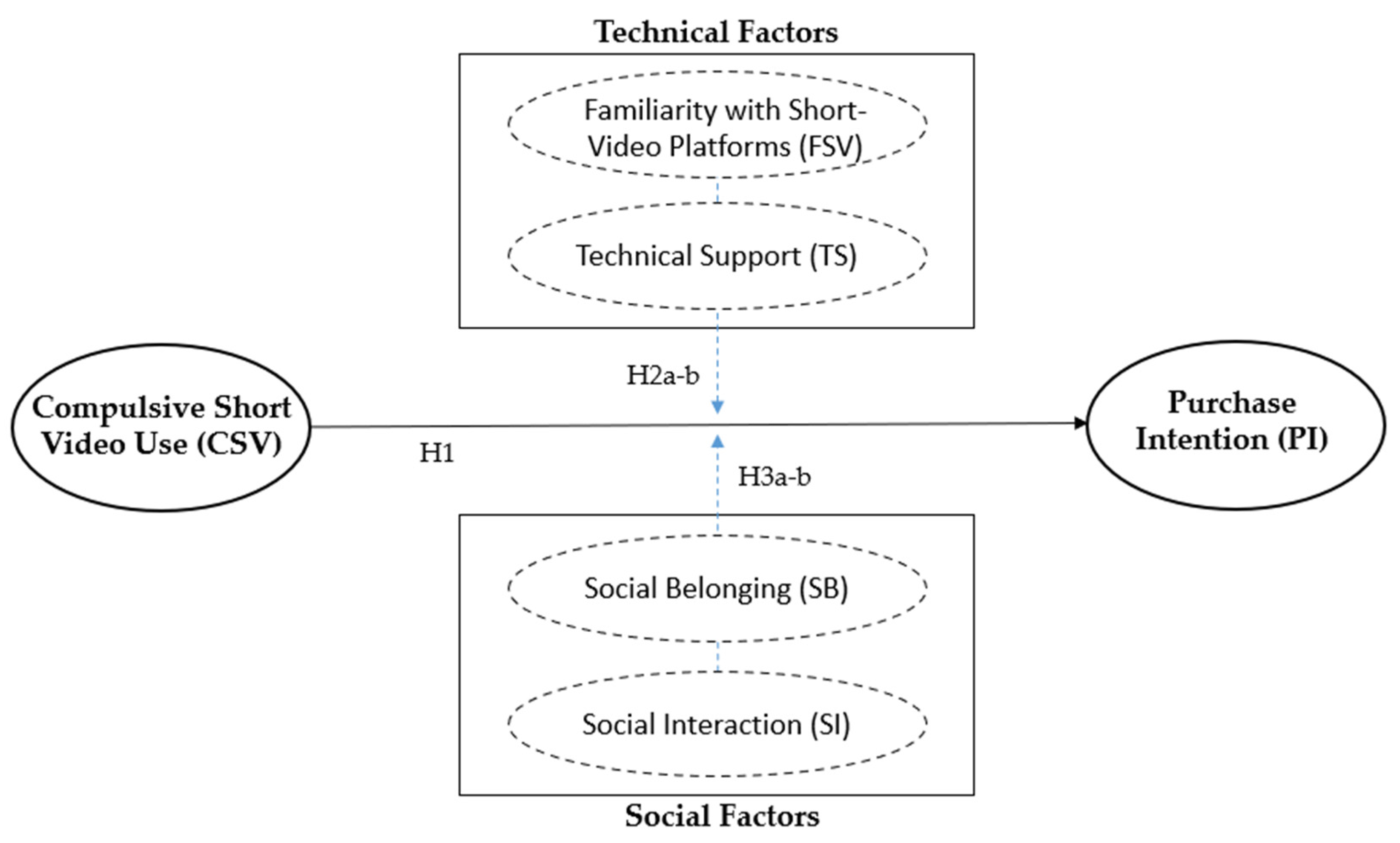
This study proposes a research framework grounded in Socio-Technical Systems Theory (STST) to explain how compulsive short video use (CSV) evolves into purchase intention (PI). As illustrated in Figure 1, the model specifies a direct pathway from CSV to PI (H1), reflecting the dual-process premise that diminished self-regulatory capacity increases reliance on automatic, cue-driven decision processes.
Figure 1.
Research Framework.
Beyond this baseline effect, the model incorporates four moderators that represent the technical and social subsystems emphasized by STST. Together, these moderators operationalize the principle of joint optimization by capturing how aligned—or misaligned—socio-technical configurations influence the translation of CSV into commercial responses.
On the technical side, platform familiarity (FSV) and technical support (TS) shape users’ procedural fluency and perceived reliability. When these technical conditions reduce friction and uncertainty, compulsive impulses are more likely to manifest as purchase intention (H2a, H2b). On the social side, social belonging (SB) reinforces normative alignment and affective attachment, which may amplify the CSV–PI linkage, whereas social interaction (SI) diverts attention and introduces competing social cues that may weaken the pathway (H3a, H3b).
By structuring the model in this way, the framework positions CSV as a psychological vulnerability that is neither uniformly harmful nor uniformly influential; its commercial consequences depend on the socio-technical configuration in which users engage. This design extends STST from a descriptive backdrop to an explanatory mechanism, showing how technical and social subsystems jointly regulate whether compulsive media use escalates into purchase intention.
3. Methodology
3.1. Data Collection and Sampling
Data for this study were collected through an online survey distributed via social media in China. WeChat and TikTok (Douyin) were chosen as the primary channels because of their high penetration rates, integration of short-video functions, and seamless connection to e-commerce, which provide an appropriate context for this research. These platforms operate on continuously updated mobile app versions, which are typically auto-updated on users’ devices. Accordingly, the study relied on the stable versions available during the data collection period, focusing on commonly accessible features rather than version-specific functionalities. The online survey method was selected for its efficiency, cost-effectiveness, and ability to reach diverse groups of short-video users. Although the sample was collected through social media channels, this approach is widely used in short-video consumption research and is appropriate for targeting active users who regularly engage with algorithmic content and embedded commerce features.
Several procedures were implemented to ensure data quality. First, an initial qualifying item confirmed recent experience with short-video platforms, and respondents who did not meet this criterion were excluded. Second, IP addresses were recorded to prevent duplicate responses. Third, responses completed in less than 3.5 min were deemed unreliable and excluded. This threshold corresponds to the lower bound of completion times observed in a pilot test, making it a conservative and commonly used criterion for identifying satisficing responses in digital survey research. All participants were informed at the beginning of the survey about the study purpose, anonymity, and confidentiality, and they voluntarily participated after providing electronic informed consent. The research procedures complied with the ethical guidelines of the authors’ institution. A total of 600 responses were collected, and after removing invalid or incomplete cases, 542 valid responses were retained for the final analysis.
3.2. Survey Instrument
The survey instrument consisted of two parts: demographic questions and items designed to measure the six core constructs of this study. All items were rated on a 7-point Likert scale (1 = strongly disagree, 7 = strongly agree) [70]. The measurement items were adapted from previously validated scales, refined to fit the short-video commerce context, and verified through a translation–back-translation process to ensure linguistic and conceptual accuracy [35,55,71].
Compulsive Short Video Use (CSV, 5 items) captured maladaptive, repetitive, and hard-to-control engagement with short-video platforms [5,6,7]. Purchase Intention (PI, 4 items) was measured using future-oriented evaluative statements assessing respondents’ likelihood, willingness, consideration, and comfort with purchasing products shown in short videos. No behavioral indicators (e.g., purchase frequency) were included, ensuring conceptual alignment with the definition of PI [34,36,72]. Familiarity with Short-Video Platforms (FSV, 5 items) reflected respondents’ comfort, ease of use, and accumulated experience with short-video platforms for both viewing and purchasing [55,56]. Technical Support (TS, 4 items) evaluated perceptions of platform reliability, smooth functionality, and responsiveness [4,37]. Social Belonging (SB, 4 items) measured users’ sense of acceptance, connectedness, and community membership within short-video environments [48,49,53]. Finally, Social Interaction (SI, 3 items) reflected communication, peer engagement, and interactive behaviors such as commenting and sharing [50,51,73]. Together, these measures allowed the study to capture both compulsive consumption tendencies and the socio-technical conditions hypothesized to moderate their translation into purchase intention.
3.3. Reliability and Validity
The internal consistency of the six constructs was first examined using Cronbach’s α coefficients. As shown in Table 1, all α values ranged from 0.910 (FSV) to 0.983 (CSV), far exceeding the conventional threshold of 0.70 [74]. This confirms that the items exhibited stable and consistent responses across participants. The reliability of the Purchase Intention (PI) construct remained excellent (α = 0.959). In particular, CSV (0.983) and SB (0.970) continued to show exceptionally high reliability, indicating strong internal consistency. Overall, the six scales demonstrated excellent measurement quality and were deemed appropriate for subsequent validity assessments and structural equation modeling [75].
Table 1.
Reliability Results.
3.4. Convergent Validity
Convergent validity was assessed through confirmatory factor analysis (CFA). All standardized factor loadings exceeded the recommended threshold of 0.70, ranging from 0.803 (FSV) to 0.962 (CSV), confirming that the observed indicators accurately represented their intended latent constructs. Composite Reliability (CR) values ranged from 0.911 to 0.983, and Average Variance Extracted (AVE) values ranged from 0.671 to 0.921, both well above their respective benchmarks of 0.70 and 0.50 [76]. The CFA model exhibited excellent overall fit (χ2(532) = 553.366, p = 0.252; CFI = 0.999; TLI = 0.999; RMSEA = 0.009; SRMR = 0.015). These results in Table 2 confirm that all constructs demonstrate strong convergent validity, reliably capturing their underlying theoretical concepts [75].
Table 2.
Confirmatory Factor Analysis Results.
3.5. Discriminant Validity
Discriminant validity was evaluated using multiple complementary criteria. First, as shown in Table 3, the Fornell–Larcker criterion [76] was satisfied: the square root of the AVE for each construct exceeded all inter-construct correlations. Although the correlation between Compulsive Short Video Use (CSV) and Purchase Intention (PI) was notably high (r = 0.981), the AVE square roots for CSV (0.960) and PI (0.925) both surpassed this value, meeting the conservative thresholds recommended by Hair [75]. These results indicate that the constructs remain empirically distinguishable despite their strong association.
Table 3.
Discriminant Validity (Fornell–Larcker Criterion).
To mitigate the possibility that the strong CSV–PI correlation reflects common method variance (CMV), several procedural remedies were implemented following Podsakoff, et al. [77,78]. These included ensuring respondent anonymity, blocking duplicate IP submissions, screening out low-quality or rapid responses, and incorporating attention-check items. Such procedures reduce the likelihood that the observed relationships arise from systematic response bias.
Beyond these methodological considerations, CSV and PI are conceptually distinct constructs. CSV reflects an affect-driven, maladaptive engagement pattern characterized by diminished control and compulsive tendencies [6], whereas PI represents a more deliberate, forward-looking evaluation of one’s likelihood or willingness to purchase products shown in short videos [72]. This conceptual distinction aligns with dual-process perspectives that differentiate automatic affective processing from reflective evaluative judgment [14].
Importantly, the measurement items for the two constructs do not overlap. CSV items capture adverse psychological or behavioral experiences (e.g., sleep disturbance, interference with daily functioning), while PI items capture future purchase intentions. To further prevent conceptual contamination, Item 48—which assessed past purchasing behavior rather than intention—was removed to avoid artificially inflating construct correlations.
Table 4 provides a side-by-side comparison of CSV and PI measurement items to illustrate their semantic and conceptual boundaries. Together, these statistical, procedural, and conceptual checks confirm that the six constructs demonstrate adequate discriminant validity for subsequent structural analyses.
Table 4.
Comparative Overview of CSV and PI Measurement Items.
4. Empirical Results
4.1. Summary Statistics
Table 5 presents the demographic characteristics of the 542 valid respondents included in this study. The sample was relatively balanced in terms of gender, with 46.3 percent identifying as male and 53.7 percent as female. A majority of participants (65.9 percent) reported having completed high school or vocational education, while 34.1 percent held a university or college degree. In terms of generational composition, 40.0 percent of respondents belonged to Generation X (born 1965–1980), 31.0 percent to Generation Y or Millennials (1981–1995), and 26.0 percent to Generation Z (1996–2006), with only 3.0 percent selecting “other.” Regarding marital status, 53.3 percent were single, 22.9 percent married without children, and 23.8 percent married with one or more children. Employment status was diverse, with 19.0 percent employed, 33.8 percent unemployed, 33.0 percent self-employed, and 14.2 percent retired. Finally, with respect to the level of economic development of respondents’ hometowns, a majority came from Tier 2 (moderately developed) regions (57.9 percent), followed by Tier 1 cities (19.0 percent), Tier 3–4 regions (14.4 percent), and rural or township areas (8.7 percent).
Table 5.
Summary Statistics of Demographic Variables (n = 542).
Together, these descriptive statistics indicate that the sample is broadly representative of short-video platform users across different demographic and socioeconomic groups in China, thereby providing a suitable basis for testing the study’s hypotheses.
The fact that a majority of respondents (65.9%) reported a high school or vocational education background is broadly consistent with patterns observed on major Chinese digital platforms, where user participation tends to be concentrated among younger groups with lower to middle levels of educational attainment [79]. Therefore, this distribution likely reflects actual user characteristics rather than sampling bias. However, because the present study relied on voluntary online participation rather than probability-based sampling, it may not have captured all user groups in proportion to their presence in the broader population, even if the sample mirrors the core user base. Accordingly, caution is warranted when generalizing the findings to higher-education groups or to a more diverse population of platform users.
4.2. Findings from the Structural Equation Model
We estimated five structural equation models to test whether the effect of Compulsive Short Video Use (CSV) on Purchase Intention (PI) is contingent on socio-technical conditions. Four models introduced a single moderator at a time: (i) Familiarity with short-video platforms (FSV), (ii) Technical Support (TS), (iii) Social Belonging (SB), and (iv) Social Interaction (SI), each entered as a covariate together with its interaction with Compulsive Use, so that moderation is captured as a latent interaction between the two factors. A fifth, simultaneous model included all four moderators and all four interactions jointly to assess robustness when the moderators are considered together. In all models, exogenous latent variables were allowed to covary, and statistical inference relied on maximum likelihood with robust standard errors. Table 6 reports the results of these five SEM models.
Table 6.
Results of Structural Equation Models (n = 542).
Across all specifications, the direct effect of Compulsive Short Video Use on Purchase Intention was large and highly significant. As shown in Table 6, in the single-moderator model that included Familiarity, the unstandardized coefficient was b = 5.171, SE = 0.617, z = 8.379, p < 0.001. With Technical Support as the moderator, the estimate was b = 5.334, SE = 0.732, z = 7.289, p < 0.001. With Social Belonging, it was b = 5.081, SE = 0.558, z = 9.112, p < 0.001, and with Social Interaction, b = 5.282, SE = 0.577, z = 9.149, p < 0.001. In the simultaneous model that entered all moderators and interactions together, the direct effect remained strong (b = 5.427, SE = 0.765, z = 7.092, p < 0.001). The unstandardized estimate varied slightly (5.18 to 5.43) depending on the inclusion of moderator blocks and their interactions, reflecting differences in variance partitioning and factor scaling.
The main effects of the moderators themselves on Purchase Intention were small and statistically non-significant once Compulsive Use was included. In the single-moderator models, the estimates were: Familiarity b = 0.348, SE = 0.292, z = 1.194, p = 0.233; Technical Support b = 0.375, SE = 0.307, z = 1.221, p = 0.222; Social Belonging b = −0.008, SE = 0.068, z = −0.120, p = 0.905; and Social Interaction b = 0.189, SE = 0.110, z = 1.721, p = 0.085. In the simultaneous model, the corresponding coefficients were b = 0.496, SE = 0.328, z = 1.512, p = 0.130 (FSV); b = 0.372, SE = 0.318, z = 1.167, p = 0.243 (TS); b = 0.031, SE = 0.083, z = 0.375, p = 0.708 (SB); and b = 0.176, SE = 0.115, z = 1.539, p = 0.124 (SI). This pattern indicates that these factors do not independently raise purchase intention, but rather shape the strength of the link from compulsive use to purchase intention.
Consistent with that interpretation, the interaction terms show systematic moderation. In the single-moderator models, the interaction between Compulsive Use and Familiarity was b = 0.454, SE = 0.244, z = 1.857, p = 0.063 †, and between Compulsive Use and Technical Support was b = 0.482, SE = 0.170, z = 2.842, p = 0.004 (highly significant). The interaction with Social Belonging was b = 0.087, SE = 0.058, z = 1.515, p = 0.130, providing weaker positive evidence. The interaction with Social Interaction was negative (b = −0.197, SE = 0.111, z = −1.771, p = 0.077 †), suggesting attenuation when online social engagement is high. In the simultaneous model that entered all moderators jointly, the corresponding interaction estimates were b = 0.479, SE = 0.276, z = 1.733, p = 0.083 † (FSV), b = 0.414, SE = 0.172, z = 2.405, p = 0.016 * (TS), b = 0.110, SE = 0.065, z = 1.697, p = 0.090 † (SB), and b = −0.134, SE = 0.109, z = −1.221, p = 0.222 (SI). Following the study’s analytic threshold that p < 0.10 constitutes supportive evidence, we conclude that Familiarity and Technical Support reliably strengthen the effect of compulsive use on purchase intention, Social Belonging offers additional but weaker strengthening, and Social Interaction tends to weaken this pathway.
Finally, the simultaneous model explains the vast majority of the variance in Purchase Intention (residual variance = 3 percent), which is consistent with the very large direct effect and the presence of reinforcing interactions. Together, the findings demonstrate that compulsive short-video use is a powerful antecedent of purchase intention, and that this effect is systematically contingent on socio-technical context.
Table 7 summarizes the results of hypothesis testing based on standardized coefficients derived from the SEM models. The analysis shows that compulsive short video use has a very strong and positive impact on purchase intention (β = 0.98–1.00), confirming that excessive and repetitive engagement with short-video platforms functions as a powerful driver of consumer purchasing tendencies. Beyond this direct effect, the results also highlight the importance of socio-technical conditions in shaping the strength of this relationship. Technical support (β = 0.41–0.48) and familiarity with short-video platforms (β = 0.45–0.48) both magnify the conversion of compulsive use into purchase intention, illustrating that reliable system performance and accumulated user experience facilitate seamless transitions from viewing to buying. Social belonging (β = 0.09–0.11) provides a modest yet positive reinforcement, suggesting that a sense of community and acceptance enhances consumers’ responsiveness to compulsive engagement. In contrast, social interaction (β = −0.13 to −0.20) shows a weak negative moderation effect, implying active peer communication and relational engagement can divert attention away from transactional cues. Overall, the evidence validates the hypothesized model, confirming both the strong direct impact of compulsive short-video use and the contingent role of socio-technical conditions.
Table 7.
Hypotheses Testing Results (Standardized Coefficients, n = 542).
5. Discussion
5.1. Summary of Key Findings
The empirical results demonstrate that compulsive short-video use (CSV) is the strongest antecedent of purchase intention (PI) within highly integrated short-video commerce environments. Across all structural models, CSV displayed an exceptionally large and stable effect on PI, indicating that compulsive engagement is not simply a dysfunctional usage pattern but a commercially consequential psychological state. This finding aligns with dual-process perspectives emphasizing that cognitive depletion reduces reflective processing and increases reliance on affect-driven, automatic responses, thereby amplifying susceptibility to embedded persuasive cues [6,14,49].
The moderating analyses further reveal that the conversion of compulsive engagement into purchase intention is shaped by the socio-technical environment rather than by individual vulnerability alone. Technical support and platform familiarity strengthened the CSV–PI relationship, suggesting that compulsive impulses are more readily activated when users experience fluent navigation, reliable system performance, and minimal friction at key decision moments. Such conditions facilitate states of cognitive absorption and effortlessness, lowering the resources required for behavioral execution [65]. From a socio-technical standpoint, these findings demonstrate that the technical subsystem—system reliability, responsiveness, and accumulated fluency—acts as a catalyst that accelerates the transition from compulsive viewing to commercial behavior [29,46].
The social subsystem produced a more nuanced pattern. Social belonging modestly amplified the CSV–PI pathway by reinforcing identity-based norms and providing social validation within platform communities, consistent with the premise that individuals internalize group-endorsed behaviors when affiliation is strong [48,80]. In contrast, social interaction exerted a weak but negative effect, redirecting cognitive attention away from transactional cues and toward relational exchanges. The modest size of this attenuation suggests a dual mechanism in which interaction may prolong platform exposure but simultaneously disrupt the cognitive processing of commercial signals.
Taken together, the findings show that the commercial effects of compulsive media use arise through the alignment of psychological depletion, friction-reducing technical affordances, and social cues that shape the salience of consumption signals. CSV becomes commercially potent when these socio-technical elements converge to channel affect-driven impulses into purchase-oriented decisions. This indicates that digital commerce outcomes are emergent properties of socio-technical configurations rather than simple reflections of individual traits or isolated platform features.
5.2. Theoretical Implications
The study offers several contributions to the theoretical understanding of compulsive digital consumption and algorithmically mediated commerce. First, the results reframe compulsive short-video use as a socio-technical state rather than a purely psychological deficit. The strong effect on PI suggests that compulsive states emerge through continuous interaction with platform architectures that integrate entertainment, recommendation algorithms, and embedded purchase functions [33]. These reframing shifts scholarly focus from individual loss of control to the structural activation of cognitive vulnerability.
Second, the findings extend dual-process perspectives by illustrating how the cognitive tendencies of compulsive users intersect with algorithmic design. When personalized feeds and shoppable overlays are embedded directly within content flows, the automatic processing characteristic of cognitive depletion is not merely triggered but strategically amplified [14,15]. In this sense, compulsive behavior functions as a psychological intensifier of algorithmic persuasion.
Third, the results contribute to uses-and-gratifications theory by showing that gratifications initially sought for emotional regulation or hedonic escape can spill over into commerce when platforms tightly integrate transactional features [45]. Rather than treating gratifications and commercial responsiveness as distinct experiences, the findings illustrate how they become mutually reinforcing within integrated ecosystems.
Fourth, the differentiated effects of social belonging and social interaction refine existing models of digital social influence. Belonging strengthened persuasion by providing normative endorsement, whereas interaction weakened it by introducing attentional competition. These distinctions highlight the multidimensional nature of sociality in digital environments and reveal that different forms of social engagement operate through distinct psychological pathways [67].
Finally, the study extends the relevance of Socio-Technical Systems Theory (STST) to consumer-facing digital platforms. Behavioral outcomes emerged from the joint alignment of psychological states, technical affordances, and social scaffolding, supporting the STST proposition that outcomes arise from the interplay of interdependent subsystems rather than from any single dimension [29,47]. Demonstrating this alignment in a consumer context modernizes the framework and underscores its value for understanding contemporary algorithmic commerce environments.
5.3. Managerial Implications
The findings provide actionable insights for platform operators, marketers, and designers of short-video commerce systems. Purchase intention does not arise from commercial exposure alone; it emerges from the interaction between users’ psychological states and the socio-technical structures of the platform [29].
A central implication concerns users who exhibit compulsive viewing tendencies. These individuals display heightened sensitivity to embedded commercial cues, making them a high-conversion yet high-risk segment. While this presents opportunities for monetization, it also raises ethical concerns. Responsible design practices—such as transparent labeling of shoppable content, optional purchase delays, and usage-awareness tools—can help safeguard user autonomy during periods of reduced self-regulation.
The results also emphasize the behavioral importance of technical design. Platform familiarity and system reliability significantly accelerated conversion, suggesting that interface clarity, navigation fluency, and low latency are not simply operational optimizations but core elements of behavioral influence. Investments in stable infrastructure and intuitive pathways can substantially increase the likelihood that compulsive impulses translate into purchase actions.
Social features must be calibrated with equal care. Elements that foster belonging, such as curated communities or recognition systems, reinforce persuasive effects [48]. In contrast, highly interactive comment environments can dilute commercial signals by diverting users’ attention to relational exchanges. Platforms may therefore benefit from managing the density, placement, and prominence of interactive functions to ensure that social engagement supports rather than disrupts transactional cues.
Overall, the findings highlight that psychological, technical, and social subsystems operate as interconnected rather than independent drivers of commercial behavior. Effective strategy in short-video commerce requires coordinated management across these layers to maximize conversion while preserving long-term user trust and well-being.
5.4. Limitations and Future Research
This study has several limitations that offer fruitful directions for future inquiry. The use of cross-sectional survey data restricts causal interpretation; longitudinal designs, experiments, or naturalistic behavioral data would better capture how compulsive tendencies evolve and interact with platform features over time. Although the study implemented procedural remedies to improve data quality, self-reported measures remain vulnerable to recall bias and social desirability [78]. Combining survey responses with behavioral trace data such as clickstream logs or transaction histories would provide more robust validation of the mechanisms identified.
The empirical context of China presents both strengths and constraints. China’s short-video commerce ecosystem is uniquely characterized by deep integration of entertainment, algorithmic recommendation, influencer culture, and instant purchasing. While this setting enhances theoretical richness, it limits generalizability. Comparative studies across markets with differing regulatory regimes, platform architectures, and cultural norms can clarify whether the socio-technical activation of compulsive tendencies is universal or context-specific [33].
Additional socio-technical moderators warrant investigation. Algorithmic transparency, content-creator influence, privacy sensitivities, reward structures, and perceived intrusiveness may further condition the compulsive use–purchase pathway. Incorporating these factors would help map the broader ecology of compulsive digital behavior.
Finally, Socio-Technical Systems Theory implies that psychological, technical, and social subsystems interact dynamically [30]. These cross-level interactions may produce emergent effects not observable through single-level moderation tests. Future work using multi-group SEM, moderated mediation, or computational modeling could deepen understanding of how socio-technical alignment shapes compulsive consumption.
6. Conclusions and Suggestions
This study shows that compulsive short-video use is a powerful antecedent of purchase intention and that its commercial influence depends on the alignment of psychological depletion, technical affordances, and social scaffolding. By integrating perspectives from dual-process theory, uses-and-gratifications, social identity theory, and Socio-Technical Systems Theory, the study proposes a coherent framework explaining how affect-driven impulses become economically activated within short-video commerce ecosystems.
The results contribute theoretically by reframing compulsive digital behavior as a context-sensitive commercial driver rather than a purely dysfunctional outcome. They further extend STST by demonstrating that behavioral outcomes in algorithmic commerce reflect the joint configuration of psychological, technical, and social subsystems. For practitioners, the findings highlight the importance of designing socio-technical architectures that facilitate efficient conversion while maintaining ethical responsibility toward users experiencing diminished self-regulation.
As short-video commerce continues to expand globally, understanding how compulsive engagement becomes commercial action will remain a central task for scholars and platform designers. Future research should employ longitudinal, experimental, and cross-cultural approaches and incorporate additional socio-technical variables to refine the framework proposed here. Recognizing the interdependence of psychological, technical, and social dimensions will be essential for advancing theory and guiding responsible innovation in digital commerce environments.
Author Contributions
Conceptualization, R.K.M. and J.M.K.; methodology, R.K.M. and J.M.K.; software, R.K.M. and J.M.K.; validation, R.K.M., J.Y.J. and J.M.K.; formal analysis, J.M.K.; investigation, R.K.M.; resources, R.K.M.; data curation, R.K.M.; writing—original draft preparation, R.K.M. and J.M.K.; writing—review and editing, R.K.M., J.Y.J. and J.M.K.; visualization, R.K.M.; supervision, J.M.K.; project administration, J.M.K. All authors have read and agreed to the published version of the manuscript.
Funding
This research received no external funding.
Institutional Review Board Statement
The study was conducted in accordance with the Declaration of Helsinki and approved by the Ethics Committee of Wenzhou-Kean University (protocol code WKUIRB202579; date of approval: 28 May 2025).
Data Availability Statement
The data gathered and used in this study is available upon reasonable request to the corresponding author.
Conflicts of Interest
The authors declare no conflicts of interest.
References
- Zhang, N.; Hazarika, B.; Chen, K.; Shi, Y. A cross-national study on the excessive use of short-video applications among college students. Comput. Hum. Behav. 2023, 145, 107752. [Google Scholar] [CrossRef]
- Luo, C.; Hasan, N.A.M.; bin Ahmad, A.M.Z.; Lei, G. Influence of short video content on consumers purchase intentions on social media platforms with trust as a mediator. Sci. Rep. 2025, 15, 16605. [Google Scholar] [CrossRef] [PubMed]
- Chen, J.; Shen, X.-L. Consumers’ decisions in social commerce context: An empirical investigation. Decis. Support Syst. 2015, 79, 55–64. [Google Scholar] [CrossRef]
- Cao, H.; Chen, Z.; Cheng, M.; Zhao, S.; Wang, T.; Li, Y. You recommend, i buy: How and why people engage in instant messaging based social commerce. Proc. ACM Hum. Comput. Interact. 2021, 5, 67. [Google Scholar] [CrossRef]
- Andreassen, C.S.; Griffiths, M.D.; Pallesen, S.; Bilder, R.M.; Torsheim, T.; Aboujaoude, E. The Bergen Shopping Addiction Scale: Reliability and validity of a brief screening test. Front. Psychol. 2015, 6, 1374. [Google Scholar] [CrossRef]
- O’Guinn, T.C.; Faber, R.J. Compulsive buying: A phenomenological exploration. J. Consum. Res. 1989, 16, 147–157. [Google Scholar] [CrossRef]
- Meerkerk, G.-J.; Van Den Eijnden, R.J.; Vermulst, A.A.; Garretsen, H.F. The compulsive internet use scale (CIUS): Some psychometric properties. Cyberpsychology Behav. 2009, 12, 1–6. [Google Scholar] [CrossRef]
- Van Den Eijnden, R.J.; Lemmens, J.S.; Valkenburg, P.M. The social media disorder scale. Comput. Hum. Behav. 2016, 61, 478–487. [Google Scholar] [CrossRef]
- Ye, J.-H.; Zheng, J.; Nong, W.; Yang, X. Potential Effect of Short Video Usage Intensity on Short Video Addiction, Perceived Mood Enhancement (‘TikTok Brain’), and Attention Control among Chinese Adolescents. Int. J. Ment. Health Promot. 2025, 27, 271–286. [Google Scholar] [CrossRef]
- Chen, S.; Zhi, K.; Chen, Y. How active and passive social media use affects impulse buying in Chinese college students? The roles of emotional responses, gender, materialism and self-control. Front. Psychol. 2022, 13, 1011337. [Google Scholar] [CrossRef]
- Iyer, G.R.; Blut, M.; Xiao, S.H.; Grewal, D. Impulse buying: A meta-analytic review. J. Acad. Mark. Sci. 2020, 48, 384–404. [Google Scholar] [CrossRef]
- Faber, R.J.; O’guinn, T.C. A clinical screener for compulsive buying. J. Consum. Res. 1992, 19, 459–469. [Google Scholar] [CrossRef]
- Dang, T.-Q.; Nguyen, L.-T.; Duc, D.T.V. Impulsive Buying and Compulsive Buying in Social Commerce: An Integrated Analysis using the Cognitive-Affective-Behavior Model and Theory of Consumption Values with PLS-SEM. SAGE Open 2025, 15, 21582440251334215. [Google Scholar] [CrossRef]
- Kahneman, D. Fast and Slow Thinking; Allen Lane and Penguin Books: New York, NY, USA, 2011. [Google Scholar]
- Samson, A.; Voyer, B.G. Two minds, three ways: Dual system and dual process models in consumer psychology. AMS Rev. 2012, 2, 48–71. [Google Scholar] [CrossRef]
- Li, M.; Wang, Q.; Cao, Y. Understanding consumer online impulse buying in live streaming e-commerce: A stimulus-organism-response framework. Int. J. Environ. Res. Public Health 2022, 19, 4378. [Google Scholar] [CrossRef]
- Deng, M.; Yang, Y.; Sun, B. Research on the purchase intention of social commerce consumers in video streams: Dual pathways of affection and rationality. Behav. Sci. 2024, 14, 738. [Google Scholar] [CrossRef]
- Katz, E.; Blumler, J.G.; Gurevitch, M. Uses and gratifications research. Public Opin. Q. 1973, 37, 509–523. [Google Scholar] [CrossRef]
- Rubin, A.M. Television uses and gratifications: The interactions of viewing patterns and motivations. J. Broadcast. Electron. Media 1983, 27, 37–51. [Google Scholar] [CrossRef]
- Liang, T.-P.; Ho, Y.-T.; Li, Y.-W.; Turban, E. What drives social commerce: The role of social support and relationship quality. Int. J. Electron. Commer. 2011, 16, 69–90. [Google Scholar] [CrossRef]
- Ji, M.; Chen, X.; Wei, S. What motivates consumers’ purchase intentions in e-commerce live streaming: A socio-technical perspective. Int. J. Hum. Comput. Interact. 2025, 41, 1585–1605. [Google Scholar] [CrossRef]
- Montag, C.; Lachmann, B.; Herrlich, M.; Zweig, K. Addictive features of social media/messenger platforms and freemium games against the background of psychological and economic theories. Int. J. Environ. Res. Public Health 2019, 16, 2612. [Google Scholar] [CrossRef]
- Qin, Y.; Omar, B.; Musetti, A. The addiction behavior of short-form video app TikTok: The information quality and system quality perspective. Front. Psychol. 2022, 13, 932805. [Google Scholar] [CrossRef] [PubMed]
- Rogowska, A.M.; Lechowicz, O. The Relationship Between Problematic TikTok Use and Depression in University Students: The Mediating Role of Insomnia. J. Clin. Med. 2025, 14, 4652. [Google Scholar] [CrossRef]
- Miedzobrodzka, E.; Du, J.; van Koningsbruggen, G.M. TikTok use versus TikTok self-control failure: Investigating relationships with well-being, academic performance, bedtime procrastination, and sleep quality. Acta Psychol. 2024, 251, 104565. [Google Scholar] [CrossRef]
- Jameel, A.; Khan, S.; Alonazi, W.B.; Khan, A.A. Exploring the impact of social media sites on compulsive shopping behavior: The mediating role of materialism. Psychol. Res. Behav. Manag. 2024, 17, 171–185. [Google Scholar] [CrossRef]
- Halim, E.; Artahni, L.; Teoh, A.P. Critical Success Factor of Impulsive Buying in Short Video Platform. In Proceedings of the 2023 1st IEEE International Conference on Smart Technology (ICE-SMARTec), Bandung, Indonesia, 17–19 July 2023; pp. 196–201. [Google Scholar]
- Leng, J. The Impact of Short Video Engagement on Impulsive Buying Patterns and Customer Satisfaction Among Car Consumers: Exploring the Mediating Influence of In-Store Interaction and Psychological Intent. Adv. Consum. Res. 2024, 1, 1–10. [Google Scholar]
- Emery, F.E.; Trist, E.L. Socio-technical systems. Manag. Sci. Models Tech. 1960, 2, 83–97. [Google Scholar]
- Trist, E.; Bamforth, K.W. Some social and psychological consequences of the longwall method of coal-getting. In Technology, Organizations and Innovation: Critical Perspectives on Business and Management, Volume I: The Early Debates; Preece, D., McLoughlin, I., Dawson, P., Eds.; Routledge: London, UK, 2000; pp. 79–118. [Google Scholar]
- Nguyen, H.G.; Nguyen, D.T.; Le, B.N. Consumer Buying Intention in Livestreaming Commerce: An Integrated Model of Socio-Technical System Theory and Uses & Gratifications Theory. Pak. J. Commer. Soc. Sci. 2025, 19, 198. [Google Scholar] [CrossRef]
- Chang, Y.-H.; Silalahi, A.D.K.; Eunike, I.J.; Riantama, D. Socio-technical systems and trust transfer in live streaming e-commerce: Analyzing stickiness and purchase intentions with SEM-fsQCA. Front. Commun. 2024, 9, 1305409. [Google Scholar] [CrossRef]
- Ye, Q.; Luo, Y.; Cao, C.; Zhong, Y. How Attachment Influences Users’ Decisions in Mobile Social Commerce Context From a Socio-Technical Systems Perspective. J. Organ. End User Comput. 2023, 35, 1–23. [Google Scholar] [CrossRef]
- Spears, N.; Singh, S.N. Measuring attitude toward the brand and purchase intentions. J. Curr. Issues Res. Advert. 2004, 26, 53–66. [Google Scholar] [CrossRef]
- Ajzen, I. The theory of planned behavior. Organ. Behav. Hum. Decis. Process. 1991, 50, 179–211. [Google Scholar] [CrossRef]
- Zhao, Y.; Wang, L.; Tang, H.; Zhang, Y. Electronic word-of-mouth and consumer purchase intentions in social e-commerce. Electron. Commer. Res. Appl. 2020, 41, 100980. [Google Scholar] [CrossRef]
- Zhang, H.; Lu, Y.; Gupta, S.; Zhao, L. What motivates customers to participate in social commerce? The impact of technological environments and virtual customer experiences. Inf. Manag. 2014, 51, 1017–1030. [Google Scholar] [CrossRef]
- Huang, W.; Wang, X.; Zhang, Q.; Han, J.; Zhang, R. Beyond likes and comments: How social proof influences consumer impulse buying on short-form video platforms. J. Retail. Consum. Serv. 2025, 84, 104199. [Google Scholar] [CrossRef]
- Lo, P.-S.; Dwivedi, Y.K.; Tan, G.W.-H.; Ooi, K.-B.; Aw, E.C.-X.; Metri, B. Why do consumers buy impulsively during live streaming? A deep learning-based dual-stage SEM-ANN analysis. J. Bus. Res. 2022, 147, 325–337. [Google Scholar] [CrossRef]
- Jin, S.V.; Ryu, E. “I’ll buy what she’s# wearing”: The roles of envy toward and parasocial interaction with influencers in Instagram celebrity-based brand endorsement and social commerce. J. Retail. Consum. Serv. 2020, 55, 102121. [Google Scholar]
- Liu, Y.; Wang, M. The effect of short video content marketing on consumer purchase intention. Front. Bus. Econ. Manag. 2023, 11, 12934. [Google Scholar] [CrossRef]
- Hofmann, W.; Friese, M.; Strack, F. Impulse and self-control from a dual-systems perspective. Perspect. Psychol. Sci. 2009, 4, 162–176. [Google Scholar] [CrossRef]
- Parboteeah, D.V.; Valacich, J.S.; Wells, J.D. The influence of website characteristics on a consumer’s urge to buy impulsively. Inf. Syst. Res. 2009, 20, 60–78. [Google Scholar] [CrossRef]
- Sun, Y.; Bao, Z. Live streaming commerce: A compulsive buying perspective. Manag. Decis. 2023, 61, 3278–3294. [Google Scholar] [CrossRef]
- LaRose, R. The problem of media habits. Commun. Theory 2010, 20, 194–222. [Google Scholar] [CrossRef]
- Mumford, E. Socio-technical design: An unfulfilled promise or a future opportunity? In Proceedings of the Organizational and Social Perspectives on Information Technology: IFIP TC8 WG8. 2 International Working Conference on the Social and Organizational Perspective on Research and Practice in Information Technology, Aalborg, Denmark, 9–11 June 2000; pp. 33–46. [Google Scholar]
- Pasmore, W.; Winby, S.; Mohrman, S.A.; Vanasse, R. Reflections: Sociotechnical systems design and organization change. J. Change Manag. 2019, 19, 67–85. [Google Scholar] [CrossRef]
- Ashforth, B.E.; Mael, F. Social identity theory and the organization. Acad. Manag. Rev. 1989, 14, 20–39. [Google Scholar] [CrossRef]
- Baumeister, R.F.; Leary, M.R. The need to belong: Desire for interpersonal attachments as a fundamental human motivation. In Interpersonal Development; Laursen, B., Collins, W.A., Eds.; Routledge: London, UK, 2007; p. 33. [Google Scholar]
- Oh, C.S.; Bailenson, J.N.; Welch, G.F. A systematic review of social presence: Definition, antecedents, and implications. Front. Robot. AI 2018, 5, 114. [Google Scholar] [CrossRef] [PubMed]
- Shafiq, S.; Nasreen, S.; Baig, M.S.Y. Development and Validation of The Social Media Interaction Scale for Youth. Pak. J. Humanit. Soc. Sci. 2024, 12, 3394–3403. [Google Scholar] [CrossRef]
- Biocca, F.; Harms, C.; Burgoon, J.K. Toward a more robust theory and measure of social presence: Review and suggested criteria. Presence Teleoperators Virtual Environ. 2003, 12, 456–480. [Google Scholar] [CrossRef]
- Gunawardena, C.N.; Zittle, F.J. Social presence as a predictor of satisfaction within a computer-mediated conferencing environment. Am. J. Distance Educ. 1997, 11, 8–26. [Google Scholar] [CrossRef]
- Shen, X.; Wang, J. How short video marketing influences purchase intention in social commerce: The role of users’ persona perception, shared values, and individual-level factors. Humanit. Soc. Sci. Commun. 2024, 11, 290. [Google Scholar] [CrossRef]
- Venkatesh, V.; Morris, M.G.; Davis, G.B.; Davis, F.D. User acceptance of information technology: Toward a unified view. MIS Q. 2003, 27, 425–478. [Google Scholar] [CrossRef]
- Arfi, W.B.; Nasr, I.B.; Khvatova, T.; Zaied, Y.B. Understanding acceptance of eHealthcare by IoT natives and IoT immigrants: An integrated model of UTAUT, perceived risk, and financial cost. Technol. Forecast. Soc. Change 2021, 163, 120437. [Google Scholar] [CrossRef]
- Zhao, L.; Lu, Y.; Huang, W.; Wang, Q. Internet inequality: The relationship between high school students’ Internet use in different locations and their Internet self-efficacy. Comput. Educ. 2010, 55, 1405–1423. [Google Scholar] [CrossRef]
- Flavián, C.; Guinalíu, M.; Gurrea, R. The role played by perceived usability, satisfaction and consumer trust on website loyalty. Inf. Manag. 2006, 43, 1–14. [Google Scholar] [CrossRef]
- Soleimani, M. Buyers’ trust and mistrust in e-commerce platforms: A synthesizing literature review. Inf. Syst. e-Bus. Manag. 2022, 20, 57–78. [Google Scholar] [CrossRef]
- Yin, X.; Li, J.; Si, H.; Wu, P. Attention marketing in fragmented entertainment: How advertising embedding influences purchase decision in short-form video apps. J. Retail. Consum. Serv. 2024, 76, 103572. [Google Scholar] [CrossRef]
- Zeng, R.; Guo, S.; Evans, R. Intentional news avoidance on short-form video platforms: A moderated mediation model of psychological reactance and relative entertainment motivation. Humanit. Soc. Sci. Commun. 2024, 11, 248. [Google Scholar] [CrossRef]
- Gao, P.; Zeng, Y.; Cheng, Y. The formation mechanism of impulse buying in short video scenario: Perspectives from presence and customer inspiration. Front. Psychol. 2022, 13, 870635. [Google Scholar] [CrossRef] [PubMed]
- Wang, W.; Wu, S. Analyzing User Psychology and Behavior in Short-Form Video Shopping Platforms: An Integrated TAM and ISS Model Approach. SAGE Open 2024, 14, 21582440241287076. [Google Scholar] [CrossRef]
- Yu, S.; Jiang, Z.; Chen, D.-D.; Feng, S.; Li, D.; Liu, Q.; Yi, J. Leveraging tripartite interaction information from live stream e-commerce for improving product recommendation. In Proceedings of the 27th ACM SIGKDD Conference on Knowledge Discovery & Data Mining, Virtual, 14–18 August 2021; pp. 3886–3894. [Google Scholar]
- Csikszentmihalyi, M.; Csikzentmihaly, M. Flow: The Psychology of Optimal Experience; Harper & Row: New York, NY, USA, 1990; Volume 1990. [Google Scholar]
- Tajfel, H. Social Identity and Intergroup Behaviour; Cambridge University Press: Cambridge, UK, 2010. [Google Scholar]
- Kreijns, K.; Xu, K.; Weidlich, J. Social presence: Conceptualization and measurement. Educ. Psychol. Rev. 2022, 34, 139–170. [Google Scholar] [CrossRef] [PubMed]
- Kowert, R.; Domahidi, E.; Festl, R.; Quandt, T. Social gaming, lonely life? The impact of digital game play on adolescents’ social circles. Comput. Hum. Behav. 2014, 36, 385–390. [Google Scholar] [CrossRef]
- Rodriguez, M.G.; Gummadi, K.; Schoelkopf, B. Quantifying information overload in social media and its impact on social contagions. In Proceedings of the International AAAI Conference on Web and Social Media, Ann Harbor, MI, USA, 1–4 June 2014; pp. 170–179. [Google Scholar]
- Likert, R. A technique for the measurement of attitudes. Arch. Psychol. 1932, 22, 55. [Google Scholar]
- Brislin, R.W. Back-translation for cross-cultural research. J. Cross Cult. Psychol. 1970, 1, 185–216. [Google Scholar] [CrossRef]
- Fishbein, M.; Ajzen, I. Belief, attitude, intention and behavior: An introduction to theory and research. Philos. Rhetor. 1975, 10, 130–132. [Google Scholar]
- Short, J.; Williams, E.; Christie, B. The Social Psychology of Telecommunications; Wiley: Hoboken, NJ, USA, 1976. [Google Scholar]
- Nunnally, J.C.; Bernstein, I.H. Psychometric Theory; McGraw-Hill Companies, Inc.: Columbus, OH, USA, 1994. [Google Scholar]
- Hair, J.F. Multivariate Data Analysis; Kennesaw State University: Kennesaw, GA, USA, 2009. [Google Scholar]
- Fornell, C.; Larcker, D.F. Evaluating structural equation models with unobservable variables and measurement error. J. Mark. Res. 1981, 18, 39–50. [Google Scholar] [CrossRef]
- Podsakoff, P.M.; MacKenzie, S.B.; Podsakoff, N.P. Sources of method bias in social science research and recommendations on how to control it. Annu. Rev. Psychol. 2012, 63, 539–569. [Google Scholar] [CrossRef] [PubMed]
- Podsakoff, P.M.; MacKenzie, S.B.; Lee, J.-Y.; Podsakoff, N.P. Common method biases in behavioral research: A critical review of the literature and recommended remedies. J. Appl. Psychol. 2003, 88, 879. [Google Scholar] [CrossRef] [PubMed]
- Qian, W.; Hexel, O.; Zagheni, E.; Kashyap, R.; Weber, I. Demographic inequalities in digital spaces in China: The case of Weibo. In Proceedings of the 17th International AAAI Conference on Web and Social Media, Limassol, Cyprus, 5–8 June 2023. [Google Scholar] [CrossRef]
- Tajfel, H.; Turner, J.; Austin, W.G.; Worchel, S. An integrative theory of intergroup conflict. In Intergroup Relations: Essential Readings; Psychology Press: East Sussex, UK, 2001; pp. 94–109. [Google Scholar]
Disclaimer/Publisher’s Note: The statements, opinions and data contained in all publications are solely those of the individual author(s) and contributor(s) and not of MDPI and/or the editor(s). MDPI and/or the editor(s) disclaim responsibility for any injury to people or property resulting from any ideas, methods, instructions or products referred to in the content. |
© 2025 by the authors. Licensee MDPI, Basel, Switzerland. This article is an open access article distributed under the terms and conditions of the Creative Commons Attribution (CC BY) license (https://creativecommons.org/licenses/by/4.0/).