


Simple Summary
The Hawaiian flower thrips, Thrips hawaiiensis, is a widespread pest that infests the flowers of numerous horticultural crops. We characterized the previously unknown olfactory system of Thrips hawaiiensis by analyzing its odorant-binding proteins (OBPs). Our genome survey revealed 12 OBP genes, a count comparable to other thrips but low relative to most insects. Subsequent transcriptomic and RT-qPCR analyses identified consistent male-biased expression, implicating these OBPs in male-specific olfactory behaviors, such as mate location and foraging. We further identified 11 CSPs, the majority of which showed a male-biased expression pattern similar to that of the OBPs.
Abstract
Olfaction is essential for key insect behaviors, such as host-seeking and mating, and is initiated by odorant-binding proteins (OBPs), which bind and transport hydrophobic odors. Thrips hawaiiensis is a major pest that infests the flowers of numerous horticultural crops, yet its chemosensory mechanisms remain poorly understood. Now, the availability of its genome assembly allows us to address this gap. To this end, we performed a comprehensive exploration and comparative analysis of its OBP genes. Our genome-wide analysis identified a total of 12 OBP genes in T. hawaiiensis, whereas the repertoire across other published thrips genomes ranges from 10 to 17, a count significantly lower than that in most other insects. Notably, transcriptomic and RT-qPCR analyses revealed consistent male-biased expression of OBPs in T. hawaiiensis, supporting their role in mate-finding and foraging behaviors. Furthermore, we identified 11 chemosensory proteins (CSPs). Transcriptomic and RT-qPCR analyses revealed that these CSPs exhibit an expression pattern similar to that of the OBPs, with over half of the genes showing significantly higher expression in males. This work provides a foundational framework for future functional studies of olfactory proteins, both in T. hawaiiensis and the wider insect community.
1. Introduction
Thrips hawaiiensis (Morgan) (Thysanoptera: Thripidae), a common flower-dwelling thrips species native to the Oriental and Pacific regions, has expanded its geographical range through international trade to Africa, Australia, Europe, and the Americas [1,2,3,4,5]. T. hawaiiensis primarily feeds and resides within floral tissues [1,5,6]. The elevated risk of global introduction and spread of T. hawaiiensis, driven by its strong thigmokinetic behavior, high fecundity, and short life cycle [1,7], is fueling growing concern about its potential to become a major pest of many crops. As a strictly flower-dwelling species, T. hawaiiensis inflicts damage on a wide range of crops, including tobacco [8], rose [9], gladiolus [10], Brassica oleracea [11], coffee [12], mango [13], citrus [14], apples and pears [6], and bananas [15,16]. Direct feeding on floral and fruit tissues induces symptoms such as scarring, necrosis, and malformation, the severity of which depends on infestation intensity. Furthermore, its pollen-feeding behavior can adversely affect plant fertility [17].
Olfaction is essential for detecting and interpreting environmental cues, enabling organisms to locate food, hosts, mates, and oviposition sites, as well as to evade predators and pathogens [18]. Both invertebrates and vertebrates use the olfactory system to mediate odorant detection [19]. The accurate operation of the olfactory system depends on a coordinated series of olfactory proteins. Key among these are odorant-binding proteins (OBPs), chemosensory proteins (CSPs), odorant receptors (ORs), gustatory receptors (GRs), ionotropic receptors (IRs), sensory neuron membrane proteins (SNMPs), odorant-degrading enzymes (ODEs), and Niemann–Pick protein C2 (NPC2) [20,21]. Notably, OBPs participate in the initial biochemical reaction of the olfactory transduction cascade. They play a critical role by discriminating, binding, and transporting odorant molecules to their corresponding Ors [22,23,24]. OBPs are characterized as small, water-soluble, and extracellular, residing in the sensillar lymph that bathes the sensory dendrites [19,25]. The classification of OBPs is based on their conserved cysteine patterns, yielding distinct subfamilies: Classic (six cysteines), Minus-C (four or five), Plus-C (at least eight), and Dimer/Atypical OBPs, the latter two comprising tandem or fused classic domains that may form dimer-like structures [23,26,27,28]. The first OBP was identified in Antheraea polyphemus [29]. Subsequently, transcriptomic and genomic data have facilitated the identification of a rapidly increasing number of OBPs. Although OBPs have been characterized in several thrips species, including Frankliniella occidentalis [30], Frankliniella intonsa [30], and Megalurothrips usitatus [26], this gap persists for Thrips hawaiiensis. The recent availability of a genome assembly for T. hawaiiensis [31] provides a crucial resource to address this gap, allowing for a comprehensive exploration and comparative analysis of its OBP repertoire.
We conducted a comprehensive analysis of odorant-binding protein (OBP) genes in Thrips hawaiiensis, beginning with genome-wide identification. This was followed by characterization of their chromosomal distribution, phylogenetic evolution, gene structures, and protein domains. Tissue-specific expression profiling across both sexes was performed via RT-qPCR. Collectively, our results lay the necessary groundwork for elucidating the functional roles of OBPs and for devising targeted, eco-friendly control methods for this pest.
2. Materials and Methods
2.1. Identification of OBP Genes in Thrips
The genome assembly, along with its GFF annotation, coding sequence (CDS), and protein sequence files for T. hawaiiensis, were obtained from figshare (https://doi.org/10.6084/m9.figshare.26125162) [31]. To investigate the prevalence of OBPs in thrips, we also retrieved publicly available whole-genome data of thrips (as of that available from June 2025), including two other populations of Megalurothrips usitatus (samples from Hainan, China [32], and Zhejiang, China [33]), Dendrothrips minowai [34], Frankliniella fusca [35], Frankliniella occidentalis [36], Odontothrips loti [37], Thrips palmi [38], Thrips tabaci [39], Frankliniella intonsa [40], and Stenchaetothrips biformis [41]. Known OBP amino acid sequences from Frankliniella intonsa and Frankliniella occidentalis [30] were retrieved from GenBank (National Center for Biotechnology Information, NCBI) and used as query sequences for a BLASTP (v2.5.0) search against the thrips amino acid database, applying an identity cutoff of 30%. Then, gene annotation was performed using hmmscan (v3.1b1) with the Pfam-A.hmm database, applying an E-value threshold of 1 × 10⁻⁵ to identify putative OBP genes (PF01395.18). To improve accuracy, the hmmscan results were combined with BLAST-based annotations by retaining only overlapping gene predictions, yielding a high-confidence gene set for downstream analyses. The putative N-terminal signal peptides of T. hawaiiensis OBPs were identified using the SignalP 6.0 online server (https://services.healthtech.dtu.dk/services/SignalP-6.0/, accessed on 28 October 2025) [42]. The OBP sequences were aligned using MUSCLE (v5.1) [43] software. The resultant alignment file was then imported into Jalview software (v2.11.5.0) [44] for visualization.
2.2. Characteristics Analysis of OBPs
The OBP sequences of thrips were aligned using MUSCLE (v5.1) [43]. Following alignment, a maximum likelihood (ML) phylogenetic tree was constructed on the aligned dataset with IQ-TREE (v2.2.5) [45], employing 1000 ultrafast bootstrap replicates (-B 1000). The chromosomal locations of OBP genes were retrieved from the T. hawaiiensis GFF annotation file using a custom Python (v3.10.13) script. They were subsequently visualized on the chromosomes via the online tool MapGene2Chrom (http://mg2c.iask.in/mg2c_v2.1/, accessed on 28 October 2025) [46,47]. The exon–intron structures of the ThawOBP genes were determined through an in-house Python script.
2.3. Insect Sample Collection
A laboratory population of Thrips hawaiiensis was established from individuals collected on kidney beans (Phaseolus vulgaris) at the Institute of Plant Protection, Fujian Academy of Agricultural Sciences, China (119°34′ E, 26°13′ N), and has been continuously reared on this host since 2016. The kidney bean diet was prepared by soaking in water, coating with a 10% honey solution, and air-drying. Thrips were maintained in MGC-350HP artificial climate incubators (Yiheng Scientific Instruments, Shanghai, China) under the following conditions: 27 ± 1 °C, 60 ± 5% RH, and a 16:8 (L:D) photoperiod.
2.4. RNA Extraction and Real-Time Quantitative PCR Analysis of ThawOBPs
A total of 300 adult male and female T. hawaiiensis samples were selected for analysis of relative mRNA expression levels. Total RNA was extracted from the samples using the Trizol method. Subsequently, the RNA was reverse transcribed into cDNA using a reverse transcription kit (Accurate Biology, Changsha, Hunan, China).
A primer design tool (https://www.ncbi.nlm.nih.gov/tools/primer-blast/, accessed on 28 October 2025) was used to design primers for the ThawOBP gene of Thrips hawaiiensis, with β-actin as the internal reference gene [48]. RT-qPCR was performed on an ABI QuantStudio 5 system (Thermo Fisher Scientific, Waltham, MA, USA), with the entire process conducted on ice. Each experiment included at least two technical replicates and three biological replicates. The expression levels in male and female Thrips hawaiiensis were calculated using the 2−ΔCT method. Data analysis and visualization were conducted using GraphPad Prism (v9.5.0) and R (v4.2.0) for correlation calculations. All the primers used in this study are listed in Table 1.
Table 1.
OBP genes’ primer information used for RT-qPCR.
2.5. Transcriptome Sequencing
To obtain a comprehensive overview of gene expression, total RNA was isolated from adult male and female subjects. Criteria for cDNA library qualification are as follows: the AD260/280 absorbance ratio should be between 1.8 and 2.0, the A260/230 ratio should be between 1.9 and 2.4, and the concentration measured by Qubit should be between 0.95 and 3.0. Each biological replicate comprised a pool of approximately 800 individuals. RNA extraction was performed using TRIzol Reagent (Thermo Fisher Scientific, USA). Subsequently, Illumina paired-end libraries were constructed with the TruSeq RNA Library Preparation Kit (Illumina, San Diego, CA, USA) according to the manufacturer’s instructions and sequenced on an Illumina NovaSeq 6000 platform. This generated approximately 14.3 GB of high-quality 150 bp paired-end sequence data.
2.6. Phylogenetic Analysis of OBP Genes
A maximum likelihood phylogeny was reconstructed using IQ-TREE (v2.3.3) [45]. To determine the most appropriate substitution model, we used the built-in ModelFinder tool, which selected the optimal model from a candidate set based on the Bayesian Information Criterion. The analysis was subsequently conducted under the best-fit model, WAG + R4. Branch support was assessed using ultrafast bootstrap approximation, with 1000 replicates.
3. Results
3.1. Identification and Sequence Analysis of OBPs in T. hawaiiensis
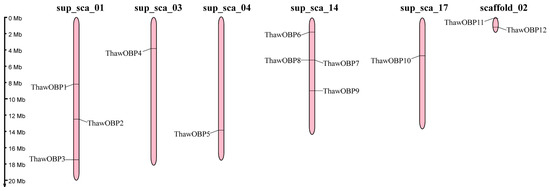
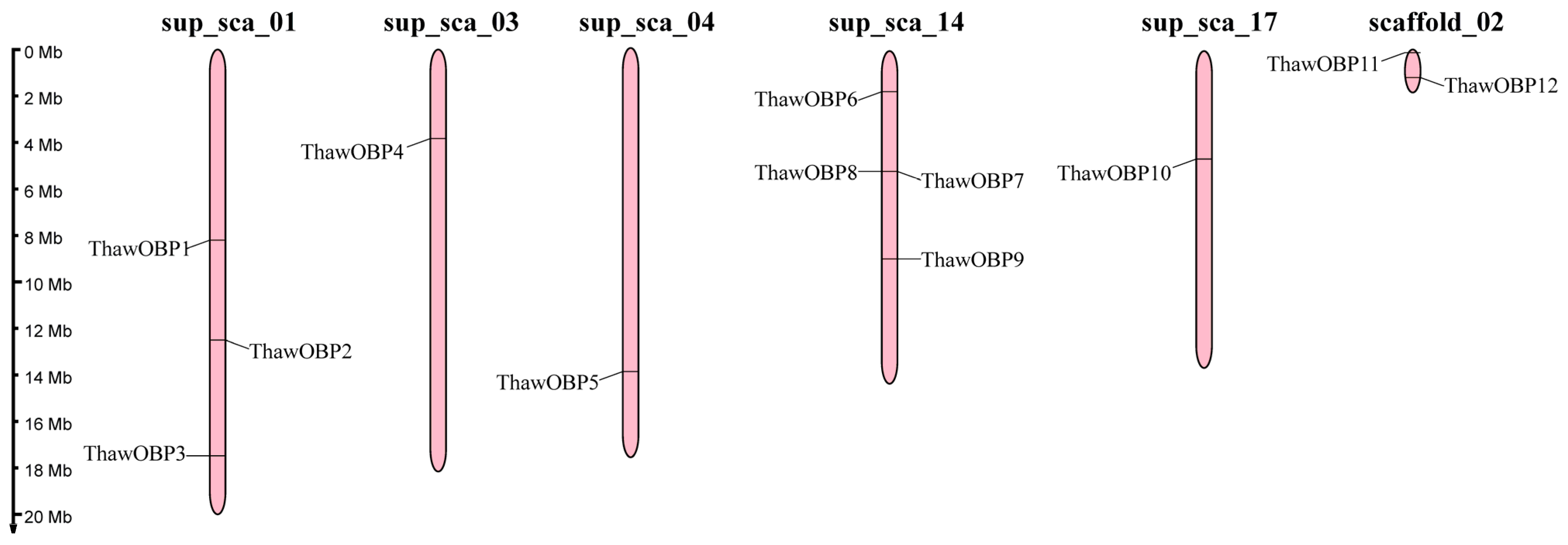
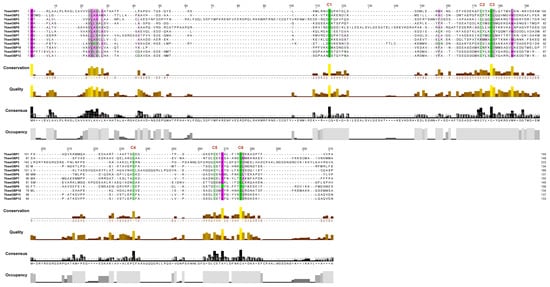
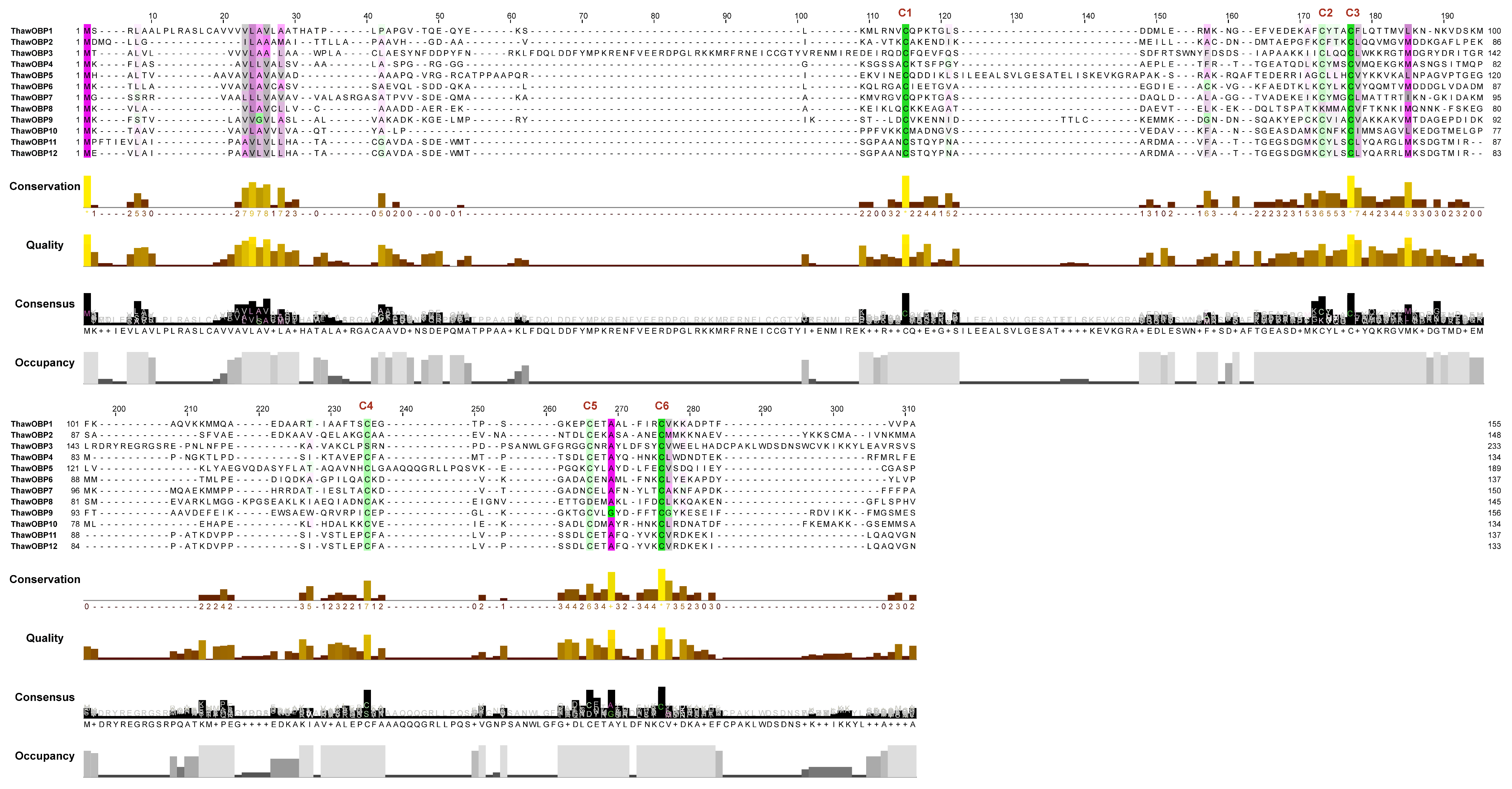
The genome of T. hawaiiensis was assembled using a hybrid approach that integrated the technologies of Oxford Nanopore long-read sequencing, Illumina short-read sequencing, and Hi-C chromatin conformation capture. This strategy produced a final assembly of 287.59 Mb, with a scaffold N50 of 13.84 Mb. According to BUSCO analysis, the assembled genome exhibits a high completeness of 98.7% [31]. As shown in Table 2, a total of 12 ThawOBP genes were identified through our BLASTP analysis. The genes, named ThawOBP1-ThawOBP12 based on their chromosomal locations (Figure 1), each possessed a complete open reading frame (ORF). The putative proteins range from 133 (ThawOBP12) to 233 (ThawOBP3) amino acids, while most are approximately 150 amino acids long. The analysis classified these genes into two subfamilies: the Classic subfamily (10 genes) and the Minus-C subfamily (two genes, namely ThawOBP3 and ThawOBP8) (Figure 2). All encoded proteins possess a putative N-terminal signal peptide, with the cleavage site predicted between amino acids 17 and 28. These putative ThawOBPs share from 31.4% (ThawOBP2) to 86.8% (ThawOBP5) sequence identity with their closest matches in the database, supported by highly significant E-values ranging from 8.28 × 10−128 to 3.67 × 10⁻⁸ (Table 2). Chromosomal mapping of the 12 identified ThawOBP genes across major genomic scaffolds was conducted. The genes are unevenly distributed, with sup_sca_14 harboring a significant number of ThawOBP loci. Several additional scaffolds also contain ThawOBP genes (Figure 1), suggesting a dispersed genomic organization of the odorant-binding protein family in this species.
Table 2.
Identification and characteristics of OBPs in Thrips hawaiiensis.
Figure 1.
Genomic distribution of ThawOBP genes. Gene positions are indicated along the scale (0–20 Mb).
Figure 2.
Amino acid sequence alignment of ThawOBPs. Different colors represent different categories of amino acids. In conserved regions, the colors exhibit high consistency, while in variable regions, they appear diverse and multicolored. * Indicates that the amino acid residues at this position are highly conserved.
3.2. Analysis of Phylogenetic Relationship and Gene Structure of OBPs in T. hawaiiensis
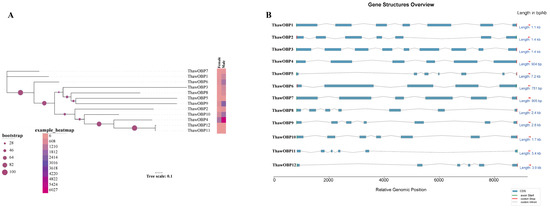
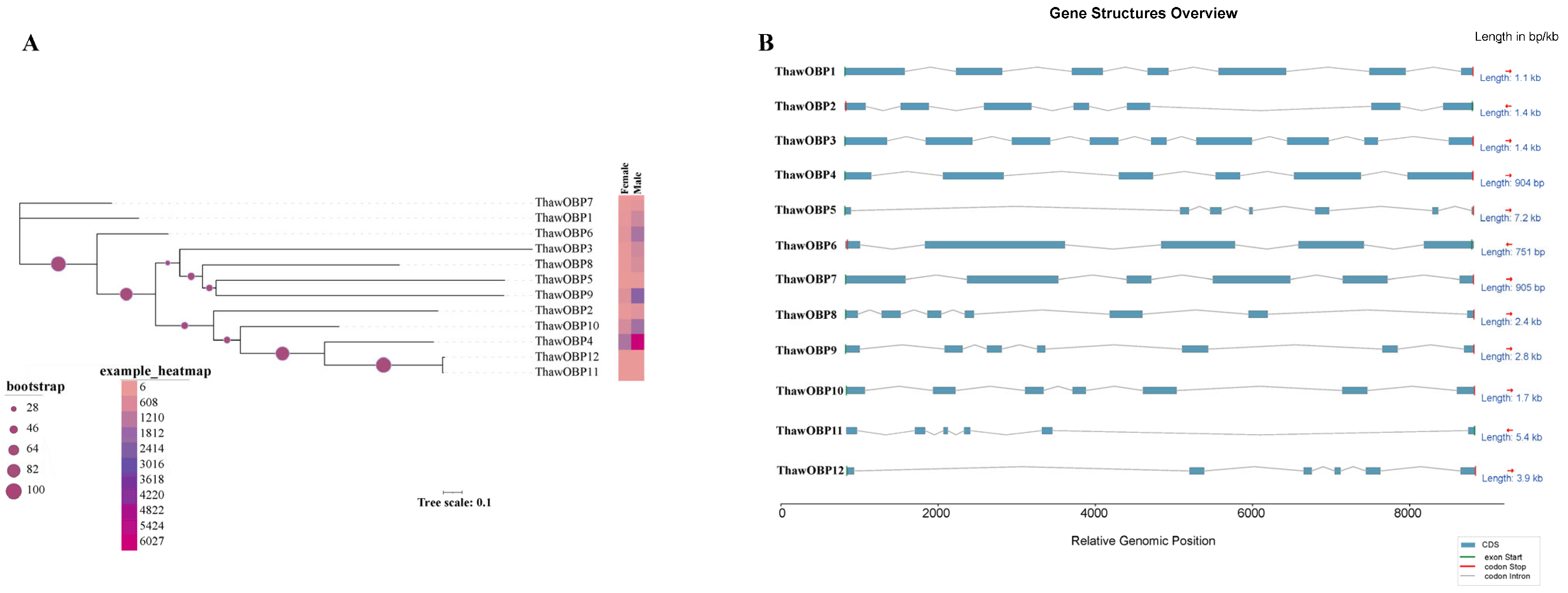
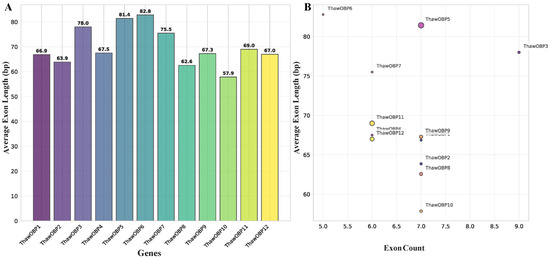
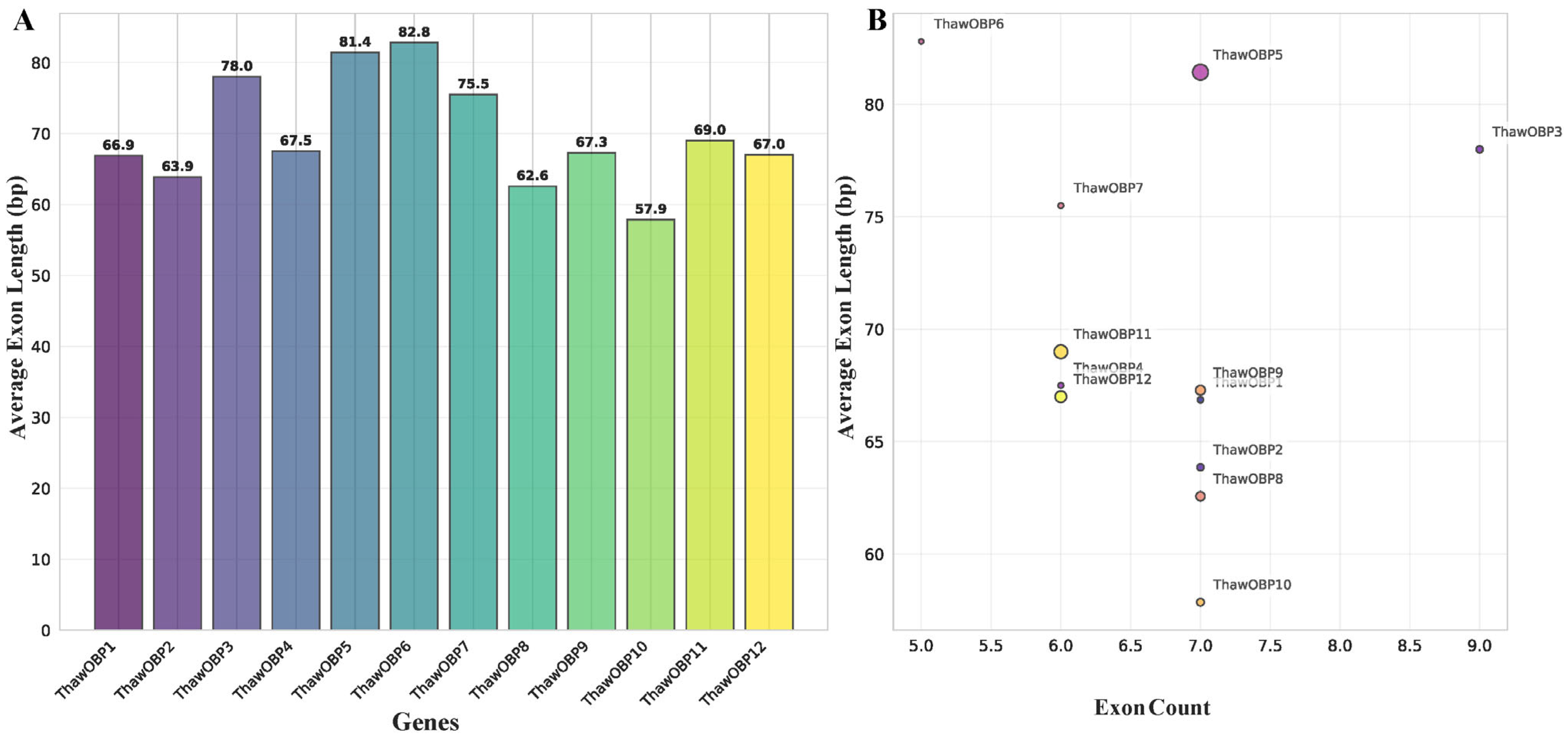
Investigation of the phylogenetic relationships and exon–intron structures of OBP genes in T. hawaiiensis unveiled considerable diversity within this gene family. A phylogenetic tree was constructed from full-length OBP sequences. The tree reveals the evolutionary relationships among the 12 ThawOBP genes, which are categorized into three distinct clades (Figure 3A). ThawOBP11 and ThawOBP12 form a closely related pair with high bootstrap support, suggesting a strong functional constraint. Similarly, ThawOBP4 and ThawOBP10 cluster together, indicating a close evolutionary relationship. ThawOBP1 and ThawOBP7 are positioned more distantly from the other groups, with ThawOBP1 and ThawOBP7 appearing as two of the more divergent sequences in the dataset (Figure 3A). The number of exons in these OBP genes varied between five and nine, with the majority containing six or seven (Figure 3B). Our analysis of the ThawOBP family showed that the average exon length was 69.97 bp. Furthermore, we found that the exon lengths across all 12 genes were relatively constrained, ranging from 57.9 to 82.8 bp (Figure 4A). Among the 12 ThawOBP genes, ThawOBP10 possessed the shortest average exon length (57.9 bp) and contained 7 exons. In contrast, ThawOBP3 had the highest exon count (9) and an average exon length of 78.0 bp. Furthermore, ThawOBP4, ThawOBP11, and ThawOBP12 shared an identical exon number of 6 and exhibited similar average exon lengths (Figure 4B). These structural features are entirely consistent with the clustering pattern observed in Figure 2.
Figure 3.
Characteristics of the ThawOBP genes. (A) Phylogenetic tree of twelve ThawOBP genes, constructed based on their protein sequences. The tree, with a scale of 0.1, shows bootstrap support values at key nodes. An adjacent heatmap displays the relative expression levels of each ThawOBP gene in adult females and males. (B) Schematic overview of the genomic structures of the ThawOBP genes. The diagrams detail the organization of coding sequences (CDS), non-coding regions, exons, start/stop codons, and introns. Red arrows represent the positive and negative strands.
Figure 4.
Exon structure characteristics of ThawOBP genes. (A) The average exon length across the 12 ThawOBP genes. (B) Visual representation of the exon architectural features (count and average length) in the 12 ThawOBP genes. Circle sizes are proportional to gene length, with larger circles representing longer genes.
3.3. Phylogenetic Relationship Analysis of All OBPs
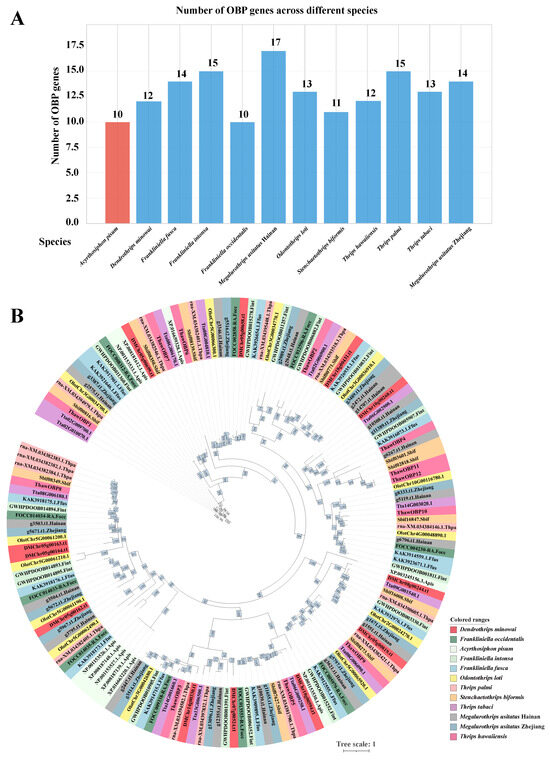
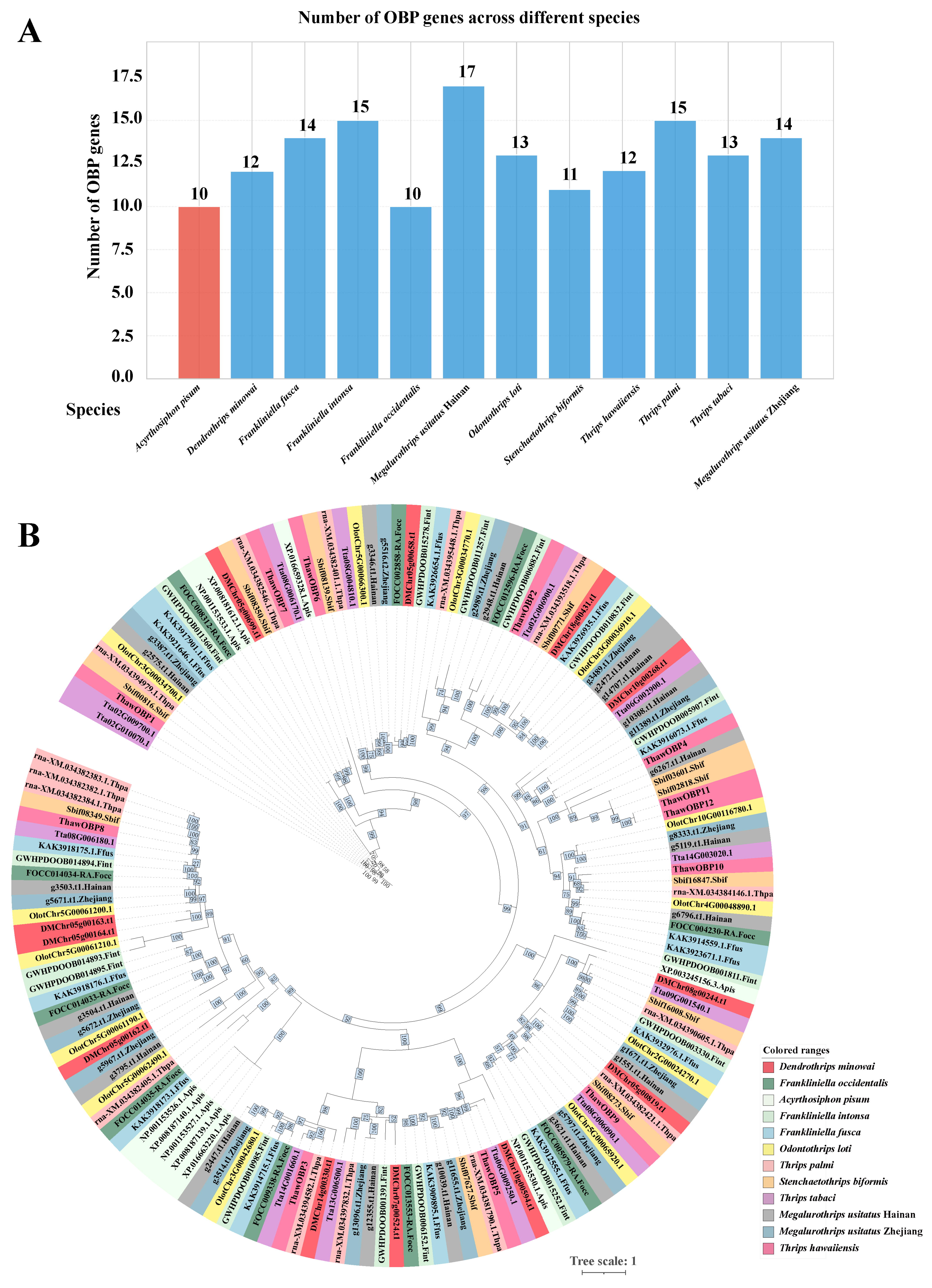
Using the same identification methodology, we conducted analyses in species including Dendrothrips minowai [34], Frankliniella occidentalis [36], Frankliniella intonsa [40], Frankliniella fusca [35], Odontothrips loti [37], Thrips palmi [38], Stenchaetothrips biformis [41], Thrips tabaci [39], Megalurothrips usitatus (Hainan) [32], Megalurothrips usitatus (Zhejiang) [33], and Acyrthosiphon pisum [49]. The results revealed that the number of OBPs identified ranges from 10 to 17 across these species (Figure 5A). To assess the phylogenetic relevance between Thrips hawaiiensis OBPs and other OBPs, all OBPs were aligned to generate unrooted trees. As shown in Figure 5B, the OBPs from the same species (Zhejiang and Hainan populations) were tightly clustered, whereas those from other thrips species were interspersed, a pattern likely attributable to their close phylogenetic relationship within the same family, Thripidae.
Figure 5.
Gene number comparison and phylogenetic analysis of odorant-binding proteins (OBPs) across multiple insect species. (A) The total number of OBP genes identified in insect species. The number of OBP genes in Acyrthosiphon pisum is represented by red bars, while that in thrips is represented by blue bars. (B) A maximum likelihood phylogenetic tree of OBP amino acid sequences. The tree includes representatives from various thrips species and the pea aphid (Acyrthosiphon pisum). Colored arcs highlight the clustering of sequences from specific species. Key nodes are numerically labeled with their corresponding bootstrap values. The scale bar represents the number of amino acid substitutions per site.
3.4. Expression Patterns of T. hawaiiensis OBP Genes
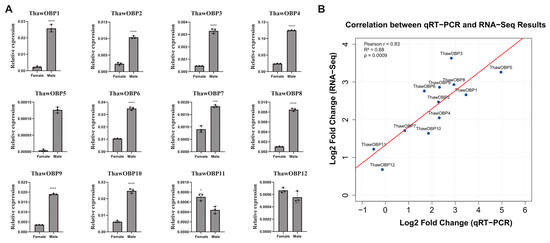
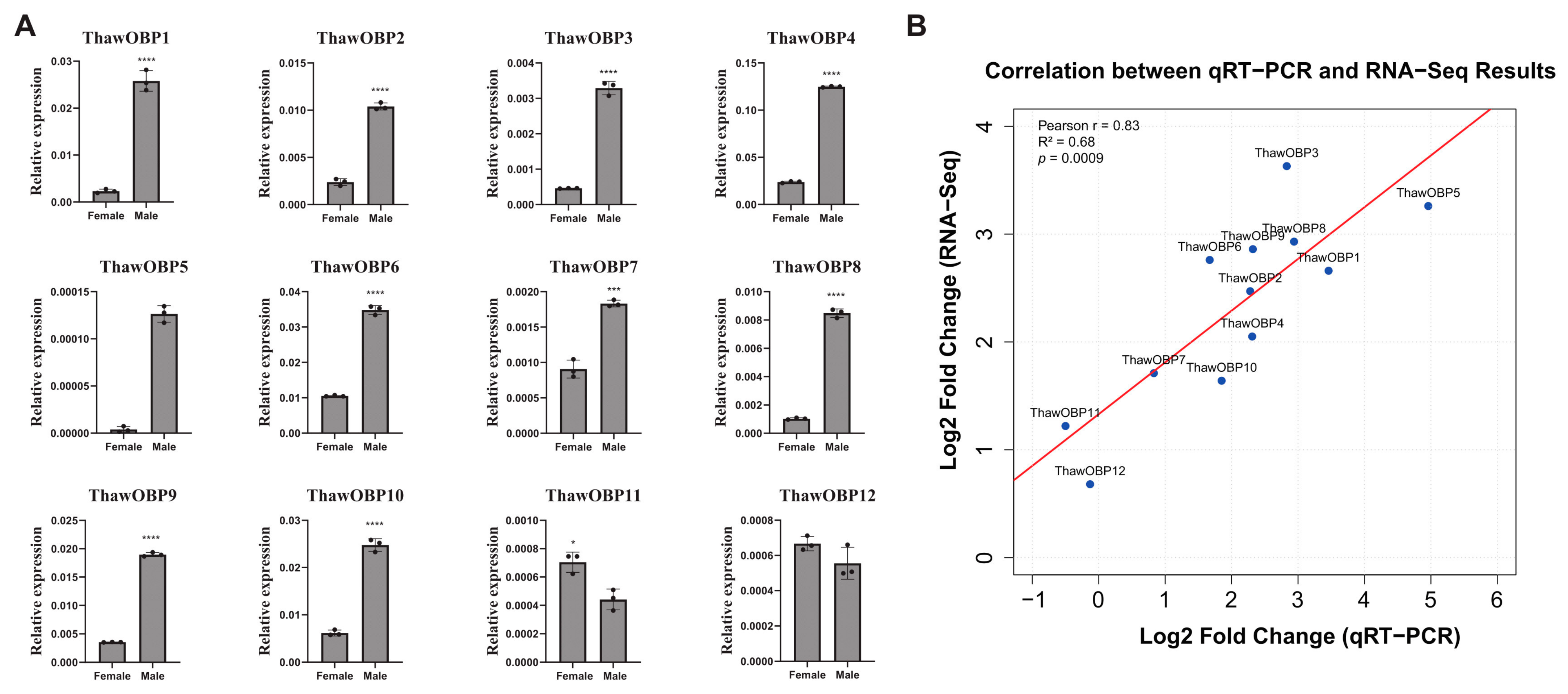
The transcriptomic analysis was conducted using a comprehensive reference-based pipeline. Raw sequencing reads were quality-trimmed and adapter-removed using Trimmomatic (v0.39) [50] to ensure data quality for downstream analyses. Subsequently, the processed reads were aligned to the reference genome using HISAT2 (v2.2.1) [51], a splice-aware aligner optimized for RNA-seq data. Finally, gene-level read counts were quantified from the aligned reads using HTSeq-count (v2.0.2) [52] with default union-counting mode, generating a count matrix for subsequent differential expression analysis. To validate the gene expression profiles obtained from transcriptome sequencing, we selected 12 OBP genes in Thrips hawaiiensis for confirmation by RT-qPCR. The results demonstrated that 10 of these genes exhibited male-biased expression (Figure 6A), consistent with transcriptomic predictions. A strong correlation (Pearson correlation coefficient r = 0.83) was observed between the RNA-Seq and RT-qPCR results, validating the reliability of the transcriptomic data (Figure 6B). The male-biased expression patterns were consistent across both methods for most genes, except for ThawOBP11 and ThawOBP12. For these two genes, a discrepancy was noted: they showed minimal expression bias by RT-qPCR (Log2FC ≈ 0 or negative) but were indicated as low-level male-biased by RNA-Seq, a divergence potentially due to their low expression levels or technical limitations.
Figure 6.
Validation of gene expression profiles. (A) Expression profile of OBP genes in female and male adults of Thrips hawaiiensis by RT-qPCR. Asterisks denote statistically significant differences between sexes as determined by Student’s t-test (* p < 0.05, *** p< 0.001, **** p < 0.0001). (B) Correlation analysis of the gene expression ratios obtained from RNA-Seq and RT-qPCR data. The RT-qPCR log2values (expression ratios; y-axis) were plotted against the RNA-Seq log2 values (x-axis). The Pearson correlation coefficient (r) is given in the plot, and the circle indicates the extremely significant difference at p < 0.01.
To investigate whether other olfaction-related gene families follow similar patterns, we also identified genes encoding chemosensory proteins (CSPs) (PF03392.9) using the same pipeline. A total of 11 CSP genes were identified in the T. hawaiiensis genome. The expression patterns of the 11 identified CSP genes were analyzed based on transcriptome sequencing and validated by RT-PCR. Transcriptomic data revealed that eight genes were significantly upregulated in males compared to females of T. hawaiiensis (Figure S1A). The RT-qPCR validation confirmed the accuracy of the transcriptomic expression profiles (Figure S1B). All primers used in this study are listed in Table S1. The results demonstrate that over half of the genes show significantly higher expression in males, consistent with the expression pattern observed for OBP genes.
4. Discussion
The identification of olfactory genes is fundamental to elucidating the molecular mechanisms of olfaction. In many insect species, odorant-binding proteins (OBPs) have been identified through transcriptomic and genomic analyses. Notably, studies have reported 51 OBP genes in Drosophila melanogaster [53], 65 in Anopheles gambiae [54], 64 in Aedes aegypti [54], 53 in Culex quinquefasciatus [54], 44 in Bombyx mori [55], and 50 in Tribolium castaneum [56]. In the present study, by analyzing our previously published genome data, we expanded the repertoire of OBPs in the insect species Thrips hawaiiensis to 12. While the 12 OBPs in T. hawaiiensis are substantially fewer than those in model insects such as D. melanogaster, this number is comparable to other thrips species, such as M. usitatus (14,17), F. occidentalis (10), T. palmi (15), F. intonsa (15), and O. loti (13) (Figure 5A). The number of OBP genes identified in other insects is significantly larger than that in thrips. This comparative reduction in thrips could be due to a simplified olfactory system or a unique evolutionary trajectory. Furthermore, phylogenetic analysis revealed that ThawOBP11 and ThawOBP12 cluster into a clade and exhibit the highest degree of sequence similarity (Figure 3A), a finding supported by sequence alignment (Figure 2).
For adult thrips, the most critical behaviors are host plant seeking, mating, and reproduction. These behaviors involve the extensive detection of both plant volatiles and thrips pheromones [57,58]. Male adults of both thrips species synthesize an aggregation pheromone detectable by both sexes that mediates attraction [59,60]. Consequently, these genes likely play a role in mediating the detection of both plant volatiles and the male-derived aggregation pheromone in Thrips hawaiiensis. Extensive research has demonstrated that odorant exposure can alter the expression levels of OBPs [61,62,63]. Through in vitro and in vivo functional assays in Bactrocera dorsalis, OBP83g-2 was identified as a key OBP involved in γ-octalactone perception, which was further confirmed to play a significant role in γ-octalactone-mediated oviposition behavior [64]. In Hyphantria cunea, OBP2 plays a crucial role in guiding larvae toward food sources that contain adult sex pheromones [65]. While the knockdown of SfruOBP18 did not impair larval survival or development, our combined RNAi and bioassay approach uncovered its critical function in conferring tolerance to multiple insecticides. This suggests a novel and non-canonical role for SfruOBP18 in insecticide susceptibility in Spodoptera frugiperda [66]. In our study, gene expression pattern analysis shows strong male-specific expression of OBP and CSP genes in T. hawaiiensis (Figure 6A and Figure S1). This pattern, also reported for OBPs and CSPs in M. usitatus, Frankliniella occidentalis, and Frankliniella intonsa [26,30], further supports their functional role in male-driven behaviors such as mate location and foraging. In experiments with Rhynchophorus ferrugineus, females injected with OBP-dsRNA showed a significant decrease in the expression of both RferOBP3 and RferOBP1768, which led to impaired perception of the odorants trans-2,4-nonadienal and trans-2-nonenal [67]. Docking results suggested a role for FoccOBP4/FintOBP4, FoccOBP6/FintOBP6, and FoccCSP2/FintCSP2 in transporting the major pheromone neryl (S)-2-methylbutanoate, with FoccOBP6/FintOBP6, FoccCSP2/FintCSP2, and FoccCSP3/FintCSP3 also implicated in binding the minor component (R)-lavandulyl acetate [30]. Based on these findings, we hypothesize that the majority of OBP and CSP genes in T. hawaiiensis are expressed at higher levels in males than in females, suggesting that males may possess a heightened sensitivity to environmental odors.
5. Conclusions
In summary, we report the first genome-wide identification of odorant-binding protein (OBP) genes and chemosensory protein (CSP) genes in Thrips hawaiiensis and characterize their expression profiles in both female and male T. hawaiiensis. This work provides crucial data for elucidating the functions of olfactory proteins in T. hawaiiensis, thereby paving the way for novel, targeted management strategies against thrips pests.
Supplementary Materials
The following supporting information can be downloaded at https://www.mdpi.com/article/10.3390/biology15020170/s1: Table S1: CSP genes primer information used for RT-qPCR; Figure S1: Expression profiles of CSP genes. (A) A heatmap illustrates the relative expression levels of each CSP gene in female and male adults. (B) Relative expression levels of CSP genes in female and male Thrips hawaiiensis adults were assessed using RT-qPCR. Asterisks indicate statistically significant differences between sexes (Student’s t-test: * p < 0.05, *** p < 0.001, and **** p < 0.0001).
Author Contributions
Conceptualization, X.H., Y.L. and Q.F.; methodology, X.H. and Y.L.; software, X.H.; validation, Q.F., formal analysis, X.H. and Q.F.; investigation, Y.L.; resources, X.H.; data curation, X.H.; writing—original draft preparation, X.H.; writing—review and editing, Y.L.; visualization, X.H. and Q.F.; supervision, X.H.; project administration, X.H. and Y.L.; funding acquisition, X.H. and Y.L. All authors have read and agreed to the published version of the manuscript.
Funding
This work was supported by Ningbo Yongjiang grant (2022A-220-G).
Institutional Review Board Statement
Not applicable.
Informed Consent Statement
Not applicable.
Data Availability Statement
The genomic data for Thrips hawaiiensis were retrieved from the figshare database under the accession https://doi.org/10.6084/m9.figshare.26125162.
Acknowledgments
We thank Heng Li and Yun Yu (Institute of Plant Protection, Fujian Academy of Agricultural Sciences, Fuzhou, China) for providing the Thrips hawaiiensis insects used in this study. This work was supported by the High-performance Computing Center, Institute of Plant Virology, Ningbo University, 315221, Ningbo, China.
Conflicts of Interest
The authors declare no competing financial interests.
References
- Murai, T. Development and reproductive capacity of Thrips hawaiiensis (Thysanoptera: Thripidae) and its potential as a major pest. Bull. Entomol. Res. 2001, 91, 193–198. [Google Scholar] [CrossRef] [Scilit]
- Reynaud, P.; Balmès, V.; Pizzol, J. Thrips hawaiiensis (Morgan, 1913) (Thysanoptera: Thripidae), an Asian pest thrips now established in Europe. EPPO Bull. 2008, 38, 155–160. [Google Scholar] [CrossRef] [Scilit]
- Aliakbarpour, H.; Che Salmah, M.R. Seasonal abundance and spatial distribution of larval and adult thrips (Thysanoptera) on weed host plants in mango orchards in Penang, Malaysia. Appl. Entomol. Zool. 2011, 46, 185–194. [Google Scholar] [CrossRef] [Scilit]
- Goldarazena, A. First record of Thrips hawaiiensis (Morgan, 1913) (Thysanoptera: Thripidae), an Asian pest thrips in Spain. EPPO Bull. 2011, 41, 170–173. [Google Scholar] [CrossRef] [Scilit]
- Mound, L.A. Thysanoptera: Diversity and interactions. Annu. Rev. Entomol. 2005, 50, 247–269. [Google Scholar] [CrossRef] [Scilit] [PubMed]
- Fu, B.; Qiu, H.; Li, Q.; Tang, L.; Zeng, D.; Liu, K.; Gao, Y. Flower injection of imidacloprid and spirotetramat: A novel tool for the management of banana thrips Thrips hawaiiensis. J. Pest Sci. 2020, 93, 1073–1084. [Google Scholar] [CrossRef] [Scilit]
- Zhang, F.; Fu, B.; Liu, K.; Qiu, H.; Wu, Y. The effect of temperature on the development and survival of Thrips hawaiiensis (Morgan). Acta Ecol. Sin. 2014, 34, 3895–3899. [Google Scholar]
- Kurosawa, M.; Takaoka, I.; Naito, T. Thrips infesting the tobacco plants in Japan (Thysanoptera). Jpn. J. Entomol. 1964, 32, 402. [Google Scholar]
- Woo, K.; Paik, W. Studies on the thrips (Thysanoptera) unrecorded in Korea (I). Korean J. Plant Prot. 1971, 10, 69–73. [Google Scholar]
- Chen, J.-S.; Lo, P.K.-C. Differential preference of the flower-dwelling thrip, Thrips hawaiiensis (Morgan) (Thysanoptera: Thripidae), to some gladiolus cultivars. J. Agric. Res. China 1987, 36, 317–326. [Google Scholar]
- Chandra, J.; Lal, O. Record of thrips on some vegetables and ornamental plants from Kulu Valley, Himachal Pradesh. Himachal Pradesh Indian J. Entomol. 1973, 35, 164–166. [Google Scholar]
- Ketavan, C. Thrips of Economic Importance and Their Control in Thailand; Kasetsart University: Bangkok, Thailand, 1978. [Google Scholar]
- Chen, J.-Y.; Gao, Y.-L.; Han, D.-Y.; Li, L.; Zhang, F.-P.; Niu, L.-M.; Fu, Y.-G. Species composition and distribution of thrips (Thysanoptera) in mango orchards of China. Anim. Biol. 2018, 68, 175–192. [Google Scholar] [CrossRef] [Scilit]
- Chiu, H.; Shen, S.; Wu, M. Occurrence and damage of thrips in Citrus orchards in southern Taiwan. Chin. J. Entomol. 1991, 11, 310–316. [Google Scholar]
- Tsai, Y.; Hwang, M.; Chen, H. Occurrence and damage of Thrips hawaiiensis in banana orchards. Chin. J. Entomol. 1992, 12, 231–237. [Google Scholar]
- Jhala, R.; Borad, P.; Bharpoda, T. Incidence of Thrips hawaiiensis (Morgan) on banana in Gujarat. Insect Environ. 2004, 10, 55. [Google Scholar]
- Marullo, R.; De Grazia, A. Thrips hawaiiensis a pest thrips from Asia newly introduced into Italy. Bull. Insectology 2017, 70, 27–30. [Google Scholar]
- Andersson, M.N.; Löfstedt, C.; Newcomb, R.D. Insect olfaction and the evolution of receptor tuning. Front. Ecol. Evol. 2015, 3, 53. [Google Scholar] [CrossRef] [Scilit]
- Zhou, J.-J. Odorant-binding proteins in insects. Vitam. Horm. 2010, 83, 241–272. [Google Scholar]
- Rützler, M.; Zwiebel, L. Molecular biology of insect olfaction: Recent progress and conceptual models. J. Comp. Physiol. A 2005, 191, 777–790. [Google Scholar] [CrossRef] [Scilit]
- Zhu, J.; Guo, M.; Ban, L.; Song, L.-M.; Liu, Y.; Pelosi, P.; Wang, G. Niemann-Pick C2 proteins: A new function for an old family. Front. Physiol. 2018, 9, 52. [Google Scholar] [CrossRef] [Scilit]
- Sun, L.; Wang, Q.; Wang, Q.; Dong, K.; Xiao, Y.; Zhang, Y.-J. Identification and characterization of odorant binding proteins in the forelegs of Adelphocoris lineolatus (Goeze). Front. Physiol. 2017, 8, 735. [Google Scholar] [CrossRef] [Scilit] [PubMed]
- Brito, N.F.; Moreira, M.F.; Melo, A.C. A look inside odorant-binding proteins in insect chemoreception. J. Insect Physiol. 2016, 95, 51–65. [Google Scholar] [CrossRef] [Scilit] [PubMed]
- Tang, B.; Tai, S.; Dai, W.; Zhang, C. Expression and functional analysis of two odorant-binding proteins from Bradysia odoriphaga (Diptera: Sciaridae). J. Agric. Food Chem. 2019, 67, 3565–3574. [Google Scholar] [CrossRef] [Scilit] [PubMed]
- Pelosi, P.; Maida, R. Odorant-binding proteins in insects. Comp. Biochem. Physiol. Part B Biochem. Mol. Biol. 1995, 111, 503–514. [Google Scholar] [CrossRef] [Scilit]
- Xia, G.; Yang, L.; Li, B.; Wang, Q.; Huang, L.; Tian, X.; Zhang, G. Genome-Wide Identification and Expression Profiling of Odorant-Binding Protein Genes in the Bean Flower Thrips Megalurothrips usitatus (Bagnall) (Thysanoptera: Thripidae). Insects 2025, 16, 212. [Google Scholar] [CrossRef] [Scilit]
- Xu, P.; Zwiebel, L.; Smith, D. Identification of a distinct family of genes encoding atypical odorant-binding proteins in the malaria vector mosquito, Anopheles gambiae. Insect Mol. Biol. 2003, 12, 549–560. [Google Scholar] [CrossRef] [Scilit]
- Zhou, J.J.; He, X.L.; Pickett, J.; Field, L. Identification of odorant-binding proteins of the yellow fever mosquito Aedes aegypti: Genome annotation and comparative analyses. Insect Mol. Biol. 2008, 17, 147–163. [Google Scholar] [CrossRef] [Scilit]
- Vogt, R.G.; Riddiford, L.M. Pheromone binding and inactivation by moth antennae. Nature 1981, 293, 161–163. [Google Scholar] [CrossRef] [Scilit]
- Li, X.; Cheng, J.; Chen, L.; Huang, J.; Zhang, Z.; Zhang, J.; Ren, X.; Hafeez, M.; Zhou, S.; Dong, W. Comparison and functional analysis of odorant-binding proteins and chemosensory proteins in two closely related thrips species, Frankliniella occidentalis and Frankliniella intonsa (Thysanoptera: Thripidae) based on antennal transcriptome analysis. Int. J. Mol. Sci. 2022, 23, 13900. [Google Scholar] [CrossRef] [Scilit]
- Hu, X.; Tian, H.; Chen, Y.; Zheng, Y.; Wei, H.; Chen, J.-P.; Zhang, C.-X.; Chen, Y.; Li, Y. Genome assembly of Hawaiian flower thrips Thrips hawaiiensis (Thysanoptera: Thripidae). Sci. Data 2025, 12, 225. [Google Scholar] [CrossRef] [Scilit]
- Ma, L.; Liu, Q.; Wei, S.; Liu, S.; Tian, L.; Song, F.; Duan, Y.; Cai, W.; Li, H. Chromosome-level genome assembly of bean flower thrips Megalurothrips usitatus (Thysanoptera: Thripidae). Sci. Data 2023, 10, 252. [Google Scholar] [CrossRef] [Scilit]
- Zhang, Z.; Bao, J.; Chen, Q.; He, J.; Li, X.; Zhang, J.; Liu, Z.; Wu, Y.; Wang, Y.; Lu, Y. The Chromosome-Level Genome Assembly of Bean Blossom Thrips (Megalurothrips usitatus) Reveals an Expansion of Protein Digestion-Related Genes in Adaption to High-Protein Host Plants. Int. J. Mol. Sci. 2023, 24, 11268. [Google Scholar] [CrossRef] [Scilit] [PubMed]
- Xiu, C.; Zhao, D.; Zhang, J.; Liu, H.; Wang, Y.; Liu, H.; Cai, X.; Luo, Z.; Bian, L.; Fu, N. Chromosome-level genome assembly of Dendrothrips minowai and genomic analysis highlights distinct adaptations to high polyphenols in tea plants. Pest Manag. Sci. 2025, 81, 4143–4153. [Google Scholar] [CrossRef] [Scilit] [PubMed]
- Catto, M.A.; Labadie, P.E.; Jacobson, A.L.; Kennedy, G.G.; Srinivasan, R.; Hunt, B.G. Pest status, molecular evolution, and epigenetic factors derived from the genome assembly of Frankliniella fusca, a thysanopteran phytovirus vector. BMC Genom. 2023, 24, 343. [Google Scholar] [CrossRef] [Scilit] [PubMed]
- Song, W.; Cao, L.-J.; Chen, J.-C.; Bao, W.-X.; Wei, S.-J. Chromosome-level genome assembly of the western flower thrips Frankliniella occidentalis. Sci. Data 2024, 11, 582. [Google Scholar] [CrossRef] [Scilit]
- Luo, Y.; Wei, S.; Dai, W.; Miao, M.; Wang, Y.; Zhang, R.; Ban, L. Chromosome-level genome assembly of Odontothrips loti Haliday (Thysanoptera: Thripidae). Sci. Data 2024, 11, 451. [Google Scholar] [CrossRef] [Scilit]
- Guo, S.K.; Cao, L.J.; Song, W.; Shi, P.; Gao, Y.F.; Gong, Y.J.; Chen, J.C.; Hoffmann, A.A.; Wei, S.J. Chromosome-level assembly of the melon thrips genome yields insights into evolution of a sap-sucking lifestyle and pesticide resistance. Mol. Ecol. Resour. 2020, 20, 1110–1125. [Google Scholar] [CrossRef] [Scilit]
- Gao, Y.; Ji, J.; Xu, C.; Wang, L.; Zhang, K.; Li, D.; Wang, X.; Xin, M.; Hua, H.; Chen, L. Chromosome-level genome assembly of cotton thrips Thrips tabaci (Thysanoptera: Thripidae). Sci. Data 2024, 11, 1003. [Google Scholar] [CrossRef] [Scilit]
- Song, W.; Wang, J.-X.; Cao, L.-J.; Chen, J.-C.; Bao, W.-X.; Chen, M.; Wei, S.-J. A chromosome-level genome for the flower thrips Frankliniella intonsa. Sci. Data 2024, 11, 280. [Google Scholar] [CrossRef] [Scilit]
- Hu, Q.-L.; Ye, Z.-X.; Zhuo, J.-C.; Li, J.-M.; Zhang, C.-X. A chromosome-level genome assembly of Stenchaetothrips biformis and comparative genomic analysis highlights distinct host adaptations among thrips. Commun. Biol. 2023, 6, 813. [Google Scholar] [CrossRef] [Scilit]
- Almagro Armenteros, J.J.; Tsirigos, K.D.; Sønderby, C.K.; Petersen, T.N.; Winther, O.; Brunak, S.; von Heijne, G.; Nielsen, H. SignalP 5.0 improves signal peptide predictions using deep neural networks. Nat. Biotechnol. 2019, 37, 420–423. [Google Scholar] [CrossRef] [Scilit] [PubMed]
- Edgar, R.C. MUSCLE: Multiple sequence alignment with high accuracy and high throughput. Nucleic Acids Res. 2004, 32, 1792–1797. [Google Scholar] [CrossRef] [Scilit] [PubMed]
- Waterhouse, A.M.; Procter, J.B.; Martin, D.M.; Clamp, M.; Barton, G.J. Jalview Version 2—A multiple sequence alignment editor and analysis workbench. Bioinformatics 2009, 25, 1189–1191. [Google Scholar] [CrossRef] [Scilit] [PubMed]
- Nguyen, L.T.; Schmidt, H.A.; von Haeseler, A.; Minh, B.Q. IQ-TREE: A fast and effective stochastic algorithm for estimating maximum-likelihood phylogenies. Mol. Biol. Evol. 2015, 32, 268–274. [Google Scholar] [CrossRef] [Scilit]
- Chao, J.-T.; Kong, Y.-Z.; Wang, Q.; Sun, Y.-H.; Gong, D.-P.; Lv, J.; Liu, G.-S. MapGene2Chrom, a tool to draw gene physical map based on Perl and SVG languages. Hereditas 2015, 37, 91–97. [Google Scholar]
- Chao, J.; Li, Z.; Sun, Y.; Aluko, O.O.; Wu, X.; Wang, Q.; Liu, G. MG2C: A user-friendly online tool for drawing genetic maps. Mol. Hortic. 2021, 1, 16. [Google Scholar] [CrossRef] [Scilit]
- Chen, Y.-X.; Tian, H.-J.; Lin, S.; Yu, Y.; Xie, L.-C.; Li, H.; Chen, Y.; Lin, T.; Gu, X.-J.; Wei, H. Sublethal effects of emamectin benzoate on development, reproduction, and vitellogenin and vitellogenin receptor gene expression in Thrips hawaiiensis (Thysanoptera: Thripidae). J. Insect Sci. 2023, 23, 12. [Google Scholar] [CrossRef] [Scilit]
- Consortium, I.A.G. Genome sequence of the pea aphid Acyrthosiphon pisum. PLoS Biol. 2010, 8, e1000313. [Google Scholar]
- Bolger, A.M.; Lohse, M.; Usadel, B. Trimmomatic: A flexible trimmer for Illumina sequence data. Bioinformatics 2014, 30, 2114–2120. [Google Scholar] [CrossRef] [Scilit]
- Kim, D.; Paggi, J.M.; Park, C.; Bennett, C.; Salzberg, S.L. Graph-based genome alignment and genotyping with HISAT2 and HISAT-genotype. Nat. Biotechnol. 2019, 37, 907–915. [Google Scholar] [CrossRef] [Scilit]
- Anders, S.; Pyl, P.T.; Huber, W. HTSeq—A Python framework to work with high-throughput sequencing data. Bioinformatics 2015, 31, 166–169. [Google Scholar] [PubMed]
- Hekmat-Scafe, D.S.; Scafe, C.R.; McKinney, A.J.; Tanouye, M.A. Genome-wide analysis of the odorant-binding protein gene family in Drosophila melanogaster. Genome Res. 2002, 12, 1357–1369. [Google Scholar] [CrossRef] [Scilit] [PubMed]
- Manoharan, M.; Ng Fuk Chong, M.; Vaïtinadapoulé, A.; Frumence, E.; Sowdhamini, R.; Offmann, B. Comparative genomics of odorant binding proteins in Anopheles gambiae, Aedes aegypti, and Culex quinquefasciatus. Genome Biol. Evol. 2013, 5, 163–180. [Google Scholar] [CrossRef] [Scilit] [PubMed]
- Gong, D.-P.; Zhang, H.-J.; Zhao, P.; Xia, Q.-Y.; Xiang, Z.-H. The odorant binding protein gene family from the genome of silkworm, Bombyx mori. BMC Genom. 2009, 10, 332. [Google Scholar] [CrossRef] [Scilit]
- Dippel, S.; Oberhofer, G.; Kahnt, J.; Gerischer, L.; Opitz, L.; Schachtner, J.; Stanke, M.; Schütz, S.; Wimmer, E.A.; Angeli, S. Tissue-specific transcriptomics, chromosomal localization, and phylogeny of chemosensory and odorant binding proteins from the red flour beetle Tribolium castaneum reveal subgroup specificities for olfaction or more general functions. BMC Genom. 2014, 15, 1141. [Google Scholar] [CrossRef] [Scilit]
- Terry, I.; Schneider, M. Copulatory behaviour and mating frequency of the western flower thrips, Frankliniella occidentalis (Insecta: Thysanoptera). J. Pure Appl. Zool. 1993, 4, 339–354. [Google Scholar]
- Steenbergen, M.; Abd-el-Haliem, A.; Bleeker, P.; Dicke, M.; Escobar-Bravo, R.; Cheng, G.; Haring, M.A.; Kant, M.R.; Kappers, I.; Klinkhamer, P.G. Thrips advisor: Exploiting thrips-induced defences to combat pests on crops. J. Exp. Bot. 2018, 69, 1837–1848. [Google Scholar] [CrossRef] [Scilit]
- Zhang, P.J.; Zhu, X.Y.; Lu, Y.B. Behavioural and chemical evidence of a male-produced aggregation pheromone in the flower thrips Frankliniella intonsa. Physiol. Entomol. 2011, 36, 317–320. [Google Scholar] [CrossRef] [Scilit]
- James, G.; Hamilton, C.; Hall, D.R.; William, D.; Kirk, J. Identification of a male-produced aggregation pheromone in the western flower thrips Frankliniella occidentalis. J. Chem. Ecol. 2005, 31, 1369–1379. [Google Scholar] [CrossRef] [Scilit]
- Yin, J.; Wang, C.; Fang, C.; Zhang, S.; Cao, Y.; Li, K.; Leal, W.S. Functional characterization of odorant-binding proteins from the scarab beetle Holotrichia oblita based on semiochemical-induced expression alteration and gene silencing. Insect Biochem. Mol. Biol. 2019, 104, 11–19. [Google Scholar]
- Wu, H.; Liu, Y.; Shi, X.; Zhang, X.; Ye, C.; Zhu, K.Y.; Zhu, F.; Zhang, J.; Ma, E. Transcriptome analysis of antennal cytochrome P450s and their transcriptional responses to plant and locust volatiles in Locusta migratoria. Int. J. Biol. Macromol. 2020, 149, 741–753. [Google Scholar] [CrossRef] [Scilit]
- Mappin, F.; Bellantuono, A.J.; Ebrahimi, B.; DeGennaro, M. Odor-evoked transcriptomics of Aedes aegypti mosquitoes. PLoS ONE 2023, 18, e0293018. [Google Scholar] [CrossRef] [Scilit]
- Chen, X.; Lei, Q.; Liang, C.; Wang, J.; Jiang, H. A case study on the γ-octalactone induced expression of Obp83g-2 in Bactrocera dorsalis (Hendel) revealed the transcriptional regulation of insect odorant binding protein. Commun. Biol. 2025, 8, 1355. [Google Scholar] [CrossRef] [Scilit]
- Yuan, T.; Wang, H.; Zhang, Q.-H.; Wickham, J.D.; Zhang, Y.-N.; Gu, T.; Zhang, L. General Odorant Binding Protein 2 and Odorant Binding Protein 36 facilitate the recognition of adult sex pheromone components by Hyphantria cunea larvae. Insect Sci. 2025. Advance online publication. [Google Scholar] [CrossRef] [Scilit]
- Zhao, R.; Wang, H.-H.; Wang, Z.; Xiao, X.; Yin, X.-H.; Hu, S.-Y.; Miao, H.-N.; Zhang, Y.-J.; Liang, P.; Gu, S.-H. Omics Analysis of Odorant-Binding Proteins and Cuticle-Enriched SfruOBP18 Confers Multi-Insecticide Tolerance in Spodoptera frugiperda. J. Agric. Food Chem. 2024, 72, 22532–22544. [Google Scholar] [CrossRef] [Scilit]
- Yuan, W.; Rao, X.; Zhong, B.; Chen, M.; Ali, H.; Lv, C.; Niu, C. Exploring the functional profiles of odorant binding proteins crucial for sensing key odorants in the new leaves of coconut palms in Rhynchophorus ferrugineus. Int. J. Biol. Macromol. 2024, 261, 129852. [Google Scholar] [CrossRef] [Scilit]

Disclaimer/Publisher’s Note: The statements, opinions and data contained in all publications are solely those of the individual author(s) and contributor(s) and not of MDPI and/or the editor(s). MDPI and/or the editor(s) disclaim responsibility for any injury to people or property resulting from any ideas, methods, instructions or products referred to in the content. |
© 2026 by the authors. Licensee MDPI, Basel, Switzerland. This article is an open access article distributed under the terms and conditions of the Creative Commons Attribution (CC BY) license.