


Simple Summary
Knowledge of plants and their uses is an essential link between people and the environment. To foster biocultural diversity as a vehicle for mutually beneficial coexistence, we need to understand how plant-related knowledge circulates. Considering the rapid loss of biocultural diversity, especially in peripheral areas, the local dimensions of ecological knowledge circulation merit greater scholarly attention. Exploring the current Polish-Lithuanian-Belarusian borderland, we found relatively homogeneous wild food plant knowledge circulated within historically united, yet now separated, local communities of Lithuanians and Poles. However, we call for deeper qualitative analysis in order to detect recent changes in the flow of knowledge.
Abstract
The circulation of local ecological knowledge (LEK) is a promising avenue of research for wild plant studies. To encourage the acceptance, celebration, and appreciation of biocultural diversity, which is rapidly disappearing nowadays, we need to estimate and assess multifaceted local ecological knowledge. It has direct application for local communities in informing effective policies for improving food security and building community-specific responses to environmental and social transitions. The present study draws on data collected among two ethnic groups—Lithuanians and Poles—via 200 semi-structured in-depth interviews and participant observation conducted in 2018 and 2019 in Podlasie Voivodeship (Poland), the Vilnius Region (Lithuania), and the Hrodna Region (Belarus). We aimed to observe LEK circulation in the border area through cross-ethnic and cross-country comparisons. A total of 2812 detailed use reports of wild plants were recorded. In total, 72 wild plant taxa belonging to 33 plant families were used across the food domain. Our findings show that cross-country differences were minimal, while there was some variation between the ethnic groups selected as case studies. We emphasize the need, in future studies, to combine quantitative research with qualitative approaches in order to more thoroughly identify peculiarities of cross-border circulation as a reservoir for community food resilience and biocultural diversity.
1. Introduction
Biocultural diversity is rapidly disappearing [1,2], especially in peripheral areas [3]. To encourage the acceptance, celebration, and appreciation of biocultural diversity, we need to estimate and assess the importance of the local dimensions of ecological knowledge.
Border regions have been at the center of scientific debate from different perspectives [4,5,6]. Driven by various political, social, and cultural processes, human activities such as border shifts strongly modify natural environments [7] and impact the flow of knowledge. Border areas might represent places to study environmental knowledge as a dynamic process [8]. Local communities constantly reshape their knowledge through interconnections, mutual influences, and non-linear flows of information [9,10,11]. Depending on boundary appearance/disappearance and opening/closure, the border area could be a barrier, filter, or contact zone [12] where knowledge can or cannot circulate.
The mixing of different cultural elements and a dynamically changing environment in border areas foster creating and maintaining multiple communication channels between local communities [13]. At the same time, in borderlands, intensive circulation of knowledge might contribute to the formation of shared uses and unique cultural realities that contradict the image of boundaries as a barrier [14]. The separations created by states provide clues to the development of unofficial social relations and hybrid manifestations, specifically, language confluence [15]. Several studies have highlighted the so-called “border paradox” [16] where national boundaries have determined and facilitated the creation of shared cross-border flows of knowledge. Borders, as the social construction of peripherality [17], might lead to the homogenization of knowledge [18].
Recently, there has been a growing body of research concerned with the importance of borders in LEK transmission [19,20]. Several researchers have noted changes in the use of natural resources [21] (p. 60) and significant divergence in LEK between the divided border communities [22,23], despite many years of living together in the same area and sharing the same religious faith [24], as well as accessing multilingual folk and scientific literature regarding the use of wild plants [25]. In this vein, various ethnobotanical border studies have found that differences within the compared ethnic groups are more pronounced than those with other local communities currently inhabiting the same country [26,27].
Nevertheless, peripheral border areas represent an ideal study site for exploring the phenomenon of LEK circulation in its temporal and spatial dynamics. The present-day Polish-Lithuanian-Belarusian triangle has been subjected to a series of border shifts. For centuries, the triangle between Poland, Lithuania, and Belarus has been a multi-linguistic, multi-religious, and multi-cultural area to a certain extent [28,29]. Historical conditions and its geographically peripheral location have made this region a place of cohabitation of various ethnic groups: Poles, Lithuanians, Belarusians, Ukrainians, Jews, Russians (predominantly Old-Believers), Tatars, Roma, etc. The studied cultural landscape has become a reservoir, and even a hotspot, of biological and cultural diversity. The selected area and its communities have been investigated from historical [30,31,32,33,34,35] and modern ethnobotanical perspectives [36,37,38,39]. Thus far, however, our understanding of the degree to which border shifts may result in the homogeneity of culturally unique knowledge has been limited.
The aims of the study were to (1) document LEK on wild food plants among Lithuanian and Polish communities in the Polish-Lithuanian-Belarusian borderland, (2) conduct cross-border and cross-ethnic comparisons in order to understand the dynamics of knowledge circulation within the region, and (3) evaluate the effects of border shifts on LEK circulation within the tri-border area. On the basis of the potential influence of state frontiers, we expect to see, as a general trend, knowledge heterogeneity among the three countries and relative knowledge homogeneity within the cross-border ethnic groups.
2. Materials and Methods
2.1. Study Site and Data Collection
The data was collected, over six months in 2018 and 2019, via semi-structured interviews and participant observation conducted in 60 rural settlements in the regions of Podlasie Voivodeship (Poland), Vilnius (Lithuania), and Hrodna (Belarus). Most of the territory of the tri-border area is inhabited by people who nowadays self-identify as Polish [40,41,42]. Nevertheless, the selection of villages for fieldwork was also predetermined by the dispersed and compact settlements of Lithuanians in the study area (Figure 1).
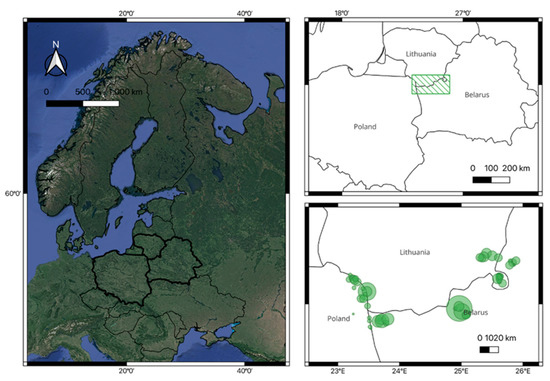
Figure 1.
Map of the study area. The border region, which consists entirely of lowlands with a maximum altitude of ca. 240 m above sea level, extends over parts of northern Podlasie (NE Poland), Dzūkija (SE Lithuania), and various districts in the Neman River Basin (NE Belarus); designed with QGIS 3.22.16 ‘Białowieża’.
The studied tri-border area is located in the East European Platform and is characterized by considerable landform diversity, significant forest cover, and valuable geomorphologic features formed by continental glaciation [43]. The border region contains diverse ecosystems, such as abundant forests, meadows, wetlands, and waterbodies. Small patchwork fields and adjacent areas of arable land planted with various crops are characteristic features of the rural landscape of the study area (Figure 2). The study region’s soil is accorded little agricultural value, which justifies the introduction of afforestation schemes [44]. For the study sample, we mainly selected rural settlements close to forest ecosystems in all three case studies [45].
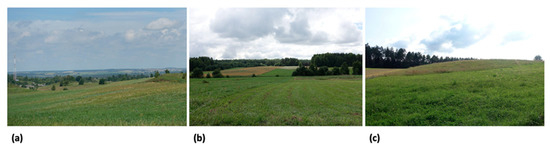
Figure 2.
Typical landscapes of the (a) Belarusian, (b) Lithuanian, and (c) Polish parts of the studied border area. Credit: J.P., 2018–2019.
The local residents are mainly bi- or multilingual [46,47]. Our interviewees predominantly used more than one language/local dialect in communication (primarily Polish, Lithuanian, Belarusian, and Russian). Elderly interviewees from Belarus and Lithuania often declared that they speak (or their parents spoke) “pa prostu” or “pa tutejšamu” (which means ‘straightforward, easy, unsophisticated speech’, an uncodified vernacular form of Belarusian) [48,49]. Several times, our interviewees showed fluidity in their ethnic identity. For instance, in Lithuania, some people of Polish descent considered themselves both Poles and Lithuanians. In Belarus, older people identified themselves as Poles, while the younger generation declared themselves Belarusians. The strongest identification in all the surveyed groups was among Lithuanians.
The political landscape of the studied area was highly dynamic. Poland, Lithuania, and Belarus shared significant historical events from the 14th century through the middle of the 20th century [50]. Before 1939, all the territory of the study area was incorporated into the Second Polish Republic (with administrative borders between investigated settlements). Then, after Soviet invasion, the study region was divided among the Byelorussian Soviet Socialist Republic, the Lithuanian Soviet Socialist Republic, and the Polish People’s Republic. Therefore, there was a soft border between Belarus and Lithuania as they were both part of the Soviet Union, but they had a hard border with Poland. After the collapse of the USSR, between 1989 and 1992, Poland, Lithuania, and Belarus all gained independence. Finally, in 2004, Lithuania and Poland became members of the European Union, thus establishing a hard border with Belarus.
This research was carried out within the framework of an ethnobotanical study focusing on border regions of Eastern Europe (ERC Starting Grant no. 714874). In the interest of the umbrella project, our goal was to obtain a sample conforming to specific criteria: individuals approximately 40 years of age or more, representing both men and women, and belonging to ethnic groups (Polish and Lithuanian) living in all three researched countries. We included only local (born in the region and lived there for at least the last 30 years) rural residents. We used a pseudo-random sampling method, complementing it with occasional snowball sampling. To obtain more detailed information, we interviewed people in their homes or/and during walks in the surrounding area, which lasted from 30 min to 3 h, depending on the availability of the individual.
The study sample included a total of 200 people: 156 women and 44 men. We conducted interviews with 95 Lithuanians and 105 Poles, with an average age of 68.54 and 72.07 years, respectively. The discrepancy in gender arose because of the low number of elderly men in the study area. The majority of interviewees in the study sample were retired and had either worked on collective farms (in Belarus and Lithuania) or were small-scale farmers (in Poland). About 25% of the sample represents (former) teachers, librarians, and nurses from all three countries. All interviewees self-identified as Roman Catholic.
To evaluate the wild food plant LEK, the data was grouped by country and ethnic group. In total, we defined 6 case studies for comparison: (1) Lithuanians living in Belarus (BYLT), (2) Poles from Belarus (BYPL), (3) Lithuanians from Lithuania (LTLT), (4) Poles living in Lithuania (LTPL), (5) Lithuanians from Poland (PLLT), and (6) Poles living in Poland (PLPL). Furthermore, in every case study, we collected data on control variables that may affect the distribution of WFP knowledge within an ethnic group living in a specific country. These variables included: gender (0—female, 1—male), education (according to ISCED-11 [51] classification: 0—no schooling; 1—primary education; 2—lower secondary education; 3—upper secondary education; 4—post-secondary non-tertiary; and 5—equivalent tertiary education level), age (in years), and language (according to the number of declared languages spoken by an interviewee: 1–4, among which were Polish, Lithuanian, Belarusian, and Russian).
Table 1 shows the socio-demographic distribution of the sample selected for analysis. We found no statistically significant association between the interviewees’ ages among the six case studies (p = 0.099). Consequently, our cross-border study sample was relatively homogeneous by age (Figure 3).

Table 1.
Sample distribution by gender, age, education, and language.
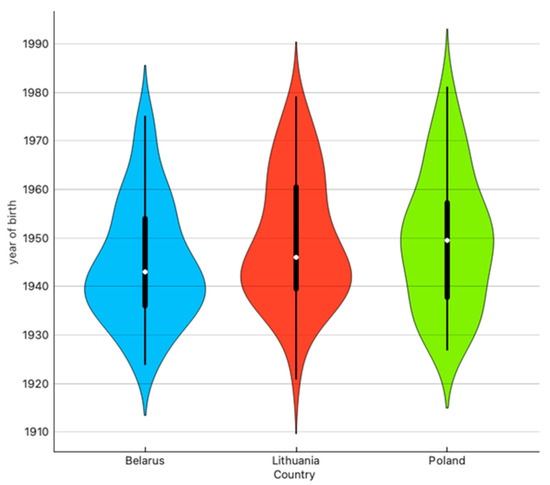
Figure 3.
Violin plot of the age distribution of the sample in the three studied countries.
The Code of Ethics of the International Society of Ethnobiology [52] was strictly followed. The research protocol was approved by the Ethics Committee of Ca’ Foscari University of Venice. Written and oral consent were obtained from all participants prior to the interviews. All interview recordings were subsequently transcribed, maintaining the linguistic and metacommunicative nuances for more transparency in and reproducibility of the statistical analysis.
Voucher specimens were collected for the wild taxa, when available, and subsequently deposited at the herbarium of Ca’ Foscari University of Venice (UVV): Lithuanian specimens bear accession numbers DZULT01–DZULT136 and DDZULT01–DDZULT42, and Polish specimens bear accession numbers DZUPL001–DZUPL107 and DDZUPL01–DDZUPL39. The total number of specimens collected was 324. Taxonomic identification, botanical nomenclature, and family assignments followed the Flora Europaea [53] and the Plants of the World Online database [54]. Local plant names were transliterated following the rules of the standard Belarusian and Russian languages.
2.2. Data Analysis
The information gathered from the interviewees was entered into a Microsoft Excel spreadsheet in the form of detailed use reports (DUR), where each interviewee mentioned the use of wild species and their preparation [55]. To explore knowledge circulation within the tri-border area, we conducted bivariate and multivariate analyses.
To test the homogeneity of the sample, we calculated cross-country differences based on the number of taxa used by a person and grouped the results by area, gender, age, education, and language spoken. We used Student’s t-test (for two variables) and ANOVA and chi-square test (for three or more variables) to determine whether differences in the number of plants mentioned were statistically significant. The statistical confidence level was set at p ≤ 0.05. We used Pearson’s correlation coefficient to test the relationship between the individual scores for the knowledge domains.
To conduct cross-ethnic and cross-country comparisons, Jaccard similarity indices were calculated following González-Tejero et al. [56]: , where A is the number of species/genera in sample A, B is the number of species/genera in sample B, and C is the number of species/genera common to A and B.
To perform the quantitative assessment of the collected data, we used the ethnobotanyR package [57]. Specifically, to evaluate the significance of wild food species for the studied local communities, several quantitative calculations were made. We quantified use reports and number of uses per species [58], fidelity level (FL) of the various uses of species [59], relative frequency of citation index (RFC) [60], cultural importance index (CI) [59], and informant consensus factor (ICF) [61]. The combination of these calculations offered a comprehensive evaluation of the importance of plants for the studied local communities (see Appendix A).
Statistical analysis and graph plotting was performed with Microsoft Excel (Data Analysis) and R-4.2.2 software(R Development Core Team; Venice, Italy) using various CRAN packages [62].
3. Results
We recorded the food uses of 72 wild plant taxa belonging to 33 plant families, the most representative of which were Asteraceae (10 taxa), Rosaceae (8 taxa), Ericaceae (6 taxa), and Lamiaceae (6 taxa) (Table 2). The collected data was divided into 2812 DUR, covering both current and past uses.
Table 2.
Use of wild plants for food among Lithuanians living in Belarus (BYLT), Lithuania (LTLT), and Poland (PLLT); and Poles from Belarus (BYPL), Lithuania (LTPL), and Poland (PLPL). Local name (s): PL—mentioned among the Polish community; LT—among the Lithuanian community.
The most multifunctional taxa in all three regions (countries) of the studied border area were Rubus idaeus (used in 9 emic categories), used mainly for jam, non-alcoholic drinks, and snacks; Vaccinium oxycoccos (8), used as a seasoning, a snack, and for jam making; Vaccinium vitis-idaea (8), used primarily for jam, as a snack, and for recreational tea; and Vaccinium myrtillus (7), used mainly for jam, as a snack, and for non-alcoholic drinks. The most popular used taxa among all interviewees were Rumex acetosa (280 DUR), followed by Vaccinium myrtillus (268 DUR), Armoracia rusticana (223 DUR), Betula spp. (188 DUR), and Carum carvi (181 DUR).
The most popular food categories included soup made from Rumex acetosa (274 DUR), relish (seasoning) made from Armoracia rusticana (215), sap from Betula spp. (169), seasoning made from Carum carvi (138), and jam made from Vaccinium myrtillus (133). The most diverse emic food categories used within the three regions of the study area were recreational tea (40 plant taxa), snacks (mainly berries) (27), various additives (20), and non-alcoholic drinks (19).
The highest (100.00%) fidelity level in all three countries was found for the use of Achillea millefolium, Artemisia vulgaris, Capsella bursa-pastoris, Equisetum pratense, Helichrysum arenarium, Hypericum spp., Leonurus cardiaca, Matricaria chamomilla, Melissa officinalis, Nepeta cataria, Thymus spp., and Tussilago farfara for recreational tea (Figure 4); Cirsium oleraceum, Heracleum sphondylium, Rumex acetosa, and Urtica urens for soup; Borago officinalis and Symphytum officinale in salad; Campanula sp., Corylus avellana, and Oenothera biennis as a snack; Armoracia rusticana, Origanum vulgare, and Thlaspi arvense as a seasoning; Aesculus hippocastanum and Cichorium intybus as a food substitute; and Alnus spp. for smoking meat.
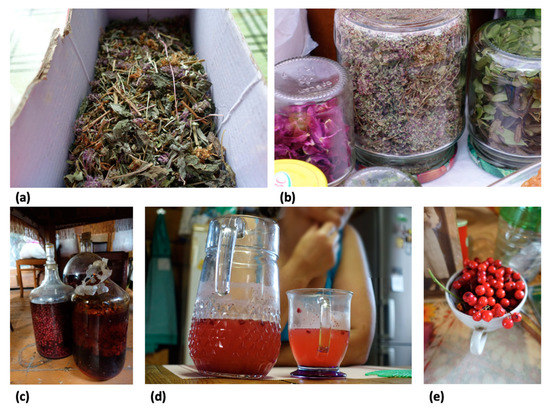
Figure 4.
Wild species used for food: (a) mixed herbs dried for recreational tea, Lithuania; (b) herbs prepared for recreational tea, Poland; (c) wine made from Rubus idaeus, Belarus; (d) compote, made from Fragaria vesca, Lithuania; and (e) snack of Viburnum opulus, Belarus. Credit: J.P., 2018–2019.
3.1. Sample Analysis
According to the use of wild plants for food, we detected no significant difference on the country level. However, we found a lower average score for plant species mentioned by Poles (mean 8.79) compared to Lithuanians (mean 10.55) (p = 0.011) and significant differences in wild food plants mentioned when comparing all six case studies among each other (p = 0.007) (Figure 5).
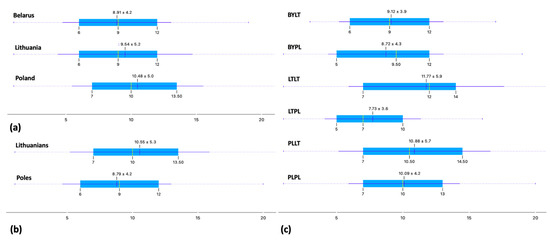
Figure 5.
Box plots for the ‘number of taxa mentioned’ grouped by (a) country, (b) ethnic group, and (c) case study.
There was a significant difference in the number of plants used by the two genders, in which men reported using fewer plants than women (7.9 and 10.12 on average, respectively) (p = 0.007). We did not find statistically significant evidence of the impact of educational level (p = 0.331), nor the number of languages spoken (p = 0.495), on the number of used plants (Table 3).
Table 3.
Influence of socio-demographic variables on the number of taxa mentioned by interviewees.
We observed that in all our cross-border case studies age did not play a significant role in the distribution of LEK (ANOVA: 1.883, p = 0.099). More than 20 taxonomic species were mentioned mostly by middle-aged adults. Pearson’s correlation coefficient between the age of interviewees and the plant species mentioned was negative (r = −0.076) and reflected a non-significant association (Figure 6).
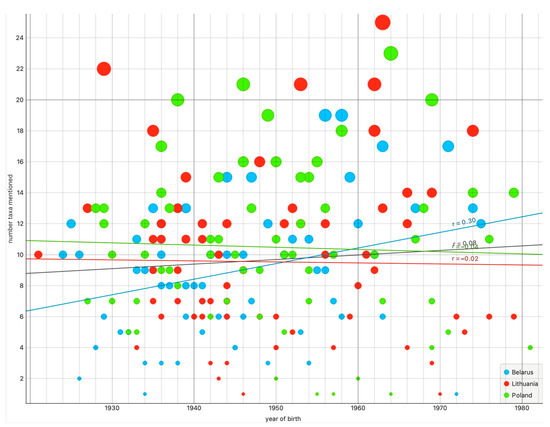
Figure 6.
Distribution of the number of taxa mentioned in Belarus, Lithuania, and Poland according to the year of birth of interviewees. The size of the circle correlates with the number of taxa mentioned.
3.2. Cross-Country and Cross-Ethnic Comparisons
We found a high level of homogeneity (similarity) among the case studies with a core of 21 common taxa. Lithuanians from Lithuania used a greater diversity of taxa (52), whereas Poles from Lithuania (33) used fewer taxa but with greater intensity (based on DUR) (Figure 7).
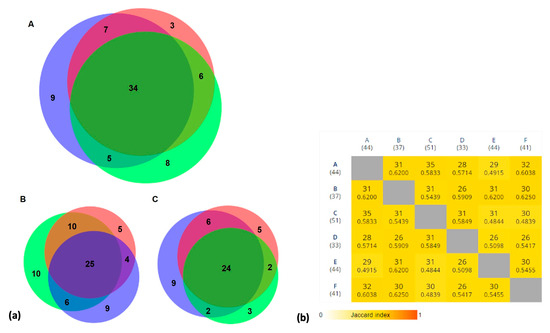
Figure 7.
(a) Venn diagrams for the division of used taxa and use instances: A, recorded in Belarus (red), Lithuania (green), and Poland (violet); B, among Lithuanians living in Belarus (red), Lithuania (green), and Poland (violet); C, among Poles living in Belarus (red), Lithuania (green), and Poland (violet); (b) Jaccard similarity indices for the various compared groups based on detailed use reports, where A—Lithuanians in Belarus, B—Poles in Belarus, C—Lithuanians in Lithuania, D—Poles in Lithuania, E—Lithuanians in Poland, and F—Poles in Poland.
The least amount of overlap in the gathered data, and thus the lowest Jaccard index (similarity coefficient) value, was between Lithuanians living in Lithuania and Poles (0.4839) and Lithuanians (0.4844) from Poland. A greater level of overlap in the use of wild plant taxa for food, and consequently a higher level of LEK homogenization, was observed between Poles living in Belarus and Lithuanians (0.6200) and Poles (0.6250) from Poland.
Little difference was found between ethnic groups and groups living in the same country. In this respect, the boundaries between ethnic groups are rather blurred, as they share 30 or 31 taxa.
The relative frequency of citation ranged between 0.826 and 0.014 in all three case studies (Table 4). Thus, we did not identify quantitative differences on the taxon level.
Table 4.
The relative frequency of citation of the top 20 wild plants mentioned by interviewees in the study area.
Vaccinium myrtillus (1.180) was the most culturally significant plant in all six case studies. It has a CI index value ranging between 1.343 (for Poles from Belarus) and 0.938 (for Lithuanians living in Poland). The next most culturally significant taxon was Rubus idaeus (0.815), with a range between 1.062 (for Lithuanians living in Poland) and 0.594 (for Poles from Poland), followed by Rumex acetosa with a CI index value of 0.795. For this latter taxon, the difference between studied cases was relatively low and ranged between 0.941 for Lithuanians from Belarus and 0.500 for Poles living in Lithuania. Interestingly, Carum carvi has a CI index value of 0.755, with greater cultural importance for Poles (0.938) in all three countries in comparison with Lithuanians (0.806). Urtica dioica is culturally significant in the studied communities and has a CI index value of 0.680, with a range between 1.156 for Lithuanians from Poland and 0.344 for Poles from Poland. Therefore, the results confirmed relative homogeneity among CI values obtained in the different cross-border case studies. The top ten species of wild food plants with the highest CI values were mentioned in every case study (see Appendix B).
The informant consensus factor (ICF) for the whole study border area was very high (0.970) (Table 5). A similar pattern was observed when considering the countries of Belarus (0.935), Lithuania (0.934), and Poland (0.933) separately, and when comparing the two ethnic groups: Lithuanians (0.959) and Poles (0.949).
Table 5.
Informant consensus factor.
4. Discussion
Nowadays, the Polish-Lithuanian-Belarusian borderland represents the result of many layers of past environmental processes and human interventions. We observed that wild food plant knowledge was relatively evenly distributed across the area regardless of the existing state boundaries, as we did not find statistically significant differences between countries. A high ICF value indicates an extraordinary level of agreement among interviewees in the whole studied region on the taxonomic level of wild plants used for food. Previously, a high ICF in the food domain was observed primarily in non-border areas [20,63,64].
Relatively homogeneous knowledge on the use of wild plants for food in the studied region might be explained by the fact that Poles and Lithuanians have resided in the investigated territories for centuries [50]. The flexible qualities of identity and the possession of different languages in the studied region facilitated the cross-border flow of knowledge, not only by creating shared connections between individuals but also by allowing bridge-building among other ethnic groups. Interestingly, no clear national identity as “tutejszy” (“from here”) has been observed for the rural population in this historical region, even in the interwar period [29]. Furthermore, the recorded fluid and floating identity in the border zone facilitated knowledge circulation.
We observed that nowadays the two relatively distinct studied groups still use, in everyday communication, “język tutejszy”/“mowa prosta” (local language) as a lingua franca. This certainly facilitated inter-ethnic communication in the multicultural border region and promoted the more open exchange of information. In certain cases, two local communities used to speak Russian. For a former Soviet territory, it is quite a widespread practice of inter-ethnic communication [65], especially considering that older and middle-aged respondents predominantly studied Russian at school.
Our field results indicated that for all three studied countries, the environment has changed and many plant species have disappeared. For instance, extinct plants included those that were used for recreational tea (Centaurea cyanus and Nepeta cataria) and as a snack (Vaccinium uliginosum, Corylus avellana, Oxalis actosella, and Pinus sylvestris). In addition, some taxa were used for food practices no longer in circulation: bread making (Acorus calamus), meat smoking (Juniperus communis and Populus tremula), and famine foods associated with WWII and the post-war period (Stellaria media, Chenopodium album, and Heracleum sphondylium). Some interviewees also stressed that plants such as Armoracia rusticana and Carum carvi have become feral and no longer need to be planted as they grow on their own, without intervention. Moreover, our field materials revealed that wild apple and pear trees have gone out of use, as they have been replaced by cultivated ones (Malus sylvestris and Pyrus pyraster).
Despite their extinction from the natural landscape, we found that many plants continue to exist in the discourse of an ethnic group, as they are still highly involved in food traditions (e.g., Papaver for making Christmas and Easter pastries, Vaccinium oxycoccos for making kissel, etc.). These traditions remain very strong in the studied communities as almost every interviewee noted that they try to keep making certain dishes within the family on major Catholic holidays so that now they buy all the ingredients in shops. Furthermore, we observe here an essential feature: even if the plant has fallen out of natural circulation due to the social and ecological changes that took place during the 20th century, it remains culturally important.
The homogeneity in LEK observed between Lithuanian and Polish communities settled in both Belarus and Lithuania may likely be explained by their long period of coexistence within the same (Soviet) social and political system, as already discussed in other post-Soviet ethnobotanical case studies [22,26]. The high homogeneity of wild food plant knowledge between Poles from Belarus and Poles from Poland may be the result of the long-term effects of a shared, common history before 1939 (actively emphasized by interviewees) and the current unrestricted communication between the two groups where the research was conducted, owing to a simplified border crossing system.
The identified convergent trajectories of LEK circulation among the studied ethnic groups may represent the primary response to recent cultural globalization forces. Globalization acts to foster relationships between heterogeneous communities, often transcending national borders, even though the flow of knowledge within national boundaries may be limited as well [66]. Thus, we cannot exclude the effects of globalization [67] on the blurring of borders and the statistically insignificant differences in plant taxa used nowadays by the studied ethnic groups. While powerful global forces such as market expansion and linguistic colonization may have a widespread erosional effect, this is not inevitable, and culture- and site-specific factors also determine the outcome [68,69,70].
Although the prevalence of high consensus levels for wild food species between Polish and Lithuanian interviewees living in Poland, Lithuania, and Belarus is significant, there are many levels of divergence in ethnobotanical knowledge noted between these two ethnic groups within the country case studies. Distinct cultural groups tend to diverge in food practices through specific cultural associations with consumable resources [63]. In particular, ethnic group-level statistically significant heterogeneity is observed within one country. The marked heterogeneity in LEK observed between Poles from Poland and Lithuanians from Lithuania can likely be explained by the presence of the hard Lithuanian-Polish border and the almost total lack of contact between the two communities during Communist/Soviet times. The closed Soviet-Polish border strongly influenced wild food plant knowledge circulation as, in all cases, Poland is quantitatively different from former Soviet Lithuania and Belarus. Free circulation of social discourse on wild food plants and free practical application (access to resources) are the basis for resistance and help develop adaptive food security strategies that allow substantially independent policy decisions.
5. Conclusions
We documented a high diversity of wild plants used for food within the studied cross-border region, while the number of plants used by each specific research group was considerably smaller. This and the high ICF obtained for the whole region show that every studied group has preserved (obtained) a fraction of the general wild food plant knowledge circulating within the region. This may signal the existence of long-term effects of common, shared traditional ecological knowledge within the entire region.
Our findings suggest that the divergences observed are possibly linked to various environmental, cultural, social, political, and economic shifts experienced by the studied countries. We also noticed clear differences on the discourse level, which would require separate qualitative analyses of attitudes and sentiments, which cannot be reflected in descriptive statistics. Our findings indicate that different permeabilities of former boundaries of the Soviet Union might have influenced wild food plant knowledge circulation (Belarusian-Polish vs Polish-Lithuanian borders). The consequences of various political settings on knowledge circulation needs to be addressed by future studies.
Author Contributions
Conceptualization, J.P. and R.S; methodology, R.S.; validation, J.P., R.K. and R.S.; formal analysis, J.P.; resources, R.S.; data curation, J.P. and P.Š.; writing—original draft preparation, J.P.; writing—review and editing, J.P., M.S., P.Š., R.K., A.P. and R.S.; visualization, J.P.; supervision, A.P. and R.S. All authors have read and agreed to the published version of the manuscript.
Funding
The research was conducted with the financial support of the European Research Council (ERC) under the European Union’s Horizon 2020 research and innovation programme (grant number 714874). MS was supported by the Chilean National Agency for Research and Development Doctoral Fellowship (No. 21210819, ANID 2021).
Institutional Review Board Statement
The study was conducted in accordance with the Code of Ethics of the International Society of Ethnobiology and approved by the Ethics Committee of Ca’ Foscari University of Venice (Italy).
Informed Consent Statement
Written and oral consent were obtained from all participants prior to the interviews.
Data Availability Statement
Data are available upon request to the corresponding author.
Acknowledgments
We particularly thank the Polish and Lithuanian communities in Poland, Lithuania, and Belarus for their warm welcome and generous sharing of knowledge. We extend our gratitude to Baiba Prūse, Ieva Mežaka, and Andra Simanova for their kind assistance in conducting the Lithuanian fieldwork.
Conflicts of Interest
The authors declare no conflict of interests.
Abbreviations
LEK—Local Ecological Knowledge; PL—Polish community; LT—Lithuanian community; BYLT—Lithuanians living in Belarus; BYPL—Poles from Belarus; LTLT—Lithuanians from Lithuania; LTPL—Poles living in Lithuania; PLLT—Lithuanians from Poland; PLPL—Poles living in Poland; UR—Use Reports; NU—Number of Uses; FL—Fidelity Level, RFC—Relative Frequency of Citation; ICF—Informant Consensus Factor; CI—Cultural importance; WWII—World War II.
Appendix A
Table A1.
Overview of ethnobotanical calculations.
Table A1.
Overview of ethnobotanical calculations.
| Calculation | Formula | Explanation | Reference |
|---|---|---|---|
| Use reports (UR) | The total uses of the species by all interviewees within each use category for that species. | [58] | |
| Number of uses (NU) | The total number of use categories. | [58] | |
| Fidelity level (FL) | The percentage of interviewees who use a plant for the same purpose compared to all uses of the plant for any purpose, where Ns is the number of interviewees that use a particular plant for a specific purpose, and FCs is the frequency of citation for the species. | [59] | |
| Relative frequency of citation (RFC) | The frequency of citation for each species s, where URi refers to the use reports for all interviewees i, and N is the total number of interviewees in the survey. | [60] | |
| Cultural importance (CI) | The sum of the proportion of interviewees that mention the use of each species. | [59] | |
| Informant consensus factor (ICF) | Quantitative parameter to evaluate of agreement among interviewees’ knowledge circulated, where Nur is the number of use reports in the food category, and Nt is the number of species (taxa). | [61] |
Appendix B
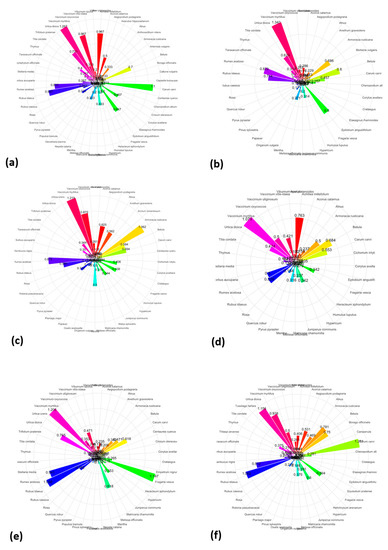
Figure A1.
Radial plots of cultural importance (CI) index values for the case studies: (a) BYLT, (b) BYPL, (c) LTLT, (d) LTPL, (e) PLLT, and (f) PLPL. Analysis performed using EthnobotanyR package in RStudio.
References
- Rapport, D.; Maffi, L. Nature and Culture; Pilgrim, S., Pretty, J.N., Eds.; Routledge: New York, NY, USA; London, UK, 2010; pp. 121–138. [Google Scholar]
- Bromham, L.; Dinnage, R.; Skirgård, H.; Ritchie, A.; Cardillo, M.; Meakins, F.; Greenhill, S.; Hua, X. Global predictors of language endangerment and the future of linguistic diversity. Nat. Ecol. Evol. 2022, 6, 163–173. [Google Scholar] [CrossRef] [PubMed]
- Upadhyay, R.K.; Hasnain, S.I. Linguistic diversity and biodiversity. Lingua 2017, 195, 110–123. [Google Scholar] [CrossRef]
- Scott, J.W. A Research Agenda for Border Studies; Scott, J.W., Ed.; Elgar: Cheltenham, UK, 2020; pp. 3–24. [Google Scholar]
- Van der Vleuten, E.; Feys, T. Borders and Frontiers in Global and Transnational History Introduction. J. Mod. Eur. Hist. 2016, 14, 29–34. Available online: https://www.jstor.org/stable/26266222 (accessed on 10 July 2022). [CrossRef]
- Bacas, J.L.; Kavanagh, W. Border Encounters: Asymmetry and Proximity at Europe’s Frontiers; Berghahn Books: New York, NY, USA; Oxford, UK, 2013. [Google Scholar]
- Liverman, D.M.; Varady, R.G.; Chávez, O.; Sánchez, R.A. Environmental issues along the United States-Mexico border: Drivers of Change and Responses of Citizens and Institutions. Annu. Rev. Energy Environ. 1999, 24, 607–643. [Google Scholar] [CrossRef]
- Lässig, S. The History of Knowledge and the Expansion of the Historical Research Agenda. Ger. Hist. Inst. Bull. 2016, 59, 28–58. [Google Scholar]
- Gänger, S. Circulation: Reflections on circularity, entity, and liquidity in the language of global history. J. Glob. Hist. 2017, 12, 303–318. [Google Scholar] [CrossRef]
- Östling, J. Circulation, arenas, and the quest for public knowledge: Historiographical currents and analytical frameworks. Hist. Theory 2020, 58, 111–126. [Google Scholar] [CrossRef]
- Sarasin, P.; Kilcher, A. (Eds.) Nach Feierabend. In Zürcher Jahrbuch für Wissensgeschichte; Diaphanes: Zurich, Germany, 2011; Volume 7, pp. 7–11. [Google Scholar]
- Wieckowski, M. Eco-frontier in the mountainous borderlands of Central Europe. Rev. Géogr. Alp. 2013, 101–102. [Google Scholar] [CrossRef]
- Turner, N.; Davidson-Hunt, I.J.; O’Flaherty, M. Living on the edge: Ecological and cultural edges as sources of diversity for social-ecological resilience. Hum. Ecol. 2003, 31, 439–460. [Google Scholar] [CrossRef]
- Markuszewska, I.; Tanskanen, M.; Subirós, J.V. Boundaries from Borders: Cross-Border Relationships in the Context of the Mental Perception of a Borderline-Experiences from Spanish-French and Polish-German Border Twin Towns. Quaest. Geogr. 2016, 35, 105–119. [Google Scholar] [CrossRef]
- Albuquerque, P. The Cultural Uniqueness of Portuguese-Spanish Border Landscapes. Komparatīvistikas Almanahs 2022, 15, 184–196. [Google Scholar]
- Shao, D. The Palgrave Dictionary of Transnational History; Iriye, A., Saunier, P.-Y., Eds.; Palgrave Macmillan: Basingstoke, UK, 2009; pp. 99–102. [Google Scholar]
- Paasi, A. Competitive European Peripheries. Advances in Spatial Science; Eskelinen, H., Snickars, F., Eds.; Springer: Berlin/Heidelberg, Germany, 1995. [Google Scholar]
- Krige, J.; Leonelli, S. Mobilizing the Transnational History of Knowledge Flows. COVID-19 and the Politics of Research at the Borders. Hist. Technol. 2021, 37, 125–146. [Google Scholar] [CrossRef]
- Mattalia, G.; Stryamets, N.; Pieroni, A.; Sõukand, R. Knowledge transmission patterns at the border: Ethnobotany of Hutsuls living in the Carpathian Mountains of Bukovina (SW Ukraine and NE Romania). J. Ethnobiol. Ethnomed. 2020, 16, 41. [Google Scholar] [CrossRef]
- Sõukand, R.; Pieroni, A. The importance of a border: Medical, veterinary, and wild food ethnobotany of the Hutsuls living on the Romanian and Ukrainian sides of Bukovina. J. Ethnopharmacol. 2016, 185, 17–40. [Google Scholar] [CrossRef]
- Yongge, S. Where China Meets Southeast Asia; Evans, G., Hutton, C., Eng, K.K., Eds.; Palgrave Macmillan: New York, NY, USA, 2000; pp. 51–71. [Google Scholar]
- Stryamets, N.; Mattalia, G.; Pieroni, A.; Khomyn, I.; Sõukand, R. Dining Tables Divided by a Border: The Effect of Socio-Political Scenarios on Local Ecological Knowledge of Romanians Living in Ukrainian and Romanian Bukovina. Foods 2021, 10, 126. [Google Scholar] [CrossRef] [PubMed]
- Vitasović-Kosić, I.; Kaligarič, M.; Juračak, J. Divergence of Ethnobotanical Knowledge of Slovenians on the Edge of the Mediterranean as a Result of Historical, Geographical and Cultural Drivers. Plants 2021, 10, 2087. [Google Scholar] [CrossRef]
- Pieroni, A.; Cianfaglione, K.; Nedelcheva, A.; Hajdari, A.; Mustafa, B.; Quave, C.L. Resilience at the border: Traditional botanical knowledge among Macedonians and Albanians living in Gollobordo, Eastern Albania. J. Ethnobiol. Ethnomed. 2014, 10, 31–33. [Google Scholar]
- Kazancı, C.; Oruç, S.; Mosulishvili, M. Medicinal ethnobotany of wild plants: A cross-cultural comparison around Georgia-Turkey border, the Western Lesser Caucasus. J. Ethnobiol. Ethnomed. 2020, 16, 71. [Google Scholar] [CrossRef] [PubMed]
- Pieroni, A.; Sõukand, R. Are borders more important than geographical distance? The wild food ethnobotany of the Boykos and its overlap with that of the Bukovinian Hutsuls in Western Ukraine. J. Ethnobiol. 2017, 37, 326–345. [Google Scholar] [CrossRef]
- Belichenko, O.; Kolosova, V.; Melnikov, D.; Kalle, R.; Sõukand, R. Language of Administration as a Border: Wild Food Plants Used by Setos and Russians in Pechorsky District of Pskov Oblast, NW Russia. Foods 2021, 10, 367. [Google Scholar] [CrossRef]
- Barwiński, M. Borderland of Nations, Religions and Cultures-The Case of Podlasie. Eur. Spat. Res. Policy 2017, 24, 111–125. [Google Scholar] [CrossRef]
- Korzeniewska, K. ‘Vietinis’ (tutejszy) lenkas, katalikas: Pietryčių Lietuvos gyventojų religinė-etninė tapatybė (tyrimas Dieveniškėse, Kernavėje, Turgeliuose). Etniškumo Stud. 2013, 2, 149–179. [Google Scholar]
- Łuczaj, Ł. Dziko rosnace rosliny jadalne w ankiecie Jozefa Rostafinskiego z roku 1883 [Wild edible plants in Józef Rostafiński’s questionnaire of 1883]. Wiad. Bot. 2008, 52, 39–50. [Google Scholar]
- Łuczaj, Ł. Changes in the utilization of wild green vegetables in Poland since the 19th century: A comparison of four ethnobotanical surveys. J. Ethnopharmacol. 2010, 128, 395–404. [Google Scholar] [CrossRef] [PubMed]
- Łuczaj, Ł. Dziko rosnące rośliny jadalne użytkowane w Polsce od połowy XIX w. do czasów współczesnych [Wild food plants used in Poland from the mid-19th century to the present]. Etnobiol. Pol. 2011, 1, 57–125. [Google Scholar]
- Łuczaj, Ł.; Köhler, P.; Pirożnikow, E.; Graniszewska, M.; Pieroni, A.; Gervasi, T. Wild edible plants of Belarus: From Rostafiński’s questionnaire of 1883 to the present. J. Ethnobiol. Ethnomed. 2013, 9, 21. [Google Scholar] [CrossRef]
- Kujawska, M.; Klepacki, P.; Łuczaj, Ł. Fischer’s Plants in folk beliefs and customs: A previously unknown contribution to the ethnobotany of the Polish-Lithuanian-Belarusian borderland. J. Ethnobiol. Ethnomed. 2017, 13, 20. [Google Scholar] [CrossRef]
- Pirożnikow, E. Park Krajobrazowy Puszczy Knyszyńskiej w Systemie Ochrony Przyrody i Edukacji Środowiskowej. In Proceedings of the Parki Krajobrazowe w I Połowie XXI Wieku- Edukacja Ekologiczna Wczoraj i Dziś na Przykładzie Parku Krajobrazowego Puszczy Knyszyńskiej, Supraśl, Poland, 27–28 May 2008; Górniak, A., Poskrobko, B., Eds.; Fundacja Ekonomistów Środowiska i Zasobów Naturalnych: Białystok, Poland, 2008; pp. 64–79. [Google Scholar]
- Kujawska, M.; Łuczaj, Ł. Traditions and Transformations in Ethnobotany; Pochettino, M.L., Ladio, A.H., Arenas, P.M., Eds.; Cyted: Buenos Aires, Argentina, 2010; pp. 545–551. [Google Scholar]
- Sõukand, R.; Quave, C.L.; Pieroni, A.; Pardo-de-Santayana, M.; Tardío, J.; Kalle, R.; Łuczaj, Ł.; Svanberg, I.; Kolosova, V.; Aceituno-Mata, L.; et al. Plants used for making recreational tea in Europe: A review based on specific research sites. J. Ethnobiol. Ethnomed. 2013, 9, 58. [Google Scholar] [CrossRef]
- Sõukand, R.; Pieroni, A.; Biró, M.; Dénes, A.; Dogan, Y.; Hajdari, A.; Kalle, R.; Reade, B.; Mustafa, B.; Nedelcheva, A.; et al. An ethnobotanical perspective on traditional fermented plant foods and beverages in Eastern Europe. J. Ethnopharmacol. 2015, 170, 284–296. [Google Scholar] [CrossRef]
- Sõukand, R.; Hrynevich, Y.; Vasilyeva, I.; Prakofjewa, J.; Vnukovich, Y.; Paciupa, J.; Hlushko, A.; Knureva, Y.; Litvinava, Y.; Vyskvarka, S.; et al. Multi-functionality of the few: Current and past uses of wild plants for food and healing in Liubań region, Belarus. J. Ethnobiol. Ethnomed. 2017, 13, 10. [Google Scholar] [CrossRef]
- Statistics Lithuania. Lithuanian 2011 Population Census in Brief. In Lietuvos Statistikos Departamentas; 2011. Available online: https://osp.stat.gov.lt/documents/10180/217110/Lietuvos_gyventojai_2011.pdf (accessed on 1 February 2022).
- National Statistical Committee of the Republic of Belarus. Natsional’nyy Sostav Naseleniya Grodnenskoy Oblasti; Statisticheskiy Byulleten; National Statistical Committee of the Republic of Belarus: Grodno, Belarus, 2020. [Google Scholar]
- Ludność w Województwie Podlaskim. Stan i Struktura Demograczno-Społeczna. In Narodowy Spis Powszechny Ludności i Mieszkań 2011; GUS (CSO): Białystok, Poland, 2013. [Google Scholar]
- Giedraitiene, J.; Satkunas, J.; Graniczny, M.; Doktor, S. The chemistry of groundwater: A geoindicator of environmental change across the Polish-Lithuanian border. Env. Geol. 2002, 42, 743–749. [Google Scholar] [CrossRef]
- Senetra, A.; Szczepańska, A.; Veteikis, D.; Wasilewicz-Pszczółkowska, M.; Šimanauskienė, R.; Volungevičius, J. Changes of the land use patterns in the Polish and Lithuanian trans-border rural area. Baltica 2013, 26, 157–168. [Google Scholar] [CrossRef]
- Pieroni, A.; Sõukand, R. Forest as Stronghold of Local Ecological Practice: Currently Used Wild Food Plants in Polesia, Northern Ukraine. Econ. Bot. 2018, 72, 311–331. [Google Scholar] [CrossRef]
- Engelking, A. The Myth of the Tower of Babel and Its Consequences: The Indigenous Grammars of the Mixed World. A Contribution to the Anthropology of Borderlands (Based on Research in Belarusian-Lithuanian Borderlands). Český Lid Etnol. Časopis 2015, 102, 1–26. [Google Scholar]
- Smułkowa, E. Białoruś i Pogranicza. Studia o Języku i Społeczeństwie; Wydawnictwa UniwersytetuWarszawskiego: Warszawa, Poland, 2002. [Google Scholar]
- Wiemer, B. Aspects of Multilingualism in European Language History. Braunmüller, K., Ferraresi, G., Eds.; Hamburg Studies on Multilingualism: Hamburg, Germany, 2003. [Google Scholar]
- Jankowiak, M. Współczesne gwary białoruskie na Litwie (rejon wileński). Slav. Vilnensis 2021, 66, 85–101. [Google Scholar] [CrossRef]
- Snyder, T. The Reconstruction of Nations: Poland, Ukraine, Lithuania, Belarus, 1569–1999; Yale University Press: London, UK, 2003. [Google Scholar]
- ISCED. International Standard Classification of Education ISCED 2011. 2012. Available online: https://ec.europa.eu/eurostat/statistics-explained/index.php?title=International_Standard_Classification_of_Education_(ISCED)#Implementation_of_ISCED_2011_.28levels_of_education.29 (accessed on 12 September 2022).
- International Society of Ethnobiology. International Society of Ethnobiology Code of Ethics (with 2008 additions). 2016. Available online: http://www.ethnobiology.net/what-we-do/core-programs/ise-ethics-program/code-of-ethics/code-in-english (accessed on 12 April 2018).
- Tutin, T.G.; Heywood, V.H.; Burges, N.A.; Valentine, D.H.; Walters, S.M.; Webb, D.A. Flora Europaea; Cambridge University Press: Cambridge, UK, 1964. [Google Scholar]
- Plants of the World Online. Available online: https://powo.science.kew.org/ (accessed on 15 February 2022).
- Kalle, R.; Sõukand, R. Wild plants eaten in childhood in Estonia. Bot. J. Linn. Soc. 2013, 172, 239–253. [Google Scholar] [CrossRef]
- González-Tejero, M.R.; Casares-Porcel, M.; Sánchez-Rojas, C.P.; Ramiro-Gutiérrez, J.M.; Molero-Mesa, J.; Pieroni, A.; Giusti, M.E.; Censorii, E.; de Pasquale, C.; Della, A.; et al. Medicinal plants in the Mediterranean area: Synthesis of the results of the project Rubia. J. Ethnopharmacol. 2008, 116, 341–357. [Google Scholar] [CrossRef] [PubMed]
- Whitney, C. EthnobotanyR: Calculate Quantitative Ethnobotany Indices. R Package Version 0.1.9. 2022. Available online: https://CRAN.R-project.org/package=ethnobotanyR (accessed on 5 June 2022).
- Prance, G.T.; Balee, W.; Boom, B.M.; Carneiro, R.L. Quantitative Ethnobotany and the Case for Conservation in Amazonia. Conserv. Biol. 1987, 1, 296–310. [Google Scholar] [CrossRef]
- Friedman, J.; Yaniv, Z.; Dafni, A.; Palewitch, D. A preliminary classification of the healing potential of medicinal plants, based on a rational analysis of an ethnopharmacological field survey among Bedouins in the Negev desert, Israel. J. Ethnopharmacol. 1986, 16, 275–287. [Google Scholar] [CrossRef]
- Tardío, J.; Pardo-de-Santayana, M. Cultural Importance Indices: A Comparative Analysis Based on the Useful Wild Plants of Southern Cantabria (Northern Spain)1. Econ. Bot. 2008, 62, 24–39. [Google Scholar] [CrossRef]
- Trotter, R.T.; Logan, M.H. Plants in Indigenous Medicine and Diet, Behavioural Approaches; Etkin, N.L., Ed.; Redgrave Publishing Company: New York, NY, USA, 1986; pp. 91–112. [Google Scholar]
- R Core Team. R: A Language and Environment for Statistical Computing; R Foundation for Statistical Computing: Vienna, Austria, 2021. [Google Scholar]
- Bussmann, R.W.; Paniagua Zambrana, N.Y.; Sikharulidze, S.; Kikvidze, Z.; Kikodze, D.; Tchelidze, D.; Khutsishvili, M.; Batsatsashvili, K.; Hart, R.E. A comparative ethnobotany of Khevsureti, Samtskhe-Javakheti, Tusheti, Svaneti, and Racha-Lechkhumi, Republic of Georgia (Sakartvelo), Caucasus. J. Ethnobiol. Ethnomed. 2016, 12, 43. [Google Scholar] [CrossRef] [PubMed]
- Quave, C.; Pieroni, A. A reservoir of ethnobotanical knowledge informs resilient food security and health strategies in the Balkans. Nat. Plants. 2015, 1, 14021. [Google Scholar] [CrossRef] [PubMed]
- Pavlenko, A. Russian as a lingua franca. Annu. Rev. Appl. Linguist. 2006, 26, 78–99. [Google Scholar] [CrossRef]
- Appadurai, A. Fear of Small Numbers. An Essay on the Geography of Anger; Duke University Press: Durham, CA, USA; London, UK, 2006. [Google Scholar]
- Vandebroek, I.; Balick, M.J. Globalization and Loss of Plant Knowledge: Challenging the Paradigm. PLoS ONE 2012, 7, e37643. [Google Scholar] [CrossRef] [PubMed]
- Zent, S. Understanding Cultural Transmission in Anthropology: A Critical Synthesis; Ellen, R., Lycett, S.J., Johns, S.E., Eds.; Berghahn Books: Oxford, UK; New York, NY, USA, 2013; pp. 213–265. [Google Scholar]
- Bielsa, E.; Kapsaskis, D. The Routledge Handbook of Translation and Globalization; Routledge: New York, NY, USA; London, UK, 2021. [Google Scholar]
- Krige, J. Knowledge Flows in a Global Age: A Transnational Approach; University of Chicago Press: Chicago, IL, USA, 2022; p. 37. [Google Scholar]
Disclaimer/Publisher’s Note: The statements, opinions and data contained in all publications are solely those of the individual author(s) and contributor(s) and not of MDPI and/or the editor(s). MDPI and/or the editor(s) disclaim responsibility for any injury to people or property resulting from any ideas, methods, instructions or products referred to in the content. |
© 2023 by the authors. Licensee MDPI, Basel, Switzerland. This article is an open access article distributed under the terms and conditions of the Creative Commons Attribution (CC BY) license (https://creativecommons.org/licenses/by/4.0/).