


Abstract
As oil and gas field development enters mid and late stages, steel pipeline corrosion becomes more severe, driving the adoption of non-metallic pipes. This study tested non-metallic composite pipe HDPE inner-layer materials in simulated produced water at 60 °C and 70 °C, analyzing surface structure, mechanical properties, and chemical composition via systematic analytical methods. The findings indicate that the surface roughness Ra of the sample remains stable following immersion, with no voids observed; the tensile strength of the material decreases by 8.94% and 15.36% at temperatures of 60 °C and 70 °C. Infrared research indicated that the material’s structure remained stable at both temperatures, with no occurrence of oxidation or chain scission. The environmentally corrected lifetime (24.3 years) provides a practical framework for operators in analogous Sichuan Basin conditions, bridging the gap between idealized laboratory predictions and field performance.
1. Introduction
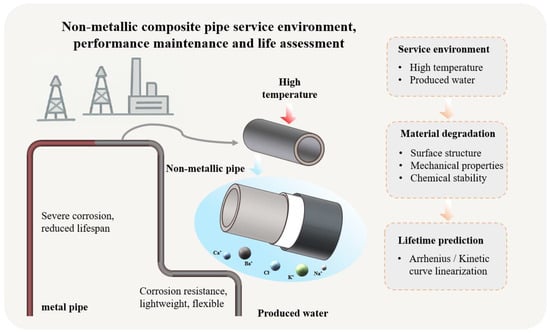
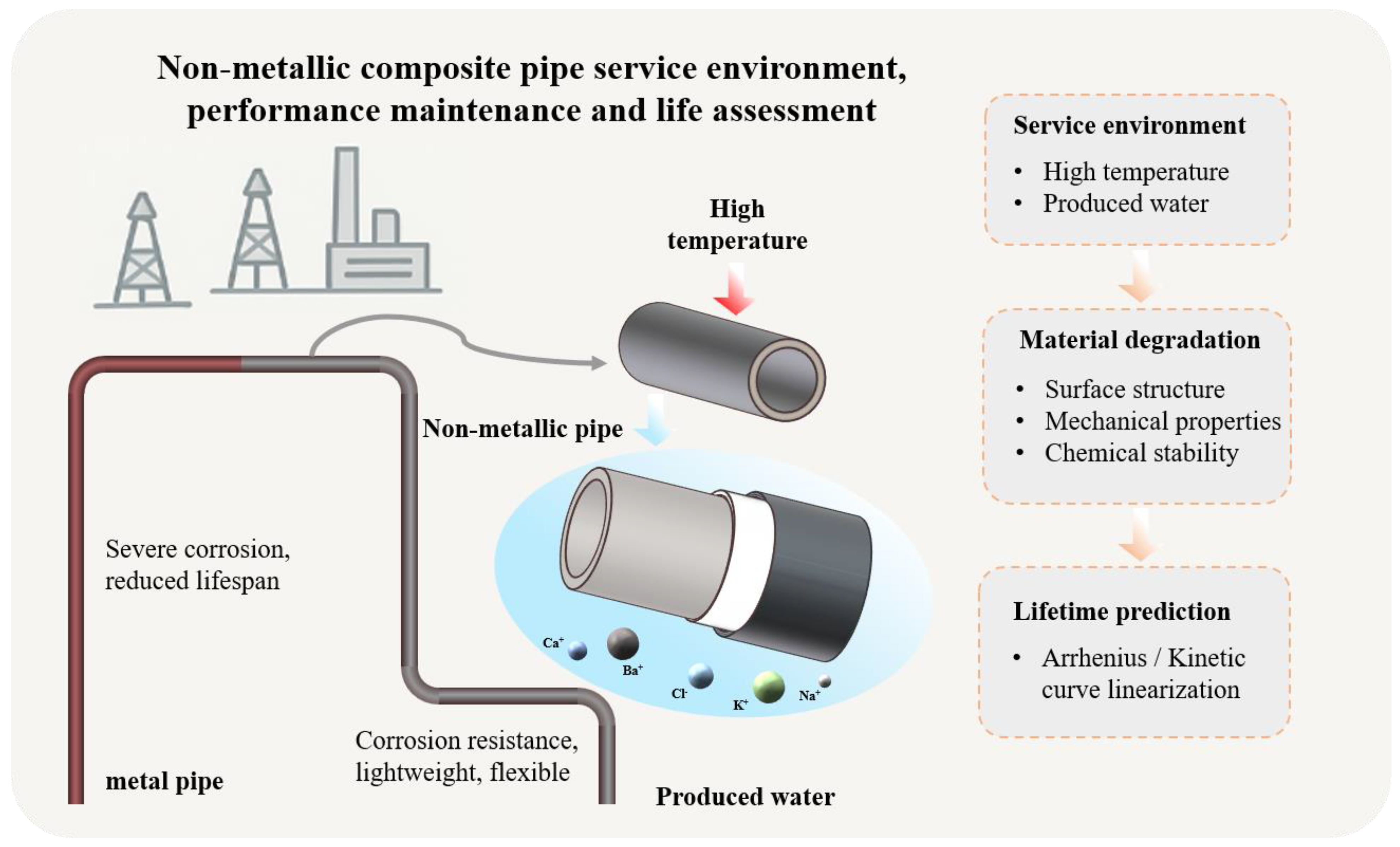
The majority of oilfields in China are progressively advancing into the intermediate and advanced phases of development, with the operational environment becoming increasingly complex and severe. The corrosion of steel pipelines is escalating annually, leading to significant economic losses and posing substantial risks to the safe operation of the oilfields [1,2,3]. In this context, non-metallic pipelines are extensively utilized in the oil and gas sectors characterized by hostile environments due to their notable advantages of superior corrosion resistance, prolonged service life, lightweight, and high bending flexibility [4,5,6]. Statistics indicate that non-metallic pipes constitute over 10% of the total surface collection pipeline network, with a strong annual growth rate of 10% [7]. However, the prolongation of service duration leads to considerable aging and degradation of the internal lining materials in non-metallic pipelines due to factors such as the corrosiveness of the transport medium, temperature, pressure, and the level of water mineralization, as illustrated in Figure 1. This complexity arises because produced water typically contains high concentrations of salts, dissolved metal ions, CO2/H2S, suspended particles, and organic acids. These constituents can collectively induce hydrolysis, oxidation, and photodegradation, ultimately deteriorating the mechanical properties of polymers [8,9]. In aqueous phase environments, penetration of water molecules into the polyethylene (PE) or polypropylene (PP) matrix triggers chain segment breakage, crystallinity changes, and accumulation of oxidation products, leading to material embrittlement and significantly lower tensile strength and elongation at break [10]. This deterioration weakens or completely destroys the function of the pipe and ultimately leads to pipe failure [4,11]. Therefore, there is a need to investigate techniques for testing and analyzing the performance of non-metallic pipeline products under operational conditions.
Figure 1.
Aging of non-metallic pipes.
Srii et al. [12] conducted accelerated thermo-oxidative aging of high-density polyethylene (HDPE) at elevated temperature and oxygen conditions and estimated the service life of HDPE across various temperature and pressure combinations utilizing the Arrhenius time-to-failure model; Niu et al. [13] incorporated the interaction of temperature and pressure into the aging experiments of polyethylene pipes and developed a comprehensive life assessment methodology grounded in Arrhenius’ law, revealing that the oxidation induction time and the Melt Mass Flow Rate diminished by approximately 15% and 20% for each 10 °C rise in temperature and 0.1 MPa increase in pressure, respectively; Kriston et al. [14] immersed HDPE plates in distilled water at 80 °C for 12 months, and found that the long-term degradation of HDPE in water is governed by one or two dominant oxidation reactions, with oxygen content determining the reaction direction; Loumpas et al. [15] incorporated UV radiation and seawater immersion into aging experiments, developing a σUTS prediction model that revealed 15% reduction in oxidation induction time per 10 °C temperature rise. Chen et al. [16] conducted long-term thermal oxidation experiments on PE pipes under hydrostatic pressure, and established a model based on the time-to-failure pressure relationship that can be used to quickly assess the remaining life of pipes in the field.
Srii et al. [17] compared ANN and FEM for PE100 pipe tensile strength prediction, finding Bayesian Regularization ANN (R2 ≈ 0.999) superior to FEM, thereby validating machine learning for HDPE mechanical behavior forecasting; Lin et al. [18] proposed a framework for the assessment of interlayer variability by stratified sampling of the outer layer, middle layer, and inner layer of the pipe wall. Singh et al. [19] evaluated kenaf/HDPE composites in seawater, 5% NaOH solution, and diesel, finding highest moisture absorption in deionized water. The study partially addressed multivalent ions but lacked Ba2+/Ca2+ quantification. Wang et al. [20] investigated UV, ozone, thermal, and salt spray aging of HDPE via experiments and FEM, showing degradation confined to a surface layer (<380 μm) with macroscopic stability retained after 1000 h due to competing chain scission, crosslinking, and rearrangement mechanisms; Elkori et al. [21] observed crystallinity increase in HDPE bottles aged in seawater at 80 °C, but ion-specific degradation pathways were not delineated.
Whelton et al. [22] conducted accelerated aging experiments on HDPE samples immersed in chlorinated water at 23 °C and 37 °C, observing surface carbon group formation and reduced oxidation induction time. The study highlighted the importance of monitoring solution chemistry and water absorption in accelerated protocols. Haddad et al. [23] used thermal coupling of ultraviolet with 35 °C as a means of accelerated aging and found a decrease in tensile strength of about 18% and a decrease in elongation at break of 30% using a Taguchi design with regression analysis and gave a prediction equation for mechanical degradation under different aging paths.
Table 1 summarizes the existing research on the aging and life prediction of polyethylene materials. Despite extensive research on polyethylene aging in aqueous environments, critical knowledge gaps persist in practical oilfield applications. Firstly, most accelerated aging studies utilize deionized water or simplistic saline solutions, which inadequately replicate the complex ionic cocktail (Ba2+, Ca2+, HCO3−) characteristic of produced water from Southwest China’s carbonate reservoirs. Secondly, existing life prediction models predominantly consider single-factor acceleration (temperature or pressure), neglecting the synergistic effects of regional environmental factors including geological strain and construction quality variation. Thirdly, material specifications for oilfield-specific HDPE composites remain proprietary, limiting the validation of degradation mechanisms across different grades.
Table 1.
Research content comparison.
This article examines the inner layer material of a specific non-metallic composite pipe utilized in the southwest oil and gas field, immersed in a simulated produced-water environment. Following aging tests at varying temperatures and immersion durations, the alterations in surface structure, mechanical properties, and chemical composition of the material are analyzed. Based on the test results, the residual service life of the pipe is predicted through kinetic curve fitting. To bridge the discrepancy between laboratory aging and field performance, environmental correction factors are introduced, providing a framework for assessing non-metallic pipeline applicability in analogous produced-water environments.
2. Experimental Preparation
2.1. Materials Preparation
The inner layer of a specific category of non-metallic composite pipe supplied by PetroChina Southwest Oil and Gasfield Company is composed of HDPE. Owing to vendor confidentiality constraints, the specific formulation and certain proprietary physical-property parameters cannot be disclosed. The aging test was conducted via sample immersion in vessels containing a simulated produced-water environment. The simulated produced water was formulated based on field data from the Chuanzhong Oil and Gas Mine, PetroChina Southwest Oil and Gasfield Company, with its detailed composition presented in Table 2. The aging environment was established utilizing a thermostatic chamber, with specific conditions defined as follows: constant temperatures of 60 °C and 70 °C maintained under forced-air circulation, implemented in 7-day cycles for a total of seven cycles [14].
Table 2.
Composition of simulated produced water.
2.2. Sample Preparation
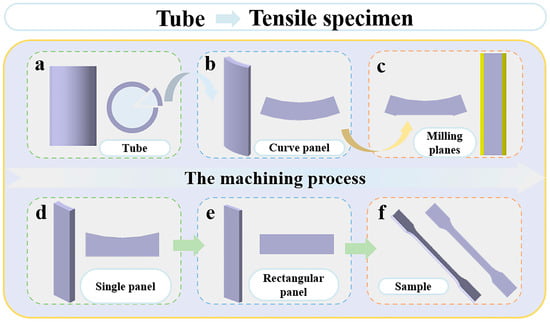
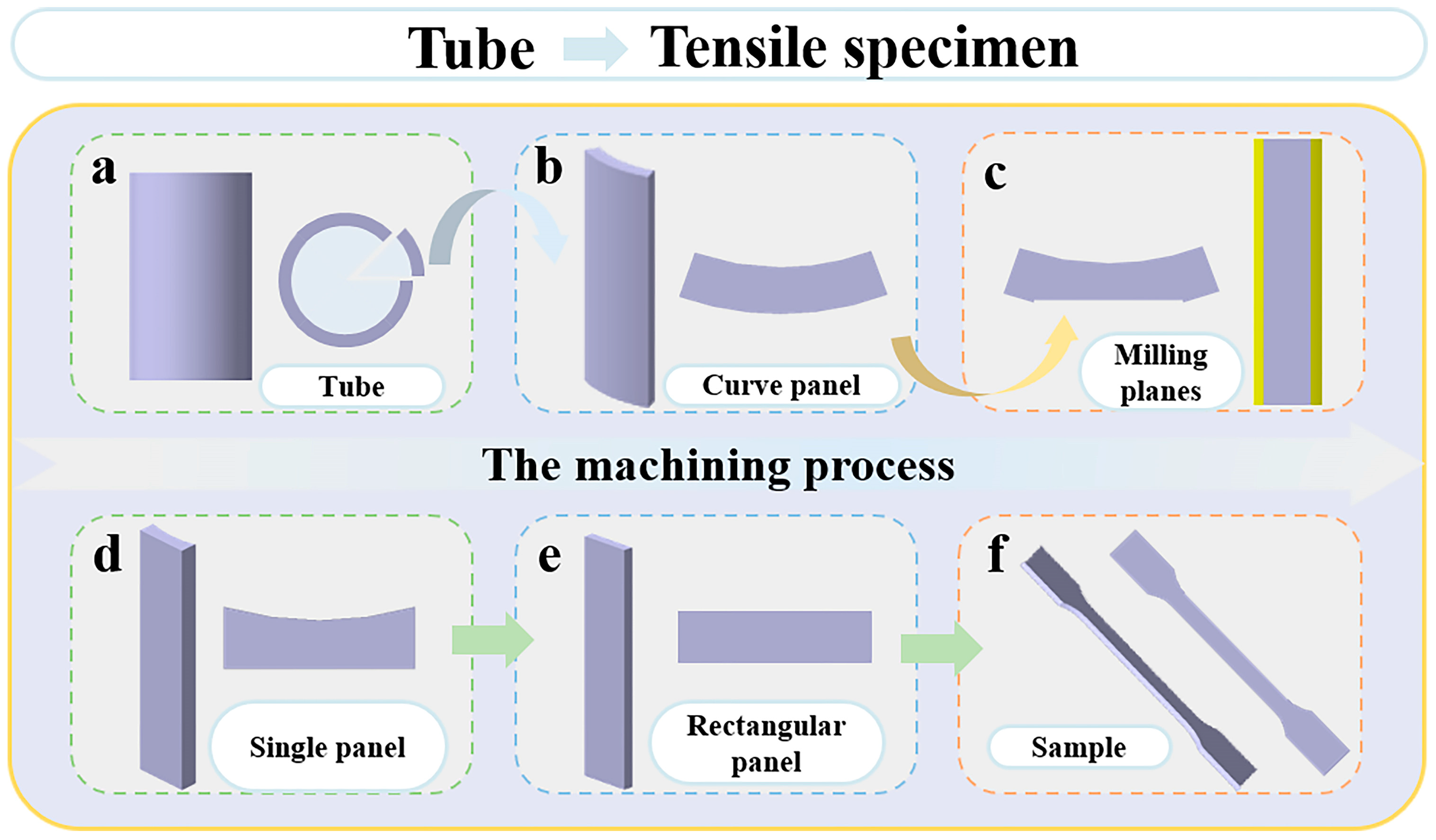
The raw material tube is sectioned using a table saw to produce the curved plate, which is subsequently positioned on the Computerized Numerical Control (CNC) lathe for milling into a rectangular sample plate, followed by preparation in accordance with GB/T 1040-2022 for standard sample type 1A. The machining process is shown in Figure 2.
Figure 2.
(a–f) Schematic diagram of sample processing.
Sample Preparation Procedure: 1. The raw material pipe was sectioned into 20 cm long specimens using a band saw, followed by grinding of both end faces to achieve surface smoothness; 2. Cutting lines were scribed onto the specimen pipes, which were then mechanically sectioned using a band saw to yield eight identical curved plate segments; 3. The curved plates were secured onto a CNC milling machine via a dedicated fixture, and the concave and convex surfaces were separately milled to fabricate planar test specimens; 4. The planar specimens were clamped for subsequent milling operations conducted at a spindle speed of 2000 rpm and a feed rate of 10 mm·min−1 to produce dog-bone test specimens conforming to Standard Test Specimen Type 1A.
2.3. Performance Testing and Structural Characterization
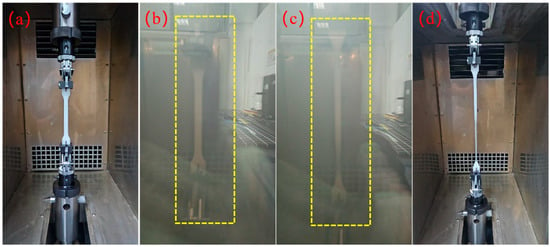
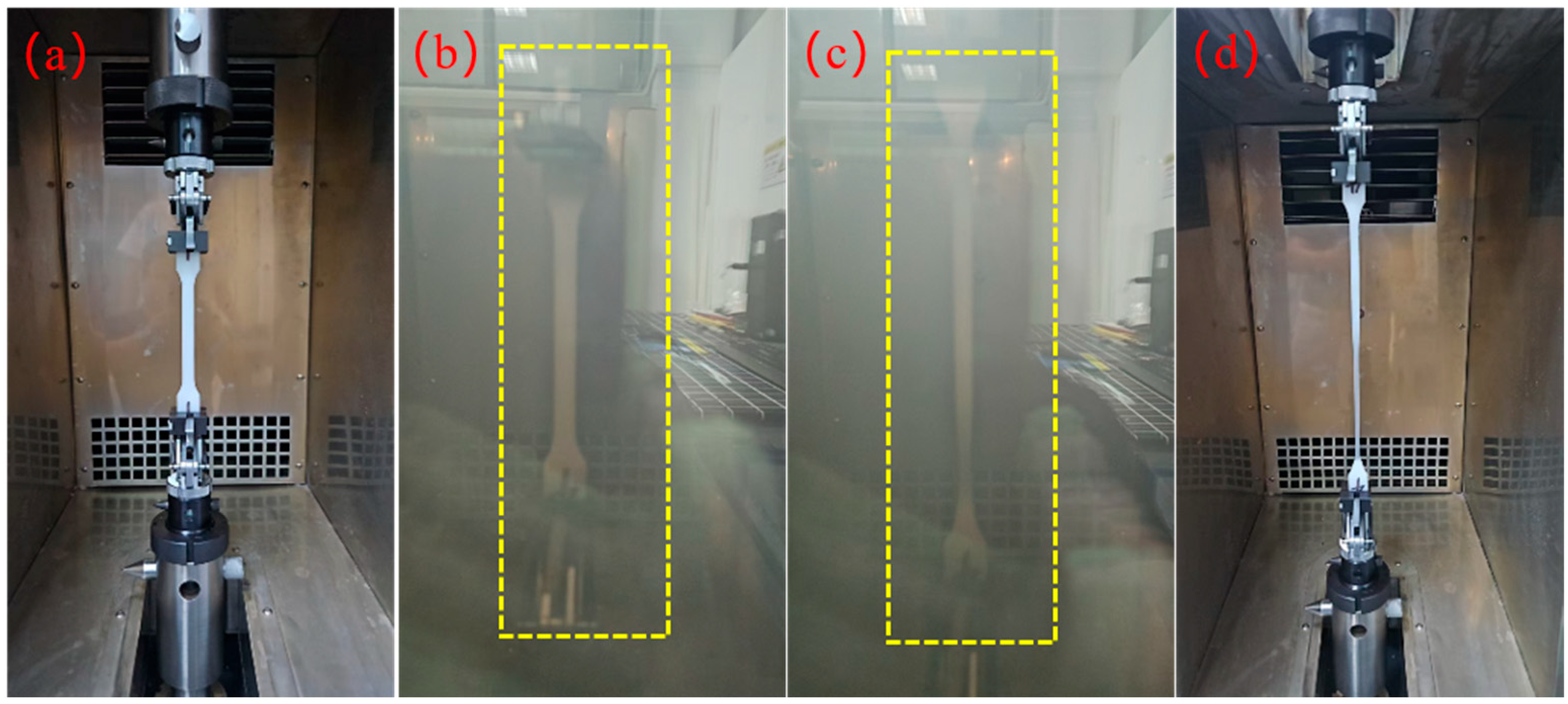
The mechanical properties test involves a tensile sample shaped like a dumbbell, conducted using the UTM5105X universal material testing machine supplied by SUNS. The test loading speed is 50 mm/min, the sample width is 10 mm, the thickness is 4 mm, the initial marking distance is 50 mm, and each sample group undergoes four tests, with the average value recorded. The tensile test is conducted within a temperature-controlled chamber in Figure 3. Once the temperature reaches the set value, the sample is maintained at this temperature for 10 min before the tensile test commences.
Figure 3.
Ambient temperature tensile test; (a) sample clamping; (b) temperature-holding phase; (c) tensile loading; (d) completion of the test.
Fourier transform infrared spectroscopy (FT-IR) analysis: Infrared tests were conducted on HDPE samples to assess the influence of immersion temperature and duration on the material’s chemical makeup. The assessment was conducted utilizing the attenuated total reflection attachment mode of the Nexus 670 from Nicolet Instruments.
Surface structure: The soaked samples were taken out from the containers under two-temperature environments for 35 d and 42 d, respectively, and put into the optical profilometer to observe the change in appearance and morphology.
3. Result and Discussion
3.1. Effect of Immersion Temperature and Time on the Change in Surface Structure of Materials
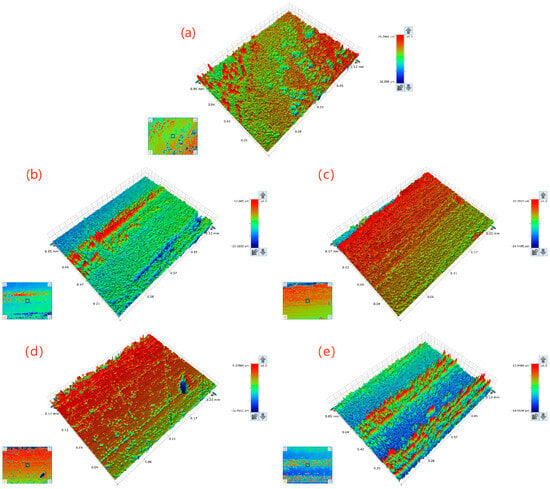
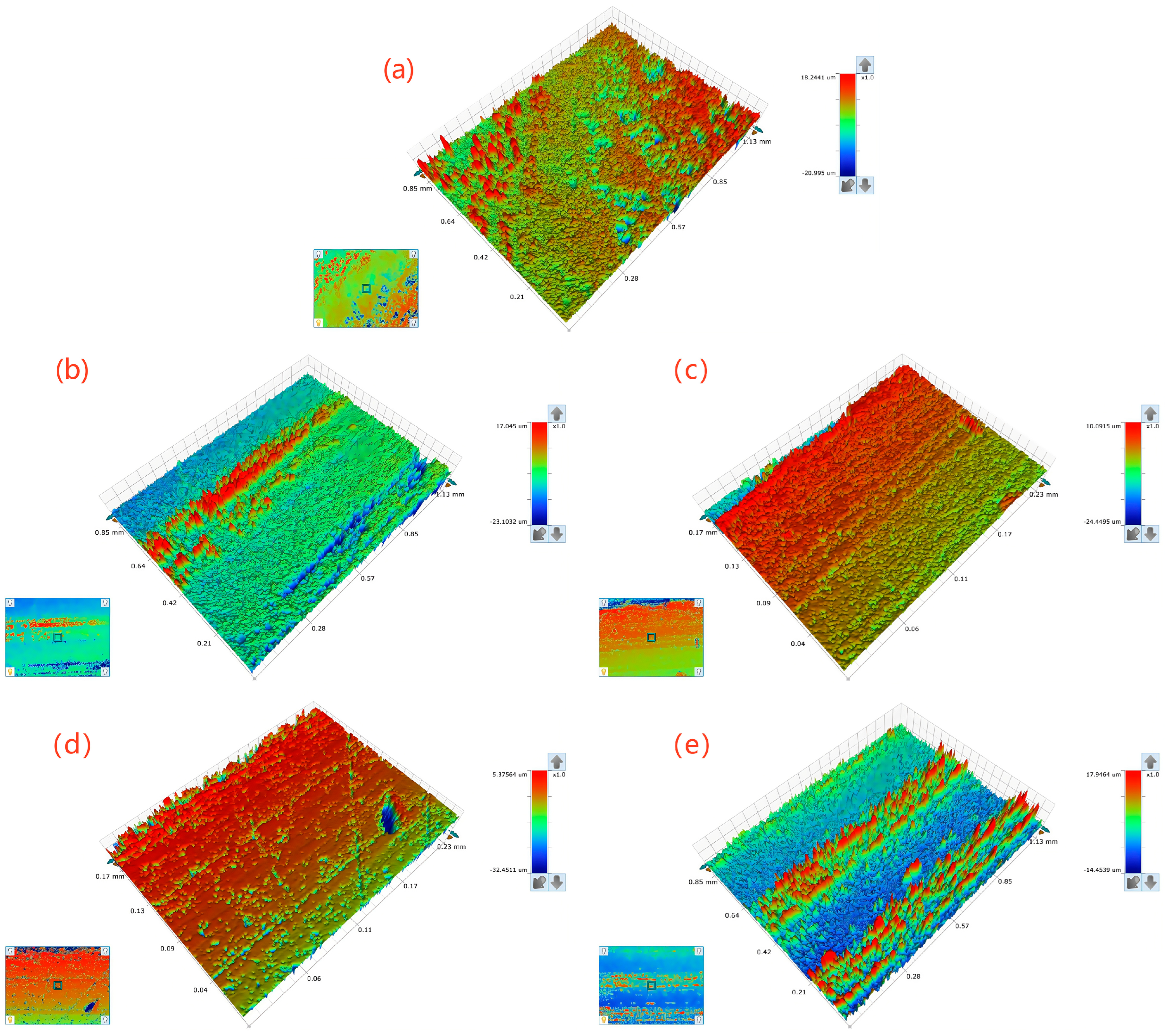
An optical profilometer is a non-contact tool for measuring surface topography, capable of precisely assessing microstructural parameters including surface roughness and contour by acquiring three-dimensional topographic data of the material surface through the principle of optical interference. This research used optical profilometry to examine the surface topography of unsoaked specimens and those subjected to high-temperature immersion at 60 °C and 70 °C, with the objective of assessing the material’s surface stability in a high-temperature aqueous environment. Optical profilometry assessments were conducted on specimens following high-temperature immersion at 60 °C for varying durations (35 and 42 days), with the findings illustrated in Figure 4.
Figure 4.
Material surface profile; (a) unsoaked sample; (b) 35 d at 60 °C sample; (c) 42 d at 60 °C sample; (d) 70 °C immersion 35 d sample; (e) 70 °C immersion 42 d sample.
The morphology of samples immersed at 60 °C and 70 °C was measured and compared with non-immersed samples, as presented in Table 3. After 35 days of high-temperature immersion at 60 °C, the surface exhibited no voids, and the Ra value of the specimens slightly decreased to 2.20 μm, indicating an enhancement in surface roughness. This improvement may be attributed to the high-temperature aqueous environment facilitating the uniform distribution of surface sediments, which filled some microscopic depressions. At 42 days of age, the Ra value rose to 2.52 μm, signifying the onset of a minor aging event on the material’s surface, with deposits perhaps becoming partially dislodged or exhibiting modest corrosion.
Table 3.
Optical profiler measurement result.
The surface roughness of the samples immersed at 70 °C for 35 days exhibited a marked increase relative to the control group, likely due to the prolonged immersion time and the elevated temperature of 70 °C, which may have expedited the material’s aging process, leading to alterations in surface deposits or microstructural damage.
3.2. Effect of Immersion Temperature and Time on the Mechanical Properties of Materials
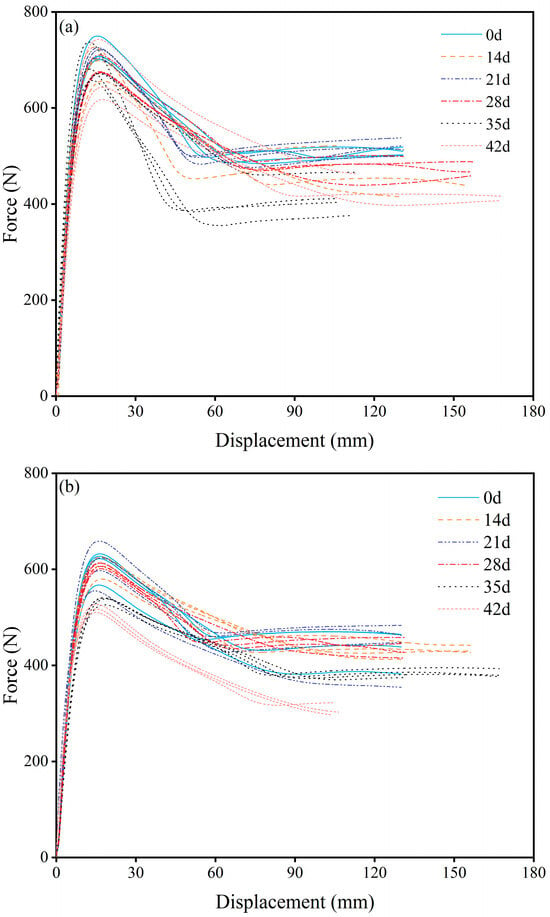
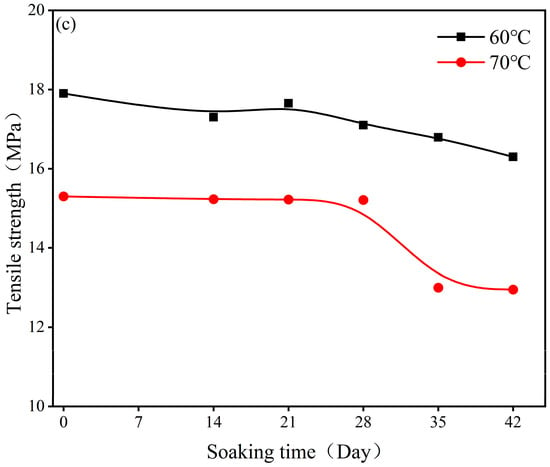
Figure 5 illustrates the tensile strength test results for materials following immersion in produced water at 60 °C and 70 °C for various durations. Tensile testing was conducted in an environmental chamber, with specimens held at the specified temperature for 10 min prior to tensile loading.
Figure 5.
Tensile strength test results at (a) 60 °C; (b) 70 °C. (c) Trend in mechanical property changes.
The reported tensile strength values represent the mean of four replicate specimens. Across all conditions, the coefficient of variation (CV) remained consistently below 8.2%, demonstrating excellent repeatability. All specimens exhibited ductile fracture accompanied by pronounced necking, confirming that the observed degradation stemmed from alterations in chain mobility rather than brittle fracture induced by embrittlement. These findings are consistent with the absence of detectable oxidation products in Fourier transform infrared spectroscopy.
The tensile strength retention P of the material in the simulated produced-water solution has been calculated in Equation (1).
is the tensile strength of the sample before immersion, MPa; is the tensile strength of the sample after immersion, MPa.
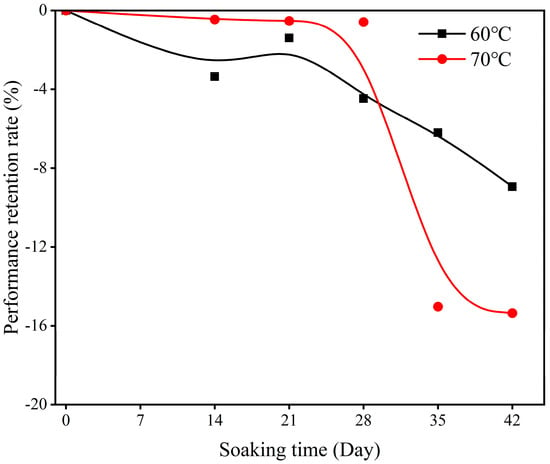
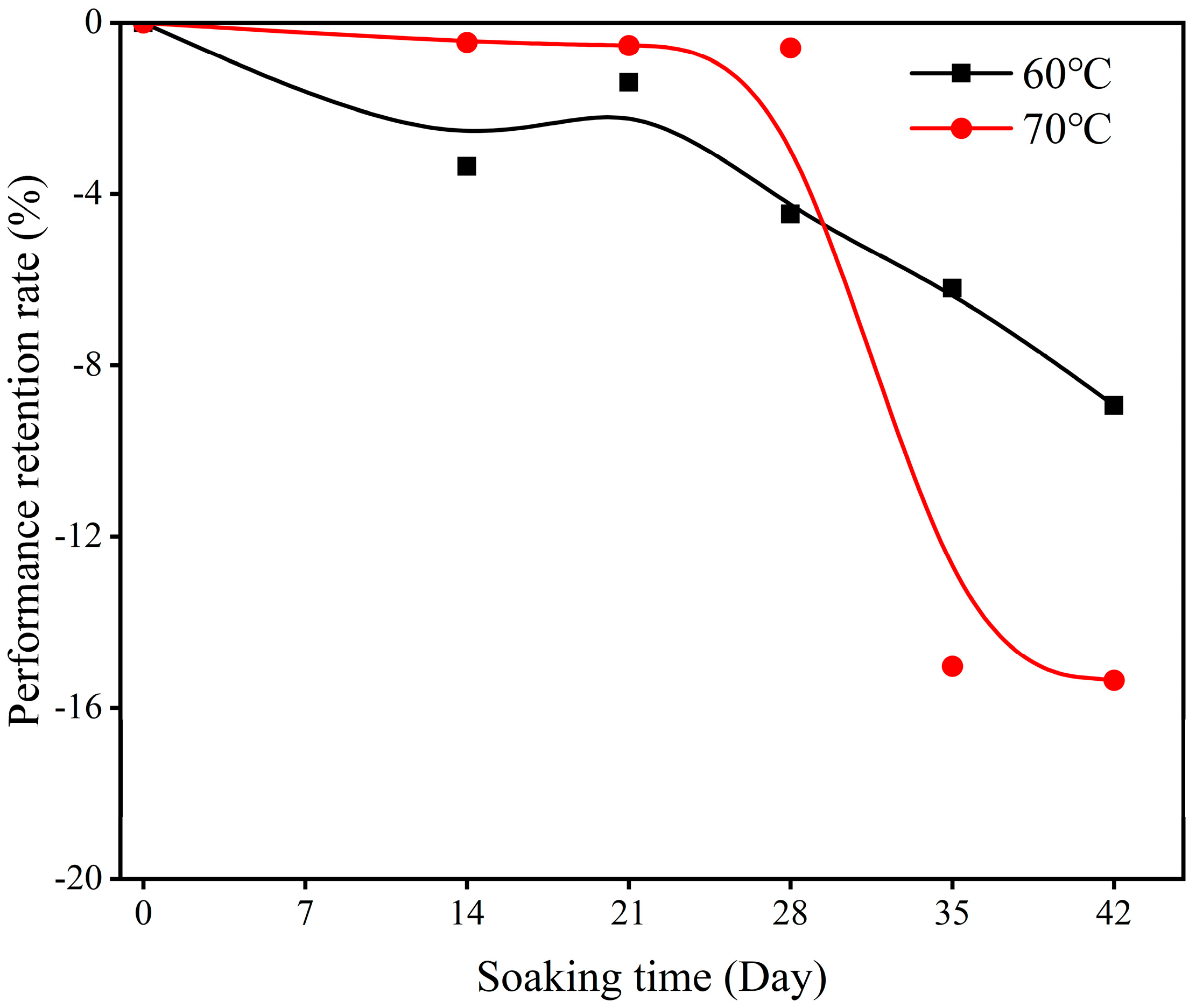
Figure 6 illustrates the rate of change curves for the tensile strength of materials subjected to aging in simulated production aqueous solutions at 60 °C and 70 °C across varying durations. The tensile strength of materials immersed in simulated aqueous solutions at 60 °C and 70 °C exhibited a decline relative to the blank samples. In the simulated aqueous solution at 60 °C, the tensile strength diminished after 14 days of immersion, subsequently experienced a slight recovery, and then exhibited a gradual decline after 21 days of immersion, with the maximum rate of change in tensile strength reaching −8.94%.
Figure 6.
Mechanical property retention rate.
At 70 °C, the material’s strength remains rather stable for the initial 28 days, after which it exhibits a progressive decline, with an accelerated rate of reduction compared to 60 °C, culminating in a maximum tensile strength change rate of −15.36%. Higher temperatures accelerate tensile strength loss by weakening intermolecular forces and the main-chain chemical bond. Under elevated temperature conditions, when solution molecules infiltrate the material’s interior, they may occupy molecular interstices, thereby disrupting intermolecular forces and diminishing the material’s strength [24,25,26,27,28].
3.3. Effect of Immersion Temperature and Time on the Chemical Composition of Materials
Following exposure to various environments over time, polyethylene materials will experience aging and deterioration, resulting in diminished mechanical capabilities, thermal resistance, compressive strength, and other characteristics of the materials [29,30].To examine the impact of experimental temperature and immersion duration on the molecular structure of the materials, infrared analysis was conducted on samples immersed at 60 °C and 70 °C in generated water, as well as on the control samples. Figure 5 displays the infrared spectra of both the unsoaked samples and those subjected to high-temperature soaking.
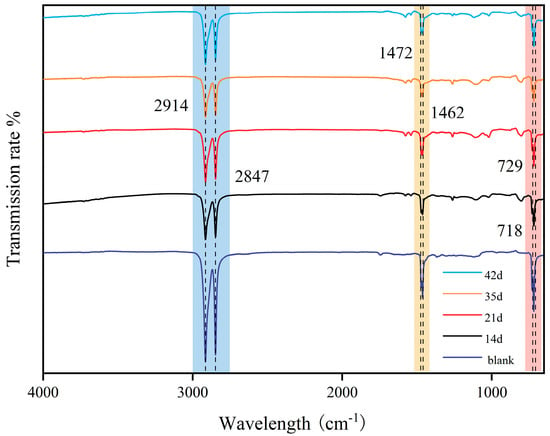
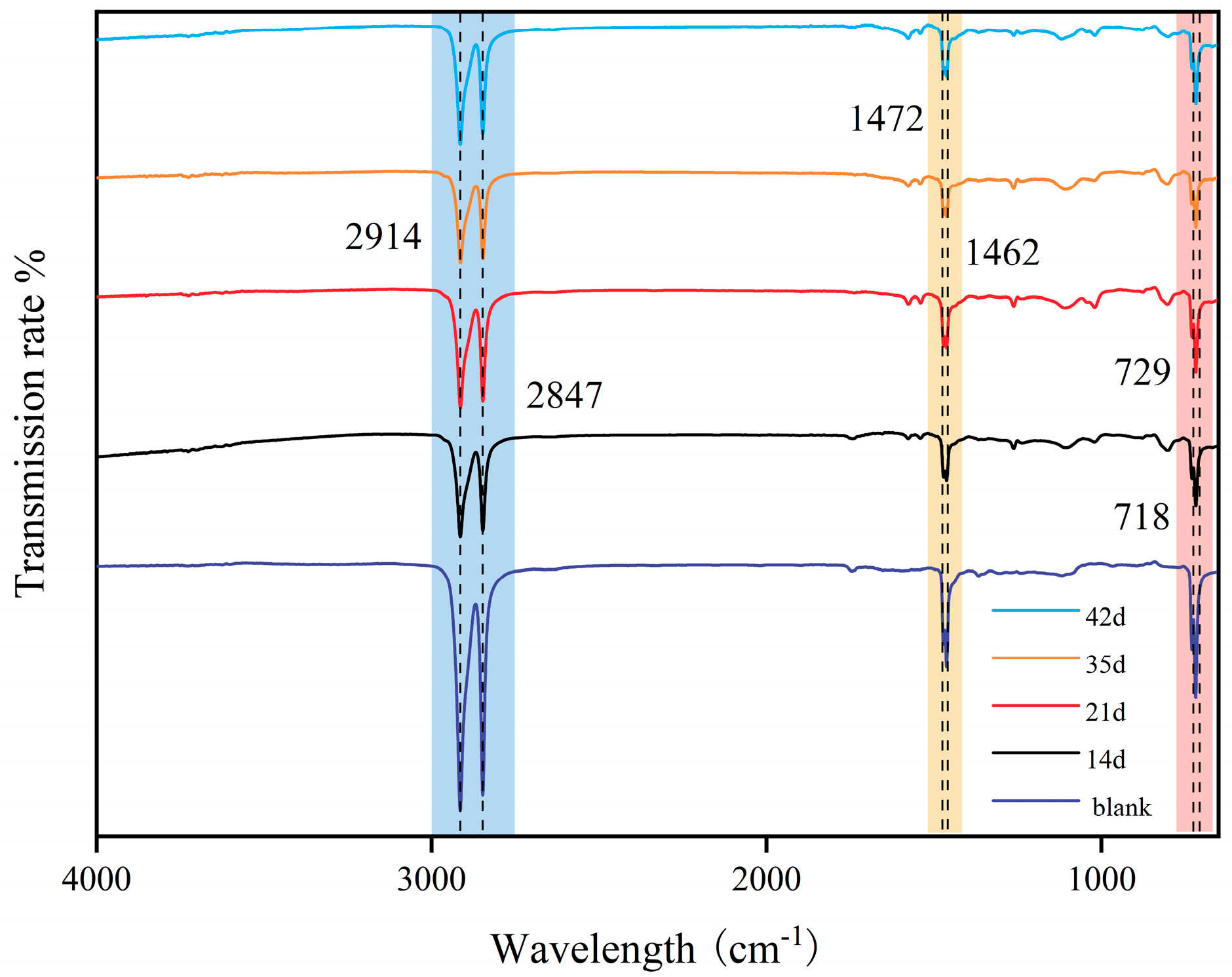
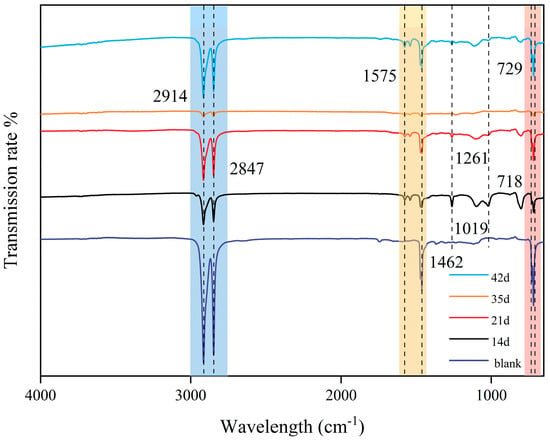
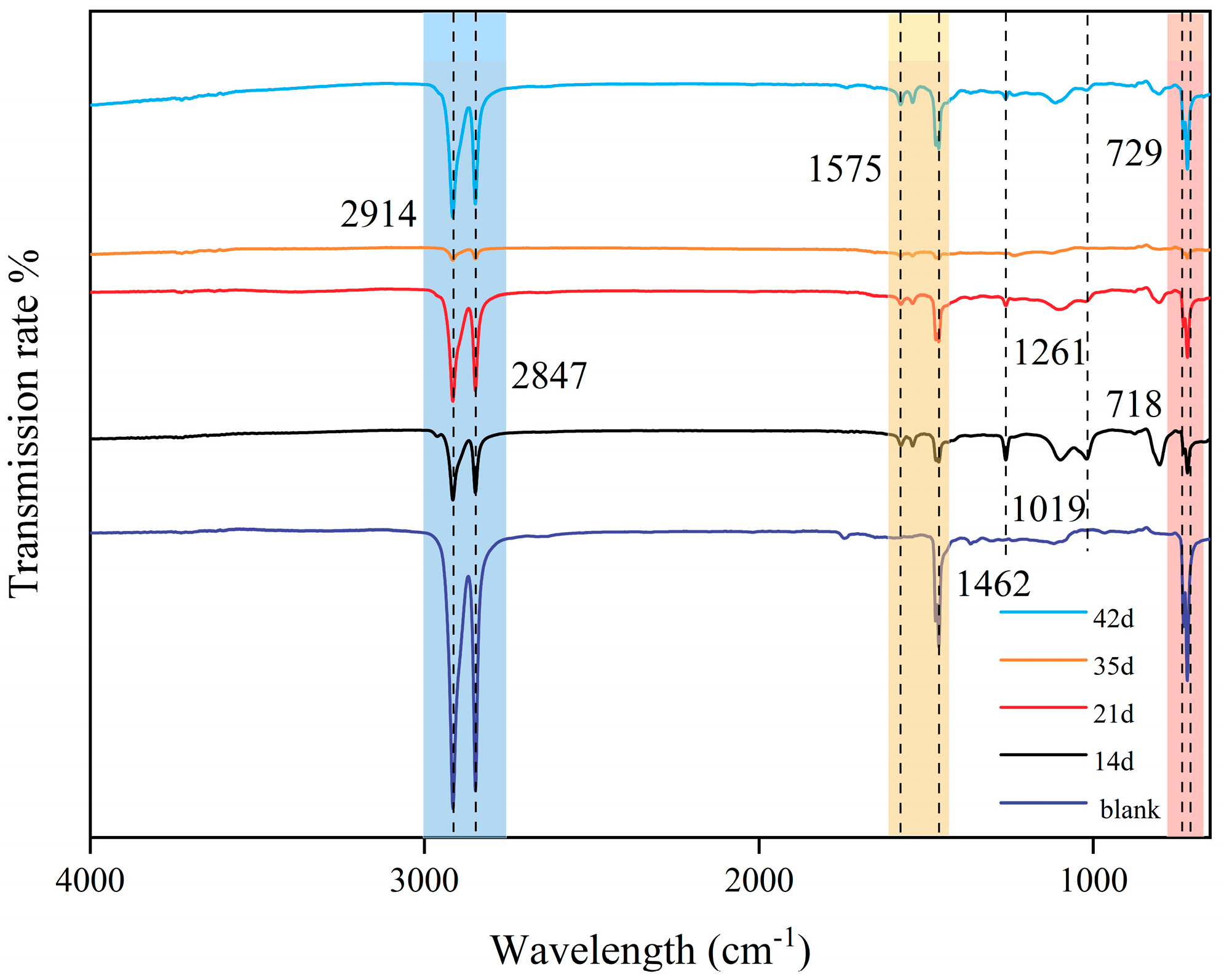
Following the immersion of HDPE in solutions with defined concentrations of barium, calcium, sodium, potassium, chloride, and bicarbonate ions at 60 °C for durations of 0 d, 14 d, 21 d, 35 d, and 42 d, as illustrated in Figure 7, the distinctive characteristic peaks of HDPE, including the asymmetric- and symmetric-stretching vibration peaks of methylene (-CH2-) (approximately 2914–2916 cm−1 and 2846–2848 cm−1), bending vibrational peaks (1462–1472 cm−1), and rocking vibrational peaks (around 718–729 cm−1), remained consistently identifiable, signifying the preservation of the core structure of HDPE throughout the immersion period. The fundamental structure of HDPE was predominantly maintained during immersion.
Figure 7.
Infrared spectra of samples at 60 °C after different times of immersion in simulated produced-water environments.
Upon comparing the spectra for each time duration, it is observed that the intensity of the stretching and bending vibration peaks of the methylene group exhibits a little tendency of attenuation, while the intensity of the rocking vibration peak also demonstrates minor fluctuations. This phenomenon is believed to be intricately linked to the synergistic effect of various ionic constituents in the solution, which adsorb onto the active sites of the HDPE surface and disrupt the typical movement patterns of polymer chains. Concurrently, the elevated temperature of 60 °C accelerates the thermal motion of the chains, leading to the relaxation of intersegmental forces and an increase in chain activity, thereby inducing alterations in the intensity of the characteristic peaks. Nevertheless, the distinctive absorption peaks of carbonyl (approximately 1700 cm−1) and hydroxyl (approximately 3300–3600 cm−1), which are indicative of typical oxidation products, were not identified throughout the entire soaking cycle. Additionally, the C=C stretching vibration peaks of the small molecule olefin (around 1650 cm−1) were absent, conclusively demonstrating that HDPE did not experience the oxidation process. This indicates that HDPE underwent no significant oxidative degradation or chain scission.
In the simulated produced-water environment at 70 °C shown in Figure 8, there were no discernible indications of new functional group formation. The intensity of the characteristic peaks altered marginally, although remained largely unchanged, and no chain breakdown occurred. This signifies that no substantial oxidation or chain scission transpired in HDPE under these conditions. The underlying cause may be the physical adsorption of metal cations in the solution, such as barium and calcium ions, onto the polyethylene surface. At 70 °C, the thermal motion of the polyethylene molecular chains is enhanced, yet it does not reach the melting point, resulting in only minor rearrangement and creep. Although the duration is prolonged, the cumulative effect remains negligible, thereby maintaining the overall structural integrity and preventing significant chemical degradation or extensive physical damage.
Figure 8.
Infrared spectra of samples at 70 °C after different times of immersion in simulated produced-water environments.
Despite the absence of notable oxidation signature peaks, little oxidation may still occur throughout the soaking phase. This trace level of oxidation may produce a limited number of oxygen-containing functional groups on the polyethylene chain, such as the newly generated (C=C) stretching vibrational absorption peak at 1575.32 cm−1, the aromatic ring backbone vibrational absorption peak at 1261.68 cm−1, and the (C-O-C) stretching vibrational peaks at 1098.15 cm−1 and (C-O-C) stretching vibrational peaks at 1019.76 cm−1. The newly formed functional groups will interact with the existing chemical bonds, altering the local electron cloud density and vibrational modes, hence affecting the intensity of the distinctive peaks. The decline in peak strength of the sample immersed at 70 °C for 35 d is attributed to increased surface roughness, which scatters more infrared light, hence diminishing the absorption of the characteristic peaks.
3.4. Mechanistic Interpretation of Aging Behavior
From this, we can summarize the three stages of HDPE degradation mechanisms in effluent water, as shown in Table 4:
Table 4.
Three-stage summary of HDPE degradation mechanisms in effluent water.
During Stage I (0–14 days), mechanical properties exhibited a marginal, partially reversible reduction—a phenomenon plausibly attributed to the plasticizing effect of water molecules and small-molecule ions. Infiltration of water and dissolved salts into the amorphous phase or interfacial regions of high-density polyethylene (HDPE) attenuates intersegmental friction and depresses the localized glass transition temperature; consequently, this manifests as a transient decrease in yield strength and modulus during tensile testing at a constant strain rate. A short-term reduction in Ra is observed upon the transient filling of micro-grooves by surface adsorption/deposition.
The quasi-stable plateau (dynamic equilibrium) observed during Stage II (14–28 days) arises from the competitive interplay between surface deposition and solution-phase adsorption. In this phase, cations (e.g., Ba2+, Ca2+) and anions co-precipitate to form an adsorbed–deposited film on the surface. This film concurrently infills surface micropores (thereby reducing Ra) while generating localized stress concentration sites (resulting in elevated local Rp). Such competing mechanisms—deposition-induced coverage counteracted by localized spalling or micro-pitting—account for the non-monotonic evolution of surface roughness parameters as functions of temperature and exposure duration.
Stage III (28–42 days) exhibits a pronounced deterioration in tensile strength, predominantly governed by diffusion-controlled physical degradation and microstructural rearrangement. Elevated temperatures accelerate solute diffusion and segmental dynamics, facilitating enhanced ingress of small molecules into the polymer matrix. This process attenuates interchain van der Waals forces and disrupts chain entanglement networks, thereby reducing the effective load-bearing cross-section. Concurrently, under prolonged immersion, minute surface defects, localized spalling of deposits, or micro-pits may serve as crack initiation sites. Under tensile loading, these features promote premature necking and act as stress concentrators, ultimately compromising overall strength.
The FTIR experiment detected no significant enhancement of carbonyl (C=O ~1700 cm−1) or hydroxyl (3300–3600 cm−1) absorption peaks, indicating that within the physicochemical conditions and temperature regime of the produced water employed, no significant chemical oxidative chain scission or substantial introduction of oxygen-containing functional groups occurred. Consequently, the mechanical degradation observed in this study primarily stems from physical plasticization, adsorption/deposition-induced microstructural rearrangement, and diffusion-induced stress concentration.
Concerning temperature effects, strength degradation is more pronounced at 70 °C. This can be explained by the strong temperature dependence of diffusion coefficients and segmental relaxation times in accordance with Arrhenius behavior: per degree Celsius increase, localized segmental motion is significantly intensified, enabling deeper and more rapid water/ion penetration, thereby accelerating the onset of macroscopic damage in Stage III. This mechanistic framework is also consistent with our approach in Section 4 for extrapolating lifetime based on rate constants—namely, describing the time-dependent degradation rate of material properties using the temperature-dependent rate constant.
4. Lifetime Prediction Analysis
4.1. Kinetic Model Formulation
Given that polyethylene degradation in hygrothermal environments is predominantly controlled by thermo-oxidative radical chain reactions, and given the constraints imposed by limited testing resources and operational pipeline inspection requirements, the methodology employing dynamic curve linearization in Equation (2) in conjunction with the Arrhenius equation represents the most appropriate approach under these conditions [31].
Relative to long-term hydrostatic testing (requiring 1–2-year test durations) and crack propagation testing (necessitating pre-notched specimens), this method affords distinct advantages through sampling flexibility, abbreviated testing cycles, and simplified instrumentation. It is particularly suited for extracting dumbbell specimens from non-critical sections of in-service pipelines. This approach furnishes a viable solution for rapid assessment of residual service life of polyethylene pipelines under thermo-oxidative aging conditions, reconciling theoretical consistency with engineering credibility. The two-temperature design provides preliminary kinetic estimation, and additional temperature points will be integrated in subsequent work for refinement.
It aims to ascertain the rate constant (K) at various temperatures, employing the Arrhenius formula to extrapolate the rate constant value at ambient temperature, thereby facilitating the establishment of the performance change equation at room temperature. The pipe’s lifespan at the specified operating temperature is determined.
: ratio of tensile strength of PE pipe after aging to tensile strength before aging; A: prefactor; α: correction factor; K: aging rate constant at each temperature; t: life of pipe at actual operating temperature (years).
Taking logarithms on both sides of the kinetic Equation (2) yields lnP = lnA − ktα, let X = tα, Y = lnP, a = lnA, b = −k. The equation can then be expressed as Y = a + bX. Linear fitting was performed by computer to obtain the data in Table 5.
Table 5.
Parameters of mathematical modeling of material property changes at 60 °C and 70 °C.
The Arrhenius Equation (3) is then used to extrapolate the value of the aging rate constant K at a certain temperature to establish the performance change equation.
Z: Arrhenius constant; E: activation energy, kJ/mol; R: molar gas constant, often taken as 8.314472 J/(mol-K); T: temperature (K).
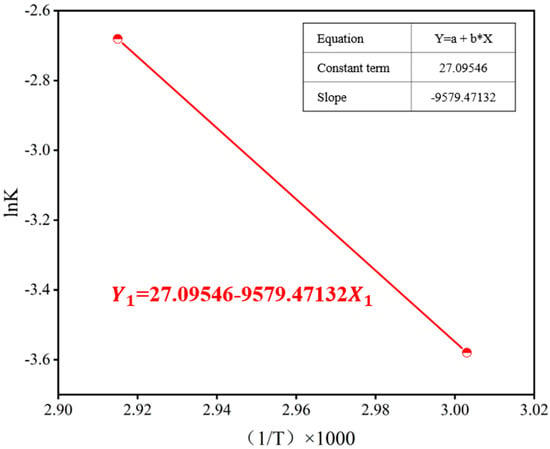
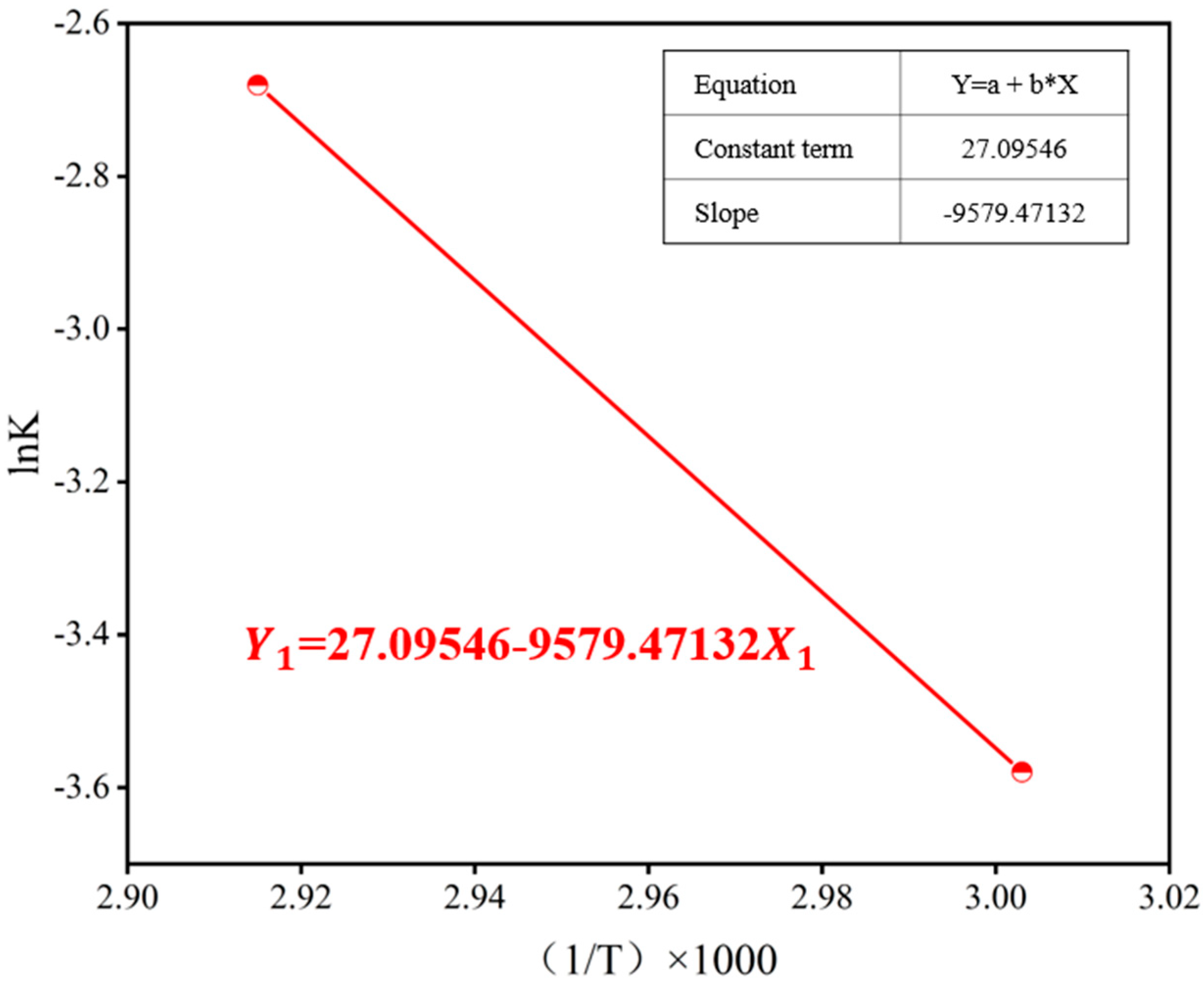
Taking logarithms on both sides of the Arrhenius formula, E/RT, let X1 = 1/T, Y1 = lnk, a1 = lnZ, b1 = −E/R. The equation can then be expressed as Y1 = a1 + b1X1. Linear fitting by computer, as in Figure 9, yields the coefficients a1 =27.09546, b1 = −9579.47132. Substituting into the equation, we obtain the following: E/RT.
Figure 9.
Performance change rate constants as a function of temperature.
The aging rate of the pipe is lnk = −5.05 when the standard temperature is 298 K. Collation of Equation (4) is as follows:
Pipe failure was defined as P = F/F0 = 0.5 for lifetime calculation; the use of Equation (4) can be calculated to use time is 52.5 years at room temperature.
4.2. Environmental Impact Factor
Laboratory-based life predictions typically overestimate field performance. To improve accuracy, environmental correction factors K are integrated into the kinetic model. These factors account for Suining’s geology, climate, and produced-water chemistry. The composite correction factor, defined by Equation (5), provides a more realistic framework for pipeline safety assessment and maintenance planning.
Temperature factor K1: based on the publicly accessible data platform of Suining City [32], China, the average annual temperature is 17.4 °C; however, surface temperatures can reach an extreme of 40 °C during summer, resulting in an equivalent aging temperature of 26 °C [33], as compared to the experimental benchmark of 25 °C. Based on Equation (6) [34], the aging rate increases by approximately 11%; hence, K1 is designated as 1.11. A seasonal amplitude of ±4 °C induces a ±5%–6% change in rate constant; hence, the ±0.05 uncertainty adopted.
E: apparent activation energy, taken as 80 kJ mol−1; R: constant, taken as 8.314 J/(mol·K).
Internal pressure factor K2: the operational pressure of the oil and gas field pipeline network is 1.6 MPa. According to the studies by Tian et al. [35] and Lan et al. [36], the life discount at 0.1 MPa is 9.6%. Assuming a constant life discount rate per unit of pressure, this value is linearly extrapolated to 1.6 MPa using Equation (7), resulting in an internal pressure factor K2 of 1.2. Variation among pipe grades justifies a ±0.10 interval.
α: slope, taking the value 0.096; p: corresponding pressure value, (MPa).
Geological factor K3: Suining City is situated in the central region of the Sichuan Basin, characterized by interbedded mudstone and saltpaste rock, as per the research conducted by Sun et al. [37]. The geological catastrophes in Suining city mostly consist of landslides and unstable slopes, with the areas west and east of the Fuling River, characterized by tectonic denudation erosion, being particularly susceptible to these geological hazards. Taking into account the aforementioned considerations, the supplementary strain is 30%–40%, and the initial value of K3 is 1.3–1.4.
The construction impact factor K4 should be modified based on particular construction conditions and quality control measures [38]. Based on industry experience, as indicated in Table 6, the impact factor K4 is assigned a value of 1.2 ± 0.1.
Table 6.
Construction impact factor values.
In summary, the composite environmental impact coefficient K equals the product of K1 through K4. Multiplying the intermediate values yields a result of 2.16, while the minimum and maximum K values are determined as 1.67 and 2.74, respectively. Substituting these K values into Equation (8) yields a final predicted pipeline service life of 24.3 years under comprehensive environmental impact considerations, with a plausible range of 19.2–31.4 years.
where t0: predicted lifetime from laboratory kinetic modeling; K: impact factor; t1: actual predicted usable lifetime.
5. Conclusions
- The absence of voids on the surface of the samples after 42 days of immersion at elevated temperatures suggests that the appearance and morphology of the polyethylene material in the inner layer of the composite pipe remained stable under the simulated produced-water conditions. There were no obvious structural defects in the material. However, surface stability and aging should be of concern when used in 70 °C environment.
- The tensile strength variation rates of the material at 60 °C and 70 °C are −8.94% and −15.36%, respectively, and both rates comply with the ±20% criterion established in GB/T34903.1 (IS023936-1).
- The infrared spectrogram study indicated that HDPE submerged in simulated produced-water solution at 60 °C and 70 °C exhibited no substantial alterations in chemical structure, no formation of large numbers of oxygen-containing functional groups, and no significant oxidation or chain degradation after 0, 14, 21, 35, and 42 d. HDPE thus demonstrates excellent chemical stability and suitability for similar produced-water applications.
- The lifespan of the plastic pipe was estimated utilizing the kinetic curve straightening approach, presuming a 50% degradation in the material’s mechanical properties to ascertain failure, resulting in a calculated lifespan of 52.5 years at ambient temperature. The environmentally corrected lifetime is estimated at 24.3 years, taking into account local temperatures, pressures, geological strains, and construction quality.
- This study establishes a transferable methodology for regional life prediction that incorporates localized environmental stressors, which can be adapted for other oil and gas provinces.
- Limitations and Future Work: The current two-temperature kinetic model should be expanded to 4–5 levels (45–85 °C) to confirm activation energy invariance.
The aggregated test results indicate that the composite pipe’s inner layer material is suitable for this produced-water situation.
Author Contributions
Methodology, C.G. and M.L.; Software, Y.L., J.L. and M.L.; Investigation, L.Y., C.G. and M.L.; Data curation, Y.L., J.L. and M.L.; Writing – original draft, L.Y.; Writing – review & editing, J.Q. and B.D.; Supervision, J.L. and B.D.; Project administration, L.Y. and J.Q.; Funding acquisition, L.Y. All authors have read and agreed to the published version of the manuscript.
Funding
This research received no external funding.
Institutional Review Board Statement
Not applicable.
Informed Consent Statement
Not applicable.
Data Availability Statement
Data will be made available on request.
Conflicts of Interest
Authors Li Yang, Yan Li, Chunyong Gu, Jing Li, Minzhu Luo were employed by the PetroChina Southwest Oil and Gas Field Company. The remaining authors declare that the research was conducted in the absence of any commercial or financial relationships that could be construed as a potential conflict of interest.
References
- Saeed, W.S.; Al Mehairi, A.S.; Alnaqbi, A.M.; Al Blooshi, S.O. Applications & Challenges of the Non-Metallic Material for Hydrocarbon Piping. In Proceedings of the SPE International Petroleum Exhibition and Conference, Abu Dhabi, United Arab Emirates, 2–5 October 2023; p. D031S088R007. [Google Scholar]
- Li, Q.; Du, B.; Liu, Y.; Jian, Q.; Feng, T.; Zhang, X.; Nie, S.; Chen, L. On structural behavior of lightweight steel-reinforced polymer/composite hybrid structures: A review of analytical, experimental, and numerical methods. Mech. Adv. Mater. Struct. 2025, 10, 1–30. [Google Scholar] [CrossRef] [Scilit]
- Badeghaish, W.; Noui-Mehidi, M.; Salazar, O. The future of nonmetallic composite materials in upstream applications. In Proceedings of the SPE Gas & Oil Technology Showcase and Conference, Dubai, United Arab Emirates, 21–23 October 2019; p. D021S014R004. [Google Scholar]
- Cai, X.; Shao, X.; Zhang, Z.; Ding, H.; Qi, G.; Li, H. Discussion on New Evaluation Technology of Non-Metallic Composite Continuous Pipe for Oil and Gas Field. J. Mater. Sci. Chem. Eng. 2021, 9, 1–6. [Google Scholar] [CrossRef]
- Zhang, Y.; Li, X.; Feng, C.; Ma, C.; Zhang, C.; Zhou, Y.; Bi, H. Research progress on failure prediction and prevention technology of non-metallic pipes in oil and gas fields. Chem. Ind. Eng. Prog. 2024, 43, 1118–1132. [Google Scholar]
- Wei, X.; Wang, Y.; Jiao, Y.; Xue, P.; Han, J.; Xiong, J. Bending behaviors of carbon fiber composite honeycomb cores with various in-plane stiffness. Compos. Struct. 2024, 347, 118448. [Google Scholar] [CrossRef] [Scilit]
- Cai, X.; Shao, X.; Qi, G.; Zhang, Z.; Li, H. Research progress on new technology of full-size test and evaluation of non-metallic pipes for oil and gas fields. Mater. Sci. 2022, 12, 1370–1375. [Google Scholar]
- Melchers, R.E.; Ahammed, M. Estimating the long-term reliability of steel and cast iron pipelines subject to pitting corrosion. Sustainability 2021, 13, 13235. [Google Scholar] [CrossRef] [Scilit]
- Kong, L.; Qi, D.; Li, H.; Ding, N.; Ge, P.; Xu, Y.; Zhang, C.; Pan, C.; Fan, X. Aging of polyethylene of raised temperature resistance pipe liner after a four-year service in a crude oil gathering system. J. Fail. Anal. Prev. 2021, 21, 1323–1330. [Google Scholar] [CrossRef] [Scilit]
- Samarth, N.B.; Mahanwar, P.A. Degradation of Polymer &Elastomer Exposed to Chlorinated Water—A Review. Open J. Org. Polym. Mater. 2021, 11, 1–50. [Google Scholar]
- Shu, Y.; Xiong, C.; Zhang, J. Causes of Corrosion and Scaling in Oilfield Gathering and Transportation Systems in High Water Containment Period and Comprehensive Prevention and Control Technologies. Corros. Sci. Prot. Technol. 2010, 22, 67–70. [Google Scholar]
- Srii, I.; Zamma, A.; Belouaggadia, N. Impact of thermal-oxidative ageing on high-density polyethylene pipes: Analysis and prediction of service life. In Proceedings of the 5th International Conference on Innovative Research in Applied Science, Engineering and Technology, Fez, Morocco, 15–16 May 2025; pp. 1–9. [Google Scholar]
- Niu, L.; Wang, Y.; Lin, N.; Yue, Y.; Fu, W.; Tuhanjiang, E. Performance Analysis of Natural Gas Polyethylene Pipes Based on the Arrhenius Equation. Fluid Dyn. Mater. Process. 2025, 21, 1473. [Google Scholar] [CrossRef] [Scilit]
- Kriston, I.; Földes, E.; Staniek, P.; Pukánszky, B. Dominating reactions in the degradation of HDPE during long term ageing in water. Polym. Degrad. Stab. 2008, 93, 1715–1722. [Google Scholar] [CrossRef] [Scilit]
- Lourmpas, N.; Papanikos, P.; Efthimiadou, E.K.; Fillipidis, A.; Lekkas, D.F.; Alexopoulos, N.D. Degradation assessment of high-density polyethylene (HDPE) debris after long exposure to marine conditions. Sci. Total Environ. 2024, 954, 176847. [Google Scholar] [CrossRef] [Scilit]
- Chen, W.; Xiong, H.; Xia, L.; Chen, Z. Experimental Research on Thermal-Oxidative Aging Performance of Polyethylene Pipe Under Hydrostatic Pressure. J. Press. Vessel. Technol. 2024, 146, 061501. [Google Scholar] [CrossRef] [Scilit]
- Ihssan, S.; Shaik, N.B.; Belouaggadia, N.; Jammoukh, M.; Nasserddine, A. Enhancing PEHD pipes reliability prediction: Integrating ANN and FEM for tensile strength analysis. Appl. Surf. Sci. Adv. 2024, 23, 100630. [Google Scholar] [CrossRef] [Scilit]
- Lin, N.; Sun, X.; Sun, M.; Cui, W.; Meng, T.; Wang, D. Differentiation of aging properties in different circumferential layers of the polyethylene pipeline. J. Phys. Conf. Series 2024, 2783, 012017. [Google Scholar] [CrossRef] [Scilit]
- Singh, M.K.; Zafar, S. Wettability, absorption and degradation behavior of microwave-assisted compression molded kenaf/HDPE composite tank under various environments. Polym. Degrad. Stab. 2021, 185, 109500. [Google Scholar] [CrossRef] [Scilit]
- Wang, L.; Qi, Z.; Yang, C.; Ding, X.; Deng, Q.; Yang, B.; Hu, N. Experimental and numerical investigation on mechanical properties change of HDPE in various aging conditions. npj Mater. Degrad. 2025, 9, 54. [Google Scholar] [CrossRef] [Scilit]
- Elkori, R.; Lamarti, A.; Salmi, H.; Hachim, A.; El Had, K. Degradation of high density polyethylene packaging by accelerated aging in sea water. Polym. Eng. Sci. 2023, 63, 2241–2250. [Google Scholar] [CrossRef] [Scilit]
- Whelton, A.J.; Dietrich, A.M. Critical considerations for the accelerated ageing of high-density polyethylene potable water materials. Polym. Degrad. Stab. 2009, 94, 1163–1175. [Google Scholar] [CrossRef] [Scilit]
- Haddad, N.; Belbahb, A. The effect of age and wear on the mechanical performance of HDPE 80 polyethylene pipes. Res. Eng. Struct. Mater. 2024, 10, 1357–1371. [Google Scholar] [CrossRef] [Scilit]
- Yarysheva, A.; Arzhakova, O. Modification of high-density polyethylene with a fibrillar–porous structure by biocompatible polyvinyl alcohol via environmental crazing. Polymers 2024, 16, 1184. [Google Scholar] [CrossRef] [Scilit]
- Carrera, M.C.; Erdmann, E.; Pastor, J.M.; Destefanis, H.A. Improving barrier properties of HDPE using PVA as clay modifier. J. Mater. Sci. Appl. 2013, 10, 1–18. [Google Scholar]
- Tian, Z.; Zou, Y.; Liu, G.; Wang, Y.; Yin, J.; Ming, J.; Alshareef, H.N. Electrolyte solvation structure design for sodium ion batteries. Adv. Sci. 2022, 9, 2201207. [Google Scholar] [CrossRef] [Scilit]
- Elkori, R.; Lamarti, A.; Salmi, H.; El Had, K.; Hachim, A. Experimental study of the degradation of HDPE packaging under accelerated thermal aging. Eng. Solid Mech. 2024, 12, 195–206. [Google Scholar] [CrossRef] [Scilit]
- Aigbodion, V.S.; Hassan, S.B.; Atuanya, C.U. Kinetics of isothermal degradation studies by thermogravimetric data: Effect of orange peels ash on thermal properties of high density polyethylene (HDPE). J. Mater. Environ. Sci. 2012, 3, 1027–1036. [Google Scholar]
- Yu, Y.; Liu, P.; Chen, L.; Gu, F.; Wang, H.; Sun, J.; Zhao, J. Effect of temperature and soaking time on the aging properties of HDPE. Plastics 2022, 51, 137–140. [Google Scholar]
- Sha, D. Experimental Design Study on Thermo-Oxidative Aging Law of Urban Gas Polyethylene Pipeline. Master’s Thesis, Beijing Jiaotong University, Beijing, China, 2016. [Google Scholar]
- Wu, L.; Qiao, L.; Fan, J.; Wen, J.; Li, Z.; Zhang, Y. Advances in polyethylene pipe life prediction research. China Plast. 2023, 37, 149–162. [Google Scholar]
- Open Platform for Public Data in Suining, China. Available online: https://www.suining.gov.cn/data#/Home (accessed on 8 September 2025).
- Zhang, Y.; Zhu, X.; Mei, Z.; Li, H. Equivalent Estimating Methods of Ageing on Polymer Matrix Composites Residual Strength. Mater. Rep. 2012, 26, 150–152+160. [Google Scholar]
- Peterson, J.D.; Vyazovkin, S.; Wight, C.A. Kinetics of the thermal and thermo-oxidative degradation of polystyrene, polyethylene and poly (propylene). Macromol. Chem. Phys. 2001, 202, 775–784. [Google Scholar] [CrossRef] [Scilit]
- Tian, Y.; Qin, J.; Xiong, Y.; Tian, Y.Z. Wet-Heat Aging Performance of PE100 Materials and Its Aging Life Prediction. Plastics 2015, 44, 9–11. [Google Scholar]
- Lan, H.; Sha, D.; Meng, T.; Fang, X.; Zuo, J.; Li, X. Thermal oxidative aging laws of PE gas pressure pipes. Nat. Gas Ind. 2016, 36, 78–83. [Google Scholar]
- Sun, S.; Huang, R. Risk assessment of geological disasters in Suining City of Sichuan China. J. Chengdu Univ. Technol. (Sci. Technol. Ed.) 2010, 37, 174–180. [Google Scholar]
- GB 50332-2002; Structural Design Code for Pipeline Water Supply and Waste Water Engineering. Standards Press of China: Beijing, China, 2002.

Disclaimer/Publisher’s Note: The statements, opinions and data contained in all publications are solely those of the individual author(s) and contributor(s) and not of MDPI and/or the editor(s). MDPI and/or the editor(s) disclaim responsibility for any injury to people or property resulting from any ideas, methods, instructions or products referred to in the content. |
© 2025 by the authors. Licensee MDPI, Basel, Switzerland. This article is an open access article distributed under the terms and conditions of the Creative Commons Attribution (CC BY) license (https://creativecommons.org/licenses/by/4.0/).