Abstract
Cobalt-based Prussian blue hollow spheres (CoHCF HSs) with different Co contents were synthesized using a self-templated coprecipitation technology. The microstructure and electrochemical properties of CoHCF HSs were investigated. The results indicate that all samples exhibit a face-centered cubic crystal structure. With increasing cobalt content in the Prussian blue analogues, the X-ray diffraction peaks shift toward higher angles due to the reduction in interplanar spacing. Computer simulations revealed that Na+ ions exhibit higher adsorption energies (ΔEa) at Co sites (ΔEa = 1.45 eV) compared to Fe sites (ΔEa = 1.18 eV), which enables Co sites to adsorb more Na+ ions, providing greater sodium storage capacity. With increasing cobalt content, the reduced aspect ratio of CoHCF HSs surface nanoscale protrusions decreases the specific surface area. Consequently, the overall average CoHCF HSs size decreases with increasing cobalt content, which predominates the increase in specific surface area, contributing to supplying more active sites. The best electrochemical properties showed an initial capacity of 121.16 mAh g−1 at a current density of 0.2 A g−1 but not at the largest specific surface area. These findings suggest that improving the electrochemical performance of CoHCF electrodes requires consideration of the synergistic effects between specific surface area and elemental composition.
1. Introduction
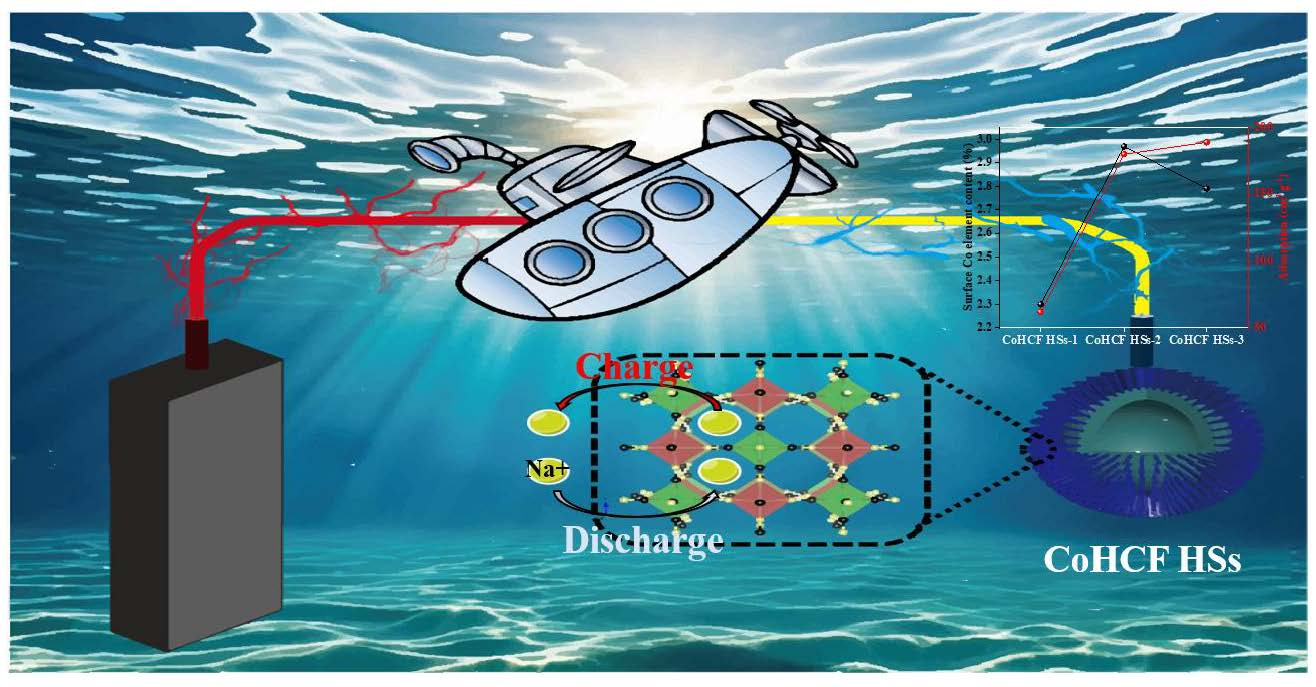
As an emerging electrochemical energy storage system, sodium-ion seawater batteries (SWBs) have attracted widespread attention [,,]. The sodium-ion battery utilizes seawater as the electrolyte, which naturally provides a large amount of sodium ions for abundant sodium ions for charge carriers, offering several advantages, including resource abundance, low cost, high safety, and environmental friendliness. Consequently, they have demonstrated promising application potential in scenarios such as smart buoys, underwater sensors, and offshore energy storage systems [,,]. However, SWBs face challenges due to their low energy density and lack of suitable cathode materials, which limits their practical application. The combined advantages of their open framework structure enabling high energy density and good cycling stability [], along with aqueous synthesis compatibility that facilitates scalable production [], collectively position Prussian blue analogues (PBAs) as promising cathode candidates for SWBs. For instance, electrodes fabricated with nickel hexacyanoferrate (NiHCF) not only enhance the output voltage of seawater batteries but also demonstrate virtually no capacity fading even under high-current-density cycling conditions []. The hybrid energy storage device featuring an amorphous MoOx anode and a potassium copper hexacyanoferrate (KCuHCF) cathode delivers exceptional comprehensive performance: it achieves a specific energy of 41.2 Wh/kg at a high specific power of 519 W/kg while maintaining 76.8% energy efficiency []. As an ideal cathode material for seawater batteries, PBAs require critical enhancement of their specific capacity in marine environments. Current strategies to improve the specific capacity of PBAs primarily focus on increasing their specific surface []. For instance, self-templated core-shell hollow nanocubes composed of PBA and MOF demonstrate exceptional performance as aqueous battery cathodes, achieving 88 Wh kg−1 energy density and 13.07 kW kg−1 peak power density []. Similarly, Prussian blue-derived FeP cubes confined within a 3D MXene network (FeP@MXene) deliver a high reversible capacity of 444.1 mAh g−1 with zero capacity fading over 500 cycles []. This composite design not only enhances specific capacity but also mitigates Jahn-Teller distortion during ion intercalation/deintercalation. The fundamental mechanism by which increased specific surface area enhances specific capacity lies in the exposure of more active sites. Therefore, simultaneously maximizing both the density of accessible active sites and their intrinsic sodium storage capability is essential for achieving superior specific capacity. Wu et al. [] revealed a synergetic interaction between elemental composition and specific surface area. They synthesized Co-Ni Prussian blue analogues (PBAs) with varying Co:Ni molar ratios and discovered that specific capacity does not consistently increase with higher specific surface area. Consequently, selecting elements with superior inherent sodium storage properties and strategically optimizing both specific surface area and elemental composition through synthetic control enables the achievement of enhanced specific capacity. As a cathode material for sodium-ion batteries, high-quality Na0.61Fe[Fe(CN)6]0.94 (HQ-PB NaFe) demonstrates outstanding electrochemical performance, delivering a high specific capacity of 170 mAh g−1 coupled with exceptional stability, showing no noticeable degradation over 150 cycles []. In particular, cobalt hexacyanoferrate (CoHCF) exhibits the highest theoretical specific capacity (170 mAh g−1) among all Prussian blue analogues for sodium-ion batteries []. Considering both elements comprehensively, cobalt-based Prussian blue analogues (CoPBAs) are highly suitable research subjects. Current studies on CoPBAs primarily focus on multi-element doping [,,], while systematic investigations into the influence of cobalt content itself remain scarce. In particular, research addressing how cobalt concentration affects crystal structure, morphology, and electrochemical performance is notably insufficient. Crucially, during synthesis, the Co2+ ion concentration in precursor solutions significantly regulates crystal nucleation and growth processes, thereby inducing substantial variations in crystalline phase composition, surface elemental distribution, and the exposure degree of active sites [,].
In this work, hollow spherical cobalt-based Prussian blue (CoHCF HSs) with different Co contents was synthesized by adjusting the amount of Co-glycerate solid spheres (Co-glycerate SSs) precursor. According to crystal growth theory, modulating the concentration of a single element allows controlled growth of electrode materials, thereby regulating the material’s specific surface area and surface-active site distribution. When the amount of Co-glycerate solid spheres (Co-glycerate SSs) precursor was 140 mg, CoHCF HSs delivered a high reversible capacity of 121.16 mAh·g−1 at 0.2 A·g−1. Even under a high current density of 2 A·g−1, the material retains 54.8 mAh·g−1, exhibiting excellent rate capability along with good cycling stability. This study provides both theoretical insight and practical guidance for the application of Co-based PBAs as cathode materials in seawater batteries.
2. Methods
2.1. Synthesis of CoHCF HSs
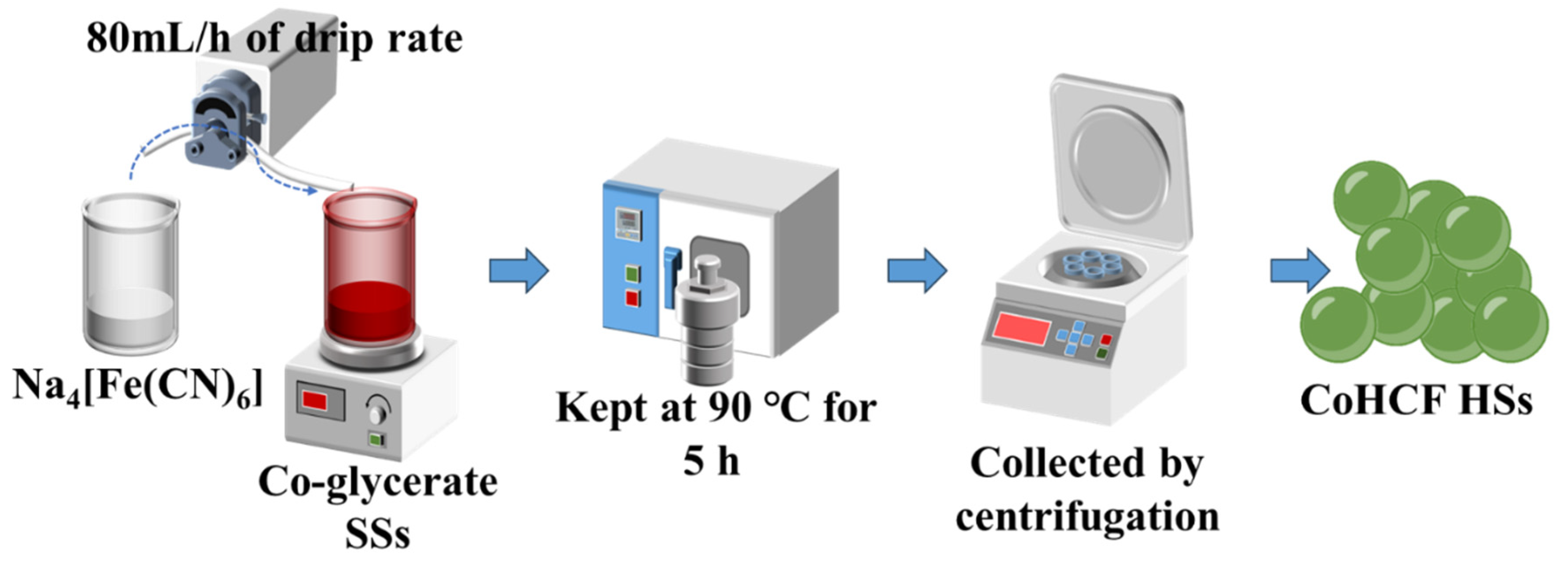
Figure 1 illustrates the schematic synthesis route of CoHCF HSs (CoPBA hollow spheres, HSs). The synthesis method was adapted from the self-templating strategy based on facile anion exchange, as proposed by Zeng et al. [].
Figure 1.
Flowchart of the synthesis process of CoHCF HSs.
Synthesis of spherical Co-glycerate SSs:109 mg of Co(NO3)2·6H2O (Meryer (Shanghai) Biochemical Technology Co., Ltd., Shanghai, China) was dissolved in a mixed solution of 8 mL glycerol (Shanghai Titan Scientific Co., Ltd., Shanghai, China) and 40 mL isopropanol (Shanghai Titan Scientific Co., Ltd., Shanghai, China), followed by stirring for 20 min. The resulting transparent solution was then transferred into a Teflon-lined stainless-steel autoclave and heated at 180 °C for 6 h. After the reaction, the autoclave was naturally cooled to room temperature. The resulting precipitate was collected by centrifugation and washed several times with ethanol to obtain spherical Co-glycerate SSs.
Synthesis of CoHCF HSs: A predetermined amount (x mg, x = 70 mg, 105 mg, 140 mg, 175 mg, and 210 mg) of Co-glycerate SSs was ultrasonically dispersed in 100 mL of ethanol for 15 min to form solution A. Simultaneously, 152 mg of Na4[Fe(CN)6]·3H2O (Sinopharm Chemical Reagent Co., Ltd., Shanghai, China) was dissolved in 60 mL of deionized water to form solution B. Under continuous stirring, solution B was slowly added to solution A. The resulting mixture was then transferred into a Teflon-lined stainless-steel autoclave and heated at 90 °C for 5 h. After the reaction, the product was collected by centrifugation and washed several times with deionized water and ethanol to obtain CoHCF HSs.
To investigate the effect of Co-glycerate SSs dosage on the morphological evolution of CoHCF HSs, the input amounts of Co-glycerate SSs were set to 70 mg, 105 mg, 140 mg, 175 mg, and 210 mg, respectively. The resulting samples were correspondingly denoted as CoHCF HSs-1, CoHCF HSs-1.5, CoHCF HSs-2, CoHCF HSs-2.5, and CoHCF HSs-3.
2.2. Structure Characterization
The surface morphology of CoHCF HSs-X was observed and analyzed using field-emission scanning electron microscopy (FESEM, Hitachi S-4800, Hitachi, Ltd., Tokyo, Japan). Energy-dispersive X-ray spectroscopy (EDS, Oxford Xplore 30 Energy Dispersive Spectrometer, Oxford, UK) was performed at an accelerating voltage of 20 kV to conduct magnified elemental analysis in selected regions, enabling qualitative and semi-quantitative elemental identification. Phase composition and crystal structure were characterized by X-ray diffraction (XRD, Rigaku Corporation, Tokyo, Japan) using Cu Kα radiation (λ = 1.5418 Å) as the X-ray source. The scanning rate was 5°·min−1 over a 2θ range of 5°–80°. The specific surface area of the samples was measured using nitrogen adsorption-desorption analysis (Micromeritics ASAP 2020, Micromeritics Instrument Corporation, Norcross, GA, USA). The adsorption temperature was −200 °C, with degassing performed at 120 °C for 12 h. X-ray photoelectron spectroscopy (XPS, Thermo Fisher Nexsa, Thermo Fisher Scientific, Waltham, MA, USA) was employed to analyze the chemical states and bonding environments. Al Kα radiation (hν = 1.4 keV) was used as the excitation source, with a take-off angle of 50° (this was measured relative to the surface normal) and an analysis area of 200 μm. The applied voltage and current were 12 kV and 0.4 mA, respectively. The XPS spectra were calibrated using the work function method as described in references [,], with the C 1s peak set at 284.8 eV.
2.3. Electrochemical Measurements
In this study, the electrochemical performance of CoHCF HSs-X electrodes was evaluated at room temperature using a three-electrode testing system. The active material (CoHCF HSs-X), carbon black, and polyvinylidene fluoride (PVDF) were mixed in a mass ratio of 7:2:1 and dispersed in N-methyl-2-pyrrolidone (NMP) to form a homogeneous slurry. The slurry was then uniformly coated onto a 1 cm × 0.5 cm carbon cloth substrate, with an effective coated area of 0.5 cm × 0.5 cm. The prepared electrodes were dried in a vacuum oven at 70 °C for 12 h. The mass loading of active material was approximately 9.6 mg·cm−2. Electrochemical measurements were conducted using a electrochemical workstation (CHI 660E, Shanghai Chenhua Instrument Co., Ltd., Shanghai, China) with a standard three-electrode setup in a 3.5% NaCl aqueous electrolyte. Cyclic voltammetry (CV) and galvanostatic charge-discharge (GCD) tests were performed within a potential window of 0.1–1.1 V.
3. Results and Discussion
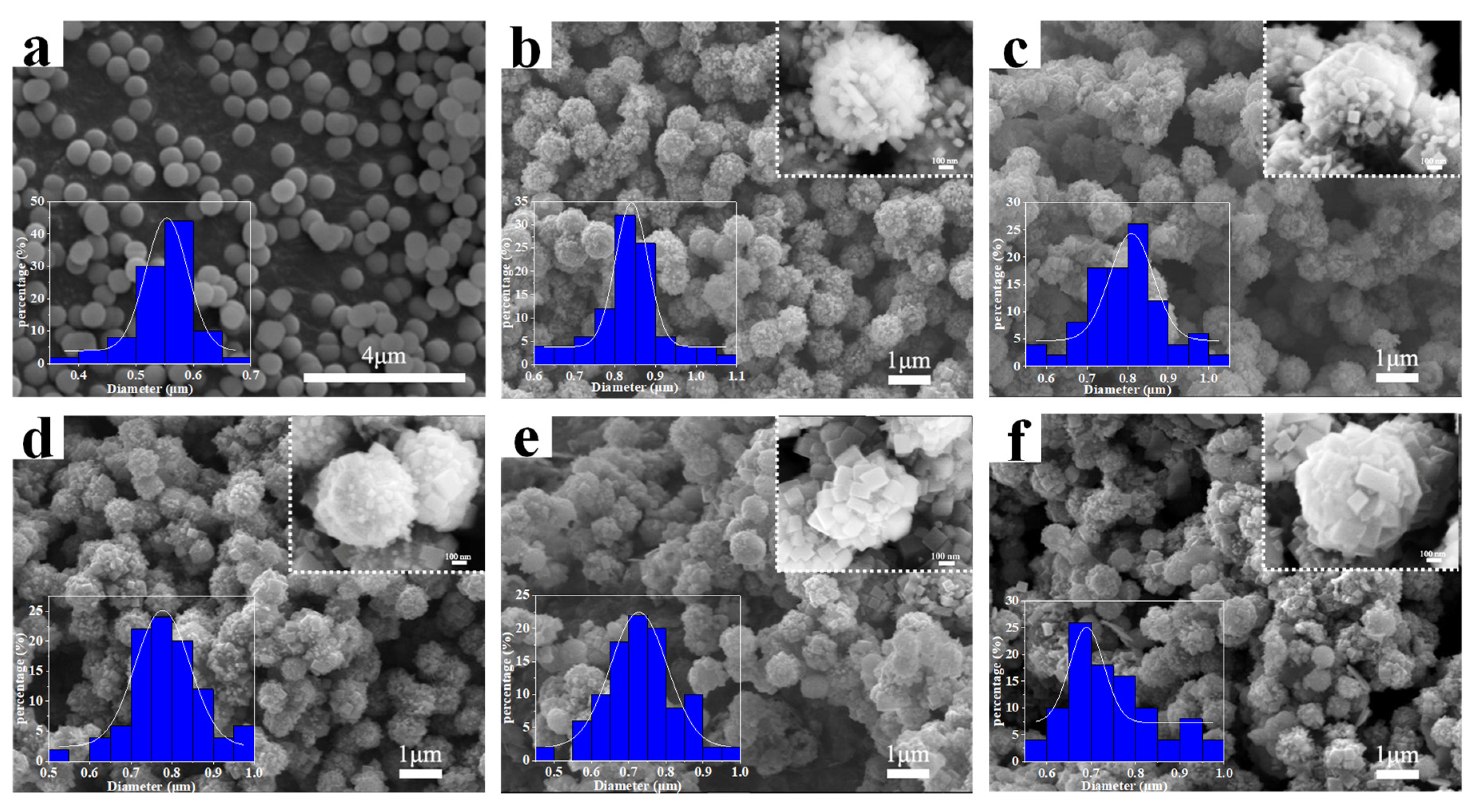
The microstructure of the synthesized Co-glycerate SSs and CoHCF HSs samples was examined using scanning electron microscopy (SEM) (Figure 2). The precursor Co-glycerate SSs displayed a smooth, well-defined spherical morphology, with an average particle size of 500 ± 50 nm (Figure 2a). Figure 2b–f show SEM images of samples synthesized with varying Co-glycerate SSs dosages. The spherical morphology of the precursor is retained in all cases, with CoHCF nucleating on the surface of the Co-glycerate SSs and eventually encapsulating the entire sphere. This spherical structure increases surface exposure when stacked, thereby improving contact with the electrolyte solution. Nanoscale protrusions were observed on the spherical surfaces of the CoHCF samples, becoming thicker and shorter as the Co2+ concentration in the synthesis solution increased. According to classical crystal growth theory, low supersaturation leads to a slower nucleation rate, fewer nuclei, and slower growth, producing larger crystal particles. In contrast, high supersaturation causes rapid nucleation, a greater number of nuclei (often resulting in burst nucleation), and faster growth, leading to smaller crystals due to solute distribution across more particles []. In the CoHCF HSs-1 sample, a limited number of nucleation sites led to the sparse formation of nanoscale protrusions on the spherical surface, leaving parts of the underlying sphere exposed. This nanoscale protrusion-sphere composite had an average particle size of 850 ± 50 nm. In the CoHCF HSs-2 sample, higher nucleation density resulted in densely packed nanoscale protrusions, reducing the amount of exposed spherical surface, with an average particle size of approximately 770 ± 50 nm. With increasing Co2+ concentration, the particle size of CoHCF HSs progressively decreased, reaching 727 nm and 688 nm for the CoHCF HSs-2.5 and CoHCF HSs-3 samples, respectively. However, significant microstructural changes occurred in the CoHCF HSs-3 sample. The spherical surfaces became entirely covered with newly formed CoHCF, leading to overlap of nanoscale protrusions. Consequently, the original spherical morphology was no longer distinguishable, manifesting a stepwise crystallization pattern.
Figure 2.
SEM images of (a) Co-glycerate SSs, (b) CoHCF HSs-1, (c) CoHCF HSs-1.5, (d) CoHCF HSs-2, (e) CoHCF HSs-2.5, and (f) CoHCF HSs-3.
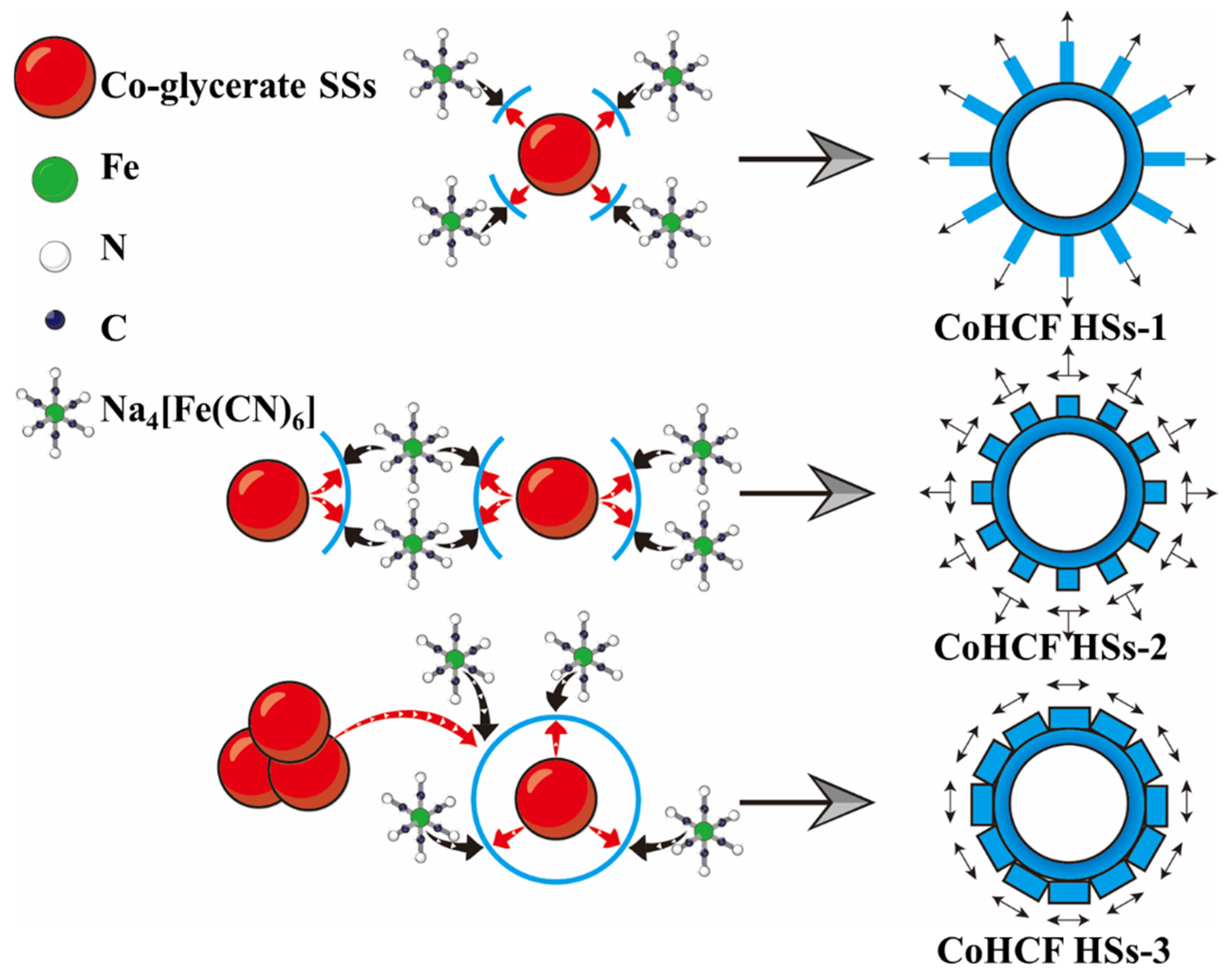
As illustrated in Figure 3, a schematic diagram depicts the effect of varying Co-glycerate SSs dosages on the crystal growth process of CoHCF HSs. At low Co-glycerate SSs dosages, crystal growth proceeds primarily outward from the surface of the spheres. Typically, the crystal growth rate (defined as the increase in crystal length per unit time) is a function of supersaturation—higher supersaturation yields a faster growth rate. Thus, growth occurs outward, perpendicular to the Co-glycerate SSs surface, toward regions of higher supersaturation in the Na4[Fe(CN)6] solution, resulting in the formation of elongated nanoscale protrusions. As the dosage of Co-glycerate SSs increases, the same amount of Na4[Fe(CN)6] must be distributed across more nucleation sites. This reduces the local supersaturation at the Co-glycerate surface, slowing the growth rate and yielding shorter, thicker nanoscale protrusions. When the dosage becomes excessive, CoHCF undergoes burst nucleation, rapidly covering the surface of the Co-glycerate SSs. This impedes the diffusion of Co2+ from the sphere interiors, forcing the system to utilize Co2+ from the external solution. As a result, cobalt concentration becomes higher at the outer surfaces of the spheres, while the externally formed nanoscale protrusions contain lower cobalt levels, as later confirmed by XPS analysis. The size of the nanoscale protrusions and the degree to which the original spherical surface remains exposed play a crucial role in determining the specific surface area of the samples, which in turn influences their electrochemical performance. The next paragraph examines the composition and specific surface area of these samples.
Figure 3.
Schematic diagram of the effect of different Co-glycerate SSs incorporation amounts on the crystallization growth process of CoHCF HSs.
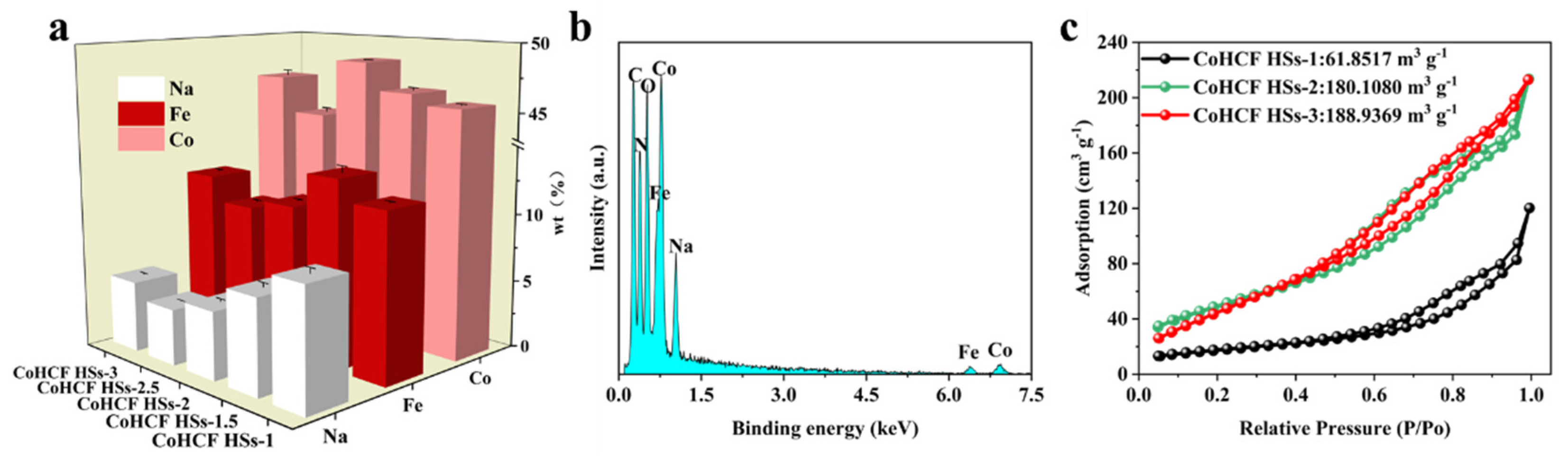
Energy-dispersive X-ray spectroscopy (EDS) analysis was performed on the synthesized CoHCF HSs samples, as shown in Figure 4a,b. The variation in Co2+ concentration in the synthesis solution significantly affected the cobalt content in the resulting products. When the original spherical surface of CoHCF HSs remained partially exposed, an increase in the dosage of Co-glycerate SSs correspondingly led to an increase in the cobalt content of the final product. When the protruding structures of CoHCF HSs fully covered the spherical surface, as in the CoHCF HSs-2.5 sample, the structure could no longer obtain Co2+ from its core. Instead, it relied on Co2+ ions released into the solution from other dissolved Co-glycerate SSs. As a result, it became more difficult for CoHCF crystals to acquire Co2+, leading to a decrease in cobalt content in the CoHCF HSs-2.5 sample. This issue was alleviated by subsequently increasing the Co2+ concentration, which led to a continued rise in cobalt content.
Figure 4.
(a) Mass percentages of Na, Fe, and Co in different CoHCF HSs samples; (b) EDS spectrum of CoHCF HSs-2; (c) nitrogen adsorption-desorption isotherms of CoHCF HSs-1, CoHCF HSs-2, and CoHCF HSs-3.
The Co and Fe contents in the CoHCF HSs samples directly influence the electrochemical performance of the assembled electrodes. Therefore, it is necessary to investigate the Co and Fe contents in the samples. In the CoHCF HSs-2 sample, the average molar ratio of Co to Fe reached its maximum (as the relative atomic masses of Co and Fe are similar, the mass ratio approximates the molar ratio), with the sample having a chemical formula of NaCo2Fe0.4HCF. The total mass percentage of Co and Fe was second only to that of CoHCF HSs-1.5 (60.07% for HSs-1.5 vs. 59.47% for HSs-2). Figure 4b displays the EDS spectrum of the CoHCF HSs-2 sample, where Na, O, Fe, Co, C, and N elements were detected. No additional impurity elements were observed in the other samples; thus, their spectra are not shown. The EDS results confirm the successful synthesis of cobalt-based Prussian blue.
Brunauer–Emmett–Teller (BET) surface area analysis was performed on representative samples, as shown in Figure 4c. It was found that the nanoblock structures on the spherical surfaces significantly influenced the specific surface area, with CoHCF HSs-1, HSs-2, and HSs-3 exhibiting values of 61 m2 g−1, 180 m2 g−1, and 188 m2 g−1, respectively. A larger specific surface area provides more interfacial contact between the electrode material and the electrolyte, allowing for greater Na+ accessibility and thereby exposing more active sites. As previously discussed, an increase in Co content leads to wider surface nanoscale protrusions on the spheres, which in turn enhances the specific surface area.
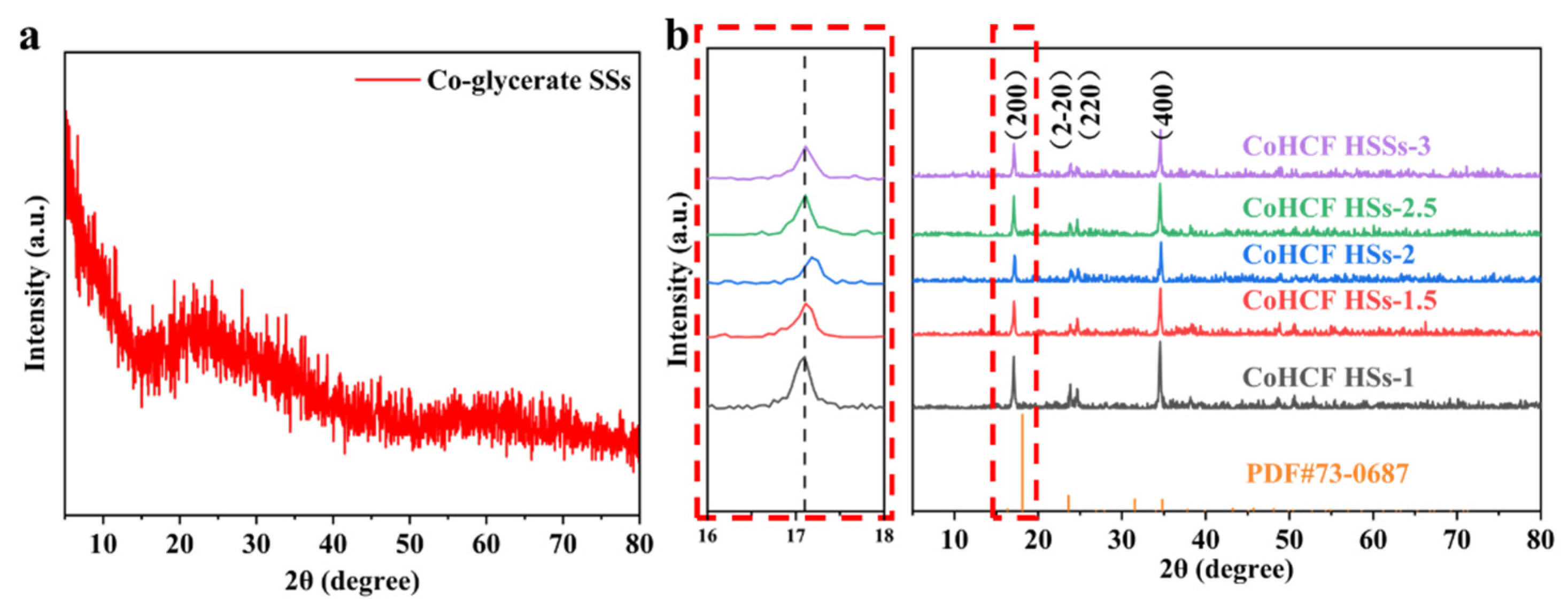
The structural characteristics of Prussian blue analogues (PBAs), including lattice parameters, interaxial angles, and potential phase transitions, can significantly influence the intercalation behavior of alkali metal ions. As shown in Figure 5a, the XRD pattern of the synthesized cobalt-glycerate solid sphere sample exhibits excellent agreement with previously reported data, as evidenced by a descending trend within the 13° to 20° range and a distinct protrusion between 20° and 30°, confirming the successful synthesis of the precursor. Figure 5b presents the XRD patterns of different CoHCF HSs samples. Compared to the standard card of Fe4[Fe(CN)6]3 (PDF#73-0687), the diffraction peaks of the samples exhibit slight shifts toward lower angles, which can be attributed to the occupation of octahedral voids in the crystal lattice by Na+ ions, leading to an increase in interplanar spacing. The diffraction peaks observed at 2θ = 17.1°, 24.6°, and 34.6° correspond to the (200), (220), and (400) planes of the CoHCF phase, respectively, indicating that the synthesized samples possess a face-centered cubic (FCC) crystal structure. The peak splitting observed at the (220) plane may result from rhombohedral distortion of the face-centered cubic lattice induced by the intercalation of Na+ ions into the crystal structure [,,]. A magnified examination of the (200) peaks revealed a systematic shift among the different CoHCF HSs samples. Fe2+ and Fe2+ possess different ionic radii. This inherent size difference determines that any substitution is necessarily accompanied by systematic alteration of lattice parameters, thus leading to shifts in XRD diffraction peaks. It is therefore speculated that the observed peak shifts may be attributed to the substitution of larger Fe2+ ions by smaller Fe2+ ions during the coprecipitation process, resulting in reduced interplanar spacing. Based on this observation, it is inferred that the cobalt content in the samples follows a similar trend. For instance, CoHCF HSs-2 exhibits the largest rightward shift of the (200) peak, suggesting the highest degree of Fe2+ substitution by Co2+, and consequently, the highest Co content. This inference is consistent with the EDS results shown in Figure 4a, further supporting the conclusion of maximum cobalt incorporation in this sample. According to Bragg’s Law (Equation (1)), a decrease in the interplanar spacing d leads to an increase in the diffraction angle θ, which explains the peak shift observed in the XRD patterns []:
Figure 5.
(a) XRD patterns of Co-glycerate SSs and (b) CoHCF HSs-X, along with the XRD magnified view of their (200) peaks.
In the following section, the relationship between the chemical composition and crystal structure of the samples will be further analyzed in conjunction with energy-dispersive X-ray spectroscopy (EDS) results.
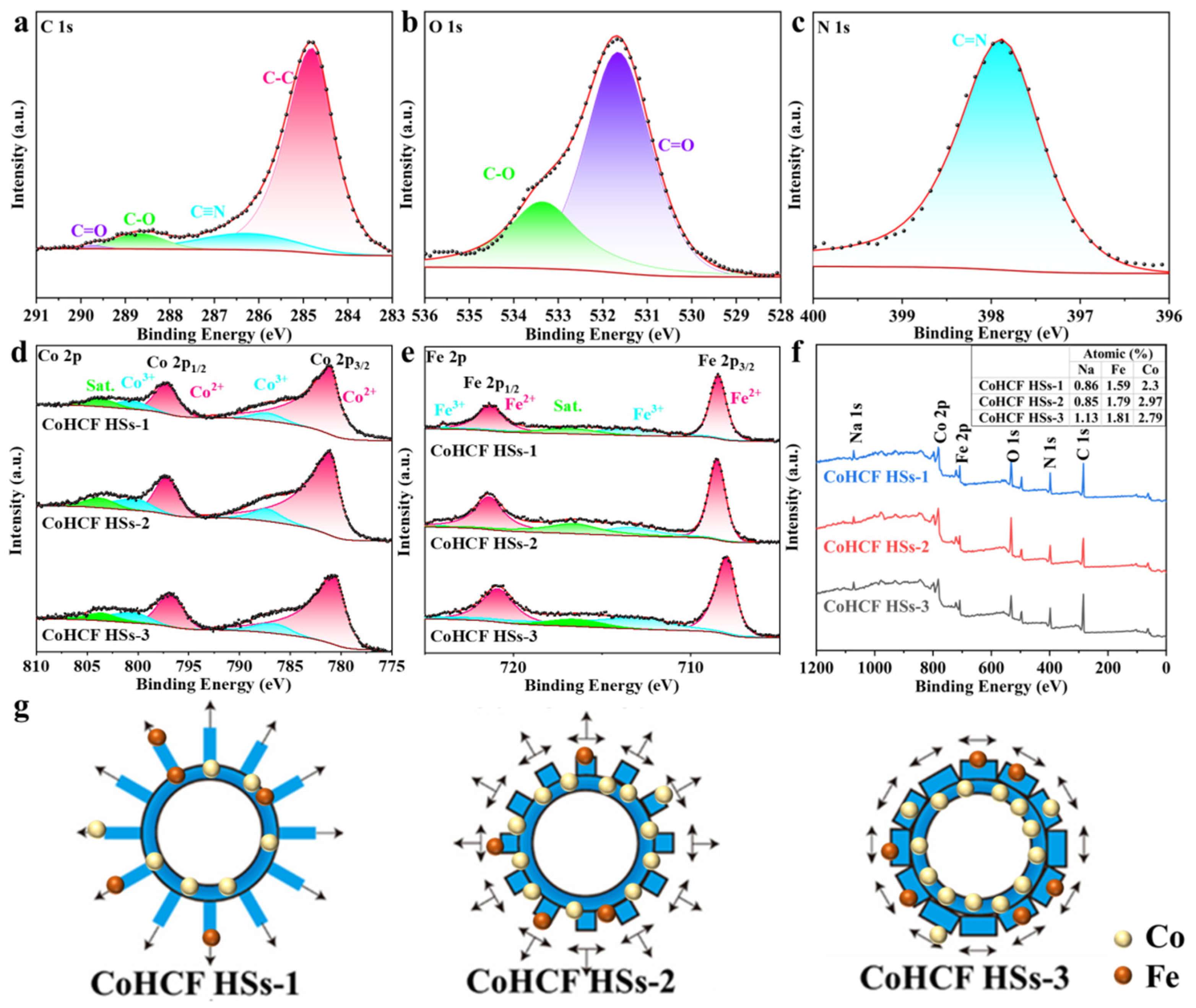
To further investigate the surface chemical states of the CoHCF HSs, X-ray photoelectron spectroscopy (XPS) was conducted. The XPS analysis confirmed the presence of C, O, N, Co, Fe, and Na elements, consistent with the earlier EDS results. Figure 6a–c show the high-resolution fitted spectra of C 1s, O 1s, and N 1s for the CoHCF HSs-2 sample. In the C 1s spectrum (Figure 6a), four deconvoluted peaks are observed at 284.79 eV, 286.27 eV, 288.88 eV, and 289.7 eV, corresponding to C-C, C≡N, C-O, and C=O bonds, respectively []. The O 1s spectrum (Figure 6b) shows two distinct peaks at binding energies of 531.65 eV and 533.33 eV, attributed to C=O and C-O bonds, respectively []. As shown in Figure 6c, the N 1s peak appears at 397.89 eV and is assigned to the C=N configuration []. Figure 6d presents the Co 2p spectra of the CoHCF HSs-X series (X = 1, 2, 3). In the CoHCF HSs-1 sample, the main Co 2p3/2 and Co 2p1/2 peaks are located at 781.15 eV and 797.22 eV, respectively. Deconvolution reveals the coexistence of Co3+ (at 787.22 eV and 800.58 eV) and Co2+ (at 781.02 eV and 797.20 eV) oxidation states []. No significant peak shift was observed in the Co 2p spectra of the CoHCF HSs-2 and HSs-3 samples, indicating that Co is in a similar chemical environment in both cases. In the Fe 2p spectrum (Figure 6e), the CoHCF HSs-1 sample exhibits Fe 2p3/2 and Fe 2p1/2 peaks at 708.45 eV and 721.31 eV, respectively. The fitted spectrum confirms the presence of both Fe2+ (708.43 eV and 721.29 eV) and Fe3+ (713.3 eV and 723.85 eV) oxidation states []. According to the full spectrum XPS analysis results shown in Figure 6f, the atomic ratios of Na, Fe, and Co were calculated. Among all samples, CoHCF HSs-2 exhibited the highest surface atomic ratio of Co, in agreement with the EDS results. However, the Co to Fe atomic ratio in CoHCF HSs-2 was determined to be 1.65, which is significantly lower than the molar ratio of 4.38 obtained from EDS measurements. Considering the comparable atomic masses of Fe and Co, the atomic ratio approximates the molar ratio, suggesting that the content of Co in the surface nanoblock protrusions is relatively lower than that on the original spherical surface. In summary, cobalt is more concentrated in the interior of the particles, whereas iron and sodium are preferentially enriched in the surface nanostructures.
Figure 6.
XPS spectra of CoHCF HSs-2: (a) C 1s, (b) O 1s, and (c) N 1s high-resolution spectra; XPS spectra of CoHCF HSs: (d) Co 2p, (e) Fe 2p, and (f) survey spectrum; (g) schematic diagrams of elemental distribution for different samples.
Figure 6g presents a schematic diagram of elemental distribution across different samples based on XPS and EDS data alongside growth mechanisms, where CoHCF HSs-1 exhibited reduced surface cobalt content due to insufficient cobalt addition during synthesis, while CoHCF HSs-2 achieved optimal cobalt exposure through stoichiometrically balanced reaction conditions that maximized surface-active sites; however, CoHCF HSs-3 ultimately displayed diminished surface cobalt exposure because excessive cobalt addition during early reaction stages led to encapsulation of active sites by subsequent crystal growth.
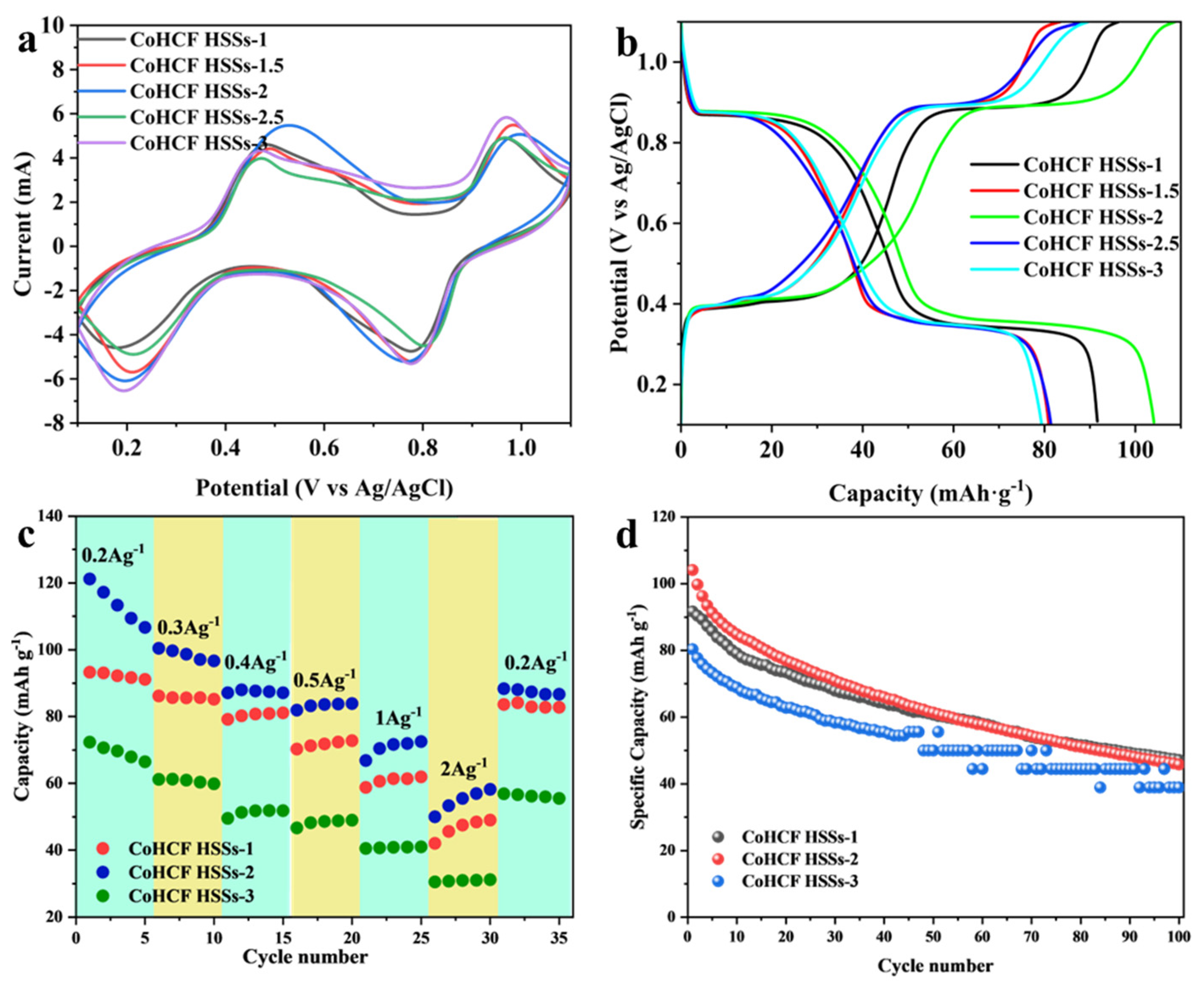
To evaluate the electrochemical performance of CoHCF HSs-X electrodes in a 3.5% NaCl electrolyte, a three-electrode system was employed. Figure 7a presents the cyclic voltammetry (CV) curves of the CoHCF HSs electrodes at a scan rate of 50 mV·s-1. Distinct redox peaks are observed at 0.46/0.19 V and 0.97/0.77 V, corresponding to the Co2+/Co3+ redox couple (Na2Co2+Fe3+(CN)6 ↔ Co3+Fe3+(CN)6 + Na+ + e−) and the Fe2+/Fe3+ couple (Na2Co2+Fe2+(CN)6 ↔ NaCo2+Fe3+(CN)6 + Na+ + e−), respectively [,]. Among the samples, CoHCF HSs-2 exhibits the largest CV curve area and higher redox potentials for both the Co2+/Co3+ and Fe2+/Fe3+ couples, indicating superior electrochemical performance. Figure 7b displays the galvanostatic charge-discharge (GCD) curves of CoHCF HSs-X electrodes at a current density of 0.2 A·g−1. It is evident that CoHCF HSs-1 and CoHCF HSs-2 deliver significantly higher specific capacities of 91.64 mAh·g−1 and 104.08 mAh·g−1, respectively, compared to the other samples. The increased cobalt content enhances the specific capacity of the electrodes, while the microstructural characteristics also play a crucial role in sodium storage performance. In both CoHCF HSs-1 and HSs-2, the original spherical surface remains partially exposed, with Co enrichment in the core and Fe enrichment in the surface nanoscale protrusions—consistent with the findings reported by Zeng et al. []. Additionally, as shown in Figure 7b, the Co-related redox reaction contributes to an extended voltage plateau, leading to a higher energy density. Although CoHCF HSs-3 possesses the largest specific surface area, it exhibits a lower capacity due to the reduced cobalt content in the surface nanoblocks. Moreover, a noticeable voltage hysteresis in the Co2+/Co3+ redox plateau was observed, which gradually diminished with increasing Co content. Figure 7c presents the rate performance of CoHCF HSs-1, HSs-2, and HSs-3 at various current densities. CoHCF HSs-1 delivered an average capacity of 92.2 mAh·g−1 at 0.2 A·g−1, which retained 46.5 mAh·g−1 at 2 A·g−1. Upon returning to 0.2 A·g−1, 90% of the initial capacity was recovered. CoHCF HSs-2 exhibited an average capacity of 113.5 mAh·g−1 at 0.2 A·g−1, reaching a maximum of 121.16 mAh·g−1. Even at a high current density of 2 A·g−1, it retained 54.8 mAh·g−1, with a 77% recovery upon returning to the initial current. In contrast, CoHCF HSs-3 showed inferior rate performance, delivering 69.4 mAh·g−1 at 0.2 A·g−1 and dropping to 30.8 mAh·g−1 at 2 A·g−1, with a recovery ratio of 81% after the current density was reduced. CoHCF HSs-2 exhibited rate characteristics comparable to HSs-1 under high current conditions, which may be attributed to the Co-rich spherical surface. However, the capacity degradation at low current density was similar to that of HSs-3, likely related to the nanoscale protrusions’ surface morphology. Figure 7d shows the coulombic efficiency of the CoHCF HSs-2 electrode over 100 cycles at a current density of 0.2 A·g−1. The initial specific capacity was 104 mAh·g−1. From the 15th cycle onward, the coulombic efficiency stabilized at 100%. However, after 100 cycles, the capacity declined to 46 mAh·g−1, indicating that the cycling stability and reversibility require further improvement.
Figure 7.
(a) Comparative cyclic voltammetry (CV) curves of CoHCF HSs electrodes at a scan rate of 50 mV·s−1; (b) galvanostatic charge-discharge (GCD) curves of CoHCF HSs electrodes at a current density of 0.2 A·g−1; (c) rate capability of CoHCF HSs electrodes at various current densities; (d) cycling performance and coulombic efficiency of the CoHCF HSs-2 electrode at 0.2 A·g−1 over 100 cycles.
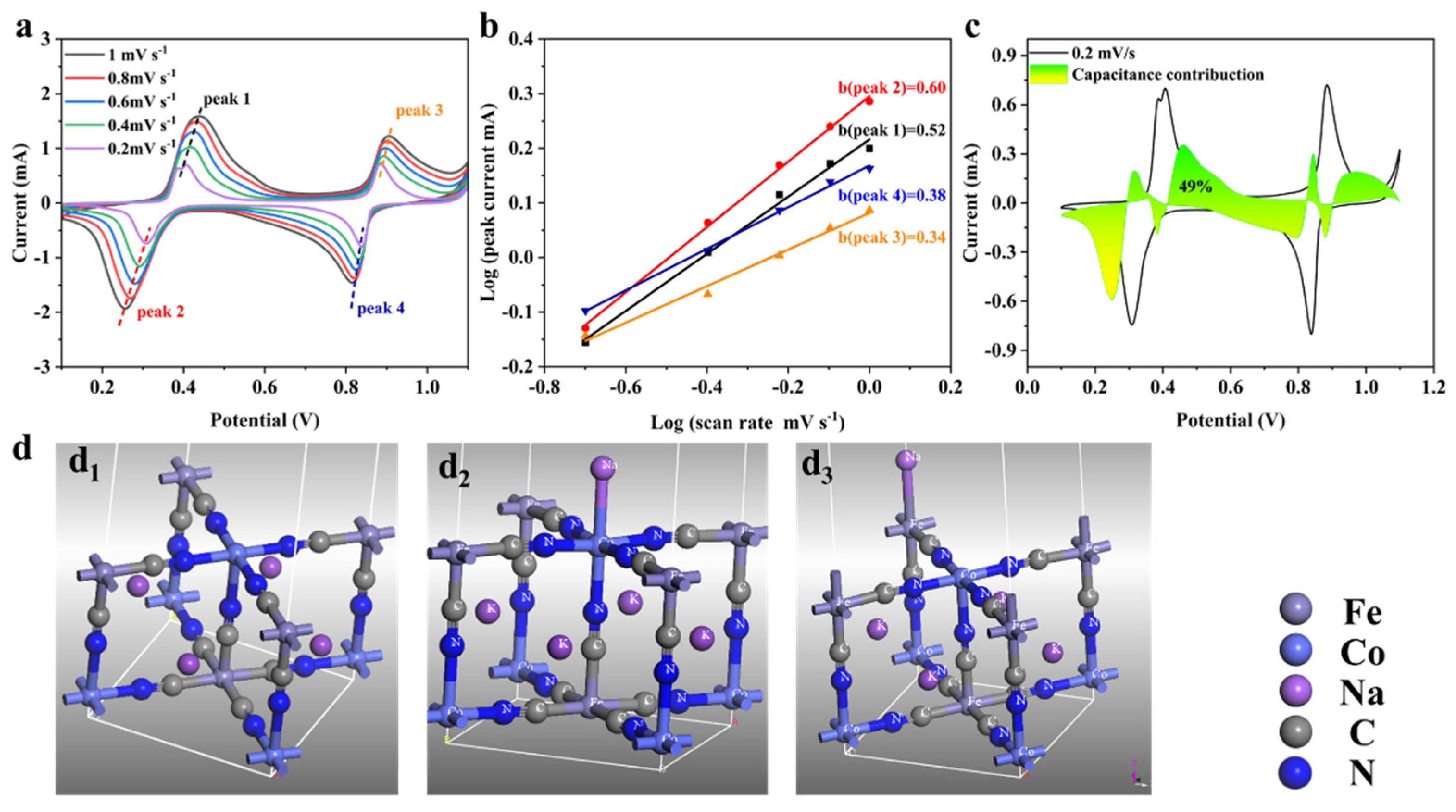
As shown in Figure 8a, to further understand the sodium storage mechanism of the CoHCF HSs-2 electrode, cyclic voltammetry (CV) tests were conducted at scan rates ranging from 0.2 to 1 mV·s−1 to analyze the electrochemical kinetics of Na+. Two pairs of symmetric redox peaks observed in the CV curves correspond to the insertion and extraction processes of Na+ within the CoHCF HSs lattice. The relative contributions of diffusion-controlled and capacitive processes in the current response can be described by the empirical relationship []:
where i is the current, v is the scan rate, and a and b are adjustable parameters. A b value close to 0.5 indicates a diffusion-controlled process, while a value near 1.0 suggests a capacitive-controlled mechanism. As shown in Figure 8b, the linear fitting of log(i) versus log(v) yielded b values of 0.60 and 0.52 for the Co2+/Co3+ redox peaks and 0.38 and 0.34 for the Fe2+/Fe3+ peaks. These results indicate that the electrochemical process of CoHCF HSs-2 is primarily diffusion-controlled, with the Fe redox reaction being more severely limited by ion diffusion. The b values for Co fall between 0.5 and 1.0, implying that the sodium storage behavior is governed by a combination of diffusion-controlled and surface capacitive processes. In addition, the relative contributions from capacitive and diffusion-controlled processes can be quantified using Dunn’s equation [,]:
where k1v represents the capacitive contribution and k2v1/2 corresponds to the diffusion-controlled portion. As shown in Figure 8c, at a scan rate of 0.2 mV·s−1, the capacitive contribution accounts for 49% of the total current. The current distribution also indicates that the redox peaks are predominantly governed by ion diffusion, which is consistent with the prior b value analysis. Taken together, the b values and capacitive contribution analysis suggest that Co ions exhibit more favorable electrochemical kinetics in this material compared to Fe ions, indicating faster redox dynamics.
Figure 8.
(a) CV curves at different scanning rates of CoHCF HSs-2, (b) the corresponding calculated value of b, (c) surface capacitance percentage at 0.2 mV s−1, and (d) computational model of CoHCF HSs-2 ((d1) represents the structural model of Na2CoFe(CN)6, (d2) represents the model depicting Na binding at the Co site within this structure, and (d3) represents the model depicting Na binding at the Fe site within this structure).
To further elucidate the superior Na+ storage performance of the CoHCF HSs-2 sample, first-principles calculations based on density functional theory (DFT, Simulation and calculation were performed using Materials Studio 2023 software) were conducted to evaluate the Na+ adsorption energies (ΔEa) at Co and Fe sites [,,]. Based on the experimental data, a 4 × 4 × 4 supercell model of Na2Co[Fe(CN)6] was constructed, into which Na+ ions were inserted to form Na-Co and Na-Fe bonding configurations (Figure 8d). The calculated Na+ adsorption energy at the Co site (ΔEa = 1.45 eV) was higher than that at the Fe site (ΔEa = 1.18 eV), indicating a stronger binding affinity of Na+ to Co atoms. This suggests that a higher Co content favors enhanced Na+ storage capacity in CoHCF HSs anodes.
Table 1 lists the capacities of relevant Prussian blue materials, demonstrating that the electrode material synthesized in this work exhibits exceptional sodium storage capacity and promising application prospects.
Table 1.
Comparison of specific capacities of different PBA materials in sodium-ion electrolyte.
4. Conclusions
In this study, spherical CoHCF materials were successfully synthesized via a self-templated method combining coprecipitation with a facile anion exchange process. Experimental results demonstrate that the Co concentration in the reaction solution significantly influences both the surface morphology and particle size of CoHCF materials. As the dosage of Co-glycerate SSs increases, the corresponding rise in Co2+ concentration within the synthesis environment induces a morphological evolution wherein the nanoscale protrusions on CoHCF HSs transition from slender to stubby configurations, ultimately forming a continuous coverage across the spherical surface. Mechanistic analysis reveals that this morphological transformation is accompanied by progressive particle size reduction, wherein the dominant size effect results in a continuous increase in specific surface area—theoretically expected to enhance specific capacity. However, studies identified a compositional gradient across the spherical surface, with nanoscale protrusion-rich regions exhibiting lower Co content. As these protrusions progressively envelop the entire sphere, the overall Co proportion declines. Computational simulations further demonstrate that Co sites (ΔEa = 1.45 eV) possess higher Na+ adsorption energy and greater capacitive contribution compared to Fe sites (ΔEa = 1.18 eV), enabling superior sodium storage capacity and enhanced Na+ reaction kinetics. Consequently, the surface Co concentration fundamentally governs the electrochemical performance. Optimization of specific capacity requires not only increased surface area but also precise regulation of surface elemental composition. When employing 140 mg of Co-glycerate SSs precursor, the resulting CoHCF HSs-2 delivers the highest initial specific capacity of 121.16 mAh·g−1 at 0.2 A·g−1. This study concludes that the electrochemical performance of CoHCF materials is governed by the synergistic interplay between specific surface area and elemental composition, providing an effective strategy for optimizing sodium storage properties through structural and compositional control, thereby offering valuable insights and theoretical guidance for developing high-performance cathode materials for seawater batteries.
Author Contributions
Formal analysis, Investigation, Methodology; Software; Writing—original draft: C.S.; Visualization, Data curation, Writing—original draft: H.D.; Project administration, Investigation, Writing—review & editing, Resources, Supervision: R.W.; Funding acquisition, Validation, Writing—review & editing: L.W. All authors discussed the results and helped with the preparation of the final manuscript. All authors have read and agreed to the published version of the manuscript.
Funding
This research was funded by National Natural Science Foundation of China grant number 52401017.
Institutional Review Board Statement
Not applicable.
Informed Consent Statement
Not applicable.
Data Availability Statement
Data is contained within the article.
Conflicts of Interest
The authors declare no conflict of interest.
References
- Kim, J.K.; Mueller, F.; Kim, H.; Bresser, D.; Park, J.S.; Lim, D.H.; Kim, G.T.; Passerini, S.; Kim, Y. Rechargeable-hybrid-seawater fuel cell. NPG Asia Mater. 2014, 6, e144. [Google Scholar] [CrossRef]
- Hwang, S.M.; Park, J.S.; Kim, Y.; Go, W.; Han, J.; Kim, Y.; Kim, Y. Rechargeable seawater batteries-from concept to applications. Adv. Mater. 2019, 31, 1804936. [Google Scholar] [CrossRef]
- Kong, M.; Bu, L.; Wang, W. Investigations on the discharge/charge process of a novel AgCl/Ag/carbon felt composite electrode used for seawater batteries. J. Power Sources 2021, 506, 230210. [Google Scholar] [CrossRef]
- Senthilkumar, S.T.; Go, W.; Han, J.; Thuy, L.P.T.; Kishor, K.; Kim, Y.; Kim, Y. Emergence of rechargeable seawater batteries. J. Mater. Chem. A 2019, 7, 22803–22825. [Google Scholar] [CrossRef]
- Yu, J.; Li, B.Q.; Zhao, C.X.; Zhang, Q. Seawater electrolyte-based metal–air batteries: From strategies to applications. Energy Environ. Sci. 2020, 13, 3253–3268. [Google Scholar] [CrossRef]
- Li, S.; Tian, X. Progress of seawater batteries: From mechanisms, materials to applications. J. Power Sources 2024, 617, 235161. [Google Scholar] [CrossRef]
- Yao, H.; Gao, Y.; Lin, X.; Zhang, H.; Li, L.; Chou, S. Prussian Blue Analogues for Aqueous Sodium-Ion Batteries: Progress and Commercialization Assessment. Adv. Energy Mater. 2024, 14, 2401984. [Google Scholar] [CrossRef]
- Le, Z.; Li, W.; Dang, Q.; Jing, C.; Zhang, W.; Chu, J.; Tang, L.; Hu, M. A high-power seawater battery working in a wide temperature range enabled by an ultra-stable Prussian blue analogue cathode. J. Mater. Chem. A 2021, 9, 8685–8691. [Google Scholar] [CrossRef]
- Zhang, P.; Zheng, Y.; Wang, H.; Wu, J.M.; Zhang, Z.; Wen, W. A battery-supercapacitor hybrid energy storage device that directly uses seawater or saltwater lake water. Mater. Today Adv. 2024, 24, 100535. [Google Scholar] [CrossRef]
- Goel, G.; Sharma, M.; Tripathi, S.K. Prussian blue analogue as cathode materials in sodium ion batteries: A review. J. Energy Storage 2025, 126, 116995. [Google Scholar] [CrossRef]
- Pi, Y.; Lin, H.; Meng, Z.; Qiu, Z.; Su, Y.; Hang, X.; Pang, H. Self-template synthesis of PBA/MOF hollow nanocubes for aqueous battery. Chem. Eng. J. 2024, 499, 155618. [Google Scholar] [CrossRef]
- Liu, J.; Li, B.; Mu, P.; Li, Y.; Xu, L.; Shi, Y.; Fu, J.; Zheng, H.; Tang, M. Fabricating 3D Network for FeP@ MXene toward Stable and High-Capacity Lithium-Ion Storage. Small Methods 2025, 9, 2500185. [Google Scholar] [CrossRef]
- Wu, P.; Wu, J.; Huang, X.; Wang, L.; Liu, M.; Wang, Z.; Wang, Z. Effect of doping Ni on microstructures and properties of CoxNi1-xHCF based seawater battery. Vacuum 2024, 220, 112822. [Google Scholar] [CrossRef]
- You, Y.; Wu, X.L.; Yin, Y.X.; Guo, Y.G. High-quality Prussian blue crystals as superior cathode materials for room-temperature sodium-ion batteries. Energy Environ. Sci. 2014, 7, 1643–1647. [Google Scholar] [CrossRef]
- Kim, J.; Yi, S.H.; Li, L.; Chun, S.E. Enhanced stability and rate performance of zinc-doped cobalt hexacyanoferrate (CoZnHCF) by the limited crystal growth and reduced distortion. J. Energy Chem. 2022, 69, 649–658. [Google Scholar] [CrossRef]
- Jiang, X.; Liu, H.; Song, J.; Yin, C.; Xu, H. Hierarchical mesoporous octahedral K 2 Mn 1− x Co x Fe (CN) 6 as a superior cathode material for sodium-ion batteries. J. Mater. Chem. A 2016, 4, 16205–16212. [Google Scholar] [CrossRef]
- Quan, J.; Xu, E.; Zhu, H.; Chang, Y.; Zhu, Y.; Li, P.; Sun, Z.; Yu, D.; Jiang, Y. A Ni-doping-induced phase transition and electron evolution in cobalt hexacyanoferrate as a stable cathode for sodium-ion batteries. Phys. Chem. Chem. Phys. 2021, 23, 2491–2499. [Google Scholar] [CrossRef]
- Bie, X.; Kubota, K.; Hosaka, T.; Chihara, K.; Komaba, S. Synthesis and electrochemical properties of Na-rich Prussian blue analogues containing Mn, Fe, Co, and Fe for Na-ion batteries. J. Power Sources 2018, 378, 322–330. [Google Scholar] [CrossRef]
- Wang, X.; Dong, A.; Zhu, Z.; Chai, L.; Ding, J.; Zhong, L.; Li, T.T.; Hu, Y.; Qian, J.; Huang, S. Surfactant-Mediated Morphological Evolution of MnCo Prussian Blue Structures. Small 2020, 16, 2004614. [Google Scholar] [CrossRef] [PubMed]
- Bornamehr, B.; Presser, V.; Zarbin, A.J.; Yamauchi, Y.; Husmann, S. Prussian blue and its analogues as functional template materials: Control of derived structure compositions and morphologies. J. Mater. Chem. A 2023, 11, 10473–10492. [Google Scholar] [CrossRef]
- Zeng, Y.; Lu, X.F.; Zhang, S.L.; Luan, D.; Li, S.; Lou, X.W. Construction of Co–Mn Prussian blue analog hollow spheres for efficient aqueous Zn-ion batteries. Angew. Chem. Int. Ed. 2021, 60, 22189–22194. [Google Scholar] [CrossRef]
- Greczynski, G.; Hultman, L. Reliable determination of chemical state in x-ray photoelectron spectroscopy based on sample-work-function referencing to adventitious carbon: Resolving the myth of apparent constant binding energy of the C 1s peak. Appl. Surf. Sci. 2018, 451, 99–103. [Google Scholar] [CrossRef]
- Greczynski, G.; Hultman, L. X-ray photoelectron spectroscopy: Towards reliable binding energy referencing. Prog. Mater. Sci. 2020, 107, 100591. [Google Scholar] [CrossRef]
- Wu, K.J.; Edmund, C.M.; Shang, C.; Guo, Z. Nucleation and growth in solution synthesis of nanostructures–from fundamentals to advanced applications. Prog. Mater. Sci. 2022, 123, 100821. [Google Scholar] [CrossRef]
- Yan, C.; Zhao, A.; Zhong, F.; Feng, X.; Chen, W.; Qian, J.; Ai, X.; Yang, H.; Cao, Y. A low-defect and Na-enriched Prussian blue lattice with ultralong cycle life for sodium-ion battery cathode. Electrochim. Acta 2020, 332, 135533. [Google Scholar] [CrossRef]
- Wan, P.; Xie, H.; Zhang, N.; Zhu, S.; Wang, C.; Yu, Z.; Chu, W.; Song, L.; Wei, S. Stepwise hollow Prussian blue nanoframes/carbon nanotubes composite film as ultrahigh rate sodium ion cathode. Adv. Funct. Mater. 2020, 30, 2002624. [Google Scholar] [CrossRef]
- Pan, Z.T.; He, Z.H.; Hou, J.F.; Kong, L.B. Designing CoHCF@ FeHCF Core–Shell Structures to Enhance the Rate Performance and Cycling Stability of Sodium-Ion Batteries. Small 2023, 19, 2302788. [Google Scholar] [CrossRef] [PubMed]
- Zhang, H.; Peng, J.; Li, L.; Zhao, Y.; Gao, Y.; Wang, J.; Cao, Y.; Dou, S.; Chou, S. Low-Cost Zinc Substitution of Iron-Based Prussian Blue Analogs as Long Lifespan Cathode Materials for Fast Charging Sodium-Ion Batteries. Adv. Funct. Mater. 2023, 33, 2210725. [Google Scholar] [CrossRef]
- Chiu, Y.H.; Kongvarhodom, C.; Saukani, M.; Yougbaré, S.; Chen, H.M.; Wu, Y.F.; Lin, L.Y. Strategic integration of nickel tellurium oxide and cobalt iron prussian blue analogue into bismuth vanadate for enhanced photoelectrochemical water oxidation. Int. J. Hydrogen Energy 2024, 89, 142–150. [Google Scholar] [CrossRef]
- Qi, X.; Yang, G.; Jing, M.; Fu, Q.; Chiu, F.C. Microfibrillated cellulose-reinforced bio-based poly (propylene carbonate) with dual shape memory and self-healing properties. J. Mater. Chem. A 2014, 2, 20393–20401. [Google Scholar] [CrossRef]
- Bera, A.; De, R.; Schmidt, H.; Leistenschneider, D.; Ulusoy Ghobadi, T.G.; Oschatz, M.; Karadaş, F.; Dietzek-Ivanšić, B. Probing the Interfacial Molecular Structure of a Co-Prussian Blue In Situ. Adv. Mater. Interfaces 2024, 11, 2400009. [Google Scholar] [CrossRef]
- Zhang, L.; Wan, Z.; Deng, J.; Li, F.; Dong, J.; Yang, W.; Xie, S.; Li, G.; Zhang, F. Catalytic membranes assembled by Co–Fe Prussian blue analogues functionalized graphene oxide nanosheets for rapid removal of contaminants. J. Membr. Sci. 2024, 705, 122886. [Google Scholar] [CrossRef]
- Wang, Z.; Huang, Z.; Yu, P.; Wong, C.P.; Jiang, C. High-performance stretchable flexible supercapacitor based on lignosulfonate/Prussian blue analogous nanohybrids reinforced rubber by direct laser writing. Chem. Eng. J. 2024, 486, 150288. [Google Scholar] [CrossRef]
- Morozova, P.A.; Ryazantsev, S.V.; Dembitskiy, A.D.; Morozov, A.V.; Das, G.; Aquilanti, G.; Gaboardi, M.; Plaisier, J.R.; Tsirlin, A.A.; Presniakov, I.A.; et al. Unexpected Chain of Redox Events in Co-Based Prussian Blue Analogues. Chem. Mater. 2023, 35, 3570–3581. [Google Scholar] [CrossRef]
- Jian, Y.; Ju, J.; Pei, L.; Gao, W.; Li, D.; Wang, W.; Qiao, Y.; Lu, Z. Constructing High-Performance Yarn-Shaped Electrodes via Twisting-after-Coating Technique for Weavable Seawater Battery. ACS Appl. Mater. Interfaces 2024, 16, 71038–71047. [Google Scholar] [CrossRef]
- Wang, J.; Polleux, J.; Lim, J.; Dunn, B. Pseudocapacitive contributions to electrochemical energy storage in TiO2 (anatase) nanoparticles. J. Phys. Chem. C 2007, 111, 14925–14931. [Google Scholar] [CrossRef]
- Dayanithi, J.; Murugesan, M.; Annamalai, N.; Balu, R.; Shanmugam, K. Enhanced Specific Capacitance and Cycling Stability of Li2Cu2(MoO4)3 of NASICON Family of Supercapacitor Applications. ChemistrySelect 2024, 9, e202403389. [Google Scholar] [CrossRef]
- Chong, S.; Yuan, L.; Li, T.; Shu, C.; Qiao, S.; Dong, S.; Liu, Z.; Yang, J.; Liu, H.K.; Dou, S.X.; et al. Nitrogen and oxygen Co-doped porous hard carbon nanospheres with core-shell architecture as anode materials for superior potassium-ion storage. Small 2022, 18, 2104296. [Google Scholar] [CrossRef]
- Dou, S.; Xu, J.; Yang, C.; Liu, W.D.; Manke, I.; Zhou, W.; Peng, X.; Sun, C.; Zhao, K.; Yan, Z.; et al. Dual-function engineering to construct ultra-stable anodes for potassium-ion hybrid capacitors: N, O-doped porous carbon spheres. Nano Energy 2022, 93, 106903. [Google Scholar] [CrossRef]
- Pan, Z.; Qian, Y.; Li, Y.; Xie, X.; Lin, N.; Qian, Y. Novel bilayer-shelled N, O-doped hollow porous carbon microspheres as high performance anode for potassium-ion hybrid capacitors. Nano-Micro Lett. 2023, 15, 151. [Google Scholar] [CrossRef] [PubMed]
- Gong, A.; Zhao, Y.; Zhang, X.; Liang, B.; Zhang, W.; Li, K. Three-dimensional Prussian blue nanoflower as a high-performance sodium storage electrode for water desalination. Sep. Purif. Technol. 2022, 285, 120333. [Google Scholar] [CrossRef]
- Thieu, Q.Q.V.; Hoang, H.; Nguyen, D.Q.; Nguyen, V.D.; Le, M.L.P.; Tran, N.H.T.; Kim, I.T.; Nguyen, T.L. Enhancing electrochemical performance of sodium Prussian blue cathodes for sodium-ion batteries via optimizing alkyl carbonate electrolytes. Ceram. Int. 2021, 47, 30164–30171. [Google Scholar] [CrossRef]
- Wang, J.; Mi, C.; Nie, P.; Dong, S.; Tang, S.; Zhang, X. Sodium-rich iron hexacyanoferrate with nickel doping as a high performance cathode for aqueous sodium ion batteries. J. Electroanal. Chem. 2018, 818, 10–18. [Google Scholar] [CrossRef]
- Yan, X.; Yang, Y.; Liu, E.; Sun, L.; Wang, H.; Liao, X.Z.; He, Y.; Ma, Z.F. Improved cycling performance of prussian blue cathode for sodium ion batteries by controlling operation voltage range. Electrochim. Acta 2017, 225, 235–242. [Google Scholar] [CrossRef]
- Zhang, R.; Liu, Y.; Liu, H.; Zhong, Y.; Zhang, Y.; Wu, Z.; Wang, X. Y-tube assisted coprecipitation synthesis of iron-based Prussian blue analogues cathode materials for sodium-ion batteries. RSC Adv. 2024, 14, 12096–12106. [Google Scholar] [CrossRef]
- Lu, K.; Song, B.; Zhang, J.; Ma, H. A rechargeable Na-Zn hybrid aqueous battery fabricated with nickel hexacyanoferrate and nanostructured zinc. J. Power Sources 2016, 321, 257–263. [Google Scholar] [CrossRef]
- Choi, Y.M.; Kim, J.; Li, L.; Chun, S.E. Enhanced lifespan and rate capability of cobalt hexacyanoferrate in aqueous Na-ion batteries owing to particle size reduction. J. Power Sources 2023, 556, 232407. [Google Scholar] [CrossRef]
- Xu, Y.; Wan, J.; Huang, L.; Xu, J.; Ou, M.; Liu, Y.; Sun, X.; Li, S.; Fang, C.; Li, Q.; et al. Dual redox-active copper hexacyanoferrate nanosheets as cathode materials for advanced sodium-ion batteries. Energy Storage Mater. 2020, 33, 432–441. [Google Scholar] [CrossRef]
Disclaimer/Publisher’s Note: The statements, opinions and data contained in all publications are solely those of the individual author(s) and contributor(s) and not of MDPI and/or the editor(s). MDPI and/or the editor(s) disclaim responsibility for any injury to people or property resulting from any ideas, methods, instructions or products referred to in the content. |
© 2025 by the authors. Licensee MDPI, Basel, Switzerland. This article is an open access article distributed under the terms and conditions of the Creative Commons Attribution (CC BY) license (https://creativecommons.org/licenses/by/4.0/).