

Review Reports
by
- Yu Lu 1,
- Lin Kai 1 and
- Feng Chen 1,*
- et al.
Reviewer 1: Anonymous Reviewer 2: Anonymous
Round 1
Reviewer 1 Report
Comments and Suggestions for AuthorsThe present paper presents a novel one-step laser manufacturing strategy to create complex structures on silicon using femtosecond Bessel beams and spatio-temporal modulation. The paper is well written, very interesting, and suitable for publication. The introduction outlines the rationale for the study and provides a comprehensive review of the existing literature. The experimental methodologies are clearly detailed, and the results are clearly presented and correctly interpreted.
Comments and suggestions:
Can you clarify the sentence between lines 46 and 49: “Alternatively, the formation of nanoscale laser-induced periodic surface structures (LIPSS) is largely restricted to shallow micro-structures with low aspect ratios, which is a prerequisite for the moderate and stable periodic energy deposition required for regular LIPSS generation”. Is the word “prerequisite” correctly used here? The shallow micro-structures formed by LIPSS are a consequence and not a “prerequisite” of the moderate periodic energy deposition.
In the experimental setup of figure 1, there are 3 lenses represented but only two are described in the text.
It would be helpful if you could include the intensity profile of the Bessel beam.
Please clarify the meaning of Np in figure 2: is it the same as N defined in the materials and method section? In this section there are two parameters N, one for the number of sub-pulses and one for the pulses train.
What is the meaning of “FAT” in figure 2g? is it the same as fr?
In the result section the authors refer: “The central region develops fluidic resolidification structures, which disrupt the original annular patterns corresponding to the side lobes adjacent to the main lobe. Concurrently, the ablation structures in the outer side-lobe regions become more pronounced, with laser-induced periodic surface structures (LIPSS) emerging.” What is the actual laser fluence at the central and in the outer side-lobe regions? How do they compare with the literature? Also, a magnified SEM image showing the LIPSS referred by the authors would be helpful.
In figure 3 legend, what is “SME”? is it SEM? In this figure the text mentions "yellow" and "white" scale bars. It may be difficult to distinguish them in paper printed in grayscale.
In the legend of figure 4, there the term “SME” appears again.
To support the model illustrated in Figures 3g and 3h (lines 191–298), the authors should include theoretical calculations of the spatial energy distribution for each experimental scenario.
Finally, the paper describes the formation of different types of nanostructures, nanocoatings and nanoparticles. Chemical analysis would be hepful to determine whether these structures consist of pure silicon or silicon oxides.
As a result, I recommend the publication of the paper with the incorporation of these suggestions.
Author Response
We sincerely thank the Reviewer for the thorough evaluation of our manuscript and for the positive assessment of our work. The constructive comments provided are greatly appreciated and have helped us significantly improve the manuscript. Below, we provide a point-by-point response to each specific comment and suggestion. All corresponding revisions have been carefully incorporated into the revised manuscript, with changes highlighted for the Reviewer’s convenience. Please refer to the attached Point‑to‑Point Response (Review 1).pdf for further details and note that any formatting issues in the response file can be directly reviewed in that document.
Point to Point Responses
Comments and suggestions:
Comment 1: Can you clarify the sentence between lines 46 and 49: “Alternatively, the formation of nanoscale laser-induced periodic surface structures (LIPSS) is largely restricted to shallow micro-structures with low aspect ratios, which is a prerequisite for the moderate and stable periodic energy deposition required for regular LIPSS generation”. Is the word “prerequisite” correctly used here? The shallow micro-structures formed by LIPSS are a consequence and not a “prerequisite” of the moderate periodic energy deposition.
Response: We thank the Reviewer for raising this point and apologize for the lack of clarity in our original phrasing. It was not our intention to imply that the microstructure is a prerequisite for energy deposition. We have revised the sentence (see Lines 46-50):
“Alternatively, the formation of well-ordered laser-induced periodic surface structures (LIPSS) requires moderate and stable periodic energy deposition. This condition is inherently difficult to maintain on complex or high-aspect-ratio microstructures, thus regular LIPSS are largely restricted to relatively shallow features [18,19].”
Comment 2: In the experimental setup of figure 1, there are 3 lenses represented but only two are described in the text.
Response to Comment 2:
We appreciate the Reviewer’s attention to detail. Indeed, the initial schematic (Figure 1) included a beam expander that was not detailed in the text. We have now supplemented the description in the Experimental Setup section as follows (Lines 82-84):
“The Gaussian beam from the laser source was first expanded by a beam expander (comprising lenses of f=-100 mm and f=+150 mm focal lengths)”
Correspondingly, the labels in Figure 1 (a) have been updated to clearly indicate the “Beam Expander” component. We believe these revisions have fully addressed the point raised.
Comment 3: It would be helpful if you could include the intensity profile of the Bessel beam.
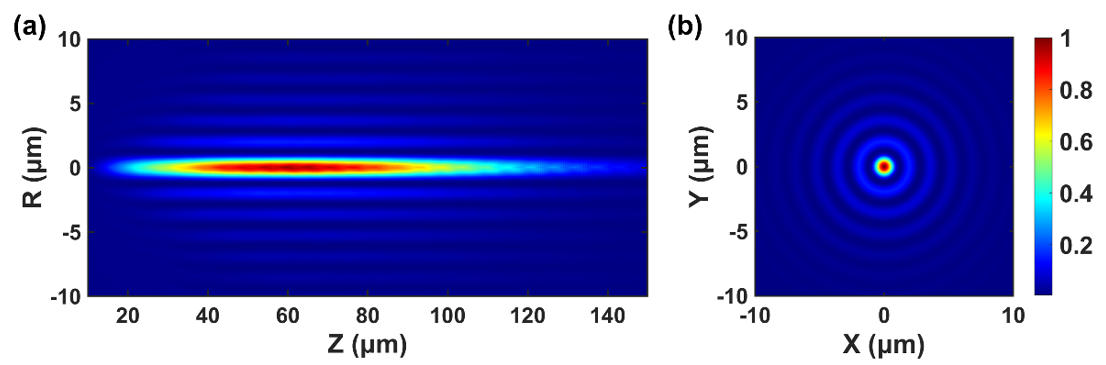
Figure R1-1 (a) Simulated transvers profile of the focused Bessel beam propagating in free space. (b) Simulated profile of the focused Bessel beam on the silicon surface. These two picture corresponds to Figure 1 (d-e) in the revised manuscript.
Response: We thank the Reviewer for the helpful suggestion. In response, we have added a clear illustration of the Bessel beam's intensity profile (now shown as Figure 1d-e in the revised manuscript) and provided a corresponding description in the Methods section (see Lines 97-105):
“The transverse and cross-sectional intensity profiles of the Bessel beam are shown in Figure 1d and e, respectively. The transverse profile (Figure 1d) shows that the beam exhibits an extended depth of focus, maintaining its characteristic profile over a propagation length of about 120 μm. As illustrated in Figure 1e, the intensity profile on the silicon sur-face is dominated by an intense central lobe with a diameter of approximately 1 μm (bot-tom to peak), surrounded by concentric side-lobe rings. The majority of the beam energy is confined within the central lobe and the first few high-intensity side lobes. This unique intensity distribution underpins the spatially differentiated material interactions observed in this work.”
The new Figures 1d and 1e provide clear evidence linking the Bessel beam's non-uniform energy profile to the distinct material responses observed in different spatial zones. We believe this addition strengthens the physical foundation of our work.
Comment 4: Please clarify the meaning of Np in figure 2: is it the same as N defined in the materials and method section? In this section there are two parameters N, one for the number of sub-pulses and one for the pulses train.
Response: We thank the Reviewer for identifying this error in our original notation. The Reviewer is absolutely correct. We have now corrected this and, in the revised manuscript, Np is used consistently and exclusively to denote the number of pulses within a single pulse train. All relevant instances in the text, figures, and captions have been reviewed and updated to adhere to this clear convention.
Comment 5: What is the meaning of “FAT” in figure 2g? is it the same as fr?
Response: We thank the Reviewer for identifying this error in the figure 2g. The label “FAT” was incorrect and undefined. It should consistently be fT, which in our system is defined as the repetition frequency of the pulse trains. As illustrated in Fig. 1b, each pulse train is synchronized to and initiated by an external trigger signal of the same frequency. Therefore, fT equivalently represents both the trigger frequency and the pulse-train repetition rate.
We have corrected this labeling error in the revised Figure 2 and ensured that fT is used uniformly throughout the manuscript. Furthermore, to aid readability, the meaning of fT has been explicitly reiterated in the Results section (see Line 154):
“Given a constant sample translation speed of 4000 μm/s and a pulse train frequency, namely, the trigger frequency of fT=500 Hz, the center-to-center spacing between adjacent micro-holes is approximately 8 μm.”.
Comment 6: In the result section the authors refer: “The central region develops fluidic resolidification structures, which disrupt the original annular patterns corresponding to the side lobes adjacent to the main lobe. Concurrently, the ablation structures in the outer side-lobe regions become more pronounced, with laser-induced periodic surface structures (LIPSS) emerging.” What is the actual laser fluence at the central and in the outer side-lobe regions? How do they compare with the literature? Also, a magnified SEM image showing the LIPSS referred by the authors would be helpful.

Figure. R1-2 Schematic of the laser fluence profile along the axis of the focused Bessel beam, indicating the peak fluence at the central lobe and successive side lobes.
Response: We sincerely thank the reviewer for the insightful comments. The request for clarification regarding the specific laser fluence and supporting microscopy images is highly valuable and has been addressed in detail. To visually clarify the spatial distribution of energy in our Bessel beam profile, we have prepared a schematic (Fig. R1-2), which depicts the laser fluence along the beam axis and labels the peak fluence of each relevant side lobe. Accordingly, the precise fluence values corresponding to these regions have been specified in the revised manuscript:
Lines 136-141:
“In the central region, where the main lobe exhibits a peak fluence of 59 J/cm², fluidic resolidification structures are formed, which disrupt the original annular patterns associated with the neighboring side lobes. Concurrently, the ablation structures in the outer side-lobe regions become increasingly distinct. Notably, within the areas corresponding to the 6th and 7th side lobes, where peak fluences range from 1.32 J/cm² to 0.91 J/cm², the emergence of laser-induced periodic surface structures (LIPSS) is observed.”
Lines 147-152:
“As the number of pulses increases, the region of stable LIPSS generation extends further outward into the area corresponding to the 8th and 9th side lobes, where the peak fluences range from 0.57 J/cm² to 0.35 J/cm². Concurrently, the lower-order LIPSS structures closer to the main lobe gradually transformed into groove structures. This observed trend in LIPSS evolution is consistent with the results reported in Ref. 40.”
Lines 431-432:
“40. Hu, M.; JJ Nivas, J; Fittipaldi, R.; Amoruso, S. Femtosecond laser surface structuring of silicon in dynamic irradiation condi-tions. Opt. Laser. Tech. 2022, 156, 108594, doi: 10.1016/j.optlastec.2022.108594”
Following the reviewer’s helpful suggestion, a magnified SEM image clearly depicting the LIPSS morphology has been included as an inset in Fig. 2d of the revised manuscript. This addition provides direct visual evidence of the periodic structures discussed.
Comment 7: In figure 3 legend, what is “SME”? is it SEM? In this figure the text mentions "yellow" and "white" scale bars. It may be difficult to distinguish them in paper printed in grayscale.
In the legend of figure 4, there the term “SME” appears again.
Response: We sincerely apologize for these careless errors. The Reviewer is correct. “SME” is a typo and should be “SEM”. Additionally, we appreciate the Reviewer’s consideration regarding the scale bars. We have corrected all instances of “SME” to “SEM” in the legends of Figures 3 and 4.
Regarding the scale bars, we have revised the descriptions as follows:
Lines 196-197: “Scale bar: 5 μm for (a) and (b) (white ones); 1 μm for (c-f) and the inserted picture in (b) (yellow ones).”.
Lines 276-277: In Figure 4 legends “Scale bar: 5 μm in the main figures (white ones) and 1 μm in the inserted picture of (a-c) (yellow ones).”.
We believe these revisions have resolved both issues raised.
Comment 8: To support the model illustrated in Figures 3g and 3h (lines 191–298), the authors should include theoretical calculations of the spatial energy distribution for each experimental scenario.
Response: We thank the Reviewer for this valuable suggestion to strengthen the theoretical support for our model. In direct response, we have performed numerical simulations of the electric field distribution to visualize the beam propagation and energy localization within cavities that mimic our experimental structures.

Figure. R 1-3 Simulation of the e-field distribution of inside a silicon V-groove incident with a focused Bessel beam
These simulation results are now presented as Figure R1-3 and Figure 3h in the updated manuscript. A detailed description of these simulations and their direct relevance to the proposed “propagation and intensification mechanism” has been added to the main text (please see Lines 201-212):
“This subtractive and transformative process concurrently clears the optical path, facilitating the beam's downward propagation. This propagation is sustained by diffraction and interference within the beam itself, combined with reflections from the cavity sidewalls. As a result, the beam re‑concentrates intense energy at the cavity bottom, generating new hot spots that drive further ablation and create a self‑reinforcing cycle (Fig. 3g).This propagation and intensification mechanism is directly supported by numerical simulations of the electric field distribution within representative cavities (Fig. 3h). The simulations re-veal that, despite a discrete field pattern arising from internal reflections and interference, significant energy is consistently concentrated near the bottom region even in deep (e.g., 27 μm) cavities. This confirms that the Bessel beam’s self‑reconstructing property, aided by sidewall reflections, enables effective energy delivery to the bottom of high‑aspect‑ratio structures, thereby validating the proposed dynamic cycle. ”
These theoretical calculations provide strong visual and physical confirmation that the unique properties of the Bessel beam allow it to penetrate and deliver intense energy to the bottom of high-aspect-ratio structures, thereby supporting the dynamic feedback loop illustrated in Figure 3g.
Comment 9: Finally, the paper describes the formation of different types of nanostructures, nanocoatings and nanoparticles. Chemical analysis would be hepful to determine whether these structures consist of pure silicon or silicon oxides.
Response: We appreciate the reviewer's suggestion regarding chemical analysis of the nanostructures, nanocoatings, and nanoparticles formed during the process. While compositional characterization could provide additional insights into material transformations, the primary focus of this study lies in elucidating the formation mechanism of micro‑nano hierarchical structures from an optical and structural perspective. Specifically, we aim to reveal how the central and peripheral lobes of the Bessel beam work synergistically to shape these features. Whether the nanostructures consist of pure silicon or silicon oxides does not alter the core optical and mechanical mechanisms underlying their formation, which remains the central narrative of this work.
Furthermore, we acknowledge that compositional changes such as oxidation can occur during laser processing in ambient air. However, such transformations can be achieved more systematically and controllably through supplementary methods, such as post‑processing in oxygen plasma or controlled atmospheres, which are relevant for specific applications like tailoring surface chemistry for biomedical interfaces or modulating optical properties for photonic devices. These aspects, while important for functional optimization, fall outside the scope of the present study, which is focused on the optical and morphological mechanisms of hierarchical structure formation.
In summary, while chemical analysis would undoubtedly enrich the understanding of laser-induced material modifications, it is not essential for addressing the key research questions posed in this manuscript. We believe that the structural and mechanistic insights presented here provide a solid foundation for future investigations into compositional tailoring and functionalization of such hybrid micro-nanostructures.
As a result, I recommend the publication of the paper with the incorporation of these suggestions.
Response: We are grateful to Reviewer 1 for the constructive feedback and, in particular, for the final endorsement recommending publication. We believe the manuscript has been significantly strengthened through this revision process, and we thank the Reviewer once again for the valuable input.
Reviewer 2 Report
Comments and Suggestions for AuthorsThe paper presents the results of fabrication of micro-/nanostructures
by using emission-programmed femtosecond Bessel beams. Efficiency of
the overall fabrication process is pre-determined, among others, by
integration of additive, transformative and subtractive processes
in a single step, while using a temporally gated laser pulse train.
The paper is quite well written and organized. It can be interesting
for reader of Nanomaterials. I may recommend this work for
publication, provided that the authors would properly revise it.
The following issues should be addressed in the revised manuscript.
1) The authors call the structures as "Hybrid" in the title.
In which sense they are hybrid?
2) Line 62: "Here" means "In this work"?
3) Possible restrictions and realizable scenarios of programming of
fs pulse emission should be discussed.
4) Line 99: since each microhole is formed by one pulse train,
fabrication of the structures with a large number of holes may need
an enormously large number of pulse trains; what number of the holes
per structure is realistic?
5) Are the hole sizes indicated in Fig. 4 typical? Which size range
is best consistent with the proposed approach?
6) Please give more information about materials to which the proposed
approach can be applied.
7) Please justify the choice of material used in your work.
8) Comparison with more common (more "usual") approaches would be
desirable, in terms of both efficiency and complexity of
realization.
9) Please discuss in more detail possible types of the structures, to
which your approach is applicable, and physical phenomena obtainable
in these structures.
Author Response
Response to Reviewer 2 Comments
General Comments: The paper presents the results of fabrication of micro-/nanostructures by using emission-programmed femtosecond Bessel beams. Efficiency of the overall fabrication process is pre-determined, among others, by integration of additive, transformative and subtractive processes in a single step, while using a temporally gated laser pulse train. The paper is quite well written and organized. It can be interesting for reader of Nanomaterials. I may recommend this work for publication, provided that the authors would properly revise it.
Response: We sincerely thank the reviewer for the positive evaluation of our manuscript and for the constructive comments. We have carefully considered all points raised and have revised the manuscript accordingly. Below, we provide a point-by-point response to each specific comment and suggestion. All corresponding revisions have been incorporated into the manuscript, with changes highlighted for the Reviewer's convenience. Please refer to the attached Point‑to‑Point Response (Review 2).pdf for further details and note that any formatting issues in the response file can be directly reviewed in that document.
The following issues should be addressed in the revised manuscript.
Comment 1: The authors call the structures as "Hybrid" in the title. In which sense they are hybrid?
Response: We thank the Reviewer for this comment. In this work, the term was intended to denote the spatial and functional integration of multiscale features. To avoid ambiguity and better reflect the structural hierarchy, we have adopted the more precise term “hierarchical” and revised the title accordingly. The structures are hybrid in a structural sense, integrating microscale holes/pillars with nanoscale coatings. We have also updated the text to consistently use “hierarchical” where appropriate.
Comment 2: Line 62: "Here" means "In this work"?
Response: We agree with the Reviewer and have changed “Here” to “In this work”. We also have checked for similar instances to improve formality and clarity.
Comment 3: Possible restrictions and realizable scenarios of programming of fs pulse emission should be discussed.
Response: We thank the Reviewer for raising this important point. We agree that a discussion on the limits and prospects of the temporal programming strategy is valuable. The core trade-off lies in the balance between achieving fine temporal control and maintaining sufficient average power for high throughput. To address this, we have expanded the Conclusion section to include a dedicated analysis (Lines 295-307):
“Compared with conventional continuous‑output laser processing, the emission‑programming strategy provides superior temporal control at the level of individual pulse trains—a precision unattainable through mere adjustment of pulse energy or scan speed. However, this fine temporal control inherently reduces the average power com-pared to continuous operation at the same repetition rate, establishing a practical trade‑off between control fidelity and processing throughput. As a result, the current processing rate of 500 holes/s at 4000 μm/s is primarily constrained by the available pulse energy at the laser’s intrinsic high repetition rate (fp). Looking forward, employing laser sources that deliver higher pulse energies at elevated repetition rates would allow the same programmed energy per hole to be delivered at proportionally higher scanning speeds (e.g., ~10,000 μm/s) and pulse‑train frequencies. Thus, this method establishes a scalable framework in which advancements in laser technology directly translate to enhanced throughput, without altering the underlying temporal control scheme.”
We believe this addition strengthens the manuscript by clearly outlining the current restrictions, realizable scenarios, and future scalability of our programming approach, thereby providing a more complete perspective for readers and potential authors in the field.
Comment 4: Line 99: since each microhole is formed by one pulse train, fabrication of the structures with a large number of holes may need an enormously large number of pulse trains; what number of the holes per structure is realistic?
Response: We thank the Reviewer for this practical question regarding the scalability of the process. Under the current parameters (fT=500 Hz, v=4000 μm/s, line interval Δy=10-16 μm), the fabrication of a large array is indeed serial and time-bound. To provide a concrete estimate: fabricating a 1 mm × 1 mm area with an 8 μm lateral spacing (determined by v/fT) and a 10 μm line interval would contain approximately 12,500 micro-holes. The theoretical minimum processing time for this area, governed by the scanning mechanics, would be on the order of tens of seconds.
This directly relates to the trade-off discussed in response to Comment 3. The current throughput is limited by the available pulse energy at high repetition rates, which caps fT and v. As outlined in the revised Conclusion, this is not a fundamental limit of the programming concept but a current system constraint. Employing a laser with higher average power would allow proportional increases in fT and v, thereby reducing the processing time for a given number of holes linearly. For instance, increasing both fT and v by a factor of 10 (to ~5 kHz and ~40 mm/s, respectively, with sufficient pulse energy) would reduce the processing time for the same 1 mm² array to a few seconds, making large-area fabrication highly practical. Thus, the method provides a clear and scalable pathway from laboratory demonstration to potential application.
Comment 5: Are the hole sizes indicated in Fig. 4 typical? Which size range is best consistent with the proposed approach?
Response: We thank the Reviewer for this insightful question, which rightly highlights an important aspect of our work's characterization. The hole sizes indicated in Fig. 4d-f are indeed representative of the structures formed under the given line intervals. We acknowledge, however, that providing rigorous statistical data on hole-to-hole size uniformity within the areal scans presents a practical challenge, largely due to two characterization limitations evident in the images:
- In top-view (Fig. 4a-c), the micropillars and dense nanoparticle coating obscure the clear rim of the micro-holes, making precise diameter measurement from above difficult.
- For cross-sections, the cleaving method becomes highly unpredictable for 2D arrays. The complex stress distribution makes it difficult to obtain a clean, continuous fracture through multiple intact holes, as seen in the fragmented side views of Fig. 4d-f.
Thus, while the trend of decreasing depth with line interval is clearly observed, a full statistical analysis of size variation across the array is constrained by these measurement realities. The most reliable and consistent individual hole data come from the in-line scanned tracks in Fig. 3, where clean cross-sections were obtainable. We appreciate the Reviewer's attention to this nuance and hope this clarification is helpful.
Comment 6: Please give more information about materials to which the proposed approach can be applied.
Response: We thank the reviewer for this constructive comment. As pointed out in the Conclusion section of our manuscript, the proposed rapid drilling strategy and its underlying physical mechanisms—particularly the synergistic role of the central and peripheral lobes of the femtosecond Bessel beam in driving subtractive, transformative, and additive processes—are inherently transferable to a range of opaque materials (where strong absorption initiates the key thermo‑fluidic responses). This universality stems from fundamental material interactions with the shaped beam rather than material‑specific chemistry. We have now expanded the relevant sentence in the Conclusion to better highlight this point (see Line 308-315).
“From a material standpoint, the proposed strategy and the underlying physical mechanisms are rooted in fundamental material responses to ultrafast laser irradiation, such as strong near-infrared absorption and consequent melt-flow dynamics. Therefore, they are inherently transferable to a broad range of non‑transparent materials, including other semiconductors (e.g., Ge, GaAs) and metals (e.g., Ti, stainless steel). This universality positions the resulting hierarchical structures as promising candidates for applications in photodetectors, biocompatible surfaces, and drag‑reduction coatings”
We believe this broader material applicability further underscores the potential of our method for fabricating functional hybrid micro‑nanostructures in fields such as photodetection, biomedical interfacing, and drag‑reduction surfaces.
Comment 7: Please justify the choice of material used in your work.
Response: We appreciate the reviewer’s query regarding material selection. Silicon was chosen as the model material in this study due to its well-understood optical and thermal responses under ultrafast laser irradiation, enabling a clear focus on the interplay between the central and peripheral lobes of the Bessel beam in driving the formation of micro-nano hierarchical structures. At the same time, silicon is a technologically relevant material with direct applications in areas such as photovoltaics, photodetection, and functional surfaces, ensuring the practical significance of our findings. We have clarified this rationale in the revised manuscript within the Materials and Methods section (Please see Line 70-71).
“Silicon was chosen for this study due to its well‑characterized optical and thermal response, and its technological relevance in photovoltaics and photodetection ensures the practical significance of the approach.”
Comment 8: Comparison with more common (more "usual") approaches would be desirable, in terms of both efficiency and complexity of realization.
Response: We thank the reviewer for the suggestion to compare our approach with more common methods. The comparison can be framed from two complementary perspectives. The first, already discussed in the manuscript, addresses the complexity of realization: our emission‑programming strategy introduces a higher level of temporal control, which, under current laser parameters, involves a trade‑off with processing efficiency (Line 295-297):
“Compared with conventional continuous‑output laser processing, the emission‑programming strategy provides superior temporal control at the level of individual pulse trains—a precision unattainable through mere adjustment of pulse energy or scan speed.”
More distinctively, a second and perhaps more fundamental advantage lies in spatial process integration. Our Bessel‑beam‑based approach intentionally creates a structured energy profile that spatially decouples and concurrently drives distinct physical mechanisms—such as central ablation and peripheral deposition—within a single scan. This inherent capability enables the direct, one‑step fabrication of true 3D hierarchical micro‑nano structures, which represents a significant advance in structural complexity over conventional single‑interaction‑mode techniques. A concise discussion of this integrative advantage has been added to the revised manuscript (see Line 258‑262).
“This approach enables the single‑step fabrication of true 3D hierarchical micro‑nano structures, integrating tapered micro‑holes, elevated micropillars, and a dense coating of nanostructures. By spatially coupling distinct material modification modes (subtractive, transformative, and additive processes) within one beam profile, it accomplishes structural complexities that are challenging to achieve with conventional techniques.”
Comment 9: Please discuss in more detail possible types of the structures, to which your approach is applicable, and physical phenomena obtainable in these structures.
Response: We thank the reviewer for the insightful suggestion to elaborate on the applicability and potential of our approach. Beyond the demonstrated micro‑nano hierarchical structures, our emission‑programmed Bessel beam strategy provides a versatile platform for fabricating advanced surface architectures with tailored physical properties. Three promising directions include:
(1) Micrometer‑thick membranes with large‑scale micro‑hole arrays: The rapid, high‑aspect‑ratio drilling capability can be extended to fabricate perforated membranes featuring uniform pore arrays. Such membranes are ideal platforms for studying gas–liquid contact dynamics and bubble behavior in liquid environments, where pore geometry critically influences interfacial phenomena.
(2) Replicable micro‑tip arrays: The uniform, taper‑shaped micro‑cavities serve as excellent master templates for nano‑imprinting. They can be replicated to create arrays of microscopic tips, which are highly desirable for the development of flexible tactile or pressure sensors, leveraging the sharp features for enhanced sensitivity.
(3) Programmable graded surfaces: By spatially varying the temporal sequence of pulse trains, one can locally control the microstructure morphology in a single scan. This enables the creation of surfaces with spatially graded properties (e.g., wettability, adhesion), opening avenues for advanced applications in directed fluid transport and cell guidance.
A concise discussion highlighting these extended structural possibilities and their associated physical phenomena has been added to the revised manuscript (see Lines 295‑300), underscoring the method’s potential as a programmable platform for functional surface engineering.
“From a structural standpoint, the capability to spatially and temporally program the beam enables the fabrication of functional surfaces with tailored geometries and properties. These include large‑area micro‑hole membranes for studying gas‑liquid interface dynamics, uniform micro‑tip arrays for flexible sensing, and surfaces with programmable wettability gradients for directed fluid transport or cell guidance.”