Article

Optical Waveguide-Pair Design for CMOS-Compatible Hybrid III-V-on-Silicon Quantum Dot Lasers
by
Peter Raymond Smith
1,
Konstantinos Papatryfonos
1,2,* and
David R. Selviah
1,*
1
Department of Electronic and Electrical Engineering, University College London, London WC1E 7JE, UK
2
Institute of Electronics, Microelectronics and Nanotechnology (IEMN), UMR CNRS 8520, University of Lille, Avenue Poincare, 59650 Villeneuve of Ascq, France
*
Authors to whom correspondence should be addressed.
Nanomaterials 2025, 15(21), 1645; https://doi.org/10.3390/nano15211645
Submission received: 24 July 2025 / Revised: 4 October 2025 / Accepted: 24 October 2025 / Published: 28 October 2025
(This article belongs to the Section Nanophotonics Materials and Devices)

Abstract

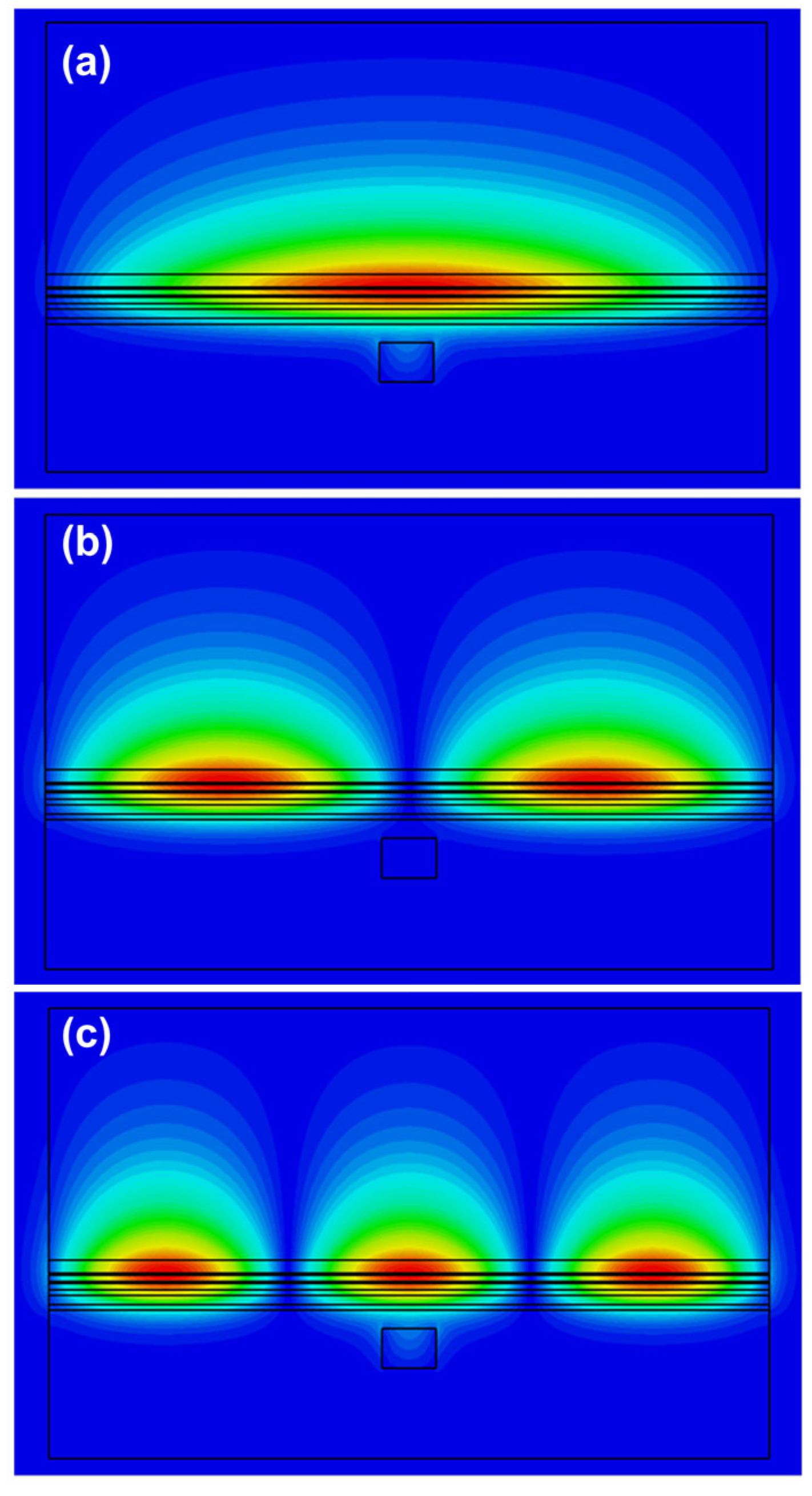
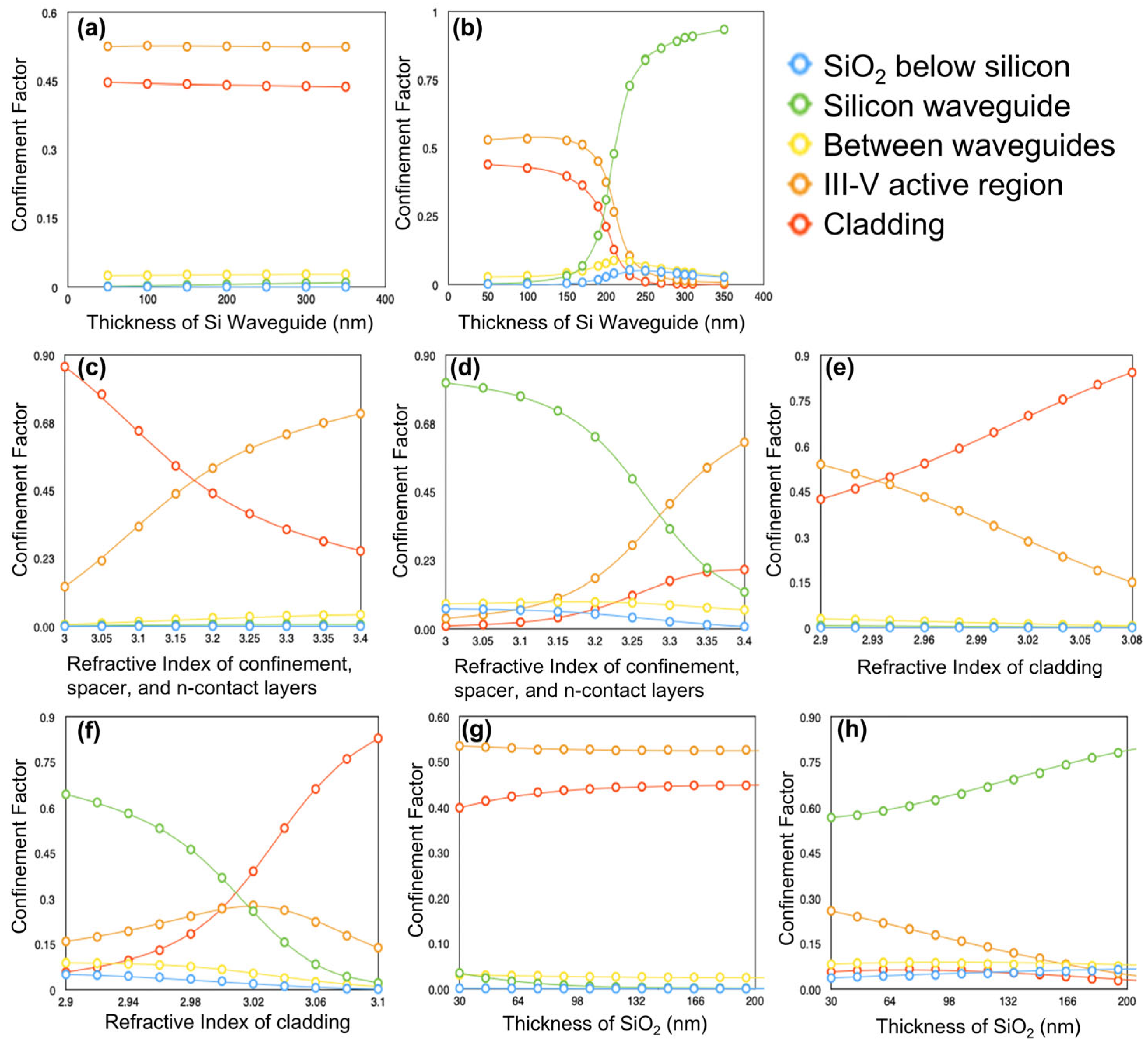
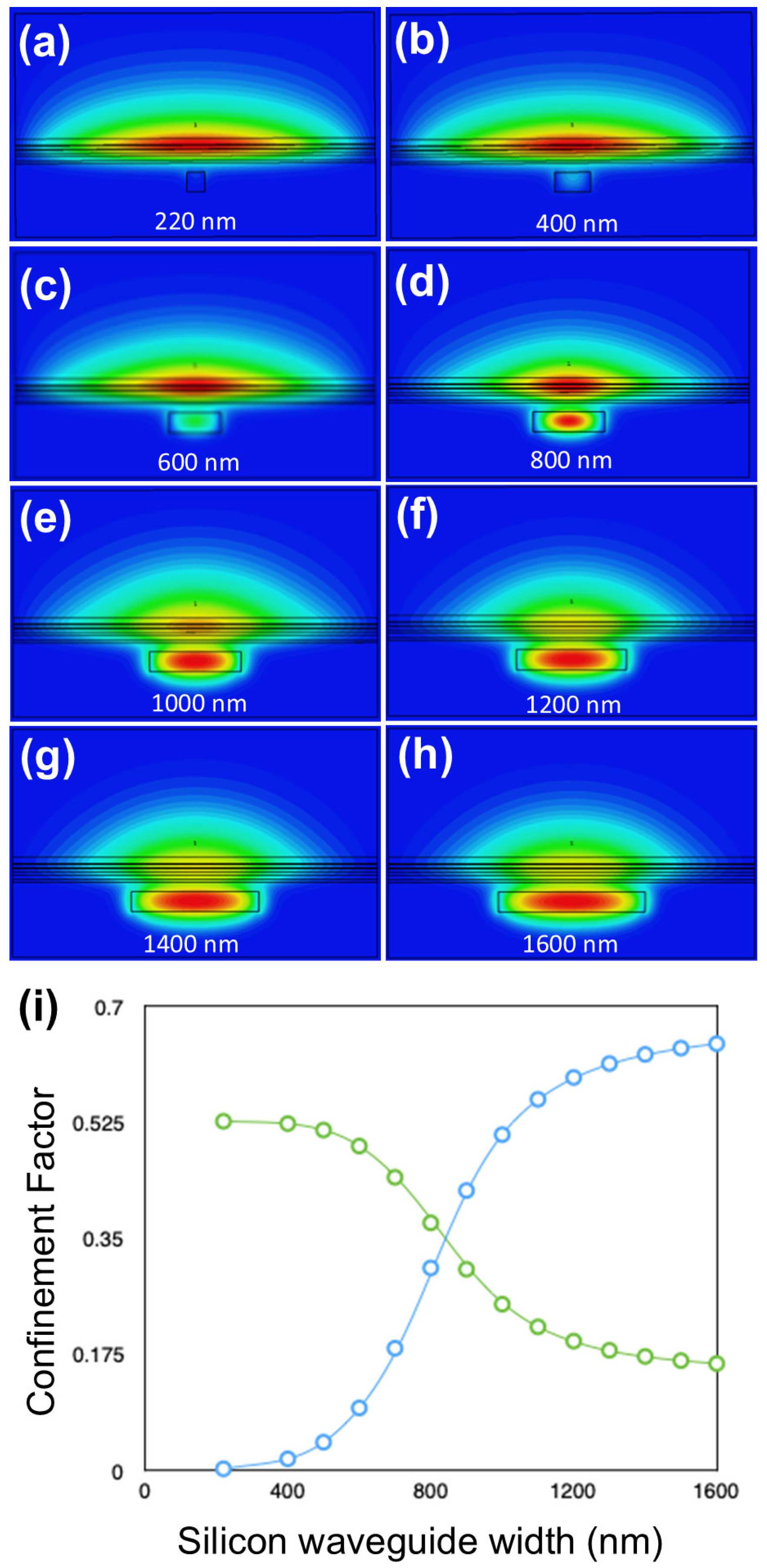
The development of compact, energy-efficient integrated lasers operating at 1.3 µm re-mains a critical focus in silicon photonics, essential for advancing data communications and optical interconnect technologies. This paper presents a numerical study of distributed Bragg reflector (DBR) hybrid III-V-on-silicon lasers, analyzing design trade-offs and optimization strategies based on supermode theory. The III-V section of the design incorporates InAs/(Al)GaAs quantum dots (QDs), which offer improved temperature insensitivity at the cost of more complex III-V/Si optical coupling, due to the high refractive index of (Al)GaAs. Consequently, many current laser designs rely on silicon waveguides with a thickness exceeding 220 nm, which helps coupling but limits their compatibility with standard CMOS technologies. To address this challenge, we perform detailed simulations focusing on 220-nm-thick silicon waveguides. We first examine how the mode profiles jointly depend on the silicon waveguide dimensions and the geometry and composition of the III-V stack. Based on this analysis, we propose a novel epitaxial design that enables effective III-V/Si coupling, with the optical mode strongly confined within the III-V waveguide in the gain section and efficiently transferred to the silicon waveguide in the passive sections. Moreover, the final design is shown to be robust to fabrication-induced deviations from nominal parameters.
Keywords: silicon photonics; design methodology; distributed Bragg reflector laser; evanescent coupling; hybrid laser; quantum dot laser; overlap integral; supermode theory; tolerance; trade-off silicon photonics; design methodology; distributed Bragg reflector laser; evanescent coupling; hybrid laser; quantum dot laser; overlap integral; supermode theory; tolerance; trade-off