


Abstract
The growth in the number of students in higher education institutions (HEIs) in Latin America reached 33.5 million in 2021 and more than 220 million worldwide, increasing the number of data volumes in academic management systems. Some of the difficulties that universities face are providing high-quality education to students and developing systems to evaluate the performance of teachers, which encourages offering a better quality of teaching in universities; in this sense, machine learning emerges with great potential in education. This literature review aims to analyze the factors, machine learning algorithms, challenges, and limitations most used to evaluate the quality of teaching based on performance. The methodology used is PRISMA, which considers analyzing literature produced between 2014 and 2024 on factors, prediction algorithms, challenges, and limitations to predict the quality of teaching. Here, 54 articles from journals indexed in the Web of Science and Scopus databases were selected, and 111 factors were identified and categorized into five dimensions: teacher attitude, teaching method, didactic content, teaching effect, and teacher achievements. Regarding the advances in machine learning in predicting teacher teaching quality, 30 ML algorithms were identified, the most used being the Back Propagation (BP) neural network and support vector machines (SVM). The challenges and limitations identified in 14 studies related to HEIs are managing the large volume of data and how to use it to improve the quality of education.
1. Introduction
Artificial intelligence (AI) and machine learning (ML) techniques are effective sources for gaining valuable insights into teaching quality (TQ) and have been widely applied in various fields such as telecommunications, insurance, retail, construction, transportation, healthcare, finance, and education [1,2,3,4,5]. The application of AI and ML will play an increasingly important role in higher education institutions (HEIs) because it enables students and faculty to have a personalized approach to faculty teaching quality based on their own experiences and preferences [6]. At the same time, AI can reduce the time needed for routine administrative tasks, allowing HEI faculty to focus more on teaching and research [7].
In recent years, improving the quality of teaching and learning has been considered an important concern in research and practice; the enormous amount of data accumulated in HEIs is a gold mine where useful knowledge for educational quality can be discovered [8]. Based on the above, the report of [9] indicates a high growth of undergraduate and graduate students in HEIs in Latin America, reaching 33.5 million in 2021, experiencing significant growth. At a global level, according to data from the UNESCO Institute for Statistics, the number of students enrolled in HEIs is more than 220 million; it has more than doubled in recent decades [10]. The study of [11] indicates that evaluating TQ accurately and efficiently has become a priority for educational institutions because they seek to ensure academic excellence and remain competitive in an increasingly demanding environment. In this context, the advancement of technology, and in particular, artificial intelligence and machine learning, offers new opportunities to improve the assessment of the teaching quality of university teachers (TQUT). In addition, the global AI market in the education sector reached a value of 4 billion dollars in 2022 and is projected to grow at a compound annual growth rate (CAGR) of over 10% between 2023 and 2032, which shows the increasing adoption of AI solutions in education [12].
The quality of teaching naïven universities is a key indicator of an institution’s educational level and is fundamental for students’ academic and professional development [13,14]. Its assessment of teaching quality is a complex problem with multiple criteria and variables, which requires a combination of quantitative and qualitative methods to be more objective and scientific [15,16]. Furthermore, Ref. [14] indicates that an accurate and objective evaluation allows teachers to improve their teaching strategies, optimize educational resources, and ensure that students receive an education aligned with standards of excellence. The topic of teaching quality has been widely debated in academic literature, as evidenced in the studies of [17,18,19], which propose a TQ evaluation model in BP adaptive neural networks. Ref. [20] proposes a quality framework based on ML. Refs. [21,22] design a TQ evaluation model in English. Ref. [23] presents methods for evaluating and analyzing university teaching quality. Ref. [24] proposes a portfolio evaluation of teaching effectiveness in ML. Ref. [25] presents an online TQ assessment model. Ref. [15] proposes an intelligent CE assessment model based on ISSA DRNN. These studies highlight the importance of integrating AI and ML for data-driven decision-making.
The issue explored in this article focuses on the quality of the teacher’s teaching (QTT) and measures the impact of teacher effectiveness (TE) on performance within higher education institutions (HEIs). According to [26], discovering university professors’ key skills and cultivating their capabilities is both a primary task and a challenging problem for HEIs. Despite universities striving to recruit and train teachers with a broad range of competencies, there is no clear, validated system to comprehensively identify and measure these skills. As noted in [27,28], ensuring the quality of subject-specific teaching scientifically relies on recommending appropriate teachers—a complex issue due to the diverse characteristics of faculty, necessitating the design of effective algorithms. Furthermore, Ref. [17] highlights that evaluating teaching quality in universities is critical because it significantly affects the reputation of these institutions, which is largely determined by the quality of education. However, this evaluation is complex due to the non-linear nature of the problem and the subjectivity involved. Assessing the quality of a product is far easier than evaluating the instruction of a professor, given the various components and the bidirectional nature of the teaching process, which involves both teachers and students.
According to [29], AI techniques benefit students, professors, directors, and decision-makers, enabling them to perform tasks more effectively and efficiently while enhancing educational quality. However, as [20] points out, traditional evaluation methods—such as direct observations and administrator-led assessments—are often subjective and fail to accurately reflect a teacher’s impact on student learning. This lack of precision and objectivity limits the ability of institutions to identify and retain the most effective teachers. Moreover, as indicated, traditional methods struggle to process large volumes of information effectively, applying machine learning (ML) algorithms.
Evaluating teaching quality in higher education (TQUT) helps institutions understand faculty performance, promptly identify shortcomings, and improve faculty quality and university-level education [23,30,31]. However, as [32,33] points out, current teacher performance evaluation systems are inefficient, making it challenging to assess faculty performance accurately. Additionally, ineffective talent acquisition mechanisms and limited human resource mobility hinder universities’ ability to manage their personnel efficiently, ultimately negatively impacting educational quality and institutional development.
Research has sought to identify the factors or indicators of teaching quality and teacher performance. For instance, Ref. [23] used 16 evaluation indicators classified into four categories, selected according to five principles, to evaluate teaching quality in universities offering diverse academic programs. Similarly, Ref. [21] applied 25 indicators across eight categories and noted high correlations among the variables. Ref. [18] identified 16 teaching quality evaluation indicators across four aspects or categories, constructing a comprehensive evaluation index system. Meanwhile, Ref. [34] identified 24 teaching quality indicators in English, grouped into five categories. These findings underscore the need to compile a catalog of TQUT factors systematically.
Regarding the prediction algorithms, different machine learning algorithms have been used in teacher teaching quality, such as the model of [11] that applies a teaching quality evaluation model based on a backpropagation (BP) neural network that solves the deficiencies of teaching quality evaluation methods and improves the accuracy of the evaluation prediction. For his part, Zhong [23], in his ML research, selected the support vector machine (SVM) algorithm to evaluate teaching quality, where the accuracy of the SVM algorithm ranged between 80 and 98%. The study [20] applied multiple linear regression to assess teaching effectiveness and predict teacher performance with a limited sample of 400 data sets, obtaining 95.77% accuracy. In addition, Ref. [21] applies the combination of embedded web systems and machine learning using the fuzzy decision tree algorithm to evaluate the quality of online teaching in English, significantly improving the quality of education. Each author indicates that their models should be tested with new indicators and a more extensive data set.
According to the challenges and limitations [35], one of the most significant challenges of higher education institutions is the accumulated amount of data and how it can be used to improve the quality of academic programs. Almufarreh [20] indicates that it should be contrasted with other ML to verify its accuracy. According to [23], a significant challenge is selecting scientific, complete, measurable, oriented, and valid evaluation indicators to ensure that teaching performance is adequately evaluated in different aspects. Ref. [36] indicates that one of the limitations is that teacher competence is a relatively complex concept; it is necessary to dynamically adjust the indicators and weights of the evaluation system according to the specific subject areas and teacher training requirements, and a limited number of experts can affect the evaluation result, so the evaluation system must be tested and improved. Thus, the need to study its possible impact and limitations arises.
However, studies in this field have revealed that much knowledge needs to be inventoried, analyzed, and classified for factors and algorithms. Despite advances in teacher education quality, there are significant gaps in knowledge, particularly in implementing ML-based techniques that can effectively handle variability in data to understand its implications in TQ better. For these reasons, a systematic literature review was conducted to map the research in this area and identify gaps in knowledge in the factors, algorithms, challenges, and limitations of ML in TQUT.
This study aims to systematically review all the important aspects developed and related to ML prediction factors, algorithms, trends, and limitations based on ML. To answer the research question ¿What ML prediction factors, advances, challenges, and limitations have been investigated about TQUT?
The main contributions of this review are the following:
- ∘
- To provide a comprehensive catalog of teaching quality factors classified into five dimensions. Its application will allow you to build a factor framework with the different variables or organize your data set to group them by category.
- ∘
- To identify the various prediction algorithms used and their accuracy in TQUT. To measure teacher performance and obtain better accuracy in the algorithms used in the data set.
- ∘
- To compile the challenges and limitations identified in the different studies contributing to TQUT. It will allow HEIs to know the computational power they need according to their data volumes. It will also allow them to understand the structure of the different data sets and the importance of selecting the indicators.
- ∘
- To provide the reader with a wide range of bibliographical references that they can use to deepen their understanding of ML-based models that facilitate TQUT prediction. This will allow each researcher to know the identified barriers and previous studies to address new research.
The contribution of this paper lies in its systematic analysis of how AI is transforming higher education through advanced technologies such as machine learning algorithms, predictive analytics, and supervised and unsupervised learning techniques. These tools are critical to creating educational solutions customized for decision-making. ML integration addresses the challenges of improving teaching quality and identifying improvement patterns according to the category of factors in performance evaluation. The insights provided by this study aim to review all the important aspects developed and related to factors, ML prediction algorithms, trends, and limitations based on ML. In addition, it guides teachers, HEI managers, and researchers in leveraging ML-driven innovations to improve academic success and institutional effectiveness.
This article is organized into six sections. Section 2 provides a background on TQUT and ML. Section 3 outlines the methodology for the systematic literature review. Section 4 presents the results, focused on answering the research questions discussed in Section 5. Finally, the conclusions follow in Section 6.
2. Theoretical Background
According to Gu [11], competition in the 21st century has to do with the quality of teachers, and the challenges of all countries in the world also have to do with the quality of talent. As [37] indicated, the highest quality level in the educational system is to predict teachers’ performance to obtain knowledge about the educational elements affected. The work of Abunasser et al. [35] mentions that one of the greatest challenges of HEIs is the accumulated amount of data and how it can be used to improve the quality of academic programs and teacher performance. In addition, Ref. [38] indicates that an adequate allocation of academic resources can support the management of HEIs.
This section assesses the theoretical foundations of ML and QTT in higher education and explores their integration into academic practices. Through a detailed analysis of these foundations, the transformative potential of ML in HEIs to reconfigure educational ecosystems and improve teaching practices and institutional decision-making becomes evident.
2.1. Teachers’ Teaching Quality
The quality of teachers’ teaching is essential for a university and college to survive and grow and is a measure of the trend towards international higher education [3]. According to [39], teaching quality is not defined by ranking a teacher’s competence or effectiveness against others. Still, it is defined by the teacher’s role to be reflective, effective, collaborative, and continue learning. For Chen and Mokhtar [40], the quality of teachers’ teaching is assessed through four channels: student assessment, expert assessment, peer assessment, and teacher self-assessment. However, for Adams et al. [41], evaluating teaching quality helps teachers understand the quality of their work and discover deficiencies in time.
Effective teachers are firmly committed to creating a positive learning experience and impacting student learning to transform it into a quality environment for knowledge dissemination [24]. Therefore, Ref. [42] indicates the importance of having a well-defined teacher profile and well-prepared educators to use advanced technologies, improving the quality of teaching and student learning outcomes.
2.2. Teacher Performance Assessment
Teacher assessment in higher education is crucial to ensure that students receive high-quality education and that teachers can deliver their students the most excellent learning experience possible [20]. Assessing teacher quality helps to understand teaching effectiveness, identify areas for improvement, and provide effective feedback, which can improve teaching efficiency and university management [23,43,44,45].
Therefore, Refs. [46,47] mention that teacher evaluation is an education management tool to facilitate the teacher’s personal growth. In addition, Meng et al. [48] state that the evaluation of classroom performance is one of the important components of a comprehensive evaluation of the quality of university education and has aroused the interest of both universities and teachers. As indicated by Zhang et al. [49], the teaching quality evaluation systems must be synchronized in universities; the current situation makes it necessary to build a teaching quality evaluation system; its positioning determines for teachers that the evaluation of teaching quality cannot be done only through theory, and smart technology must be used.
2.3. Artificial Intelligence
AI was first used by McCarty, Minsky, Rochester, and Shannon from 1996 to 2006. Popenici and Kerr [50,51] and Brooks and Thompson [52] agree that AI is a computer system capable of performing human-like processes, such as learning, adaptation, synthesis, self-correction, and the use of data for complex processing tasks. Therefore, Lee M. et al. [53] mention that AI evolves as machines become increasingly capable of performing tasks that require intelligence, so much so that, during the 1990s with the introduction of computers, according to [29] in the educational sector, improvements have been made focused on the development of AI-enhanced learning environments, intelligent tutoring systems, adaptive learning systems, intelligent agents, and intelligent collaborative learning systems.
2.4. Machine Learning Algorithms
ML for Alloghani et al. [54] is an area of AI that uses computerized techniques to solve problems based on data and historical information that does not require modifications to the core process. Refs. [50,55,56] agree that ML is a computer algorithm that learns from data to make decisions without being programmed. Therefore, Ref. [35] mentions that AI algorithms improve with use and become more accurate when more data are available. On the other hand, machine learning systems, according to [57], are used in education to predict students’ learning performance and produce personalized learning paths.
With the continuous advancement of information technology and machine learning in today’s culture, it is possible to employ machine learning to create a teaching evaluation system, which can be used to monitor teachers’ teaching in real time [3]. As a result, teachers can get to know themselves more quickly in the teaching process and adjust their teaching plans.
2.5. Related Works
Seven literature reviews have been identified for using AI and ML. They focus on different fields of education, such as student performance, student dropout, at-risk students, learning processes, efficient management of educational resources, and big data in teacher evaluation. None of them focus on teacher teaching quality evaluation and teacher performance in ML. These studies differ in terms of the methodology used and the approaches adopted; key findings and a description of each study are provided in Table 1.

Table 1.
Research gaps in AI and ML academic topics.
Issah [58] conducted a literature review on applying machine learning techniques to predict academic performance using academic and non-academic factors to identify the machine learning methods used and how student characteristics relate to their performance. Fahd et al. [59] conducted a meta-analytic analysis of previous studies on the application of machine learning in higher education to assess academic performance, identify at-risk students, and predict dropout, using the PRISMA framework to systematize the review of the studies.
In their article, Albreiki [60] presents a systematic literature review on predicting student performance using ML techniques. The review focuses on identifying student risk factors and predicting school dropout using various ML techniques. Salas-Pilco [29] investigates AI’s application in Latin America’s higher education, focusing on how AI applications are used in learning, teaching, and administration processes within HEIs. The review covers AI techniques, including machine learning, deep learning, and natural language processing, and examines the main educational topics these applications address.
Hilbert [61] examines the use of machine learning techniques in educational sciences and highlights how these techniques can analyze large data sets to model complex relationships, which is crucial given the increasing availability of large-scale educational data through massive open online courses and other means. Ref. [62] addresses the use of AI techniques in improving educational quality, highlighting recent challenges and progress in this field. It focuses on how AI applications can be used in education to improve educational services and overcome existing challenges, including integrating AI into different areas of education. Ref. [63] conducts a bibliometric review of the teaching knowledge assessment system in universities in the context of big data, examines current trends and key research points in the field, reviews conventional teaching assessment models, and proposes directions for improving teaching knowledge assessment systems.
Therefore, despite literature review studies (as shown in Table 1), a comprehensive analysis that considers the existing articles on ML implementation in HEIs regarding teacher quality, teaching quality, or teaching performance could not be found. This study aims to provide a systematic literature review of machine learning models’ application, teaching quality factors, and trends and limitations in the higher education sector. Therefore, this research attempts to take initial steps to fill the existing gap in the literature. It classifies and analyzes the approach of applying machine learning studies on teacher quality, factors, and algorithms employed in higher education. Furthermore, the research briefly identifies future research trends.
3. Materials and Methods
The systematic review for the development of this research is based on the methodology “The PRISMA 2020 statement” [64], and the procedure proposed by [65] was used, which was adapted by [66] and has the following phases:
- Planning: Research questions, search protocols, and keywords are proposed.
- Development: Documents corresponding to primary studies are selected according to the inclusion and exclusion criteria and the protocol established in the planning phase.
- Results: The review and statistical analysis results are presented in Section 3.3 and Section 4.
3.1. Planning
To carry out the bibliographic review, three research questions were formulated, which will allow us to identify the aspects that have been analyzed on factors, techniques, challenges, and limitations of TQUT:
RQ1: What are the factors considered in teacher teaching quality in higher education?
RQ2: What are the advances of ML in predicting teacher teaching quality in higher education?
RQ3: What challenges and limitations have been identified in the application of ML for teacher teaching quality in higher education?
To answer the research questions, a review of primary publications was conducted to identify potentially relevant documents. Searches were conducted in bibliographic databases from January 2014 to December 2024: “title-abs-key” for Scopus and “topic” for Web of Science (Wos), using the following search string as shown in Table 2.
Table 2.
Database search string.
The last 10 years, considering that in the previous years, there were few studies and related works, including reviews that began in 1991 and others since 2009, were also considered to be periods of technological progress and that in recent years, machine learning has been evolving in its application to the teaching of university teachers.
The search was limited to publications with an impact factor from the SCImago journal ranking. The research questions formulated served as a guide throughout the review process. In addition, inclusion and exclusion criteria were defined to identify relevant studies for the research, which are presented in Table 3.
Table 3.
Inclusion and exclusion criteria.
3.2. Development
The primary analysis process of the studies found during the search was subjected to a selection procedure based on the criteria detailed in Table 3, covering both the inclusion and exclusion criteria. To achieve this, it was necessary to conduct a prior review of the content to determine its relevance for the present study and to find those studies related to the factors, techniques, challenges, and limitations of TQUT through ML. Most of the works were discarded because they corresponded to topics such as prediction in academic performance and educational competencies in business areas, health or agriculture, and school educational levels, did not apply machine learning, and others for not contributing to the research questions. Figure 1 illustrates the PRISMA flowchart explaining the applied process and identifying the activities carried out to select or reject the studies. Mendeley was used to organize and manage the bibliographic references throughout the review.
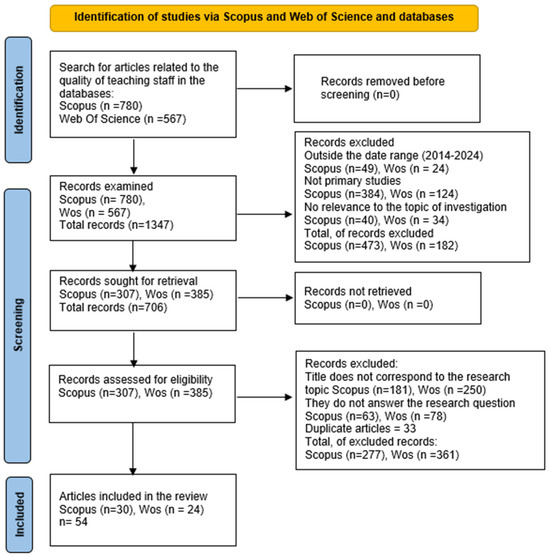
Figure 1.
Systematic review process according to PRISMA [64].
3.3. Data Collection and Analysis
For data collection, relevant publications were identified and studied. The search covered the topics of teacher teaching quality, teacher performance evaluation, and teacher quality, which guaranteed comprehensive coverage based on machine learning in higher education. For the analysis of the articles that passed the abstract selection stage, they were reviewed in their entirety to ensure that they presented empirical findings, theoretical advances, and the application of ML and that they answered the research questions. We had the help of education experts who allowed us to identify the different variables of the factors and thus be able to merge similar factors or define their names. This focused search strategy represented recent advances in ML, particularly in its application in higher education.
3.3.1. Publication Trend by Year
The number of publications in the aspects of factors, algorithms, challenges and limitations in TQUT shows an increasing trend in both potential articles (see Figure 2a) and selected articles (see Figure 2b). Which highlights the greater importance of research on the quality of teaching.
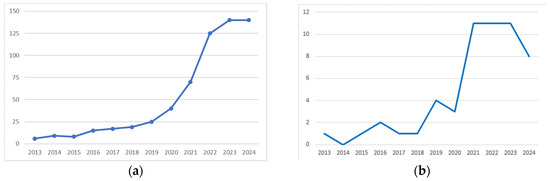
Figure 2.
Number of publications per year: (a) potentially eligible and (b) selected studies.
3.3.2. Articles Selected by Journal Quality Factor
Of the total number of articles selected, 68.52% are in the Q1 and Q2 quartiles, which indicates a great interest in TQUT and guarantees that the results obtained in this research are reliable (see Figure 3).
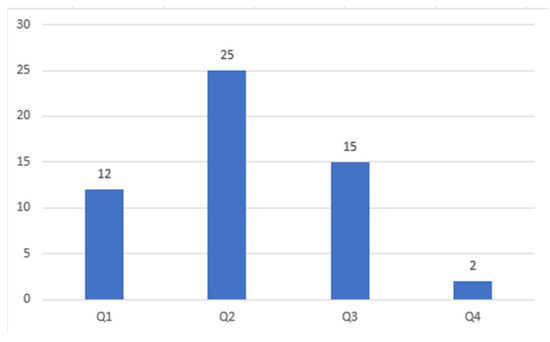
Figure 3.
Number of articles published by quartile.
3.3.3. Selected Articles by Journal
Figure 4 illustrates that the three most prominent journals (IEEE Access, Mobile Information Systems, and Scientific Programming) accounted for 27.78% of the publications; the “Other” category was classified as journals that contributed only one article.
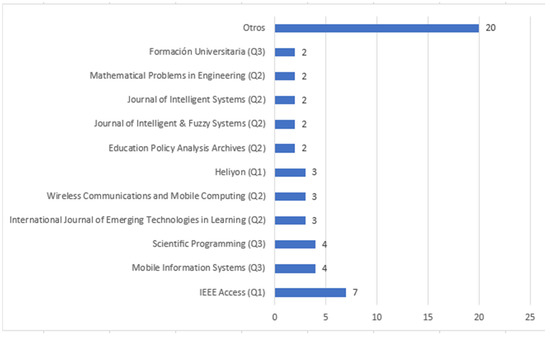
Figure 4.
Articles by journal.
4. Results
In this section, we answer the research questions raised in Section 3.1 based on the selected studies.
4.1. RQ1: What Are the Factors Considered in Teacher Teaching Quality in Higher Education?
The factors of teacher quality are those criteria and characteristics that are considered to ensure that teachers possess the necessary qualities, skills, and knowledge. Authors such as [19] indicate that the dynamic process of teaching and learning constitutes a teaching activity, and many factors can affect the quality of teacher education to different degrees and angles. In this context, 43 studies were found describing 112 factors used for TQUT, which have been grouped into 5 dimensions described in Table 4.
Table 4.
Category of Factors used for TQUT.
Teacher attitude: 28 factors were identified, of which the most studied are effective communication, teacher-student interaction, teacher preparation before class, subject matter expertise, and teacher enthusiasm, respectively (see Table 5).
Table 5.
Teacher attitude factors for TQUT.
Teaching Method: 18 factors were identified, of which the five most studied are teaching resources, classroom environment, flexible teaching method, modern teaching method, and capacity for innovation (see Table 6).
Table 6.
Teaching method factors for TQUT.
Teaching content: Twenty factors were identified, of which the five most studied are teaching content, combining theory with practice, curricular planning, well-organized content, and the level of difficulty of the subject (see Table 7).
Table 7.
Teaching content factors for TQUT.
Teaching effect: Twenty factors were identified, of which the five most studied are teaching effectiveness, positive classroom climate, problem-solving skills, student enthusiasm for learning, and student academic performance (see Table 8).
Table 8.
Teaching effect factors for TQUT.
Teacher achievements: 25 factors were identified, of which the 5 most studied are feedback to students, publications and academic contributions, teaching attitude, professional skills, and teacher knowledge level (see Table 9).
Table 9.
Teacher achievement factors for TQUT.
The number of studies reporting a greater number of factors in each of the categories has been quantified [11,14,15,18,21,23,47,67,68,69,70,71,75,76]. These authors have a minimum contribution of 8 indicators and a maximum contribution of 30 indicators; this approach not only reinforces the validity of the analysis but also facilitates comparisons and allows a more objective interpretation of the results obtained.
4.2. RQ2: What Are the Advances of ML in Predicting Teacher Teaching Quality in Higher Education?
Machine learning techniques are algorithms that are used to predict and discover patterns that are not easily perceived by people, and this approach allows their application in the quality of teaching of the teachers. As indicated by the author [17], machine learning algorithms are computational techniques that can process and analyze large volumes of data to identify patterns and make predictions to evaluate teaching quality objectively. To answer this research question, 30 ML studies are presented that describe the TQUT algorithms used, as shown in Table 10; the most used algorithms are back-propagation neural networks and support vector machines (SVM).
Table 10.
Machine learning algorithms for TQUT.
4.3. RQ3: What Challenges and Limitations Have Been Identified in Applying ML for Teacher Teaching Quality in Higher Education?
The challenges and limitations in artificial intelligence (AI) are multiple and cover technical, ethical, and social aspects, as described below in Table 11.
Table 11.
Challenges and limitations for TQUT.
5. Discussion
The result of this systematic review of the literature on the usefulness of ML in teaching quality processes in higher education shows a growing emphasis on research. This is because ML is a fairly new and emerging field that has only just begun to emerge, so it is likely that this topic will receive greater attention and be a starting point for improving teaching processes in higher education.
5.1. About the Factors
In this study, it was observed that the factors were classified into five dimensions (teaching attitude, teaching method, teaching content, teaching effect, and teacher achievements), where the most studied factor is that of teacher-student interaction, from the point of view where it measures the quality and effectiveness of communications and relationships between the teacher and his students within the learning environment. Two other factors studied of great importance are the one that combines theory with practice, which emphasizes the teacher’s ability to integrate theoretical knowledge with practical applications within the teaching process, and the feedback factor to students that measures the teacher’s ability to respond to each of the students’ concerns or comments and adapt their teaching style and strategies to the diverse needs, learning styles and rhythms of the students.
Some research has considered four and five dimensions of factors, such as the authors Zhong (2023) [69], Ai and Feng (2022) [18], and Wang et al. (2017) [71], that apply to the evaluation of the quality of teachers’ teaching in the areas of physical education, English, among others, each of them with different numbers of variables. The studies of [20], with three dimensions for e-learning for a teaching quality evaluation framework, and Ruan (2023) [21] apply 8 dimensions to ten basic courses of online teaching; they mention that their models can still be improved with new indicators to improve the accuracy of the results. Therefore, it is important to mention that in the evaluation of the quality of teaching performance in universities, scientific, reasonable, valid, and reliable factors should be used. This information is useful in this and future research, which has the relevance and importance of the inventory of factors, with which a TQUT factor framework can be built in higher education.
5.2. About the Algorithms
In this study, a variety of machine learning algorithms used to predict teaching quality in different contexts, scenarios, and approaches were identified, identifying 30 algorithms. Where the three most commonly cited algorithms in the models are BP Neural Network in 6 studies, Support Vector Machine in 4 studies, and Naïve Bayes (NB) in 2 studies, as seen in Table 11. These studies have taken advantage of teaching quality data to propose and apply prediction models, using different techniques and individual and combined algorithms.
The studies of [3,11,17,19,21,23,35,49,70,73] apply a model in the design of a teaching quality evaluation system in the university classroom with different types of algorithms; the authors indicate that it would be interesting to work with a larger number of data sets and add other indicators. Online education is having a great reception worldwide in the study of [21,81]; they apply a model to evaluate the quality of online teaching, but its authors indicate that the model needs additional review for refinement.
Each research analyzed in the review uses different indicators, which makes the process of constructing a framework of factors for the data set a complex process, without leaving aside the different levels of computational power, evaluation criteria in accordance with the environment of the HEIs, and the quality of information to build a conceptual model of TQUT in higher education.
5.3. About Challenges and Limitations
In this study, 14 challenges and limitations were identified, where one of the limitations that the authors indicate is that their studies focus on a limited sample of data. Secondly, in contrast with other ML algorithms, one of the greatest challenges of HEIs is the accumulated amount of data and how it can be used to improve the quality of academic programs.
A significant challenge is the selection of evaluation indicators that are scientific, complete, measurable, targeted, and valid. To ensure that teacher performance is adequately assessed in different aspects, it can be seen that one of the limitations is the evaluation of teachers considered a relatively complex process; therefore, it is necessary to dynamically adjust the indicators and weights of the evaluation system according to the specific subject areas and teacher training requirements. In addition, a limited number of experts can affect the outcome of the evaluation so the evaluation system should be tested and improved.
6. Conclusions
For this study, a systematic review of the literature related to TQUT through ML was conducted. Of the 1347 articles identified, 54 research articles were meticulously selected through analysis, allowing the discovery of advances in the field regarding factors, prediction algorithms, and challenges and limitations. This review identified 111 factors in 54 studies, 30 prediction algorithms in 21 studies, and 14 challenges and limitations in 15 studies. Regarding the factors, we identified five dimensions: teacher attitude (28 factors), teaching method (18 factors), teaching content (20 factors), teaching effect (20 factors), and teacher achievements (25 factors). In particular, the most studied factors were teacher-student interaction, combining theory with practice, and student feedback. In the field of ML advances, neural networks with BP and support vector machines emerged as the most commonly used algorithms.
Most studies focused on teacher performance evaluation but did not measure teacher effectiveness and quality, with limited research on data sets. Regarding algorithms, one of the points to test is unsupervised learning to identify patterns that people do not easily perceive. The challenges of having a high-quality data set to minimize the possibility of algorithmic bias are discussed.
Our research shows that it is important to highlight that universities should apply the use of ML in teaching quality because it allows to analyze data, identifies patterns, and provides useful information, so it can provide a series of significant benefits to improve the quality of decision-making of HEIs, in addition to the fact that it is important to have a system of complete, measurable teaching quality evaluation indicators aimed at improving teacher performance by having a good data set. However, it will be essential to guarantee the ethics and privacy of the data when implementing ML solutions.
The research represents a significant advancement for higher education, particularly in using Machine Learning (ML) technologies to improve teaching quality. Identifying teaching quality factors can provide an innovative framework to address current challenges. This integration of ML can revolutionize higher education, allowing patterns to be identified and predictions to be made to improve data-driven teaching. The findings suggest great potential for future research in using ML in education. Future studies can focus on refining these technologies’ applications and overcoming current challenges and limitations. This area of research can generate new insights into how to apply data analytics to improve educational quality and how to overcome barriers to the effective implementation of these technologies in higher education institutions.
This study had some limitations that must be considered. Only English-language studies were included, and only WoS and Scopus databases were used as data sources. Based on our findings, future research should focus on developing practices and strategies to address TQUT factors to build a factor framework and a system of teaching quality indicators in ML, as well as expanding this study to include other languages and additional databases.
Author Contributions
Conceptualization, W.Z.-R.; methodology, W.Z.-R. and C.R.; formal analysis, W.Z.-R. and J.P.-V.; investigation, W.Z.-R.; resources, W.J.Z.-R. and J.M.M.-T.; writing—original draft preparation, W.Z.-R.; writing—review and editing, W.Z.-R. and C.R.; supervision, C.R. All authors have read and agreed to the published version of the manuscript.
Funding
This research received no external funding.
Institutional Review Board Statement
Not applicable.
Informed Consent Statement
Not applicable.
Data Availability Statement
The original contributions presented in this study are included in the article. Further inquiries can be directed to the corresponding author.
Conflicts of Interest
The authors declare no conflicts of interest.
References
- Reddy, S.; Allan, S.; Coghlan, S.; Cooper, P. A governance model for the application of AI in health care. J. Am. Med. Inform. Assoc. 2020, 27, 491–497. [Google Scholar] [CrossRef] [PubMed]
- Lee, J.; Davari, H.; Singh, J.; Pandhare, V. Industrial Artificial Intelligence for industry 4.0-based manufacturing systems. Manuf. Lett. 2018, 18, 20–23. [Google Scholar] [CrossRef]
- Liu, Y. Evaluation Algorithm of Teaching Work Quality in Colleges and Universities Based on Deep Denoising Autoencoder Network. Mob. Inf. Syst. 2021, 2021, 8161985. [Google Scholar] [CrossRef]
- Gade, K.; Geyik, S.; Kenthapadi, K.; Mithal, V.; Taly, A. Explainable AI in industry: Practical challenges and lessons learned. In Proceedings of the Companion Proceedings of the Web Conference 2020, Taipei, Taiwan, 20–24 April 2020. [Google Scholar]
- Guo, H. Research on the Construction of the Quality Evaluation Model System for the Teaching Reform of Physical Education Students in Colleges and Universities under the Background of Artificial Intelligence. Sci. Program. 2022, 2022, 6556631. [Google Scholar] [CrossRef]
- Munir, H.; Vogel, B.; Jacobsson, A. Artificial Intelligence and Machine Learning Approaches in Digital Education: A Systematic Revision. Information 2022, 13, 203. [Google Scholar] [CrossRef]
- Pokrivcakova, S. Preparing teachers for the application of AI-powered technologies in foreign language education. J. Lang. Cult. Educ. 2019, 7, 135–153. [Google Scholar] [CrossRef]
- Yanes, N.; Mostafa, A.M.; Ezz, M.; Almuayqil, S.N. A machine learning-based recommender system for improving students learning experiences. IEEE Access 2020, 8, 201218–201235. [Google Scholar] [CrossRef]
- Montes, N.; Osorio, L. Panorama de la Educación Superior en Iberoamérica a través de los Indicadores de la Red Índices. Obs. Iberoam. Ciencia Tecnol. Soc. 2023, 1–38. Available online: https://oei.int/oficinas/argentina/publicaciones/panorama-de-la-educacion-superior-en-iberoamerica-a-traves-de-los-indicadores-de-la-red-indices/ (accessed on 16 February 2025).
- UNESCO. Los Datos Estadísticos de la Educación Superior de un Vistazo. WHEC. [Online]. Available online: https://uis.unesco.org/sites/default/files/documents/f_unesco1015_brochure_web_sp.pdf?utm_source=chatgpt.com (accessed on 16 February 2025).
- Gu, Q. Research on Teaching Quality Evaluation Model of Higher Education Teachers Based on BP Neural Network and Random Matrix. Math. Probl. Eng. 2022, 2022, 5088853. [Google Scholar] [CrossRef]
- GMI. AI in Education Market Size. GMI. Available online: https://www.gminsights.com/industry-analysis/artificial-intelligence-ai-in-education-market (accessed on 16 February 2025).
- Ma, X. Artificial intelligence-driven education evaluation and scoring: Comparative exploration of machine learning algorithms. J. Intell. Syst. 2024, 33, 20230319. [Google Scholar] [CrossRef]
- Jing, G. The quality evaluation system of ideological and political classroom teaching in universities based on GA-BP algorithm. Concurr. Comput. Pract. Exp. 2024, 36, e8228. [Google Scholar] [CrossRef]
- Xie, P. Intelligent Assessment of Teaching Quality of Computer Technology Courses in Colleges and Universities Based on ISSA-DRNN. Appl. Math. Nonlinear Sci. 2024, 9, 1–14. [Google Scholar] [CrossRef]
- Xu, H.; Kim, M. Combination prediction method of students’ performance based on ant colony algorithm. PLoS ONE 2024, 19, e0300010. [Google Scholar] [CrossRef]
- Jin, Y.; Yang, Y.; Yang, B.; Zhang, Y. An Adaptive BP Neural Network Model for Teaching Quality Evaluation in Colleges and Universities. Wirel. Commun. Mob. Comput. 2021, 2021, 4936873. [Google Scholar] [CrossRef]
- Ai, L.; Feng, T. Application of BP Neural Network in Teaching Quality Evaluation of Higher Vocational Education. Mob. Inf. Syst. 2022, 2022, 8644276. [Google Scholar] [CrossRef]
- Wenwen, L. Modeling and simulation of teaching quality in colleges based on BP neural network and training function. J. Intell. Fuzzy Syst. 2019, 37, 6349–6361. [Google Scholar] [CrossRef]
- Almufarreh, A.; Noaman, K.M.; Saeed, N. Academic Teaching Quality Framework and Performance Evaluation Using Machine Learning. Appl. Sci. 2023, 13, 3121. [Google Scholar] [CrossRef]
- Ruan, G. Design of English online teaching quality evaluation model based on web embedded system and machine learning. Soft Comput. 2023, 6, 1–12. [Google Scholar] [CrossRef]
- Qi, S.; Liu, L.; Kumar, B.S.; Prathik, A. An English teaching quality evaluation model based on Gaussian process machine learning. Expert. Syst. 2022, 39, e12861. [Google Scholar] [CrossRef]
- Zhong, Y. Evaluation and analysis of teaching quality of university teachers using machine learning algorithms. J. Intell. Syst. 2023, 32, 20220204. [Google Scholar] [CrossRef]
- Sabharwal, R.; Miah, S.J. Evaluating teachers’ effectiveness in classrooms: An ML-based assessment portfolio. Soc. Netw. Anal. Min. 2024, 14, 28. [Google Scholar] [CrossRef]
- Li, M.; Su, Y. Evaluation of online teaching quality of basic education based on artificial intelligence. Int. J. Emerg. Technol. Learn. 2020, 15, 147–161. [Google Scholar] [CrossRef]
- Li, H.-D.; Zhang, L.; Lin, C.-L. An Intelligent Model for Assessing Abilities of University Teachers Based on AHP and Delphi Method. J. Netw. Intell. 2021, 6, 461–472. [Google Scholar]
- Yao, D.; Deng, X. Teaching Teacher Recommendation Method Based on Fuzzy Clustering and Latent Factor Model. IEEE Access 2020, 8, 210868–210885. [Google Scholar] [CrossRef]
- Yao, D.; Deng, X. A course teacher recommendation algorithm based on improved latent factor model and personalrank. IEEE Access 2021, 9, 108614–108627. [Google Scholar] [CrossRef]
- Salas-Pilco, S.Z.; Yang, Y. Artificial intelligence applications in Latin American higher education: A systematic review. Int. J. Educ. Technol. High. Educ. 2022, 19, 21. [Google Scholar] [CrossRef]
- Escorza, T.E. Teacher evaluation as a direct path towards the improve|ement of educational quality. Rev. Investig. Educ. 2019, 37, 15–37. [Google Scholar] [CrossRef]
- Guzmán, C.J. Contributions of Best Practices in Teaching to Improving Higher Education Instruction. Educ. Policy Anal. Arch. 2021, 29, n111. [Google Scholar]
- Liu, C. Data-Driven Optimal Scheduling Algorithm of Human Resources in Colleges and Universities. Sci. Program. 2022, 2022, 1–10. [Google Scholar] [CrossRef]
- Wei, D.; Guo, L.; Dong, W. Analysis on the Classification and Evaluation System of Talents in Colleges and Universities from the Perspective of AHP. Mob. Inf. Syst. 2022, 2022, 6515974. [Google Scholar] [CrossRef]
- Cui, Y. Optimizing decision trees for English Teaching Quality Evaluation (ETQE) using Artificial Bee Colony (ABC) optimization. Heliyon 2023, 9, e19274. [Google Scholar] [CrossRef]
- Abunasser, B.S.; Al-Hiealy, M.R.J.; Barhoom, A.M.; Almasri, A.R.; Abu-Naser, S.S. Prediction of Instructor Performance using Machine and Deep Learning Techniques. Int. J. Adv. Comput. Sci. Appl. 2022, 13, 78–83. [Google Scholar] [CrossRef]
- Zhang, J.; Shi, J.; Liu, X.; Zhou, Y. An Intelligent Assessment System of Teaching Competency for Pre-service Teachers Based on AHP-BP Method. Int. J. Emerg. Technol. Learn. 2021, 16, 52–64. [Google Scholar] [CrossRef]
- Ali, R.H. Artificial intelligence techniques to predict the performance of teachers for kindergarten: Iraq as a case study. Evol. Intell. 2022, 17, 313–325. [Google Scholar] [CrossRef]
- Salazar, A.F.; López, J.F.; Tavizón, A.; Araiza-Vázquez, M.J. Study of a genetic algorithm for academic management. Form. Univ. 2019, 12, 63–72. [Google Scholar] [CrossRef]
- Darling-Hammond, L. Defining teaching quality around the world. Eur. J. Teach. Educ. 2021, 44, 295–308. [Google Scholar] [CrossRef]
- Chen, L.; Mokhtar, M.M. Education on quality assurance and assessment in teaching quality of high school instructors. J. Big Data 2023, 10, 142. [Google Scholar] [CrossRef]
- Adams, T.; Aguilar, E.; Berg, E.; Cismowski, L.; Cody, A.; Cohen, D.B.; Dean, S.; Formigli, L.; Fung, J.; Lee, C.; et al. A Coherent System of Teacher Evaluation for Quality Teaching. Educ. Policy Anal. Arch. 2015, 23, n17. [Google Scholar]
- Ramírez-Montoya, M.S.; Loaiza-Aguirre, M.I.; Zúñiga-Ojeda, A.; Portuguez-Castro, M. Characterization of the teaching profile within the framework of education 4.0. Futur. Internet 2021, 13, 91. [Google Scholar] [CrossRef]
- Jin, Y.; Yang, Y.; Yang, B.; Zhang, Y. Evaluation Model of Educational Curriculum in Higher Schools Based on Deep Neural Networks. Mob. Inf. Syst. 2021, 2021, 6275096. [Google Scholar] [CrossRef]
- Zhang, H.; Wang, J. A Smart Knowledge Discover System for Teaching Quality Evaluation via Genetic Algorithm-Based BP Neural Network. IEEE Access 2023, 11, 53615–53623. [Google Scholar] [CrossRef]
- Jiang, Y.; Zhang, J.; Chen, C. Research on a new teaching quality evaluation method based on improved fuzzy neural network for college english. Int. J. Contin. Eng. Educ. Life-Long. Learn. 2018, 28, 293–309. [Google Scholar] [CrossRef]
- Weng, S.-S.; Liu, Y.; Chuang, Y.-C. Reform of Chinese Universities in the Context of Sustainable Development: Teacher Evaluation and Improvement Based on Hybrid Multiple Criteria Decision-Making Model. Sustainability 2019, 11, 5471. [Google Scholar] [CrossRef]
- Rocha, R. Escala de opinión de los estudiantes sobre la efectividad de la docencia (EOEED) en educación superior. Form. Univ. 2013, 6, 13–22. [Google Scholar] [CrossRef]
- Meng, L.; Zhu, J.; Wang, L. Classroom Teaching Performance Evaluation Model Guided by Big Data and Mobile Computing. Wirel. Commun. Mob. Comput. 2022, 2022, 2084423. [Google Scholar] [CrossRef]
- Zhang, H.; Xiao, B.; Li, J.; Hou, M. An improved genetic algorithm and neural network-based evaluation model of classroom teaching quality in colleges and universities. Wirel. Commun. Mob. Comput. 2021, 2021, 2602385. [Google Scholar] [CrossRef]
- Popenici, S.A.D.; Kerr, S. Exploring the impact of artificial intelligence on teaching and learning in higher education. Res. Pract. Technol. Enhanc. Learn. 2017, 12, 22. [Google Scholar] [CrossRef]
- Yu, J. Academic Performance Prediction Method of Online Education using Random Forest Algorithm and Artificial Intelligence Methods. Int. J. Emerg. Technol. Learn. 2021, 16, 45–57. [Google Scholar] [CrossRef]
- Brooks, C.; Thompson, C. Predictive Modelling in Teaching and Learning. In Handbook of Learning Analytics; SoLAR: Vancouver, BC, Canada, 2022; pp. 29–37. [Google Scholar] [CrossRef]
- Lee, M.C.M.; Scheepers, H.; Lui, A.K.H.; Ngai, E.W.T. The implementation of artificial intelligence in organizations: A systematic literature review. Inf. Manag. 2023, 60, 103816. [Google Scholar] [CrossRef]
- Alloghani, M.; Al-Jumeily, D.; Mustafina, J.; Hussain, A.; Aljaaf, A.J. A Systematic Review on Supervised and Unsupervised Machine Learning Algorithms for Data Science. In Supervised and Unsupervised Learning for Data Science; Springer: Cham, Switzerland, 2020; pp. 3–21. [Google Scholar] [CrossRef]
- Agaoglu, M. Predicting Instructor Performance Using Data Mining Techniques in Higher Education. IEEE Access 2016, 4, 2379–2387. [Google Scholar] [CrossRef]
- Ahmadi, F.; Ahmad Abadi, M.S. Data Mining in Teacher Evaluation System using WEKA. Int. J. Comput. Appl. 2013, 63, 12–18. [Google Scholar] [CrossRef]
- Ciolacu, M.; Tehrani, A.F.; Binder, L.; Svasta, P.M. Education 4.0—Artificial Intelligence Assisted Higher Education: Early recognition System with Machine Learning to support Students’ Success. In Proceedings of the 2018 IEEE 24th International Symposium for Design and Technology in Electronic Packaging (SIITME), Iași, Romania, 25–28 October 2018; Volume 24, pp. 23–30. [Google Scholar] [CrossRef]
- Issah, I.; Appiah, O.; Appiahene, P.; Inusah, F. A systematic review of the literature on machine learning application of determining the attributes influencing academic performance. Decis. Anal. J. 2023, 7, 100204. [Google Scholar] [CrossRef]
- Fahd, K.; Venkatraman, S.; Miah, S.J.; Ahmed, K. Application of machine learning in higher education to assess student academic performance, at-risk, and attrition: A meta-analysis of literature. Educ. Inf. Technol. 2022, 27, 3743–3775. [Google Scholar] [CrossRef]
- Albreiki, B.; Zaki, N.; Alashwal, H. A Systematic Literature Review of Student’ Performance Prediction Using Machine Learning Techniques. Educ. Sci. 2021, 11, 552. [Google Scholar] [CrossRef]
- Hilbert, S.; Coors, S.; Kraus, E.; Bischl, B.; Lindl, A.; Frei, M.; Wild, J.; Krauss, S.; Goretzko, D.; Stachl, C. Machine learning for the educational sciences. Rev. Educ. 2021, 9, e3310. [Google Scholar] [CrossRef]
- Verma, A.; Kumar, Y.; Kohli, R. Study of AI Techniques in Quality Educations: Challenges and Recent Progress. SN Comput. Sci. 2022, 2, 238. [Google Scholar] [CrossRef]
- Xin, X.; Shu-jiang, Y.; Nan, P.; Chenxu, D.; Dan, L. Review on A big data-based innovative knowledge teaching evaluation system in universities. J. Innov. Knowl. 2022, 7, 100197. [Google Scholar] [CrossRef]
- Page, M.J.; McKenzie, J.E.; Bossuyt, P.M.; Boutron, I.; Hoffmann, T.C.; Mulrow, C.D.; Shamseer, L.; Tetzlaff, J.M.; Akl, E.A.; Brennan, S.E.; et al. The PRISMA 2020 statement: An updated guideline for reporting systematic reviews. BMJ 2021, 372, 71. [Google Scholar] [CrossRef] [PubMed]
- Kitchenham, B.; Pearl Brereton, O.; Budgen, D.; Turner, M.; Bailey, J.; Linkman, S. Systematic literature reviews in software engineering—A systematic literature review. Inf. Softw. Technol. 2009, 51, 7–15. [Google Scholar] [CrossRef]
- Arcos-Medina, G.; Mauricio, D. Aspects of Software Quality Applied to the Process of Agile Software Development: A Systematic Literature Review. Int. J. Syst. Assur. Eng. Manag. 2019, 10, 867–897. [Google Scholar] [CrossRef]
- Luo, Y.; Zhao, X.; Qiu, Y. Evaluation model of art internal auxiliary teaching quality based on artificial intelligence under the influence of COVID-19. J. Intell. Fuzzy Syst. 2020, 39, 8713–8721. [Google Scholar] [CrossRef]
- Chang, T.C.; Wang, H. A multi criteria group decision-making model for teacher evaluation in higher education based on cloud model and decision tree. Eurasia J. Math. Sci. Technol. Educ. 2016, 12, 1243–1262. [Google Scholar] [CrossRef]
- Zhang, J.; Zhang, C. Teaching quality monitoring and evaluation of physical education teaching in ordinary college based on edge computing optimization model. J. Supercomput. 2023, 79, 16559–16579. [Google Scholar] [CrossRef]
- Zhang, D.; Chen, L. A BP Neural Network-Assisted Smart Decision Method for Education Quality. IEEE Access 2023, 11, 74569–74578. [Google Scholar] [CrossRef]
- Wang, B.; Wang, J.; Hu, G. College english classroom teaching evaluation based on particle swarm optimization—Extreme learning machine model. Int. J. Emerg. Technol. Learn. 2017, 12, 82–97. [Google Scholar] [CrossRef]
- Wang, P. Construction of a Prediction Model for Distance Education Quality Assessment Based on Convolutional Neural Network. Comput. Intell. Neurosci. 2022, 2022, 8937314. [Google Scholar] [CrossRef] [PubMed]
- Guan, L. Evaluating teaching quality in colleges using combination of artificial neural networks (ANNs) and black hole optimization (BHO). Heliyon 2023, 9, e20687. [Google Scholar] [CrossRef] [PubMed]
- Guo, S.; Yang, X.; Hamzani, N.; Samsudin, S. The analysis of teaching quality evaluation for the college sports dance by convolutional neural network model and deep learning. Heliyon 2024, 10, e36067. [Google Scholar] [CrossRef]
- Jun-On, N.; Peeyada, P.; Suparatulatorn, R.; Cholamjiak, W. Pre-service mathematics teachers’ performance prediction using a modified Mann-Tseng forward-backward splitting algorithm. J. Math. Comput. Sci. 2024, 34, 313–325. [Google Scholar] [CrossRef]
- Zhang, G. The Evaluation and Development of University English Teaching Quality Based on Wireless Network Artificial Intelligence. J. Comb. Math. Comb. Comput. 2023, 117, 77–86. [Google Scholar] [CrossRef]
- Yang, Y. Quality evaluation method of a mathematics teaching model reform based on an improved genetic algorithm. Sci. Program. 2021, 2021, 6395349. [Google Scholar] [CrossRef]
- Jiaxin, L. An Evaluation Method of English Teaching Based on Machine Learning. Math. Probl. Eng. 2022, 2022, 6059206. [Google Scholar] [CrossRef]
- Huang, C. Teaching Evaluation Research of Professional Courses Based on Multinomial Random Forest With Improved Grassberger Entropy. IEEE Access 2024, 12, 91154–91163. [Google Scholar] [CrossRef]
- Wang, Z. Physical Education Teaching Quality Assessment Model Based on Gaussian Process Machine Learning Algorithm. Int. J. Marit. Eng. 2024, 1, 727–736. [Google Scholar] [CrossRef]
- Guo, S.; Chai, Q.; Wang, M. Evaluation Model of Online and Offline Mixed Teaching Quality in Colleges and Universities Based on BP Neural Network. Sci. Program. 2022, 2022, 7560227. [Google Scholar] [CrossRef]
- Xie, F. Monitoring and Quality Evaluation Method of English Teaching in Machine Manufacturing Based on Machine Learning and Internet of Things. EAI Endorsed Trans. Scalable Inf. Syst. 2023, 10, 1–10. [Google Scholar] [CrossRef]
Disclaimer/Publisher’s Note: The statements, opinions and data contained in all publications are solely those of the individual author(s) and contributor(s) and not of MDPI and/or the editor(s). MDPI and/or the editor(s) disclaim responsibility for any injury to people or property resulting from any ideas, methods, instructions or products referred to in the content. |
© 2025 by the authors. Licensee MDPI, Basel, Switzerland. This article is an open access article distributed under the terms and conditions of the Creative Commons Attribution (CC BY) license (https://creativecommons.org/licenses/by/4.0/).