Analysis of Dynamic Responses of Floating Offshore Wind Turbines in Typical Upstream Wake Conditions Based on an Innovative Coupled Dynamic Analysis Method

Abstract
1. Introduction
2. Methodology
2.1. Model Description
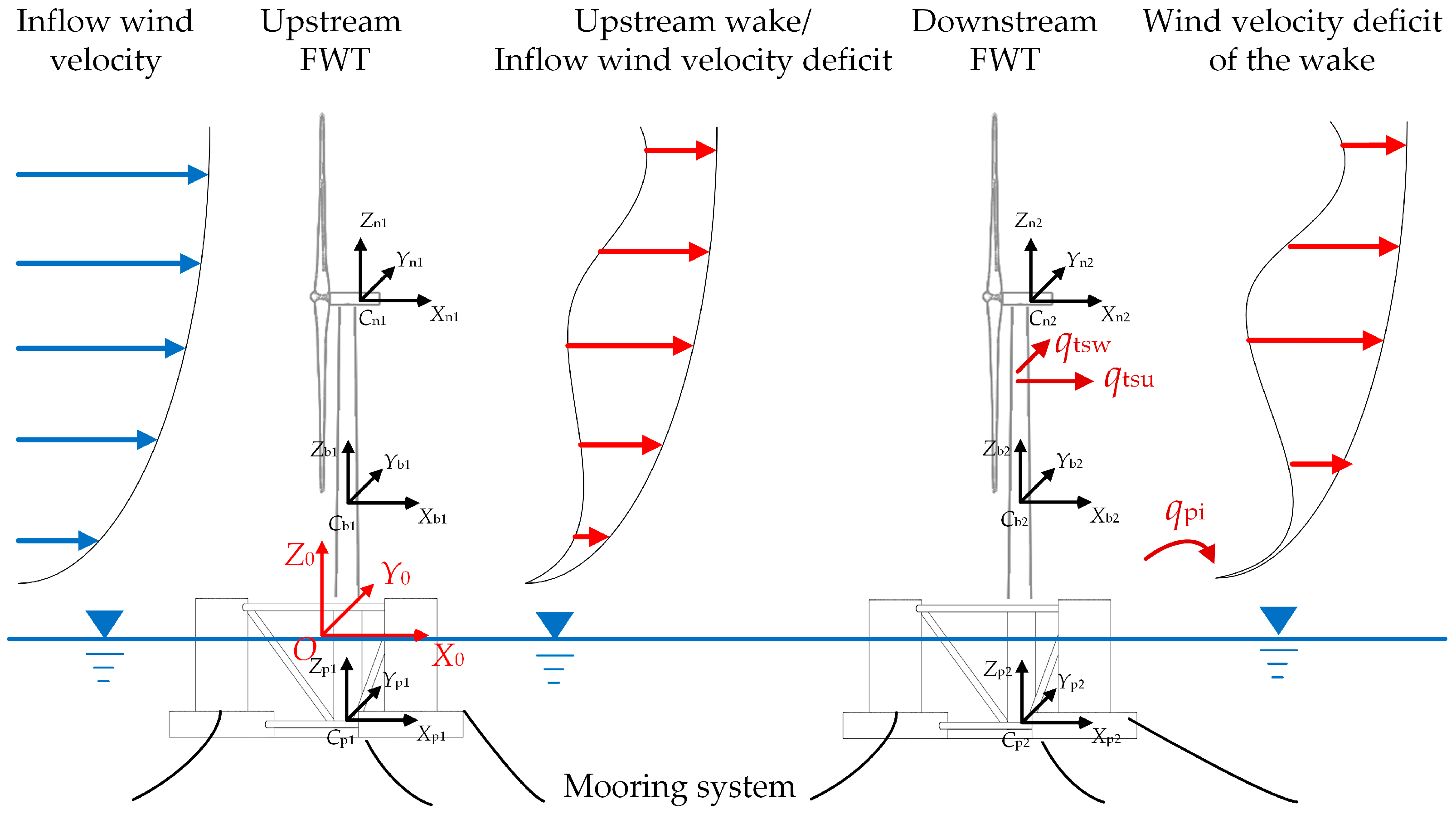
2.2. Coupled Dynamics Modelling
2.3. External Loads Calculation
2.3.1. Aerodynamics Modeling
- (1)
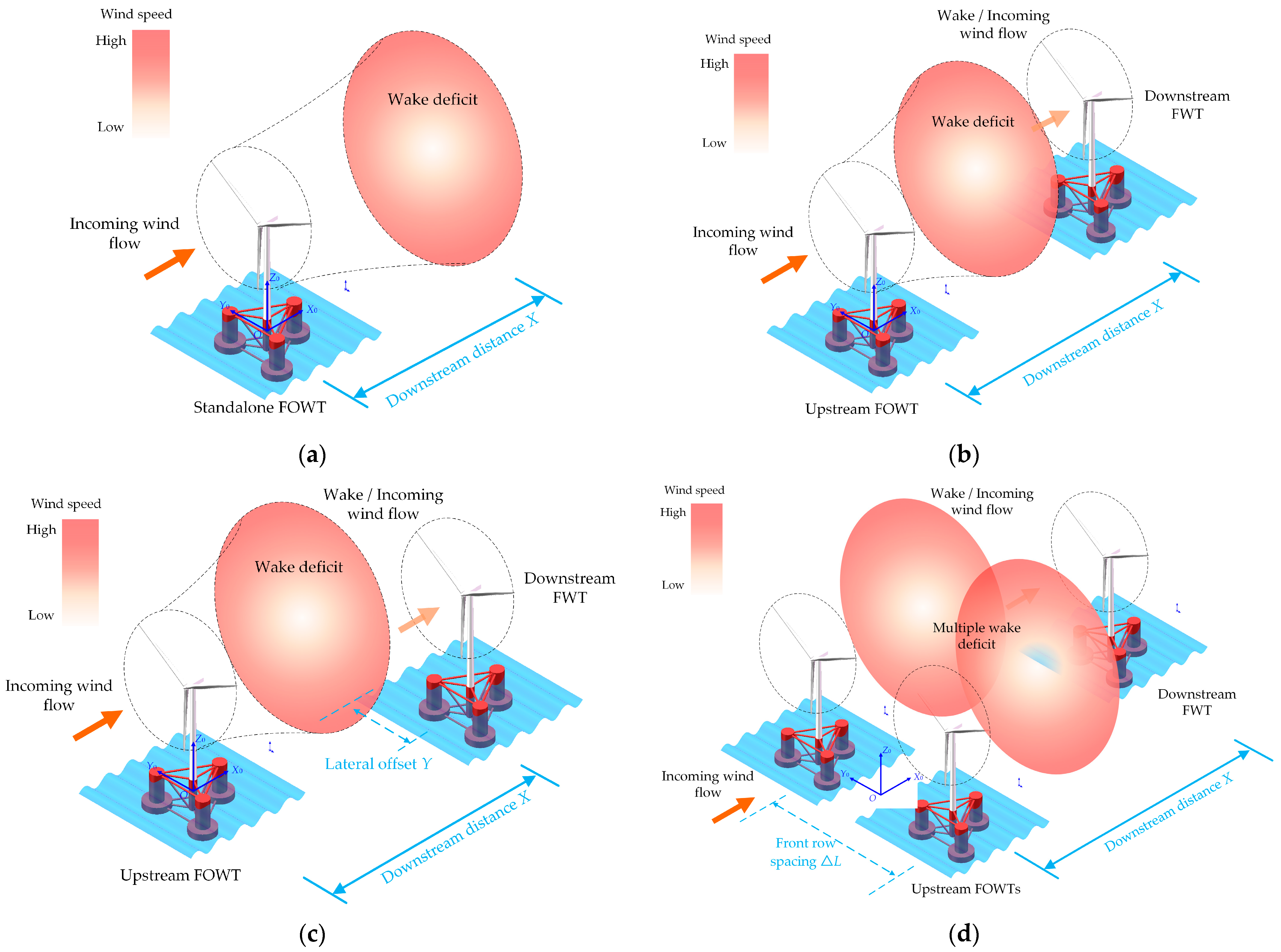
- Upstream wake
- (2)
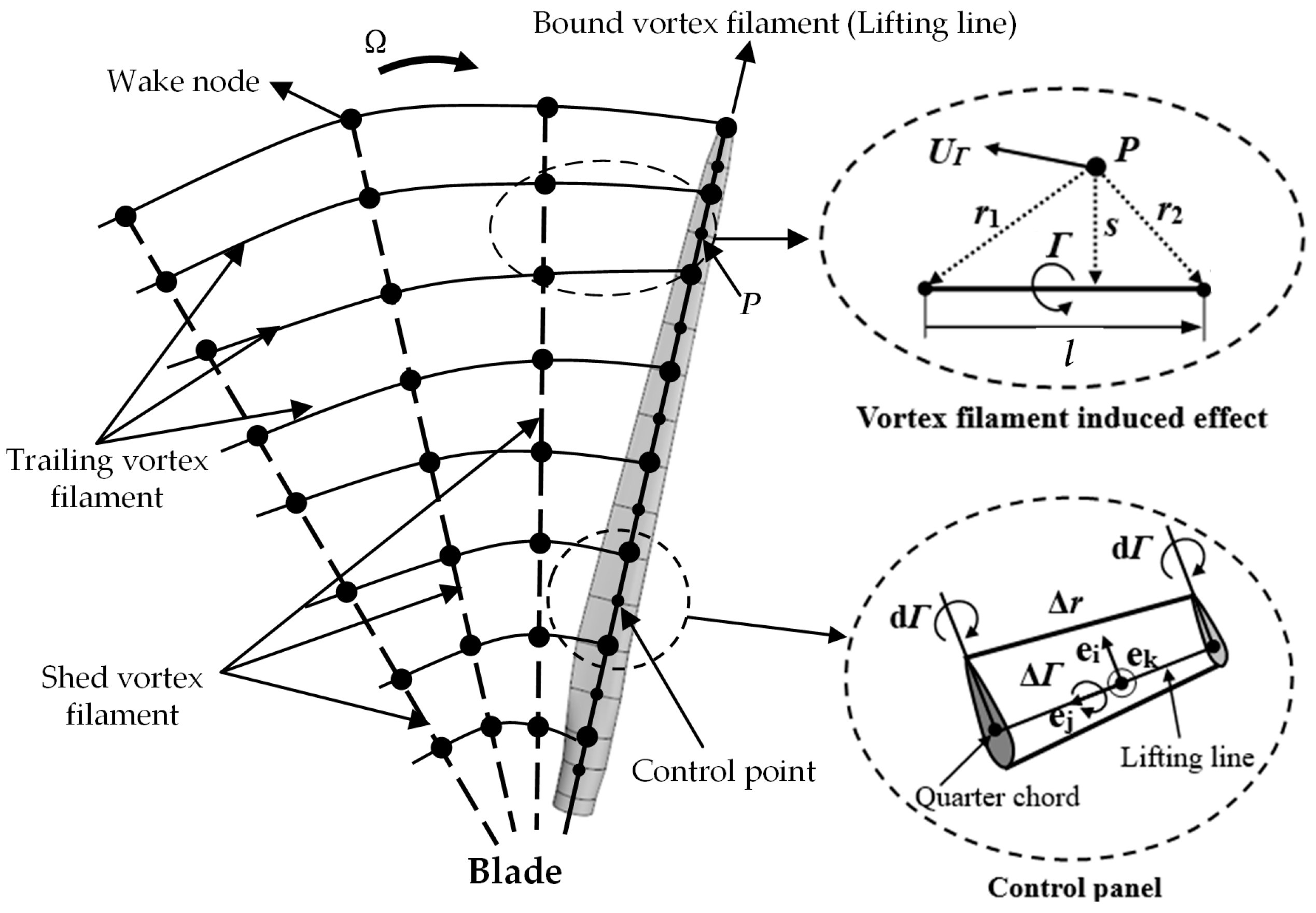
- Numerical model
- (3)
- Wind load
2.3.2. Hydrodynamics Modeling
- (1)
- Hydrostatic restoring force
- (2)
- Wave load
- (3)
- Mooring force
2.4. Calculation Strategies and Validations
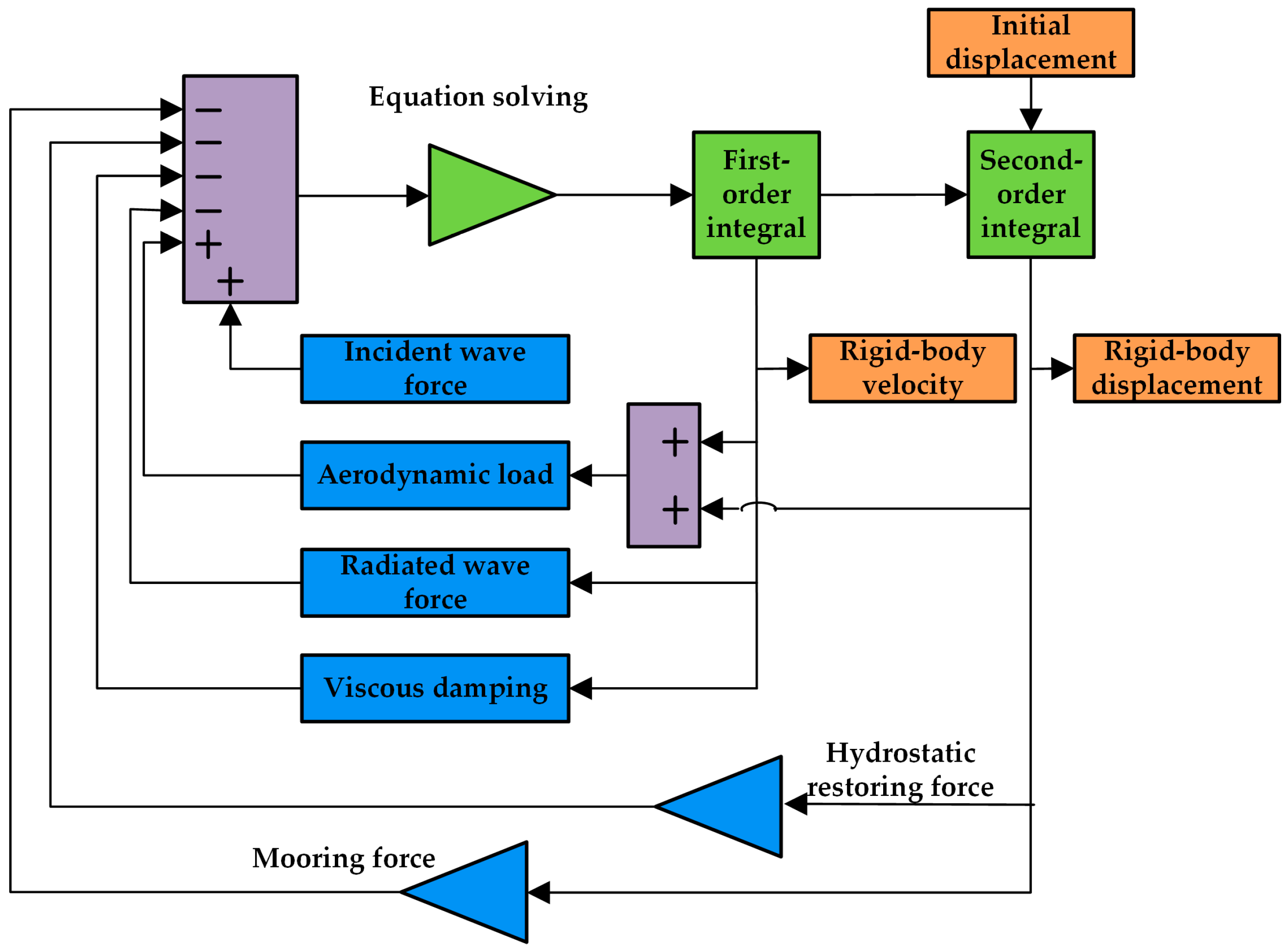
2.4.1. Calculation Strategies
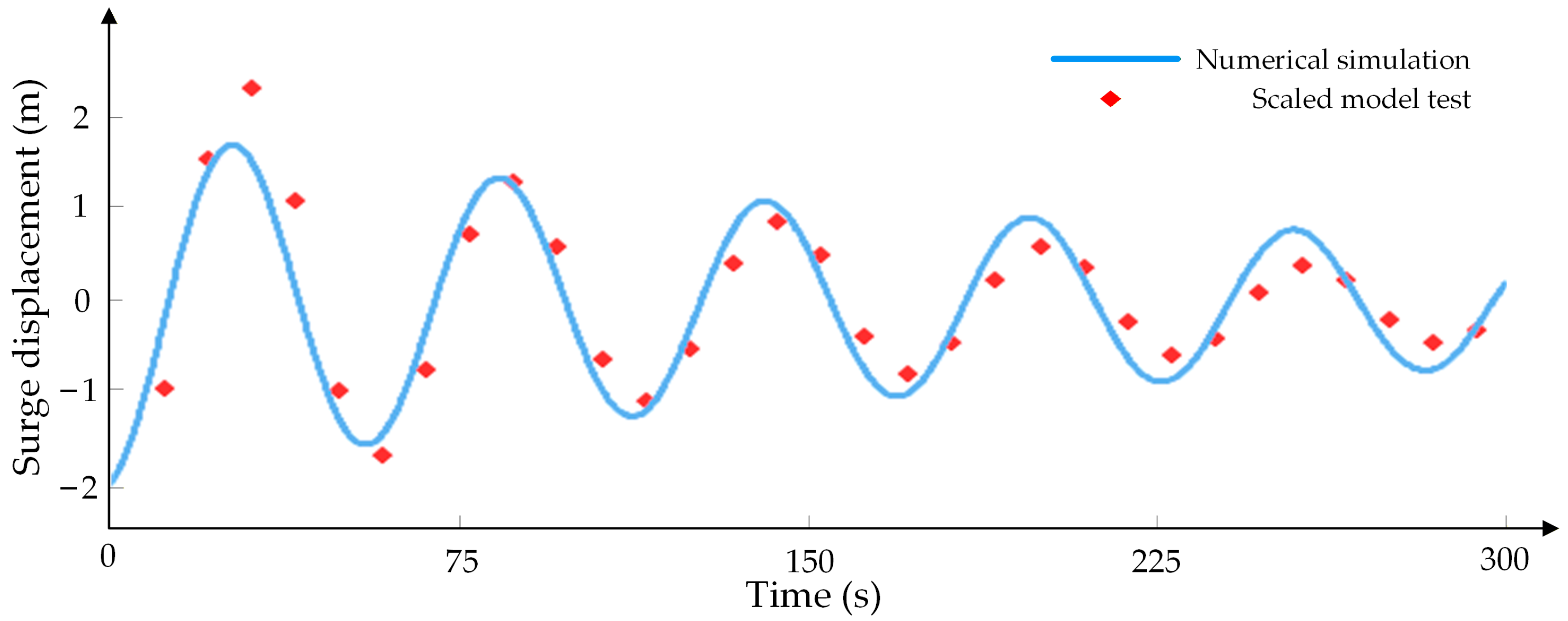
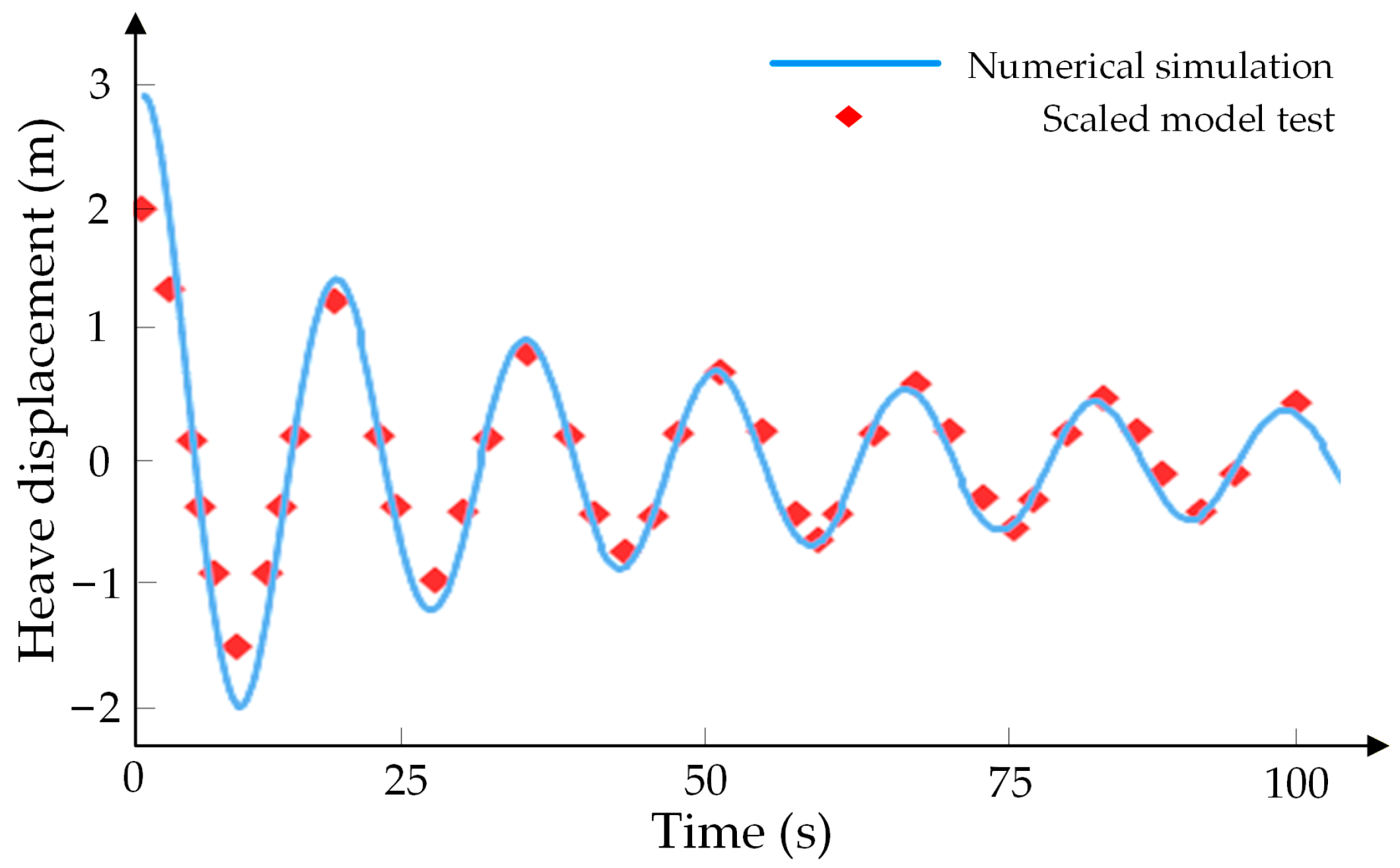
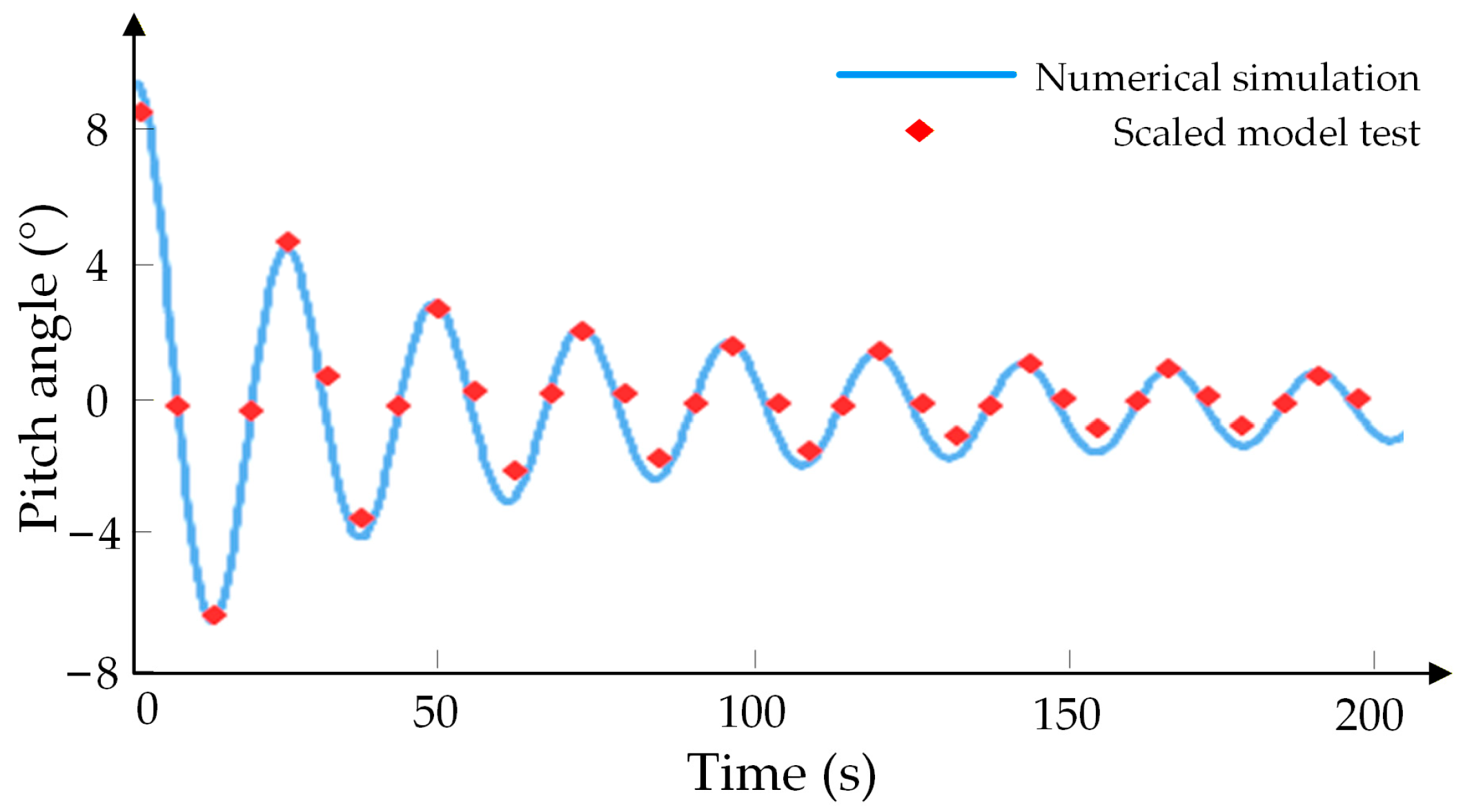
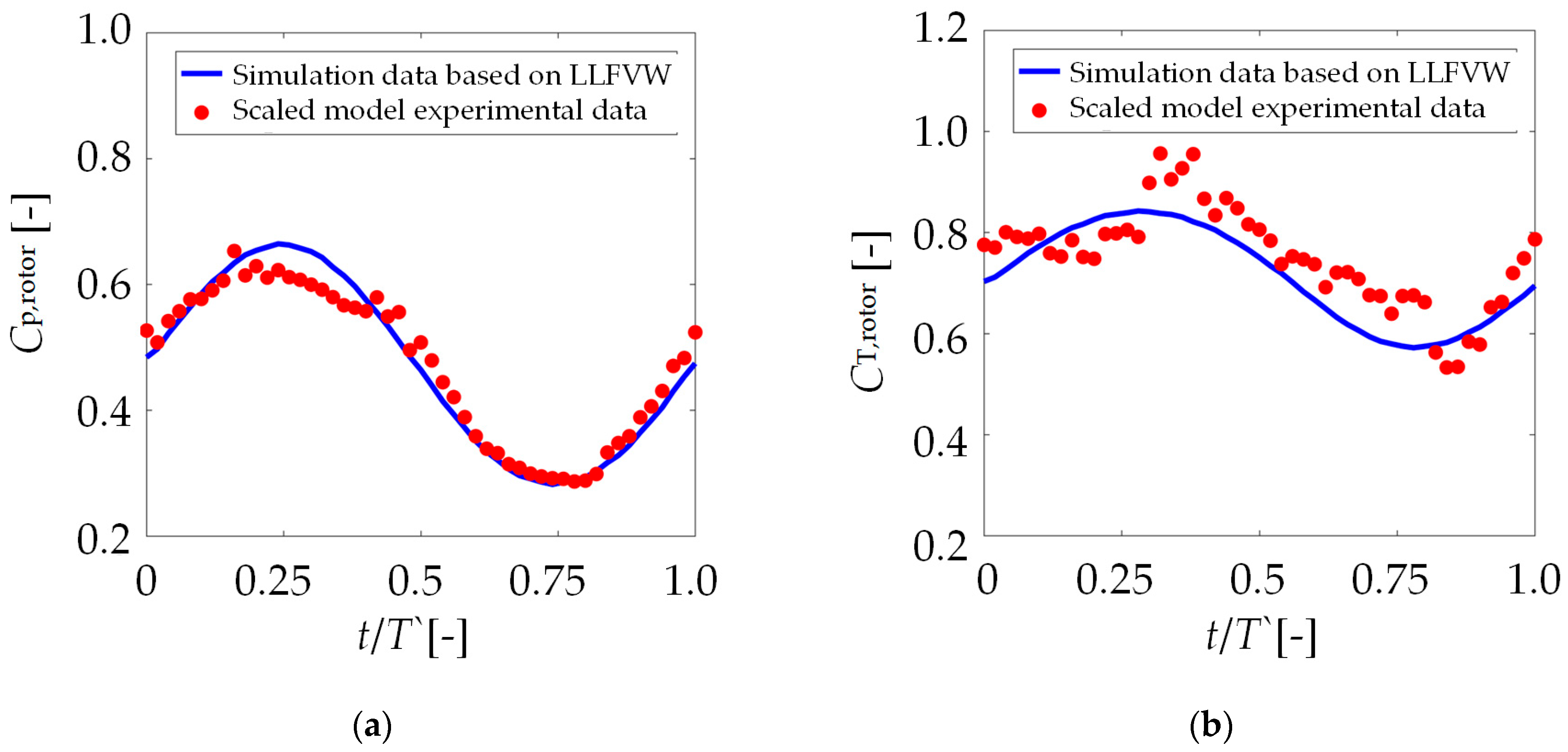
2.4.2. Validations
2.5. Simulation Setup
3. Results and Discussion
3.1. Dynamic Responses in Wake Condition I
3.2. Dynamic Responses in Wake Condition II
3.3. Dynamic Responses in Wake Condition III
3.4. Discussion
4. Conclusions
Author Contributions
Funding
Data Availability Statement
Acknowledgments
Conflicts of Interest
Abbreviations
| IEA | International Energy Agency |
| FOWTs | Floating Offshore Wind Turbines |
| SDG | Sustainable Development Goals |
| DOF | Degree of Freedom |
| BEM | Blade Element Momentum |
| TLP | Tension Leg Platform |
| CFD | Computational Fluid Dynamics |
| OC4 | Offshore Code Comparison Collaboration Continuation |
| DeepCwind | A deepwater coupling analysis tool developed by Det Norske Veritas (DNV) |
| UALM | Unsteady Actuator Line Models |
| naoe-FOAM-SJTU | An overlapping grid solver developed by Shanghai Jiao Tong University |
| LES | Large Eddy Simulation |
| LLFVW | Lifting Line Free Vortex Wake |
References
- Evro, S.; Oni, B.A.; Tomomewo, O.S. Global Strategies for a Low-Carbon Future: Lessons from the US, China, and EU’s Pursuit of Carbon Neutrality. J. Clean. Prod. 2024, 461, 142635. [Google Scholar] [CrossRef]
- Ahmad, H.; Yaqub, M.; Lee, S.H. Global Trends in Carbon Neutrality: A Scientometric Review on Energy Transition Challenges, Practices, Policies, and Opportunities. Environ. Dev. Sustain. 2025, 1–26. [Google Scholar] [CrossRef]
- Lundquist, J.K.; DuVivier, K.K.; Kaffine, D.; Tomaszewski, J.M. Costs and Consequences of Wind Turbine Wake Effects Arising from Uncoordinated Wind Energy Development. Nat. Energy 2018, 4, 26–34. [Google Scholar] [CrossRef]
- Jung, C.; Sander, L.; Schindler, D. Future Global Offshore Wind Energy under Climate Change and Advanced Wind Turbine Technology. Energy Convers. Manag. 2024, 321, 119075. [Google Scholar] [CrossRef]
- Global Wind Energy Council (GWEC). Global Wind Report 2022; Global Wind Energy Council: Brussels, Belgium, 2022. [Google Scholar]
- Otter, A.; Murphy, J.; Pakrashi, V.; Robertson, A.; Desmond, C. A Review of Modelling Techniques for Floating Offshore Wind Turbines. Wind Energy 2022, 25, 831–857. [Google Scholar] [CrossRef]
- Yang, L.; Li, B.; Dong, Y.; Hu, Z.; Zhang, K.; Li, S. Large-Amplitude Rotation of Floating Offshore Wind Turbines: A Comprehensive Review of Causes, Consequences, and Solutions. Renew. Sustain. Energy Rev. 2025, 211, 115295. [Google Scholar] [CrossRef]
- Moharram, N.A.; Konsowa, A.H.; Shehata, A.I.; El-Maghlany, W.M. Sustainable Seascapes: An in-Depth Analysis of Multigeneration Plants Utilizing Supercritical Zero Liquid Discharge Desalination and a Combined Cycle Power Plant. Alex. Eng. J. 2025, 118, 523–542. [Google Scholar] [CrossRef]
- Li, L.; Liu, Y.; Yuan, Z.; Gao, Y. Dynamic and Structural Performances of Offshore Floating Wind Turbines in Turbulent Wind Flow. Ocean Eng. 2019, 179, 92–103. [Google Scholar] [CrossRef]
- Chen, S.; Wang, K.; Wen, Y.; Le, C.; Gao, Z. Fully Coupled Dynamic Analysis of Novel Floating Dual-Rotor Wind Turbines. Phys. Fluids 2025, 37, 017114. [Google Scholar] [CrossRef]
- Zhou, T.; Lan, H.; Xu, C.; Han, X.; Wu, X. Wake and Performance of Floating Offshore Wind Turbines under Six Degrees of Freedom Conditions. Phys. Fluids 2025, 37, 015167. [Google Scholar] [CrossRef]
- Cai, Y.; Li, X.; Leng, S.; Zhao, H.; Zhou, Y. Effect of Combined Surge and Pitch Motion on the Aerodynamic Performance of Floating Offshore Wind Turbine. Ocean Eng. 2024, 306, 118061. [Google Scholar] [CrossRef]
- Leng, S.; Cai, Y.; Zhao, H.; Li, X.; Zhao, J. Study on the near Wake Aerodynamic Characteristics of Floating Offshore Wind Turbine under Combined Surge and Pitch Motion. Energies 2024, 17, 744. [Google Scholar] [CrossRef]
- Deng, Y.; Zhu, C.; Zhang, S.Y.; Yang, Y.; Zhang, B. A Novel Coupling Framework for Integrating Turbine and Substructure Dynamics of Floating Offshore Wind Turbines. Ocean Eng. 2025, 340, 122307. [Google Scholar] [CrossRef]
- Huang, H.; Liu, Q.; Iglesias, G.; Li, C. Advanced Multi-Physics Modeling of Floating Offshore Wind Turbines for Aerodynamic Design and Load Management. Energy Convers. Manag. 2025, 346, 120437. [Google Scholar] [CrossRef]
- Zhao, F.; Wang, T.; Gao, X.; Sun, H.; Yang, H.; Han, Z.; Wang, Y.; Zhu, X. Experimental Study on Wake Interactions and Performance of the Turbines with Different Rotor-Diameters in Adjacent Area of Large-Scale Wind Farm. Energy 2020, 199, 117416. [Google Scholar] [CrossRef]
- Pryor, S.C.; Barthelmie, R.J. Wind Shadows Impact Planning of Large Offshore Wind Farms. Appl. Energy 2024, 359, 122755. [Google Scholar] [CrossRef]
- He, G.; Sun, H.; He, R. A Novel Analytical Wake Model for Floating Offshore Wind Turbines with Pitch Motion Effects. Renew. Energy 2026, 256, 124090. [Google Scholar] [CrossRef]
- Wu, H.; Zhao, Y.; He, Y.; Shao, Y.; Mao, W.; Han, Z.; Huang, C.; Gu, X.; Jiang, Z. Transient Response of a TLP-Type Floating Offshore Wind Turbine under Tendon Failure Conditions. Ocean Eng. 2021, 220, 108486. [Google Scholar] [CrossRef]
- Zhang, C.; Wang, S.; Cui, M.; Liu, H.; Liu, A.; Xu, J.; Xie, S. Modeling and Dynamic Response Analysis of a Submersible Floating Offshore Wind Turbine Integrated with an Aquaculture Cage. Ocean Eng. 2022, 263, 112338. [Google Scholar] [CrossRef]
- Jonkman, J.M.; Matha, D. Dynamics of Offshore Floating Wind Turbines—Analysis of Three Concepts. Wind Energy 2011, 14, 557–569. [Google Scholar] [CrossRef]
- Luo, Y.; Qian, F.; Sun, H.; Wang, X.; Chen, A.; Zuo, L. Rigid-Flexible Coupling Multi-Body Dynamics Modeling of a Semi-Submersible Floating Offshore Wind Turbine. Ocean Eng. 2023, 281, 114648. [Google Scholar] [CrossRef]
- Cheng, P.; Wan, D. Fully Coupled Aero-Hydrodynamic Simulation of Floating Offshore Wind Turbines with Overset Grid Technology. In Lecture Notes in Civil Engineering, Proceedings of the Fourth International Conference in Ocean Engineering (ICOE2018), Chennai, India, 18–21 February 2018; Springer: Berlin/Heidelberg, Germany, 2019; Volume 22, pp. 647–661. [Google Scholar]
- Wang, J.; Zhao, W.; Wan, D. Development of Naoe-FOAM-SJTU Solver Based on OpenFOAM for Marine Hydrodynamics. J. Hydrodyn. 2019, 31, 1–20. [Google Scholar] [CrossRef]
- Archer, C.L.; Vasel-Be-Hagh, A.; Yan, C.; Wu, S.; Pan, Y.; Brodie, J.F.; Maguire, A.E. Review and Evaluation of Wake Loss Models for Wind Energy Applications. Appl. Energy 2018, 226, 1187–1207. [Google Scholar] [CrossRef]
- Xu, S.; Yang, X.; Zhao, W.; Wan, D. Numerical Analysis of Aero-Hydrodynamic Wake Flows of a Floating Offshore Wind Turbine Subjected to Atmospheric Turbulence Inflows. Ocean Eng. 2024, 300, 117498. [Google Scholar] [CrossRef]
- Bastankhah, M.; Porté-Agel, F. A New Analytical Model for Wind-Turbine Wakes. Renew. Energy 2014, 70, 116–123. [Google Scholar] [CrossRef]
- Sun, H.; Yang, H.; Gao, X. Investigation into Spacing Restriction and Layout Optimization of Wind Farm with Multiple Types of Wind Turbines. Energy 2019, 168, 637–650. [Google Scholar] [CrossRef]
- Wu, S.; Archer, C.L.; Mirocha, J.D. New Insights on Wind Turbine Wakes from Large-eddy Simulation: Wake Contraction, Dual Nature, and Temperature Effects. Wind Energy 2024, 27, 1130–1151. [Google Scholar] [CrossRef]
- Chanprasert, W.; Sharma, R.N.; Cater, J.E.; Norris, S.E. Large Eddy Simulation of Wind Turbine Fatigue Loading and Yaw Dynamics Induced by Wake Turbulence. Renew. Energy 2022, 190, 208–222. [Google Scholar] [CrossRef]
- Yao, T.; Lu, Q.; Wang, Y.; Zhang, Y.; Kuang, L.; Zhang, Z.; Zhao, Y.; Han, Z.; Shao, Y. Numerical Investigation of Wake-Induced Lifetime Fatigue Load of Two Floating Wind Turbines in Tandem with Different Spacings. Ocean Eng. 2023, 285, 115464. [Google Scholar] [CrossRef]
- Zong, H.; Porté-Agel, F. A Momentum-Conserving Wake Superposition Method for Wind Farm Power Prediction. J. Fluid Mech. 2020, 889, A8. [Google Scholar] [CrossRef]
- Sun, H.; Yang, H. Numerical Investigation of the Average Wind Speed of a Single Wind Turbine and Development of a Novel Three-Dimensional Multiple Wind Turbine Wake Model. Renew. Energy 2020, 147, 192–203. [Google Scholar] [CrossRef]
- Nishino, T.; Dunstan, T.D. Two-Scale Momentum Theory for Time-Dependent Modelling of Large Wind Farms. J. Fluid Mech. 2020, 894, A2. [Google Scholar] [CrossRef]
- Lin, J.; Wang, Y.; Duan, H.; Liu, Y.; Zhang, J. A Scaled Wind Turbine Model-Based Aerodynamic Testing Apparatus for Offshore Floating Wind Turbines. J. Mar. Eng. Technol. 2023, 22, 263–272. [Google Scholar] [CrossRef]
- Wang, Y.; Lin, J.; Zhang, J. Investigation of a New Analytical Wake Prediction Method for Offshore Floating Wind Turbines Considering an Accurate Incoming Wind Flow. Renew. Energy 2022, 185, 827–849. [Google Scholar] [CrossRef]
- Lin, J.; Duan, H.; Xu, B.; Wang, Y.; Zhang, J. Equivalent Aerodynamic Design of Blade for Offshore Floating Wind Turbine Model. J. Mar. Sci. Eng. 2022, 10, 132. [Google Scholar] [CrossRef]
- Wang, Y.; Lin, J.; Duan, H.; Zhang, J. Investigation on Thrust Characteristics of a Downstream Offshore Floating Wind Turbine under Yawed Inflow Conditions. J. Mar. Sci. Eng. 2021, 9, 1215. [Google Scholar] [CrossRef]
- Lin, J.; Wang, Y.; Zhang, G.; Liu, Y.; Zhang, J. Novel Tuned Mass Dampers Installed inside Tower of Spar Offshore Floating Wind Turbines. Ocean Eng. 2024, 301, 117412. [Google Scholar] [CrossRef]
- Robertson, A.; Jonkman, J.; Masciola, M.; Song, H.; Goupee, A.; Coulling, A.; Luan, C. Definition of the Semisubmersible Floating System for Phase II of OC4; National Renewable Energy Lab. (NREL): Golden, CO, USA, 2014. [Google Scholar]
- Jonkman, J.; Butterfield, S.; Musial, W.; Scott, G. Definition of a 5-MW Reference Wind Turbine for Offshore System Development; National Renewable Energy Lab. (NREL): Golden, CO, USA, 2009. [Google Scholar]
- Li, L.; Wang, J.; Hu, Z.; Zhong, X. The Development and Validation of an Aero-Hydro Simulation Code for Offshore Floating Wind Turbine. In Proceedings of the 13th National Conference on Hydrodynamics and 26th National Hydrodynamics Symposium, Qingdao, China, 22 August 2014; Ocean Press: Qingdao, China, 2014; pp. 507–517. (In Chinese). [Google Scholar]
- Lai, T.; Yi, T.-H.; Li, H.-N.; Fu, X. An Explicit Fourth-Order Runge–Kutta Method for Dynamic Force Identification. Int. J. Struct. Stab. Dyn. 2017, 17, 1750120. [Google Scholar] [CrossRef]
- Wen, B.; Tian, X.; Dong, X.; Peng, Z.; Zhang, W. Influences of Surge Motion on the Power and Thrust Characteristics of an Offshore Floating Wind Turbine. Energy 2017, 141, 2054–2068. [Google Scholar] [CrossRef]
- Tian, X.-L.; Xiao, J.-R.; Liu, H.-X.; Wen, B.-R.; Peng, Z.-K. A Novel Dynamics Analysis Method for Spar-Type Floating Offshore Wind Turbine. China Ocean Eng. 2020, 34, 99–109. [Google Scholar] [CrossRef]
- Lamei, A.; Hayatdavoodi, M. On Motion Analysis and Elastic Response of Floating Offshore Wind Turbines. J. Ocean Eng. Mar. Energy 2020, 6, 71–90. [Google Scholar] [CrossRef]
- Tran, T.; Kim, D.; Song, J. Computational Fluid Dynamic Analysis of a Floating Offshore Wind Turbine Experiencing Platform Pitching Motion. Energies 2014, 7, 5011–5026. [Google Scholar] [CrossRef]
- Farrugia, R.; Sant, T.; Micallef, D. A Study on the Aerodynamics of a Floating Wind Turbine Rotor. Renew. Energy 2016, 86, 770–784. [Google Scholar] [CrossRef]
- Micallef, D.; Sant, T. Loading Effects on Floating Offshore Horizontal Axis Wind Turbines in Surge Motion. Renew. Energy 2015, 83, 737–748. [Google Scholar] [CrossRef]
- Jeon, S.; Kim, B.; Huh, J. Comparison and Verification of Wake Models in an Onshore Wind Farm Considering Single Wake Condition of the 2 MW Wind Turbine. Energy 2015, 93, 1769–1777. [Google Scholar] [CrossRef]
- Liu, Z.; Wang, Y.; Hua, X.; Zhu, H.; Zhu, Z. Optimization of Wind Turbine TMD under Real Wind Distribution Countering Wake Effects Using GPU Acceleration and Machine Learning Technologies. J. Wind Eng. Ind. Aerodyn. 2021, 208, 104436. [Google Scholar] [CrossRef]





| Term | Value |
|---|---|
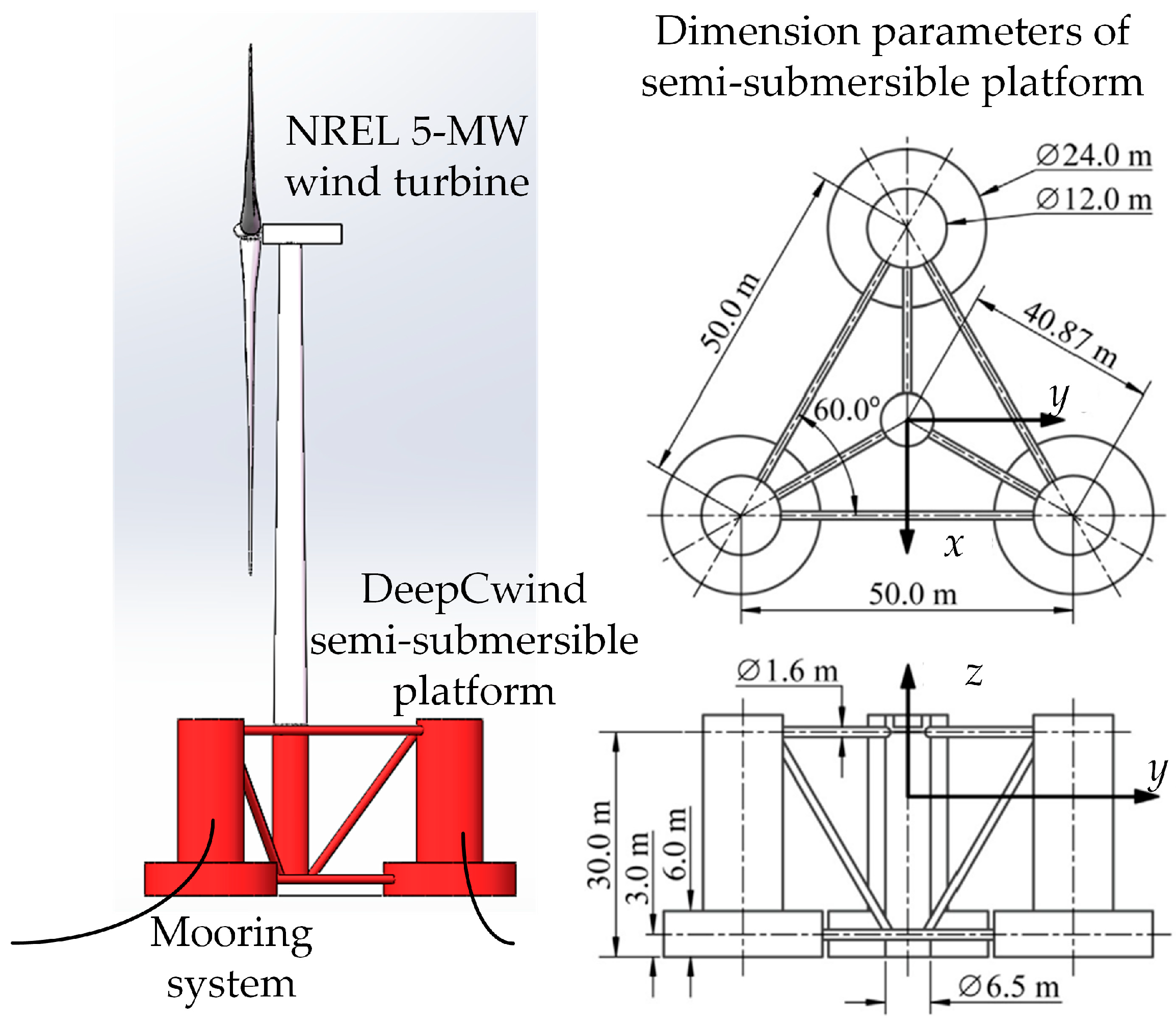
| Gross platform weight | 1.3444 × 10⁷ kg |
| Draught depth | 20 m |
| Displacement | 1.39868 × 10⁴ m3 |
| Center of gravity | −14.4 m (the still water level is 0 m) |
| Ballast tank height | 6 m |
| Ballast tank diameter | 24 m |
| Upper float height | 26 m |
| Upper float diameter | 12 m |
| Connection rod diameter | 1.6 m |
| Bow-rocking moment of inertia | 1.391 × 10⁹ kg·m2 |
| Longitudinal moment of inertia | 8.011 × 10⁹ kg·m2 |
| Transverse moment of inertia | 8.011 × 10⁹ kg·m2 |
| Term | Value |
|---|---|
| Rotor type | 3 Blades, upwind |
| Drive-train | Multiple-stage gearbox |
| Rated wind speed | 11.4 m/s |
| Rotor diameter | 126 m |
| Hub height | 90 m |
| Overhang | 5 m |
| Shaft tilt and pre-cone | 5°, 2.5° |
| Distance from the tower top to the still water surface | 87.6 m |
| Tower top/bottom diameter | 3.87 m/6 m |
| Wall thickness at tower top/bottom | 0.019 m/0.027 m |
| Distance from the tower’s center of gravity to the still water surface | 44.6 m |
| Rotor, nacelle and tower mass | 1.1 × 10⁵ kg, 2.4 × 10⁵ kg, 3.4746 × 10⁵ kg |
| Term | Value |
|---|---|
| Number of anchor chains | 3 |
| Vertical length of the mooring system | 200 m |
| Angle between anchor chains | 120° |
| Radius of the mooring | 938.6 m |
| Cable guide hole vertical height | 14 m |
| Cable Hole Radius | 141.868 m |
| Anchor chain length | 835.5 m |
| Anchor chain diameter | 0.0766 m |
| Equivalent density of anchor chain in water | 108.63 kg/m |
| Equivalent tensile stiffness of anchor chain | 753.6 × 10⁶ N |
| Term | Value |
|---|---|
| 11.4 m/s | |
| Wake parameter C | 0.472 |
| Wind shear exponent | 0.1 |
| 0.08 | |
| 0.025 | |
| Tip speed ratio (TSR) for Each FOWT | 7 |
| Wave amplitude and period | 1.2646 m, 10 s |
| Streamwise distance X | 5 D0, 15 D0 |
| Lateral offset Y | R0 |
| Spacing between the two front FOWTs ΔL | 288 m |
Disclaimer/Publisher’s Note: The statements, opinions and data contained in all publications are solely those of the individual author(s) and contributor(s) and not of MDPI and/or the editor(s). MDPI and/or the editor(s) disclaim responsibility for any injury to people or property resulting from any ideas, methods, instructions or products referred to in the content. |
© 2025 by the authors. Licensee MDPI, Basel, Switzerland. This article is an open access article distributed under the terms and conditions of the Creative Commons Attribution (CC BY) license (https://creativecommons.org/licenses/by/4.0/).
Share and Cite
Wang, Y.; Zong, J.; Mou, J.; Yang, J.; Zhu, X. Analysis of Dynamic Responses of Floating Offshore Wind Turbines in Typical Upstream Wake Conditions Based on an Innovative Coupled Dynamic Analysis Method. J. Mar. Sci. Eng. 2025, 13, 2276. https://doi.org/10.3390/jmse13122276
Wang Y, Zong J, Mou J, Yang J, Zhu X. Analysis of Dynamic Responses of Floating Offshore Wind Turbines in Typical Upstream Wake Conditions Based on an Innovative Coupled Dynamic Analysis Method. Journal of Marine Science and Engineering. 2025; 13(12):2276. https://doi.org/10.3390/jmse13122276
Chicago/Turabian StyleWang, Yangwei, Jisen Zong, Jianhui Mou, Junjie Yang, and Xinghao Zhu. 2025. "Analysis of Dynamic Responses of Floating Offshore Wind Turbines in Typical Upstream Wake Conditions Based on an Innovative Coupled Dynamic Analysis Method" Journal of Marine Science and Engineering 13, no. 12: 2276. https://doi.org/10.3390/jmse13122276
APA StyleWang, Y., Zong, J., Mou, J., Yang, J., & Zhu, X. (2025). Analysis of Dynamic Responses of Floating Offshore Wind Turbines in Typical Upstream Wake Conditions Based on an Innovative Coupled Dynamic Analysis Method. Journal of Marine Science and Engineering, 13(12), 2276. https://doi.org/10.3390/jmse13122276