Improved Estimation of Cotton Aboveground Biomass Using a New Developed Multispectral Vegetation Index and Particle Swarm Optimization
 ,
,  ,
,
Abstract
1. Introduction
2. Materials and Methods
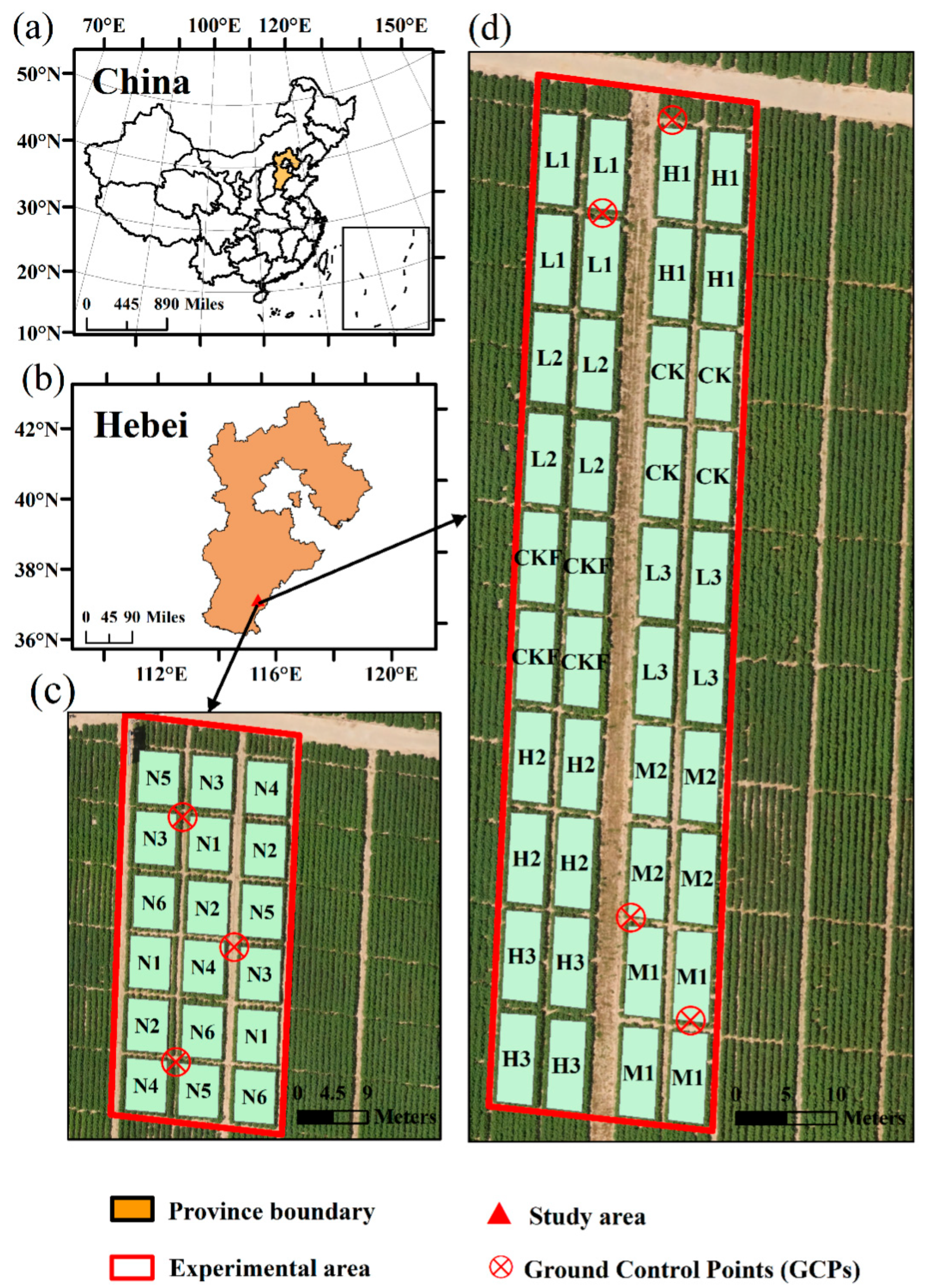
2.1. Study Sites and Experimental Design
2.2. Data Acquisition
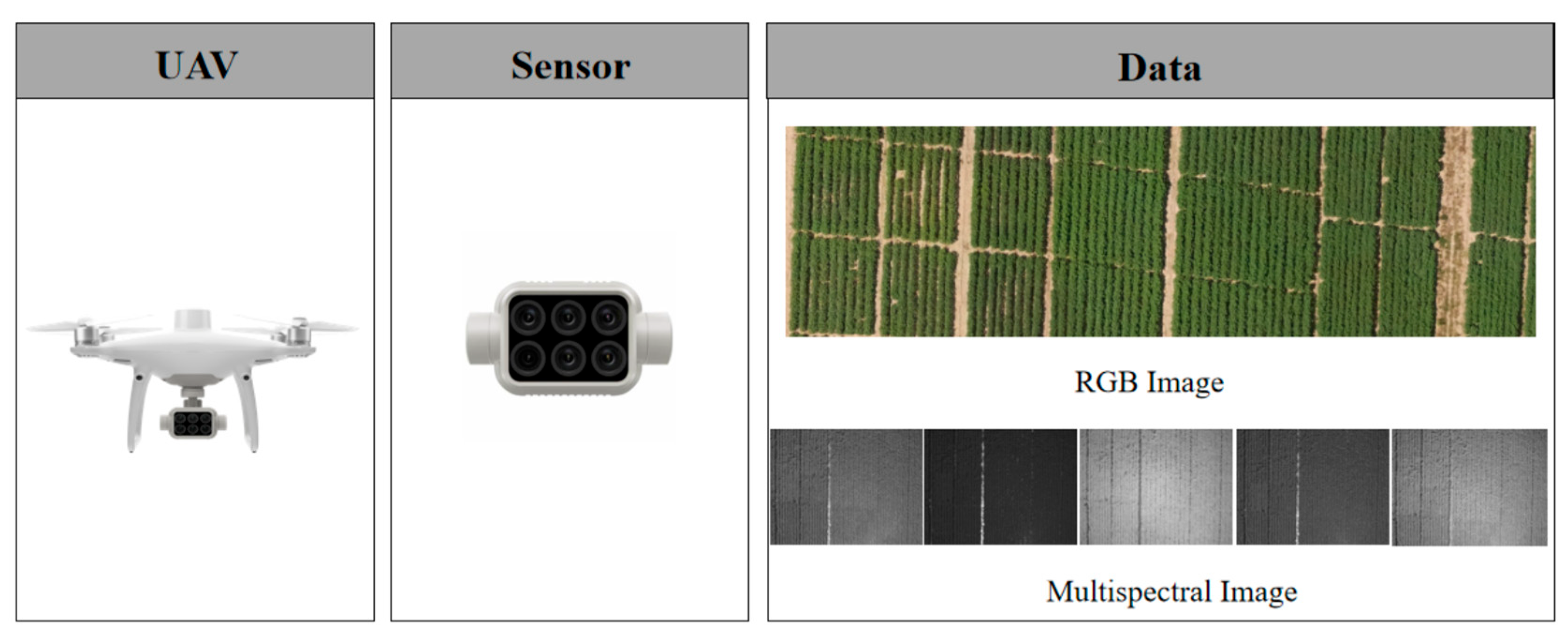
2.2.1. UAV Data Acquisition and Preprocessing
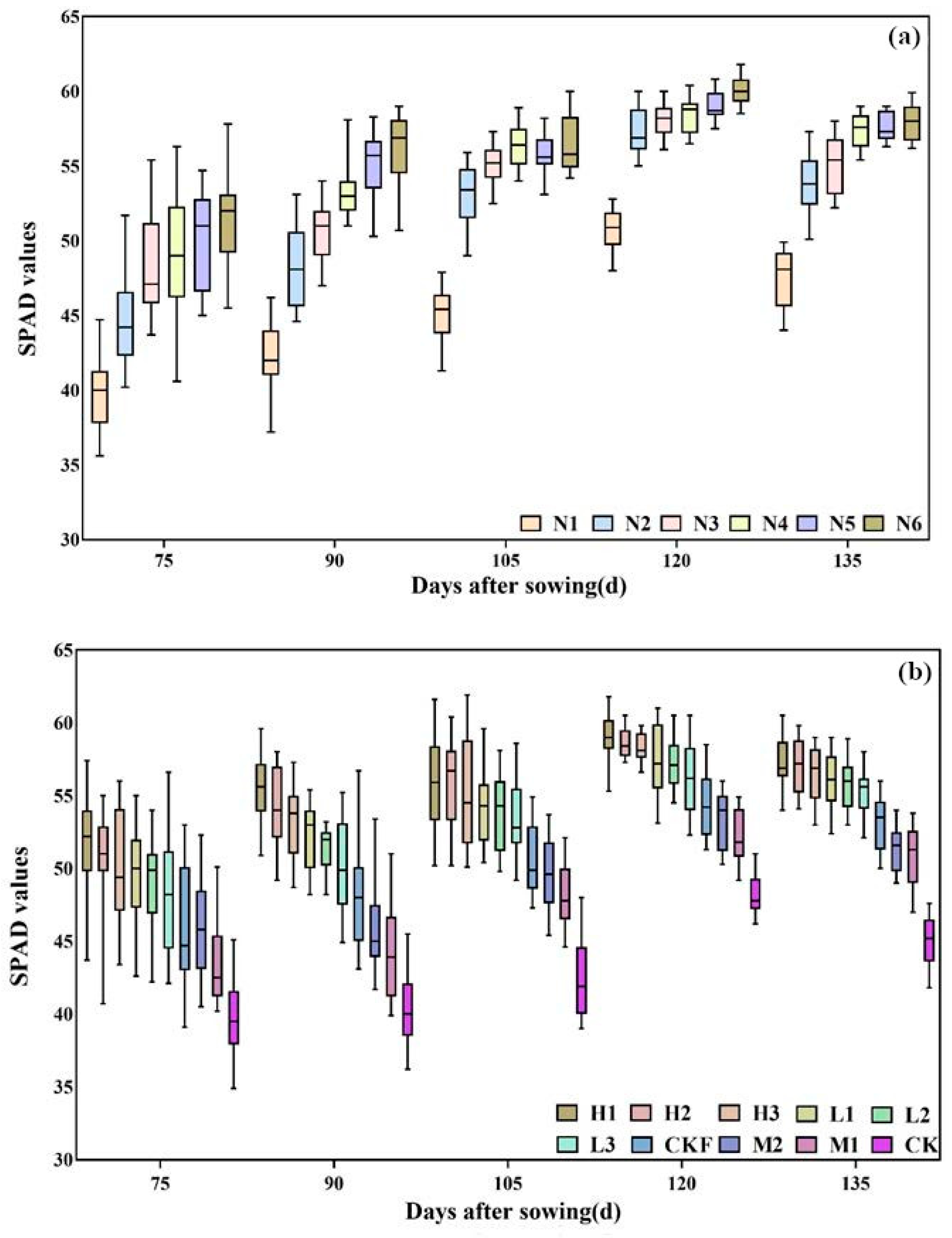
2.2.2. SPAD and AGB Acquisition
2.2.3. Selection of Spectral Indices
2.3. VI-Weight SPAD Variation Coefficient
2.4. Setting of Regression Methods
2.4.1. RFR
2.4.2. XGBoost
2.4.3. CatBoost
2.4.4. PSO-CatBoost
2.4.5. PSO-XGBoost
2.5. Correlation Analysis and Accuracy Assessment
Accuracy Assessment
3. Results
3.1. Descriptive Statistics of Cotton AGB
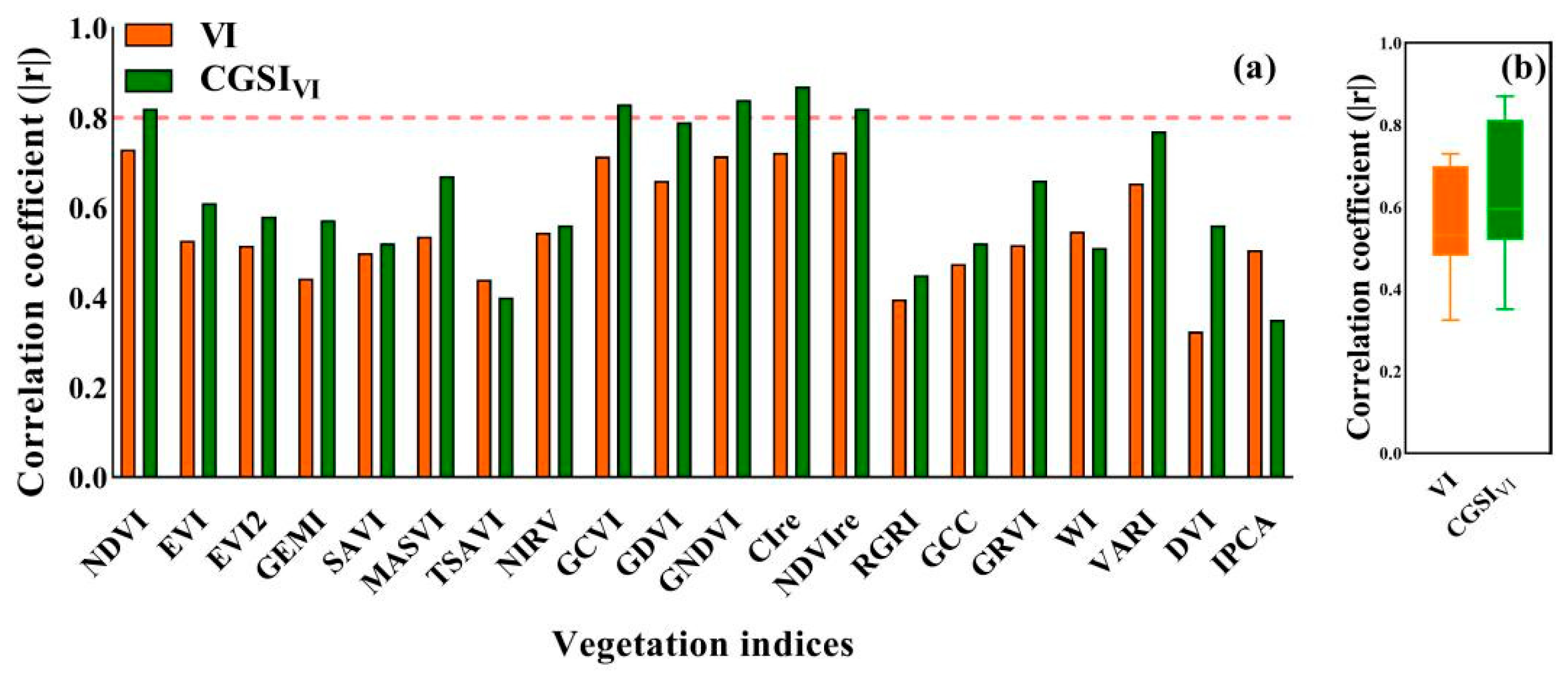
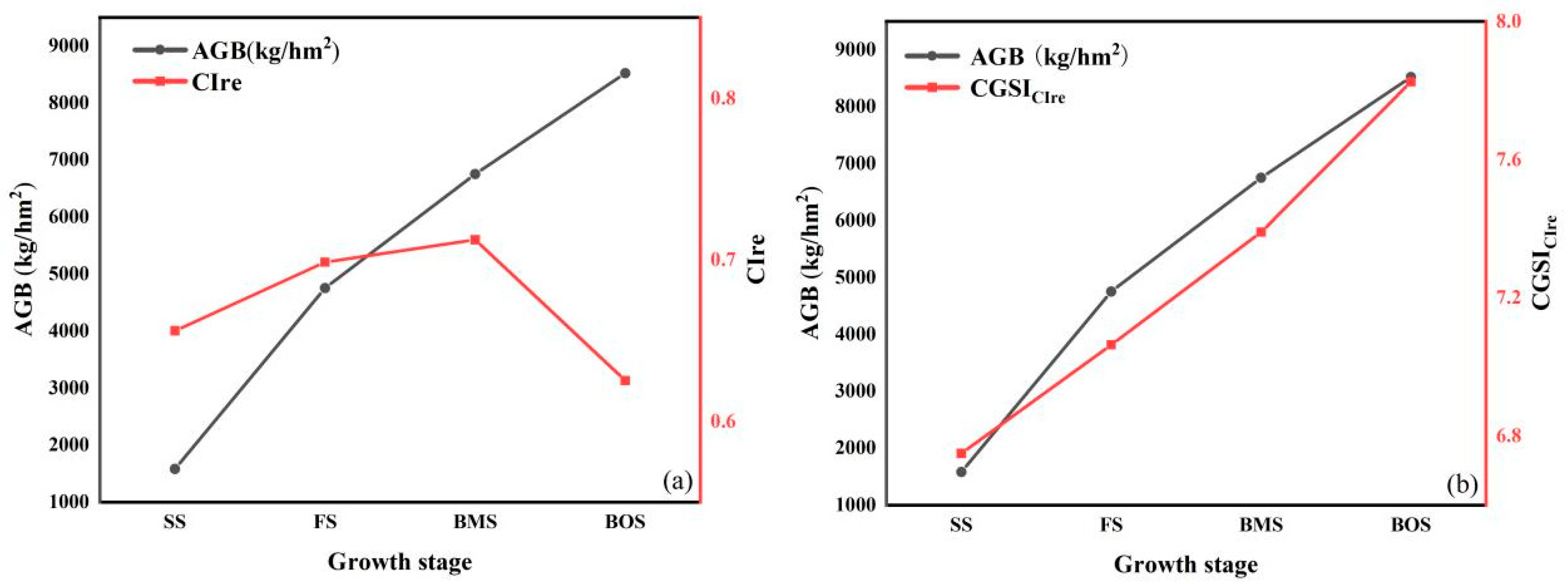
3.2. Correlation Analysis of VI and CGSIVI with AGB
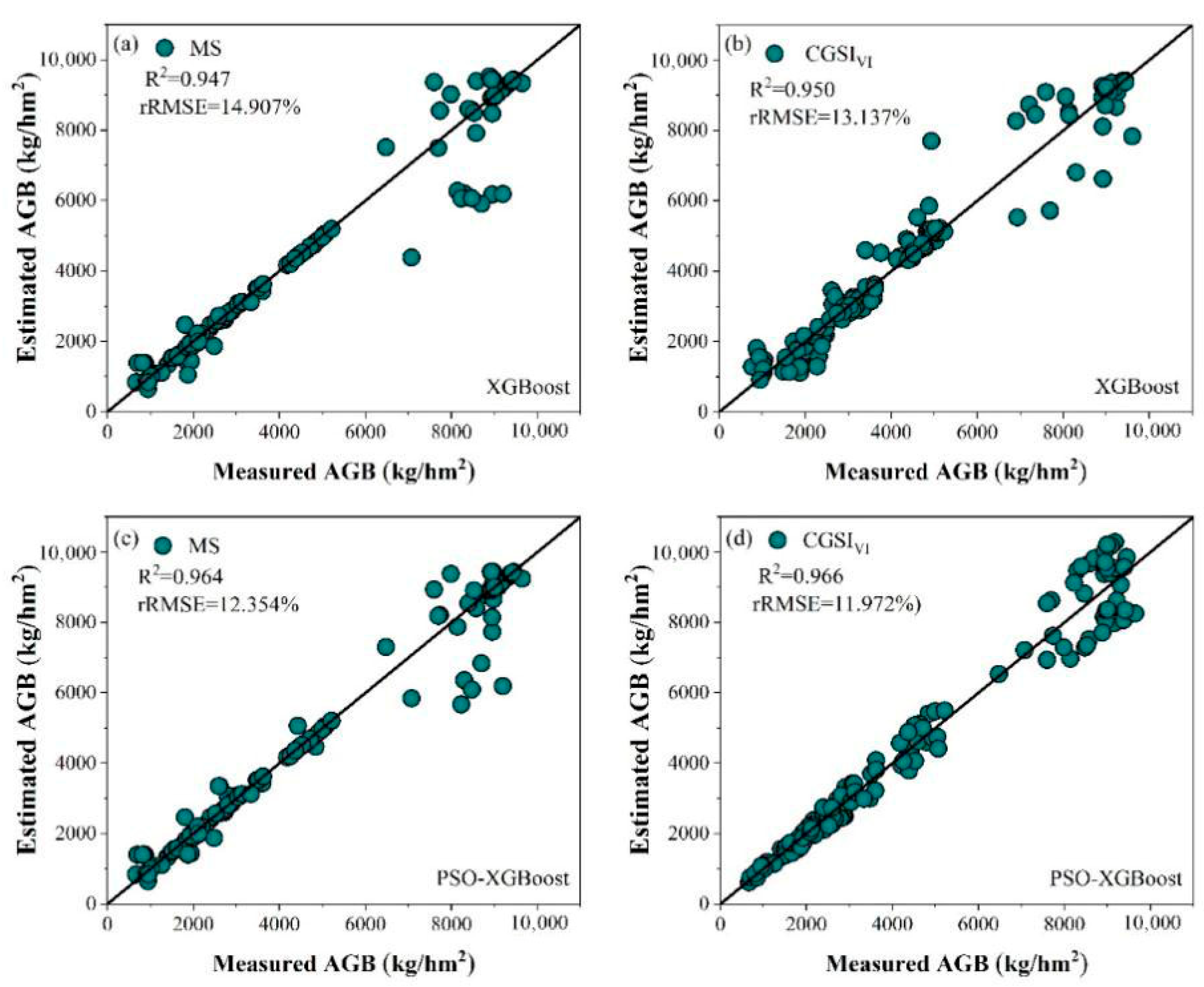
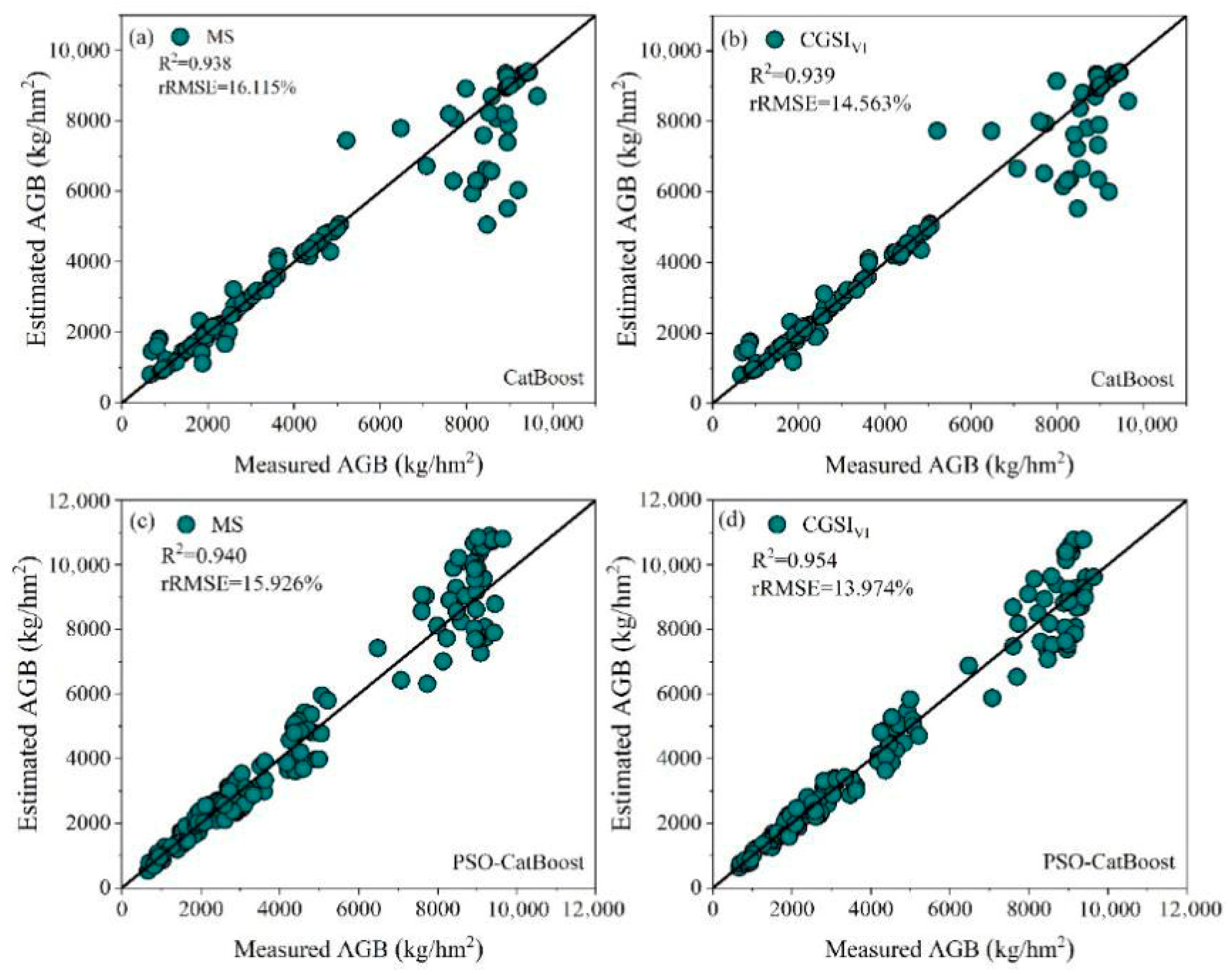
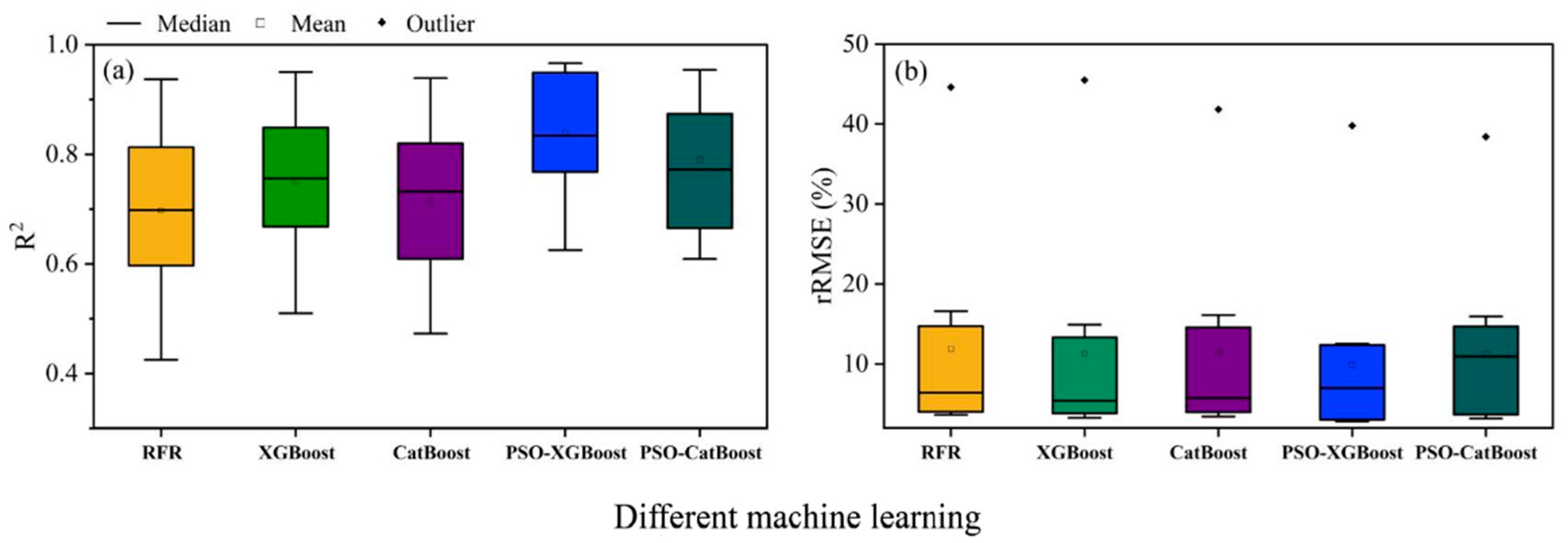
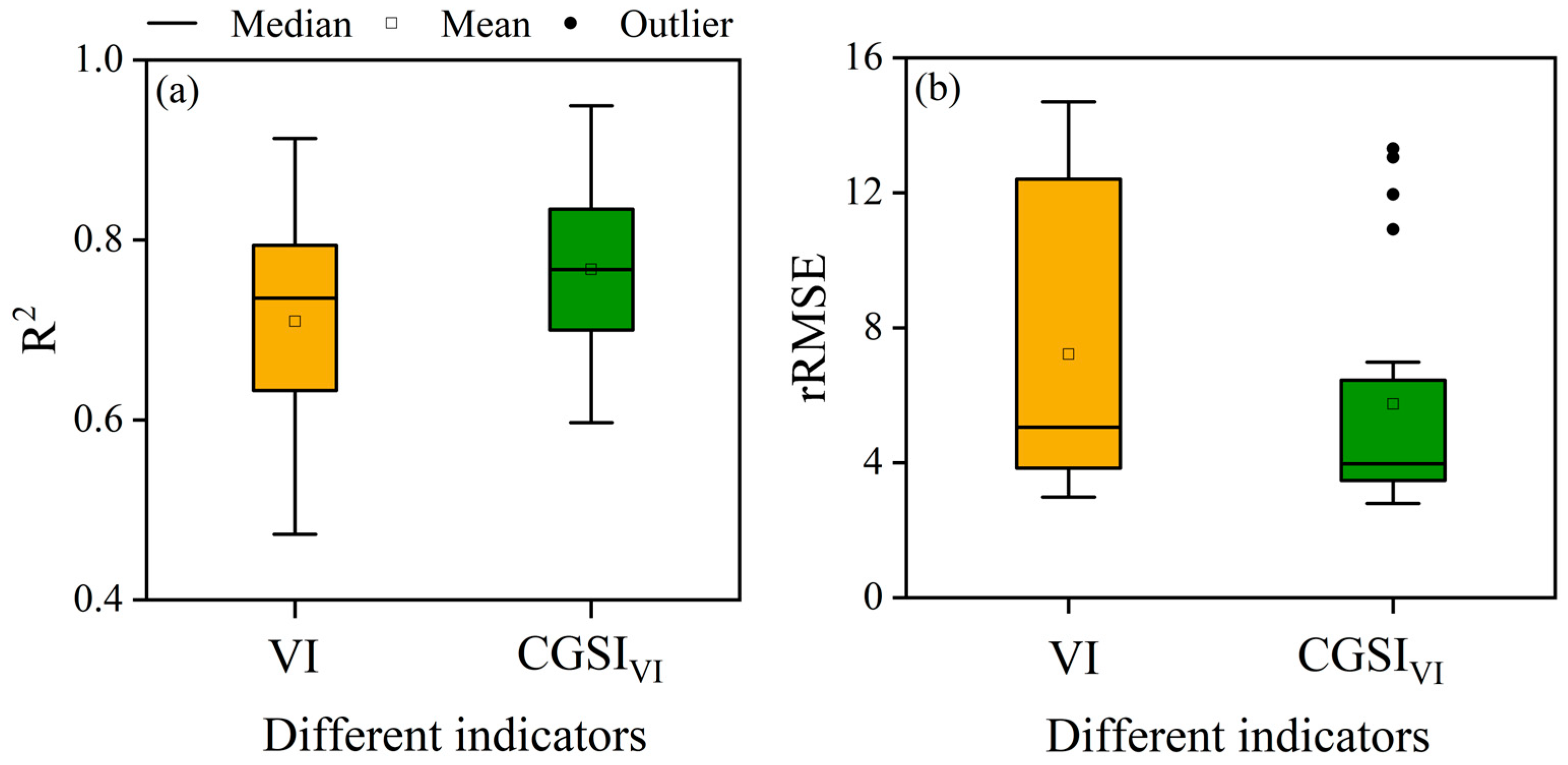
3.3. AGB Estimation with Different Machine Learning Algorithms at the Whole Stage
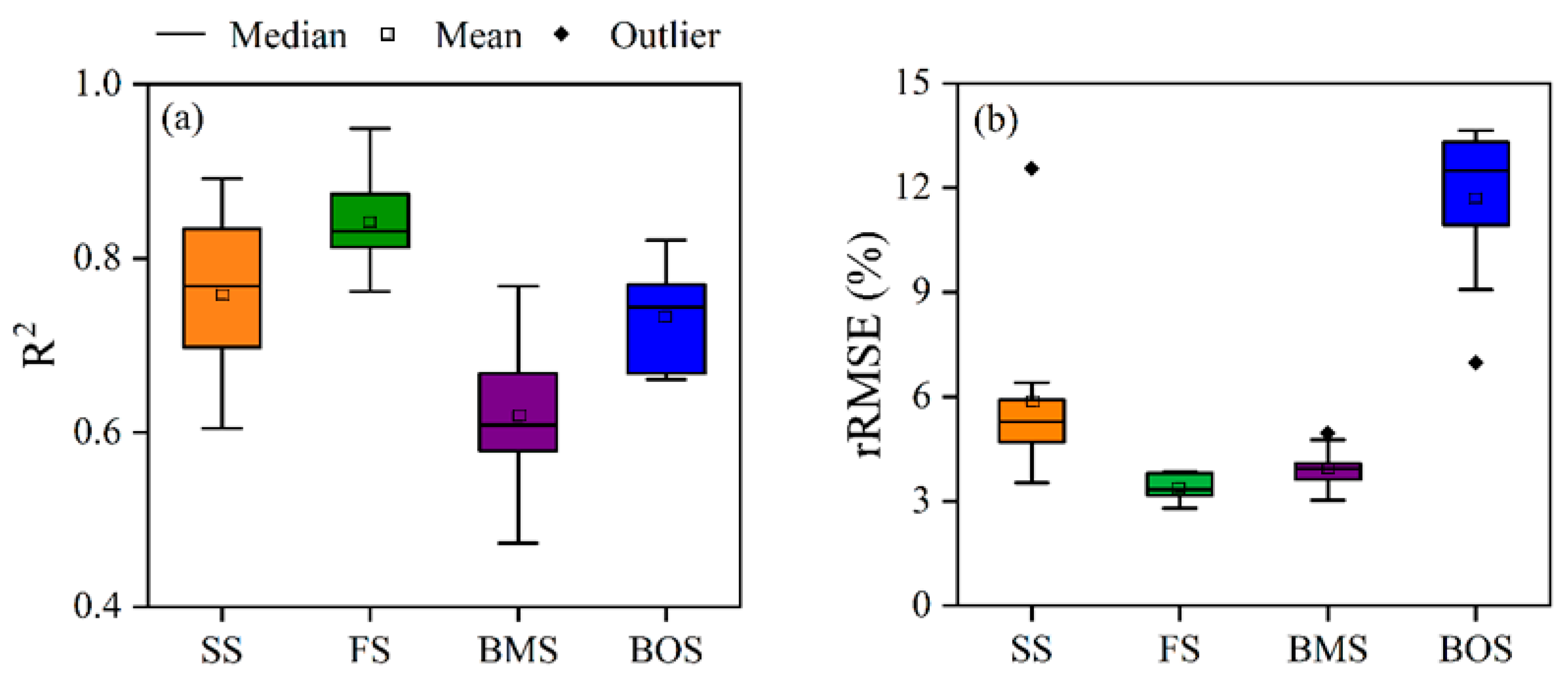
3.4. Estimates of AGB at Different Growth Stages
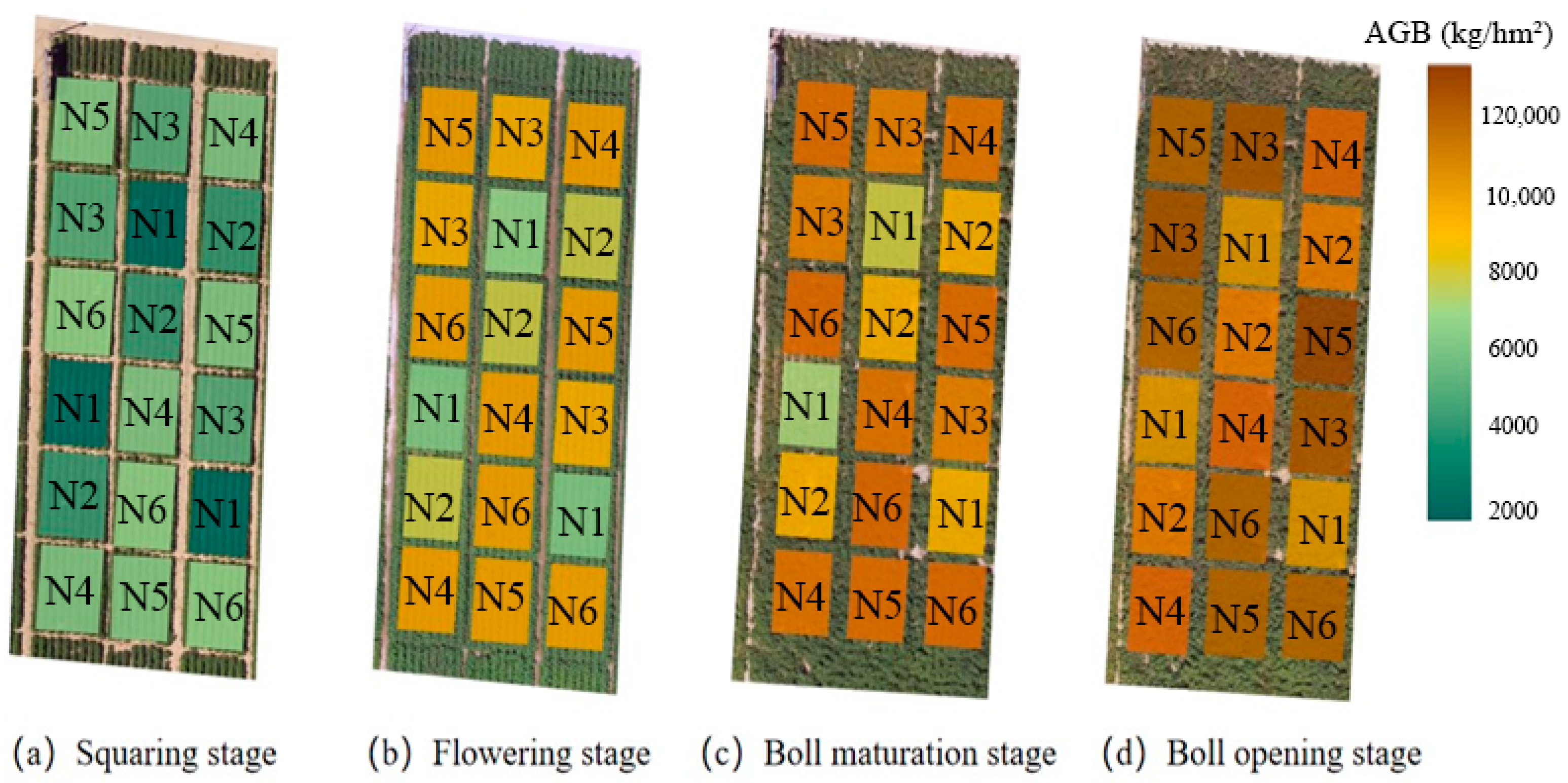
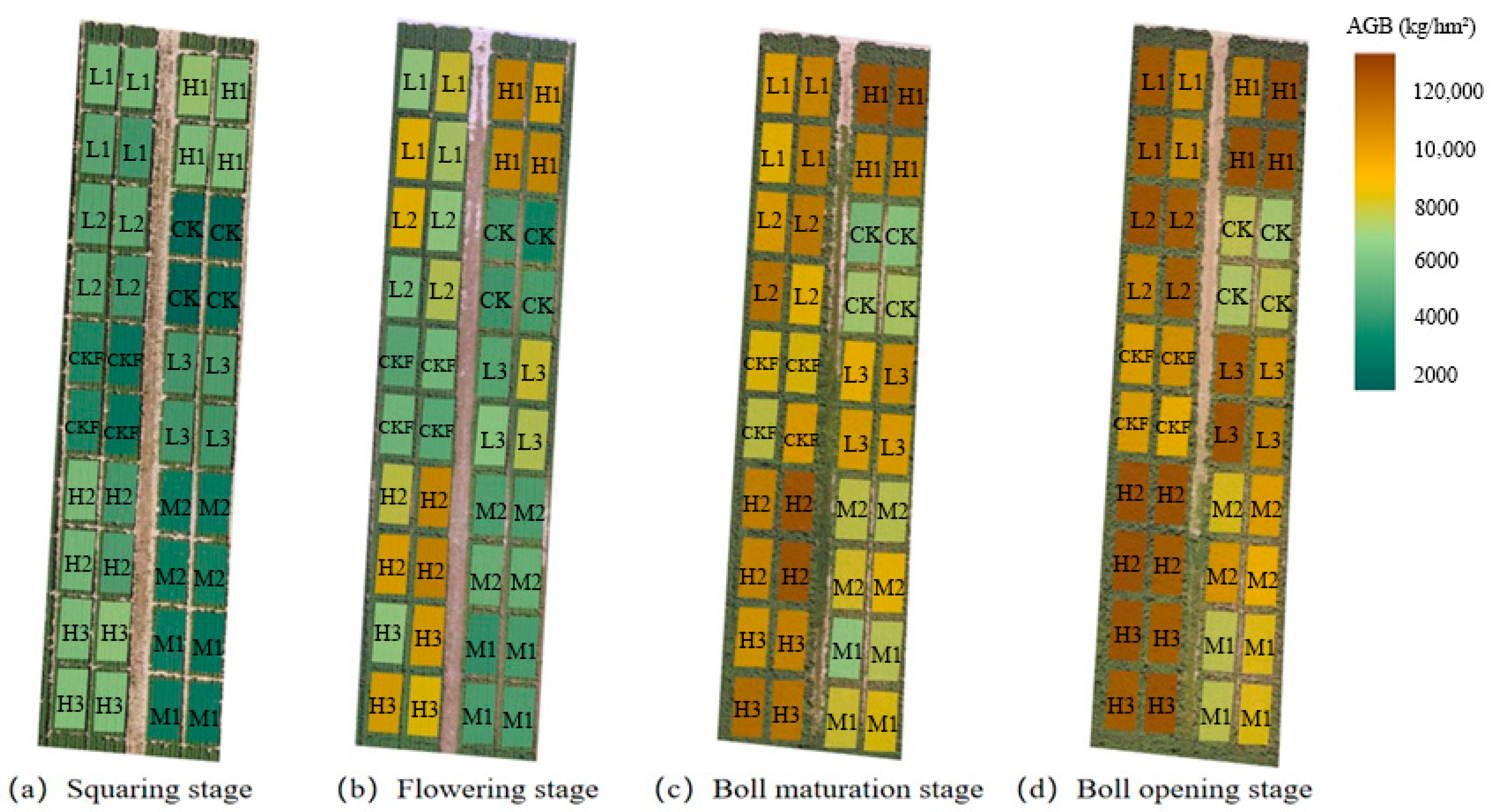
3.5. Spatial and Temporal Distribution of Cotton AGB
4. Discussion
5. Conclusions
Author Contributions
Funding
Institutional Review Board Statement
Informed Consent Statement
Data Availability Statement
Conflicts of Interest
References
- Liu, B.; Asseng, S.; Wang, A.; Wang, S.; Tang, L.; Cao, W.; Zhu, Y.; Liu, L. Modelling the Effects of Post-Heading Heat Stress on Biomass Growth of Winter Wheat. Agric. For. Meteorol. 2017, 247, 476–490. [Google Scholar] [CrossRef]
- Kharel, T.P.; Tyler, H.L.; Mubvumba, P.; Huang, Y.; Bhandari, A.B.; Fletcher, R.S.; Anapalli, S.; Joshi, D.R.; Mengistu, A.; Birru, G.; et al. Machine Learning on Multi-spectral Imagery to Estimate Nutrient Yield of Mixed-species Cover Crops. Agric. Environ. Lett. 2025, 10, e70009. [Google Scholar] [CrossRef]
- Anees, S.A.; Mehmood, K.; Khan, W.R.; Sajjad, M.; Alahmadi, T.A.; Alharbi, S.A.; Luo, M. Integration of Machine Learning and Remote Sensing for above Ground Biomass Estimation through Landsat-9 and Field Data in Temperate Forests of the Himalayan Region. Ecol. Inform. 2024, 82, 102732. [Google Scholar] [CrossRef]
- Zhang, P.; Lu, B.; Ge, J.; Wang, X.; Yang, Y.; Shang, J.; La, Z.; Zang, H.; Zeng, Z. Using UAV-Based Multispectral and RGB Imagery to Monitor above-Ground Biomass of Oat-Based Diversified Cropping. Eur. J. Agron. 2025, 162, 127422. [Google Scholar] [CrossRef]
- David, R.M.; Rosser, N.J.; Donoghue, D.N.M. Improving above Ground Biomass Estimates of Southern Africa Dryland Forests by Combining Sentinel-1 SAR and Sentinel-2 Multispectral Imagery. Remote Sens. Environ. 2022, 282, 113232. [Google Scholar] [CrossRef]
- Houborg, R.; McCabe, M. High-Resolution NDVI from Planet’s Constellation of Earth Observing Nano-Satellites: A New Data Source for Precision Agriculture. Remote Sens. 2016, 8, 768. [Google Scholar] [CrossRef]
- Shen, S.; Li, W.; Zou, J.; Harrison, M.T.; Liu, S.; Eyshi Rezaei, E.; Liu, K.; Kamali, B.; Wang, Z.; Zhang, D.; et al. Fusing UAV Multiple Data and Phenology to Predict Crop Biomass. Inf. Process. Agric. 2025, S2214317325000460. [Google Scholar] [CrossRef]
- Biswal, S.; Pathak, N.; Chatterjee, C.; Mailapalli, D.R. Estimation of Aboveground Biomass from Spectral and Textural Characteristics of Paddy Crop Using UAV-Multispectral Images and Machine Learning Techniques. Geocarto Int. 2024, 39, 2364725. [Google Scholar] [CrossRef]
- Uddling, J.; Gelang-Alfredsson, J.; Piikki, K.; Pleijel, H. Evaluating the Relationship Between Leaf Chlorophyll Concentration and SPAD-502 Chlorophyll Meter Readings. Photosynth. Res. 2007, 91, 37–46. [Google Scholar] [CrossRef]
- Yu, D.; Zha, Y.; Sun, Z.; Li, J.; Jin, X.; Zhu, W.; Bian, J.; Ma, L.; Zeng, Y.; Su, Z. Deep Convolutional Neural Networks for Estimating Maize Above-Ground Biomass Using Multi-Source UAV Images: A Comparison with Traditional Machine Learning Algorithms. Precis. Agric. 2023, 24, 92–113. [Google Scholar] [CrossRef]
- Zhai, W.; Li, C.; Cheng, Q.; Mao, B.; Li, Z.; Li, Y.; Ding, F.; Qin, S.; Fei, S.; Chen, Z. Enhancing Wheat Above-Ground Biomass Estimation Using UAV RGB Images and Machine Learning: Multi-Feature Combinations, Flight Height, and Algorithm Implications. Remote Sens. 2023, 15, 3653. [Google Scholar] [CrossRef]
- Allu, A.R.; Mesapam, S. Crop Health Assessment from Predicted AGB and NPK Derived from UAV Spectral Indices and Machine Learning Techniques. Agronomy 2025, 15, 2059. [Google Scholar] [CrossRef]
- Ramesh, V.; Kumaresan, P. Stacked Ensemble Model for Accurate Crop Yield Prediction Using Machine Learning Techniques. Environ. Res. Commun. 2025, 7, 035006. [Google Scholar] [CrossRef]
- Zhang, Y.; Xia, C.; Zhang, X.; Cheng, X.; Feng, G.; Wang, Y.; Gao, Q. Estimating the Maize Biomass by Crop Height and Narrowband Vegetation Indices Derived from UAV-Based Hyperspectral Images. Ecol. Indic. 2021, 129, 107985. [Google Scholar] [CrossRef]
- Han, Y.; Tang, R.; Liao, Z.; Zhai, B.; Fan, J. A Novel Hybrid GOA-XGB Model for Estimating Wheat Aboveground Biomass Using UAV-Based Multispectral Vegetation Indices. Remote Sens. 2022, 14, 3506. [Google Scholar] [CrossRef]
- Groten, S.M.E. NDVI—Crop Monitoring and Early Yield Assessment of Burkina Faso. Int. J. Remote Sens. 1993, 14, 1495–1515. [Google Scholar] [CrossRef]
- Wiegand, C.L.; Richardson, A.J.; Escobar, D.E.; Gerbermann, A.H. Vegetation Indices in Crop Assessments. Remote Sens. Environ. 1991, 35, 105–119. [Google Scholar] [CrossRef]
- Potopová, V.; Trnka, M.; Hamouz, P.; Soukup, J.; Castraveț, T. Statistical Modelling of Drought-Related Yield Losses Using Soil Moisture-Vegetation Remote Sensing and Multiscalar Indices in the South-Eastern Europe. Agric. Water Manag. 2020, 236, 106168. [Google Scholar] [CrossRef]
- Carpenter, G.D. GEMI: Fostering Environmental Excellence by Business World-Wide. Environ. Conserv. 1991, 18, 181–182. [Google Scholar] [CrossRef][Green Version]
- Bausch, W.C. Soil Background Effects on Reflectance-Based Crop Coefficients for Corn. Remote Sens. Environ. 1993, 46, 213–222. [Google Scholar] [CrossRef]
- Begue, A.; Myneni, R. Operational NOAA Vegetation Indices-Absorbed PAR Relationships for Sahelian Vegetation Canopies. In Proceedings of the 1995 International Geoscience and Remote Sensing Symposium, IGARSS ’95. Quantitative Remote Sensing for Science and Applications, Firenze, Italy, 10–14 July 1995; Volume 2, pp. 1296–1298. [Google Scholar]
- Baret, F.; Guyot, G.; Major, D. TSAVI: A Vegetation Index Which Minimizes Soil Brightness Effects on LAI and APAR Estimation. In Proceedings of the 12th Canadian Symposium on Remote Sensing Geoscience and Remote Sensing Symposium, Vancouver, BC, Canada, 10–14 July 1989; pp. 1355–1358. [Google Scholar]
- Badgley, G.; Anderegg, L.D.L.; Berry, J.A.; Field, C.B. Terrestrial Gross Primary Production: Using NIRV to Scale from Site to Globe. Glob. Change Biol. 2019, 25, 3731–3740. [Google Scholar] [CrossRef]
- Ismail, M. Assessment of Genetic Improvement in Doubled Haploid Lines of Bread Wheat under Heat-Stressed Environment; University of Gezira: Wad Medani, Sudan, 2007. [Google Scholar]
- Wu, W. The Generalized Difference Vegetation Index (GDVI) for Dryland Characterization. Remote Sens. 2014, 6, 1211–1233. [Google Scholar] [CrossRef]
- Daughtry, C. Estimating Corn Leaf Chlorophyll Concentration from Leaf and Canopy Reflectance. Remote Sens. Environ. 2000, 74, 229–239. [Google Scholar] [CrossRef]
- Jordan, C.F. Derivation of Leaf-Area Index from Quality of Light on the Forest Floor. Ecology 1969, 50, 663–666. [Google Scholar] [CrossRef]
- Leblon, B.; Guerif, M.; Baret, F. The Use of Remotely Sensed Data in Estimation of PAR Use Efficiency and Biomass Production of Flooded Rice. Remote Sens. Environ. 1991, 38, 147–158. [Google Scholar] [CrossRef]
- Adam, E.; Mutanga, O.; Rugege, D. Multispectral and Hyperspectral Remote Sensing for Identification and Mapping of Wetland Vegetation: A Review. Wetl. Ecol Manag. 2010, 18, 281–296. [Google Scholar] [CrossRef]
- Villa, P.; Stroppiana, D.; Fontanelli, G.; Azar, R.; Brivio, P. In-Season Mapping of Crop Type with Optical and X-Band SAR Data: A Classification Tree Approach Using Synoptic Seasonal Features. Remote Sens. 2015, 7, 12859–12886. [Google Scholar] [CrossRef]
- Gillespie, A.R.; Kahle, A.B.; Walker, R.E. Color Enhancement of Highly Correlated Images. II. Channel Ratio and “Chromaticity” Transformation Techniques. Remote Sens. Environ. 1987, 22, 343–365. [Google Scholar] [CrossRef]
- Chen, A.; Orlov-Levin, V.; Meron, M. Applying High-Resolution Visible-Channel Aerial Imaging of Crop Canopy to Precision Irrigation Management. Agric. Water Manag. 2019, 216, 196–205. [Google Scholar] [CrossRef]
- Torres-Sánchez, J.; Peña, J.M.; De Castro, A.I.; López-Granados, F. Multi-Temporal Mapping of the Vegetation Fraction in Early-Season Wheat Fields Using Images from UAV. Comput. Electron. Agric. 2014, 103, 104–113. [Google Scholar] [CrossRef]
- Grenzdörffer, G.J. Crop Height Determination with UAS Point Clouds. Int. Arch. Photogramm. Remote Sens. Spat. Inf. Sci. 2014, XL-1, 135–140. [Google Scholar] [CrossRef]
- Fallahi, H.; Ebrahimnejad, S.; Sabouri, H.; Lakzadeh, I.; Ghasemi, M.; Kohkan, S. Evaluation of Genotype × Interaction Effects on Grain Yield of Barely Genotypes Using Additive Main Effects and Multiplicative Interactions (AMMI). J. Crop Breed. 2018, 9, 144–151. [Google Scholar] [CrossRef]
- O’brien, R.M. A Caution Regarding Rules of Thumb for Variance Inflation Factors. Qual. Quant. 2007, 41, 673–690. [Google Scholar] [CrossRef]
- Zhai, W.; Li, C.; Fei, S.; Liu, Y.; Ding, F.; Cheng, Q.; Chen, Z. CatBoost Algorithm for Estimating Maize Above-Ground Biomass Using Unmanned Aerial Vehicle-Based Multi-Source Sensor Data and SPAD Values. Comput. Electron. Agric. 2023, 214, 108306. [Google Scholar] [CrossRef]
- Su, H.; Shen, W.; Wang, J.; Ali, A.; Li, M. Machine Learning and Geostatistical Approaches for Estimating Aboveground Biomass in Chinese Subtropical Forests. For. Ecosyst. 2020, 7, 64. [Google Scholar] [CrossRef]
- Prokhorenkova, L.; Gusev, G.; Vorobev, A.; Dorogush, A.V.; Gulin, A. CatBoost: Unbiased Boosting with Categorical Features. In Proceedings of the 32nd International Conference on Neural Information Processing Systems, Montreal, QC, Canada, 3–8 December 2018. [Google Scholar]
- Kennedy, J.; Eberhart, R. Particle Swarm Optimization. In Proceedings of the ICNN’95—International Conference on Neural Networks, Perth, WA, Australia, 27 November–1 December 1995; Volume 4, pp. 1942–1948. [Google Scholar]
- Fei, S.; Hassan, M.A.; Xiao, Y.; Su, X.; Chen, Z.; Cheng, Q.; Duan, F.; Chen, R.; Ma, Y. UAV-Based Multi-Sensor Data Fusion and Machine Learning Algorithm for Yield Prediction in Wheat. Precis. Agric. 2023, 24, 187–212. [Google Scholar] [CrossRef]
- Islam, M.R.; Haque, K.; Akter, N.; Karim, M.A. Leaf Chlorophyll Dynamics in Wheat Based on SPAD Meter Reading and Its Relationship with Grain Yield. Sci. Agric. 2014, 8, 13–18. [Google Scholar]
- Liu, Y.; Xiao, J.; Ju, W.; Zhu, G.; Wu, X.; Fan, W.; Li, D.; Zhou, Y. Satellite-Derived LAI Products Exhibit Large Discrepancies and Can Lead to Substantial Uncertainty in Simulated Carbon and Water Fluxes. Remote Sens. Environ. 2018, 206, 174–188. [Google Scholar] [CrossRef]
- Yoshida, H.; Horie, T. A Process Model for Explaining Genotypic and Environmental Variation in Growth and Yield of Rice Based on Measured Plant N Accumulation. Field Crops Res. 2009, 113, 227–237. [Google Scholar] [CrossRef]



| Camera Parameter | Parameter Value |
|---|---|
| Filter | Blue: 450 nm ± 16 nm; |
| Green: 560 nm ± 16 nm; | |
| Red: 650 nm ± 16 nm; | |
| Red Edge: 730 nm ± 16 nm; | |
| Near-Infrared: 840 nm ± 26 nm | |
| Color Sensor ISO Range | 200–800 |
| Monochrome Sensor Gain | 1–8 times |
| Electronic Global Shutter | 1/100–1/20000 s (RGB); 1/100–1/10000 s (Multispectral imaging) |
| Maximum Photo Resolution | 1600 × 1300 (4: 3.25) |
| Sensor | Vegetation Index | Calculation Formula | References |
|---|---|---|---|
| Multispectral | Normalized Difference Vegetation Index (NDVI) | NDVI = (NIR − R)/(NIR + R) | [16] |
| Enhanced Vegetation Index (EVI) | EVI = 2.5 × (NIR − R)/(NIR + 6 × R − 7.5 × B + 1) | [17] | |
| Two-Band Enhanced Vegetation Index (EVI2) | EVI2 = 2.5 × (NIR − R)/(NIR + 2.4 × R + 1) | [18] | |
| Global Environment Monitoring Index (GEMI) | GEMI = [2 × (NIR2 − R2) + 1.5 × NIR + 0.5 × R]/(NIR + R + 0.5) | [19] | |
| Soil-Adjusted Vegetation Index (SAVI) | SAVI = 1.5 × (NIR − R)/(NIR + R + 0.5) | [20] | |
| Modified Soil-Adjusted Vegetation Index (MSAVI) | MSAVI = 0.5 × [2 × NIR + 1-sqrt((2 × NIR + 1)2 − 8 × (NIR − R))] | [21] | |
| Transformed Soil-Adjusted Vegetation Index (TSAVI) | TSAVI = 0.33 × (NIR − 0.33 × R − 0.5)/[0.5 × NIR + R − 0.5 × 0.33 + (1 + 0.332)] | [22] | |
| Near-Infrared Reflectance times Vegetation (NIRv) | NIRv = NDVI × NIR | [23] | |
| Green Chlorophyll Vegetation Index (GCVI) | GCVI = NIR/GREEN − 1 | [24] | |
| Green Difference Vegetation Index (GDVI) | GDVI = NIR − GREEN | [25] | |
| Green Normalized Difference Vegetation Index (GNDVI) | GNDVI= (NIR − G)/(NIR + G) | [26] | |
| Chlorophyll Index Red Edge (CIre) | CIre = NIR/REDedge − 1 | [27] | |
| Red Edge Normalized Difference Vegetation Index (NDVIre) | NDVIre= (NIR − REDedge)/(NIR + REDedge) | [28] | |
| Difference Vegetation Index (DVI) | DVI = NIR-R | [29] | |
| RGB | Red to Green Ratio Index (RGRI) | RGRI = R/G | [30] |
| Green Chromatic Coordinate (GCC) | GCC = G/(R + G + B) | [31] | |
| Green Red Vegetation Index (GRVI) | GRVI= (GREEN − RED)/(GREEN + RED) | [32] | |
| Water Index (WI) | WI = (G − B)/(R − G) | [33] | |
| Visible Atmospherically Resistant Index (VARI) | VARI = (G − R)/(G + R − B) | [34] | |
| Principal component analysis index (IPCA) | IPCA = 0.994 × |R − B| + 0.961 × |G − B| + 0.914 × |G − R| | [35] |
| Growth Stage | Dataset | Number of Samples | Maximum Value (t/hm2) | Minimum Value (t/hm2) | Average Value (t/hm2) | Standard Deviation (t/hm2) |
|---|---|---|---|---|---|---|
| Entire growth stage | Training | 324 | 10.007 | 0.633 | 4.585 | 2.754 |
| Testing | 140 | 9.605 | 0.765 | 4.516 | 2.665 | |
| Squaring stage | Training | 81 | 2.480 | 0.633 | 1.694 | 0.519 |
| Testing | 35 | 2.417 | 0.666 | 1.679 | 0.477 | |
| Flowering stage | Training | 81 | 3.623 | 2.522 | 3.041 | 0.290 |
| Testing | 35 | 3.621 | 2.592 | 3.051 | 0.316 | |
| Boll maturation stage | Training | 81 | 5.245 | 4.187 | 4.726 | 0.294 |
| Testing | 35 | 5.192 | 4.113 | 4.750 | 0.329 | |
| Boll opening stage | Training | 81 | 10.007 | 6.477 | 8.809 | 0.616 |
| Testing | 35 | 9.646 | 7.205 | 8.866 | 0.594 |
| Data | RFR | XGBoost | CatBoost | PSO-XGBoost | PSO-CatBoost | |||||
|---|---|---|---|---|---|---|---|---|---|---|
| R2 | rRMSE (%) | R2 | rRMSE (%) | R2 | rRMSE (%) | R2 | rRMSE (%) | R2 | rRMSE (%) | |
| SPAD | 0.43 | 44.61 | 0.51 | 45.49 | 0.49 | 41.83 | 0.63 | 39.79 | 0.65 | 38.40 |
| VI | 0.94 | 16.60 | 0.95 | 14.91 | 0.94 | 16.16 | 0.96 | 12.35 | 0.94 | 15.93 |
| CGSIVI | 0.94 | 14.73 | 0.95 | 13.14 | 0.94 | 14.56 | 0.97 | 11.97 | 0.95 | 13.97 |
| Growth Stage | Data | RFR | XGBoost | CatBoost | PSO-XGBoost | PSO-CatBoost | |||||
|---|---|---|---|---|---|---|---|---|---|---|---|
| R2 | rRMSE (%) | R2 | rRMSE (%) | R2 | rRMSE (%) | R2 | rRMSE (%) | R2 | rRMSE (%) | ||
| Squaring stage | VI | 0.61 | 6.41 | 0.77 | 5.15 | 0.66 | 5.73 | 0.83 | 12.56 | 0.77 | 14.70 |
| CGSIVI | 0.70 | 5.91 | 0.75 | 5.37 | 0.77 | 5.20 | 0.89 | 3.53 | 0.85 | 4.19 | |
| Flowering stage | VI | 0.79 | 3.84 | 0.81 | 3.81 | 0.76 | 3.85 | 0.91 | 2.98 | 0.84 | 3.20 |
| CGSIVI | 0.81 | 3.61 | 0.85 | 3.26 | 0.82 | 3.42 | 0.95 | 2.80 | 0.87 | 3.17 | |
| Boll maturation stage | VI | 0.51 | 4.76 | 0.58 | 4.09 | 0.47 | 4.96 | 0.71 | 3.39 | 0.61 | 3.94 |
| CGSIVI | 0.60 | 4.00 | 0.67 | 3.63 | 0.61 | 3.94 | 0.77 | 3.03 | 0.67 | 3.64 | |
| Boll opening stage | VI | 0.66 | 12.75 | 0.67 | 13.31 | 0.66 | 13.64 | 0.80 | 9.08 | 0.77 | 12.25 |
| CGSIVI | 0.70 | 13.32 | 0.76 | 11.96 | 0.73 | 13.05 | 0.82 | 6.98 | 0.77 | 10.92 | |
Disclaimer/Publisher’s Note: The statements, opinions and data contained in all publications are solely those of the individual author(s) and contributor(s) and not of MDPI and/or the editor(s). MDPI and/or the editor(s) disclaim responsibility for any injury to people or property resulting from any ideas, methods, instructions or products referred to in the content. |
© 2025 by the authors. Licensee MDPI, Basel, Switzerland. This article is an open access article distributed under the terms and conditions of the Creative Commons Attribution (CC BY) license (https://creativecommons.org/licenses/by/4.0/).
Share and Cite
Wu, G.; Hou, M.; Wang, Y.; Sun, H.; Liu, L.; Zhang, K.; Zhu, L.; Jin, X.; Li, C.; Zhang, Y. Improved Estimation of Cotton Aboveground Biomass Using a New Developed Multispectral Vegetation Index and Particle Swarm Optimization. Agriculture 2025, 15, 2608. https://doi.org/10.3390/agriculture15242608
Wu G, Hou M, Wang Y, Sun H, Liu L, Zhang K, Zhu L, Jin X, Li C, Zhang Y. Improved Estimation of Cotton Aboveground Biomass Using a New Developed Multispectral Vegetation Index and Particle Swarm Optimization. Agriculture. 2025; 15(24):2608. https://doi.org/10.3390/agriculture15242608
Chicago/Turabian StyleWu, Guanyu, Mingyu Hou, Yuqiao Wang, Hongchun Sun, Liantao Liu, Ke Zhang, Lingxiao Zhu, Xiuliang Jin, Cundong Li, and Yongjiang Zhang. 2025. "Improved Estimation of Cotton Aboveground Biomass Using a New Developed Multispectral Vegetation Index and Particle Swarm Optimization" Agriculture 15, no. 24: 2608. https://doi.org/10.3390/agriculture15242608
APA StyleWu, G., Hou, M., Wang, Y., Sun, H., Liu, L., Zhang, K., Zhu, L., Jin, X., Li, C., & Zhang, Y. (2025). Improved Estimation of Cotton Aboveground Biomass Using a New Developed Multispectral Vegetation Index and Particle Swarm Optimization. Agriculture, 15(24), 2608. https://doi.org/10.3390/agriculture15242608