1. Introduction
The olive grove is one of the most representative agricultural systems in the Mediterranean region, both in terms of its extent and its socio-economic and environmental importance [
1,
2]. Within the European Union, the area dedicated to olive cultivation ranges between 4 and 5 million hectares, primarily concentrated in Spain (55%) and Italy (23%) [
3]. In traditional rainfed systems, such as those predominant in Andalusia, southern Spain, more than 1.7 million hectares are cultivated, generally on shallow soils with limited effective rooting depth due to poorly developed horizons and rock fragments, and under low management intensity, characterized by the absence of irrigation and relatively low external inputs, with moderate fertilizer and herbicide use and infrequent tillage operations [
4].
A common practice in these systems is maintaining bare soil in the inter-row areas, either through mechanical tillage or herbicide application, aiming to reduce water and nutrient competition with spontaneous vegetation [
5]. However, this strategy might result in heavy soil loss by erosion and soil compaction and ultimately degrade soil quality [
6]. Such management practices may also influence soil carbon dynamics and CO
2 fluxes [
7], highlighting the need to better understand the mechanisms driving carbon cycling in Mediterranean olive groves.
In this context, soil respiration (Rs) represents one of the main mechanisms by which soil organic carbon (SOC) stored in the soil is returned to the atmosphere [
8]. Globally, soils are estimated to emit approximately 107 Pg of carbon annually through soil respiration, according to a machine learning model based on global ecological data [
9], vastly exceeding the annual emissions derived from fossil fuel combustion
In addition to root activity, a substantial proportion of soil respiration is driven by microbial processes. Soil microorganisms decompose organic compounds through biochemical pathways that ultimately lead to the mineralization of both labile and recalcitrant substrates. These processes rely on extracellular enzymes that break down soil organic matter into simpler molecules subsequently used in microbial metabolic pathways, ultimately releasing CO
2 [
8,
10]. The rate of microbe-mediated respiration is strongly regulated by substrate availability, soil moisture, temperature, and microbial community abundance and structure, which may differ markedly between under-canopy and inter-row microenvironments in Mediterranean olive groves [
11]. Recent field measurements in Mediterranean olive orchards have quantified these microsite contrasts, showing that mean annual soil respiration under olive trees can be about 2.7 times higher than in alleys, accompanied by roughly 30% higher soil water content and lower soil temperatures beneath the canopy [
12]. These results illustrate that under-canopy and inter-row microenvironments can differ strongly in both microclimate and soil conditions, providing a clear rationale for explicitly distinguishing UC and IR zones in olive-grove carbon-flux studies.
Soil respiration comprises two main components: autotrophic respiration, associated with root metabolic activity and the consumption of photosynthetically derived carbohydrates, and heterotrophic respiration, driven by microbial decomposition of soil organic matter. Autotrophic respiration typically varies with plant physiological activity and phenology, whereas heterotrophic respiration is primarily regulated by substrate quality, temperature, and moisture [
13]. The relative contribution of each component can vary widely in Mediterranean agroecosystems, where water availability and microenvironmental heterogeneity strongly shape soil CO
2 efflux [
14]. Operationally, in this study we use the term Rs to denote the net CO
2 efflux from the soil surface measured by the chambers. This flux integrates autotrophic respiration from roots and the rhizosphere, including mycorrhizal associations that can be substantial in olive systems, together with heterotrophic respiration from microbial decomposition of soil organic matter. In calcareous Mediterranean soils, Rs may also include a minor abiotic contribution from carbonate dissolution, and although we did not partition Rs into its autotrophic, heterotrophic or abiotic components, this conceptual distinction provides a useful framework for interpreting the total soil CO
2 efflux measured in this orchard.
Soil respiration is regulated by a wide range of biotic and abiotic factors. Key biotic drivers include root metabolic activity, rhizodeposition, microbial community composition and function, and the quantity and quality of organic substrates. Abiotic controls include soil moisture, temperature, texture, aeration, and nutrient availability [
14,
15]. Mediterranean climates, characterised by strong seasonality and recurrent water stress, amplify the sensitivity of these processes and generate highly heterogeneous respiration responses across microenvironments [
11].
In Mediterranean olive groves, the presence of the tree canopy creates contrasting microenvironments between the under canopy (UC) and inter-row (IR) zones. Beneath the canopy, reduced solar radiation leads to lower evaporation rates and more stable temperatures, promoting higher soil moisture retention and a buffered microclimate. In addition, leaf fall, fine debris, and root exudates contribute to greater inputs of fresh organic matter. In contrast, bare IR zones receive higher direct radiation, experience wider temperature fluctuations, and exhibit lower soil moisture, conditions that may constrain microbial activity and heterotrophic respiration. This microenvironmental heterogeneity results in marked spatial patterns of soil respiration, as reported in Mediterranean agroecosystems [
11]. Additionally, soil composition, structure, and organic matter content influence soil respiration dynamics. Texture and porosity affect aeration and water availability, while aggregate stability can determine carbon accessibility to microorganisms [
10].
Understanding the drivers of Rs in these agroecosystems is crucial not only due to its role in the global carbon cycle but also because of its sensitivity to agricultural management practices and climate change effects. Typical Mediterranean climate conditions, characterized by hot, dry summers and mild, wet winters, generate marked daily and seasonal fluctuations in temperature and moisture that affect soil carbon dynamics, microbial activity, and soil gas fluxes [
11,
16]. In such climates, soil moisture has been proposed as a more limiting factor than temperature in controlling soil respiration, particularly during the dry summer months [
14]. Despite this relevance, many previous studies do not distinguish between UC and IR zones and rely on average parcel-scale estimates, which may obscure fine-scale dynamics [
12,
17,
18]. Moreover, traditional rainfed olive groves, despite their extensive distribution, are underrepresented in global research networks on soil carbon fluxes [
14], reinforcing the need for specific studies that explicitly consider their structural heterogeneity.
Monitoring soil respiration (Rs) using automated continuous-measurement systems provides key advantages over manual or low-frequency sampling. These systems enable the detection of diurnal and nocturnal variability, rain-induced pulses, and rapid shifts driven by temperature or moisture changes, thereby capturing the true temporal dynamics of soil CO
2 efflux. This is especially important in Mediterranean ecosystems, where strong temporal and spatial variability may lead to substantial biases if continuous measurements are not employed. Several studies have emphasized the value of automated systems for improving carbon-budget accuracy and understanding soil processes in semi-arid environments [
19,
20,
21].
Despite the relevance of Mediterranean olive groves as extensive agricultural systems, there is a lack of studies that combine continuous high-temporal-resolution measurements with an explicit differentiation between UC and IR microsites. This spatial heterogeneity is often oversimplified in carbon-budget assessments, potentially leading to biased estimates of soil CO2 fluxes. The main innovation of this study lies in integrating automated continuous measurements with a clear separation of UC and IR zones, allowing us to evaluate their differential contribution to total CO2 efflux and to improve understanding of the environmental drivers modulating soil respiration in rainfed olive orchards.
Based on this background, we hypothesize that soil respiration will be consistently higher UC than in the IR area due to microenvironmental differences in soil moisture, temperature, and organic matter inputs. We also expect soil moisture to act as the main limiting factor controlling Rs throughout the year, modulating both the magnitude and the sensitivity of soil CO2 fluxes in both zones.
In this context, the present study aims to characterize and quantify Rs in a traditional rainfed olive grove under Mediterranean climate, assessing its temporal and spatial variability and main environmental drivers. To achieve this goal, the following specific objectives were set: (i) Quantify Rs rates in two contrasting zones of the olive grove, under the tree canopy and inter-row, using an automatic continuous measurement system. (ii) Analyze seasonal variability of Rs between both zones, using synchronized high-frequency monitoring periods covering spring, summer, autumn, and winter. (iii) Explore the influence of key environmental variables (soil temperature, moisture, and CO2 concentration) on Rs, identifying differences in sensitivity between UC and IR. (iv) Describe the diurnal and nocturnal dynamics of Rs, identifying distinct hourly patterns and their relationship with the specific microclimatic conditions of each zone. (v) Compare Rs rates with SOC stocks at the zone scale to contextualize emission magnitudes relative to soil carbon reserves.
2. Materials and Methods
2.1. Experimental Site and Treatments
The study was conducted in a commercial olive grove within the Protected Designation of Origin (PDO) Estepa, located in Seville province, southwestern Spain. The experimental site, has an elevation of 299 m a.s.l. and geographical coordinates of 37°14′23.95″ N and 4°58′27.02″ W. The olive trees were 37 years old and planted with an inter-row spacing of 11 m and an on-row spacing of 9 m, corresponding to an approximate density of 101 trees ha
−1. The region has a Mediterranean climate with continental influences. The mean annual temperature is 17.5 °C, with an average annual precipitation of 495 mm and a potential evapotranspiration of 1379 mm, based on climatic data from the Andalusian (1993–2024) [
22]. Summers are hot, with temperatures exceeding 35 °C, while winters are mild to cold.
The olive grove follows traditional rainfed management and covers an area of 90.1 ha. The soil is classified as a Calcic Regosol (IUSS Working Group WRB, 2022) and has a clay-loam texture. Clay content averaged 35.0% and 33.1%, and sand content 24.2% and 23.6% in the under-canopy (UC) and inter-row (IR) zones, respectively. Soil pH averaged 8.36 (UC) and 8.43 (IR). The cation exchange capacity (CEC) was 25.3 cmol (+) kg−1 in UC and 24.7 cmol (+) kg−1 in IR. Bulk density in the 0–30 cm layer averaged 1.14 g cm−3 under UC and 1.16 g cm−3 in IR. Soil inorganic carbon content averaged 6.3% in UC and 6.8% in IR.
Fertilization practices typically consisted of the application of a compound NPK fertilizer (15–15–15) once a year in February at a rate of 200–300 kg ha−1 y−1, depending on annual conditions. The orchard is rainfed, with no supplemental irrigation. Weed control is typically achieved through two herbicide applications per year (one in late winter and another in mid-spring), using a combination of pre- and post-emergence products to suppress the spontaneous cover crop.
2.2. Experimental Design and Soil Respiration Measurements
A LI-8100 automated flux chamber system (LI-COR Inc., Lincoln, NE, USA) was used to continuously measure Rs. Four chambers were installed in two representative zones, separated by approximately <15 m to ensure spatial representativeness. These two plots per zone, where the two chamber were installed, were chosen after a field survey as typical examples of under-canopy and inter-row conditions within the orchard, in terms of tree size and canopy structure, slope, and management. These locations were confirmed as representative through a preliminary survey of soil temperature and moisture patterns, ensuring that each selected point displayed the characteristic microenvironmental behavior expected for UC and IR zones. To minimize edge effects and local anomalies, chambers were installed away from field borders, wheel tracks and visibly disturbed areas. While this layout maximizes temporal resolution at each microsite, it inevitably limits the spatial replication of measurements. Two chambers were placed under the tree canopy, while the other two were located in the alleyways between trees, allowing an assessment of Rs spatial variability.
Figure 1 shows the distribution of the remote sensing installed on the olive grove and the continuous monitoring setup using automated soil CO
2 flux chambers (LI-COR 8100, LI-COR Inc., Lincoln, NE, USA), meteorological station (MetSENS600, Campbell Scientific Inc., Logan, UT, USA), Soil moisture profile sensor (SoilVUE™, Campbell Scientific Inc., Logan, UT, USA) and soil water content reflectometer (CS655, Campbell Scientific Inc., Logan, UT, USA) were installed as well. Both sensors were installed at a depth of 10 cm. Energy supply by photovoltaic assembly and communication system into the portable unit UMF2 provided infrastructure to perform autonomous station. Measurements were recorded in two sampling campaigns: the first from September to December 2024 and the second from January 2025 to July 2025, ensuring that all seasons of the year were covered (spring, summer, autumn, and winter).
At each measurement point, a PVC collar (20 cm internal diameter, 10 cm height) was installed to interface the automated LI-8100 CO
2 flux chamber with the soil surface. The collars were inserted approximately 5 cm into the soil, leaving the remaining height above the surface. Collars were installed at least two weeks before the start of automated measurements to allow for soil equilibration and minimize disturbance effects. This installation procedure follows the standard automated chamber protocol described by Romero-Toribio et al. [
23]. All live vegetation inside the collars was clipped at ground level without disturbing the soil surface, while litter was left in place to preserve natural organic matter and surface conditions. The collars remained permanently installed throughout the entire monitoring period and were not removed between measurement campaigns, ensuring that all measurements were taken at fixed positions.
Before installation, the gas analyzer in the chambers was calibrated by LI-COR Inc. using precision gases under controlled temperature conditions. The CO2 calibration was adjusted using a rectangular hyperbola, incorporating corrections for temperature, pressure, band broadening, and cross-sensitivity to water vapor. Meanwhile, water vapor calibration was conducted using a third-order polynomial, which also accounted for variations in pressure and temperature. Over time, the infrared gas analyzer’s optical bench zero and span may shift due to temperature fluctuations, optical bench cleanliness, and other influencing factors. To maintain accuracy, zero and span adjustments were performed during instrument measurements, followed by monthly verifications to ensure consistency with the standard calibration.
In each measurement, CO2 concentration was recorded every second for each chamber in sequential order. Simultaneously, the equipment measured chamber temperature, pressure, water vapor mole fraction, relative humidity, and other variables to apply water content corrections to the CO2 concentration data.
2.3. Processing of CO2 Concentration and Soil Respiration Data
CO2 concentration values were corrected for water content using SoilFluxPro software (version 5.2.0, LI-COR Inc., Lincoln, NE, USA). The dry CO2 flux was determined by applying a linear regression to the dry CO2 concentration over time. As a result, the linear increase in CO2 concentration within the chamber volume was considered positive (CO2 efflux) and expressed in μmol m−2·s−1. In this study, the measured CO2 efflux represents the total soil CO2 flux from biological and potential abiotic sources and is hereafter referred to as Rs. The measurement protocol included an observation length of 4 min, a pre-purge duration of 5 min, and a post-purge duration of 2 min to ensure stable and accurate flux determinations.
2.4. Temporal Coverage and Data Selection
Soil respiration measurements were conducted from 12 September 2024 to 16 July 2025, covering a total of 123 days with valid data for both the UC and IR zones of the olive orchard. During this period, a total of 4653 measurements were recorded in UC and 6483 in IR (
Table 1), using automated chambers connected to a LI-8100A system.
Although measurements were not collected continuously on a daily basis, the dataset provides representative coverage of all seasons, enabling robust seasonal analyses. The monitoring periods were selected to ensure balanced seasonal coverage while maintaining synchronized measurement dates between the UC and IR zones. Although the chambers did not record continuously every day of the year, each seasonal period included high-frequency automated measurements that captured the typical environmental conditions of that season. This approach ensured that seasonal comparisons were based on equivalent and temporally aligned datasets for both microsites. Moreover, since the measurement dates were synchronized between both zones (UC and IR), direct comparisons between locations within the same time window are ensured. To analyze seasonal patterns of cumulative soil CO
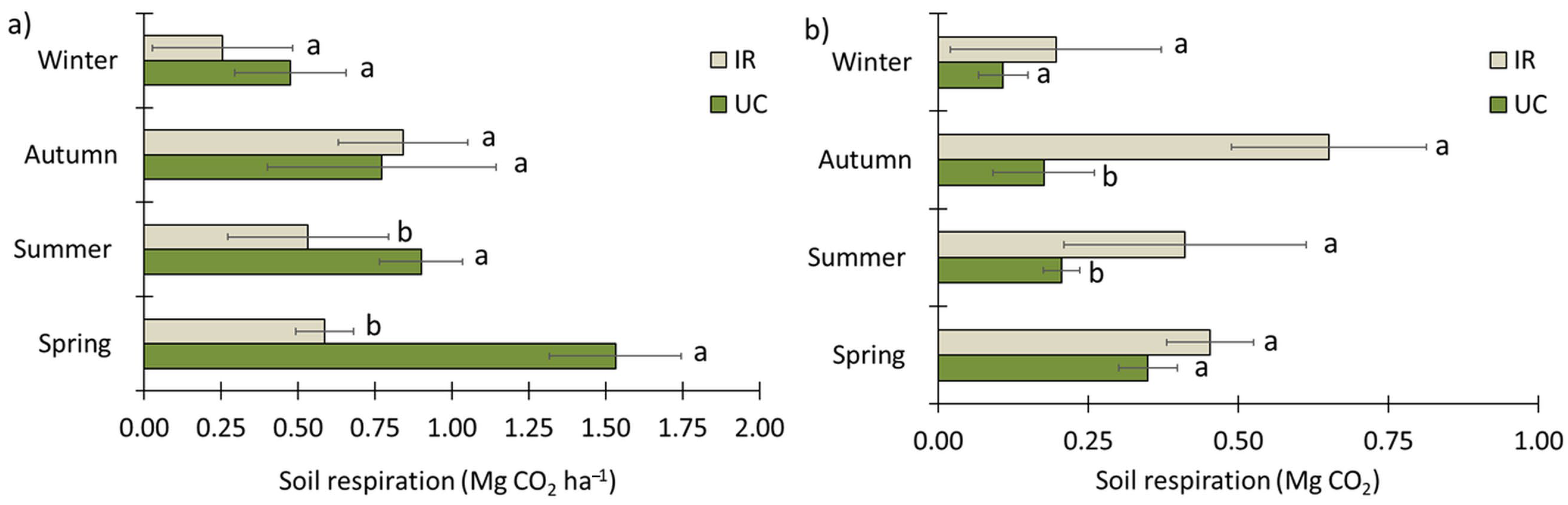
2 efflux (Rs), all available measurements for each season were used. Since the number of measurement days varied between seasons, seasonal totals were proportionally adjusted to account for the full length of each season. The measurement periods and number of days with data for each season are summarized in
Table 2. The full-year estimate was obtained by summing the seasonally adjusted contributions.
For each season (winter, spring, summer and autumn), we first calculated the mean daily Rs using all available measurement days within that season. This seasonal mean daily flux was then multiplied by the total number of days in the corresponding season (according to the calendar) to obtain the cumulative seasonal CO2 efflux. Annual soil respiration per hectare was finally estimated as the sum of the four seasonal fluxes.
For orchard-scale upscaling, the total surface was partitioned into two zones: UC and IR. Based on the tree spacing (11 m between rows and 9 m within rows) and average canopy area, the UC zone was estimated to cover 2278 m2 per hectare (≈23% of the orchard surface), while the remaining 7722 m2 (≈77%) were assigned to the IR zone. These proportions are consistent with the orchard layout and were visually checked using aerial imagery (orthophotos) of the grove. Annual CO2 fluxes at the orchard one hectare scale were then obtained by multiplying the mean Rs of each zone by its corresponding surface fraction and summing both contributions.
For the analyses of daily variability, diurnal dynamics, and correlations with environmental variables (soil temperature and soil water content), the complete dataset was used to maximize statistical power and enhance the detection of temporal patterns.
2.5. Data Analysis
Statistical analyses were conducted using R software (version 4.3.0; R Foundation for Statistical Computing, Vienna, Austria) using the following packages: stats for basic non-parametric tests, dunn.test and FSA for Dunn’s multiple comparisons, car for homogeneity of variance assessments, and ggplot2, ggpubr, and reshape2 for graphical data visualization. The normality of the data was assessed using the Shapiro–Wilk test for each group UC and IR and time period (day and night). The results indicated that the data did not follow a normal distribution in any case (p < 0.05), then non-parametric methods were applied. To evaluate differences in CO2 fluxes between seasons and zones (UC and IR), the Kruskal–Wallis test was used. When significant differences were detected, post hoc pairwise comparisons were performed using Dunn’s test with Bonferroni correction to identify specific group differences. In addition, Wilcoxon rank-sum tests and Welch’s t-tests were performed as complementary analyses to confirm the robustness of the results.
Cumulative CO2 emissions were quantified daily using the trapezoid rule, with differentiation by month and between seasons for all measurements.
Annual soil respiration per hectare (Mg CO2 ha−1 y−1) was obtained by integrating daily fluxes (μmol m−2 s−1) over time and scaling them by ground area; this conversion depends only on soil surface and measurement duration and therefore does not require any assumption about soil depth or bulk density. SOC stocks (Mg SOC ha−1) were calculated for the 0–30 cm soil layer as the product of SOC concentration, bulk density and layer thickness (top 30 cm), using mean bulk densities of 1.14 g cm−3 UC and 1.16 g cm−3 in the IR, as measured in the field.
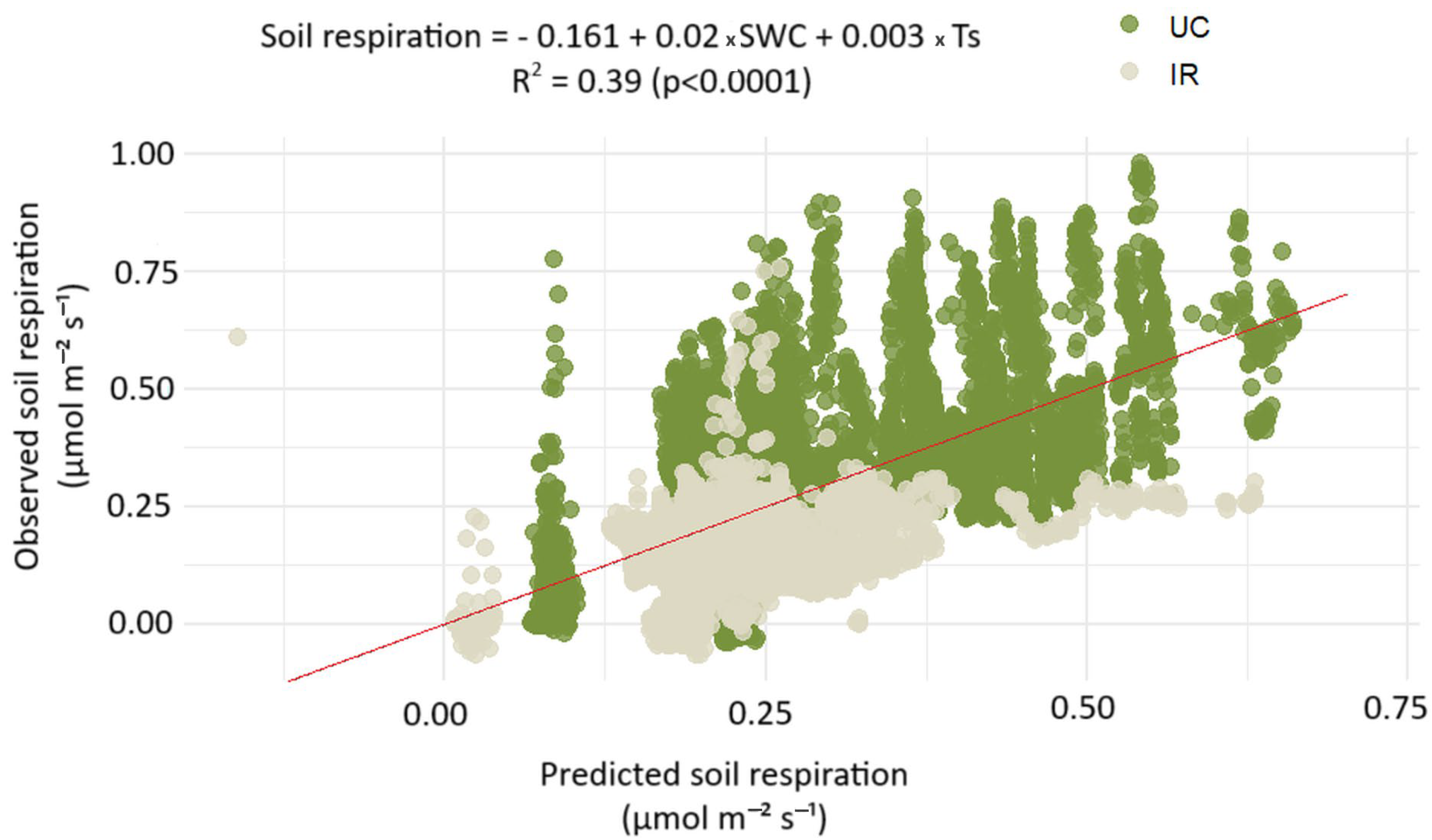
The potential impact of various predictive variables (such as temperature and humidity) on CO2 emissions was assessed using multiple regression, aiming to identify the variables with a significant effect. For this purpose, we used daily mean values of Rs, Ts and SWC for each measurement day, obtained by averaging all valid records over the 24 h period. This aggregation to the daily scale reduces the strong short-term autocorrelation that is typical of high-frequency chamber measurements. Model assumptions were examined through residual diagnostics, including inspection of residuals versus fitted values and time, as well as the Durbin–Watson statistic for temporal autocorrelation. These checks did not reveal strong serial dependence at the daily scale, supporting the use of a standard multiple linear regression model for descriptive purposes.
4. Discussion
4.1. Spatial Variability of Soil Respiration in a Traditional Rainfed Olive Grove
Our results show clear spatial heterogeneity in Rs between the UC and IR zones of a traditional rainfed olive grove. Such differentiation is in line with earlier studies indicating that contrasts in microenvironmental conditions and in annual carbon inputs, reflected in different SOC contents, can strongly regulate soil carbon dynamics [
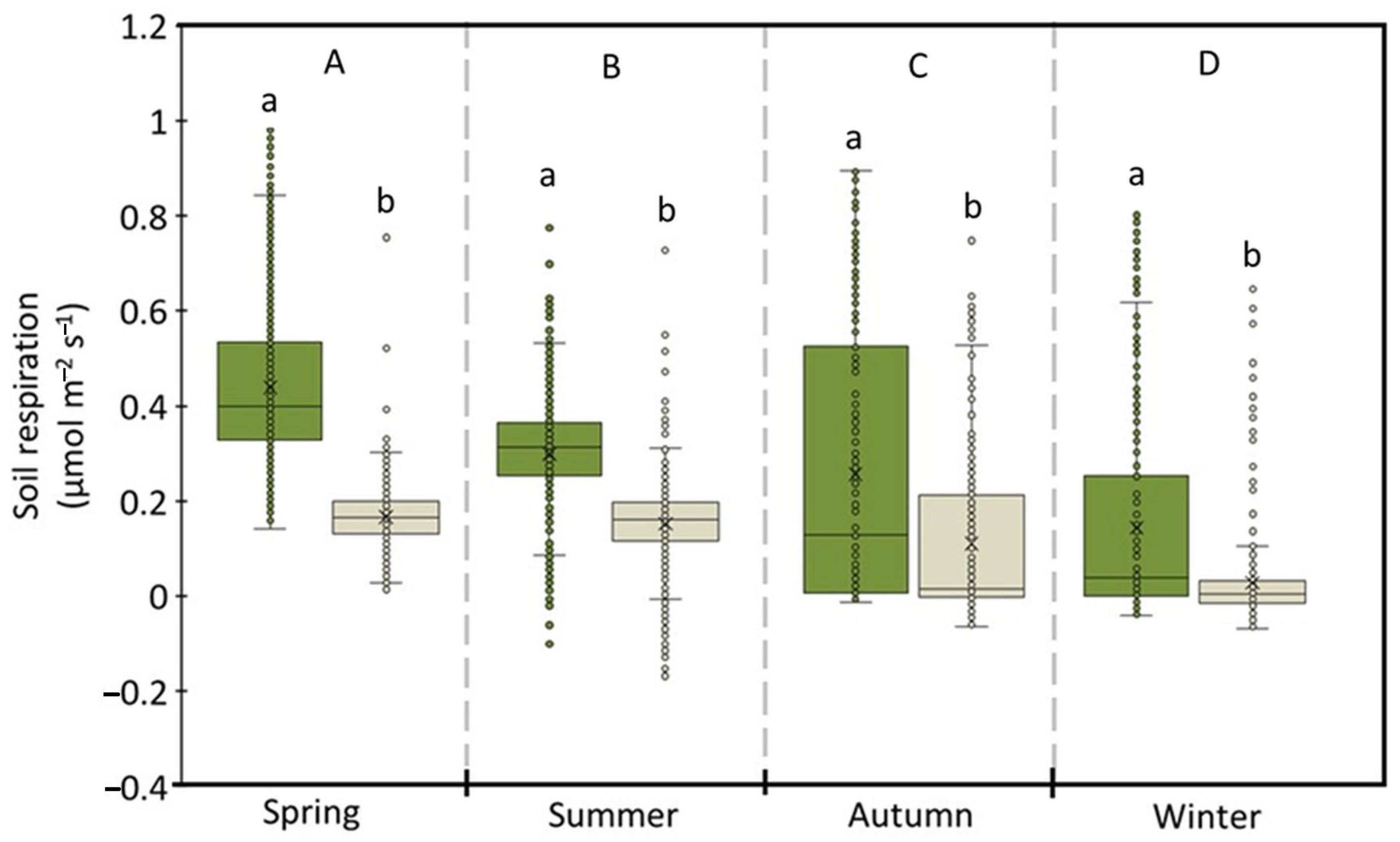
19]. In the present orchard, Rs in the UC zone was 66.5% higher per unit area than in the IR zone, suggesting that the greater accumulation of organic matter and the comparatively buffered conditions beneath the canopy enhance microbial activity and root respiration [
16]. Because our study did not include autotrophic–heterotrophic partitioning or a formal decomposition of environmental drivers, the mechanisms discussed below should be interpreted as plausible, literature-supported explanations rather than as quantitative attributions derived directly from our dataset.
The magnitude and direction of the UC–IR contrast agrees with Aranda-Barranco et al. [
12], who reported that UC respiration contributes substantially to total orchard Rs and that accounting for this spatial variability can increase annual soil-respiration budgets by 1.6–2.3 times compared with eddy-covariance estimates. Although the absolute values differ between sites, both studies highlight the dominant influence of canopy cover on Rs. This effect is closely linked to differences in SOC: in our study, SOC content under the canopy was 30.8% higher than in the IR soil. Several interacting factors likely explain this pattern. First, senescent olive leaves fall preferentially beneath trees, providing a concentrated annual carbon input; Domouso et al. [
24] estimated an average deposition of ~723 kg C ha
−1 y
−1 of olive leaf litter under the canopy. Together with rhizodeposited carbon from olive roots, this promotes SOC accumulation in UC. By contrast, the IR zone receives limited organic inputs because weeds are largely suppressed by pre- and post-emergence herbicides, reducing regular carbon additions to soil. Finally, the absence of cover in IR also favors surface soil loss, which can further deplete SOC. These combined processes offer a coherent explanation for both higher SOC and higher CO
2 emissions in the UC zone.
It is important to note that SOC is a long-term integrative state variable that responds to processes operating over years to decades, whereas the Rs measurements presented here reflect short-term CO2 fluxes observed over a single hydrological year. Consequently, the SOC values reported in this study represent a static snapshot at the time of sampling and cannot be interpreted as temporal responses to the one-year Rs record. The differences in SOC between UC and IR therefore reflect structural soil properties and long-term management effects, rather than short-term biogeochemical feedbacks. Multi-year monitoring would be required to quantify whether Rs dynamics contribute measurably to SOC changes over longer timescales.
Mechanistic evidence from other systems supports this interpretation. Manipulative experiments altering litter and root inputs show that changes in the amount and quality of plant detritus can restructure soil bacterial and fungal communities and their decomposition-related functional traits, leading to substantial shifts in CO
2 production [
25]. Field studies likewise demonstrate that litter inputs affect not only Rs magnitude but also its temperature sensitivity through their control of labile-carbon availability and microbial responses [
26]. In semiarid Mediterranean agroecosystems, management that increases organic matter inputs and soil moisture tends to enhance microbial biomass and activity [
27]. Taken together, these findings reinforce the view that spatial contrasts in organic inputs, microbial activity, and management-driven soil properties underpin the strong UC–IR heterogeneity observed here.
Comparable UC–IR patterns have been reported in other Mediterranean agroecosystems. Montanaro et al. [
11] showed that vegetation cover and localized soil management strongly influence CO
2 emissions, especially in shaded areas that retain more moisture. By comparing sustainable (cover crops, compost) and conventional management across irrigated and rainfed groves, they found that the interaction between soil temperature and water availability is a major control on Rs, with moisture limiting Rs below critical thresholds and high temperatures (≈20 °C and above) potentially suppressing Rs even when moisture is adequate. In our orchard, the greater soil water content and organic-carbon availability in UC likely sustain higher biological activity through dry periods, consistent with previous work in similar environments [
14].
4.2. Seasonal Dynamics and Microclimatic Control of Soil Respiration
Seasonal variations in Rs reflect the strong influence of the Mediterranean climate, characterized by wet winters and hot, dry summers. In our study, the highest Rs rates occurred in spring (0.46 μmol CO
2 m
−2 s
−1), and the lowest in winter (0.08 μmol m
−2 s
−1), demonstrating marked sensitivity to seasonal change. This pattern is consistent with findings by Yao et al. [
15], who identified soil water availability as the primary global driver of Rs variability, especially in arid and semi-arid regions.
To understand the drivers of this variation, we applied a multiple linear regression model using Ts and SWC as predictors. The model showed that both variables positively influenced CO
2 emissions, with greater sensitivity to soil moisture. Specifically, a 1% increase in SWC raised Rs by 0.0201 μmol m
−2 s
−1, compared to just 0.0029 μmol m
−2 s
−1 per 1 °C increase in Ts. This stronger influence of soil moisture over temperature corroborates observations from semi-arid ecosystems [
14,
28,
29], reinforcing the notion that soil water content acts as a primary limiting factor for respiration.
Spatially, within the orchard, IR zones, exposed to direct solar radiation, had higher soil temperatures (mean summer Ts ≈ 35.85 °C) but lower Rs rates than UC zones (mean summer Ts ≈ 28.01 °C), where canopy cover created a cooler, moister microclimate. Despite the high-temperature potential in IR, the low moisture restricted microbial activity during summer. This aligns with Davidson and Janssens [
8], who warn that water stress can inhibit soil respiration even under favorable temperatures Similarly, Montes et al. [
30] reported in Chaparral Shrublands that soil water content exerted a strong and significant influence on Rs throughout the year, whereas soil temperature was a significant control only when soils were moist and temperatures were below 20 °C. Additionally, Wang et al. [
31] and Chen et al. [
32] have shown that the temperature response of respiration is largely contingent on water availability and soil properties, particularly in semi-arid ecosystems.
These seasonal and spatial differences in temperature and moisture likely influenced the observed patterns of soil respiration. The relationship between Rs, Ts and SWC is not strictly linear but rather context-dependent. Under wet and cool winter conditions, low soil temperature can limit microbial and root activity, leading to reduced Rs. Conversely, during dry summer periods, low SWC becomes the dominant constraint, suppressing CO
2 efflux despite high temperatures. These opposing seasonal effects highlight the interactive and non-linear nature of temperature and moisture controls on Rs in Mediterranean environments. The adjusted R
2 of 0.39 indicates moderate explanatory power, which is expected given the complexity of biogeochemical processes involved and the influence of additional, unmeasured drivers. It is important to note that the purpose of this statistical model was not to derive a mechanistic temperature response function, but rather to evaluate the relative contribution of Ts and SWC under Mediterranean conditions, where water limitation often suppresses the exponential behaviour typically observed in Rs temperature relationships. Nevertheless, the high statistical significance of the coefficients and their agreement with field observations support the usefulness of this simple model as a descriptive tool to quantify the relative influence of soil moisture and temperature on Rs in Mediterranean agro-ecosystems. These findings are particularly relevant in the context of climate change scenarios projecting intensified and more frequent dry periods in the Mediterranean basin, with significant impacts on ecological and biogeochemical processes [
33]. Understanding the interactions among moisture, temperature, and canopy structure is therefore crucial for anticipating carbon flux changes and designing adaptive management strategies that enhance the resilience of these vulnerable systems.
Together, our results support the view that soil moisture is the main limiting factor for edaphic respiration in this agricultural system, and that its interaction with temperature, modulated by microclimatic conditions such as shading or differential evaporation, governs both seasonal dynamics and spatial differences in CO2 emissions. Ignoring these nuances would oversimplify the system and could compromise the efficacy of models or management practices aimed at climate mitigation.
4.3. Diurnal/Nocturnal Dynamics and CO2 Concentration
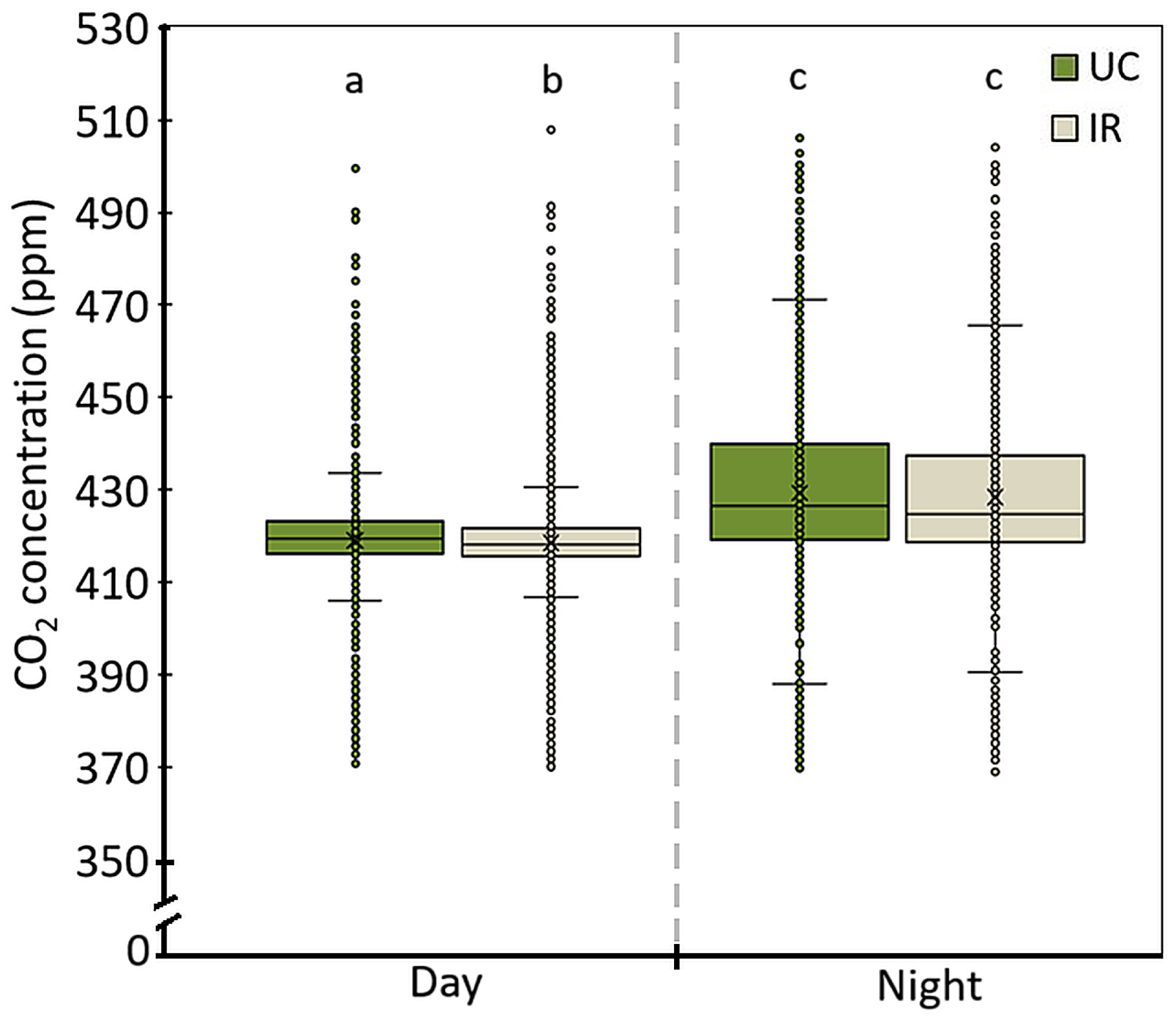
CO
2 concentrations were consistently higher at night in both UC and IR zones, indicating accumulation due to reduced vertical diffusion under thermal inversion conditions. During the day, differences between UC and IR were more pronounced, reflecting direct responses to solar radiation and soil temperature. This pattern is consistent with [
20], who showed that certain atmospheric circumstances in arid or semi-arid ecosystems, marked by thermal inversion or nocturnal accumulation, promote elevated soil CO
2 concentrations and alter respiration fluxes, even where soil heterogeneity is high.
4.4. Implications for Managing Traditional Olive Groves
Our findings emphasize the need to explicitly consider microenvironmental heterogeneity when designing sustainable management strategies in traditional olive groves. The marked differences observed between UC and IR zones, in terms of soil respiration, carbon content, and dynamics, indicate that these areas are functionally distinct and that differentiated management could yield complementary benefits.
UC zones, characterized by higher biological activity, greater relative humidity, and fresh organic input, function as hubs of active mineralization. This intense respiration may facilitate nutrient release and enhance local soil fertility and tree development.
On the other hand, IR zones, though respiring less, harbor lower SOC stocks. If tillage is minimized and spontaneous cover crops together with organic are implemented, these zones could become important long-term carbon sinks. Various studies have shown that establishing spontaneous cover reduces erosion, improves water infiltration, and encourages carbon accumulation in less labile forms [
34,
35,
36].
Such a differentiated approach allows optimization of complementary soil functions within the same agricultural system: nutrient recycling and edaphic dynamism in UC, and persistent carbon storage in IR. Furthermore, the high spatial variability recorded in this study suggests that sampling and monitoring practices must adapt to this orchard structural heterogeneity. Aggregated measurements at the orchard scale can mask key processes and produce erroneous carbon-balance estimates, as noted by Stoyan et al. [
37]. Stratified sampling by functional zones (UC vs. IR) can significantly improve the precision of emission models and carbon inventories in agroecosystems.
4.5. Limitations and Future Research
This study has several limitations that should be considered when interpreting the results. First, measurements were carried out in a single commercial olive grove using four automated chambers (two per zone), which represents an important limitation in terms of spatial replication. Although the chambers were installed in representative plots, this limited spatial replication may not encompass the full variability of soil properties, topography and management existing within traditional olive-growing areas. Second, the temporal coverage comprised 123 non-continuous days distributed across all seasons. The seasonal and annual cumulative fluxes therefore rely on the assumption that the sampled days are representative of the corresponding periods, and that the 2024–2025 hydrological year is broadly typical for the region. Extreme events or short-lived “hot moments” of CO2 efflux may have been under-represented.
Third, the upscaling of chamber measurements to seasonal and annual balances and to the hectare scale involves uncertainties related to both temporal interpolation and the partitioning of the orchard into under-canopy and inter-row surface fractions. While these assumptions are consistent with the structural design of the orchard, we did not propagate these uncertainties formally and the reported annual values should therefore be interpreted as first-order estimates. Fourth, the multiple regression model including soil temperature and soil water content explained a moderate fraction of the variance in Rs. Other unmeasured drivers, such as root phenology, substrate availability, soil structure or microbial community composition, may also contribute to the observed dynamics. In addition, environmental covariates were monitored at a single depth and location, and we did not separate autotrophic and heterotrophic components of respiration.
Future research should address these limitations by increasing spatial replication across orchards with contrasting soils, climates and management practices, and by extending the monitoring period to multi-year, fully continuous records. Combining automated chambers with eddy-covariance or other plot-scale approaches would help to evaluate scaling assumptions and to close the carbon budget at larger scales. Experimental designs that explicitly partition root and microbial respiration, and that include additional biotic and abiotic predictors, would improve process understanding and model performance. Finally, integrating soil respiration measurements with trials of cover crops, reduced tillage and organic amendments would allow a direct assessment of how alternative management options affect both carbon stocks and CO2 efflux in traditional Mediterranean olive groves.
5. Conclusions
This study provides a detailed assessment of Rs in a traditional rainfed Mediterranean olive grove, integrating high-frequency automated measurements with a microsite-based approach that distinguishes between UC and IR zones.
Our findings reveal strong spatial and seasonal heterogeneity in Rs. On a per-area basis, UC exhibited substantially higher annual Rs (3.68 Mg CO2 ha−1 y−1) than IR (2.21 Mg CO2 ha−1 y−1), reflecting the influence of microclimatic and substrate conditions beneath the canopy. However, when scaled to the orchard surface, the larger area under IR resulted in a higher overall CO2 contribution, emphasizing the importance of accounting for internal structural heterogeneity when estimating carbon budgets.
Seasonal patterns showed maximum Rs in spring and minimum in winter, with soil moisture exerting a stronger influence than temperature on CO2 efflux. This pattern supports the interpretation that water availability is the primary limiting factor for Rs in semi-arid Mediterranean systems, particularly during dry and hot periods.
These results highlight the relevance of explicitly considering microsite heterogeneity when quantifying soil atmosphere CO2 exchange and designing sustainable management strategies. Practices that enhance moisture retention and organic matter inputs, such as maintaining or establishing cover crops and minimizing tillage, could strengthen the role of IR zones in reducing CO2 losses at the field scale, while UC areas remain essential hotspots for nutrient cycling and biologically active carbon processes. Overall, this microsite-explicit approach provides a useful basis for improving carbon-balance assessments and guiding management decisions under Mediterranean conditions.



 ,
,