Rapamycin Modulates the Polarisation of CD4+ T Cells Towards TH1 Cells in Patients with Active Granulomatosis with Polyangiitis and Microscopic Polyangiitis


Abstract
1. Introduction
2. Materials and Methods
2.1. Patients
2.2. Clinical Data at Blood Sampling (at Diagnosis)
2.3. Definition of Active AAV
2.4. PBMC Isolation and Storage (at Diagnosis)
2.5. PBMC Culture and Rapamycin Treatment
2.6. Fluorescence-Activated Cell Sorting (FACS)
2.7. Statistical Analyses
3. Results
3.1. Patients’ Characteristics and Comparison Between Patients with Active Disease and Those with Inactive Disease
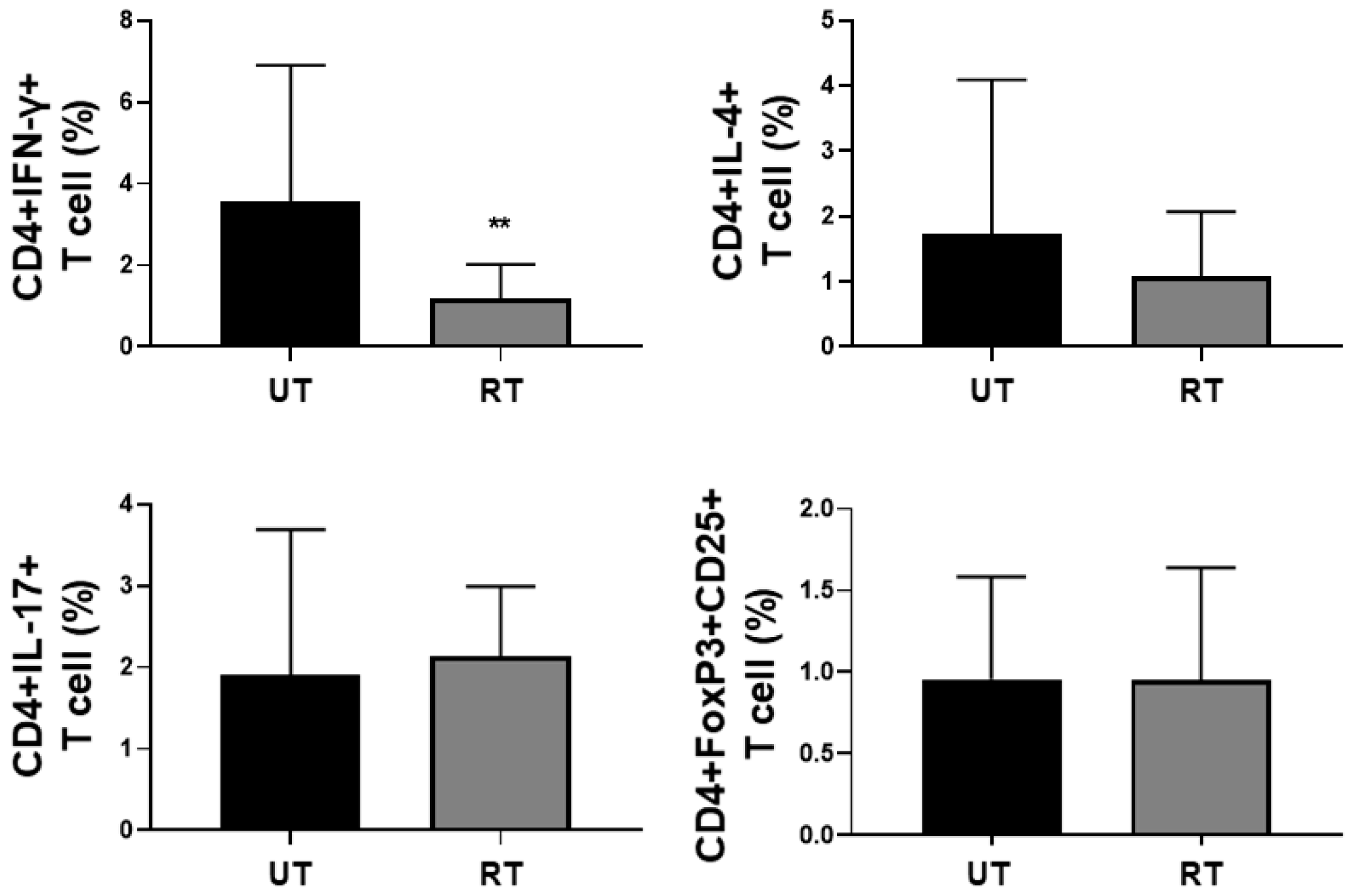
3.2. Comparison of the Populations of T Cell Subsets According to Rapamycin Treatment
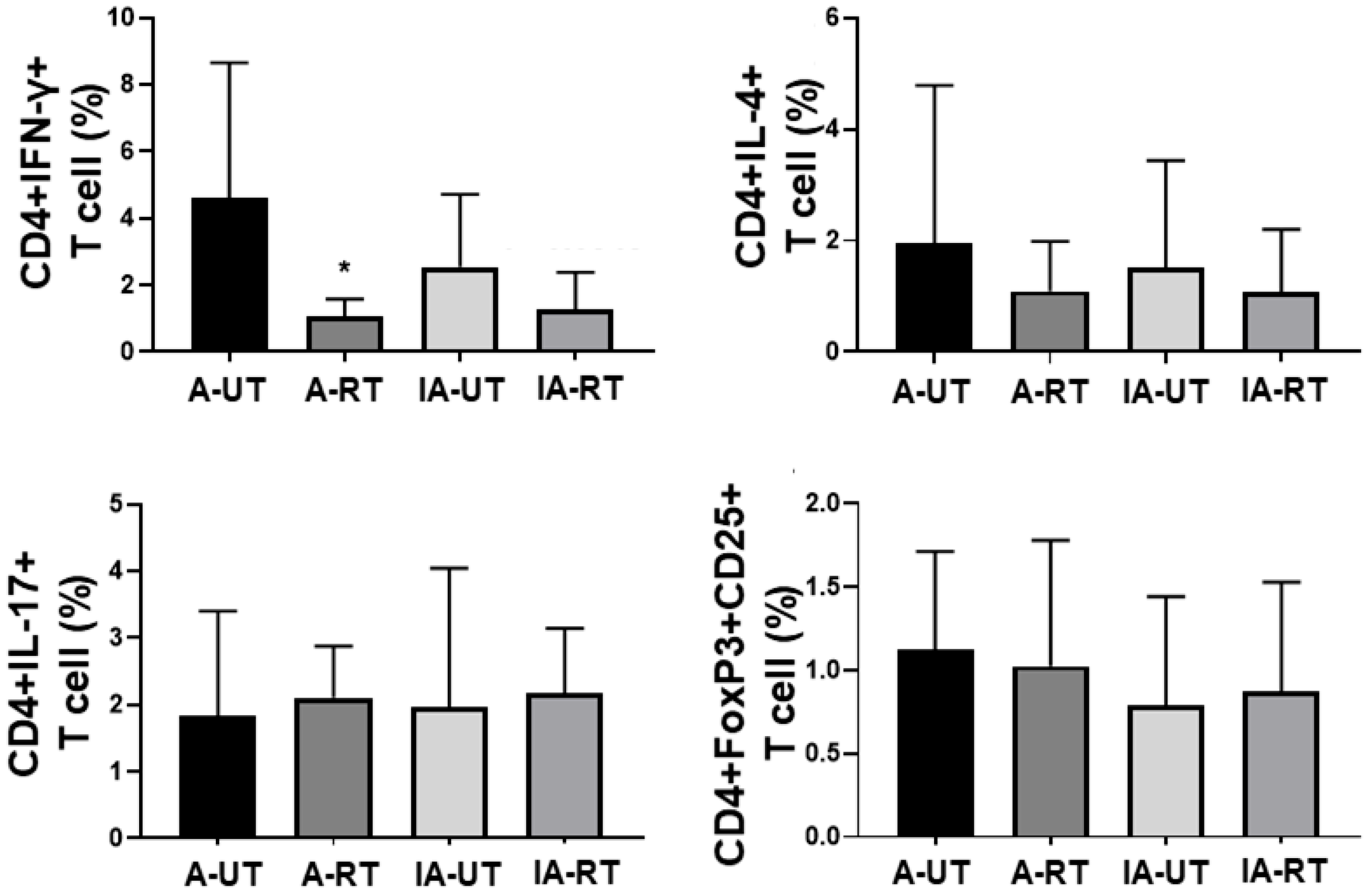
3.3. Comparison of the Populations of T Cell Subsets According to Rapamycin Treatment and GPA/MPA Activity
4. Discussion
5. Conclusions
Supplementary Materials
Author Contributions
Funding
Institutional Review Board Statement
Informed Consent Statement
Data Availability Statement
Conflicts of Interest
References
- Powell, J.D.; Delgoffe, G.M. The mammalian target of rapamycin: Linking T cell differentiation, function, and metabolism. Immunity 2010, 33, 301–311. [Google Scholar] [CrossRef] [PubMed]
- Chi, H. Regulation and function of mTOR signalling in T cell fate decisions. Nat. Rev. Immunol. 2012, 12, 325–338. [Google Scholar] [CrossRef] [PubMed]
- Jennette, J.C.; Falk, R.J.; Bacon, P.A.; Basu, N.; Cid, M.C.; Ferrario, F.; Flores-Suarez, L.F.; Gross, W.L.; Guillevin, L.; Hagen, E.C.; et al. 2012 revised International Chapel Hill Consensus Conference Nomenclature of Vasculitides. Arthritis Rheum. 2013, 65, 1–11. [Google Scholar] [CrossRef] [PubMed]
- Lamprecht, P. Off balance: T-cells in antineutrophil cytoplasmic antibody (ANCA)-associated vasculitides. Clin. Exp. Immunol. 2005, 141, 201–210. [Google Scholar] [CrossRef] [PubMed]
- Abdulahad, W.H.; Lamprecht, P.; Kallenberg, C.G. T-helper cells as new players in ANCA-associated vasculitides. Arthritis Res. Ther. 2011, 13, 236. [Google Scholar] [CrossRef] [PubMed]
- Yoon, T.; Ahn, S.S.; Ko, E.; Song, J.J.; Park, Y.B.; Lee, S.W. IL-6 Receptor Expression on the Surface of T Cells and Serum Soluble IL-6 Receptor Levels in Patients with Microscopic Polyangiitis and Granulomatosis with Polyangiitis. J. Clin. Med. 2023, 12, 7059. [Google Scholar] [CrossRef] [PubMed]
- Watts, R.; Lane, S.; Hanslik, T.; Hauser, T.; Hellmich, B.; Koldingsnes, W.; Mahr, A.; Segelmark, M.; Cohen-Tervaert, J.W.; Scott, D. Development and validation of a consensus methodology for the classification of the ANCA-associated vasculitides and polyarteritis nodosa for epidemiological studies. Ann. Rheum. Dis. 2007, 66, 222–227. [Google Scholar] [CrossRef] [PubMed]
- Robson, J.C.; Grayson, P.C.; Ponte, C.; Suppiah, R.; Craven, A.; Judge, A.; Khalid, S.; Hutchings, A.; Watts, R.A.; Merkel, P.A.; et al. 2022 American College of Rheumatology/European Alliance of Associations for Rheumatology classification criteria for granulomatosis with polyangiitis. Ann. Rheum. Dis. 2022, 81, 315–320. [Google Scholar] [CrossRef] [PubMed]
- Suppiah, R.; Robson, J.C.; Grayson, P.C.; Ponte, C.; Craven, A.; Khalid, S.; Judge, A.; Hutchings, A.; Merkel, P.A.; Luqmani, R.A.; et al. 2022 American College of Rheumatology/European Alliance of Associations for Rheumatology classification criteria for microscopic polyangiitis. Ann. Rheum. Dis. 2022, 81, 321–326. [Google Scholar] [CrossRef] [PubMed]
- Mukhtyar, C.; Lee, R.; Brown, D.; Carruthers, D.; Dasgupta, B.; Dubey, S.; Flossmann, O.; Hall, C.; Hollywood, J.; Jayne, D.; et al. Modification and validation of the Birmingham Vasculitis Activity Score (version 3). Ann. Rheum. Dis. 2009, 68, 1827–1832. [Google Scholar] [CrossRef] [PubMed]
- Han, C.W.; Lee, E.J.; Iwaya, T.; Kataoka, H.; Kohzuki, M. Development of the Korean version of Short-Form 36-Item Health Survey: Health related QOL of healthy elderly people and elderly patients in Korea. Tohoku J. Exp. Med. 2004, 203, 189–194. [Google Scholar] [CrossRef] [PubMed]
- Hester, J.; Schiopu, A.; Nadig, S.N.; Wood, K.J. Low-dose rapamycin treatment increases the ability of human regulatory T cells to inhibit transplant arteriosclerosis in vivo. Am. J. Transplant. 2012, 12, 2008–2016. [Google Scholar] [CrossRef] [PubMed]
- Luo, Y.; Guo, J.; Zhang, P.; Cheuk, Y.C.; Jiang, Y.; Wang, J.; Xu, S.; Rong, R. Mesenchymal Stem Cell Protects Injured Renal Tubular Epithelial Cells by Regulating mTOR-Mediated Th17/Treg Axis. Front. Immunol. 2021, 12, 684197. [Google Scholar] [CrossRef] [PubMed]
- Han, S.; Georgiev, P.; Ringel, A.E.; Sharpe, A.H.; Haigis, M.C. Age-associated remodeling of T cell immunity and metabolism. Cell Metab. 2023, 35, 36–55. [Google Scholar] [CrossRef] [PubMed]


| Variables | Total Patients (N = 20) | Active Patients (N = 10) | Inactive Patients (N = 10) | p-Values |
|---|---|---|---|---|
| Demographic data | ||||
| Age (years) | 65.5 (50.8–71.0) | 71.0 (59.8–75.5) | 57.5 (43.3–68.3) | 0.023 |
| Female sex (N, (%)) | 10 (50.0) | 5 (50.0) | 5 (50.0) | 1.000 |
| AAV subtype (N, (%)) | ||||
| MPA | 16 (80.0) | 10 (100.0) | 6 (60.0) | 0.087 |
| GPA | 4 (20.0) | 0 (0) | 4 (40.0) | |
| ANCA type and positivity (N, (%)) | ||||
| MPO-ANCA (or P-ANCA) | 17 (85.0) | 10 (100.0) | 7 (70.0) | 0.211 |
| PR3-ANCA (or C-ANCA) | 3 (15.0) | 1 (10.0) | 2 (20.0) | 1.000 |
| AAV-specific indices | ||||
| BVAS | 8.0 (4.0–14.8) | 14.5 (13.5–16.5) | 4.0 (2.75–4.25) | <0.001 |
| SF-36 PCS | 52.5 (24.3–67.0) | 51.4 (12.2–66.1) | 55.6 (38.7–71.2) | 0.315 |
| SF-36 MCS | 49.3 (42.3–62.3) | 46.9 (40.7–66.3) | 55.6 (40.7–61.0) | 0.739 |
| Laboratory results | ||||
| White blood cell count (/mm3) | 7545.0 (6990.0–10,857.5) | 9085.0 (7265.0–13,500.0) | 7230.0 (6550.0–9230.0) | 0.075 |
| Neutrophil count (/mm3) | 5570.0 (4440.0–8912.5) | 6430.0 (4912.5–10,807.5) | 4960.0 (3622.5–6532.5) | 0.075 |
| Serum creatinine (mg/dL) | 1.1 (0.7–1.8) | 1.7 (1.3–2.9) | 0.7 (0.7–1.0) | <0.001 |
| ESR (mm/hr) | 68.0 (16.0–105.5) | 74.0 (41.8–110.3) | 32.0 (11.0–84.8) | 0.247 |
| CRP (mg/L) | 11.0 (1.4–65.6) | 25.7 (6.7–97.4) | 1.8 (1.2–20.1) | 0.105 |
Disclaimer/Publisher’s Note: The statements, opinions and data contained in all publications are solely those of the individual author(s) and contributor(s) and not of MDPI and/or the editor(s). MDPI and/or the editor(s) disclaim responsibility for any injury to people or property resulting from any ideas, methods, instructions or products referred to in the content. |
© 2025 by the authors. Licensee MDPI, Basel, Switzerland. This article is an open access article distributed under the terms and conditions of the Creative Commons Attribution (CC BY) license (https://creativecommons.org/licenses/by/4.0/).
Share and Cite
Ha, J.W.; Yoon, T.; Kwon, O.C.; Park, Y.-B.; Lee, S.-W. Rapamycin Modulates the Polarisation of CD4+ T Cells Towards TH1 Cells in Patients with Active Granulomatosis with Polyangiitis and Microscopic Polyangiitis. J. Clin. Med. 2025, 14, 8720. https://doi.org/10.3390/jcm14248720
Ha JW, Yoon T, Kwon OC, Park Y-B, Lee S-W. Rapamycin Modulates the Polarisation of CD4+ T Cells Towards TH1 Cells in Patients with Active Granulomatosis with Polyangiitis and Microscopic Polyangiitis. Journal of Clinical Medicine. 2025; 14(24):8720. https://doi.org/10.3390/jcm14248720
Chicago/Turabian StyleHa, Jang Woo, Taejun Yoon, Oh Chan Kwon, Yong-Beom Park, and Sang-Won Lee. 2025. "Rapamycin Modulates the Polarisation of CD4+ T Cells Towards TH1 Cells in Patients with Active Granulomatosis with Polyangiitis and Microscopic Polyangiitis" Journal of Clinical Medicine 14, no. 24: 8720. https://doi.org/10.3390/jcm14248720
APA StyleHa, J. W., Yoon, T., Kwon, O. C., Park, Y.-B., & Lee, S.-W. (2025). Rapamycin Modulates the Polarisation of CD4+ T Cells Towards TH1 Cells in Patients with Active Granulomatosis with Polyangiitis and Microscopic Polyangiitis. Journal of Clinical Medicine, 14(24), 8720. https://doi.org/10.3390/jcm14248720